Archive for the ‘Islamic State’ category

Europe Still Sleeps, and Europeans Still Die

March 30, 2016

Europe Still Sleeps, and Europeans Still Die, Front Page MagazineBruce Thornton, March 30, 2016

bt

While England Slept is the title of Winston Churchill’s 1938 book documenting the failure of England to counter Germany’s rearmament. Despite the gruesome price paid for ignoring Churchill’s warnings, postwar Europe has slumbered for decades while its cultural dysfunctions have nurtured the jihadist violence erupting across Europe. Last week’s attacks in Brussels, coming four months after the Paris attacks that killed 130, suggests there are more attacks to come. According to AP, 400-600 ISIS-trained terrorists are making their way to Europe.

Europe can’t say it wasn’t warned. In 2002 Oriana Fallaci published The Rage and the Pride, a passionate defense of Western civilization and an indictment of those who appease Islamic illiberalism.  Ten years ago Bruce Bawer’s While Europe Slept gave first-hand reports of Europe’s feckless immigration policies that fostered and appeased Muslim radicalism and violence. A year later Claire Berlinski’s Menace in Europe and Melanie Phillips’ Londonistan sounded the same alarms. And there are the dystopian novels of Michel Houellebecq like Platform and last year’s Submission, which link Europe’s cultural and spiritual exhaustion to the rise of homegrown jihadism and Islamization.

An even more important prophet is Bat Ye’or, whose Eurabia (2005) documented “Europe’s evolution from a Judeo-Christian civilization, with important post-Enlightenment secular elements, into a post-Judeo-Christian civilization that is subservient to the ideology of jihad and the Islamic powers that propagate it.” The result is the dhimmi mentality of Europe’s elites, which manifests in word and deed Western inferiority to Islam, and guilt over alleged crimes against the Muslim world.

But a secularized Europe committed to multicultural fantasies and la dolce vita as the highest goods has dismissed these prophets as bigots and “Islamophobes” who distort the “religion of peace.” Yet after the collapse of the Ottoman caliphate in 1923––the “catastrophe” Osama bin Laden mentioned after 9/11–– the theorists of modern jihadism were forthright and plain in expressing the intolerant and triumphalist Islamic beliefs and jihadist imperative consistent with Ye’or’s analysis. Islam’s nature, Muslim Brotherhood founder Hassan al-Banna wrote, is “to dominate, not to be dominated, to impose its laws on all nations, and extend its power to the entire planet.” Fellow Muslim Brother Sayyid Qutb concurred: “Islam has a right to remove all those obstacles which are in its path.” The Ayatollah Khomeini, leader of the Iranian Revolution, agreed: “The great prophet of Islam carried in one hand the Koran and in the other a sword; the sword is for crushing the traitor and the Koran for guidance . . . Islam is a religion of blood for infidels but a religion of guidance for other people.”

Nor are these sentiments alien to traditional Islamic beliefs as codified in the Koran, Hadith, Muslim histories, and the biographies of Mohammed. As such, the jihadist imperative, despite anticolonial and nationalist rhetoric, was the foundational motivation for the military attacks on Israel in 1948, 1967, and 1973, and today it still drives the terror campaigns against Israel waged by Hamas, Hezbollah, and the PLO. Jihad in the name of Allah sparked the Iranian Revolution of 1979, and the subsequent launching of the Iranian terrorist mother ship from which numerous jihadist organizations have continued to receive training and financial support. The Taliban who gave sanctuary to al Qaeda in Afghanistan are close students of jihad and shari’a law, executing transgressors in a soccer stadium paid for by the EU.

Nor has the West been spared. Jihad lay at the heart of al Qaeda’s serial attacks on the U.S. and its military in 1993 (first World Trade Center bombing), 1996 (Khobar Towers), 1998 (East African embassies), 2000 (U.S.S. Cole), and the spectacular carnage of September 11, 2001, as well as inspiring the terrorist murders in Madrid (2004), London (2005), Fort Hood (2013), Boston (2013), San Bernardino (2015), Paris (January and November, 2015), and now Brussels. And don’t forget the torture, rape, and murders perpetrated by ISIS, the latest and most successful example of modern jihadism inspired by traditional Islamic doctrine.

We know the terrorists’ Islamic bona fides because they continually tell us why they want to kill us, in speeches, internet videos, and writings filled with Koranic verses and precedents from the life of Mohammed. Yet despite this evidence, elites in Europe and the U.S. refuse to confront the religious origins of jihadism, settling for the stale environmental and psychological causes dear to the materialist mentality. Thus they continue to chant the “nothing to do with Islam” mantra, as our president did in response to the Brussels attack. “ISIL is not ‘Islamic,’” the president asserted. “No religion condones the killing of innocents, and the vast majority of ISIL’s victims have been Muslim.” The first two clauses are patently false to Koranic commands and Islamic history, and the third is a non sequitur.

But the most powerful refutation of this common delusion is the scarcity of public protests by observant Muslims against the “extremists” who allegedly have “hijacked” their faith. After each jihadist atrocity there is typically more celebratory ululation and cries of “Allahu Akbar” in the Muslim world than marches against terrorism by heretical “extremists.” There are no “million Muslim marches,” no “not in our name movements,” no large scale Muslim attendance at memorial services for the victims. Yet perceived insults to Islam or Mohammed will produce violent mobs and lethal rampages.

Nor should this surprise us, when poll after poll registers significant pluralities and majorities of Muslims who approve of violence against infidels, and support the implementation of illiberal shari’a law. The latest evidence for such support from “moderate Muslims” comes from Brussels, where the planner of the Paris and Brussels attacks, Salah Abdeslam, was hiding in plain sight in the Muslim-dominant district of Molenbeek. Yet it still took four months for Belgian police to find him, and when they moved in for the arrest, they were met with rocks and bottles from residents who knew he was there and never tipped off the authorities.

Yet this is just one of many such enclaves in Europe. Ca n’Anglada in Barcelona, Marxloh and Neukölln in Germany, Seine-Saint-Denis and Clichy-sous-Bois in France, Malmo in Sweden, and many other towns and neighborhoods across Europe house disaffected and unassimilated Muslim immigrants whose faith predisposes them to contempt for the infidel and his secular laws, and justifies violence against the enemies of Islam. And despite the segregation, unemployment, crime, costly welfare transfers, and jihad-preaching mosques in these neighborhoods, Europe has accepted hundreds of thousands more Muslim immigrants in 2015 alone. Undoubtedly among them are untold numbers of ISIS-trained terrorists, many of them from the 5000 European Muslims who have gone to fight for ISIS in Iraq and Syria.

That is the reality everyone knows who wants to know. But too many in the West do not want to know, just as those enamored of Soviet communism did not want to know about the gulags and show-trials and engineered famines that killed at least 20 million. Like yesterday’s communist sympathizers, today the sleepwalkers of Europe are trapped in their ideological fever-dreams––fashionable self-loathing, guilt for colonialism and imperialism, sentimental one-worldism, and noble-savage multicultural fantasies. Worst of all, they are crippled by a refusal to appreciate and defend their political and cultural inheritance––prosperity, human rights, freedom, consensual government, and tolerance––created by their ancestors.

The character of Michel in Houellebecq’s Platform (2001) articulates the failure of civilizational nerve that has paved the way for metastasizing jihadist violence. Europe’s forbears, the jaded hedonist Michel muses, “believed in the superiority of their civilization,” and “invented dreams, progress, utopia, the future.” But their “civilizing mission,” their “innocent sense of their natural right to dominate the world and direct the path of history had disappeared.” All that is left is the dwindling cultural capital being squandered by their descendants, who have lost “those qualities of intelligence and determination,” and who exist only for the present and its material pleasures. Like like Michel, they are “decadent” and “given over entirely to selfishness.”

But at least Michel, unlike the sleepwalking European elite, recognizes that this is cultural suicide: “I was aware, however, that such a situation was barely tenable, that people like me were incapable of ensuring the survival of a society. Perhaps, more simply, we were unworthy of life.”

The terrorists of Paris and Brussels agree.

Turkish Gov’t Children’s Magazine Promotes Martyrdom

March 30, 2016

Turkish Gov’t Children’s Magazine Promot, Clarion Project, March 30, 2016

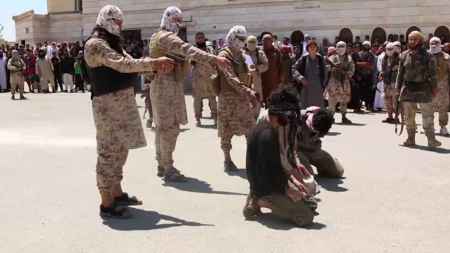
Islamic-State-Afghan-School-IP_1Illustrative Photo: An Islamic State school for children in Afghanistan. (Video screenshot)

A cartoon published by the Turkish Ministry of Religious Affairs shows a father extolling the virtues of Islamic martyrdom to his son.

The issue of the children’s magazine is meant to promote dialogue between parents and children. In the cartoon, a father asks his son, “Do you want to be a martyr?” The son replies, “Of course I want to be a martyr. Who doesn’t want to go to heaven?”

The son then explains that “heaven is happy with martyrs” and that much praise is heaped upon the martyr making him wish that he could have been martyred 10 times.  The cartoon ends with the son saying, “I wish I could be killed as martyr.”

According to the Turkish news outlet Cumhuriyet, the magazine has met harsh criticism. Psychologist and Professor Dr. Serdar Degirmencioglu, a critic of Turkey’s Islamist President Recep Tayyip Erdogan commented, “Religiosity has, in recent years, turned into a literal political tool. They do not even hide it. The Ministry of Religion was provided more money than several other ministries combined and continues intensive work for religious children.”

He added, “They want to use the drawings to transfer the message of martyrdom to children because they think it will be more attractive. ‘Martyrs suffer,’ ‘sins forgiven’ it says. So it’s a painless death and a promise of heaven.”

Degirmencioglu noted the similarity between this worldview and the Islamic State remarking, “Turkey is overwhelmed with the pain of these massacres and with those pursuing the mentality of religiosity. All this has led to the death of people, an exact same mentality, that blinds people to the horrors of what the Religious Affairs Ministry is trying to spread to children in Turkey.”

“The children will grow up and they will run toward death when those in power tell them to,” he said.

US Residents Linked to Terrorism Increased 200% in 2015

March 30, 2016

US Residents Linked to Terrorism Increased 200% in 2015, Truth RevoltTiffany Gabbay, March 29, 2016

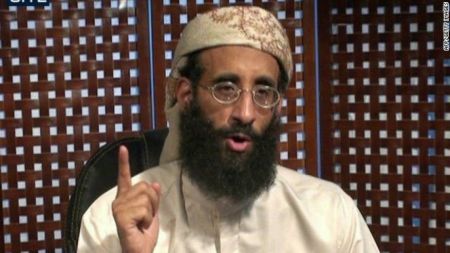
anwar-al-awlaki-story-top

In the wake of terror attacks in Paris, San Bernardino and Brussels, the Anti-Defamation League (ADL) issued a new report that exposes the rise of terrorist activity among US-based Muslims.

ADL reports that in 2015, 80 US residents were inspired by ISIS and linked to terrorism themselves, marking a nearly 200 percent increase from 2014. PRNewswire reports:

“The tragic attacks in Brussels remind us of the need to continuously evaluate the threat posed by foreign terrorist organizations and the influence they have on communities around the world,” said Oren Segal, Director of ADL’s Center on Extremism. “While there are significant differences in the threats to the U.S. and Europe, this report identifies some meaningful similarities, which can help us understand the threats and develop solutions to counteract them.”

As in Europe, the vast majority of U.S. residents linked to terror plots and other activity motivated by Islamic extremist ideology in 2015 acted in support of ISIS. ISIS and other terrorist groups continue to take advantage of technology to mobilize followers, spread their messages and expand their influence worldwide. While in-person networks are stronger and more prevalent in Europe, and particularly in Belgium, than in the U.S., the internet and social media sites remain a pivotal element of the modern radicalization process worldwide.

The ADL report uncovered terror plots across 22 states, with the largest portion occurring in New York, Minnesota and California. The report found that these US resident-terrorists engaged in plotting attacks and furnishing material support for attacks. Key aspects of the report found that 20 of the terror-linked US residents converted to Islam and came from a diverse array of ethnic backgrounds:

“Understanding the backgrounds, demographics, and aspirations of U.S. residents engaged in activity motivated by Islamic extremist ideology can provide valuable insights into the trends and nature of terrorism we currently face and how we can best be equipped to combat it,” said Jonathan A. Greenblatt, ADL CEO. “As we saw the events tragically unfold in Brussels, ISIS terror has far reaching influence across the globe.  And the risk is not only from ISIS members themselves, but from those who might be radicalized by their hateful message.”

The way we can combat it is by abandoning our obsession with multiculturalism and political correctness. Crucial to that is purging the invented term “Islamophobia” from the popular lexicon. Further, our intelligence and law enforcement communities must not be impeded in their responsibility to monitor all mosques and Islamic centers for hate speech and questionable practices among congregates and faith leaders. Nor should they be barred from monitoring self-segregated communities that have refrained from assimilation or engaging in profiling whenever and wherever applicable.

Most important, we must exhibit strength — not capitulation — in our foreign and domestic policy concerning terrorism or the infiltration of any values anathema to our own. We must not turn on our allies. We must not tamp down any regime, however repugnant, that aids us in crushing Islamic extremism. The Islamic world bows only to the iron fist. Diplomacy works on those with whom there is leverage, not on those who aren’t even afraid of losing their own lives or the lives of their children.

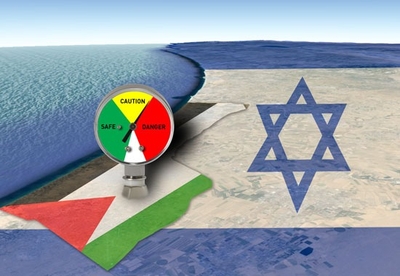
The Gaza Time Bomb

March 30, 2016

The Gaza Time Bomb, Investigative Project on Terrorism, Yaakov Lappin, March 30, 2016

1161

On the surface, the Gaza Strip looks relatively calm, with few security incidents occurring since the end of the protracted 2014 summer conflict between Hamas and Israel.

Behind the scenes, pressure within the Islamist-run enclave is gradually building again, just as it did prior to the 2014 war.

Gaza’s civilian population is hostage to Hamas’s dramatically failed economic policies, and its insistence on confrontation with Israel, rather than recognition of Israel and investment in Gaza’s economic future.

Ultimately, the civilian-economic pressure cooker in Gaza looks likely to explode, leading Hamas to seek new hostilities with Israel, for which it is preparing in earnest.

Right now, Hamas remains deterred by Israel’s firepower, and is enforcing its part of the truce. Hamas security forces patrol the Strip’s borders to prevent Gazans from rioting, to stop them from trying to escape Gaza into Israel, and to stop ISIS-affiliated radicals who fire rockets at Israel.

Hamas is using the current quiet to replenish its rocket arsenal, dig its combat tunnel network, and build up sea-based attack capabilities. It is investing many resources in cooking up new ways to surprise Israel in any future clash. These efforts have not gone unnoticed by the Israel Defense Forces (IDF).

Hamas has not fired a single rocket into Israel since August 2014, but it encourages violence in the West Bank as part of a strategy to destabilize its Palestinian rival, the Fatah-led Palestinian Authority. Hamas in Gaza also works remotely to set up and orchestrate terrorism cells in the West Bank, while plotting way to overthrow Fatah from power. The Shin Bet, Israel’s domestic intelligence agency, has successfully foiled nearly all of these efforts thus far, saving many Israeli lives, and the PA’s rule, too.

A deeper look at processes under way in Gaza reveals why the status quo seems untenable in the long run. Thirty percent (910,000) of Gaza’s population of 1.85 million are aged 15 to 29, and out of these, 65 percent are unemployed. This represents one of the highest unemployment rates for young people in the world. Many are university educated and deeply frustrated. The overall unemployment rate in Gaza is 38.4 percent, and rising steadily. Eighteen thousand Gazan university students graduate every year. Most of them have nothing to do with their degrees, and return home to a life of idle unemployment. Many Gazans dream of leaving. The suicide rate is growing. Under Hamas’s rule, these young people see no change on the horizon.

Out of the total population of Gaza, 1.3 million receive assistance from United Nations aid workers, without which, a humanitarian crisis would likely ensue.

Those who dare complain, such as Gazan bloggers, find themselves whisked away into Hamas police custody, where they receive firm warnings to remain silent, or else.

Meanwhile, the Gazan population is growing at an unsustainable rate. Since Israel pulled out all of its soldiers and civilians in 2005, 600,000 Gazans have been born. This is a generation that has never been to Israel (unlike the older Gazans), and its only experience of Israel is through air force missiles fired at Hamas targets following clashes sparked by the jihadist regime’s military wing.

Many of these young people are exposed to the propaganda of Hamas’s media outlets, like the Al-Aksa television station, which is a major source of incitement. Some are also exposed to the wider world through the Internet, and are aware that life can be different for them.

By 2020, Gaza’s population will hit 2.3 million people. It could run out of drinking water. This might prompt a civilian revolt, which could push Hamas into starting a new war with Israel to distract attention.

To try to relieve the pressure, Hamas leaders make promises that they cannot keep, such as the setting up of a sea port, and the opening of the Rafah crossing with Egypt, which the anti-Hamas Egyptian government opened just 18 times in 2015 for fear of allowing jihadists in Gaza to pour into the restive Sinai Strip.

A Hamas delegation traveled to Egypt earlier this month to try to mend relations with the Cairo government. The effort resulted in failure, after Egyptian officials accused Hamas of failing to acknowledge its collaboration with the ISIS-affiliated Sinai Province insurgents.

Changes are underway within Hamas itself, which are causing the Izzadin Al-Qassam Brigades military wing to gain power at the expense of the political wing, which is led by Ismael Haniyeh.

Yiyhe Sinwar is a senior Hamas member with growing power, operating in the gray zone between both wings. He is close to military wing chief Muhammed Def, and to Haniyeh. Sinwar’s power represents the rise of military wing’s influence, where many members are finding their way into political elite positions in Gaza.

Marwan Isa is another senior Hamas member, influential to both wings. While the political wing has, behind closed doors, been hesitant to support the military wing’s disastrous adventures against Israel, its ability to veto future attacks may vanish.

Additionally, Hamas is running out allies as it did before the 2014 war.

Iran continues to fund its military wing, as well as Palestinian Islamic Jihad. Yet Tehran’s ability to traffic weapons into Gaza has been ruined by Egypt’s tunnel demolition drive.

Iran’s overall influence on Gaza, therefore, is limited.

The Muslim Brotherhood-friendly Qatar has also stepped back from Hamas, limiting its funding projects in Gaza to civilian reconstruction only, building a modern highway in Gaza and a fancy new neighborhood in Khan Younis. However, no Qatari funds go to Hamas’s military build-up. Turkey’s assistance to Hamas is limited, too. It paid for a new Gaza hospital and 11 mosques, but beyond that, its support is mostly rhetorical.

The Arab world is indifferent to Gaza, meaning that Hamas is in strategic distress.

ISIS-inspired ideology is penetrating Gaza, and a few thousand former Hamas, Fatah, and Islamic Jihad members have defected to small Salafist-jihadist groups there. These groups have been responsible for all rocket fire into Israel since the summer of 2014.

In fact, the only state that makes major efforts to care for Gaza’s civilians is Israel. Israel provides 60 percent of Gaza’s electricity (30 percent is locally produced and Egypt provides the remaining 10 percent).

In 2015, Israel allowed 104,000 Gazans through the Erez border crossings to assist traders and humanitarian journeys. At the Kerem Shalom vehicle crossing, 900 trucks pass each day from Israel into Gaza, carrying all manner of goods, from fuel, to construction materials and commercial goods.

For Gaza civilians, the only ray of light seems to shine from the reconstruction mechanism, which Israel quietly set in motion after Hamas cynically used Gazan civilian areas as rocket launching zones and urban combat bases.

Israel set up a computerized reconstruction system that closely monitors and enables the rebuilding, while preventing the use of concrete and dual use items from falling into Hamas’s hands. Gaza contractors who cannot account for their materials on the computerized systems are immediately removed from their positions, a heavy price to pay in the unemployment-rife Gaza Strip.

Funded by international donors and the Palestinian private sector, the mechanism, which Israel pushed to set up, has repaired 80,000 of the 130,000 housing units damaged during the conflict. Another 20,000 are currently being repaired.

Of the 18,000 homes completely destroyed in 2014, nearly 11,000 have already been rebuilt, and material for nearly 2,000 more homes has been bought and paid for.

The reconstruction program is providing jobs and a little hope for Gazans. But it is unlikely to be sufficient to stave off an economic collapse. Again, the rebuilding effort is funded almost entirely by outside sources while Hamas invests tremendous resources into terrorism-guerilla capabilities and denies the Gazan people the opportunity of economic development by refusing to recognize Israel.

Until Gaza is run by people with different priorities, its residents have little hope their lives will improve.

Secrets and Lies: Turkey’s Covert Relationship With ISIS

March 29, 2016

Secrets and Lies: Turkey’s Covert Relationship With ISIS, Clarion Project, Meira Svirsky, March 29, 2016

Islamic-State-5-IPWith the aid of Turkish officials, Islamic State fighters’ have been able to travel through Turkey to reach Syria (Photo: Video screenshot)

A hot warning received by intelligence officials revealed that the Islamic State (ISIS/ISIL) is planning an “imminent attack” on Jewish children in Turkey. Officials believe the most likely target is in the Beyoglu district of Istanbul, where a Jewish school is attached to a synagogue and community center.

The information was obtained after Turkey arrested six ISIS operatives in the southern city of Gaziantep last week.

“This is a more than credible threat. This is an active plot,” a Turkey source said.

Less than 10 days ago, a suicide bomber stalked Israeli tourists in Istanbul before blowing himself up near them, killing five people (four of them Israelis) and wounding many more.

“The so-called Islamic State is believed to be behind both sets of attacks and the organization continues in determined efforts to perpetrate further attacks in Turkey and elsewhere,” reported Sky News, quoting from an intelligence report seen by the news outlet.

In addition to the six arrested, another three ISIS operatives were arrested last week. Turkey, it seems is scrambling to protect itself from attacks the terror group has threatened to execute all across Europe.

After the Brussels attacks, Turkish President RecepTayyip Erdogan shocked the world by saying that Turkey had captured one of the perpetrators of the massacre last June and send him back to his country.  Erdogan specifically said that Ibrahim El Bakraoui, one of the suicide bombers in the Brussels airport, was detained in Turkey and sent back to Belgium with a warning (that was ignored) that he was a militant.

Yet, new documents obtained by Kurdish YPG fighters (People’s Protection Units) and the Syrian Democratic Forces (SDF) who are fighting together, refute the claim made by Erdogan that Turkey is preventing ISIS and Al-Nusra (Al Qaeda’s official affiliate in Syria) from travelling through Turkey to reach Syria.

The documents seized from Islamic State headquarters in seven locations, including Kobane, show that ISIS fighters from all over the world – and particularly from Kazakhstan, Indonesia, and Tajikistan  — were given passage through Turkey to Syria.

The Firat News Agency (ANF), a Kurdish outlet whose websites have been repeatedly blocked in Turkey by Turkish courts, reports that the hundreds of documents show that since 2013, ISIS fighters have used the Istanbul and Adana airports and have received permits from the Turkish government to reside in Turkey until they cross over to Syria.

The documents also include bus tickets, electronic Turkish visas, residency permits, and documents with stamps from Turkish immigration officials.

Chillingly, the documents show that chemical and explosive materials was transferred from Turkey to Syria. One such document was signed by the manager of Istanbul’s Police Foreigners’ Department Erkan Aydoga. Manuals in Turkish as to how to use these materials were also given to the jihadis.

A sample of the documents can be viewed here.

Turkey, as has been previously reported, is playing a dangerous and duplicitous game with the West. As Clarion Project has wrote, Turkey’s arms transfers to al-Qaeda-linked Islamist jihadis in Syria have been long-documented, yet largely ignored by the Western media. A major raid by the U.S. on an Islamic State safe house in Syria in the summer of 2015 gleaned large amounts of intelligence undeniably linking Turkey to the Islamic State.

Similarly, the fact the Turkey has been the top financial sponsor of Hamas since 2012, with Erdogan arranging for the transfer of $250-300 million to this U.S.-designated terrorist group annually, is another oft-ignored inconvenience. Similarly, the West has brilliantly avoided confronting Turkey on its abysmal human rights record.

Using air-tight documentation, Nafeez Ahmed, editor of InsurgeIntelligence, writes about the many reasons the West has chosen to look the other way while Turkey facilitates oil sales for the Islamic State, which guarantees its strength and viability.

“There are many explanations,” writes Ahmed, “but one perhaps stands out: the West’s abject dependence on terror-toting Muslim regimes, largely to maintain access to Middle East, Mediterranean and Central Asian oil and gas resources.”

Since 2013, the Turkish government has been building a $100 million mega-mosque in Lanham, Maryland, taking Turkey’s“outreach” in America out of the realm of the subtle. This week in America, U.S. President Barack Obama will join Erdogan at the opening of the mosque, the largest in the U.S.

The show, it seems, must go on.

Cartoons of the Day

March 28, 2016

H/t Freedom is Just Another Word

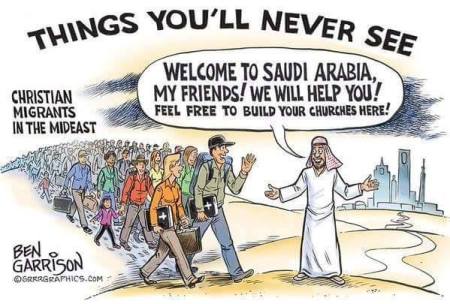
Welcome to Saudi Arabia


H/t Joopklepzeiker

Turkey

Pakistan on the Mediterranean

March 28, 2016

Pakistan on the Mediterranean, Washington Free Beacon, March 28, 2016

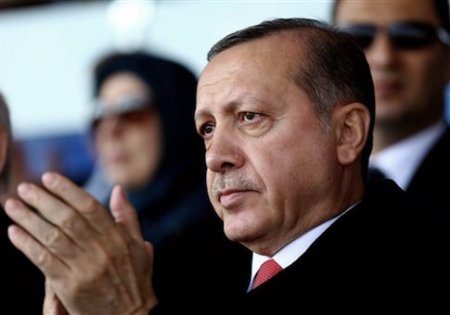
Turkish President Recep Tayyip Erdogan listens during a ceremony to commemorate the 101st anniversary of the Battle of Gallipoli in Canakkale, Turkey, Friday, March 18, 2016. Turkish President Recep Tayyip Erdogan on Friday warned Europe that it, too, could fall victim to attacks by Kurdish militants following a terror attack in Ankara that killed 37 people. (Kayhan Ozer, Presidential Press Service, Pool via AP)

Turkish President Recep Tayyip Erdogan listens during a ceremony to commemorate the 101st anniversary of the Battle of Gallipoli in Canakkale, Turkey, Friday, March 18, 2016. Turkish President Recep Tayyip Erdogan on Friday warned Europe that it, too, could fall victim to attacks by Kurdish militants following a terror attack in Ankara that killed 37 people. (Kayhan Ozer, Presidential Press Service, Pool via AP)

President Obama will welcome Erdoğan to Washington this week for a strategy meeting about countering the ISIS.

**********************

On March 18, European and Turkish diplomats signed off on a comprehensive deal on migrants pouring from Syria, Iraq, and elsewhere in the Middle East through Turkey and into the European Union. Under the terms of the deal, for every illegal migrant the E.U. returns to Turkey, Turkey would send one refugee for resettlement in Europe. Additionally, Turkey and Europe agreed to re-open discussions concerning the Muslim country’s efforts to join the E.U., and Europe agreed to allow Turks visa-free travel throughout the Schengen zone.

Two days after the deal was announced, a Turk who had joined the Islamic State blew himself up among tourists on Istanbul’s Istiklal Street, one of the city’s major shopping and tourism districts. Two days after that, ISIS suicide bombers killed dozens in two separate attacks in Brussels. ISIS called what occurred in Belgium “a drop in the sea” compared with what the terrorists have in store for “nations of disbelief.”

Turkey and its president, Recep Tayyip Erdoğan, have used the growing threat to argue that the West must better conform its policies to Turkey’s desires. In the wake of the Brussels attacks, Prime Minister Ahmet Davutoğlu chided Europe. “Europe has no partner other than Turkey to provide its regional security,” he declared, adding a subtle threat: “They should see this reality and act accordingly.” Meanwhile President Obama will welcome Erdoğan to Washington this week for a strategy meeting about countering the ISIS.

The reality Davutoğlu deliberately ignores, however, is his own country’s role in allowing ISIS to develop and metastasize. The Turkish government is adept at pulling the wool over Western officials’ eyes. Erdoğan pays lip service in meetings with European and American officials to the importance of both democracy and the Turkish partnership with the West, for example, declaring, “Secularism is the protector of all beliefs and religions.” He speaks differently to his Turkish audience. As mayor of Istanbul, he described himself as “the imam of Istanbul” and declared, “Thank God almighty, I am a servant of Shari‘a.” He is famous for his quip, “Democracy is like a streetcar. When you come to your stop, you get off.” In recent years, he has declared his goal to be to “raise a religious generation.”

This “religious generation” is flowing into the cauldron of Syria and Iraq. More than 30,000 foreign fighters from as many as 100 countries now fight with the Islamic State. The bulk of these soldiers—perhaps 90 percent—crossed into the Islamic State from Turkey. Turkish visa policy contributes to the problem. A direct correlation can be drawn between foreign fighters serving ISIS and those nationalities from which Turkish authorities require no visa or provide waivers: Several thousand more Moroccans and Tunisians, who need no visas to transit Turkey, fight with ISIS in Syria and Iraq than Algerians and Libyans, who do. If Erdoğan simply required visas in advance for those under the age of 40 coming from countries like Morocco, Tunisia, Lebanon, and Jordan—or, for that matter, from Russia, the United Kingdom, and Australia—the flood of recruits into the Islamic State would slow to a trickle.

ISIS terrorists regularly traverse the Turkish border, not only for medical care but also for rest and relaxation. Some merchants in Istanbul openly sell ISIS propaganda and promise that proceeds from their sale will benefit the group’s fight in Syria and Iraq. Smugglers peddling contraband oil to fund ISIS rely on Turkey to bring the oil to market, paying off local and perhaps even national officials of the AKP, Turkey’s governing party, along the way.

Turkey has done more than lend passive support to Islamist radicals. In his 13 years in power, Erdoğan has transformed Turkey from a Western-leaning democracy into Pakistan-on-the-Mediterranean. There was, for example,the leak of documents from the Millî İstihbarat Teşkilatı (MİT), Turkey’s intelligence service, showing Turkish support of the Nusra Front, an al Qaeda affiliate operating in Syria. And, rather than give medals to the Turkish soldiers who intercepted truckloads of weaponry destined for Syrian radicals, Erdoğan ordered their arrest.

Likewise, when Turkish journalists exposed—with photographic evidence—the transfer of munitions and other supplies from the Turkish border to ISIS, Erdoğan’s response was not to applaud the media but to seize the newspaper and arrest its editors and many of its reporters.

There is also evidence that, as Kurds fighting ISIS in Kobani in 2014 began to turn the tide against the radical group, Erdoğan and Turkish intelligence officials allowed ISIS fighters to pass through Turkey and attack Kobani from across the border, a flank the town’s largely Kurdish residents assumed was secure.

From the beginning, Erdoğan has looked at the Syrian refugee crisis not as a humanitarian tragedy but an arrow in his quiver. Inside Turkey, he has offered Sunni refugees Turkish citizenship if they settle in Turkish provinces currently dominated by the Shi‘ite offshoot Alevi sect. And, whereas the world condemns ISIS “genocide” against the Yezidi, the Yezidi who sheltered in Turkey were then victimized, again, by local AKP-run municipalities who refused to provide services offered to Sunni refugees.

Allowing Turkey to choose which refugees to send to Europe and promising to eliminate visa restrictions for Turks only rewards Erdoğan for his behavior and gives him additional leverage in his dealings with the West. Nor is this the type of policy Erdoğan’s neighbors would support. Earlier this year, King Abdullah II of Jordan told Congress, “The fact that terrorists are going to Europe is part of Turkish policy and Turkey keeps on getting a slap on the hand, but they are let off the hook.” He added that, “radicalization was being manufactured in Turkey.”

Abdullah’s message fell on deaf in ears in Washington, Brussels, Paris, and Berlin. It is Erdoğan who has the initiative as he pursues the Islamicization of Turkey and neo-Ottoman imperialism. He has built a Pakistan on the Mediterranean: an incubator of terror that markets itself as the only available partner of the West, with tragic results.

Sisi asks Obama for military intervention to save Egypt from ISIS

March 28, 2016

Sisi asks Obama for military intervention to save Egypt from ISIS, DEBKAfile, March 28, 2016

Egyptian President Abdel Fatteh El-Sisi has sent a secret missive to President Barack Obama asking for urgent US military intervention in support of Egypt’s war on the Islamist State in Sinai, before the jihadis pose a real threat to Cairo. DEBKAfile’s exclusive intelligence and counterterrorism sources report that El-Sisi has come to the conclusion that Egyptian army lacks the ability to eradicate the terrorist peril without direct US military support.

In his note, he asks Washington to replicate in Sinai the format of US intervention in the war on ISIS in Iraq and Syria, namely, to send in special operations forces to establish bases and operate drones against jihadist targets. Unless stopped, he warns, the Islamic State is on the point of transforming the Sinai Peninsula into its primary forward base in the Middle East, bolstered by its branches of terror across North Africa, especially in Libya. US intervention is necessary to avert this.

So far, Sisi has received no answer from the White House and no sign of one in the pipeline.

Our military sources note that, given his record as former defense minister and a much-decorated general in the Egyptian army, an appeal to a foreign power for military assistance is out of character and would normally be found unacceptable in his own milieu. It must therefore be seen as a sign of extreme distress over Cairo’s failure to vanquish – or even contain ISIS, which now poses a strategic threat to Egypt proper.

In this situation, the generals in Cairo were dismayed to read a New York Timesleader on March 25, captioned “Time to Rethink US relationship with Egypt,” which faults the Egyptian regime’s human rights record and suggests that the relationship does Washington more harm than good.

The NYT concludes by saying, “Over the next few months, the president should start planning the possibility of a break in the alliance with Egypt. That scenario appears increasingly necessary.”

Since this article appeared out of the blue, it is feared in Cairo that it is President Obama’s way of spurring the Egyptian president’s SOS.

Some high-ranking military figures in Cairo have started talking about alternatives: If Washington refuses to come up with military assistance for fighting the Islamic State, perhaps the time has time to go elsewhere.
An Egyptian appeal to Moscow cannot be ruled out.


Fighting ISIS plays into ISIS’ Hands?

March 28, 2016

Fighting ISIS plays into ISIS’ Hands? Front Page Magazine, Daniel Greenfield, March 28, 2016

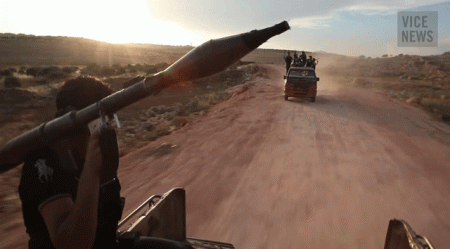
isis-shooting-syria

If you’re keeping score, freeing Islamic terrorists from Gitmo does not play into the hands of ISIS. Neither does bringing Syrians, many of whom sympathize with Islamic terrorists, into our country. And aiding the Muslim Brotherhood parent organization of ISIS does not play into the Islamic group’s hands.

However if you use the words “Islamic terrorism” or even milder derivatives such as “radical Islamic terrorism”, you are playing into the hands of ISIS. If you call for closer law enforcement scrutiny of Muslim areas before they turn into Molenbeek style no-go zones or suggest ending the stream of new immigrant recruits to ISIS in San Bernardino, Paris or Brussels, you are also playing into the hands of ISIS.

And if you carpet bomb ISIS, destroy its headquarters and training camps, you’re just playing into its hands. According to Obama and his experts, who have wrecked the Middle East, what ISIS fears most is that we’ll ignore it and let it go about its business. And what it wants most is for us to utterly destroy it.

Tens of thousands of Muslim refugees make us safer. But using the words “Muslim terrorism” endangers us. The more Muslims we bring to America, the faster we’ll beat ISIS. As long as we don’t call it the Islamic State or ISIS or ISIL, but follow Secretary of State John Kerry’s lead in calling it Daesh.

Because terrorism has no religion. Even when it’s shouting, “Allahu Akbar”.

Obama initially tried to defeat ISIS by ignoring it. This cunning approach allowed ISIS to seize large chunks of Iraq and Syria. He tried calling ISIS a JayVee team in line with his recent claim that, “We defeat them in part by saying you are not strong, you are weak”. Unimpressed, ISIS seized Mosul. It was still attached to the old-fashioned way of proving it was strong by actually winning land and wars.

Then Obama tried to defeat ISIS by arming the Islamist allies of Al Qaeda and now a lot more American weapons are in the hands of Islamic terrorists. Some of them are even in the hands of ISIS.

Europe and the United States decided to prove that we were not at war with Islam by taking in as many Muslims as we could. Instead of leading to less terrorism, taking in more Muslims led to more terrorism.

Every single stupid counterintuitive strategy for defeating Islamic terrorism has been tried. And it has failed miserably. Overthrowing “dictators” turned entire countries into terrorist training camps. Bringing Islamists to power in Egypt, Libya and Tunisia led directly to attacks on American diplomatic facilities. The Muslim Brotherhood showed no gratitude to its State Department allies. Instead its militias and forces either aided the attackers or stood by and watched while taking bets on the outcome.

Islamic terrorism has followed an entirely intuitive pattern of cause and effect. There’s a reason that the counterintuitive strategies for fighting Islamic terrorism by not fighting Islamic terrorism don’t work. They make no sense. They never did. Instead they all depend on convincing Muslims, from the local Imam to Jihadist organizations, to aid us instead of attack us by showing what nice people we are. Meanwhile they also insist that we can’t use the words “Islamic terrorism” because Muslims are ticking time bombs who will join Al Qaeda and ISIS the moment we associate terrorism with the I-word.

The counterintuitive strategy assumes that Islamic terrorism will only exist if we use the I-word, that totalitarian Jihadist movements just want democracy and that our best allies for fighting Islamic terrorism are people from the same places where Islamic terrorism is a runaway success. And that we should duplicate the demographics of the countries where Islamic terrorism thrives in order to defeat it.

The West’s counterterrorism strategy makes less sense than the ravings of most mental patients. The only thing more insane than the counterintuitive strategy for defeating Islamic terrorism is the insistence that the intuitive strategy of keeping terrorists out and killing them is what terrorists want.

If you believe the experts, then Islamic terrorists want us to stop them from entering Europe, America, Canada and Australia. They crave having their terrorists profiled by law enforcement on the way to their latest attack. And they wish we would just carpet bomb them as hard as we can right now.

When ISIS shoots up Paris or Brussels, it’s not really trying to kill infidels for Allah. Instead it’s setting a cunning trap for us. If we react by ending the flow of migrants and preventing the next attack, ISIS wins. If we police Muslim no-go zones, then ISIS also wins. If we deport potential terrorists, ISIS still wins.

But if we let ISIS carry out another successful attack, then ISIS loses. And we win. What do we win?

It depends. A concert hall full of corpses. Marathon runners with severed limbs. Families fleeing the airport through a haze of smoke. Only by letting ISIS kill us, do we have any hope of beating ISIS.

Politicians and experts claim that ISIS is insane. It’s not insane. It’s evil. Its goals are clear and comprehensible. The objectives of the Islamic State are easy to intuitively grasp. Our leaders and experts are the ones who are out of their minds. They may or may not be evil, but they are utterly insane. And they have projected their madness on Islamic terrorists who are downright rational compared to them.

Unlike our leaders, Islamic terrorists don’t confuse victory and defeat. They aren’t afraid that they’ll win. They don’t want us to kill them or deport them. They don’t care whether we call them ISIS or Daesh. They don’t derive their Islamic legitimacy from John Kerry or a State Department Twitter account. They get it from the Koran and the entire rotting corpus of Islamic law that they seek to impose on the world.

Our leaders are the ones who are afraid of winning. They distrust the morality of armed force and borders. They disguise that distrust behind convoluted arguments and counterintuitive rationales. Entire intellectual systems are constructed to explain why defeating ISIS is exactly what ISIS wants.

After the San Bernardino shootings, Obama insisted that, “Our success won’t depend on tough talk or abandoning our values…  That’s what groups like ISIL are hoping for.” But ISIS does not care whether Obama talks tough, even if it’s only his version of tough talk in which he puffs out his chest and says things like, ”You are not strong, you are weak.” It is not interested in Obama’s “right side of history” distortion of American values either. ISIS is not trying to be counterintuitive. It’s fighting to win.

And our leaders are fighting as hard as they can to lose.

The counterintuitive strategy is not meant to fight terror, but to convince the populace that winning is actually losing and losing is actually winning. The worse we lose, the better our plan is working. And when we have completely lost everything then we’ll have the terrorists right where we want them.

Just ask the dead of Brussels, Paris, New York and a hundred other places.

This isn’t a plan to win. It’s a plan to confuse the issue while losing. It’s a plan to convince everyone that what looks like appeasement, defeatism, surrender and collaboration with the enemy is really a brilliant counterintuitive plan that is the only possible path to a lasting victory over Islamic terrorism.

But intuitive beats counterintuitive. Winning intuitively beats losing counterintuitively. Counterintuitively dead terrorists multiply, but intuitively they stay dead. Counterintuitively, not discussing the problem is the best way to solve it. Intuitively, you solve a problem by facing it. Counterintuitively, collaborating with the enemy is patriotism. Intuitively, it’s treason.

IRA, ISIS and the Fate of Great Britain

March 25, 2016

IRA, ISIS and the Fate of Great Britain, Clarion Project, JC Dash, March 25, 2016

(Here’s a video, in honor of Easter Week, which eventually ended oppressive British rule over Ireland after more than a century.

Did I mention that I’m half Irish? — DM)


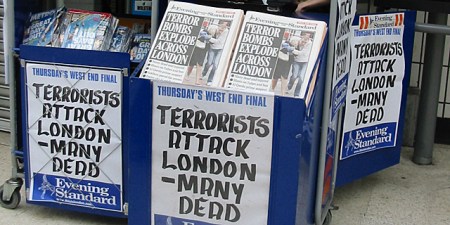
London-bombing-7-77/7/05 is a day etched in the collective memory of the British. (Source: https://commons.wikimedia.org/w/index.php?curid=215746)

The first time I was invited to Belfast I have to admit I was terrified. After a lull with relatively few bombings in the 80’s the 90’s there was a resurgence of bombing campaigns. I was travelling in the wake of a double bombing in London in several other places on mainland Britain. At the time the Irish population in England was forced to live in the shadows. The Irish communities came under enormous amounts of surveillance and Irish residents were viewed with the same suspicion.

The United Kingdom was not bound by the constraints of political correctness and threats from the Irish community. The government was concerned with the safety and security of its citizens. That’s not to say Britain did not make mistakes. Many were made but Britain recognized the problems and dealt with them.

So what changed?

On July 7, 2005 a series of deadly bombings hit London. ‘Traditional terrorism’ died and radical Islam took up the terror reigns.

(This video looks at that fateful day🙂 (The video refuses to embed. You will have to click on it to see it. — DM)

There are many differences between the terrorism of the IRA and today’s radical Islamists. Let’s not fool ourselves, both are cruel and heartless with no respect for human life. But the Irish conflict itself was stalled by a peace initiative. The IRA stopped the bombing, even the splinter groups have been relatively quiet for 15 years.

Let’s put one myth to bed. Islamist extremism has no political or religious agenda. It is about world domination under a man-made system of laws perverting the religion of Islam to suit their own means.

They kill without prejudice. Men, women, children of all nationalities and all religions, even Islam, are targeted. They do not bomb to force a political process they bomb to dominate.

It is not just the terror that is forcing Britain to its knees but the hyper-successful way Islamists have penetrated the government, intelligentsia and liberal elite controlling political correctness to breed a generation of apologists. Schools, municipalities, government officials and influencers all willingly feed on their Islamist agenda.

In the wake of the attacks by ISIS in France and Belgium, Britain needs to wake up. David Cameron, the UK’s prime minister, is among the few with the guts to speak out. Britain needs to decide what is more important, protecting the people, cultural identity and the rule of law or appeasing radical Islam and just giving up.

Make no mistake, Islamist extremism is also alive and well across the Atlantic. In fact it’s a global problem.

It’s time the U.S. admitted there is a problem, joined the dots and make sure it doesn’t repeat the same mistakes as the United Kingdom.