Archive for the ‘Islamic radicalization’ category

Canada Home to Islamic Radicals

May 25, 2016

Canada Home to Islamic RadicalsThe Toronto Sun via Middle East Forum, Tarek Fatah, May 24, 2016

2683

In November 2014, while testifying before the Senate Committee on National Security and Defence, I raised the issue of Islamic clerics using mosque sermons to attack the foundational principles of Western civilization and liberal secular democracy.

Liberal Senator Grant Mitchell was outraged by my testimony that at most Canadian mosques, the Friday congregation includes a ritual prayer asking, “Allah to give victory to Muslims over the ‘Kufaar’ (non-Muslims).” In a heated exchange with me, the senator suggested I wasn’t telling the truth, implying I was motivated by Islamophobia. Sadly, Sen. Mitchell is not alone in such views.

But neither is there any let-up in the attacks on Canadian values emanating from many mosque pulpits and Islamic conferences hosted by radical Islamist groups.

For example, in a sermon on Friday, May 6, delivered at a mosque in Edmonton, an imam invoked the memory of Prophet Muhammad to whip up hatred against Israel. He declared peace accords with Israel are “useless garbage” and vowed that Jerusalem will be conquered “through blood.”

In February, the same cleric predicted Islam would soon conquer Rome, “the heart of the Christian state.”

The Edmonton mosque diatribe was not isolated.

On May 13, just north of Toronto, an Islamic society hosted a celebration of Iranian mass murderer, Ayatollah Khomeini. The poster promoting the event described Khomeini as a, “Liberator and Reformer of the Masses.”

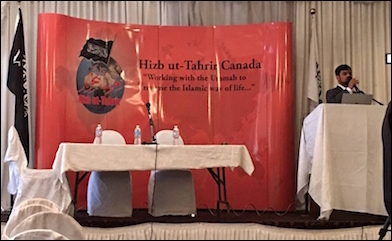
On Saturday, the Islamist group Hizb-ut-Tahrir, banned in some countries, hosted a conference to discuss the re-establishment of a global Islamic caliphate.

Pakistan-Canadian writer Tahir Gora went to cover the event, but was barred from entering the hall. “They said this was a closed door, in-camera meeting for our supporters,” Gora told me after he was asked to leave.

2684A speaker addresses the Hizb-ut-Tahrir conference in Mississauga, Ontario, on May 21.

Fortunately, one Palestinian-Canadian woman was able to enter the event.

She shared with me some of the proceedings from inside the gathering. “I walked into the banquet hall with approximately 100 attendees who were gender segregated. I sat next to a woman who said she had been in Canada for 40 years.” When I asked her if she felt any disconnect between enjoying 40 years of democracy, yet supporting the Hizb-ut-Tahrir who wanted to end it, she explained that democracy has done nothing good to people, so she and other believers follow Allah’s rule.

“The first speaker reminded Muslims that they are obligated to implement Allah’s orders that fulfil the Islamic State. It is “not permissible for us to choose’ he said, citing the Quran. However, he said it was necessary to win the public’s hearts and minds; and to partner with people of power, citing examples from the life of the Prophet.”

“At the end, a three-minute video was presented to demonstrate the collective oil and natural gas production capabilities of the Muslim world, the human capital needed to mine and process these resources … the military power required to protect them and the types of weapons needed to make such a military effective.”

While this was unfolding we received news that the Trudeau government, as part of its infrastructure development program, had authorised a $200,000 grant to a southern Ontario mosque with links to the Muslim Brotherhood.

Which begs the question: Who’s minding the store?

Germany’s largest Muslim organization gets Muslim prof fired for saying violent Qur’an verses not valid for all time

May 24, 2016

Germany’s largest Muslim organization gets Muslim prof fired for saying violent Qur’an verses not valid for all time, Jihad Watch, 

Islamic apologists routinely claim that violent Qur’an verses have no validity beyond Muhammad’s time, but this story illustrates that this is not the mainstream view in Islam. The persecution of Mouhanad Khorchide also shows the uphill battle that genuine Muslim reformers face: branded as heretics and/or apostates, they’re often shunned (or worse) by the very community that needs their ideas the most.

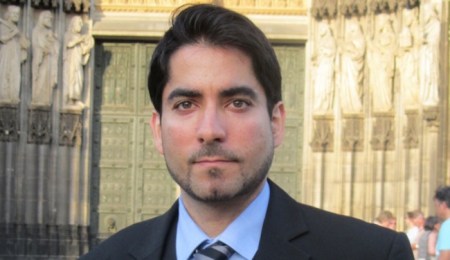
Mouhanad-Khorchide

“Opinion: A German Islam must be liberal, self-critical,” by Susanne Schröter, DW, May 23, 2016:

When the theologian Mouhanad Khorchide, who teaches at the University of Münster, published “Islam Is Compassion” in 2012, he received a variety of diverse reactions. Many non-Muslims celebrated the work as the revelation of a humanistic Islam: an Islam that no one needs to fear. This feeling arose in part because the author created a picture of God that is not “interested in the labels of Muslim or Christian or Jewish, believer or nonbeliever.”

Korchide threw out the idea that Koran verses that appear violent or hostile toward women or non-Muslims may be valid for all eternity. He wanted them to be viewed as the words of a bygone era.

It seemed that the professor, with the swoop of his pen, managed to brush aside all those reservations that made people wonder whether Islam really “belonged to Germany,” as former President Christian Wulff said famously in a 2010. One might even have thought that Muslims would offer Khorchide a pat on the back.

On the website for DITIB, Germany’s Turkish Islamic union and the country’s largest Muslim organization, one can read that Khorchide’s statements were a “rejection of the teachings of classical Islam” and an “insult to Muslim identity.” For this reason, the professor was removed from his post at the university. As if that weren’t enough, the coordinating body of Germany’s Central Council of Muslims (ZMD), a cooperative made up of a number of large organizations, produced a nearly 100-page assessment document to discredit him further, but luckily was not able to get far with it….

“Jihad,” when used in the sense of a real war, is a term that is used in the Koran and in Islamic heritage. There are clerics who claim jihad is an appropriate instrument for avenging insults to the Prophet Muhammad – such as an act of revenge for a nation’s foreign policy. These clerics are even lent the pulpit at some mosques, though the official leaders of the houses of worship issue apologies to the community if religious youths clamor after extremists. But Salafism is a youth movement, and it draws in so many teenagers and young adults that the psychologist Ahmad Mansour speaks of a “Generation Allah.”

Mansour isn’t only referring to those youths who join radical groups and potentially fight in such places as Syria, but also those whose beliefs vacillate between extremism and orthodoxy. “Generation Allah” refers to youths who find meaning in life by subjecting themselves unquestioningly to God and his rules, who ask constantly what is halal (allowed) or haram (forbidden) because their perspective is that they can be winners in paradise. I have spoken to such young men. Living in contemporary German society is dangerous for these young men, full of sin, and as a result they reject any relationships with so-called unbelievers. They go beyond what is normally required of their faith.

Some Muslim organizations encourage such segregation. Nearly every mosque has soccer teams that play against other sides from other mosques. Islamic day care and cultural centers are being founded; Islamic NGOs are working with underprivilileged [sic] people and youth. Parallel structures are being developed that would allow Muslims to avoid contact with non-Muslims from the cradle to the grave….

Islamic Extremism in France Part III: Stemming the Tide

May 23, 2016

Islamic Extremism in France Part III: Stemming the Tide, Clarion Project, Leslie Shaw, May 23, 2016

(Too little, too late. — DM

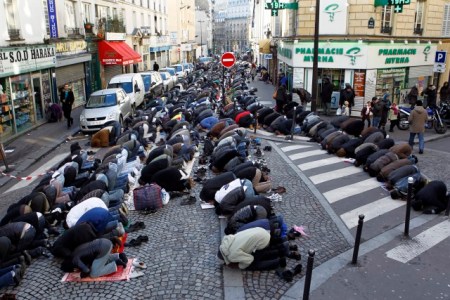
FranceMuslimPrayerStreetIP_2Illegal prayer on the street in France (Photo: © Reuters)

Radical threats require radical solutions involving measures that hurt, such as the police operations enabled by the current state of emergency. The French government’s soft, long-term strategy indicates ideological weakness and the absence of a will to fight the enemy. The enemy is global political Islam and not just a few thousand deviants that need to be neutralized or rehabilitated.

*********************

In April 2015, French Prime Minister Manuel Valls said that a Salafist minority was “winning the ideological and cultural war” for control of Islam in France.

“Salafists account for 1% of Muslims in the country, but all you hear about is their message, the messages on social media,” Valls declared in a closing address in Paris to a conference on the populist exploitation of Islamism in Europe.

“There is an activist minority of Salafist groups that is winning the ideological and cultural war,” he added, endorsing the claim of his Urban Affairs Minister Patrick Kanner that “around a hundred” French neighborhoods presented “similarities” to the Molenbeek district of Brussels, reputed to be a jihadist enclave, although deeming that “comparisons are not easy to make.”

The Prime Minister had earlier stirred controversy by speaking of “geographical, social and ethnic apartheid” after the January 2015 attacks in Paris. He reckoned that in some districts in France “an essential job of reconquest of the secular republic” was needed.

The latest figures on operations enabled by the state of emergency show that these words are finally being translated into action: 3,549 police raids, 407 people placed under house arrest, 743 arms caches seized, 395 arrests and 344 people placed in detention.

One of the mosques closed was described by Interior Minister Bernard Cazenuve as “a hotbed of radical ideology.” The closure of the Lagny-sur-Marne mosque by administrative decree in December 2015 was confirmed by the Council of State, France’s highest court, in February 2016.

The mosque, 20 miles east of Paris, had been frequented by around 200 people. During the raid, police discovered a handgun, documents on jihad and a clandestine Koranic nursery school. Nine members of the congregation were placed under house arrest and 22 more were barred from leaving France.

The mosque was run by the local Muslim Association, which managed to overturn the Council of State ruling on a technicality. The government responded by initiating proceedings to dissolve the Muslim Association, claiming it was promoting radical Islamic ideology and organizing travel for jihadists to Iraq and Syria. Mohamed Hammoumi, the 34 year-old Salafist Imam who ran the mosque until his departure for Egypt in 2014, continued to direct operations from there and acted as a go-between for the jihadists travelling from France to the combat zones.

French law enables the government to dissolve by decree, i.e. with no legal proceedings, associations whose activities are considered as amounting to a combat unit, a militia or a group agitating against the French Republic. The decision rests with the Council of State.

The role played by Muslim associations and mosques in the nationwide ecosystem of radical Islam is not just a recent discovery. The problem is that up until the 2015 attacks, nothing was done to stamp out these vectors of terror, and the few public figures who spoke out about the danger were branded as fascists, racists and Islamophobes.

At the same time, the criminals who transitioned from crime to jihad benefited from the lenience of French courts.

Ismaël Omar Mostefai, one of the Bataclan jihadists, had eight criminal convictions between 2004 and 2008 but never did any time in prison. In 2010 he was registered on the French anti-terrorism database for radicalization. He was a regular attendee at the Lucé mosque next to the historic town of Chartres. In 2004 the construction of this mosque led to demonstrations by local residents. A comment made at the time by Philippe Loiseau, a municipal politician, has turned out to be prophetic:

“I fear that this mosque will be a hotbed of radicalization that will pose a dangerous risk for the population.”

Twelve years and hundreds of deaths and injuries later, the French government has rolled out its strategy to tackle the existential threat that radical Islam poses to the country. Prime Minister Valls unveiled a new plan at a cabinet meeting on May 9. It consists of 30 existing and 50 new measures focused on six areas:

1.      Prevention and detection of youth radicalization

2.      Creation of deradicalization centres

3.      Enhanced surveillance in prisons

4.      Life sentences for perpetrators of terrorist attacks

5.      A central administrative command to co-ordinate local actions against jihadism

6.      Suspension of welfare payments for jihadists who travel to combat zones

The 30 existing measures incorporated in this new plan were rolled out at a cabinet meeting in April 2014 by Interior Minister Bernard Cazeneuve. The stated objectives were to prevent French citizens from leaving to wage jihad abroad and combat the radicalization of French Muslim youth. Two years later, these measures have proven to be ineffective. Time will tell if the 50 new measures will eradicate the threat, but it may be a case of locking the stable door after the horses have bolted.

The notion that “deradicalization,” whether in the form of prevention or rehabilitation, will stem the tide of radical Islam sweeping through France seems rather naïve. It is like telling young people not to use drugs or putting a junkie through rehab in the hope that he will never shoot up again. Half a century of measures to fight drug addiction have not solved that problem and these measures designed to combat radical Islam are likely to be as ineffective, what they really need is to check www.taylorrecovery.com to find a solution.

Radical threats require radical solutions involving measures that hurt, such as the police operations enabled by the current state of emergency. The French government’s soft, long-term strategy indicates ideological weakness and the absence of a will to fight the enemy. The enemy is global political Islam and not just a few thousand deviants that need to be neutralized or rehabilitated.a

Exclusive: ‘I was Raised by an Islamist Terror Cult in America’

May 15, 2016

Exclusive: ‘I was Raised by an Islamist Terror Cult in America’ Clarion ProjectRyan Mauro, May 15, 2016

Silhouette-Man-Woman-Pixabay-IPIllustrative picture: Pixabay)

The Clarion Project has been in contact with a woman who grew up within Jamaat ul-Fuqra, a cultish Sufi Islamist terrorist group that now goes by the name of Muslims of the Americas.

The group is best known for establishing “Islamic villages” on U.S. soil, for example, its “Islamberg” headquarters in New York state.

She has agreed to anonymously come forward with her heartbreaking story. We have removed details for her safety. She provided photographs and specific facts that are unavailable in the public sphere that we subsequently confirmed.

The following is her testimony provided to Clarion Project national security analyst Ryan Mauro. It is one of the very few first-hand testimonies from someone who was inside Jamaat ul-Fuqra when it committed terrorism under that name:

I still know many Muslims and I know that Jamaat ul-Fuqra is nothing like them, but there are violent ones who will take issue with what I say and do. They believe you should be killed if you decide not to be Muslim or practice Islam the way they do because, to them, it’s “apostasy,” and that’s a capital offense under Islam. I do believe some of those violent Muslims may attempt to kill me.

From my point of view as a kid in Michigan, everything was great even though my mom and dad got a divorce and I was living with my mom. My first introduction to X [a Fuqra member] was when he hit me for breaking rules I knew nothing about. My name was also changed to be Islamic.

We lived at 52 Ferris Street in Highland Park, Michigan, a three-story building with six apartments on each floor. The entire building was occupied by black Muslims, some who came from Detroit. Non-Muslims were not allowed to move in. Armed guards were at the front entrance.

Living in the building was like living in a Muslim country. We didn’t go outside much because they didn’t want us to be influenced by non-Muslims. Us kids didn’t have any friends outside of the building. We were very poor and slept on the bare floor with no beds. Sometimes we didn’t have heat or hot water. We didn’t have any furniture whatsoever. We ate on the floor out of large platters with our fingers. Food was also sometimes scarce.

Once my mother was making the only food we had in the house: Beans and rice. As she was seasoning, she mistakenly poured the entire bottle of salt in it. I watched her break down crying because this was the only food she had to feed her children. Someone told her to use a potato to suck the salt out of the food so we could eat it.

The building was like a house of horrors. Some of the kids were tortured by their parents or beaten by the “brothers” in the building. There was one kid in particular I remember who was treated really badly. He would be beaten severely for little things like taking food from the refrigerator for himself. He and some others would sometimes not be allowed to stand up and forced to hop around like a bunny for days on end. They’d make him run errands throughout the building, hopping up three flights of stairs.

He was also starving and I remember him coming to our door begging for food. There was a fire set by one girl who was also known to be beaten badly and kept separate from the rest of the kids. Years later, I met the boy again and he just broke down crying. It was heart-wrenching. He wanted to know why no one helped him.

There were exercise classes in the basement. The brothers were training for whatever Muslim war they continuously told us was coming. Our schooling was irregular and not formal. There were no science classes and math was deficient. Mostly we learned to read and write English and Arabic. I learned later about the gaping holes in our education. Sometimes there was class once a week, sometimes not at all.

We were not allowed to listen to music or watch commercials. They didn’t want us to be influenced by them. There were some odd rules like the children couldn’t have cabbage patch dolls. They were called “evil.” The Smurfs were considered demonic.

This was true of my entire time with Fuqra. There was a tape recorder that I’d use to secretly record kids shows on the TV like Kids Incorporated. I only learned the pop songs from that time by hearing them sung on that show. I didn’t even hear Michael Jackson’s “Beat It” until much later in life. I’d try to memorize the songs in a closet because I couldn’t be caught listening to them.

Growing up, I thought all Muslims were like us. Later, I realized these were just the odd rules of our Muslim cult and that most Muslims did not follow most of the same rules as we did. Just like most Muslims are not terrorists and some Muslims don’t wear full coverings, every sect is different.

We would hear all kinds of fearful messages. I was told that in my lifetime the Muslims would have to fight the kafiroons (non-believers) and I would have to make sure I was on the right side of the war.

The females, including myself, wore what we called jilabias; a head-to-ankle length traditional Muslim garment. We usually made them ourselves. We sewed our own clothes when I was a kid, which was fun. We had different colored jilabias.

It was also common for men to have several wives. I was molested by one man, who I know also molested another girl. It causes feelings of shame that can affect you the rest of your life. It changes your brain chemistry.

The leader of our community was a man known as “Imam Musa.” It’s important to note that we were not Nation of Islam Muslims. In fact, we were taught that the Nation of Islam members aren’t really Muslims.

One day, there was a lot of commotion and we were told that a sheikh from Pakistan was coming to visit our little community inside the building. His name was Sheikh Mubarik Ali Gilani. They said he was a direct descendant of the Prophet Mohammed. It was all anyone talked about and some said he was coming to the U.S. seeking recruits for jihad in Afghanistan.

Everyone in the building was about the sheikh. Every disagreement was deferred to the Sheikh. The Sheikh and his wife would even name his followers’ babies.

When the sheikh arrived, I met him very briefly because I had a weird dream about the Prophet Mohammed. I couldn’t really remember the details. It was supposed to be a big honor to meet the sheikh. The leaders of our community met with him and some changes were made.

One of the first things that happened is that the sheikh married one of the girls who was around 14 years old and he was probably in his 40s. The marriage was supposed to combine our community with the sheikh’s community in Pakistan. It was the kind of marriage that reminds me of ancient times where a father would marry his daughter off to someone important in order to have a treaty with that community. She left to live with him in Pakistan and her father became the new leader of the community.

The sheikh renamed our community at this point to be “Jamaat ul-Fuqra,” which means “community of the impoverished.”

His followers in America are primarily African-American converts to Islam, but I believe our community was the first, or one of the first, he visited in the United States. Several of the “brothers” from the building went to Pakistan to meet with the sheikh, and when they returned, they were even more militant and religious than before. It was as if they had been hypnotized.

We were told that they prayed a lot and had mysticism circles. I vaguely remember something about them praying and going up to see Prophet Mohammed. They carried out small “missions.” Various sources on the Internet said that Fuqra carried out various terrorist attacks in the 1980s and early 1990s across the U.S. I heard about one of them.

There are press reports about Fuqra members bombing a building that housed a cleric. I knew one of them and that he had gone to visit the sheikh in Pakistan. Somehow, during the attack, the door to the basement got locked behind them and they died in the ensuing fire. The rumor in our community was that the CIA locked the door and trapped them inside. The men who died were considered “martyrs for the cause of Allah” in our community.

When we were there, one day I overheard people saying something about the FBI watching the building in navy blue cars outside. I looked out the window and, sure enough, there was a navy blue four-door sedan sitting out there. After that day, I noticed it was out there all the time.

In the 1990s, I heard several rumors. I heard that Sheikh Gilani was barred from entering the U.S. because he was suspected of being involved in a terrorist attack involving an airplane. I heard that Sheikh Gilani lives in a luxurious compound in Pakistan and that his family is extremely wealthy. His wives have expensive jewelry and servants and even their own seamstress.

I don’t know if these rumors are true first-hand, but supposedly there is a big dichotomy between how luxurious the sheikh and his family live and how poor his followers in the United States live.

Not long after the sedan was noticed, the sheikh sent an order from Pakistan that all Muslims in the building had to disperse across the country. This was devastating for me because I couldn’t see my friends anymore. I was very lonely. The community members went to California, Washington D.C., South Carolina, Georgia, New York and maybe other places.

I knew that Fuqra had bought land in rural areas of New York and Georgia for followers to settle at where they could follow strict religious codes. A group of us went to New Orleans in Louisiana and we didn’t have to wear our jalabias because we had to be incognito.

We lived in a two room shack behind someone’s house. The leader drove a cab. We moved frequently. I suspect that when they couldn’t pay the rent, they’d get evicted and move. In between moves, we’d live with other families and that was fun because we could play with other kids. I remember seeing scary and loud fights between the women married to the leader. A knife was pulled one time and another time a pregnant woman was kicked.

We drove to Brooklyn to hear the sheikh speak in a large mosque during one of his trips to America. His wife was there in a private room and she was revered in the community. I’ll always remember the shoes she wore. They looked like shoes that a genie would wear; gold and curled at the tip.

During that visit, I saw something that left a lasting impression on me. All the females were called to the basement of the mosque. There had to be 30-40 of us in a circle on the floor. They brought a chair out and put it in the middle of us. Then they brought out Y [a Fuqra member] and she had to sit backwards in the chair with her back facing the crowd. A woman came out with a big stick and gave her 10 lashes while the crowd of women said “shame on you!” with each lash.

At first, she just winced in agony. Eventually she was crying pretty hard. The entire scene was traumatizing for me and I felt bad for the children seeing it. She didn’t immediately go back to New Orleans, but did after some time.

The leader of the New Orleans community continued to be abusive and beat kids. I remember him beating one boy for peeing standing up. I guess Muslim men are supposed to sit down when they used the restroom. It really upset me.

One time I walked into the living room and saw one of the boys getting beaten. He looked at me with pain and fear in his eyes. I immediately screamed for the leader to stop hitting him and then I started shaking with fear. No one talked back to him. He told me to leave a room and continued the beating with a belt as the boy hunched and crawled into a corner. I felt helpless. It was the catalyst for me deciding to leave.

I took some pocket change and ran away. I didn’t know where to go, so I just walked up and down random neighborhoods and ended up at an outdoor mall. Eventually, I was falling asleep and had to go back home. My mom was crying when I walked in and I told her I wanted to go live with my dad.

I ran away again only days later and was hit with a belt when I came home. This time, I fought back and began screaming for someone to call the police. It made him give up and walk away in a huff. I later ran away again and got to a pay phone where I called my dad in Michigan. He had tried to take me away when I was growing up but was stopped by guys with guns. I knew he’d rescue me.

He called a cab to bring me to the airport and I sat there and waited for hours. Then I saw my grandpa come out of the airport and he paid the taxi that had been waiting forever. We flew back to Michigan.

After I left, most of the Muslims left the New Orleans site and went to other Fuqra places. I know some did not move to other Fuqra communities and I suspect that some of them stopped being a part of Jamaat ul-Fuqra.

It was time to start my life over in Michigan but I still suffer a lot from all I experienced to this day.
‘Kill Me Now, I Have to Be in Heaven by Four’

May 12, 2016

‘Kill Me Now, I Have to Be in Heaven by Four’ Clarion Project, May 12, 2016

ClockIllustrative picture. (Photo: © Creative Commons/Sunghwan Yoon)

An ISIS prisoner captured by the Peshmerga near Mosul demanded to be executed immediately since he had to be in heaven by 4pm.

He informed his captors the day of his capture was the Muslim festival of Isra and Mi’iraj, which celebrates the famous night journey of the founder of Islam Muhammed to Jerusalem and his temporary ascension to heaven to receive instruction from Allah. The fighter claimed he wanted to attend a commemoration ceremony for this event in heaven, which he said would start at 4pm.

One of the fighters of the Peshmerga who was assigned to the prisoner said the armed man told him “Don’t take care of me, you are an infidel.”

A lieutenant-colonel in the forces of the Peshmerga, Salim al-Surji, bandaged the wounds of the prisoner. He spoke to Rudaw media after a battle at Telskuf in which several Peshmerga fighters were killed.

“While I was filming the ISIS men on my phone” Surji said, “I saw that one of them was moving his ankle. So that’s when I put my hand on his chest and found that he was breathing. He was also conscious and talking. His explosive belt had not detonated and he was hurt in his ankle due to the explosion of one of his comrades. He was unable to walk. He told me ‘you are infidels, kill me.’”

Al-Surji didn’t listen to him and bandaged his ankle.

“While I was bandaging his wound I asked him where he was from and he said he’s from Samarra (a city in Iraq) and that he came to fight here with 50 other armed men. They were supposed to commit suicide using their suicide belts because today is the anniversary of the Isra and Mi’iraj celebration. He told me ‘all of us must be in heaven by 4pm, kill me.’”

CAIR Tries to Deceive About Somali Terror Recruits

May 10, 2016

CAIR Tries to Deceive About Somali Terror Recruits, Clarion ProjectRyan Mauro, May 10, 2016

Somali-Recruitment-ISIS-Minnesota-HPFox News starts to Somalis in Minnesota (Photo: Video screenshot)

The Council on American-Islamic Relations (CAIR), a U.S. Muslim Brotherhood front designated by the United Arab Emirates as a terrorist group, was asked by FOX News about Islamist terrorist recruitment among Somalis in Minnesota. CAIR’s answer, which appeared in a TV segment that included the Clarion Project, was almost comically deceptive.

The segment hosted by Pete Hegseth was about why terrorist groups like Al-Shabaab (Al-Qaeda’s branch in Somalia) and the Islamic State have an exceptional level of success in recruiting Somali-Americans.

CAIR-MN Executive Director Jaylani Hussein answered by saying:

“The Minnesota Muslim community has been working hard to address recruitment by the Al-Shabaab terror group and has achieved results, in that there has not been any new known recruits in the past few years…Treating the Muslim community as suspect only harm relations with law enforcement and alienates and stigmatizes our community.”

The spin lies in that CAIR is talking only about Al-Shabaab to give the impression that the Somali terrorist recruitment problem is a thing of the past. What it didn’t mention is that the reason the radicalized Somalis aren’t going to Al-Shabaab is simply because they are going to the Islamic State instead.

A bipartisan House Homeland Security report in September states that “radicalized individuals who were once intent on traveling to Afghanistan or Somalia are now traveling to Syria.”

That same report found that Minnesota is the origin of 26% of the American “foreign fighter” recruits who join Islamist terrorist groups overseas. The second state was California, the origin of 12%, followed by the New York City/New Jersey area with another 12%.

To put that in perspective, Minnesota has about one-ninth of the population of California, New York City and New Jersey combined—but has produced more than twice the amount of recruits of those three areas combined.

The ability of Al-Shabaab to recruit Somali-Americans, particularly in the Minneapolis area of Minnesota, has long been acknowledged by counter-terrorism experts. The danger is heightened by the extremist preaching from within the Somali communities in Minnesota and Tennessee.

Ironically, a Somali activist has blasted CAIR for marginalizing Muslim moderates and failing to combat the ideology that feeds terrorism. Now, the Islamic State has replaced Al-Shabaab as the most common destination for American recruits, including Somalis.

CAIR knows that the Islamic State is recruiting disproportionately from Somali-Americans. CAIR, ever so desperate to downplay the problem and avoid accountability for Islamic leaders, obviously made a calculated decision to try to deceive the audience by commenting only on Al-Shabaab.

Contrast their reply with what Somali community activist Omar Jamal said in the clip. He warned that Somali youth are being radicalized and recruited at this moment, facilitated by a lack of integration into American society and a failure by the U.S. government to combat extremism.

The only types of problems that can be fixed are the problems that are acknowledged.

Islamist Extremism in France (Part II)

May 4, 2016

Islamist Extremism in France (Part II), Clarion Project, Leslie Shaw, May 4, 2016

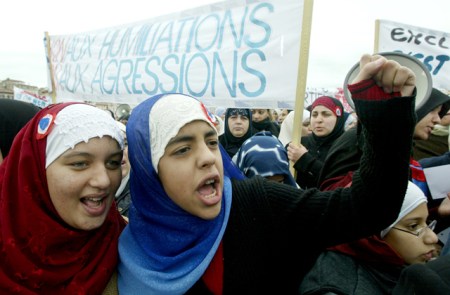
France-Muslims-Protest-Hijab-Ban-IP_0Muslims in France protest against a French law that forbids the wearing of religious symbols (including the hijab) in the primary and secondary schools. (Photo: © Reuters)

France has one of the largest Muslim communities in the West (estimated at 10% of the population), and French corporates have more experience than most in dealing with radical Islam.

City of Paris

In September 2012, in response to the encroachment of radical Islam, the mayor of Paris set up an Observatory on Secularism to ensure the principles of the 1905 separation of Church and State were being respected by the city’s 73,000 employees.

The observatory remained dormant but was reactivated in January 2015 after the Islamic terrorist attacks. Saïd Kouachi, one of the Charlie Hebdo killers, worked in the city sanitation department from 2007 to 2009. He was part of an employment program for young people from the ghettoes surrounding Paris.

A number of these youths were assigned to going door-to-door to inform householders on the benefits of domestic waste segregation. Many created problems for their supervisors due to their increasingly fundamentalist Islamic beliefs: refusing to shake hands with women, bringing prayer mats with them and taking time off to return to their workplaces to pray. Kouachi was moved from district to district as his supervisors, who described him as fundamentalist and unmanageable, became exasperated with his behavior. He was fired in July 2009.

A supervisor later revealed that city authorities had been notified about Kouachi’s radical behavior on several occasions, but that the subject was taboo. A “Charter on Secularism” was posted in the sanitation workshops and a one-day training program held for supervisors in 2013, but no action was taken to deal with the problem.

Since January 2015, the Observatory members meet regularly, have issued a 20-page rulebook to municipal employees and interviewed numerous city managers about the problems of radicalization. Departments most affected are sanitation, parks and gardens, public safety and security, and youth and sport. Common issues are praying in the workplace, refusal to shake hands with, look at or follow instructions from female supervisors, demands for work schedule accommodation on Fridays and during Ramadan, wearing of hijabs and other head-coverings.

RATP Paris Transit Authority

The RATP chapter of the CFDT union claims there is a groundswell of Islamist ideology within the company where Samy Amimour, one of the 2015 Paris suicide bombers, worked as a bus driver. In December 2015, a newspaper reported that several RATP employees were targeted by “Fiche S,” a law enforcement indicator that flags individuals linked to terrorism.

Religion-based workplace incidents are widespread. In 2013, RATP management issued a guidebook to supervisors listing typical infringements of secular principles and outlining rules to enforce. An RATP executive commented, “We pretend the problem has been solved, but the reality is that managers in contact with radicalized individuals in bus depots are left on their own to handle these kinds of things.”

ADP Paris Airports Authority

Following the November 2015 attacks in Paris, CDG Airport CEO Augustin de Romanet revealed that 70 airside security badges had been withdrawn from Muslim airport employees and 4,000 staff lockers raided by police as the employees were considered a security risk.

French Automobile Industry

The problems facing French public-sector companies have long been present in the automobile industry, where Muslims account for around 70 percent of the workforce. Militant Islam began to manifest itself in the 1980s, when it emerged that shop stewards frequently had links to the Muslim Brotherhood.

Employees began to shave their heads, grow beards and wear Islamic garb as the Salafist ideology gained ground in the suburbs where the auto plants are located. Automakers Renault and Peugeot integrated Muslim practices into their management model, setting up on-site prayer rooms and planning work schedules to fit in with prayer times and Ramadan.

Employee associations were established to cater to the needs of Muslim staff, organizing religious celebrations, pilgrimages to Mecca and arranging for the repatriation to North Africa of deceased workers. This policy of appeasement benefited the industry since it minimized religion-linked workplace conflict and litigation and fostered employee engagement.

Radical Islam and the Emergence of Jihadism

The first generation of Muslim immigrants who came to France in the 1950s kept their faith to themselves. The second generation was more militant and began making demands for accommodation of Islam. Opting for exclusion rather than integration into mainstream society, some turned to crime. Those caught and imprisoned often converted to radical Islam, spreading the ideology throughout the ghettoes upon release.

The third generation came of age with the nationwide 2005 riots, sparked by the electrocution of two juvenile delinquents who climbed over a fence into an electricity substation to escape from the police.

The same year, Abu Musab al-Suri published a 1,600-page Global Islamic Resistance Call urging the masterminds of jihad to exploit the presence of the huge disaffected Muslim populations in Europe by prompting them to set up terror cells targeting Western civilians. The strategy was rolled out on the internet and by Salafist imams operating in mosques financed by the Gulf states.

A growing number of Muslims in France and Europe converted to radical Islam resulting in the emergence of an informal jihadist army on the continent. In February 2016, the number of radical Islamists identified by French law enforcement was 11,700.

Where Have All the “Good Boys” Gone?: Effective Handling of Captured Terrorists

April 28, 2016

Where Have All the “Good Boys” Gone?: Effective Handling of Captured Terrorists, Investigative Project on Terrorism, Patrick Dunleavy, April 28, 2016

133

Captured terror suspect Salah Abdeslam now sits in an isolated cell inside a French maximum security prison. Before his extradition from Belgium this week, the individual responsible for the recent terror attacks in both Paris and Brussels that killed over 150 people was known to prison officials as a model inmate and is being called “a very good boy.”

This is not the first time a captured Islamist terrorist received this type of description. In 2013, Indiana U.S. District Court Judge Jane Magnus-Stinson lauded the prison behavior of John Walker Lindh. Lindh, also known as the “American Taliban,” is serving a 20-year sentence after he was captured by American forces in 2001 fighting alongside the jihadists in Afghanistan. He also carried an explosive device and was believed by many to be partly responsible in the death of a CIA Operations Officer named Johnny Micheal Spann. Spann was killed in 2001 when inmates in the Qali-Jangi prison at Mazar-e Sharif started a riot at the fortress in Afghanistan.

The riot occurred the same day Lindh was interviewed by Spann and another CIA officer. Some felt strongly that Lindh purposely withheld information he had regarding the pending prison revolt.

Appearing before Judge Magnus-Stinson, Lindh requested lightening some conditions of his confinement. The Bureau of Prisons opposed the changes, saying it believed Lindh remained a security risk.

The judge saw it differently, finding that although Lindh was convicted of the terrorist acts, “His scant, nonviolent disciplinary history during his incarceration has merited him a classification of low security.”

In other words becoming “jail wise” can make you less of a threat to the United States. The term has become synonymous with inmates who have learned to work the system to their advantage by outwardly appearing to be compliant to prison rules without ever changing their criminal nature.

They don’t call them “cons for nothing.

We know that Lindh did not attend any de-radicalization program specifically designed to treat radical Islamists because there is none in the United States prison system. What then of the terrorists incarcerated at Guantanamo Bay? As the administration pursues a policy of closing the prison at any cost, we find ex-detainees being sent to dubious locations.

Earlier this month, nine inmates were transferred from GITMO to Saudi Arabia. What awaits them there? The Saudis have a de-radicalization program that would be the envy of most captured jihadists.

Located at the al-Ha’ir prison outside of Riyadh, inmates can look forward to lavender walls, red carpet, queen size beds, a refrigerator, television and private showers. There is even an ATM so inmates can draw from their commissary accounts which the government replenishes every month. Married inmates are entitled to monthly conjugal visits with fresh linens, tea, and sweets provided on the nightstand.

The Wahhabi/Salafist teachings prominent in Saudi Arabia allow men to have up to four legitimate wives, so inmates can actually get a wife to visit once a week. The de-radicalization philosophy there is to see the terrorists as misguided, or simply suffering from an ideological sickness which can be easily corrected with the proper treatment. Sounds simple and extravagant.

No wonder terrorists are calling for the closing of the Guantanamo prison. They want to go to the Islamic version of Disneyland.

Yet even with all these perks, a very real threat of recidivism remains which the Saudis have had to face. Several graduates of the program have gone on to become suicide bombers right there in Saudi Arabia. Others returned to the battlefield in countries outside the kingdom.

Recent events both in Europe and the United States raise legitimate questions as to how best to handle terrorists once they are captured and incarcerated. Several terrorists in both the Brussels and Paris attacks had spent time in prison where they were radicalized by other jihadists. Authorities neglected to have an adequate post-release program in place to monitor those getting out of prison. After all, as far back as 10 years ago, French intelligence officials knew they had a serious problem with Islamic radicalization in the prison system. They also knew that the main radicalizing influence was by those already incarcerated for terrorist acts or providing material support for terrorists.

Officials in the United Kingdom have known for years that they had a problem, not only with radicalized inmates, but also with clergy who made things worse. Some Islamic prison clergy provided literature to inmates that espoused a strict Wahhabi-Salafist form of the religion. This not only led to more inmates being exposed to radical Islamist ideology, but it also created a form of extortion and intimidation, as shariah law was imposed on whole cell blocks.

Again, no effective post-release program was created so authorities could gauge whether released inmates were de-radicalized or continuing down the path of a committed jihadist.

The United States faces a similar problem with the pending release of a large number of convicted terrorists after years of incarceration. The Justice Department acknowledges we are not prepared to release them. No established de-radicalization or rehabilitation program is in place to deal with those individuals. The DOJ identifies three distinct groups of incarcerated international terrorists: those convicted of actual terrorism like 1993 World Trade Center bombers El Sayyid Nosair, Ramzi Yousef, etc.; those whose convictions included a nexus to terrorism like financing and support; and perhaps the most enigmatic, are those inmates whose conduct during their time in prison was connected to terrorism.

A recent example involves David Wright and Nicholas Rovinski, who were arrested in Boston last June and charged with providing material support for ISIS. Roviniski was still able to communicate with Wright through letters sent from the jail. Rovinski wrote to Wright last August, describing ways to continue their plans to take “down the United States government and decapitate non-believers,” prosecutors allege in a superseding indictment. This is not the first time a terrorist in prison was able to send letters out to other terrorists.

Mohammed Salameh, convicted in the 1993 World Trade Center bombing and incarcerated in the maximum security federal prison in Florence, Col. managed to smuggle letters out to Mohamed Acraf. Acraf was one of the individuals responsible for the 2004 train bombing in Madrid, Spain that killed 200 people. This glaring security leak was outlined in a report by the Inspector General’s Office which stated the Bureau of Prisons “is unable to effectively monitor the mail of terrorist and other high-risk inmates in order to detect and prevent terrorism and criminal activities.”

This would be the same IG office that also stated the BOP was unable to effectively vet Islamic clergy or religious volunteers entering the prisons.

Something has to be done to stop the leaks. Yes, terrorists go into prison, yet they are not rendered harmless. Terrorists also eventually complete their sentences and get out of prison. A study by the Centre on Religion and Geopolitics (CRG), found that 65 percent of Islamic terrorists spent time in prison during their careers.

It is therefore incumbent that there be a comprehensive strategy that deals not only with capturing radical Islamic terrorists but also effective confinement and post release monitoring. U.S. Rep. Stephen Fincher, R-Tenn., has sponsored H.R. 4285, which would tighten some of the security lapses now occurring in regard to terrorists in prison. For example, federal prison volunteers would be screened for connections to terrorism. This would be an effective first step in initiating the strategy. Legislating prison reform is nothing new.

Prison officials nationally routinely face federal mandates on how to operate. Failure to comply often leads to funding cuts. Perhaps it is time to tighten the purse strings until an effective counter-terrorism program for corrections is in place nationwide. The ultimate motivation should come from a steadfast desire to keep us safe from those committed to do us harm.


The Sweet Face of Islam

April 23, 2016

The Sweet Face of Islam, American Thinker, Richard Butrick, April 23, 2016

(The reference to Trump’s “misguided remarks that due to terrorist attacks (San Bernardino) Muslims in America needed to wear identification. . . .” provides no citation as to where he said it. Even Snopes, a generally left wing site, states that he did not say it.– DM) 

After a nasty terrorist attack one can expect to read about how unrepresentative of the true doctrines of Islam such acts are. Not infrequently we are treated to the remarks of an attractive young Muslim woman explaining that Islam is the religion of peace, inclusion and justice for all. Usually we are reassured that Muslims love America and are patriotic, Constitution-supporting citizens. Recently, Republican Muslim Coalition President Saba Ahmed draped in an American flag, proclaimed that she was a proud, patriotic American. After Trump’s misguided remarks that due to terrorist attacks (San Bernardino) Muslims in America needed to wear identification, the Facebook post of Marwa Balkar went viral:

I chose the peace sign because it represents my #Islam. The one that taught me to oppose #injustice and yearn for #unity. The one that taught me that killing one innocent life is equivalent to killing humanity.

One is naturally inclined to believe that someone who is a Muslim and is brought up in a Muslin community knows whereof he/she speaks. And that may be quite correct as regards their assessment of the attitudes of their own community. But it does not follow that that they speak with great knowledge of the Koran or Sunnah or of Sharia law. Even less does it follow that they understand the ultimate agenda of the various Islamic front groups in the U.S. that are affiliated with the Muslim Brotherhood or the Wahhabi supported fronts of Saudi Arabia. They may be recruited by such organizations to put a nice face on Islam but that hardly means that that is what the ultimate agenda is of such organizations.

As a case in point, here is an interesting account of the rude awakening of a Muslim American who grew up in a patriotic Muslim community in Hamtramck, Michigan.

As a Muslim growing up in the United States, I was taught by my imams and the community around me that Islam is a religion of peace. My family modeled love for others and love for country, and not just by their words. My father served in the U.S. Navy throughout my childhood, starting as a seaman and retiring as a lieutenant commander. I believed wholeheartedly a slogan often repeated at my mosque after 9/11: “The terrorists who hijacked the planes also hijacked Islam.”

Yet as I began to investigate the Quran and the traditions of Muhammad’s life for myself in college, I found to my genuine surprise that the pages of Islamic history are filled with violence. How could I reconcile this with what I had always been taught about Islam?

The point being that in the last analysis the rank and file and acolytes of Islam can be led to believe whatever their handlers at the time find it tactically expedient for them to believe as they are led down road to Islam Uber Alles. In particular, what matters is the real agenda and beliefs of Islam’s front organizations and their leaders. And what is maddeningly incompressible about that is the extent to which the Muslim Brotherhood and the Saudis have been able to dupe U.S. leadership. Hiding behind the Islamophobia ruse, front groups in the U.S. have suckered the Obama administration into believing in the patriotic, constitution supporting sweet face of Islam, here are the real agendas.

The Saudi agenda. For decades, the Saudis sent ambassadors who were “just like us,” drinking expensive scotch, partying hard, playing tennis with our own political royalty, and making sure that American corporations and key individuals made money. A lot of money. In return the Saudi’s got to fund their Wahhabi supremacist, Jew hating, female subjugating message in their mosques and madrassahs. This despite the fact that the Saudis would never let us fund a church or synagogue in Saudi Arabia.

And the 28 pages excised from the 9/11 Commission’s report? Those pages allegedly document Saudi complicity. Our own government kept those revelations from the American people. Because, even after 9/11, the Saudis were “our friends.”

The Muslim Brotherhood agendaThe Muslim Brotherhood was founded in 1928 by Islamic cleric (and Hitler admirer) Hassan al-Banna after the collapse of the Ottoman Empire.

The group seeks as its end-game to install a Sunni Islamic caliphate throughout the world. The explicit goal of the Muslim Brotherhood. as stated by al-Banna, is that given that is the nature “of Islam to dominate, not to be dominated, to impose its law on all nations and to extend its power to the entire planet.” Both former Al Qaeda leader Osama Bin Laden and ISIS “caliph” Abu Bakr Al Baghdadi were members of the Brotherhood. Its current spiritual leader, Yusuf Al-Qaradawi, has a knack for bashing Jews and praising Nazis. The Muslim Brotherhood’s motto remains: “Allah is our objective. The Prophet is our leader. Qur’an is our law. Jihad is our way. Dying in the way of Allah is our highest hope.”

Yet the president continues to regard the various front groups of MB as legitimate organization combating Islamophobia and acting as “rational agents” in the political arena. In fact, he has just had the leaders of the following Islamic front organization over to the White House on Muslim Brotherhood Day: CAIR (Council on American Islamic Relations); MPAC (Muslim Public Affairs Counci); ISNA (Islamic Society of North America).

All these groups have funneled money to terrorist groups, regard Israel as a terrorist nation and reject the designation of Hamas and Hizb’allah as terrorist groups. And, most importantly, support the imposition of Sharia.

Hijacked Islam? When Muslims (Sunni, Shia) have the upper hand is there any other kind? Meanwhile Islam’s useful idiots dance the taqiyya on the yellow brick road to dhimmitude.


Islamic Extremism in France: A Primer (Part I)

April 17, 2016

Islamic Extremism in France: A Primer (Part I), Clarion Project, Leslie Shaw, April 24 [sic] 17, 2016

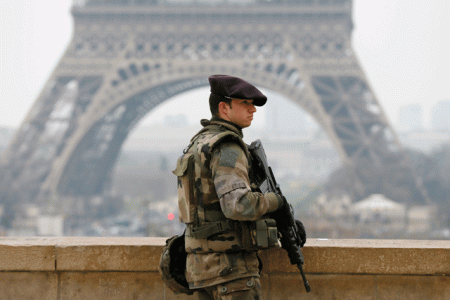
France-Soldiers-Patrol-IP_4A French soldier patrols after the Charlie Hebdo attack (Photo: © Reuters)

In 732, the town of Sens in Burgundy was invaded and looted by the troops of Abd el-Rahman as a diversionary tactic to divide the French armies who went on to defeat the Saracens at the Battle of Poitiers later that year. Thirteen centuries later, the town again made the history books.

On November 20, 2015 following the Islamist terror attacks, a state of emergency was declared and the first curfew was announced in Sens following a series of raids in the Champs-Plaisants district that uncovered stockpiles of weapons and fake identity papers.

Two weeks later, French law enforcement raided the Lagny-sur-Marne mosque east of Paris. Among objects seized were a 9mm revolver, a concealed hard disk and jihadist documents. The raid led to nine house arrests and prohibitions on leaving France against 22 people.

The former president of the Lagny Muslim Association had already fled to Egypt in December 2014 with 10 members of his congregation. Two other mosques were closed down, one in Lyon and one in Gennevilliers, a northern suburb of Paris.

Less than one month after the state of emergency was declared, French police had carried out 2,235 raids with 232 people detained and 234 weapons seized. This was just the first phase in the uncovering of the radical Islamic ecosystem financed by foreign states and organized crime that emerged and spread throughout France from the 1990s.

The terrorist attacks of November 2015 and January 2016 came as no surprise to French defense and security services, who had issued a warning at the beginning of 2015 that thousands of Islamic radicals “willing and able to out-wait the capacity of the state to dedicate scarce resources to watching them” were ready to strike. That assessment proved to be correct.

France is now confronted with a permanent terror threat from a section of its population, and despite the deployment of 10,000 troops to support 100,000 police and gendarmes, more attacks will occur in the coming years and decades. French people can no longer live in security in their own country, thanks to bad policy decisions made over the past 50 years.

The Kervenanec district of Lorient in Brittany is one of France’s 762 zones euphemistically labelled “Sensitive Areas” by the Ministry of the Interior, where endemic crime has reached critical proportions. Lorient is also one of the strongholds of radical Islam in Brittany, where the number of mosques serving the region’s 180,000 Muslims doubled from 27 in 2003 to 53 in 2015, the most notorious being the Sunna mosque in Pontanézen run by Salafist Imam Rachid Abou Houdeyfa, who is notorious for indoctrinating children.

In one religious education class, he told children that “people who listen to music will be swallowed up by the earth and turned into monkeys and pigs.”

More and more young Bretons, seduced via social media, are converting to Islam and repudiating their families. At least 15 are fighting in Syria and Iraq, and the DGSI (secret service) is currently investigating 110 individuals linked to jihadist networks.

The indigenous Bretons are up in arms, notably the sheep farmers, because of widespread sheep-rustling in the weeks leading up to the Islamic feast of Aïd-el-Kebir. Around 120,000 sheep are ritually slaughtered each year in France, often illegally and with great cruelty, in homes and apartments.

The scourge of radical Islam that is sweeping the country is impacting children as well as adolescents and young adults. In January 2015 pupils at Daniel-Mayer public junior high school in the 18th district of Paris brandished knives and meat cleavers in a rap video posted on YouTube.

Further south, a 13-year-old boy was arrested in Ariane, an eastern suburb of Nice. He was suspected of having fired a dozen shots with an airgun at a nursery school playground, wounding 2 girls aged 4 and 5, one in the head, the other in the back. Ariane is referred to in the press report as a “quartier sensible” or “sensitive neighbourhood,” which is coded language for a ghetto. These incidents demonstrate that the culture of jihad is spreading like wildfire among the children of a certain sector of the French population.

In yet another case, a 15-year-old high school student shouting “Allah Akbar” shot his physics teacher with an airgun after threatening to kill his French teacher. This happened on the same day that Le Parisien newspaper revealed that over 50% of French school teachers have taken out private insurance coverage against the risk of verbal and physical violence involving pupils and their parents.

Aside from private schools and state schools in middle-class areas, the French education system has become a difficult and dangerous place to work in. Meanwhile, the government continues to relax standards to accommodate unruly pupils who have no interest in learning, and Islam has become a standard part of the curriculum. An exercise in the chapter on Islam in the French 7th grade History/Geography course requires pupils to answer six questions about this text entitled Rewards for Combatants of Islam:

“Not equal are those of the believers who sit at home, except those who are disabled, and those who strive hard and fight in the Cause of Allah with their wealth and their lives. Allah has preferred in grades those who strive hard and fight with their wealth and their lives above those who sit at home. Unto each, Allah has promised good, but Allah has preferred those who strive hard and fight, above those who sit at home, by a huge reward.”

Is there a valid reason that 12-year-old children should be reading this, let alone memorizing the tenets of jihad?