Archive for the ‘Islamic law’ category

Divine Islamic Revelation Now International Law

December 31, 2016

Divine Islamic Revelation Now International Law, American ThinkerJonathan F. Keiler, December 31, 2016

Who is the real winner in the passing of U.N. Resolution 2334 condemning Israeli “settlements” in so-called Palestinian land? It is not the Arabs who live in East Jerusalem and the West Bank, nor the leftist BDS movement, nor the world community which acted in usual blind lock-step in condemning Israel, or even the Obama administration which sacrificed American stature and credibility to express personal pique, though all appear to be gleefully rubbing grubby hands. The real winner is radical Islam, which the aforementioned parties claim to oppose.

For all the talk of preserving a “two-state” solution between Israel and the Palestinian Arabs, and its attendant equivocating between Arab violence and incitement and the peaceful building of Jewish homes, the real heart 2334 is the first paragraph, which states that the Resolution

Reaffirms that the establishment by Israel of settlements in the Palestinian territory occupied since 1967, including East Jerusalem, has no legal validity and constitutes a flagrant violation under international law…

That “international law” is the creation of U.N. Security Council, which invents such law with the passage of resolutions, regardless of whether standard principles of law-making, such as precedent, judicial or statutory authority are present. If the U.N.S.C. passed a resolution declaring Mars and its “inhabitants” a country, that would be international law. Its resolutions on Israel are almost pure exercises in self-referential circular reasoning. But that does not mean that they are without legal or practical impact, especially when endorsed by the United States, still — if barely — the world’s preeminent power.

With Resolution 2334 the U.N.S.C. and the United States (thanks to President Obama) have endorsed and enshrined in international law the idea that Jerusalem is a historically Arab city, a bit of myth-making that could have come directly from an ISIS spokesman. For while it is a fact that Jerusalem (East and West) is and mostly has been a Jewish city, about which there can be no reasonable historical cavil, it has been the mission of Islam to convince otherwise.

That Islamic mission is part and parcel of the broader Muslim conception which sees Islam as the true and culminating expression of the god of Abraham. By extension Jews and Christians are, at best, deluded inauthentic monotheists, who may pay to be tolerated by Muslims, but nothing more. Denying Jerusalem’s Jewish identity denies its Christian identity as well. Thus, this resolution is as much an attack on Christians and Christianity as it is on “Israeli settlement activity.”

A couple days before the passage of the Resolution 2334, historian Bat Ye’or carefully delineated the U.N.’s continuing attack not only on Israel but on the West and Christianity in criticizing last April’s Jerusalem Declaration of UNESCO which ignores historical Jewish ties to the Temple Mount and declares the entire area Muslim.  Unlike U.N.S.C. resolutions, the decisions of UNESCO’s executive council are not considered binding international law, but taken in conjunction with Resolution 2334 that is now the practical effect.

This is yet another example of how Islam, including its most radical adherents, is winning the war of ideas with the Judeo-Christian West, a war that has been going on physically and intellectually since Mohammed’s first “revelation” in the early 7th Century.

From the start, Mohammed was acutely aware that to spread the new faith he had to give it legitimacy in the eyes of pre-Islamic pagan Arabs who were already gravitating toward monotheistic beliefs, some tribes having already adopted Christianity or Judaism. Mohammed supplied this legitimacy in large part by tying Allah’s revelations to existing belief systems, pagan and monotheistic alike. Thus, the Quran famously references Abraham, Moses, Jesus, and several other notable New and Old Testament figures. Per Mohammed these men were all Muslim prophets whose words and deeds were misinterpreted by the Christians and Jews who created the Old and New Testaments.

So obviously, Christians and Jews have long presented a problem for Islam. Mohammed believed that they would be eager converts to Islam, since they were already monotheists and Allah’s “revelations” acknowledged those Christian and Jewish prophets. When this did not happen, Mohammed and his successors variously slaughtered, enforced conversions or reduced the status of the “people of the book” and taxed them.

Jerusalem plays an important role in this process as I explained in detail here. While Jerusalem in not mentioned in the Quran, supposedly, early in Mohammed’s time in Medina — possibly to encourage Jewish conversion to Islam — Muslims prayed toward Jerusalem. Mohammed gave this up after a few months and turned toward Mecca.

Islam’s second caliph, the very capable Umar, captured Jerusalem a few years after Mohammed’s death. He deliberately chose the Temple Mount, where the Jewish temple stood and where Jesus walked, as the site of Islam’s first work of monumental architecture, the Dome of the Rock. He claimed the space for Islam not only physically, but spiritually, asserting that the rocky outcrop within the shrine was the very rock upon which Abraham took Isaac to be sacrificed, and Muslim scholars began to claim that the “furthest precinct” referenced in the Quran as part of Mohammed’s “night journey” was Jerusalem.

Of course, this was a lot of hooey and still is. Certainly, medieval and later Christians didn’t buy it, nor Jerusalem’s Jews then or now, but evidently President Obama and the U.N.S.C. does. Because between the UNESCO decision and Resolution 2334 it now appears that “international law” (with the concurrence of the sitting U.S. Government) establishes East Jerusalem with the Temple Mount and its ancient Jewish Quarter as historical Arab territory, although it most assuredly is not.

Unlike the New and Old Testaments, the Quran eschews narrative. It is neither a story nor a history. Muslims believe it is the direct revelation of Allah given to Mohammed as Allah saw fit, which is not man’s role to question. In failing to veto Resolution 2334 in the wake of the UNESCO move, the United States along with the rest of the international community, has now officially bought into the Islamic version of Jerusalem’s history, and with that, effectively the Muslim assertion of divine revelation in support of Islamic activity and the implementation of international law. That is a godsend to Islamic terrorists and they will see it that way too.

Germany Submits to Sharia Law

December 1, 2016

Germany Submits to Sharia Law, Gatestone InstituteSoeren Kern, December 1, 2016

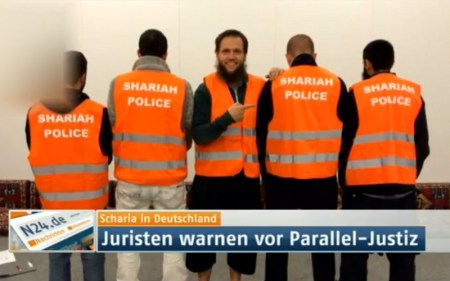
A German court has ruled that seven Islamists who formed a vigilante patrol to enforce Sharia law on the streets of Wuppertal did not break German law and were simply exercising their right to free speech. The “politically correct” decision, which may be appealed, effectively authorizes the Sharia Police to continue enforcing Islamic law in Wuppertal.

The self-appointed “Sharia Police” distributed leaflets which established a “Sharia-controlled zone” in Wuppertal. The men urged both Muslim and non-Muslim passersby to attend mosques and to refrain from alcohol, cigarettes, drugs, gambling, music, pornography and prostitution.
Critics say the cases — especially those in which German law has taken a back seat to Sharia law — reflect a dangerous encroachment of Islamic law into the German legal system.

In June 2013, a court in Hamm ruled that anyone who contracts marriage according to Islamic law in a Muslim country and later seeks a divorce in Germany must abide by the original terms established by Sharia law. The landmark ruling effectively legalized the Sharia practice of “triple-talaq,” obtaining a divorce by reciting the phrase “I divorce you” three times.

A growing number of Muslims in Germany are consciously bypassing German courts altogether and instead are adjudicating their disputes in informal Sharia courts, which are proliferating across the country.

“If the rule of law fails to establish its authority and demand respect for itself, then it can immediately declare its bankruptcy.” — Franz Solms-Laubach, Bild’sparliamentary correspondent.

A German court has ruled that seven Islamists who formed a vigilante patrol to enforce Sharia law on the streets of Wuppertal did not break German law and were simply exercising their right to free speech.

The ruling, which effectively legitimizes Sharia law in Germany, is one of a growing number of instances in which German courts are — wittingly or unwittingly — promoting the establishment of a parallel Islamic legal system in the country.

The self-appointed “Sharia Police” sparked public outrage in September 2014, when they distributed yellow leaflets which established a “Sharia-controlled zone” in the Elberfeld district of Wuppertal. The men urged both Muslim and non-Muslim passersby to attend mosques and to refrain from alcohol, cigarettes, drugs, gambling, music, pornography and prostitution.

1653-1A German court has ruled that a group of Islamists who formed a vigilante patrol to enforce Sharia law on the streets of Wuppertal did not break German law and were simply exercising their right to free speech. They were charged under a law that prohibits the wearing of uniforms at public rallies — a law originally designed to ban neo-Nazi groups from parading in public.

The vigilantes are followers of Salafism, a virulently anti-Western ideology that openly seeks to replace democracy in Germany (and elsewhere) with an Islamic government based on Sharia law.

Salafist ideology posits that Sharia law is superior to secular, common law because it emanates from Allah, the only legitimate lawgiver, and thus is legally binding eternally for all of humanity. According to the Salafist worldview, democracy is an effort to elevate the will of humans above the will of Allah, and is therefore a form of idolatry that must be rejected. In other words, Sharia law and democracy are incompatible.

Wuppertal Mayor Peter Jung said he hoped the police would take a hard line against the Islamists: “The intention of these people is to provoke and intimidate and force their ideology upon others. We will not allow this.”

Wuppertal Police Chief Birgitta Radermacher said the “pseudo police” represented a threat to the rule of law and that only police appointed and employed by the state have the legitimate right to act as police in Germany. She added:

“The monopoly of power lies exclusively with the State. Behavior that intimidates, threatens or provokes will not be tolerated. These ‘Sharia Police’ are not legitimate. Call 110 [police] when you meet these people.”

Wuppertal’s public prosecutor, Wolf-Tilman Baumert, argued that the men, who wore orange vests emblazoned with the words “SHARIAH POLICE,” had violated a law that bans wearing uniforms at public rallies. The law, which especially prohibits uniforms that express political views, was originally designed to prevent neo-Nazi groups from parading in public. According to Baumert, the vests were illegal because they had a “deliberate, intimidating and militant” effect.

On November 21, 2016, however, the Wuppertal District Court ruled that the vests technically were not uniforms, and in any event did not pose a threat. The court said that witnesses and passersby could not possibly have felt intimidated by the men, and that prosecuting them would infringe on their freedom of expression. The “politically correct” decision, which may be appealed, effectively authorizes the Sharia Police to continue enforcing Islamic law in Wuppertal.

German Courts and Sharia Law

German courts are increasingly deferring to Islamic law because either the plaintiffs or the defendants are Muslim. Critics say the cases — especially those in which German law has taken a back seat to Sharia law — reflect a dangerous encroachment of Islamic law into the German legal system.

In May 2016, for example, an appeals court in Bamberg recognized the marriage of a 15-year-old Syrian girl to her 21-year-old cousin. The court ruled that the marriage was valid because it was contracted in Syria, where such marriages are allowed according to Sharia law, which does not set any age limit to marriage. The ruling effectively legalized Sharia child marriages in Germany.

The case came about after the couple arrived at a refugee shelter in Aschaffenburg in August 2015. The Youth Welfare Office (Jugendamt) refused to recognize their marriage and separated the girl from her husband. The couple filed a lawsuit and a family court ruled in favor of the Youth Welfare Office, which claimed to be the girl’s legal guardian.

The court in Bamberg overturned that ruling. It determined that, according to Sharia law, the marriage is valid because it has already been consummated, and therefore the Youth Welfare Office has no legal authority to separate the couple.

The ruling — which was described as a “crash course in Syrian Islamic marriage law” — ignited a firestorm of criticism. Some accused the court in Bamberg of applying Sharia law over German law to legalize a practice that is banned in Germany.

Critics of the ruling pointed to Article 6 of the Introductory Act to the German Civil Code (Einführungsgesetz zum Bürgerlichen Gesetzbuche, EGBGB), which states:

“A legal standard of another State shall not be applied where its application results in an outcome which is manifestly incompatible with the essential principles of German law. In particular, it is not applicable if the application is incompatible with fundamental rights.”

This stipulation is routinely ignored, however, apparently in the interests of political correctness and multiculturalism. Indeed, Sharia law has been encroaching into the German justice system virtually unchecked for nearly two decades. Some examples include:

  • In August 2000, a court in Kassel ordered a widow to split her late Moroccan husband’s pension with another woman to whom the man was simultaneously married. Although polygamy is illegal in Germany, the judge ruled that the two wives must share the pension, in accordance with Moroccan law.
  • In March 2004, a court in Koblenz granted the second wife of an Iraqi living in Germany the right to remain permanently in the country. The court ruled that after five years in a polygamous marriage in Germany, it would be unfair to expect her to return to Iraq.
  • In March 2007, a judge in Frankfurt cited the Koran in a divorce case involving a German-Moroccan woman who had been repeatedly beaten by her Moroccan husband. Although police ordered the man to stay away from his estranged wife, he continued to abuse her and at one point threatened to kill her. Judge Christa Datz-Winter refused to grant the divorce. She quoted Sura 4, Verse 34 of the Koran, which justifies “both the husband’s right to use corporal punishment against a disobedient wife and the establishment of the husband’s superiority over the wife.” The judge was eventually removed from the case.
  • In December 2008, a court in Düsseldorf ordered a Turkish man to pay a €30,000 ($32,000) dowry to his former daughter-in-law, in accordance with Sharia law.
  • In October 2010, a court in Cologne ruled that an Iranian man must pay his ex-wife a dower of €162,000 euros ($171,000), the current equivalent value of 600 gold coins, in accordance with the original Sharia marriage contract.
  • In December 2010, a court in Munich ruled that a German widow was entitled to only one-quarter of the estate left by her late husband, who was born in Iran. The court awarded the other three-quarters of the inheritance to the man’s relatives in Tehran in accordance with Sharia law.
  • In November 2011, a court in Siegburg allowed an Iranian couple to be divorced twice, first by a German judge according to German law, and then by an Iranian cleric according to Sharia law. The director of the Siegburg District Court, Birgit Niepmann, said the Sharia ceremony “was a service of the court.”
  • In July 2012, a court in Hamm ordered an Iranian man to pay his estranged wife a dower as part of a divorce settlement. The case involved a couple who married according to Sharia law in Iran, migrated to Germany and later separated. As part of the original marriage agreement, the husband promised to pay his wife a dower of 800 gold coins payable upon demand. The court ordered the husband to pay the woman €213,000 ($225,000), the current equivalent value of the coins.
  • In June 2013, a court in Hamm ruled that anyone who contracts marriage according to Islamic law in a Muslim country and later seeks a divorce in Germany must abide by the original terms established by Sharia law. The landmark ruling effectively legalized the Sharia practice of “triple-talaq,” obtaining a divorce by reciting the phrase “I divorce you” three times.
  • In July 2016, a court in Hamm ordered a Lebanese man to pay his estranged wife a dower as part of a divorce settlement. The case involved a couple who married according to Sharia law in Lebanon, migrated to Germany and later separated. As part of the original marriage agreement, the husband promised to pay his wife a dower of $15,000. The German court ordered him to pay her the equivalent amount in euros.

In an interview with Spiegel Online, Islam expert Mathias Rohe said that the existence of parallel legal structures in Germany is an “expression of globalization.” He added: “We apply Islamic law just as we do French law.”

Sharia Courts in Germany

A growing number of Muslims in Germany are consciously bypassing German courts altogether and instead are adjudicating their disputes in informal Sharia courts, which are proliferating across the country. According to one estimate, some 500 Sharia judges are now regulating civil disputes between Muslims in Germany — a development that points to the establishment of a parallel Islamic justice system in the country.

A major reason for the growth in Sharia courts is that Germany does not recognize polygamy or marriages involving minors.

The German Interior Ministry, responding to a Freedom of Information Act request, recently revealed that 1,475 married children are known to be living in Germany as of July 31, 2016 — including 361 children who are under the age of 14. The true number of child marriages in Germany is believed to be much higher than the official statistics suggest, because many are being concealed.

Polygamy, although illegal under German law, is commonplace among Muslims in all major German cities. In Berlin, for example, it is estimated that fully one-third of the Muslim men living in the Neukölln district of the city have two or more wives.

According to an exposé broadcast by RTL, one of Germany’s leading media companies, Muslim men residing in Germany routinely take advantage of the social welfare system by bringing two, three or four women from across the Muslim world to Germany, and then marrying them in the presence of a Muslim cleric. Once in Germany, the women request social welfare benefits, including the cost of a separate home for themselves and for their children, on the claim of being a “single parent with children.”

Although the welfare fraud committed by Muslim immigrants is an “open secret” costing German taxpayers millions of euros each year, government agencies are reluctant to take action due to political correctness, according to RTL.

Chancellor Angela Merkel once declared that Muslims must obey the constitution and not Sharia law if they want to live in Germany. More recently, Justice Minister Heiko Maas said:

“No one who comes here has the right to put his cultural values or religious beliefs above our law. Everyone must abide by the law, no matter whether they have grown up here or have only just arrived.”

In practice, however, German leaders have tolerated a parallel Islamic justice system, one which allows Muslims to take the law into their own hands, often with tragic consequences.

On November 20, 2016, for example, a 38-year-old German-Kurdish man in Lower Saxony tied one end of a rope to the back of his car and the other end around the neck of his ex-wife. He then dragged the woman through the streets of Hameln. The woman, who survived, remains in critical condition.

The newsmagazine, Focus, reported that the man was a “strictly religious Muslim who married and divorced the woman according to Sharia law.” It added: “Under German law, however, the two were not married.” Bild reported that the man was married “once under German law and four times under Sharia law.”

The crime, which has drawn renewed attention to the problem of Sharia justice in Germany, has alarmed some members of the political and media establishment.

Wolfgang Bosbach, of the ruling Christian Democratic Union (CDU), said: “Even if some people refuse to admit it, a parallel justice system has established itself in Germany. This act shows a clear rejection of our values and legal order.”

On November 23, Bild, the largest-circulation newspaper in Germany, warned that the country was “capitulating to Islamic law.” In a special “Sharia Report” it stated:

“The 2013 coalition agreement between the CDU and the Social Democrats promised: ‘We want to strengthen the state’s legal monopoly. We will not tolerate illegal parallel justice.’ But nothing has happened.”

In a commentary, Franz Solms-Laubach, Bild’s parliamentary correspondent, wrote:

“Even if we still refuse to believe it: Parts of Germany are ruled by Islamic law! Polygamy, child marriages, Sharia judges — for far too long the German rule of law has not been enforced. Many politicians dreamed of multiculturalism….

“This is not a question of folklore or foreign customs and traditions. It is a question of law and order.

“If the rule of law fails to establish its authority and demand respect for itself, then it can immediately declare its bankruptcy.”


Muslim persecution forces convert from Islam to Christianity to flee home under armed guard…in the UK

November 5, 2016

Muslim persecution forces convert from Islam to Christianity to flee home under armed guard…in the UK, Jihad Watch

No one should be surprised that this kind of thing is happening in Britain. It’s going to happen a great deal more, too, because the death penalty for apostasy is part of Islamic law. It’s based on the Qur’an: “They wish you would disbelieve as they disbelieved so you would be alike. So do not take from among them allies until they emigrate for the cause of Allah. But if they turn away, then seize them and kill them wherever you find them and take not from among them any ally or helper.” (Qur’an 4:89)

A hadith depicts Muhammad saying: “Whoever changed his Islamic religion, then kill him” (Bukhari 9.84.57). The death penalty for apostasy is part of Islamic law according to all the schools of Islamic jurisprudence.

This is still the position of all the schools of Islamic jurisprudence, both Sunni and Shi’ite. Sheikh Yusuf al-Qaradawi, the most renowned and prominent Muslim cleric in the world, has stated: “The Muslim jurists are unanimous that apostates must be punished, yet they differ as to determining the kind of punishment to be inflicted upon them. The majority of them, including the four main schools of jurisprudence (Hanafi, Maliki, Shafi’i, and Hanbali) as well as the other four schools of jurisprudence (the four Shiite schools of Az-Zaidiyyah, Al-Ithna-‘ashriyyah, Al-Ja’fariyyah, and Az-Zaheriyyah) agree that apostates must be executed.”

Qaradawi also once famously said: “If they had gotten rid of the apostasy punishment, Islam wouldn’t exist today.”

nissar-hussain-and-family

“‘Persecuted’ family forced to flee Manningham home as threats escalate,” by David Jagger, Telegraph & Argus, November 4, 2016:

A FATHER who said he suffered “seven years of persecution” has been forced to flee his home under armed guard amid fears for his safety.

Nissar Hussain was with his family when police arrived and moved him to a safe place.

Mr Hussain said the culmination of the “extreme persecution” had devastated his family and the dramatic arrival of armed police was a complete surprise.

“My family are distraught and extremely traumatised to be leaving,” said Mr Hussain.

“But when your life is at stake there is no other choice.”

Mr Hussain converted to Christianity 20 years ago, but says in recent years he has been subjected to harassment and violence by sections of the Islamic community.

“This extreme persecution by certain people in the Muslim community because we are converts has broken us as a family,” he said.

“We are fragmented and I do not know how we will recover from this. We haven’t functioned properly for years.”

He said “serious questions” needed to be answered.

Last year, Mr Hussain was hospitalised after his kneecap was smashed and his hand broken during an attack outside his home in St Paul’s Road, Manningham.

Two hooded men, one armed with a pick-axe handle, assaulted him in a vicious attack caught on CCTV.

At the time, Mr Hussain said he and his family were being driven out of the city and he was making plans to leave. This week he had started packing up his belongings when the police arrived on Thursday.

He briefly returned home yesterday to collect more items, with police guarding, before leaving Bradford for good.

The 50-year-old, who was a nurse before leaving work due to post-traumatic stress disorder, said his six children, aged eight to 24, and wife would never see their friends again.

He had been expecting an attack for some months, but when the police arrived he was “none the wiser” that he was at such serious risk.

“The armed police arrived at about 3pm on Thursday,” he said….

On the Road to a Sharia State – Investigating the UK’s Sharia Courts

October 14, 2016

On the Road to a Sharia State – Investigating the UK’s Sharia Courts, Creeping Sharia, October 14, 2016

uksharia

Source: Machteld Zee: “Islamization is Planned” – Vlad Tepes

Machteld Zee Ph.D. is a Dutch scholar who investigated sharia courts in the UK for her Ph.D. thesis. This interview was published in the Algemeen Dagblad, a nationwide Dutch newspaper, on October 4, 2016.

The interview is relevant for several reasons:

  • Very few non-Muslims ever have gained access to the world of sharia courts in the UK. She has.
  • The University of Leiden is fairly highbrow in the Netherlands, because it is not only one of the oldest universities. but also because the heir to the Dutch throne traditionally studies at this university (for example, our former Queens Juliana and Beatrix did, just like our current head of state King Willem-Alexander). The reputation of this university gives authority to her voice.
  • She has become a target of attacks by leftist apologists for radical Islam since she published her thesis. She could do with some positive publicity. Similarly, Islam-sceptics could benefit from her work.

The translated interview:

“Islamization is Planned”

Investigating Sharia

The Islamization of Europe follows a strategy, according to Machteld Zee in her bookHoly Identities, which was published today. ‘Once you have knowledge of it, you understand what is going on.’

‘I discovered a comprehensive system of law that contradicts our secular laws.’

Investigating sharia courts

Machteld Zee (32), a Dutch political scientist from the University of Leiden, studied sharia courts in the UK and wrote her Ph.D. thesis on it in 2015.

She was one of the few outsiders who gained access to the sessions of these Islamic courts. 95% of the cases before these courts are divorce cases. Her investigations resulted in a pamphlet, Holy Identities.

‘If you compare the Netherlands in the 1980s with today,’ says the political scientist and law school graduate Machteld Zee, ‘you will see an increased influence of Islam everywhere. Saudi Arabia and other countries flooded the world with thousands of imams, Islamic text books, mosques and tons of money.’

Machteld Zee needed barely 150 pages to describe the background of Islamic fundamentalism, which is gaining ground in Western countries. Her book Holy Identities: On the Road to a Sharia State is an analysis of the problems of the multicultural society.

You say that conservative Muslims want to convince their fellow Muslims to embrace sharia, the religious law of Islam. These fundamentalists are being helped by ‘useful non-believers’, non-Islamic intellectuals, politicians and opinion leaders who don’t want to offend Muslims.

‘Yes, leading multiculturalists actually believe that Muslims should be shielded from criticism because it would inflict psychological damage on them. Although many Muslims consider this an idiotic point of view, others use it to call those who criticize Islam ‘Islamophobes’ and ‘racists’.

You described yourself as left-leaning liberal when you started your investigation on sharia courts in the UK. Now you warn against a lack of knowledge of and a lack of resistance against the advancing radical Islam.

‘I discovered a comprehensive system of law — far more systematic then I had expected — that contradicts our secular laws. Many Muslim women are locked into a religious marriage because their community thinks a divorce according secular law is insufficient. In these communities — Muslim communities — sharia law trumps secular law when it comes to marriage. Women have to ask a sharia judge or an imam to dissolve their marriage, for example when the husband physically abuses her. Even Dutch Muslim women travel to the UK to appear before sharia courts. It is a parallel society. I object to it because these practices go against women’s rights.’

You have analyzed the activities of the Muslim Brotherhood. It is a political and religious movement that aims for world domination, and is supported by lots of money from fundamentalist circles. The sharia courts are part of this project, you wrote.

‘That is why it is so important that we know what is going on. Authors that I studied for my investigation were generally benevolent towards sharia courts. It turned out, however, that none of them ever attended a session of such a court. They don’t know what is going on in these courts. Now they ask me to tell all about it. Women are advised by these courts to accept polygamy and to not file criminal complaints in case of domestic violence. Physically abusive fathers are given custody of their children. I have the impression that the tide of the public debate is turning now that these facts are becoming public. I hardly hear anyone pleading in favour of sharia courts anymore.’

In your book you call out the politically correct elites, who tries to cover up abuse within Islam and tries to downplay the threat of Islamic fundamentalism.

‘In the first place, I think I am reporting facts. Where I notice that influential Western intellectuals tend to discourage critics of Islam and help fundamentalists to isolate and ‘Islamize’ Muslim communities, that is a matter of fact. My book is a compact discourse that aims to bring its readers up to date on fundamentalist Islam.’

How do you see the future?

We will have to act more defensively and resist Islamization. We should not yield to demands that images of scantily dressed women in public have to be covered up, for example. Just say no. Citizens should not leave everything to the government. They can defend our beliefs and values themselves, too. Why does a college in The Hague decides to abandon the Christmas tree pre-emptively? Why is alcohol banned in places where Muslims show up? There is no need for that. We are doing it to ourselves.’

Do you fear criticism? Undoubtedly, you will be labeled as a right-winger.

‘I don’t experience that when I speak in public. Even a ‘leftist’ audience responds positively to my story. Right-wing? Come on, equal rights for women and resistance against representatives of a religion who make threats of violence — let’s call that common sense.’

Federal Government Authorizes Facebook, Twitter, and YouTube to Censor “Anti-Islam” Speech; Lawsuit Filed

July 13, 2016

Federal Government Authorizes Facebook, Twitter, and YouTube to Censor “Anti-Islam” Speech; Lawsuit Filed, July 13, 2016

AFLC_SocialMedia_Censorship_Banner_07-11-16-3-Final-1024x527

Today, the American Freedom Law Center (AFLC) filed a federal lawsuit in the U.S. District Court for the District of Columbia, challenging Section 230 of the Communications Decency Act (CDA) under the First Amendment.

Section 230 provides immunity from lawsuits to Facebook, Twitter, and YouTube, thereby permitting these social media giants to engage in government-sanctioned censorship and discriminatory business practices free from legal challenge.

The lawsuit was brought on behalf of the American Freedom Defense Initiative (AFDI), Pamela Geller, Robert Spencer, and Jihad Watch.

As alleged in the lawsuit, Geller and Spencer, along with the organizations they run, are often subject to censorship and discrimination by Facebook, Twitter and YouTube because of Geller’s and Spencer’s beliefs and views, which Facebook, Twitter, and YouTube consider expression that is offensive to Muslims.

Such discrimination, which is largely religion-based in that these California businesses are favoring adherents of Islam over those who are not, is prohibited in many states, but particularly in California by the state’s anti-discrimination law, which is broadly construed to prohibit all forms of discrimination.  However, because of the immunity granted by the federal government, Facebook, Twitter, and YouTube are free to engage in their otherwise unlawful, discriminatory practices.

As set forth in the lawsuit, Section 230 of the CDA immunizes businesses such as Facebook, Twitter, and YouTube from civil liability for any action taken to “restrict access to or availability of material that” that they “consider[] to be obscene, lewd, lascivious, filthy, excessively violent, harassing, or otherwise objectionable, whether or not such material is constitutionally protected.”

Robert Muise, AFLC co-founder and senior counsel, issued the following statement:

“Section 230 of the CDA confers broad powers of censorship upon Facebook, Twitter, and YouTube officials, who can silence constitutionally protected speech and engage in discriminatory business practices with impunity by virtue of this power conferred by the federal government in violation of the First Amendment.”

Muise went on to explain:

“Section 230 is a federal statute that alters the legal relations between our clients and Facebook, Twitter, and YouTube, resulting in the withdrawal from our clients of legal protections against private acts.  Consequently, per U.S. Supreme Court precedent, state action lies in our clients’ challenge under the First Amendment.”

David Yerushalmi, AFLC co-founder and senior counsel, added:

“Facebook, Twitter, and YouTube have notoriously censored speech that they deem critical of Islam, thereby effectively enforcing blasphemy laws here in the United States with the assistance of the federal government.”

Yerushalmi concluded:

“It has been the top agenda item of Islamic supremacists to impose such standards on the West.  Its leading proponents are the Muslim Brotherhood’s network of Islamist activist groups in the West and the Organization of Islamic Cooperation (OIC), which co-sponsored, with support from Obama and then-Secretary of State Clinton, a U.N. resolution which called on all nations to ban speech that could promote mere hostility to Islam.  Facebook, Twitter, and YouTube are falling in line, and we seek to stop this assault on our First Amendment freedoms.”

AFLC Co-Founders and Senior Counsel Robert J. Muise and David Yerushalmi, along with the plaintiffs in this case, Pamela Geller and Robert Spencer, will hold a Press Call from 2:00-2:30 p.m. on Wednesday, July 13.  To access this press conference call, dial(641) 715-3655 and enter code 111815.

Germany’s Turkish-Muslim Integration Problem

June 24, 2016

Germany’s Turkish-Muslim Integration Problem, Gatestone Institute, Soeren Kern, June 24, 2016

♦ Seven percent of respondents agreed that “violence is justified to spread Islam.” Although these numbers may seem innocuous, 7% of the three million Turks living in Germany amounts to 210,000 people who believe that jihad is an acceptable method to propagate Islam.

♦ The survey also found that labor migration is no longer the main reason why Turks immigrate to Germany: the most important reason is to marry a partner who lives there.

♦ A new statistical survey of Germany — Datenreport 2016: Social Report for the Federal Republic of Germany — shows that ethnic Turks are economically and educationally less successful than other immigrant groups, and that more than one-third (36%) of ethnic Turks live below the poverty line, compared to 25% of migrants from the Balkans and southwestern Europe.

♦ “In our large study we asked Muslims how strongly they feel discriminated against, and we searched for correlations to the development of a fundamentalist worldview. But there are none. Muslim hatred of non-Muslims is not a special phenomenon of Muslim immigration, but is actually worse in the countries of origin. Radicalization is not first produced here in Europe, rather it comes from the Muslim world.” — Ruud Koopmans, sociologist.

Nearly half of the three million ethnic Turks living in Germany believe it is more important to follow Islamic Sharia law than German law if the two are in conflict, according to a new study.

One-third of those surveyed also yearn for German society to “return” to the way it was during the time of Mohammed, the founder of Islam, in the Arabia of the early seventh century.

The survey — which involves Turks who have been living in Germany for many years, often decades — refutes claims by German authorities that Muslims are well integrated into German society.

The 22-page study, “Integration and Religion from the Viewpoint of Ethnic Turks in Germany” (Integration und Religion aus der Sicht von Türkeistämmigen in Deutschland), was produced by the Religion and Politics department of the University of Münster. Key findings include:

  • 47% of respondents agreed with the statement that “following the tenets of my religion is more important to me than the laws of the land in which I live.” This view is held by 57% of first generation Turkish immigrants and 36% of second and third generation Turks. (The study defines first generation Turks as those who arrived in Germany as adults; second and third generation Turks are those who were born in Germany or who arrived in the country as children.)
  • 32% of respondents agreed that “Muslims should strive to return to a societal order like that in the time of Mohammed.” This view is held by 36% of the first generation and 27% of the second and third generation.
  • 50% of respondents agreed that “there is only one true religion.” This view is held by 54% of the first generation and 46% of the second and third generation.
  • 36% of respondents agreed that “only Islam is able to solve the problems of our times.” This view is held by 40% of the first generation and 33% of the second and third generation.
  • 20% of respondents agreed that “the threat which the West poses to Islam justifies violence.” This view is held by 25% of the first generation and 15% of the second and third generation.
  • 7% of respondents agreed that “violence is justified to spread Islam.” This view is held by 7% of the first generation and 6% of the second and third generation. Although these numbers may seem innocuous, 7% of the three million Turks living in Germany amounts to 210,000 people who believe that jihad is an acceptable method to propagate Islam.
  • 23% of respondents agreed that “Muslims should not shake the hand of a member of the opposite sex.” This view is held by 27% of the first generation and 18% of the second and third generation.
  • 33% of respondents agreed that “Muslim women should wear a veil.” This view is held by 39% of the first generation and 27% of the second and third generation.
  • 31% of female respondents said that they wear a veil in public. This includes 41% of the first generation and 21% of the second and third generation.
  • 73% of respondents agreed that “books and movies that attack religion and offend the feelings of deeply religious people should be banned by law.”
  • 83% of respondents agreed that “I get angry when Muslims are the first to be blamed whenever there is a terrorist attack.”
  • 61% of respondents agreed that “Islam fits perfectly in the Western world.”
  • 51% of respondents agreed that “as an ethnic Turk, I feel like a second class citizen.”
  • 54% of respondents agreed that “regardless of how hard I try, I am not accepted as a member of German society.”

The study also found that Turks and native Germans hold radically different perceptions about Islam:

  • While 57% of Turkish Germans associate Islam with human rights, only 6% of Germans do.
  • While 56% of Turkish Germans associate Islam with tolerance, only 5% of Germans do.
  • While 65% of Turkish Germans associate Islam with peace, only 7% of Germans do.

Based on the answers provided, the authors of the survey concluded that 13% of respondents are “religious fundamentalists” (18% of the first generation and 9% of the second and third generation). Although these numbers may appear insignificant, 13% of the three million Turks in Germany amounts to nearly 400,000 Islamic fundamentalists, many of whom believe that violence is an acceptable means to spread Islam.

The survey’s findings mirror those of other studies, which show that Turkish migrants are poorly integrated into German society.

In 2012, the 103-page study, “German-Turkish Life and Values” (Deutsch-Türkische Lebens- und Wertewelten), found that only 15% of ethnic Turks living in Germany consider the country to be their home. Other key findings include:

  • Nearly half (46%) of Turks agreed with the statement, “I hope that in the future there will be more Muslims than Christians living in Germany”; more than half (55%) said that Germany should build more mosques.
  • 72% of respondents said that Islam is the only true religion; 18% said that Jews are inferior to Muslims and 10% said that Christians are inferior.
  • 63% of Turks between the ages of 15 and 29 said they approve of a Salafist campaign to distribute a Koran to every household in Germany; 36% said they would be willing to support the campaign financially.
  • 95% of respondents said it is absolutely necessary for them to preserve their Turkish identity; 87% said they believe that Germans should make a greater effort to be considerate of Turkish customs and traditions.
  • 62% of respondents said they would rather be around Turks than Germans; only 39% of Turks said that Germans were trustworthy.

The survey also found that labor migration is no longer the main reason why Turks immigrate to Germany: the most important reason is to marry a partner who lives there.

Meanwhile, a new statistical survey of Germany — Datenreport 2016: Social Report for the Federal Republic of Germany (Datenreport 2016: Sozial-bericht für die Bundesrepublik Deutschland) — shows that ethnic Turks are economically and educationally less successful than other immigrant groups.

The report, produced by Germany’s official statistics agency, Destatis, in cooperation with several German think tanks, shows that more than one-third (36%) of ethnic Turks are living below the poverty line, compared to 25% of migrants from the Balkans and southwestern Europe (Spain and Portugal). The average income of ethnic Turkish households is €1,242 ($1,400) per month, compared to €1,486 ($1,700) for non-Turkish migrants and €1,730 ($1,950) for German households.

Only 5% of ethnic Turks earn more than 150% of the average German income, compared to 21% of migrants from Eastern Europe, 18% of those from southwestern Europe and 11% of those from the Balkans.

1662An open-air market in the heavily-Turkish Kreuzberg district of Berlin. (Image source: The Berlin Project video screenshot)

The report also shows that Turks have a lower educational attainment than other migrant groups in Germany. Only 60% of ethnic Turks complete secondary school (Hauptschulabschluss), compared to 85% of migrants from Eastern Europe. Moreover, only 8% of ethnic Turks between the ages of 17 and 45 earn a Bachelor’s degree, compared to 30% of migrants in the same demographic from Eastern Europe. Education is a determinative factor for successful integration, according to the report.

German multiculturalists often blame the lack of Turkish integration on the Germans themselves. Writing for Die Welt, economist Thomas Straubhaar argues that most Germans view Turks as guests, not as fellow citizens, an attitude which discourages Turks from integrating:

“Ethnic Turks are essentially treated as guests — hence the controversy over whether their faith belongs to Germany or not. Their immigration is seen as temporary. Their contribution to German culture is seen in a negative light.

“Those who treat migrants as guests should not be surprised when they behave as such. Guests are not expected to have any emotional devotion to the host, nor does the host feel any obligation to show irrevocable loyalty to the guest.

“Guests will not be willing to put all their cards on the table of the host country and take full responsibility for successful integration. Guests assume that sooner or later they must return home again. In everything they do, they will always consider their guest status and be only halfheartedly engaged. This applies to investments in language, culture, friendships, social contacts and professional career.”

Others counter that those who act like strangers should not be surprised if they are treated as strangers. Sociologist Ruud Koopmans argues that one of the most determinative factors in successful integration involves the cultural gap between host and guest. The greater the distance, the greater the integration challenge.

In a recent interview with WirtschaftsWoche, Koopmans criticized multiculturalists who for normative reasons insist that culture and religion should not be factored into the debate on integration:

“In all European countries, Muslim immigrants lag behind all other immigrant groups in almost every aspect of integration. This applies to the labor market, but also to educational achievement, inter-ethnic contacts, i.e., contacts with the local population, and identification with the country of residence.

“Three decisive factors determine cultural distance: language skills, inter-ethnic contacts — especially those involving marriage — and values about the role of women. They all have something to do with religion. This of course applies especially for ideas about the role of women, which are derived directly from the Islamic religion. The greater the cultural distance between groups — especially when there are cultural taboos — the more complicated inter-ethnic marriages become. Such taboos make it virtually impossible for a Muslim, and especially Muslim women, to marry a non-Muslim. Statistics from various European countries show that less than ten percent of Muslim marriages are inter-ethnic.”

Detlef Pollack, the author of the University of Münster study cited above, blames the lack of Turkish integration on discrimination: “The message to the majority German population is that we should be more sensitive to the problems encountered by those of Turkish origin,” he told Deutsche Welle. “It is our view that the feeling of not being accepted is expressed in the vehement defense of Islam.”

Koopmans rejects the link between discrimination and radicalization:

“This is a common assertion. But it is wrong. In our large study we asked Muslims how strongly they feel discriminated against, and we searched for correlations to the development of a fundamentalist worldview. But there are none. Muslim hatred of non-Muslims is not a special phenomenon of Muslim immigration, but is actually worse in the countries of origin. Radicalization is not first produced here in Europe, rather it comes from the Muslim world.”