H/t Townhall
H/t Papundits
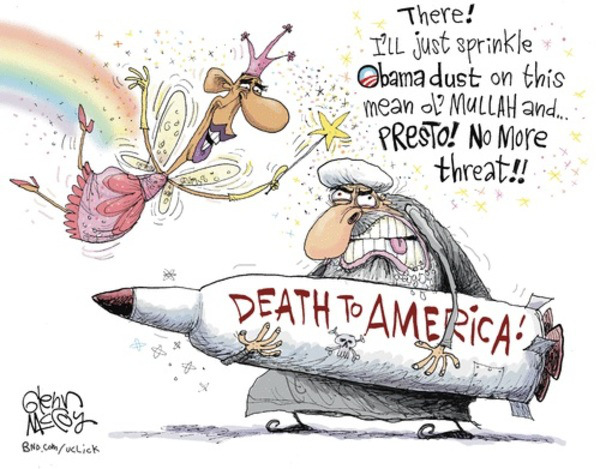
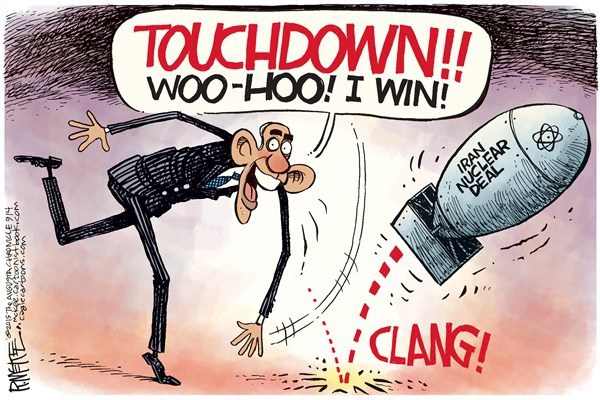
Nuclear Jihad, Gatestone Institute, Denis MacEoin, September 7, 2015
“[Some] analysts,” writes the historian and former Israeli Ambassador to the United States, Michael Oren, “claimed the president [Barack Obama] regarded Iran as an ascendant and logical power — unlike the feckless, disunited Arabs and those troublemaking Israelis — that could assist in resolving other regional conflicts. I first heard this theory at Georgetown back in 2008, in conversation with think tankers and former State Department officials. They also believed Iran’s radical Islam was merely an expression of interests and fears that the United States could with sufficient goodwill, meet and allay. … Iran, according to Obama was a pragmatic player with addressable interest. For Netanyahu, Iran was irrational, messianic, and genocidal – ‘worse,’ he said, ‘than fifty North Koreas.'”[1]
Since the signing of the deal at the UN, hot-tempered criticisms and defences have gone into overdrive in the political, journalistic, and diplomatic spheres. Acres have been written and are still being written about the deal, making it the hottest political potato of recent years. Expert analysts such as Omri Ceren and, more recently, Joel Rosenberg have cut through the deliberate obfuscation to show the extent of the dangers the deal presents to the Middle East, the United States, Israel, and the world.
The deal’s supporters insist that it will bring peace and calm to the region, while a host of denigrators — chief among them Israeli Prime Minister Binyamin Netanyahu — have exposed the enormous risks it entails. Already, a vast majority of American citizens are opposed to the deal.
Within the U.S. Congress, bipartisan opposition to the deal is high and mounting. Yet, on September 2, President Obama succeeded in winning over a 34th senator, enough that ultimate passage of the deal is a foregone conclusion. That does not, however, mean that the debate will end. In all likelihood, it will grow fiercer as time passes and true consequences become clearer to the public and politicians alike.
Recent revelations that the International Atomic Energy Agency (IAEA), which oversees nuclear developments worldwide, has agreed that only Iranians will be allowed to inspect the most controversial of Iran’s nuclear sites, have raised anxieties about proper monitoring of the deal. The military complex of Parchin, where Iran is suspected of work on nuclear weapons, will be closed to outside inspection, making it certain that, if Iran decides to cheat (something it has done before), it will be able to do so with impunity. Sanctions will not be re-imposed. And, as we shall see, cheating on the deal can be justified by the Iranians who could always refer to the practice of the prophet Muhammad with the Quraysh tribe in Mecca.
Obama, his Secretary of State John Kerry, and the entire US administration are not merely behind the deal, but almost fanatically so. Many argue that Obama is more interested in securing his “legacy” as the world’s greatest peacemaker (or war-creator, as the case may well turn out to be), the statesman par excellence who alone could bring the theocratic regime of Iran in from the cold and shower the Middle East with true balance in its troubled affairs.
To bring this about, Obama has had to diminish, if not leave totally open to obliteration, American support for Israel, the single country in the world most clearly exposed to a possible genocide should the Iran’s Islamic regime choose to exterminate it, as it has so often threatened to do.
Mahmoud Ahmadinejad’s words mellal-e Eslami bayad Esra’il-ra qal’ o qam’ kard – “the Islamic nations must exterminate Israel” — have been given renewed vigour now that it is highly likely that Iran, evading serious inspections by the IAEA, will soon possess the weapons to do just that.
Even if the treaty is a done deal, it is time to show yet another massive hole in the administration’s strategy. Already, Obama, Kerry and the tightly knit administration have shown themselves remarkably obdurate in turning a blind eye to the many concerns that surround the deal. At the end of the “sunset period,” if not sooner, Iran gets to have, legitimately, as many bombs as it likes. Other problems include breakout times; centrifuge production; centrifuge concealment; uranium enrichment by stealth; refusal to allow the IAEA to inspect military sites; the acquisition of intercontinental ballistic missiles — presumably to be used intercontinentally at guess who. It is no secret that the hardliners in Iran still speak of America as “The Great Satan” and consider it their enemy. That does not even include the implications of lifting sanctions on, and paying billions of dollars to, the world’s main sponsor of terrorism.
As Michael Oren has shown, however, the American president presumably thinks he is doing a deal with a logical and pragmatic regime. Barack Obama, an intelligent, well-read man of Muslim origin, knows almost nothing about Islam; that is the greatest flaw in the Iran deal he has fought so hard to inflict on the human race. With access to platoons of experts, to some of the greatest libraries with holdings in Islamic doctrines and history, and with the Mullahs and Iran’s public still daily promising to destroy America, Obama apparently still believes Islam is a religion of peace and that a theocratic, terror-supporting, medieval regime should have the power to make nuclear bombs. The obverse is that he might like, perhaps not wittingly, to see America, Israel and the West brought to their knees.
This author has previously exposed one aspect of Iran’s serious lack of logic, rationality, or pragmatism — namely the extent to which apocalyptic thinking, messianic prophecy, and dreams of Islamic transcendence through universal conflict pervade the clerical elite, a high percentage of the masses, and even the Islamic Revolutionary Guard Corps. One might assume that this would be especially true when they are flush with cash and nuclear weapons, and the risk to their own survival is substantially lower.
On August 17, just over a month after the signing of the nuclear deal, Iran’s Supreme Leader, ‘Ali Khamene’i, addressed a religious conference, where he expressed his undying hatred for the United States. He said, for example:
We must combat the plans of the arrogance [i.e. the West, led by the U.S.] with jihad for the sake of Allah. … jihad for the sake of God does not only mean military conflict, but also means cultural, economic, and political struggle. The clearest essence of jihad for the sake of God today is to identify the plots of the arrogance in the Islamic region, especially the sensitive and strategic West Asian region. The planning for the struggle against them should include both defense and offense.
The deal has done nothing whatever to stop military threats to Israel, an ally of the United States (though treated with disrespect by America’s president). Speaking on 2 September, the Islamic Revolutionary Guard Corp’s top commander in Tehran province, Brigadier General Mohsen Kazemayni, stated that, “… they [the US and the Zionists] should know that the Islamic Revolution will continue enhancing its preparedness until it overthrows Israel and liberates Palestine.”
There is a simple word for this: warmongering.
Why is the U.S. President insisting on a bad deal with a warmongering regime?
When a military force at its strongest fantasizes about the coming of a Messiah (the Twelfth Imam) to lead them to victory over all infidels, talk of logic, rationality and pragmatism seems acutely out of touch with reality.
Obama’s assumption that there is something solid about the Iranian regime that makes it suitable as a recipient for such largesse and the chance to enrich uranium until kingdom come seems to be based on false consciousness. The regime has been in place for almost forty years, quite a respectable time for a dictatorship. In part, that has been because it has mastered the art of suppression, giving its people a degree of freedom that is missing in several other Islamic countries, such as Saudi Arabia, Sudan, or Afghanistan. These partial freedoms, especially for young people, lull the population into risk-averseness, possibly helped along by the memory in 2009 of pleas for more freedom, which the United States ignored and the mullahs savaged.
Obama, in his ongoing attempt to portray Islam as benign — and a dictatorial regime as a sold basis for peace and understanding in the Middle East — ignores the religious element of the theocracy, as well as the sadistic repression, and in doing so misses a lot.
First of all, Shi’ite Islam is different from its Sunni big brother. It is deeply imbued with features largely absent from Sunni Islam. The most important Shi’i denomination is that of the Twelvers (Ithna’ ‘Ashariyya), who, from the beginning of Islam, have believed themselves to be not only the true version of the faith, but the group destined by God to rule in its name. Beginning with ‘Ali, the son-in-law of the Prophet and the fourth Caliph of the Sunnis, the Shi’a began as his supporters. (Please see the Appendix that follows this article: it contains material that even Barack Obama and his advisors need to know; without it, they simply will not “get” what the ayatollahs are about. It comes to an important conclusion that has considerable bearing on today’s events — and not the one you may expect.)
Beneath the smiles and banter lie the unsmiling masks and the taqiyya-flavoured lies. Beneath the wheeling and dealing and the refusals to compromise lies a sense of destiny for the regime, a belief that it stands on the brink of the realization of the centuries-old Shi’ite dream: that God will finally set his people on the pinnacle of the world and usher in the never-ending reign of the Imam Mahdi, with all injustice gone, the martyrs in paradise, the ayatollahs and mujtahids andmaraji’ in glory, and all the infidels in hell.
It is precisely because Barack Obama and his aides have never got down and dirty to take in hard information that they have remained utterly out of touch with the real springs and cogs of Iranian Shi’ite thinking.
Obama has, when all is said and done, let himself be deluded by the charm offensive of Hassan Rouhani and his henchman Javad Zarif. Obama may not believe in the mystical land of Hurqalyaor the white steed on which the Twelfth Imam will ride to the world’s last battle any more than you or I do. But the clerical elite of Iran, and those who follow them blindly — men and women brought up from birth on these tales, and who travel in the thousands every day to send a message to the Imam at the Jamkaran Mosque near Qom — believe these things with absolute devotion, and that is why this story matters, because it has political consequences.
Shi’i Muslim law enshrines jihad, holy war, as fully as does Sunni law. For Sunnis, jihad has always been possible under the authority of a Caliph, whether fought under his orders or led by kings and governors under his broad aegis.
The Shi’a, however, do not recognize the Caliphate and have often been the victims of Sunni jihads. They may feel impelled to fight a holy war, but under what authority could they do so?
The power of the clergy had waned under the anti-clerical reign of Iran’s Pahlavi dynasty (1925-1979), only to burst out more strongly than ever in the Islamic Revolution, which placed all authority in a new system of government: rule by a religious jurist, a faqih.[2] Overnight, a jihad state was brought into existence; a jihad state with vast oil reserves, modern military equipment, and, at first, the support of almost the entire Iranian population. The clerical hierarchy under Ayatollah Ruhollah Khomeini did not just intend to prepare the way for the coming of the Mahdi. They were now his earthly deputies, in whose hands lay life and death for millions.
The new Shi’ism allowed the clergy to take on powers they had never imagined. More and more economic and legal power came to be concentrated in the hands of a narrow body of scholars, and sometimes a single man could be the source of religious and legal authority for the entire Shi’i world — in Iran, Afghanistan, eastern Arabia, Bahrain, and so on. Thus were the foundations laid for the revolutionary rank of Supreme Leader, taken by the Ayatollahs Khomeini and Khamene’i.
Look for a moment at the preamble to the Constitution of the Islamic Republic of Iran.[3] You will see quickly that this does not read like any other constitution you have seen. The preamble sets the tone. Here, in an account of the circumstances leading to the revolution we read of the clergy as the ruhaniyyat-e mobarez, “the militant or fighting clergy.” These are not Anglican vicars at their prayers or rabbis studying Talmud. A mobarez is a warrior, a champion, a fighter. Not far down the preamble, one encounters a description of their struggle as “The Great Holy War,”jihad-e bozorg. We are not in Obama’s world of logical and pragmatic striving for political and diplomatic coherence. This is made even clearer in one of the constitution’s earlier articles, “The Religious Army.” Here, we read that the Iranian Army and the Islamic Revolutionary Guard Corps “have responsibility… for a religious mission, which is Holy War (Jihad) in the path of God, and the struggle to extend the supremacy of God’s law in the world.”
How do you reach a compromise and a pragmatic deal with a regime that thinks in this way? Are the U.S. administration and the P5+1 blind to something the Iranians have never even bothered to conceal? Do they really take everything in the talks at face value? Perhaps they think references to jihad and fighting clergy are nothing more than pious talk “for domestic consumption,” as they tried to explain — as real and everyday as the myths and legends of other faiths. If they do, then they have far less excuse for their blindness, for the Iranian regime is already at war and is already fighting its jihad.
In Iraq, for example, a country with a majority Twelver Shi’i population, Iranian-backed militias have been at war for many years, first against the Americans, then the Sunnis, and now the hordes of Islamic State. In June 2014, Grand Ayatollah al-Sayyid ‘Ali al-Husayni al-Sistani issued a fatwa calling on Iraqis to fight against Islamic State, justifying their fight as jihad wajib kafa’i: a Jihad that is compulsory for those who choose it, but not for the entire population. The ruling calls for a struggle against ISIS’s irhab – their “terrorism.” Jihad is a religious and legal duty, and even though ISIS may call its fighting jihad, it is here condemned as terror.
Hezbollah, created and backed by Iran, is by far the largest terrorist group in the region. Hezbollah is considered a state within a state, with forces and infrastructure inside Lebanon and Syria. It has used the name “Islamic Jihad Organization” to cover its attacks on Israeli forces in Lebanon. In its 1988 Open Letter (Risala maftuha), it describes its followers as “Combatants of the Holy War” and goes on — in terms similar to those in the Hamas Covenant — “our struggle will end only when this entity [Israel] is obliterated. We recognize no treaty with it, no cease fire, and no peace agreements, whether separate or consolidated.”
Hezbollah and its creator, the Iranian Islamic regime, have a curious link to the Palestinian terror movement, Hamas, despite Hamas being exclusively Sunni. By financing, arming, and defending Hamas, Iran is fighting a strange proxy jihad that serves its own purposes of defying the West, achieving regional hegemony, and winning praise from all Muslims in the world for its own war against Israel. It also furthers the goals of the Muslim Brotherhood (of which Hamas is the Palestinian branch) in the same struggle.
I have dragged you through the briars and mud because it is important here to see another culture through its own eyes. If we insist in pretending that Shi’i Muslims think like Sunni Muslims or, worse still, like Jews or Christians — if we brush all that history and all those doctrines under the carpet of “any deal is better than no deal ” — we will go on making the same mistakes. We will believe that a purely political and diplomatic enterprise to bring Iran in from the cold and create a new trading alliance will transform an evil regime into a land of sweetness and light.
Members of the U.S. Congress must wake up and examine, in however cursory a fashion, these views that motivate the Iranian leadership, and must stop pretending that they are as logical and pragmatic as would be convenient for the wishes of the West.
Not that Obama and Kerry have ever sounded logical or pragmatic in how they have approached this debate and this deal-making process. In an act of supreme folly, the White House has dismissed Ayatollah Khamene’i’s recent call for “Death to America;” they pretend it is just empty rhetoric for the Iranian people.
 Left: Senior Iranian cleric Ayatollah Mohammad Ali Movahedi Kermani, speaking on July 17 in Tehran, behind a banner reading “We Will Trample Upon America” and “We defeat the United States.” Right: Iran’s Supreme Leader, Ali Khamenei, proclaims “Death to America” on March 2
We are walking with a blindfold toward sure disaster. Forget the dreams of a Messiah if you will, but do not for one moment let yourself be lulled into thinking that only ISIS is serious about waging a jihad.
Despite their oft-expressed delusion that “Islam is a religion of peace,” President Obama, Secretary John Kerry and other leaders are, like it or not, already engaged in a war against jihad. They have already fought it in Afghanistan, Iraq, Libya and elsewhere. However much Obama wants to stand off from involvement in the jihad struggles of the Middle East, he cannot: Western states are fighting jihad, sometimes abroad, increasingly at home.
A Third World War is already taking place, a war the Islamists and Islamic states understand, but which many in the West still refuse to grasp. They are not even willing to respect the true motivations of the enemies against whom they fight. The Iran deal strengthens the hands of a regime that is the world’s terrorist state, a state that furthers jihad in many places because its clerical hierarchy considers itself uniquely empowered to order and promote holy war.
Let us for the moment ignore the nuclear aspect of this deal and look instead on what it offers the world’s leading jihad state. The removal of sanctions coupled with the business deals Europeans and others are rushing to secure, the delivery of perhaps $150 billion to Tehran, and the turning of many blind eyes to both Iran’s internal repression and its jihad wars in Iraq, Syria, Yemen, Gaza, and Lebanon leave the ayatollahs poised to dominate much of the Middle East.
And that is not all. Obama’s belief in the stability of the Iranian regime seems to rest on its endurance since 1979. His trust in Khamene’i’s presumed fatwa of 2013, forbidding nuclear weapons rests on the assumption that it even exists. It does not. No one has ever seen it. Even if the fatwa did exist, fatwas are not permanent. They are always regarded as temporary rulings with Twelver Shi’ism. This is a crucial technical point that the White House seems incapable of — or ill-disposed to — grasping.
Further, Obama’s faith in Iranian President Hassan Rouhani as a reformer and moderate flies in the face of Rouhani’s devotion to the hardline clerical leadership of which he is a part. Here are a few facts:
We only have to get this wrong once. Chants of “Death to America” and “Death to Israel” are not narcotic iterations of slogans but sincerely felt expressions of intent.
Khamene’i last month praised the Iranian people for calling for the deaths of the USA and Israel, and said that he hoped God would answer their prayers because in at most ten years, the Iranian mullahs and their IRGC will possess the power to exterminate Israel, if they and their God so wish.
Why, then, is this deal going ahead at all?
Why are sanctions against the world’s leading exporter of jihadi terrorism being lifted, not strengthened?
Why is one of the world’s most tyrannical regimes being rewarded for its intransigence, and especially for repeatedly violating the Non-Proliferation Treaty?
Why has Israel’s Prime Minister been vilified and sidelined simply for drawing attention to the weaknesses of a deal that could lead to the death of all of his people?
Why have the P5+1 never taken seriously the Shi’ite rule that it is permitted to lie to infidels and conceal one’s own true intentions?
Why are secrets being kept — such as the contents of the two side-deals?
Why is the U.S. Congress being asked to vote without the benefit of full disclosure?
Why is the IAEA banned from spontaneously inspecting only declared Iranian nuclear sites, and why are military sites completely off-limits?
The questions are so many and so critical that we remain in the dark about where this will lead mankind. No one who has ever done a financial or political deal would ever sign on the dotted line until they had answers to all their questions. Far more hangs on this deal than perhaps any deal in history. Yet those who want to make it enforceable under international law are uninformed about the most basic contents of the deal, as well as the beliefs and historical roots of their enemy.
Such folly is almost without precedence, except possibly in the process of appeasement that endeavoured to placate the Third Reich and treat Adolf Hitler as the best friend of democracy.
The Iranian regime not only despises democracy, it considers all Western law — including international law — invalid. This view has several deep roots. For both Sunni and Shi’i Muslims, only rule under God is valid, under a Caliph or a clerical theocracy under a Supreme Ruler. Human beings have no right to interfere. Democracy leads to the making of human laws that may contradict shari’a law, and such effrontery is considered arrogant and presumptuous. The democratic elements in Iran are tightly controlled, and supremacy rests in all areas beneath clerical authority. The same principle applies to international law, UN resolutions, treaties and so forth.
Iran has openly genocidal intent, as well as a devotion to holy war that goes to the very deepest level.
Before we leave the subject of jihad, there is one other factor that everyone has overlooked. It is the Treaty of Hudaybiyyah, the most important agreement in early Islamic history. In the year 628, Muhammad, now ruling in Medina, signed the ten-year Treaty of Hudaybiyyah with his long-time enemies, the tribal confederacy of Quraysh, who ruled Mecca. Twenty-two months later, under the pretext that a clan from a tribe allied with the Quraysh had squabbled with a tribe allied to the Muslims, Muhammad broke the treaty and attacked Mecca, conquering it.
What is important about this is that Muhammad had made the treaty while he was still relatively weak. But in the months after signing it, his alliances and growing conversions meant that he now possessed superior military strength — and that was when he pounced.
In 1994, the treaty became crucial to the issue of peace between Israel and the Palestinians.[4]In September 1993, Palestinian leader Yassir Arafat signed the Oslo Accords along with Israeli Prime Minister Yitzhak Rabin, and the following year the two leaders were awarded the Nobel Peace Prize.
However, even as he awaited that prize, Arafat spoke at a mosque in Johannesburg alluded to the Treaty of Hudaybiyyah and referred to “a jihad to liberate Jerusalem”: “I see this agreement,” he said, “as being no more than the agreement signed between our Prophet Muhammad and the Quraysh in Mecca.”
Non-Muslims may well have misunderstood this as a reference to some early Muslim peace-making. But Arafat made his meaning clear: “We now accept the peace agreement, but [only in order] to continue on the road to Jerusalem.”[5]
The nuclear deal that President Obama and his supporters have imposed will strengthen Iran considerably, removing sanctions and delivering perhaps $150 billion to the country. It is as certain as day follows night, that the Iranian regime will find a pretext to break the deal. Already, on September 3, the Supreme Leader Ayatollah Khamene’i made it clear that he would back out of the deal if sanctions were not completely removed at once.
Whatever happens in the days ahead, the U.S. Congress, backed by a majority of the American public, needs to strike this madcap deal down before it wreaks a storm of tribulations on everyone.
Denis MacEoin has a PhD (Cambridge 1979) in Persian Studies and has written widely on Iran and its religious beliefs.
‘Ali became the first in a line of twelve imams, all deemed the true leaders of Islam, but all denied their right to rule and all but one assassinated (or so it is claimed) by the Sunni Caliphs. From this comes the Shi’i sense of suffering, injustice, oppression by despots, neglect and rights — all of which played an important part in the 1979 revolution and continue to play out across society.
The Shi’a are the underdogs who are willing to sacrifice all to establish the rights of their imams and their successors. That was what the 1979 evolution was all about, and it is what present the regime still insists on as the justification for its opposition to Western intrusion, democracy, women’s rights and all the rest, which are deemed by Iran’s leadership as part of a plot to undermine and control the expansion of the Shi’i faith on the global stage.
The twelfth imam, according to Shi’ite legend, was a young boy, Muhammad al-Mahdi, the son of the murdered eleventh imam. Born in 869 in the Iraqi city of Samarra during the reign of the Sunni Abbasid Caliphate, his father, Hasan al-‘Askari, died when Muhammad was born.
It is said that young Muhammad, in order to avoid his enemies, went into something called Occultation (ghayba). Even if this originally was physical, he was never seen alive again and is supposed to have entered the celestial realm of Hurqalya, from which he will one day return as the promised Saviour, the Qa’im bi’l-Sayf, the One Who will Arise with the Sword to do battle with injustice and infidelity.
This belief is what waters modern Shi’i apocalypticism, something promoted intensely by former president Mahmoud Ahmadinejad. This expectation has considerable significance for Iran’s drive to nuclear power. But that is not why I raise the issue here. There is another, more mundane, aspect to the Imam’s disappearance and continued Occultation, and it may be even more relevant to the matters at hand.
The answer to what authority they could fight under was that only the Imam in each generation could order or lead jihad. But when the twelfth Imam vanished from human sight, was jihad to remain in abeyance until his return or could it be fought under another authority? The answer was not at first simple, but one thing started to happen: the Shi’a began to consider their religious scholars to be the intermediaries with the Imam, and this laid the basis for the possibility that they might have the right to order jihad. For some time, this was just conjectural, for the Shi’a had little worldly power.
In 1501, a new dynasty, the Safavids, came to power in Iran, forced most of the population to convert to Shi’ism, and created a line of kings under whom the clerical class became more and more powerful. The Shah could still lead jihad, but the clergy were needed to give permission. The Safavid dynasty lasted till 1722, and an interregnum was followed by the emergence of a new line of Shahs, the Qajars, who ruled from 1796 to 1925.
Under the Qajars, the Shi’i clerical hierarchy underwent deep and lasting changes, producing today’s version of Twelver Islam, the Usulis.
The newly powerful ‘ulama of the 19th century took on the mantle of deputies for the Hidden Imam and ordered jihads in 1809 and 1826 (against Russia), 1836, 1843, and 1856-7 (against the British). In 1914, when the British occupied Iraq at the start of World War I, the Shi’i clergy in the shrine centres there declared jihad to reinforce the call for Holy War by the Ottoman empire.
__________________________________
[2] As in Khomeini’s theory and book, Velayat-e Faqih, the Custodianship of the Jurisprudent.
[3] Here in English, here in Persian.
[4] For a detailed discussion of the treaty and its implications for making peace with Muslims, see Daniel Pipes, “Lessons from the Prophet Muhammad’s Diplomacy,” The Middle East Quarterly, September 1999, pp. 65-72.
[5] Natasha Singer, “Arafat Text Raises Ire,” Forward, May 27, 1994.
The hijrah into Europe, Front Page Magazine, Robert Spencer, September 4, 2015

If you don’t accept the brave new world that is sure to bring more jihad and more Sharia to Europe, you’re a Nazi and a racist.
************************
Approximately 104,460 asylum seekers arrived in Germany during the month of August, setting a new record. That makes 413,535 registered refugees and migrants coming to Germany in 2015 so far. The country expects a total of around 800,000 people to seek asylum in Germany this year. And that’s just Germany. The entire continent of Europe is being inundated with refugees at a rate unprecedented in world history. This is no longer just a “refugee crisis.” This is a hijrah.
Hijrah, or jihad by emigration, is, according to Islamic tradition, the migration or journey of Muhammad and his followers from Mecca to Yathrib, later renamed by him to Medina, in the year 622 CE. It was after the hijrah that Muhammad for the first time became not just a preacher of religious ideas, but a political and military leader. That was what occasioned his new “revelations” exhorting his followers to commit violence against unbelievers. Significantly, the Islamic calendar counts the hijrah, not Muhammad’s birth or the occasion of his first “revelation,” as the beginning of Islam, implying that Islam is not fully itself without a political and military component.
To emigrate in the cause of Allah – that is, to move to a new land in order to bring Islam there, is considered in Islam to be a highly meritorious act. “And whoever emigrates for the cause of Allah will find on the earth many locations and abundance,” says the Qur’an. “And whoever leaves his home as an emigrant to Allah and His Messenger and then death overtakes him, his reward has already become incumbent upon Allah. And Allah is ever Forgiving and Merciful.” (4:100) The exalted status of such emigrants led a British jihad group that won notoriety (and a shutdown by the government) a few years ago for celebrating 9/11 to call itself Al-Muhajiroun: The Emigrants.
And now a hijrah of a much greater magnitude is upon us. Evidence that this is a hijrah, not simply a humanitarian crisis, came last February, but was little noted at the time and almost immediately forgotten. The Islamic State published a document entitled, “Libya: The Strategic Gateway for the Islamic State.” Gateway into Europe, that is: the document exhorted Muslims to go to Libya and cross from there as refugees into Europe. This document tells would-be jihadis that weapons from Gaddafi’s arsenal are plentiful and easy to obtain in Libya – and that the country “has a long coast and looks upon the southern Crusader states, which can be reached with ease by even a rudimentary boat.”
The Islamic State did not have in mind just a few jihadis crossing from Libya: it also emerged last February that the jihadis planned to flood Europe with as many as 500,000 refugees. Now the number is shooting well beyond that in Germany alone. Of course, not all of these refugees are Islamic jihadis. Not all are even Muslims, although most are. However, no effort whatsoever is being made to determine the refugees’ adherence to Sharia and desire to bring it to their new land. Any such effort would be “Islamophobic.” Yet there are already hints that the Islamic State is putting its plan into effect: jihadis have already been found among the refugees trying to enter Europe. There will be many more such discoveries.
Eight hundred thousand Muslim refugees in one year alone. This will transform Germany, and Europe, forever, overtaxing the welfare economies of its wealthiest nations and altering the cultural landscape beyond recognition. Yet the serious public discussion that needs to be had about this crisis is shouted down by the usual nonsense: the Washington Post Wednesday published an inflammatory and irresponsible piece likening those concerned about this massive Muslim influx into Europe to 1930s Nazis ready to incinerate Jews by the millions. Hollywood star Emma Thompson accused British authorities of racism for not taking in more refugees – as if British authorities haven’t already done enough to destroy their nation.
And so it goes. If you don’t accept the brave new world that is sure to bring more jihad and more Sharia to Europe, you’re a Nazi and a racist. Meanwhile, no one is bothering even to ask, much less answer, one central question: why is it incumbent upon Europe have to absorb all these refugees? Why not Saudi Arabia or the other Muslim countries that are oil-rich and have plenty of space? The answer is unspoken because non-Muslim authorities refuse to believe it and Muslims don’t want it stated or known: these refugees have to go to Europe because this is a hijrah.
This is also Europe’s death knell.
Rocket from Gaza follows IDF-Palestinian clash in West Bank town of Jenin, DEBKAfile, September 1, 2015
Palestinian rocket fire from the Gaza Strip put southern Israel on red alert before dawn Tuesday. Sept 1 in the wake of a major clash that erupted in the West Bank refugee camp of Jenin Sunday night. The circumstances of that episode are not entirely clear. Israel playing the Jenin encounter down, whereas the Palestinians are presenting it as “the biggest battle of the third initifada.” An Israeli soldier and five Palestinians were injured.
It began, DEBKAfile’s military sources report, when a large combined force of the IDF, Shin Bet and Police Special Operations, riding in dozens of vehicles, entered the Jenin camp Monday night to round up Islamic Jihad and Hamas terrorist suspects. In the Al-Hadaf district, they surrounded the homes of Bassam Al-Saeedi, reputed Jihad chief on the West Bank, and Majdi Abu al-Hejja, a local Hamas military arm operative.
At some point, Israeli rocket fire badly damaged Al-Saeedi’s house.
The IDF sources say it was a single small rocket, without explaining why it was fired. The IDF spokesman first reported “a heavy exchange of fire” around the building. Early Monday, the word “heavy” was dropped from the briefing to reporters and finally, there was no reference to any exchange of fire at all.
The Palestinians claim that the Jihad leader was not at home at the time of the raid and so escaped his pursuers. But there is no word on either side about the fate of any occupants of building and whether any were killed.
Did the IDF decide to knock the building down in response to gunfire coming out of it? Or was it a warning to the Islamic Jihad and other Palestinian terrorist groups to halt their latest spate of violence or lose their homes?
Another mystery is how Bassam Al-Saeedi came to be away from home, confounding the information reaching the Shin Bet? Did he get a tip-off of the impending Israeli raid for his arrest?
If armed Palestinian groups on the West Bank have taken to posting spotters outside their areas to forewarn them of approaching Israeli forces, this would ratchet up their operational tactics to the military level observed by fellow Hamas and the Islamic Jihad groups in the Gaza Strip.
While Bassam Al-Saheedi escaped arrest, the Hamas operative Majdi Abu al-Hejja and his brother were captured and taken away for interrogation.
In weighing in heavily for a preventive detention operation against suspected terrorist leaders Sunday night, Israeli security chiefs were almost certainly acting on a decision to avert any possible terrorist action for disrupting the opening of the school year Monday, Sept. 1. The level of Palestinian violence on and from the West Bank and Jerusalem has risen sharply in recent weeks.
Thirteen years ago, at the peak of the Palestinians’ Second intifada, Israel launched a major assault on the Jenin refugee camp. Thirteen Israeli soldiers were lost in this major battle on April 5, 2002. Since then, the refugee camp has claimed to hold the flag of armed Palestinian resistance to Israel and its army. Security forces arriving there to detain suspects routinely come under a hail of rocks and firebombs. However, the current clash of arms represented a sharp escalation in the Israeli-Palestinian confrontation on the West Bank.
The Iranian Nuclear Deal Viewed Through the Eyes of ISIS and Iran’s Children, Accuracy in Media, Lt. Colonel James G. Zumwalt, USMC (Ret.), August 27, 2015
(Assume for the sake of argument that the Islamic Republic is only half as evil as the Islamic State. That’s hardly a persuasive argument in favor of the “deal” with Iran. –DM)
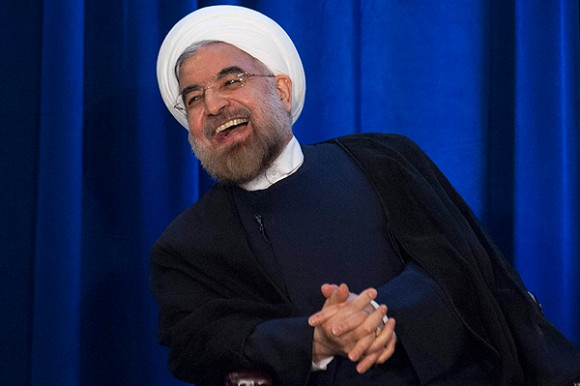
As Congress votes next month on whether to support the nuclear agreement Team Obama has negotiated with Iran, two assessments are necessary.
One is content-oriented-looking to the four corners of the document to understand exactly what Iran is being allowed legally to do, as well as the impact it will have on our national security.
Fully understanding that, the other assessment is then to analyze Iranian intentions-looking outside the document to determine the likelihood of full compliance by the mullahs.
As Congress undertakes the first assessment, it seems, unfortunately, to pay less heed to the second. But, as the latter demands understanding what the mullahs’ ultimate goal is, in addition to their commitment to achieving it, it is most relevant.
Interestingly, to better understand the mullahs’ ultimate goal, we need only look to ISIS-a group in pursuit of a similar one.
Before we do so, however, consider the following hypothetical: based on what we know about the group today, would Congress even consider negotiating the same nuclear deal with ISIS that has been negotiated with Iran? We hope it would not. The very thought of any agreement paving the way for a nuclear-armed ISIS would be an interminable nightmare for the world community.
The blatant savagery of ISIS undermines its credibility as a candidate with whom to hold nuclear negotiations. A group whose sole creative contribution to society has been to develop increasingly horrific ways of executing victims (and proudly displaying them on video) does not make for a responsible nuclear negotiating partner.
We may have thought the burning alive of caged Jordanian pilot Mu’ath al-Kaseasbeh earlier this year represented the extreme of ISIS brutality. It did not.
We have seen other victims paraded out, hands tied behind their backs, forced to kneel in front of their ISIS captors who-unbeknownst to the captives had buried explosive devices where they were kneeling-move safely away before detonating them. The sight of flying body parts then met with cries of “Allahu Akbar” from among the ISIS savages.
We have seen videos of Arab Christians similarly being positioned and beheaded by ISIS captors.
We have reports of an ISIS leader who, by night, raped his 11-year-old slave girl and, by day, strapped her to the windshield of his vehicle to afford him concealment from snipers as he drives.
The savagery of ISIS knows no limits. Its soldiers, after executing a Muslim father, strapped an explosive device to the baby child he left behind, detonating it to demonstrate to trainees the weapon’s battlefield impact upon the human body.
ISIS justifies its savagery on a Quranic mandate to pursue Islam’s ultimate goal: a global Caliphate by which to rule all inhabitants under sharia-a system of laws stripping its own believers of human dignity and non-believers of their lives.
But it is interesting that the ultimate goal for Islam sought by ISIS is really no different than that sought by Iran’s mullahs.
The brutality of ISIS, the irrationality of its leadership, the darkness that strips it of any humanity, the avowed purpose of its very being-all of this is mirrored within the mindset of Iran’s mullahs. Iran’s mullahs are ISIS wolves in sheep’s clothing.
ISIS is driven by a virulent Islamic ideology, unprotected by state boundaries, seeking to impose sharia upon the world. Iran is driven by a virulent Islamic ideology, protected by state boundaries, seeking the very same global objective.
The two mindsets evolved from one Islamic tree, branching out into different sects following Muhammad’s death. While differences evolved in culture, political systems, eschatological beliefs concerning the “Twelfth” or “Hidden Imam,” the role economics plays, etc., what we should find disturbing is, regardless of which sectarian branch prevails, for us, the end result is the same. Whether a Sunni ISIS Caliphate or a Shiite Iranian one were to dominate, infidels would be forced either to convert to Islam or die-with death imposed by whatever means available.
It is the commitment to an Iranian Caliphate that should concern us more than the commitment of ISIS to one. The mullahs believe for theirs to evolve, global chaos needs to occur-with man a catalyst in triggering it. Thus, providing them with a path for a nuclear-armed Iran gives the mullahs the means to fulfill the prophecy of Islam to which they adhere.
The Western mind rationalizes Iran would never initiate a nuclear strike for fear of retaliation. But the concept of Mutual Assured Destruction (MAD) that prevented a Cold War from turning hot will have no impact upon Iran. Its mullahs see this life as but a means of ensuring their arrival in the next-a paradise of unlimited sexual desires with “recycled” virgins promised by Muhammad. Such is their reward for striving in this life to make the world an infidel-free one.
We see the evil of ISIS by the sins it commits. Why do we fail to see it in the deeds of Iran’s mullahs who mirror them? Perhaps it is because ISIS boasts about its inhumanity while the mullahs are less vocal about theirs.
To fully understand the mullahs’ commitment to their ultimate goal, we need view it through the most innocent of eyes.
The best insight into the soul of a nation’s leadership is examining how it treats its most treasured asset-its own children.
Peering into the soul of Iran’s leadership, one sees only darkness.
As Iran’s mullahs came to power in 1979, the violence against the Shah was soon redirected against their own people, claiming thousands of lives. Some were children who, lacking knowledge about sharia, were held accountable, nonetheless, for violating it and summarily executed. Sharia was to rule over all, even those of a tender age incapable of its comprehension.
For Supreme Leader Ayatollah Ruhollah Khomeini, the sacrifice of children in this life was deemed acceptable to ensure ascendancy to the next. As he proclaimed in December 1979, “Could anyone wish his child to be martyred to obtain a good house? This is not the issue. The issue is (achieving) another world”-i.e., martyrdom of a child is justified in furtherance of Islam.
The extreme to which Khomeini took this was documented during Tehran’s eight-year war with Iraq.
Seeking to reduce Iranian army losses suffered penetrating Iraqi positions heavily defended by minefields, Khomeini issued a call for children to march through these fields to clear a route of attack. Each child was presented a plastic key beforehand, which, Khomeini promised, unlocked the gates to paradise. An estimated 500,000 children were so sacrificed.
A child’s life today in Iran continues to hold little value-children are still executed for acts deemed criminal under sharia. Accordingly, Tehran fails to comply with the Convention on Rights of the Child-an international commitment it made to protect its own children.
The virulent ideology of both ISIS and Iran’s mullahs merge on the common ground they share in totally devaluing the life of a child, evidenced by their unconscionable willingness to use children as weapons of war-whether it be to clear minefields, to serve as suicide bombers, or to execute prisoners.
The mullahs’ willingness to sacrifice the lives of their children should not be lost on us. If they, in pursuit of their ultimate goal, are unwilling to honor international commitments protecting their own children, only a fool can expect them to honor the international commitments set forth in a nuclear agreement.
He, too, is a fool who accepts President Obama’s claim that the Iranian leadership’s cries of “Death to America” are simply made for domestic consumption, ignoring Iranian President Hassan Rouhani’s recent warning, “Saying death to America is easy; we need to express death with action.” If Congress approves Obama’s nuclear agreement with Iran, Rouhani’s wish to replace hopeful words for America’s death with action to achieve it will take a deadly step forward.
Next month’s vote on the Iranian nuclear deal will reveal to us just how many fools we have in Congress.
Velayati: Iran More Powerful to Back Regional Allies after Nuclear Deal, Tasnim News Agency, August 15, 2015
(Great! More jobs for jihadists. Obama should like that. — DM)
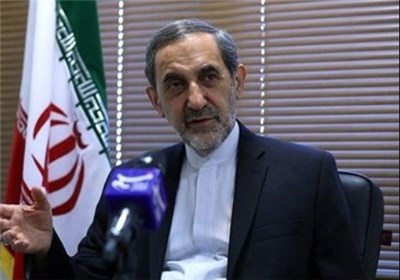
TEHRAN (Tasnim) – Secretary-General of World Assembly of Islamic Awakening Ali Akbar Velayati praised the recent conclusion of nuclear talks between Iran and six world powers, saying that with the deal, Tehran has more strength to support its friends in the Middle East region.
Speaking at the opening ceremony of the 6th gathering of General Assembly of Ahl-ul-Bayt World Assembly here in Tehran on Saturday morning, Velayati, who is also the head of the Strategic Research Center of Iran’s Expediency Council, stressed the need for the consolidation of the anti-Israeli Resistance Front in the region.
“The Islamic Republic of Iran will always support the current (Resistance Front) and of course, with the nuclear agreement, it will have more power to side with its friends in the region,” he noted.
Iran and the Group 5+1 (Russia, China, the US, Britain, France and Germany) on July 14 reached a conclusion on a lasting nuclear agreement that would terminate all sanctions imposed on Tehran over its nuclear energy program after coming into force.
The Iranian official further pointed to the most important reasons behind regional crises, saying that despite the claims made by certain countries, the crises do not have religious or sectarian nature.
Velayati added that the regional problems has its roots in the plots hatched by Islam’s enemies, who are seeking to misuse some religious differences and portray a violent image of Muslims.
The 6th General Assembly of Ahl-ul-Bayt World Assembly was inaugurated with a speech by Iranian President Hassan Rouhani.
About1.800 foreign guests from 130 countries along with senior Iranian political and cultural figures have participated in the four-day event.
Egypt’s Christians in the Shadow of the Muslim Brotherhood, Washington Free Beacon,
(Please see also, WFB’s Bill Gertz discusses story on Obama support for Muslim Brotherhood on Steve Malzberg Show. — DM)
Copts view the Obama administration cynically. Egyptians now whisper that the American president who pleased Arab liberals with his speech “A New Beginning” at al-Azhar in 2009 is secretly funding the Muslim Brotherhood and purposefully neglecting the Islamic State. A group of Copts protested outside of the White House in February 2015, demanding more aggressive action against IS following the beheading of the 21 Copts.
Al-Ahram, the largest newspaper in Egypt, published reports in 2013 that the United States diplomatic mission in Egypt, led by Ambassador Anne Patterson, was discouraging Coptic Christians from participating in protests against Morsi. Even though Patterson adamantly denied the accusations, the report sowed more distrust among Copts.
Tensions between the Coptic community and the administration worsened when, in the same year, an Obama Homeland Security adviser named Mohamed Elibiary suggested Copts raising awareness of their persecution were promoting “Islamophobic” bigotry.
**************************
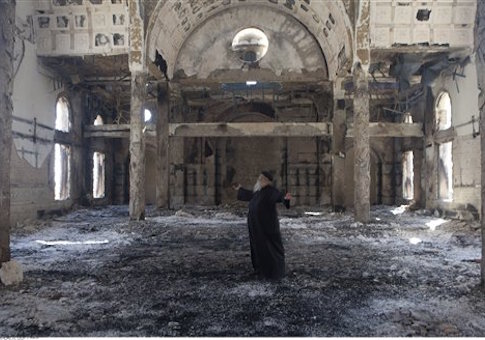 Christian Coptic Priest Father Samuel reacts as he stands inside the burned and heavily damaged St. Mousa church in Minya, Egypt / AP
In the nearly five years of turmoil that have followed the resignation of President Hosni Mubarak in 2011, no group in Egypt has suffered more than the 15 million Coptic Christians. Both a religious and ethnic minority, the Copts are descended from the native population of Egypt who lived and ruled there from the time of the pharaohs until the Roman conquest in 31 B.C. They are the largest Christian community in the Middle East today.
Copts have long been the target of discrimination and persecution in the majority-Arab nation. But this ancient people faced a terrifying new prospect in 2012: Muslim Brotherhood rule.
After Mubarak was ousted, the violence began almost immediately. Churches and schools were burned; peaceful protestors were massacred. When parliamentary elections were held nine months later, they were swept by the Muslim Brotherhood and other Islamist parties. When Mohamed Morsi won the presidential election in May 2012, the party’s victory looked complete. The same year, Morsi gave himself unlimited powers and the party drafted a new constitution inspired by Sharia law.
Morsi benefitted from the organizational advantage of the Muslim Brotherhood. Backed by imams preaching the benefits of religious rule, the previously banned political party was able to defeat the fractured coalitions of the pro-West, liberal, and secular candidates.
“They used thugs to carry out political intimidation against Christians,” a former member of Egyptian Parliament told the Washington Free Beacon. Chants celebrating the Brotherhood victory echoed through the streets of Cairo. “Morsi won! Copts out!”
 Ousted president Mohamed Morsi / AP
During Morsi’s rule, Christians were murdered and tortured by the hundreds. Attacks and abductions of Christian children spiked significantly. “Most Americans do not know how vicious and bloody the Muslim Brotherhood is,” Ahmed, a 24-year old secular Muslim, said. “They really can’t understand.”
Pope Tawadros II, Egypt’s Coptic Christian leader, criticized Morsi for negligence after six Christians were killed when police and armed civilians besieged Egypt’s largest cathedral. “We want actions, not words,” the Pope said.
Public accusations of blasphemy also became ubiquitous. A Facebook post interpreted as undermining Islam could bring a mob of fundamentalists with rocks and Molotov cocktails to the homes of Christians, surrounding them with families trapped inside. Sham trials with no legal representation would follow. Anti-Christian terrorism was not punished, but the wrong words often landed Copts in prison, forcing the church to make public apologies and families to leave their towns and villages.
Lydia, an activist who provides relief supplies to torn Christian communities in Upper Egypt, and who requested that only her first name be used to preserve her safety and that of her colleagues, witnessed the Muslim Brotherhood offer the very poorest Egyptians social services that bought their allegiance. “When you have no food or money, you will listen to anyone who gives you the resources your family desperately needs,” Lydia said. “They brainwash the illiterate with extremism so they hurt Christians.”
Still, Morsi’s authoritarian rule—rewriting the constitution, disbanding the Egyptian parliament, tossing potentially obstructive judges into jail—was not long lived. Barely a year after he assumed office, a reported 35 million citizens took to the streets to protest his rule, leading the Egyptian military, under Gen. Abdel Fattah al-Sisi, to remove him from power in July 2013.
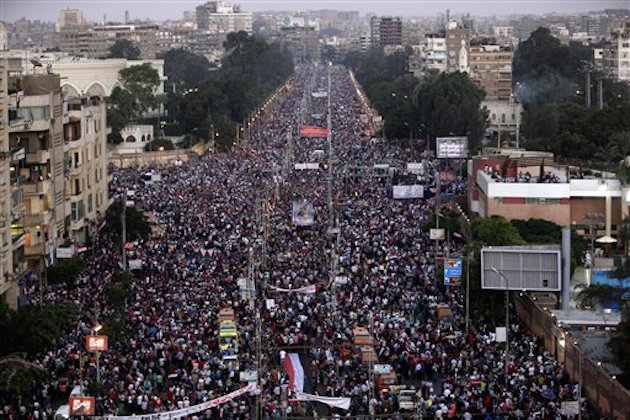 Egypt’s ousted President Mohammed Morsi protest at the presidential palace in Cairo, Egypt, Friday, July 26, 2013 / AP
Sen. James Lankford (R., Okla.) told the Free Beacon that had al-Sisi not responded, the promise of Egyptian Democracy would have died. “What it seemed the Egyptian people wanted was more opportunity to be able have some sort of functioning democracy, elections, input into their own government,” Lankford said. “It was the immediate understanding as soon as the Muslim Brotherhood was elected, that was the last election Egypt would have.”
In 2014, al-Sisi was elected Egypt’s new president. He won a solid electoral victory, giving him control of the Egyptian government with the responsibilities of forming a new constitution, a new parliament, and a new judicial system. The Coptic Church fervently supported al-Sisi’s candidacy because the new president promised Copts equality in citizenship, security in their communities, and the ability to build places of worship.
The new Egyptian president challenged the leaders of the Islamic world to push a more moderate message. In December 2014, hundreds of Christian and Muslim theologians gathered at al-Azhar, Egypt’s leading mosque and religious university, participated in a conference to fight “jihad” and promote inclusion. Al-Sisi ambitiously called for a “religious revolution” in January 2015, saying that clerics bear responsibility for the growing extremism in the Middle East.
As president, al-Sisi took many symbolic steps to integrate the Coptic community with the majority Sunni population. In a surprise to most Egyptians, al-Sisi attended a mass at Saint Mark Orthodox Cathedral in Cairo on Christmas Eve, a first for any Egyptian president. Al-Sisi regularly invites Pope Tawadros II to appear beside him when he announces major policy rollouts or requests public dialogue from senior advisers.
Al-Sisi also appointed two Copts as members of his cabinet. Under the constitution, the president of Egypt has the power to select 10 members of parliament. Political observers believe he will select Copts to fill a majority of those appointed seats to offer a more representative parliament.
“Our lives haven’t changed much but one positive result of the revolution is the Egyptian people have politically woken up,” said Hala, a Mubarak-era government official who also wished to be identified by her first name only because she fears political retribution. “We no longer accept what we are told. Egyptians are at least aware of the government’s actions and they are more aware of the troubles Copts face.”
But while al-Sisi’s administration provides a welcome change of tone toward the Coptic community, the day-to-day lives of Copts remain little changed from the Mubarak days.
Coptic Solidarity is a five-year-old public charity organization and advocacy group devoted to advancing equality for Copts in Egypt. Their efforts have helped raise awareness about the persecution Christians face in the Middle East. Alex Shalaby, an Egyptian businessman currently residing in the United States and Coptic Solidarity’s new president, believes Egypt under al-Sisi has continued many of the same practices as previous presidents Sadat, Mubarak, and Morsi.
“Discrimination is rampant, especially in Upper Egypt. We still see reconciliation tactics pressuring the closing of Christian churches and there are still very few Coptic government appointees, he explained. “Coptic Solidarity monitors all developments within Egypt and we are not able to say much has been accomplished in terms of real change to improve Coptic lives in the last 12 months.”
Human rights groups have been critical of al-Sisi’s record. Amnesty International’s Hassiba Hadj Sahraoui accused the president of “employing the same methods of torture and other ill-treatment used during the darkest hours of the Mubarak era.” The Egyptian government received heavy criticism after a court sentenced hundreds of Muslim Brotherhood members to death, intensifying its crackdown on Islamists.
Despite assurances from al-Sisi, sectarian violence still regularly occurs in the rural villages of Upper Egypt where the government has less control.
In Nasreya, Islamists responded to a video of five Christian students making fun of the Islamic State terrorist groups by demanding the students be turned over to the authorities for insulting the religion of Islam. Villagers hurled rocks at Copts and vandalized their property. No arrests were reported for the attacks but the teacher and students were imprisoned for days.
On March 26, 2015, in El Galaa another horde gathered to protest the building of a new church that served 1,400 Christians, also attacking Christian homes in a similar manner. The local government forced the new church to have no outer symbol of Christianity. In Mayana and Abu Qurqas villages, police raided churches, confiscated items from the altar, and shut down reconstruction work.
Lydia, the activist based in Upper Egypt, has witnessed firsthand the damage from these attacks. “I had to console a girl, nine years old, crying because she was afraid her parents were going to be kicked out of their own home,” she said.
“They are poor, illiterate, and now their home is burned and their own community has banned them. All because they are Christians,” she continued.
“The police don’t bother to protect Christians. They do the exact opposite in Upper Egypt,” Lydia said. “The local governments have been loaded with Islamists for years.”
But violence is not exclusive to the country’s outskirts. On June 30, 2015, the two-year anniversary of the popular uprising against Morsi, Islamists detonated bombs by the homes of well-known Christians. Additionally, The Fathers Church in Alexandria was firebombed on July 22, 2015. This summer’s assassination of Egypt’s Attorney General Hesham Barakat in a car bombing, reportedly carried out by a wing of the Muslim Brotherhood, served as an ugly reminder that Egypt’s violence has not passed.
 An Egyptian policeman stands guard at the site of a car bombing that killed n Egyptian policeman stands guard at the site of a car bombing that killed Hesham Barakat / AP
Despite these problems, al-Sisi still enjoys support among prominent Copts. Amir Ramzy is a prominent Coptic judge and public figure in Egypt’s legal system, and a loyal defender of al-Sisi’s administration.
“We cannot remove prejudice overnight,” Ramzy said. “We must focus on changing the attitude of the people on the ground first.”
The judge pointed to the dire state al-Sisi found the country in when he took office as reason for slow progress.
“Egypt is fighting Islamists inside and outside our borders. Egypt is fighting a horrid economy with massive unemployment. Al-Sisi is taking on large projects to change these conditions,” Ramzy said. “It is difficult to control chaos and promote social change at the same time.”
The judge referred to the decades it took the United States to implement civil rights reforms. He asked for reasonable expectations out of Egypt’s new president and insists under al-Sisi the country is heading in the right direction. “Just one year after his election, Egypt has new roads, a new canal, new investments, and a new hope for the poor.”
Despite not being content with the pace of progress, Shalaby said al-Sisi is an improvement over his predecessor. As a retired executive, he said he understood national security and economic development should be the president’s priority. “Al-Sisi must do what is best for Egypt first. What is best for Egypt is what is best for Copts. What is good for Copts is good for Egypt.”
 Abdel-Fattah al-Sisi / AP
Copts view the Obama administration cynically. Egyptians now whisper that the American president who pleased Arab liberals with his speech “A New Beginning” at al-Azhar in 2009 is secretly funding the Muslim Brotherhood and purposefully neglecting the Islamic State. A group of Copts protested outside of the White House in February 2015, demanding more aggressive action against IS following the beheading of the 21 Copts.
Al-Ahram, the largest newspaper in Egypt, published reports in 2013 that the United States diplomatic mission in Egypt, led by Ambassador Anne Patterson, was discouraging Coptic Christians from participating in protests against Morsi. Even though Patterson adamantly denied the accusations, the report sowed more distrust among Copts.
Egyptians publicly celebrated when Patterson left the country.
Tensions between the Coptic community and the administration worsened when, in the same year, an Obama Homeland Security adviser named Mohamed Elibiary suggested Copts raising awareness of their persecution were promoting “Islamophobic” bigotry. Elibiary, who generated controversy due to views perceived by some to be friendly to the Muslim Brotherhood, released a series of tweets with the R4BIA salute, perceived to be a symbol of hate by many in Egypt.
Elbiary later deleted his tweets and removed the symbol. Bishop Angaelos, Pope Tawadros II’s personal representative called the incident “disturbing.” Elbiary left the Obama administration under pressure from critics in 2014.
Following the ouster of Morsi, the United States canceled weapons deliveries to Egypt and halted all military aid. As the White House took its time to build a relationship with al-Sisi, Russian President Vladimir Putin visited the country and signed a nuclear agreement.
The White House announced in the spring of 2015 that weapons deliveries to Egypt would ultimately be resumed.
Despite the uneasiness in the country, Christians believe they will one day be equal citizens in their homeland. Such progress may be slow and painful, but amidst anxiety there is hope in Egypt.
Much of this hope is derived from the perception of al-Sisi’s decent treatment of the Copts. Ramzy, the judge, told theFree Beacon, “al-Sisi may not be perfect, but he is Copts’ best chance to promote ourselves from second class citizens. He should receive America’s support.”
Britain: The “Struggle of Our Generation”, The Gatestone Institute, Samuel Westrop, August 10, 2015
On July 20, Prime Minister David Cameron outlined his government’s plans to counteract Islamic extremism, which he described as the “struggle of our generation.”
In a speech before Ninestiles School, in the city of Birmingham, Cameron articulated a view of the Islamist threat that, just a couple of years ago, few else in British politics would have dared to support.
In a report for BBC Radio 4, the journalist John Ware described Cameron’s speech, and the government’s proposed counter-extremism measures, as “something no British government has ever done in my lifetime: the launch of a formal strategy to recognize, challenge and root out ideology.”
Cameron’s speech was wide-ranging. It addressed the causes, methods and consequences of Islamist extremism.
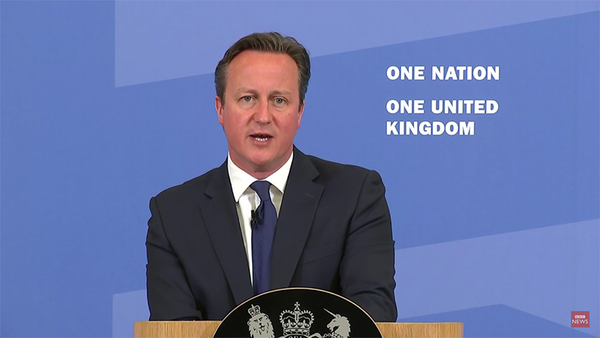 (Image source: BBC video screenshot)
We must recognize, Cameron reasoned, that Islamist terror is the product of Islamist ideology. It is definitely not, he argued, “because of historic injustices and recent wars, or because of poverty and hardship. This argument, what I call the grievance justification, must be challenged. … others might say: it’s because terrorists are driven to their actions by poverty. But that ignores the fact that many of these terrorists have had the full advantages of prosperous families or a Western university education.”
“Extreme doctrine” is to blame — a doctrine that is “hostile to basic liberal values … Ideas which actively promote discrimination, sectarianism and segregation. … which privilege one identity to the detriment of the rights and freedoms of others.” This is a doctrine “based on conspiracy: that Jews exercise malevolent power; or that Western powers, in concert with Israel, are deliberately humiliating Muslims, because they aim to destroy Islam.”
People are drawn to such extremist ideas, Cameron argued, because:
“[Y]ou don’t have to believe in barbaric violence to be drawn to the ideology. No-one becomes a terrorist from a standing start. It starts with a process of radicalisation. When you look in detail at the backgrounds of those convicted of terrorist offences, it is clear that many of them were first influenced by what some would call non-violent extremists.
“It may begin with hearing about the so-called Jewish conspiracy and then develop into hostility to the West and fundamental liberal values, before finally becoming a cultish attachment to death. Put another way, the extremist world view is the gateway, and violence is the ultimate destination.”
To counteract the extremist threat, Cameron concludes, the government will “tackle both parts of the creed — the non-violent and violent. This means confronting groups and organisations that may not advocate violence — but which do promote other parts of the extremist narrative.”
Further, no longer will extremist groups be able to burnish their moderate credentials by pointing to ISIS as the Islamic bogeyman:
“We’ve got to show that if you say ‘yes I condemn terror — but the Kuffar are inferior’, or ‘violence in London isn’t justified, but suicide bombs in Israel are a different matter’ – then you too are part of the problem. Unwittingly or not, and in a lot of cases it’s not unwittingly, you are providing succour to those who want to commit, or get others to commit to, violence.
For example, I find it remarkable that some groups say ‘We don’t support ISIL’ as if that alone proves their anti-extremist credentials. And let’s be clear Al-Qaeda don’t support ISIL. So we can’t let the bar sink to that level. Condemning a mass-murdering, child-raping organisation cannot be enough to prove you’re challenging the extremists.”
Rather radically for a Western leader, Cameron also asserted that, “simply denying any connection between the religion of Islam and the extremists doesn’t work… it is an exercise in futility to deny that. And more than that, it can be dangerous. To deny it has anything to do with Islam means you disempower the critical reforming voices; the voices that are challenging the fusing of religion and politics…”
Cameron’s speech was groundbreaking. No previous Prime Minister in past decades would have dared to make such statements. This is not to say, however, that it is without fault.
Cameron is not just talk. An “Extremism Analysis Unit” has been set up within the Home Office, which will serve to tackle Islamist extremism, including “non-violent” groups. According to the journalist John Ware, the new body is currently preparing lists of extremist preachers and groups.
More importantly, a variety of new legislation is being brought before Parliament. However, some of the proposed laws, critics argue, are draconian. “Banning Orders” will outlaw designated “extremist groups.” “Extremism Disruption Orders,” meanwhile, will restrict designated “extremists” from appearing on television, or publishing without the authorities’ approval. And “Closure Orders” will allow the government to close any institution deemed guilty of promoting extremism.
Cameron has correctly and radically diagnosed the problem of Islamic extremism. His solutions, however, do not appear promising.
A more useful next step would be for the government to tackle its own relationships with extremist groups. Britain’s registered charities offer a particularly vivid example of Islamist extremism going unchallenged.
In 2014, I wrote about the Islamic Network, a group that describes itself as “a da’wah[proselytizing] organisation which aims to promote awareness and understanding of the religion of Islam.”
In a series of religious rulings published on its website, the Islamic Network charity advocated themurder of apostates; encouraged Muslims to hate non-Muslims; stated that when non-Muslims die, “the whole of humanity are relieved;” and described Western civilisation as “evil.” Further, the Islamic Network directed a great deal of hatred towards the Jews. Its website claimed: “The Jews strive their utmost to corrupt the beliefs, morals and manners of the Muslims. The Jews scheme and crave after possessing the Muslim lands, as well as the lands of others.”
In spite of these views, the Islamic Network is a registered charity, which means it is entitled to subsidy from the taxpayer.
As a result of revealing the material published on the Islamic Network’s website, as well as several complaints submitted to the Charity Commission, the government opened an inquiry into the charity. After a year of deliberation, the Charity Commission published its report, which concluded that the Islamic Network had indeed published extremist material.
The Charity Commission’s solution, however, was to give the charity’s trustees booklets titled, “How to manage risks in your charity,” and warn them not to do it again.
Britain may finally have a government that understands the problem of Islamist extremism, but if government bodies fail to challenge extremist charities such as the Islamic Network, then what use is this enlightenment?
The Islamic Network is but one of many dozens of examples. Why is the British organizationInterpal, for example, still allowed to be a registered charity? Interpal is a designated terrorist organization under United States law. Its trustees regularly meet with senior leaders of the terror group Hamas. In 2013, for instance, Interpal trustee Essam Yusuf took part in a ceremony with the Hamas leader Ismail Haniyeh, at which they expressed praise for Hamas’ military wing, the Al Qassam Brigades, and glorified “martyrdom.”
Or what of Islamic Relief, one of Britain’s largest charities? Established by the Muslim Brotherhood, Islamic Relief’s directors have included Ahmed Al-Rawi, a Muslim Brotherhood leader who, in 2004, supported jihad against British and American troops in Iraq; and Essam El-Haddad, who is accused by an Egyptian court of divulging Egyptian state secrets to Hamas, Hezbollah and Iran, and using Islamic Relief to finance global terrorism.
Despite Islamic Relief’s links to Islamist extremism, the charity continues to receive millions of pounds from the British government.
David Cameron’s speech on July 20 should be applauded. If another political party had won the recent general election, no such speech would have been made. But before the Prime Minister turns his hand to censorship, perhaps the government should address extremist groups closer to home.
“Death to America” Falling on Obama’s Deaf Ears, American Thinker, Eileen F. Toplansky, August 10, 2015
(Please see also, It’s Not Just Iran’s Hardliners Saying ‘Death to America.’ — DM)
The Iranian curriculum is based on an Iranian-style Islam called the New Islamic Civilization (NIC). The battle between good and evil, which is to be waged on a global scale, “is the responsibility of each Iranian citizen,” and “it begins with defense.” America is seen as “arrogant,” and “any kind of freedom of speech, political debate or appreciation of Iranian culture or values other than those espoused by the regime are intolerable[.]”
[T]reating Iran as a normal country instead of one that inculcates acts of aggression is extraordinarily dangerous.
**********************
We are well past the point where we can ever believe Obama the man because, as those prescient about Obama’s background instinctively understood, whatever was taught Obama the child is what is now being reflected in his dangerous anti-American actions.
Thus, the 17th-century Jesuit-inspired quotation of “give me the child, and I will mold the man” remains true.
This is why the idea that one can trust the Iranians is not only naive, but extraordinarily dangerous, given the education of their children. In the May 2015 Special Interim Report entitled “Imperial Dreams: The Paradox of Iranian Education” by Eldad J. Pardo, the incessant propagandizing and intimidation of Iranian students is proof positive that they are being primed to attack those whom their leaders deem the enemy. The first page of the report shows the map of a “New Dreams of World Power” with Iran at the center. Underneath this map is a picture of “Iranian children preparing for martyrdom.”
Lest one think this is unthinkable, recall the fact that Iran and its proxies regularly send their children as suicidal bombers. Thus, as Pardo recounts, the Iranian education curriculum includes “the ambition to impose Iranian hegemony on the world; a culture of militarism and jihad; blind obedience and martyrdom; and hostility and paranoia toward foreigners.”
In fact, “jihad war is unending,” and “the frenzied rush toward the end-of-time’s ‘horrifying battle'” is the lifeblood of continuous jihad.
The backdrop to all this education is the idea that Iran is committed to “total struggle for the creation of a just world order” and that such a “condition will remain until the coming of the Mahdi, the Shiite Messiah[.]” The messianic ideal here is quite different from what most Westerners believe; that it is ignored will be a fatal mistake. And Obama knows this, which is why Americans must stomach, yet again, his “compendium of demagoguery, historical revisionism and outright lying.”
Iranian students understand that “possible martyrdom on a massive scale and for which they practice from the first grade – could be launched as part of an Iranian ‘attack on countries ruled by oppressive governments.'” Moreover, Iranian students study about “dissimulation” (taqiyya) and “misleading the enemy.” They learn that “in time of need, dissimulation and temporary pacts – even with ‘un-Godly, idolatrous governments’ – are proper (but only until such time as the balance of power should change).” The idea of sacrifice is “constantly instilled in them,” as evidenced by the Teacher’s Guide for Persian, Grade 3 text. Never is there any concern with the “human wave assault,” which includes many sacrificed schoolchildren. Instead, enthusiasm for military participation is promoted in the first grade, for six-year-olds.
Surely Obama’s many Muslim Brotherhood advisers would have informed him of taqiyya, and since Obama early on learned the tenets of Islam, this is part of his worldview. Whether one believes he is a pathological liar or not, the fact remains that Obama defends the Iranian deal with falsehoods and slurs. Moreover, he recently exploited American college students at American University, much as his Iranian counterparts abuse their own children with incessant misinformation and propaganda.
The Iranian educational curriculum makes much of the Aryan-Shiite basis of Iranian identity wherein the Allies, and not Nazi Germany, are vilified, and, of course, the Holocaust is completely avoided. Hence, the unremitting cries of “Death to Israel” fall on ears already primed to hate the Jew. Furthermore, in echoes of Nazism, “children are instructed not to obey their parents in matters regarding martyrdom,” and pictures of soldiers are amply sprinkled in the textbooks.
This is of little concern to Obama, who has been surrounded by anti-Semites for many years. The anti-Jewish hatred does not disturb him, nor does it deter him. While Caroline Glick asserts that Obama maintains that “an anti-Semite is someone who refuses to recognize the 3,000-year connection between the Jews and the Land of Israel,” and “an anti-Semite is also someone who refuses to recognize the long history of persecution that the Jewish people suffered in the Diaspora,” this is hardly a ringing endorsement of ensuring that no harm will come to the Jewish people. Acknowledging a connection to a piece of land is not the same as making certain that that land is not blown to smithereens.
The Iranian curriculum is based on an Iranian-style Islam called the New Islamic Civilization (NIC). The battle between good and evil, which is to be waged on a global scale, “is the responsibility of each Iranian citizen,” and “it begins with defense.” America is seen as “arrogant,” and “any kind of freedom of speech, political debate or appreciation of Iranian culture or values other than those espoused by the regime are intolerable[.]”
In essence, the “school textbooks prepare the entire Iranian population for a constant state of emergency, requiring Iranians to foment revolutions throughout the world, particularly across the Middle East, while evil arrogant enemies – who hate Iran and Islam – scheme against them.” In fact, texts emphasize the martyrdom of women as well as cyber warfare tactics. Most importantly, “students learn that no checks are needed on the Supreme Leader’s authority, including his right to sanctify new weapons” (italics mine). Blind obedience to the Supreme Leader is mandatory.
In a Grade 11 Iranian text, students are enjoined to understand that jihad “covers a range of meanings including killing, massacring, murdering and fighting,” and jihad “permits its use against anyone, anywhere.” There is “defensive jihad,” which refers to an “enemy transgressing the border or city of the Muslims, or defense of one’s own or other’s life, honor and property.” Thus, as Muslims gain in number in American cities, it is clear that defensive jihad can be used, especially since defensive jihad is seen as a warfare that is “gradual” and that can be “military and sometimes cultural,” since it “sometimes aims at conquering a land or part of it and sometimes aims at political-economic control.”
Then there is “internal jihad,” which “represents a war with outlawed people who implement rebellion and disobedience as well as armed uprisings.” Western ideas of freedom will be relegated to the dustbin of history, and those who desire it will be annihilated.
Finally there is “elementary jihad,” which at first glance sounds familiar to Western ears. It is “defined as an attack on countries ruled by oppressive governments that do not allow free religious activities or freedom to listen to the call of religion.” But there is no freedom of religion in Iran. It can be only Islam. There is no room for any other ideas. And, in fact, “non-Islamic moral constraints” have no impact as Hezb’allah, Iran’s Lebanese proxy, or any other Islamic-inspired group engages in jihad.
Thus, as Jeffrey Herf writes, treating Iran as a normal country instead of one that inculcates acts of aggression is extraordinarily dangerous. This is a war of ideas – whose will remain supreme? In essence, Obama is painting a bull’s-eye on America, and not on Iran, who continues the “Death to America” chant on a regular basis. And while Mona Charen claims that “Obama doesn’t take the Iranian chant seriously,” I, for one, beg to disagree.
Column One: Obama’s enemies list, Jerusalem Post, Caroline Glick, August 6, 2015
 US President Barack Obama at the Rose Garden of the White House. (photo credit:OFFICIAL WHITE HOUSE PHOTO / PETE SOUZA)
[T]he real question lawmakers need to ask is whether the deal is good for America. Is Obama right or wrong that only partisan zealots and disloyal Zionists could oppose his great diplomatic achievement? To determine the answer to that question, you need to do is ask another one. Does his deal make America safer or less safe? The best way to answer that question is to consider all the ways Iran threatens America today, and ask whether the agreement has no impact on those threats, or whether it mitigates or aggravates them.
***********************
In President Barack Obama’s defense of his nuclear deal with Iran Wednesday, he said there are only two types of people who will oppose his deal – Republican partisans and Israel- firsters – that is, traitors.
At American University, Obama castigated Republican lawmakers as the moral equivalent of Iranian jihadists saying, “Those [Iranian] hard-liners chanting ‘Death to America’ who have been most opposed to the deal… are making common cause with the Republican Caucus.”
He then turned his attention to Israel.
Obama explained that whether or not you believe the deal endangers Israel boils down to whom you trust more – him or Prime Minister Benjamin Netanyahu. And, he explained, he can be trusted to protect Israel better than Netanyahu can because “[I] have been a stalwart friend of Israel throughout my career.”
The truth is that it shouldn’t much matter to US lawmakers whether Obama or Netanyahu has it right about Israel. Israel isn’t a party to the deal and isn’t bound by it. If Israel decides it needs to act on its own, it will.
The US, on the other side, will be bound by the deal if Congress fails to kill it next month.
So the real question lawmakers need to ask is whether the deal is good for America. Is Obama right or wrong that only partisan zealots and disloyal Zionists could oppose his great diplomatic achievement? To determine the answer to that question, you need to do is ask another one. Does his deal make America safer or less safe? The best way to answer that question is to consider all the ways Iran threatens America today, and ask whether the agreement has no impact on those threats, or whether it mitigates or aggravates them.
Today Iran is harming America directly in multiple ways.
The most graphic way Iran is harming America today is by holding four Americans hostage. Iran’s decision not to release them over the course of negotiations indicates that at a minimum, the deal hasn’t helped them.
It doesn’t take much consideration to recognize that the hostages in Iran are much worse off today than they were before Obama concluded the deal on July 14.
The US had much more leverage to force the Iranians to release the hostages before it signed the deal than it does now. Now, not only do the Iranians have no reason to release the hostages, they have every reason to take more hostages.
Then there is Iranian-sponsored terrorism against the US.
In 2011, the FBI foiled an Iranian plot to murder the Saudi ambassador in Washington and bomb the Saudi and Israeli embassies in the US capital.
One of the terrorists set to participate in the attack allegedly penetrated US territory through the Mexican border.
The terrorist threat to the US emanating from Iran’s terrorist infrastructure in Latin America will rise steeply as a consequence of the nuclear deal.
As The Wall Street Journal’s Mary Anastasia O’Grady wrote last month, the sanctions relief the deal provides to Iran will enable it to massively expand its already formidable operations in the US’s backyard. Over the past two decades, Iran and Hezbollah have built up major presences in Cuba, Venezuela, Nicaragua, Ecuador and Bolivia.
Iran’s presence in Latin America also constitutes a strategic threat to US national security. Today Iran can use its bases of operations in Latin America to launch an electromagnetic pulse attack on the US from a ballistic missile, a satellite or even a merchant ship.
The US military is taking active steps to survive such an attack, which would destroy the US’s power grid. Among other things, it is returning the North American Aerospace Defense Command (NORAD) to its former home in Cheyenne Mountain outside Colorado Springs.
But Obama has ignored the findings of the congressional EMP Commission and has failed to harden the US electronic grid to protect it from such attacks.
The economic and human devastation that would be caused by the destruction of the US electric grid is almost inconceivable. And now with the cash infusion that will come Iran’s way from Obama’s nuclear deal, it will be free to expand on its EMP capabilities in profound ways.
Through its naval aggression in the Strait of Hormuz Iran threatens the global economy. While the US was negotiating the nuclear deal with Iran, the Revolutionary Guards unlawfully interdicted – that is hijacked – the Marshall Islands-flagged Maersk Tigris and held its crew hostage for weeks.
Iran’s assault on the Tigris came just days after the US-flagged Maersk Kensington was surrounded and followed by Revolutionary Guards ships until it fled the strait.
A rational take-home message the Iranians can draw from the nuclear deal is that piracy pays.
Their naval aggression in the Strait of Hormuz was not met by American military force, but by American strategic collapse at Vienna.
This is doubly true when America’s listless response to Iran’s plan to use its Houthi proxy’s takeover of Yemen to control the Bab el-Mandab strait is taken into consideration. With the Bab el-Mandab, Iran will control all maritime traffic from the Persian Gulf and the Red Sea. Rather than confront this clear and present danger to the global economy, America abandoned all its redlines in the nuclear talks.
Then there is Iran’s partnership 20-year partnership with al-Qaida.
The 9/11 Commission found in its report that four of the 9/11 terrorists transited Iran before traveling to the US. As former Defense Intelligence Agency director Lt.-Gen. (ret.) Mike Flynn told Fox News in the spring, Iranian cooperation with al-Qaida remains deep and strategic.
When the US Navy SEALs killed Osama bin Laden in 2011, they seized hard drives containing more than a million documents related to al-Qaida operations. All but a few dozen remain classified.
According to Flynn and other US intelligence officials who spoke to The Weekly Standard, the documents expose Iran’s vast collaboration with al-Qaida.
The agreement Obama concluded with the mullahs gives a tailwind to Iran. Iran’s empowerment will undoubtedly be used to expand its use of al-Qaida terrorists as proxies in their joint war against the US.
Then there is Iran’s ballistic missile program.
The UN Security Council resolution passed two weeks ago cancels the UN-imposed embargoes on conventional arms and ballistic missile acquisitions by Iran. Since the nuclear deal facilities Iranian development of advanced nuclear technologies that will enable the mullahs to build nuclear weapons freely when the deal expires, the Security Council resolution means that by the time the deal expires, Iran will have the nuclear warheads and the intercontinental ballistic missiles required to carry out a nuclear attack on the US.
Obama said Wednesday that if Congress votes down his nuclear deal, “we will lose… America’s credibility as a leader of diplomacy. America’s credibility,” he explained, “is the anchor of the international system.”
Unfortunately, Obama got it backwards. It is the deal that destroys America’s credibility and so upends the international system which has rested on that credibility for the past 70 years.
The White House’s dangerous suppression of seized al-Qaida-Iran documents, like its listless response to Iran’s maritime aggression, its indifference to Iran’s massive presence in Latin America, its lackluster response to Iran’s terrorist activities in Latin America, and its belittlement of the importance of the regime’s stated goal to destroy America – not to mention its complete collapse on all its previous redlines over the course of the negotiations – are all signs of the disastrous toll the nuclear deal has already taken on America’s credibility, and indeed on US national security.
To defend a policy that empowers Iran, the administration has no choice but to serve as Iran’s agent. The deal destroys America’s credibility in fighting terrorism. By legitimizing and enriching the most prolific state sponsor of terrorism, the US has made a mockery of its claimed commitment to the fight.
The deal destroys the US’s credibility as an ally.
By serving as apologists for its worst enemy, the US has shown its allies that they cannot trust American security guarantees. How can Israel or Saudi Arabia trust America to defend them when it is endangering itself? The deal destroys 70 years of US nonproliferation efforts. By enabling Iran to become a nuclear power, the US has made a mockery of the very notion of nonproliferation and caused a nuclear arms race in the Middle East.
The damage caused by the deal is already being felt. For instance, Europe, Russia and China are already beating a path to the ayatollahs’ doorstep to sign commercial and military deals with the regime.
But if Congress defeats the deal, it can mitigate the damage. By killing the deal, Congress will demonstrate that the American people are not ready to go down in defeat. They can show that the US remains committed to its own defense and the rebuilding of its strategic credibility worldwide.
In his meeting with Jewish leaders Tuesday, Obama acknowledged that his claim – repeated yet again Wednesday – that the only alternative to the deal is war, is a lie.
Speaking to reporters after the meeting, Greg Rosenbaum, chairman of the National Democratic Jewish Council, which is allied with the White House, said that Obama rejected the notion that war will break out if Congress rejects the deal with veto-overriding majorities in both houses.
According to Rosenbaum, Obama claimed that if Congress rejects his nuclear deal, eventually the US will have to carry out air strikes against Iran’s nuclear facilities in order to prevent them from enriching uranium to weapons-grade levels.
“But,” he quoted Obama as saying, “the result of such a strike won’t be war with Iran.”
Rather, Obama said, Iran will respond to a US strike primarily by ratcheting up its terrorist attacks against Israel.
“I can assure,” Obama told the Jewish leaders, “that Israel will bear the brunt of the asymmetrical responses that Iran will have to a military strike on its nuclear facilities.”
What is notable here is that despite the fact that it will pay the heaviest price for a congressional defeat of the Iran deal, Israel is united in its opposition to the deal. This speaks volume about the gravity with which the Israeli public views the threats the agreement unleashed.
But again, Israel is not the only country that is imperiled by the nuclear deal. And Israelis are not the only ones who need to worry.
Obama wishes to convince the public that the deal’s opponents are either partisan extremists or traitors who care about Israel more than they care about America. But neither claim is true. The main reason Americans should oppose the deal is that it endangers America. And as a consequence, Americans who oppose the deal are neither partisans nor turncoats.
They are patriots.




 anneinpt
 artaxes
 danmillerinpanama
 davidking1530
 Peter Hofman
 Joseph Wouk
 Peter
Peter Louisiana Steve
 WarSclerotic
Recent Comments