Archive for the ‘Iranian nukes’ category

What About Iran’s “JCPOA”?

December 15, 2015

What About Iran’s “JCPOA”? Gatestone InstituteLawrence A. Franklin, December 15, 2015

(The article mentions, but otherwise provides little of substance concerning, Iran’s interpretation of the Joint Cooperative Plan of Action (JCPOA).  This analysis by the Middle East Media Institute is about Supreme Leader Khamenei’s “guidelines” for its interpretation and implementation. They suggest something quite different from the document presented to the U.S. Congress.– DM)

  • The self-appointed P5+1, elected by no one but themselves, should be embarrassed to find that they have made a deal with no one but themselves.
  • The media’s emphasis on the JCPOA has sadly neglected any in-depth coverage of Iran’s own comprehensive plan of action, which seems to consist of developing nuclear weapons, ballistic missiles and related systems to deliver them.
  • The IAEA cannot even confirm with certainty that Iran does not already possess a nuclear bomb, and yet is not expected to challenge Tehran’s assertion that it ceased nuclear weapons development more than a decade ago.
  • Although the U.S. also cannot be certain of Iran’s intentions, it would be advisable to assume that Iran means what it says: “Death to America” and “Death to Israel.”

Iran is cheating already — or is it? Iran has not signed anything, so presumably it cannot be cheating on something it never agreed to – as predicted on these pages half a year ago. The self-appointed P5+1 (the five permanent members of the UN Security Council plus Germany), elected by no one but themselves, should be embarrassed to find that they have made a deal with no one but themselves.

The lavishly touted and lavishly dangerous “Iran Deal” not only paves the way for Iran to have nuclear weapons, as it was planning, anyway; it also rewards Iran’s repeated violations of the Non-Proliferation Treaty — which it did sign — with up to $150 billion. With a punishment like that, we should all start violating commitments.

Iran’s recent missile tests have, been undermining the rationale of the Joint Comprehensive Plan of Action (JCPOA), which the P5+1 signed with itself. If Iran is concerned that its missile tests might have violated multiple UN Resolutions, a paltry detail such as that clearly has not bothered anyone before, so why should it bother anyone now?

The media’s emphasis on the JCPOA has sadly neglected any in-depth coverage of Iran’s own comprehensive plan of action, which seems to consist of developing nuclear weapons, ballistic missiles and related systems to deliver them.

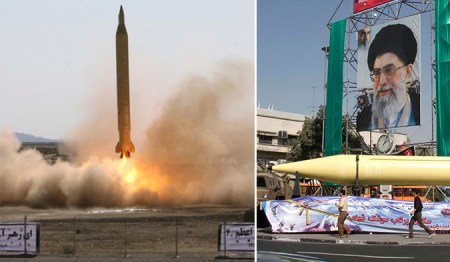
While Western diplomats were congratulating themselves on their JCPOA arrangement, Iran sent a “slap-in-the-face” signal to the Free World by launching an Emad [“Pillar”] ballistic missile on October 10. On December 8, State Department spokesperson John Kirby indirectly acknowledged the launch of a second ballistic missile, fired on November 21. Kirby was quick to point out that test was not a violation of the JCPOA.

The launches are violations, however, of UN Security Council Resolution #2231, which bans ballistic missile tests by Iran. Although these tests do not defy the letter of the JCPOA, they do defy the spirit of it. Even though the initial missile test was denounced by the U.S. and allied UN representatives, no action has so far been taken against Iran. The U.S. Ambassador to the United Nations, Samantha Power, did condemn the October test and probably will also condemn the second test. But if this is outrage, that may be the extent of it.

What seems clear is that Iran’s Islamic Revolution Guard Corps (IRGC), which controls the ballistic missile program, is attempting to goad the West into additional punitive action against the Islamic Republic. Such response would serve to strengthen the hardline opposition to the JCPOA in Iran. Further, if the United States does nothing but issue condemnatory rhetoric, it will be interpreted by the regime as additional confirmation that the U.S. desires a nuclear agreement at virtually any cost.

1388

The International Atomic Energy Association (IAEA), after its investigation into the Possible Military Dimensions (PMD) of Iran’s past nuclear weapons development activities, was forced, thanks to Tehran’s lack of cooperation and transparency to deliver an inconclusive initial report on December 2[1].

The Iranian regime’s officials, such as Deputy Foreign Minister Sayed Abbas Araghchi, have demanded the immediate lifting of the 12 UN Resolutions against Iran when the IAEA Board of Governors votes on the final PMD report on December 15.

The IAEA cannot therefore confirm with certainty that Iran does not already possess a nuclear bomb, or whether or not Tehran is presumably still pursuing one. The IAEA Board of Governors is, nevertheless, not expected to challenge Tehran’s assertion that it ceased any such activities more than a decade ago.

Iran currently has several types of ballistic missiles in varying stages of development. The range of these missiles extends from the regional to the intercontinental — with a version of one missile capable of reaching the continental United States. The most touted operational system is the Shahab (“Meteor”) program, with several follow-on versions. The Shahab system has benefited by seemingly close cooperation with North Korea’s ballistic missile program, Russian nuclear weapons engineers who were unemployed after the Soviet Union imploded, and China’s direct and indirect technical assistance.

The principal threat to regional states, particularly to Israel, is that one does not know what one does not know — in this instance, the stage of Iran’s nuclear weapons programs.

Action by the U.S. Congress to inquire why the public disclosure of Iranian ballistic missile tests is being disseminated in dribs and drabs is long overdue, especially as America’s technical intelligence collection methods provide immediate and certain knowledge of such tests.

Although the U.S. also cannot be certain of Iran’s intentions, it would be advisable to assume that Iran means what it says: “Death to America” and “Death to Israel.” If one assumes that these statements, made by a regime that stones women to death, are not mere propaganda, but ideological commitments, the time to demonstrate the Free World’s resolve by way of strategic military exercises on Iran’s borders is long overdue.

______________________________
[1] Initial PMD Report summary observations are that Iran had a coordinated program to develop a nuclear explosive device up through 2003 but the program appears not to have advanced beyond scientific testing which did permit Iran to acquire certain competencies and capabilities. However, some aspects of the program continued until 2009.

Power Struggle Between Iranian Supreme Leader Khamenei’s Ideological Camp And Rafsanjani’s Pragmatic Camp Intensifies – Part I: Khamenei Blocks Iran’s Implementation Of The JCPOA

December 11, 2015

Power Struggle Between Iranian Supreme Leader Khamenei’s Ideological Camp And Rafsanjani’s Pragmatic Camp Intensifies – Part I: Khamenei Blocks Iran’s Implementation Of The JCPOA, MEMRI, A. Savyon and Y. Carmon*, December 11, 2015

Introduction

In advance of the February 2016 elections in Iran for both the Majlis and the Assembly of Experts, and in light of Hashemi Rafsanjani’s November 25, 2015 announcement that he will run for the Assembly of Experts, the power struggle between the pragmatic camp, which Rafsanjani leads, and the ideological camp, led by Supreme Leader Ali Khamenei, has intensified. It now centers on two main focal points:

  1. Khamenei’s blocking of Iran’s implementation of the JCPOA. After Khamenei halted the implementation of the JCPOA in his October 21, 2015 letter to Iranian President Hassan Rohani,[1] all the representatives of the regime announced their support for Khamenei’s instructions; even President Rohani and Foreign Minister Javad Zarif were compelled to do so. The only one to speak out against this was Rafsanjani, who called on the regime to carry out its obligations under the JCPOA.[2]
  2. The Iranian regime’s circling the wagons against both the “American enemy” and against the “new fitna” within Iran – that is, the Rafsanjani camp which is calling for openness vis-à-vis the U.S. and for Iran to implement the JCPOA.[3] The regime activity against the U.S. and the “new fitna” gives the ideological camp leverage over the pragmatic camp. The ideological camp is playing this up in advance of the elections and hinting that the outcome of the last presidential election, in 2013, was a grave failure that must not be allowed to happen again. The Khamenei-affiliated daily Kayhan is even preparing for the possibility that Rafsanjani’s pragmatic camp will again triumph in the elections, and stated that such a development would be counter to the Islamic Revolution and its values, and must be prevented.

This first report in a two-part series on the aspects of this power struggle will focus on Supreme Leader Ali Khamenei’s blocking of Iran’s implementation of the JCPOA. The forthcoming report will focus on the Iranian regime’s promotion of its anti-U.S. stance and its stance against the “new fitna” within Iran.

MEMRI has published nearly two dozen reports on the power struggle between the Khamenei and Rafsanjani camps.   

Khamenei Blocks Iran’s Implementation Of The JCPOA

On October 21, 2015, Supreme Leader Ali Khamenei issued nine conditions countermanding the original language of the JCPOA as it was presented on July 14, 2015.[4] All regime officials, including pragmatic camp members such as President Rohani and Foreign Minister Zarif, immediately announced their acceptance of Khamenei’s new conditions – except for Hashemi Rafsanjani, who was the only one to speak out against Khamenei and called on Iran to implement its obligations under the JCPOA.[5]

Elements connected to the negotiating team and the Rafsanjani camp, among them Atomic Energy Organization of Iran (AEOI) director Ali Akbar Salehi and Expediency Council secretary Ali Shamkhani, attempted to create the impression of first steps to implement the JCPOA by transferring older-generation centrifuges that were already inactive from one site to another.

However, they were stopped immediately by Majlis members and others from the ideological camp.[6]Negotiating team members from Rafsanjani’s pragmatic camp were forced to state that thus far, no active centrifuges had been dismantled. On November 25, 2015, nuclear negotiating team member and Deputy Foreign Minister Abbas Araghchi told Iranian TV of the measures Iran had taken to meet its JCPOA commitments, saying that “none of Iran’s steps on this matter so far contradict the Leader’s letter… As far as I know, we are still in the phase of dismantling the inactive centrifuges.”[7]

On November 14, 2015, AEOI director Ali Akbar Salehi told Iranian Channel 3 TV: “The centrifuges that were dismantled were not active and did not enrich uranium… Now, we are dealing with the dismantling of centrifuges, and we began this two weeks ago, according to the orders from the Office of the President that we have undertaken and to the timetable. At Fordo, there are a few centrifuges, that is, 1,000-2,000; at the last minute, we will collect some 1,000 centrifuges from Fordo. So far, no centrifuges from Fordo have been dismantled; we have merely prepared the ground for dismantling [centrifuges]. What has been dismantled so far were inactive centrifuges at Natanz.”[8]

On November 3, 2015, AEOI spokesman Behrouz Kamalvandi said: “We will advance the work in a way that will be in accordance with the principles and guidelines of the Leader… Not a single centrifuge has been dismantled yet; at this point, we are at the preparatory stage.”[9] Several days later, he said that Iran would begin to dismantle active centrifuges immediately after the Iranian PMD (Possible Military Dimensions) dossier is closed by the IAEA Board of Governors,[10] explaining: “Now we are dismantling the inactive centrifuges; there are more of them than there are active centrifuges.” He noted that there are now only about 3,000 active  centrifuges and about 10,000 that have not been active for several years, and added: “The [active] centrifuges will be dismantled at the same time as [Iran carries out the steps to which it is obligated under the JCPOA at] the Arak reactor and as our enriched uranium is replaced with yellowcake.[11]

Iranian Foreign Minister Zarif: The Superpowers Must Meet All Their Obligations Before Iran Implements Its Own

At a November 29, 2015 joint press conference with his Greek counterpart, Foreign Minister Zarif stated that Iran’s implementation of the JCPOA could begin only after the IAEA Board of Governors closes Iran’s PMD dossier.[12] He then added a completely new demand: that the P5+1 carry out at least some of its obligations under the JCPOA even before Iran carries out its own. Zarif added that the Iranians were currently conducting talks with U.S. Secretary of State John Kerry and other American officials on this matter.

Iran’s presentation of this demand is an essential violation of the language of the agreed version of the JCPOA, which states that Iran must first implement its part in order to reach Implementation Day, and that only then, and concurrently with IAEA verification that Iran has indeed met its obligations, will the P5+1 begin carrying out its obligations with regard to the sanctions.

The following are the main points of Zarif’s statements:

Asked what progress has been made with regard to Khamenei’s demand, in his letter to President Rohani, for a direct letter from Europe and the U.S. to Iran on the issue of the removal of the sanctions, he replied: “Europe and the U.S. are obligated to remove the sanctions the day the JCPOA is implemented – that is, the U.S. must carry out steps on the day of the decision – i.e. [by Implementation Day] the U.S. and the E.U. must carry out these steps in certain ways.

“The process of implementation by the oversight team has already begun. This does not mean that the action taken by the U.S. and the E.U., and which should yield results by Implementation Day, are sufficient. We believe that the U.S. must continue to implement steps until Implementation Day. The U.S. president has ordered the energy secretary, secretary of state, and commerce secretary to carry out their obligations, and that they take all steps necessary to implement the U.S.’s obligations. The President of the United States ordered them to carry out their obligations and that prior to Implementation Day [of the JCPOA] these obligations must be implemented. On this matter, we are holding talks with the American secretary of state and other American elements [emphasis added].”[13]

*A. Savyon is Director of the MEMRI Iran Media Project; Y. Carmon is President of MEMRI.

Endnotes:

[1] See MEMRI Inquiry & Analysis No. 1196, Iranian Supreme Leader Khamenei’s Letter Of Guidelines To President Rohani On JCPOA Sets Nine Conditions Nullifying Original Agreement Announced July 14, 2015, October 22, 2015.

[2] See MEMRI Inquiry & Analysis No.1204, Breaking Report: Challenging Khamenei, Rafsanjani Demands That Iran Fulfill Its Obligations Under The JCPOA, And Reveals: We Had Nuclear Option In Iran-Iraq War, October 28, 2015.

[3] This fitna and its members were described clearly by Majlis National Security and Foreign Policy committee member Ahmad Bakhshayesh: “The Leader speaks of [American] infiltration and warns the officials. The Leader’s [warning] was addressed mainly to elements of the regime wishing to create ties with the U.S…. In our country there are two lines of thought: One is resistance to the arrogance [meaning the U.S.], championed by the Leader; and the second is ties with the U.S. like with any other country without fear of infiltration, which is championed by Hashemi Rafsanjani and President Rohani.” Fars (Iran), November 15, 2015.

[4] See MEMRI Inquiry & Analysis No. 1196, Iranian Supreme Leader Khamenei’s Letter Of Guidelines To President Rohani On JCPOA Sets Nine Conditions Nullifying Original Agreement Announced July 14, 2015, October 22, 2015.

[5] For Rafsanjani’s statements, see MEMRI Inquiry & Analysis Report No. 1204, Breaking Report: Challenging Khamenei, Rafsanjani Demands That Iran Fulfill Its Obligations Under The JCPOA, And Reveals: We Had Nuclear Option In Iran-Iraq War, October 28, 2015. For Iran’s commitments, as outlined by the Arms Control Association, see MEMRI Daily Brief No. 65, MEMRI: ‘The Emperor Has No Clothes’, October 30, 2015.

[6] See, for example, the statement by Alizera Zakani, head of the Majlis special committee to examine the JCPOA, who said that reducing the number of centrifuges at nuclear sites violated the first condition of Khamenei’s letter. According to him, this improper step triggered a warning, and subsequently the action was halted, at least at Fordo. Mehr (Iran), November 8, 2015.

[7] ISNA (Iran), November 25, 2015.

[8] IRNA (Iran), November 14, 2015.

[9] ISNA (Iran), November 3, 2015.

[10] See MEMRI Inquiry & Analysis No. 1207, The Prospects For JCPOA Implementation Following The Release Of IAEA Sec-Gen Amano’s Report On The PMD Of Iran’s Nuclear Program, December 8, 2015; and MEMRI Special Dispatch No. 6229, Statements By Iranian Deputy Foreign Minister Abbas Araghchi Indicate: IAEA’s PMD Report Is Being Written In Negotiation With Iran, Not Independently, November 27, 2015.

[11] Kayhan (Iran), November 11, 2015.

[12] See MEMRI Inquiry & Analysis No. 1207, The Prospects For JCPOA Implementation Following The Release Of IAEA Sec-Gen Amano’s Report On The PMD Of Iran’s Nuclear Program, December 8, 2015; and MEMRI Special Dispatch No. 6229, Statements By Iranian Deputy Foreign Minister Abbas Araghchi Indicate: IAEA’s PMD Report Is Being Written In Negotiation With Iran, Not Independently, November 27, 2015.

[13] ISNA (Iran), November 29, 2015.

The Prospects For JCPOA Implementation Following The Release Of IAEA Sec-Gen Amano’s Report On The PMD Of Iran’s Nuclear Program

December 8, 2015

The Prospects For JCPOA Implementation Following The Release Of IAEA Sec-Gen Amano’s Report On The PMD Of Iran’s Nuclear Program, MEMRI, A. Savyon, Y. Carmon, and U. Kafash, December 8, 2015

Introduction

On December 2, 2015, International Atomic Energy Agency (IAEA) secretary-general Yukiya Amano released his report on the Possible Military Dimensions (PMD) of Iran’s nuclear program.[1]

The report’s findings, whatever they turned out to be, were not supposed to impact the continued implementation of the Joint Comprehensive Plan of Action (JCPOA) in any way – even if they were completely negative regarding Iran. From the outset, it was agreed that all that Iran was obligated to do was to cooperate with the IAEA investigation of its PMD, and nothing more.

The next milestone date for the continued implementation of the JCPOA is December 15, 2015, when Amano’s PMD report will be presented to the IAEA Board of Governors and the latter will resolve whether to close Iran’s PMD dossier in the IAEA. This resolution is meant to be adopted by the UN Security Council.

The implementation process is meant to be continued by Iran – that is, Iran must meet its obligations under the JCPOA. These consist primarily of the removal of nine tons of low-grade enriched uranium from the country, the dismantling of centrifuges so that only 6,000 active ones remain, the pouring of concrete into the core of the Arak nuclear reactor such that it will not be able to be used to manufacture plutonium, the adoption of the Additional Protocol, and more.

After that, the IAEA will check to verify that Iran has carried these out; when it announces that it has, the next milestone date, Implementation Day, will come into force. At that time, Europe and the U.S. will carry out their promise, made October 19, 2015, to lift and suspend their sanctions on Iran.

It was Iran itself that made Amano’s PMD report a problematic issue, and, essentially, a condition for its continued implementation of the JCPOA. Iran demanded that the IAEA Board of Governors close its PMD dossier, and, according to some Iranian spokesmen, it should do so in a way that completely exonerates Iran of accusations against it regarding development of a military nuclear program. That is, Iran will not be satisfied with a closure of the dossier that is merely formal if Amano’s report does not completely exonerate it.

To this end, in the days leading up to the release of the report, Iran pressured the IAEA and the P5+1, with the aim of ensuring that the report would completely clear Iran of suspicions regarding PMD.[2]

In addition to its direct pressure on Amano, Iran also implemented political pressure on the P5+1, warning that if the dossier remained open, Iran would not implement its obligations under the JCPOA, and that the West had to choose between the PMD, that is, accusing Iran of developing a military nuclear program, and implementing the JCPOA.[3]

The Findings Of Amano’s PMD Report

Iran’s pressure netted only partial success. Prior to the report’s release, Amano stated: “What I can now say is that this is an issue that cannot be answered by ‘yes’ and ‘no.'”[4] The report included aspects that were both positive and negative for Iran.

On the one hand, it stated: “The Agency has not found indications of an undeclared nuclear fuel cycle in Iran, beyond those activities declared retrospectively by Iran. The Agency has found no indications of Iran having conducted activities which can be directly traced to the ‘uranium metal document’ or to design information for a nuclear explosive device from the clandestine nuclear supply network.”

However, it also said: “The Agency assesses that explosive bridgewire (EBW) detonators developed by Iran have characteristics relevant to a nuclear explosive device.”

With regard to the Parchin facility, Amano’s PMD report stated that “[t]he information available to the Agency… does not support Iran’s statements on the purpose of the building.” Furthermore, the report stated that “the Agency assesses that the extensive activities undertaken by Iran since February 2012 at the particular location of interest to the Agency seriously undermined the Agency’s ability to conduct effective verification.” It continued:

“The Agency assesses that Iran conducted computer modelling of a nuclear explosive device prior to 2004 and between 2005 and 2009. The Agency notes, however, the incomplete and fragmented nature of those calculations… The Agency assesses that, before the end of 2003, an organizational structure was in place in Iran suitable for the coordination of a range of activities relevant to the development of a nuclear explosive device. Although some activities took place after 2003, they were not part of a coordinated effort. The Agency’s overall assessment is that a range of activities relevant to the development of a nuclear explosive device were conducted in Iran prior to the end of 2003 as a coordinated effort, and some activities took place after 2003. The Agency also assesses that these activities did not advance beyond feasibility and scientific studies, and the acquisition of certain relevant technical competences and capabilities. The Agency has no credible indications of activities in Iran relevant to the development of a nuclear explosive device after 2009.”[5]

Iran’s Future Moves Vis-à-vis The PMD Dossier In The IAEA Board Of Governors

Assuming that the IAEA Board of Governors follows the Iran-U.S. dictates and closes Iran’s PMD dossier[6] in spite of the findings mentioned above, it is not clear that a formal closure of the dossier by the Board of Governors would satisfy Iranian Supreme Leader Ali Khamenei, or whether he would block Iran’s implementation of the JCPOA because the Amano report’s findings do not exonerate Iran.

The Iranian reactions to the report have been mixed, in accordance with the speakers’ affiliation with either the pragmatic camp of President Rohani and Foreign Minister Zarif, or the ideological camp. While the former is willing to settle for a formal closure of the PMD dossier without Iran’s complete exoneration,[7] the latter stresses that the reports’ findings determine that Iran conducted military nuclear development prior to 2009, and see this as a reason to stop the entire JCPOA process. 

The Appendix below presents statements by Deputy Foreign Minister and negotiator Abbas Aragchi, representing the pragmatic camp, and by Hossein Shariatmadari, editor of the Iranian daily Kayhan, which is affiliated with Supreme Leader Khamenei, representing the ideological camp.

It cannot be known whether Khamenei and ideological camp spokesmen will accept the Board of Governors’ resolution as sufficient. Furthermore, even if Khamenei decides to accept a closure of the PMD dossier by the Board of Governors as sufficient, his nine new conditions for Iran’s implementation of the JCPOA, as set out on October 21, 2015, remain an obstacle to Iran’s implementation of the JCPOA.[8]

Appendix

Statements By Deputy Foreign Minister Araghchi Immediately After The Release Of Amano’s PMD Report

On December 2, 2015, Iranian Deputy Foreign Minister Abbas Araghchi told Iranian Channel 1: “In the matter of the [Final Assessment] on Past and Present Outstanding Issues [Regarding Iran’s Nuclear Program], the Amano report states explicitly that all the claims about PMD [refer] strictly to scientific studies [and not to military development]. This is the most salient point in the Amano report. The general view of the IAEA vis-à-vis Past and Present Outstanding Issues in Iran’s nuclear program counters the claims made against Iran in the past decade.

“The IAEA assessment is that prior to 2003, research activity was carried out in Iran, not by it. Likewise, there is no sign that nuclear material was diverted to any initiatives that are not for peaceful purposes.

“The claims in the IAEA report about science and research activity are unacceptable to us, and we will inform the IAEA of our opinion on this matter within the allotted time, even though previously Amano said that his report was not black or white, but in my opinion it leans more towards the white side, particularly when the conclusion of the report explicitly rejects [the claim] that there is in Iran a military program, and it is preparing the ground for the Board of Governors to close the issue of the PMD dossier.

“The report states that there is no sign of nuclear material in matters that are not for peaceful purposes, and also that there is no sign of an undeclared nuclear fuel cycle in Iran. In the matter of equipment [for] dual use, the IAEA says that in the past Iran worked on detonators, but the report declares that these detonators had uses for both peaceful and non-peaceful purposes, and that the IAEA could not make a determination in this matter…

“Likewise, Iran’s procurements [activities] are not against [the law] and there is no organization in Iran that was established to produce an atomic bomb and nuclear weapons. The IAEA pointed out that in the past there was an organizational structure for this purpose [i.e. to create a nuclear weapon] and that in Iran’s view this, this organization could have been used for conventional weapons.

“Nowhere in the IAEA report does it say that Iran conducted dual use activity, except it is written that dual use activity was carried out in Iran; nowhere in the report does it accuse the Iranian government of operating in this direction.

“An additional positive point is that nowhere in the IAEA report is the term PMD used, since we have never officially recognized this matter and have not allowed the use of it in official documents or discussions. The JCPOA and the [IAEA] Road-map likewise do not use this term. In this report, there is use of [the term] ‘[Final Assessment] on Past and Present Outstanding Issues [Regarding Iran’s Nuclear Program] and there is no use at all of the term Possible Military Dimensions.

“The IAEA’s claim that in the past there was research concerning military nuclear activity could be a negative issue. I believe that if the IAEA had sought the truth, it would not have said such a thing. Additionally, the IAEA claimed that an explosives firing chamber was constructed at Parchin, that now does not exist. According to photos from 2000 that we have shown the IAEA, and on which the IAEA is basing its claims, there was never any such chamber at such a location. Further, the IAEA visited Parchin twice, in 2004 and 2005, and saw no such thing. We do not confirm this claim, and we did not want such a summary to appear in the IAEA report.

“All in all, when all the IAEA’s previous claims are placed next to the [Amano report’s] findings, it appears that the report’s fairness leans in Iran’s favor. The Board of Governors has no excuse to leave this dossier open…

“Although the IAEA took samples from the Parchin site, it is not declaring that it found nothing to justify its claims. We expected the IAEA to act fairly and realistically and not to present these things in the report…

“Amano is not in a position to close the PMD dossier. Amano is a [strictly] technical element that must report on his assessment according to reality, facts on the ground, and research that was carried out. The Board of Governors must resolve whether to close the PMD dossier. In my opinion, with regard to the report that Amano published, this procedure should be ended, because there is no proof that Iran’s nuclear program is military, or [was so] even in the past…

“According to the JCPOA, the P5+1 must submit to the Board of Governors a draft resolution with the aim of closing the PMD dossier. It does not appear that the board will decide otherwise in the matter, because the [political] will is to close [the dossier], and the Amano report provides a reason to do so.

“Another positive point in the Amano report is its pointing out that the Road-map was carried out perfectly by Iran. According to it, Iran met all its obligations.

“Still, the absolute Iranian position is that if this dossier is not closed, and if even the smallest window remains open [that will allow] a return to this issue, the JCPOA will not be implemented. We have conveyed this message, in a serious manner, to the other side, that if the PMD dossier is not closed [as noted above], we will not carry out our main steps in the JCPOA. The P5+1 and the Board of Governors must choose one or the other: the PMD or the JCPOA.

“The IAEA report mentions a prohibition on the use of dual equipment in illegal matters, particularly nuclear weapons, but there is no prohibition on the use of dual equipment in ways that are for peaceful purposes or for conventional weapons. The IAEA has said that EBW [Exploding-Bridgewire Detonator] and MPI [Multipoint Initiation] are equipment that has a use in nuclear weapons, Iran has manufactured them and used them. The IAEA says explicitly that it cannot determine [which] use Iran has made of them. We have presented the IAEA with documents that show the use of this equipment in the oil industry and Amano mentioned that Iran has used dual equipment in matters of peaceful purposes…”[9]

Hossein Shariatmadari In Kayhan Editorial, December 5, 2015

In Kayhan’s December 5, 2015 editorial, Shariatmadari wrote: “On Wednesday, December 2, the IAEA released its final report on the PMD. In this report, without presenting any evidence or proof, the IAEA rejects the opinion of Iran, which Iran has stated many times, and writes that up until 2009 Iran engaged in a series of activities connected to the production of nuclear weapons. This is despite the fact that in the past 12 years Iran has absolutely rejected any deviation [in a military direction] in its civilian nuclear activity.

“In spite of the extensive and comprehensive visits by IAEA inspectors, there is no finding to this claim. Several minutes after it was released, the report was welcomed by the media in the U.S. and in the Zionist regime. It was said that this report confirms their previous statements against Iran’s nuclear program, and Iran was accused of lying and cheating for several years.

“It may be that the IAEA report will have dangerous ramifications, that should be stated:

“1.   It was told [to us] that in the nuclear talks it was agreed that the IAEA report would be grey, but that the Board of Governors will close [the matter of the] claim [regarding] the PMD by means of its final resolution. About this, it must be said that:

“a.    If this is a matter of an official agreement, where is this mentioned in the JCPOA? The answer is: Nowhere.

“b.   And if this was an oral agreement, how can the oral agreements of the rival be trusted when it has violated and continues to violate its formal obligations?!

“c.    It was told [to us] that the IAEA report would be grey – that is, with black and white points, positive and negative. Contrary to the opinion of our dear brother Dr. Araghchi, not only does this report not lean more towards white, but most of its sections are black. Additionally, the white points that the members [of the negotiating team] mention have only a white exterior, and their essence is completely black; we will address this later on.

“2.   The report states that up to 2009, Iran engaged in research and development connected to [nuclear] weapons – that is, the part of the report that addresses Iran’s nuclear challenge, which has continued for 12 years, is decided in favor of the rival. This is because in the past 12 years, the U.S. and its allies, and after that the P5+1, accused Iran of deviating in its nuclear program in the direction of nuclear weapons… Ultimately, the IAEA carried out more extensive oversight activity than [that required] in the Additional Protocol, and found no document attesting that Iran’s nuclear activity was not civilian. [Our] technical and judicial expectation was that the report would reject the claims that Iran had deviated in its nuclear program or at the very least that it would be stated [in it] that it had found no sign of such a deviation. But the report confirms the groundless and evidence-free claim of the U.S. and its allies.

“3.   Our friends [on the negotiating team] say that the general view of the report shows that its conclusion contradicts all the claims and talk against Iran’s nuclear program in the past 12 years… For 12 years [the U.S. and its allies] have claimed that Iran’s nuclear program is not civilian and is advancing in the direction of nuclear weapons. The IAEA report justifies this claim. How, then, can it be said that ‘the report contradicts the claims [against Iran] in the past 12 years!?’

“4.   The U.S. and its allies accused Iran, without presenting any proof, that up until 2009 it made efforts to obtain nuclear weapons. Now, the report justifies the claims and accuses Iran of lying, cheating, concealing, breaking the law, and more. Those responsible for the nuclear negotiations must be asked: Was this the intention of the ‘acquisition of international confidence for Iran’ that you talked so much about? Take a quick look at the statements by American, European, and Zionist elements, and at the commentary and analysis by the foreign media, that were published immediately after the report was released: U.S. Secretary of State John Kerry says proudly that everything we [the U.S.] said about Iran’s nuclear program was true.[10] He stresses that we [the U.S.] had never had any doubts that Iran had striven to attain nuclear weapons.[11] Reuters rejected Iran’s statements that we had never wanted nuclear weapons, and wrote, with a large headline: ‘Iran had ‘coordinated effort’ relevant to atom bombs – IAEA.’ USA Today accuses Iran of lying about its non-civilian nuclear activity up to 2009. The Times of Israel spoke respectfully of the opinion of Israeli experts that from the outset, they had said that Iran was making efforts to create nuclear weapons, and more.

“5.   The first article of the [IAEA] report states that it is ‘based on information available to the IAEA… [The points in the original report] include information obtained by the IAEA from Iran in the Framework for Cooperation, including the Road-map and the JCPOA.’ This article says, or at least can be interpreted as saying, that even the elements in Iran (as the IAEA supposes) agreed that up to 2009 Iran engaged in non-civilian [nuclear] activity. Now, tell me: What is white in this report [as Araghchi said], and what in it arouses pride?!

“6.   The IAEA report on the PMD is a final report, and the IAEA saw no need to continue to investigate. Perhaps there will be those who will see this as a white point, and as a point in [Iran’s] favor. But in effect, the IAEA is stating absolutely that Iran made efforts to attain nuclear weapons, and that there is no need to reexamine this. That is, the ground has been prepared for future exploitation [of this claim against Iran].

“7.   The report justifies the suspicion of the U.S. and its allies regarding Iran’s nuclear activity and their perception of it non-civilian. Therefore, this justifies grave restrictions on Iran’s nuclear activity, as well as unprecedented oversight on it. If we accept this report, we will destroy [with our own hands] all our achievements gained through great effort and sacrifices in blood.

“8.    The IAEA report could be more dangerous than the JCPOA, because it is an international document that proves that the opinions and proof that Iran submitted concerning its non-civilian nuclear program are unrealistic and unreliable. Therefore, the U.S. can extend the implementation of the JCPOA from 15 years to 25 years, or even for eternity, on the pretext that the IAEA report shows that you [i.e. Iran] have lied  for 12 years about your nuclear program and there is guarantee that you will not want to produce nuclear weapons under your civilian program.  

“9.    If Iran accepts the IAEA report, as unfortunately is becoming clear from statements by certain elements, the document will gain international [validity], and even if the Board of Governors closes the PMD dossier, this document [i.e. the report] is sufficient in order to permanently restrict our nuclear program and to leave Iran’s nuclear activity in the laboratory and as pilot [project]. That is, on the level of ‘nothing.’ Not for nothing have the rival’s media published the report enthusiastically and applauded the IAEA and its secretary-general.

“10. With regard to the U.S.’s long list of broken promises and deception in the past 12 years of [Iran’s] nuclear challenge, it can be said fervently that even if we assume that the Board of Governors closes the PMD dossier, as the friends [in the negotiating team] say it has promised, the IAEA’s final report can serve as a good basis for future extortion and excessive demands on the part of the U.S…

“11. In conclusion, the defense of [Iran’s] national and scientific interests requires that the elements connected to the nuclear [issue] in Iran show strength and might and explicitly oppose the report and [demand that it be considered] an illegal report and not a technical report [that is, that it be considered a political report] lacking all findings and proof.”[12]


Endnotes:

[1] Final Assessment on Past and Present Outstanding Issues regarding Iran’s Nuclear Programme, Isis-online.org/uploads/isis-reports/documents/IAEA_PMD_Assessment_2Dec2015.pdf.

[2] Iranian Deputy Foreign Minister Abbas Araghchi said: “In the coming days, our experts will be in touch with IAEA experts, and if necessary, they will raise further points. It is even possible that I will meet with Amano again… According to what we were told, there are some weak points in the IAEA report, on which I have commented. I am optimistic that they will be amended. I have provided necessary comments to the Americans and Europeans.” ISNA (Iran), November 25, 2015. On November 29, 2015, he said: “We expect [IAEA secretary-general] Amano to present the Board of Governors with a realistic and moderate report. It is true that it is not possible to determine absolutely what happened 10-15 years ago, and there are various possibilities. We do not expect that Amano will present an absolute report… In any event,  the resolution [about closing the PMD dossier]  lies with the Board of Governors [and not with Amano]. Our criterion is the closure of the PMD dossier in the Board of Governors. We are waiting for its resolution.” Mehr. Iran, November 29, 2015. Also see MEMRI Special Dispatch No. 6229, Statements By Iranian Deputy Foreign Minister Abbas Araghchi Indicate: IAEA’s PMD Report Is Being Written In Negotiation With Iran, Not Independently, November 27, 2015.

[3] Aragchi said on November 29, 2015: “We are now in consultation on the content of the draft resolution that the P5+1 is meant to present to the Board of Governors. In the content [of the draft resolution], they must use terms that mean closure and conclusion of the PMD dossier in the Board of Governors. If this dossier is not closed, our position is absolutely clear – this dossier must be closed, so that we implement the JCPOA. If not, we will not implement our obligations, that according to the JCPOA Iran must implement after the closure of the PMD dossier. That is, the JCPOA will not be implemented fully. Mehr (Iran), November 29, 2015. Araghchi added, “If Yukiya Amano or the Board of Governors present their report in such a way that it does not meet the obligations that were given, Iran too will stop [implementing] the JCPOA.” Press TV, Iran, November 26, 2015. Also, at a November 26, 2015 press conference, Foreign Minister Zarif said: “The Amano report, in the coming days, will help close the dossier permanently. If the report is realistic enough, Iran will move in the direction envisioned for it in the past [that is, it will implement the JCPOA].”The PMD is encapsulated, though we believe undeservedly, as ‘concerns past and present’ in the text of the JCPOA; we hope Amano’s report within upcoming days will help close the case forever. If the report is realistic enough, Iran will move in the direction predicted for it before.” Mehr (Iran), November 26, 2015. Also see similar statements by Supreme National Security Council secretary Ali Shamkhani, ISNA, Iran, November 29, 2015. Additionally, on December 1, 2015, the daily Etemaad, which is affiliated with pragmatic camp leader Hashemi Rafsanjani, stated that the negotiating team had said clearly that the West must choose between the PMD and the JCPOA.

[4] Reuters, November 26, 2015.

[5] Final Assessment on Past and Present Outstanding Issues regarding Iran’s Nuclear Programme. Isis-online.org/uploads/isis-reports/documents/IAEA_PMD_Assessment_2Dec2015.pdf.

[6] A hint at this could be found in the December 5, 2015 editorial of the Iranian daily Kayhan, in which the paper’s editor, Hossein Shariatmadari, wrote: “It was told [to us] that in the nuclear talks it was agreed that the IAEA report would be grey, but that the Board of Governors will close [the matter of the] claim [regarding] the PMD by means of its final resolution” (see Appendix for the full editorial). Also, Araghchi’s November 26, 2015 statements to Iran’s Press TV hinted at commitments to Iran in this vein: “If Yukiya Amano or the Board of Governors present their report in such a way that it does not meet the obligations that were given, Iran too will stop [implementing] the JCPOA.”

[7] Although the members of the negotiating team also claimed that the Amano report contains statements that are unacceptable. Following the report’s release, Araghchi said in a December 2, 2015 television interview: “The claims in the IAEA report about science and research activity are unacceptable to us, and we will inform the IAEA of our opinion on this matter within the allotted time… The IAEA’s claim that in the past there was research concerning military nuclear activity could be a negative issue. I believe that if the IAEA had sought the truth, it would not have said such a thing. Additionally, the IAEA claimed that an explosives firing chamber was constructed at Parchin, that now does not exist. According to photos from 2000 that we have shown the IAEA, and on which the IAEA is basing its claims, there was never any such chamber at such a location. Further, the IAEA visited Parchin twice, in 2004 and 2005, and saw no such thing. We do not confirm this claim, and we did not want such a summary to appear in the IAEA report” (for the full statements, see Appendix). ISNA, Iran, December 2, 2015. See also statements by Atomic Energy Organization of Iran director Ali Akbar Salehi: “Based on the Amano report, there remains no way to leave the PMD dossier open… Based on this [report], and on my extensive experience in the IAEA, the PMD dossier will be closed for certain, because they have not succeeded in presenting any document. Therefore, this false dossier that has entangled us for many years will be closed permanently.” Nasimonline, Iran, December 3, 2015.

[8] See MEMRI Inquiry & Analysis Series Report No. 1196, Iranian Supreme Leader Khamenei’s Letter Of Guidelines To President Rohani On JCPOA Sets Nine Conditions Nullifying Original Agreement Announced July 14, 2015, October 22, 2015.

[9] ISNA (Iran), December 2, 2015.

[10] MEMRI did not find Kerry’s exact words in this regard.

[11] Kerry said at a December 4, 2015 press conference that “nobody has had any doubts whatsoever about Iran’s past military endeavors.” State.gov/secretary/remarks/2015/12/250362.htm.

[12] Kayhan (Iran), December 5, 2015.
Iran threatens to walk away from nuke deal

November 26, 2015

Iran threatens to walk away from nuke deal, Washington ExaminerPete Kasperowicz, November 26, 2015

A top Iranian official warned Thursday that Iran would stop its efforts to comply with the Iran nuclear agreement unless international inspectors stop their investigation into Iran’s past work on its nuclear program.

Under the deal, inspectors were instructed to examine the “possible military dimensions” of Iran’s nuclear program, or PMDs.

International Atomic Energy Agency chief Yukiya Amano is expected to release a new report on Iran’s nuclear program on Dec. 1. Iran’s deputy foreign minister, Seyyed Abbas Araqchi, warned that if the Dec. 1 report doesn’t close the file on PMDs, Iran will walk away.

“In case Yukiya Amano or the Board of Governors presents their report in such a way that it does not meet the stipulated commitments, the Islamic Republic of Iran will also stop [the implementation of] the JCPOA,” he said, according to PressTV, Iran’s state-owned news service.

The JCPOA is the Joint Comprehensive Plan of Action, informally known as the Iran deal.

Iran’s new threat could be a significant problem for the implementation of the deal. On the same day Araqchi spoke, Amano delivered remarks in Vienna in which he said it’s still not clear how much undeclared nuclear material might exist in Iran.

“As my latest report on safeguards implementation in Iran shows, the agency continues to verify the non-diversion of nuclear material declared by Iran under its Safeguards Agreement,” IAEA Director General Yukiya Amano said in a prepared statement in Vienna, Austria.

“But we are not in a position to provide credible assurance about the absence of undeclared nuclear material and activities in Iran, and therefore to conclude that all nuclear material in Iran is in peaceful activities,” he added.

Amano has made similar remarks all year, and it’s a strong sign that Iran has yet to fully cooperate with inspectors under the Iran nuclear agreement.

Western leaders ignore ‘apocalyptic Islam’ at their peril

November 15, 2015

Western leaders ignore ‘apocalyptic Islam’ at their peril, Israel National News, Ari Soffer, November 15, 2015

img634813Bataclan concert hall following terror attackReuters

[G]laringly absent from the discussions [of the Paris attack] are any serious attempts to understand the ideological motivations of the Muslim extremists, several of them French citizens, who carried out the worse terror attacks in France in a generation – including the first-ever suicide bombings on French soil.

**************************

Despite years of warnings by intelligence agencies that radicalized Muslims would eventually emerge from the battlefields of Syria and Iraq to launch bloody attacks in the West, Europe has been blindsided by one of the most brutal terrorist atrocities in recent memory.

The coordinated attacks by three teams of ISIS terrorists in Paris on Friday sent shockwaves far beyond France, with the massacre of at least 129 people reigniting the debate around immigration after it was revealed that at least two of the attackers entered Europe posing as “refugees.”

The attacks also fueled debate over how to end the Syrian civil war, as well as over ongoing efforts to defeat ISIS on the battlefields of Syria and Iraq, the latter of which has seen several successes over the past few weeks.

But glaringly absent from the discussions are any serious attempts to understand the ideological motivations of the Muslim extremists, several of them French citizens, who carried out the worse terror attacks in France in a generation – including the first-ever suicide bombings on French soil.

That, says best-selling author Joel Rosenberg, is the reason such acts of terror are bound to repeat themselves.

Joel spoke to me prior to the attacks at the recent Jerusalem Leaders Policy Summit, and voiced concern that by failing to grapple with the apocalyptic ideology behind actors such as ISIS, Western states would never be able to decisively defeat them.

Watch: Author Joel Rosenberg speaks in Jerusalem:

A jovial, somewhat self-deprecating character, Rosenberg – who worked for Binyamin Netanyahu during his failed prime ministerial bid in 1999, as well as Natan Sharansky – describes himself as “a failed political consultant,” but boasts a rather more successful career as writer, selling millions of novels highlighting the threat of radical Islam.

Today he lives in Netanya in northern Israel with his family, having made aliyah from the US last August at the height of Operation Protective Edge (though a practicing Christian his father was Jewish, making him eligible for aliyah under the Right of Return). From there, he has continued his efforts to explain “the threats we mutually face as Israelis and Americans from radical Islam” – a threat he says he only fully appreciated after working with Netanyahu.

“Misunderstanding the nature of the threat… of evil, is to risk being blindsided by it,” he said, citing Peal Harbor and 9/11 as examples. “And we’re going to be blindsided by a nuclear Iran, just like we’re being blindsided by ISIS.”

“At the core of it, American leaders are refusing to deal with the theology and eschatology of our enemy,” he said. “Not every Muslim is a terrorist, not every Muslim is a threat, not every Muslim is a problem – in fact the vast majority are not.

“The question is, the ones who are – what do they want? What do they say they want? What motivates them?”

The current US administration is particularly hesitant to label the threat as it is.

“Obama refuses to even acknowledge radical Islam. Come on – really? At this stage in the 21st century you’re not even ready to acknowledge the ideology that is motivating these folks? That’s a problem.”

Days later, as the attacks in Paris unfolded, some criticized the US president for once again failing to mention radical Islam at all in his speech reacting to the massacre.

Watch: Obama delivers response to Paris attacks:

But beyond the relatively wide umbrella of “radical Islam” Rosenberg warns of a far deadlier threat.

“Radical Islam encompasses a wide range of groups… Hamas, the Muslim Brotherhood, Hezbollah, the Taliban, Al Qaeda – all of these are serious threats,” he noted. “But apocalyptic Islam is now the biggest threat. this is the Iranian leadership, this is ISIS.”

He argues that the hyper-messianic ideologies shared by both sides of the Shia-Sunni jihadist coin are unprecedented in the history of modern western civilization.

“Apocalyptic Islam is motivated by the idea that the end of days has come, that the Mahdi [Muslim messiah – ed.] is coming at any moment to establish a global Islamic kingdom or Caliphate, and that the way to hasten his coming is to annihilate two countries: Israel the ‘Little Satan,’ and America the ‘Big Satan,'” he explained, describing the messianic beliefs shared by both ISIS and the “Twelver Shia” sect which figures prominently among Iran’s leadership.

“But the western political class doesn’t want to even deal with the theological ideas that are driving the radical Islamists – let alone to explain the end of times theologies of two ‘nation states’,” he continued, referring to Iran and ISIS’s self-declared “Islamic State,” which encompasses huge swathes of territory in Iraq and Syria.

“Never in history have we had one, much less than two states, whose leaders are trying to force the end of the world,” Rosenberg noted.

While Jews and Christians also have their own beliefs in the “end of times” or the messianic age, the difference is that “we don’t believe we have to commit a genocide to bring about the end of times.”

While some strategic and doctrinal differences do clearly exist between Iran and ISIS – who are themselves mortal enemies – Rosenberg emphasized that the fundamental threat was essentially the same.

“Shia apocalypticism and Sunni apocalypticism are similar. Both believe the messiah is coming soon, that his kingdom is coming, they need to change their behavior to accelerate his coming… but the eschatology and strategies are different.

“ISIS’s strategy is to commit genocide today, because the goal is to build the caliphate, to force the hand of the messiah to come.

“Iran is not trying to build a caliphate today. They’re building the infrastructure to build nuclear weapons. Why? Because while ISIS wants to commit genocide today Iran wants to commit genocide tomorrow. The point is: don’t launch until you’re ready. Rather than kill thousands in one day, Iran wants to eventually kill millions.”

He disagreed with assessments shared by some experts that the Iranian regime, while extreme, ultimately functions as a rational actor, insisting their words, beliefs and actions only led to one conclusion.

“When you look a the messages of annihilation they are saying… when you look at the infrastructure they’re building and when you look at the eschatology, these roads converge.

“They’re not interested in negotiating something together with us – they’re taking a gift,” he said of the nuclear deal Tehran signed with world powers. “You’re giving us two paths to a nuclear bomb: if we cheat, or if we don’t cheat? OK we’ll take it!”

In the shorter term Iran might they use its nuclear capabilities for more limited political goals such as “blackmail or to give a cover for terror,” he said.

But in the long term its goals were just as bloodthirsty as ISIS. In facing down both threats, the West must recognize it is facing a zero-sum game.

“For these guys killing is at the center of what they’re doing. When you bear that in mind making concessions isn’t just a mistake or misguided – it’s insane.”

Cartoon of the day

November 11, 2015

H/t Hope n’ Change

slings-and-narrows-1

Iranian Supreme Leader Khamenei’s Letter Of Guidelines To President Rohani On JCPOA Sets Nine Conditions Nullifying Original Agreement Announced July 14, 2015

October 23, 2015

Iranian Supreme Leader Khamenei’s Letter Of Guidelines To President Rohani On JCPOA Sets Nine Conditions Nullifying Original Agreement Announced July 14, 2015, Middle East Media Research Foundation, Y. Carmon and A. Savyon, October 22, 2015

(Please pay particular attention to Conditions 1 – 6 and their implications as noted by MEMRI. The conditions appear to be quite substantial. Additional material, including Twitter and Facebook messages, is also provided in appendices at the end of the article. I have not reproduced that material here.– DM)

On October 21, 2015, Iranian Supreme Leader Ali Khamenei published a letter of guidelines to Iranian President Hassan Rohani on the execution of the Joint Comprehensive Plan of Action (JCPOA). The letter’s publication coincides with the days of the Ashura that are of vital religious and national significance in Iran and symbolize steadfastness against the forces of evil. Intended as an historical document aimed at assuring Iran’s future, the letter was posted on Khamenei’s website in Persian and tweeted from his Twitter account and posted on his Facebook page in English (see Appendices), and published in English by the official Islamic Republic of Iran Broadcasting authority IRIB (see below). The letter is now a founding document in all things concerning theJCPOA and the conditions under which Iran will be willing to execute it.

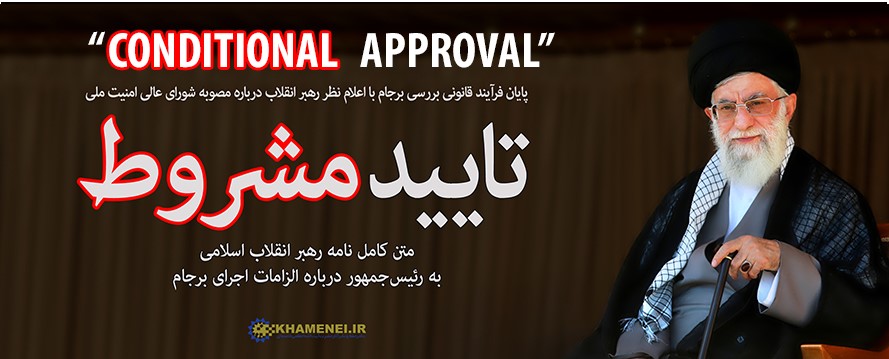
The letter, defined by Khamenei on his website as “conditional approval” of the JCPOA, sets several new conditions for Iran’s execution of the agreement. These conditions constitute late and unilateral additions to the agreement concluded three months previously that fundamentally change it. Khamenei stresses that the agreement awaits his opinion following what he calls “precise and responsible examination” in the Majlis and “clearance of this agreement through legal channels” in Iran’s Supreme National Security Council.  

25366

It should be further noted that in his introduction to the new conditions, Khamenei attacks the U.S. and President Obama with great hostility, and calls for Obama to be prosecuted by international judiciary institutions. He states that Obama had sent him two letters declaring that he has no intention of subverting the regime of the Islamic Republic of Iran, but adds that the U.S.’s support for fitna in Iran (i.e. the popular post-election unrest in 2009), its monetary aid to opponents of the Republic, and its explicit threats to attack Iran have proven the opposite and have exposed the real intent of America’s leaders, whose enmity towards Iran will not end. He wrote that the Americans’ behavior in the nuclear talks is another link in the chain of its enmity towards Iran, that America entered into the talks with the aim of “deception,” and that therefore Iran must remain alert in light of America’s hostile intentions.

The set of conditions laid out by Khamenei creates a situation in which not only does the Iranian side refrain from approving the JCPOA,[1] but, with nearly every point, creates a separate obstacle, such that executing the agreement is not possible.

The following are Khamenei’s nine conditions, and their implications:

Khamenei’s Conditions For Iranian Execution Of The JCPOA

First condition: Khamenei demands that the U.S. and Europe lift the sanctions, not suspend them, and in addition demands “solid and sufficient” guarantees in advance that this will be done, before Iran takes its own steps and meets its own obligations under the agreement. These guarantees, insists Khamenei, must include, inter alia, an official letter from the U.S. president and from the EU undertaking to fully lift the sanctions. Furthermore, he demands that this letter will state that any declaration by the West that the “structure of the sanctions will remain in force” (i.e. allowing snapback) will be considered “non-compliance with the JCPOA” on the part of the West.

Implications: These conditions constitute a total change of the JCPOA. Khamenei is not allowing any execution of the JCPOA by Iran until this is accepted in writing by the other side, and thus he is nullifying the JCPOA as agreed upon on July 14, 2015.

Second condition: Any sanctions against Iran “at every level and on every pretext,” including terrorism and human rights violations, by any one of the countries participating in the negotiations will “constitute a violation of the JCPOA,” and a reason for Iran to stop executing the agreement.

Implications: This demand, that links the JCPOA to other issues and prohibits any punishment of Iran on any issue and for any reason, serves as an excuse for Iran to cancel the agreement.

Third condition: Under the JCPOA, Iran is obligated, following the JCPOA’s Adoption Day, to carry out its obligations concerning changing the function of the nuclear reactor at Arak and shipping out most of its stockpile of enriched uranium. Contrary to this, Khamenei is changing the timetable of the JCPOA, stating that Iran will not carry out these actions until after the International Atomic Energy Agency (IAEA) declares that it is closing its dossier on Iran’s “past and future issues (including the so-called Possible Military Dimensions or PMD of Iran’s nuclear program).”

Implications: This demand to change the timetable creates a situation in which Iran will not take action as stipulated in the JCPOA, and will not meet its obligations, before the sanctions are eased, also according to the JCPOA, but instead dictates that the sanctions must first be lifted completely and states that only then will Iran meet its obligations. Khamenei here is creating a situation in which the IAEA will not be able to report on Iran’s meeting of its obligations regarding the Arak reactor and regarding the shipping out of its enriched uranium by the target date of December 15, 2015, because Iran is not going to do so by then – thus the execution of the agreement is thwarted from the beginning.

Fourth condition: Iran will meet its obligations to “renovate” and change the purpose of the Arak reactor only after there is a signed agreement on an “alternative plan” for changes to the reactor, and after there is “sufficient guarantee” that this alternative plan will be implemented.

Implications: Iran’s fulfillment of its obligations regarding the Arak reactor, as stipulated by the JCPOA, will be postponed until some unknown future date.

Fifth condition: Iran will carry out its obligation to ship out its enriched uranium to another country in exchange for yellowcake “on a gradual basis and on numerous occasions,” and only after “a secure agreement has been clinched to that effect, along with sufficient guarantees” that this exchange will be implemented.

Implications: The date for Iran to ship out its enriched uranium as stipulated by the JCPOA is postponed until some unknown future date. Khamenei is demanding that Iran receive in exchange for the enriched uranium not raw uranium as per the JCPOA, but instead uranium that has been enriched, albeit to a lower level than the uranium it ships out. This is yet another change to the JCPOA as concluded on July 14, 2015.

Sixth condition: Khamenei instructs President Rohani to begin, along with reducing Iran’s ability to enrich uranium under the JCPOA, immediately to expand Iran’s ability to enrich uranium with a 15-year long-term plan for 190,000 centrifuge SWU (Separative Work Units). “This plan,” he says, “must allay any concern stemming from some points entailed in the JCPOA appendices.”

Implications: This article nullifies the declared goal of the JCPOA, which is to reduce Iran’s nuclear enrichment capabilities.

Seventh condition: The Iranian Atomic Energy Organization must ensure continued nuclear research and development, in its various dimensions, such that in eight years’ time, Iran will not be lacking in enrichment technology. This, he says, is all in accordance with the JCPOA.

Eighth condition: In the event of doubt or ambiguity regarding the content of the JCPOA, the source of authority for removing this doubt or ambiguity will be the content of the talks – i.e. it will also include the statements by the Iranian side, not just the “interpretation provided by the opposite party,” that is, the P5+1.

Implications: Any doubt or ambiguity regarding the content of the JCPOA will become the source of unending dispute and will paralyze any possibility of executing the agreement.

Ninth condition: Due to apprehensions that the other side, particularly the U.S., will break its promises or cheat, President Rohani must establish a “well-informed and smart panel” to monitor the execution of the agreement.

Implications: Khamenei is creating an administrative framework for perpetual delays in the execution of the agreement.

Khamenei adds also a 10th condition, directed at Iran, not the P5+1, demanding that Rohani take seriously his instructions in the matter of the “resistance economy,” the main thrust of which is self-reliance instead of basing Iran’s economy on external sources. He also demands that after the sanctions are lifted, there will be no “unbridled imports,” and no imports whatsoever from the U.S.

Political Ramifications In Iran

In February 2016, elections for the Majlis and the Assembly of Experts are set to take place in Iran. The pragmatic camp, headed by Hashemi Rafsanjani and President Rohani, had hoped that a quick execution of the agreement would allow the sanctions to be eased and funds to be released immediately, which in turn would allow the pragmatic camp to present these achievements and triumph in the elections. By setting these conditions, however, Khamenei has thwarted any speedy execution of the agreement, and thus has thwarted the pragmatic camp’s hope for electoral success.

IRIB Translation

The following is the official English translation of Khamenei’s letter, as published by IRIB.[2] This translation was tweeted by Khamenei and also posted on his Facebook page (see Appendix I and II).

“Wednesday, 21 October 2015 17:41
“Ayatollah Khamenei sends a letter to President Hassan Rouhani about the JCPOA

25367

“Ayatollah Seyyed Ali Khamenei, the Leader of the Islamic Revolution, in a letter to President Hassan Rouhani, who also heads the Supreme National Security Council (SNSC), referred to the precise and responsible examination of the Joint Comprehensive Plan of Action (JCPOA) in the Islamic Consultative Assembly (parliament) and also the SNSC, and the clearance of this agreement through legal channels, and issued important instructions regarding the observation of and safeguarding the country’s national interests. Enumerating nine-point requirements for the implementation of the JCPOA, Ayatollah Ali Khamenei endorsed SNSC Resolution 634, dated August 10, 2015, provided that the following provisions and requirements are observed.

“The full text of Ayatollah Khamenei’s letter follows on:

In the Name of Allah, the Most Compassionate, the Most Merciful

“Your Excellency,  Mr Rouhani,
“President of the Islamic Republic of Iran and Head of the Supreme National Security Council
“May God bestow success upon you.
“Greetings to You

“The agreement known as the Joint Comprehensive Plan of Action (JCPOA) has already been cleared through legal channels following precise and responsible examinations in the Islamic Consultative Assembly, [parliamentary] ad hoc committees and other committees as well as the Supreme National Security Council. Since the agreement is waiting for my view, I deem it necessary to remind several points so that Your Excellency and other officials directly or indirectly involved in the issue would have enough time to comply with and safeguard national interests and the country’s best interests.

“1. Before anything else, I deem it necessary to extend my gratitude to all those involved in this challenging procedure throughout all its periods, including the recent nuclear negotiating team whose members tried their best in explaining the positive points and incorporating all those points [into the agreement], critics who reminded all of us of weak points through their appreciable meticulousness, and particularly the chairman and members of the Majlis ad hoc committee [set up to review the JCPOA] as well as the senior members of the SNSC who covered some voids by including their important considerations, and finally the Speaker of Majlis and Members of Parliament who adopted a cautious bill to show the right way of implementation [of the agreement] to the administration, and also national media and the country’s journalists who despite all their differences of view presented a complete image of this agreement to public opinion. This voluminous collection of activity and endeavors and thoughts [spent] on an issue which is thought to be among the unforgettable and instructive issues of the Islamic Republic, deserves appreciation and is a source of satisfaction. Therefore, one can say with certainty that the divine reward for these responsible contributions will, God willing, include assistance and mercy and guidance by Almighty God because the divine promises of assistance in exchange for assisting His religion are unbreakable.

“2. Enjoying decades-long background of presence in the very details of the affairs of the Islamic Republic of Iran, you must have naturally realized that the government of the United States of America, neither in the nuclear issue nor in any other issue, had been pursuing no other approach but hostility and disturbance, and is unlikely to do otherwise in the future either. The remarks by the US President [Barack Obama] in two letters addressed to me on the point that [Washington] has no intention of subverting the Islamic Republic of Iran turned out to be unreal and his open threats of military and even nuclear strike, which can result in a lengthy indictment against him in international courts, laid bare the real intentions of US leaders. Political pundits and public opinion of many nations clearly understand that the case of his never-ending hostility is the nature and identity of the Islamic Republic of Iran, which is born out of the Islamic Revolution. Insistence on rightful Islamic stances and opposition to the hegemonic and arrogant system, perseverance against excessive demands and encroachment upon oppressed nations, revelations on the US support for medieval dictators and suppression of independent nations, incessant defense for the Palestinian nation and patriotic resistance groups, rational and globally popular yelling at the usurping Zionist regime constitute the main items which make the US regime’s enmity against the Islamic Republic inevitable, and this enmity will continue as long as the Islamic Republic [continues to] disappoint them with its internal and sustainable strength.

“The behavior and words of the US government in the nuclear issue and its prolonged and boring negotiations showed that this (nuclear issue) was also another link in their chain of hostile enmity with the Islamic Republic. Their deception through flip-flopping between their initial remarks that came after Iran accepted to hold direct talks with them and their constant non-compliance with their pledges throughout two-year-long negotiations and their alignment with the demands of the Zionist regime and their bullying diplomacy regarding relations with European governments and bodies involved in the negotiations are all indicative of the fact that the US’s deceitful involvement in the nuclear negotiations has been done not with the intention of a fair settlement [of the case], but with the ill intention of pushing ahead with its hostile objectives about the Islamic Republic.

“Doubtlessly, vigilance vis-à-vis the hostile intentions of the US government and instances of resistance on the part of the officials of the Islamic Republic of Iran throughout the negotiations managed, in numerous cases, to prevent heavy damage from being inflicted [upon Iran].

“However, the outcome of the negotiations, which is enshrined in the JCPOA, has numerous ambiguities and structural weaknesses that could inflict big damage on the present and the future of the country in the absence of meticulous and constant monitoring.

“3. The nine-point provisions entailed in the recent bill adopted by the Majlis and the 10-point instructions outlined in the resolution of the Supreme National Security Council carry helpful and effective points which must be taken into consideration. Meantime, there are some other necessary points which are announced here while some of the points mentioned in the two documents are highlighted.

“First, since Iran has accepted to negotiate basically for the objective of removal of unjust economic and financial sanctions and its enforcement (the lifting of sanctions) is tied to Iran’s future actions under the JCPOA, it is necessary that solid and sufficient guarantees be arranged to avoid any infraction by the opposite parties. Written declaration by the US president and the European Union for the lifting of the sanctions is among them. In the statements of the EU and the US president, it must be reiterated that these sanctions will be fully lifted. Any declaration that the structure of the sanctions will remain in force shall imply non-compliance with the JCPOA.

“Second, throughout the eight-year period, any imposition of sanctions at any level and under any pretext (including repetitive and fabricated pretexts of terrorism and human rights) on the part of any of the countries involved in the negotiations will constitute a violation of the JCPOA and the [Iranian] government would be obligated to take the necessary action as per Clause 3 of the Majlis bill and stop its activities committed under the JCPOA .

“Third, the measures related to what is mentioned in the next two clauses will start only after the International Atomic Energy Agency (IAEA) announces [the conclusion of] the past and future issues (including the so-called Possible Military Dimensions or PMD of Iran’s nuclear program).

“Fourth, measures to renovate the Arak plant by preserving its heavy [water] nature will start only after a firm and secure agreement has been signed on an alternative plan, along with sufficient guarantees for its implementation.

“Fifth, the deal with a foreign government for swapping enriched uranium with yellow cake will start only after a secure agreement has been clinched to that effect, along with sufficient guarantees [for its implementation]. The aforesaid deal and exchange must be done on a gradual basis and on numerous occasions.

“Sixth, by virtue of the Majlis bill, the plan and the necessary preparations for mid-term development of the atomic energy industry, which includes the method of advancement in different periods of time for 15 years for the final objective of 190,000 SWU, must be drawn up and carefully reviewed by the Supreme National Security Council. This plan must allay any concern stemming from some points entailed in the JCPOA appendices.

“Seventh, the Atomic Energy Organization of Iran must organize research and development in different aspects such that after the end of the eight-year period, there would be no shortage of technology for the level of [uranium] enrichment entailed in the JCPOA.

“Eighth, it must be noted that on the ambiguous points in the JCPOA document, the interpretation provided by the opposite party is not acceptable and the reference would be the text of the negotiations.

“Ninth, the existence of complications and ambiguities in the text of the JCPOA and the suspicion of breach of promise, infractions and deception by the opposite party, particularly the US, require that a well-informed and smart panel be established to monitor the progress of affairs and [gauge] the opposite party’s commitment and realization of what was mentioned above. The composition and the tasks of this would-be panel should be determined and approved by the Supreme National Security Council.

“In witness whereof, Resolution 634, dated August 10, 2015, of the Supreme National Security Council, is endorsed pending the observation of the aforementioned points.

“In conclusion, as it has been notified in numerous meetings to you and other government officials and also to our dear people in public gatherings, although the lifting of sanctions is a necessary job in order to remove injustice [imposed on people] and regain the rights of the Iranian nation, economic overture and better livelihood and surmounting the current challenges will not be easy unless the Economy of Resistance is taken seriously and followed up on entirely. It is hoped that this objective will be pursued with full seriousness and special attention would be paid to enhancing national production. You should also watch out so that unbridled imports would not follow the lifting of sanctions, and particularly importing any consumer materials from the US must be seriously avoided.

“I pray to Almighty God for your and other contributors’ success.
“Source: www. leader. ir”

__________________

Endnotes:

[2] English.irib.ir/news/leader/item/217470-ayatollah-khamenei-sends-a-letter-to-president-hassan-rouhani-about-the-jcpoa, October 21, 2015.

[3] Twitter.com/khamenei_ir, October 21, 2015.

[4] Facebook.com/www.Khamenei.ir/posts/943612332378368:0, posted October 21, 2015.

Looking beyond the ‘third intifada’

October 14, 2015

Looking beyond the ‘third intifada’ Jerusalem PostLouis Rene Beres, October 13, 2015

ShowImage (14)Funeral in the Shuafat refugee camp in east Jerusalem, on October 10, 2015. (photo credit: AHMAD GHARABLI / AFP)

About expected Palestinian state intentions, there is little real mystery to fathom. It should already be widely understood that any new state of Palestine could provide a ready platform for launching endlessly renewable war and terrorism against Israel. Significantly, not a single warring Palestinian faction has ever even bothered to deny such overtly criminal intent. On the contrary, aggressive intent has always been openly embraced, fervently cheered as a distinctly sacred “national” incantation.

*********************************

It’s farewell to the drawing-room’s civilized cry, The professor’s sensible where to and why, The frock-coated diplomat’s social aplomb, Now matters are settled with gas and with bomb.”

– W.H. Auden, Danse Macabre

With apparent suddenness, and a very deliberate brutality, Palestinian terrorists are launching a new wave of indiscriminate assaults they proudly hail as a “third intifada.”

But behind the protective veneer of language, where homicide is conveniently transfigured into revolution, these latest Arab attacks remain what they have always been – that is, crudely camouflaged expressions of rampant criminality.

Jurisprudentially, this is all perfectly obvious. Prima facie, under all pertinent international law, calculated assaults on mostly women and children can never be sanitized or justified. Always, rather, they represent codified crimes of war and crimes against humanity.

Always, such crimes are unpardonable.

Oddly enough, even after the painfully long history of egregious Palestinian crimes carried out against noncombatant populations, a sizable portion of the “international community” still seeks to encourage Palestinian statehood. Self-righteously, of course, and with ritualistic indignation directed against Israeli “intransigence,” the “civilized community of nations” remains willing to rip a 23rd Arab state from the still-living body of Israel. Even now, as the Palestinians remain rigorously segmented into barbarously warring factions – into opponents who enthusiastically maim and torture each other, all while cooperating in doing the same to their commonly despised Israeli victims – world public opinion calls naively for Palestinian “self-determination.”

Even now, when any new Palestinian state could quickly come to resemble an already-fractured Syria, the United Nations and its secretary – general seem much more concerned with comforting the markedly unheroic Palestinian criminals than with protecting fully innocent Israeli civilians.

Unapologetically, and whatever their unhindered and ongoing excesses, Fatah, Hamas and Islamic Jihad are easily able to incite followers to inflict and then celebrate incessant harms upon Israel.

At some point, it is likely that such harms, joyously imposed with a reassuring impunity, could involve diverse weapons of mega-terrorism, including assorted chemical, biological, or even nuclear agents.

In this last category of insidious choice, Palestine, after formalizing its sought-after condition of statehood or sovereignty, could be placed in an optimal position to assault Israel’s Dimona nuclear reactor.

This plainly sensitive facility was previously attacked, in both 1991 and again in 2014. Those earlier missile and rocket barrages, which produced no ascertainably injurious damages to the critical reactor core, had originated with Iraqi and Hamas aggressions, respectively.

About expected Palestinian state intentions, there is little real mystery to fathom. It should already be widely understood that any new state of Palestine could provide a ready platform for launching endlessly renewable war and terrorism against Israel. Significantly, not a single warring Palestinian faction has ever even bothered to deny such overtly criminal intent. On the contrary, aggressive intent has always been openly embraced, fervently cheered as a distinctly sacred “national” incantation.

A September 2015 poll by the Palestinian Center for Policy and Survey research – the leading social research organization in the Palestinian territories – found that a majority of Palestinians unhesitatingly reject a two-state solution.

When asked, as a corollary question, about any preferred or alternate ways to establish an independent Palestinian state, 42 percent called for “armed action.”

Only 29% favored “negotiation,” or some sort of peaceful resolution.

Not much mystery here.

On all currently official Hamas and Palestinian Authority (PA ) maps of “Palestine,” Israel has been removed altogether, or identified exclusively as “occupied Palestine.”

By these revealingly forthright and vengeful depictions, Israel has already been forced to suffer a “cartographic genocide.” Unambiguously, from the standpoint of any prospective Palestinian state policies toward Israel, such incendiary maps are portentous, predictive and possibly even prophetic.

What is not generally recognized is that a Palestinian state, any Palestinian state, could play a determinedly serious role in bringing some form of nuclear conflict to the Middle East. Palestine, of course, would itself be non-nuclear; but that’s not the issue. There would remain several other ways in which the new state’s predictable infringements of Israeli security could make the Jewish state more vulnerable to an eventual nuclear attack from Iran, or, in the even more distant future, from a newly-nuclear Arab state.

This second prospect would likely have its core origins in understandable reactions to the plainly impotent Vienna pact with Iran.

Following the July 14, 2015 Joint Comprehensive Plan of Action (JCPOA ), several Sunni states in the region, most plausibly Egypt and/ or Saudi Arabia, will likely feel compelled to “go nuclear.”

In essence, any such considered Sunni Arab nuclear proliferation would represent a more-or-less coherent “self-defense” reaction against expectedly escalating perils, once still-avoidable dangers now issuing from the reciprocally fearful Shi’ite world.

There is also more to expect from the Sunni side. Here, in actions that would have no apparent connection to expected Iranian nuclearization, Islamic State (IS) could begin an avowedly destructive march westward, across Jordan, and all the way to the borders of West Bank (Judea/Samaria). There, should a Palestinian state already be established and functional, dedicated Sunni terrorist cadres would likely make quick work of any deployed Palestinian army. In the event that a new Arab state had not yet been suitably declared – that is, in a fashion consistent with codifying Montevideo Convention (1934) expectations – invading IS forces (not Israel) will have become the principal impediment to Palestinian independence.

Credo quia absurdum – “I believe because it is absurd.” In either case, any such IS or IS-related conquest could create another available platform for launching relentless terrorist attacks across the region.

In time, of course, most of these murderous attacks would be aimed precisely at Israel.

IS, as everyone can see, is on the move. It has already expanded well beyond Iraq and Syria, notably into Yemen, Libya, Egypt and Somalia.

Although Hamas leaders generally deny any IS presence in Gaza, that terrorist group’s black flag is now seen more and more regularly in that expressly Palestinian space.

In principle, at least, Israel could sometime find itself forced to cooperate with Hamas against IS, but any reciprocal willingness from the Islamic Resistance Movement, whether glaringly conspicuous or beneath the radar, is implausible.

Additionally, Egypt regards Hamas as part of the much wider Muslim Brotherhood, and prospectively, just as dangerous as IS.

In any event, after Palestine, and even in the absence of any takeover of the new Arab state by IS forces, Israel’s physical survival would require increasing self-reliance in existential military matters.

Such expansions, in turn, would demand: 1) an appropriately revised nuclear strategy, involving deterrence, defense, preemption and warfighting capabilities; and 2) a corollary conventional strategy.

Significantly, however, the birth of Palestine could impact these strategies in several disruptive ways.

Most ominously, a Palestinian state could render most of Israel’s conventional capabilities substantially more problematic. It could thereby heighten certain eventual chances of a regional nuclear war.

Credo quia absurdum. A nuclear war in the Middle East is not out of the question. At some point, such a conflict could arrive in Israel not only as a “bolt-from-the-blue” surprise missile attack, but also as a result, whether intended or inadvertent, of escalation.

If, for example, certain enemy states were to begin “only” with conventional and/or biological attacks upon Israel, Jerusalem might then respond, sooner or later, with nuclear reprisals. Or if these enemy states were to begin hostilities with certain conventional attacks upon Israel, Jerusalem’s own conventional reprisals might then be met, at least in the future, with enemy nuclear counterstrikes.

For now, this second scenario could become possible only if Iran were to continue its evident advance toward an independent nuclear capability. It follows that a persuasive Israeli conventional deterrent, at least to the extent that it could prevent enemy state conventional, and/or biological attacks, would substantially reduce Israel’s risk of any escalatory exposure to a nuclear war. Israel will need to maintain its capacity for “escalation dominance,” but Palestinian statehood, on its face, could still impair this overriding strategic obligation.

A subsidiary question comes to mind. Why should Israel need a conventional deterrent at all? Israel, after all, seemingly maintains a capable nuclear arsenal and corollary doctrine, even though both still remain “deliberately ambiguous.”

And there arises a still further query. Even after “Palestine,” wouldn’t enemy states desist from launching conventional and/or biological attacks upon Israel, here, out of an entirely reasonable and prudent fear of suffering a nuclear retaliation? Not necessarily. Aware that Israel would cross the nuclear threshold only in certain extraordinary circumstances, these enemy states could be convinced – rightly or wrongly – that so long as their attacks were to remain non-nuclear, Israel would respond only in kind. Faced with such probable calculations, Israel’s ordinary security would still need to be sustained by conventional deterrent threats.

A strong conventional capability will still be needed by Israel to deter or to preempt conventional attacks – attacks that could, if undertaken, lead quickly, via escalation, to various conceivable forms of unconventional war.

Credo quia absurdum. It is still not sufficiently understood that Palestine could have serious effects on power and peace in the Middle East. As the creation of yet another enemy Arab state would need to arise from the intentional dismemberment of Israel, the Jewish state’s strategic depth would inevitably be diminished. Over time, therefore, Israel’s conventional capacity to ward off assorted enemy attacks could be correspondingly reduced.

Paradoxically, if enemy states were to perceive Israel’s own sense of expanding weakness and desperation, this could strengthen Israel’s nuclear deterrent. If, however, pertinent enemy states did not perceive such a “sense” among Israel’s decision-makers (a far more likely scenario), these states, now animated by Israel’s conventional force deterioration, could then be encouraged to attack. The cumulative result, spawned by Israel’s post-Palestine incapacity to maintain strong conventional deterrence, could become: 1) defeat of Israel in a conventional war; 2) defeat of Israel in an unconventional chemical/biological/nuclear war; 3) defeat of Israel in a combined conventional/unconventional war; or 4) defeat of Arab/Islamic state enemies by Israel in an unconventional war.

For Israel, a country less than half the size of Lake Michigan, even the “successful” fourth possibility could prove intolerable. The tangible consequences of a nuclear war, or even a “merely” chemical/ biological war, could be calamitous for the victor as well as the vanquished.

Under such exceptional conditions of belligerency, the traditional notions of “victory” and “defeat” would likely lose all serious meaning.

Although a meaningful risk of regional nuclear war in the Middle East must exist independently of any Palestinian state, this uniquely serious threat would be still greater if a new Arab terrorist state were authoritatively declared.

Palestine, it has increasingly been argued, could sometime become vulnerable to overthrow by even more militant jihadist Arab forces, a violent transfer of power that could then confront Israel with an even broader range of regional perils.

In this connection, IS, again, could find itself at the outer gates of “Palestine.” In such a scenario, it is plausible that the IS fighters would make fast work of any residual Palestinian defense force, PA and/ or Hamas, and then absorb Palestine itself into a rapidly expanding Islamic “caliphate.”

Before anything remotely decent could be born from such a determined theocracy, a very capable sort of gravedigger would have to wield the forceps.

The “third intifada” is just another legitimizing term for remorseless Palestinian terrorism. Should it transform the always fratricidal Palestinian territories into another corrupted Arab state, Palestine, either by itself, or as a newly-incorporated part of a still-growing IS “caliphate,” would become another Syria. Even more significantly, Palestine could bring specifically nuclear-based harms to the broader region.

Then, quite predictably, all pertinent “matters” would be settled “with gas and with bomb.”

The Iranian Majlis Has Not Approved The JCPOA But Iran’s Amended Version Of It

October 13, 2015

The Iranian Majlis Has Not Approved The JCPOA But Iran’s Amended Version Of It, Middle East Media Research Institute, A. Savyon* and Y. Carmon, October 13, 2015

(Even Obama’s foggy notions of “common sense” should include the premise that, if there are multiple parties to an agreement, they should all follow the same agreement. — DM)

[T]he inclusion of these new Iranian demands in a Majlis decision constitutes the first written demand by an Iranian authority to amend the agreement, a demand that was mentioned verbally on September 3, 2015 by Iran’s Supreme Leader Ali Khamenei.

****************

On October 13, 2015 the Iranian Majlis approved, by a majority of 161-59 with 13 abstentions, not the JCPOA but rather an Iranian amended version it.

Paragraph 3 of the Majlis decision states that “the government will monitor any non-performance by the other party [to the agreement] in the matter of failing to lift the sanctions, or restoring the canceled sanctions, or imposing sanctions for any another reason, and will take steps to actualize the rights of the Iranian nation and to terminate the voluntary cooperation [this apparently refers to the Additional Protocol, which, according to the JCPOA, Iran will implement voluntarily] and to handle the rapid expansion of the Iranian nuclear program for peaceful purposes, so that within two years the enrichment potential in Iran will reach 190,000 SWU. The Supreme National Security Council will handle this matter, and the government will to submit to the Council a plan in the matter within four months.”[1]

Implications:

Considering that the non-cancellation of the sanctions is part of the JCPOA (according to the JCPOA, U.S. sanctions will be merely “suspended,” rather than canceled, so as to allow their “snapback” in the case of an Iranian violation); and considering that the re-imposition of sanctions, and the imposition of new sanctions, in case of an Iranian violation are likewise part of the JCPOA – the Majlis decision constitutes ratification of a nonexistent document. It was not a ratification of the JCPOA as it stands, but rather of additional demands made by Iran after the JCPOA was agreed upon on July 14, 2015 in Vienna.

Furthermore, the inclusion of these new Iranian demands in a Majlis decision constitutes the first written demand by an Iranian authority to amend the agreement, a demand that was mentioned verbally on September 3, 2015 by Iran’s Supreme Leader Ali Khamenei.[2]

The Majlis decision defines clauses in the JCPOA as “non-performance of the agreement by the other party” and therefore the Majlis’ approval is meaningless.

* A. Savyon is director of the MEMRI Iran Media Project; Y. Carmon is President of MEMRI.

Endnotes:

[1] ISNA (Iran), October 13, 2015.

[2] Khamenei announced explicitly on September 3, 2015 that he does not accept the terms of the agreement and demanded that the sanctions should be immediately removed, rather than suspended, as a condition for accepting the agreement. See the following MEMRI reports:

Special Dispatch No. 6151, “Khamenei Declares That He Will Not Honor The Agreement If Sanctions Are Merely Suspended And Not Lifted,” September 4, 2015; Special Dispatch No. 6162, “Expected September 28 NY Meeting Between P5+1 Foreign Ministers And Iran Could Signify Reopening Of Nuclear Negotiations To Address Khamenei’s September 3 Threat That If Sanctions Are Not Lifted, But Merely Suspended, There Will Be No Agreement,” September 21, 2015.

Op-Ed: Chaos and 2nd Cold War, Part II: Israel’s Nuclear Strategy

October 11, 2015

Op-Ed: Chaos and 2nd Cold War, Part II: Israel’s Nuclear Strategy, Israel National News, Prof. Louis René Beres, October 11, 2015

(Part I is available here. — DM)

Israel should now be calculating the exact extent or subtlety with which it should consider communicating key portions of its nuclear posture and positions. Naturally, Israel should never reveal any too-specific information about its nuclear strategy, its nuclear hardening, or even its nuclear yield-related capabilities. Still, sometimes, the duty of finely-honed intelligence services should not be to maximize strategic secrecy, but rather, to carefully “share” certain bits of pertinent information.

**********************************

How will Russia respond to any ramped up American uses of force in the Middle East, and, more plausibly, vice-versa?  One must assume that Jerusalem is already asking these key questions, and even wondering whether, in part, greater mutualities of interest could sometime exist with Moscow than with Washington.

To wit, Prime Minister Benjamin Netanyahu met with Russia’s President Vladimir Putin in September 2015. Among other things, the Israeli leader must  be calculating: 1)Will the Obama Administration’s incoherent retreat from most of the Middle East point toward a more permanent United States detachment from the region; and 2) If it does, what other major powers are apt to fill the resultant vacuum? Just as importantly, and as an obvious corollary to (2), above, the prime minister should be inquiring: “How will the still-emerging Cold War II axis of conflict impact America’s pertinent foreign policy decisions?”

There are some additional ironies yet to be noted. Almost certainly, ISIS, unless it is first crushed by U.S. and/or Russian-assisted counter-measures, will plan to march westward across Jordan, ultimately winding up at the borders of West Bank (Judea/Samaria). There, ISIS Jihadists could likely make fast work of any still-posted Hamas and Fatah forces, in effect, taking over what might once have become “Palestine.” In this now fully imaginable scenario, the most serious impediment to Palestinian statehood is not Israel, but rather a murderous band of Sunni Arab terrorists.[16]

What about the larger picture of “Cold War II?” Israeli defense planners will need to factor into their suitably nuanced calculations the dramatically changing relationship between Washington and Moscow. During “Cold War I,” much of America’s support for the Jewish State had its most fundamental origins in a perceived need to compete successfully in the Middle East with the then Soviet Union. In the progressive development of “Cold War II,” Jerusalem will need to carefully re-calculate whether a similar “bipolar” dynamic is once again underway, and whether the Russian Federation might, this time around, identify certain strategic benefits to favoring Israel in regional geo-politics.

In all such strategic matters, once Israel had systematically sorted through the probable impact of emerging “superpower” involvements in the Middle East, Jerusalem would need to reassess its historic “bomb in the basement.” Conventional wisdom, of course, has routinely pointed in a fundamentally different policy direction. Still, this “wisdom” assumes that credible nuclear deterrence is simply an automatic result of  physically holding nuclear weapons. By the logic of this too-simplistic argument, removing Israel’s nuclear bomb from the “basement” would only elicit new waves of global condemnation, and would likely do so without returning any commensurate security benefits to Jerusalem.

Scholars know, for good reason, that the conventional wisdom is often unwise. Looking ahead, the strategic issues facing Israel are not at all uncomplicated or straightforward.  Moreover, in the immutably arcane world of Israeli nuclear deterrence, it can never really be adequate that enemy states merely acknowledge the Jewish State’s nuclear status. Rather, it is also important that these states should be able to believe that Israel holds usable nuclear weapons, and that Jerusalem/Tel-Aviv would be willing to employ these usable weapons in certain clear, and situationally recognizable, circumstances.

Current instabilities in the Middle East will underscore several good reasons to doubt that Israel could ever benefit from any stubborn continuance of deliberate nuclear ambiguity. It would seem, too, from certain apparent developments already taking place within Mr. Netanyahu’s “inner cabinet,” that portions of Israel’s delegated leadership must now more fully understand the bases of any such informed skepticism.

In essence, Israel is imperiled by compounding and inter-related existential threats that justify its fundamental nuclear posture, and that require a correspondingly purposeful strategic doctrine. This basic need exists well beyond any reasonable doubt. Without such weapons and doctrine, Israel could not expectedly survive over time, especially if certain neighboring regimes, amid expanding chaos,  should soon become more adversarial, more Jihadist, and/or less risk-averse.

Incontestably, a purposeful nuclear doctrine could prove increasingly vital to coping with various more-or-less predictable strategic scenarios for Israel, that is, those believable narratives requiring preemptive action, and/or an appropriate retaliation.

Typically, military doctrine carefully describes how national forces should fight in various combat operations. The literal definition of “doctrine” derives from Middle English, from the Latin doctrina, meaning teaching, learning, andinstruction. Though generally unrecognized, the full importance of doctrine lies not only in the several ways that it can animate and unify military forces, but also in the uniquely particular fashion that it can transmit certain desired “messages.”

In other words, doctrine can serve an increasingly imperiled  state as a critical form of communication, one directed to its friends, and also to its foes.

Israel can benefit from just such broadened understandings of doctrine. The principal security risks now facing Israel are really more specific than general or generic. This is because Israel’s extant adversaries in the region will likely be joined, at some point, by: (1) a new Arab state of “Palestine;” and/or by (2) a newly-nuclear Iran. It is also because of the evidently rekindled global spark of “bipolar” or “superpower” adversity, and the somewhat corollary insertion of additional American military forces to combat certain new configurations of Jihadi terror.

For Israel, merely having nuclear weapons, even when fully recognized in broad outline by enemy states, can never automatically ensure successful deterrence. In this connection, although starkly counter-intuitive, an appropriately selective and thoughtful end to deliberate ambiguity could improve the overall credibility of Israel’s nuclear deterrent.  With this point in mind, the potential of assorted enemy attack prospects in the future could be reduced by making available certain selected information concerning the safety of  Israel’s nuclear weapon response capabilities.

This crucial information, carefully limited, yet more helpfully explicit, would center on the distinctly major and inter-penetrating issues of Israeli nuclear capability and decisional willingness.

Skeptics, no doubt, will disagree. It is, after all, seemingly sensible to assert that nuclear ambiguity has “worked” thus farWhile Israel’s current nuclear policy has done little to deter multiple conventional terrorist attacks, it has succeeded in keeping the country’s enemies, singly or in collaboration, from mounting any authentically existential aggressions. This conclusion is not readily subject to any reasonable disagreement.

But, as the nineteenth-century Prussian strategic theorist, Karl von Clausewitz, observed, in his classic essay, On War, there may come a military tipping point when “mass counts.” Israel is already coming very close to this foreseeable point of no return. Israel is very small.  Its enemies have always had an  undeniable advantage in “mass.”

More than any other imperiled state on earth, Israel needs to steer clear of such a tipping point.

This, too, is not subject to any reasonable disagreement.

Excluding non-Arab Pakistan, which is itself increasingly coup-vulnerable, none of Israel’s extant Jihadi foes has “The Bomb.”  However, acting together, and in a determined collaboration, they could still carry out potentially lethal assaults upon the Jewish State. Until now, this capability had not been possible, largely because of insistent and  persistently overriding fragmentations within the Islamic world. Looking ahead, however, these same fragmentations could sometime become a source of special danger to Israel, rather than remain a continuing source of  national safety and reassurance.

An integral part of Israel’s multi-layered security system lies in the country’s ballistic missile defenses, primarily, the Arrow or “Hetz.” Yet, even the well-regarded and successfully-tested Arrow, now augmented by the newer and shorter-range iterations of “Iron Dome,” could never achieve a sufficiently high probability of intercept to meaningfully protect Israeli civilians.[17] No system of missile defense can ever be “leak proof,” and even a single incoming nuclear missile that somehow managed to penetrate Arrow or corollary defenses could conceivably kill tens or perhaps hundreds of thousands of Israelis.[18]

In principle, at least, this fearsome reality could be rendered less prospectively catastrophic if Israel’s traditional reliance on deliberate ambiguity were suitably altered.

Why alter? The current Israeli policy of an undeclared nuclear capacity is unlikely to work indefinitely. Leaving aside a Jihadi takeover of already-nuclear Pakistan, the most obviously unacceptable “leakage” threat would come from a nuclear Iran. To be effectively deterred, a newly-nuclear Iran would require convincing assurance that Israel’s atomic weapons were both (1) invulnerable, and (2) penetration-capable.

Any Iranian judgments about Israel’s capability and willingness to retaliate with nuclear weapons would then depend largely upon some prior Iranian knowledge of these weapons, including their expected degree of protection from surprise attack, as well as Israel’s expected capacity to “punch-through” all pertinent Iranian active and passive defenses.

Jurisprudentially, at least, following JCPOA in Vienna, a  nuclear weapons-capable Iran is a fait accompli. For whatever reasons, neither the “international community” in general, nor Israel in particular, had ever managed to create sufficient credibility concerning a once-timely preemptive action. Such a critical defensive action would have required very complex operational capabilities, and could have generated Iranian/Hezbollah counter actions that might have a  very significant impact on the entire Middle East. Nevertheless, from a purely legal standpoint, such preemptive postures could still have been justified, under the authoritative criteria of anticipatory self-defense, as permitted under customary international law.

It is likely that Israel has undertaken some very impressive and original steps in cyber-defense and cyber-war, but even the most remarkable efforts in this direction will not be enough to stop Iran altogether. Earlier, the “sanctions” sequentially leveled at Tehran – although certainly better than nothing – could have had no tangible impact on effectively halting Iranian nuclearization.

Strategic assessments can sometimes borrow from a Buddhist mantra. What is, is. Ultimately, a nuclear Iran could decide to share some of its nuclear components and materials with Hezbollah, or with another kindred terrorist group. Ultimately, amid growing regional chaos, such injurious assets could find their way to such specifically U.S- targeted groups as ISIS.

Where relevant, Israeli nuclear ambiguity could be loosened by releasing certain very general information regarding the availability and survivability of appropriately destructive  nuclear weapons.

Israel should now be calculating the exact extent or subtlety with which it should consider communicating key portions of its nuclear posture and positions. Naturally, Israel should never reveal any too-specific information about its nuclear strategy, its nuclear hardening, or even its nuclear yield-related capabilities. Still, sometimes, the duty of finely-honed intelligence services should not be to maximize strategic secrecy, but rather, to carefully “share” certain bits of pertinent information.

What about irrational enemies? An Israeli move from ambiguity to disclosure would not likely help in the case of an irrational nuclear enemy. It is even possible, in this regard, that particular elements of Iranian leadership might meaningfully subscribe to certain end-times visions of a Shiite apocalypse. By definition, any such enemy would not necessarily value its own continued national survival more highly than any other national preference, or combination of preferences. By definition, any such enemy would present a genuinely unprecedented strategic challenge.

Were its leaders to become authentically irrational, or to turn in expressly non-rational directions, Iran could then effectively become a nuclear suicide-bomber in macrocosm.  Such a profoundly destabilizing strategic prospect is improbable, but it is also not inconceivable. A similarly serious prospect exists in already-nuclear Pakistan.

To protect itself against military strikes from irrational enemies, especially those attacks that could carry existential costs, Israel will need to reconsider virtually every aspect and function of its nuclear arsenal and doctrine. This is a strategic reconsideration that must be based upon a number of bewilderingly complex intellectual calculations, and not merely on ad hoc, and more-or-less presumptively expedient political judgments.

Removing the bomb from Israel’s basement could enhance Israel’s strategic deterrence to the extent that it would heighten enemy perceptions of the severe and likely risks involved. This would also bring to mind the so-called Samson Option, which, if suitably acknowledged, could allow various enemy decision-makers to note and underscore a core assumption. This is that Israel is prepared to do whatever is needed to survive. Interestingly, such preparation could be entirely permissible under governing international law, including the 1996 Advisory Opinion of the International Court of Justice.[19]

Irrespective of  its preferred level of ambiguity, Israel’s nuclear strategy must always remain oriented toward deterrence, not to actual war-fighting.[20] The Samson Option refers to a policy that would be based in part upon a more-or-less implicit threat of massive nuclear retaliation for certain anticipated enemy aggressions.  Israel’s small size means, inter alia, that any nuclear attack would threaten Israel’s very existence, and could not be tolerated. Israel’s small size also suggests a compelling need for sea-basing (submarines) at least a recognizably critical portion of its core nuclear assets,

From a credibility standpoint, a Samson Option could make sense only in “last-resort,” or “near last-resort,” circumstances. If the Samson Option is to be part of a convincing deterrent, as it should, an incremental end to Israel’s deliberate ambiguity is essential. The really tough part of this transformational process will lie in determining the proper timing for such action vis-a-vis Israel’s security requirements, and in calculating authoritative expectations (reasonable or unreasonable) of the “international community.”

The Samson Option should never be confused with Israel’s overriding security objective: To seek stable deterrence at the lowest possible levels of military conflict. As a last resort, it basically states the following warning to all potential nuclear attackers:  “We (Israel) may have to `die,` but (this time) we won’t die alone.”

There is a related observation. In our often counter-intuitive strategic world, it can sometimes be rational to pretend irrationality. The nuclear deterrence benefits of any such pretended irrationality would depend, at least in part, upon an enemy state’s awareness of Israel’s intention to apply counter-value targeting when responding to a nuclear attack. But, once again, Israeli decision-makers would need to be aptly wary of ever releasing too-great a level of specific operational information.

In the end, there are specific and valuable critical security benefits that would likely accrue to Israel as the result of a purposefully selective and incremental end to its historic policy of deliberate nuclear ambiguity.   The right time to begin such an “end”  has not yet arrived. But, at the precise moment that Iran verifiably crosses the nuclear threshold, or arguably just before this portentous moment, Israel should  promptly remove The Bomb from its “basement.”

When this critical moment arrives, Israel should already have configured (1) its presumptively optimal allocation of nuclear assets; and (2) the extent to which this preferred configuration should now be disclosed. Such strategic preparation could then enhance the credibility of Israel’s indispensable nuclear deterrence posture.

When it is time for Israel to selectively ease its nuclear ambiguity, a second-strike nuclear force should be revealed in broad outline. This robust strategic force – hardened, multiplied, and dispersed – would need to be fashioned so as to recognizably inflict a decisive retaliatory blow against major enemy cities. Iran, it follows, so long as it is led by rational decision-makers, should be made to understand that the actual costs of  any planned aggressions against Israel would always exceed any expected gains.

In the final analysis, whether or not a shift from deliberate ambiguity to some selected level of nuclear disclosure would actually succeed in enhancing Israeli nuclear deterrence would depend upon several complex and intersecting factors. These include, inter alia, the specific types of nuclear weapons involved; reciprocal assessments and calculations of pertinent enemy leaders; effects on rational decision-making processes by these enemy leaders; and effects on both Israeli and adversarial command/control/communications operations. If  bringing Israel’s bomb out of the “basement” were to result in certain new enemy pre-delegations of nuclear launch authority, and/or in new and simultaneously less stable launch-on-warning procedures, the likelihood of unauthorized and/or accidental nuclear war could then be substantially increased.

Not all adversaries may be entirely rational. To comprehensively protect itself against potentially irrational nuclear adversaries, Israel has no logical alternative to developing an always problematic conventional preemption option, and to fashion this together with a suitable plan for subsequent “escalation dominance.” Operationally, especially at this very late date, there could be no reasonable assurances of success against many multiple hardened and dispersed targets. Regarding deterrence, however, it is noteworthy that “irrational” is not the same as “crazy,” or “mad,” and that even an expectedly irrational Iranian leadership could still maintain susceptible preference orderings that are both consistent and transitive.

Even an irrational Iranian leadership could be subject to threats of deterrence that credibly threaten certain deeply held religious as well as civic values. The relevant difficulty here for Israel is to ascertain the precise nature of these core enemy values. Should it be determined that an Iranian leadership were genuinely “crazy” or “mad,” that is, without any decipherable or predictable ordering of preferences, all deterrence bets could then have to give way to preemption, and possibly even to certain plainly unwanted forms of war fighting.

Such determinations, of course, are broadly strategic, not narrowly jurisprudential. From the discrete standpoint of international law, especially in view of Iran’s expressly genocidal threats against Israel, a preemption option could still represent a permissible expression of anticipatory self-defense. Again, however, this purely legal judgment would be entirely separate from any parallel or coincident assessments of operational success. There would be no point for Israel to champion any strategy of preemption on solely legal grounds if that same strategy were not also expected to succeed in specifically military terms.

Growing chaotic instability in the Middle East plainly heightens the potential for expansive and unpredictable conflicts.[21] While lacking any obviously direct connection to Middle East chaos, Israel’s nuclear strategy must now be purposefully adapted to this perilous potential. Moreover, in making this adaptation, Jerusalem could also have to pay special attention not only to the aforementioned revival of  major “bipolar” animosities, but also, more specifically and particularly, to Russia’s own now-expanding nuclear forces.

This cautionary warning arises not because augmented and modernized Russian nuclear forces would necessarily pose any enlarged military threat to Israel directly, but rather because these strategic forces could determine much of the way in which “Cold-War II” actually evolves and takes shape. Vladimir Putin has already warned Washington of assorted “nuclear countermeasures,” and recently test launched an intercontinental nuclear missile.[22] One such exercise involved a new submarine-launched Bulava missile, a weapon that could deliver a nuclear strike with up to 100 times the force of the 1945 Hiroshima blast.

Current adversarial Russian nuclear posturing vis-à-vis the United States remains oriented toward the Ukraine, not the Middle East.[23] Nevertheless, whatever happens to U.S.-Russian relations in any one part of the world could carry over to certain other parts, either incrementally, or as distinctly sudden interventions or escalations. For Jerusalem, this means, among other things, an unceasing obligation to fashion its own developing nuclear strategy and posture with an informed view to fully worldwide power problems and configurations.

Whether looking toward Gaza, West Bank (Judea/Samaria), Iran, Lebanon, Iraq, Jordan, Egypt, or Syria, Israel will need to systematically prioritize existential threats, and, thereafter, stay carefully focused on critically intersecting and overriding factors of global and regional security. In all such meticulously careful considerations, both chaos and Cold War II should be entitled to occupy a conspicuous pride of place.

Sources:

[16] A further irony here concerns Palestinian “demilitarization,” a pre-independence condition of statehood called for by Israeli Prime Minister Benjamin Netanyahu. Should Palestinian forces (PA plus Hamas) ever actually choose to abide by any such formal legal expectation, it could makes these forces less capable of withstanding any foreseeable ISIS attacks. Realistically, however, any such antecedent compliance would be highly improbable. See, for earlier legal assessments of Palestinian demilitarization, Louis René Beres and (Ambassador) Zalman Shoval, “Why a Demilitarized Palestinian State Would Not Remain Demilitarized: A View Under International Law,” Temple International and Comparative Law Journal, Winter 1998, pp. 347-363; and Louis René Beres and Zalman Shoval, “On Demilitarizing a Palestinian `Entity’ and the Golan Heights: An International Law Perspective,” Vanderbilt Journal of Transnational Law, Vol. 28, No. 5, November 1995, pp. 959-972.

[17] There is another notable and more generic (pre-nuclear age) risk of placing too-great a reliance on defense. This is the risk that a corollary of any such reliance will be a prospectively lethal tendency to avoid taking otherwise advantageous offensive actions. Recall, in this connection, Carol von Clausewitz On War:  “Defensive warfare…does not consist of waiting idly for things to happen. We must wait only if it brings us visible and decisive advantages. That calm before the storm, when the aggressor is gathering new forces for a great blow, is most dangerous for the defender.” See: Carl von Clausewitz, Principles of War, Hans W. Gatzke, tr., New York: Dover Publications, 2003, p. 54.

[18] For early authoritative accounts, by the author, of expected consequences of a nuclear attack, see: Louis René Beres, Apocalypse: Nuclear Catastrophe in World Politics (Chicago: University of Chicago Press, 1980); Louis René Beres, Mimicking Sisyphus: America’s Countervailing Nuclear Strategy (Lexington, Mass., Lexington Books, 1983); Louis René Beres, Reason and Realpolitik: U.S. Foreign Policy and World Order (Lexington, Mass., Lexington Books, 1984); and Louis René Beres, Security or Armageddon: Israel’s Nuclear Strategy (Lexington, Mass., Lexington Books, 1986).

[19] See: “Summary of the Legality of the Threat or Use of Nuclear Weapons,” Advisory Opinion, 1996, I.C.J., 226 (Opinion of 8 July 1996). The key conclusion of this Opinion is as follows: “…in view of the current state of international law, and of the elements of fact at its disposal, the Court cannot conclude definitively whether the threat or use of nuclear weapons would be lawful or unlawful in an extreme circumstance of self-defense, in which the very survival of a State would be at stake.”

[20] This advice was a central recommendation of the Project Daniel Group’s final report,  Israel’s Strategic Future (ACPR, Israel, May 2004: “The overriding priority of Israel’s nuclear deterrent force must always be that it preserves the country’s security without ever having to be fired against any target. The primary point of Israel’s nuclear forces must always be deterrence ex ante, not revenge ex post.” (p. 11). Conceptually, the core argument of optimizing military force by not resorting to any actual use pre-dates the nuclear age. To wit, Sun-Tzu, in his ancient classic, The Art of War, counseled: “Supreme excellence consists of breaking the enemy’s resistance without fighting.”

[21] Once again, Prussian military thinker, Carl von Clausewitz, had already highlighted the generic (pre-nuclear age) dangers of unpredictability, summarizing these core hazards as matters of “friction.”

[22] ICBM test launches are legal and permissible under the terms of New START, It does appear, however,  that Russia has already developed and tested a nuclear-capable cruise missile with a range of 500-5500 KM, which would be in express violation of the Intermediate Nuclear Forces Treaty (INF). At the same time, current research into the U.S. Conventional Prompt Global Strike Program seeks to circle around INF Treaty limitations, by employing a delivery vehicle trajectory that is technically neither ballistic nor cruise.

[23] Russia, of course, is operating much more openly and substantially in Syria, but here, in the Middle East theatre, at least, Moscow’s public tone toward Washington is somewhat less confrontational or adversarial.