Archive for the ‘Iranian military sites’ category

Satire | Watch out Kim, your nukes are next!

July 27, 2015

Watch out Kim, your nukes are next! Dan Miller’s Blog, July 27, 2015


(The views expressed in this article are mine and do not necessarily reflect those of Warsclerotic or its other editors. — DM)

Having been thoroughly schooled by Iran during the P5+1 nuke negotiations on the necessity for flexibility, the Obama Administration is now even better prepared to take on the Democratic People’s Republic of Korea.

Kim Jong-un learns of U.S.  plans to negotiate

Kim learns of U.S. plans

As North Korea and more recently Iran proved, sanctions are feeble devices for getting rogue nations to eliminate their nuclear weapons programs. Possibly effective in bringing such nations to the bargaining table, they tend to collapse as the negotiators come to understand the benefits their nations would realize by their elimination (the sanctions, not necessarily their nations).

According to a July 26th Washington Post article titled U.S. planning to press harder against North Korea on human rights,

After the Obama administration’s groundbreaking nuclear deal with Iran, there have been calls to replicate that pact with North Korea, a rogue state that already has nuclear-weapons capability.

From Washington to Beijing, analysts and policymakers have been talking about the agreement as a possible “blueprint” for negotiations with Pyongyang. [Emphasis added.]

But Kim Jong Un’s regime has made it clear that it expects to be accepted as a nuclear power — saying this month it is “not interested” in an Iran-style deal. The Obama administration is instead focusing on human rights to further isolate North Korea, encouraged by the outbursts this approach has elicited from Kim’s stubbornly recalcitrant regime — apparently because the accusations cast aspersions at the leader and his legitimacy. [Emphasis added.]

“There is a growing assumption that the North Koreans are not going to surrender their nukes,” Andrei Lankov, a North Korea expert based in Seoul, said after recent meetings with officials in Washington. Human rights are Washington’s “next political infatuation,” he said.

The linked article also notes,

Pyongyang this month denounced the United States for “escalating” its anti-North Korea campaign after Sung Kim, the U.S. special representative for North Korea policy said at a public forum that “pressure is a very critical part of our approach to dealing with North Korea.”

The North’s state-run Korean Central News Agency reported afterward that pressure “being persistently increased” would simply “harden” North Korea’s “will to take tough counter-action against” the United States.

North Korean representatives have been notably responsive at the United Nations to criticism of the country’s human rights record and of the leadership in particular, staging a number of protests at forums in New York. [Emphasis added.]

North Korea’s increased responsiveness shows that nuke negotiations with it may well be even more successful than were those with Iran, giving Dear Leader Obama an even greater giant leap forward in His pursuit of foreign policy legacies.

Engagement with North Korea is becoming increasingly necessary. It has recently been reported that

the North has recently upgraded a missile platform and may be readying to launch a long-range missile around the time of a national anniversary in October.

In addition, North Korea is building a new high explosives assembly facility at its main Yongbyon nuclear complex. North Korea will probably use such explosives internally only for peaceful purposes, while (although not suggested by the linked article) preparing them for shipment elsewhere. Perhaps they may be sold to Iran and sent via diplomatic pouch to ensure safety.

Iran persuaded Washington, once “infatuated” with the “possible military dimensions” of Iran’s nuclear program, that Iran itself should probe those dimensions, turn the results of its investigations over to the indefatigable UN watchdog (the International Atomic Energy Agency, a.k.a. “IAEA”) and thereby negate all suspicions. Following that precedent, North Korea should itself investigate whether there are bases for allegations of its human rights violations. It should then, in no less timely fashion, turn any relevant information it finds over to the appropriate UN agency — perhaps the Security Council, where all permanent members, including stellar human rights advocates Russia and China, have vetoes.

Despite the brilliance of its handling of the Iranian nuke program — and the equal if not even greater brilliance of the plan to proceed with North Korea — unsubstantiated rumors will be spread by warmongering hawks such as those who continue to challenge Obama’s great victory over Iran. For example, it may be claimed that any DPRK officials who provide evidence of human rights violations will be executed by hungry dogs starved for the purpose.

That is nonsense. Most of the dogs in North Korea are already starving. The over-inflated egos of any DPRK officials that cause them to blather irresponsibly about such things would simply be deflated by defensive antiaircraft weapons such as recently used on Defense Minister Hyon Yong Chol. It’s the humane way to deal with those guilty of “disloyalty and showing disrespect to dictator Kim Jong Un.” It would, in fact, be sufficient evidence of North Korea’s respect for human rights (comparable Iran’s) to terminate any further inquiry immediately.

If, as Obama claims, “99% of world” likes the Iran “deal,” at least 200% will love a deal with North Korea under which it demonstrates its respect for human rights while promising not to use its nukes on any nation unless it wants to because Dear Leader Kim is upset. The trade potentials are equally mind-boggling and the deal will be no less a win-win situation for everyone than the “deal” with Iran!

And we will do just as well with North Korea!

And we will do the same with North Korea!

Speaking of the Iran deal (7)

July 27, 2015

Speaking of the Iran deal (7), Power LineScott Johnson, July 27, 2015

Omri Ceren writes to comment on Jay Solomon’s Wall Street Journal article “White House says Iran unlikely to address suspicions of secret weapons program” (accessible here via Google. Omri writes:

The WSJ gained access to some of the documents on the Iran deal that the administration filed with Congress to meet its obligations under the Corker legislation. Two of the documents – both of which are secret and one of which is fully classified (!) – are about the verification process. They reveal that the Obama administration has completely collapsed on the long-standing demand that Iran come clean on the possible military dimensions (PMDs) of its atomic program:

On Iran’s alleged past weapons work, the Obama administration said it concluded: “An Iranian admission of its past nuclear weapons program is unlikely and is not necessary for purposes of verifying commitments going forward…. U.S. confidence on this front is based in large part on what we believe we already know about Iran’s past activities… The United States has shared with the IAEA the relevant information, and crafted specific measures that will enable inspectors to establish confidence that previously reported Iranian [weaponization] activities are not ongoing.”

There’s a history to this collapse. Secretary Kerry made this exact argument to reporters the week before Vienna, but it was a disaster and the State Department immediately retreated: spokesman John Kirby spent the next week telling reporters that they had simply misunderstood Kerry. Ad yet Kerry’s statement is almost word for word what made its way into the documents provided to Congress. Except this time there can’t be a public debate about the stance, because the filing was done in secret and the administration went so far as to classify one of the documents. They’ve made sure that this time there won’t be – there can’t be – any transparency debate over their claims.

Given how the last time went, it’s easy to understand why the administration would want to avoid a robust public discussion over the stance.

On June 11 – a Thursday – the Associated Press revealed that the Obama administration intended to provide Iran with sanctions relief without Tehran resolving the IAEA’s PMD concerns. Instead the Iranians would just have to agree to provide access to inspectors, and the threat of snapback would in theory prevent the them from backsliding [a]. Critics characterized the concession as tantamount to leaving PMD concerns permanentely unresolved, because if current sanctions were inadequate to force Iranian disclosure, how could threatening to restore some of those sanctions later be adequate?

For the next two days – Friday and Monday – the State Department tried arguing that the sequencing would work. They also tried to gaslight reporters by claiming that the administration had always sought access not resolution, leading to exchanges like “our position on this remains the same” vs. “it doesn’t remain the same… you’re lowering the bar even further from address to just agree to give access to” [b].

That wasn’t working so on Tuesday Secretary Kerry teleconferenced into the briefing and introduced a brand new argument: instead of claiming that the Iranians would keep providing PMD-related access after sanctions relief, he declared that the U.S didn’t need to resolve PMDs at all: “We know what they did. We have no doubt. We have absolute knowledge with respect to the certain military activities they were engaged in” [c].

That talking point was even worse. Caving on PMDs guts the verification regime: the IAEA needs to know what the Iranians did and have, so that inspectors can verify they’ve stopped doing those things and given up those assets, and it needs to know how close the Iranians came to a bomb, so that analysts can know how far the Iranians are now [d]. Kerry’s argument – that the West doesn’t need more knowledge because the West already has sufficient knowledge – was indefensible: IAEA chief Amano had said just 3 months before that the agency still lacked adequate insight into Iran’s undeclared activities and former CIA director Michael Hayden published on Wednesday that the same was true of U.S. intelligence community [e][f].

So the rest of the week was retreat. The Obama administration fell back to claiming that reporters had misunderstood Kerry, and that of course the Iranians would still be forced to answer outstanding U.S. and IAEA questions. But since reporters had understood Kerry just fine, the briefings were bloodbaths. On Wednesday seven reporters piled on Kirby, who nonetheless insisted that the plain interpretation of Kerry’s comments was “incorrect” and that “it’s very clear what the expectations are of Iran… we have to resolve our questions about it with specificity. Access is very, very critical” [g]. Ditto for Thursday: “I don’t want to have to rehash this all again today… we were straightforward yesterday about it… nothing has changed about our policy with respect to the possible military dimensions” [h]. Ditto for Friday: “we’ve talked about this before… before there can be a deal, it needs to be determined… that the IAEA will have the access that they need to resolve their concerns” [i].

The converage from Friday to Monday explained why the State Department had retreated. Rep. Devin Nunes, the chair of the House Permanent Select Committee on Intelligence, told Bloomberg View: “My only thought here is that the secretary misspoke or did not understand the question… We clearly don’t have the picture that we need of Iran’s capabilities.” [j]. Veteran diplomat James Jeffrey wrote that “by essentially telling the international community that “the past is past,” Washington and the P5+1 would undercut the arms-control regime that the IAEA is tasked with maintaining globally… there is a term for this that folks all over the region understand, and which Iran greatly values: ‘winning.’ [k]. Politico quoted former IAEA verification chief Olli Heinonen explaining “you need to know how far they got” to calculate breakout [l].

And yet the administration went ahead and put the original Kerry argument, which was crushed when they rolled it out publicly, into the Iran deal.

_________________

[a] http://bigstory.ap.org/article/add1fc3326d74ab08de652e58a5f3060/officials-nuke-deal-wont-answer-iran-weapons-qs-day-1
[b] http://www.state.gov/r/pa/prs/dpb/2015/06/243728.htm
[c] http://www.state.gov/secretary/remarks/2015/06/243892.htm
[d] http://online.wsj.com/news/articles/SB10001424052702304081804579559630836775474
[e] http://www.pbs.org/newshour/bb/iaea-monitoring-irans-nuclear-program/
[f] http://www.washingtontimes.com/news/2015/jun/17/michael-hayden-john-kerrys-unreliable-words-underm/?page=all
[g] http://www.state.gov/r/pa/prs/dpb/2015/06/243942.htm
[h] http://www.state.gov/r/pa/prs/dpb/2015/06/243983.htm
[i] http://www.state.gov/r/pa/prs/dpb/2015/06/244038.htm
[j] http://www.bloombergview.com/articles/2015-06-19/no-u-s-doesn-t-have-absolute-knowledge-on-iran-s-nukes
[k] http://www.washingtoninstitute.org/policy-analysis/view/behind-the-non-flub-on-irans-weaponization-program
[l] http://www.politico.com/story/2015/06/iran-nuclear-deal-ayatollah-fatwa-complication-119244.html

Op-Ed The consequences of a bad deal with Iran

July 26, 2015

Op-Ed The consequences of a bad deal with Iran, LA Times, John Bolton, July 26, 2015

American weakness has brought us to this difficult moment. While we obsessed about its economic discomfort, Iran wore its duress with pride. It was never an even match. We now have to rely on a tiny ally to do the job for us. But unless we are ready to accept a nuclear Iran (and, in relatively short order, several other nuclear Middle Eastern states), get ready. The easy ways out disappeared long ago.

***************************

President Obama has made an art form of attacking his opponents rather than substantively defending his own policies, most recently regarding the Vienna agreement on Iran’s nuclear program. Essentially, Obama argues that we must either accept his wretched deal or go to war to prevent Iran from acquiring nuclear weapons.

As is typical, Obama posits the wrong choice, apparently to distract from the unpleasant reality that the agreement won’t work. It will not prevent Iran from getting nuclear weapons. So the real choice we are faced with is dealing with the consequences of military action or the consequences of a nuclear Iran. Neither is palatable, but the latter is far worse. If the real objective is stopping Iran from getting nuclear weapons, preemptive military action is now inescapable.

This rock-and-hard-place outcome has long been foreseeable. Iran’s dogged determination to become a nuclear-weapons state was fiercer and stronger than the West’s frail response. Assuming Iran scrupulously complies with every provision agreed to in Vienna — an absurdly unlikely scenario given the ayatollahs’ objectives and history — its ambitions for nuclear weapons will simply have been delayed eight to 10 years.

In all likelihood, the ayatollahs are already at work violating the accords. After all, Iran has systematically breached its voluntarily-assumed obligations under the Nuclear Non-Proliferation Treaty for more than 30 years. Now the president’s deal will allow Iran to keep the fruits of its violations. Yes, the deal includes restrictions on uranium enrichment, but Tehran can retain its enrichment program, with guaranteed international assistance in improving it. These concessions are fatal mistakes.

Moreover, Iran’s ballistic missile efforts — its development of the means to deliver nuclear weapons all over the world — will barely be touched. Nor does the deal in any way address Iran’s clandestine weaponization efforts, which it has denied and hidden from the International Atomic Energy Agency with great skill.

Last week, the news that the administration has not even seen the texts of two agreements between the energy agency and Iran, both crucial to implementation of the Vienna accords, only raises further doubts. President Obama must provide the texts of these “side deals” to Congress before any serious consideration of the overall agreement is possible.

Some critics of Obama’s plan advocate scuttling the deal and increasing economic sanctions against Iran instead. They are dreaming. Iran and the United States’ negotiating partners have already signed the accords and are straining at their leashes to implement them. There will be no other “better deal.” Arguments about what Obama squandered or surrendered along the way are therefore fruitless. As for sanctions, they were already too weak to prevent Iran’s progress toward the bomb, and they will not be reset now. To paraphrase Bruce Springsteen, “These sanctions are going boys, and they ain’t coming back.”

Patrick Clawson, the director for research at the Washington Institute for Near East Policy, provided the most recent thumbs-down assessment of sanctions: “Iran has muddled through the shock of the sanctions imposed in 2012, and its structural [economic] problems are not particularly severe compared to those of other countries.” He estimates Iran’s nuclear and terrorism-support programs to cost only about $10 billion annually. No wonder administration officials have testified that sanctions (including those imposed piecemeal before 2012) did not slow Iran’s nuclear efforts.

Nor will the deal’s “snapback” mechanism (intended to coerce Iran back into compliance if it breaches its obligations) change that reality. Tehran’s belligerent response is expressly stated in the agreement’s text: “If sanctions are reinstated in whole or in part, Iran will treat that as grounds to cease performing its commitments … in whole or in part.” Tehran does risk losing some future economic benefits should sanctions snap back, but by then it will have already cashed in the assets the deal unfreezes and signed new lucrative trade and investment contracts.

Once those benefits begin flowing all around, the pressure on world governments will only increase to ignore Iranian violations, or to treat them as minor or inadvertent, certainly not warranting the reimposition of major sanctions. The ayatollahs have dusted off Lenin’s barb that “the capitalists will sell us the rope with which we will hang them,” and applied it to the age of nuclear proliferation.

If diplomacy and sanctions have failed to stop Iran, diplomacy alone will fail worse. Like it or not, we now face this unpleasant reality: Iran probably will violate the deal; it may not be detected doing so and if detected, it will not be deterred by “snapback” sanctions. So we return to the hard question: Are we prepared to do what will be necessary to stop Iran from getting nuclear weapons?

Obama most certainly is not, which means the spotlight today is on Israel.

If Israel strikes, there will be no general Middle East war, despite fears to the contrary. We know this because no general war broke out when Israel attacked Saddam Hussein’s Osirak reactor in 1981, or when it attacked the North Korean-built Syrian reactor in 2007. Neither Saudi Arabia nor other oil-producing monarchies wanted those regimes to have nuclear weapons, and they certainly do not want Iran to have them today.

However, Iran may well retaliate. At that point, Washington must be ready to immediately resupply Israel for losses incurred by its armed forces in the initial attack, so that Israel will still be able to effectively counter Tehran’s proxies, Hamas and Hezbollah, which will be its vehicles for retaliation. The United States must also provide muscular political support, explaining that Israel legitimately exercised its inherent right of self-defense. Whatever Obama’s view, public and congressional support for Israel will be overwhelming.

American weakness has brought us to this difficult moment. While we obsessed about its economic discomfort, Iran wore its duress with pride. It was never an even match. We now have to rely on a tiny ally to do the job for us. But unless we are ready to accept a nuclear Iran (and, in relatively short order, several other nuclear Middle Eastern states), get ready. The easy ways out disappeared long ago.

Congress can’t see the P5+1 side deals available to Iran’s Parliament

July 25, 2015

Congress can’t see the P5+1 side deals available to Iran’s Parliament, Dan Miller’s Blog, July 25, 2015

(The views expressed in this article are mine and do not necessarily reflect those of Warsclerotic or its other editors. — DM)

Iran scam Part III

Kerry says that although he has neither read nor even seen the”classified” side deals between Iran and the IAEA about the “possible military dimensions” of Iran’s nuclear program, he has been fully briefed, knows “exactly” what they say and will brief Congress in closed session.

Parts I and II of this series deal with the bases for and absurdities of the January 14th U.S. approval of the Joint Comprehensive Plan of Action. From a national security perspective, the published “deal” was absurd even without recently discovered but secret and “classified” side deals about the military dimensions of Iran’s nuclear program. With them, the “deal” has gone from merely absurd to insane.

The “deal” and U.S. law

The  nuke deal provides that the UN International Atomic Energy Agency (IAEA) will

negotiate separately with Iran about the inspection of a facility long-suspected of being used to research long-range ballistic missiles and nuclear weapons.

The Iran Nuclear Agreement Review Act of 2015, signed by Obama on May 22, 2015,

amends the Atomic Energy Act of 1954 to direct the President, within five days after reaching an agreement with Iran regarding Iran’s nuclear program, to transmit to Congress:

the text of the agreement and all related materials and annexes; . . . [Emphasis added.]

It does not exclude any related materials, “classified” or not such as “side deals,” from those required to be provided to the Congress. However, they have been “classified” and cloaked in secrecy to achieve that end.

The side deals

We do not know precisely what the side deals say; only the signatories, Iran and the IAEA, know. However, according to an article titled Iran Bombshell: It Will Inspect Itself,

This week brought the stunning news that Senator Tom Cotton (R., Ark.) and Representative Mike Pompeo (R., Kan.) had discovered, during a meeting with IAEA officials, the existence of secret side deal between the IAEA and Tehrana side deal that will not, like the main nuclear agreement, be shared with Congress. So critics of the agreement were understandably eager to hear an explanation from Secretary of State John Kerry when he and other senior administration officials testified before the Senate Foreign Relations Committee yesterday. [Emphasis added.]

The hearing produced a new bombshell: In its investigation of Iran’s past nuclear-weapons-related work, the IAEA will rely on Iran to collect samples at its Parchin military base and other locations. [Emphasis added.]

. . . .

In his questioning of administration witnesses, Risch said:

Parchin stays in place. Now, does that sound like it’s for peaceful purposes? Let me tell you the worst thing about Parchin. What you guys agreed to was [that] we can’t even take samples there. The IAEA can’t take samples there. [Iranians are] going to be able to test by themselves! Even the NFL wouldn’t go along with this. How in the world can you have a nation like Iran doing their own testing? [Emphasis added.]

. . . Are we going to trust Iran to do this? This is a good deal? This is what we were told we were going to get when we were told, “Don’t worry, we’re going to be watching over their shoulder and we’re going to put in place verification[s] that are absolutely bullet proof”? We’re going to trust Iran to do their own testing? This is absolutely ludicrous.

The issue became even more interesting when Senator Robert Menendez (D., N.J.), who learned about the side deal from Risch’s question, had the following exchange with Kerry:

Menendez: “Is it true that the Iranians are going to be able to take the samples, as Senator Risch said? Because chain of custody means nothing if at the very beginning what you’re given is chosen and derived by the perpetrator.”

Kerry: “As you know, senator, that is a classified component of this that is supposed to be discussed in a classified session. We’re perfectly prepared to fully brief you in a classified session with respect to what will happen. Secretary Moniz has had his team red-team that effort and he has made some additional add-ons to where we are. But it’s part of a confidential agreement between the IAEA and Iran as to how they do it. The IAEA has said they are satisfied that they will be able to do this in a way that does not compromise their needs and that adequately gives them answers that they need. We’ve been briefed on it, and I’d be happy to brief you.” [Emphasis added.]

Menendez: “My time is up. If that is true, it would be the equivalent of the fox guarding the chicken coop.”

Here’s a video of Sen. Menendez questioning Kerry. The interesting part begins at about 10:00 into the video.

Kerry acknowledged that he had neither read nor even seen the side deals but that he and his scientific expert, Secretary Moniz — who leads the effort to uncover the non-existence extent of any “possible military dimensions” (PMD) of Iran’s nuke activities — have been fully briefed and know “exactly” what the side deals say. They promised to tell members of Congress in closed session.

A blast from the past

A blast from the past

Kerry and Moniz, like others in the Obama administration, are committed to the “deal” and to having the Congress accept rather than reject it. Kerry would be very “embarrassed” if the “deal” were killed. So would Obama. It is reasonable to expect that any briefings they provide will be conducted with those goals firmly in mind — just as it is reasonable to expect that Iranian inspections of, and collection of samples from, Parchin and other military sites will be conducted with the goal of negating the existence of any “possible military dimensions.”

Are there additional side deals that have yet to be discovered and reported? At this point, probably only Iran and the IAEA know.

It’s “Déjà vu all over again”

In a “blast from the past,” the UN agency charged with ensuring that all of Syria’s chemical weapons were disposed of properly did not do so:

International inspectors failed to stop Syria from stockpiling chemical weapons, in spite of an international agreement in 2013, according to a new report by the Wall Street Journal on Friday. International inspectors were skeptical of Syria’s claims to have disposed of its stockpiles, but were afraid that reporting violations would destroy the overall deal: “Members of the inspection team didn’t push for answers, worried that it would compromise their primary objective of getting the regime to surrender the 1,300 tons of chemicals it admitted to having.” [Emphasis added.]

. . . .

The Syrian guards assigned to inspections convoys also drove slowly, failed to destroy chemical weapons when asked to do so, and appeared to be intermingled with Iranian soldiers who were guarding Syrian chemical weapons sites. As a result, Syria remains unaccountable.

The IAEA faces comparable difficulties in evaluating Iran’s “possible military dimensions” and, if reports about the side deals are even partially accurate, will continue to bow to Iranian interests in denying the existence of those dimensions.

Conclusions

The “possible military dimensions” of Iran’s nuclear program are why a “deal” was deemed necessary. Aside from its military dimensions, there would have been few objections to a peaceful Iranian nuclear program devoted to electrical generation, medical research and the like. Iran’s conduct over the years and continuing through the present has belied its claims about the exclusively peaceful nature of its actions.

The Obama administration seeks to keep the members of Congress — and the “little people” who elect them — ignorant of gaping holes in the P5+1 “deal,” particularly those relevant to Iran’s militarization of nukes, the most important of all gaping holes thus far discovered. It is now obfuscating, and will continue to obfuscate, the IAEA – Iran side deals.

As a signatory to the side deals with the IAEA, Iran has the texts. The Iranian parliament will approve or reject the “deal,” apparently after the sixty day period granted to the U.S. Congress to review it. The Iranian parliament will be subject to pressures and obfuscations by the Khamenei regime, their nature depending on whether it wants the deal to be approved or rejected. Between shouts of “death to America” and “death to Israel,” Khamenei has given mixed signals about his desires. The Iranian parliament, unlike the U.S. Congress, will likely see the texts of the side deals if, as is also likely, they drastically limit IAEA investigations of Iran’s nuke militarization activities and hence enhance the “deal’s” appeal.

By whom have the texts of the side deals been “classified?” The Obama administration? Treating the texts as “classified” is very likely a ploy to avoid Congressional and public scrutiny. Kerry and Moniz claim to know “exactly” what the unread side deals say, and contend that they will tell members of Congress, in closed session, what they know. They will do so with the goal of making the “deal” appear to be as good for Obama as they can. They may very well persuade many if not most Democrats to approve the “deal.”

If the Obama administration even approached being as transparent as Obama has often claimed, He would waive all relevant classifications and allow the briefings to be in open, rather than closed, session, with the full texts of all side deals before the members of the Congress and available to the public at large. He won’t. He could (but won’t) be threatened with impeachment for blocking legislative action by the Congress. Even if Obama were threatened, He would know it to be an empty gesture; the Senate would reject any bill of impeachment adopted by House.

At least until Obama has left office (hopefully, in January of 2017), we are stuck. Like Obama’s America, Israel, perhaps in conjunction with Saudi Arabia and other Arab nations, has the ability to destroy Iran’s nuclear weaponization facilities which threaten them. Whether they, unlike Obama’s America, have the will to do it is a different matter.

ADDENDUM

According to a Washington Examiner article posted this evening,

House Speaker John Boehner and Senate Majority Leader Mitch McConnell insisted in a letter to President Obama that the administration hand over any side agreements between Iran and the IAEA as well, saying that’s what’s required by a law passed earlier this year giving Congress a chance to review the deal.

Iran Bombshell: It Will Inspect Itself

July 24, 2015

Iran Bombshell: It Will Inspect Itself, Center for Security Policy, Fred Fleitz, July 24, 2015

I am glad that Senator Risch ignored the Obama administration’s ridiculous demand to treat the side deal as a classified matter. One has to ask, Classified from whom? Certainly not for Iran, since it is a party to the agreement. I believe Obama officials insisted the deal was classified in order to keep knowledge of it from the American people, and possibly from Middle Eastern states such as Israel and Saudi Arabia that oppose the agreement.

***********************

This week brought the stunning news that Senator Tom Cotton (R., Ark.) and Representative Mike Pompeo(R., Kan.) had discovered, during a meeting with IAEA officials, the existence of secret side deal between the IAEA and Tehran — a side deal that will not, like the main nuclear agreement, be shared with Congress. So critics of the agreement were understandably eager to hear an explanation from Secretary of State John Kerry when he and other senior administration officials testified before the Senate Foreign Relations Committee yesterday.

The hearing produced a new bombshell: In its investigation of Iran’s past nuclear-weapons-related work, the IAEA will rely on Iran to collect samples at its Parchin military base and other locations.

As a former intelligence analyst experienced in the collection of environmental samples for investigations of weapons of mass destruction, I found this allegation impossible to believe when I heard Senator James Risch (R., Idaho) make it yesterday morning.

In his questioning of administration witnesses, Risch said:

Parchin stays in place. Now, does that sound like it’s for peaceful purposes? Let me tell you the worst thing about Parchin. What you guys agreed to was [that] we can’t even take samples there. The IAEA can’t take samples there. [Iranians are] going to be able to test by themselves! Even the NFL wouldn’t go along with this. How in the world can you have a nation like Iran doing their own testing?

. . . Are we going to trust Iran to do this? This is a good deal? This is what we were told we were going to get when we were told, “Don’t worry, we’re going to be watching over their shoulder and we’re going to put in place verification[s] that are absolutely bullet proof”? We’re going to trust Iran to do their own testing? This is absolutely ludicrous.

The issue became even more interesting when Senator Robert Menendez (D., N.J.), who learned about the side deal from Risch’s question, had the following exchange with Kerry:

Menendez: “Is it true that the Iranians are going to be able to take the samples, as Senator Risch said? Because chain of custody means nothing if at the very beginning what you’re given is chosen and derived by the perpetrator.”

Kerry: “As you know, senator, that is a classified component of this that is supposed to be discussed in a classified session. We’re perfectly prepared to fully brief you in a classified session with respect to what will happen. Secretary Moniz has had his team red-team that effort and he has made some additional add-ons to where we are. But it’s part of a confidential agreement between the IAEA and Iran as to how they do it. The IAEA has said they are satisfied that they will be able to do this in a way that does not compromise their needs and that adequately gives them answers that they need. We’ve been briefed on it, and I’d be happy to brief you.”

Menendez: “My time is up. If that is true, it would be the equivalent of the fox guarding the chicken coop.”

The revelation that Iran will collect samples concerning its own nuclear-weapons-related activity makes the whole agreement look like a dangerous farce. This is not just an absurd process; it also goes against years of IAEA practice and established rules about the chain of custody for collected physical samples.

Senator Risch suggested in his remarks that the IAEA would remotely monitor the Iranians’ taking of samples by video. But even if there were a reliable way to ensure that Iranian “inspectors” were carefully monitored, took samples from locations identified by the IAEA, and provided these samples directly to IAEA officials, the process would still be a sham, since it would still place unacceptable limitations on IAEA inspections. To be meaningful, IAEA inspectors must have unfettered access to suspect facilities and be free to take samples anywhere, using whatever collection devices they choose. Only by collecting samples at locations and with methods that Iranian officials may not have anticipated can inspectors reliably find possible evidence of nuclear-weapons-related work that Iran tried to clean up.

That the Obama administration would agree to let Iran collect its own samples at Parchin (where explosive testing related to nuclear-warhead development reportedly took place) and other sites is consistent with reports that surfaced in June (and about which I wrote National Review articles on June 15 and June 17) that Kerry had offered to let Iran off the hook for past nuclear-weapons-related work. Iranian supreme leader Ali Khamenei reportedly rejected this offer as being insufficiently generous.

Remember also that Kerry told reporters on June 16: “We’re not fixated on Iran specifically accounting for what they did at one point in time or another. We know what they did.” Kerry walked back this comment, but I believe it represented part of the Obama administration’s negotiating strategy in the Iran talks.

The Obama administration claims that the Iran–IAEA side deal is a confidential and bilateral arrangement reached between IAEA officials and Tehran, and says that it has been briefed on the deal but not seen its actual language. As I wrote here on July 23, I find this impossible to believe, since the apparent arrangement so clearly reflects Secretary Kerry’s attempt last month to make concerns about Iran’s past nuclear-weapons-related work go away.

I am glad that Senator Risch ignored the Obama administration’s ridiculous demand to treat the side deal as a classified matter. One has to ask, Classified from whom? Certainly not for Iran, since it is a party to the agreement. I believe Obama officials insisted the deal was classified in order to keep knowledge of it from the American people, and possibly from Middle Eastern states such as Israel and Saudi Arabia that oppose the agreement. I also believe that Congress would not know about this matter at all if IAEA officials had not told Senator Cotton and Congressman Pompeo about it.

Possibly making the situation worse, Fox News analyst Monica Crowley said in a tweet yesterday that there are additional side deals. Omri Ceren, managing director of the Israel Project, a nonprofit advocacy organization, e-mailed me yesterday, writing that “the Israelis are saying there will be several more.”

These new developments indicate that not only did the Obama administration negotiate a nuclear deal with Iran that was worse than anyone outside the Obama administration knew only a few days ago, but it also tried to shield a sham inspections process from congressional review, in violation of the law. The entire nuclear agreement is not just a bad deal; it is a deal that now displays the bad faith of the Obama administration toward Congress and the American people. The secret side agreements are yet another compelling reason for a large bipartisan majority in Congress to reject the dangerous nuclear accord with Iran.

Report: International inspectors fail to stop Syria chemical weapons

July 24, 2015

Report: International inspectors fail to stop Syria chemical weapons, Breitbart, Joel B. Pollak, July 24, 2015

(“It’s like Déjà vu all over again.” Please see also, Kerry raps Menendez over ‘classified’ Iran clause, update. — DM)

ap_iranian-foreign-minister-mohammad-javad-zarif_ap-photo4-640x420Carlos Barria/Pool via AP

The Syrian regime, however, imposed harsh restrictions on UN inspectors. ““We had no choice but to cooperate with them,” Scott Cairns, one of the leaders of the UN inspections team, told the Journal.

**********************

International inspectors failed to stop Syria from stockpiling chemical weapons, in spite of an international agreement in 2013, according to a new report by the Wall Street Journal on Friday. International inspectors were skeptical of Syria’s claims to have disposed of its stockpiles, but were afraid that reporting violations would destroy the overall deal: “Members of the inspection team didn’t push for answers, worried that it would compromise their primary objective of getting the regime to surrender the 1,300 tons of chemicals it admitted to having.”

After President Barack Obama failed to enforce his 2012 “red line” against dictator Bashar al-Assad’s use of chemical weapons in the ongoing Syrian civil war, the U.S. agreed to a Russian-brokered agreement in Geneva that provided for the regime to ship its stockpiles abroad while international inspectors gained access to its production and storage facilities.

The Syrian regime, however, imposed harsh restrictions on UN inspectors. ““We had no choice but to cooperate with them,” Scott Cairns, one of the leaders of the UN inspections team, told the Journal.

Initially, the U.S. Central Intelligence Agency had reported that Syria’s declarations about its chemical weapons program matched its own assessments of what the regime possessed. However, the CIA turned out to have underestimated Syria’s capacity, the Journal reports.

The Syrian guards assigned to inspections convoys also drove slowly, failed to destroy chemical weapons when asked to do so, and appeared to be intermingled with Iranian soldiers who were guarding Syrian chemical weapons sites. As a result, Syria remains unaccountable.

The report comes as the Obama administration attempts to persuade Congress that the international inspections regime under a new deal with Iran will be sufficient to monitor that country’s nuclear program, including unknown nuclear facilities and military sites. Critics say that the inspections regime is not tough enough to allow proper verification of Iranian compliance. The Senate Foreign Relations Committee learned Thursday that UN inspectors may rely on the Iranian regime to provide environmental test samples from its own military sites.

In his State of the Union address in January 2014, President Barack Obama said: “American diplomacy, backed by the threat of force, is why Syria’s chemical weapons are being eliminated, and we will continue to work with the international community to usher in the future the Syrian people deserve–a future free of dictatorship, terror and fear.

In a speech in September 2014 about ISIS, he said: “It is America that helped remove and destroy Syria’s declared chemical weapons so they cannot pose a threat to the Syrian people–or the world–again.”

Atomic Energy Organization Of Iran Chief Ali Akbar Salehi: We Have Reached An Understanding With The IAEA On The PMD, Now Political Backing Exists And The Results Will Be Very Positive

July 22, 2015

Atomic Energy Organization Of Iran Chief Ali Akbar Salehi: We Have Reached An Understanding With The IAEA On The PMD, Now Political Backing Exists And The Results Will Be Very Positive. MEMRI, July 22, 2015

(Please see also House Republican: Obama Administration Won’t Release Full Iran Deal to Congress and State Spokesman Repeatedly Refuses to Answer Whether There Are ‘Side Deals’ Between Iran and Nuclear Watchdog. The questions now appear to have been answered.– DM)

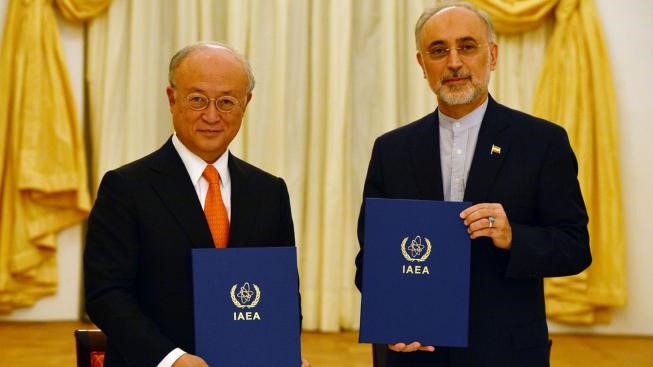
24178Secretary-general Amano (left) with AEOI’s Salehi (Image: IAEA)

The technical issues are now being resolved in a political framework. They have set a time frame and, God willing, the issue must be resolved by December 15.”

********************

The PMD (Possible Military Dimensions) issue that includes an investigation of suspicions that Iran previously conducted a military nuclear program, was one of the main stumbling blocks between Iran and the P5+1 group and primarily between Iran and the United States and the EU3. These suspicions are based inter alia on a November 2011 International Atomic Energy Agency (IAEA) report that the agency had information on Iran’s performance of activities related to nuclear weapons development until 2003 and that some of these activities were possibly continuing.[1] Iran persistently refused to respond to all the IAEA’s questions and due to its refusal to cooperate fully with the IAEA the UN Security Council passed six anti-Iran resolutions demanding that Iran cooperate immediately with the IAEA on this topic in order to disclose the truth.

On July 14, 2015, the day the Comprehensive Joint Plan of Action agreement between Iran and the P5+1 was declared, IAEA Secretary-General Yukio Amano and the Atomic Energy Organization of Iran chief Ali Akbar Salehi, one of the lead Iranian negotiator, signed a “roadmap agreement” in which Iran committed to provide the IAEA with clarifications and explanations on the PMD. Amano announced that if Iran would cooperate fully with the IAEA (as opposed to its conduct up to now) he could submit his conclusions by December 15, 2015. Under the agreement the lifting of sanctions enters into effect only following the IAEA report’s submission.

In an interview to the Iranian channel IRIB on July 21, 2015, Salehi disclosed that Iran has reached an understanding with the IAEA regarding the PMD; that now problems are solved on the political level and since political backing exists, the IAEA cannot do whatever it wants as it did in the past when such political backing did not exist. Therefore, the IAEA’s PMD investigation would be most positive for Iran. Salehi explained that the IAEA had to act reasonably otherwise it would be the loser.

Below is the transcript of Salehi’s IRIB interview:

Salehi: “By December 15, at the end of the year, the issue (of the PMD) should be determined. The IAEA will submit its report to the board of governors. It will only submit it. The Joint Comprehensive Plan of Action will continue independently of the results of this report. We have reached understandings with the IAEA. God willing, there will be very positive results. We do not accept the PMD issue, the (suspicions against) Iran’s past (military nuclear) activity. We are resolving this in a political-technical framework, in order to deny them any pretext. Look, if it was decided that the (IAEA) will not be convinced no matter what… As the saying goes: If someone pretends to be asleep, you cannot wake him up. If someone does not want to be convinced, it does not matter how hard you try. You tell him that it is daytime, and he tells you that it’s night. If the IAEA was not meant to be convinced in the regular track, it would never be convinced, regardless of what we did. They presented 18 questions, we answered them (but couldn’t convince them), and there is nothing more that could be done. Now that the technical issues are being resolved on the political level, the pace has picked up. The technical issues are now being resolved in a political framework. They have set a time frame and, God willing, the issue must be resolved by December 15.”

Interviewer: “But considering the IAEA’s bad record regarding…”

Salehi: “In short, they will be the losers. As I have said, the issue has received political backing. The work of (the IAEA) must be reasonable. They cannot do anything unreasonable. When there is no political backing, they do whatever they want, but now there is political backing, and the issue should be resolved, and God willing, it will be.”

Endnote:

[1] Iaea.org, July 14, 2015.

State Spokesman Repeatedly Refuses to Answer Whether There Are ‘Side Deals’ Between Iran and Nuclear Watchdog

July 22, 2015

State Spokesman Repeatedly Refuses to Answer Whether There Are ‘Side Deals’ Between Iran and Nuclear Watchdog, Washington Free Beacon, , July 22, 2015

(Please see also, House Republican: Obama Administration Won’t Release Full Iran Deal to Congress. — DM)

State Department spokesman John Kirby repeatedly refused to answer direct questions from MSNBC’s Joe Scarborough Wednesday over whether he knew about reported “side deals” between Iran and the nuclear watchdog International Atomic Energy Agency (IAEA) that would not be subject to scrutiny by Congress or the American public.

“I won’t speak for the IAEA,” Kirby said. “What I can tell you is that all relevant documents to this deal, certainly all those in our possession, have been delivered to Congress. They were delivered over the weekend, and they’ll have access to everything that we have access to.”

The U.N. nuclear watchdog plays the critical role of verification in the agreement by seeking to ensure Iran is not violating it with illicit nuclear activity.

National Review reported on two Republicans issuing a press release that they’d discovered these deals while meeting with IAEA officials in Vienna

Senator Tom Cotton (R., Ark.) and Congressmen Mike Pompeo (R., Kan.) issued a press release today on a startling discovery they made during a July 17 meeting with International Atomic Energy Agency officials in Vienna: There are two secret side deals to the nuclear agreement with Iran that will not be shared with other nations, with Congress, or with the U.S. public.

One of these side deals concerns inspection of the Parchin military base, where Iran reportedly has conducted explosive testing related to nuclear-warhead development. The Iranian government has refused to allow the IAEA to visit this site. Over the last several years, Iran has taken steps to clean up evidence of weapons-related activity at Parchin.

The other secret side deal concerns how the IAEA and Iran will resolve outstanding issues on possible military dimensions (PMDs) of Iran’s nuclear program. In late 2013, Iran agreed to resolve IAEA questions about nuclear weapons-related work in twelve areas. Iran only answered questions in one of these areas and rejected the rest as based on forgeries and fabrications.

Scarborough was unsatisfied with Kirby’s answer and pressed him repeatedly to give a definitive answer to whether the U.S. had knowledge of these details or whether such “side deals” existed at all. The exchange went on:

SCARBOROUGH: But Admiral, does the State Department know of secret side deals between Iran and the IAEA? Do you know of secret side deals between Iran and the IAEA? Does Secretary Kerry know of secret side deals between Iran and the IAEA?

KIRBY: What we know is that the IAEA will be working with Iran to make sure that they have the information and access that they need to be able to verify Iran’s commitments to this deal.

SCARBOROUGH: But that’s not the question I asked. That’s not the question I asked, Admiral. Are you all familiar with side deals between the IAEA as it pertains to Iran’s nuclear program that we don’t know about?

KIRBY: This isn’t about side deals, Joe. This is about making sure the IAEA gets the access they need to verify Iran’s commitments, and they’re going to do that. I can’t speak for the IAEA. What I can do is speak for the State Department, and I can say definitely that every relevant document –

SCARBOROUGH: But you certainly can speak to your knowledge and Secretary Kerry’s knowledge and the State Department’s knowledge and the White House’s knowledge. Do you all have knowledge of these side deals?

KIRBY: We know that the IAEA is going to work with Iran to make sure they get the access they need. How they do that and what manner they do that, I’m going to let them speak to that.

Co-host Mika Brzezinski cut in.

“It sounds like there’s side deals,” she said.

“I’m just trying to get a yes or a no,” Scarborough said.

Kirby looked perturbed at this point.

“I can’t really answer it any better than I did,” he said. “I mean, the IAEA needs to get the access to verify Iran’s compliance and they’ll do that. How they work with Iran on that is really for them to speak to. What I can you tell you though is every relevant document in this deal, and there’s a lot of them, everything has been delivered to Congress, and they’re going to get ample time to speak to Secretary Kerr and Secretary Moniz to answer all their questions.”

Scarborough concluded the exchange by saying Kirby actually could have answered better with a simple yes or no, but he moved on.

House Republican: Obama Administration Won’t Release Full Iran Deal to Congress

July 22, 2015

House Republican: Obama Administration Won’t Release Full Iran Deal to Congress, National Review, Joel Gehrke, July 21, 2015

President Obama won’t allow Congress to review two key aspects of the Iranian Nuclear deal, Republican lawmakers learned from international partners last week. Under the terms of the Joint Comprehensive Plan of Action (JCPOA), the International Atomic Energy Agency would negotiate separately with Iran about the inspection of a facility long-suspected of being used to research long-range ballistic missiles and nuclear weapons.

“The Obama administration has failed to make public separate side deals that have been struck for the ‘inspection’ of one of the most important nuclear sites—the Parchin military complex,” said Representative Mike Pompeo (R., Kan.) in a statement Tuesday. “Not only does this violate the Iran Nuclear Agreement Review Act, it is asking Congress to agree to a deal that it cannot review.” The IAEA has been trying to gain access to the Parchin site since 2005, but Iran has refused, even as it apparently demolished various parts of the complex. “The hardliners do not want to grant any concessions unless Iran is suitably rewarded,” International Institute for Strategic Studies director Mark Fitzpatrick told the BBC in 2014, after reports emerged of explosions at the base.

The terms of the current agreement wouldn’t allow Congress to review any concessions the IAEA makes to get into the site. “Even members of Congress who are sympathetic to this deal cannot and must not accept a deal we aren’t even aware of,” said Pompeo. The IAEA will also separately negotiate “how the IAEA and Iran will resolve outstanding issues on possible military dimensions of Iran’s nuclear program,” according to a release from Pompeo’s office. Senator Tom Cotton (R., Ark.) and Pompeo, who serves on the House Intelligence Committee, learned of the arrangement while meeting with the IAEA in Vienna, Austria last week. “That we are only now discovering that parts of this dangerous agreement are being kept secret begs the question of what other elements may also be secret and entirely free from public scrutiny,” Cotton said in a statement to the press.

Speaking of the Iran deal (4)

July 21, 2015

Speaking of the Iran deal (4), Power LineScott Johnson, July 21, 2015

Omri Ceren writes to draw attention to Bill Gertz’s Free Beacon article on the ludicrous inspections regime established under the deal with Iran. Omni writes:

Last April – in the immediate days after the Lausanne framework was announced – Obama administration officials assured reporters that it was a good deal because the verification regime would include anytime/anywhere inspections [a][b][c]. Then there was a range of hearings and forums held in early June – which was the lead-up to Vienna – at which IAEA veterans, nuclear experts, and top US intelligence officials confirmed that indeed anytime/anywhere access to suspicious sites was a minimum prerequisite to verifying a deal with Iran [d][e][f][g]).

Then the Vienna talks began and it became clear that the administration would cave to Iranian intransigence on verification. White House validators started trying to convince reporters that technology could be a substitute for robust access [h][i].

Then the talks ended and it was confirmed that Iran will be allowed to block IAEA inspectors for 24 days at a time. The administration is doubling down on the technology talking point and making it mostly about “environmental sampling.” White House communications staffers have begun using the phrase as their two-word answer to any questions about the collapse on inspections. Energy Secretary Moniz repeated it over and over again on last weekend’s Sunday talk shows [j]. White House validators got the hint and have begun invoking it as well yesterday [k]. The argument is that the IAEA’s technology is so good that – even though they have almost a month to destroy evidence – the Iranians could never “sanitize” a site so well that the IAEA couldn’t detect nuclear activity.

There are a couple of reasons why that argument doesn’t hold up.

(1) Diplomatic – Even if the IAEA could detect that *some* kind of nuclear activity had occurred in a sanitized site, the Iranians will have destroyed enough evidence to prevent the agency from determining *what* kind of activity occurred. The goal of verification is not just detection but detection to a sufficient degree that a diplomatic response can be justified. No country is going to be confident enough to blow up the deal without the IAEA being certain that significant cheating had occurred, and being able to explain what it was.

(2) Scientific – It’s just not true. The IAEA’s technology is not good enough. A month isn’t enough time for the Iranians to dismantle a big site like Natanz, but that’s not where they’ll cheat. They’ll cheat in smaller facilities that can be easily dismantled and scrubbed in a couple of weeks. Olli Heinonen – who is the former Deputy Director General of the IAEA, and who worked at the agency for 27 years, and who sat atop its verification shop as head of the Department of Safeguards – explained to reporters today that the Iranians could assemble all the parts they needed for a nuclear bomb in a building that’s just 239 square yards [full article linked above]. And unlike a facility like Natanz, small buildings can in fact be sanitized in 24 days:

Much of this equipment is very easy to move… So you can take it out over the night… and then there is this dispute settlement time which is 24 days – you will use that to sanitize the place, make new floors, new tiles on the wall, paint the ceiling and take out the ventilation… This [nuclear] equipment can be taken out in one or two nights. How long will it take for you to renovate your home? It doesn’t take three weeks… Secretary Kerry has said if there is big installation, 24 days is enough… But there are certain activities where unfortunately in my view, it’s not enough.

This isn’t a theoretical debate. In 2003 the Iranians delayed access to the Kalaye Electric Company for two weeks and completely scrubbed it. They pulled the same trick with the Lashkar Abad laser uranium enrichment plant.

It’s just not true that they can’t dismantle a covert facility in 24 days, and even if it was true they could still dismantle enough to ensure that no country would be confident enough to call them out for cheating.

[a] https://youtu.be/ObV5motay7E?t=1m18s
[b] http://www.timesofisrael.com/top-obama-adviser-dismisses-idea-that-better-iran-deal-is-possible/
[c] http://www.bloomberg.com/politics/articles/2015-04-20/inspectors-need-full-access-in-any-iran-nuclear-deal-moniz-says
[d] http://www.foreign.senate.gov/imo/media/doc/062515_Albright_Testimony.pdf
[e] http://www.foreign.senate.gov/imo/media/doc/062515_Albright_Testimony.pdf
[f] http://taskforceoniran.org/transcripts/Looming_Deadline_Event.pdf
[g] http://docs.house.gov/meetings/FA/FA13/20150610/103582/HHRG-114-FA13-Wstate-FlynnM-20150610.pdf
[h] http://www.nytimes.com/2015/07/07/world/middleeast/nuclear-inspectors-await-chance-to-use-modern-tools-in-iran.html
[i] http://www.thedailybeast.com/articles/2015/07/06/the-spy-tech-that-will-keep-iran-in-line.html
[j] http://www.powerlineblog.com/archives/2015/07/speaking-of-the-iran-deal-2.php
[k] http://www.msnbc.com/msnbc/qa-hans-blix-iran-deal-remarkably-far-reaching