The Dangers of the January 15 “Peace Talks” in Paris, TheJerusalemCenter via YouTube, January 8, 2017
The Dangers of the January 15 “Peace Talks” in Paris, TheJerusalemCenter via YouTube, January 8, 2017
Video from Jerusalem: Muslim drives truck into crowd, murdering four; Hamas celebrates, Jihad Watch,
(Please see also, 4 dead as truck plows into troops in Jerusalem. — DM)
We have seen a spate of such attacks recently — and a billboard in Nazareth that actually called for them. “Moderate” Fatah called for such attacks. And the Islamic State issued this call in September 2014:
So O muwahhid, do not let this battle pass you by wherever you may be. You must strike the soldiers, patrons, and troops of the tawaghit. Strike their police, security, and intelligence members, as well as their treacherous agents. Destroy their beds. Embitter their lives for them and busy them with themselves. If you can kill a disbelieving American or European — especially the spiteful and filthy French — or an Australian, or a Canadian, or any other disbeliever from the disbelievers waging war, including the citizens of the countries that entered into a coalition against the Islamic State, then rely upon Allah, and kill him in any manner or way however it may be….If you are not able to find an IED or a bullet, then single out the disbelieving American, Frenchman, or any of their allies. Smash his head with a rock, or slaughter him with a knife, or run him over with your car, or throw him down from a high place, or choke him, or poison him….
“Four murdered in terror attack in Jerusalem’s East Talpiot,” by Roi Yanovasky and Omri Efraim, Ynet News, January 8, 2017:
Four people—three women and a man in their 20s—were murdered and 13 wounded when a Palestinian truck driver deliberately rammed into pedestrians on a popular promenade overlooking the walled Old City of Jerusalem on Sunday.
The truck, which has Israeli license plates stolen from a private vehicle, sped towards pedestrians waiting at a bus stop and hit them deliberately, police said.
“The terrorist came from the direction of Alar Street. He noticed a group of people coming off a bus that stopped along the promenade. As far as we know, he sped up and hit them,” said Jerusalem District Police spokeswoman Galit Ziv.
Police said the terrorist was shot and neutralized. Palestinian sources identified the terrorist as Fadi al-Kanabir, a released prisoner from Jabel Mukaber, a neighborhood in East Jerusalem that borders East Talpiot. IDF troops raided the terrorist’s house shortly after the attack.
Speaking at the scene of the attack, Police Commissioner Roni Alsheikh said there was no prior intelligence regarding the terrorist’s intention to carry out his attack. He said no additional details can be revealed about the terrorist at this moment as the investigation is still ongoing.
A driver who witnessed the incident said on the radio the truck ploughed into a group of soldiers, and that they fired on the driver, who reversed direction and ran over them again.
“They shot him, until they neutralized him,” said the bus driver, who gave his name only as Moshe.
A tour guide who was at the scene said, “I saw a truck speeding… people ran for cover, yelling ‘terror attack’… it lasted about a minute and a half until the terrorist was neutralized … I was treating the wounded, trying to strengthen them and praying.”…
Hamas praised the attack, trying to get #TruckIntifada trending on Twitter and handing out sweets in Gaza to celebrate it.
“This truck attack shows that any attempt to put a stop to the resistance will fail,” Hamas’s military wing, the al-Qassam Brigades, wrote on Twitter.
Hamas’s Fatah and the No-State Solution, Gatestone Institute, Khaled Abu Toameh, January 3, 2017
Palestinian Authority President Mahmoud Abbas declared that 2017 will be the “year of international recognition of the State of Palestine.”
The melee in Gaza exposes as the lie that it is Abbas’s repeated claim of a unified Fatah able to lead the Palestinians towards statehood. Incredibly, Abbas seeks global recognition of a Palestinian state at a time when the flames in his own backyard are set to engulf him and his questionable regime.
More bad news from the poll: if presidential elections were to be held today, Ismail Haniyeh, leader of the terrorist group Hamas, would beat Abbas by 49% to 45%.
Palestinians are now openly talking about two different Fatah factions. After Abbas’s decision to strip the legislators of their parliamentary immunity, six Fatah PLC members participated in a Hamas-sponsored meeting of the PLC in the Gaza Strip. This was the first time since 2007 that such a move had been made.
Fatah leaders in the Gaza Strip, unlike their colleagues in the West Bank, are de facto recognizing the Hamas rule over the Gaza Strip. This is wonderful news for Hamas, whose leader, Ismail Haniyeh is likely to defeat Abbas in a presidential election.
The Fatah gunmen who marched in the Gaza Strip courtesy of Hamas are not supporters of Abbas. Instead, they represent the “other face” of Fatah — the one that does not believe in any peace process with Israel and shares Hamas’s ambition of destroying Israel.
During a celebration in Ramallah marking the 52nd anniversary of the founding of his Fatah faction, Palestinian Authority (PA) President Mahmoud Abbas declared that 2017 will be the “year of international recognition of the State of Palestine.” Hailing the recent anti-settlement UN Security Council resolution 2334, Abbas said he was prepared to work with the new administration of Donald Trump “to achieve peace in the region.”
But while Abbas and his lieutenants were celebrating in Ramallah, at least 11 Palestinians were wounded in a scuffle that erupted between rival Fatah factions in the Gaza Strip. According to sources in the Gaza Strip, the fight broke out between Abbas loyalists and supporters of estranged Fatah leader Mohammed Dahlan. The confrontation, which was the most violent between the two sides in many years, is yet another sign of increasing schism in Fatah. Moreover, it is an indication of how Abbas’s control over his own faction is slipping through his hands. Hamas policemen who were at the scene did not interfere to break up the fight between the warring Fatah activists.
The melee in Gaza exposes as the lie that is Abbas’s repeated claim of a unified Fatah, able to lead the Palestinians towards statehood. Incredibly, Abbas seeks global recognition of a Palestinian state at a time when the flames in his own backyard are set to engulf him and his questionable regime.
Abbas says he wants to work with the Trump Administration to achieve peace in the Middle East, yet he cannot even achieve peace in his very own faction.
Abbas’s speech coincided with a new public opinion poll that showed that 64% of Palestinians want him to step down. The poll, conducted by the Ramallah-based Palestinian Center for Policy and Survey Research, also showed that two-thirds of Palestinians do not believe that the current Fatah leadership can achieve their aspirations.
The poll’s findings show that the percentage of Palestinians who want Abbas to resign has risen over the past three months from 61% to 64%. More bad news from the poll: if presidential elections were to be held today, Ismail Haniyeh, leader of the terrorist group Hamas, would beat Abbas by 49% to 45%.
The results of the poll should not come as a surprise to those who have been monitoring Palestinian affairs for the past few years. Judging from the sentiments on the Palestinian street, there is good reason to believe that the 81-year-old Abbas, who is now in his 12th year of his four-year term in office, has long ago lost much of his credibility among his people. The real surprise is that only 64% of Palestinians want to see him gone.
Many Palestinians hold Abbas personally responsible for the continued and rapid deterioration in the Palestinian arena. They see his incompetent and failed leadership as the main reason behind the 2007 violent Hamas takeover of the Gaza Strip. As soon as Hamas started shooting, Abbas’s fragile, corrupt and strife-ridden Palestinian Authority security forces collapsed. Critics of Abbas say that lack of leadership and decision-making on his part facilitated the Hamas seizure of the Gaza Strip.
Yet over the years, it has become evident that Abbas has not only lost the Gaza Strip and its two million inhabitants to Hamas, but that he is also losing control over his own Fatah faction there. Abbas has managed to alienate many Fatah leaders and activists in the Gaza Strip (most of whom are not necessarily affiliated with his arch-rival, Dahlan) to a point where Palestinians are now openly talking about two different Fatah factions.
Instead of devoting his energies to freeing the Gaza Strip from the iron grip of Hamas, Abbas has spent the past few years waging war against anyone in Fatah who dares to challenge his policies or criticize him. In this regard, he has resorted to a number of punitive measures that have further escalated tensions among Fatah cadres.
These measures include cutting off salaries and pensions to Fatah employees whose loyalty to Abbas is in question or who are suspected of being affiliated with Dahlan. As far as Abbas is concerned, affiliation with Hamas is less of a crime than being affiliated with Dahlan or any of his rivals in Fatah. Another measure that Abbas has taken to punish his rivals in Fatah: stripping them of their parliamentary immunity. The latest victims of this punishment: Mohamed Dahlan, Nasser Juma’ah, Shami Al-Shami, Najat Abu Baker and Jamal Al-Tirawi. Abbas took the decision without seeking the approval of the Palestinian parliament, the Palestinian Legislative Council (PLC), or any other judicial or decision-making institution. His detractors point out that the removal of the parliamentary immunity is in violation of the Palestinian Basic Law, because the PLC is the only party authorized to take such a decision.
When Fatah legislators protested against Abbas’s arbitrary measure by holding a sit-in strike inside the offices of the International Committee of the Red Cross in Ramallah, Abbas ordered his security forces to raid the compound and evict them by force. “This is a grave violation of the legislators’ rights and it is completely unjustified,” said a spokeswoman for Fatah in the Gaza Strip.
“It is also an indication of the repressive measures taken by the Palestinian Authority security forces. The legislators were holding a peaceful protest inside the offices of the Red Cross after President Abbas’s decision to remove their parliamentary immunity. We hold the president, the prime minister and the security forces responsible for the violations against human rights and public freedoms. We also condemn the silence of the Red Cross towards this despicable assault against the legislators inside the (Red Cross) offices.”
Abbas’s crackdown on his Fatah critics has driven them into the open arms of Hamas. After Abbas’s decision to strip the legislators of their parliamentary immunity, six Fatah PLC members participated in a Hamas-sponsored meeting of the PLC in the Gaza Strip. This was the first time since 2007 that such a move had been made.
The PLC has been effectively paralyzed since the Hamas takeover of the Gaza Strip. However, this has not prevented Hamas from continuing to convene sessions of the parliament in the Gaza Strip during the past few years. Until recently, Fatah legislators have boycotted these meetings because they do not recognize Hamas’s rule over the Gaza Strip. Abbas’s punitive and vengeful measures, however, have pushed Fatah legislators to change this status quo. This means that Fatah leaders in the Gaza Strip, unlike their colleagues in the West Bank, are de facto recognizing the Hamas rule over the Gaza Strip. This is wonderful news for Hamas, whose leader, Ismail Haniyeh (according to the latest poll) is likely to defeat Abbas in a presidential election.
Emboldened by the growing divisions in Fatah, Hamas leaders are also beginning to flirt with disgruntled Abbas critics who have been hurt by Abbas’s measures. For the first time in many years, the Hamas government permitted thousands of Fatah gunmen to hold a military parade in the Gaza Strip this week, marking the faction’s 52nd anniversary.
 Pictured: For the first time in many years, Hamas permitted thousands of Fatah gunmen to hold a military parade in the Gaza Strip this week. (Image source: YouTube video screenshot)
The Fatah gunmen who marched in the Gaza Strip courtesy of Hamas are not supporters of Abbas, the overall commander of Fatah. Instead, they represent the “other face” of Fatah — the one that does not believe in any peace process with Israel and shares Hamas’s ambition of destroying Israel. The message that the Gaza Strip branch of Fatah wished to send to Abbas: Unlike you and your West Bank Fatah, we will not give up the “armed struggle” against Israel. “This parade sends a message to Abbas that Fatah has not relinquished the armed struggle,” explained Palestinian political scientist Ibrahim Abrash.
Meanwhile, Abbas appears to be living on a different planet. His ego prevents him from grasping the news that the polls reveal: most of his people are done with him. He refuses to wake up to the truth that his Fatah faction is falling into pieces, his erstwhile loyalists getting into bed with Hamas. He asks the world to recognize a Palestinian state when his own private residence in the Gaza Strip is forbidden to him. Indeed, it seems that the Palestinians are moving toward a “no-state solution” — a Gaza Strip run by Hamas and dissident Fatah members and a West Bank controlled by another Fatah that is still loyal to Abbas, largely because he is paying them salaries.
Abbas maintains that he is eager to work with the Trump Administration to achieve peace in the region. But will he have the courage to tell the new US administration some uncomfortable truths — namely that he has become a political liability to the majority of his people, and that the Palestinians have never been as divided as they are at this moment? In short, will Abbas dare to share the truth of the splintered Fatah’s no-state solution?
Fatah Honors Islamist Terrorists For 52nd Anniversary, Clarion Project
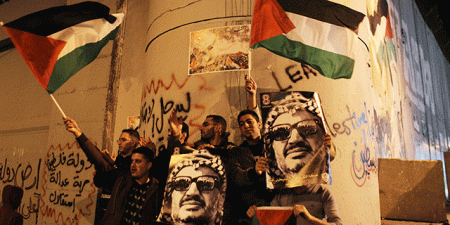
The ruling party in the Palestinian Authority celebrated its 52nd anniversary with Facebook posts glorifying bloodthirsty terrorists.
Fatah, the ruling party of the Palestinian Authority, celebrated its 52nd anniversary on Saturday. They used the occasion to heap praise on some of the most vicious Islamist terrorists in Israeli history, despite being ostensibly a secular organization.
Fatah praised Sheikh Ahmed Yassin, the founder of the Muslim Brotherhood branch and jihadist terrorist organization Hamas, featuring his picture among those on a banner of terrorists who murdered Israeli civilians. Praise was also heaped on the founder of Islamic Jihad, Fathi Shaqaqi, along with several other secular terrorists.
“Fatah embraces its people and praises the Martyrs,” the organization posted on Facebook, as translated by Palestinian Media Watch.

“To be a real Palestinian, you must be a self-sacrificing fighter (Fida’i), know much and reveal little, search for the security in the heart of the danger, get used to having no time to cry over endings but rather to always have new beginnings.
Long life to you and long live the anniversary of the Launch [of Fatah] (Intilaqa), and may it be a good year.
A people whose leaders are Martyrs will undoubtedly triumph with Allah’s help…”
The inclusion of Sheikh Yassin, who was killed in by an Israeli missile in 2004, comes as Fatah is attempting to reconcile with its longstanding foe Hamas, which currently controls the Gaza strip.
Russia has reportedly volunteered to broker a reconciliation between the divided factions.
“The Russians will host a meeting of Fatah, Hamas and other Palestinian officials in Moscow in the middle of January to discuss reconciliation,” PLO Executive Committee member Wasel Abu Yousef told The Jerusalem Post on Monday.
Muslim Activist to Trump: Brotherhood Should Be Banned, Clarion Project, Ryan Mauro, January 1, 2016
 Muslim Brotherhood supporters in Egypt (Photo: © Reuters)
Dr. Qanta Ahmed, a Muslim activist who appeared in the Clarion Project’s Honor Diaries documentary about the oppression of women in the Muslim world, asked President-elect Trump to designate the Muslim Brotherhood as a terrorist organization in a new op-ed in Newsday.
She recommends designating the Muslim Brotherhood as a terrorist organization, just like its Palestinian wing, Hamas, has been designated. This is a necessary step in waging a broader ideological war against Islamism rather than just against a few specific Islamist terrorist groups like Al-Qaeda and the Islamic State.
Dr. Ahmed writes:
Trump can start by outlawing the Muslim Brotherhood, as President Sisi did in Egypt. He must designate it a foreign terrorist organization and acknowledge that it is at the very least an indicator of extremism. Then, he must follow the money. If Islamism is to be exposed in America, forensic financial investigations must scrutinize all institutions where Islamism can flourish without scrutiny — mosques, charities, and advocacy groups. There can be no exceptions.
The pushback against those advocating designating the Brotherhood as a terrorist group and making Islamism the target of U.S. strategy is that it will be perceived as—or even qualifies as—a war on the faith of Islam.
The West’s embrace of the Brotherhood and other Islamists is motivated by a false impression that they are “moderate” and a desire to avoid the appearance of a war on Islam where we fail to distinguish Muslim friends from Muslim foes.
Yet, Ahmed rightly points out that the current stance towards Islamism, is exactly that—a “profound inability by the United States to distinguish Islam from Islamism.”
Incoming Defense Secretary General Mattis makes a similar point: Framing the adversary as Islamism (Political Islam) allows a new constituency of partners and allies to be tapped.
On the contrary, the current administration’s set-up of terrorist vs. non-terrorist allows Islamists to fill the “non-terrorist” slot in the struggle, leaving genuine Muslim reformers out of the picture.
The U.S’ narrow focus on the symptoms of terrorist groups overlooks how the Muslim world itself is starting to discuss the diseases of Islamism as well as Islamism’s rejection of modernized interpretations of the religion.
This narrow focus on the part of the U.S. is partially rooted in the assumption that the Muslim world will be alienated by a broader ideological delineation (Islam vs. Islamism). Ironically, the West has been so fixated on declaring what will alienate prospective Muslim friends that it has failed to listen and observe what will actually alienate them.
As I recently wrote, “Overlooked allies amongst Muslims and non-Muslim minorities will surface as U.S. policy forces the Muslim world to take stances on Islamism and its adhering organizations. New allies will be born as the discussion of Islamism leads to rejections of it. If messaged correctly, the U.S. will end up with more Muslim allies of better quality.”
Dr. Ahmed argues that supporting “pluralist Muslims” against Islamism will allow the U.S. to build ties with this constituency:
Like Eisenhower, Trump will be at the right place, at the right time, in the right history. Trump will do battle with Islamism at a time when a disparate Muslim world is finally unifying with enormous political will to join that effort.
A petition has been launched urging President-elect Trump to meet with the Muslim Reform Movement, a pro-Western alliance of Muslims who want to challenge Islamism. You can sign the petition here.
The Trump administration’s strategy towards defeating Islamism will be the biggest factor deciding the success of U.S. foreign policy in the next four years.
Merry Christmas and Happy Hanukkah, Dan Miller’s Blog, December 25, 2016
(The views expressed in this article are mine and do not necessarily reflect those of Warsclerotic or its other editors. — DM)


We were delighted with the “surprising” election outcome this year and look forward to a reawakened America under President Trump. He — and the rest of us — have an Augean stable to muck out. We hope for a revitalized and far better America than we have seen for the past eight years and for a better world for all, with no more disgraces of this sort:
Desire for a “two state solution” does not mean that there would be one state for the Jews and another for the Palestinians, living separately but in peace and harmony. Palestinian hatred for non-Muslims would not permit Israelis to live at peace in their separate state. Ultimately, if the Palestinians are successful, it would mean one Palestinian state with no Jews and few if any Christians.
Gaza, which had been controlled by the Palestinian Authority’s Fatah, has been controlled by Hamas since 2007. Despite an annual population growth rate of 2.91% (2014 est.), there are now few Christians.
In 2006, there were 5,000 Christians living in Gaza when hard-line Hamas took power from the more moderate Fatah party. Ten years later, there are just 1,100 left. . . .
In Israel, where Arab Christians have comparatively more opportunities than their Palestinian counterparts, the Christian population has stayed stable. The Christian population grew by about 5,000 in the past 20 years. Today Christians in Israel number 164,700, about 2 percent of the population, a similar ratio to past decades.
If the Palestinian Authority permits free and fair Palestinian elections throughout Israel, Hamas is quite likely to displace the PA as Israel’s “partner for peace.” Hamas is funded and otherwise supported by The Islamic Republic of Iran.
This violence is brought to you by the Religion of Peace and tolerance:
To end on a humorous but nevertheless sad note,
Again, Merry Christmas and Happy Hanukkah, with hopes for a better, more peaceful world with less hatred.

Ruff, Dan, Sunshine and Jeanie
The Palestinian Jihads against Israel, Gatestone Institute, Khaled Abu Toameh, December 13, 2016
“We will not recognize Israel because it will inevitably go away. And we will not backtrack on the option of armed struggle until the liberation of all Palestine.” — Khalil Al-Haya, Hamas senior official.
The abandonment of Gaza by Israel in 2005 drove the Palestinian vote for Hamas the next year. It also explains why many Palestinians continue to support Hamas — because they still believe that violence is the way to defeat Israel.
Hamas believes that Israel does not have the right to defend itself against rockets and terror attacks. It even considers Israel’s self-defense as an “act of terror.”
In yet another sign that exposes Hamas’s ongoing preparations to attack Israel, the movement last week held a drill with live ammunition in the northern Gaza Strip.
“What has been achieved so far is a small jihad, and the big jihad is still awaiting us.” — Palestinian Authority President Mahmoud Abbas. Abbas is convinced that his “diplomatic jihad” against Israel is no less effective than Hamas’s jihad of terrorism.
Yet even if Abbas manages to achieve reconciliation with Hamas, this move should not be seen as sign of pragmatism on the part of the Islamist movement. Under no circumstances will Hamas relinquish its policy of the destruction of Israel and its replacement with an Islamist state.
From Abbas’s point of view, Hamas’s terrorism will only increase the pressure on Israel to capitulate. Here Abbas has an ally in Hamas: to multiply jihads to force Israel to its knees.
The Palestinian Islamist movement, Hamas, which is currently celebrating the 29th anniversary of its founding, misses no opportunity to broadcast its stated reason for being: to wage jihad (holy war) in order to achieve its goal of destroying Israel. Those who allege that Hamas is moving toward pragmatism and moderation might take note.
Last week, tens of thousands of Palestinians took to the streets of the Gaza Strip to participate in rallies marking the anniversary of the founding of Hamas. As in previous years, the rallies were held under the motto of jihad and “armed resistance” until the liberation of all Palestine, from the Jordan River to the Mediterranean Sea. Another message that emerged loud and clear from the rallies: Hamas will never recognize Israel’s right to exist.
This year’s rallies once again also served as a reminder of the enormous popularity that Hamas continues to enjoy among Palestinians — not only in the Gaza Strip, but also in the West Bank, where supporters of the Islamist movement celebrated the occasion, but on a smaller scale and with a lower profile, out of fear of the Palestinian Authority (PA) and Israeli security forces.
Khalil Al-Haya, a senior Hamas official, outlined in a speech before his supporters in the Gaza Strip his movement’s strategy, namely to pursue the fight until the elimination of Israel. “We will not recognize Israel because it will inevitably go away,” he declared.
“And we will not backtrack on the option of armed struggle until the liberation of all Palestine. Since its establishment, Hamas has been — and will remain — a Palestinian Islamic national and resistance movement whose goal is to liberate Palestine and confront the Israeli project. The liberation of the Gaza Strip is just the first step toward the liberation of Palestine — all Palestine. There is no future for the Israeli entity on our homeland.”
When Hamas leaders talk about the “liberation” of the Gaza Strip, they are referring to the total unilateral Israeli disengagement from that area in 2005. Hamas and many Palestinians have never viewed the full withdrawal from the Gaza Strip as a gesture on the part of Israel. Nor have they ever considered the disengagement as a sign that Israel is no longer interested in controlling the lives of nearly two million Palestinians living in the Gaza Strip.
On the contrary, Hamas and many Palestinians continue to see the Israeli disengagement from the Gaza Strip as a sign of weakness. In fact, this disengagement is why Hamas won the Palestinian parliamentary election in 2006, when it took credit for driving Israel out of the Gaza Strip through suicide bombings and rockets. Back then, this abandonment of land by Israel drove the Palestinian vote for Hamas. It also explains why many Palestinians continue to support Hamas — because they still believe that violence is the way to defeat Israel.
Many Palestinians see Israeli concessions, gestures and unilateral moves as proof of capitulation, rather than positive signs testifying to Israel’s peaceful intentions. These “concessions for peace” by Israel further increases Palestinians’ appetite for launching armed attacks against Israel. Today, many Palestinians are convinced that they can achieve more through stabbings, vehicular rammings and shooting attacks than sitting with Israel at the negotiating table.
The Qatar-based Hamas leader, Khaled Mashaal, seized the anniversary as an opportunity once again to remind everyone of his movement’s real goals. Speaking on the Al-Jazeera TV network, which serves as a platform for the Muslim Brotherhood organization (Hamas is an offshoot of Muslim Brotherhood), Mashaal said:
“We are moving forward with our resistance to achieve our national project… We are looking forward to liberating Palestine and cleansing the Al-Aqsa Mosque and protecting it from division and demolition. We also seek the return of the refugees to their homeland and the liberation of our prisoners from Israeli jails.”
When he talks about “cleansing” Al-Aqsa Mosque, the Hamas leader is referring to Jewish visits to the Temple Mount. Hamas and the Palestinian Authority have been exploiting these visits to incite their people against Israel. They claim that Jewish visitors are “desecrating” the holy site and should not be allowed to set foot there. These words mirror those used by President Mahmoud Abbas, who said that Palestinians will not allow Jews to “defile with their filthy feet” the Al-Aqsa Mosque (although no Jew has entered the mosque itself).
Mashaal, who in the past few years has been living as royalty in Qatar (the country that is the main patron of Muslim Brotherhood), went on to emphasize that Hamas has “not changed its strategy of liberating Palestine.” He also said that, “Military work remains the backbone of liberation.” Hamas, he added, “Continues to believe in the full liberation of Palestine and that jihad and resistance are the only means to expel the occupation and liberate Palestine and the blessed Al-Aqsa Mosque.” According to Mashaal, Hamas continues to look toward Arab and Islamic countries, including Iran, for the military, financial and political support to achieve its goal of destroying Israel.
Hamas’s armed wing, Ezaddin Al-Qassam, boasted on this occasion that 22 of its men have been killed since the beginning of 2016, while preparing for the next war with Israel. Most of the Hamas men were killed when the tunnels in which they were working in collapsed. Hamas continues to build new tunnels and renovate those that were destroyed during the last war with Israel in 2014. Hamas says it wants to use these tunnels in the future to infiltrate Israel and kill or kidnap Israeli civilians or soldiers.
Ironically, while Hamas pursues its round-the-clock efforts to prepare for war against Israel, its leaders do not hesitate to depict themselves as victims, and warn of supposed Israeli plans to launch a “new aggression” against Palestinians. Hamas believes that Israel does not have the right to defend itself against rockets and terror attacks. It even considers Israel’s self-defense as an “act of terror.”
Take, for example, Hamas spokesman Fawzi Barhoum’s recent assessment. Lashing out at U.S. aid to Israel, Barhoum said that the American military and financial aid to Israel constitutes “official support for terrorism.”
This is effectively Hamas’s message to the new U.S. administration: Stop supporting Israel with weapons and money because that hinders our goal of destroying Israel. In yet another sign that exposes Hamas’s ongoing preparations to attack Israel, the movement last week held a drill with live ammunition in the northern Gaza Strip. The drill enacted, among other things, an incursion into a civilian populated area. Hamas said the drill was the fruit of 380 hours of non-stop military training of its “Special Units.”
Hamas’s rhetoric and actions leave no room for doubt as to its intentions. Twenty-nine years after its establishment, a defiant Hamas continues to believe that Israel can, and should, be destroyed. The dream to eliminate Israel remains alive and well among many Palestinians, as evidenced at Hamas rallies by the massive turnouts.
Hamas and the Palestinian Authority, however, are kissing cousins when it comes to Israel. Hamas’s talk of jihad against Israel is right in line with Abbas’s speech before the 7th Congress of Fatah, which convened in Ramallah two weeks ago. “What has been achieved so far is a small jihad, and the big jihad is still awaiting us,” Abbas declared.
According to Abbas’s aides, the PA president was referring to a different type of jihad — one that relates to his ongoing efforts in the international arena to isolate and delegitimize Israel, to force it to make far-reaching concessions to the Palestinians. Abbas’s diplomatic warfare against Israel began several years ago, with the PA’s efforts to join international institutions and seek unilateral recognition in the UN of a Palestinian state. His ultimate goal is to have the international community exert pressure on Israel to withdraw fully to the pre-1967 lines. Abbas wants to establish a Palestinian state with the help of the international community, and not through direct negotiations with Israel. He is convinced that his “diplomatic jihad” against Israel is no less effective than the Hamas jihad of terrorism.
This Abbas talk of “small” and “big” jihad comes at a time when Abbas and Hamas are in courting mode. Some reports have suggested that Abbas recently sent conciliatory messages to Hamas in yet another bid to end the dispute between the two sides. He and Khaled Mashaal have had regular phone contact, with both expressing a desire to end the conflict between them. The reports have even suggested that the two rival parties may be preparing to resume their “reconciliation” talks in Doha under the auspices of Qatar. Last October, Abbas met in Doha with Mashaal and another Hamas leader, Ismail Haniyeh, as part of his rapprochement with the Islamist movement. The meeting was said to be held in a cordial atmosphere, and some Palestinian political analysts point to a warming of relations between the two sides.
 Last October, Palestinian Authority President Mahmoud Abbas met in Qatar with Khaled Mashaal and another Hamas leader, Ismail Haniyeh, as part of his rapprochement with the Islamist movement. Pictured above: Abbas (right) meets with Khaled Mashaal in Qatar on July 20, 2014, in a previous reconciliation attempt. (Image source: Handout from the PA President’s Office/Thaer Ghanem)
Yet even if Abbas manages to achieve reconciliation with Hamas, this move should not be seen as a sign of pragmatism on the part of the Islamist movement. Under no circumstances will Hamas relinquish its policy of the destruction of Israel and its replacement with an Islamist state. The movement’s own words on its anniversary provide the best proof of this intention. To their credit, Hamas leaders are nothing if not honest about their commitment to Israel’s destruction. Abbas certainly will not attempt to convince Hamas to abandon this fundamental goal. So, as far as Hamas is concerned, reconciliation means that Abbas will move closer to the Islamist movement and not vice versa.
In fact, Mahmoud Abbas seems to believe that Hamas’s and his jihads complement each other. Thus, Hamas will continue its deadly jihad, while Abbas will pursue his “diplomatic jihad” against Israel. From his point of view, Hamas’s terrorism will only increase the pressure on Israel to capitulate. Here Abbas has an ally in Hamas: to multiply jihads to force Israel to its knees.
DHS: Hamas-Tied NJ Imam Must Prove Why He Shouldn’t Be Deported, Investigative Project on Terrorism, John Rossomando, December 7, 2016
Evidence being used against him in the Department of Homeland Security’s effort to deport him is the product of torture and is not credible, a Hamas-connected imam testified Tuesday in a Newark, N.J. immigration court.
Mohammad Qatanani is imam at the Islamic Center of Passaic County. Immigration officials have been fighting to deport him since 2006, alleging he failed to disclose connections with Hamas when he applied for permanent residency. When he came to the United States 10 years earlier, he claimed he had never been arrested or belonged to any terrorist groups.
That history makes Qatanani subject to deportation, DHS says.
Tuesday’s hearing centered on Qatanani’s October 1993 arrest and conviction by an Israeli military court on charges he provided support to Hamas. He claims Israeli authorities detained him and never charged him.
“No lawyer prior to 2008 ever told me that I had a conviction,” Qatanani said.
U.S. Immigration Judge Judge Alberto Reifkohl ruled in 2008 that the bulk of the evidence and testimony introduced by the Department of Homeland Security was not credible and granted Qatanani permanent residency, better known as a “green card.”
The Justice Department’s Board of Immigration Appeals sent the case back to Reifkohl in October 2009, finding that he erred rejecting the credibility of evidence and government testimony.
In addition, DHS attorneys bolstered some of the evidence obtained from Israeli officials, including two confessions which include statements Qatanani made about his Hamas connection. Three additional witness statements came from people who told Israeli officials that Qatanani recruited them to join Hamas
Qatanani claims he never was given translations of the Hebrew-language Israeli court records and never knew what they alleged. “There is no confession to my understanding” Qatanani said Tuesday.
He also disputed that the signatures on the documents were his, saying instead they were “similar” to his signature. DHS evidence was able to match the fingerprints on the documents to Qatanani.
He claims he was mistreated in Israeli custody, but never signed any documents he thought were confessions, describing them as “finishing papers.”
The legal standard in immigration court is less stringent than a criminal conviction. This means DHS only needs to show that Qatanani had associations with Hamas that he hid on his visa application. Under immigration law, the Qatanani has the burden of proof to show he is not a terrorist, said Department of Homeland Security Deputy Chief Counsel Chris Brundage.
It’s impossible for Qatanani to get around the fact he lied when he said he never had been arrested, Brundage said.
No ruling was issued before the hearing recessed. It is scheduled to resume next month.




 anneinpt
 artaxes
 danmillerinpanama
 davidking1530
 Peter Hofman
 Joseph Wouk
 Peter
Peter Louisiana Steve
 WarSclerotic
Recent Comments