Archive for the ‘Germany’ category

Germany Moves To Remove Anti-Erdogan Poem And Merkel Calls Turkey To Apologize

April 5, 2016

Germany Moves To Remove Anti-Erdogan Poem And Merkel Calls Turkey To Apologize, Jonathan Turley’s Blog, Jonathan Turley, April 5, 2016

220px-recep_tayyip_erdogan
220px-angela_merkel_2008

The enabling of an authoritarian like Erdogan is a new low for the Western nations. Not only is Erdogan destroying free speech and the free media in Turkey, but he has now found a way to enlist Western governments like Germany to embrace the same anti-free speech principles.

********************

We recently discussed how Turkish President Recep Tayyip Erdogan has turned his suppression of critics to other countries and was demanding action from governments against his critics. At the time, I was relieved to report that Germany had held the line on free speech. My relief of premature. German ZDF public television said Monday it had deleted a poem recited by presenter Jan Böhmermann from last Thursday’s edition of “Neo Magazin Royal” after pressure from the German government. Böhmermann’s poem, containing numerous sexual innuendos, accuses Erdogan of repressing minorities, including Kurds and Christians. German government spokesman Steffen Seibert said Chancellor Angela Merkel in a telephone call on Sunday evening with Turkish Prime Minister Ahmet Davutoglu had agreed that Böhmermann had recited a “deliberately abusive text.” Merkel has done precisely what civil libertarians feared: feeding Erdogan’s desire to suppress speech and affirming that he can indeed silence critics abroad.

What is truly maddening is that the spokesman insisted that none of this takes away from the “high value” the German government placed on freedoms of the press and public opinion. Unbelievable. Merkel silences Germans to appease a rising dictator while insisting that she remains committed otherwise to free speech.

Böhmermann mocked Merkel and said “Limits, at last. I think we have spectacularly shown, jointly with ZDF, where the limits of satire lie by us in Germany. At last!”

Merkel is not the only one who should be condemned in this matter. ZDF Program director Norbert Himmler insisted that there were limits to irony and satire.

“In this case, they were clearly exceeded . . . As a result, in consultation with Jan Böhmermann, we have decided to take the passage out of the broadcast. That relates to the video in the Mediathek, clips on YouTube, and re-runs.”

As we discussed, Erdogan flew into a rage over a satirical song entitled “Erdowie, Erdowo, Erdogan,” that ridiculed Erdogan’s alleged extravagance and a crackdown on civil liberties. Here is the video:

https://www.youtube.com/watch?v=7x85wo62z-0

The video is a parody of a 1980s song by the German pop star Nena, “Irgendwie, Irgendwo, Irgendwann,” (“Anyway, Anywhere, Anytime”) which is changed to “Erdowie, Erdowo, Erdogan.” The facts that it reports however are not satirical but actual. The video details Erdogan crackdown on democracy and basic freedoms as well as his infamous intolerance for any criticism. Merkel has now added fuel to the meglomania of Erdogan in saying that certain criticism will not be tolerated in Germany. That is likely far more than the Turks ever dreamed of . . . to have a major Western nation embrace censorship.

We have previously discussed the alarming rollback on free speech rights in the West, particularly in France (here and here and here and here and here and here) and England (here and here and here and here and here and here and here and here and here and here). Much of this trend is tied to the expansion of hate speech and non-discrimination laws. We have seen comedians targeted with such court orders under this expanding and worrisome trend. (here and here). In Germany, Merkel government has crackdown on anti-immigration speech as the government expands its list of permitted and prohibited speech.

The enabling of an authoritarian like Erdogan is a new low for the Western nations. Not only is Erdogan destroying free speech and the free media in Turkey, but he has now found a way to enlist Western governments like Germany to embrace the same anti-free speech principles.

‘You Are Not The People, You Are The Past’ Public Broadcaster Tells German Critics Of Mass Immigration

April 2, 2016

‘You Are Not The People, You Are The Past’ Public Broadcaster Tells German Critics Of Mass Immigration, BreitbartVirginia Hale, April 2, 2016

Not todays peopleScreengrab/Neo Magazin Royal

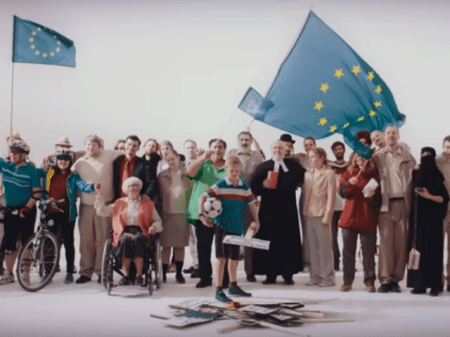
“You are not the people, you are the past,” was the message to German critics of mass immigration on Germany’s public broadcaster ZDF’s NEO MAGAZIN ROYALE television programme.

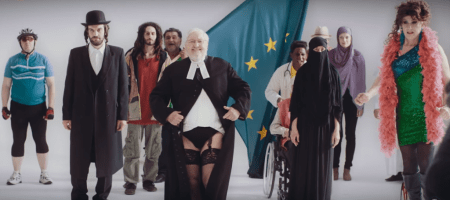
The message was delivered in a video featuring a multi-ethnic crowd of disabled, gay and transgender people, as well as a Muslim woman wearing a face veil and a man wearing traditional Saudi headgear, all telling a crowd of Germans that they are “not Germany”.

The video opens with a crowd of angry-looking white Germans hitting against the windows of a bus to intimidate a frightened Arab child and his father, a policeman dragging the child out and hurling him to the ground. Led by the German comedian and television presenter’Jan Böhmermann, brightly dressed people rise from graves, forming a crowd to combat the beige-clad Germans who are wielding Donald Trump placards and signs reading “Refugees not welcome.”

VH-Video-Image-2-1024x576

Condemning the German crowd as “authoritarian nationalist dorks” and telling them “you are not the people, you are the past,” Böhmermann cautions that “true Germans are coming for you, you’d better run fast.”

Warning the beige-clad Germans that “10 million bicycle helmets are in sight” Böhmermann describes the lifestyle of “true Germans” to be one of cycling, recycling and eating kebab and muesli. In what is perhaps a jab at protests from senior members of Merkel’s Christian Democratic Union against pork being “quietly removed from menus” of public canteens, Böhmermann also declares that the “true Germans” eat vegan sausages.

Lambasting the crowd — which holds placards featuring politicians critical of mass immigration, such as Eurosceptic Alternative for Germany’s leader Frauke Petry, the Netherlands’ Geert Wilders and France’s Marine Le Pen — Böhmermann rejects their calls for “strong leaders, fences and walls”. He explains that this is because Germans are “liberal”, “compassionate”,“temperate” and “peaceful” as the crowd on his side — which features a dog, a woman wearing a niqab, a man wearing a Saudi Arabian headdress and an elderly white woman in a wheelchair pushed by an African man — advances on the Germans protesting against mass immigration.

Showing politicians considered to be right wing, such as Hungary’s Viktor Orbán and Russian leader Vladimir Putin, edited to be wearing Donald Trump’s hairstyle, Böhmermann warns against “maniacs with wicked hair” stating that Germany has “been there”, and that such politics resulted in Nazi Germany.

Employing similar tactics to Luke Montgomery, director of controversial left wing campaigns which feature foul-mouthed children, ZDF’s video shows a blonde child shouting profanities and yelling epithets at the beige-clad Germans.

As the young girl declares that because it’s 2016 “it is perfectly legal” for migrants to do “whatever the **** they want to do” because they are “******* human beings just like you and everyone else” the video shows the conservatively dressed Muslim man and the Jewish man smiling and shaking hands. There is also a white woman donning a purple hijab, a man dressed as a woman tearing his wig off, and even an elderly male Lutheran minister opening his robes to reveal lingerie and suspenders underneath.

VH-Video-Image-3-1024x457

As Böhmermann announces Germany is “open”, “multicultural” and “tolerant”, his crowd charges forward under a giant European Union flag shouting and hurling objects towards the white Germans, who flee as they are hit with food and books.

He lists what he says to be German values which includes “never forget”, referring to the Holocaust, and “diversity”. Bizarrely he also declares “freedom of speech” to be a German value despite the government’s policy of working with social media websites such as Facebook to censor criticism of migrants’ behaviour, and the obvious irony that the message of the video appears to be that critics of multiculturalism must be shut down.

Regardless of equipment, or radio and television usage, all households in Germany must pay a blanket fee of €215.76 per annum which funds public broadcasters ZDF and Deutschlandradio, as well as the nine regional broadcasters of the ARD network.

Germany’s Merkel to Voters: “No Change to Migration Policy”

March 18, 2016

Germany’s Merkel to Voters: “No Change to Migration Policy” Gatestone InstituteSoeren Kern, March 18, 2016

♦ Chancellor Angela Merkel ‘s migration policy is causing security mayhem in Germany, where mostly Muslim migts are raping and assaulting women and children with virtual impunity.

♦ Merkel’s party was defeated in two out of the three federal states voting in March 13 regional elections. By contrast, the Alternative for Germany (AfD) — an upstart anti-establishment party campaigning against Merkel’s liberal migration policy — surged to double-digit results in all three states.

♦ Political and media elites are ramping up a months-long campaign to delegitimize AfD voters as agitators, arsonists, far-right extremists, fascists, Nazis, populists and xenophobes.

♦ Vice Chancellor Sigmar Gabriel has called on German intelligence to begin monitoring the AfD, presumably in an effort to silence critics of the government’s migration policy. Gabriel has called for Germany to take in even more migrants by airlifting them into the country directly from the Middle East.

German Chancellor Angela Merkel has vowed to continue her open-door migration policy — despite heavy losses in regional elections that were widely regarded as a referendum on that very policy.

Merkel’s Christian Democratic Union (CDU) was defeated in two out of the three federal states voting on March 13. By contrast, the Alternative for Germany (AfD) — an upstart anti-establishment party campaigning against Merkel’s liberal migration policy — surged to double-digit results in all three states: Baden-Württemberg, Rhineland-Palatinate and Saxony-Anhalt.

In a press conference after the election results were in, Merkel remained defiant. She reprimanded German voters for questioning her handling of the migration crisis: “There are people who did not listen to us at all and simply cast protest votes. We need to solve this [migrant] problem, not through theoretical debates, but by finding a [European] solution to the problem.”

The elections were the most important in Germany since Merkel allowed more than one million migrants from Africa, Asia and the Middle East to enter the country in 2015. Merkel’s migration policy is causing security mayhem in Germany, where mostly Muslim migrants are raping and assaulting women and children with virtual impunity.

With immigration now the dominant issue in German politics, Merkel’s refusal to reverse her open-door migration policy has alienated many of her traditional supporters, scores of whom are flocking to the AfD to protest Germany’s pro-immigration, pro-EU political establishment.

The AfD was founded as a Eurosceptic party in 2013 by German economists advocating the abolition of the European single currency, the euro, and opposing financial bailouts of profligate eurozone countries such as Greece, Italy, Portugal and Spain.

At the time, the AfD was widely ridiculed by Germany’s mainstream media. In July 2013, for example, the Rheinische Post published an “analysis” which referred to the AfD as the “unlucky professor’s party” that “does not have many chances” as a political party. Nevertheless, in 2014 and 2015, the AfD secured seats in five of Germany’s 16 regional parliaments, and seven seats in the European Parliament.

After an internal power struggle, Frauke Petry — a 40-year-old chemist, entrepreneur and mother of four who hails from the former East Germany — assumed leadership of the AfD in July 2015. Since then, Petry has broadened the party’s initial focus on economics to immigration.

The AfD — now the third-largest party in Germany — poses a significant challenge to the political status quo in Germany. If its momentum holds, the AfD is on track to cross the 5% threshold in general elections in 2017 to qualify for seats in the national legislature, the Bundestag.

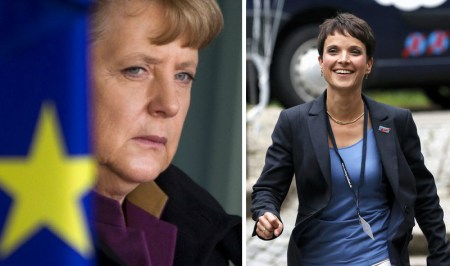
1515In recent regional elections, the CDU party of German Chancellor Angela Merkel (left) suffered heavy losses to the upstart anti-establishment party Alternative for Germany, led by Frauke Petry (right).

The left-leaning German newsmagazine, Der Spiegel, long hostile toward the AfD, acknowledged that the party has achieved a “breakthrough” and called the election result “Black Sunday” for Merkel:

“For a long time she had hoped, despite considerable popular opposition to her refugee policy, to win two chancelleries in the southwest of the country. This has come to nothing. Merkel will now have to live with the accusation that she has allowed the AfD finally to establish itself [as a democratic alternative] to the right of the CDU.”

The leader of the AfD, Frauke Petry, said the fact that her party won big in two states in western Germany — Baden-Württemberg and Rhineland-Palatinate — showed that “the AFD is an all-German party and that citizens in all regions of Germany want a change of politics.” In a Facebook post, she added:

“Yesterday we made a first important step in the right direction to break the cartels of consensus parties. Already, it has been indicated that they [mainstream parties] will not accept the will of the people. We will probably see the most colorful combination of political coalitions, just so they can continue to stay in power and further marginalize voters of the AfD.”

Petry was referring to Merkel’s spokesman, Steffen Seibert, who said that despite her electoral drubbing, Merkel will not reverse course on migration:

“The Federal Government will continue to pursue its refugee policy, with full determination, at home and abroad. At home, we will ease the path to integrate those people who have sought and found protection here. At European level, the goal must be a common, sustainable European solution that leads to a reduction in the number of refugees in all member states of the European Union.”

The CDU’s general secretary, Peter Tauber, echoed the view that there is no alternative to Merkel’s migration policy: “Considering what we have already achieved, I recommend that we continue on the path we are on.”

Some German commentators have tried to downplay the AfD’s gains by arguing that although Merkel lost the election, she actually won the election because the majority of Germans voted for mainstream parties. Bernd Ulrich, editor of Die Zeit, wrote:

“These three elections, which were in fact a plebiscite on the refugee policy, sent an encouraging message of approval. On average, two-thirds of voters cast ballots for parties that support the relatively liberal refugee policies of Angela Merkel.”

Writing in Der Spiegel, columnist Jakob Augstein argued:

“On Sunday Angela Merkel achieved an unlikely feat: her party was trounced, but her refugee policy was confirmed and strengthened… How did the chancellor do on Election Day? In truth, she has been strengthened. The fact is: a large majority of voters support the chancellor.”

According to Augstein, Merkel is “the right woman in the wrong party” because she has moved the center-right CDU to the left on so many issues, including migration policy, that the party is now virtually indistinguishable from its coalition partner, the center-left Social Democratic Party (SPD). What Augstein failed to mention is that Merkel’s move to the left is responsible for creating a political vacuum to the right of the CDU — a vacuum that is now being filled by the AfD.

Other political and media elites are ramping up a months-long campaign to delegitimize AfD voters as agitators, arsonists, far-right extremists, fascists, Nazis, populists and xenophobes.

German media are also churning out stories — many of which are based on hearsay — aimed at discrediting the AfD. The magazine, Stern, published this headline: “Reports of Nazi Songs at AfD-Election Party.” The Berliner Kurier: “Former Teacher Calls AfD Leader Frauke Petry a Liar.”Die Welt: “AfD Candidate Accused of Running Escort Service.” Berliner Morgenpost: “After AfD Coup, Saxony-Anhalt’s Hoteliers Are Anxious.” Stern: “AfD and Donald Trump: Hate is the Main Issue.” Die Zeit: “AfD Principles: Not So Important.”

On Election Day, Die Zeit ridiculed the AfD’s 70-point political platform by using the following bullet points:

“More popular referendums, more monitoring of citizens, stiffer penalties for criminals, dissolve the EU, shrink the state, lower taxes, cut social spending, put women back in the kitchen, ban employment quotas for women, make it harder to file for divorce, abolish abortion, close borders, harass Muslims, ruin the climate, expand nuclear power, expand the military, more private weapons, etc.”

Taxpayer-funded ZDF public television broadcast an interview with Thomas Kliche, a German psychologist, who compared AfD voters to “children who are stubborn and unreasonable.” The only way to deal with such people, he said, is “just have patience, ignore the stupidity, and confront it with rationalism.”

According to Kliche, AfD voters are suffering from “macro-social stress” induced by globalization (i.e., mass migration):

“People react with various forms of shock management. This begins with retrograde, regressive, childish fantasies that everything can be as it was before. Some believe that by shouting ‘We are the People!’ [the main slogan of anti-government demonstrators in East Germany in 1989-1990, reminding their leaders that Germany should be ruled by the people, not by an undemocratic party claiming to represent them], the migrants will disappear…. They have no solutions, just fantasies. Building a fence — this is a fantasy. Separate yourself from the world — that is a fantasy.”

Meanwhile, Vice Chancellor Sigmar Gabriel has called on German intelligence to begin monitoring the AfD, presumably in an effort to silence critics of the government’s migration policy. Gabriel — who leads the SPD, which also suffered significant losses on March 13 — has called the AfD a party of “right-wing extremists” who “use the language of the Nazis.” At the same time, Gabriel has called for Germany to take in even more migrants by airlifting them into the country directly from the Middle East.

By contrast, Horst Seehofer, the head of the Christian Socialist Union (CSU), the CDU’s sister party in Bavaria, said the rise of the AfD amounts to a “tectonic shift in the political landscape of Germany.” He warned that tectonic shifts trigger earthquakes that cause irreversible changes. Seehofer demanded that Merkel reverse course: “It cannot be that after such an election result, the answer to the electorate is: everything will go on as before.”

CSU politician Hans-Peter Uhl summed it up this way: “I expect the chancellor clearly to admit: ‘Yes, we have understood. We are going to return to the voters. Politics must move toward the voter, not the other way around. This is called democracy.'”

Merkel has not said if she plans to run for a fourth term in 2017.

Trump and the Left’s Accusations of Fascism

March 16, 2016

Trump and the Left’s Accusations of Fascism, Front Page MagazineBruce Thornton, March 16, 2016

trump

Donald Trump’s success in the primaries and his rhetoric have sparked troubled meditations about an awakening of fascist impulses among his supporters. Bret Stephens has drawn an analogy with the Thirties, “the last dark age of Western politics,” and compared Trump to Benito Mussolini. On the left, Dana Milbank, in a column titled “Trump Flirts with Fascism,” wrote about a campaign rally at which Trump was “leading supporters in what looked very much like a fascist salute,” a scene New York Times house-conservative David Brooks linked to the Nuremberg party rallies.

Much of the rhetoric that links Trump to fascism or Nazism is merely the stale ad Hitlerum fallacy used by progressives to demonize the candidate. They did the same thing when they called George W. Bush “Bushitler.” This slur reflects the hoary leftist dogma that conservatives at heart are repressed xenophobes and knuckle-dragging racists lusting for a messianic leader to restore their lost “white privilege” and punish their minority, immigrant, and feminist enemies. As such, the attack on Trump is nothing new or unexpected from a progressive ideology whose totalitarian inclinations have always had much more in common with fascism than conservatism does.

What Auden called the “low dishonest decade” of the Thirties, however, is indeed instructive for our predicament today, but not because of any danger of a fascist party taking root in modern America. Communism was (and in some ways still is) vastly more successful at infiltrating and shaping American political, cultural, and educational institutions than fascism ever was. But the same cultural pathologies that enabled both fascist and Nazi aggression still afflict us today. These pathologies and their malign effects are more important than the reasons for Trump’s popularity–– anger at elites, economic stagnation, and anti-immigrant passions–– that supposedly echo the “waves of fear and anger” of Auden’s Thirties.

The most important delusion of the Thirties still active today is the idealistic internationalism that had developed over the previous century. A world shrunk by new communication and transportation technologies and linked by global trade, internationalists argued, meant nations and peoples were becoming more alike. Thus they desired the same prosperity, political freedom, human rights, and peace that the West enjoyed. Interstate relations now should be based on this “harmony of interests,” and managed by non-lethal transnational organizations rather than by force. Covenants and treaties like the Hague and Geneva Conventions, and institutions like the League of Nations and the International Court of Arbitration, could peacefully resolve conflicts among nations through diplomatic engagement, negotiation, and appeasement.

The Preamble to the First Hague Convention (1899) captures the idealism that would compromise foreign policy in the Thirties. The Convention’s aims were “the maintenance of the general peace” and “the friendly settlement of international disputes.” This goal was based on the “solidarity which unites the member of the society of civilized nations” and their shared desire for “extending the empire of law and of strengthening the appreciation of international justice.” Two decades later, the monstrous death and destruction of World War I should have shattered the delusion of such “solidarity” existing even among the “civilized nations.” Despite that gruesome lesson, Europe doubled down and created the League of Nations, which failed to stop the serial aggression that culminated in World War II.

But the League wasn’t the only manifestation of naïve internationalism. The Locarno Treaty of 1925 welcomed Germany back into the community of nations with a seat on the League of Nations council. Nobel Peace prizes, and wish-fulfilling headlines like the New York Times’ “France and Germany Bar War Forever,” were all that resulted. The Kellogg-Briand pact of 1928 “condemn[ed] recourse to war for the solution of international controversies, and renounce[d] it as an instrument of national policy” in interstate relations. The signing powers asserted that “the settlement or solution of all disputes or conflicts . . . shall never be sought except by pacific means.”

All the future Axis Powers signed the treaty, and they all soon shredded these “parchment barriers.” In the next few years, Japan invaded Manchuria, Hitler remilitarized the Rhineland in gross violation of the Versailles Treaty, and Italy invaded Ethiopia. By the time Germany annexed Austria, and Neville Chamberlain’s faith in negotiation and appeasement handed Czechoslovakia to Hitler, all these treaties and conventions and conferences were dead letters, and the League of Nations was exposed as a “cockpit in the tower of Babel,” as Churchill suggested after the First World War.

However, such graphic and costly evidence showing the folly of “covenants without the sword,” as Hobbes put it, did not discredit this dangerous idealism over the following decades. Indeed, it lies behind the disasters of Obama’s foreign policy. Just consider his “outreach” to our enemies, his acknowledgement of our own “imperfections,” his reliance on toothless U.N. Security Council Resolutions, his preference for non-lethal economic sanctions to pressure adversaries, and his belief that negotiated settlements and agreements can achieve peace and good relations even with our fiercest enemies. All reflect the same failure to recognize that our adversaries in fact do not sincerely want to reach an agreement, for the simple reason they are not in fact “just like us,” and so they do not want peace and prosperity and good relations with their neighbors and the “world community.”

The catalogue of Obama’s failures is long and depressing. The “reset” with Russia and promise of “flexibility,” the empty “red line” threats against Bashar al Assad, the arrogant dismissal of a metastasizing ISIS as a “jayvee” outfit, the alienation of allies like Egypt, Saudi Arabia, and Israel, the cultivation of the jihadist Muslim Brotherhood, the ill-conceived overthrow of Muammar Ghaddafi, and the rhetoric of guilt and self-abasement are just the most noteworthy failures. The nuclear deal with Iran, of course, is the premier monument to this folly. Yet despite the increasing evidence of its futility­­––Iran’s saber-rattling in the Gulf, capture of U.S. military personnel, genocidal rhetoric, and testing of missiles in blatant violation of a U.N. Security Council resolution–– Obama still clings to this internationalist delusion.

A recent article in The Atlantic on Obama’s foreign policy shows, despite his protestations of hardheaded “realism,” that he has not learned from his failures. Thus he still thinks that the vigorous use of force is usually an unnecessary and dangerous mistake, and that verbal persuasion and diplomatic engagement are more effective. He also still believes that “multilateralism regulates [U.S.] hubris” of the sort that George W. Bush showed when he recklessly invaded Iraq, and that American foreign policy has frequently displayed.

Obama’s delusional faith in rhetoric, especially his own, comes through in his rationale for the infamous 2009 Cairo speech: “I was hoping that my speech could trigger a discussion, could create space for Muslims to address the real problems they are confronting—problems of governance, and the fact that some currents of Islam have not gone through a reformation that would help people adapt their religious doctrines to modernity.” The idea that Obama’s mere words could start a “discussion” that would transform 14-century-old religious doctrines fundamentally inimical to liberal democracy, human rights, and all the other Western goods we live by, is a fantasy. Obama’s self-regard recalls Neville Chamberlain’s boast after his meeting with Hitler at Bad Godesberg that he “had established some degree of personal influence with Herr Hitler.”

Or consider Obama’s take on Vladimir Putin:

He understands that Russia’s overall position in the world is significantly diminished. And the fact that he invades Crimea or is trying to prop up Assad doesn’t suddenly make him a player. You don’t see him in any of these meetings out here helping to shape the agenda. For that matter, there’s not a G20 meeting where the Russians set the agenda around any of the issues that are important.

A “player,” in Obama’s foreign policy universe, is a leader who uses “smart power” like diplomacy and negotiated deals, and recognizes that the use of force will backfire and lead to costly “quagmires.” As Secretary of State John Kerry suggested, Putin is using outdated “19th century” instruments of foreign policy like military force in a world that presumably has evolved beyond it.

In contrast, a genuine “player,” as Obama fancies himself, attends summits and conferences, such as the useless climate change conference in Paris, and “sets the agenda.” And like his rationale for the Cairo speech, as the leader of the world’s greatest power, his rhetoric alone can be a force for change. Thus just saying that Syria’s “Assad must go,” while doing nothing to achieve that end, is still useful, and refusing to honestly identify the traditional Islamic foundations of modern jihadism will build good will among Muslims and turn them against the “extremists.”

Meanwhile, Putin and Iran fight and bomb and kill in Syria and Iraq, and now they are the big “players” in a region that the U.S. once dominated, but that now serves the interests of Russia and Iran. I’m reminded of Demosthenes’ scolding of the Athenians for refusing to confront Phillip II of Macedon: “Where either side devotes its time and energy, there it succeeds the better––Phillip in action, but you in argument.”

In other words, for Obama as for Chamberlain, appeasing words rather than forceful deeds are the key to foreign policy––precisely the belief that led England to disastrously underestimate Hitler until it was too late. And that same belief has turned the Middle East into a Darwinian jungle of clashing tribes, sects, and nations.

Obama wraps his foreign policy of retreat in claims to “realist” calculations of America’s security and genuine interests, and buttresses his claim by citing his strategically inconsequential drone killings. But such rhetoric hides an unwillingness to risk consequential action and pay its political costs. And it reflects a commitment to the internationalist idealism that gives diplomatic verbal processes an almost magical power to transform inveterate enemies into helpful partners. Europe tried that in the Thirties, and it led to disaster. That’s a much more important lesson from that sorry decade’s history than the lurid fantasies about fascism coming to America on the wings of Trump’s rhetoric.

Germany: Migrant Rape Crisis Worsens

March 5, 2016

Germany: Migrant Rape Crisis Worsens, Gatestone Institute, Soeren Kernn, March 5, 2016

♦ Sexual violence in Germany has skyrocketed since Angela Merkel allowed more than one million mostly male migrants from Africa, Asia and the Middle East into the country. The crimes are being downplayed by the authorities, apparently to avoid fueling anti-immigration sentiments.<

♦ “The moment they [male migrants] see a young woman wearing a skirt or any type of loose clothing, they believe they have a free pass.” — Restaurant owner at a mall in Kiel.

♦ “Every police officer knows he has to meet a particular political expectation. It is better to keep quiet [about migrant crime] because you cannot go wrong.” — Rainer Wendt, the head of the German police union.

♦ Police are warning about a potential breakdown of public order this summer, when women who are lightly dressed are confronted by young male migrants.

♦ Jakob Augstein, an influential columnist for the magazine Der Spiegel, says that Germans worried about migrant crimes are motivated by racism. His views shed light on the worldview of German multiculturalism: Migrants who assault German women and children are simply rebelling against German power structures. Germans who criticize such assaults are racists.

♦ Police in Cologne received more than 1,000 complaints from women, including 454 reports of sexual assaults, related to New Year’s Eve. Police in Hamburg received complaints from 351 women, including 218 reports of sexual assault that took place on the same evening.

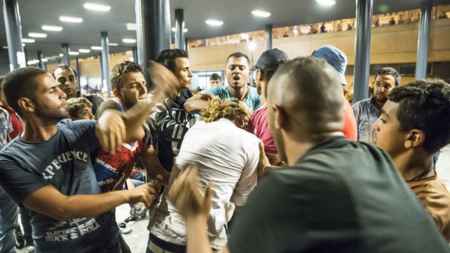
A mob of asylum seekers from Afghanistan assaulted three teenage girls at a shopping center in the northern German city of Kiel. The attack — which occurred over two-hours on the evening of February 25, and mirrored the mass assaults of German women in Cologne on New Year’s Eve — shows, once again, that public spaces in Germany are becoming increasingly perilous for women and children.

Police reports show that sexual violence in Germany has skyrocketed since Chancellor Angela Merkel allowed more than one million mostly male migrants from Africa, Asia and the Middle East into the country. But the crimes are being played down by German authorities, apparently to avoid fueling anti-immigration sentiments.

Police in Kiel say the assault began at around 5:30 pm, when two Afghan males (aged 19 and 26) began stalking and photographing three girls (aged 15, 16 and 17) at a food court in the Sophienhof, a large shopping center near the city’s central train station.

After posting photographs of the girls on social media, the two men were quickly joined by at least 30 other migrants who began collectively to harass the girls in a Muslim “rape game” known in Arabic as “taharrush” (al-taharrush al-jinsi, Arabic for “sexual harassment”).

When police arrived, the migrants, rather than running way, began verbally and physically abusing the officers, some of whom were injured. It took police two hours to restore order. The initial two perpetrators, asylum seekers from Afghanistan, were arrested; the other migrants involved in the incident remain at large.

At a news conference on February 27, police spokesman Oliver Pohl revealed that more women are now coming forward to report similar experiences at the Sophienhof.

The owner of a restaurant at the mall said:

“Groups of young men gather at the Sophienhof every evening. What they do here is unacceptable. The moment they see a young woman wearing a skirt or any type of loose clothing, they believe they have a free pass. It is about time migrants are made to understand: things in Germany function differently than in their home countries.”

In an interview with Kieler Nachrichten, the local leader of the Free Democrats (FDP), Wolfgang Kubicki, expressed dismay at the deteriorating security situation in Kiel:

“It cannot be that girls and women, as well as their parents or spouses, should be afraid in public spaces. People are asking: If you are no longer safe in Sophienhof, where then?

“The perpetrators must be brought to justice. We must not create the impression that perpetrators will go unpunished for such assaults. … Turning a blind eye to such incidents is the opposite of integration and ultimately leads to the creation of parallel societies.

“It starts with small things. Time and again I keep hearing from the police how disrespectful young migrants are towards the officers. We have to support our security forces and reverse the loss of confidence in the police and judiciary. Otherwise we risk citizens taking the law into their own hands. I do not want to see vigilantes patrolling our streets.”

Kubicki was referring to revelations that politicians in Kiel ordered the city police to overlook many of the crimes perpetrated by migrants. A document leaked to the newspaper Bild in late January showed that the orders were given in October 2015, when more than 10,000 migrants were entering Germany each day. According to Bild, police in North Rhine-Westphalia and Lower Saxony have also been instructed to be lenient to criminal migrants.

Meanwhile, the raping and assaulting of German women and children by migrants and refugees — German police often refer to them by using politically correct euphemisms such as “southerners” (Südländer), men with “dark skin” (dunkelhäutig, dunklere Gesichtsfarbe, dunklem Hauttyp) or a combination of the two: “southern skin color” (südländische Hautfarbe) — continues apace (See Appendix below).

1496Left: At least 30 male migrants assaulted three girls (aged 15, 16 and 17) at the Sophienhof mall in Kiel, Germany, on February 25. Only two of the men were arrested by police. Right: In the first two months of this year alone, there have been dozens of reported cases of migrants sexually assaulting women and children at public swimming pools across Germany. In some areas, authorities have distributed cartoon guides, to “educate” migrants that sexual assault is not acceptable.

Reliable statistics on sexual crimes committed by migrants are notoriously elusive. German authorities have repeatedly been accused of underreporting the true scale of the crime problem in the country. For example, up to 90% of the sex crimes committed in Germany in 2014 do not appear in the official statistics, according to André Schulz, the head of the Association of Criminal Police (Bund Deutscher Kriminalbeamter, BDK).

On February 25, the newspaper, Die Welt, reported that authorities in the German state of Hesse were suppressing information about migrant-related crimes, ostensibly due to a “lack of public interest.”

On January 24, Die Welt reported that the suppression of data about migrant criminality is a “Germany-wide phenomenon.” According to Rainer Wendt, the head of the German police union (Deutschen Polizeigewerkschaft, DPolG), “Every police officer knows he has to meet a particular political expectation. It is better to keep quiet [about migrant crime] because you cannot go wrong.”

On January 22, the newsmagazine Focus reported that the Federal Anti-Discrimination Agency (Antidiskriminierungsstelle des Bundes, ADS) put pressure on police in North Rhine-Westphalia (NRW) to remove a reference to “North African criminal groups” in a press release. According to Focus, the ADS wrote: “There is a danger that people from these countries are placed under a general suspicion. We encourage you to delete the reference to the North African origin from the press release.” NRW Police later removed the offending words because “it could not be excluded that our formulation in the press release could be misunderstood as a discriminatory statement.” Interestingly, the original article by Focus has since been removed from the magazine’s webpage.

Some German commentators are downplaying or rationalizing the growing sexual violence against women and children. According to Jakob Augstein, an influential columnist for the newsmagazine Der Spiegel, Germans worried about migrant crimes are presumably motivated by deep-seated racism.

Shortly after the attacks in Cologne on New Year’s Eve, Augstein ridiculed the idea that Muslim migrants were targeting German women. On his Facebook page, he wrote:

“We are so racist. Everyone immediately wanted to believe that 1,000 North Africans were committing mischief. One thousand: this is a fairy tale figure. Just like the three golden hairs of the devil. Or the seven dwarfs. Or the thirteenth fairy.

“One thousand Tunisians who attacked ‘our’ women. That is just what we needed. The foreigner and his menacing sexuality — this is the oldest prejudice of racism.”

Now Augstein says the sexual assaults committed by migrants are a form of social rebellion.

Writing on his Facebook page on February 23, Augstein argued that the true victims in all of this are the migrants, because of their low rank in Germany’s social hierarchy. He wrote:

“The victims of Cologne were inferior to their perpetrators only in the immediate moment of the attacks. Those women were powerless and helpless at the moment they were assaulted and robbed. But before the attacks and after, they were and are superior to their attackers.

“For the victims of Clausnitz [on February 18, an anti-migrant mob tried to block the arrival of 20 asylum seekers into the town] it is different: they were inferior to their attackers before, during and after the incidents. They are always inferior.

“The lawbreaking in Cologne brought a brief rupture in the established hierarchy, a reversal of the true balance of power. The reason is that in this moment, the relationship between victim and perpetrator was reduced to physical strength. In all other respects, the victims of Cologne are superior to their perpetrators: language, nationality, education, social status, wealth, legal certainty, self-confidence. …

“In Clausnitz, the strong subdued the weak. This makes the attack in Clausnitz so repugnant. And — if you really want to draw such comparisons — this gives the attack on Clausnitz a different moral quality than the attack on Cologne.”

Augstein, whose opinions have not been seriously challenged by the mainstream media, sheds light on the upside-down worldview of German multiculturalism: Migrants who assault German women and children are simply rebelling against German power structures. Germans who dare to criticize such assaults are racists.

Meanwhile, on February 24, a court in Cologne handed down the first sentence related to the mayhem in the city on New Year’s Eve, when more than a thousand migrants sexually assaulted hundreds of German women on a public square in front of the Cologne Cathedral. A 23-year-old Moroccan migrant was given a six-month suspended sentence and fined 100 euros ($108) — for stealing a woman’s cellphone. So far no one has been charged for sexual assault.

In an interview with the television program, Kölnische Rundschau, Cologne’s chief of police, Jürgen Mathies, admitted that most of those who committed the assaults will never be brought to justice. He said the surveillance videos are too fuzzy definitively to identify anyone.

Police in Cologne say they have received more than 1,000 complaints from women, including 454 reports of sexual assaults, related to New Year’s Eve. Police in Hamburg say they have received complaints from 351 women, including 218 reports of sexual assault that took place on the same evening.

Police are now warning about a potential breakdown of public order this summer, when women who are lightly dressed are confronted by young male migrants.

Appendix

Sexual Assaults and Rapes by Migrants in Germany, January-February 2016.

Gatestone Institute first reported about Germany’s migrant rape epidemic in September 2015. The problem has now spread to cities and towns in all 16 of Germany’s federal states. Following are a few cases from just the first two months of 2016:

January 1. More than a thousand migrants sexually assaulted hundreds of German women in the cities of Cologne, Hamburg and Stuttgart.

January 4. A group of migrant youths sexually assaulted a handicapped girl in Bielefeld.

January 5. An Afghan migrant attempted to rape a 15-year-old girl in Burghausen.

January 7. A 36-year-old asylum seeker was arrested for raping a 16-year-old boy inside the city hall of Wolfsburg. A “southerner” (südländisch, arabisch) sexually assaulted a 13-year-old girl near a train station in Ellwangen.

January 8. A 17-year-old Syrian migrant exposed himself to women at a swimming pool in St. Ingbert.

January 9. A 48-year-old woman was raped by three migrants in Dresden. The perpetrators have not been arrested. Also on January 9, a 45-year-old woman was sexually assaulted by an “Arab-speaking” man in Gleidingen, a town near Hanover. A group of five North Africans (Algerians, Moroccans) sexually assaulted five women in Oldenburg. Two North African migrants (Libya, Tunisia) sexually assaulted a 31-year-old woman at the main train station in Leipzig. A migrant attempted to rape a 46-year-old woman in Saarbrücken-Altenkessel.

January 10. A group of “southerners” (südländisches Aussehen) sexually assaulted three girls at a public swimming pool in Ansbach. A 21-year-old West African was arrested for raping a 15-year-old girl at a train station in Wuppertal. A 36-year-old Syrian migrant sexually assaulted a 20-year-old woman in Bornhöved. The woman was showing the man an apartment that had been advertised for rent.

January 11. A 35-year-old migrant from Pakistan sexually assaulted a three-year-old girl at a refugee shelter in Kamen. Eight migrants attempted to rape a woman at a grocery store in Ampfing. She defended herself by using pepper spray. A 20-year-old Moroccan assaulted a 24-year-old woman in Frankenberg.

January 12. A “southerner” (südländisch aussehenden) raped a 16-year-old girl in Wuppertal. Two “Arabic speaking” men assaulted a 37-year-old woman in Fröndenberg.

January 13. Four migrants (südländisch aussehen) attempted to rape a 13-year-old girl inGelsenkirchen. Three migrants sexually assaulted a 31-year-old woman in Oldenburg. A migrant attempted to rape a woman at a train station in Altötting. She defended herself by using pepper spray. Three “southerners” (südländischer oder arabischer Herkunft) assaulted a woman in Bad Münstereifel.

January 14. Three migrants (südländische Hautfarbe) sexually assaulted a 47-year-old woman in the Bavarian town of Dingolfing. Three “southerners” (Südländer) assaulted a 22-year-old women on a train in Bremerhaven.

January 15. A 36-year-old migrant sexually assaulted an eight-year-old girl at a public park in Hilden near Solingen. A 31-year-old migrant from Tunisia was arrested for attempting to rape a 30-year-old woman in Chemnitz. A 31-year-old migrant from Morocco appeared in court for raping a 31-year-old woman in Dresden. A migrant sexually assaulted a 42-year-old woman inMainz. A migrant (dunkleren Teint) sexually assaulted a 32-year-old woman in Münchfeld. An African migrant sexually assaulted a 55-year-old woman in Mannheim.

Also on January 15, all male migrants over the age of 18 were banned from a public swimming pool in Bornheim, near Bonn, after assaults against female patrons at the facility. The measure was branded as racist by German media outlets.

January 16. A migrant from Syria sexually assaulted a 12-year-old girl in Mudersbach. A 36-year-old migrant sexually assaulted an eight-year-old girl in Mettmann. A 36-year-old migrant assaulted an 8-year-old girl in Hilden. A 19-year-old migrant from Afghanistan sexually assaulted four girls between the ages of 11 and 13 at an indoor swimming pool in Dresden. The migrant was arrested but then released. A 25-year-old Moroccan migrant assaulted two woman at a grocery store in Zeithain.

January 17. Three “southerners” (Südländer) attempted to rape a young woman in Kiel. Two migrants (19 and 38 years old) sexually assaulted a 21-year-old woman at a restaurant in the main train station in Nuremberg. A 19-year-old Afghan migrant assaulted four girls (aged 11 to 13) at a public swimming pool in Dresden. Migrants invaded female changing rooms at a swimming pool in Burghausen. Two “southerners” (dunklen/südländischen Typ) attempted to rape a 42-year-old woman at a pharmacy in Altötting.

January 18. A 43-year-old Syrian migrant assaulted a 63-year-old woman in Wetzlar. Police say the man also assaulted two other women (aged 62 and 74) in Wetzlar.

January 19. A 17-year-old Eritrean migrant attempted to rape an 18-year-old woman in a parking garage in Bad Oldesloe. After police intervened, the man head-butted an officer, who was hospitalized.

January 20. Migrants invaded female showers and changing rooms at two public swimming pools in Leipzig.

January 21. A “black skinned” (schwarz glänzende Hautfarbe) man attempted to rape a 13-year-old girl in Langenfeld. Two migrants assaulted an 18-year-old woman in Dingolfing.

January 22. A migrant (südländisches Äußeres) attempted to rape a 16-year-old girl in Feuerbach district of Stuttgart, and in downtown Stuttgart, four “Arabic looking” (arabisches Aussehen) men sexually assaulted a 23-year-old woman. Migrants harassed women at public swimming pools in Zwickau.

January 23. Migrants sexually assaulted two 11-year-old girls at a public swimming pool inWilhelmshaven. Two asylum seekers from Afghanistan assaulted two 17-year-old women at a public swimming pool in Straubing. Three 16-year-old migrants from Afghanistan and Syria assaulted two 13-year-old girls at a public swimming pool in Hachenburg.

Also on January 23, a 35-year-old migrant sexually assaulted a woman in a restroom on a train inDüsseldorf. A 22-year-old Syrian migrant exposed himself on a train in Hanover. An 18-year-old Syrian asylum seeker raped a 17-year-old woman in Straubing. Two unidentified men sexually assaulted an 18-year-old woman in Wiesbaden.

January 24. Two men speaking “broken German” attempted to rape a 25-year-old woman in Lehrte as she was walking home from the train station. The men pulled a knife on the woman and ordered her to “spread your legs.”

January 25. A 30-year-old migrant from “North Africa” (nordafrikanischem Erscheinungsbildexposed himself to a 19-year-old woman on a public bus in Marburg, and then to passersby at the main train station.

January 26. A 35-year-old migrant attempted to rape a young girl in Bochum. Two female passersby intervened and called police.

January 27. Two “southerners” (dunklem Teint) sexually assaulted a 15-year-old girl at a bus stop in Überlingen. A 21-year-old asylum seeker assaulted an 18-year-old woman in a female changing room at a fitness studio in Lahr.

January 28. A migrant from Sudan sexually assaulted a female police officer in Hanover as she was attempting to arrest him for theft. Two “underage refugees” (minderjährige Flüchtlingesexually assaulted a 12-year-old girl at a shelter for children in Düsseldorf. It later emerged that one of the perpetrators was a 22-year-old migrant from Iran who claimed he was 16 years old to gain access to the shelter. A 17-year-old Afghan migrant assaulted a 14-year-old girl in Frankenberg. A “southerner” (Südländer) sexually assaulted an 18-year-old woman in Backnang.

January 31. A 30-year-old German, originally from Turkmenistan, raped a seven-year-old girl inKiel. The man kidnapped the girl from a school playground at 11 AM, took her to his apartment and, after abusing her, set her free. It later emerged that the man had been accused of sexually assaulting a five-year-old girl at another kindergarten in Kiel on January 18, but due to insufficient evidence, the public prosecutors failed to pursue the case.

Also on January 31, four unidentified migrants (ausländischem Aussehen) sexually assaulted a 17-year-old woman in Vilshofen. An unidentified “dark skinned” (dunkelhäutig) man assaulted a woman in Villingen. Two North African migrants sexually assaulted two 15-year-old girls inSalzgitter.

February 1. A 40-year-old asylum seeker from Syria kissed a 7-year-old boy at a bus stop inGaildorf.

February 2. Two “dark skinned” (dunklere Gesichtsfarbe) men assaulted a 31-year-old woman, who was nine months pregnant, in the parking lot of a supermarket in Schweinfurt. A 26-year-old migrant using several different identities assaulted three women on a train in Berlin. Two “dark skinned” (dunklem Hauttyp) men assaulted a 14-year-old girl on a school bus in Eslohe.

February 3. Three Afghan migrants sexually assaulted two 14-year-old girls from France at a public swimming pool in Munich. A 16-year-old migrant assaulted a 16-year-old girl at a swimming pool in Heidenheim. An 18-year-old Libyan migrant attempted to rape a 25-year-old woman in Leipzig. A “southern looking man” (südländisch aussehend) exposed himself to passengers on a regional train in Harburg.

February 4. A 29-year-old migrant from Nigeria raped a 21-year-old woman at a carnival celebration in Schloß Holte-Stukenbrock. A 25-year-old asylum seeker from Syria assaulted  two women at the same carnival. More than 20 women were sexually assaulted during carnival celebrations in Cologne. A Syrian migrant sexually assaulted a 49-year-old woman after a carnival in Bad Reichenhall. A 29-year-old migrant assaulted a woman after a carnival in Dinslaken.

Also on February 4, an African migrant (Schwarzafrikaner) assaulted a woman at a supermarket in Lörrach. When police arrived, the man assaulted the officers, who needed backup to subdue him. Police have been unable to determine the man’s identity; he was carrying a fake ID. An Eritrean migrant who assaulted two women in Zeithain was freed after a judge determined the man was drunk when he committed the crimes. A “southerner” (Südländer) assaulted a young woman in Elsfleth.

February 5. Groups of North African migrants assaulted women at carnival celebrations in downtown Cologne. Two migrants sexually assaulted a 16-year-old girl in Straubing. A migrant assaulted a 19-year-old woman in Villingen-Schwenningen. Two “Arabic looking” (arabisch aussehend) men assaulted a 13-year-old girl in Klietz.

February 6. A group of 30 migrants attempted to rape an 18-year-old woman in Mühldorf am Inn, a town in Bavaria. Three Afghan migrants were arrested for sexually assaulting several women at a carnival celebrations on in Laufenburg. A 28-year-old Iraqi migrant assaulted a woman after a carnival in Bocholt. A 24-year-old migrant assaulted two 15-year-old girls at a carnival celebration in Badorf. A 48-year-old Jordanian migrant assaulted a 16-year-old girl at a carnival parade in Frankfurt. “Five or six” migrants assaulted a 25-year-old woman after carnival celebrations in Cologne. Several “foreigners” (Ausländer) assaulted “numerous” women at a carnival in Konstanz.

Also on February 6, a “southerner” (südländisches Aussehen) sexually assaulted a 19-year-old man in Ravensburg. Four “southerners” (südländisches Aussehen) assaulted and robbed two girls (13 and 14 years old) near the main train station in Bochum. A migrant (dunklen Teint) assaulted a woman in Friedrichstadt. Five migrants sexually assaulted an 11-year-old girl at a public swimming pool in Celle.

February 7. A 24-year-old Algerian migrant assaulted two teenage girls at a carnival in Rietberg. Three “Arab looking” (arabisches Aussehen) men sexually assaulted several women at a carnival in Mainz. Two “dark skinned men” (dunkelhäutige Männer) sexually assaulted a 31-year-old woman at a carnival in Gütersloh. Four Afghan migrants were arrested for assaulting two 14-year-old girls at carnival celebrations in Erfurt. Four Afghan migrants sexually assaulted a 17-year-old woman in Heppenheim. Several women were assaulted at a carnival in Hardheim. A 21-year-old Moroccan migrant sexually assaulted a woman at a carnival in Kranenburg. Two “dark skinned” (dunkelhäutig) men assaulted two women at a carnival in Flieden.

Also on February 7, a 17-year-old Afghan migrant sexually assaulted a 12-year-old girl at a public swimming pool in Landshut. A 16-year-old migrant from Afghanistan sexually assaulted several women at Schillerplatz, a large public square in downtown Mainz. A “dark skinned” (dunklem Hauttyp) man sexually assaulted a 17-year-old woman in Backnang. Three “southern looking” (südländischem Aussehen) assaulted a woman in Offenburg. A group of “dark skinned” (dunklen Teint) migrants sexually assaulted a 16-year-old girl in Ochtrup.

Also on February 7, a “dark skinned” (dunkelhäutig) man sexually assaulted a 24-year-old woman in Mühldorf. Five migrants assaulted a 15-year-old girl in Bernburg. A “southerner” (südländisches Aussehen) assaulted a 37-year-old woman on a bus in Bochum. Two “southerners” (zwei Südländer) sexually assaulted an 18-year-old woman on an express train in Stuttgart. A “southerner” (südländisch Aussehen) assaulted a 39-year-old woman near the train station in Dresden. A migrant assaulted a 46-year-old woman in Eppelheim.

February 8. A 35-year-old migrant sexually assaulted a 15-year-old girl at a carnival in Siegburg. Two Moroccans assaulted a 36-year-old woman at a carnival in Brilon. Three migrants assaulted a 49-year-old woman in Andechs.

February 9. North African migrants assaulted a 19-year-old woman during carnival revelry in Opladen, a district of Leverkusen. Several “southerners” (Südländer) assaulted a 23-year-old woman in a supermarket parking lot in Göttingen. Four migrants sexually assaulted three 13-year-old girls at a public swimming pool in Borghorst.

February 11. A 36-year-old asylum seeker raped a 14-year-old girl in Braunschweig.

February 12. A “dark skinned” (dunkle Teint) sexually assaulted a boy at a swimming pool inNordenham. A migrant assaulted a boy at a swimming pool in Nordenham. Three “dark skinned” (dunkle Hautfarbe) men assaulted a 16-year-old girl in Füssen.

February 13. Several migrants assaulted three girls (aged between 10 and 11) at a swimming pool in Norden. A migrant assaulted a 49-year-old woman in a bakery in Gütersloh.

February 14. Two migrants from Iran and Syria assaulted two girls (aged 10 and 11) at a public swimming pool in Dresden. Four migrants assaulted a 19-year-old woman in Duisburg. Migrants assaulted several women at a discotheque in Mengeringhausen.

February 15. A 17-year-old North African assaulted several women at the main train station inBremen. A 23-year-old Algerian migrant assaulted a 14-year-old girl on metro train in Frankfurt. Four “dark skinned” (Dunkelhäutige) men assaulted a 35-year-old woman in Künzelsau.

February 16. An “Arabic looking” man assaulted a 14-year-old girl on a bus in Dörzbach.

February 17. A man with a “dark complexion” (dunklem Hautteint) exposed himself to passersby in the Biebrich district of Wiesbaden. A “14 or 15-year-old” boy with “dark skin” (dunkler Teintexposed himself to several women at a traffic light in Hörstel. Two “southerners” (südländischem Aussehen) assaulted a 25-year-old woman in Dresden.

February 18. Three “southern looking” (südländische Erscheinung) men attempted to rape a woman in Uelzen. At least one of the men was attacked by the woman’s Rottweiler.

February 20. A 34-year-old Iraqi asylum seeker assaulted two girls, aged 13 and 14, at a supermarket in Rotenburg. Two “dark skinned” (dunklen Teint) men speaking broken German raped a 49-year-old woman near a cemetery in Biberach. A 51-year-old Bosnian migrant was arrested for repeatedly raping a 17-year-old woman in the Feuerbach district of Stuttgart. Two “dark brown skinned” males sexually assaulted a 19-year-old woman in Trier. A 28-year-old Afghan migrant attempted to rape a woman in Blankenburg. A “dark skinned” (dunklen Teint) man sexually assaulted a 23-year-old man in Greven.

February 21. Seven migrants from Afghanistan and Iran invaded female changing rooms at a public swimming pool in Aurich. A 35-year-old Syrian migrant assaulted a 14-year-old girl at a pool in Eckernförde. An unidentified migrant raped a 21-year-old woman at the train station inBad Schwartau. A 44-year-old migrant sexually assaulted a 29-year-old female volunteer at a refugee shelter in Großenlüder. A “southerner” (südländisches Aussehen) assaulted a 14-year-girl on a train in Neubrandenburg. Several days later, the same girl was attacked by the same suspect at a playground in the city.

February 22. A man “speaking German with a foreign accent” sexually assaulted a 20-year-old woman in Asperg. A “southerner” (südländischer Typ) assaulted a 16-year-old girl inFeldkirchen. Two “Turkish or Arab” man attempted to rape a 15-year-old girl in Brandenburg.

February 23. A 16-year-old migrant who raped two boys (9 and 11 years of age) in the town ofGlöwen was released from jail. A judge ruled that because the suspect lives with his parents and has no money, he does not pose a flight risk. A 34-year-old Algerian migrant assaulted two women (17 and 22 years of age) at a subway station in Berlin. A migrant touched himself in front of a 19-year-old woman on a public bus in Chemnitz. A migrant touched himself in front of a 21-year-old woman on a subway train in Chemnitz.

February 24. A 31-year-old Nigerian asylum seeker sexually assaulted a 21-year-old woman in a church in Weilheim. Police say the man previously assaulted another woman in the same church. He also assaulted two women in the town hall and another woman at a nursing home. A “southerner” (südländischem Äußeren) assaulted an 18-year-old woman in Kassel.

February 25. A dark skinned (südländische Hautfarbe) man assaulted two girls (13 and 15 years of age) on a city bus in the Mockau-Nord district of Leipzig. An “African” (afrikanischen Typ) man assaulted a 48-year-old woman on a tram in Leipzig.

February 26. Two Afghan migrants were accused of raping a 24-year-old woman in Magdeburg. A 29-year-old man was arrested for assaulting several women at the train station in Mülheim an der Ruhr. A 20-year-old asylum seeker assaulted a 20-year-old woman in Landau.

February 28. Two Afghan migrants (aged 14 and 34) raped two girls (aged 14 and 18) at a public swimming pool in Norderstedt. Two Afghan migrants sexually assaulted a 19-year-old woman in Mannheim. A “southerner” (südländischer Typ) assaulted a 46-year-old woman in front of the city hall in Schwarzenbach. A 19-year-old Algerian migrant assaulted a 21-year-old woman in Hamm.

The Women-Hunt in Germany

March 3, 2016

The Women-Hunt in Germany, Front Page MagazineStephen Brown, March 3, 2016

germany-cologne-train-station-1000-arab-mobs-molest-rape-sexual-assault-women-illustration1

“If a woman gets raped walking in public alone, then she, herself, is at fault. She is only seducing men by her presence. She should have stayed home like a Muslim woman.” – Dr. Abd Al-Aziz Fawzan Al-Fawzan, Professor of Islamic Law, Saudi Arabia.

Many Germans welcomed with open arms the million, mostly male and Muslim, migrants Federal Chancellor Angela Merkel invited into Germany last September. At train stations, they handed out water bottles to the newcomers, while holding signs stating: “Willkommen!” At first, everything was, as the Germans say, “Friede, Freude, Eierkuchen” (“peace, joy and happiness”).

But the good feeling these greeters created, especially among themselves, has somewhat dissipated, primarily due to the increasing number of reported sexual assaults by migrants against women and children. The best known incident was the sexual molestation of hundreds of women in Cologne on New Year’s Eve by about 1,000, mostly North African men that included migrants.

The latest such multicultural enriching incident to create similar outrage occurred last Thursday in Kiel, a northern German city in Schleswig-Holstein, a state bordering Denmark. Three teenage girls, aged 15, 16 and 17, were visiting a central shopping mall, the Sophienhof, in “broad daylight” when two young Afghan asylum seekers, aged 19 and 26, began to follow and film them with their cell phones.

“Evidently, the criminals then posted these films on their social networks with the result that more and more men came to a restaurant area of the Sophienhof in order to persecute, sneer at them and to frighten them,” reported the newspaper, Die Welt.

Like the women in Cologne and those participating in the anti-Morsi demonstrations on Tahrir Square in Egypt in 2013, the three Kiel teenagers were at first probably unaware they were being hunted, and that a pack of hyenas was slowly surrounding them.

In total, between 20 and 30 men of “migration background,” as German papers described them, were involved. Police report there were no acts of sexual violence, but papers state the teenagers were “very hard pressed.”

But if no sexual molestation did occur, it is probably only because it was in the middle of the day, in the middle of a shopping mall. Outside and at night, this story most likely would have had a much sadder and more tragic outcome. As it was, it was reported the girls received psychological counselling after their ordeal.

The teenagers’ torment finally ended when passersby noticed their plight and notified security, who in turn notified police. Police then took four men, including the two Afghans, into custody, but not without difficulties.

“As a consequence (of their arrest), the suspects fought fiercely, also at the police station,” Die Welt reported. “The talk is of massive insults, threats and bodily injuries. At the suspects’ medical examination, the police doctor was also threatened and insulted.”

However, thanks to Germany’s “cuddly” justice system, as law-and-order Germans derisively call it, all suspects were released by the following day. Police are currently evaluating mall security videos to lay charges.

Perhaps the most surprising aspect surrounding this awful incident is that Germans are so surprised.

But why, one wonders, are they so astonished when such occurrences as this one and the mass sexual assault of women in Cologne have been going on around them for years in Sweden, France and England?

In England, Muslim men associated with the rape of hundreds of girls in Rotherham, were recently given heavy prison sentences. And Muslim rape gangs in Sweden have contributed to giving that country the second highest rape rate per capita in the world. Only one African country, Lesotho, has a higher rate.

The whole world also witnessed this tactic of surrounding women by large numbers of men in order to sexually molest and/or rape them in 2011 on Tahrir Square in Egypt during Arab Spring demonstrations. CBS’s Lara Logan was its most famous victim. Part and parcel of the culture, it even has a name: “taharrush gamea.” So if some Muslim men behave like this in their own countries, why wouldn’t they do so in other countries, especially in ones full of infidel women?

The Cologne police chief called “taharrush gamea,” a completely “new phenomenon,” one never encountered before. Besides terrorizing women, since the Cologne event it is responsible for turning many against Merkel’s migrant policy.

Also unsurprisingly, after the Kiel incident became known in the city, the local newspaper, Kieler Nachrichten, reported more women came forward to state they had had “similar experiences” at the Sophienhof. A police spokesman said this is “quite typical for this kind of crime marked by shame.”

The Nachrichten states, however, that the hunting of girls is “just the tip of the iceberg.”

“Business people in Sophienhof report an increasing number of thefts,” the paper reports. “Again and again customers are bothered.”

A mall worker, who emigrated to Germany “decades ago” from the Arab world, said young migrants are at the mall practically every evening and that he can tell by their accent that “they are almost all Syrians.”

“What they do here is not right,” he complained to the Kieler Nachtrichten. “As soon as they see a young woman wearing a skirt or some way or other open clothing, they believe they have a free pass.”

At a neighbouring department store, the situation is perhaps even worse. A store clerk there states they have been “experiencing difficult situations here since the end of last year.”

“Sometimes, young foreigners jostle old people,” she said. “They bother young women…, grab them, smack their behinds. They have also shouted abuse at people and spit at them. When they appear in a group, they display a disrespectful approach to others.”

Due to their understandable fear, many women in Germany have changed their behaviour since last September. Some do not go out alone, or only in a group with female friends, in the evening any more. The risk of harassment, or worse, by migrant “street terrorists,” as they are called in Holland, is deemed too great.

However, when women disappear more and more from public, this will have the negative effect of gradually giving Germany the appearance of an Islamic society. In some Muslim countries, women can only venture outside properly covered and with a male relative. Which could be Germany’s future, if the current trend is not reversed.

And with women becoming more hesitant to venture evenings from their homes because of fear, more and more German public space, also like in Islamic countries, will be left to men. In this case, Muslim men. All of which represents a further Islamisation of German society and another step downwards toward dhimmitude status.

After the tormenting of the three teenaged girls, a female journalist reported that last summer in Kiel people “smiled mildly” at several young, male migrants who were standing at a tennis court near their refugee hostel, watching the girls training there. This was just something new to them, they thought.

“However, there were larger numbers every day,” she related. “They filmed them (the girls) with their cell phones.”

After last week’s incident at the Sophienhof, it is doubtful anyone is smiling any more.

The Refugee Hostel: Germany’s Islamist Hell

February 23, 2016

The Refugee Hostel: Germany’s Islamist Hell, Front Page MagazineStephen Brown, February 23, 2016

refugee-crisis-357690

They fled religious hatred, rape and violence in their homelands for the “safe” haven of Germany — only to encounter the same, brutal conditions in their new accommodations: the refugee hostel.

Violence in refugee centers became a national topic in Germany last October, only weeks after Federal Chancellor Angela Merkel invited into Europe one million, mainly Muslim, refugees. But exposure of this disgraceful situation appears to have had little effect, as German newspapers are reporting this month that conditions remain unchanged.

In fact, life in German refugee hostels has now become so unbearable that religious minorities, women traveling alone or with children, and homosexuals are fleeing their accommodations. For them, according to one paper, the word “hostel” has become synonymous with ‘”defenselessness”.

The constant harassment and mistreatment at the hands of Muslim male refugees is not only becoming intolerable and dangerous, but, for some, life-threatening.

“Torn bibles and insults, ripped off crosses and even blows to the face, the complaints about violence in the refugee centers do not let up,” the German newspaper, Die Welt, stated recently.

According to Rainer Wendt, chairman of the German Police Union, outbreaks of violence in German refugee centers were occurring before last August. In the first six months of 2015, police were called out 1,288 times to refugee asylums and registered 499 crimes. One problem is definitely the overcrowding, Wendt said, but there are also “knallharte” (very brutal) criminal structures among the refugees.

Most violent incidents occur between Muslims themselves. They form groups, Wendt says, according to “ethnicity, religion or clan structure and go at one another with knives and self-made weapons.” And the fights, which can involve dozens on each side, concern “power struggles” and are “above all, religious or politically motivated.” Numerous violent disputes have ended in death.

“Here the Sunnis fight the Shiites, there are Salafists of different brands …women are forced to wear the veil. Men are forced to pray. Islamists want to install their values and order there,” said Wendt.

But among the mistreated minority groups, one is especially targeted for abuse: Muslim converts to Christianity. Many are from Iran and Afghanistan where Christians are a persecuted minority and Islamic law demands that they be put to death for leaving the faith.

One human rights organization official says the chances of a Muslim convert to Christianity, unwilling to hide his faith, being subjected to violence or mobbing in a refugee center is “nearly 100 percent.” And the situation is only going to get worse.

“Among those arriving now, a not insignificant portion is at least on the level of the Muslim Brotherhood in its religious intensity,” he said.

Pastor Gottfried Martens, who counts six hundred Christian converts from Islam in his Berlin parish, agrees. Martens, who baptized many of them himself, said, it is “above all Christian converts from Islam who have to suffer as a minority” in the hostels. Christians are not allowed to prepare their meals in the kitchens and “whoever does not pray five times a day in the direction of Mecca is mobbed.”

“Almost all of them have huge problems in their hostels,” said Martens. “Strictly believing Muslims there convey the view: Where we are, sharia rules, our law rules.”

Which causes one to wonder: What does this situation bode for Germany’s future once these “refugees” are let loose in society?

One Christian refugee from Iran is probably also asking himself this same question. In an anonymous interview with Die Welt, he said he would never have thought he would face religious persecution in Germany like that in Iran. There, he had belonged to an underground church and fled after the secret police had arrested his brother for attending one too. After crossing Turkey on foot, he made it to Germany where he thought he could finally live out a Christian life without fear.

But he was wrong. Placed in a hostel with mostly strictly believing Sunni Syrians, the young Iranian says he cannot openly profess his faith or “then I will be threatened.”

“During Ramadan, they wake me up before dawn and say I should eat before the sun comes up,” he told Die Welt. “When I decline, they say I’m an “infidel.” They spit at me. They treat me like an animal and threaten to kill me.”

The one other group suffering equal, and possibly worse, abuse in German refugee asylums is women traveling alone. Overall, women make up 25 percent of the migrant population. And they, as well as children, are particularly vulnerable to sexual violence. The federal official responsible for this area in refugee asylums nation-wide says reports of such violence reach him daily from around Germany.

As regards the number of such incidents, no one knows for sure. But according to the Psychosocial Center for Refugees, “there are many.” In a center in Giessen, there were 15 reported cases of sexual abuse of women in one month, leading police to investigate cases of rape and forced prostitution. The situation there is described as “a second- or third-world situation…like a UN refugee camp in Africa.”

But the “dark number” regarding sexual assaults is thought to be “high.”

“It is difficult to bring a refugee woman to make a statement to the police,” states one article on the subject. “There often exists cultural inhibitions or the fear an act of violence could negatively affect their asylum application.”

Women are usually greatly outnumbered by men in the hostels. In one center, of the 600 residents, only 87 are women and 34 are underage girls. Such is their fear, they rarely go out their doors, keeping to themselves. As a result, women refugees often feel like “fair game” for the male residents and of having been “abandoned” to them.

“For many women in their accommodations, it is like a co-ed visiting a men’s prison,” said one woman, a former hostel employee.

In some hostels, men are reported to be “always lying in wait.” One Iranian Christian woman said male residents in her hostel are constantly trying to grab her between the legs or touch her hair, a foreshadowing of the mass sexual assault of women in Cologne on New Year’s Eve. And, again, a foreshadowing of what is in store for women once these savages descend in large numbers on all of German society.

A female Russian journalist, who fled to Germany after running afoul of the Putin government, said after living in four different refugee hostels that she “would never have thought such conditions are possible in Germany.”

In one asylum, the violence between two groups of men, she relates, was so severe that “many police came every evening.” She also lived in fear her door could be broken open at any time. Once, conditions were so bad, she did not shower for five days. And women only went to the washroom in pairs.

But it was in the women’s washroom that the Russian journalist witnessed the most “humiliating” occurrence. In three of the hostels, a man was constantly there, as if standing guard, changing his “watch” regularly with others. The intruder may have been charging money to use the facilities, as sometimes happens in refugee centers, although she never had to pay. Nevertheless, she believes these men wanted to show women by their unwanted presence “we despise you, you have nothing to say.”

“I comprehended that this had system,” she said. “…The women there are worth nothing, nothing at all. They are being treated like dogs.”

When the Russian refugee asked one asylum administration why it wasn’t doing anything about the danger women face, she got the impression it was being “silently accepted.” The ten thousand private security men stationed in refugee hostels around Germany are obviously providing insufficient protection. Refugees have also sometimes complained about their behaviour.

Some politicians and German police chiefs, like Wendt, demanded last October, after receiving the initial reports of violence, that religious minorities, women traveling alone and unaccompanied children should have separate accommodations. Which would be the sensible solution. But little has been done despite the federal official’s admission that “abusers have it very easy establishing closeness to women and children and committing acts of sexual violence.”

The reason for such inexcusable, and perhaps criminal, indifference, as for much else that is destroying Western civilization, is ‘political correctness’. By separating the refugees by gender, religion and ethnicity, liberals believe one would already be setting up “parallel societies” in the hostels. As well, separation would represent “a victory” for the Islamists as it repudiates Western values regarding equal treatment, thus hindering integration. Such liberals believe that “intensively religious Muslims must learn to live with other religions.”

Good luck with that.

Incredibly, some liberals have convinced themselves the hostels’ problems are not gender, religion or ethnicity related but rather are owed only to organizational factors like cramped living conditions or better staff training. For example, one woman, who researches gender-specific violence with a German human rights organization, sees no “special connection between the hostels, the residents’ origin and the potential for violence.”

“What happens there also happens to German women outside the accommodations,” she said.

With the existence of such indifferent and shameful attitudes among some of those involved with the hostels, it is not surprising one female observer has concluded that women refugees “have no hope for help and understanding.”

And in their dangerous naivety liberals, as usual, fail to recognize the true reality: Strictly believing Muslims, upon crossing the German border, do not automatically become potential human rights activists who are “suddenly filled with the spirit of Western tolerance.” Instead, they shout out ISIS slogans in the refugee hostels and threaten Shiites with beheadings. Tolerating and respecting women, different ethnic groups and religions is not high on their list of things to do in Germany.

Thus, the real tragedy of the refugee asylums is that people, living human beings, are being heartlessly and needlessly sacrificed on the leftists’ altar of utopian ideas, offerings to their multicultural god. Little account is taken of the naked fear women, children and religious minorities are experiencing. Once again proving that Liberal “humanitarianism” only extends as far as its politically correct beliefs.

Germany: Migrant Crime Skyrockets

February 21, 2016

Germany: Migrant Crime Skyrockets, Gatestone InstituteSoeren Kern, February 21, 2016

♦ The actual number of crimes in Germany committed by migrants in 2015 may exceed 400,000.

♦ The report does not include crime data from North Rhine-Westphalia, the most populous state in Germany and also the state with the largest number of migrants. North Rhine-Westphalia’s biggest city is Cologne, where, on New Year’s Eve, hundreds of German women were sexually assaulted by migrants.

♦ “For years the policy has been to leave the [German] population in the dark about the actual crime situation… The citizens are being played for fools. Rather than tell the truth, they [government officials] are evading responsibility and passing blame onto the citizens and the police.” — André Schulz, director, Association of Criminal Police, Germany.

♦ 10% of the migrants from the chaos in Iraq and Syria have reached Europe so far: “Eight to ten million migrants are still on the way.” — Gerd Müller, Development Minister.

Migrants committed 208,344 crimes in 2015, according to a confidential police report that was leaked to the German newspaper, Bild. This figure represents an 80% increase over 2014 and works out to around 570 crimes committed by migrants every day, or 23 crimes each hour, between January and December 2015.

The actual number of migrant crimes is far higher, however, because the report, produced by the Federal Criminal Police Office (Bundeskriminalamt, BKA), includes only crimes that have been solved (aufgeklärten Straftaten). According to Statista, the German statistics agency, on average only around half of all crimes committed in Germany in any given year are solved (Aufklärungsquote). This implies that the actual number of crimes committed by migrants in 2015 may exceed 400,000.

Moreover, the report — “Crime in the Context of Immigration” (Kriminalität im Kontext von Zuwanderung) — includes data from only 13 of Germany’s 16 federal states.

The report does not include crime data from North Rhine-Westphalia, the most populous state in Germany and also the state with the largest number of migrants. North Rhine-Westphalia’s biggest city is Cologne, where, on New Year’s Eve, hundreds of German women were sexually assaulted by migrants. It is not yet clear why those crimes were not included in the report.

The report also lacks crime data from Hamburg, the second-largest city in Germany, and Bremen, the second most populous city in Northern Germany.

Further, many crimes are simply not reported or are deliberately overlooked: political leaders across Germany have ordered police to turn a blind eye to crimes perpetrated by migrants, apparently to avoid fueling anti-immigration sentiments.

According to the report, most of the crimes were committed by migrants from: Syria (24%), Albania (17%), Kosovo (14%), Serbia (11%), Afghanistan (11%), Iraq (9%), Eritrea (4%), Macedonia (4%), Pakistan (4%) and Nigeria (2%).

Most of the migrant crimes involved theft (Diebstahl): 85,035 incidents in 2015, nearly twice as many as in 2014 (44,793). Those were followed by property and forgery crimes (Vermögens- und Fälschungsdelikte): 52,167 incidents in 2015.

In addition, in 2015, migrants were involved in 36,010 reported cases of assault, battery and robbery (Rohheitsdelikte: Körperverletzung, Raub, räuberische Erpressung), roughly twice as many as in 2014 (18,678). There were also, in 2015, 28,712 reported incidents of fare evasion on public transportation (Beförderungserschleichung).

There were 1,688 reported sexual assaults against women and children, including 458 rapes or acts of sexual coercion (Vergewaltigungen oder sexuelle Nötigungshandlungen).

According to the report, migrants were accused of 240 attempted murders (Totschlagsversuch), in 2015, compared to 127 in 2014. In two-thirds of the cases, the perpetrators and victims were of the same nationality. There were 28 actual murders: migrants killed 27 other migrants, as well as one German.

Finally, the report said that 266 individuals were suspected of being jihadists posing as migrants; 80 of these were determined not to be jihadists; 186 cases are still being investigated. The infiltration of jihadists into the country, according to the report, is “a growing trend.”

The report leaves far more questions than answers. It remains unclear, for example, how German police define the term “migrant” (Zuwanderer) when compiling crime statistics. Does this term refer only to those migrants who arrived in Germany in 2015, or to anyone with a migrant background?

If the report refers only to recently arrived migrants — Germany received just over one million migrants from Africa, Asia and the Middle East in 2015 — this would imply that at least 20% of the migrants who arrived in Germany in 2015 are criminals. But if the number of crimes committed by migrants is actually twice as high as the report states, then at least 40% of newly arrived migrants are criminals. Yet the report asserts: “The vast majority of asylum seekers are not involved in criminal activity.”

Also, for reasons that are not given, the report fails to include offenses committed by North Africans, long known to be responsible for an increase in crimes in cities and towns across Germany.

1480Police in Bremen, Germany are shown detaining four young North African criminals who have been terrorizing local shopkeepers. (Image source: ARD video screenshot)

In Hamburg, police say they are helpless to confront a spike in crimes committed by young North African migrants. Hamburg is now home to more than 1,000 so-called unaccompanied minor migrants (minderjährige unbegleitete Flüchtlinge, MUFL), most of whom live on the streets and apparently engage in all manner of criminal acts.

A confidential report, leaked to Die Welt, reveals that Hamburg police have effectively capitulated to the migrant youths, who outnumber and overwhelm them. The document states:

“Even the smallest issue can quickly lead to aggressive offensive and defensive behavior. The youths come together in groups to stand up for each other and also to fight each other…

“When dealing with others, the youths are often irreverent and show a lack of respect for local values ​​and norms. The youths congregate mainly in the downtown area, where they can be seen almost every day. During the daytime, they hang out mostly in the St. George district, but in the evenings they carry out their activities in the Binnenalster, Flora- and Sternschanzenpark and St. Pauli [all across central Hamburg]. They usually appear in groups; up to 30 youths have been observed on weekend nights in St. Pauli. The behavior of these highly delinquent youths towards police officers can be characterized as aggressive, disrespectful and condescending. They are signaling that they are indifferent to police measures…

“The youths quickly become conspicuous, mainly in the domains of pickpocketing or street robbery. They also break into homes and vehicles, but the crimes are often reported as trespassing or vandalism because the youths are just looking for a place to sleep. Shoplifting for obtaining food is commonplace. When they are arrested, they resist and assault [the police officers]. The youths have no respect for state institutions.”

The paper reports that German authorities are reluctant to deport the youths back to their countries of origin because they are minors. As a result, as more unaccompanied minors arrive in Hamburg each day, the crime problem not only persists, but continues to grow.

Meanwhile, in a bid to save the city’s tourism industry, Hamburg police have launched a crackdown on purse-snatchers. More than 20,000 purses — roughly 55 a day — are stolen in the city each year. According to Norman Großmann, the director of the federal police inspector’s office in Hamburg, 90% of the purses are stolen by males between the ages of 20 and 30 who come from North Africa or the Balkans.

In Stuttgart, police are fighting a losing battle against migrant gangs from North Africa who are dedicated to the fine art of pickpocketing.

In Dresden, migrants from Algeria, Morocco and Tunisia have effectively taken control over the iconic Wiener Platz, a large public square in front of the central train station. There they sell drugs and pickpocket passersby, usually with impunity. Police raids on the square have become a game of “whack-a-mole,” with a never-ending number of migrants replacing those who have been arrested.

German authorities have repeatedly been accused of underreporting the true scale of the crime problem in the country. For example, up to 90% of the sex crimes committed in Germany in 2014 do not appear in the official statistics, according to the head of the Association of Criminal Police (Bund Deutscher Kriminalbeamter, BDK), André Schulz. He said:

“For years the policy has been to leave the [German] population in the dark about the actual crime situation… The citizens are being played for fools. Rather than tell the truth, they [government officials] are evading responsibility and passing blame onto the citizens and the police.”

In an apparent effort to defuse escalating political tensions, Germany’s Federal Office for Migration and Refugees (Bundesamt für Migration und Flüchtlinge, BAMF) on February 16 said it was expecting only 500,000 new migrants to arrive in the country in 2016. In December 2015, however, BAMF director Frank-Jürgen Weise told Bild that “this figure [500,000] is only being used for ‘resource planning’ because at this time we cannot say how many people will come in 2016.”

On January 1, the International Monetary Fund (IMF) estimated that 1.3 million asylum seekers would enter the European Union annually during 2016 and 2017.

In a January 9 interview with Bild, Development Minister Gerd Müller warned that the biggest refugee movements to Europe are still to come. He said that only 10% of the migrants from the chaos in Iraq and Syria have reached Europe so far: “Eight to ten million migrants are still on the way.”

Adding to the uncertainty: On February 18, senior security officials from Austria, Croatia, Macedonia, Serbia and Slovenia — all countries along the so-called Balkan Route, which hundreds of thousands of migrants are using to enter the European Union — agreed to coordinate the joint transport of migrants from the Macedonia-Greece border all the way to Austria, from where they will be sent to Germany.

Germany’s Migrant Crisis: January 2016

February 12, 2016

Germany’s Migrant Crisis: January 2016, Gatestone Institute, Soeren Kern, February 12, 2016

♦ Despite snow, ice and freezing temperatures across much of Europe, a total of 91,671 migrants entered Germany during January 2016.

♦ German taxpayers could end up paying 450 billion euros ($500 billion) for the upkeep of the million migrants who arrived in Germany in 2015. This would presumably double to nearly one trillion euros if another million migrants arrive in 2016.

♦ A 19-year-old migrant from Afghanistan sexually assaulted four girls between the ages of 11 and 13 at a swimming pool in Dresden. The migrant was arrested but then set free.

♦ Three teenage migrants from North Africa tried to stone to death two transsexuals in Dortmund after they were seen walking around in women’s clothing. The victims were saved by police.

♦ Bild reported that politicians in Kiel had ordered the police to overlook crimes perpetrated by migrants.

♦ “The topics we cover are determined by the government. … We must report in such a way that serves Europe and the common good, as it pleases Mrs. Merkel. … today we are not allowed to say anything negative about the refugees. This is government journalism.” – Wolfgang Herles, retired public media personality.

♦ The European Commission called for the “rejection of false associations between certain criminal acts, such as the attacks on women in Cologne on New Year’s Eve, and the mass influx of refugees.”

In January 2016, the German public appeared finally to wake up to the implications of their government’s decision to allow 1.1 million — mostly male — migrants from Africa, Asia and the Middle East to enter the country during 2015.

After more than a thousand Muslim migrants sexually assaulted hundreds of women in cities across Germany on New Year’s Eve, Chancellor Angela Merkel began to face a rising voter backlash to her open-door migration policy.

Merkel’s government has responded to the criticism by: 1) attempting to silence critics of the open-door migration policy; 2) trying to “export” the migrant problem to other countries in the European Union; and 3) announcing a series of measures — branded as unrealistic by critics — to deport migrants accused of committing crimes in Germany.

What Merkel has steadfastly refused to do, however, is reduce the number of migrants entering the country. Despite snow, ice and freezing temperatures across much of Europe, a total of 91,671 migrants — an average of around 3,000 migrants each day — entered Germany during the month of January 2016.

The following is a review of some of the more notable stories about the migration crisis in Germany during January 2016.

January 1. More than a thousand migrants sexually assaulted hundreds of German women in the cities of Cologne, Hamburg and Stuttgart. The government and the mainstream media were accused of trying to cover up the crimes, apparently to avoid fueling anti-immigration sentiment.

January 1. As Muslim migrants were causing mayhem on German streets, the Minister President of Baden-Württemberg, Winfried Kretschmann, said he could not understand public concerns about the “alleged Islamization” of Germany. In an interview with Die Welt, he said: “If you look at the facts, this fear is unfounded. We have a stable democracy and a free society. State and religion are separated. How should Muslims, who represent a minority, Islamize our society?” When asked why Germans are afraid, Kretschmann replied: “People are afraid of strangers they do not know.”

January 1. The International Monetary Fund (IMF) estimated that 1.3 million asylum seekers would enter the European Union annually during 2016 and 2017.

January 2. A fight between children as young as 11 at a refugee shelter in Stockach near Konstanz turned into a mass brawl after parents of the children joined in the fighting. Police were deployed to restore order. Seven people were injured.

January 3. A 16-year-old Moroccan migrant went on a rampage after a judge in Bremen ordered him to be jailed for stealing a man’s laptop at knife-point. On the way from the courthouse to the jail, the Moroccan seriously injured a police officer by kicking him in the face. Once inside the jail cell, the migrant ripped a toilet from the floor and smashed it against a wall.

The chairman of the Bremen Police Union, Jochen Kopelke, said that migrants were attacking city police with increasing frequency: “The tone has become extremely aggressive; sometimes the police must apply massive force to get a situation under control.” According to Bremen Senator Ulrich Mäurer, “the excesses of violence against police officers show that these people have no respect for our constitutional order and its representatives.”

January 3. More than 50 migrants were involved in a mass brawl at a refugee shelter inEllwangen near Stuttgart. Police said migrants attacked each other with fire extinguishers, metal pipes, rocks and stones. According to local media, mass brawls have become commonplace at migrant shelters in the area.

January 3. Hans-Werner Sinn, one of the best-known economists in Germany, cited estimates that German taxpayers could end up paying 450 billion euros ($500 billion) for the upkeep of the million migrants who arrived in Germany in 2015. This estimate would presumably double to nearly one trillion euros if another million migrants arrive in Germany in 2016.

January 4. An internal report written by a senior federal police officer revealed chaos “beyond description” in Cologne on New Year’s Eve. The report, which was leaked to the news magazineDer Spiegel and published in full by the newspaper Bild, said that women were forced to “run a gauntlet” of drunken men of a “migrant background” to enter or depart the main train station. “Even the appearance of the police officers and their initial measures did not stop the masses from their actions.” One migrant told a police officer: “I am Syrian; you have to treat me kindly! Mrs. Merkel has invited me.”

January 5. Cologne Mayor Henriette Reker said: “There is no reason to believe that those involved in the sexual assaults in Cologne were refugees.” Cologne Police Chief Wolfgang Alberssaid: “At this time we have no information about the offenders.”

January 6. Former Interior Minister Hans-Peter Friedrich said it was “scandalous that it took the mainstream media several days” to report on the sexual assaults in Cologne. He said public media was a “cartel of silence” exercising censorship to protect migrants from accusations of wrongdoing.

January 7. A charity called Refugees Welcome Bonn, which organized a Rhine River cruise as welcoming party for migrants in Bonn, apologized after it emerged that migrants groped and sexually harassed some female guests during the event.

January 8. The Interior Ministry revealed that of the 32 suspects identified in the Cologne assaults, 22 were asylum seekers. Cologne Police Chief Wolfgang Albers was fired for withholding information about the assaults from the public.

January 9. A vigilante group began patrolling the streets of Düsseldorf to “make the city safer for our women.” Similar groups emerged in Cologne and Stuttgart.

January 10. Three teenage migrants from North Africa tried to stone to death two transsexuals inDortmund after they were seen walking around in women’s clothing. The victims were saved by police, who happened to pass by in a car. One of the victims said: “I never could have imagined that something like this could happen in Germany.”

January 11. A 35-year-old migrant from Pakistan sexually assaulted a three-year-old girl at a refugee shelter in Kamen.

January 12. In an interview with Bild, Frank Oesterhelweg, a politician with the center-right Christian Democrats (CDU), caused a scandal when he said that police should be authorized to use deadly force to prevent migrants from raping German women:

“These criminals deserve no tolerance, they have to be stopped by the police. By force if necessary, and, yes, you read correctly, even with firearms. An armed police officer has a duty to help a desperate woman. One must, if necessary, protect the victims by means of force: With truncheons, water cannons or firearms.”

Police union leader Dietmar Schilff was irate: “These statements are outrageous and do not help the police at all. There are clear rules for using the service weapon. What would have happened in Cologne if the police had used clubs and guns?” According to Bild, many German police officers are afraid of using lethal force “because of the legal consequences.”

January 12. A YouGov poll showed that 62% of Germans believe the number of asylum seekers is too high, up from 53% in November. According to the poll, the growing resistance to immigration was being driven by the hardening of attitudes by German women.

January 13. An Interior Ministry report leaked to Bild warned that jihadist attacks like those in Paris could take place in Germany “at any time.” The report said that attacks would likely be spread over several days and against “various target categories.”

January 13. A 20-year-old migrant from Somalia was sentenced to four years in prison for raping an 88-year-old woman in Herford. His defense attorneys argued for leniency because, according to them, the man was traumatized by his flight from Somalia. In Gelsenkirchen, four migrantsattacked a 45-year-old man after he tried to prevent them from raping a 13-year-old girl.

January 14. The Bundestag, the lower house of the German parliament, approved a plan to provide all refugees with identity cards that will contain information such as fingerprints and country of origin. The cards will be linked to a centralized refugee data system. The plan may be too late: the German government has lost track of the whereabouts of hundreds of thousands of migrants who entered the country in 2015.

January 14. Prosecutors in Cologne said they were offering a reward of 10,000 euros ($11,000) for information leading to the arrest or identification of those who committed the sexual assaults and robberies on New Year’s Eve.

January 14. A Bavarian politician sent a bus carrying 31 refugees on a seven-hour journey to Chancellor Angela Merkel’s office in Berlin to protest her open-door refugee policy. Merkel sentthe migrants back to Bavaria.

January 14. City officials in Rheinberg cancelled this year’s carnival celebrations. Local police said that in wake of the sexual assaults in Cologne on New Year’s Eve, they were unable to guarantee the safety of female revelers.

January 15. A 36-year-old migrant sexually assaulted an eight-year-old girl at a public park in Hilden near Solingen. A 31-year-old migrant from Tunisia was arrested for attempting to rape a 30-year-old woman in Chemnitz. A 31-year-old migrant from Morocco appeared in court for raping a 31-year-old woman in Dresden. A migrant sexually assaulted a 42-year-old woman in Mainz. A migrant sexually assaulted a 32-year-old woman in Münchfeld. An African migrant sexually assaulted a 55-year-old woman in Mannheim.

January 15. Male migrants were banned from a public swimming pool in Bornheim, near Bonn, after they were accused of assaulting female patrons at the facility.
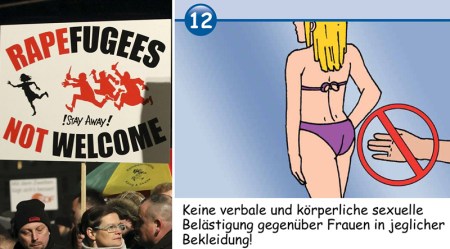
1470In January, there were thousands of cases of migrants sexually assaulting women in Germany, including many that took place in public pools. The government began to face a rising voter backlash to the open-door migration policy, including public protests (left). In some areas, authorities have distributed cartoon guides, to “educate” migrants that sexual assault is not acceptable (right).

January 15. Finance Minister Wolfgang Schäuble, in an interview with the Süddeutsche Zeitung, signaled his determination to export Germany’s migrant problem by calling for a Europe-wide gas tax to help pay for the cost of hosting millions of migrants. He said:

“If the funds in national budgets and the European budget are not enough, then let us agree, for example, to raise a levy on every liter of gasoline at a certain level. If a country refuses to pay, I am still prepared to do it. Then we will build a coalition of the willing.”

January 16. Norbert Röttgen, chairman of the foreign affairs committee in the German Bundestag and a lawmaker in Angela Merkel’s Christian Democratic Union (CDU), called upon the government to create a Ministry for Migration, Integration and Refugees. He said the migrant crisis had developed into a “primary and permanent task for the state” and is of “decisive importance for the future of our country and Europe.”

January 16. A 19-year-old migrant from Afghanistan sexually assaulted four girls between the ages of 11 and 13 at an indoor swimming pool in Dresden. The migrant was arrested but then set free. A migrant from Syria sexually assaulted a 12-year-old girl in Mudersbach. A 36-year-old migrant sexually assaulted an eight-year-old girl in Mettmann.

January 16. A group of between six and eight African migrants ambushed three people leaving a discotheque in Offenburg. The migrants were ejected from the discotheque after female clients complained that the men were sexually harassing them. After they left, at around 4AM, the migrants attacked them with metal rods, street signs and garbage bins.

January 17. In an interview with Bild am Sonntag, the president of the federal criminal police, Holger Münch, said that the number of crimes in refugee shelters had increased “significantly” since 2015, when the migrant influx began. He said that the migrants mostly responsible were from the Balkans and North Africa, especially Algerians, Tunisians and Moroccans. He added that half the offenses at the refugee shelters were physical assaults, but that there was also a growing number of homicides and sexual crimes.

January 17. In an interview with the Süddeutsche Zeitung, former Bavarian Prime Minister Edmund Stoiber warned that Chancellor Angela Merkel will “destroy Europe” if she refuses to reduce the number of migrants entering Germany.

January 17. Berlin clergyman Gottfried Martens accused German politicians and church leaders of ignoring the persecution of Christians by Muslims in German refugee shelters. He said that the Christians were facing “verbal threats, threats with knives, blows to the face, ripped crucifixes, torn bibles, insults of being an infidel, and denial of access to the kitchen because of uncleanness.”

January 18. A 26-year-old Algerian man was the first person to be arrested in connection with a string of sexual assaults during New Year’s celebrations in Cologne. He was apprehended at a refugee shelter in the nearby town of Kerpen. Cologne’s chief prosecutor, Ulrich Bremer, said that nearly 500 women had come forward with allegations of sexual assault, including three cases of rape.

January 18. A 24-year-old migrant from Sudan was released after being held for questioning at a police station in Hanover. After crossing the street, the man, who receives 300 euros ($335) a month in social welfare benefits, dropped his pants and exposed himself in public and shouted, “Who are you? You cannot do anything to me. Whatever I cannot get from the state, I will steal.”

January 19. Addressing the European Parliament in Strasbourg, European Council President Donald Tusk warned that the European Union had “no more than two months” to get control over the migration crisis or face the collapse of the Schengen passport-free travel zone.

January 19. A poll published by Bild showed that support for Chancellor Angela Merkel’s conservative bloc was down 2.5 points at 32.5%, its lowest result since the 2013 election. The poll showed that support for the anti-immigration Alternative for Germany (AfD) was up 1 point at 12.5%; support for the Social Democrats was up 1 point at 22.5%.

January 19. A 28-year-old migrant from Iran pushed a 20-year-old woman onto the tracks of an oncoming train in Berlin. She later died.

January 20. Bild reported that migrants invaded female changing rooms and showers at two public swimming pools in Leipzig. Migrants, dressed in their street clothes and underwear, also jumped into the swimming pools. According to Bild, the city hall had tried to keep the incidents quiet, but details were leaked to the media.

January 21. More than 200 migrants have sued the German government for delays in processing their asylum applications.

January 22. Facing political pressure over the migrant crisis, Chancellor Angela Merkel met in Berlin with Turkish Prime Minister Ahmet Davutoglu to discuss ways to stem the flow of Syrian and other refugees from Turkish shores. She renewed a pledge to provide Turkey with financial support. In November 2015, EU leaders pledged 3 billion euros ($3.4 billion) to Ankara to help care for an estimated 2.5 million Syrian refugees in Turkey; the deal has been delayed by a dispute among EU member states over who will pay.

January 22. A report by municipal authorities in Zwickau that was leaked to Bild revealed that migrants were defecating in public swimming pools. Security cameras also filmed migrants harassing women in the public sauna and attempting to storm the female dressing room.

January 22. Police in Hanover investigated four nightclub bouncers for allegedly beating an 18-year-old Algerian migrant after he tried to steal the purses of two teenage girls. Two days before the incident, the migrant had been sentenced to one year in juvenile detention for robbery, but he was free to roam the streets until his sentence began.

January 22. A migrant attempted to rape a 16-year-old girl in Feuerbach district of Stuttgart, and in downtown Stuttgart, four migrants sexually assaulted a 23-year-old woman.

January 23. The Süddeutsche Zeitung reported that migrants had attacked women in 12 of Germany’s 16 states on New Year’s Eve. In addition to the attacks Cologne, 195 women filed complaints in Hamburg; 31 in Hesse; 27 in Bavaria; 25 in Baden-Württemberg; 11 in Bremen; and six in Berlin.

January 23. Two migrants sexually assaulted an 18-year-old woman in Wiesbaden, and a 35-year-old migrant sexually assaulted a woman in a restroom on a train in Düsseldorf.

January 23. The Stuttgarter Nachrichten reported that dental work for migrants could end up costing German taxpayers billions of euros.

January 24. An official police report leaked to The Huffington Post showed that Interior Minister Thomas de Maizière was not being truthful when he said that between 100 and 200 migrants are being denied entry into Germany each day. The report stated that since September 14, border police had prevented 7,185 migrants from entering the country — or only about 60 migrants turned away each day.

January 25. A 30-year-old migrant from North African exposed himself to a 19-year-old woman on a public bus in Marburg, and then to passersby at the main train station.

January 26. In an interview with the German public radio, Deutschlandfunk, retired public media personality Wolfgang Herles admitted that public broadcasters receive “instructions from above” when it comes to reporting the news:

“We have the problem that we are too close to the government. The topics we cover are determined by the government. But many of the topics the government wants to prevent us from reporting about are more important than the topics they want us to cover…

“We must report in such a way that serves Europe [the European Union] and the common good, as it pleases Mrs. Merkel. There are written instructions … today we are not allowed to say anything negative about the refugees. This is government journalism, and this leads to a situation in which the public loses their trust in us. This is scandalous.”

Previously, Claudia Zimmermann, a reporter with the public television broadcaster WDR, said that public media outlets in Germany “have been warned to report the news from a pro-government perspective.”

January 26. A 24-year-old man on an evening stroll with his three-month-old baby daughter in the Eißendorf district of Hamburg was approached by two migrants who demanded his wallet and cellphone. When he said he was not carrying any valuables, the migrants attacked him with a knife. Fleeing for his life, the man ran onto a frozen pond and broke through the ice. A passerby heard the man calling for help. The baby, under water for an extended period, was revived by paramedics called to the scene. The baby remains in intensive care; the migrants remain at large.

January 26. A 28-year-old migrant from Algeria applied for asylum in Wesel. Authorities became suspicious because of his proficiency in German. They later determined that he had arrived in Germany in November 2014, rather than, as he claimed, in October 2015. It emerged that he had outstanding warrants for theft, but evaded police by using six different identities.

January 26. The Kieler Nachrichten reported that the proliferation of sexual assaults by migrants has women in the northern city of Kiel afraid to be out at night because the city is too dark. In an effort to save electricity, municipal officials decided to convert all of the city’s street lights to LED bulbs, but they do not provide sufficient light to keep the streets illuminated at night.

January 26. The mayor of Freiburg, Dieter Salomon, ordered police to take a hard line against migrants accused of snatching purses and assaulting women in the city’s discotheques. According to club owners, migrants have been robbing women on the dance floor and raping them in the restrooms. Many of the offenders are allegedly underage migrants from North Africa. Club owners say that the migrants are not afraid of authority: “They know that nothing will happen to them here.”

January 27. A 39-year-old migrant from Afghanistan tried to enter Germany at Simbach, a town on the border of Austria. A background check determined that in May 2000, a German court had sentenced the man to an eight-year prison term for rape. He had been deported to Afghanistan in 2006 with orders never to return.

January 27. The public radio and television channel, Mitteldeutscher Rundfunk, reported that German taxi drivers are profiting from the migrant crisis by taking migrants to doctors’ appointments and asylum interviews. The cab fares are being paid for by German taxpayers. MDR reported on a taxi company in Leipzig that had billed the government for 800 taxi fares for taking migrants to run errands. One taxi driver, for example, drove a migrant family on an 80 km (50 mile) journey for an appointment with migration authorities. The meter was left running while the driver waited for the migrants to return from their meeting. The fare was 309 euros ($344).

January 28. Bild reported that politicians in Kiel had ordered the police to overlook crimes perpetrated by migrants. According to the paper, the police in North Rhine-Westphalia and Lower Saxony have also been instructed to be lenient to criminal migrants.

January 28. A migrant from Sudan sexually assaulted a female police officer in Hanover as she was attempting to arrest him for theft. Public prosecutor Thomas Klinge confirmed the incident. “Such brazen behavior towards a police officer has been unheard of until now,” he said.

January 28. Berlin’s Tempelhof airport, the iconic site of the Berlin Airlift in 1948-49, is set to become the biggest refugee shelter in Germany. In a controversial move to alter the airport’s zoning regulations, Berlin’s municipal government — run by a coalition between the Christian Democratic Union and the Social Democratic Party — voted to build five massive structures to house 7,000 migrants there. Opposition politicians said the government was creating an “immigrant ghetto” in the heart of Berlin.

January 28. Police in Berlin said that a volunteer with the charity group Moabit Hilft hadfabricated a story about a 24-year-old migrant said to have died while waiting for days outside an asylum registration office. The story was allegedly faked in an effort to embarrass the government for its slow response to the migrant crisis.

January 29. The European Commission, the powerful administrative arm of the European Union, said that the sexual assaults in Cologne had nothing to do with the migrant crisis and were simply a matter of public order. A confidential memo leaked to The Telegraph stressed the importance of the Commission’s “continuing role in sounding the voice of reason to defuse tensions and counter populist rhetoric.” The Commission called for “the unconditional rejection of false associations between certain criminal acts, such as the attacks on women in Cologne on New Year’s Eve, and the mass influx of refugees.”

January 29. A public vocational school in the Wilhelmsburg district of Hamburg cancelled plans to host classes for refugees after male migrants sexually harassed dozens of female students at the school.

January 29. The German news magazine Focus published the results of a poll showing that 40% of Germans want Chancellor Angela Merkel to resign because of her migrant policies.

January 30. A gang of migrants on a Munich subway train were filmed attacking two elderly men who tried to stop them from groping a woman. Images show the migrants grabbing two men by the arms and neck and shouting abuse at them. It later emerged that the migrants were from Afghanistan; although they had been denied asylum in Germany four years ago, the German government refused to deport them because Afghanistan is “too dangerous.”

January 31. The Interior Minister of Saxony-Anhalt, Holger Stahlknecht, of the Christian Democrats, announced that he would delay releasing the 2015 crime statistics until March 29, two-and-half weeks after regional elections. The statistics are normally released in February or early March. Rüdiger Erben of the Social Democrats said: “The late release date reinforces my suspicion that the statistics are horrific.”

January 31. ISIS sympathizers defaced more than 40 gravestones at a cemetery in Konstanzwith slogans such as, “Germans out of Syria,” “Christ is Dead” and “Islamic State.”

January 31. A 30-year-old German, originally from Turkmenistan, raped a seven-year-old girl in Kiel. The man kidnapped the girl from a school playground at 11AM, took her to his apartment and, after abusing her, set her free. It later emerged that the man, who is the father of two children, had been accused of sexually assaulting a five-year-old girl at another kindergarten in Kiel on January 18, but the public prosecutors failed to pursue the case due to insufficient evidence. “In hindsight, we regret that decision,” the prosecutors said.

January 31. In an underhanded effort to silence critics of the government’s open door migration policy, Vice Chancellor Sigmar Gabriel called on German intelligence to begin monitoring the Alternative for Germany (AfD), the third-largest party in Germany. The AfD is surging in popularity because of its anti-immigration platform.

The End Of The Multiculturalist Consensus In Europe

February 5, 2016

The End Of The Multiculturalist Consensus In Europe, Daily Caller, Michel Gurfinkiel, February 3, 2016

(Please see also, Latest Poll: Merkel in Free Fall, Germans Sensible; 76% of AfD Supporters OK with Genuine Refugees.  — DM)

One wonders why America, a nation of immigrants, can be suddenly so receptive to Donald Trump’s anti-immigration rhetoric. The best answer, so far, is that immigration does not seem to work any more the way it did, at least for certain groups of immigrants.

A similar situation has arisen in Europe. In 2009, the American journalist Christopher Caldwell famously characterized the changes that a massive non-European, non-Judeo-Christian, immigration was forcing over Europe as a “revolution.” We may now be on the brink of a counter-revolution, and that can be as violent and far-reaching as revolution itself.

Last year’s massacres in Paris (the attacks on satirical cartoonists and a kosher supermarket’s customers in January 2015, then the November 13 killing spree) were a tipping point : the French – and by extension, most Europeans — realized that unchecked immigration could lead to civil war.

Then there was the Christmas crisis in Corsica, a French island in the Mediterranean. On December 24, a fire was activated at an immigrant-populated neighborhood in Ajaccio, the capital of Southern Corsica. As soon as the firemen arrived, they were attacked by local youths, Muslims of North African descent. Such ambushes have been part of French life for years. This time, however, the ethnic Corsicans retaliated; for four days, they rampaged through the Muslim neighborhoods, shouting Arabi Fora! (Get the Arabs out, in Corsican). One of Ajaccio’s five mosques was vandalized.

Then, there was the New Year’s crisis in Germany and other Northern European countries. On December 31, one to two thousand male Muslim immigrants and refugees swarmed the Banhofvorplatz in Cologne, a piazza located between the railway Central Station and the city’s iconic medieval cathedral. As it turned out during later in the evening and the night, they intended to “have fun”: to hunt, harass, or molest the “immodest” and presumably “easy” German women and girls who celebrated New Year’s Eve at the restaurants and bars nearby, or to steal their money. 766 complaints were lodged. Similar incidents took place in other German cities, like Hamburg, Frankfurt and Stuttgart, as well as in Stockholm and Kalmar in Sweden, and Helsinki in Finland.

Here again, the local population reacted forcefully. Support for asylum seekers from the Middle East plummeted – 37 percent of Germans said that their view of them has “worsened,” and 62 percent said that there are “too many of them.” The Far Right demonstrated against immigration in many cities, but liberal-minded citizens were no less categorical. Le Monde, the French liberal newspaper, on January 20 quoted Cologne victims as saying, “Since 1945, we Germans have been scared to be charged with racism. Well, the blackmail is over by now.”

Indeed, postwar Europe, and Germany in particular, had been built upon the rejection of Hitler’s mad regime and everything it stood for. Nationalism, militarism, authoritarianism, and racism were out. Multinationalism, pacifism, hyperdemocracy, and multiculturalism were in. This simple, almost Manichean, logic is collapsing now – under the pressure of hard facts. Or rather the Europeans now understand that it was flawed in many ways from the very beginning, especially when it came to multiculturalism, the alleged antidote to racism.

What Europeans had in mind when they rejected racism in 1945 was essentially antisemitism. Today, the “correct” antiracist attitude would be to welcome non-European immigrants en masse and to allow them to keep their culture and their way of life, even it that would contradict basic European values. Hence last summer’s “migrants frenzy,” when the EU leadership in Brussels and major EU countries, including Angela Merkel’s Germany, decided to take in several millions of Middle East refugees overnight.
European public opinion is now awaking to a very different view. And the political class realizes that it must adjust – or be swept away.

European public opinion is now awaking to a very different view. And the political class realizes that it must adjust – or be swept away.

The Schengen regime – which allows free travel from one country to the other in most of the EU area – is being quietly suspended; every government in Europe is bringing back borders controls. The French socialist president François Hollande is now intent to strip disloyal immigrants and dual citizens of their French citizenship (a move that precipitated the resignation, on January 27, of his super-left-wing justice minister, Christiane Taubira). He is also hiring new personnel for the police and the army and even considering raising a citizens’ militia. Merkel now says that immigrants or refugees who do not abide by the law will be deported. Even Sweden, currently ruled by one of Europe’s most left-wing cabinets, has been tightening its very liberal laws on immigration and asylum.

Most Europeans agree with such steps. And wait for even more drastic measures.