Archive for the ‘France’ category

Islamic Extremism in France: A Primer (Part I)

April 17, 2016

Islamic Extremism in France: A Primer (Part I), Clarion Project, Leslie Shaw, April 24 [sic] 17, 2016

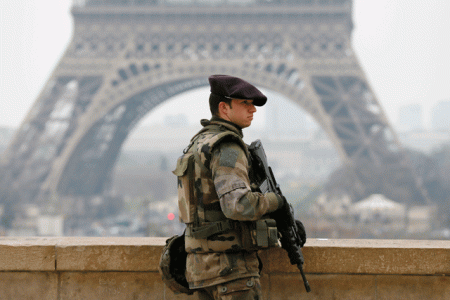
France-Soldiers-Patrol-IP_4A French soldier patrols after the Charlie Hebdo attack (Photo: © Reuters)

In 732, the town of Sens in Burgundy was invaded and looted by the troops of Abd el-Rahman as a diversionary tactic to divide the French armies who went on to defeat the Saracens at the Battle of Poitiers later that year. Thirteen centuries later, the town again made the history books.

On November 20, 2015 following the Islamist terror attacks, a state of emergency was declared and the first curfew was announced in Sens following a series of raids in the Champs-Plaisants district that uncovered stockpiles of weapons and fake identity papers.

Two weeks later, French law enforcement raided the Lagny-sur-Marne mosque east of Paris. Among objects seized were a 9mm revolver, a concealed hard disk and jihadist documents. The raid led to nine house arrests and prohibitions on leaving France against 22 people.

The former president of the Lagny Muslim Association had already fled to Egypt in December 2014 with 10 members of his congregation. Two other mosques were closed down, one in Lyon and one in Gennevilliers, a northern suburb of Paris.

Less than one month after the state of emergency was declared, French police had carried out 2,235 raids with 232 people detained and 234 weapons seized. This was just the first phase in the uncovering of the radical Islamic ecosystem financed by foreign states and organized crime that emerged and spread throughout France from the 1990s.

The terrorist attacks of November 2015 and January 2016 came as no surprise to French defense and security services, who had issued a warning at the beginning of 2015 that thousands of Islamic radicals “willing and able to out-wait the capacity of the state to dedicate scarce resources to watching them” were ready to strike. That assessment proved to be correct.

France is now confronted with a permanent terror threat from a section of its population, and despite the deployment of 10,000 troops to support 100,000 police and gendarmes, more attacks will occur in the coming years and decades. French people can no longer live in security in their own country, thanks to bad policy decisions made over the past 50 years.

The Kervenanec district of Lorient in Brittany is one of France’s 762 zones euphemistically labelled “Sensitive Areas” by the Ministry of the Interior, where endemic crime has reached critical proportions. Lorient is also one of the strongholds of radical Islam in Brittany, where the number of mosques serving the region’s 180,000 Muslims doubled from 27 in 2003 to 53 in 2015, the most notorious being the Sunna mosque in Pontanézen run by Salafist Imam Rachid Abou Houdeyfa, who is notorious for indoctrinating children.

In one religious education class, he told children that “people who listen to music will be swallowed up by the earth and turned into monkeys and pigs.”

More and more young Bretons, seduced via social media, are converting to Islam and repudiating their families. At least 15 are fighting in Syria and Iraq, and the DGSI (secret service) is currently investigating 110 individuals linked to jihadist networks.

The indigenous Bretons are up in arms, notably the sheep farmers, because of widespread sheep-rustling in the weeks leading up to the Islamic feast of Aïd-el-Kebir. Around 120,000 sheep are ritually slaughtered each year in France, often illegally and with great cruelty, in homes and apartments.

The scourge of radical Islam that is sweeping the country is impacting children as well as adolescents and young adults. In January 2015 pupils at Daniel-Mayer public junior high school in the 18th district of Paris brandished knives and meat cleavers in a rap video posted on YouTube.

Further south, a 13-year-old boy was arrested in Ariane, an eastern suburb of Nice. He was suspected of having fired a dozen shots with an airgun at a nursery school playground, wounding 2 girls aged 4 and 5, one in the head, the other in the back. Ariane is referred to in the press report as a “quartier sensible” or “sensitive neighbourhood,” which is coded language for a ghetto. These incidents demonstrate that the culture of jihad is spreading like wildfire among the children of a certain sector of the French population.

In yet another case, a 15-year-old high school student shouting “Allah Akbar” shot his physics teacher with an airgun after threatening to kill his French teacher. This happened on the same day that Le Parisien newspaper revealed that over 50% of French school teachers have taken out private insurance coverage against the risk of verbal and physical violence involving pupils and their parents.

Aside from private schools and state schools in middle-class areas, the French education system has become a difficult and dangerous place to work in. Meanwhile, the government continues to relax standards to accommodate unruly pupils who have no interest in learning, and Islam has become a standard part of the curriculum. An exercise in the chapter on Islam in the French 7th grade History/Geography course requires pupils to answer six questions about this text entitled Rewards for Combatants of Islam:

“Not equal are those of the believers who sit at home, except those who are disabled, and those who strive hard and fight in the Cause of Allah with their wealth and their lives. Allah has preferred in grades those who strive hard and fight with their wealth and their lives above those who sit at home. Unto each, Allah has promised good, but Allah has preferred those who strive hard and fight, above those who sit at home, by a huge reward.”

Is there a valid reason that 12-year-old children should be reading this, let alone memorizing the tenets of jihad?

Europe Goes Back to Sleep

April 1, 2016

Europe Goes Back to Sleep, Power LineSteven Hayward, April 1, 2016

Back in late February I reported (“Be Like France”) how the French appeared to be taking the problem of Islamic terrorism seriously, as opposed to Obama, who thinks it a risk somewhere not far above infection from hangnails.

You can call it all off. Europe is going back to sleep. From yesterday’s WSJ:

Hollande Retreats from Plan to Change French Constitution

PARIS—French President François Hollande abandoned a plan to strengthen his hand in fighting terrorism by amending France’s constitution, showing how political pressure at home is undermining his law-and-order response to the Nov. 13 attacks.

Mr. Hollande said Wednesday he would no longer seek to pass two constitutional amendments that would have enshrined the government’s power to declare a state of emergency and to strip some convicted terrorists of their French citizenship. . .

The groundswell of public support that buoyed Mr. Hollande in the immediate aftermath of the Paris attacks is fading. . .

Meanwhile, Belgium, whose interior minister admitted Wednesday that the government has cut security forces “too much,” is planning to respond to the terrorist threat with a new $448 million effort at . . . outreach:

After the Paris attacks, the Belgian government announced a €400 million ($448 million) investment in counterterrorism measures, which include significantly increasing counterradicalization efforts in Brussels’s most sensitive neighborhoods.

Good luck with that.

Like France, Belgium seems unable to pass its own version of the Patriot Act:

Four months ago, the Belgian government also announced other legal measures to fight terrorism more efficiently, such as creating a better database of foreign terrorist fighters and allowing house searches 24 hours a day, and not just between 5 a.m. and 9 p.m. as under current law.

Belgium’s parliament is still in the process of making the necessary legal changes needed to put those measures into effect.

The interior minister also said, “We will not change the rule of law in this country to be able to interrogate terrorists in a different way.”

Paging Donald Trump.

French nuke carrier for sea-air drill with Egypt ahead of Libya offensive

February 29, 2016

French nuke carrier for sea-air drill with Egypt ahead of Libya offensive, DEBKAfile, February 29, 2016

Tahya_MisrFrench-built Egyptian frigate “Tahya Misr”

[T]he joint French-Egyptian naval-air force drill about to take place is the most substantial sign that a real operation to confront ISIS in Libya may finally be about to go forward.

***************************

The French nuclear-powered aircraft carrier Charles de Gaulle is steaming through the Red Sea on its way to the Mediterranean via the Suez Canal for joint maneuvers with the Egyptian navy in preparation for a reduced coalition offensive against Islamic State’s deepening grip on Libya. DEBKAfile’s military sources, reporting this, say it will be the Egyptian navy’s first joint exercise with a nuclear-powered aircraft carrier; and also the first drill to be conducted by the new Egyptian missile frigate Tahya Misr (Long Live Egypt!),  which underwent a series of exercises after it was delivered by the French DCNS naval shipbuilders last June.

The Charles de Gaulle departed the Persian Gulf Monday, Feb. 22 and is due to reach the eastern Mediterranean in the first week of March. The Egyptian frigate’s weapons systems can shoot down planes and ballistic missiles as well as striking naval or ground targets. Its weapons systems can shoot down planes and ballistic missiles as well as striking naval or ground targets. But the vessel has been stripped of its regular electronic warfare and satellite communications systems for the exercise – apparently after a quiet understanding between France, Egypt and Israel.

The Egyptian frigate was originally designed to secure the Suez Canal against potential terrorist attacks from the Islamic State networks in the Sinai Peninsula and their offshoots in the Canal cities of Port Said, Ismailia and Suez. The warship was moved into the Mediterranean after President Francois Hollande and Egyptian President Abdul-Fatteh El-Sisi moved forward on plans for a joint assault with Italy to root out ISIS positions in Libya.

The three powers have agreed to launch this offensive in late April or May, DEBKAfile’s military and counterterrorism sources report.

The joint naval exercise will meanwhile drill coordination between the French and Egyptian navies and air forces in readiness for the combat operation. They will practice landing fighter-bombers taking off from the Charles de Gaulle decks at air bases in Egypt’s western desert near the Libyan border, for refueling, reloading munitions or emergency landings, when damaged by enemy fire.

They will also rehearse joint marine landings from French and Egyptian warships.

Our sources report that the trilateral assault plan has undergone repeated revisions in recent weeks, mainly because President Barack Obama has had second thoughts about his initial scheme for the United States to lead the operation in Libya – this time from the front.

His first plan was for a large marine contingent to land on the Libyan coast under heavy air cover. But lately, he can’t decide whether to deploy any US troops at all and inclines towards leaving the main onus of the anti-ISIS campaign in Libya to European and Middle East armies.

A final decision is expected by our Washington sources to substantially scale down the original plan. The dithering in Washington has led to delays in Paris, Cairo, Rome and London on drawing up a final list of ISIS targets to be hit and the size of the invasion forces, although the operation is just weeks away and time is pressing.

Islamic State commanders, viewing this lack of resolve, are beginning to feel safe in their Libyan strongholds, after drawing confidence from the recent downsizing of coalition strikes against its forces and bases in Iraq and Syria.

Since a small coalition vanguard for the main offensive landed in Libya last year, nothing much as happened to hold back ISIS advances in Libya,  except for US drone strikes.

The White House spokesman Josh Earnest said this week that President Obama planned to address the terrorist organization’s advances in Libya with top military officials.

Also this week, Libyan military officials reported that 15 French Special Operations experts had been in Benghazi for the past two months, assisting Libyan national troops in fighting the extremists. According to another report, a “small number” of British advisers has joined US military operatives who are giving local militias “tactical training in Misrata.

However, the joint French-Egyptian naval-air force drill about to take place is the most substantial sign that a real operation to confront ISIS in Libya may finally be about to go forward.

France: Criticize Islam and Live under Police Protection

February 28, 2016

France: Criticize Islam and Live under Police Protection, Gatestone InstituteGiulio Meotti, February 28, 2016

“After a few moments of fear, I thought that if there are these threats it is because my fight foiled the plans of the Muslim Brothers by bringing them to light. I decided not to give up.” — Laurence Marchand-Taillade, National Secretary of the Parti Radical de Gauche (Radical Party of the Left).

The author Éric Zemmour lives under police protection. Two policemen follow him wherever he goes — including to court, where Muslim organizations tried to defame him and his work by accusing him of “Islamophobia,” to silence him.

In France, hunting season is still open for critics of Islam.

“You are sentenced to death. It’s just a matter of time.” This message, in Arabic, was sent by Islamists to Laurence Marchand-Taillade, National Secretary of the Parti Radical de Gauche (Radical Party of the Left). She now lives under the protection of the French police.

Marchand-Taillade forced the Muslim Brotherhood to withdraw, under pressure from France’s Interior Ministry, its invitation of three Islamic fundamentalists to a conference in Lille. The Islamists in question were the Syrian Mohamed Rateb al Nabulsi, the Moroccan Abouzaid al Mokrie and the Saudi Abdullah Salah Sana’an, who deem that the penalty for homosexuality is death, that the international coalition against the Islamic State is “infidel,” that Jews “destroy the nations” and that only religious music is permitted.

Laurence Marchand-Taillade published an article in Le Figaro in which she called for the ban of these Islamists with their “anti-Semitic and pro-jihadist message.”

In the magazine Marianne, Marchand-Taillade then penned, along with the French-Algerian journalist Mohamed Sifaoui, an article calling for the resignation of the leaders of the Observatory of Secularism.

“I am the president of an association that supports secularism in the Val-d’Oise” said Marchand-Taillade to me in an interview,

“and for years, I observed unreasonable sacrifices and compromises from the National Observatory of Secularism, which has encouraged radical communitarianism by participating to forums such as ‘We Are United,’ with the rapper Médine, who has called for the ‘crucifixion of the secularists,’ the ‘Collective against Islamophobia’ and Nabil Ennasri, a Muslim Brother from Qatar. The president of the Observatory of Secularism, Jean Louis Bianco, gave credit to these Salafist organizations at war with our values.

“Since the first months of 2014, I started also to report to the authorities of the arrival of imams such as Nader Abou Anas, who justifies marital rape, and Hatim Abu Abdillah, who promises a ‘cruel punishment’ for women. Then I went to Lille, on February 6 and 7, where Tariq Ramadan and others were indoctrinating our youths” Since then, her life has not been the same.

How did she react to the death sentence?

“After a few moments of fear, I thought that if there are these threats it is because my fight foiled the plans of the Muslim Brothers by bringing them to light. I decided not to give up. Islamists began a long process of infiltrating all sectors of civil society. The concept is based on the written doctrines of Hassan al-Banna, the grandfather of [Tariq] Ramadan. Their flag has two swords and the Koran; indoctrination and violence are the methods to gain power. France is a country chosen for several reasons: it has a large population from North Africa; it is a secular country in which you can use the freedoms of democracy as weapons against it, and it had weak policies. The only way to stop the threat is to reaffirm secularism and absolute freedom of conscience. We cannot allow entire portions of the French population to fall in the trap of hating the country where they are born and, above all, which considers them part of the nation. It is choice of civilization, while there is an attempt to destroy two centuries of progress for humanity.”

What happened to Marchand-Taillade — the 24-hour a day police protection she needs because she exercised her constitutional right to freedom of expression — tells us a lot about France, where dozens of academics, intellectuals, novelists and journalists now have to live under police protection just because of their criticism of Islam.

It is not only politicians such as Marine Le Pen and Samia Ghali, the mayor of Marseille, and not only judges such as Albert Lévy, who has conducted investigations on Islamic fundamentalists.

The most famous is Michel Houellebecq, author of the novel Submission, who lives under the protection of the gendarmerie since he published his last novel. There is also haute protection(“high protection”) for Éric Zemmour, the author of Le Suicide Français. Two policemen follow him wherever he goes — including to court, where Muslim organizations tried to defame him and his work by accusing him of “Islamophobia,” to silence him.

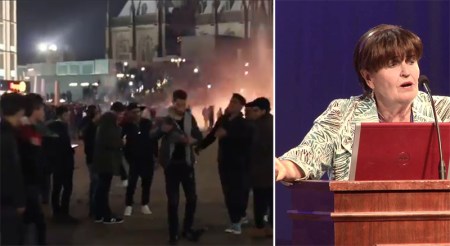
1486French politician Laurence Marchand-Taillade (left) lives under police protection after receiving a death threat from Islamists. French author Éric Zemmour also lives under police protection. Two policemen follow him wherever he goes — including to court, where Muslim organizations tried to defame him and his work by accusing him of “Islamophobia,” to silence him.

Charlie Hebdo‘s director, “Riss,” and the remaining cartoonists live under police protection, and their new offices are in an undisclosed location. My friend Robert Redeker, a professor of philosophy condemned to death in 2006 by Islamists for an article he wrote in Le Figaro, still lives like a fugitive, as if he is a political prisoner in his own country. His conferences and courses have been canceled, his house sold, his father’s funeral celebrated in secrecy, and his daughter’s wedding organized by the police.

Mohammed Sifaoui, who lived undercover in a French cell of al Qaeda and has written a shocking book, Combattre le terrorisme islamiste (“Combat Islamist Terrorism”) also lives under police protection. His photo and name appear on jihadi websites next to the word murtad(“apostate”).

The French philosopher and essayist, Michel Onfray, just withdrew the planned publication of an essay critical of Islam, He claims that “no debate is possible” in the country after the November 13 attacks in Paris (his book has just been published in my country, Italy).

Frédéric Haziza, a radio journalist and author for the magazine Le Canard Enchaîné, has been the target of threats from Islamists, and is under protection, as is Philippe Val, the former director of Charlie Hebdo and France Inter, who decided to publish the Mohammed cartoons in 2006. The Franco-Algerian journalist Zineb Rhazaoui is always surrounded by six policemen, as is the brave imam Hassen Chalgoumi, who is protected as if he were a head of state.

In Britain, the 1989 fatwa against Salman Rushdie eliminated any doubt among scholars and journalists whether it was appropriate or not to criticize Islam. In the Netherlands, it was enough to shoot dead Theo Van Gogh for having made a film, Submission, about a woman abused in a forced marriage. Dutch MP Geert Wilders had to debate wearing bulletproof vests and Ayaan Hirsi Ali, who wrote Submission’s script, fled the country and found a refuge in the U.S. In Sweden, that artist Lars Vilks now lives like a shadow. In Denmark, the headquarters of theJyllands Posten newspaper, which published the original Mohammed cartoons, has a barbed wire fence two meters high and one kilometer long. It has become like a U.S. embassy in the Middle East.

In France, hunting season is still open for critics of Islam, even after the decimation of Charlie Hebdo‘s brave artists. But for how long?

The Islamization of France in 2015

January 19, 2016

The Islamization of France in 2015, Gatestone InstituteSoeren Kern, January 19, 2016

♦ An estimated 40,000 cars are burned in France every year — a destruction often attributed to rival Muslim gangs. Every day, more than 80 cars are burned.

♦ The rector of the Grand Mosque of Paris, Dalil Boubakeur, called for the number of mosques in France to be doubled over the next two years. Boubakeur said that 2,200 mosques are “not enough” for the “seven million Muslims living in France.” He demanded that unused churches be converted into mosques.

♦ Prime Minister Manuel Valls revealed in April that more than 1,550 French citizens or residents are involved in terrorist networks in Syria and Iraq.

♦ “Can we not talk about subjects that split opinion? If you talk about immigration, you are a xenophobe. If you talk about security, you are a fascist. If you talk about Islam, you are an Islamophobe.” – Henri Guaino, MP.

♦ “Those who denounce the illegal behavior of fundamentalists are more likely to be sued than the fundamentalists who behave illegally.” – Marine Le Pen, leader of the National Front party.

The Muslim population of France reached 6.5 million in 2015, or around 10% of the overall population of 66 million. In real terms, France has the largest Muslim population in the European Union, just above Germany.

Although French law prohibits the collection of official statistics about the race or religion of its citizens, this estimate is based on several studies that attempted to calculate the number of people in France whose origins are from Muslim-majority countries.

What follows is a chronological review of some of the main stories about the rise of Islam in France during 2015:

JANUARY

January 1. The Interior Ministry announced the most anticipated statistic of the year: a total of 940 cars and trucks were torched across France on New Year’s Eve, a 12% decrease from the 1,067 vehicles burned during the annual ritual on the same holiday in 2014. Car burnings, commonplace in France, are often attributed to rival Muslim gangs that compete with each other for the media spotlight over which can cause the most destruction. An estimated 40,000 cars are burned in France every year.

January 3. A 23-year-old Muslim man in Metz tried to strangle a police officer while shouting “Allahu Akbar!” (“Allah is the greatest!”). The assault took place at the police station after the man, who was arrested for purse-snatching, asked the officer to bring him a glass of water. When the policeman opened the cell door, the man lunged at him. The officer was rescued by a colleague who saw the scene unfold on a video surveillance camera.

January 7-9. A series of jihadist attacks in Paris left 17 people dead. The first and deadliest of the attacks occurred on January 7, when French-born Islamic radicals Chérif and Saïd Kouachi stormed the offices of the magazine Charlie Hebdo and fatally shot eight employees, two police officers, and two others, and injured eleven other people. On January 8, a third assailant in the attacks, Amedy Coulibaly, shot and killed municipal police officer Clarissa Jean-Philippe in Montrouge, a suburb of Paris. On January 9, Coulibaly entered a HyperCacher kosher supermarket in Paris, killed four people and took several hostages. Coulibaly was killed when police stormed the store. His female accomplice, Hayat Boumeddiene, France’s “most wanted woman,” remains at large and is believed to have fled to Syria.
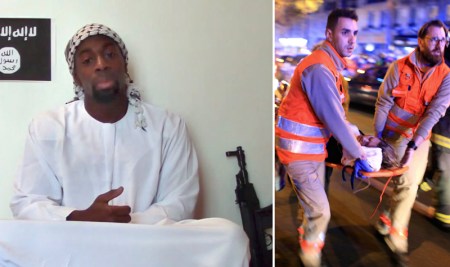
1432Last January, Amedy Coulibaly (left) murdered a policewoman and four Jews in Paris, before being shot dead by police. Right: Medics carry a victim wounded in an attack by Islamist terrorists, who shot hundreds of concert-goers, killing 90, at the Bataclan theater in Paris on November 13, 2015.

January 18. A poll by the firm, Institut français d’opinion publique (IFOP), published by Journal du Dimanche, showed that 42% of French people oppose the publication of cartoons depicting the Prophet Mohammed, such as those published by Charlie Hebdo, and indicated they believed there should be “limitations on free speech online and on social networks.” The vast majority (81%) said they favored stripping French nationality from dual nationals who have committed an act of terrorism on French soil. More than two-thirds (68%) said that French citizens should be banned from returning to the country if “they are suspected of having gone to fight in countries or regions controlled by terrorist groups.”

January 20. Prime Minister Manuel Valls said the terrorist attacks exposed a “territorial, social, ethnic apartheid” that is plaguing France. In a speech described as one of the strongest indictments of French society ever by a government figure, Valls said there was an urgent need to fight discrimination, especially in impoverished suburbs that are home to many Muslim immigrants. He said that despite years of government efforts to improve conditions in run-down neighborhoods, many people have been relegated to living in ghettos. He added:

“The social misery is compounded by daily discrimination, because someone does not have the right family name, the right skin color, or because she is a woman. I am not making excuses, but we have to look at the reality of our country.”

January 21. Valls announced a €736 million ($835 million) program to augment its anti-terrorism defenses amid a rapidly expanding jihadist threat. He said the government would hire and train 2,680 new anti-terrorist judges, security agents, police officers, electronic eavesdroppers and analysts over the next three years. The government will also spend €480 million on new weapons and protective gear for police. The initiative includes an enhanced online presence based on a new government website called “Stop Djihadisme.”

January 27. Police arrested five suspected jihadists, aged 26 to 44, in dawn raids in Lunel, a small town near the Mediterranean coast. At least ten, and possibly as many as 20 people from the town — with a population of just 25,000 — have travelled to Syria and Iraq to fight with the Islamic State.

January 28. An Ipsos/Sopra-Steria poll produced for Le Monde and Europe 1 Radio found that 53% of French citizens believe the country is “at war” and 51% feel that Islam is “incompatible” with the values of French society.

Also in January, artwork depicting women’s shoes on Muslim prayer rugs was removed from an exhibition in the Paris suburb of Clichy-la-Garenne after the Federation of Islamic Associations of Clichy warned it might provoke “uncontrollable, irresponsible incidents.” The artwork, made by the French-Algerian artist Zoulikha Bouabdellah, included high-heel shoes placed on the center of prayer rugs in shades of blue, white and red, symbolizing the French flag. She said she did not consider the work to be blasphemous, but curator Christine Ollier said it would be removed to “avoid polemics.” The act of self-censorship was criticized by other artists, who said that the freedom of expression was being undermined.

FEBRUARY

February 5. A teacher at France’s only state-funded Muslim faith school quit his job, saying that the Averroès Lycée (high school) in Lille was a hotbed of “anti-Semitism, sectarianism and insidious Islamism.” In an article published by Libération, philosophy teacher Sofiane Zitouni wrote:

“The reality is that Averroès Lycée is a Muslim territory that is being funded by the state. It promotes a vision of Islam that is nothing other than Islamism. And it is doing it in an underhand and hidden way in order to maintain its state funding.”

The school’s director, Hassan Oufker, said he would sue Zitouni, of Algerian descent, for defamation.

February 12. The Union of French Muslim Democrats (L’Union des démocrates musulmans Français, UDMF), a start-up Muslim political party, said it had begun fielding candidates in local elections in eight cities in France. UDMF founder Najib Azergui said his group wants to give a voice to the country’s Muslim community by: promoting Islamic finance; promoting the use of Arabic in French schools; working to overturn France’s ban on wearing the veil in schools, and fighting against the “dangerous stigmatization that equates Islam with terrorism.”

February 15. The government announced a series of measures to clamp down on the radical Islam being spread in mosques, including a ban on financial support from countries such as Qatar and Saudi Arabia. French Muslims opposed the move. Karim Bouamrane, a socialist politician said:

“If foreign countries are stepping in to fund mosques, it is because the French government won’t. Muslims cannot run the risk of refusing cash from outside, because the French government won’t allocate them funds to build mosques.”

Bouamrane said France’s 1905 law separating Church and State should be changed to allow the French state to provide financial support for Muslim worship.

February 16. Nacer Bendrer, a 26-year-old French citizen, was extradited to Belgium for his role in the May 20214 jihadist attack against the Jewish Museum in Brussels. He is suspected of helping compatriot Mehdi Nemmouche, 29, carry out the attack in which four people were murdered. When arrested near Marseilles, Bendrer was in possession of a Kalashnikov type of assault rifle, two automatic pistols and a shotgun. Bendrer and Nemmouche reportedly met while in prison in Salon-de-Provence in southern France between 2008 and 2010.

February 23. For the first time ever, French authorities confiscated the passports and identity cards of six French citizens who were allegedly planning to travel to Syria to join the Islamic State. The government said it might seize the passports of at least 40 others.

February 25. Interior Minister Bernard Cazeneuve unveiled a plan to “reform” the Muslim faith to bring it into line with the “values of the French Republic.” This, he said, would be done by means of a new “Islamic Foundation” devoted to conducting “revitalizing research” into a form of Islam that “carries the message of peace, tolerance and respect.” The government would create, among other measures, a new forum to: promote dialogue with the Muslim community; improve the training of Muslim preachers; combat radicalization in French prisons; and regulate Muslim schools.

MARCH

March 3. Prime Minister Manuel Valls announced that the state would double the number of university courses on Islam in an effort to stop foreign governments from financing and influencing the training of French imams. Valls said that he wanted more imams and prison chaplains who have been trained abroad to “undergo more training in France, to speak French fluently and to understand the concept of secularism.” There are currently six universities in France offering courses in Islamic studies and theology. Valls said he wanted to double that number to 12 and that the courses would be free of charge.

March 6. Mohamed Khattabi, the “progressive” imam of the Aicha Mosque in Montpellier, said in a sermon that selfishness is part of “the nature of women.” Khattabi — a Moroccan-Canadian who has lived in France for more than 20 years, and who claims to be a “promoter of an Islam within French society, of coexistence” — said:

“No matter how much good you bestow upon a woman, she will deny it. Her selfishness drives her to deny it. This holds true for all women, whether Western, Arab, Muslim, Jewish, or Christian. This is the nature of women.

“If a woman overcomes her nature and acknowledges [the truth] … Allah grants her a higher place in paradise. But if she succumbs to her nature, and refuses to acknowledge the man’s rights — or rather, the goodness that man bestows upon her — she is destined to go to [hell]…”

March 8. Prime Minister Manuel Valls warned that as many as 10,000 Europeans could be waging jihad in Iraq and Syria by the end of 2015:

“There are 3,000 Europeans in Iraq and Syria today. When you do a projection for the months to come, there could be 5,000 before summer and 10,000 before the end of the year. Do you realize the threat this represents?”

March 16. The Interior Ministry blocked five Islamist websites that, it said, were promoting terrorism. The sites included one belonging to al-Hayat Media Center, the propaganda wing of the Islamic State. Interior Minister Bernard Cazeneuve said: “I make a distinction between freedom of expression and the spread of messages that serve to glorify terrorism. These hate messages are a crime.” But the Human Rights Commissioner of the Council of Europe, Nils Muižnieks, criticized the move because it was carried out without judicial oversight: “Limiting human rights to fight against terrorism is a serious mistake and an inefficient measure that can even help the terrorists’ cause.”

March 17. Interior Minister Bernard Cazeneuve revealed that the government has stopped paying welfare benefits to 290 French jihadists fighting with the Islamic State. He said that the agencies responsible for distributing welfare payments were being notified as soon as it was confirmed that a French citizen had left the country to fight abroad.

March 19. Prime Minister Manuel Valls unveiled a new bill that would allow intelligence services to monitor and collect the email and telephone communications of anyone suspected of being a terrorist. “These are legal tools, but not tools of exception, nor of generalized surveillance of citizens,” he said. “There will not be a French Patriot Act,” he said, referring to American legislation bearing the same name. “There cannot be a lawless zone in the digital space. Often we cannot predict the threat, the services must have the power to react quickly.”

APRIL

April 4. The rector of the Grand Mosque of Paris, Dalil Boubakeur, called for the number of mosques in France to be doubled over the next two years. Speaking at a gathering of French Islamic organizations in the Paris suburb of Le Bourget, Boubakeur said that 2,200 mosques are “not enough” for the “seven million Muslims living in France.” He demanded that unused churches be converted into mosques.

April 7. The Secretary of State for State Reform, Thierry Mandon, claimed that the lack of “decent” places of worship for French Muslims was partly to blame for some of them turning to radical Islam. He said:

“There are not enough mosques in France. There are still too many cities where the Muslim faith is practiced in conditions that are not decent. We are forced to recognize that sometimes the Muslim places of worship are not satisfactory. If they are decent, open rather than underground or hidden, it will be better.”

April 8. Hackers claiming to belong to the Islamic State attacked TV5Monde, a French television network, and knocked it off the air globally. The network broadcasts in more than 200 countries. “We are no longer able to broadcast any of our channels. Our websites and social media sites are no longer under our control and are all displaying claims of responsibility by Islamic State,” the broadcaster’s director general, Yves Bigot, said. The hackers accused President François Hollande of having committed “an unforgivable mistake” by joining a US-led military coalition carrying out air strikes against ISIS positions in Iraq and Syria.

April 13. Prime Minister Manuel Valls revealed that more than 1,550 French citizens or residents are involved in terrorist networks in Syria and Iraq. The figures have almost tripled since January 2014.

April 13. An opinion poll produced for Atlantico found that nearly two-thirds (63%) of French citizens were in favor of restricting civil liberties in order to combat terrorism. Only 33% said they were opposed to having their freedoms reduced, although this number increased significantly among younger respondents.

April 15. A 21-year-old Muslim destroyed more than 200 gravestones at a Catholic cemetery in Saint-Roch de Castres, a town near Toulouse. Police sent the man to the hospital because he was in a “delusional state and unable to communicate.”

April 22. French police arrested Sid Ahmed Ghlam, a 24-year-old Algerian computer science student suspected of planning an attack on Christian churches in Villejuif, a suburb south of Paris. He was arrested after apparently shooting himself by accident. Police found three Kalashnikov assault rifles, handguns, ammunition and bulletproof vests, as well as documents linked to al-Qaeda and Islamic State, in his car and home. Police said Ghlam had expressed a desire to join the Islamic State in Syria.

April 21. A study by the Observatory of Religion in the Workplace (Observatoire du fait religieux en entreprise, OFRE) and the Randstad Institute found that 23% of the managers in France were regularly confronting religious problems at work, up from 12% in 2014. OFRE President Lionel Honoré said religious tension had increased since January because Muslims who feel stigmatized by the jihadist attacks in Paris were becoming more forceful in asserting their beliefs.

MAY

May 5. Sébastien Jallamion, a 43-year-old policeman from Lyon, was suspended from his job and fined €5,000 ($5,400) after he condemned the death of Frenchman Hervé Gourdel — who was beheaded by jihadists in Algeria in September 2014. Jallamion explained:

“I am accused of having created, in September 2014, an anonymous Facebook page, showing several ‘provocative’ images and commentaries, ‘discriminatory and injurious,’ of a ‘xenophobic or anti-Muslim’ nature. As an example, there was that portrait of the Caliph al-Baghdadi, head of the Islamic State, with a visor on his forehead. This publication was exhibited during my appearance before the discipline committee with the following accusation: ‘Are you not ashamed of stigmatizing an imam in this way?’ My lawyer can confirm this… It looks like a political punishment. I cannot see any other explanation.

“Our fundamental values, those for which many of our ancestors gave their life are deteriorating, and that it is time for us to become indignant over what our country is becoming. This is not France, land of Enlightenment that in its day shone over all of Europe and beyond. We must fight to preserve our values, it is a matter of survival.”

May 11. Sarah K., a 15-year-old French Muslim girl of Algerian descent who was banned from class twice for wearing a long black skirt to class, was allowed to return to school wearing a similar dress. Maryse Dubois, the head teacher of the Léo-Lagrange school in the town of Charleville-Mézières, had said she considered the long dress to be a conspicuous religious symbol and a violation of France’s secularism laws. Sarah’s mother said Dubois backed down after news of the incident went viral.

May 27. The leaders of a small mosque in Oullins, a suburb of Lyons, made legal history by using France’s 1905 law separating church and state to prevent a Salafist from radicalizing other members of the mosque. The law includes a clause that guarantees the right to worship and calls for sanctions against anyone found to be disrupting a worship service. A court in Lyons found Faouzi Saïdi, 51, guilty of being disruptive by criticizing the mosque’s imam and holding parallel prayers. Saidi, who was fined €1,500 ($1,640), said his only crime was to “have a big mouth.” He added: “I don’t understand why I’ve been convicted. I practice Islam as it is prescribed.”

JUNE

June 4. Former president Nicolas Sarkozy’s opposition party — rebranded as “The Republicans” — held a meeting on the question of “Islam in France or Islam of France” as part of a roundtable discussion on the “crisis of values” in France. Sarkozy said: “The question is not to know what the Republic can do for Islam, but what Islam can do to become the Islam of France.”

Muslim groups criticized the meeting. “We cannot participate in an initiative like this that stigmatizes Muslims,” said Abdallah Zekri, the president of the National Observatory on Islamophobia. The organizer of the meeting, MP Henri Guaino, countered: “Can we not talk about subjects that split opinion? If you talk about immigration, you are a xenophobe. If you talk about security, you are a fascist. If you talk about Islam, you are an Islamophobe.”

June 6. Prime Minister Manuel Valls said that more than 850 French citizens or residents had travelled to fight in Syria and Iraq. More than 470 are still there and 110 are believed to have been killed in battle.

June 7. Interior Minister Bernard Cazeneuve said that 113 French citizens or residents have died as jihadists on battlefields in the Middle East. There are 130 ongoing judicial proceedings concerning 650 persons related to terrorism, and 60 individuals have been banned from leaving the country.

June 7. More than a dozen members of Forsane Alizza (Knights of Pride), a group formed to defend Muslims against “Islamophobia,” went on trial in Paris for allegedly plotting terrorist attacks. The group — formed in August 2010 by a 37-year-old Franco-Tunisian, Mohamed Achamlane, who refers to himself as “Emir” — put a message on its website demanding that French forces leave all Muslim-majority countries. The message said: “If our demands are ignored, we will consider the government to be at war against Muslims.” In court, Achamlane said: “There is no radical or moderate Islam. There is only authentic Islam.”

Jun 15. Prime Minister Manuel Valls told a half-day conference on relations with the Muslim community that “Islam is here to stay.” He also stressed that there is no link between Islam and extremism. “We must say all of this is not Islam,” Valls said. “The hate speech, anti-Semitism that hides behind anti-Zionism and hate for Israel … the self-proclaimed imams in our neighborhoods and our prisons who are promoting violence and terrorism.” The conference did not discuss radicalization because the issue was deemed too sensitive.

June 23. A court in Paris rejected a case brought by a mother trying to sue the French government for failing to stop her teenage son from leaving to join jihadists in Syria. The boy was 16 when he left with three others from the French city of Nice in December 2013; he took a plane to Turkey, then traveled overland to Syria. His mother, identified only as Nadine A., argued that airport police in Nice should have stopped the boy because he had only a one-way ticket and no baggage. The court ruled that the airport officers were not responsible, and rejected her demand for €110,000 ($120,000) in compensation.

June 28. Prime Minister Manuel Valls told iTele that there are between 10,000 and 15,000 Salafists in France, and that 1,800 people were “linked” in some way to the Islamist cause. He said that the West was engaged in a “war against terrorism,” adding: “We cannot lose this war because it is fundamentally a war of civilization. It is our society, our civilization, that we are defending.”

June 29. Interior Minister Bernard Cazeneuve revealed that France has deported 40 imams for “preaching hatred” in the past three years: “Since the beginning of the year we have examined 22 cases, and around 10 imams and preachers of hatred have been expelled.”

June 29. Yassin Salhi, a 35-year-old father of three, confessed to beheading his boss and trying to blow up a chemical plant near Lyon. The severed head was found hanging on the fence outside the plant, next to two flags bearing the Muslim profession of faith. Salhi, a truck driver, was born in France to parents of Moroccan and Algerian descent. Before his arrest, Salhi took a picture of himself with the severed head and sent the image to a French jihadist fighting for the Islamic State in Syria. Salhi’s wife said: “We are normal Muslims. We do Ramadan.”

Also in June, in Bordeaux, the De L’Orient à L’Occidental grocery store, whose owners recently converted to Islam, scrapped a “gender ban” after facing a barrage of criticism. In an effort to ensure that males and females did not come into contact with one another in the store, the owners attempted to ban women from shopping on Mondays, Tuesdays, Wednesdays and Fridays, and to ban men on Thursdays, Saturdays and Sundays.

JULY

July 8. The weekly newsmagazine, Valeurs Actuelles, launched a nationwide petition titled, “Do not touch my church!” after the head of the Grand Mosque of Paris, Dalil Boubakeur, said that empty churches in France should be converted into mosques. The magazine pointed to an Ifop poll which showed that nearly seven out of ten respondents (67%) said they were opposed to turning French churches into mosques.

July 10. Mohamed Achamlane, 37, the Franco-Tunisian leader of a banned group called Forsane Alizza (Knights of Pride), was sentenced to nine years in prison on terrorism charges after police raids found weapons and a list of Jewish targets in his personal files. The group, created in 2010 with the purported goal of stopping the spread of “Islamophobia,” was banned by the government in March 2012 after jihadist propaganda appeared on its website.

July 14. Some 130 cars were burned in Paris to mark the Bastille Day, the French national day. More than 80 cars are burned every day in France, mostly by young Muslims.

July 15. French authorities foiled a jihadist plot to behead a high-ranking member of the French military at Port-Vendre, a military base near Perpignan, and post a video of the decapitation on the Internet. Counter-terrorism police arrested three men, including Djibril A., a former seaman with the French Navy.

July 22. A 21-year-old woman named Angelique Sloss was attacked by a mob of Muslim women after they saw her sunbathing with two friends in the Parc Léo-Lagrange in Reims. The women accused her of “immorally” exposing too much flesh at a public location.

AUGUST

August 13. A court in Dijon upheld a decision by Gilles Platret, the mayor of Chalon-sur-Saône, to stop offering alternatives to pork in school cafeterias. Platret welcomed the ruling as a “first victory for secularism.” The move was condemned by Muslim groups. Abdallah Zekri of the French Council for the Muslim Faith (Conseil français du culte musulman, CFCM) said:

“I can only condemn the decision of the mayor, which was not made to restore social peace in schools and is creating an outcry in the Muslim community. All Muslims respect secularism. Muslims have never asked for halal meals in canteens.”

August 16. French mayor Yves Jégo filed a petition to introduce a new law that would require all French public schools to offer a vegetarian option in the cafeteria. The initiative aims to help students who cannot eat pork due to religious reasons. Jégo said the topic of school lunch menus was a “source of a useless confrontation aimed in reality in most cases at the Muslim community” that “challenges our ability to make living together a reality.” More than 150,000 people have signed the petition.

August 21. Ayoub El-Khazzani, a 26-year-old Moroccan, was arrested after he boarded a high-speed Amsterdam-to-Paris train with 554 passengers on board and opened fire with a Kalashnikov rifle. He was subdued with the help of three Americans and a Briton. It later emerged that El-Khazzani had fought with ISIS in Syria and was known to at least four intelligence agencies.

SEPTEMBER

September 6. Marine Le Pen, the leader of the National Front party, accused Germany of exploiting the migrant crisis in an effort to drive down wages. Speaking to supporters in Marseilles, she said:

“Germany probably thinks its population is moribund, and it is probably seeking to lower wages and continue to recruit slaves through mass immigration. Germany seeks not only to rule our economy, it wants to force us to accept hundreds of thousands of asylum seekers.”

September 7. President François Hollande said France would take in 24,000 migrants over the next two years: “It is the duty of France. The right of asylum is an integral part of our soul and flesh. Our history demands this responsibility.”

September 8. Prime Minister Manuel Valls condemned two French mayors who said they would only take in Christian refugees. “You do not sort refugees on the basis of religion,” Valls said. “The right to asylum is a universal right.” The mayor of Roanne, Yves Nicolin, said he would only take in Christians, to be “certain they are not terrorists in disguise.” The mayor of Belfort, Damien Meslot, said he would only consider taking in Christian families from Iraq and Syria because “they are the most persecuted.”

September 22. Eric Zemmour, a French writer and political journalist, was acquitted of charges of inciting racial hatred. Zemmour had been prosecuted for comparing gangs of foreigners to the invading barbarians that followed the fall of the Roman Empire. In a May 2014 radio broadcast, he had said:

“The Normans, the Huns, the Arabs, the great invasions after the fall of Rome have now been replaced by gangs of Chechens, Roma, Kosovars, Maghrebins and Africans who rob, assault and pillage. Only homogenous societies such as Japan, which have for a long time said no to mass immigration and protected their natural barriers … have escaped this street violence.”

Prosecutors had called for him to be fined €5,000 ($5,400) and for the radio station RTL to be fined €3,000 euros for posting the broadcast on its Internet site. The court, however, declared: “Excessive and shocking though these words may appear, they only referred to a fraction of the communities and not to them in their entirety.”

September 27. Mohamed Chebourou, a 27-year-old French-Algerian Islamic extremist, went on the run after being granted a brief leave of absence from the Meaux-Chauconin prison in Seine-et-Marne, east of Paris. He was serving a seven-year sentence for robbery and was not to be released until 2019. He was later arrested in Algeria. France’s Justice Minister Christiane Taubira faced pressure to explain how an Islamic extremist could be granted a furlough from prison.

OCTOBER

October 12. A 15-year-old Muslim student was arrested after shouting “Allahu Akbar!” (“Allah is the Greatest!”) and shooting his physics teacher in the hand with a BB gun at a school in Châlons-en-Champagne. The boy said he wanted to die a martyr.

October 20. Marine Le Pen, the leader of the National Front party, went on trial on charges of inciting religious hatred after comparing Muslim street prayers to the Nazi occupation. At a campaign rally in Lyon in 2010, she had said:

“I am sorry, but for those who really like to talk about World War II, if we are talking about an occupation, we could talk about the [street prayers], because that is clearly an occupation of territory.

“It is an occupation of sections of the territory, of neighborhoods in which religious law applies — it is an occupation. There are no tanks, there are no soldiers, but it is an occupation nevertheless, and it weighs on people.”

Le Pen said she was a victim of “judicial persecution.” She added:

“It is a scandal that a political leader can be sued for expressing her beliefs. Those who denounce the illegal behavior of fundamentalists are more likely to be sued than the fundamentalists who behave illegally.”

October 29. Counter-terrorism police foiled a jihadist plot to attack the principle base of the French Navy in Toulon. They arrested Hakim Marnissi, a 25-year-old native of Toulon, who had been under surveillance since summer 2014, when he began posting ISIS propaganda on his Facebook page. Police believe Marnissi was radicalized by Mustapha Mojeddem, a French jihadist, also from Toulon, who is fighting with ISIS in Syria.

NOVEMBER

November 13. A series of coordinated jihadist attacks in Paris and its northern suburb, Saint-Denis, left 130 people dead and more than 360 injured. Three suicide bombers struck near the Stade de France in Saint-Denis, followed by suicide bombings and mass shootings at cafés, restaurants, and a concert hall in Paris.

November 14. In a televised address to the nation, President François Hollande blamed the Paris attacks on the Islamic State. Speaking from the Elysée presidential palace, Hollande said:

“It is an act of war that was committed by a terrorist army, a jihadist army, Daesh [Arabic acronym for the Islamic State], against France. It is an act of war that was prepared, organized and planned from abroad, with complicity from the inside.”

November 14. Ahmad Almohammad, one of the jihadists who blew himself up at the Stade de France, the venue targeted by three suicide bombers during a game between the national team and Germany on November 13, had posed as an asylum seeker to gain entry into the European Union. He had entered the European Union with a fake Syrian passport. It emerged that he had been welcomed ashore on the Greek island of Leros on October 3 by volunteers with the French charity, Médecins Sans Frontières (Doctors Without Borders).

November 16. In a rare speech to a joint session of parliament, President François Hollande warned: “We are in a war against jihadist terrorism that threatens the entire world.”

November 17. Thirty Muslims, all of Bangladeshi origin and living in Paris, turned up to protest the jihadist attacks on November 13. Paris is home to up to 1.7 million Muslims. One of the protesters, Mohammad Hassan, said:

“Muslims are not being loud enough. This needed to be done because some Muslims are afraid of coming out to say the truth. About five percent of Muslims support the terrorists. The rest of them need to speak out. I wish more Muslims would join us here.”

November 18. Police raided an apartment in the Paris suburb of Saint-Denis outside Paris, after they receive a tip that Abdelhamid Abaaoud, the architect of the Paris attacks, might be at the location. Two people were killed, including Hasna Aitboulahcen, a female suspect who detonated a suicide vest. Eight people were arrested.

November 18. A Jewish teacher was stabbed in Marseille by three people claiming to be supporters of the Islamic State. Three men on scooters approached the teacher in the street before showing him a picture of Mohamed Merah, a jihadist who killed seven people in a series of attacks in southern France in 2012. They then stabbed the teacher in the arm and leg.

November 24. Anouar Kbibech, the president of the French Council of the Muslim Faith (Conseil Français du Culte Musulman, CFCM), called for imams in France to obtain preaching licenses as a way to “fight against radicalization.” The certification would verify that imams “promote an Islam that is open and tolerant” and “respect the laws of the Republic.” This “empowerment” could be “withdrawn” if necessary.

November 30. The latest issue of the ISIS French-language magazine Dar al-Islam called on supporters in France to kill teachers who promote secularism in French schools. “It is therefore an obligation to fight and kill these enemies of Allah,” the magazine wrote (p.17).

DECEMBER

December 2. The Secretary General of Air France’s CGT labor union, Philippe Martinez, revealed the organization had expelled nearly 500 members suspected of being Islamic extremists.

December 2. Interior Minister Bernard Cazeneuve announced the closure of a mosque in Lagny-sur-Marne, east of Paris, on the grounds that it was spreading Islamic radicalism and recruiting for ISIS. It was the third mosque to be shut down on the grounds of extremism within a week.

December 13. Nearly 70 employees of the two main airports in Paris had their security clearances revoked after they were identified as being Islamic extremists. So-called red badges are issued to employees, including aircraft service technicians, baggage handlers and gate agents, who work in the secure zones of Roissy-Charles de Gaulle and Orly airports.

December 15. Marine Le Pen, the leader of the National Front party, was acquitted on charges of inciting hatred over comments she made likening Muslim street prayers to Nazi occupation. The presiding judge said that while Le Pen’s comments were “shocking,” they were protected “as a part of freedom of expression.”

December 16. Between 800 to 1,000 migrants tried to break into the Channel Tunnel near the French port city of Calais in a bid to reach Britain. Police, who used tear gas to disperse the crowd, said the number seeking to cross the Channel in a single day was “unprecedented.” Approximately 4,500 migrants from Africa, Asia and the Middle East live in squalid conditions at a makeshift camp in Calais known as the “Jungle.”

December 31. In his traditional New Year’s Eve address, President François Hollande warned that France could be subject to more jihadist attacks in 2016:

“We have just experienced a terrible year. Beginning with the cowardly attacks against Charlie Hebdo and Hypercacher, then the bloody assaults in Montrouge, Villejuif, Saint-Quentin Fallavier, then the Thalys train, and ending with the horrific acts of war in Saint-Denis and Paris… France is not finished with terrorism. The threat is still there. It remains at its highest level.”
Is Europe Giving Up?

January 8, 2016

Is Europe Giving Up? Gatestone InstituteJudith Bergman, January 8, 2016

♦ As a response to a gang of a thousand migrant men sexually assaulting women in Cologne on New Year’s Eve, the mayor suggested a “code of conduct” for German girls and women, as a measure to “prevent such things from ever happening again.”

♦ The idea of a “code of conduct” for girls and women to accommodate male predators not only places the blame on the victim but is an inversion of responsibility unseen in Western jurisprudence. The politically correct urge to accommodate the culture of immigrants means that justice is no longer blind.

♦ Each asylum seeker, upon entering Europe, needs to be informed, in the clearest possible manner, that all women, even infidels, must be treated with respect.

♦ “I feel betrayed by Britain. I came here to get away from this and the situation is worse here than in the country I escaped from.” — A Muslim woman, quoted by Baroness Caroline Cox.

The cathedral opposite the main train station used to be the traditional gathering spot for New Year’s Eve revelers in the German city of Cologne.

This year, Germans who poured out from the train station to celebrate the New Year they were met by a crowd of some 1000 young men. The men, according to German police, seemed to be of Arab or North African origin. They had taken over the entire public square in front of the station, and divided themselves into smaller gangs to surround women who were passing by. They then sexually assaulted them, and stole their wallets, purses and phones.

Police have so far received over 100 criminal complaints; three-quarters of them for sexual assault, and one for rape.

According to the British Telegraph, “Women were robbed, groped, and had their underwear torn from their bodies, while couples had fireworks thrown at them.”

“Shortly after midnight, the first women came to us… Crying and in shock they described how they had been severely sexually harrassed. We went to look for women in the crowd. I picked one up from the ground. She was screaming and crying. Her underwear had been torn from her body,” an unnamed policeman said.

In Hamburg, according to the police, a series of similar incidents took place in the city’s Reeperbahn red-light district. Witnesses described groups of five to fifteen men of who “hunted” women in the streets.”

The Mayor of Cologne, Henriette Reker, suggested in response, a “code of conduct” for German girls and women, as a measure to “prevent such things from ever happening again.” Her proposed code of conduct entails staying at an arm’s length from strangers, remaining within one’s group, and asking bystanders to intervene or help as a witness.

The “code of conduct” Mayor Reker recommended sparked a storm of criticism against her. She later said that not only German women but visitors from “other cultures” should also be educated on acceptable conduct as well. “We need to prevent confusion about what constitutes happy behaviour and what is utterly separate from openness, especially in sexual behaviour,” she said.

So Cologne is facing mass sexual assaults, robbery and violence from what appear to be huge organized gangs of young migrant men, and the mayor is talking of teaching “happy behavior”?!

Yet, this is the approach that is often taken in other countries of Europe. As Andrew Higgins wrote in the New York Times last month, in Norway, Muslim immigrants are taught how to relate to women:

“Fearful of stigmatizing migrants as potential rapists and playing into the hands of anti-immigrant politicians, most European countries have avoided addressing the question of whether men arriving from more conservative societies might get the wrong idea once they move to places where it can seem as if anything goes. But, with more than a million asylum seekers arriving in Europe this year, an increasing number of politicians and also some migrant activists now favor offering coaching in European sexual norms and social codes.”

“The biggest danger for everyone is silence,” said a clinical psychologist in Norway, Per Isdal, who has been working with the immigrants. Many refugees come from cultures that are not gender equal and where women are the property of men. We have to help them adapt to their new culture,” Mr. Isdal said.

A course manual in Norway sets out a simple rule that all asylum seekers need to learn and follow: “To force someone into sex is not permitted in Norway, even when you are married to that person.”

Other than the “code of conduct” for German women to help keep criminal immigrant sexual predators away, Cologne’s Mayor Reker was most cautious in her statements. She avoided criticizing in any way Germany’s immigration policies, which led last year to one million migrants entering Germany. “It’s completely improper… to link a group that appeared to come from North Africa with the refugees,” said Reker.

But facts are facts. Of the more than one million migrants arriving in Germany in 2015, most were from Muslim countries, mainly from the Middle East or North Africa.

“We will not tolerate such cowardly and abhorrent attacks,” said German Justice Minister Heiko Maas. “This is apparently an entirely new dimension of organized crime.” All of those involved, Maas demanded, must be “identified and made accountable.”

That is not going to be easy, German officials made clear: “Footage from surveillance cameras mounted at the entrance to the Cologne station will certainly help, but the number of people on the square combined with darkness and the not entirely reliable memories of many of those partying at the site will make the process dramatically more difficult.”

Germany’s Chancellor Angela Merkel, however, despite the problems being caused by the wave of migrants, has refused to set a limit on how many migrants Germany should admit.

Despite German officialdom’s assurances that it will seek justice for the victims of the sexual assaults and violence on New Year’s Eve in Cologne, Hamburg, Dusseldorf and elsewhere, Mayor Reker’s “code of conduct” for women and girls in the face of sexual assaults represents a new low in the way that Europe approaches crime — which is becoming increasingly rampant.

What will be next? Will there be further “codes of conduct” requesting girls and women only to walk outside accompanied by a male escort? As unimaginable as this sounds, that is the kind of measure the “code of conduct” will invite.

The flaw in the “code of conduct” is that it makes girls and women responsible for the criminal conduct of male predators.

What will be the defendant’s argument in a future case: “Well, your honor, she did not keep me at arm’s length, so of course I assumed she was game”?

The idea that there should be any “code of conduct” for girls and women to accommodate male predators not only places the blame on the victim; it is an inversion of responsibility. This has no precedence in the West, either in culture or in jurisprudence. Blaming female victims only emboldens male sexual predators.

The migrants know what laws are — there are plenty of them under Islamic sharia law. In the West, there is another type of law in their new host countries, which have welcomed them as guests. In the Middle East, “host countries” with “guests” is also a familiar concept. Virtually all the monarchies and emirates hold the view that the state is their “house” and newcomers their guests; so if a guest cannot behave the way the host expects, he is escorted out. No one would expect a host to put up with a guest who trashed his house.

In the same way, each asylum seeker, upon entering Europe, needs to be informed immediately, in the clearest possible manner, that all women, even infidels, must be treated with respect.

The politically correct urge to accommodate the culture of immigrants only means that justice is no longer blind. It means regressing to unequal justice before the law. It means that because of even a well-intentioned courtesy, half the citizens — women — remain mistreated, disregarded, and with scant, if any, rights.

Unacceptable behavior is not exclusive to Germany. It is a troubling trend that has spread in recent years over large parts of Britain and the European continent.

In March 2014, the British Law Society adopted controversial guidelines for solicitors on how to compile “Sharia compliant” wills. The guidelines allowed British solicitors to write Islamic wills that deny women an equal share of inheritances and exclude “unbelievers” altogether. Children born out of wedlock — and even those who had been adopted — could not be counted as legitimate heirs. The idea, apparently, was that these guidelines, favoring inequality, should be recognized by British courts. At the time, Nicholas Fluck, then president of the Law Society, said the guidance would promote “good practice” in applying Islamic principles in the British legal system.

Facing a barrage of protests, the Law Society, just eight months later, had to apologize and withdraw the controversial recommendations. Andrew Caplen, then the new president of the society, apologized and said that the criticism had been taken on board.

Keith Porteous Wood, executive director of the National Secular Society, who had campaigned for the guidelines to be withdrawn, said:

“This is an important reverse for what had seemed to be the relentless march of sharia to becoming de facto British law. Until now, politicians and the legal establishment either encouraged this process or spinelessly recoiled from acknowledging what was happening. I congratulate the Law Society for heeding the objections we and others made. This is particularly good news for women who fare so badly under sharia law, which is a non-democratically determined, non-human rights compliant and discriminatory code”.

Another example of accommodation in Britain came in December 2015. A two-year commission, the Commission on Religion and Belief in Public Life, chaired by former senior judge Baroness Butler-Sloss, concluded in its report ,”Living with Difference: community, diversity and the common good,” that Britain is no longer a Christian country, and should stop acting as if it were one. The Commission’s report stated that the decline of churchgoing and the rise of Islam and other faiths means that a “new settlement” is needed for religion in the UK.

Perhaps most controversially, the report called for a new approach to anti-terror policy (page 37):

“In universities two of the biggest problems put to us in our consultation were to do with a tendency to view issues of religion and belief through a lens of security and counter-terrorism… there is currently concern about the requirements of the Counter-Terrorism and Security Act 2015 in relation to universities. ‘Enabling free debate within the law,’ wrote the Russell Group of universities, ‘is a key function which universities perform in our democratic society. Imposing restrictions on non-violent extremism or radical views would risk limiting freedom of speech on campus and may potentially drive those with radical views off campus and underground, where … [they] cannot be challenged in an open environment. Closing down challenge and debate could foster extremism and dissent … “

Simply put, the report advocates, in the name of free speech and “living with difference,” that students should be allowed to voice extremist and radical views on campus without fear of being reported to the security services.

The report was condemned by Cabinet ministers as “seriously misguided,” and the Church of England said it was “a waste.” Among those who fathered the report and provided input to it were the former and present Archbishops of Canterbury, Rowan Williams and Justin Welby; Home Secretary Theresa May, and senior executives at the BBC and Channel 4.

In the United Kingdom, Baroness Caroline Cox, a member of the House of Lords and a nurse by training, is attempting to reverse this trend. This October, she introduced a bill in the House of Lords to make it illegal for any arbitration tribunal to “do anything that constitutes discrimination, harassment or victimisation on grounds of sex.” She quoted one Muslim woman who had told her, “I feel betrayed by Britain. I came here to get away from this and the situation is worse here than in the country I escaped from.” When a colleague claimed the Bill was trying to “demonise Muslims,” another colleague, Lord Carlile, said it was really just trying to “demonise discrimination.”

1415Left: A scene from New Year’s Eve in front of Cologne’s central railway station. Right: Britain’s Baroness Caroline Cox, who is leading a fight to protect women’s rights from the encroachment of Islamic Sharia law on the British legal system.

Europe seems to have learned nothing from the past decades. Its problems with immigrant Muslim populations continue to deteriorate. Accommodation has not solved these problems; more accommodation will undoubtedly not solve them either. More accommodation will make them, if anything, worse.

Iran Executes Three Iranians Every Day; The West Rewards It.

December 30, 2015

Iran Executes Three Iranians Every Day; The West Rewards It. Gatestone InstituteJudith Bergman, December 30, 2015

♦ “Death sentences in Iran are particularly disturbing because they are invariably imposed by courts that are completely lacking in independence and impartiality. They are imposed either for vaguely worded or overly broad offences, or for acts that should not be criminalized at all, let alone attract the death penalty. Trials in Iran are deeply flawed, detainees are often denied access to lawyers in the investigative stage, and there are inadequate procedures for appeal, pardon and commutation” — From a July 2015 Amnesty International report.

♦ How ironic that Europeans have no problem stuffing themselves with syrupy Iranian dates exported by this regime, knowing full well that there are thousands of prisoners are being tortured in Iran while awaiting their executions.

♦ Amnesty International reports that in the fall of 2015, cartoonist Atena Farghadani was forced to undergo a “virginity and pregnancy test” prior to her trial. The charge? “Illegitimate sexual relations,” for having shaken hands with her lawyer.

♦ Iran nevertheless won a top seat on the U.N.’s Commission on the Status of Women in April 2014. Not a single UN member, not even the US, objected.

On the UN’s Human Rights Day, observed December 10, an Iranian woman was sentenced to death by stoning in the Islamic Republic of Iran.

Since the Islamic Revolution in 1979, Iran is believed to have imposed death by stoning on at least 150 people, according to the International Committees against Execution and Stoning.

“Stoning,” Iranian human rights activist Shabnam Assadollahi said, “is an act of torture. There are 15 countries in which stoning is either practiced and authorized by law or tolerated. One of those 15 countries is Iran. The last known execution by stoning was in 2009. In Iran under the Islamic law, stonings, hangings, and executions are legal torture.

“In Islam under Sharia law, the stoning (Rajm) is commonly used as a form of capital punishment, called Hudud,” Assadollahi explained.

“Under the Islamic Law, it is the ordained penalty in cases of adultery committed by a married man or married woman with others who are not her/his legal partner. Stoning is carried out by a crowd of Muslims who follow the Sharia law by throwing stones (small and large) at a convicted person until she or he is killed. The international community must pressure Iran, Afghanistan, Saudi Arabia, Yemen, Sudan, Somalia, Pakistan, and other countries where stoning is legally carried or tolerated. Why cannot the public loudly cry out and advocate for women oppressed by those regimes?”

Instead of cries of outrage, the West, in the wake of the nuclear “deal” Iran has not even signed, has been scrambling to ingratiate itself with the Iranian regime. Countries such as France, Germany, Austria and Switzerland have barely been able to contain themselves at the prospect of doing business with them. It has been years since the Europeans could legally engage in trade with the murderous regime of the mullahs, who still cry, “Death to Israel, Death to America” — the “Little Satan” and the “Great Satan’ — and they have not been wasting time.

In fact, the P5+1 negotiators (the five permanent members of the UN Security Council plus Germany) had just finished signing the “deal” with themselves, when Germany’s Vice Chancellor, Sigmar Gabriel, hurried himself and a group of representatives from German companies and industry groups onto a plane for a visit to Iran.

The French Foreign Minister, Laurent Fabius, who usually knows better, likewise, found it “… completely normal that after this historic deal was signed, France and Iran should restart normal relations.”

1407French Foreign Minister Laurent Fabius said that it is “completely normal that after this historic [nuclear] deal was signed, France and Iran should restart normal relations.” Left, Iranian Foreign Minister Javad Zarif hugs Fabius at the close of nuclear talks in Geneva, Nov. 23, 2014. Right: A public execution in Iran.

Before the sanctions took effect in 2011, French companies such as Renault and Peugeot were making billions of euros from their involvement with Iran’s auto industry. Similarly, the French company Total was heavily involved in the oil sector. France was evidently not going to miss a beat in bringing this lucrative trade back to la République.

How ironic that the country of “liberté, egalité and fraternité” finds it “completely normal” to have normal diplomatic and trade relations with a country that treats its own citizens, especially women, worse than the mud under the mullah’s feet; that executes whoever disagrees with the regime, and that hangs homosexuals from cranes. How ironic that Europeans have no problem stuffing themselves with syrupy Iranian dates exported by this smiling regime, knowing full well that there are thousands of Iranian prisoners being tortured in Iranian prisons while awaiting their execution day.

Iranian authorities are believed to have executed 694 people between January 1 and July 15, 2015 — an average of three executions a day. Since the election of the “moderate” President Hassan Rouhani in 2013, the number of executions has markedly gone up. According to a July 2015 Amnesty International report:

“Death sentences in Iran are particularly disturbing because they are invariably imposed by courts that are completely lacking in independence and impartiality. They are imposed either for vaguely worded or overly broad offences, or for acts that should not be criminalized at all, let alone attract the death penalty. Trials in Iran are deeply flawed, detainees are often denied access to lawyers in the investigative stage, and there are inadequate procedures for appeal, pardon and commutation.”

The report goes on to state that the majority of those put to death in 2015 were people from disadvantaged backgrounds, who were convicted on drug charges. “This is in direct breach of international law, which restricts the use of the death penalty to only the ‘most serious crimes’ – those involving intentional killing. Drug-related offences do not meet this threshold.”

Among those executed in Iran this year are members of ethnic and religious minorities convicted of “enmity against God” and “corruption on earth.” These include Kurdish political prisoners and Sunni Muslims. On August 26, 2015, Behrouz Alkhani, a 30-year-old man from Iran’s Kurdish minority, was executed despite awaiting the outcome of a Supreme Court appeal.

Iran is the second most prolific executioner in the world after China, according to Amnesty International’s latest global death penalty report.

Iran also tops the global list statistically for executioners of juvenile offenders, even though it is a state party to the Convention on the Rights of the Child and the International Covenant on Civil and Political Rights, both of which prohibit the imposition of the death penalty against persons who were below 18 years of age at the time of the crime, without exception. (Of course Iran was also a signatory to the nuclear Non-Proliferation Treaty, which it also violated repeatedly.) Iran continues to impose the death penalty against juvenile offenders, frequently deferring the execution until after they pass the age of 18. In 2015, at least four juvenile offenders are believed to have been executed: Javad Saberi, Vazir Amroddin, Samad Zahabi and Fatemeh Salbehi.

Iran is scheduled to be reviewed by the Committee on the Rights of the Child on January 11-12, 2016. The Committee has already expressed deep concerns about the use of death penalty against juvenile offenders and asked Iran to provide information on the progress and outcome of the cases of juvenile offenders undergoing re-trial.

Despite all the atrocities that Iran commits towards its citizens, women hold a special place of denigration and humiliation in Iranian society. Young women are reported brutally arrested by the thousand every week for not wearing a “proper hijab.” A woman in Iran is de facto first her father’s property, then after marriage, her husband’s property. According to the UN Secretary General’s February 2015 Report on the Situation of Human Rights in Iran, child marriage is prevalent. The legal age of marriage for girls is 13; some as young as 9 may be married by permission of the court. In 2011, about 48,580 girls between the age of 10 and 14 were married; in 2012, there were at least 1,537 girls under the age of 10 who were reportedly married. Pedophilia is thereby widespread and legal.

Married women may not work, attend sporting events or leave the country without their husband’s permission. When arrested, they suffer unspeakable torture in prison. Rape is commonly used as torture in prison against both women and men.

Forced “virginity testing” is also commonly used in prison, a serious violation of international law. It violates women’s and girls’ human rights to physical integrity, dignity, privacy and right to be free from torture and cruel and inhuman and degrading treatment. According to Amnesty International, satirical cartoonist Atena Farghadani, held in prison since January 2015, was sentenced in June 2015 to twelve years and nine months in prison for her peaceful activism, including meeting with families of political prisoners, and for drawing a satirical cartoon depicting legislators as monkeys, cows, and other animals. The cartoon was to protest a bill that sought to criminalize voluntary sterilization and restrict access to contraception and family planning services.

In December 2014, when Farghadani was out on bail, she released a video message on YouTube, detailing how female prison guards at Evin prison had beaten her, verbally abused her and forced her to strip naked for body searches. She was rearrested in January 2015, and in the fall of 2015 she was forced to undergo a “virginity and pregnancy test” prior to her trial. The charge? “Illegitimate sexual relations” for having shaken hands with her lawyer.

Iran nevertheless won a top seat on the U.N.’s Commission on the Status of Women in April 2014. Not a single UN member, not even the US, objected, to that election.

An exhaustive account of the atrocities that the Iranian regime continues to commit against its own people would require volumes. Nevertheless, the West, seems to remain unfazed in furthering its lucrative relations with the murderous regime.

Those politicians and executives scrambling to do business with the mullahs should realize that Iran’s intercontinental ballistic missiles can tomorrow be aimed at them. Those who comfort themselves with the thought that Iran only wants to annihilate Israel might do well to think again. Iran has tested a two-stage solid-fuel missile, the Sejjil-2, with a range of more than 2,000 km, allowing it to target southeastern Europe. In addition, Iran recently unveiled the Soumar cruise missile, reportedly a reverse-engineered version of the Russia’s Raduga Kh-55 — which was designed as a nuclear delivery system. It has a claimed range of 2,500-3,000 km.

Nevertheless, the International Atomic Energy Agency (IAEA) has acceded to Iran’s demands toclose its 12-year investigation into whether Iran had a secret nuclear weapons program. The IAEA produced a report earlier this month that strongly suggested Iran did have a nuclear weapons program for the years up until 2003.

The West clearly not only fails to care about the plight of the Iranians — it does not even care about its own populations being within Iranian missile range.

The New French “Résistance”

December 2, 2015

The New French “Résistance,” Gatestone InstituteGuy Millière, December 2, 2015

  • Some spoke of “resistance,” but to them, resistance meant listening to music. A man on a talk show said he was offering “free hugs.”
  • A French judge, Marc Trevidic, in charge of all the major Islamic terrorism cases over the last ten years, said a few days before the November attacks in Paris that the situation was “getting worse” and that “radicalized groups” could “carry out attacks resulting in hundreds of deaths.” He was quickly transferred to a court in northern France, where he has been assigned to petty crimes and divorce cases.
  • All the French political leaders know that the situation is out of control, but not one will say so publicly. Not one has asked the government why it took almost three hours for the police to intervene during the attack at the Bataclan Theater, where 89 people were murdered and over 200 wounded.
  • France’s political leaders are apparently hoping that people will get used to being attacked and learn to live with terrorism. In the meantime, they are trying to divert the attention of the public with — “climate change!”

Several weeks have passed since Islamist attackers bloodied Paris. France’s President François Hollande is describing the killers as just “a horde of murderers” acting in the name of a “mad cause.” He adds that “France has no enemy.” He never uses the word “terrorism.” He no longer says the word “war.”

France never was, in fact, at war. Police were deployed on the streets. Special Forces had to “intervene” a few days later in the Paris suburb of Saint-Denis. That was it.

French forces did bomb positions of the Islamic State in Syria; and Hollande traveled the world to find coalition, but could not. Now he says he wants to turn a page. The French public seems to want to turn a page, too.

From the beginning, pacifism and appeasement filled the air. A German pianist came to playJohn Lennon’s Imagine in front of the Bataclan Theater; since then, other pianists have come. On the Place de la République, people assemble every evening to sing more songs by the Beatles: All You Need Is Love; Love Me Do. Candles are lit, and banners deployed, calling for “universal brotherhood.”

Those invited to speak on TV about what happened allude to “senseless acts.” They do not blame anyone.

Some spoke of “resistance,” but to them, resistance meant listening to music. To others, it meant having a drink with friends in a bar. In a widely circulated video, a man tries to reassure his child. “They have guns,” he mutters, “but we have flowers.”

Heart-shaped stickers are posted on mosques. Words such as “We love you” and “We share your pain” are written on the hearts.

1372

Just after the attacks, French philosopher Michel Onfray said that France for many years had led Islamophobic bombings against the Muslim world, so “it was logical if the Muslims now attacked France.”

When his words were used in an Islamic State propaganda video, and reporters asked him if he regretted what he said, he replied, “No.”

A man who lost his wife in the Bataclan massacre said on a talk show that he would live in the future as he did before; that he had no hatred at all against the murderers, just compassion. Another man on a different talk show said he was offering “free hugs.”

If some French think otherwise, they are silent.

All political leaders in France speak like Hollande. They say the country must show “unity” and “solidarity.” All of them know the mood of the vast majority; even those who might want to say more, stay silent.

Almost no one mentions radical Islam. Those who do, prefer the word “jihadism,” and rush to emphasize that “jihadism” is “not related to Islam.”

Hollande, when he still spoke of war, said that France had “an enemy.” He avoided the word “Islamic,” instead referring to the Islamic State by its Arabic acronym, “Daesh.”

He knew that “Daesh” could not be defeated without an American intervention that would not take place. With symbolic gestures, he did the best he could.

He also seems to know that the main enemy of France is not in Syria or Iraq, but inside the country: France already finds herself defeated.

More than half the Islamists who attacked Paris on November 13 were Muslims born and raised in France. Mohamed Merah, the murderer of Jewish children in Toulouse in 2012, and those who attacked the satirical magazine Charlie Hebdo and the kosher supermarket in January all were Muslims born and raised in France.

Over 750 no-go zones — autonomous areas ruled by radical imams and Muslim gangs — exist in France.

Radical imams and Muslim gangs also control most of France’s prisons: 70% of prison inmates in France are apparently Muslim. Non-Muslim inmates are attacked and threatened; many are forced to convert to Islam.

A British survey published in 2014 showed that 16% of French approve of the Islamic State. Among people aged 18-25, the proportion rose to 27%. Within the French Muslim population, the numbers are undoubtedly higher.

More than 1000 French Muslims have left France to fight for the Islamic State. At least 400 havereturned without being stopped or vetted at a border. Thousands of radicalized French Muslims have never left. Many are good, loyal citizens; but many could have learned all they wanted to know on the internet and on Islamic satellite television stations. Still others — hundreds of thousands of French Muslims — are not radicalized but are ready to help the radicalized ones; ready to host them or offer them asylum.

More than 10,000 French Muslims are classified as extremely dangerous by the police and are linked to “jihadist activities”. They are registered in what the French government calls “S files,” but there is no way to monitor their whereabouts. Placing them all in detention centers would involve a complete break with what is left of the rule of law in France.

All of the French Muslims who participated in the November 13 attacks were registered in “S files,” but that did not change anything. They were free to act, and they did.

For the first time in Europe, suicide bomb attacks took place. The explosive used to make suicide belts, triacetone triperoxide (TATP), is powerful and extremely sensitive to friction, temperature change and impact. Making belts containing TATP requires a “professional.”

A French judge, Marc Trevidic, in charge of all the main Islamic terrorism cases over the last ten years, said a few days before the November attacks that the situation was “getting worse,” was now “out of control,” and that “radicalized groups” established in the country could “carry out attacks resulting in hundreds of deaths.” He was quickly transferred to a court in Lille, northern France, where he was assigned to petty crimes and divorce cases.

All the French political leaders know that Marc Trevidic is right — that the situation is out of control — but not one will say so publicly. Not one has asked the government why it took almost three hours for the police to intervene during the attack at the Bataclan Theater, where 89 people were murdered and over 200 wounded. There are simply not enough well-trained police, and not enough weapons in the hands of the police, and not enough bulletproof vests.

For the next few months, more soldiers and police officers will be placed in front of public buildings, synagogues, churches and mosques, but “soft” targets, such as theaters, cafés and restaurants, are not protected. It is as easy to enter a theater in Paris today as it was on November 13. French police do not have the right to carry a weapon when they are on duty.

In a few weeks, French military actions against the Islamic State will doubtless stop. President Hollande, the French government, and most French political leaders probably hope that the French will soon forget the attacks. They know that the problems are now too widespread to be solved without something resembling a civil war. When more attacks occur, they will talk of “war” again. They are supposedly hoping that people will get used to being attacked and learn to live with terrorism.

In the meantime, French politicians are trying to divert the attention of the public with — “climate change!” The conference in Paris will last a fortnight. President Hollande says he wants save the planet. He will be photographed next to America’s Barack Obama and China’s Jiang Zemin.

French journalists are no longer discussing jihad; they are discussing “climate change.”

Until December 11, at least, Paris will be the safest city.

In June 2015, five months after the January attacks, French Prime Minister Manuel Valls said that the French had to “adapt to Islam”. In November, he added that “Islam has to stand up to jihadism”. The French Council of the Muslim Faith, offering “condolences” to the families of the victims, specified that Muslims were “victims” too, and that they should not be “stigmatized.”

Regional elections will be held on December 6th and 13th, the same time as the conference on climate change.

Polls show that the rightist party, National Front, will almost certainly win in a landslide. Marine Le Pen, leader of the National Front, did not depart from the calls for “unity” and “solidarity.” She is, however, the only politician to say unambiguously that the main enemy is not outside the country, but within. She is also the only politician to say that a return to security implies a return to border controls. A National Front victory does not, however, mean that Marine Le Pen will win the 2017 presidential election: all the other parties and the media might band together against her.

France’s National Front is part of the increasingly popular rejection of the European Union. Thei nvasion of Europe by hundreds of thousands of mostly Muslim migrants has strengthened that stance. The Islamist attacks in Paris, combined with the state of emergency decreed in Belgium for several days after the attacks, have helped this rejection to gain more ground. In addition, the news that several of the Paris terrorists came to France among illegal migrants — and had successfully used false Syrian passports to enter Europe, where they could go from country to country unhindered — did not help.

The rise of populism is slowly destroying the unelected, unaccountable, and untransparent European Union. Many European mainstream journalists see this change as a “threat.”

The real threat to Europe might be elsewhere.

“The barbarians,” wrote the commentator Mark Steyn, “are inside, and there are no gates.”

After the attacks in Paris, Judge Marc Trevidic, again, raised the possibility of simultaneous attacks in several cities in France and in Europe. He said that if these attacks took place, the situation would become “really serious”. He said he had documents to show that Islamist groups were planning to organize such attacks. If the suicide bombers, he said, had been on time at the Stade de France, before the 79,000 spectators had entered, the death toll could have been worse. He concluded that too little had been done for too long, and that now it was probably too late.

During the November 27 official ceremony in Paris honoring the victims of the attacks, a song, If We Only Have Love, by Jacques Brel — selected by President Hollande – was sung: “If we only have love – We can melt all the guns – And then give the new world – To our daughters and sons.”

How could an Islamist not be moved by that?

Op-Ed: Islam has superseded Christianity in France

December 1, 2015

Op-Ed: Islam has superseded Christianity in France, Israel National News, Giulio Meotti, November 30, 2015

France is busy building a coalition to strike Islamic State in Syria after the massacre of 130 citizens in Paris. But a “mini Islamic State” is already functioning in the French suburbs.

A 2,200-page report, titled “Banlieu de la République” (Suburbs of the Republic), commissioned by the French think tank Institut Montaigne, explained that suburbs are becoming “separate Islamic societies”, where sharia, the Islamic law, has overcome French secular rule. The French Interior Ministry called these “Priority Security Zones” (Zones de Sécurité Prioritaires) and they include heavily Muslim parts of Amiens, Aubervilliers, Avignon, Béziers, Bordeaux, Clermont-Ferrand, Grenoble, Lille, Lyon, Marseilles, Montpellier, Mulhouse, Nantes, Nice, Paris, Perpignan, Strasbourg, Toulouse and many other towns.

It is an ongoing French Intifada. The epicenter of this French Jihad is St. Denis, where the terrorists lived and planned the last attacks, and where French kings are buried. Isn’t it ironic that Islam now dominates the cradle of French Christianity?

Demography and identity are on the Islamists’ side in France.

A few days ago, the Association of French Mayors published a “Handbook of Secularism” which enumerates new rules. Among these, of course, there is the removal of Christian Nativity scenes from municipalities, considered disrespectful of the principle of “vivre-ensemble” and offensive to other religions (and Muslims in particular). In these 36 pages of recommendations, the mayors seem to have forgotten “16 centuries of history” as Franck Margain, vice president of the Parti Chrétien-démocrate, said, denouncing the handbook’s erasure of all vestiges of Christianity.

The France that was “Ainee fille de l’Eglise”, the eldest and favorite daughter of the Church, is no more. The country of Emmanuel Mounier, Georges Bernanos, Francois Mauriac, Jacques Maritain, Teilhard de Chardin, that country is now caught between two fires, state secularism and Islam.

Jean-Claude Chesnais, the famous French demographer, has no doubts: “There will be a hybridization of cultures that will lead to a rapid Islamization”. Demographically, Islam is the winner. Non-Muslims are growing at a rate of 1.2 children per family, while Islamic families up to five times faster. In the last 30 years more mosques and prayer centers for Muslims have been built in France than all the Catholic churches built in the last century.

Meanwhile, thousands of French Muslims left their country to wage the “holy war” in Syria and Iraq. Le Figaro Magazine published a story by the journalist Rachida Samouri who infiltrated in Seine-Saint-Denis to talk with the French who support ISIS. “In Raqqa, the capital of the Islamic State, the French are at home: the second most spoken language after Arabic is French, in the streets Isis spreads terror and the French are the worst, they threaten and beat women if the their face is not hidden by the niqab, or if they make noise with their shoes. The noise of the heels of a woman is considered a sin. These French left France for Syria perceiving it as their promised land. In Raqqa, their children turn into monsters. They have French passports, they will return one day. What will be the France of these children raised by cutting off heads in the name of Allah?”

This is the internal front the French authorities don’t want even to discuss.

Criticism of Islam is disappearing in France. This week, the renowned French atheist and left-wing philospher Michel Onfray withdrew the planned publication of a critical essay “Penser L’Islam” (Thinking Islam) claiming that “no debate is possible” in the country. Dozens of French writers and journalists, from Michel Houellebecq to Eric Zemmour and Mohammed Sifaoui, are under police protection for their criticism of Islam.

Once, in France, there was the war between “the cube and the cathedral”, the Grande Arche de la Défense in Paris built by François Mitterrand as a monument to a glittering secular modernity, and the Cathedral of Notre-Dame, today reduced to a museum.

Now both are dominated and looked down upon by the Islamic crescent.


US-Russian discord over Syria stoked by Turkey’s downing of the Russian warplane

November 25, 2015

US-Russian discord over Syria stoked by Turkey’s downing of the Russian warplane, DEBKAfile, November 25, 2015

WarOverSyria480


On Wednesday, Nov. 25, US President Barack Obama, in a conversation with Turkish President Tayyip Erdogan, said Turkey has the right to defend its territory just like any other country. He also said that the Russian Su-24 plane crossed the border and stayed in Turkey for 17 seconds. In other words, it was 1.6 km inside Turkish territory. However, when it was hit by an AIM-9X Sidewinder missile fired by the Turkish F-16, it was either right on the border or already inside Syrian territory. The pilots apparently landed on the Syrian side of the border and Moscow announced Wednesday that both were “in safe hands.”

No matter how the incident is interpreted, it has generated five points that could lead to an aerial or naval clash between US and Russian forces in the Syrian theater.

1. It was the first time in 65 years, since 1950, that an American-made warplane from a NATO member state shot down a Russian warplane with an American-made air-to-air missile. This ramifications of this incident were no doubt seriously pondered at the NATO session called after the event.

2. Obama did not only come out in support of the Turkish version of the incident, but asserted that Putin did not speak the truth when he said that the plane was 1 km inside Syrian territory when it was shot down. The Russian president has not yet answered the charge, but there is no doubt that he will.

3. The military clash between Russia and Turkey has now become part of the personal contest between Obama and Putin over the future of Syrian President Bashar Assad.

Obama says that as long as Assad remains in power, not only will there be no agreement on how to end the war in Syria, but it will be impossible to defeat ISIS.

Putin says, the exact opposite: that it is impossible to end the war, or to defeat ISIS, without Assad as president. After those goals are achieved, he says, Assad’s future may be discussed.

Moskva_11.15

4. On Tuesday night, Nov. 24, Putin made his next move in the ramped-up chess match between the US and Russia in Syria.

The Russian general staff announced that the missile cruiser Moskva, one of the largest warships in the world, was ordered to move closer to the Syrian coast opposite the port of Latakia, near the Turkish border, and to “destroy any target posing danger.”

DEBKAfile’s military sources say the Moskva serves as a floating missile base with a complement of advanced S-300 ground-to-air missiles.

This was a message for Ankara that any Turkish warplane nearing Syria, or flying in the Hatay province of southern Turkey – where the Su-24 incident occurred – was exposed to being shot down by Russian missiles. The Russian general command also announced that Russian warplanes would henceforth escort all Russian flights operating in Syrian airspace, including bombers.

5. Although he backed Erdogan verbally, Obama has not resorted to any military steps against Russia. But he does have a card up his sleeve. The USS Harry S. Truman carrier with strike force is on its way to the Mediterranean, having sailed from the US on Nov.16.

The Truman will join the French aircraft carrier Charles de Gaulle, whose planes started bombing ISIS targets in Iraq on Nov. 23. If Obama orders the Truman to enter the Syrian theater, there will be two warships from NATO member states facing Russian naval forces off the Syrian coast, led by the missile carrier Moskva.