Archive for the ‘Foreign policy’ category

Russian hands-off warning to US, Saudis, Turks amid crucial Aleppo battle

February 6, 2016

Russian hands-off warning to US, Saudis, Turks amid crucial Aleppo battle, DEBKAfile, February 6, 2016

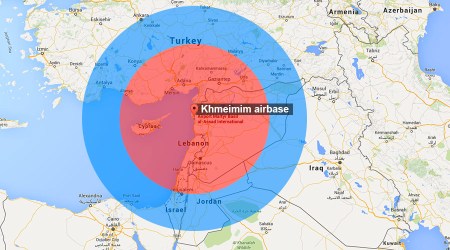
S-400_range_map_25.11.15 (1)

The five-year Syrian civil war, faces its most critical moment. Saturday, Feb. 6, a combined force of Syrian army and Hizballah troops and an Iraqi Shiite militia under Iranian officers, were led by Russian air and Spetsnaz (special forces) officers into pressing forward to encircle 35,000 rebels trapped in Aleppo, the country’s largest city. As they tightened the siege, 400,000 Syrian civilians were also trapped and forced to bear heavy Russian air bombardment and savage artillery fire from the ground forces closing in on the city.

Rebel supply routes were cut off Thursday and Friday when Syrian and Hizballah forces captured the Azaz Corridor connecting Aleppo and all of the northern province of Idlib to the Turkish border.

Tens of thousands of refugees fleeing from the beleaguered town are massing at Bab al-Salama, the last Turkish border crossing to be closed against them. This is the largest Syrian refugee exodus since the start of the civil war.

The rebels under siege are painfully short of weaponry for fighting off the massive, combined offensive, DEBKAfile’s military sources report. Their only remaining recourse is to surrender or be ground into submission as the conquering force knocks over their positions and takes over street after street.

Once the combined forces fighting with Bashar Assad’s army take Aleppo and northern Syria, the opposition will have suffered its heaviest defeat since the war began. The rebels groups’ capacity to continue fighting the regime will be gravely diminished.

Their desperate plight – and the fresh surge of Syrian refugees in unmanageable numbers – cut short the conference in Geneva for a settlement of the Syrian conflict, before it got underway – and prompted reactions from sponsors of rebel groups.

In Riyadh, Brig, Gen. Ahmed Asiri, adviser to Saudi Defense Minister Muhammed Bin Salman, announced Friday that Saudi Arabia is ready “to participate in any ground operations that the international coalition launches against ISIS.” This offer was taken as a veiled response to the SOS from the rebel stronghold in Aleppo.

In Washington, State Department circles, in a briefing to US media, said the time had come to establish a no-fly security zone in northern Syria. They said: “Once a zone were established we do not believe Russia would challenge the stronger US and NATO forces, particularly if they were operating mainly from Turkey.”

The next day, Friday, Moscow came back with a sharp response: Russian Deputy Defense Minister Anatoly Antonov said: “Russian air defense systems enable early detection of threats to Russian aircraft flying combat missions over Syria and provide adequate measures to ensure flight safety.”

This was a reminder of the sophisticated air defense S-400 and S-300 missile systems Russia installed at its Syrian air base after the Turkish air force downed a Russian warplane in November.

Syrian Foreign Minister Walid al-Moallem put it more crudely: “Any foreign troops entering Syria would return home in wooden coffins.”

He advised armed opposition groups fighting the government offensive in the area to lay down their weapons because, he said, “government advances signal that the five-year-old Syria war is nearing its end.”

Saturday, US Secretary of State John Kerry urged Russia to implement a ceasefire in Syria, saying its bombing campaign was killing women and children in large numbers and “has to stop.” He told reporters on his return from a trip to Europe: “Russia has indicated to me very directly they are prepared to do a ceasefire,” adding “The Iranians confirmed in London just a day and a half ago they will support a ceasefire now.”

DEBKAfile’s military sources have seen no sign of any ceasefire or even a slowdown in the Russian-led Syrian-Iranian Aleppo offensive.

Atwan: ISIS Savagery – from Islamic History; West Likely to “Contain” ISIS Like It Contained Arafat

February 5, 2016

Atwan: ISIS Savagery – from Islamic History; West Likely to “Contain” ISIS Like It Contained Arafat, MEMRI-TV via You Tube, February 4, 2016


From the blurb beneath the video:

In a December 15 lecture about ISIS at the American University in Beirut, Abdel Bari Atwan, former editor-in-chief of “Al-Quds Al-Arabi” and the current editor-in-chief of “Al-Rai Al-Youm” rejected common claims that the savagery of ISIS is alien to Islam, presenting examples of similar conduct from Islamic history. Atwan said that the West faces two options: to contain ISIS or to destroy it. The former is more likely than the latter, he added. The West always starts by trying to destroy organizations that it considers to be terrorist and ends up negotiating with them, Atwan said, citing the Taliban, the PLO, and the IRA as prominent examples.

A (Much) Better Year

February 5, 2016

A (Much) Better Year, Front Page Magazine, Caroline Glick, February 5, 2016
ob

[A] of the Republicans candidates are significantly more supportive of Israel than the Democratic candidates. So it is simply an objective fact that Israel will be better off if a Republican is elected in November no matter who he is and no matter who the Democratic candidate is.

Part of the reason Obama is acting with such urgency and intensity is that he knows that regardless of who is elected to replace him, the next president will not be as viscerally hostile to Israel or as emotionally attached to Islam as he is.

**********************

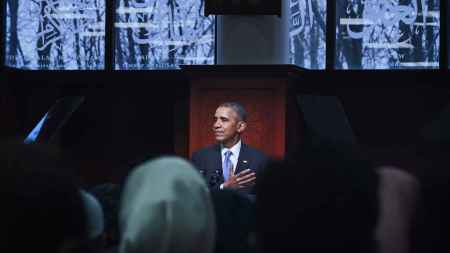
On Wednesday the U.S. media interrupted its saturation coverage of the presidential primaries to report on President Barack Obama’s visit to a mosque in Maryland. The visit was Obama’s first public one to a mosque in the US since entering the White House seven years ago. The mosque Obama chose to visit demonstrated once again that his views of radical Islam are deeply problematic.

Obama visited the Islamic Society of Baltimore, a mosque with longstanding ties to the Muslim Brotherhood and Hamas. During Operation Protective Edge, the leaders of the mosque accused Israel of genocide and demanded that the administration end US support for the Jewish state.

According to The Daily Caller, the mosque’s former imam Mohammad Adam el-Sheikh was active in the Islamic American Relief Agency, a charity deemed a terror group in 2004 after the US Treasury Department determined it had transferred funds to Osama bin Laden, Hamas, al-Qaida and other terrorist groups.

El-Sheikh left the Baltimore mosque to take over the Dar el-Hijra mosque in northern Virginia. He replaced Anwar al-Awlaki as imam after Awlaki moved to Yemen in 2003. In Yemen Awlaki rose to become a senior al-Qaida commander.

Awlaki radicalized many American jihadists both through direct contact and online. He radicalized US Army major Nidal Malik Hasan, and inspired him to carry out the 2009 massacre of 13 US soldiers and civilians at Fort Hood in Texas. Awlaki was killed by a US drone strike in 2011.

In 2010, a member of the Islamic Society of Baltimore was arrested for planning to attack an army recruiting office. According to the Mediaite news portal, the mosque reportedly refused to cooperate with the FBI in its investigation.

Obama’s visit to the radical mosque now is a clear signal of how he intends to spend his last year in office. It tells us that during this period, Obama will adopt ever more extreme positions regarding radical Islam.

Obama’s apologetics for radical Islamists is the flipside of his hostility for Israel. This too is escalating and will continue to rise through the end of his tenure in office.

The US Customs authority’s announcement last week that it will begin enforcing a 20-yearold decision to require goods imported from Judea and Samaria to be labeled “Made in the West Bank,” rather than “Made in Israel,” signals Obama’s intentions. So, too, it is abundantly clear that France’s plan to use the UN Security Council to dictate Israel’s borders was coordinated in advance with the Obama administration.

Part of the reason Obama is acting with such urgency and intensity is that he knows that regardless of who is elected to replace him, the next president will not be as viscerally hostile to Israel or as emotionally attached to Islam as he is.

On the Democratic side, neither candidate is a particularly energetic supporter of Israel or counter- jihad warrior. Former secretary of state Hillary Clinton’s recently released email discussions of Israel with her closest advisers indicate that all of Clinton’s closest counselors are hostile to Israel.

For his part, Vermont’s socialist Sen. Bernie Sanders harbors the far Left’s now standard anti-Israel attitudes. Not only did Sanders – like Clinton – support Obama’s nuclear deal with Iran. He boycotted Prime Minister Benjamin Netanyahu’s speech before the Joint Houses of Congress where Netanyahu laid out Israel’s reasons for opposing the deal. Sanders gave television interviews condemning Netanyahu for making the speech, accusing him of electioneering on the back of the US Congress. Sanders criticized Israel during Operation Protective Edge and supports decreasing US military aid to Israel.

For all their anti-Israel sensibilities, though, neither Clinton nor Sanders gives the impression that they are driven by them as Obama is.

Unlike Obama, neither appear to be animated by their hostility toward Israel. Neither seem to be passionate in their support for Muslim Brotherhood- affiliated groups or in their desire to realign the US away from Israel, from its traditional Arab allies and toward Iran. This lack of passion makes it safe to assume that if elected president, while they will adopt anti-Israel policies, they will not seek out ways to weaken Israel or strengthen its sworn enemies.

On the Republican side, the situation is entirely different. All of the Republican presidential candidates are pro-Israel. To be sure, some are more pro-Israel than others. Sen. Ted Cruz, for instance, is more supportive than his competitors. But all of the Republicans candidates are significantly more supportive of Israel than the Democratic candidates. So it is simply an objective fact that Israel will be better off if a Republican is elected in November no matter who he is and no matter who the Democratic candidate is.

It hasn’t always been this way. And it doesn’t have to remain this way.

Back in 1992 when Bill Clinton was running against George H.W. Bush, if Israel was your issue, you voted for Clinton because he was rightly viewed as more pro-Israel than Bush.

Twenty-four years ago, supporting Israel carried no cost for Clinton. According to Gallup, in 1992, 52 percent of Democrats were pro-Israel.

On the other hand, Bush was probably harmed somewhat for the widespread perception that he was anti-Israel. In 1992, 62% of Republicans were pro-Israel.

Over the past 15 years, the situation has altered considerably.

Today, Republicans are near unanimous in their support for Israel. According to a Gallup poll from February 2015, 83% of Republicans support Israel.

Only 48% of Democrats do. From 2014 to 2015, Democratic support for Israel plunged 10 points.

The cleavage on Israel is particularly acute among partisan elites.

Last summer, pollster Frank Luntz conducted a survey of US elite partisan opinion on Israel. His data were devastating. According to Luntz’s data, 76% of Democratic elite believe that Israel has too much influence over US foreign policy. Only 20% of Republicans do.

Nearly half (47%) of highly educated, wealthy and politically active Democrats think that Israel is a racist country. Thirteen percent of their Republican counterparts agree.

And whereas only 48% of Democrats believe that Israel wants peace, 88% of Republicans believe that Israel wants peace with its neighbors.

These trends affect voting habits. According to Luntz, while only 18% of Democrats say they would be more likely to vote for a politician who supports Israel, 31% said they are less likely to vote for a pro-Israel candidate. In contrast, 76% of Republicans say they want their representatives to support Israel.

Forty-five percent of Democrats said they would be more likely to vote for a politician who is critical of Israel and 75% of Republicans said they would be less likely to vote for an anti-Israel candidate.

These data tell us two important things. Today Democratic candidates will gain nothing and may lose significant support if they support Israel.

In contrast, a Republican who opposes Israel will have a hard time getting elected, much less winning a primary.

Partisan sensibilities aren’t the only reason that Israel is will be better off if a Republican wins in November. There is also the issue of policy continuity.

Even though neither Clinton nor Sanders share Obama’s anti-Israel passion, their default position will be to maintain his policies. Traditionally, when an outgoing president is replaced by a successor from his own party, many of his foreign policy advisers stay on to serve his successor.

Moreover, if American voters elect a Democrat to succeed Obama, their decision will rightly be viewed as a vote of confidence in his policies.

Obama has radicalized the Democratic Party in his seven years in office. When Obama was inaugurated, the Blue Dog caucus of conservative Democratic members of the House of Representatives had 54 members. Today only 14 remain.

Obama’s Democratic Party is not Bill Clinton’s party.

A party that isn’t forced to pay a price for its policies isn’t likely to change them. If the Democrats are not defeated in the run for the White House in November, their party will not reassess its shift to radicalism and reconsider its increasingly hostile stance on Israel.

That then brings us to the state of the presidential race following the Iowa caucuses and ahead of next Tuesday’s primary in New Hampshire. The Iowa caucuses showed a significant gap in enthusiasm among partisan voters. Participation rates in the Republican caucuses were unprecedented.

Cruz shattered the record for vote getting in the state that saw participation rates up 30% from 2012. On the Democratic side, participation rates were below the 2008 level.

On the Republican side, the three top candidates – Cruz, businessman Donald Trump and Sen. Marco Rubio – are all backed by committed, fervent supporters. On the Democratic side, Clinton’s supporters are reportedly diffident about her. And while Sanders enjoys enthusiastic support from voters under 45, he can’t seem to convince people who actually know what socialism is to support him.

If Sanders wins the Democratic nomination, on the face of it, it is difficult to see his path to victory in the general election. Whereas Obama was elected by hiding his radical positions, Sanders is running openly as a socialist and attacks Obama from the Left. Whether America is a center-right or center-left country, the undisputed truth is that it is a centrist country.

As for Clinton, the likelihood grows by the day that by the general election, her inability to inspire her base will be the least of her problems.

The FBI’s ongoing probe of her use of a private email server during her tenure as secretary of state is devastating her chances of getting elected.

The State Department’s revelation last week that 22 of Clinton’s emails were too classified to be released, even with parts blacked out, makes it impossible to dismiss the prospect that she will be indicted for serious felony offenses. Yet, as Jonah Goldberg argued Wednesday in National Review, with her narrow victory in Iowa, Clinton blocked the opening for a less damaged candidate – like Vice President Joe Biden or former New York mayor Michael Bloomberg – to step into the race.

In other words, the Republican nominee will have an energized base and will face either a legally challenged or openly socialist Democratic opponent.

According to terrorism expert Steven Emerson, before Obama visited the Islamic Society of Baltimore, he asked the FBI for its opinion of the mosque. FBI investigators informed Obama of the mosque’s ties to terrorism. They urged him not to confer it with the legitimacy that comes with a presidential visit.

Obama ignored the FBI’s advice.

The next 11 months will be miserable for Israel.

But we should take heart. By all accounts, next year will be better. And judging by the way the presidential race is shaping up, next year may be a much, much better year.
Humor | Hillary is Transparent and Open

January 31, 2016

Hillary is Transparent and Open, Dan Miller’s Blog, January 31, 2016

(The views expressed in this post are mine and do not necessarily reflect those of Warsclerotic or any of its other editors. — DM)

President Obama claimed to be the most open and transparent president ever but did not follow through. During her term as Secretary of State, Hillary Clinton showed her persistent openness and transparency to friend and foe alike.

Right.

Clinton emails

Hillary demonstrated her openness and transparency to the entire world  — friend and foe alike — through her use of an unsecured home-brew server for e-mails containing classified national security information. As of late December, more than 1,200 e-mails found on Hillary’s server had been deemed classified. More continued to be found.

According to a report by Intelligence Community Inspector General I. Charles McCullough III dated January 14th, “‘several dozen’ additional classified emails — including specific intelligence known as ‘special access programs’ (SAP)” had been discovered.

That indicates a level of classification beyond even “top secret,” the label previously given to two emails found on her server, and brings even more scrutiny to the presidential candidate’s handling of the government’s closely held secrets.

As of January 29th, at least twenty-two of the most recently discovered e-mails were top secret and contained such damaging information that not even redacted copies can be released to members of the Congress.

With such undiscriminating openness to our enemies, Hillary demonstrated unprecedented impartiality. By doing so, she helped to dispel vicious rumors that America helps only its few remaining friends. The State Department, now under the direction of John Kerry, was unwilling to extend the same courtesy to the Congress, doubtless a greater enemy than any foreign nation. This may have been hard for him to do. But then, sometimes it’s hard to be John Kerry.

Hillary’s principal opponent in the race for the Democrat presidential nomination, Bernie Sanders, merely says that to be true socialists we must share everything. Hillary does more than talk; she shares.

A vote for Hillary is a vote for openness. Due to her exceptional devotion to non-discriminatory transparency, our enemies will love us even more, perhaps even until death do us part.

A European-Iranian honeymoon

January 31, 2016

A European-Iranian honeymoon, Israel Hayom, Prof. Eyal Zisser, January 31, 2016

Last week, the European dam burst. While the continent was turning a cold shoulder to Israel and European entities continued with their threats of boycott, its gates were thrown open to Iran. European leaders put their obsession with Israel aside for an hour or two, and after paying the necessary lip service to International Holocaust Memorial Day, gave Iranian President Hassan Rouhani a royal welcome.

The Iranian president, the smiling face of the Islamic republic, arrived for visits to Italy and France. It was the first visit of its kind since the nuclear deal was signed, a visit that signaled the start of a European-Iranian honeymoon, a visit that will be followed by others like it all over the continent. Rouhani’s visit came days after the economic sanctions on Iran were lifted. It’s no wonder that during the visit, announcements were made about contact between the Iranians and a number of Italian and French companies on deals including a return to European cars being manufactured in Iranian plants and, of course, contracts to purchase Iranian oil. The Iranians are hungry for Europe’s products and technology, while European companies are hungry for Iranian money.

As Rouhani was being received in Europe as an honored guest, Iran’s spiritual leader Ayatollah Ali Khamenei was busy with his longtime hobby of denying the Holocaust. He posted a clip on his website in which he called to investigate whether or not the Holocaust had actually happened, as the Zionists claim it did. But no one in Europe bothered Rouhani with any minor matter like that. After all, it was U.S. Secretary of State John Kerry who urged people not to take Tehran’s calls to annihilate Israel and the U.S. seriously, saying it was only talk. The Europeans also didn’t bother to raise the question of Iranian involvement in regional destabilization, such as in Yemen and Syria, or about Tehran’s support of terrorism. Even questions about respecting human rights and freedom of expression and promoting democracy in Iran itself were removed out of respect for the agenda of the day. Europe, as we know, only asks those questions of Israel.

Indeed, despite Rouhani’s smiles, no change has taken place yet in Iran itself. The conservative camp continues to rule with a fist of iron and supreme leader Khamenei remains firmly at the wheel, or in the hands of the Revolutionary Guard and not Rouhani and his people. So while Rouhani was trying to spread the slogan of a “new Iran” throughout Europe and asking his hosts to turn over a new leaf in the relations between Iran and Europe, the conservatives at home were preparing an unpleasant surprise. Most of the reform camp’s candidates for the parliamentary election scheduled to take place on February 26 were rejected. Even the grandson of late Ayatollah Ruhollah Khomeini, Ahmed Khomeini, who wanted to be elected to the Council of Experts — the Iranian body that oversees the supreme spiritual leader and is responsible for choosing his successor — was rejected on the grounds of “not proving appropriate religious capabilities.”

Iran should be judged not by its words, but by its actions, but the Iranian record speaks for itself. A mere two months after it signed the nuclear agreement with the major world powers in July 2015, Tehran sent thousands of soldiers to Syria to fight on the side of Syrian President Bashar Assad. Painful pictures are coming out of Syria of children dying of hunger in cities under siege by Assad’s forces, Hezbollah fighters, and members of the Iranian Revolutionary Guard. But Iran has been rewarded for its doings in Syria and invited by the U.N. and western countries to take part in a discussion on Syria’s future. The Iranian record also includes ballistic missile tests, to show us what Iranian’s military ambitions are; the arrest of U.S. sailors in the Persian Gulf; and — just like in the good old days — an angry mob setting fire to the Saudi Arabian embassy in Tehran.

The Europeans are choosing to ignore all that as they announce a new chapter in Iranian-European relations. The bill for the honeymoon will be footed by others — in Syria, the Persian Gulf, and Israel.

IDF Preparing for Arrival of ISIS on Syrian Border

January 30, 2016

IDF Preparing for Arrival of ISIS on Syrian Border, Investigative Project on Terrorism, Yaakov Lappin, January 29, 2016

934

As conflict and mayhem continue to rage across Syria, the Israel Defense Forces (IDF) is preparing to encounter the threat of ISIS and al-Qaida forces right on its borders, and could encounter such threats in the coming months.

The preparations come as the Syrian civil war shows no sign of letting up. This is a conflict that has led to the violent deaths of 300,000 Syrians, and the displacement of more than 10 million others, 4.5 million of whom have fled the country.

Today, the IDF’s Military Intelligence Directorate views Syria as a former state that has broken apart into multiple ‘Syrias.’ The Assad regime controls barely 30 percent of Syria and is fully reliant on the foreign assistance of Russia, Hizballah, and Iran. Sunnis and Shi’ites wage daily war on one another.

It is worth examining the wider recent events in the multifaceted Syrian conflict, and place the IDF’s preparations in their broader regional perspective.

In Syria’s murderous kill-or-be-killed environment, Salafi-jihadist doctrines flourish, in the form of ISIS, which views Shi’ites (including the Assad regime and Hizballah) as infidels who must be destroyed.

ISIS cells have operated recently in Lebanon too, targeting Shi’ite Hizballah’s home turf of Dahiya in southern Beirut with two large bombings in November that claimed over 40 lives, while ISIS in Iraq continues to target Shi’ites.

Today, ISIS has between 30,000-50,000 members who are dedicated to expanding their caliphate and killing all those who disagree with their doctrine, including even fellow Sunni jihadi members of al-Qaida’s branch in Syria, the Al-Nusra Front, which has 8,000-12,000 members.

ISIS continues to use its territory in Syria and Iraq to plot major, mass-casualty terrorist attacks in Western cities. At the same time, its budgetary future looks uncertain, as oil funds have decreased significantly following allied air strikes on oil facilities. In the past year, 45 percent of ISIS’s $1.3 billion budget came from oil, far less than the oil revenue in 2014.

Unlike ISIS, al-Qaida believes in following a phased, slower plan in setting up a caliphate, and the two jihadist organizations have been at war with each other for more than two years in Syria.

Shi’ites led by Iran are fighting to stop the Salafi-jihadis’ spread. Under the command of Iranian Revolutionary Guard Corps (IRGC)-Quds Force unit commander, Qassem Suleimani, Iranian fighting forces and advisers moved into Syria. Iran has sustained more than 300 casualties there thus far.

Hizballah, too, is heavily involved in Syria’s battles, losing an estimated 1,300 fighters and sustaining 10,000 injuries – meaning more than half of its conscripted fighting force has been killed or wounded. Iran and its proxies are using the mayhem to try to spread their own influence in Syria.

Near Israel’s border with Syria, the Al-Yarmouk Martyrs Battalions, which is affiliated with ISIS, has set up many posts.

An estimated 600 members of the group control a population of around 40,000 Syrians. Al-Yarmouk is at war with al-Qaida’s Jabhat Al-Nusra, which maintains a few thousand members in the Syrian Golan near Israel.

Jabhat Al-Nusra’s membership is mostly derived of local Syrians, who tend to be more hesitant to start a war with Israel that would result in their areas, and relatives, being badly affected. Yet 10 to 15 percent of its membership comes from abroad, and have no commitment to the area. These foreign fighters have no qualms about precipitating attacks on Israel. At the moment, however, Jabhat Al-Nusra is bogged down by its fight with Al-Yarmouk.

ISIS has officially put Israel in its sights, and its leader, Abu Bakr Al-Baghdadi, declared his intention at the end of December to attack Israel.

The IDF is taking the threat seriously and is preparing for a range of possible attacks, including strategic terror attacks, cross-border raids, the sending of bomb-laden armored vehicles into Israel, and rocket, missile, small-arms, and mortar fire on the Israeli Golan Heights.

One possibility is that the heavily armed Al-Yarmouk group, which is facing the southern Golan Heights, might follow an Islamic State directive to attack Israel.

In 2014, Al-Yarmouk became an ISIS representative, swearing allegiance to it, though it is not fully subordinate to it.

Al-Yarmouk’s late leader, known as Al Khal (“the uncle”), was killed in November in an attack by Jabhat Al-Nusra. Before his violent end, Al Khal only partially committed himself to ISIS, and turned down ISIS requests to send fighters to Iraq.

Al-Yarmouk’s response to Jabhat Al-Nusra’s attacks came in December, when it assassinated a Jabhat Al-Nusra commander in his armored vehicle, just 400 meters from the Israeli border.

Al-Yarmouk subscribes to the Salafi jihadist ideology and has shoulder-held missiles, tanks, and other weapons looted during raids on the Assad regime military bases.

But Israel is also preparing for the possibility of encountering ISIS itself, not just an affiliate group.

ISIS proper is currently situated 40 kilometers from the Israeli border in southern Syria. One possibility is that Russian airstrikes will cause ISIS forces to ricochet southwards, towards Israel.

The IDF is gathering intelligence on all armed groups near its border, exhausting many resources to assess their capabilities, and intentions.

Israel watched as Shi’ite Hizballah came from Lebanon to block Sunni jihadist advances towards Lebanon in recent months, and as Russian airstrikes blocked the advance of the rebels northwards, to Damascus.

The IDF remains in a heightened state of alert along the Syrian border, though it is also working to avoid the creation of easy targets for the array of predatory forces on the other side.

As part of its preparations, the IDF’s Northern Command has given more autonomy to regional field commanders to enable faster responses to surprise attacks by reducing the initial chain of command during emergencies.

Inter-branch cooperation between intelligence, ground forces, and the air force has also been tightened.

Additionally, the IDF has fortified its border fence with Syria, adding electronic sensors to better be able to detect and respond to a potential attack in time.

The underlying assumption within military circles is that, sooner or later, ISIS will turn its guns on Israel, and the IDF does not intend to be caught off guard when that happens.

Obama’s Fake Syrian Peace Talks Falling Apart

January 29, 2016

Obama’s Fake Syrian Peace Talks Falling Apart, Front Page Magazine, Daniel Greenfield, January 29, 2016

obama-wears-tan-suit-149481242256_6

The peace talks strategy for Syria comes out of Iran and Russia, two countries determined to keep Assad in power. Obama wanted the peace talks in order to rig a fake settlement that would come apart once he was out of office. But the only people fooled by this were stupid enough to get their news from CNN and their talking points from Think Progress. The Sunni side only participated to the extent that they could wreck the talks and extract some demands. They have no intention in signing on to Assad staying in power or to letting Obama get away with a fake solution that does just that.

And, oh yes, no one actually thinks Obama has any credibility.

As the Obama administration pushes for peace in Syria, its credibility is crumbling among Syrian opposition leaders, many of whom increasingly doubt the U.S. is serious about ending the rule of dictator Bashar Assad.

Because he isn’t.

If the talks peter out or collapse, that will further undermine President Barack Obama’s foreign policy legacy, which already has been tarnished by the endless bloodshed in Syria

It’s okay. Obama will blame Tom Cotton or Bush or Israel. Or someone. And the media will go along with it.

“A number of the opposition has expressed the feeling that the U.S. is not acting as an honest broker and that they’ve lost both trust and faith in the ability of the United States to deliver on a political settlement in Syria,” said Andrew Bowen, a senior fellow at the Center for the National Interest who has contacts among Syrian opposition groups.

Obama signed on with Iran. So he’s about as much of an honest broker as any other foreign agent.

“Kerry did not make any promises, nor did he put forward any initiatives,” said Khaled Khoja, president of the opposition Syrian National Coalition, in onestatement questioning U.S. intentions. “He has long been delivering messages similar to those drafted by Iran and Russia, which call for the establishment of a ‘national government’ and allowing Bashar al-Assad to stay in power and stand for re-election.”

Well yes. What else do you expect Kerry to do? This is the only thing he’s been doing since he got to the Senate and even beforehand with the Viet Cong. Traitors gotta traitor.

Among the numerous reports floating around — some of them highly speculative — are those that allege Kerry warned opposition leaders they could lose international support if they didn’t attend Friday’s talks. The reports come as the U.S. has appeared to be backing away from its demand that Assad must leave office by signaling its support for the notion of a transitional period.

And that period will come to an end once Obama is out of office.

But all this is theater anyway as the groups with the most fighters on the ground, including Al Qaeda and ISIS, are not represented. Most of the Islamists aren’t either. So this is just the Muslim Brotherhood, whose actual strength is weak, throwing a tantrum. Even if the Sunni groups signed some sort of deal it would be as worthless as the fake elections Hillary still talks up in Libya

Russians let Hizballah into Daraa, breaking their promise to Israel

January 28, 2016

Russians let Hizballah into Daraa, breaking their promise to Israel, DEBKAfile, January 28, 2016

Syria_South

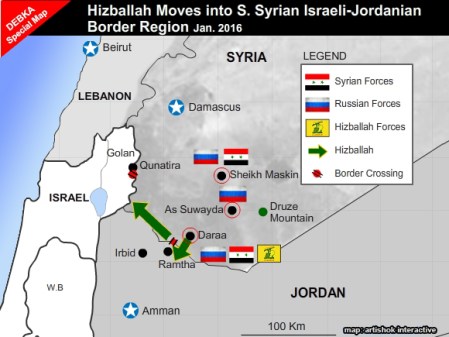
On Wednesday, Jan. 27 a large Hizballah force entered the southern Syrian town of Daraa, a critically dangerous event for Israel’s security. The way to the town, which lies near the Jordanian border and across from the Israeli Golan, was opened before Hizballah by none other than Russian forces. This was a blatant violation of President Vladimir Putin’s commitments to Prime Minister Binyamin Netanyahu and Jordanian King Abdullah not to permit Iranian and Iran-backed forces, such as Hizballah and Iraqi and Afghani Shiite militias, reach their borders in consequence of Russia’s military intervention in the Syria war.

Daraa is just 32 km from the southern Golan and 12 km from the Jordanian border. Hizballah forces in this town are therefore within easy striking distance from northern Israeli and Jordan.

What happened Wednesday was that a sizeable Hizballah contingent made it into Daraa, the day after a Syrian unit under the command of Russian officers captured the town of Sheikh Maskin, cutting off rebel forces east of Daraa from their comrades to the west.

Control of Sheikh Maskin is the key to the crossroads leading to Damascus in the north, the Druze Mountain town of es-Suwaida in the east, and Quneitra on Golan opposite Israel’s northern defenses.

The battle for Sheikh Maskin was the first in the Syrian conflict to be directly fought under Russian command. Its fall sparked accounts of Russian officers commanding Syrian troops in different parts of Syria.

So far, Israel has not reacted to the Hizballah force’s advance, notwithstanding public statements by Prime Minister Binyamin Netanyahu and Defense Minister Moshe Ya’alon that this would never be allowed to happen.

DEBKAfile’s military sources explain this reticence by a persistent misreading of the Syrian crisis in the higher ranks of the Israeli defense establishment. Military Intelligence chief Maj. Gen. Herzl Halevi, who has a good grasp of its complexities, is a lone voice against the defense minister and IDF chief of staff, Lt. Gen. Gady Eisenkot

In Amman, however, King Abdullah and his generals signified both alarm and fury. DEBKAfile’s sources report that Wednesday morning, the king shot off an urgent message to President Putin demanding an explanation for the Russian officers’ action in opening the door of Daraa to hostile Hizballah fighters.

Jordan has fought Hizballah and its conspiracies for three years, ever since its security forces seized an arms cache that Hizballah had smuggled into the kingdom for a terror cell to mount attacks in the northern province of Irbid. Amman is now concerned that Hizballah is close enough to make a grab for Al-Ramtha, the only border crossing between Syria and Jordan. That would be a feather in the cap of Iran’s Lebanese proxy, as the first Arab border crossing to fall to a Hizballah force outside Lebanon, and one, moreover, located athwart a main regional water source, the Yarmouk River.

As of Thursday morning, Jan. 28, Abdullah had not received a reply to his missive from Putin, but a message did come through to Amman from Syrian President Bashar Assad.

Using a back-door intelligence channel, he sent a notice in the name of Gen. Bahjat Suleiman, former Syrian ambassador to Jordan until he was expelled in May 2014, that King Abdullah must now face the consequences of his long support for the rebels of southern Syria.

The monarch was also advised to prepare for the influx of thousands of fleeing rebel fighters whom the combined Syrian and Hizballah forces were pushing towards the Jordanian border.

The next hours will be critical for the development of a similar crisis on the Israel-Syrian border in the Golan region.

A new US-Russian-Turkish military buildup over Syria: In unison or at odds?

January 25, 2016

A new US-Russian-Turkish military buildup over Syria: In unison or at odds? DEBKAfile, January 25, 2016

TurkishAirBase480

The US and Russia are in the process of a military buildup in the Kurdish areas of northern Syria. It is ranged along a narrow strip of land 85 km long, stretching from Hassakeh in the east up to the Kurdish town of Qamishli on the Syrian-Turkish border. Facing them from across that border is a parallel buildup of Turkish strength. This highly-charged convergence of three foreign armies athwart a tense borderland is reported here by DEBKAfile’s military sources. It is too soon to determine whether the three armies are operating in sync or at odds, especially in view of the bitter relations between Moscow and Ankara.

US Forces 

American Special Operations troops and Air Force attack helicopters landed first at Remelan airport. They are the first US troops to operate from a ground base in Syria, accommodated in living quarters built for them in advance by a US engineering corps unit. The airport runway has been widened for US warplanes.

American Special Operations troops and Air Force attack helicopters landed first at Remelan airport. They are the first US troops to operate from a ground base in Syria, accommodated in living quarters built for them in advance by a US engineering corps unit. The airport runway has been widened for US warplanes.

Russian Forces

Next came two Russian military missions on Jan. 16.  One group, led by a general and consisting of air force and Special Operations officers, is preparing to take over a small abandoned base in Syrian army-controlled territory just 80 km from the new US facility at Remelan, and adapt it for Russian use.

The other group, which consists of intelligence officers – some from Russia’s FSB federal security service, the FSB – indicates that Moscow has decided it is high time for professionals to protect the classified information moving around the Russian Task Force in Syria and safeguard it from reaching the wrong hands. .

The abandoned base is less than 3.5 km from the Turkish border, and would act as a Russian barrier between US forces in northern Syria and the Turkish border contingents.

Turkish Forces

This Russian deployment set off alarm bells in Ankara, and so the Turkish army responded with the third troop buildup, arraying tanks and mobile artillery on the border across from Qamishli.

Over the weekend, Turkish President Tayyip Erdogan stated, “We have said this from the beginning: we won’t tolerate such formations (in northern Syria) along the area stretching from the Iraqi border up to the Mediterranean.”

At the same time, US Vice President Joe Biden said Saturday, Jan. 23, that  the U.S. and Turkey are prepared for a military solution against ISIS in Syria should the Syrian government and rebel-opposition forces fail to reach a peace agreement during its upcoming meeting in Geneva.

However, Ankara views its war on terror as focused on both Kurdish separatists and ISIS, which is subjecting Turkey to multi-casualty attacks.

DEBKAfile’s military and intelligence sources note that Turkey’s military options are very limited. Its leaders know they dare not put a foot wrong because the Russian force in Syria is just waiting for an opportunity to avenge the downing of a Russian Su-24 warplane by the Turkish air force on November 24.

Another group of actors stirring the pot in northern Syria is the Kurds, particularly the YPG militia, the only fighting force in Syria capable of defeating ISIS, which has been reinforced by the Iraqi autonomous Kurdish region’s Peshmerga, as well as the outlawed Turkish PKK Kurdish organization.

At this stage, it is impossible to determine how this triple buildup will play out tomorrow – how far the US and Russia are in concert, at what point they may decide to vie for footholds in the Kurdish region of northern Syria and how far the Turks are clued into the joint US-Russian strategy for bludgeoning ISIS.

Off Topic | Trump, Conservative Ideolgues and Populists

January 24, 2016

Trump, Conservative Ideolgues and Populists, Dan Miller’s Blog, January 24, 2016

(The views expressed in this article are mine and do not necessarily reflect those of Warsclerotic or its other editors. — DM)

Conservative ideologues want to keep things essentially as they are, making only marginal and generally ineffective changes. Populists want to change things to be more consistent with what “we the people” want. Often, what we the people want is better than what our “leaders” want or try to provide. Under these definitions, Trump is a populist, not a conservative ideologue. That’s good.

According to Dictionary. com, these are attributes of “conservatives:”

Disposed to preserve existing conditions, restore traditional ones, and to limit change.

According to the same source, “populism” means:

Any of various, often anti-establishment or anti-intellectual political movements or philosophies that offer unorthodox solutions or policies and appeal to the common person rather than according with traditional party or partisan ideologies.

Grass-roots democracy; working class activism; egalitarianism.

National Review recently published an entire special edition devoted to attacking Trump on the ground that he is insufficiently conservative. Whom did National Review support in 2008 and 2012? Guess or go to the link. He did not win.

NR - Trump

Writing at PJ Media about National Review’s special issue, Roger L. Simon argued that 

Many of their arguments revolve around whether Trump is a “true conservative.” Instead of wading into the definitional weeds on that one — as they say on the Internet, YMMV [Your Milleage May Vary] — allow me to address the macro question of what the purpose of ideology actually is. For me, it is to provide a theoretical basis on which to act, a set of principles. But that’s all it is. It’s not a religion, although it can be mistaken for one (communism). [Insert and Emphasis added.]

Ideology should function as a guide, not a faith, because in the real world you may have to violate it, when the rubber meets the road, as they say. For those of us in the punditocracy, the rubber rarely if ever meets the road.  All we have is our theories. They are the road for us. If we’re lucky, we’re paid for them.  In that case, we hardly ever vary them. It would be bad for business.

Trump’s perspective was the reverse. The rubber was constantly meeting the road. In fact, it rarely did anything else. He always had to change and adjust. Ideological principles were just background noise, barely audible sounds above the jack hammers. [Emphasis added.]

When National Review takes up arms against Trump, it is men and women of theory against a man of action. The public, if we are to believe the polls, prefers the action. It’s not hard to see why. The theory has failed and become increasingly disconnected from the people. It doesn’t go anywhere and hasn’t for years. I’m guilty of it too. (Our current president is 150% a man of theory.) Too many people — left and right — are drunk on ideology. [Emphasis added.]

Were the “old White men” who wrote and signed the Declaration of Independence, and those who fought for the colonies in the Revolutionary War, conservative ideologues? Did they want to preserve existing conditions under the King of England, his governors and military? Or were they pragmatic populists, as well as men of action, who opposed the King’s establishment and offered unorthodox solutions appealing to the “common” people? It took a lot of pushing from such revolutionaries as Thomas Jefferson and John Adams, but the pragmatic populists won.

I don’t want to suggest that Donald Trump is this generation’s George Washington, John Adams, Thomas Jefferson or Ben Franklin. Times are now sufficiently different that doing so would be frivolous. Among other differences, there should be no need to go to war now because we still have an electoral process, flawed though it may be. Nor are we ruled by an unelected, hereditary king; we are ruled by an elected president who considers Himself a king, ignores or twists the Constitution to fit His needs, often ideological, and acts by royal executive decree when the Congress declines to do His bidding or goes about it too slowly to suit Him.

Be that as it may, what’s wrong with the populist notion encouraging members of the governed class — the “vulgarians” — to have greater voices in how they are governed than those who govern them, often to their own benefit, while mocking those whom they govern? Sometimes we the people make mistakes and sometimes we get it right. Ditto our dear leaders. Why not give us a chance for a change?

Into which category — conservative ideologue or populist — if either, does Donald Trump fit, do we need him now and, if so, why?

Here’s the 2012 video Whittle referred to in the video above:

Which of the current Republican candidates has taken, or is the most likely to take, positions comparable to those suggested in the above video?

In September of last year, I wrote an article titled To bring America back we need to break some stuff. There, I quoted Daniel Greenfield for the following proposition:

What we have now is not a movement because we have not defined what it is we hope to win. We have built reactive movements to stave off despair. We must do better than that. We must not settle for striving to restore some idealized lost world. Instead we must dream big. We must think of the nation we want and of the civilization we want to live in and what it will take to build it. [Emphasis added.]

Our enemies have set out big goals. We must set out bigger ones. We must become more than conservatives. If we remain conservatives, then all we will have is the America we live in now. And even if our children and grandchildren become conservatives, that is the culture and nation they will fight to conserve. We must become revolutionaries. [Emphasis added.]

I also suggested that if we don’t seek real — even revolutionary — change we might as well try to join the European Union. That would keep things pretty much as they now are and would, therefore, be more the “conservative” than the populist thing to do.

Our unelected and unaccountable bureaucracy could merge with that of the EU and our Congress could merge with the impotent EU Parliament.

Here’s a new Trifecta video about a proposal by the Governor of Texas to amend the Constitution which, he contends, has been broken by those who have improperly increased the power of the Federal Government while diminishing that of the states.

The Constitution is not broken. It’s just been poorly interpreted, twisted and otherwise ignored. In recent years Obama — who claims to be a “constitutional scholar” — has done more to ignore, twist and misinterpret it than any other president I can remember. Depending on what amendments might be adopted and ratified, an Obama clone (Hillary Clinton?) might well do the same; perhaps even worse. A president can personally stop that process by not doing it. A president can halt poor judicial interpretations only by nominating judges unlikely to make them.

Conclusions

Trump is not perfect; nobody is. However, he says what he thinks rather than spew multiculturally correct pablum. Few are sufficiently thick-skinned to do that. A “vulgarian,” he is not politically correct. Others are because they don’t want to offend. Trump recognizes that Islam is the religion of war, death and oppression and does not want the further Islamisation of America, which is already proceeding apace. Few leaders of either party are willing to take that position, mean it and act on it effectively if elected.

We are mad, not insane. We want to give we the people a bigger and stronger voice in how and by whom we are governed. If, by voting to make Trump our President, we make a big mistake so be it. Worse candidates with fewer qualifications have been elected and reelected. During His first and second term as President, Obama has gone far in His quest to transform America fundamentally and in the wrong directions. If Trump does not come sufficiently close to correcting course to meet our expectations during his first term, we won’t vote to reelect him. In the meantime,

Opps. I almost forgot this