Archive for the ‘Europe’ category

Will Europe Refuse to Kneel like the Heroic French Priest?

July 30, 2016

Will Europe Refuse to Kneel like the Heroic French Priest? Gatestone InstituteGiulio Meotti, July 30, 2016

♦ Go around Europe these days: you will find not a single rally to protest the murder of Father Jacques Hamel. The day an 85-year-old priest was killed in a French church, nobody said “We are all Catholics”.

♦ Even Pope Francis, in front of the most important anti-Christian event on Europe’s soil since the Second World War, stood silent and said that Islamists look “for money”. The entire Vatican clergy refused to say the word “Islam”.

♦ Ritually, after each massacre, Europe’s media and politicians repeat the story of “intelligence failures” — a fig leaf to avoid mentioning Islam and its project of the conquest of Europe. It is the conventional code of conduct after any Islamist attack.

♦ Europe looks condemned to a permanent state of siege. But what if, one day, after more bloodshed and attacks in Europe, Europe’s governments begin negotiating, with the mainstream Islamic organizations, the terms of submission of democracies to Islamic sharia law? Cartoons about Mohammed have already disappeared from the European media, and the scapegoating of Israel and the Jews started long time ago. After the attack at the church, the French media decided even to stop publishing photos of the terrorists. This is the brave response to jihad by our mainstream media

Imagine the scene: the morning Catholic mass in the northern French town of Etienne du Rouvray, an almost empty church, three parishioners, two nuns and a very old priest. Knife-wielding ISIS terrorists interrupt the service and slit the throat of Father Jacques Hamel. This heartbreaking scene illuminates the state of Christianity in Europe.
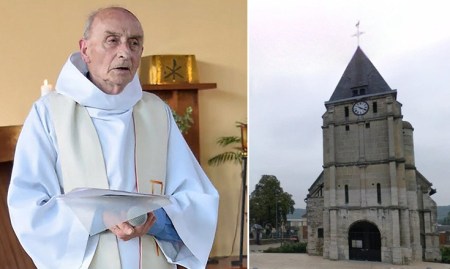
1734Father Jacques Hamel was murdered this week, in the church of St. Étienne-du-Rouvray, by Islamic jihadists.

It happened before. In 1996 seven French monks were slaughtered in Algeria. In 2006, a priest was beheaded in Iraq. In 2016, this horrible Islamic ritual took place in the heart of European Christianity: the Normandy town where Father Hamel was murdered is the location of the trial of Joan of Arc, the heroine of French Christianity.

France had been repeatedly warned: Europe’s Christians will meet the same fate of their Eastern brethren. But France refused to protect either Europe’s Christians or Eastern ones. When, a year ago, the rector of the Great Mosque of Paris, Dalil Boubakeur, suggested transforming empty French churches (like that one in Etienne du Rouvray) into mosques, only a few French intellectuals, led by Alain Finkielkraut and Pascal Bruckner, signed the appeal entitled, “Do not touch my church” (“Touche pas à mon église“) in defense of France’s Christian heritage. Laurent Joffrin, director of the daily newspaper Libération, led a left-wing campaign against the appeal, describing the signers as “decrepit and fascist“.

For years, French socialist mayors have approved, in fact, the demolition of churches or their conversion into mosques (the same goal as ISIS but by different, “peaceful” means). Except in the Saint-Germain-des-Prés quarter of Paris, and in some beautiful areas such as the Avignon Festival, France is experiencing a dramatic crisis of identity.

While the appeal to save France’s churches was being demonized or ignored, the same fate was suffered by endangered Eastern Christian being exterminated by ISIS. “It is no longer possible to ignore this ethnic and cultural cleansing”, reads an appeal signed by the usual combative “Islamophobic” intellectuals, such as Elisabeth Badinter, Jacques Julliard and Michel Onfray. In March, the newspaper Le Figaro accused the government of Manuel Valls of abandoning the Christians threatened with death by ISIS by refusing to grant them visas.

Go around Europe these days: you will find not a single rally to protest the killing of Father Hamel. In January 2015, after the murderous attack on Charlie Hebdo, the French took to the streets to say “Je suis Charlie”. After July 26, 2016, the day an 85-year-old priest was murdered in a church, nobody said “We are all Catholics”. Even Pope Francis, in the face of the most important anti-Christian event on Europe’s soil since the Second World War, stood silent and said that Islamists look “for money“. The entire Vatican clergy refused to write or say the word “Islam”.

Truth is coming from very few writers. “Religions overcome other religions; police can help little if one is not afraid of death.” With these words, six months after the massacre at the magazine Charlie Hebdo, the writer Michel Houellebecq spoke with the Revue des Deux Mondes. Our elite should read it after every massacre before filling up pages on “intelligence failures.”

It is not as if one more French gendarmerie vehicle could have stopped the Islamist who slaughtered 84 people in Nice. Perhaps. Maybe. But that is not the point. Ritually, after each massacre, Europe’s media and politicians repeat the story of “intelligence failures”. In the case of the attack in Etienne du Rouvray, the story is about a terrorist who was placed under surveillance.

The “intelligence failure” theory is a fig leaf to avoid mentioning Islam and its project of the conquest of Europe. It is the conventional code of conduct after any Islamist attack. Then they add: “Retaliation” creates a spiral of violence; you have to work for peace and show good intentions. Then, in two or three weeks, comes the fatal “we deserve it”. For what? For having a religion different from them?

We always hear the same voices, as in some great game of dissimulation and collective disorientation in which no one even knows which enemy to beat. But, after all, is it not much more comforting to talk about “intelligence” instead of the Islamists who try, by terror and sharia, to force the submission of us poor Europeans?

Europe looks condemned to a permanent state of siege. But what if, one day, after more bloodshed and attacks in Europe, Europe’s governments begin negotiating, with the mainstream Islamic organizations, the terms of submission of democracies to Islamic sharia law? Cartoons about Mohammed and the “crime” of blasphemy have already disappeared from the European media, and the scapegoating of Israel and the Jews started long time ago.

After the attack at the church, the French media decided even to stop publishing photos of the terrorists. This is the brave response to jihad by our mainstream media, who also showed lethal signs of cowardice during the Charlie Hebdo crisis.

The only hope today comes from an 85-year-old French priest, who was murdered by Islamists after a simple, noble gesture: he refused to kneel in front of them. Will humiliated and indolent Europe do the same?

America’s First Major Socialist Party Debuts in Philadelphia

July 30, 2016

America’s First Major Socialist Party Debuts in Philadelphia, PJ MediaRoger L Simon, July 29, 2016

(How different would Hillary be from the late lamented el Thugo down in Venezuela? He and his family got rich and his daughter remains the richest person there. El Thugo  was rotten to the core and his anointed successor, Maduro is, if that is possible, even worse. Should she become Obama’s successor, Hillary has much to look forward to. — DM)

soc party

Under cover of a sudden profusion of American flags (borrowed from city hall) and staged chants of “USA” ringing out on the final day, a new party was born in Philadelphia.

Gone are The Democrats.  Welcome, The Socialists.  

Okay, the Democratic Socialists, in deference to Bernie Sanders, whose party it is no matter who was giving the acceptance speech on Thursday. He held the whip hand and will continue to do so to keep his followers on the reservation.

And, yes, there have been more than a few socialist parties in America before – Eugene V. Debs, Norman Thomas, etc. – but never has one of our two major political parties been taken over to such an extent, not even during the days of George McGovern or Jimmy Carter.

I wouldn’t go quite so far as Dan Greenfield, who wrote the following in a compelling column inFrontPage:

Sinclair Lewis famously said, “When Fascism comes to America, it will be wrapped in the flag and carrying a cross”. More accurately, when Communism comes to America, it will be wrapped in the flag and carrying a cross. That’s what the Democratic National Convention was.

So far, as I see it, it’s still socialism.  Hillary Clinton (even under the spell of Bernie ) is closer to François Hollande or some other Eurocrat than she is to Chairman Mao.  But the situation is bad enough and likely to get worse, if she is elected.

Those who think that she will be the second coming of centrist Bill should have their heads examined – or at least watch the reruns of her speech.  Bill was asleep during it.  Call it self-preservation of mind or body, he couldn’t take it either way.  He knew what was coming and it wasn’t going to be a reprise of his most famous line – “The days of big government are over.”  Quite the contrary.  The days of big government are coming as never before.  So he shut his eyes, and not just from whatever health issue he may be harboring.

They should also reread Hayek’s The Road to Serfdom, written during the rise of the National Socialist Party, for a clear analysis of why socialism inevitably turns totalitarian.

Which leads me to this:  Many of you think you have the luxury of debating whether Donald Trump is sufficiently conservative or is really a Republican or will carry out all the things he says he will (more of this in a moment).

Sorry, you don’t.  It’s five minutes to midnight for Western Civilization.  Europe, in case you haven’t noticed, is on the brink of going Islamic.  Twenty-five percent of French teenagers already are. Mohammed has been the most popular baby name in the UK for some time. (Thank God, they passed Brexit.) And Ms. Merkel, despite the constant carnage in her country, is doubling down on Middle Eastern immigration.

Hillary Clinton intends to do the same thing here – in the name of human rights, naturally, when, needless to say, it’s about votes.  Economically, if she passes even a third of her proposals, our country will be so far in debt we may never find a way out, ratifying all of Hayek’s predictions as we all become slaves to a desperate state.

Pessimistic, sure.  But we can stop it.  This is a surprisingly winnable election if we pull together.

So for reassurance, let me tell one story from the Republican Convention. It was, as anyone watching television knows, a mostly uninformative event, as virtually all conventions are.  But I did go to a luncheon panel on the economy held by Freedom Works.  Larry Kudlow was the moderator.  I forget everyone on it, but it was a distinguished panel of conservative economists including Stephen Moore and a man named Harold Hamm I had never heard of.  My bad.  It turns out Hamm had more to do with the immediate revival, such as it is, of the US economy than anybody – he is the king of fracking, the developer of the Bakken formation and someone with a net worth at least double Trump’s and closer to George Soros’.

All of the panelist had worked closely, some one-on-one, with Trump on his tax plan, This plan is quite in the mainstream of conservative economic policy with lower, simplified rates across the board, particularly for businesses, which Trump puts at 15%.  (It currently starts at 39%.) Republicans have been calling for this reduction for years to bring our corporations home and generate jobs.

Anyway, midway into the panel, Kudlow asked a question on everybody’s mind – and probably yours too.  Larry wanted to know if the panelists thought Trump would go through with it, if Donald was, to put it bluntly, for real.

The panelists were all emphatic in saying Trump would.  They also gave him high marks for listening, of all things.

Now I know you can rationalize this a lot of ways.  Rich and powerful as these men were, they clearly wanted to be advisers to a man who could be the most powerful in the world.  So factor that in.  And factor in that I have been supporting Trump for a while.  But then ask yourself if you would rather have Hillary…. and socialism.

And I’m not even going to get into the Supreme Court.

Trump and NATO

July 27, 2016

Trump and NATO, Front Page MagazineBruce Thornton, July 27, 2016

trump nato

The Never Trump crowd has found another example of The Donald’s disqualifying ignorance: comments he made about NATO. He has said that our contributions to NATO are “unfair,” that they are “costing us a fortune,” that we are “getting ripped off,” and that they are “getting a free ride.” By the way, Obama in his Atlantic interview also called the Europeans “free riders,” but I don’t recall a lot of sneering at the president for his “alarming” and “dangerous” remarks, as one critic put it.

Trump also implied that he would put the European NATO members’ feet to the fire about meeting the 2006 requirement that they spend 2% of GDP on their militaries, and suggested he would negotiate a new contribution schedule. Few NATO members have met that requirement, which is a violation of Article 3 that requires member states to “maintain and develop their individual and collective capacity to resist armed attack.” According to NATO’s own report, only five countries are estimated to meet the 2% requirement in 2016. France, Germany, Italy, and Spain­­––the first, third, fourth, and fifth largest economies in the EU––are not among them. The richest, Germany, is expected to remain at 1.19%. In contrast, the US will spend 3.9%. As Lord Robertson, NATO Secretary General from 1999-2004, put it, European nations are “military pygmies.”

Critics of Trump are technically correct to say that he exaggerates when he claims that the US pays the “lion’s share” of NATO funding. In fact, the US pays under a fifth (22%). But the complaints about European NATO members, which predate Trump by decades, take into account more salient deficiencies. “Common funding,” of which the US covers a fifth, is “used to finance NATO’s principal budgets: the civil budget (NATO HQ running costs), the military budget (costs of the integrated Command Structure) and the NATO Security Investment Programme (military capabilities),” according to NATO. In other words, mostly institutional bureaucratic infrastructure.

“Indirect spending” covers what each nation voluntarily contributes to an operation. NATO acknowledges the greater share the US spends on indirect spending: “there is an over-reliance by the Alliance as a whole on the United States for the provision of essential capabilities, including for instance, in regard to intelligence, surveillance and reconnaissance; air-to-air refuelling; ballistic missile defence; and airborne electronic warfare.” We could also mention transport aircraft, cruise missiles, and other matériel that the European countries simply don’t have much of. For example, in the 2011 NATO bombing of Libya, there were 246 cruise missiles launched. The US fired 228 of them. At $1.5 million apiece, that adds up to $342 million taxpayer dollars spent to destabilize a country and get four of our citizens killed.

This discrepancy in indirect spending and military capability was already obvious in the 1990’s when NATO intervened in Bosnia and Kosovo to stop a vicious war. During the 1999 crisis in Kosovo, the Europeans had to make “heroic efforts” just to deploy 2% of their two million troops, according to the British foreign secretary. Historian William Shawcross writes of the bombing campaign, “The United States flew the overwhelming majority of the missions, and dropped almost all the precision-guided U.S.-made munitions, and most of the targets were generated by U.S. intelligence.”

So Trump’s complaints, as blustering and exaggerated as they may be, are legitimate. Operations conducted by NATO are overwhelmingly American funded and directed, and NATO is a diplomatic fig-leaf for American power.

No more convincing are the reasons critics give for supporting NATO. The alliance has not prevented “major state conflict since World War II,” as a writer at NRO claims. Given that some 40 million people have died in conflicts since WWII, I’m not sure what “peace” we’re talking about. During the Cold War, the peace between the US and the Soviet Union was kept by nuclear “mutually assured destruction” and millions of American troops, not NATO. Nor was Europe in any condition to fight among themselves. The Europeans were, and still are in many ways, burned out after 30 years of warring, and had neither the will, the morale, nor the belief in anything worth dying for to engage in another war. With their security underwritten by the US, they could spend their money on lavish social welfare programs and la dolce vita. Thinking NATO kept the peace is as preposterous as claiming the EU did.

Then there’s Article 5, the pledge that NATO members will fight for any member state that’s been attacked. Much is made of the only time Article 5 has been invoked, after the terrorist attacks on 9/11. Yet all that solidarity and allied good will didn’t stop France and Germany from trying to undermine the US when it tried to get the UN to sanction the war in 2003 on Saddam Hussein, who had violated 16 UN resolutions and the formal terms ending the 1991 Iraq War. Despite the consensus of American and European intelligence agencies that Hussein had WMD stockpiles, France and Germany took the lead in lobbying the Security Council to oppose the authorization to use force against Iraq.  Germany’s ambassador to the UN Council pressured members like Mexico and Chile to vote against the US. Worse yet, France and Germany, along with Belgium, formally objected to a proposal for NATO to send defensive equipment to Turkey, which wanted assurances that it would be supported by its fellow NATO members if attacked for supporting the war against Hussein.

This behavior of NATO allies did not reflect principle, but national interests and politics. German Chancellor Gerhard Schroeder was running for re-election, and found reflexive German anti-Americanism and pacifism a convenient distraction from his terrible economic record. France had grubbier reasons in addition to its own ressentiment towards the US––renewing the arm sales to Iraq and oil development contracts it had enjoyed for years before the war, and could resume once the sanctions on Hussein were lifted, something France was actively pursuing. As Shawcross summarized, “The long friendship with Saddam, commercial considerations, the response to le défi Américain, and concern over the reactions of France’s Muslims––all these played a part in [President Jacques] Chirac’s calculations in the summer of 2002.”

The importance put on Article 5 forgets that, as George Washington said, “It is a maxim founded on the universal experience of mankind, that no nation can be trusted farther than it is bound by its interests.” NATO members have made and in the future will make decisions based on each nation’s estimation of its interests. So there’s no guarantee that invoking Article 5 would lead to meaningful NATO member support. And given the weakness of their militaries, just how much actual rather than rhetorical support could the Europeans provide in the event of an attack? How many battle carrier groups does NATO possess? The Europeans can’t even afford cruise missiles.

Finally, the arguments for NATO are predicated on an either-or fallacy. If we don’t have the NATO alliance and the benefits it supposedly brings for collective security, then we’ll have nothing. But of course, if NATO disappeared tomorrow, the US would quickly sign bilateral and multilateral defense agreements with individual countries or groups of countries, including some current NATO members. The argument that without NATO our security would be endangered is as fallacious as the argument of the Remain faction in England that leaving the EU would put the UK in danger. A country as rich and powerful as the US will find no dearth of countries eager to bandwagon with it.

Trump’s critics continue to search for dubious reasons to justify sitting out the election or even voting for Hillary. There may be many reasons not to vote for Trump, but criticizing NATO isn’t one of them.

Islamism Rises from Europe’s Secularism

July 24, 2016

Islamism Rises from Europe’s Secularism, Gatestone InstituteGiulio Meotti, July 24, 2016

♦ In France, the Socialist government imposed a “secularism charter” in every school, banning Christianity from the educational system. Municipalities have already changed the enrollment form for schoolchildren by eliminating the words “father” and “mother”, replacing them with “legal manager 1” and “legal manager 2”. It is George Orwell’s “Newspeak”.

♦ After two major terror attacks in 2015, France, instead of promoting a cultural “jihad” based on Western values, responded to Islamic fundamentalism with a ridiculous “Day of Secularism” to be celebrated every 9th of December.

♦ This narrow secularism has also prevented France from openly supporting Eastern Christians under Islamist oppression.

♦ The empty 13th century Oude Kerk church in Amsterdam is now used for exhibitions and can be rented for gala dinners. In front of it there is “Sexyland”, offering “Live F*ck Shows”, a coffee shop for drugs and an “Erotic Supermarket” for dildos. For seven euros one can also visit the church.

On October 2000, in the sunny French city of Nice, the 105-member European Convention drafted the Charter of Fundamental Rights of the European Union.

Drawn up by the committee of former French President Valéry Giscard d’Estaing, the document only referred to the “cultural, religious and humanist inheritance of Europe”. The European Parliament had rejected a proposal from Christian Democrat MEPs and Pope John Paul II, to include in the text Europe’s “Judaeo-Christian roots”.

In the 75,000-word Charter there is not a single mention of Christianity. Since then, a wind of aggressive secularism has pervaded all EU policies. The European Court of Human Rights, for example, asked to remove crucifixes from classrooms: they were allegedly a threat to democracy.

The city of Nice — where exactly sixteen years ago Europe’s rulers decided to eliminate the Judeo-Christian roots from the (never approved) EU Constitution — has just witnessed the bloody manifestation of another religion: radical Islam. “Nature abhors a vacuum”: This is the truth to which our élites do not want to listen; Islamism rises from what William McGurn, George W. Bush’s speechwriter, called “Europe’s feckless secularism“.

You can see it not only in Europe’s churches, three-quarters empty, and the boom of Europeans converting to Islam, but also from what is happening in Europe’s schools. The trends do not support Viktor Orbán‘s vision for a Christian Europe.

A few days ago, Belgium, which was recently targeted in terror attacks, decided that religion classes in French-speaking primary and secondary schools will be cut in half starting in October 2016, and replaced with an hour of “citizenship classes“: lessons in secularism. In Brussels, half the children in public schools already choose to take classes in Islam.

In France, the Socialist government imposed a “secularism charter” in every school, banning Christianity from the educational system. That charter is the manifesto of the “révolution douce” (“soft revolution”), France’s extreme secularism. It is an attempt to eliminate any claim of identity. A Jewish yarmulke, a Christian cross and an Islamic veil are treated the same way. This secularism is what has been rightly defined “the Left’s blind spot with Islam“.

It is a secularism that has also gone mad. The Yves Codou elementary school in the village of La Môle, for example, celebrated “Parents’ Day” instead of Mother’s Day, in order not to upset gay couples. Municipalities have already changed the enrollment form for schoolchildren by eliminating the words “father” and “mother”, replacing them with “legal manager 1” and “legal manager 2”. It is George Orwell’s “Newspeak”.

After two major terror attacks in 2015, France, instead of promoting a cultural “jihad” based on Western values, responded to Islamic fundamentalism with a ridiculous “Day of Secularism” to be celebrated every 9th of December.

It is not that this secularism “exacerbated” cultural tensions, as many liberals say. It is that this secularism severed French culture from the very ideals that created the West. Severing it made this culture blind to the incompatibility of Islamism with secular-minded values. A French teacher,Isabelle Rey, after the massacre at the satirical magazine, Charlie Hebdo, wrote that

“many of our students do not share our dismay at the events. We can pretend to have a consensus, but it is a fact that a significant portion of our population believes that the journalists deserved their fate or that the Kouachi brothers [the murderers] died as heroes”.

This narrow secularism has also prevented France from openly supporting Eastern Christians under Islamist oppression. The music group “The Priests” had planned to advertise an upcoming concert in Paris with a banner on a poster that said proceeds would go towards the cause of Christians persecuted in Iraq and Syria — but the company operating the Paris subway system initially banned the ad, saying it considered the banner as a violation of secularism.

Sweden, one of the European countries more infiltrated by radical Islam, is listed as “the least religious” nation in the West. According to Statistics Sweden, just 5% of Swedes are regular churchgoers, and one in three couples that get married chooses a civil ceremony. How did Sweden get there? Many years ago, the Swedish government banned any religious activities in schools except for those directly related to religion classes.

Not only has secularism no answers for terrorism; it also leaves Europeans unsure about what is worth fighting, killing, and dying for. If you believe, as the secularists do, that our values are mere accidents of history and that the highest good is comfort, then you will care nothing for the future of civilization.

The symbol of this Euro-Secularism is the Oude Kerk, dating from the 13th century, and one of the most famous churches in Amsterdam. The empty church is now used for exhibitions and can be rented for gala dinners. In front of it there is “Sexyland”, offering “Live F*ck Shows”, a coffee shop for drugs and an “Erotic Supermarket” for dildos. For seven euros one can also visit the church.

1707The symbol of Euro-Secularism is the 13th century Oude Kerk in Amsterdam. The empty church is now used for exhibitions and can be rented for gala dinners. In front of it there is “Sexyland”, offering “Live F*ck Shows”, a coffee shop for drugs and an “Erotic Supermarket” for dildos. (Image source: Wikimedia Commons)

Welcome to Amsterdam, where the most practised religion is Islam.

France: After the Third Jihadist Attack

July 23, 2016

France: After the Third Jihadist Attack, Gatestone InstituteGuy Millière, July 23, 2016

(Please see also, Another Day, Another Jihad Massacre. — DM)

♦ Successive French governments have built a trap; the French people, who are in it, are thinking only of how to escape. The situation is more serious than many imagine. Whole areas of France are under the control of gangs and radical imams.

♦ Prime Minister Manuel Valls repeated what he already said 18 months ago: “France is at war.” He named an enemy, “radical Islamism,” but he was quick to add that “radical Islamism” has “nothing to do with Islam.” He then repeated that the French will have to get used to living with “violence and attacks.”

♦ The French are increasingly tired of attempts to exonerate Islam. They know perfectly well that all Muslims are not guilty. But they also know that all those who committed attacks in France in recent years were Muslims. The French have no desire to get used to “violence and attacks.” They do not want to be on the losing side and they feel that we are losing.

Nice, July 14, 2016: Bastille Day. The evening festivities were ending. As the crowd watching fireworks was beginning to disperse, the driver of a 19-ton truck, zig-zagging, mowed down everyone in his way. Ten minutes and 84 dead persons later, the driver was shot and killed. Dozens were wounded; many will be crippled for life. Dazed survivors wandered the streets of the city for hours.

French television news anchors quickly said that what happened was almost certainly an “accident,” or when the French authorities started to speak of terrorism, that the driver could just be a madman. When the police disclosed the killer’s name and identity, and that he had been depressed in the past, they suggested that he had acted in a moment of “high anxiety.” They found witnesses who testified that he was “not a devout Muslim” — maybe not a Muslim at all.

President François Hollande spoke a few hours later and affirmed his determination to “protect the populace.”

Prime Minister Manuel Valls repeated what he already said 18 months ago: “France is at war.” He named an enemy, “radical Islamism,” but he was quick to add that “radical Islamism” has “nothing to do with Islam.” He then repeated what he emphasized so many times: the French will have to get used to living with “violence and attacks.”

The public reaction showed that Valls convinced hardly anyone. The French are increasingly tired of attempts to exonerate Islam. They know perfectly well that all Muslims are not guilty. They also know that, nevertheless, all those who committed attacks in France in recent years were Muslims. They do not feel protected by François Hollande. They see that France is attacked with increasing intensity and that radical Islam has declared war, but they do not see France declaring war back. They have no desire to get used to “violence and attacks.” They do not want to be on the losing side and they feel that we are losing.

Because the National Front Party uses more robust language, much of the public votes for its candidates. The National Front’s leader, Marine Le Pen, will undoubtedly win the first round of voting in the presidential election next year. She will probably not be elected in the end, but if nothing changes quickly and clearly, she will have a very good chance next time.

Moderate politicians read the public opinion polls, harden their rhetoric, and recommend harsher policies. Some of them might demand harsher measures, such as the expulsion of detained terrorists who have dual citizenship and the detention of people that praise attacks. Some have even called for martial law.

Calm will gradually return, but it is clear that the situation in France is approaching the boiling point.

The recent attacks served as an accelerant. Four years ago, when Mohamed Merah murdered soldiers and Jews in Toulouse, the population did not react. Most French did not feel directly concerned; soldiers were just soldiers, and Jews were just Jews. When, in January 2015, Charlie Hebdo cartoonists were slaughtered, an emotional reaction engulfed the country, only to quickly vanish. A huge demonstration was organized in the name of “freedom of speech” and the “values of the republic.” Hundreds of thousands claimed, “Je Suis Charlie” (“I am Charlie”). When, two days later, Jews were murdered again in a kosher grocery store, hardly anyone said “I am a Jew.”

Those who tried to speak of jihad were promptly reduced to silence. Not even a year later, in November, the Bataclan Theater bloodbath did not lead to protests, but was a deeper shock. The mainstream media and the government could no longer hide that it was an act of jihad. The number killed was too overwhelming; one could not just turn the page. The mainstream media and the government did their best to downplay anger and frustration and to emphasize sadness.Solemn ceremonies with flowers and candles were everywhere. A “state of emergency” was declared and soldiers were sent into the streets.

But then the feeling of danger faded. The Euro 2016 soccer championship was organized in France, and the French team’s good performance created a false sense of unity.

The Nice attack was a wake-up call again. It brutally reminded everyone that the danger is still there, deadlier than ever, and that the measures taken by the authorities were useless gesticulations. Memories of the previous killings came back.

Attempts to hide that Mohamed Lahouaiej-Bouhlel, the terrorist in Nice, was a jihadist fooled no one. Instead, it just created more anger, more frustration, and more desire for effective action.

Days before the Nice attack, the media reported that the parliamentary inquiry commission report on the Bataclan Theater attack revealed that the victims had been ruthlessly tortured and mutilated, and that the government had tried to cover up these facts. Now the entire public discovered the extent of the horror, adding fuel to the fire.

France seems now on the verge of a revolutionary moment; it would not take much to cause an explosion. But the situation is more serious than many imagine.

Whole areas of France are under the control of gangs and radical imams. The government delicately calls them “sensitive urban zones.” Elsewhere they are bluntly called “no go zones.” There are more than 570 of them.

Hundreds of thousands of young Muslims live there. Many are thugs, drug traffickers, robbers. Many are imbued with a deeply rooted hatred for France and the West. Recruiters for jihadists organizations tell them — directly or through social networks — that if they kill in the name of Allah, they will attain the status of martyrs. Hundreds are ready. They are unpinned grenades that may explode anywhere, anytime.

Although possessing, carrying and selling weapons are strictly regulated in France, weapons of war circulate widely. And, of course, the Nice attack has shown once again that a firearm is not necessary to commit mass murder.

Twenty-thousand people are listed in the government’s “S-files,” an alert system meant to identify individuals linked to radical Islam. Most are unmonitored. Toulouse murderer Mohamed Merah, the murderers of the Charlie Hebdo cartoonists, and many of the terrorists who attacked the Bataclan Theater were in the S-files. Mohamed Lahouaiej-Bouhlel, the terrorist who acted in Nice, was not.

France’s intelligence chief said recently that more attacks are to come and that many potential killers wander freely, undetected.

Doing what the French government is doing today will not improve anything. On the contrary. France is at the mercy of another attack that will set the powder keg ablaze.

Doing more will lead to worse before matters get better. Regaining control of many areas would entail mobilizing the army, and leftists and anarchists would certainly add disorder to disorder.

Imprisoning whoever could be imprisoned in the name of public safety would imply more than martial law; it would mean the suspension of democratic freedoms, and even so, be an impossible task. The jails in France are already full. The police are outnumbered and showing signs of exhaustion. The French army is at the limit of its capacity for action: it already patrols the streets of France, and is deployed in Africa and the Middle East.

1578 (1)The French army is at the limit of its capacity for action: it already patrols the streets of France and is deployed in Africa and the Middle East. Pictured above: French soldiers guard a Jewish school in Strasbourg, February 2015. (Image source: Claude Truong-Ngoc/Wikimedia Commons)

Successive governments have built a trap; the French, who are in it, are thinking only of how to escape.

President François Hollande and Prime Minister Manuel Valls bear all the guilt. For years, many in France supported any movement that denounced “Islamophobic racism.” They passed laws defining criticism of Islam as a “hate crime.” They relied more and more on the Muslim vote to win elections. The most important left-wing think tank in France, Terra Nova, which is considered close to the Socialist Party, published several reports explaining that the only way for the left to win elections is to attract the votes of Muslim immigrants and to add more Muslims to the France’s population.

The moderate right is also guilty. President Charles de Gaulle established the “Arab policy of France,” a system of alliances with some of the worst dictatorships in the Arab-Muslim world, in the belief that France would regain its lost power thanks to this system. President Jacques Chirac followed in the footsteps of de Gaulle. President Nicolas Sarkozy helped overthrow the Gaddafi regime in Libya and bears a heavy responsibility for the mess that followed.

The trap revealed its lethal effects a decade ago. In 2005, riots across France showed that Muslim unrest could lead France to the brink of destruction. The blaze was extinguished thanks to the appeals for calm from Muslim organizations. Since then, France has been at the mercy of more riots.

The choice was made to practice appeasement. It did not stop the rot gaining ground.

François Hollande made hasty decisions that placed France at the center of the target. Seeing that strategic interests of France were threatened, he launched military operations against Islamist groups in sub-Saharan Africa. Realizing that French Muslims were going to train and wage jihad in Syria, he decided to engage the French army in actions against the Islamic State.

He did not anticipate that Islamist groups and the Islamic State would hit back and attack France. He did not perceive the extent to which France was vulnerable — hollowed out from within.

The results put in full light a frightening landscape. Islamists view the landscape and do not dislike what they see.

On their websites, they often quote a line from Osama bin Laden: “When people see a strong horse and a weak horse, they will naturally want to side with the strong horse.”

They appear to think that France is a weak horse and that radical Islam can bring France to its knees in a pile of dust and rubble. Time, they seem to think, is on their side as well — and demography. Muslims now make up about 10% of the French population; 25% of teenagers in France are Muslims.

The number of French Muslims who want Islamic sharia law applied in France increases year after year, as does the number of French Muslims who approve of violent jihad. More and more French people despise Islam, but are filled with fear. Even the politicians who seem ready to fight do not take on Islam.

Islamists seem to think that no French politician will to overcome what looks more and more like a perfect Arab storm. They seem to feel that the West is already defeated and does not have what it takes to carry the day. Are they wrong?

Turkey – Roger Out

July 22, 2016

Turkey – Roger Out, Front Page MagazineCaroline Glick, July 22, 2016

turkey roger out

Originally published by the Jerusalem Post

On Wednesday, NATO Secretary-General Jens Stoltenberg insisted that the purge of thousands in the Turkish military – including a third of the serving generals – did not weaken the military.

Stoltenberg told Reuters, “Turkey has a large armed force, professional armed forces and… I am certain they will continue as a committed and strong NATO ally.”

It would be interesting to know whether the 1,500 US soldiers who have been locked down at Incirlik Air Base along with several hundred soldiers from other NATO countries since the failed coup Friday night would agree with him.

Following the failed coup, the Erdogan regime cut off the base’s external electricity supply and temporarily suspended all flights from the base.

The base commander Gen. Bekir Ercan Van and 11 other service members from the base and a police officer were placed under arrest.

Incirlik is the center of NATO air operations against Islamic State in Syria. It also reportedly houses 50 nuclear warheads. The atomic bombs belong to the US. They deployed to Turkey – under US control – as a relic of the Cold War.

It took US President Barack Obama two years of pleading to convince Turkish President Recep Erdogan to allow NATO forces to use the base at Incirlik. It was only after the Kurdish political party secured unprecedented gains in Turkey’s parliamentary elections last year, and Tayyip Erdogan decided to expand his operations against the Kurds of Iraq and Syria to dampen domestic support for the Kurds, that he agreed to allow NATO forces to use the base.

His condition was that the US support his war against the Kurds – the most effective ground force in the war against Islamic State.

Stoltenberg’s statement of support for Turkey is particularly troubling because Erdogan’s post-coup behavior makes it impossible to continue to sweep his hostility under the rug.

For nearly 14 years, since his AK Party first won the national elections in late 2002, Erdogan and his followers have made clear that they are ideologically – and therefore permanently – hostile to the West. And for nearly 14 years, Western leaders have pretended this reality under the rug.

Just weeks after AKP’s first electoral triumph, the Turkish parliament shocked Washington when it voted to reject the US’s request to deploy Iraq invasion forces along the Turkish border with Iraq. Turkey’s refusal to permit US operations from its territory are a big reason the Sunni insurgency in Iraq was able to organize.

It took the US some two months to take over northern Iraq. By that time, the Ba’athists had organized the paramilitary militias that later morphed into al-Qaida in Iraq and then, following the US withdrawal from Iraq in 2011, Islamic State.

Ever since then, Erdogan has paid lip service, and even assisted NATO and the EU from time to time, when it served his momentary interests to do so. But the consistent trend of his behavior has been negative.

Since taking power, Erdogan has galvanized the organs of state propaganda – from the media to the entertainment industry to the book world – to indoctrinate the citizens of Turkey to hate Jews and Americans and to view terrorists supportively.

This induced hatred has been expressed as well in his foreign policy. Erdogan was the first major leader to embrace Hamas after its electoral victory in the 2006 Palestinian Authority elections. He treated Hamas terror chief Ismail Haniyeh like a visiting monarch when he hosted him shortly after those elections.

During Hezbollah’s 2006 war against Israel, Turkey was caught red-handed as it allowed Iran to move weapons systems to Hezbollah through Turkish territory.

Erdogan has turned a blind eye to al-Qaida. And he has permitted ISIS to use Turkey as its logistical base, economic headquarters and recruitment center. Earlier this year the State Department claimed that all of the 25,000 foreign recruits to ISIS have entered Syria through Turkey.

As for Iran, until Obama engineered the lifting of UN sanctions against Iran through his nuclear deal with the ayatollahs, Turkey was Iran’s conduit to the international market. Turkey was Iran’s partner in evading sanctions and so ensuring the economic viability of the regime. According to a series of investigative reports by Turkish and foreign reporters, Erdogan’s family was directly involved in this illicit trade.

Then there is Europe. For ISIS, Turkey has been a two-way street. Fighters have entered Syria through Turkey, and returned to Europe through Turkey. Turkey is behind the massive inflow of Syrian refugees to Europe.

German Chancellor Angela Merkel tried to cut a deal with Erdogan that would stem the flow. Erdogan pocketed her economic concessions and did nothing to stop the hemorrhage of refugees to Europe.

As for the US, the years of anti-American incitement and indoctrination of Turkish society are now coming into full flower in the aftermath of the coup. Even before the dust had settled, Erdogan was pointing an accusatory finger at Washington.

Insisting that the failed coup was the brainchild of exiled Islamic cleric – and erstwhile ally of Erdogan – Fetullah Gulen, who took up residence in Pennsylvania’s Poconos Mountains 16 years ago – Erdogan demanded that the US immediately put Gulen on an airplane with a one-stop ticket to Turkey.

In the days that followed, the Erdogan regime’s accusations against the US became more and more unhinged. Prime Minister Binali Yildirim said that failure to comply with Erdogan’s extradition demand would be viewed as a hostile act by the US.

And Turkish Labor Minister Suleyman Soylu flat out said that “America is behind the coup,” in a media interview.

In other words, after arresting the base commander and other forces at Incirlik, and while effectively holding US-led NATO forces and 50 nuclear warheads prisoner for the past six days, Turkey is accusing the US of engineering the coup attempt.

But apparently, NATO has decided to try to again sweep reality under the rug, once more. Hence, Stoltenberg’s soothing insistence that there is no cause for worry. Turkey remains a trusted member of the alliance.

This isn’t merely irresponsible. It is dangerous, for several reasons.

First of all, Stoltenberg’s claim that the Turkish military is as strong as ever is simply ridiculous.

A third of the serving generals are behind bars along with thousands of commanders and soldiers, educators, police officers, jurists and judges.

Who exactly can be willing to take the initiative in this climate? Amid at best mixed messages from the regime regarding the war against ISIS, and with the generals who coordinated the campaign with NATO now behind bars, who will maintain the alliance with NATO ? No one will.

The implications of this passivity will be felt on the ground in Turkey as well as in Syria and Iraq.

Thanks to Erdogan’s passive support, ISIS has operatives seeded throughout Turkey. Who can guarantee that they will leave the nuclear weapons at Incirlik alone? Is the US really planning to leave those bombs in Turkey when its own forces are effective prisoners of the regime? And what are the implications of removing them? How can such a necessary move be made at the same time that NATO pretends that all is well with Turkey? Then there is the problem of chemical weapons.

In recent months, ISIS has used chemical weapons in Syria and Iraq. In February, James Clapper, the director of US national intelligence, warned that ISIS is developing a chemical arsenal and intends to use chemical weapons against the US and Europe.

In May it was reported that ISIS is conducting experiments with chemical weapons on dogs and prisoners in labs located in residential neighborhoods in Mosul.

Turkey is a NATO member with open borders to Europe, and the only thing that has prevented ISIS terrorists from bringing chemical weapons to Europe has been the Turkish military and police force. They are now being purged.

Moreover, as Soner Cagaptay reported in The Wall Street Journal this week, Erdogan used out and out jihadists to put down the coup on Friday night and Saturday. He has continued to embrace them in the days that have passed since then.

In so doing, Erdogan signaled that he may well use the post-coup state of emergency to dismantle what is left of Turkey’s secular state apparatus and transform the NATO member into an Islamist state, along the lines of the short-lived Muslim Brotherhood regime in Egypt, which Erdogan enthusiastically supported.

In this climate, it is difficult, if not as a practical matter impossible, to imagine that the military and police will work particularly hard to prevent ISIS terrorists from transporting weapons of mass destruction from Syria to Europe through Turkey.

The Obama administration is partly responsible for the current crisis. Secretary of State John Kerry just agreed to subordinate the US-led anti-ISIS campaign to Russia. In so doing, he made clear that the US will not protect Turkey from Russia. This gives Erdogan little choice other than to strike out a new, far more radical course.

To Erdogan’s own Islamist convictions and US incompetence must be added a third reason to assume the situation in Turkey will only get worse.

As David Goldman has reported in the Asia Times, Turkey is on the brink of economic collapse. Its currency has been devalued by 7 percent just since the failed coup. “With about $300 billion in foreign currency liabilities, Turkish corporations’ debt service costs rise as the currency falls. Stocks have lost more than half their value in dollar terms since 2013,” Goldman warned.

In the current climate, it is hard to imagine Erdogan instituting austerity measures to pay down the debt. So he needs a scapegoat for his failure. The chosen scapegoat is clearly the US.

To make a long story short then, the Turkish military is no longer capable of cooperating in any meaningful way with the US or NATO . Erdogan, never a reliable ally, is now openly hostile.

He is in the midst of committing aggression against NATO forces at Incirlik. And he is embracing Turkish jihadists who are ideologically indistinguishable from ISIS.

The US surrender to Russia means that America cannot protect Turkey from Russia. And Erdogan has chosen to blame American for Turkey’s fast approaching economic doomsday.

Under the circumstances, if NATO takes its job of protecting the free world seriously, it has no choice but to quit with the business as usual routine and kick Turkey out of the alliance, withdraw its personnel and either remove or disable the nuclear weapons it fields in the country.

As for anti-ISIS operations, the US will have to move its bases to Iraqi Kurdistan and embrace the Kurds as the strategic allies they have clearly become.

In the aftermath of the failed coup, Turkey is a time bomb. It cannot be defused. It will go off. The only way to protect the free world from the aftershocks is by closing the border and battening down the hatches.

Brexit Disrupts Nonchalant European Union Meddling

July 13, 2016

Brexit Disrupts Nonchalant European Union Meddling, Gatestone InstituteMalcolm Lowe, July 13, 2016

♦ In respect of the Palestinian problem, the European political elites have only the means to destabilize the status quo without installing an alternative. But Israel’s leaders can take heart. Any declarations made at French President François Hollande’s conference will be unenforceable, because the EU on its own lacks the means and because its energies must now focus on stopping its own disintegration.

♦ The underlying reasons for Brexit and for EU disintegration in general have still not been widely understood. Brexit was not merely a vote of no confidence in the EU but also in the UK establishment. Similar gaps between establishment and electorate now exist in several other major European states. In some cases, however, governments are united with their electorates in detesting the EU dictatorship in Brussels.

The June 23 vote by the United Kingdom electorate to leave the European Union should be seen in the context of two other recent European events. Three days earlier, on June 20, the EU’s Foreign Ministers Council decided to solve the Palestinian problem by Christmas with its endorsement of French President François Hollande’s “peace initiative.” Three days after the vote, on June 26, the second election in Spain within a few months failed once again to produce a viable majority for any government. Worse still, the steadily rising popularity of nationalist parties in France, Germany, Austria and the Netherlands suggests that political paralysis in other EU countries is on the way.

In short, the ambitions of the ruling political cliques of Europe to solve the problems of the world are being undermined by their own neglected electorates, which are increasingly furious at the failure of those cliques to solve the problems of Europe itself. Four years ago, we wrote about Europe’s Imminent Revolution. Two years ago, about the attempt and failure of those cliques to turn the EU into a make-believe copy of the United States. Today, that revolution is creeping ahead month by month.

Before threatening Israel’s security and local supremacy, the EU foreign ministers could have recalled the results of their previous nonchalant meddling in the area. We were all rightly horrified by the threat of Muammar Gaddafi to hunt down his enemies “street by street, house by house,” as he began by shooting hundreds in his capital, in February 2011. Hollande’s predecessor, Nicolas Sarkozy, rallied European leaders — first and foremost the UK’s David Cameron — to do something about it. President Obama turned up to give a speech, something that he is good at. More importantly, Obama supplied warplanes from the NATO base in Naples. The idea was to enable victory for the Libyan rebel forces by paralyzing Gaddafi’s own air force and bombing his land forces.

Victory was achieved. But the rebels were united only in their hatred of Gaddafi. So Libya has descended into a chaos that could have been prevented only by a massive long-term presence of European land forces, which Europe — after repeated cuts in army strength — does not have. Now it is the local franchise of the Islamic State, among others, that is hunting down enemies house by house.

Europe was incapable of achieving anything in Libya without the United States, and incapable of replacing a detestable regime with a superior alternative. The lesson could have been learned from Iraq. Here, a massive American military presence accompanied a constitutional revolution and the beginnings of parliamentary rule. But the whole costly achievement collapsed when Obama decided to remove even the residual military presence needed to perpetuate it.

In respect of the Palestinian problem, too, the European political elites have only the means to destabilize the status quo without installing an alternative. But Israel’s leaders can take heart. At Hollande’s conference in December, the UK will be half in and half out, if present at all. Neither Obama nor his by then elected successor will turn up to make a speech. Any declarations made at Hollande’s conference will be unenforceable because the EU on its own lacks the means and because its energies must now focus on stopping its own disintegration.

Of the authors of the Libyan adventure, David Cameron resigned after the vote for Brexit. Obama will shortly leave after what may charitably be called a mixed record in foreign affairs. Sarkozy’s aspiration to be reelected and succeed the unpopular Hollande, whose approval rate is now just 12%, has been challenge by a recent French court decision.

Sarkozy was trying to sue Mediapart, a French investigative agency, for publishing a letter of 2007 from Gaddafi’s intelligence chief about an “agreement in principle to support the campaign for the candidate for the presidential elections, Nicolas Sarkozy, for a sum equivalent to Euro 50 million.” (The maximum individual contribution permitted in French law is 1500 euros.) The judges investigating the corruption case against Sarkozy have ruled that the letter is genuine. The suspicion, then, is that Sarkozy’s campaign to eliminate Gaddafi was at least partly motivated by the need to eliminate the supplier of a bribe.

The underlying reasons for Brexit and for EU disintegration in general have still not been widely understood. Brexit was not merely a vote of no confidence in the EU but also in the UK establishment. Out of 650 members in the House of Commons, only around 150 — nearly all Conservatives — are estimated to have voted for Brexit. Against Brexit was also a clear majority of leading figures in commerce, academia and the churches. Similar gaps between establishment and electorate now exist in several other major European states. In some cases, however, governments are united with their electorates in detesting the EU dictatorship in Brussels.

That glaring discrepancy between the UK establishment and the electorate explains the establishment’s quick acceptance of Brexit, for fear of becoming totally discredited. A contributory reason was the broad consensus on both sides of the debate that the operative style of EU institutions is deeply flawed and often detrimental to UK interests. The concessions obtained by Cameron from the EU before the vote were widely regarded as derisory. Moreover, the President of the European Parliament, Martin Schulz, had loudly proclaimed that he could obtain a vote to cancel those concessions. The real issue, therefore, was whether a Remain vote could help to reform the EU, in cooperation with other member states, or whether the EU was fundamentally unreformable. The UK electorate decided for the latter view and the establishment is committed to implementing it.

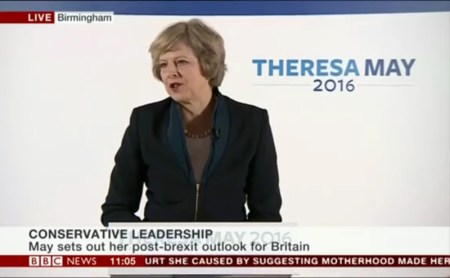
1693The glaring discrepancy between the UK establishment and the electorate explains the establishment’s quick acceptance of Brexit, for fear of becoming totally discredited. Pictured above: Theresa May launches her campaign for leader of the UK Conservative party on July 11, 2016, saying “Brexit means Brexit.”

The two earlier articles mentioned above first spotted the phenomenon of European disintegration and then explained it. Today, the intervening events have made the explanation all the simpler. Basically, the European political elites were correctly convinced, long ago, that considerable European integration was desirable, but their very successes in this area made them grossly overestimate what could and should be done further.

Up to a decade ago, it seemed that a similar pattern was becoming established in one EU country after another: the parliament was dominated by a large center-right party and a large center-left party that alternated in power from one election to another. The parallel to the United States seemed obvious, but the parallel was illusory, as we shall show.

Emboldened, the political parties concerned made the fatal mistake of trying to combine for the purpose of elections to the EU Parliament. Thus emerged a pan-European center-right pseudo-party, the “European People’s Party” (EPP), whose origins go back to a get-together of Christian Democrat parties in 1976. And a pan-European center-left pseudo-party, the “Party of European Socialists” (PES), founded in 1992 as an alliance between old-style Social Democrat parties and the former so-called Eurocommunist parties. The latter first emerged during the decline and discreditation of the Soviet Union in the 1970s and 1980s, then changed their names after its disappearance in December 1991. Thus, the core of Italy’s current Democratic Party derives from the Italian Communist Party (PCI), the major opposition party of post-war Italy.

Curiously but inevitably, the more those parties tried to unite, the more they lost support in their own countries of origin. Thus the Dutch Christian Democrats (CDA) are today a minor party of the right and the Panhellenic Socialist Movement (PASOK) barely crosses the threshold of 5% needed for entry into the Greek Parliament. (Incongruously, the last PASOK Prime Minister of Greece, George Papandreou, continues to be President of the Socialist International.) The reason for this development, however, is not far to seek.

Nationalism, it was forgotten, is an essential component of center-right sentiment. So a center-right party that prefers an international interest at the expense of the national interest of its own country loses credibility among its own core supporters; it becomes vulnerable to the rise of far-right upstart parties. Examples of this process in the EU are now so evident as not to need enumeration.

The attraction of socialism, it was forgotten, is that its core supporters expect increases in government social spending at the expense of financial stability. This becomes more difficult, the more a country is constrained by participation in a shared international framework. It becomes impossible to maintain once a country joins a common currency, since the usual remedy for socialist overspending is devaluation of the national currency. This is why PASOK has been eclipsed in Greece by the far-left SYRIZA, why the Spanish franchise of the PES (the PSOE) has lost severely to the upstart Podemos, and why support for its Dutch franchise (the PvdA) is now down to about the same as for each of two other left-wing parties.

It is also why in Britain, where the electoral system obstructs the rise of new parties, Jeremy Corbyn was voted leader by the Labour Party membership to the horror of the party establishment. Corbyn himself was a pronounced Euroskeptic until recently and only half-heartedly spoke in public for Remain, creating suspicions that he secretly voted for Leave.

A far-right party, like the Freedom Party (OFP) of Austria, has an easy sales pitch. Not so the far-left ones: after they come to power, it quickly and painfully becomes evident that they have no more ability than their derided Social Democrat predecessors to defy the constraints imposed by membership in the Eurozone.

Thus SYRIZA came to power in Greece and won a referendum to end austerity. The result was that all Greeks found that their bank accounts were virtually frozen: they were allowed to withdraw only sixty Euros a day. SYRIZA then split. The larger faction won the resulting general election and accepted the harsh conditions that the referendum had rejected. The paradoxical result in Greece is that the current government is a coalition of an upstart far-left party, SYRIZA, and an upstart nationalist party (the Independent Hellenes) that lies to the right of New Democracy (the Greek franchise of the EPP).

In other EU countries, however, the typical development has been the opposite: the erstwhile competing franchises of the EPP and the PES are in coalition against the motley upstart breakaway parties, since neither of the two gets an absolute majority in parliament any more. That is, their former raison d’être as competing alternatives has been abandoned in the need to survive in power at all. The paralysis in Spain comes from the fact that the two local franchises there are descended from the two sides in the murderous Civil War of 1936-1939. Joint government is still hardly imaginable especially for the losing socialists, who continued to suffer persecution long after the war.

Likewise, in the elections to the EU Parliament in May 2014, the EPP and the PES won only 221 and 191 seats respectively out of 751, each far short of a majority. So they clubbed together to make the top candidate of the EPP, Jean-Claude Juncker, President of the EU Commission and to retain the top candidate of the PES, Martin Schulz, as President of the Parliament. The incredible response of Juncker to Brexit has been to demand even tighter integration: he wants to force into the Eurozone the eight EU member states (other than the UK) that still have independent currencies. He also reiterated his proposal, originally made last March, to unite the armed forces of all states (with the UK gone) into a European army. For this he has the support of Schulz’s home party, the German SPD. That is, they want more and more of what the European electorates want less and less.

Especially in Eastern Europe, there are now also governments that resent the relentless centralizing urges of the EU establishment. In Hungary, for example, the government has rejected the demand of the EU Commission to absorb a quota of the immigrants currently streaming into Europe; it has scheduled a referendum on the matter for October 2. On the same day, Austria will hold a revote for the presidency, which the Freedom Party may narrowly win after narrowly losing the first time around.

These governments are among the new friends of Israel described in a recent Reuters article, titled “Diplomatic ties help Israel defang international criticism.” As it notes:

“Whereas a few years ago Israel mostly had to rely on Germany, Britain and the Czech Republic to defend its interests in the EU, now it can count Italy, Greece, Cyprus, Austria, Hungary and a handful of others among potential allies.”

These allies have no desire to penalize Israel on behalf of increasingly tedious Palestinians. On the contrary:

“Like Turkey, which last week agreed to restore diplomatic ties with Israel after a six-year hiatus, they see a future of expanding business, trade and energy ties.”

By “energy ties” is meant Israel’s recently discovered vast fields of natural gas, the phenomenon that we earlier dubbed “Israel as a Gulf State.” That is: just as governments care little for the human rights record of, say, Qatar in their eagerness to acquire its natural gas, so also the self-righteous moaning of the Palestinian Authority does not deter those governments from going for what Israel has to offer. As the Reuters article quotes a European ambassador: “There’s just no appetite to go toe-to-toe with Israel and deliver a really harsh indictment. No one sees the upside to it.”

Israel’s government is not, of course, gloating over the discontent spreading in the EU. But it surely appreciates some of the side effects.

“Gangster Islam” in Europe

July 12, 2016

“Gangster Islam” in Europe, Gatestone Institute via YouTube, July 12, 2016

The blurb beneath the video states,

“Gangster Islam,” a crime wave packing prisons and overtaking Europe, is a problem the mainstream media will not report. Ordinary Europeans — for fear of being called “racist” or even being imprisoned for “hate speech” — are afraid even to talk about it.

We Saved Our Democracy

July 7, 2016

We Saved Our Democracy, Pat Condell via YouTube, July 7, 2016

(Perhaps American will vote for her own Brexit on November 8th. — DM)

Independence and Identity: What Israel Knows, Europe Has Forgotten, and America May Yet Remember

July 4, 2016

Independence and Identity: What Israel Knows, Europe Has Forgotten, and America May Yet Remember, American ThinkerAbe Katsman, July 4, 2016

The Fourth of July is beautiful.  Independence Day marks arguably the most consequential positive political event in history and deserves every bit of the enthusiastic celebration with which it is observed.  Yet the day goes by insufficiently appreciated by so many – a symptom of the erosion of our American identity.

For some perspective, let’s start by looking at Memorial Day.  In Israel.

Israel.  Yom Hazikaron (Israel’s Day of Remembrance) is ushered in by a wailing siren.  Everyone – even drivers on the freeways – stops in his tracks for a minute of mournful silence.  The somber mood of the day is everywhere: no hot dogs or barbecues; no sales at the malls.  No rock music on the radio; no Friends reruns or light entertainment on TV – just reflective songs, unvarnished war documentaries, heart-piercing interviews with families of fallen soldiers, and coverage of countless memorial ceremonies at the nation’s cemeteries.  It is a poignant day, dripping with tragedy, loss, sacrifice, and suffering – but also with heroism, pride, honor, and gratitude.

Does that sound like your Memorial Day?

Israel may be unique in the intensity with which it observes Yom Hazikaron.  But other nations, including America, would be wise to learn from Israel about how and why it honors its fallen as it does.

Yom Hazikaron honors the 23,000 Israeli lives lost – mostly young citizen-soldiers, as well as some 2,500 terror attack victims – in modern Israel’s never-ending struggle to exist.  It is a heavy day, and everyone feels its weight: as a small nation resurrected in the wake of the Holocaust, with a culture that places a premium on each individual life, Israel knows too well not only that its freedom isn’t free, but that it comes at a steep, painful price.

As night falls on Yom Hazikaron, there is a jarring transition to raucous celebration: Yom Ha’atzmaut, Israel’s Independence Day, begins.  There are fireworks, official ceremonies and celebrations, street partying, and happy prayers of thanksgiving.  There are military flyovers, ubiquitous barbecues, and the International Bible Contest finals.  And there is an outpouring of national pride and a sense of accomplishment over how the country has survived and thrived for yet another year, feelings intensified by an appreciation for the fragility of its very existence.

Though quite the 48-hour emotional rollercoaster, the two days add depth and meaning to one another.  As painful as that price has been for Israel to gain and maintain independence, it is dwarfed by the price the Jewish people paid for their prior statelessness.

These two days are a distillation of Israelis’ remarkably strong sense of national identity, healthy cultural confidence, and appreciation for the state they have – imperfect as it may be.  These are sentiments widely shared, even – perhaps especially – by Israel’s sizeable population of immigrants from around the globe.

That is all well and good for Israel.  What is worrisome is that such a strong national identity, though once the norm, has become aberrational in the Western world.  The failure to nurture national identities among new generations and new immigrants threatens the survival of the culture and values Western nations once strongly stood for.

Europe.  The competing cultures of European nations once proudly rivaled each other, spawning revolutions in philosophy, law, science, art, exploration, industry, religion, and academia while raising the prosperity, education, and human rights levels of millions in the process.

But nationalism run amok was also a factor in Europe’s bloody wars.  Since the end of World War II, nationalism-phobia has driven Western European governments.  Though nationalism has only once mutated into Nazism, European elites threw out the baby with the bathwater: to ensure that expansionist racial fascism would not rise again, European leaders strove to minimize individual nationalisms and shrink the autonomy of individual states, cobbling together instead a new, transnational, pan-European identity.

They succeeded, perhaps too well, at diminishing the particular nationalisms of individual states.  Their artificial new Europeanist substitute, however, is a watery, post-Christian, least-common-denominator amalgam which fails any identity’s most basic test: hardly anyone is inspired to identify with it.  As Europeans lament the failure of waves of Middle Eastern and North African immigrants to assimilate, perhaps one question that should be asked is, assimilate into what, precisely?

European nations used to make history happen; “Europe” now passively endures history happening to it.  The U.K. Brexit vote notwithstanding, the exploding rates of violent crime (particularly rape), the metastasizing of terror cells, and the proliferation of no-go zones of debatable sovereignty  seem not to rouse paralyzed mainstream political leaders to act in defense of any cultural value other than so-called multiculturalism.

As cultural identities erode, so erode the senses of purpose, belonging, meaning, inspiration, and cultural confidence of citizens.   Identity-stripped societies are marked by risk aversion, listlessness, passivity, economic stagnation, lack of innovation, and – perhaps most ominous – sub-replacement-level birth rates.  (Israel, notably, has by far the highest fertility rate of any OECD country.)  The European nations, by and large, no longer seem to understand who they used to be or what they are becoming.  They have lost their way.  They are cultures in retreat.

America.  The Unites States has not yet traveled as far down the post-nationalist cul-de-sac as has Europe, but it is heading in the same direction.

We may feel Americanism in our bones, but that does not make it part of our DNA; it is not inherited automatically.  An understanding and appreciation of what America means requires transmission to each new generation.  Yet that transmission is getting ever weaker: it is no longer fashionable within the education establishment to teach students about American exceptionalism or why tens of millions fled their own countries, immigrated to America’s shores, and proudly adopted American identities and values or the degree to which America has been an unparalleled force for liberty and decency in the world.  (It doesn’t help matters that our post-nationalist president, not shy with opinions about everything else, rarely speaks of American greatness, past or present.)

Universities long ago abandoned any thought of instilling in all students some understanding and appreciation for Western and American civilization.  Instead, students are taught the arts of grievance-manufacturing and victimhood, of countering privilege and power structure, of squelching free speech and seeing a complex world exclusively through the race/class/gender prism, and of becoming expertly hypersensitive to nano-aggressions and cultural appropriations.  A wrecking ball of intellectually lazy cultural and moral relativism has displaced the Western/American canon.

Students come out of college arguably are even more ignorant of their Americanism than when they entered.  By signing the Declaration of Independence, men of wealth and stature effectively signed their own death warrants, all in the name of political principle.  Yet if university students are taught anything about those who committed their lives, fortunes, and sacred honor to secure the liberty these students take for granted, it is that the founders were privileged white male slaveholders, thus more deserving of contempt than deep study.

There is far more sense of entitlement and cynicism about America inculcated on campus than sense of appreciation and gratitude for what it means to be American, or for the ultimate sacrifice of 1.35 million American war dead.  And every year, America’s colleges churn out another 3 million graduates thus indoctrinated.

There are only a few remaining cultural institutions where Americanism is honored: the military, talk radio, and country music come to mind.  The prevailing mass cultural influences at best reflect mild embarrassment over American pride and patriotism.

Reclaiming Identity.  National identity does not mean lockstep unity or uniformity, cheerleading, or papering over a nation’s faults.  Israel, for example, soberly faces monumental challenges both internal and external, and Israeli society is fundamentally fragmented – too often along demographic lines – in how to approach them.  While American politicians sometimes call for “national conversations,” Israeli citizens live in one.  Yet Israel’s rollicking, caustic debates, frequently over core questions of just what Israeli identity means, are themselves part of that identity.

Every nation needs to find its own path to instill identity in its people and an understanding of why it is worth preserving.  In Israel’s case, as fractious as society may be, it has utilized several tools to forge its strong sense of common identity.  Through maintaining a strong Jewish historical memory and reconnecting to an ancient homeland; through breathing new life into its historic, though largely dormant, Hebrew language; through ingathering of exiles and rescue of persecuted Jews around the world; and through surviving crises together against often daunting odds, the Jewish people have re-created the nation of Israel.  Infighting aside, there is a widespread sense of shared fate and a still potent recollection of pre-state Jewish powerlessness.  Reinforced through common tradition, education, and ceremony – including Yom Hazikaron and Yom Ha’atzmaut – that powerful identity has kept Israelis together through some dangerous, trying times.

Tragically, reclamation of national identity may well be a lost cause in several European states.  But it is not yet lost in America.  The feelings of gratitude and appreciation for being American, and of understanding what America has meant to ourselves and to the wider world, still run deep in much of the population, in spite of prevailing cultural antipathies toward such attitudes.  But those sensibilities are endangered by insufficient transmission of American identity from one generation to the next and are in dire need of reinforcement.

America has always been a model to Israel of so much worth emulating.  Perhaps in the realm of strengthening of national identity, Israel can return the favor.

There are no simple solutions.  But we might start with something simple: perhaps it’s time to establish an Independence Day custom of sounding sirens for a national minute of silence.  Everyone can share a collective moment to honor the price paid for our liberty.  Linking the sacrifice of others with our own Independence Day celebration of freedom is a good way to enhance the respect and appreciation for both.  It is a small step, but it is at least a step forward, toward strengthening our American identity.