Archive for the ‘Al Qaeda’ category

Taliban rejects US general’s call for reconciliation

March 3, 2017

Taliban rejects US general’s call for reconciliation, Long War Journal, March 2, 2017

It is high time that US officials and military commanders put an end to calls for the Taliban to reconcile. After 15 plus years of war, the Taliban has proven to be a committed enemy unwilling to compromise to achieve its objective of ruling Afghanistan again. The Taliban and al Qaeda remain close allies to this day. When US leaders plead with the Taliban to make peace, they deliver the Taliban all of the fodder it needs to score a propaganda victory and show how disillusioned the US remains about their enemy.

********************************

Hours after The FDD’s Long War Journal noted the Taliban would likely reject US General John Nicholson’s call for reconciliation, the Taliban did just that yesterday.

Nicholson, the commander of US Forces – Afghanistan and Resolute Support, was quoted in a press release announcing the death of Mullah Abdul Salam, the Taliban’s shadow emir for Kunduz province:

Salam’s death is an opportunity for change. The people of Afghanistan want peace and the Government of Afghanistan is committed to achieving peace through reconciliation. The Taliban know the only path forward is reconciliation.

US, European, and Afghan officials had been urging the Taliban to reconcile for well over a decade. But the Taliban had proven unwilling to negotiate a peace deal and join the government, even after suffering setbacks.

Taliban spokesman Zabihulllah Mujahid rejected the call for reconciliation in a statement entitled “Response by spokesman of Islamic Emirate to comments by General Nicholson.” Predictably, Mujahid said that the Taliban would fight until NATO forces withdraw from Afghanistan and “accept the lawful demands of the valiant Afghan,” which means the return of a Taliban government. The crux of Mujahid’s argument is quoted at length below:

The Muslim Afghan nation views you Americans with the same eye as the invading English and Soviets and with the blessing of Jihad and help of Allah, will throw you out of their motherland in a similar fashion.

We do not view the martyrdom of Mullah Abdul Salam as failure or regret but as honor and victory which has intensified the thirst for revenge of the people of Kunduz and Afghanistan. It has revealed the truthfulness of the Mujahideen and has further increased the love for Mullah Abdul Salam and his companions in the community. Understand that we are a nation that loves martyrdom in the path of Allah as you love the short life of this fleeting world.

These are not our emotions or assumptions talking but are the realities which forced over one hundred and fifty thousand fully equipped troops to kneel.

If you do not end this occupation and accept the lawful demands of the valiant Afghan nation then this nation (Allah willing) will force you out of Afghanistan as the commander of US and NATO forces with all your might and technology just as this resistance broke, deranged and forced out your most celebrated commanders and experienced generals.

It is high time that US officials and military commanders put an end to calls for the Taliban to reconcile. After 15 plus years of war, the Taliban has proven to be a committed enemy unwilling to compromise to achieve its objective of ruling Afghanistan again. The Taliban an al Qaeda remain close allies to this day. When US leaders plead with the Taliban to make peace, they deliver the Taliban all of the fodder it needs to score a propaganda victory and show how disillusioned the US remains about their enemy.

Al Qaeda back in the crosshairs–and with good reason

February 6, 2017

Al Qaeda back in the crosshairs–and with good reason, Terror Trends Bulletin, Christopher W. Holton, February 5, 2017

map-al-qaeda-2015

There is growing evidence that, not only did Barack Obama allow the Islamic State caliphate to become established and metastasize on his watch, but he also looked the other way while Al Qaeda became resurgent.

Sean Durns over at the Washington Examiner has an article that summarizes how Al Qaeda has spread in recent years…

Al Qaeda, the group responsible for the worst terrorist attack in United States history, never really left. Instead, while news media coverage inordinately focused on the Islamic State, al Qaeda re-tooled and re-established itself for a new age.

To paraphrase Mark Twain, reports of al Qaida’s death were greatly exaggerated. Anticipatory obituaries appeared after the death of al Qaida founder Osama bin Laden on May 2, 2011. Then-President Barack Obama, for instance, said on Sept. 10, 2011 that al Qaeda was “on a path to defeat.” Similarly, then-Secretary of Defense Leon Panetta said in July 2011 that the U.S. was “within reach of strategically defeating al Qaeda.”

But as terror analysts Daveed Gartenstein-Ross and Bridget Moreng pointed out in an April 2015 op-ed, “The Islamic State’s offensive through Iraq and Syria last year has dominated the headlines, but the jihadist group that has won the most territory in the Arab world over the past six months is Al Qaeda.”

http://www.washingtonexaminer.com/al-qaeda-is-back/article/2613929

As a result, not only has Donald Trump inherited the Islamic State caliphate, he has also inherited an Al Qaeda that is rebounding.

As Trump promised in his campaign, he is taking the war to the enemy. U.S. Special Operations Forces carried out a raid on an Al Qaeda in the Arabian Peninsula (AQAP), a raid that has been the subject of much partisan bickering.

The Leftist news media is predictably celebrating the raid as “botched,” which is typical of their ignorance of military operations. They have evidently grown used to drone strikes which kept national command authority’s image squeaky clean, but also failed to achieve much of anything, given the growth of both Al Qaeda and the Islamic State. To put it mildly, the media is overeager to see the new administration fail and will report everything as a failure.

Nevertheless, the raid reportedly killed two senior AQAP Jihadists, Sultan al-Dhahab and Abd-al-Ra’uf al-Dhahab. It was sufficiently successful to prompt the leader of AQAP, Qasim Al-Raymi, to issue a call for revenge against the U.S.

The media is also all-too eager to buy into the enemy propaganda that the U.S. raid killed civilian women and children. There is no evidence either way and there is sufficient precedent for women and even children to act as combatants for Jihadist organizations, so if they were killed, they are simply casualties of war.

Bill Roggio at Long War Journal has a good report on the renewed campaign against Al Qaeda…

http://www.longwarjournal.org/archives/2017/02/us-military-says-aqap-leaders-killed-in-raid.php

Al Qaeda Chief: Use of Female Guard Denies Him Justice, Violates Muslim Rights

February 3, 2017

Al Qaeda Chief: Use of Female Guard Denies Him Justice, Violates Muslim Rights, Judicial Watch, February 2, 2017

An Al Qaeda leader and close associate of 9/11 mastermind Khalid Sheikh Mohammed (KSM) accused the U.S. government of denying him justice because a female guard escorted him to a recent court hearing in violation of his Islamic religious beliefs. His name is Abd al Hadi al Iraqi, one of 17 high-value prisoners at the U.S. military compound in Guantanamo Bay, Cuba and he’s being tried for running Al Qaeda’s army in Afghanistan, ordering attacks against American and coalition forces and civilians.

Judicial Watch was present at Hadi’s proceedings and has covered almost all the Military Commission hearings since KSM’s arraignment in 2008. The Department of Defense (DOD) approved Judicial Watch to monitor the terrorist trials as a Non-Governmental Organization (NGO) and Judicial Watch attorneys, investigators and reporters have witnessed a deep commitment to justice by military and civilian lawyers involved in the proceedings. Trials and hearings are held in a specially constructed, top security courtroom at the Naval Station in southeastern Cuba. Judicial Watch has also covered every proceeding conducted by President Obama’s special Guantanamo Periodic Review Board (PRB) via live broadcasts at the Pentagon. Comprised of senior officials from the departments of Defense, Homeland Security, Justice and State, the board reviews whether continued detention of certain individuals remains necessary to protect against significant threat to the security of the United States.

The charges against Hadi, an Iraqi national in his 50s, extend more than ten pages and outline his relationship with Osama bin Laden and plans to execute Al Qaeda’s objectives of “killing Americans and other civilians.” He is also charged with killing a U.S. solider, injuring and killing numerous German soldiers and planning a number of other attacks. In 2002, Hadi and KSM plotted to assassinate Pakistani President Pervez Musharraf, according to his DOD charging document. At the same time, KSM gave Hadi $100,000 for Al Qaeda operations and Hadi ordered numerous attacks against coalition forces in Afghanistan as well as civilians working for the United Nations. Hadi was captured in Gaziantep, Turkey while traveling from Afghanistan to Iraq in October 2006, the military file states.

During a recent arraignment in Gitmo, Hadi refused to be transferred to the courtroom by a group of guards that included a female because being touched by a strange woman violates his religious beliefs. His attorneys asked the military judge to replace the female guard with a man, but the judge refused. No criminal justice system in the world allows the defendant to decide the rules of the court. Furthermore, sidelining a woman at the request of the defendant goes against any moves the military has made to treat men and women equally. Hadi was eventually brought into the courtroom against his will, shackled into a wheelchair with straps that resembled a seatbelt on an airplane. He waved his arms, requesting permission to address the court and the military judge allowed it. Hadi rambled on about his religious rights and said that when a female guard tries to escort him he will not be able to meet with his lawyers and won’t come to court. “So I don’t know how we can achieve justice here,” he told the judge. A Middle Eastern news report on Hadi’s arraignment points out that the Islamic State is notorious for raping helpless Kurdish women and no extremist organization, including Al Qaeda, complains that it violates Islamic rules.

In 2015 Hadi’s attorneys filed a request for religious accommodation with the Office of Military Commissions in an effort to dictate the compound’s guard schedule. The document says Hadi is a “devout Muslim” and it’s a violation of his Islamic faith to have physical contact with females that aren’t his wife or close relatives. “Islam is two things—worship and rules,” the document states. “Both come from God as revealed to the Prophet.” The document proceeds to reveal that Hadi has been forcibly extracted three times because of his religious beliefs and that he will continue to resist when a female guard is assigned to him. “If female guards must have physical contact with me to bring me to meetings with my attorneys or to court, my faith requires me to refuse those movements, and I will continue to refuse them…”

UK jihadi freed from Guantanamo flees to Syria to join al-Qaeda

January 8, 2017

UK jihadi freed from Guantanamo flees to Syria to join al-Qaeda, Jihad Watch

All the UK-related Guantanamo inmates have now been released and, between them, have received a total of £20 million in High Court compensation paid for by the British taxpayer.

The money was handed over after detainees sued MI5 and MI6 for complicity in their alleged torture at the hands of the Americans.

*********************************

Obama plans, in his final days in office, to replenish the enemy ranks even further by freeing more hardened, committed, battle-trained jihadis from Guantanamo.

guantanamo

“British jihadi who was freed from Guantanamo Bay ‘has fled to Syria to join Al Qaeda,’” by Omar Wahid and Nick Craven, The Mail on Sunday, January 7, 2017 (thanks to David):

A jihadi from Britain who claims to be a former Guantanamo Bay detainee has fled to Syria where he is now fighting for Al Qaeda.

The terrorist – who has dubbed himself Abu Mugheera Al-Britani, meaning ‘from Britain’ – has written in detail about his experience in the notorious US prison camp.

Although Al-Britani’s real identity has not been established, at least 16 UK nationals and residents were held at the military camp in Cuba.

His account will fuel concerns that some freed terror suspects have not abandoned their fanatical ideology and could remain a threat to the public. It will also raise fears that compensation paid to former inmates is helping to fund terror campaigns.

All the UK-related Guantanamo inmates have now been released and, between them, have received a total of £20 million in High Court compensation paid for by the British taxpayer.

The money was handed over after detainees sued MI5 and MI6 for complicity in their alleged torture at the hands of the Americans.

Al-Britani claims he ‘spent years’ at Guantanamo Bay, where more than 700 of the world’s most dangerous Islamic terrorists were imprisoned in the aftermath of 9/11.

In an online magazine for fanatics, he writes: ‘Sitting in the blessed land of al-Shaam [Greater Syria], reflecting on those weeks and days spent behind bars, I thank Allah for releasing me and providing me with the opportunity of carrying out jihad in his path again.’…

German ambassador killed by Nusra jihadist

December 19, 2016

German ambassador killed by Nusra jihadist, DEBKAfile, December 19, 2016

(The author probably meant Russian ambassador rather than German ambassador. Update: DEBKAfile fixed it. Please see also, Video: Turkish Muslim screaming “Allahu akbar” murders Russian ambassador. — DM)

russianambasador480

The 22-year old Turkish special operations police officer Mevlut Mert Altintas, who assassinated Russian Ambassador Andrei Karlov in Ankara Monday, Dec. 12, was a member of the Nusra Front, Al Qaeda’s Syrian branch. Atlintas approached the ambassador as he gave a speech opening a photo exhibit in the Turkish capital and shot him in the back five times. After yelling “We die in Aleppo, you die here,” he recited sentences from an Arabic prayer which are Nusra’s anthem. He went on shouting “We made an oath to die in martyrdom…it is revenge for Syria and Aleppo.”

He is believed to have added: “Until they are safe, you will not taste safety. Get back, only death will take me from here.”

It is not clear if the killer was a member of the detail guarding the ambassador, or obtained access to the gallery because the guards knew him and did not stop him going up to his target. He was smartly turned out in a dark suit and tie (like the terrorists from Jordan who attacked a Tel Aviv market on June 8 and killed three people)

Moscow’s decision to substantially intervene in the Syrian war in September to save the Assad regime was prompted additionally by the outstanding combat performance of the Nusra Front rebels. Furthermore, according to new figures just released in Moscow, 2,000 Russian jihadists were killed on the Syrian front against Assad. DEBKAfile’s sources have found that the majority belonged to the Nusra Front.

Its members are being evacuated from Aleppo in large numbers in the last 24 hours, after being driven out of east Aleppo in a bitter defeat. The Nusra chief Mohammad al-Jawlani holds Russia and especially President Vladimir Putin responsible and views them as the group’s nemesis.

Since the assassin was killed, it will be difficult to establish whether he acted alone and who his contacts were in Turkey and Syria. It won’t be easy to discover if and how far Turkish Special Forces have been penetrated by Al Qaeda’s Nusra agents.

The very fact that one of those agents, a Turk, was admitted to an elite police outfit without being discovered by Turkey’s MIT intelligence service indicates how vulnerable Turkey is to insider attack by radical Islamist organizations.

DEBKAfile’s counterterrorism and intelligence sources report that the last three terrorist atrocities perpetrated in the Middle East attest to the increasing audacity of the Islamist organizations, and the incompetence of national counter-terror agencies to cope with this new wave of violence.

The Dec. 12, assault on the Coptic cathedral in Cairo, which left 25 dead, was conducted by an ISIS team from Raqqa in Syria, which spent some time in the city without discovery.

Sunday, Dec. 18, saw a string of terrorist attacks in Jordan, in which 10 people were killed that were also tied to ISIS. And the next day, Monday, the Russian ambassador to Turkey was assassinated by an operative of Al Qaeda’s Nusra front.

Also on Monday, a truck crashed into a Christmas market in Berlin, killing several people, in what appears to be part of the holiday offensive threatened by ISIS in Europe as well as the Middle East. A similar Islamist truck attack in the summer holiday in Nice, the French Riviera, killed 87 people. .

Islamic State, a new and deadlier enemy

September 27, 2016

Islamic State, a new and deadlier enemy, The Gorka BriefingSebastian Gorka, PhD, September 26, 2016

isw

An analysis/opinion piece that my wife Katharine and I wrote that was published in the Washington Times:

On the evening of May 2, 2011, America had a chance at closure.

We had lost thousands of our fellow Americans nine years earlier on that beautifully sunny September morning, and thousands more of our citizen-soldiers on the battlefields of Afghanistan and Iraq.

But now President Obama gave the word: The master jihadi is dead.

In an audacious operation deep within Pakistan, Osama bin Laden had been located. And killed. Al Qaeda would soon be described by the commander in chief, as “on the ropes,” condemned to ever-increasing irrelevance. But this was not the end. There would be no closure for our nation.

A new, deadlier enemy has since emerged. A foe responsible for the carnage of San Bernardino and Orlando, and scores of attacks around the world. Now we are at war with the Islamic State — a threat group that has already claimed responsibility for one of the recent attacks — and its new caliph, Abu Bakr al Baghdadi. Al Qaeda may no longer frighten us, but the Islamic State has dethroned it and is on the march.

We may be in the final stages of a presidential campaign which has polarized opinion on all matters, mundane and significant, but the facts speak for themselves.

According to the National Counterterrorism Center, part of the Office of the Director of National Intelligence, the Islamic State currently has “fully operational” affiliates in 18 nations around the world. Two years ago, the number was seven. Some of these branches are far from Iraq and Syria, including Afghanistan, where numerous Taliban commanders have sworn allegiance to Abu Bakr, and Nigeria, where Boko Haram — one of the deadliest jihadi groups active today — has changed its name to the West Africa Province of the Islamic State. According to the analysts of the SITE Intelligence Group, the totalitarian message of jihadism is so popular around the world that since June 2, outside the war zones of Iraq and Syria, there has been a jihadi attack somewhere around the world every 84 hours.

But does this mean that Americans are in greater danger today than on Sept. 10, 2001? Unfortunately, the answer is a resounding yes, and the empirical data is merciless in its incontrovertibility.

In its latest report titled “Muslim-American Involvement with Violent Extremism,” the University of North Carolina has compiled all the metadata on jihadi plots on U.S. soil since 2001. The trend they describe is an exponential one. The number of successful and intercepted terrorist attacks has grown every year (with an inordinate spike in 2009), and most disturbingly, with 2015 witnessing the greatest number of jihadi plots in America since the Sept. 11 attacks 15 years ago. Jihadism has not been weakened. Not abroad. Not in the States. With the attacks in California, Florida, and now apparently Minnesota, and potentially New York and New Jersey, ISIS has displaced al Qaeda, and it has done so here in America, too, not just in the Middle East or Africa.

In our report “ISIS: The Threat to the United States,” we answer the same question for the Islamic State that the University of North Carolina answered for all jihadists secreted within America.

The facts prove than our new enemy is more prevalent than al Qaeda ever was, with federal and state law enforcement arresting three times as many ISIS supports per month than the average for al Qaeda arrests since 2001. Here are the numbers: Since Abu Bakr declared the new caliphate from the pulpit of the Grand Mosque of Mosul at the end of June 2014, we have killed or interdicted 110 terrorists linked to ISIS, (the last one being two weeks ago in Roanoke, Va). And when one looks at what they were actually doing the picture is grimmest of all.

Just over 40 percent had sworn allegiance to ISIS and were set on leaving the United States to fight for jihad in Iraq and Syria. Just under 20 percent were management-level terrorists, the talent-spotters and recruiters who were facilitating the foreign passage of the “travelers,” as the FBI euphemistically calls them. But a full third of the ISIS suspects, like the San Bernardino killers, and Omar Mateen, the Orlando jihadi, had already decided that they could best serve the new Islamic State not by leaving but by killing infidels here on U.S. soil. This is the reality of life in the West today. Whether it is in California or Florida, or in Brussels, Paris or Nice.

As we start the 16th year of what has turned into our longest war ever, we must radically reassess our strategy for victory. The Islamic State has displaced al Qaeda and it is richer, better at propaganda, and has more fighters than bin Laden ever had.

November represents not only a choice of who the new commander in chief should be, but also what our new strategy to defeat ISIS and the global jihadi movement should be. We owe at least this to the memories of those lost on the beautifully sunny morning 15 years ago.

Pentagon’s top brass explores Islamic ideology’s ties to terror

September 26, 2016

Pentagon’s top brass explores Islamic ideology’s ties to terror, Washington TimesRowan Scarborough, September 25, 2016

obamadunfordPresident Barack Obama walks with Marine Gen. Joseph Dunford Jr., his nominee to be the next chairman of the Joint Chiefs of Staff, after speaking in the Rose Garden of the White House in Washington, Tuesday, May 5, 2015.

U.S. Special Operations Command has privately pressed the staff of the nation’s highest-ranking military officer to include in his upcoming National Military Strategy a discussion of the Sunni Muslim ideology underpinning the brutality of the Islamic State group and al Qaeda.

Thus, behind the scenes, the Pentagon’s top brass have entered a debate coursing through the presidential campaign: how to define an enemy the U.S. military has been fighting for 15 years.

The National Military Strategy, authored by the Joint Chiefs of Staff chairman, is one of the most important guidances issued to global combatant commanders. It prioritizes threats to the nation and how to blunt them.

The 2015 public version does not mention Islamic ideology. It lists terrorists under the ambiguous category of “violent extremist organizations” and singles out al Qaeda and the Islamic State group.

Marine Corps Gen. Joseph F. Dunford took the chairmanship of the Joint Chiefs of Staff two months later and is now preparing his first National Military Strategy.

It is during this process that Special Operations Command, which plays a major role in hunting down terrorists, has provided its input to the Joint Staff, Gen. Dunford’s team of intelligence and operations officers at the Pentagon.

Special Operations Command wants the National Military Strategy to specifically name Salafi jihadism as the doctrine that inspires violent Muslim extremists. Salafi jihadism is a branch within Sunni Islam. It is embraced by the Islamic State and used to justify its mass killings of nonbelievers, including Shiite Muslims, Sunnis and Kurds, as well as Christians.

People knowledgeable about the discussion told The Washington Times that SoCom has not been able to persuade Gen. Dunford’s staff to include Salafi jihadism in any strategy draft. It is unclear whether Gen. Dunford has been briefed on the proposals.

Spokesmen for the Joint Staff and U.S. Special Operations Command in Tampa, Florida, told The Times that they could not comment on a pending strategy. Gen. Dunford’s strategy will be classified in its entirety, meaning there will be no public version as was issued by his predecessor, Army Gen. Martin Dempsey, in 2015.

Special Operations Command is headed by Army Gen. Raymond A. Thomas III, a veteran terrorist hunter who led Joint Special Operations Command, the unit that killed Osama bin Laden and many other extremists.

There does not appear to be an effort to include the words “radical Islamic terrorism” in the strategy. But including a discussion of Salafi jihadism would tie acts of terrorism to Islamic ideology.

President Obama has fiercely rejected any connection between Islam the faith and al Qaeda, the Islamic State or any other Muslim terrorist organizations. He argues that they have corrupted the teachings of the Prophet Muhammad and the Koran. His administration refers to them as simply “extremists.”

The counterargument from many U.S. national security analysts and Muslim scholars is that mass killings are rooted in the Koran and other primary writings and preachings of credible Islamic scholars and imams. These teachings at some mosques and on social media encourage youths to become radical Islamists.

Abu Bakr al-Baghdadi, the ruthless Islamic State founder, is a cleric who studied at a seminary in Iraq. Al-Baghdadi has a Ph.D. in Koranic studies from Iraq’s Saddam University.

‘War of ideas’

If the cycle of global jihadism is to be broken, they say, U.S. officials must accurately assess the nature of the threat and its doctrines. If not, Gen. Dunford’s National Military Strategy is, in essence, directing commanders to ignore threat doctrine and relinquish the information battlefield to the enemy.

“If you look at threat doctrine from that perspective, it’s a much bigger problem because it’s not just the violent jihadists; it’s the nonviolent jihadists who support them,” said one person knowledgeable about the National Military Strategy. “Pretending there is no relationship between the violent jihadists and Islam isn’t going to win. We’re completely ignoring the war of ideas. We’re still in denial. We’re pretending the enemy doesn’t exist.”

A joint counterterrorism report by the American Enterprise Institute and the Institute for the Study of War concluded:

“Salafi-jihadi military organizations, particularly ISIS and al Qaeda, are the greatest threat to the security and values of American and European citizens.”

The Islamic State is also known as ISIS, ISIL and Daesh.

Albert M. Fernandez, who was the State Department’s chief of strategic communication, said that on some level, if not the U.S. directly, people need to talk about the form of Salafi jihadism that promotes violence.

“Using the word ‘extremism’ is extraordinarily vague language,” he said.

Some voices in the Muslim hierarchy differ with Mr. Obama and say the encouragement of violence is a problem that Islam must confront.

One such leader is Hassen Chalghoumi, imam of the Drancy Mosque in Paris. France has Europe’s largest Muslim population and has been wracked by a series of brutal terrorist attacks planned and inspired by the Islamic State.

Mr. Chalghoumi spoke last year at a conference in Washington sponsored by the Middle East Media Research Institute, which tracks jihadi social media and promotes moderate Islamic leaders.

Mr. Chalghoumi said mosques are one “battlefront” in the war on extremism.

“The third battlefront is the mosques, in many of which there is incitement to anti-Semitism, hate and ultimately violence,” he said. “This is the most critical battlefront regarding the future of Islam and its relationship with other religions. But even this one is not solely internal. The government should have a role in prohibiting money from terrorist organizations from reaching mosques and guiding their activities. It should prevent extremist leaders from preaching in pulpits from which they can abuse their power and spew hate and violence. It should make sure that the people who preach religion to others are qualified and endorse human values.”

Teaching terrorism

Advocates of publicly discussing the influence of Salafi jihadism point to Sahih al-Burkhari. It is a nine-volume collection of Sunni Muslim dictates from historical figures that is held as only second in importance to the Koran.

Volume 4, Book 56, justifies the killings of non-Muslims. “Whoever changed his Islamic religion, then kill him,” says one apostle of the Prophet Muhammad.

Volume 9, Book 88, contains this: “During the last days there will appear some young foolish people who will say the best words but their faith will not go beyond their throats (i.e., they will have no faith) and will go out from (leave) their religion as an arrow goes out of the game. So, where-ever you find them, kill them, for who-ever kills them shall have reward on the Day of Resurrection.”

Robert Spencer is an author who runs Jihad Watch, a nonprofit that reports on Islamic extremism.

He explains that Salafi Jihadism is a vehicle for taking the teachings of the Koran and applying them to jihad.

“The Islamic State scrupulously follows the Koran and Sunnah in its public actions, including its pursuit of jihad, and provides in Dabiq its Islamic justification for even its most controversial actions,” he said. “Thus the Islamic State is essentially the apotheosis [highest form] of Salafi Jihadism.”

The Sunnah contains the sayings of the Prophet Muhammad. Dabiq is a town in Syria where a final battle between Muslims and Christians supposedly will take place.

A 2008 strategy paper from Harvard University’s John M. Olin Institute said:
“Like all ideologies, Salafi-Jihadists present a program of action, namely jihad, which is understood in military terms. They assert that jihad will reverse the tide of history and redeem adherents and potential adherents of Salafi-Jihadist ideology from their misery. Martyrdom is extolled as the ultimate way in which jihad can be waged — hence the proliferation of suicide attacks among Salafi-Jihadist groups.”

Defining the enemy

How to define the Islamic State, which controls territory in Syria and Iraq and has franchises in over 20 countries, has been a hot topic in the U.S. presidential campaign.

Republican nominee Donald Trump criticizes Democratic nominee Hillary Clinton for refusing to define the threat as “radical Islamic terrorism.”

He has surrounded himself with advisers who do see the threat that way. Former CIA Director James Woolsey, who has authored papers on the extremist Islamic threat, has joined the campaign as a foreign policy adviser.

Another Trump spokesman is retired Army Lt. Gen. Michael T. Flynn, who led the Defense Intelligence Agency under Mr. Obama. He has said he was fired by the White House for promoting the idea that there is a radical Islamic movement that must be confronted.

One of Mr. Trump’s most ubiquitous surrogates is former New York Mayor Rudolph W. Giuliani, who was on Fox News on Saturday morning again criticizing Mrs. Clinton for not defining the threat.

Mrs. Clinton at one point said “radical jihadists” is the proper description. After the Pulse nightclub massacre in Orlando, Florida, by an Islamic State follower, she said “radical Islam” is permissible. She infrequently uses either term.

“Inflammatory anti-Muslim rhetoric and threatening to ban the families and friends of Muslim Americans as well as millions of Muslim businesspeople and tourists from entering our country hurts the vast majority of Muslims who love freedom and hate terror,” she said in June, taking a swipe at Mr. Trump. “So does saying that we have to start special surveillance on our fellow Americans because of their religion.”

The Defense Department on a few occasions has purged from its ranks those who advocate a discussion on how Islam the religion encourages violence.

In 2008, during the George W. Bush administration, the Pentagon ended a contract with Stephen Coughlin, an Army Reserve officer and lawyer. His consulting work centered on showing the links between Islamic law and violent extremism.

In 2012, in the Obama administration, Gen. Dempsey, then the Joint Chiefs chairman, publicly admonished Army Lt. Col. Matthew Dooley for linking the roots of Islamic teachings to the terrorism’s ideology today. Col. Dooley was removed as a teacher at Joint Forces College within the National Defense University and given a poor performance evaluation.

A student linked some of his training materials, and Muslims complained to the White House.

Gen. Dempsey called Col. Dooley’s training materials “academically irresponsible.”

The university’s teaching guidance says it permits outside-the-box instruction.

Muslim groups have petitioned the White House to end what they consider anti-Muslim training.

One set of complaints came in an October 2011 letter from 57 Islamic groups to Mr. Obama’s chief counterterrorism adviser, John O. Brennan, now the CIA director. Mr. Brennan refuses to use the words “Islamic extremists” or “radical Islamic terrorism.”

Some of the groups were unindicted co-conspirators in a federal terrorist financing prosecution in Texas. They also have ties to the global Muslim Brotherhood, whose goal is a world ruled by Islamic law.

Gen. Dempsey issued the Pentagon’s last National Military Strategy a little over a year ago.

It says the two leading terrorist organizations are al Qaeda and the Islamic State, which are defined as “violent extremist organizations.” That is the paper’s only use of the word “Islamic,” and there is no use of “Muslim” or “Salafi.”

Fifteen years after the 9/11 attacks, al Qaeda fights on

September 12, 2016

Fifteen years after the 9/11 attacks, al Qaeda fights on, Long War Journal, September 11, 2016

All appeared lost for Osama bin Laden and al Qaeda in December 2001. In the years leading up to the 9/11 hijackings, bin Laden believed that the US was a “paper tiger” and would retreat from the Muslim majority world if al Qaeda struck hard enough. The al Qaeda founder had good reasons to think this. American forces withdrew from Lebanon after a series of attacks in the early 1980s and from Somalia after the “Black Hawk Down” episode in 1993. The US also did not respond forcefully to al Qaeda’s August 1998 embassy bombings in Kenya and Tanzania, or the USS Cole bombing in October 2000.

But bin Laden’s strategy looked like a gross miscalculation in late 2001. An American-led invasion quickly overthrew the Taliban’s regime just weeks after 19 of bin Laden’s men hijacked four airliners and crashed them into the World Trade Center, the Pentagon, and a field in Pennsylvania. Some of al Qaeda’s most senior figures were killed in American airstrikes. With al Qaeda’s foes closing in, bin Laden ordered his men to retreat to the remote Tora Bora Mountains. Here, bin Laden must have thought, al Qaeda would make its last stand. The end was nigh.

Except it wasn’t.

Bin Laden slithered away, eventually making his way to Abbottabad, Pakistan. When Navy SEALs came calling more than nine years later, in early May 2011, the world looked very different.

Documents recovered in bin Laden’s compound reveal that he and his lieutenants were managing a cohesive global network, with subordinates everywhere from West Africa to South Asia. Some US intelligence officials assumed that bin Laden was no longer really active. But Bin Laden’s files demonstrated that this view was wrong.

Writing in The Great War of Our Time: The CIA’s Fight Against Terrorism – From al Qa’ida to ISIS, former CIA official Mike Morell explains how the Abbottabad cache upended the US intelligence community’s assumptions regarding al Qaeda. “The one thing that surprised me was that the analysts made clear that our pre-raid understanding of Bin Laden’s role in the organization had been wrong,” Morell writes. “Before the raid we’d thought that Bin Laden’s deputy, Ayman al Zawahiri, was running the organization on a day-to-day basis, essentially the CEO of al Qaeda, while Bin Laden was the group’s ideological leader, its chairman of the board. But the DOCEX showed something quite different. It showed that Bin Laden himself had not only been managing the organization from Abbottabad, he had been micromanaging it.”*

Consider some examples from the small set of documents released already.

During the last year and a half of his life, Osama bin Laden: oversaw al Qaeda’s “external work,” that is, its operations targeting the West; directed negotiations with the Pakistani state over a proposed ceasefire between the jihadists and parts of the government;ordered his men to evacuate northern Pakistan for safe havens in Afghanistan;instructed Shabaab to keep its role as an al Qaeda branch secret and offered advice concerning how its nascent emirate in East Africa should be run; received status reports on his fighters’ operations in at least eight different Afghan provinces; discussed al Qaeda’s war strategy in Yemen with the head of Al Qaeda in the Arabian Peninsula and other subordinates; received updates from Al Qaeda in the Islamic Maghreb, including details on a proposed truce with the government of Mauritania; authorized the relocation of veteran jihadists to Libya, where they could take advantage of the uprising against Muammar al Qaddafi’s regime; corresponded with the Taliban’s leadership; and generally made decisions that impacted al Qaeda’s operations everywhere around the globe.

Again, these are just a handful of examples culled from the publicly-available files recovered in bin Laden’s compound. The overwhelming majority of these documents remain classified and, therefore, unavailable to the American public.

Al Qaeda has grown under Zawahiri’s tenure

The story of how bin Laden’s role was missed should raise a large red flag. Al Qaeda is still not well-understood and has been consistently misjudged. Not long after bin Laden was killed, a meme spread about his successor: Ayman al Zawahiri. Many ran with the idea that Zawahiri is an ineffectual and unpopular leader who lacked bin Laden’s charisma and was, therefore, incapable of guiding al Qaeda’s global network. This, too, was wrong.

There is no question that the Islamic State, which disobeyed Zawahiri’s orders and was disowned by al Qaeda’s “general command” in 2014, has cut into al Qaeda’s share of the jihadist market and undermined the group’s leadership position. But close observers will notice something interesting about al Qaeda’s response to the Islamic State’s challenge. Under Zawahiri’s stewardship, al Qaeda grew its largest paramilitary force ever.

Brett McGurk, the Special Presidential Envoy for the Global Coalition to Counter ISIL, warned about the rise of Al Nusrah Front during testimony before the Senate Foreign Relations Committee on June 28. “With direct ties to Ayman al Zawahiri, Osama Bin Laden’s successor, Nusra[h] is now al [Qaeda’s] largest formal affiliate in history,” McGurk said. US officials previously contacted by The Long War Journal said Nusrah could easily have 10,000 or more fighters in its ranks.

It is worth repeating that Nusrah grew in size and stature, while being openly loyal to Zawahiri, after the Islamic State became its own jihadist menace. Far from being irrelevant, Zawahiri ensured al Qaeda’s survival in the Levant and oversaw its growth.

image-posted-by-tilmidh-usamah-bin-ladin-1024x348

On July 28, Al Nusrah Front emir Abu Muhammad al Julani announced that his organization would henceforth be known as Jabhat Fath al Sham (JFS, or the “Conquest of the Levant Front”) and would have no “no affiliation to any external [foreign] entity.” This was widely interpreted as Al Nusrah’s “break” from al Qaeda. But Julani never actually said that and al Qaeda itself isn’t an “external entity” with respect to Syria as the group moved much of its leadership to the country long ago. Al Nusrah’s rebranding was explicitly approved by Abu Khayr al Masri, one of Zawahiri’s top deputies, in an audio message released just hours prior to Julani’s announcement. Masri was likely inside Syria at the time.

Julani, who was dressed like Osama bin Laden during his appearance (as pictured above), heaped praise on bin Laden, Zawahiri and Masri. “Their blessed leadership has, and shall continue to be, an exemplar of putting the needs of the community and their higher interests before the interest of any individual group,” Julani said of Zawahiri and Masri.

Most importantly, Al Nusrah’s relaunch as JFS is entirely consistent with al Qaeda’s longstanding strategy in Syria and elsewhere. Al Qaeda never wanted to formally announce its role in the rebellion against Bashar al Assad’s regime, correctly calculating that clandestine influence is preferable to an overt presence for many reasons. This helps explain why Nusrah was never officially renamed as “Al Qaeda in the Levant” in the first place. However, fifteen years after the 9/11 attacks, there is such widespread ignorance of al Qaeda’s goals and strategy that Nusrah’s name change is enough to fool many.

Al Qaeda has grown in South Asia as well. In Sept. 2014, Zawahiri announced the formation of Al Qaeda in the Indian Subcontinent (AQIS), which brought together elements of several existing jihadist organizations. AQIS quickly got to work, attempting to execute an audacious plan that would have used Pakistani arms against American and Indian ships. The plot failed, but revealed that al Qaeda had infiltrated Pakistan’s military.

Pakistani officials recently told the Washington Post that they suspect AQIS has a few thousand members in the city of Karachi alone. And al Qaeda remains closely allied with the Taliban while maintaining a significant presence inside Afghanistan. In October 2015, for instance, Afghan and American forces conducted a massive operation against two large al Qaeda training camps in the southern part of the country. One of the camps was approximately 30 square miles in size. Gen. John F. Campbell, who oversaw the war effort in Afghanistan, explained that the camp was run by AQIS and is “probably the largest training camp-type facility that we have seen in 14 years of war.”

With Zawahiri as its emir, al Qaeda raised its “largest formal affiliate in history” in Syria and operated its “largest training” camp ever in Afghanistan. These two facts alone undermine the widely-held assumption that al Qaeda is on death’s door.

Elsewhere, al Qaeda’s other regional branches remain openly loyal to Zawahiri.

From April 2015 to April 2016, Al Qaeda in the Arabian Peninsula (AQAP) controlled a large swath of territory along Yemen’s southern coast, including the key port city of Mukalla. An Arab-led coalition helped reclaim some of this turf earlier this year, but AQAP’s forces simply melted away, living to fight another day. AQAP continues to wage a prolific insurgency in the country, as does Shabaab across the Gulf of Aden in Somalia. Shabaab’s leaders announced their fealty to Zawahiri in February 2012 and remain faithful to him. They have taken a number of steps to stymie the growth of the Islamic State in Somalia and neighboring countries. Shabaab also exports terrorism throughout East Africa, executing a number of high-profile terrorist attacks in recent years.

Al Qaeda in the Islamic Maghreb (AQIM) continues to operate in West and North Africa, often working in conjunction with front groups. Like al Qaeda’s branches elsewhere, AQIM prefers to mask the extent of its influence, working through organizations such as Ansar al Sharia and Ansar Dine to achieve its goals. Late last year, Al Murabitoon rejoined AQIM’s ranks. Al Murabitoon is led by Mohktar Belmokhtar, who has been reportedly killed on several occasions. Al Qaeda claims that Belmokhtar is still alive and has praised him for rejoining AQIM after his contentious relations with AQIM’s hierarchy in the past. While Belmokhtar’s status cannot be confirmed, several statements have been released in his name in recent months. And Al Murabitoon’s merger with AQIM has led to an increase in high-profile attacks in West Africa.

In sum, AQAP, AQIM, AQIS and Shabaab are formal branches of al Qaeda and have made their allegiance to Zawahiri clear. Jabhat Fath al Sham, formerly known as Al Nusrah, is an obvious al Qaeda project in Syria. Other organizations continue to serve al Qaeda’s agenda as well.

Al Qaeda’s veterans and a “new generation” of jihadist leadership

As the brief summary above shows, Al Qaeda’s geographic footprint has expanded greatly since the Sept. 11, 2001 terrorist attacks. Some US officials argue that al Qaeda has been “decimated” because of the drone campaign and counterterrorism raids. They narrowly focus on the leadership layer of al Qaeda, while ignoring the bigger picture. But even their analysis of al Qaeda’s managers is misleading.

Al Qaeda has lost dozens of key men, but there is no telling how many veterans remain active to this day. Experienced operatives continue to serve in key positions, often returning to the fight after being detained or only revealing their hidden hand when it becomes necessary. Moreover, al Qaeda knew it was going to lose personnel and took steps to groom a new generation of jihadists capable of filling in.

3-aq-leaders-released-from-iran-1023x313From left to right: Saif al Adel, Abu Mohammed al Masri and Abu Khayr al Masri. These photos, first published by the FBI and US intelligence officials, show the al Qaeda leaders when they were younger.

Last year, several veterans were reportedly released from Iran, where they were held under murky circumstances. One of them was Abu Khayr al Masri, who paved the way for Al Nusrah’s rebranding in July. Another is Saif al Adel, who has long been wanted for his role in the 1998 US Embassy bombings in Kenya and Tanzania. At least two others freed by Iran, Abu Mohammed al Masri and Khalid al Aruri, returned to al Qaeda as well.

Masri, Al Adel, and Aruri may all be based inside Syria, or move back and forth to the country from Turkey, where other senior members are based. Mohammed Islambouli is an important leader within al Qaeda. After leaving Iran several years ago, Islambouli returned to Egypt and eventually made his way to Turkey, where he lives today.

Sitting to Julani’s right during his much ballyhooed announcement was one of Islambouli’s longtime compatriots, Ahmed Salama Mabrouk. The diminutive Mabrouk is another Zawahiri subordinate. He was freed from an Egyptian prison in the wake of the 2011 uprisings.

Al Qaeda moved some of its senior leadership to Syria and several others from this cadre are easy to identify. But al Qaeda has also relied on personnel in Yemen to guide its global network. One of Zawahiri’s lieutenants, Hossam Abdul Raouf, confirmed this in an audio message last October. Raouf explained that the “weight” of al Qaeda has been shifted to Syria and Yemen, because that is where its efforts are most needed.

The American drone campaign took out several key AQAP leaders in 2015, but they were quickly replaced. Qasim al Raymi, who was trained by al Qaeda in Afghanistan in the 1990s, succeeded Nasir al Wuhayshi as AQAP’s emir last summer. Raymi quickly renewed his allegiance to Zawahiri, whom Raymi described as the “the eminent sheikh” and “the beloved father.” Another al Qaeda lifer, Ibrahim Abu Salih, emerged from the shadows last year. Salih was not public figure beforehand, but he has been working towards al Qaeda’s goals in Yemen since the early 1990s. Ibrahim al Qosi (an ex-Guantanamo detainee) and Khalid al Batarfi have stepped forward to lead AQAP and are probably also part of al Qaeda’s management team.

This old school talent has helped buttress al Qaeda’s leadership cadre. They’ve been joined by men who signed up for al Qaeda’s cause after the 9/11 attacks as well. In July, the US Treasury Department designated three jihadists who are based in Iran. One of them, known as Abu Hamza al Khalidi, was listed in bin Laden’s files as part of a “new generation” of al Qaeda leaders. Today, he plays a crucial role as the head of al Qaeda’s military commission, meaning he is the equivalent of al Qaeda’s defense minister. Treasury has repeatedly identified other al Qaeda members based in Iran, Afghanistanand elsewhere.

Some members of the “new generation” are more famous than others. Such is the case with Osama’s son, Hamzah bin Laden, who is now regularly featured in propaganda.

This brief survey of al Qaeda is not intended to be exhaustive, yet it is still sufficient to demonstrate that the organization’s bench is far from empty. Moreover, many of the men who lead al Qaeda today are probably unknown to the public.

The threat to the West

Testifying before the Senate Armed Services Committee in February, Director of National Intelligence James Clapper warned that al Qaeda “nodes in Syria, Pakistan, Afghanistan, and Turkey” are “dedicating resources to planning attacks.” His statement underscored how the threats have become more geographically dispersed over time. With great success, the US worked for years to limit al Qaeda’s ability to strike the West from northern Pakistan. But today, al Qaeda’s “external operations” work is carried out across several countries.

During the past fifteen years, Al Qaeda has failed to execute another mass casualty attack in the US on the scale of the 9/11 hijackings. Its most recent attack in Europe came in January 2015, when a pair of brothers backed by AQAP conducted a military-style assault on the Charlie Hebdo office in Paris. AQAP made it clear that the Charlie Hebdo massacre was carried out according to Zawahiri’s orders.

Thanks to vigilance and luck, al Qaeda hasn’t been able to replicate a 9/11-style assault inside the US. Part of the reason is that America’s defenses, as well as those of its partner nations, have improved. Operations such as the 9/11 hijackings are also difficult to carry out in the first place. Even the 9/11 plan experienced interruptions despite a relatively lax security environment. (Most famously, for example, the would-be 20th hijacker was denied entry into the US at an Orlando airport in the summer of 2001.)

But there is another aspect to evaluating the al Qaeda threat that is seldom appreciated. It is widely assumed that al Qaeda is only interested in attacking the West. This is flat false. Most of the organization’s resources are devoted to waging insurgencies in Muslim majority countries.

The story in Syria has been telling. Although al Qaeda may have more resources in Syria than anywhere else, Zawahiri did not order his men to carry out a strike in the West. Al Qaeda’s so-called “Khorasan Group” laid the groundwork for such operations, but Zawahiri did not give this cadre the green light to actually carry them out. Zawahiri’s stand down order is well known. In an interview that aired in May 2015, for instance, Julani explained that the “directives that come to us from Dr. Ayman [al Zawahiri], may Allah protect him, are that Al Nusrah Front’s mission in Syria is to topple [Bashar al Assad’s] regime” and defeat its allies. “We have received guidance to not use Syria as a base for attacks against the West or Europe so that the real battle is not confused,” Julani said. However, he conceded that “maybe” the mother al Qaeda organization is plotting against the West, just “not from Syria.” Julani emphasized that this “directive” came from Zawahiri himself.

To date, al Qaeda has not lashed out at the West from inside Syria, even though it is certainly capable of doing so. Al Qaeda’s calculation has been that such an attack would be too costly for its strategic interests. It might get in the way of al Qaeda’s top priority in Syria, which is toppling the Assad regime. This calculation could easily change overnight and al Qaeda could use Syria as a launching pad against the West soon. But they haven’t thus far. It helps explain why there hasn’t been another 9/11-style plot by al Qaeda against the US in recent years. It also partially explains why al Qaeda hasn’t launched another large-scale operation in Europe for some time. Al Qaeda has more resources at its disposal today than ever, so the group doesn’t lack the capability. If Zawahiri and his advisors decided to make anti-Western attack planning more of a priority, then the probability of another 9/11-style event would go up. Even in that scenario, al Qaeda would have to successfully evade the West’s defenses. But the point is that al Qaeda hasn’t been attempting to hit the West nearly as much as some in the West assume.

In the meantime, it is easy to see how the al Qaeda threat has become more diverse, just as Clapper testified. AQAP has launched several thwarted plots aimed at the US, including the failed Christmas Day 2009 bombing. In 2009, al Qaeda also plotted to strike trains in the New York City area. In 2010, a Mumbai-style assault in Europe was unraveled by security services. It is not hard to imagine al Qaeda trying something along those lines once again. Other organizations tied to al Qaeda, such as the Pakistani Taliban, have plotted against the US as well.

Fifteen years after the 9/11 attacks, al Qaeda lives. Fortunately, Zawahiri’s men have not replicated the hijackings that killed nearly 3,000 Americans. But the al Qaeda threat looms. It would be a mistake to assume that al Qaeda won’t try a large-scale operation again.

*The spellings of al Qaeda and bin Laden are changed in this quote from Morell to make them consistent with the rest of the text.

On 15th Anniversary Of 9/11, Al-Qaeda Leader Al-Zawahiri Urges Mujahideen To Focus On Targeting U.S., Incites Black Christians Against U.S. And Calls Them To Islam

September 9, 2016

On 15th Anniversary Of 9/11, Al-Qaeda Leader Al-Zawahiri Urges Mujahideen To Focus On Targeting U.S., Incites Black Christians Against U.S. And Calls Them To Islam, MEMRI, September 9, 2016

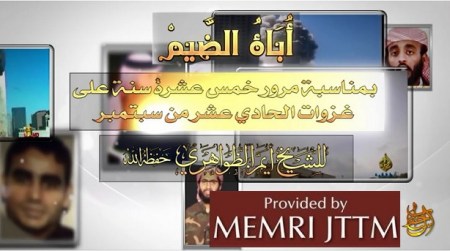
On September 9, 2016, Al-Qaeda’s media wing Al-Sahab released a video message by the group’s leader, Ayman Al-Zawahiri, marking the 15th anniversary of the 9/11 attacks. Al-Zawahiri reiterates the reasons behind the attacks and their impact on the U.S., and urges the mujahideen to focus on targeting the U.S. and its allies, and to bring the battle onto their own soil as well. Appealing to non-Muslim African-Americans, he blames their woes on the U.S. and calls to them to convert to Islam.

29874

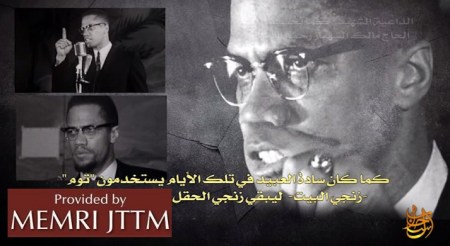
Most of the 20-minute video consists of Al-Zawahiri’s message, and the final several minutes feature an archival address by Osama bin Laden. Additionally, archival footage of a Malcolm X address is played as Al-Zawahiri appeals to African-Americans.

Below are the main points of the message:

Al-Zawahiri praises the “blessed raids” of 9/11, noting that they managed to strike deep within the U.S. and to attack its economic symbols, i.e. the Twin Towers. He also notes that the final and fourth hijacked airplane, United Flight 93, was heading towards “the biggest criminals in the White House or the Congress.” Al-Zawahiri boasts that 9/11 was a wakeup call to the U.S., reminding it that its crimes against Muslims won’t go unnoticed. The attacks’ impact, according to Al-Zawahiri, continues to be felt today, and its memory will forever be remembered by the Americans.

29875

Addressing the U.S., Al-Zawahiri reminds it: “The events of 9/11 were a direct result of your crimes against us, your crimes in Palestine, Afghanistan, Iraq, Syria, Mali, Somalia, Yemen, Islamic Maghreb, and Egypt [and] the result of your occupation of Muslim lands, theft of their resources, and support for the murderous corrupt criminals, who rule over them.” He further threatens the U.S.: “As long as your crimes continue, the events of 9/11 will be repeated thousands of times, by the will of Allah. And we will follow you – if you don’t cease your aggression [against us] – until the Day of Judgment…”

Moving on to the subject of the mujahideen, Al-Zawahiri informs the U.S. that their strength is increasing by the day: “There it is, the jihadi awakening [movement] increasing – thanks to Allah – many times over what it used to be before the blessed raids,” he says.

Addressing the mujahideen, Al-Zawahiri urges them to focus on attacking the U.S. and its allies, and on trying as much as possible to shift the battle onto these countries’ own soil. In that regard, he notes that the defeat of the U.S. will lead to the defeat of its lackeys. He also urges the mujahideen to unite, pledge allegiance to the Islamic Emirate in Afghanistan (the Taliban), support the revolutions across the Muslim world, and urge prominent Islamic leaders to form the nucleus of a future council that will be tasked with appointing an imam (leader) for all Muslims.

Speaking to the Muslims in general, Al-Zawahiri implores them to rise up against their rulers: “It has become clear to you that your rulers are tools in the hands of the secular Safavid Crusader alliance, the alliance of the devils, headed by American and the West,” he says. He also urges them to disavow these rulers, and to adopt the path of da’wa and jihad: “Your true soldiers are your mujahideen sons… who wish for you to live free and honored in the shade of the righteous caliphate, in which the ummah chooses, holds accountable, and ousts its imam.”

Al-Zawahiri also lashes out at the various Islamic movements that have emerged in the awake of the Arab Spring, calling them “sheep” and agents of the U.S. who have hijacked the sacrifices of the Muslims. He also calls on the Muslims to be the real lions – like the mujahideen – who refuse to live under these corrupt and apostate regimes.

29876

Finally, Al-Zawahiri appeals to non-Muslims, particularly African Americans, blaming their woes on the U.S. and calling them to Islam. His message is augmented with an address by Malcolm X. Al-Zawahiri says: “We inform every weakened [person] in the world: America is the source of calamity and the head of evil in this world, and it is the thief of nations’ aliment, and it is the one who humiliate the Africans [i.e. African Americans] until this day, and no matter how much they try to reform and obtain their rights according to the law and the [U.S.] constitution, they will not attain it, for the law is in the hands of the white majority, [who] control it as they wish. And they [i.e. African Americans] will not be saved but by Islam.”

Taliban storms district in eastern Afghanistan

August 27, 2016

Taliban storms district in eastern Afghanistan, Long War Journal, August 27, 2016

Taliban has regenerated its forces since the US withdrew the bulk of its combat forces, is threatening provincial capitals and seizing district centers, and operating openly as a military forces in multiple regions throughout Afghanistan. Additionally, Al Qaeda has become so emboldened by the success of the Taliban that it has established training camps in the country.

*****************

The Taliban took control of the district of Jani Khel in the eastern Afghan province of Paktia yesterday after laying siege to the district center for more than two weeks.

Both Afghan officials and the Taliban confirmed that Jani Khel fell to the Taliban late last night. On Voice of Jihad, the Taliban’s official website, the group claimed that it “stormed the enemy installations in Jani Khel district of Paktia province including district headquarters, police station and all its security and combat posts.”

“Mujahideen took over the district and overran 10 combat posts as well as police checkpoints, raising Islamic Emirate’s white flag,” the Taliban continued. Additionally, it claimed it killed “48 enemy personnel consisting of Arbakis [local militia], police and soldiers of ANA,” or Afghan National Army, and seized “15 armored tanks and 16 armored fighting vehicles,” and destroyed an additional six armored personnel carriers. The Taliban’s claims cannot be confirmed; the group routinely exaggerates the number of casualties inflicted on Afghan forces.

The governor of Jani Khel confirmed the Taliban’s claim that it did overrun the district.

“Our district was surrounded by Taliban for almost five days,” governor Abdul Rahman Solamal told Reuters. “Hundreds of them attacked our check posts overnight. If we do not retake it soon then Taliban can easily move from one province to another and can undermine security in at least three provinces.”

Solamal warned on Aug. 10 that the district was in danger of falling to the Taliban.

“The clashes are still ongoing two kilometers from the center of Janikhel,” he told TOLONews. “If supporting troops are not sent into Janikhel as soon as possible, the district will fall into the hands of the Taliban.”

Solamal’s plea for reinforcements and the failure of the Afghan government and military to provide support to districts under the threat of Taliban assaults has become all too common. The Taliban is sustaining offensive operations throughout Afghanistan as Afghan security forces, backed by US airpower and special forces, continue to struggle containing the jihadist group. Reports from Afghanistan indicate that the provincial capitals of Kunduz and Helmand are also in danger of falling to the Taliban.

The Taliban currently control or contest more than 80 of Afghanistan’s 400 plus districts, according to a study by The Long War Journal. That number may be higher as reports from some districts known to be Taliban strongholds are unavailable.

The Obama administration’s response to the deteriorating security situation has been to slow the withdrawal of US forces from the country, leaving 8,400 troops in Afghanistan instead of the 5,400 originally planned. Still, nearly 1,400 US troops will be withdrawn by the end of the year despite the fact that President Barack Obama described the security environment in Afghanistan as “precarious.” We have yet to hear an explanation as to how fewer troops will help the worsening security situation.

The US military continues to downplay Taliban gains and exaggerate the performance of the Afghan National Defense and Security Forces. On Aug. 25, Brigadier General Charles Cleveland, deputy chief of staff for communications for Resolute Support, NATO’s mission in Afghanistan, said that Afghan forces “are generally on a positive trajectory.”

“But overall, as we look at the country holistically, and as we compare and add into that the progress that we’ve seen at the ministry of defense and the ministry of interior from an institutional level, overall we still do believe that the ANDSF is performing better this year than they performed last year. We think that they are still generally on track with their offensive campaign plan, Operation Shafaq. And then finally, we still believe that they are generally on a positive trajectory.”

Cleveland made the statement despite the fact that that Taliban has regenerated its forces since the US withdrew the bulk of its combat forces, is threatening provincial capitals and seizing district centers, and operating openly as a military forces in multiple regions throughout Afghanistan. Additionally, Al Qaeda has become so emboldened by the success of the Taliban that it has established training camps in the country.