Archive for the ‘Al Azhar University’ category

Top Muslim University Rejects Reform, Stands by ‘Terrorist Curriculum

December 1, 2016

Top Muslim University Rejects Reform, Stands by ‘Terrorist Curriculum, Front Page MagazineRaymond Ibrahim, December 1, 2016

(Don’t they understand that Islam is the “religion of peace and tolerance?” Perhaps President Obama and Pope Francis, both prominent theologians, should point our their errors. — DM)

rd-1

Much of the curriculum of Al Azhar—the Islamic world’s most prestigious university, located in Cairo—is based on Islamic books written in the medieval era or earlier.  These books—histories, biographies of Muhammad, hadith (words and deeds of the latter), tafsirs (Koran exegeses), etc.—are often criticized by more reform-minded Muslims for being too backwards,, teaching things such as unrelenting jihad and hatred for non-Muslims.

During a recent televised interview, Sheikh Ahmed al-Tayeb, Egypt’s highest authority on Islam and Grand Imam of Al Azhar, was asked about his university’s reliance on these books.  His responses left many reformers disappointed.

Tayeb insisted that all books used by Al Azhar are fine: “Our heritage books are innocent and being abused by those ignorant or indecent among us—and that’s all they can be: either ignorant or indecent.”

Settling the question in such black and white terms completely overlooks the fact that many of these books are indeed loaded with problematic teachings.  It is from these books—in this case, one of the histories of the prophet—that ISIS justifies burning people alive.

He continued his apologia: “Some say, do away with the other, ancillary books of Al Azhar.  Okay, but then how can I understand the Koran and Sunna?”  He explained that if Al Azhar got rid of the other books, every Muslim would be free to interpret the Koran any which way they want—claiming that that’s what ISIS does.  Tayeb even attacked using one’s brain, or reason, to understand the Koran, claiming again that that is what ISIS does.

This was another strange assertion: it is ISIS that most criticizes the free use of the brain, and insists on slavishly following the teachings of those ancillary books—which teach anything from eating the flesh of infidel captives to selling women and children on slave markets.

But the most telling portion of the interview came when Al Azhar’s Grand Imam said:

When they [reformers] say that Al Azhar must change the religious discourse, change the religious discourse, this too is, I mean, I don’t know—a new windmill that just appeared, this “change religious discourse”—what change religious discourse?  Al Azhar doesn’t change religious discourse—Al Azhar proclaims the true religious discourse, which we learned from our elders.

As all Egyptians know, the one man that made the phrase “change religious discourse” famous is President Sisi.  He too has publicly called on Al Azhar to reconsider its usage of ancillary books—most notably on New Year’s Day, 2015—in an effort to change the international image of Islam, from one of war and enmity, to something more tolerant.

Now the highest Muslim authority in Egypt has made clear that Al Azhar never had any intention of changing anything, that the “religious discourse” articulated in the Medieval era—one of hostility and violence for the other, in a word, jihad—is the only “discourse” Muslims can accept.

Anything else is apparently quixotic—“tilting at windmills.”

Muslims may wear and pray to the Cross to deceive Christians, says Al Azhar cleric

November 17, 2016

Muslims may wear and pray to the Cross to deceive Christians, says Al Azhar cleric, Jihad Watch,  , November 17, 2016


https://www.youtube.com/watch?v=_XqKgB2PzSY

An Arabic language video of an Al Azhar professor, Dr. Salim Abdul Galil, is instructive of how that Egyptian institution sees the relationship between Muslims and Christians.

In it he discusses Koran 3:28: “Let believers not take for friends and allies infidels rather than believers: whoever does this shall have no relationship left with Allah—unless you but guard yourselves against them, taking precautions.”  Galil began by explaining this verse as meaning Muslims must never befriend or aid non-Muslims, especially against fellow Muslims.

However, if Muslims find themselves under non-Muslim authority and fear for themselves, they may, in the words of the Koran verse, “guard” themselves, by “taking precautions.”  The sheikh explained that this means that it is permissible for Muslims to pretend to be “one of them,” the infidels, but only on the outside.

By way of example, he said that if the Muslim is under the authority of Christians, and the cross is everywhere, the Muslim can wear the cross and hang it up— despite Islam’s well-known virulent hatred for the cross; he can also pretend to be a Christian and conceal his Muslim practices.  Sheikh Galil called this strategy—also known as the doctrine of taqiyya—as a “license” granted by Allah to Muslims to protect themselves against infidels.

Here, again, is a reminder of why Al Azhar is regularly accused of teaching the same brand of Islam that “radicals” adhere to.  Al-Qaeda has published a long treatise on this very topic, “Loyalty and Enmity,” calling on Muslims to hate non-Muslims, but permitting them to pretend to be one of them whenever circumstances make it prudent to do so.

And here again is a reminder of why it is that Egypt’s Coptic Christian population lives under unenviable circumstances.

Dialogue between Vatican and al-Azhar to restart in April after five-year lull

October 22, 2016

Dialogue between Vatican and al-Azhar to restart in April after five-year lull, Jihad Watch

Why has there been this “five-year lull”? Because “Al-Azhar froze talks with the Vatican in 2011 to protest comments by then-Pope Benedict XVI.” What did Benedict say? Andrea Gagliarducci of the Catholic News Agency explains that after a jihad terrorist murdered 23 Christians in a church in Alexandria 2011, Benedict decried “terrorism” and the “strategy of violence” against Christians, and called for the Christians of the Middle East to be protected.

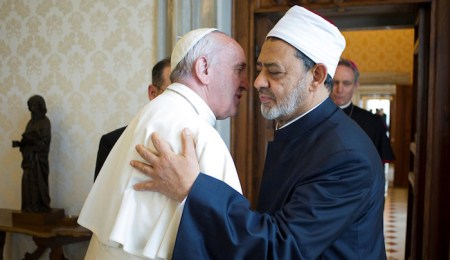
Al-Azhar’s Grand Imam, Ahmed al-Tayeb, whom Pope Francis welcomed to the Vatican in May, was furious. He railed at Benedict for his “interference” in Egypt’s affairs and warned of a “negative political reaction” to the Pope’s remarks. In a statement, Al-Azhar denounced the Pope’s “repeated negative references to Islam and his claims that Muslims persecute those living among them in the Middle East.”

Benedict stood his ground, and that was that. But in September 2013, al-Azhar announced that Pope Francis had sent a personal message to al-Tayeb. In it, according to al-Azhar, Francis declared his respect for Islam and his desire to achieve “mutual understanding between the world’s Christians and Muslims in order to build peace and justice.” At the same time, Al Tayyeb met with the Apostolic Nuncio to Egypt, Mgr. Jean-Paul Gobel, and told him in no uncertain terms that speaking about Islam in a negative manner was a “red line” that must not be crossed.

So Pope Benedict condemned a jihad attack, one that al-Azhar also condemned, and yet al-Azhar suspended dialogue because of the Pope’s condemnation. Then Pope Francis wrote to the Grand Imam of al-Azhar affirming his respect for Islam, and the Grand Imam warned him that criticizing Islam was a “red line” that he must not cross. That strongly suggests that the “dialogue” that Pope Francis has now reestablished will not be allowed to discuss the Muslim persecution of Christians that is escalating worldwide, especially since an incidence of that persecution led to the suspension of dialogue in the first place.

What’s more, the Pope’s dialogue partner, al-Tayeb, has shown himself over the years to be anything but a preacher of peace, cooperation and mercy: he has justified anti-Semitism on Qur’anic grounds; and called for the Islamic State murderers of the Jordanian pilot to be crucified or have their hands and feet amputated on opposite sides (as per the penalty in Qur’an 5:33 for those who make war against Allah and his messenger or spread “mischief” in the land. Al-Azhar was also revealed to be offering free copies of a book that called for the slaughter of Christians and other Infidels.

This “dialogue” has not saved a single church from being burned or a single Christian from being massacred. And it never will. Instead, it is being used by the Catholic hierarchy as a club to silence those who speak out about the true cause and magnitude of contemporary Muslim persecution of Christians.

This Pope, and the U.S. Conference of Catholic Bishops, are betraying the Church, Judeo-Christian civilization, and the free world. If I am a “bad Catholic” for saying that, then it is morally preferable to being a “good” one.

“Leave them; they are blind guides. And if a blind man leads a blind man, both will fall into a pit.” (Matthew 15:14)

pope-frances-tayeb-al-azhar

“Vatican-Muslim Dialogue to Restart in April, Vatican Says,” Associated Press, October 21, 2016:

VATICAN CITY — The Vatican and the prestigious Sunni Muslim center of learning, Al-Azhar, are expected to formally reopen talks next year after a five-year lull….

The Vatican announcement Friday comes after Pope Francis and the grand imam of Al-Azhar, Sheik Ahmed el-Tayyib, met at the Vatican in May and embraced. It marked a turning point after Al-Azhar froze talks with the Vatican in 2011 to protest comments by then-Pope Benedict XVI.

Benedict had demanded greater protection for Christians in Egypt after a New Year’s bombing on a Coptic Christian church in Alexandria killed 21 people.

‘Al-Ahram’ Columnist: Despite Al-Sisi’s Call For Revolution In Religious Discourse, Al-Azhar Scholars Continue On Their Extremist Path

August 24, 2016

‘Al-Ahram’ Columnist: Despite Al-Sisi’s Call For Revolution In Religious Discourse, Al-Azhar Scholars Continue On Their Extremist Path, Memri, August 24, 2016

(Please see also, Dr. Ahmed al-Tayeb: Meet the World’s ‘Most Influential Muslim’ — DM)

Recently, articles have been published in the Egyptian press attacking Al-Azhar, Egypt’s supreme religious authority, on the grounds that its scholars are not doing enough to implement the call of Egyptian President ‘Abd Al-Fattah Al-Sisi to “revolutionize” religious discourse, but instead continue to cultivate extremism. Two particularly harsh articles were penned by Ahmad ‘Abd Al-Tawab, a columnist for the official daily Al-Ahram. He wrote that one reason for the recent spate of attacks on Copts[1] is Al-Azhar’s extremist curricula, which poison people’s minds. He added that, despite ostensibly welcoming Al-Sisi’s call to reform the religious discourse, Al-Azhar has in fact done nothing to realize this call. [2] The following are excerpts from his articles:

29678Al-Azhar inner courtyard (Image: Muslimheritage.com)

Al-Azhar’s Poisonous Curricula Are Responsible For Attacks On Copts; Al-Azhar Accuses Anyone Who Disagrees With It Of Heresy

In his first article, ‘Abd Al-Tawab wrote: “[Let me say,] without beating about the bush, that the Al-Azhar institutions have not taken a single serious step in response to President Al-Sisi’s call for a religious revolution.[3] [Here is] one example of this strange state of affairs. The state collects taxes from all its citizens, Muslims and Copts, which join its other revenues that benefit both Muslims and Copts. These funds pay for various public [services], among them education, which includes Al-Azhar and its institutions and university. [Yet Al-Azhar’s] students are taught using poisonous curricula that harm the tax payer more than anyone else, and especially the Copts! In other words, society pays to train, educate and cultivate a group [of graduates] that hates society and is hostile to it and attacks it as it pleases! To this very day, Al-Azhar, with its curricula, continues to teach its students to level accusations of heresy at anyone who disagrees with them and to define the construction of churches as a crime. In some of the classes [taught at Al-Azhar], it is stated that churches should be banned in [all] countries that the early Muslims conquered by the force of arms, including Egypt. In addition,[students] are taught that anyone who does not pray – or even prays without first performing the ritual ablutions – must be killed, and the crime of his murder can be taken lightly.

“Some researchers and intellectuals make an effort to inform the public of these frightening facts, among them [Egyptian lawyer and Islamic researcher] Ahmad Abdu Maher. He points out that Al-Azhar scholars have accused him of heresy while they refuse to accuse ISIS of heresy.[4] In fact, some Al-Azhar scholars have [even] said that participating in the [international] coalition to fight ISIS is treason against Allah and His Messenger.

“Hence, it is a mistake to say that the attacks currently taking place against Copts in Minya and elsewhere are the acts of individuals [and not part of a larger phenomenon]. [Al-Azhar] students will continue to study  until they attain a certificate or a license to preach at a mosque, and then they will spread what they learned among the worshipers.

“Nearly two years have passed since the President’s call [for a religious revolution], which was [ostensibly] welcomed by the Al-Azhar scholars. But time proves that they [merely pretended to] show flexibility, so that the wave would pass [over them] quietly. This underscores the importance of forming a national committee to handle this task, which can include Al-Azhar scholars as long as they are not a majority that will take over [the committees’] decisions. Otherwise we will be swept into further waste of time and effort and enable extremism to increase even more.”[5]

Al-Azhar Is Not Helping To Promote Al-Sisi’s Religious Revolution

In his second article,  ‘Abd al-Tawab discussed Al-Sisi’s meeting with Al-Azhar Sheikh Al-Tayeb following the uniform sermon crisis,[6] and repeated his claim that, despite ostensibly welcoming Al-Sisi’s call to reform the religious discourse, Al-Azhar has in fact done nothing to promote this cause. He wrote: “There is a need, even a crucial need, for this revolution [as part of] the effort to institute a constitution that lays the foundations for a modern state. [This must be done] by strengthening the freedoms and defending them, including the freedom of worship, of scientific research, of literary and artistic creativity, etc., and also by strengthening all the international treaties to which Egypt is signatory.

“Al-Azhar’s clerics were quick to welcome the president’s call for a [religious] revolution, but this was never translated into action on the ground. In fact, for more than two years [Al-Azhar’s] activity has been in the opposite direction: it has mercilessly attacked anyone with a differing opinion without hesitating to use the weapon of accusations of heresy, or to file lawsuits that placed several people behind bars, and this based on laws that are assumed to require amendment as soon as possible in order to adapt them to the new constitution.”

“The hoped-for change [in the religious discourse] will not be achieved by means of a breakthrough in combatting extremist ideology on the internet. That is a waste of time and effort [because it is an attempt to] treat the symptoms and the outcomes [of extremism] instead of focusing on the right things – such as [reforming] the curricula that still contain horrifying expressions, improving the teachers and adapting them to the spirit of the times, dismissing extremists from senior positions, and enforcing the [state] law instead of [holding] traditional reconciliation [sessions with the Copts]…”[7]

Endnotes:

 [1] Recently there has been an escalation in attacks on Copts in Egypt, especially in the rural governorates of Minya and Beni Suef, and mainly due to rumors that Copts are using private homes in various villages as churches.

[2] In a third article about Al-Azhar, ‘Abd Al-Tawab criticized its involvement in Egypt’s foreign policy, after Al-Azhar Sheikh Ahmed Al-Tayeb met with Egypt’s new ambassadors. Al-Ahram (Egypt), August 18, 2016. Also noteworthy was an article byAl-Ahram columnist Muhammad Al-Dasuqi, who likewise wrote that this institute was not reforming the religious discourse (Al-Ahram, Egypt, June 20, 2016), and an article was by journalist Khaled Al-Montasser, who wrote in Al-Watan on June 24, 2016 that Al-Azhar was delaying the publication of a comprehensive paper on the renewal of religious discourse written by senior Al-Azhar scholar Dr. Salah Fadl. Al-Watan also published a series of articles about corruption in Al-Azhar’s institutions. See Al-Watan (Egypt),  August 3, 2016; July 13, 20, 27, 2016; June 8, 15, 22, 29, 2016, May 4, 11, 25, 2016; April 13, 20, 2016.

[3] Al-Sisi called for a “religious revolution” in a December 2014 speech. Even before this he endorsed the call made by Mansour Adly, who served as interim president of Egypt before Al-Sisi’s election, to “renew the religious discourse.” See MEMRI Special Dispatch No. 6114, Egyptian Columnists On Al-Sisi Regime’s Campaign For ‘Renewal Of Religious Discourse’ As A Way Of Fighting Terrorism, July 23, 2015.

[4] On Al-Azhar’s refusal to call ISIS heretical, see MEMRI Special Dispatch No. 5910, Al-Azhar: The Islamic State (ISIS) Is A Terrorist Organization, But It Must Not Be Accused Of Heresy, December 21, 2014.

[5] Al-Ahram (Egypt), July 25, 2016.

[6] On this affair, see MEMRI Special Dispatch No. 6556, Egypt’s Al-Azhar Opposes Ministry Of Religious Endowments Plan For Uniform Friday Sermon, August 4, 2016.

[7] Al-Ahram (Egypt), August 6, 2016. “Traditional reconciliation” refers to extra-judicial “community justice meetings” that have been used to affect a reconciliation between Muslims and Copts following clashes between the communities. Many Copts, as well as others in Egypt, have protested this practice, claiming that it is used as a way to avoid prosecuting Muslims for violence against Copts or to persuade the Copts to forgo their legal rights. See for example Al-Ahram (Egypt), July 9, 2016; Al-Yawm Al-Sabi’ (Egypt), July 27, 2016; copticsolidarity.org, August 8, 2016; dailynewsegypt.com, May 29, 2016. The “Egyptians against Discrimination” rights group recently held a demonstration in front of the prosecutor general’s office in Cairo in which they protested these reconciliation meetings and accused the state of “conspiring” with the perpetrators of attacks on Copts. Al-Ahram (Egypt), August 16, 2016; Al-Wafd (Egypt), August 15, 2016.

Dr. Ahmed al-Tayeb: Meet the World’s ‘Most Influential Muslim’

August 24, 2016

Dr. Ahmed al-Tayeb: Meet the World’s ‘Most Influential Muslim’, Front Page MagazineRaymond Ibrahim, August 24, 2016

(Please see also, Muslim cleric from terror sponsor Iran praises Pope for saying Islam is peaceful — DM)
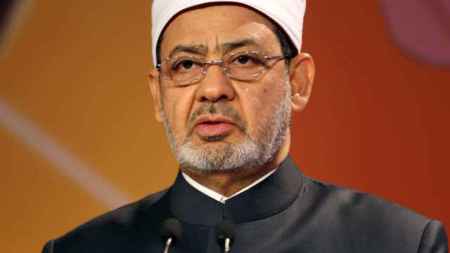
shykh-lzhr-dktwr-hmd-ltyb

There’s nothing like knowing Arabic—that is, being privy to the Muslim world’s internal conversations on a daily basis—to disabuse oneself of the supposed differences between so-called “moderate” and “radical” Muslims.

Consider the case of Egypt’s Dr. Ahmed al-Tayeb.  Hardly one to be dismissed as a fanatic who is ignorant of the true tenets of Islam, Tayeb’s credentials and career are impressive: he holds a Ph. D in Islamic philosophy from the Paris-Sorbonne University; formerly served as Grand Imam of Egypt, meaning he was the supreme interpreter of Islamic law; and since 2003 has been president of Al-Azhar University, considered the world’s leading institution of Islamic learning.   A 2013 survey named Tayeb the “most influential Muslim in the world.”

He is also regularly described by Western media and academia as a “moderate.”  Georgetown University presents him as “a strong proponent of interfaith dialogue.”  According to The National, “He is considered to be one of the most moderate and enlightened Sunni clerics in Egypt.”  In February 2015, the Wall Street Journal praised him for making “one of the most sweeping calls yet for educational reform in the Muslim world to combat the escalation of extremist violence.”

Most recently he was invited to the Vatican and warmly embraced by Pope Francis.  Al Azhar had angrily cut off all ties with the Vatican five years earlier when, in the words of U.S. News, former Pope Benedict “had demanded greater protection for Christians in Egypt after a New Year’s bombing on a Coptic Christian church in Alexandria killed 21 people.  Since then, Islamic attacks on Christians in the region have only increased.”

Pope Francis referenced his meeting with Tayeb as proof that Muslims are peaceful: “I had a long conversation with the imam, the Grand Imam of the Al-Azhar University, and I know how they think.  They [Muslims] seek peace, encounter.”

How does one reconcile Tayeb’s benevolent image in the West with his reality in Egypt?

For instance, all throughout the month of Ramadan last June, Tayeb appeared on Egyptian TV explaining all things Islamic—often in ways that do not suggest that Islam seeks “peace, encounter.”

During one episode, he reaffirmed a phrase that is almost exclusively associated with radicals: in Arabic, al-din wa’l-dawla, meaning “the religion and the polity”—a phrase that holds Islam to be both a religion and a body of rules governing society and state.

He did so in the context of discussing the efforts of Dr. Ali Abdel Raziq, a true reformer and former professor at Al Azhar who wrote a popular but controversial book in 1925, one year after the abolition of the Ottoman caliphate.  Titled, in translation, Islam and the Roots of Governance, Raziq argued against the idea of resurrecting the caliphate, saying that Islam is a personal religion that should no longer be mixed with politics or governance.

Raziq was vehemently criticized by many clerics and even fired from Al Azhar.  Concluded Tayeb, with assent:

Al Azhar’s position was to reject his position, saying he forfeited his credentials and his creed.  A great many ulema—in and out of Egypt and in Al Azhar—rejected his work and its claim, that Islam is a religion but not a polity.  Instead, they reaffirmed that Islam is both a religion and a polity [literally, al-din wa’l-dawla].

The problem with the idea that Islam must govern the whole of society should be obvious: Sharia, or Islamic law, which is what every Muslim including Tayeb refer to when they say that Islam is a polity, is fundamentally at odds with modern notions of human rights and, due to its supremacist and “anti-infidel” aspects, the source of conflict between Muslims and non-Muslims the world over.

That this is the case was made clear during another of Tayeb’s recent episodes.  On the question of apostasy in Islam—whether a Muslim has the right to abandon Islam for another or no religion—the “radical” position is well known: unrepentant apostates are to be punished with death.

Yet Tayeb made the same pronouncement.  During another Ramadan episode he said that “Contemporary apostasy presents itself in the guise of crimes, assaults, and grand treason, so we deal with it now as a crime that must be opposed and punished.”

While his main point was that those who do not follow Islam are prone to being criminals, he especially emphasized those who exhibit their apostasy as being a “great danger to Islamic society. And that’s because his apostasy is a result of his hatred for Islam and a reflection of his opposition to it. In my opinion, this is grand treason.”

Tayeb added what all Muslims know: “Those learned in Islamic law [al-fuqaha] and the imams of the four schools of jurisprudence consider apostasy a crime and agree that the apostate must either renounce his apostasy or else be killed.”  He even cited a hadith, or tradition, of Islam’s prophet Muhammad calling for the execution of Muslims who quit Islam.

Meanwhile, when speaking to Western and non-Muslim audiences, as he did during his recent European tour, Tayeb tells them what they want to hear.  Recently speaking before an international forum he asserted that “The Quran states that there is no compulsion in religion,” and that “attempts to force people into a religion are against the will of God.”  Similarly, when meeting with the Italian Senate’s Foreign Policy Commission Pier Ferdinando Casini and his accompanying delegation, Tayeb “asserted that Islam is the religion of peace, cooperation and mercy….  Islam believes in freedom of expression and human rights, and recognizes the rights of all human beings.”

While such open hypocrisy—also known as taqiyya—may go unnoticed in the West, in Egypt, human rights groups often call him out.  The Cairo Institute for Human Rights recently issued a statement accusing Al Azhar of having two faces: one directed at the West and which preaches freedom and tolerance, and one directed to Muslims and which sounds not unlike ISIS:

In March 2016 before the German parliament, Sheikh al-Tayeb made unequivocally clear that religious freedom is guaranteed by the Koran, while in Cairo he makes the exact opposite claims….  Combating terrorism and radical religious ideologies will not be accomplished by directing at the West and its international institutions religious dialogues that are open, support international peace and respect freedoms and rights, while internally promoting ideas that contribute to the dissemination of violent extremism through the media and educational curricula of Al Azhar and the mosques.

At any rate, if Tayeb holds such draconian views on apostasy from Islam—that is, when he’s speaking in Arabic to fellow Muslims—what is his position concerning the Islamic State?  Last December, Tayeb was asked why Al Azhar refuses to issue a formal statement denouncing the genocidal terrorist organization as lapsing into a state of kufr, that is, of becoming un-Islamic, or “infidel.” Tayeb responded:

Al Azhar cannot accuse any [Muslim] of being a kafir [infidel], as long as he believes in Allah and the Last Day—even if he commits every atrocity….  I cannot denounce ISIS as un-Islamic, but I can say that they cause corruption on earth.

As critics, such as Egyptian talk show host Ibrahim Eissa pointed out, however, “It’s amazing.  Al Azhar insists ISIS are Muslims and refuses to denounce them.  Yet Al Azhar never ceases to shoot out statements accusing novelists, writers, thinkers—anyone who says anything that contradicts their views—of lapsing into a state of infidelity.  But not when it comes to ISIS!”

This should not be surprising considering that many insiders accuse Al Azhar of teaching and legitimizing the atrocities that ISIS commits.  Sheikh Muhammad Abdullah Nasr, a scholar of Islamic law and Al Azhar graduate once exposed his alma mater in a televised interview:

It [Al Azhar] can’t [condemn the Islamic State as un-Islamic].  The Islamic State is a byproduct of Al Azhar’s programs.  So can Al Azhar denounce itself as un-Islamic?  Al Azhar says there must be a caliphate and that it is an obligation for the Muslim world [to establish it].  Al Azhar teaches the law of apostasy and killing the apostate.  Al Azhar is hostile towards religious minorities, and teaches things like not building churches, etc.  Al Azhar upholds the institution of jizya.  Al Azhar teaches stoning people.  So can Al Azhar denounce itself as un-Islamic?

Similarly, while discussing how the Islamic State burns some of its victims alive—most notoriously, a Jordanian pilot—Egyptian journalist Yusuf al-Husayni remarked on his satellite program that “The Islamic State is only doing what Al Azhar teaches.  He went on to quote from textbooks used in Al Azhar that permit burning people—more specifically, “infidels”—alive.

Meanwhile, Tayeb—the face of and brain behind Al Azhar—holds that Europe “must support all moderate Islamic institutions that adopt the Al-Azhar curriculum,” which “is the most eligible one for educating the youth.”  He said this during “a tour [in Germany and France] to facilitate dialogue between the East and the West.”

As for the ongoing persecution of Egypt’s most visible non-Muslim minorities, the Coptic Christians, Tayeb is renowned for turning a blind eye.  Despite the well-documented “severe persecution” Christians experience in Egypt; despite the fact that Muslim mobs attack Christians almost “every two to three days” now—recent examples include the burning of churches and Christian homes, the coldblooded murder of a Coptic man defending his grandchild from Muslim bullies, and the stripping, beating, and parading in the nude of a 70-year-old Christian woman—Tayeb recently told Coptic Christian Pope Tawadros that “Egypt represents the ultimate and highest example of national unity” between Muslims and Christians.

Although he vociferously denounces the displacement of non-Egyptian Muslims in Buddhist Myanmar, he doesn’t have a single word for the persecution and displacement of the Copts, that is, his own Egyptian countrymen.  Instead heproclaims that “the Copts have been living in Egypt for over 14 centuries in safety, and there is no need for all this artificial concern over them,” adding that “true terrorism was created by the West.”

Indeed, far from speaking up on behalf of Egypt’s Christian minorities, he has confirmed that they are “infidels”—that same label he refused to describe ISIS with.   While he did so in a technical manner—correctly saying that, as rejecters of Muhammad’s prophecy, Christians are infidels [kafir]—he also knows that labeling them as such validates all the animosity they feel and experience in Egypt, since the mortal enemy of the Muslim is the infidel.

This is consistent with the fact that Al Azhar encourages enmity for non-Muslims, specifically Coptic Christians, and even incites for their murder.  As Egyptian political commentator Dr. Khalid al-Montaser once marveled:

Is it possible at this sensitive time — when murderous terrorists rest on [Islamic] texts and understandings of takfir [accusing Muslims of apostasy], murder, slaughter, and beheading — that Al Azhar magazine is offering free of charge a book whose latter half and every page — indeed every few lines — ends with “whoever disbelieves [non-Muslims] strike off his head”?

The prestigious Islamic university—which co-hosted U.S. President Obama’s 2009 “A New Beginning” speech—has even issued a free booklet dedicated to proving that Christianity is a “failed religion.”

One can go on and on.   Tayeb once explained with assent why Islamic law permits a Muslim man to marry a Christian woman, but forbids a Muslim woman from marrying a Christian man: since women by nature are subordinate to men, it’s fine if the woman is an infidel, as her superior Muslim husband will keep her in check; but if the woman is a Muslim, it is not right that she be under the authority of an infidel.  Similarly, Western liberals may be especially distraught to learn thatTayeb once boasted, “You will never one day find a Muslim society that permits sexual freedom, homosexuality, etc., etc., as rights.  Muslim societies see these as sicknesses that need to be resisted and opposed.”

To recap, while secular Western talking heads that don’t know the first thing about Islam continue squealing about how it is being “misunderstood,” here is arguably the Muslim world’s leading authority confirming many of the cardinal points held by ISIS: he believes that Islam is not just a religion to be practiced privately but rather is a totalitarian system designed to govern the whole of society through the implementation of its human rights abusing Sharia; he supports one of the most inhumane laws, punishment of the Muslim who wishes to leave Islam; he downplays the plight of Egypt’s persecuted Christians, that is, when he’s not inciting against them by classifying them as “infidels”—the worst category in Islam’s lexicon—even as he refuses to denounce the genocidal Islamic State likewise.

Yet this well credentialed and respected scholar of Islam is considered a “moderate” by Western universities and media, from Georgetown University to the Wall Street Journal.  He is someone whom Pope Francis trusts, embraces, and quotes to reassure the West of Islam’s peacefulness.

In all fairness of course, Tayeb is neither a “moderate” nor a “radical.”  He’s merely a Muslim trying to be true to Islam.   Put differently, he’s merely a messenger.

Critics would be advised to take it up with the Message itself.

Pope Embraces Grand Sheikh of Al-Azhar

May 24, 2016

Pope Embraces Grand Sheikh of Al-Azhar, Front Page Magazine, Robert Spencer, May 24, 2016

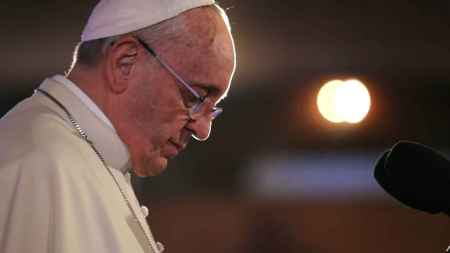
pope_francis_malacanang_6

This Pope is a disgrace to the Church, to Judeo-Christian civilization, and to the free world.

******************************

AP reported breathlessly Monday that Pope Francis “embraced the grand imam of Al-Azhar, the prestigious Sunni Muslim center of learning, reopening an important channel for Catholic-Muslim dialogue after a five-year lull and at a time of increased Islamic extremist attacks on Christians.”

Why has there been this “five-year lull”? Because “the Cairo-based Al-Azhar froze talks with the Vatican to protest comments by then-Pope Benedict XVI.” What did Benedict say? Andrea Gagliarducci of the Catholic News Agency explains that after a jihad terrorist murdered 23 Christians in a church in Alexandria 2011, Benedict decried “terrorism” and the “strategy of violence” against Christians, and called for the Christians of the Middle East to be protected.

Al-Azhar’s Grand Imam, Ahmed al-Tayeb, whom Pope Francis welcomed to the Vatican on Monday, was furious. He railed at Benedict for his “interference” in Egypt’s affairs and warned of a “negative political reaction” to the Pope’s remarks. In a statement, Al-Azhar denounced the Pope’s “repeated negative references to Islam and his claims that Muslims persecute those living among them in the Middle East.”

Benedict stood his ground, and that was that. But in September 2013, al-Azhar announced that Pope Francis had sent a personal message to al-Tayeb. In it, according to al-Azhar, Francis declared his respect for Islam and his desire to achieve “mutual understanding between the world’s Christians and Muslims in order to build peace and justice.” At the same time, Al Tayyeb met with the Apostolic Nuncio to Egypt, Mgr. Jean-Paul Gobel, and told him in no uncertain terms that speaking about Islam in a negative manner was a “red line” that must not be crossed.

So Pope Benedict condemned a jihad attack, one that al-Azhar also condemned, and yet al-Azhar suspended dialogue because of the Pope’s condemnation. Then Pope Francis wrote to the Grand Imam of al-Azhar affirming his respect for Islam, and the Grand Imam warned him that criticizing Islam was a “red line” that he must not cross. That strongly suggests that the “dialogue” that Pope Francis has now reestablished will not be allowed to discuss the Muslim persecution of Christians that will escalate worldwide, especially since an incidence of that persecution led to the suspension of dialogue in the first place.

What’s more, his dialogue partner, al-Tayeb, has shown himself over the years to be anything but a preacher of peace, cooperation and mercy: he has justified anti-Semitism on Qur’anic grounds; and called for the Islamic State murderers of the Jordanian pilot to be crucified or have their hands and feet amputated on opposite sides (as per the penalty in Qur’an 5:33 for those who make war against Allah and his messenger or spread “mischief” in the land. Al-Azhar was also revealed to be offering free copies of a book that called for the slaughter of Christians and other Infidels.

Will the Pope during al-Tayeb’s visit to the Vatican again affirm his respect for Islam and contempt for Christianity? Will he convert to Islam before al-Tayeb, or just offer his submission and a jizya payment?

The Times of Israel opined that Monday’s Vatican meeting was a “sign of improved ties between Catholic Church and Muslim world.” Really? Where? Muslims have massacred, exiled, forcibly converted or subjugated hundreds of thousands of Christians in Iraq and Syria. Have these “improved ties” saved even one Christian from suffering at the hands of Muslims? No, they haven’t. All they do is make the “dialogue” participants feel good about themselves, while the Middle Eastern Christians continue to suffer. In fact, the “dialogue” has actually harmed Middle Eastern Christians, by inducing Western Christian leaders to enforce silence about the persecution, for fear of offending their so-easily-offended Muslim “dialogue” partners.

Has the Pope welcomed any of the persecuted Christians to the Vatican? Or is that honor reserved only for this man, who will allow for “dialogue” only when his Christian “dialogue” partners maintain a respectful silence about Muslim massacres of Christians?

This Pope is a disgrace to the Church, to Judeo-Christian civilization, and to the free world.

“Leave them; they are blind guides. And if a blind man leads a blind man, both will fall into a pit.” (Matthew 15:14)

Islamic University of Minnesota a Hotbed of Extremism

April 8, 2016

Islamic University of Minnesota a Hotbed of Extremism, Investigative Project on Terrorism, John Rossomando, April 8, 2016

(But, but only an Islamophobe would object to this. –DM)

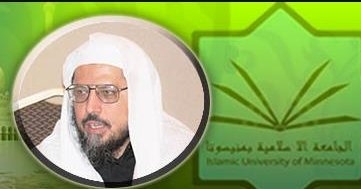
1477 (1)

The Minneapolis-based Islamic University of Minnesota (IUM) has an extremism problem.

It is run by a man who used a recent sermon to invoke a Hadith commonly espoused by Muslim terrorists to kill Jews for causing “corruption in the land.” Waleed Idris al-Meneesey also has written that Muslims should place sharia law above “man-made” law.

During a November sermon, al-Meneesy referred to the Hadith, a saying from Islam’s prophet Muhammad, describing how Jews had been punished by God repeatedly for “corruption.”

“When the Children of Israel returned to cause corruption in the time of our Prophet Muhammad,” al-Meneesy said in a translation by the Investigative Project on Terrorism, “and they disbelieved him, God destroyed him at his hand. In any case, God Almighty has promised them destruction whenever they cause corruption.”

History will repeat itself, he said.

“The Prophet related that in the Last Days his Umma [people] would fight the Jews, the Muslims East of the Jordan River, and they [the Jews] west of [the Jordan River] … Even trees and stones will say: O Muslim, this is a Jew behind me, kill him, except for Gharqad trees, the trees of the Jews. Because of this they plant many of them…”

Jerusalem “remained in the hands of the Muslims until it fell into the hands of the Jews in 1387 AH [1967 AD], and has been a prisoner in their hands for 34 years [sic], but the victory of God is coming inevitably.”

Al-Meneesy, the IUM’s president and chancellor, also serves as an imam at a Bloomington, Minn. mosque where at least five young men left the United States to fight with terrorist groups al-Shabaab and ISIS.

IUM opened in 2007, claiming 160 students registered for classes, which cost $150 each. Current enrollment figures could not be found. IUM’s website describes programs ranging from two year associates degrees to full doctorates. A bachelor’s program helps students “acquire all essential Islamic knowledge.” The Ph.D. program costs $3,000, including thesis review, and is structured “along the lines of Universities in the Middle East and Africa.”

The university’s website cites recognition by Holy Quran University in the Sudan,founded in 1990 by the regime of Sudanese war criminal and President Omar al-Bashir. Holy Quran University’s leaders signed a 2002 declaration saying it was forbidden for Muslims to buy American and Israeli goods.

IUM also professes to serve as the official representative of Sunni Islam’s most important institution – Al-Azhar University, which has grown increasingly radical – in the U.S. and Canada. Al-Azhar officials have refused to condemn the Islamic State (ISIS) as apostates and heretics. According to Egypt’s Youm 7, IUM’s curriculum, offered to American students, endorses many practices used by ISIS. These include: “[K]illing a Muslim who does not pray, one who leaves Islam, prisoners and infidels within Islam [those who do not have a clearly specified creed or sect]. [It also allows] gouging their eyes and chopping off their hands and feet, as well as banning the construction of churches and discriminating between Muslims and Ahl al-Kitab [Christians and Jews], and insulting them at times.”

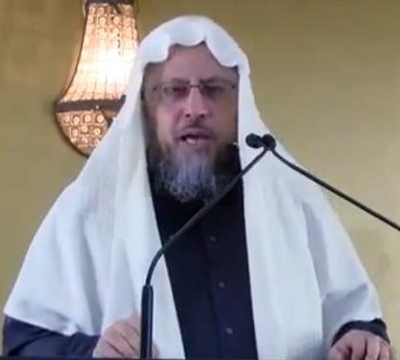
1478

Al-Meneesy’s extremism goes further back than his anti-Semitic sermon. In 2007, he authored a paper for the Assembly of Muslim Jurists Association of America (AMJA), where he sits on the fatwa committee. Muslims should refrain from participating in non-Islamic courts that do not follow Islamic shariah law, particularly those in the West guided by “man-made” law, al-Meneesey wrote.

“The authority to legislate rests with Allah alone,” al-Meneesey wrote.

Anyone who uses law other than shariah, such as civil law, is a “corrupt tyrant,” the paper said. Judging by something other than shariah equals disbelief in Allah, injustice and sinfulness, he wrote.

Muslims should be forbidden from serving as judges in non-Muslim countries, except if they are able to rule “according to the judgments of Allah,” al-Meneesey wrote. Muslims who adhere to secular law and refuse to follow the shariah are infidels. Classical interpretations of the shariah say that apostates should be killed.

In 2008, the AMJA issued a declaration telling Muslims not to cooperate with law enforcement “in countries which do not rule by Allah’s dictates.” That includes the FBI. The declaration invoked many of the same arguments as al-Meneesey’s 2007 paper.

Meanwhile, al-Meneesey’s own Dar al-Farooq Islamic Center and Al-Farooq Youth & Family Center have produced at least five young members who left to fight for ISIS or al-Shabaab in Somalia. They include:

It does not appear that al-Meneesy has addressed these cases publicly.

His radical views are not aberrations at IUM.

Instructor Sheikh Jamel Ben Ameur refused to denounce ISIS in the fall of 2014 amid stories about its brutality because news reports were “confusing” and “complicated,” the website MinnPost reported.

“We don’t need to accuse people of something we don’t know about. We don’t have to jump into judgment,” Ben Ameur told about 100 congregants at his Masjid al-Tawba in Eden Prairie, Minn.

Ben Ameur disputed the authenticity of the ISIS propaganda videos showing the beheadings of American journalists Steven Sotloff and James Foley, suggesting he didn’t know whether ISIS was responsible or not.

Another IUM instructor, Hasan Ali Mohamud, offered condolences after Israel killed Hamas founder Sheikh Ahmed Yassin in 2004.

Writing under the name Sheikh Xasan Jaamici on the Minneapolis Somali community news website SomaliTalk, Mohamud said that Yassin had achieved martyrdom and that the “Hamas mujahideen” were fighting for the liberation of the Al-Aqsa mosque from Israeli control. His Facebook page suggests that Jaamici is his middle name.

Jews will face Muhammad’s wrath. Muslims who adhere to civil law over Islamic sharia are infidels. These are ideas supported by Waleed Idris al-Meneesey, who is responsible for a “university” teaching Muslims about their faith. Where will Islamic University of Minnesota students get a more modern and accepting education?

Egyptian Author Sayyid Al-Qemany: Al-Azhar Is a Terrorist Institution

January 13, 2016

Egyptian Author Sayyid Al-Qemany: Al-Azhar Is a Terrorist Institution, MEMRI-TV via You Tube, January 13, 2016


https://www.youtube.com/watch?v=P6sJrrR8VaA


According to the blurb following the video,

In a January 2 interview on the Egyptian ON TV channel, author Sayyid Al-Qemany said that Al-Azhar should be placed on the list of terrorist organizations. “There are people working on this. They will file a suit in the international court, and I will provide them with documentation,” he said. ِFollowing the interview, it was reported in the press that Al-Azhar was planning to file a lawsuit against Al-Qemany for defamation of the institution.

Islam — Radical, Extremist and Mainstream

November 21, 2015

Islam — Radical, Extremist and Mainstream, Dan Miller’s Blog, November 21, 2015

(The views expressed in this article are mine and do not necessarily reflect those of Warsclerotic or its other editors. — DM

In largely secular western societies, Islam and its history are viewed by many non-Muslims as substantially irrelevant to how devout Muslims behave. Perhaps the view that religion is of little importance to devout Muslims is based on the role, minor if any, that religion and religious history play in their own secular lives. However, both Islamic teachings and history give devout Muslims their grounding in Islam and teach them that Islam is the religion of war, not peace: Islam must become the world’s only religion by extirpating all others.

Islam was founded by Mohamed ( c. 570 CE – 8 June 632 CE) in the sixth century. Mohamed

is considered, almost universally,[n 2] by Muslims to have been the last prophet sent by God to mankind[3][n 3] to restore Islam, which they believe to be the unaltered original monotheistic faith of Adam, Abraham, Moses, Jesus, and other prophets.[4][5][6][7] [Emphasis added.]

Islam considers the words of Mohamed, as transcribed in the “Holy” Quran and Hadith, to be the words of Allah. “Restoring” other monotheistic religions means changing them to comport with Islam as dictated to Mohamed by Allah; unaltered, those other religions cannot continue to exist; it is the duty of Muslims to force them to change or to exterminate them.

Islam provides the basis for Sunni and Shiite (principal branches of Islam) efforts to govern world civilization according to Islamic principles as voiced by Allah through his prophet, Mohamed. Since Islamic principles tolerate no religious or political freedoms (let alone contemporary gender equality or homosexuality notions), such western ideas must be extirpated — as they have been in Saudi Arabia (now the head of the UN Human Rights Council) and Iran. Islamic principles are also manifested by the hopes and efforts of the Islamic State (Sunni, like Saudi Arabia) and the Islamic Republic of Iran (Shiite) to achieve their own caliphates.

Sheikh Muhammad Abdullah Nasr is a scholar of Islamic law and a graduate of Egypt’s Al Azhar University — regularly touted as the world’s most prestigious Islamic university. Al Azhar University co-hosted Obama’s 2009 “New Beginnings” address in Cairo, to which Obama insisted that at least ten members of the Muslim Brotherhood be invited. According to an article at Jihad Watch,

After being asked why Al Azhar, which is in the habit of denouncing secular thinkers as un-Islamic, refuses to denounce the Islamic State as un-Islamic, Sheikh Nasr said:

It can’t [condemn the Islamic State as un-Islamic].  The Islamic State is a byproduct of Al Azhar’s programs.  So can Al Azhar denounce itself as un-Islamic?  Al Azhar says there must be a caliphate and that it is an obligation for the Muslim world [to establish it].  Al Azhar teaches the law of apostasy and killing the apostate.  Al Azhar is hostile towards religious minorities, and teaches things like not building churches, etc.  Al Azhar upholds the institution of jizya [extracting tribute from religious minorities].  Al Azhar teaches stoning people.  So can Al Azhar denounce itself as un-Islamic? [Emphasis added.]

Nasr joins a growing chorus of critics of Al Azhar.  Last September, while discussing how the Islamic State burns some of its victims alive—most notoriously, a Jordanian pilot—Egyptian journalist Yusuf al-Husayni remarked on his satellite program that “The Islamic State is only doing what Al Azhar teaches… and the simplest example is Ibn Kathir’s Beginning and End.”

Since the world’s preeminent Islamic university teaches Islam as proclaimed by the Islamic State, how can non-Muslims claim that the Islamic State is not Islamic? Why do many, even conservatives, refer to the Islamic State and its allied Islamic terror groups as “radical” or “extremist?”

Martin Luther was “radical” and “extreme” because he tried to reform aspects of Roman Catholicism which he deemed malign.

He strongly disputed the claim that freedom from God’s punishment for sin could be purchased with money. He confronted indulgence salesman Johann Tetzel, a Dominican friar, with his Ninety-Five Theses in 1517. His refusal to retract all of his writings at the demand of Pope Leo X in 1520 and the Holy Roman Emperor Charles V at the Diet of Worms in 1521 resulted in his excommunication by the Pope and condemnation as an outlaw by the Emperor.

Unlike Martin Luther’s eventually successful efforts to reform aspects of Roman Catholicism, the efforts of Egyptian President Sisi and other moderate Muslims to reform Islam have thus far gained little traction. Obama appears to support President Sisi’s principal opponent in Egypt, the Muslim Brotherhood and its affiliate, the Council on American-Islamic Relations (CAIR). Sisi and other moderates — rather than the Islamic State and Islamic nations such as Iran and Saudi Arabia — should be characterized as “radical” or “extreme” because they dispute the teachings of Allah as relayed through his prophet, Mohamed. The proponents of Islam as it now exists are “mainstream,” and therefore neither “radical” nor “extreme.” We should support “radicals” like President Sisi.

As noted in an article titled Beware of Islamic Terrorism,

All Islamic terrorists — not only the Islamic State group and al-Qaida — systematically and deliberately target civilians, stabbing their Muslim and “infidel” host countries in the back, abusing their hospitality to advance 14 centuries of megalomaniac aspirations to rule the globe in general, and to reclaim the “waqf” (Allah-ordained) regions of Europe in particular.

Emboldened by Western indifference, these destabilizing and terror-intensifying aspirations have been bolstered by the Islamic educational systems in Europe, the U.S. and other Western countries. These proclaim a supposedly irrevocable Islamic title over the eighth-century Islamic conquests of Lyon, Nice and much of France, as well as all of Spain; the ninth-century subjugation of parts of Italy; and the ninth- and 10th-century occupations of western Switzerland, including Geneva. [Emphasis added.]

Europe has underestimated the critical significance of this long anti-Western history in shaping contemporary Islamic education, culture, politics, peace, war, and the overall Islamic attitude toward Europe, North America, Australia, and other “arrogant infidels.” “Infidel” France has been the prime European target for Islamic terrorists, with 11 reported attacks in 2015, despite France’s systematic criticism of Israel and support for the Palestinian Authority — dispelling conventional “wisdom” that Islamic terrorism is Israeli or Palestinian-driven.

Europe has ignored the significant impact the crucial milestones in the life of the Prophet Muhammad have had on contemporary Islamic geostrategy, such as his seventh-century Hijrah, when Muhammad, along with his loyalists, emigrated or fled from Mecca to Yathrib (Medina), not to be integrated and blend into Medina’s social, economic or political environment, but to advance and spread Islam through conversion, subversion and terrorism, if necessary. Asserting himself over his hosts and rivals in Medina, Muhammad gathered a critical mass of military might to conquer Mecca and launch Islam’s drive to dominate the world. [Emphasis added.]

According to a moderate Muslim, Maajid Nawaz, writing in an article at the Daily Beast titled ISIS Is Just One of a Full-Blown Global Jihadist Insurgency,

Our political leaders have been restricting the definition of this problem to whichever jihadist group is causing them the biggest headache at the present time, while ignoring the fact that they are all borne of the same Islamist ideology. Before ISIS emerged, the U.S. State Department strangely took to naming the problem “al Qaeda-inspired extremism,” even though it was not al Qaeda that inspired the radicalism. Rather, Islamist extremism inspired al Qaeda. And in turn, ISIS did not radicalize those 6,000 European Muslims who have traveled to join them, nor the thousands of supporters the French now say they are monitoring. [Emphasis added.]

This did not happened overnight and could not have emerged from a vacuum. ISIS propaganda is good, but not that good. No, decades of Islamist propaganda in communities had already primed these young Muslims to yearn for a theocratic caliphate. When surveyed, 33 percent of British Muslims expressed a desire to resurrect a caliphate. ISIS simply plucked the low-hanging fruit, which had been seeded long ago by various Islamist groups, and it will now require decades of community resilience to push back. But we cannot even begin to do so until we recognize the problem for what it is. Welcome to the full-blown global jihadist insurgency. [Emphasis added.]

The author of that article claims that Islamism (often referred to as “political Islam“) is not Islam:

I speak as a former Liberal Democrat candidate in the U.K.’s last general election and as someone who became a political prisoner in Egypt due to my former belief in Islamism. I speak, therefore, from a place of concern and familiarity, not enmity and hostility to Islam and Muslims. In a televised discussion with CNN’s Fareed Zakaria on the issue, I have argued that of course ISIS is not Islam. Nor am I. Nor is anyone, really. Because Islam is what Muslims make it. But it is as disingenuous to argue that ISIS has “nothing to do with Islam” as it is to argue that “they are Islam.” ISIS has something to do with Islam. Not nothing, not everything, but something. . . . [Emphasis added.]

It is important to define here what I mean by Islamism: Islam is a religion, and like any other it is internally diverse. But Islamism is the desire to impose a very particular version of Islam on society. Hence, Islamism is Muslim theocracy. [Emphasis added.]

In another article, Mr. Nawaz acknowledges,

Islamism has been rising in the UK for decades. Over the years, in survey after survey, attitudes have reflected a worrying trend. A quarter of British Muslims sympathised with the Charlie Hebdo shootings. 0% have expressed tolerance for homosexuality. A third have claimed that killing for religion can be justified, while 36% have thought apostates should be killed. 40% have wanted the introduction of sharia as law in the UK and 33% have expressed a desire to see the return of a worldwide theocratic Caliphate. Is it any wonder then, that from this milieu up to 1,000 British Muslims have joined ISIS, which is more than joined the Army reserves.

I wish Mr. Nawaz well and hope that his efforts to change Islam succeed. However, in drawing distinctions between Islam and Islamism, he seems to have forgotten, or perhaps to have chosen to ignore, the teachings of Allah as relayed by his messenger and Islam’s founder, Mohamed, referenced at the beginning of this article. Mohamed (and presumably Allah himself) would be surprised by and even horrified at such notions as “Islam is what Muslims make itand that Islam does not contemplate a Muslim theocracy. So, in all probability, would be many of the clerics at Egypt’s Al Azhar University.

Here are a few videos of Islamic clerics spreading their messages of Islamic peace, love and tolerance. The last of the bunch is about one of Obama’s favorite Muslims.

https://www.youtube.com/watch?v=3CQwU_QhrHE

https://www.youtube.com/watch?v=MNYZX6lt49k

To close on a somewhat lighter note, here are a few observations by Jonah Goldberg taken from his Goldberg file (November 20, 2015 e-mail),

If you Google “Christian terrorism,” you’re probably a jackass to begin with. But if you do — bidden not by your own drive to jackassery but by the natural curiosity inspired by this “news” letter — you’ll find lots of left-wingtrollery about how the worst terrorist attacks on American soil have been committed by Christians. Much of it is tendentious, question-begging twaddle. But I really don’t want to waste a lot of time on whether Tim McVeigh was a Christian or not (he really wasn’t).

What I find interesting is that many of the same people who clutch their pearls at the mere suggestion that Islamic terrorism has anything to do with — oh, what’s the word again? — oh right: Islam, seem to have no problem making the case that “Christian terrorism” is like a real thing. Remember how so many liberals loved — loved — Obama’s sophomoric and insidious tirade about not getting on our “high horses” about ISIS’s atrocities in the here and now because medieval Christians did bad things a thousand years ago? They never seem to think that argument through. Leaving out the ass-aching stupidity of the comparison, it actually concedes the very point Obama never wants to concede. By laying the barbaric sins of Christians a thousand years ago at the feet of Christians today, he implicitly tags Muslims with the barbarism committed in their name today. [Emphasis added.]

Now, I see no need to wade too deeply into the theology here, but I think I am on very solid ground when I say that Islamic terrorism draws more easily and deeply from the Koran than Tim McVeigh drew from the Christian Bible. Of course, you’re free to disagree. In a free society, everybody has the right to be wrong in their opinions. (But don’t tell anyone at Yale that.)

. . . .

But it is simply a lie — an obvious, glaring, indisputable, trout-in-the-milk lie — that Muslims have nothing whatsoever to do with terrorism.

Simply put, this is nonsense. . . .  The jihadists say they are motivated by Islam. They shout “Allahu akbar!” whenever they kill people. “Moderate Muslims” in Saudi Arabia and elsewhere have been funding Islamic radicals around the world for nearly a century. This morning in Mali, terrorist gunmen reportedly released those hostages who could quote the Koran. The leader of ISIS has a Ph.D. in Islamic Studies and openly talks about restoring the Caliphate. [Emphasis added.]

Despite all of this, don’t be distracted from the greatest threat to our security; or perhaps we should be:

theo3

Muslim cleric: “The Islamic State is a byproduct of Al Azhar’s programs”

November 21, 2015

Muslim cleric: “The Islamic State is a byproduct of Al Azhar’s programs” Jihad Watch

[T]he phenomenon known as “ISIS” is not a temporal aberration within Islam but rather a byproduct of what is considered normative thinking for Al Azhar—the Islamic world’s most authoritative university.

*************************

Sheikh Muhammad Abdullah Nasr, a scholar of Islamic law and graduate of Egypt’s Al Azhar University—regularly touted as the world’s most prestigious Islamic university—recently exposed his alma mater in a televised interview.

Muhammad-Abdullah-Nasr

After being asked why Al Azhar, which is in the habit of denouncing secular thinkers as un-Islamic, refuses to denounce the Islamic State as un-Islamic, Sheikh Nasr said:

It can’t [condemn the Islamic State as un-Islamic].  The Islamic State is a byproduct of Al Azhar’s programs.  So can Al Azhar denounce itself as un-Islamic?  Al Azhar says there must be a caliphate and that it is an obligation for the Muslim world [to establish it].  Al Azhar teaches the law of apostasy and killing the apostate.  Al Azhar is hostile towards religious minorities, and teaches things like not building churches, etc.  Al Azhar upholds the institution of jizya [extracting tribute from religious minorities].  Al Azhar teaches stoning people.  So can Al Azhar denounce itself as un-Islamic?

Nasr joins a growing chorus of critics of Al Azhar.  Last September, while discussing how the Islamic State burns some of its victims alive—most notoriously, a Jordanian pilot—Egyptian journalist Yusuf al-Husayni remarked on his satellite program that “The Islamic State is only doing what Al Azhar teaches… and the simplest example is Ibn Kathir’s Beginning and End.”

Ibn Kathir is one of Sunni Islam’s most renowned scholars; his Beginning and End is a magisterial history of Islam and a staple at Al Azhar.  It is also full of Muslims, beginning with Muhammad, committing the sorts of atrocities that the Islamic State and other Islamic organizations and persons commit.

In February, Egyptian political writer Dr. Khalid al-Montaser revealed that Al Azhar was encouraging enmity for non-Muslims, specifically Coptic Christians, and even inciting for their murder.  Marveled Montaser:

Is it possible at this sensitive time — when murderous terrorists rest on texts and understandings of takfir [accusing Muslims of apostasy], murder, slaughter, and beheading — that Al Azhar magazine is offering free of charge a book whose latter half and every page — indeed every few lines — ends with “whoever disbelieves [non-Muslims] strike off his head”?

The prestigious Islamic university—which co-hosted U.S. President Obama’s 2009 “A New Beginning” speech—has even issued a free booklet dedicated to proving that Christianity is a “failed religion.”

In short, the phenomenon known as “ISIS” is not a temporal aberration within Islam but rather a byproduct of what is considered normative thinking for Al Azhar—the Islamic world’s most authoritative university.