Archive for July 26, 2017

California Imams Caught on Video Preaching Jew-Hatred, Violence

July 26, 2017

California Imams Caught on Video Preaching Jew-Hatred, Violence, Front Page MagazineAri Lieberman, July 26, 2017

Aside from the videos, there’s another more troubling aspect to this story, one centering on the gross disparate treatment the mainstream media provides to certain bias crimes. It appears that some hate crimes take precedence over others, depending on which ethnic group is attacked.

[A]nti-Semitic views have seeped into the left. Rancid individuals like Linda Sarsour are portrayed by media outlets like the New York Times as moderate civil rights activists when in fact, they are anything but. Sarsour, Shahin, Harmoush and many others within the Muslim community harbor deep-seated, xenophobic attitudes with particular vitriol reserved toward Jews. The fact that the mainstream media chooses to ignore this unwavering fact should be of concern to all Americans. 

*********************************

Two disturbing videos have surfaced involving California-based Muslim preachers in which both are heard spewing anti-Semitic vitriol as well as issuing implicit calls for violence against Jews. The videos, which are not dissimilar in content and shrill to those which have emerged from Gaza, Syria, Iraq and elsewhere in the Arab Mideast, reveal the extent to which anti-Semitism is deeply embedded in large segments of the American Muslim community.

The first video features Egyptian-born preacher Ammar Shahin, who is the imam of the Islamic Center of Davis, northern California. The sermon was delivered on July 21. Shahin, who delivered the sermon in both English and Arabic, is heard invoking an anti-Semitic hadith in which Muslims will do battle with the Jews and the Jews will be forced to take shelter behind rocks and trees. Shahin then says that the trees and rocks will call out to the Muslims and say, “Oh Muslim…come, there is someone behind me – except for the Gharqad tree, which is the tree of the Jews.”

Shahin refers to Jews as “filth” and calls on Allah to, “annihilate them down to the very last one; do not spare any of them.” Not content with merely the annihilation of Jewry, Shahin chillingly beseeches Allah to, “make this happen by our hands.” Apparently, a depraved Shahin wants to feel the knife plunging into his victim and derives perverse satisfaction from that feeling.

When confronted with the video, Shahin, who likened Jews to “filth” and called for their “annihilation,” among other sordid gems, alleged that his words were “taken out of context.” It’s funny how Jew-haters always claim to be “taken out of context” once they’re caught. Louis Farrakhan, Linda Sarsour and Keith Ellison, have all resorted to this same tired excuse, once exposed.

The second video, which was also delivered on July 21, features Sheikh Mahmoud Harmoush. The Friday sermon was delivered to congregants at the Islamic Center of Riverside, California.

Harmoush is heard telling his congregants that the immigrant Jews took advantage of Muslim hospitality and conspired to steal the “beautiful land…with killing, crime and massacres.” More ominously, Harmoush invokes “Jihad” and urges his flock to “wake up; it is time to be a Muslim. Prayer is not the only thing.” He further urges them to “resist and fight back” claiming that in addition to “Palestine” the Jews are seeking to seize “most of the Middle East…even Mecca and Medina.” Harmoush completes his screed with the obligatory, “destroy the [Jews] and render them sunder.”

According to the Middle East Media Research Institute (MEMRI), Harmoush “holds educational and leadership positions at several institutions in Southern California, teaches Arabic at UCLA San Bernardino, and is a member of the leadership council of the Syrian American Council.”

In 2010, Harmoush was embroiled in legal battle involving the expansion of his mosque in Temecula, California. Residents opposed to the expansion cited traffic concerns but others pointed to fears of radicalism and terror. At the time, Harmoush was quoted by the New York Times stating that accusations of radicalism “really are not worth responding to.”

Clearly, those who opposed the 2010 mosque expansion project had their fears validated by MEMRI’s recent exposé. When interviewed by the New York Times, Harmoush placed his best, moderate foot forward but a radically different and more disquieting picture of Harmoush emerges when he issued an Islamic sermon to a Muslim audience behind closed doors. There, in the safety of secrecy, away from prying eyes and ears, his true feelings poured forth to an approving audience.

Aside from the videos, there’s another more troubling aspect to this story, one centering on the gross disparate treatment the mainstream media provides to certain bias crimes. It appears that some hate crimes take precedence over others, depending on which ethnic group is attacked.

In January and June of 2017 the Islamic Center of Davis was the target of bias crimes. In the first instance, a vandal broke some of the mosque’s windows and placed bacon strips on the mosque’s door handle. In the second instance, an individual dumped cut up pages of the Quran outside the center. Both of these outrages garnered national mainstream media attention and rightfully so. By contrast, the instant shocking revelations involving the anti-Semitic Islamic sermons have garnered scant mainstream media coverage. Thus far, only Jewish and conservative media outlets have given this important matter the coverage it rightly deserves.

The reasons for this are two-fold. First and foremost, both imams originate from Muslim countries – Egypt and Syria – and this type of negative exposure runs counter to the narrative the mainstream media wishes to present. But the sad fact remains that the Muslim community is rife with rabid anti-Semitism. This is hardly surprising given that there is a near 100 percent prevalence of anti-Semitic attitudes in the Arab world.

Second, and perhaps more ominously, anti-Semitic views have seeped into the left. Rancid individuals like Linda Sarsour are portrayed by media outlets like the New York Times as moderate civil rights activists when in fact, they are anything but. Sarsour, Shahin, Harmoush and many others within the Muslim community harbor deep-seated, xenophobic attitudes with particular vitriol reserved toward Jews. The fact that the mainstream media chooses to ignore this unwavering fact should be of concern to all Americans.

Israel’s public diplomacy challenge

July 26, 2017

Israel’s public diplomacy challenge, Israel Hayom, Ariel Bolstein, July 26, 2017

Paradoxically, Israel’s willingness to look for compromise, to soothe and appease, does nothing to help shatter the lies. Sometimes the opposite is true.

We have conceded too much and we have shown that we are too willing to compromise. Of course, the world rightly assumes that no nation would willingly give up what is rightly theirs, and so millions watching from the sidelines throw their support behind the violent side that refuses to compromise.

***********************

The Jewish state is facing a growing public diplomacy problem following the events of the past few days. The anti-Israel front is trying to alter global perception of the reality in the Middle East. They attack Israel on every front — canceling history in one fell swoop (with the stroke of a pen in the case of the U.N.’s anti-Israel resolutions). They distort actual events and whitewash Islamist terror.

Under the cover of extreme anti-Israel propaganda, incitement in the Muslim world is on the rise. All those who claim the crown among the believers of the religion of Muhammad are going out of their way to portray themselves as “defenders of the mosques” from the Zionists. As usual, facts are of no importance. There is no threat to the freedom of religion, including the religion of Islam, in areas under Israeli control. Turkish President Recep Tayyip Erdogan knows this, but he has mastered the art of propaganda and knows how to use it deviously and efficiently. What is the best way to distract public opinion at home from violations of human rights, from the purging of a country of all those with different opinions, from newspapers being shut down and Turkey’s transformation into a dictatorship? That’s right: Making false accusations against Israel to blind the believers and distract them from their real troubles.

Paradoxically, Israel’s willingness to look for compromise, to soothe and appease, does nothing to help shatter the lies. Sometimes the opposite is true. The world can accept one country or another’s insistence on a particular position, even if they don’t agree with it, but will find it difficult to accept a lack of clarity and changing positions. Hesitation is the greatest enemy of any public diplomacy campaign. We should therefore ask ourselves why Israel’s enemies — those who do not shy away from violence and murder; those who never concede and perceive every one of our concessions as a sign of weakness — are so good at convincing so many of their righteousness. The answer, or at least one of the answers, can be found in the question. We have conceded too much and we have shown that we are too willing to compromise. Of course, the world rightly assumes that no nation would willingly give up what is rightly theirs, and so millions watching from the sidelines throw their support behind the violent side that refuses to compromise.

We must refine our message and focus our efforts on emphasizing our rights and not the rights of others. Our right to the land of Israel, to Jerusalem and to the Temple Mount is indisputable, and the time has come to realize this right with the uncompromising implementation of Israeli sovereignty throughout the country. A hundred years ago, the Jews realized there could be no Zionism without Zion. Now we must realize there can be no Zionist public diplomacy without explaining Zion to the world.

There are situations when it is wise (or unavoidable) to make tactical concessions on the ground. But we must never backtrack on policies that we have clearly communicated to the world. We pay dearly for these types of concessions, losing entire populations that switch over to our enemies’ side. We must present the world with a firm position that actualizes our sovereignty throughout the country by what the late Prime Minister Menachem Begin called “the virtue of our right.” Our path to a public diplomacy victory is long, but determination and an insistence on our rights will take us there.

Ariel Bolstein is the founder of the Israel advocacy organization Faces of Israel.

Israel’s government under triple siege

July 26, 2017

Israel’s government under triple siege, DEBKAfile, July 26, 2017

Where the ministers went wrong was in failing to go after the perpetrators of the murders committed at one of the most sensitive world shrines. The killers belonged to the lawless Jabarin clan that rules the Israeli Arab town of Umm al Fahm. The ministers did not treat this clan as central to the crime, out of concern for the delicate relations with Israel’s Arab minority. Instead, Temple Mount, the lightening rod of Israel’s relations with the entire Muslim and Arab world, was treated as the core issue.

If Israel fails to draw a strong red line at this point in the standoff, a new crisis or terrorist outrage will be staged every few days to force the ministers to fall back step by step on measures pivotal to national security. Popular opnion at home, incensed over the Halamish terrorist outrage, was against the first concession and will oppose any more.

*************************************

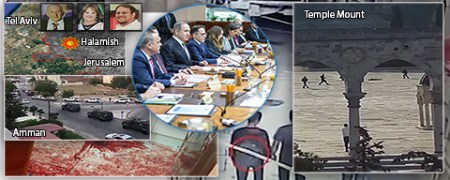
Binyamin Netanyahu’s government is being forced back step by step on the Temple Mount standoff by a three-line siege imposed by the Palestinians, Sunni Arab governments, including Jordan, and public opinion at home.

The security cabinet can’t be faulted for approving its first rational steps for securing the worshippers and visitors frequenting Temple Mount, after three Israeli Arab gunmen desecrated the shrine on July 14 by shooting dead two Israeli police officers on guard at Lion’s Gate.

Metal detectors at the gates provided a quick fix for reopening the shrines the next day.

Where the ministers went wrong was in failing to go after the perpetrators of the murders committed at one of the most sensitive world shrines. The killers belonged to the lawless Jabarin clan that rules the Israeli Arab town of Umm al Fahm. The ministers did not treat this clan as central to the crime, out of concern for the delicate relations with Israel’s Arab minority. Instead, Temple Mount, the lightening rod of Israel’s relations with the entire Muslim and Arab world, was treated as the core issue.

The Jabarins felt safe enough to carry on breaking Israel’s laws. On Tuesday, July 25, a member was caught smuggling a truckload of illegal Palestinian workers from the Palestinian town of Jenin across into Israel. It was obvious that something is badly amiss in national homeland security policies.

In another example, the government finally, a year late, ordered the home of one of the Tel Aviv Sarona Market terrorists, who murdered four Israelis, to be knocked down. One story of a building in the Hebron village of Yata will be destroyed. At the same time, the Supreme Court of Justice in Jerusalem gave the police 30 hours to hand over the bodies of the three Temple Mount gunmen, members of the Jabarin tribe,  to their families for burial.

Razing the home of one of the Tel Aviv terrorists, who claimed to have been inspired by ISIS, in a timely fashion, a year ago, might have been some deterrent for the killers of Umm al-Fahm.

It now turns out that the shrine murders 12 days ago were the result of Israeli Arabs and Palestinians coming together for a joint terrorist conspiracy against Israel. The location was deliberately chosen as the catalyst for dragging moderate Arab rulers into a plot for compelling Israel to give up its sovereignty on Temple Mount and the Old City of Jerusalem.

This conspiracy was insufficiently addressed by the ministers taking part in the security cabinet’s deliberations. The removal of the metal scanners, security cameras – or any other measures Israel was been forced to cede – will not satisfy the Palestinians and Israeli Arab leaders, including their members of parliament. They are intent on drawing their community of 1.5 million into the bloody brew they have cooked up for the entire Arab world to consume.

As this juncture, the Israeli government has no choice but to brake hard on concessions – even as street violence escalates – and draw a red line against caving in any further. The Palestinians and their clerics should be firmly informed that if they choose to continue to boycott Al Aqsa and hold prayers in the street outside the shrine, so be it. Israel will not budge any further on its responsibility to secure Temple Mount against more violence. And their dream of a victory parade on the holy compound to celebrate their humiliation of the Jewish State will never come true.

Very few Israelis are aware of the origins of the 180,000 Arabs living in Jerusalem today. Most of them originate in Hebron and migrated to Jerusalem over the years since 1967. The Hashemite Kingdom of Jordan which ruled eastern Jerusalem and its shrines for 19 years up until the Six Day War, very carefully kept Hebron natives out of the city. Their extremist conduct over Temple Mount explains why.

If Israel fails to draw a strong red line at this point in the standoff, a new crisis or terrorist outrage will be staged every few days to force the ministers to fall back step by step on measures pivotal to national security. Popular opnion at home, incensed over the Halamish terrorist outrage, was against the first concession and will oppose any more.

CAIR Loses San Diego Schools Partnership

July 26, 2017

CAIR Loses San Diego Schools Partnership, Investigative Project on Terrorism, John Rossomando, July 26, 2017

CAIR’s program aimed to increase education about Islam in the classroom. Parents and religious liberty advocates balked at singling out Muslim students for safe places without providing similar accommodations to other faiths. Muslim holidays would have been added to the school calendar, and campus events falling on those holidays would be rescheduled.

*************************************

SAN DIEGO – The Council on American-Islamic Relations (CAIR) tried to have it both ways – claiming to be a civil rights organization when it suits its purposes, but admitting at other times that its mission is religious.

That duplicity has cost CAIR a partnership with San Diego public schools and threatens to sabotage a plan to take an educational program national.

San Diego school board members agreed Tuesday night not to work with CAIR on a campaign to specifically fight anti-Muslim bullying generated by an exaggerated CAIR report. Instead, the Anti-Defamation League is poised to work on a program that aims “to comprehensively address the issue of bullying of all students.”

The agenda item specifically mentioned that school board “staff is redirected from forming a formal partnership with CAIR to forming an intercultural committee which shall include representatives of from all faiths and cultures and which shall provide input to District staff on issues of cultural sensitivities and the individual needs of various subgroups within our diverse community.”

Still, speaker after speaker criticized the proposal for excluding CAIR and for not specifically emphasizing anti-Muslim bigotry and “Islamophobia.” CAIR-San Diego Executive Director Hanif Mohebi managed to make that argument while still denying CAIR was singularly focused.

“We have never come out saying that it should only be one group. But I think also we should realize that it might be a mistake not to focus on groups that are targeted much more than the rest,” Mohebi said. “So that being said, we expect the district to publicly acknowledge and recognize the work that we have done for over a decade with the school district.”

While the Anti-Defamation League also has a focus on protecting a specific group – Jews – Regional Director Tammy Gillies said its mission also is to “secure justice and fair treatment for all. That ‘and’ is the most important part of our mission statement. When one community is unsafe we are all unsafe.”

The ADL program, she noted, has been evaluated by Columbia University, the University of Pennsylvania, Yale and other respected institutions.

The board agreed to work with CAIR in April. CAIR’s program aimed to increase education about Islam in the classroom. Parents and religious liberty advocates balked at singling out Muslim students for safe places without providing similar accommodations to other faiths. Muslim holidays would have been added to the school calendar, and campus events falling on those holidays would be rescheduled.

It was obvious, though, that board members reluctantly decided to implement a broader policy addressing bullying across cultures and religious backgrounds. Vice President Kevin Beiser reaffirmed his support for CAIR and thanked it for over a decade of partnership, but said supported the revised proposal “because I believe it codifies the board’s commitment and my commitment to making sure that all students are safe. We do have certain groups of students who are bullied at much higher rates than other students.

“We need to work together to solve that problem,” Beiser said, “and we want to thank CAIR and all of you in the Muslim community for your partnership.”

The anti-bullying program was never about “promoting a religion” as some critics claimed, said Board President Richard Barerra.

But lawyers with the Freedom of Conscience Defense Fund (FCDF) sued the school district in May, claiming the program did place Muslim students above others, violating the First Amendment’s establishment clause, the Fourteenth Amendment and California law barring assistance to religion. They also claimed the anti-bullying program was a solution to an exaggerated problem.

None of the speakers advocating for CAIR’s continued involvement addressed that Constitutional concern.

A report by CAIR’s California chapters, “Growing in Faith: California Muslim Youth Experiences with Bullying, Harassment & Religious Accommodation in Schools” inspired the program, FCDF’s lawsuit claims.

The school district’s decision to back away from partnering with CAIR is an important victory, FCDF Executive Director Daniel Piedra told the Investigative Project on Terrorism (IPT). But he remains concerned that CAIR still may partner with the school district on other programs.

Mohebi and his allies seemed upset that they will not be able to use the school district to further their agenda, Piedra said after the meeting.

“They talk about equality, but it’s really Orwellian because in their philosophy and the school board’s philosophy, they are really saying that all students are equal but that some students are more equal than others,” Piedra said.

The FCDF lawsuit remains alive despite Tuesday’s decision to switch from CAIR’s program to the ADL’s. The group wants to learn more about CAIR’s role in drafting the anti-bullying program. If it turns out that CAIR was intimately involved, the lawsuit may move forward because students’ rights would have been violated, Piedra said, and to ensure that CAIR loses future opportunities to shape policy.

FCDF could seek monetary damages, he said, but it may ask a judge to impose a consent decree compelling the school district to not partner with CAIR again.

“We are willing to work with them; however, violating the Constitution is a serious allegation, and we are going to hold that to the school district every step of the way,” Piedra said.

Under the now-abandoned program, students accused of bullying Muslim students were supposed to face “restorative justice,” requiring them to reconcile with the other student. The school district would provide monthly reports on the bullying of Muslim students and post them online.

The district’s reversal follows the FCDF’s amended complaint filed last month, which challenged CAIR’s local effort to hide behind the label of being a “civil rights organization.” It pointed to testimony by CAIR co-founder and Executive Director Nihad Awad, who told the National Labor Relations Board (NLRB) that it lacked jurisdiction over a fight over unionizing CAIR employees because CAIR is a religious organization.

CAIR letterhead includes the invocation, “In the Name of God, the Compassionate, the Merciful,” which opens every chapter in the Quran, Charles L. Posner, regional director of the National Labor Relations Board, wrote in an April 7 ruling.

This religious acknowledgement goes to the heart of the Establishment Clause‘s separation of church and state.

The loss of the San Diego program is a set-back for CAIR’s desire to take an “anti-Muslim bullying” program national. It represents the biggest government rebuke to CAIR since the FBI instituted a policy in 2008 to break-off outreach programs due to CAIR’s documented history in a Muslim-Brotherhood created Hamas-support network in the United States.

And it should send a message to districts throughout the country, Piedra said, warning CAIR that his organization will sue any public school district that partners with it in a similar anti-bullying program.

“We want to be sure for the benefit of our schoolchildren that CAIR is kept out of America’s schools,” Piedra said.

Videos suggest Russian government may be arming Taliban

July 26, 2017

Videos suggest Russian government may be arming Taliban, World Affairs Journal, Nick Paton Walsh and Masoud Popalzai, CNN, July 25, 2017

(Please see also, Taliban seizes 3 districts from Afghan government. — DM)

Story highlights
  • Two videos obtained by CNN suggest the Taliban have received improved weaponry supplied by the Russian government
  • Russia’s Foreign Ministry declined to comment but has previously called claims they are arming the Taliban “utterly false”

(CNN)The Taliban have received improved weaponry in Afghanistan that appears to have been supplied by the Russian government, according to exclusive videos obtained by CNN, adding weight to accusations by Afghan and American officials that Moscow is arming their one-time foe in the war-torn country.

US generals first suggested they were concerned the Russian government was seeking to arm the Afghan insurgents back in April, but images from the battlefield here corroborating these claims have been hard to come by.

These two videos show sniper rifles, Kalashnikov variants and heavy machine guns that weapons experts say are stripped of any means of identifying their origin.

Two separate sets of Taliban, one in the north and another in the west, claim to be in possession of the weapons, which they say were originally supplied by Russian government sources. One splinter group of Taliban near Herat say they obtained the guns after defeating a mainstream rival group of Taliban. Another group say they got the weapons for free across the border with Tajikistan and that they were provided by “the Russians.”

The videos don’t provide incontrovertible proof of the trade, of which Moscow has categorically denied involvement. Yet they offer some of the first battlefield evidence of a flow of weapons that has the Afghan and American governments deeply concerned about Moscow’s intentions here.

“The Russians have said that they maintain contact with the Taliban, we have lots of other reports from other people they are arming the Taliban … there is no smoke without fire,” Afghan government spokesman Sediq Sediqi said. “That’s why our intelligence agencies are up to the job to find out what level of support that is to the Taliban.”

Another Afghan official said they were sure that trade was happening between Russia and the Taliban.

Russia’s Foreign Ministry declined to comment for this article but has previously called claims they are arming the Taliban “utterly false” and said they were made to cover up for the United States’ failure in Afghanistan. The Russians talk to the Taliban purely to promote peace talks, they said.

US officials have long voiced concerns about any weapons flow to the terror group. Asked in April whether he would refute the reports Russia was arming the Taliban, the US commander here, Gen. John Nicholson, said: “Oh, no I’m not refuting that… Arming belligerents or legitimizing belligerents who perpetuate attacks … is not the best way forward.”

Gen. Joseph Votel, chief of US Central Command, told a congressional committee in March he believed the Russians were seeking influence in Afghanistan.

“I think it is fair to assume they may be providing some sort of support to (the Taliban) in terms of weapons or other things that may be there,” he said.

In one video the Herat group are seen brandishing the guns, which they said were taken from the mainstream Taliban, led by Mullah Haibatullah, after that group attacked them. Eighteen of their rivals were killed in the attack and six were captured, they said.

“These weapons were given to the fighters of Mullah Haibatullah by the Russians via Iran,” said their deputy leader, Mullah Abdul Manan Niazi. He went on to repeat the often-heard rationale behind the arming — which Moscow denies — that the weapons were supplied to help the Taliban better fight ISIS.

“The Russians are giving them these weapons to fight ISIS in Afghanistan, but they are using them against us too,” he said.

The second video was shot nearer Kabul and features a masked Taliban fighter parading arms he says he obtained through the northern province of Kunduz. He said he did not pay for the weapons — insurgents often pay for guns with opium crops — and that his group received the guns via the Tajik border.

“These pistols have been brought to us recently,” he says. “These are made in Russia, and are very good stuff.”

Weapons experts from the Small Arms Survey studied the videos and said there was little in them to directly tie the guns to the Russian state. The weapons were not particularly modern or rare, and even some of the more elaborate additions, like a JGBG M7 scope on one machine gun, were Chinese made and readily available online, they said.

Yet Benjamin King from the Survey said, “the weapons didn’t seem to have the manufacturer markings where we would expect them.” He said that elsewhere there have been reports of supplying governments and others going to great lengths to remove identification markings from weapons.

“If this is a pattern seen in Afghanistan then it would be noteworthy,” he added.

Sediqi, the Afghan government spokesman, said they had put the allegations to Moscow and also received a denial. He added Afghan officials have expressed their concerns about Moscow’s contacts with the Taliban, which coalition officials say legitimizes the insurgency.

“The issue of contact with the Taliban with the Russians was something that really concerned us as well,” Seddiqi said. “No contact with non-state groups.”

The incredible love and respect upon President Trump’s arrival in Israel 

July 26, 2017


Iran poised to launch rocket into space, as North Korea readies another missile test, US officials say

July 26, 2017

Iran poised to launch rocket into space, as North Korea readies another missile test, US officials say, Fox NewsLucas Tomlinson, July 26, 2017

While Iran insists its space program is for peaceful purposes, officials have long said any components used to put a satellite into orbit can also be used for building an intercontinental ballistic missile capable of hitting the United States.

*********************************

Two American foes are poised for upcoming rocket launches, two senior U.S. officials told Fox News, with another North Korean intercontinental ballistic missile launch expected as soon as Wednesday night and Iran on the verge of sending its own vehicle into space.

Iran’s Simorgh space-launch vehicle is believed to be carrying a satellite, marking the second time in over a year that Tehran has attempted to put an operational satellite into orbit — something the Islamic Republic has never done successfully, according to one of the officials who has not authorized to discuss a confidential assessment.

Iran’s last space launch in April 2016 failed to place a satellite into orbit, the official said.

The intelligence community is currently monitoring Iran’s Semnan launch center, located about 140 miles east of Tehran, where officials say the “first and second stage airframes” have been assembled on a launch pad and a space launch is expected “at any time,” according to the official.

Just days after President Trump took office, Iran conducted its first ballistic missile test under the new administration, prompting the White House to put Tehran “on notice.” Since then there have been other ballistic missile and cruise missile tests, including one from a midget submarine in early May — a type of submarine used by both Iran and North Korea.

North Korea and Iran have long been accused of sharing missile technology.

“The very first missiles we saw in Iran were simply copies of North Korean missiles,” said Jeffrey Lewis, a missile proliferation expert at the Middlebury Institute of International Studies at Monterey. “Over the years, we’ve seen photographs of North Korean and Iranian officials in each other’s countries, and we’ve seen all kinds of common hardware.”

U.S. officials are skeptical, however, that North Korea and Iran are coordinating their rocket and missile launches.

While Iran insists its space program is for peaceful purposes, officials have long said any components used to put a satellite into orbit can also be used for building an intercontinental ballistic missile capable of hitting the United States.

U.N. resolution 2231 says Iran is “called upon not to undertake any activity related to ballistic missiles designed to be capable of delivering nuclear weapons, including launches using such ballistic missile technology,” according to the text of the agreement which went into effect days after the landmark Iran nuclear agreement that was engineered by the Obama administration.

Critics have said that language was purposefully watered down to “called upon” instead of a more restrictive phrase because Russia intervened.

In a sign Congress is losing patience with both Iran and North Korea, the House of Representatives on Tuesday overwhelmingly passed (419-3) new sanctions targeting Iran, North Korea and Russia, due in part to Iran and North Korea’s missile programs.

News of Iran’s pending rocket launch coincides with more evidence North Korea is also preparing to test another ICBM, perhaps as early as Wednesday night — a date that would coincide with the 1953 Korean Armistice Agreement, which ended the fighting in the Korean War, but technically not the war itself.

U.S. officials say North Korea has recently moved fueling equipment and trucks to a launch pad near the town of Kusong, near North Korea’s border with China and about 100 miles north of the capital city of Pyongyang.

North Korea has a history of conducting missile tests on historic dates.

North Korea’s first successful launch of a long-range missile capable of reaching Alaska — a rocket the Pentagon now calls the KN-20 — occurred on July 4th, while the U.S. celebrated Independence Day.

That North Korean ICBM traveled some 1,700 miles into space, seven times higher than the orbit of NASA’s International Space Station. It is not clear, however, if the rocket’s “reentry” vehicle successfully returned to earth in one piece after it splashed down in the Sea of Japan hundreds of miles off the Korean peninsula.

Officials believe a new test of North Korea’s KN-20 is for the purpose of testing the reentry vehicle.

Director Pompeo Details How the CIA Is Changing Under President Trump

July 26, 2017

CIA Director Mike Pompeo: ‘This organization is going to be in the business of stealing secrets’

BY:
July 26, 2017 5:00 am

Source: Director Pompeo Details How the CIA Is Changing Under President Trump

The following are excerpts of an interview with CIA Director Mike Pompeo by Bill Gertz, Washington Free Beacon senior editor and veteran national security reporter.

Bill Gertz: Tell me about your first six months at CIA.

CIA Director Mike Pompeo: The agency is frankly in a place where it’s got great people out there doing the right thing, and the good news is we’ve got a president who’s going to let them go do it. More than let them, he’s going to demand that [the agency] give them the authority and capacity to take on those challenges in a way that is in the deepest traditions of what the CIA has done when it was at its best, when it was at its high points throughout its decades of service to the country.

The president—I’m with him often—turns to us for questions that are broad and complex, and is looking for answers and for our capacity to deliver them to him and to other senior leaders in government.

And so when you say, “Mr. President we’ve got work to do on that one,” he says: “What do you need to go get it done?” And he has been willing to give us the scope and the authority to go do it and I know they’ll hold us accountable too.

BG: How is the CIA going to be different under the Trump administration? We’ve heard the administration is decentralizing authority and giving field commanders more authority. Is a similar thing happening in intelligence?

MP: It is. Same thing. We have spent our first weeks identifying places where we needed authorities to go do our mission better, or we needed to make sure we had policy guidance, that is the law already permitted it but the previous administration had chosen not to do it. We need policy guidance to go get it right. In nearly every one of those cases it increases the risk level. It also greatly enhances the likelihood you’ll achieve the outcome you’re looking for.

And the president has, I think in every case it’s fair to say we’ve come and said, “Here’s the mission. Here’s the authorities we have today. Here’s what we think the gap is; here’s how we think we mitigate risk if you provide us those authorities.” And every time he’s said, “Go do it.”

BG: And does that mean operations or analysis or technology?

MP: All of the above. Look, our primary mission is foreign intelligence. That is at the core of what we do, and so the ability to go collect against the most difficult places, the most difficult targets in a way that is not one-off, that is deep and robust and redundant is something this agency is really good at when they are allowed to do it. And the president is going to go let us do it. That’s a great thing and the team loves it. The team is excited. That’s why they all went to cia.gov and signed up.

BG: People have said CIA has lost the focus on espionage and turned instead to drone operations. Are you now getting back more into spying?

MP: I try not to be critical of those who have come before. We will always have a big counterterrorism piece. Our portfolio will always include assisting the FBI and Department of Homeland Security, keeping the homeland safe, the CT mission.

This organization is going to be in the business of stealing secrets, important secrets, secrets that matter, secrets from the folks who don’t want us to have them, on the things that matter most for policy makers so that we can deliver that information in a timely way so they can make really good informed decisions.

If you don’t have that, if you’re missing that collection piece, if you’re just handing them the same things that have been written some place else, the organization doesn’t add the value that the president and team need. So we’re going to do that.

BG: Former CIA Director John Brennan made a number of reforms such as creating new “centers” on issues. The administration is doing several major organizational and policy reviews. Is there an intelligence review to look at whether intelligence needs to be reformed, changed, or improved?

MP: Bill, I speak just inside the agency. There are reviews that are being contemplated of the entire intelligence community. I’ll leave others to comment on where the administration is on that.

But inside CIA itself we took about 60 days to look at the changes that had been made, the so-called modernization. Pieces of it made sense and were consistent with what the president and my mission are at the CIA. Other pieces I thought weren’t working as well. And so we have reshaped it. Some of it’s subtle. An enormous set of layers were put in place as a result of the modernization. We’re going to beat the bureaucratic piece of this to let our warriors and our spies on the front line go do their jobs.

We created a couple of mission centers, places where we felt we weren’t adequately focused on a very near term piece of a particular threat. So, the Korean Mission Center.

We moved the counterintelligence mission center. We’ve all seen the leaks. A place where I, even long before I was CIA director, have observed that there was a lot of work to do in counterintelligence. So that now reports to me. That is important for a couple of reasons. First, I think it communicates to the team and to the world that the CIA is going to take counterintelligence very, very seriously. And second it gives me the capacity to be able to put my imprimatur on how we run CI and how our team executes that. We’ve got a good team. I meet with them quite frequently now. It will take us a little time to get to be where I think we need to be. But I’m convinced we’ve already begun to put in place the building blocks to achieve that.

BG: Right now we’re seeing a kind of anti-Russia hysteria. I’ve got questions on that. What have you seen in terms of Russian influence operations? Have they abated? Has there been pressure? Has the exposure changed their MO at all?

MP: You’ve been at this a long time, Bill. This is a decades-old challenge for America. No, it hasn’t abated. No, I don’t expect it to abate. They’re Russians, they’re Soviets, so no. We still face a threat from the Russians whether it’s, pick a name, active measures or propaganda, or trying to shape world public opinion through a whole host of means—some overt, some less so. That threat is going to be constant. We have an obligation to push back, defeat it, to work to make it painful for them so that they’ll reduce the magnitude of what they’re doing. The agency has a piece of that. Other parts of the intelligence community and the other parts of government have a piece of that too. But we’re certainly doing our part to push back.

I’ve made a trip to Moscow. I met with my counterparts there, trying to find places on counterterrorism where we can work together. You have Americans that fly on Russian airplanes. They might have information that we need. It seems to me if we can find a way to share counterterrorism information with them, we ought to. And at the same time communicate to them that it’s just unacceptable to continue to perform these active measures against the United States and that we’re watching them and we’re going to push back.

BG: I wrote the book iWar that is about information warfare. Is that something the administration is going to look at?

MP: Your point is well taken. Sometimes it just devolves to a cyber discussion. Cyber matters. It’s important. The Russians are aggressive. By the way, so are the Chinese, so are the Iranians, the North Koreans. The list is long. But yes the problem expands far beyond just cyber. There are lots of places.

It’s all of the CI effort, at least from an intelligence perspective. And then from a U.S. government perspective it’s even broader than that. So yes, it’s not just a cyber challenge. I wish it were. If we had that, we might be able to put all the resources there and knock it back.

BG: I recently interviewed an exiled Chinese billionaire, Guo Wengui, who was very plugged in to the Chinese elite. He was close friends with the vice minister of State Security. He said that over the past 50 years the Chinese have developed 25,000 spies in the United States—official intel officers, permanent residents, students, business people. Their spying focus, according Guo, has changed since 2012 toward offensive operations. Are you concerned about the Chinese intelligence threat?

MP: Most certainly. I can’t comment. I read what you wrote. I’m trying to stay out of the specifics. Look, it’s the case, the Chinese have an active campaign. I mean this is a long-time thing. It began with really commercial attacks. Trying to steal our stuff. That continues. They’ve always tried to get at our military resources, our R & D programs and the like. So those have long histories.

But it is also the case that the Chinese have moved to a place where they, I think, see themselves as a rival superpower and so intend to conduct their version of espionage programs in a way that reflects their superpower status. And so, yeah, we’ve seen it, some of it comes out of 3PLA; and some of it comes from more unattributable places. But they are working it very, very hard, much like the Russians and to a lesser degree the North Koreans. They just don’t have the scale capacity that the others have.

They have as part of their mission to reduce the relative power of the United States vis-à-vis their own country. And one of the ways they do that is through these active measures, these spying efforts.

BG: You mentioned counterintelligence. Is there some concern there could be penetrations of CIA? Does that keep you up at night?

MP: It does. It does. It’s a serious risk. When you have a big work force distributed around the world, you always run the risk that they somehow get inside the curtain. And we have pretty capable programs to identify them. To your point, it only takes one. When it comes to CI we need to attain perfection or near perfection and risk mitigation. We’ve got to make sure that we’re doing our job in a sufficiently compartmentalized way that even if they get one through that they don’t have all the keys to the candy store. So that’s an important element.

BG: NYT had a piece recently that revealed the loss of recruited CIA agents China. Can you comment on that at all?

MP: No I can’t.

BG: Okay. You have spoken about non-state hostile intelligence actors, the insider threat. Is that translating to new policies?

MP: That’s a good question. So the insider threat is not new in that sense. It’s morphed a touch perhaps, or the risk has changed a little bit. But the risk is the one we were just talking about. Whether it’s an employee, contractor is immaterial. Somebody who has access gains information. What has made the world more complicated is you now have an elaborate set of players on the outside. Non-nation states. The history of the Central Intelligence Agency is that we’ve prepared for our adversaries as countries. So the whole rubric of our operation, our legal authorities, how we think about the world, we’re organized around countries or regions. The apparatus has a whole history of knowing how to perform its intelligence functions against nation states.

These characters are different. They don’t have a particular home. They may be well operate in multiple countries all around the world and communicate electronically or see each other only in passing in an airport some place. We have to make sure the intelligence community and the CIA in particular have the authorities to respond to that, and we’re thinking about the problem set from that perspective and there’s still work to do. So I have set a group of folks on course to try and make sure we understand where our gaps are, so that we can know whether we have to go to Congress to get legislation to do that which could be possible, or if we can do it as a matter of executive authority, to make sure we’re shaping our intelligence activities in a way to address these things that are different.

BG: Does that include better internal audit and monitoring?

MP: Yeah. We have to go after these folks. We’ve got to think how we run against them. How we monitor their capacity. How we make sure they’re not getting inside our organization.

When I used the phrase non-state hostile intelligence services, I meant that as a rubric to think about them. They run spies. They hire people. They try and perform counterintelligence for themselves. They have highly elaborate defenses of their own. They’re trying to get inside America’s systems. They have sponsors often who provide resources, the money to do what they do. But they also operate the way some other countries do. That is they make money through criminal activity. So when you stare at them for a while they look all the world to be an intelligence services. They have all the central functions. They do intelligence collection. They run operations. They have a support structure. They look and smell like an intelligence service and we should treat them as such.

BG: Have there been cases when CIA or the government has identified these groups trying to get jobs in the intelligence community?

MP: I can’t comment specifically on that. But these services will do anything. They’ll offer a bounty for information. This is in the finest tradition of intelligence collection but from a very different motive force and from a very different space. They’re unanswerable to anyone in the sense of in nearly every country you have a set of citizens to whom you have to answer to one degree or another depending on where you sit in the democratic order of things. These are free-range chickens.

BG: Rest of my questions are on threats to U.S. security interests. What is most immediate threat? What are the more longer term threats?

MP: I would say terrorism and North Korea. North Korea is relatively low-probability, but massive liability risk. The terrorist threat today is non-nuclear. But different and in greater magnitude and in more places around the world. So they’re very different threats and our response has to be different. But each of them is on top of us today. So near term I’d place those two at the top.

I think China presents probably the most … well it’s hard to pick between China, Russia and Iran to be honest with you. I guess if I had to pick one with a nose above the others, I’d probably pick China. They have a real economy that they have built, unlike Russia that lives and dies on how many barrels of oil they can pluck out of the ground. And Iran that is similarly very single sector derivative and not to the scale of China population wise.

I think China has the capacity to present the greatest rivalry to American of any of those over the medium and long term.

BG: They are building up their military in a very aggressive way. Some say its part of a normal desire to be superpower. But all these niche weapons capabilities are focused on us, whether nuclear or hypersonic missiles. Is that a concern?

MP: Yeah. It’s very much focused on countering U.S. power projection. So you see that whether it’s going on in the South China Sea or East China Sea, the work they’re doing in other parts of the world. You talked about the technical piece. You’ve probably spent more time on it than me. But we could probably spend hours talking about their technical programs.

If you look at them, they are probably trying either to steal our stuff or make sure they can defeat it. And most often both. And so yes. Look, we have other relationships, we have commercial relationships with the Chinese as well. But I think its very clear when they think about their place in the world, they measure their success in placing themselves in the world where they want to be vis-à-vis the United States and not as against anyone else.

BG: And Russia. You touched on that a little bit. One thing they are doing is working on fairly alarming nuclear buildup. Reports from Russia indicate they’re building what they consider to be usable nuclear arms that are small-scale nukes.

MP: Yeah. I’ve read those reports as well. I’ve seen the reporting on their violations of the Intermediate Range Nuclear Forces Treaty as well. They are clearly building out and I would argue too their forays into places like Syria, their presence that is beginning to pop up in Afghanistan and other places, has two effects. One, it stretches them economically. It’s a challenge for Russia to keep pace with that adventurism.

But second, they learn too. When you exercise a force, you get better. So now they’ve had a chance to exercise their navy. They’ve had a chance to exercise their army. They’ve had a chance to do combined operations. Cruise missiles. Combined arms operations with their aviation assets. And so they will be better prepared in the event we’re in a scenario where deterrence hasn’t worked, whether that’s in eastern Europe or some place else.

BG: Plus they are doing hybrid warfare: Achieve strategic goals without using physical force or with little green men.

MP: I am reminded of my days as a young tank platoon leader with the threat from the Russian hordes rolling west. And they’ve achieved many of their purposes without rolling a single tank across—well maybe that’s not quite true in Ukraine—but only a handful of tanks across any international boundary. Yeah, the Gerasimov doctrine [on non-linear warfare] has been around since the 70s. If you go back and read it, it’s almost haunting to read how [Gen. Valery] Gerasimov was thinking about this in the 70s and now he’s the chief of the Russian general staff. He’s their senior military leader. And he is executing that as well.

BG: On the Iran nuclear deal, in the past you’ve somewhat suggested Iran is not complying with the Joint Comprehensive Plan of Action (JCPOA), as the Iran nuclear deal is called. The Trump administration recently certified that Tehran is complying. Do you have doubts about Iran’s compliance with the nuclear deal?

MP: I can’t give you any of the classified information. I will leave to Secretary [of State Rex] Tillerson’s statement the compliance piece.

But I think it’s fair to think about that agreement and the Iranian’s compliance with it like a bad tenant. If you’re the landlord, the rent’s due on the 10th. You call the tenant a few times and the check comes across the transom. Next day you show up and there’s an old sofa in the front yard and you ask them to get rid of it. And you know they kind of drag their feet and they scream at you a little bit and say “I’m not taking it away.” And you go, “Come on.” And eventually, the sofa disappears. That’s Iranian compliance with the JCPOA today. It is grudging. They are pushing the boundaries of it. I think the president or maybe it was the secretary of state and president used the term that all the things they are doing around the agreement clearly don’t get to the core concept, which was to create regional stability. They have not done that. And just [last Wednesday] the report from the State Department identifying them as the world’s largest state sponsor of terror.

BG: On the North Korea threat, I’ve seen reports that new intelligence indicates North Korea could have a deliverable nuclear warhead on a long-range missile by the end of the decade? Is that driving the administration’s concern?

MP: Yes. Whether it’s 10 months or 10 years is difficult from an intelligence perspective to always identify. I think of this, Bill, as a little less of could they do it, but can they do it in a way that’s reliable. That’s really the risk. It might be that they launch one, put a nuclear warhead [on it] and get lucky. That’s bad. We need to prevent that. But the real threat is can they do it in a way that’s reliable such that they have confidence in their deterrent capability.

If you said what’s the real threat. It’s their knowledge that they can deliver that, repeatedly as against the U.S. defenses. When they get to that point, they hold the United States at risk and the president has made very, very clear he’s not going to permit that to happen.

For 20 years previous administrations have just whistled past the graveyard on this. Maybe they had more time. Maybe that was okay. From an intelligence perspective, I think the president agrees with this, we’re past that. We’re too close. Whether it’s 10 years or five years and what the actual range will be and what the scope and scale of that nuclear warhead will be, we know they’re working it. We know they’re determined, we know they get closer with each launch, whether it’s successful or a failure. And the president’s very focused on assuring that this particular leader doesn’t have those particular weapons.

BG: What’s the answer? There do not appear to be a lot of good options. Diplomacy and sanctions. What’s the intelligence side?

MP: We’ll see what the president asks the agency to do.

BG: Have they asked you to do anything?

MP: I can’t talk about it. Having said that, I told you we created a mission center designed to address the threat from the North Korean government to the world and we are looking at every piece of the agency’s operations, whether it’s foreign intelligence collection, covert operations, the capacity to assist our brothers in arms at the DoD, We are preparing to make sure that when the president comes to us and says “We think we’ve hit the point where diplomacy no longer works” that we’re prepared to deliver him a set of options that might well succeed in achieving whatever the policy objective is.

BG: And then there’s ISIL. With things changing on the ground in stronghold areas of Iraq and Syria, what’s the forecast? Are there concerns foreign fighters will move to Libya, then Europe and on to the United States?

MP: So we’re very worried about where those folks go. It’s the reason I think the administration chose to just kill as many of them as they could. That is fewer folks leaving the AO creates fewer trackable items for the U.S. intelligence community. And so we’re hopeful they will be very, very successful and the risk will be lower.

But we have to be ever mindful that some of them will carry European passports and they’ll have visa free access to the United States. That’s why I think you heard Secretary [of Homeland Security John] Kelly talk a little bit about our work along not just our borders but all the ways that people get into our country. And then we have a task to try and track these folks. And we have in this sense great European partners who also selfishly have a tremendous interest in preventing attacks in their countries. They’re probably closer to the front line on this than we are. They’ve certainly had more attacks than we’ve had in our first six months in office. But we worry about where they’ll go. But we also worry about where they’ll be recreated, where they’ll be re-stood up, whether that’s ISIS in Afghanistan, or Libya, Southeast Asia—they’ve started to show up in the Philippines. So yeah this threat from radical Islamic terrorism, in this case of the Sunni variety, is very real, even after the fall of the so-called Caliphate.

BG: Any other topic you want to address?

MP: We touched on it a little bit: The media’s insatiable demand for leaks presents enormous risks to the United States of America. We have the first duty, that is, to protect our stuff from getting out. But I am confident that this administration is going to do its level best, once the secrets are out, to identify those who did them.

We talk about. There’s an old aphorism in the law that says that, I’ll get it a little bit wrong, “Justice is entitled to every man’s evidence.” This administration is intent on getting to every man to figure out how this happened. It matters to me personally. We have CIA officers who will get killed as a result of these. And I don’t want to have to go talk to their family members and say “Yup, this young man, this young woman died as a direct result of some information that was published by a media source that was released from our organization” or frankly from our government. This is deadly business so we are deadly focused on pushing back against it.

 

New US sanctions against Russia ‘defy common sense’, will cause retaliation

July 26, 2017

Source: New US sanctions against Russia ‘defy common sense’, will cause retaliation – Moscow — RT News

Aerial view of the US Capitol in Washington © Aoc / Zumapress.com / Global Look Press

Moscow will retaliate against the US for the expected adoption of new anti-Russian sanctions, which are viewed in Russia as senseless and destructive, Russia’s deputy foreign minister said.

“It can be said now that the news is very sad from the perspective of Russian-American relations and the perspectives of their development,” Kremlin press secretary Dmitry Peskov said on Wednesday.

“This is no less disheartening from the point of view of international law and international trade relations,” he said.

“The attitude to this (law) will be formed on the basis of a thorough analysis, and the decision (on how to respond) will certainly be taken by the head of state, President Putin,” he said.

The new round of sanctions by Washington is “equally dreadful from the point of view of international law and international trade relations,” Peskov told journalists.

“What is happening defies common sense. The authors and sponsors of this bill are taking a very serious step towards destroying any potential for normalizing relations with Russia,” Sergey Ryabkov told the media on Wednesday, referring to an act adopted earlier by the US House of Representatives.

The bill seeks to impose new economic sanctions against North Korea, Iran, and Russia, and received overwhelming support from US legislators.

Moscow is being targeted for alleged interference in the 2016 presidential election, an allegation that Russia denies and which has not been backed by convincing public evidence.

Russia’s foreign ministry expects the bill to become law, which would inevitably prompt Moscow to retaliate, Ryabkov warned.

Read more

© Jonathan Ernst

“We told them dozens of times that such actions would not be left without a response. I believe the signal went through even though present-day Washington tends to listen to and hear from no one but itself,” he said.

Similar concerns were voiced by Senator Frants Klintsevich, who chairs the Defense and Security Committee. He said that Washington’s stance is dragging the world into a new Cold War, and compared the looming new sanctions to the notorious 1974 Jackson–Vanik amendment.

That amendment targeted the Soviet Union with economic sanctions for obstructing the repatriation of its Jewish citizens to Israel, but survived even after the discriminative policy was canceled. It remained in effect for almost four decades, hurting Russia’s economic growth. The piece of legislation is viewed by many in Russia as an example of unfair economic competition by the US under a pretext of protecting human rights.

Klintsevich said the US move “will make very difficult, if possible at all, any Russian-American cooperation on solving important international issues, including fighting against terrorism.”

READ MORE: Brussels to act ‘within days’ if US sanctions hurt EU trade with Russia – internal memo

The US bill, which is yet to be signed into law by President Donald Trump, also sparked concern in Europe. European governments and business leaders fear the sanctions would hurt crucial joint energy projects with Russia and may be motivated by Washington’s desire to take over the European natural gas market from Russia in favor of American liquefied natural gas (LNG).


‘America 1st doesn’t mean Europe last’– EU lashes out at US sanctions against Russia

July 26, 2017

Source: ‘America 1st doesn’t mean Europe last’ – EU lashes out at US sanctions against Russia — RT News

Brussels has fired back at the new US sanctions against Russia, saying an “America first” approach does not mean EU interests can come last. Germany and France have also voiced their opposition to the new set of sanctions.

In a harshly-worded statement, Jean-Claude Juncker, president of the European Commission, lashed out at Washington saying “America first cannot mean that Europe’s interests come last.”

He added the commission “concluded today that if our concerns are not taken into account sufficiently, we stand ready to act appropriately within a matter of days.”

Read more

Aerial view of the US Capitol in Washington © Aoc / Zumapress.com / Global Look Press

The EU’s legislative body also argued the sanctions “could affect infrastructure transporting energy resources to Europe, for instance the maintenance and upgrade of pipelines in Russia that feed the Ukraine gas transit system,” according to a press release.

The sanctions bill has also caused a stir in Berlin. “This concerns not only German industry … Sanctions against Russia should not become a tool of industrial policy [pursued] in the US interests,” German Foreign Ministry spokesman Martin Schaefer told a news conference on Wednesday, as cited by Sputnik.

Speaking at the same briefing, government spokeswoman Ulrike Demmer added Berlin believes “the European industry should not become the target of US sanctions.” She noted it was crucial “to continue close coordination between the US and the EU in the sanctions policy toward Russia.”

France has said the sanctions “contradict international law” due to their “extraterritorial reach,” according to a statement by the French Foreign Ministry.

“This bill, if it comes into force, would allow measures against European natural or juridical persons for situations that have no connection with the United States,” the statement read.

French and EU laws would need to be adjusted in response to the sanctions, she said, adding that discussions should be held at European Union level.

“To protect ourselves against the extraterritorial effects of US legislation [or any other legislation], we need to work to amend national legislation and perfect EU measures,” according to the statement.

The officials were commenting on the latest package of anti-Russian sanctions voted into law on Tuesday by the US House of Representatives. The restrictions, which come as part of a bill imposing sweeping sanctions also on Iran and North Korea, target Russia’s major defense, mining, shipping and railway industries.

Read more

© Francois Lenoir

They also include penalties on European companies engaged in joint EU-Russia energy projects, with the Gazprom-run Nord Stream 2 flagship pipeline being the most probable target of renewed sanctions.

Some media reports suggested Brussels was preparing countermeasures in the event that the sanctions enter into force after being signed by the US president. Should that happen, the EU will stand ready to act immediately, according to the Financial Times.

On Monday, the newspaper wrote that the European Commission had drafted an internal memo outlining possible options on the US sanctions, including invoking a ‘Blocking Statute,’ an EU regulation that limits extraterritorial US jurisdiction in Europe, as well as triggering a number of “WTO-compliant retaliatory measures.”

Moscow maintains the US sanctions are being imposed at the expense of European businesses. “There is very serious pressure from the US on European companies,” Russian Economy Minister Maxim Oreshkin was quoted as saying by RIA Novosti on Wednesday.

He asserted the restrictions cannot inflict substantial damage on Russia. “Our macroeconomic policy is shaped in such a way so that sanctions-related shockwaves coming from outside do not have significant impact on the Russian economy,” he said.

Some experts, however, doubted the EU’s readiness to go against its transatlantic ally. “I’m not sure if the European Union has courage to take actions against this,” Dan Kovalik, an American labor rights lawyer, told RT. “I’m worried that the US is able to impose the sanctions notwithstanding the EU opposition to it.”

“I’m sure this is not about protecting democracy, either the US democracy or someone else’s. This is more about the US wanting more of a share of markets in Europe for its natural gas,” Kovalik added. “These sanctions, which would be made permanent … are really tantamount to a declaration of war against these countries, particularly Russia.”

He said the measure is likely to diminish any progress made by Donald Trump and Vladimir Putin at the G20 summit in Hamburg, as the US may be “forced into a more adversarial relationship with Russia.”


