Archive for January 2017

Saudi Journalist to Palestinians: Armed Resistance to Israel is Futile, Arab World Has Lost Interest in Your Cause

January 28, 2017

Saudi Journalist to Palestinians: Armed Resistance to Israel is Futile, Arab World Has Lost Interest in Your Cause, AlgemeinerBarney Breen-Portnoy, January 26, 2017

hamas-2Hamas fighters. Photo: Wikimedia Commons.

The Palestinian cause is “no longer a top priority” for the Arab world, a Saudi journalist declared earlier this month.

In an article published by the Saudi daily Al Jazirahnewspaper — and translated by the Middle East Media Research Institute (MEMRI) — Muhammad Aal Al-Sheikh wrote that the reliance of radical Palestinian groups on armed resistance “constitutes a kind of political suicide that only political ignoramuses [can] condone.”

According to Al-Sheikh, a two-state solution to the Israeli-Palestinian conflict is the sole option “that can be demanded and which enjoys the support of most of the international community.”

What the Palestinians, Al-Sheikh went on to say, “need to understand is that the Arabs of today are not the Arabs of yesterday, and that the Palestinian cause has lost ground among Arabs. This cause is no longer a top priority for them, because civil wars are literally pulverizing four Arab countries, and because fighting the ‘Islamic’ terrorism is the foremost concern that causes all Arabs, without exception, to lose sleep. It is folly to ask someone to sacrifice [tending to] his own problems and national interests in order to help [you solve] your own problems.”

“All I can say to my Palestinian brethren is that stubbornness, contrariness, and betting on the [support of] the Arab masses are a hopeless effort, and that ultimately you are the only ones who will pay the price of this stubbornness and contrariness,” he concluded.

In recent years, Israel has been quietly developing ties with the Sunni-Arab axis in the Middle East – including Saudi Arabia. In his September address to the UN General Assembly, Israeli Prime Minister Benjamin Netanyahu said that in addition to Egypt and Jordan, which already have signed peace treaties with the Jewish state, “Many other states in the region recognize that Israel is not their enemy. They recognize that Israel is their ally. Our common enemies are ISIS and Iran. Our common goals are security, prosperity and peace. I believe that in the years ahead we will work together to achieve these goals.”

Now That Trump Is in the White House, Can Israel Seize the Moment?

January 28, 2017

Now That Trump Is in the White House, Can Israel Seize the Moment? AlegmeinerMartin Sherman, January 27, 2017

(Please see also, Trump Will Keep Vow on Jerusalem Embassy Move, Giuliani Says. — DM)
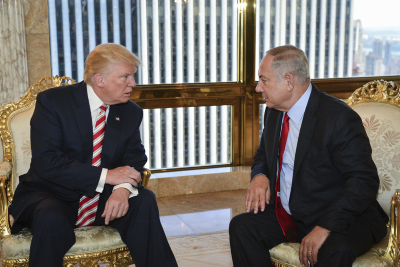
Prime Minister Benjamin Netanyahu meets with Republican Presidential candidate, Donald Trump, in New York, on September 25, 2016. Photo by Kobi Gideon/GPO *** Local Caption *** ??? ?????? ?????? ?????? ???? ?? ????? ?????????? ? ?????? ????? ?????, ????? ????? ? ??? ???? ?????

Prime Minister Benjamin Netanyahu meets with Republican Presidential candidate, Donald Trump, in New York, on September 25, 2016. Photo by Kobi Gideon/GPO

To date, there seems to be only one central pre-election commitment that the new administration appears uncharacteristically hesitant in embracing: the promise to transfer the US embassy in Israel to Jerusalem.

Of course, not all this regrettable reluctance can be blamed on the Trump administration. After all, the Israeli government itself has not been overly enthusiastic in promoting the embassy relocation.

************************

“There is a tide in the affairs of men,
Which taken at the flood, leads on to fortune.
Omitted, all the voyage of their life is bound in shallows and in miseries.
On such a full sea are we now afloat.
And we must take the current when it serves, or lose our ventures.”

— William Shakespeare, Julius Caesar, Act IV, Scene 3.

“If I am not for myself, who is for me? …And if not now, when?”

— Hillel the Elder, Ethics of the Fathers, Ch. 1:14.

In the first few days of his presidency, Donald Trump has acted with remarkable resolve to promote a number of his more strident campaign pledges, and to dismantle much of the edifice his predecessor had hoped to leave as his “legacy.”

Robust resolve

Thus, Trump moved to withdraw the US from the Trans-Pacific Partnership Agreement, which the New York Times dubbed “Obama’s signature trade achievement.”

Similarly, he instigated measures to begin rolling back “Obamacare,” the centerpiece of Obama’s domestic policy; approved the construction of two large oil pipelines (Keystone pipeline between the US and Canada, and Dakota Access Pipeline), which Obama had vetoed; cut funding of charities providing abortion services abroad, reinstating a 1984 bill that Obama had rescinded; and ordered a freeze on hiring federal government workers (apart from the military) in an “effort to reduce government debts and decrease the size of the federal workforce.

Then, later this week, Trump “signed directives to begin building a wall along [the] US border with Mexico and crack down on US cities that shield undocumented immigrants.” Likewise, he is reported to be drafting directives to be implemented “in the coming days [that] would…suspend the entry of any immigrants from Muslim-majority Middle Eastern and African countries Syria, Sudan, Somalia, Iraq, Iran, Libya and Yemen while permanent rules are studied.”

So, regardless of whether one commends or condemns these policy decisions, they certainly reflect a firm — indeed, a seemingly unswerving — commitment to his campaign pledges, no matter how controversial or contentious.

With one notable exception.

Rare reticence 

To date, there seems to be only one central pre-election commitment that the new administration appears uncharacteristically hesitant in embracing: the promise to transfer the US embassy in Israel to Jerusalem.

Readers will recall that in October 1995, the US Congress passed a law (the Jerusalem Embassy Act) with broad bi-partisan support — including from Obama’s vice president, Joe Biden and Secretary of State John Kerry — that, in effect, recognized Jerusalem as the undivided capital of Israel, under Israeli sovereignty, and explicitly called for the relocation of the US embassy to the city by May 1999. The bill, however, included a proviso permitting the president to issue a waiver holding up the relocation of the embassy should he deem it in the US national interest. The waiver is renewable every six months and since the legislation of the bill, every president — both Democrat and Republican — has exercised the waiver option. Indeed, 36 such waivers have been issued in the past — including eight by Obama — the last of which was put through in December 2016 and is due to expire in June 2017.

Accordingly, all Trump really needs to do to fulfill his pledge to relocate the US embassy to Israel’s capital is, well…nothing. Indeed, he need take no proactive measures at all. He does not need to build a wall, lay a pipeline, pass new legislation or sign a contentious executive order. All he needs to do is let the current waiver lapse, and allow the existing 1995 legislation to take effect.

Yet, for some reason, it is precisely on this issue that the new administration is displaying rare reticence in moving briskly forward to deliver on its clear commitments.

Disturbing lack of enthusiasm…from Israel

Of course, not all this regrettable reluctance can be blamed on the Trump administration. After all, the Israeli government itself has not been overly enthusiastic in promoting the embassy relocation.

Reflecting Israel’s lack of fervor in applauding Trump’s pledge was Defense Minister Avigdor Lieberman’s offhand apathy in addressing the prospect at last month’s Saban Forum in Washington. When asked by the moderator, CNN’s Jake Tapper, what he thought of Trump’s declaration that he would move the US embassy in very short order to Jerusalem, Lieberman was distinctly dismissive, indicating that he was skeptical as to the prospect: “You know, [what] we see before in every election is the same promise to remove the embassy to Jerusalem. But I think that we will wait and we will see.”

Then, virtually providing the administration with the justification to renege on its commitment, or at least significantly postpone it, Lieberman stated: “We have many other issues…we have enough challenges all around Israel. I think that it will be a mistake…to take the embassy as the focal point…We have many items on our common agenda. I think that maybe the Embassy will be one of the points.”

With such lethargic endorsement from the Israeli government, there would be little room for surprise if America’s new commander-in-chief does not push his proffered relocation vigorously forward.

Plethora of invalid arguments

A plethora of bad reasons has been advanced for not moving the US embassy to Jerusalem. Typical of such baseless arguments was the one articulated in an Haaretz op-ed, in which the writer warned: “Relocating its embassy to Jerusalem would mean the US taking a partisan stance on a central and sensitive issue, a source of controversy between Israel and the Palestinians, and between Israel and the international community.”

But of course, quite the opposite is true. By not relocating the embassy even to the western portion of Jerusalem, the US is, in fact, taking a partisan stance against Israel. For, in effect, this endorses the Palestinian/Arab position disputing Israeli sovereignty over any part of the city, including the portion that was under Israeli control prior to the Six-Day War. After all, if the US does not dispute Israeli sovereignty of the city within the pre-1967 lines, surely there should be no reason to refrain from establishing the embassy there. Or am I missing something here?

After all, the western portion of Jerusalem is, undisputedly, the functioning capital of Israel. There sit the national parliament, the prime minister’s office, all the government ministries (apart from agriculture) and the Supreme Court. Any capitulation to the notion that the Palestinians have a legitimate claim to any part of it would immediately torpedo the chances of an agreement. Accordingly, abstaining from relocating the embassy to western Jerusalem implicitly sustains grounds for such a claim and, in effect, constitutes a partisan pro-Palestinian stance.

By contrast, relocating the embassy would send a strong, even-handed message that the US will not tolerate exorbitant and unreasonable Palestinian territorial demands.

Invalid arguments (continued) 

But, perhaps the most common argument advanced for not relocating the embassy is because the Arabs and Muslims will get really mad. The threat of uncontrollable rage due to grievous insult (which would not provoke any other segment of humanity to similar conduct) has frequently been raised as reason to avoid offending Muslim sensibilities. It has already almost completely curtailed free speech in much of Western Europe and Scandinavia, where Muslim thugs are free to ravage the domestic population in the name of moral relativism and cultural diversity.

Clearly, giving into Arab/Muslim extortion because of threats of violence is a slippery slope. Once you capitulate on one issue, there is little reason not to capitulate on another.

Indeed, if the menace of Muslim mayhem can coerce nations to forgo free choice, what is to prevent further far-reaching demands, such as universal application of Shariah law, the discrimination against females and the persecution of gays?

The threat of violence is no reason to refrain from establishing the US embassy in Israel’s capital, but rather the reason to do so — and it will convey to the Arab/Muslim world that brandishing “uncontrollable rage” is an unacceptable and counter-productive mode of conducting international relations.

Respite not redemption 

The election of Trump was a huge stroke of good fortune for Israel. Just how dire its position might have been had Hillary Clinton been elected to continue the Obama legacy was vividly conveyed by two recent incidents.

The first: a surreptitious transfer of almost a quarter billion dollars to the Palestinian Authority by the outgoing president in the final hours of his incumbency, in defiance of a congressional hold on the funds.

The second: a jarring disclosure made last week by former director-general of Israel’s ministry of foreign affairs, Ambassador Dore Gold, of an astonishing admission by Obama’s National Security Adviser Susan Rice, that “even if Israel and the Palestinians reach an agreement, it is possible that the United States would oppose it” – because it might not do justice to the Palestinians.

These disturbing revelations starkly expose the blatant pro-Palestinian proclivities of the outgoing Obama administration and of the expected Clinton administration as the designated surrogate-successor.

Israel can be excused for feeling a huge sense of relief at the outcome of the November elections. However, a word of caution is necessary. For all the potential advantages involved in the Trump victory, it is — for the moment — merely a respite and still far from redemption. To attain that, there is yet much work ahead.

Catalyst or constraint?

There can be little doubt that the Trump victory harbors the potential for great opportunity for Israel. Not only is the incoming administration free from innate malice and anti-Israel bias that characterized the manifestly Islamophilic propensities of the previous one, but many in Trump’s inner circle are unabashedly pro-Zionist, and together with the wider Republican Party, unshackled to the failed “two-state solution.”

At last, after almost a quarter century, Israel has a real chance of being able to free itself of the deadly, debilitating tentacles of this pernicious paradigm — and to choose a new path that will allow it to extricate itself from the perilous cul-de-sac into which it had been led and allowed itself to be led.

The question now is whether the Israeli political class can rise to the occasion, and grasp the opportunity that destiny has provided. Will the nation’s leaders display the intellectual daring and the ideological resolve for which the hour calls? Will they be able to cast off the prevailing constraints of political correctness and forge new and sustainable paradigms for the conduct of the nation’s affairs, taking advantage of the new benign winds in Washington? Or will they, as it seems, remain captive to old molds of thought — and thus prove to be a constraint, rather than a catalyst, impeding rather than inducing the chances that the Trump administration may well afford them if they were to strike out in a bold new direction?

“There is a tide in the affairs of men…”

More than ever before, Israel’s destiny is in its own hands. The outcome of the US elections has given it a real chance to shape its destiny. The crucial question now is whether it will seize the moment or let it slip away.

Almost six months before the Trump inauguration, shortly after the Republicans had removed their endorsement of a two-state model in its party platform, I published a column entitled “What if the GOP wins?”. I called on the Israeli “Right” to prepare for the possibility of a Republican victory and formulate a credible alternative to the discredited two-state prescription.

However, I cautioned that haste to discard this failed two-state formula should not lead to the proposal/promotion of alternatives that are no less inimical than the ideas they were designed to replace.

I urged that, to reap the potential benefits of the Trump phenomenon:

Israel must prepare. It must formulate a cogent, comprehensive paradigm to replace the two-state folly, which addresses both its geographic and demographic imperatives for survival — lest it promote a proposal that threatens to make it untenable geographically or demographically — or both.

It must be a proposal that ensures that Israel retains its vital geo-strategic assets in Judea-Samaria and at the same time drastically reduces the presence of the hostile Arab population resident there — preferably by non-coercive means such as economic inducements…which, of course, is what brought the bulk of the Arab population here in the first place.

This is now becoming an urgent imperative, lest we miss the flood tide and find ourselves “bound in shallows and in miseries” that a lapse will inevitably entail.

Trump says Syrian Christian refugees will be given priority

January 27, 2017

Trump says Syrian Christian refugees will be given priority, Jihad Watch

(Please see also, Immigration Priorities: Translators, and Victims of Genocide. — DM)

“Pew Research Center said last October 38,901 Muslim refugees entered the United States in fiscal year 2016 from all countries – almost the same number of Christian refugees, 37,521.”

Reuters is being deliberately misleading. From Syria in 2016, the Obama administration admitted 12,587 refugees: 12,486 Muslims, 68 Christians, and 24 Yazidis. Trump is ending this obvious social engineering and saying that Syrian Christians, who have borne the brunt of persecution from jihad groups there, will be given priority.

This also shows the falsity of establishment propaganda media claims that Trump’s immigration ban would keep out non-Muslim victims of persecution by jihadis.

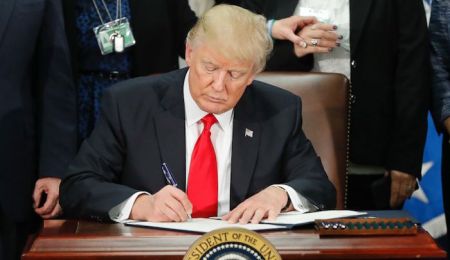
trumpwithpen

“Trump says Syrian Christian refugees will be given priority,” Reuters, January 27, 2017:

WASHINGTON, Jan 27 (Reuters) – President Donald Trump said on Friday that Syrian Christians will be given priority when it comes to applying for refugee status in the United States.

“If you were a Muslim you could come in, but if you were a Christian, it was almost impossible and the reason that was so unfair, everybody was persecuted in all fairness, but they were chopping off the heads of everybody but more so the Christians,” Trump said in an excerpt of an interview with the Christian Broadcasting Network.

Pew Research Center said last October 38,901 Muslim refugees entered the United States in fiscal year 2016 from all countries – almost the same number of Christian refugees, 37,521….

Texas Officials Warn of ISIS Threat to U.S.-Mexican Border

January 27, 2017

Texas Officials Warn of ISIS Threat to U.S.-Mexican Border, Investigative Project on Terrorism, John Rossomando, January 26, 2017

A report by the Texas Department of Public Safety raises concerns about ISIS terrorists using the Mexican border both to enter and leave the country. It noted that at least 13 aspiring terrorists have tried to cross into Mexico, or considered trying, since 2012.

Most of those cases involved people who knew they were on the federal no-fly list but wanted to travel to join terrorists, the report said. Sneaking across the southern border “presents an opportunity for increasing numbers of aspiring foreign terrorist fighters to evade US interdiction efforts such as the No-Fly List.”

The most recent example happened in October. Texas authorities arrested two Milwaukee men near San Angelo, Texas on the way to the Mexican border. Jason Ludke, 35, and Yosvany Padilla-Conde, 30, wanted to go to Mexico, obtain fraudulent travel documents and travel to join ISIS in Syria or Iraq.

In another instance in April 2015, seven Somali men from Minnesota tried to cross from San Diego into Mexico in an effort to get to Syria and fight for ISIS.

Texas resident Bilal Hamed Abood, an Iraq-born naturalized U.S. citizen, successfully used the border in 2013 to travel to Syria, where he fought for a Syrian rebel group. The FBI arrested Abood for lying about his initial travel to Syria when he tried to come home through the Dallas-Fort Worth airport. Abood claimed he fought for a faction that was not prohibited under U.S. law. However, FBI agents search his computer and found that he took an oath of allegiance to ISIS leader Abu Bakr al-Baghdadi.

Texas authorities voiced concern in 2014 about ISIS social media threats to use the Mexican border to enter the United States.

In a criminal complaint filed last year, alleged ISIS supporter Erick Jamal Hendricks claimed to have had contact with an ISIS supporter known as “Abu Harb.” “Abu Harb” told Hendricks that he was in Dallas and that the “Islamic State had brothers in Mexico.”

Previously, government officials warned about threats to the U.S. border posed by other terrorist groups including Al-Shabaab and Hizballah.

President Trump touted the ISIS threat as a reason for building his wall along the Mexican border during the campaign. He signed an executive order Wednesday calling for the wall’s construction, but funding sources are not yet clear.

Khamenei Associate Mehdi Taeb: ‘The Jews… Are The Only Ones Who Need Weapons Of Mass Destruction In Order To Rule The World – Because There Are 1.4 Billion Muslims And None Of Them Agree To Jewish Supremacy’

January 27, 2017

Khamenei Associate Mehdi Taeb: ‘The Jews… Are The Only Ones Who Need Weapons Of Mass Destruction In Order To Rule The World – Because There Are 1.4 Billion Muslims And None Of Them Agree To Jewish Supremacy’, MEMRI, January 27, 2017

In speeches and lectures that have been uploaded to the Internet in the past year, Mehdi Taeb, who directs the Ammar Strategic Base that advises Iranian Supreme Leader Ali Khamenei, has expressed antisemitic views. In his statements, Taeb has claimed that the Jews aim to control the world and therefore are obligated to kill anyone who is not willing to accept this control, particularly Muslims. He reiterated the antisemitic canard about the Jews controlling the global economy and the media, and stated that they hatch plots and sow division, strife and wars, especially among Muslims, in addition to creating and taking advantage of terrorism worldwide so as to ensure their global dominance. The Jews, he implied, even have power over God Himself. He urged his audience to awaken and act against the Jews, as instructed in the Koran, and to remove the cancerous growth of Israel, as commanded by the father of Iran’s Islamic Revolution, Ayatollah Ruhollah Khomeini.

This report will focus on two of Taeb’s speeches, a 2011 audio recording[1] and a 2014 video,[2] that in the past few months have been posted online several times. The 2011 recording is part of a series of lectures by Taeb, and the 2014 clip is from a Friday sermon in which he referred to a video of statements by an Israeli rabbi with bogus Farsi subtitles added as “proof” of anti-Shi’ite Jewish plots and terrorist actions aimed at preventing the Mahdi – the Hidden Imam, who is the Shi’ite Messiah – from coming to save the world from the Jews.

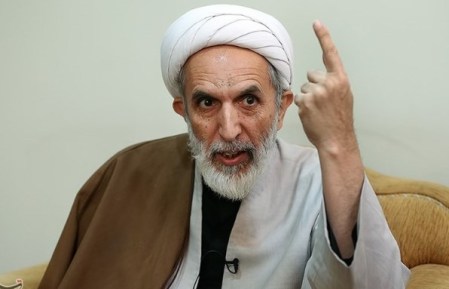
6759aMehdi Taeb (image: nowruziran.wordpress.com)

Taeb In “Know Your Enemy” Lectures: “No One In The World Wants To Control It As Badly As The Jew, Who Says ‘Either Be My Servant Or Be Destroyed'”

In an hour-long audio recording dated September 23, 2011, which was part of a lecture series titled “Know Your Enemy,” Taeb explained why the Koran warned about the Jews and their global role. The Jews, he said, have special capabilities and they are using them to take over the world. To this end, the Jews have divided the world’s population into three categories: themselves, destined to control the world; another group, destined to serve the Jews; and a third group, comprising those who oppose Jewish rule, and which the Jews are working to exterminate. The Jews need atom bombs and weapons of mass destruction to destroy those who oppose them – that is, 1.4 billion Muslims – and they did not establish the State of Israel before conducting a nuclear test.

“He added that the Jews were keeping the Mahdi from arriving, saying: “The Koran speaks much of the Jews, and often warns about them… Surat Al-Maida [the fifth Surah of the Koran]… states that the Jews are your worst enemy… This surah says that you will ultimately realize this, whether you like it or not, but that if you are willing [to understand] and to avoid [falling for the Jewish deceit], then you will be saved. However, if you are remiss and are not willing [to understand], then one day they [the Jews] will awaken you. In the end, being remiss regarding [the Jews] will also bring about [your] awakening… but after you awaken, you will find yourselves in a grave already dug [for you] by the Jews… Why does the Koran warn so about the Jews? Why is it said that the world is a pawn in the hands of the Jews? … The reason the Koran warns so about the Jews is because they have [special] capabilities, and are the most hostile to us [Muslims, more so than] others. The Jews also know how to attack better than anyone else. They are No. 1 in four ways, and that is why Islam states that we must confront them…

“The Jews want the entire world [for themselves], saying ‘the whole world belongs to us’ and ‘God gave it to us and He cannot take it back.’ If you think about the Star of David, you will realize that the Jews want… to take over the world in three stages: The first stage is Jerusalem… the second stage is from the Nile to the Euphrates, and the third stage is the whole world. The Star of David has six points. This symbol is meant to shine in the [Jewish] Temple [in Jerusalem]. Its two upper lines symbolize [the territory] from the Nile to the Euphrates, [and once they control that] then the six points of the Star of David will spread across the world and connect up with each other… in controlling the whole world.

“They have divided humanity into three categories… The first class is the Jews, who are supposed to conquer the world… and as long as they do not take over the entire world, God’s hands are tied… The second class is those who are not descendants of Jacob, but who agree that the Jews are the first class… These people are entitled to live, but must serve the Children of Israel… The third class is those who are not Children of Israel and who do not agree to the supremacy of the Children of Israel, and reject their rule… The Talmud [of the Jews] states that such people should be killed as cheaply as possible – [that is], if you can kill them with a rock, don’t kill him with a sword, because that will dull the blade…

“According to this, under the global Jewish regime, the Muslims need to be killed… Who needs an atom bomb? … The Jews! They are the only ones who need weapons of mass destruction in order to control the world, because there are 1.4 billion Muslims and none of them agree to Jewish supremacy… In order to control the world, the Jews must kill 1.4 billion Muslims… and therefore need atom bombs… Until the Jews carried out an atomic bomb test, they did not establish the State of Israel… No one in the world wants to control it as badly as the Jew, who says ‘Either be my servant or be destroyed’… For 3,000 years, the Jews have been preparing the ground for this. Today, the world’s wealth is in Jewish hands… The world hates the Americans because of their relationship with the Zionists…

“The Imam [Khomeini] once said that the Jews say Iran purchased weapons from Israel – because [the Jews] know how lowly they are, and how they are hated, and know that anyone with a connection to Israel will be hated as well. They want Iran to be hated, so they say that it purchased weapons from Israel…

“America is not severing ties with Israel because 80% of American wealth belongs to Israel… Wherever there is fire and fighting in the world, such as in India and Pakistan, the reason for it should be investigated among the Jews. The same goes for Africa…

“Because three years ago Jacques Chirac supported Hizbullah, the Jews are causing chaos in France, so as to make trouble for him… If you Muslims want the Imam Mahdi to arrive, you must remove this stumbling block [to his arrival] – that is, the Jews… In order to control the world, the Jews create chaos…That is why it is said that the world is a pawn in the hands of the Jews…

“In order for you Muslims to attain world domination, you must remove this cancerous growth… That is why the Imam Khomeini said that Israel should be removed from the map of the world…

“The Koran said that the Jews must pay the jizya [poll tax], must deliver it with both hands, and must also present themselves [to the Muslim authorities] every week – because if you leave the Jews alone, they will scheme.”

Taeb On Video Of Israeli Rabbi Amnon Yitzhak And “The Jewish Deceit”: “This Is The First Time A Clip Of A Jewish Rabbi In A Jewish Synagogue Was Leaked… He Says That [The Jews] Should Do Something So That They [The Shi’ites] Cannot Bring Their Imam Mahdi”

A video dated July 18, 2014 and posted online several times in recent months shows Taeb giving a Friday sermon in which he refers to a July 8, 2014 video of Israeli rabbi Amnon Yitzhak giving a speech to a Jewish audience. Although in the video the rabbi is discussing the biblical story of Abraham’s hospitality to three visitors in Chapter 18 of Genesis, the Farsi subtitles show him talking about Jewish plans to sow divisions among the Shi’ites so as to delay the arrival of the Mahdi. Taeb says that the rabbi’s statements prove that a Jewish trick is preventing the arrival of the Mahdi.

Following are Taeb’s statements to his audience of worshippers about what he claims the rabbi is saying:

“The Koran states that the worst hostility towards the [Muslim] believers comes from the Jews… That is, if the Imam Mahdi cannot arrive, it is because of them. ‘Go break his [the Jew’s] hands’…

“This is the first time a clip of a Jewish rabbi in a Jewish synagogue has been leaked. He gives a speech, and [in it] says that [the Jews] should do something so that they [the Shi’ites] are not able to bring their Imam Mahdi [because the Jews fear]… that if their Imam Mahdi arrives, he will dismantle our entire [Jewish] enterprise…

“[This rabbi says:] We [Jews] created Sarkhi[3] so that [the Shi’ites] would be preoccupied. We promote world soccer, so do something in order for them [the Shi’ites] to be preoccupied with soccer, sports, and the like. Do something so that they fail and turn on each other…

“This [speech by the rabbi] reveals that they [the Jews] created ISIS so that we are preoccupied with each other and so that the coming of the Imam Mahdi will be delayed. These are the explicit statements by that Jewish rabbi.”

To watch the video, click the player below. For the translation of the Farsi subtitles, see Appendix A; for a translation of Amnon Yitzhak’s actual statements in the relevant segment, see Appendix B.

(Video at the link — DM)

APPENDIX A: Translation Of Farsi Subtitles Added To July 8, 2014 Clip Of Rabbi Amnon Yitzhak

“It is absolutely necessary to distance the Shi’a in Iraq from extremist elements, as well as from thoughts of assisting their co-religionists [elsewhere], as well as from the faith written in their books, and from their Imam Mahdi who [is supposed] to fight us – so that they [the Shi’ites] cannot help him [the Mahdi] in the end times.

“Therefore, a source [of religious guidance] must be created, in order to divert them [the Shi’ites] from their religion and faith, and keep them preoccupied with games, and lead them in the direction of sporting events. [Exploiting] their love of soccer is very important right now.

“Mahmud Al-Sarkhi, our agent in Iraq, whose projects we generally rely on – after Mahmoud Al-Sarkhi was assassinated, his brother became our agent, and we made him a mirror image of his brother. And his stupid friends confirmed that he was [indeed Sarkhi] himself, after we trained him, and now he attacks everyone to create division.

“I ask you to log onto Facebook, spread his words and attacks, and become his disciples.”

APPENDIX B: Translation Of Rabbi Amnon Yitzhak’s Statements

“It’s possible to enjoy this world and live a good and happy life, even in materialistic terms, but with blessings. You can eat delicious food and say a blessing over it, drink a delicious beverage and say a blessing over it. You can have fun, dance and celebrate – but always with a blessing, while [following the] religious commandments. Everything, even the most material things, can be [used as a chance to follow the] religious commandments. When our father Abraham hosted [the three visitors], he stood there, 99 years old, in the heat of the day, after his circumcision. It was the third day after the circumcision, which is the most painful. To make him go back into his tent [God] made the sun come out [and shine hot], but [Abraham] did not go back in. He sees three Arabians, who were [really] angels, approaching him. They looked like heathen Arabians to him, [yet] he invited into his home. He ran over to his cattle, slaughtered [a calf], did everything to be hospitable. He showed them charity, that is the Jewish [way]. What did he feed them? Three tongues of oxen in mustard. He took tongues from three oxen. [He could have] taken one tongue and divided it into three, because it is large, [but] no, he was 100% charitable. You know what was happening at the time? When those Arabians arrived, the Lord was with [Abraham]. ‘The Lord appeared to Abraham near the great trees of Mamre while he was sitting at the entrance to his tent.'”

__________________

[1] Media.rasekhoon.net, September 23, 2011; translation starts at 26:00.

[2] Aparat.com, July 18, 2014.

[3] Apparently a reference to Mahmud Al-Hasani al-Sarkhi, an Iraqi Shia cleric in Iraq whose followers attacked the Iranian consulate in Basra in protest over criticism of their leader that was broadcast on Iranian television.

Dr. Jasser discusses Pres. Trump’s extreme vetting on Varney & Co 01.27.2017

January 27, 2017

Dr. Jasser discusses Pres. Trump’s extreme vetting on Varney & Co 01.27.2017 via YouTube

(Please see also, Immigration Priorities: Translators, and Victims of Genocide. — DM)


They Teach Our Children, Advise Our Government, And Support Jihad

January 27, 2017

They Teach Our Children, Advise Our Government, And Support Jihad, Investigative Project on Terrorism, Abigail R. Esman, January 27, 2017

1957

Esposito seems to want to aim his work beyond the ivory towers. He has spoken on Islam to the State Department, the FBI, the CIA, Homeland Security and other government offices.

**************************

Since the rise of ISIS as an Islamic extremist group, and certainly since its leader, Abu Bakr al-Baghdadi, declared the official creation of the caliphate, researchers and intelligence groups worldwide have noted its popularity with Muslim women, even in the West. Unlike other terrorist groups, ISIS has pointedly recruited women. And many women have, on their own, found the promise of life in the Islamic State particularly appealing.

Along the way, researchers and intelligence agencies have argued that the Muslim women who join ISIS, especially those who travel to Syria from the West, take active roles in ISIS’s jihad. While they are largely barred from fighting on the battlefield, women have enrolled in the al-Khansaa brigade, the women’s moral police force which enforces strict codes of dress and public behavior. Al-Khansaa officers regularly arrest and beat women who violate sharia-based modesty laws or who appear in public without a male companion. Other women raise their sons to be jihadists, or bring their children with them from the West in the hopes that they, too, will grow up to support the Islamic State and its jihad.

Now a young Dutch researcher, Aysha Navest, has come out with a different theory based on interviews she held with over 22 women now living in the caliphate. Navest, who is affiliated with the University of Amsterdam (UvA), says she knows several of those women. They reveal a very different portrait of the so-called “ISIS brides:” girls who are not recruited for jihad, but who willingly and eagerly make the perilous trip to Syria, where they live peaceful, happy lives as homemakers, mothers, and wives. Her findings appeared last April in the journal Anthropology Today, a peer-reviewed publication of the Royal Anthropological Institute.

There is just one problem: Aysha Navest allegedly also recruits women for the Islamic State.

This is the conclusion of journalists at the Dutch national daily NRC Handelsblad, who matched Navest’s birthdate, hometown, children’s first names and other identifying details with those of “Ought-Aisha,” a woman posting messages on the Dutch-Muslim website Marokko.nl. And according to “Ought-Aisha” (or “Sister Aisha”), life in the Islamic State is simply grand. In various posts, she has praised suicide bombers, honored Osama bin Laden, and insisted that jihadists will find rewards in Paradise. Additionally, the NRC reports, in Facebook posts she has referred to Shiites and apostates as “people who rape our women, torture our men, and kill our children.”

Unsurprisingly, the NRC’s findings put renewed focus on Navest’s reports and the nature of her research, which was performed under the tutelage of two well-known UvA professors – anthropologist Martijn de Koning and Modern Islamic Culture professor Annelies Moors. Both De Koning and Moors now admit that Navest’s subjects were interviewed anonymously, largely via WhatsApp, and that she did not share the women’s names even with them – a departure from standard research practices that call for transparency. Even so, according to Elsevier, they stand behind her research.

Others, however, voice considerable skepticism. The Dutch intelligence agency AIVD dismissed Navest’s report from the outset, noting that her conclusions stood in stark conflict not only with their own, but with other studies by UvA scholars. The UvA has now called for an independent investigation into Navest’s background and the reliability of her work.

Even fellow academics have been scathingly critical. In his column for Elsevier, Leiden University Professor of Jurisprudence Afshin Ellian observed that as a result of Navest’s online postings, “in normal situations, she would end up in prison for incitement to violence and hate with terrorist intentions.” Instead, the conclusions of her “research” showing that women do not join directly in jihad but simply enjoy idyllic lives as wives and mothers in the Caliphate, represent “the manner in which she pursues her own jihad: by pulling a smokescreen before the eyes of the unbelievers.”

But the situation also exposes a larger problem within academia internationally. In many institutions, subjectivity clouds social research, while students’ minds are too-frequently shaped by anti-democratic, anti-Western, and – worse – truth-challenged ideologues. For example, at UvA, De Koning has long been accused of sympathizing with Islamic extremists. Among other things, he co-authored a book describing Salafism as a “utopian idealism.”

Likewise, at Kent State University, the FBI is reportedly investigating history professor Julio Pino for ties to the Islamic State. A Muslim convert, Pino has made provocative comments on campus and in university-based newspapers, including shouting “Death to Israel” during a lecture by a former Israeli diplomat. In a letter to a campus publication, he declared “jihad until victory!” On Facebook, Pino once described Osama bin Laden as “the greatest.” He also posted a photograph of himself in front of the U.S. Capitol Building, adding the caption “I come to bury D.C., not to praise it,” Fox News reports.

Kent State officials say they “distanced” themselves from Professor Pino, whose tenured position poses legal challenges to dismissing him from the faculty.

In contrast, at nearby Oberlin, Assistant Professor Joy Karega’s Facebook posts calling ISIS an arm of American and Israeli intelligence agencies and blaming Israel for the attacks of 9/11 were enough to get her fired from her job teaching Rhetoric and Composition. As the industry newspaper Inside Higher Ed reported, despite initially defending her right to academic freedom, Oberlin officials ultimately determined that, “Beyond concerns about anti-Semitism, which fit into larger complaints about escalating anti-Jewish rhetoric on campus, Karega’s case has raised questions about whether academic freedom covers statements that have no basis in fact.”

Then there is John Esposito, Georgetown University’s professor of Religion and International Affairs and Islamic Studies. An extensive Investigative Project on Terrorism investigation into Esposito’s activities found that he has used his position to “defend radical Islam and promote its ideology- including defending terrorist organizations and those who support them, advocating for Islamist regimes, praising radical Islamists and their apologists, and downplaying the threat of Islamist violence.” He refuses to condemn Hamas and, according to the report, “remains a close friend and defender of Palestinian Islamic Jihad board member Sami Al-Arian.”

Al-Arian ran the PIJ’s “active arm” in America while working as a University of South Florida professor.

Like Navesh, Esposito seems to want to aim his work beyond the ivory towers. He has spoken on Islam to the State Department, the FBI, the CIA, Homeland Security and other government offices. Similarly, Navesh hoped that her “research” would help shape policy in the Netherlands, encouraging courts to issue lighter sentences on women who returned home from the Islamic State. After all, they hadn’t engaged in terrorism. They’d only lived in domestic bliss abroad. Where’s the crime in that?

None, of course, if it were true. But it is not.

There is nothing new, of course, in respected journals publishing flawed research by people who aim to shape public policy or opinion – the infamous and now-debunked Andrew Wakefield study that claimed to link autism to vaccines is a prime example. But such examples only underscore the challenges, and the need to investigate better the accuracy of scholarly reports as well as the integrity of those who write them. Islamic jihad, after all, is not just about destroying our lives, but about destroying our culture. In the face of the “smokescreens” of that jihad, intellectual vigilance will be our strongest shield.

Cartoons and Video of the Day

January 27, 2017

Via Capitol Steps


H/t Town Hall

focus


H/t Vermont Loon Watch

very-flat


huh


H/t Vermont Loon Watch

cleanup


H/t Freedom is Just Another Word

worry


pouty


Sisi’s church donation stirs religious controversy

January 27, 2017

Sisi’s church donation stirs religious controversy, Al-Monitor

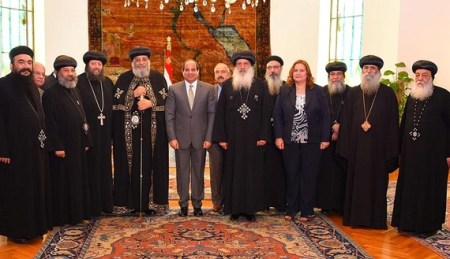
Egyptian President Abdel Fattah al-Sisi attends a meeting with Egyptian Coptic Pope Tawadros II, head of the Egyptian Coptic Orthodox Church, with some members of the Holy Synod of the Coptic Orthodox Church at the Ittihadiya presidential palace in Cairo, Egypt July 28, 2016 in this handout picture courtesy of the Egyptian Presidency. The Egyptian Presidency/Handout via REUTERS ATTENTION EDITORS - THIS IMAGE WAS PROVIDED BY A THIRD PARTY. EDITORIAL USE ONLY. - RTSK39U

Egyptian President Abdel Fattah al-Sisi attends a meeting with Egyptian Coptic Pope Tawadros II, head of the Egyptian Coptic Orthodox Church, with some members of the Holy Synod of the Coptic Orthodox Church at the Ittihadiya presidential palace in Cairo, Egypt July 28, 2016 in this handout picture courtesy of the Egyptian Presidency.

“In addition to making a donation for the building of a church, [Sisi] also donated his money to establish a mosque, thus putting both communities [Christian and Muslim] on the same pedestal.”

**************************

CAIRO — Egypt’s Coptic Christians have become used to visits by President Abdel Fattah al-Sisi. On Jan. 6, for the third year in a row, Sisi celebrated Coptic Christmas at the Abbasiya Cathedral in Cairo, extending Christmas wishes to the country’s Copts and Tawadros II, the pope of Alexandria and patriarch of the See of St. Mark.

This year, the celebration was different. The cathedral where Sisi addressed the congregation and delivered Christmas wishes stands just meters from St. Peter and St. Paul Coptic Orthodox Church, where an explosion during a service on Dec. 11 claimed the lives of 27 people and wounded 48, mostly women and children.

Sisi responded to the attack not just by visiting the church, but by announcing a 100,000 Egyptian pound (roughly $5,200) personal donation toward building a church and mosque in the new administrative capital of New Cairo.

Hamdi Rizq, the host of the show “Al-Nazra” (“The View”) on satellite TV channel Sada al-Balad, reacted by announcing during his show Jan. 6 that donations were being collected for the building of a mosque and a church in the new capital.

Amina Naseer, a professor of religion at Al-Azhar University and a member of parliament, who also serves on the parliamentary education committee, said in a Jan. 7 phone call on “Al-Nazra” that she had also donated 100,000 pounds to be split equally between the mosque and the church.

During the same show, other donors came forward: Farag Amer, the chair of the parliamentary committee for youth and sport; member of parliament Mustafa Bakry; and businessman Mohammed Abul-Enein, the owner of the Sada al-Balad network.

“The president’s call for donations for a mosque and a church should be an example to all,” Alaa Wali, head of the parliament’s housing committee, told Al-Monitor. “I suggested setting up a fund to receive donations for places of worship in general, including for renovating churches damaged because of terrorist attacks, but the priority will be a mosque and a church in the administrative capital so they can be as beautiful as possible.”

Naseer told Al-Monitor she had urged all members of parliament to donate to the fund. “Those donations are for all Egyptians, not just for the Copts,” she said. “It is true that they will go toward building a church, but that is a reaction by all Egyptians against everyone who tries to impose a foreign mandate on us, as the US Congress tried to do.”

Naseer was referring to a bill debated in Congress on Dec. 28 that would require Egypt to report annually to the US State Department on its work to restore churches vandalized by members of the Muslim Brotherhood, which was toppled from power in July 2013. Egyptian Foreign Ministry spokesman Ahmed Abu Zeed rejected in a press statement issued on the same day the bill and the debate, calling it flagrant intervention in Egypt’s affairs.

While Sisi’s donation was welcomed by some, the suggestion that Egyptians should donate to the fund was slammed by his opponents. Lawyer Tarek Elawady wrote on Facebook Jan. 6: “Sir, Egypt does not need mosques and churches; it needs schools, factories and workplaces.”

Magda Ghonem, a professor of economics and rural development at Ain Shams University in Cairo, tweeted on Jan. 7: “We have a surplus of places of worship, no smaller than the surplus in outbidding and hypocrisy. What about building the biggest home for street children, or the biggest university, or the biggest training center?”

In a lengthy post on Facebook Jan. 7, Cairo University political science professor Hazem Hosny said that the state may not have allocated the necessary funds for a church or a mosque, rather intending to rely on donations made by the citizens. “The president made the first donation, but the whole thing is an attempt to get Egyptians to pay for the new capital under the pretext of building a mosque or a church,” Hosny wrote.

Political activist Mamdouh Hamza satirized Sisi’s donation, tweeting Jan. 7: “Donate for the building of a mosque or a church, because the faithful are lining up outside thousands of mosques and churches; there’s a critical shortage of places for prayer.”

While some critics played down the importance of building mosques and churches at the present time, other bloggers and anonymous activists condemned the idea of donating for church building on religious grounds, saying it violates Sharia.

“The Christian faith is in opposition with Sharia and Islamic doctrine on many issues,” a Salafist scholar who asked not to be named told Al-Monitor. “It is haram for Muslims to donate to the building of any institution that will be a base for discussion and promotion of anything that contradicts Sharia and Islamic doctrine.”

For his part, Abdel Fattah Idriss, a professor of comparative jurisprudence at Al-Azhar University, told Al-Monitor, “There is no jurisprudence proof or any sunna in the holy Quran that prohibits a head of state from donating funds for the building of a church or any other house of worship for the monotheistic religions. Islamic Sharia had approved of this as per Prophet Muhammad who gave the right for Jews of Medina to build their temples.”

Idriss said, “The donation made by a head of state is widely welcomed, as he is considered the [protector] of all communities residing in Egypt and has the complete authority to build houses of worship. Such donations strengthen people’s patriotism and make them feel part of the nation, qualities that Islam has always sought to instill.”

He added, “In addition to making a donation for the building of a church, [Sisi] also donated his money to establish a mosque, thus putting both communities [Christian and Muslim] on the same pedestal.”

A similar controversy broke out in 2009 regarding Sharia rulings on Muslim donations for the building of churches. The sheikh of Al-Azhar at the time, Mohammed Sayed Tantawi, met a delegation from the Egyptian Union for Human Rights, headed by Naguib Gibrael, an adviser to the Orthodox Church. The media reported he had ruled that Muslims donating for church building was permitted by Islamic law. His office denied the reports after a wave of opposition from scholars at Al-Azhar.

Egypt’s Dar al-Iftaa, a government body that advises on Islamic religious affairs, ruled on Jan. 7, 2016, “Christians in Egypt may, according to Islamic law, build churches if they need that for their worship, and Islam demands they be allowed to remain, according to the laws laid down by the Egyptian state. There is nothing in any reliable text on Islamic law to prohibit that.”

Sisi’s attempt to rein in the anger of the Copts after the bombing attack of St. Peter and St. Paul Coptic Orthodox Church thus prompted a range of criticism. But it appears that the opposition comes from a pre-existing state of antagonism between him and his critics who bemoan the lack of social, economic and educational progress in Egypt.

Trump Will Keep Vow on Jerusalem Embassy Move, Giuliani Says

January 27, 2017

Trump Will Keep Vow on Jerusalem Embassy Move, Giuliani Says, Bloomberg, Michael Arnold and Jonathan Ferziger, January 26, 2017

(President Trump is not doing everything first. How odd. He must be very lazy. — DM)

trumpsalutesPresident Donald Trump salutes as he exits Marine One at the White House, Jan. 26. Photographer: Drew Angerer/Getty Images

President Donald Trump will keep his pledge to move the U.S. embassy in Israel to Jerusalem, former New York City Mayor Rudolph Giuliani said, despite Palestinian warnings that such a step would spark violence and sabotage the prospect of renewed peace talks.

Traveling to Israel with messages from Trump to Prime Minister Benjamin Netanyahu, Giuliani said the new U.S. president and his advisers will probably take “six months or so” to develop a new strategy for American peace efforts in the Middle East. How and when the U.S. moves the embassy will be discussed when Netanyahu visits the White House in early February, Giuliani said.

“I think you’ve got to wait a little bit, but it will get done,” Giuliani said of the embassy move, speaking in an interview at the Tel Aviv offices of Greenberg Traurig LLP. He heads the law firm’s global Cybersecurity, Privacy and Crisis Management practice.

The fate of Jerusalem is among the most sensitive issues Israelis and Palestinians will need to address in any future peace negotiations. Israel took the eastern part of Jerusalem from Jordan in the 1967 Middle East War and considers all of the city as its capital, while the Palestinians want the eastern portion as the capital of their hoped-for state.

Trump realizes the embassy decision “implicates four or five countries and how they’re going to react,” Giuliani said. “He needs to know how the prime minister of Israel is going to react and how he wants to see something like this done.”

Warm Relationship

Trump on Thursday told Fox News it was too early for him to speak publicly on the issue. Giuliani, who was known during his tenure for a hard-line attitude toward even petty crime in New York City, dismissed Palestinian warnings that moving the embassy would ignite the whole region.

“I think this country is capable of dealing with waves of violence,” the former mayor said.

Giuliani predicted Netanyahu and Trump would have a “very, very good, collaborative relationship,” as opposed to what he described as the “hostile relationship” between President Barack Obama and the Israeli leader.

The changed atmosphere was already evident in the first week of Trump’s tenure. While construction plans beyond Israel’s 1967 border were a recurring source of friction with the Obama administration, Trump was silent this week as Israeli officials approved plans for 2,500 housing units in the West Bank and hundreds of apartments in eastern Jerusalem.

Hanan Ashrawi, a member of the Palestine Liberation Organization’s Executive Committee, called the building plans a “flagrant violation of international law” and accused Israel of “exploiting the inauguration of the new American administration to escalate its violations and the prevention of any existence of a Palestinian state.”

Cybersecurity

Trump considered Giuliani for attorney general and secretary of state before ultimately naming him to head a committee on cybersecurity. Giuliani said he discussed cyberdefense with Netanyahu and other Israeli officials Thursday and will return in a few months for more substantive talks on the subject. Israel is among the global leadersin the field.

“We realize in the United States that we have a cybersecurity defense problem,” Giuliani said. His committee is tasked with organizing private-sector experts into groups that can help address the government’s cyber priorities, he said.