Via Latma-TV
H/t Freedom is Just Another Word

“Cardinal Blase J. Cupich of Chicago… said that as part of the dialogue’s launch last February, Bishop Robert W. McElroy of San Diego held a public discussion with Sayyid M. Syeed, national director of the Islamic Society of North America’s Office for Interfaith and Community Alliances.”
The Islamic Society of North America: “ISNA leaders view Islam as being superior to all other faiths and destined to replace them. Taha J. Alwani, a leading official of the Fiqh Council of North America, which is run under ISNA, writes: ‘In considering the earth as an arena for Islam, Allah has promised its inheritance to His righteous people, and He has promised that Islam will prevail over other religions.’…In July 2008, ISNA’s lawyers conceded that their organization, through its affiliate NAIT, had given financial support to Hamas leader Mousa Abu Marzook. Their defense was that documentary evidence of those ties dated back to the late 1980s and early 1990s, before the U.S. government had officially designated Hamas as a terrorist organization.”
“Cirelli cited statistics documenting a higher number of anti-Muslim activities…”
Anti-Jewish hate crimes are two times more common than anti-Muslim hate crimes. What is the U.S. Conference of Catholic Bishops doing to combat anti-Jewish activities? Why, nothing. Nothing at all.
“Cirelli cited statistics documenting a higher number of anti-Muslim activities nationwide as well as a recent study by The Bridge Initiative, a Georgetown University research project on Islamophobia, showing that Catholics who regularly obtained information from Catholic media were more likely to unfavorably view Muslims than those who did not.”
The Bridge Initiative is part of Georgetown University’s Saudi-funded Prince Alwaleed bin Talal Center for Muslim-Christian Understanding (ACMCU). It is run by Nathan Lean, the gutter thug who has several times published on Twitter what he thinks is my home address, in an obvious attempt to alert jihad murderers to my whereabouts and/or intimidate me into silence. Its study was designed to defame those who tell the truth about the nature and magnitude of the jihad threat, and strong-arm Catholic bookstores into not carrying books by me and others who enunciate these unwelcome truths.
So it looks as if the U.S. Conference of Catholic Bishops is throwing in completely with Hamas- and Saudi-linked groups that are determined above all to clear away all obstacles to the advancing jihad.
The U.S. Conference of Catholic Bishops is a disgrace to Catholicism, to Christianity, and to humanity.
“Leave them; they are blind guides. And if a blind man leads a blind man, both will fall into a pit.” (Matthew 15:14)
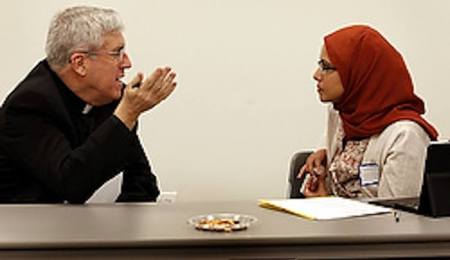
“Catholic-Muslim dialogue opens to support American Muslims,” by James Martone, Catholic News Service, January 10, 2017 (thanks to M.):
WASHINGTON, D.C. – An emerging Catholic dialogue with Muslims aims to show public support for Islamic American communities.
The dialogue stems from concerns expressed by U.S. bishops in the wake of “a serious uptick in violence against American Muslims … to make sure that they are sensitive to what is going on in the (Muslim) communities,” said Anthony Cirelli, associate director of the Secretariat for Ecumenical and Interreligious Affairs at the U.S. Conference of Catholic Bishops.
The dialogue, underway since last February, will build on three already existing regional Catholic-Muslim dialogues, also overseen by the secretariat. Those gatherings have involved Muslim and Christian scholars and religious leaders and have focused largely on academic discussions and comparisons of their respective religious texts, Cirelli said.
The regional dialogues – mid-Atlantic, Midwest and West Coast – have been effective in creating a better understanding among Muslim and Catholic leaders on a theological level, Cirelli explained.
The national dialogue also will help Muslim leaders to better advocate for current concerns, “especially with the incoming (U.S.) administration,” said Cirelli, referring to calls by President-elect Donald J. Trump and others to monitor American Muslims and limit entry of Muslim visitors from abroad.
“While our meetings will still have as a central component the all-important theological conversation, right now there is an urgency to engage more in a kind of advocacy and policy in support of the Muslim community,” Cirelli told Catholic News Service.
Cirelli cited statistics documenting a higher number of anti-Muslim activities nationwide as well as a recent study by The Bridge Initiative, a Georgetown University research project on Islamophobia, showing that Catholics who regularly obtained information from Catholic media were more likely to unfavorably view Muslims than those who did not.
“The bishops’ priority at the moment is to listen to (Muslims’) concerns, their fears, their needs … and so discern how we as Catholics can help them achieve their goals of full participation in their communities,” Cirelli said.
He said Muslim counterparts to the dialogue were still being identified.
“At this point in our nation’s history, we, the bishops, are mainly concerned with listening to and, when appropriate, coming to stand with our Muslim colleagues in their own difficult work of addressing the fears of ordinary Americans with respect to Muslims as well as their work in trying to change the negative narrative surrounding Muslims in our popular media,” Cirelli said.
The creation of the dialogue was motivated by the call of “Nostra Aetate,” the Second Vatican Council’s declaration on the relations with non-Christian religions.
“As the national conversation around Islam grows increasingly fraught, coarse and driven by fear and often willful misinformation, the Catholic Church must help to model real dialogue and goodwill,” Bishop Mitchell T. Rozanski of Springfield, Massachusetts, chairman of the bishops’ Committee on Ecumenical and Interreligious Affairs, said at the time the dialogue started in February.
Cardinal Blase J. Cupich of Chicago was designated as the dialogue’s Catholic chairman and assumed the position Jan. 1, Cirelli said.
He said that as part of the dialogue’s launch last February, Bishop Robert W. McElroy of San Diego held a public discussion with Sayyid M. Syeed, national director of the Islamic Society of North America’s Office for Interfaith and Community Alliances.
During the widely publicized event at the University of San Diego’s Joan B. Kroc Institute for Peace and Justice, Bishop McElroy challenged U.S. Catholics to take an active role in combating “the scourge of anti-Islamic prejudice.”…
Iran Steps Up Threats to Israel, U.S., Gatestone Institute, Majid Rafizadeh, January 11, 2017
(This can’t be accurate. Obama has told us that Islam is the religion of peace and tolerance. Isn’t it odd that he has not told us that the Islamic Republic has “nothing to do with Islam?” — DM)
“En Sha’a Allah [God willing], there will be no such thing as a Zionist regime in 25 years. Until then, struggling, heroic and jihadi morale will leave no moment of serenity for Zionists.” — Iran’s Supreme Leader, Ayatollah Ali Khamenei, September, 2015.
“If the Supreme Leader’s orders [are] to be executed, with the abilities and the equipment at our disposal, we will raze the Zionist regime in less than eight minutes.” — Ahmad Karimpour, a senior adviser to the Iranian Revolutionary Guards’ elite unit, the Quds Force.
Iran is also attempting to intimidate Donald Trump from taking a tough stance against Iran. Trump ought to be wary of falling into Iran’s tactical game of fear-mongering. For Iran, US concessions and silence in the face of Iran’s threats mean weakness and fear. On the other hand, when Iran sees that the US is taking a robust stance and that the military option is always on the table, Tehran retreats.
As long as Iran’s Supreme Leader is alive and as long as the ruling clerics preserve the political establishment, Iran will maintain the core pillars of its foreign policies and revolutionary principles: these are anchored in anti-Israeli, anti-American and anti-Semitic politics. Iranian politicians across the political spectrum totally agree on these fundamentals.
Iran’s threats against Israel and the US are becoming bolder and louder. Iran’s Supreme Leader, Ayatollah Ali Khamenei, is now repeatedly threatening Israel’s annihilation relatively soon.
According to Iran’s Press TV, Khamenei recently stated:
“The Zionist regime — as we have already said — will cease to exist in the next 25 years if there is a collective and united struggle by the Palestinians and the Muslims against the Zionists.”
In addition, Iranian officials are warning President-elect Donald Trump that if he makes any wrong move, it would lead to a World War, wiping Israel from the face of earth and destroying the smaller Gulf states.
Iranian leaders are adopting their classic tactics and strategy of threatening in advance — and frequently — probably to obtain concessions, push the next US administration to pursue policies of appeasement, and, more importantly, to drive the US to abandon Israel.
In addition, through anti-Israeli and incendiary statements, Khamenei and Iran’s Islamic Revolutionary Guards Corps (IRGC) are inciting Palestinians and the Muslim world to use violence against the Israeli nation. As a result, Khamenei heightens even further his anti-Israeli and anti-Semitic sentiments. Many who follow his beliefs consider it their Islamic duty to fulfill his policies, religious doctrines and prophesies.
Ahmad Karimpour, a senior adviser to the Revolutionary Guards’ elite unit, the Quds Force, previously said that Iran is ready to follow Khamenei’s orders once the leader gives the green light. According to the semi-official Fars News Agency, Karimpour said, “If the Supreme Leader’s orders [are] to be executed, with the abilities and the equipment at our disposal, we will raze the Zionist regime in less than eight minutes.”
In order to project himself as the leader of the Muslim world (both Shia and Sunni) and to mobilize opposition to Israel and the US, Khamenei reaffirmed the Islamic Republic’s support for groups that stand against Israel and America:
“Despite being engaged in certain regional issues, the Islamic Republic has always announced explicitly that Palestine is the number one issue in the Muslim world and has fulfilled its obligations in this regard.”
Iran’s leader then went on to lash out at the United States as “the most arrogant [power] and the Great Satan.”
Khamenei is correct that his generals and he have previously threatened Israel’s destruction.
In July 2016, the deputy commander of the (IRGC) warned that Iran possesses tens of thousands of missiles outside Iran to hit Israel. According to Iran’s state-owned news agency Tasnim, General Hossein Salami pointed out:
“Hezbollah has 100,000 missiles ready to hit Israel to liberate the occupied Palestinian territories if the Zionist regime repeats its past mistakes… today, the grounds for the annihilation and collapse of the Zionist regime are (present) more than ever.”
In addition, Khamenei has already published a 9-point plan on how to destroy Israel. In September 2015, he called on violence and jihad against Israel, until it is completely destroyed:
“En Sha’a Allah [God willing], there will be no such thing as a Zionist regime in 25 years. Until then, struggling, heroic and jihadi morale will leave no moment of serenity for Zionists.”
Beside exploiting people’s grievances and inciting violence against Israel, Khamenei primarily relies on Hezbollah, Hamas and the IRGC to pursue his anti-Israel agenda.
Hassan Nasrallah, the leader of Lebanon’s Hezbollah, previously disclosed that Iran is lifeline of Hezbollah. In a speech broadcast by the Shiite party’s Al-Manar TV station, he said:
“We do not have any business projects or investments via banks… We are open about the fact that Hezbollah’s budget, its income, its expenses, everything it eats and drinks, its weapons and rockets, come from the Islamic Republic of Iran. We have no money in Lebanese banks, neither in the past nor now. We do not transfer our money through the Lebanese banking system…. We totally reject this [U.S.] law until the Day of Judgment. … Even if the law is applied, we as a party and an organizational and jihadi movement, will not be hurt or affected”.
Nasrallah also insisted that, “as long as Iran has money, we have money… Just as we receive the rockets that we use to threaten Israel, we are receiving our money. No law will prevent us from receiving it.”
Notably, there are no differences across Iran’s political spectrum when it comes to opposing and threatening Israel. Moderates, reformist, principalists [in Farsi, Osolgarayan: ultra revolutionary and conservatives] and hardliners all pursue the core anti-Israel pillar of the Islamic Republic’s foreign policy.
The so-called moderate Iranian president, Hassan Rouhani, said previously:
“The Zionist regime (Israel) is a regional base for America and the global arrogance … Disunity and discord among Muslim and terrorist groups in the region … have diverted us from the important issue of Palestine… We stand with the dispossessed Palestinian nation.”
Iranian leaders believe that arming groups and people who oppose Israel is critical. Khamenei tweeted that “I announced and it will absolutely happen that, just like #Gaza, the #WestBank must also be armed…”
Iran is also attempting to intimidate Trump from taking a tough stance against Iran. Trump ought to be wary of falling into Iran’s tactical game of fear-mongering. For Iran, US concessions and silence in the face of Iran’s threats mean weakness and fear. The fact is that whenever the US surrenders to Iran’s threats, Iranian leaders become louder and bolder in their threats. On the other hand, when Iran sees that the US is taking a robust stance and that military option is always on the table, Tehran retreats.
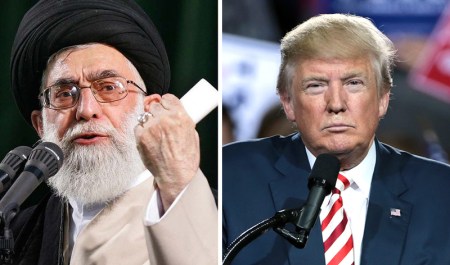
Finally, at least as long as Iran’s Supreme Leader is alive, and as long as the ruling clerics preserve the political establishment, the Islamic Republic of Iran will maintain the core pillars of its foreign policies and revolutionary principles: these are anchored in anti-Israel, anti-American and anti-Semitic politics. Iranian politicians across the political spectrum totally agree on these fundamentals.
EXCLUSIVE: Immigration Official Okays Syrian Immigrants With Fake Passports [VIDEO], Daily Caller, Alex Pfeiffer, January 10, 2017
An undercover video exclusively obtained by The Daily Caller Tuesday claims to show an immigration official in New York giving advice on how illegal Syrian immigrants can receive asylum with fake passports.
Laura Loomer, an undercover activist for Pamela Geller’s American Freedom Defense Initiative (AFDI), visited a U.S. Citizenship and Immigration Services (USCIS) office Jan. 6 in Port Chester, N.Y. Loomer told an employee who AFDI identified as “Sergio” that she knows a family from Syria who is afraid to come into the office because they are in the country illegally. She said that she wants to make sure the family is “integrated” and has “immigration services.”
“The issue with them is that they have fake passports,” Loomer says in the video. The man identified as Sergio responded, “We waive sometimes the passports or whatever because they are unable to provide that documentation.”
He asked when the Syrian family arrived, presumably to see if they would be eligible for Temporary Protected Status, which protects Syrian immigrants, of illegal or legal status, from deportation. The status is available to Syrians who have been in the U.S. since Oct. 1, 2016. and the date to register ends in a few weeks.
“The fake passport is one thing, we are going to use the name that is on the passport as AKA, also known as,” the USCIS employee responded. He added, “chances are considering the situation in Syria, they are not going to be sent back.”
The man identified as Sergio said the family could get a work permit and that Loomer should “file accurately” the paperwork and make sure that she uses their correct names or “the names they used with these passports, which are not their own names.”
The USCIS employee went on to say, “Was there ever a situation where people came with fraudulent documents and qualified for asylum? Yes, because it’s understood that they can not always obtain genuine documents. So it’s far from being unique.”
The Daily Caller asked the USCIS if giving asylum to immigrants with fake documents is “far from unique” like the USCIS employee said in the video. A spokesperson responded by saying they do not “publicly discuss individual immigration cases” and giving a link to a information on their refugee and asylum programs. Nearly 85,000 Syrian refugees were resettled in Fiscal Year 2016 and the Obama administration has sped up resettlement in the president’s last days in office.
A USCIS spokesperson also said that the agency cannot confirm the authenticity of the video as they claim it is heavily edited. The USCIS did not confirm nor deny that Sergio is an employee with the agency.
TheDC has previously reported on an internal Immigration and Customs Enforcement memo which states difficulty in preventing fraud in the refugee program as “bad actors” use false biographies and “produce and submit fictitious supporting documentation.” It has also been reported that the Islamic State has a thriving fake passport industry.
WATCH:
Obama’s Enabling of Palestinian Terror, Front Page Magazine, Joseph Puder, January 11, 2017
When we consider last month’s United Nations Security Council resolution (UNSC) 2334 that passed with deliberate U.S. abstention and later, justified in a speech by U.S. Secretary of State John Kerry, it makes the adage below come to mind. The Midrash (commentary on part of the Hebrew Scriptures) tells us, “He who becomes compassionate to the cruel will ultimately become cruel to the compassionate.” Maimonides wrote in The Guide of the Perplexed that “the wicked and calculating person who killed intentionally and was sentenced to death – if he seeks sanctuary among us, we must not provide him with asylum, and not have mercy upon him, because compassion toward the wicked is cruelty to all beings.”
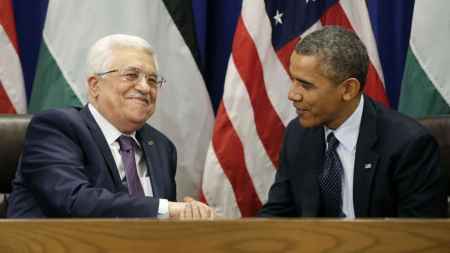
In supporting the Palestinian regime that seeks the destruction of the Jewish State as its ultimate goal, the Obama administration is being compassionate toward the wrong party. The Obama administration is knowingly and deliberately supporting the creation of another unstable Arab authoritarian regime that has failed its people. Mahmoud Abbas, like Arafat before him, albeit more subtle, seeks the same goal: undermining the Jewish state, and replacing it with an undemocratic Palestinian state. Abbas wouldn’t return to the negotiating table unless he is heavily bribed, and like Arafat, at the crucial moment when all reasonable concessions had been made, he walked out.
At their September 16, 2008 meeting in Jerusalem, Israeli Prime Minister Olmert agreed to forgo sovereignty over the Temple Mount in Jerusalem, Judaism’s holiest site, and proposed that in the framework of the peace agreement, the area containing the religious sites in Jerusalem would be managed by a special committee consisting of representatives from five nations: Saudi Arabia, Jordan, Palestinians, the U.S. and Israel. The advisors and Fatah officials heard that Olmert laid out for Abbas not only the details of the agreement but also a large map upon which he outlined the borders of the future Palestinian state. Abbas, like Arafat in July, 2000, walked out.
Considering Palestinian terrorism incited by Hamas and the Palestinian Authority against Jewish civilians and soldiers alike, it becomes clear that the Obama administration has shown compassion toward Palestinian aspirations and contempt for Jews aspiring to settle in their ancestral regions of Judea and Samaria. The Administration would be quite content on a “judenrein” West Bank. In fact, the U.S. and its European allies support the PA with huge grants, portions of which goes to pay salaries to Palestinian terrorists with blood on their hands and their families. They have likewise funded Palestinian-Arab construction projects, built illegally throughout the West Bank and Jerusalem.
The Obama administration has also shown compassion for the Iranian regime by ending the economic sanctions against the radical Islamic Iranian regime, which hangs gays and lesbians as well as juveniles. Amnesty International reported on January 26, 2016, that “Iran remains the leading executioner of juvenile offenders.” The New York Post reported on August 3, 2016 that “The Obama administration quietly shipped $400 million stacked on wooden pallets in an unmarked plane to Iran in January – just as Tehran was releasing four Americans who had been detained there.” This was done to appease the Islamic Republic, which is the leading state sponsor of terror around the world, and that has taken Americans in Iran as hostages.
U.S. Mideast mediator Dennis Ross pointed out that the Obama administration was so enamored with the so-called “moderate” Iranian President Rouhani, that it “showed readiness to accept an industrial-scale Iranian nuclear program and not to roll it back.” The Obama administration was willing to bend its principles in order to foster a relationship and perhaps an alliance of sorts (against the Islamic State in Iraq) with the Ayatollahs regime that promised “to wipe Israel off the map.”
In the summer of 2009, the Iranian people voted for freedom and against the choices of the theocratic regime that oppressed them. They demonstrated in the millions with signs that read “Obama, are you with them or with us.” Obama did not respond. He proved to have little compassion for the oppressed.
In Syria, the Shiite-Iranian Revolutionary Guards and their supported Iraqi-Shiite militias, as well as the Lebanese-Shiite terrorist group Hezbollah, are murdering hundreds of thousands of innocent Syrian Sunni Muslims, Christians, and others civilians with impunity. They are bolstering the dictatorship of the Alawi (offshoot of Shiite Islam) minority ruler Bashar Assad. The Russians have also joined in the killing of Syrian civilians in the name of combatting so-called “terrorists.”
The Palestinians of Hamas and the PA raise their children on hate and expound on the destruction of the Jewish state in schools, mosques, in the media, and in their policy directives. The Palestinian intolerance towards Jews and Christians is deeply embedded, but due to political correctness, it has never been sufficiently reported in the western media, or by western governments. Under the Palestinian regime, Christian Arabs have been victims of frequent human rights abuse by Muslims. There are many examples of intimidation, beatings, land theft, firebombing of churches and other Christian institutions, denial of employment, economic boycotts, torture, kidnapping, forced marriage, sexual harassment, and extortion. Palestinian Authority (PA) officials are directly responsible for many of the human rights violations. Muslims who have converted to Christianity are in the greatest danger. They are often left defenseless against cruelty by Muslim fundamentalists. Some have been murdered.
There is a clear dichotomy in determining who the compassionate side is, and who is the cruel. It comes together perfectly clear in the Syrian civil war arena. Thousands of Palestinians are fighting on behalf of the Syrian dictator, and help in slaughtering the Syrian people who are fighting for their freedom. The Palestinian radical group, the Popular Front for the Liberation of Palestine-General Command (PFLP-GC) led by Ahmed Jibril, provided the Assad war machine with intelligence and ground support, when he laid siege to the Palestinian populated Yarmouk refugee camp. The PFLP-GC, once a member of the Palestinian Liberation Organization (PLO) joined the Assad troops in killing fellow Palestinians.
Conversely, Israel has opened its hospital gates to wounded Syrians, both civilians and soldiers. Prime Minister Netanyahu announced last month “We are prepared to take in wounded women and children, and also men if they are not combatants. Bring them to Israel, we will take care of them in our hospitals as we have done with thousands of Syrian civilians. We are looking into ways of doing this. It is being explored as we speak.” Netanyahu added, “The suffering is great, and the one initiative we took is to help – as I said – thousands of Syrians who are sometimes mutilated beyond belief. We help them. I offered to do more today. I don’t know if we can resolve [the crisis in] Syria, but we can help mitigate some of the suffering. That is the best that Israel can do.”
Being compassionate toward the Palestinian’s aspirations to destroy the Jewish state in stages by forming a terrorist supporting state, the Obama administration is being cruel toward the Jewish state, which seeks to defend its people from the ongoing Palestinian terror.
Iranian Political Prisoners in Dire Need of the Support of the International Community, Iran News Update, January 11, 2017
(Perhaps if we referred to them as “Palestinians” the international community might notice their plight. — DM)
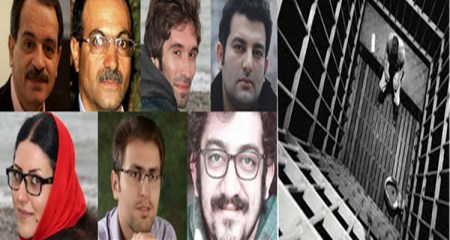
Silence of the global community sends a message to the Iranian regime that it can get away with these crimes, and that is a message not to be condoned with silence.
**************************
An article in The Hill by Ali Safavi, member of the Foreign Affairs Committee of the National Council of Resistance of Iran and president of the Near East Policy Research, discusses the alarming reports which from came from Gohardasht Prison, that activist and political prisoner Ali Moezzi, had disappeared on January 4, 2016.
Moezzi spent years in prison in the 1980’s for his affiliation with the Iranian opposition group, the Mujahedin-e Khalq (PMOI/MEK). Beginning in 2008, he served two more years, for having visited his two daughters residing in Camp Ashraf, Iraq. Arrested again in 2011, seven months after his latest release, for attending the funeral of a fellow political prisoner, he’s been imprisoned ever since. He has faced much pressure, including the extension of his current prison term beyond its specified four years.He’s also be subjected to numerous explicit death threats.
Reportedly, he’s undergone routine beatings and torture and the absence of medical care for his pre-existing health problems. Moezzi’s arrest came shortly after he had been released from a hospital after undergoing surgery following a cancer diagnosis.
The regime has repeatedly been charged with disregard for the health and well-being of prisoners, especially those detained for political or religious offenses. A recent example is Arash Sadeghi, who is serving a 15-year prison sentence for his peaceful human rights activism. Sadeghi began a hunger strike shortly after his wife was arrested. Sadeghi finally ended his hunger strike after judicial authorities granted his wife temporary release from her pre-trial detention. His hunger strike lasted more than 70 days befor the regime agreed to even that, and it was not the likelihood of Sadeghi’s imminent death that prompted them to act, but the massive support that his protest had garnered within Iran and abroad. Hundreds of Iranians gathered outside of Evin Prison, to protest his treatment. His cause was promoted on the internet and via banned social media networks by several thousands of supporters.
Salve writes, “It may not be a coincidence that Moezzi disappeared from Gohardasht Prison just one day after it was announced that Sadeghi had been hospitalized and brought back from the brink of death.” He adds, “Both incidents demonstrated that the Iranian regime has no qualms about endangering the lives of its political adversaries, but the ruling mullahs can only take such a situation to its drastic conclusion if relatively free from public scrutiny.”
He says that it may be easier for the regime simply allow political prisoners to die, if those deaths occur in secret locations, so that they can claim “plausible” deniability.
Iran’s domestic activists or the international community may still be able to save Moezzi in much the same way they saved Sadeghi, but it is impossible to know Moezzi’s current condition, much less to follow its deterioration in real time. This is a challenge as it is difficult to rally around a cause that they cannot see. However, these atrocities must not be allowed to continue in the shadows.
This is the challenge that requires serious commitment, and a campaign that includes the international community and media. “World powers must take an interest in this case, and in the overall plight of Iranian prisoners of conscience,” writes Salvi.
Which is actually underscored by the recent success of the Sadeghi case. Silence of the global community sends a message to the Iranian regime that it can get away with these crimes, and that is a message not to be condoned with silence.
Iran Demands ‘Compensation’ for U.S. Breach of Nuke Deal, Washinton Free Beacon,
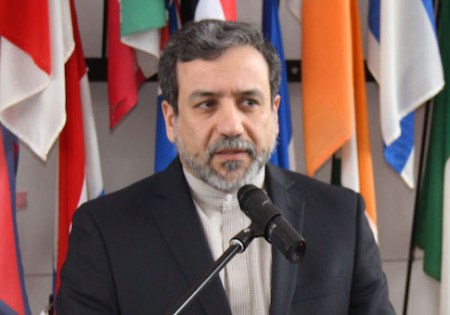
Abbas Araqchi, Iran’s deputy foreign minister for legal and international affairs and top nuclear negotiator. (Kyodo)
The call for further compensation comes just days after the Obama administration was forced to admit that it had been providing Iran with around $700 million in assets every month since the nuclear deal was approved.
*******************************
Iran is demanding further “compensation” from the United States following claims America violated the nuclear agreement by passing new sanctions on the Islamic Republic, according to comments by senior Iranian officials following meetings with the Obama administration in Vienna.
The demand for further concessions by the Obama administration comes on the heels of reports that the United States has deflated the total amount of cash, gold, and other assets provided to the Islamic Republic during the past several years. The sum is believed to be in excess of $10 billion.
Iran has threatened to retaliate against the United States in recent weeks following the passage late last year by Congress of the Iran Sanctions Act, or ISA, which will continue to economically penalize Iran for the next 10 years.
Ahead of a series of meetings Tuesday with senior U.S. officials, Iranian Deputy Foreign Minister Abbas Araqchi again accused the United States of violating the nuclear agreement and demanded compensation for the purported breach.
“The extension of the ISA is a breach of the U.S. obligations under the Joint Comprehensive Plan of Action (JCPOA) and must be compensated in an effective way,” Araqchi was quoted as telling reporters in Vienna.
The latest meetings about the nuclear deal were orchestrated by Iranian officials, who remain angry about the passage of new sanctions.
Araqchi made clear on Monday that Tehran is “serious” about retaliating against the United States for its passage of new sanctions, stating the Islamic Republic has already made moves to restart contested work on nuclear powered submarines and other weapons.
The Washington Free Beacon reported on Monday that official estimates about the amount of money awarded to Iran by the Obama administration are actually higher than previously known.
A State Department official told the Free Beacon that it would not prejudge its meetings with Iran when asked if further concessions are on the table.
“While we are not going to prejudge the outcome of any meeting, we will discuss ongoing implementation of the JCPOA as we always do,” the official said.
The total worth of the cash, assets, gold, and bullion given to Iran is in excess of $10 billion, according to Bahram Ghasemi, the spokesman for Iran’s Foreign Ministry.
“I will not speak about the precise amount,” Ghasemi was quoted as saying in Persian language reports independently translated for the Free Beacon.
The $10 billion figure is actually a “stingy” estimate, Ghasemi claimed, adding that the cash and gold sent by Washington to Iran’s Central Bank was subsequently “spent.”
“This report is true but the value was higher,” Ghasemi was quoted as saying.
“After the Geneva conference and the resulting agreement, it was decided that $700 million dollars were to be dispensed per month” by the United States, according to Ghasemi. “In addition to the cash funds which we received, we [also] received our deliveries in gold, bullion, and other things.”
Iran: How Will Rafsanjani’s Death Affect Regime? Iran News Update, January 10, 2017
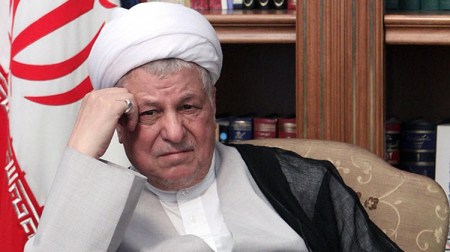
In his January 10 article for Al-Arabiya,, Heshmat Alavi, political and rights activist who focuses on Iran, writes about the effect of senior cleric Ali Akbar Hashemi Rafsanjani’s death by heart attack on Sunday, January 8, at the age of 82.
As Rafsanjani was known for his influential role in shaping the regime’s politics following the 1979 revolution, the Iranian regime was dealt a significant blow, and a power vacuum is created, less than four months prior to crucial presidential elections.
Rafsanjani’s role for the past 38 years helped maintain the regime’s measures of domestic crackdown, export of terrorism and extremism abroad, and their effort to obtain nuclear weapons, according to Alavi.
“The death of Rafsanjani, one of the pillars of the religious fascism ruling Iran and its balance factor collapsed, and the regime in its entirety is closer now to its overthrow,” said Iranian opposition leader Maryam Rajavi, President of the National Council of Resistance of Iran.
After Iran-Iraq War of the 1980s, Rafsanjani served as president from 1989 to 1997. He ran again for office again in 2005, but lost the election to firebrand Mahmoud Ahmadinejad.
In recent years, Rafsanjani has been mentoring the so-called “moderate” Iranian President Hassan Rowhani, and was known for his fierce rivalry with Iranian Supreme Leader Ali Khamenei.
Although known for his close ties to the regime founder Ruhollah Khomeini, who died in 1989, the West believed him to be a “pragmatic conservative” willing to mend fences with the outside world, especially the US.
Rafsanjani’s last post was head of the Expediency Council, a body assigned to resolve conflicts between the regime’s parliament (Majlis) and the Guardian Council, which has close links to Khamenei, and vets all candidates based on their loyalty to the establishment before any so-called elections. Rafsanjani himself was disqualified by the Guardian Council when he sought to participate in the 2013 elections as a “reformist” candidate.
Instead, Rafsanjani placed his power behind Rowhani after the latter assumed power as president in 2013. Rafsanjani used this position to “carve himself and his family an economic empire from the country’s institutions and natural resources in the past decades,” writes Alavi.
“One brother headed the country’s largest copper mine; another took control of the state-owned TV network; a brother-in-law became governor of Kerman province, while a cousin runs an outfit that dominates Iran’s $400 million pistachio export business; a nephew and one of Rafsanjani’s sons took key positions in the Ministry of Oil; another son heads the Tehran Metro construction project (an estimated $700 million spent so far),” states a 2003 Forbes analysis, which also alludes to the billions cached in Swiss and Luxembourg bank accounts by the Rafsanjanis.
While the West was convinced that Rafsanjani was more moderate than his “hardline” counterparts, he went along with them in suppressing dissidents, namely members and supporters of the People’s Mojahedin Organization of Iran (PMOI/MEK), the main opposition group that first blew the whistle on Iran’s clandestine nuclear weapons program.
“Four rulings are a must for the [PMOI]: 1- Be killed. 2- Be hanged. 3- Arms and legs be amputated. 4- Be separated from society,” Rafsanjani said back in 1981. He also played a presiding role in the 1988 massacre of over 30,000 political prisoners.
During his presidency, Rafsanjani allegedly directed numerous assassinations of dissidents abroad, including renowned human rights advocated Dr. Kazem Rajavi, former Iranian ambassador to Italy Mohammad Hossein Naghdi and Iranian Kurdish leader Abdulrahman Ghassemlou. He was also indicted for his role in the 1994 AMIA bombing in Buenos Aires that left 85 killed and hundreds wounded.
Alavi writes, “Rafsanjani has through four decades of mullahs’ rule in Iran played the role of the regime’s No. 2 figure and a balancing element, always securing the regime’s higher interests. His death will significantly weaken the mullahs’ regime in its entirety and will trigger major upheavals across the regime’s hierarchy.” He concludes by saying, “If past is any indication, the mullahs will most likely resort to further violence and the export of terrorism and extremism to prevent this newest crisis from spiraling out of control.”
The NCRI referred to Rafsanjani as “one of the two pillars and ‘key to the equilibrium’ of the Iranian regime,” adding that, “during his long career he was associated with some of the regime’s most egregious actions, including mass-casualty terror attacks and the assassinations of exiled dissidents.”
Rafsanjani is considered as one of its founding fathers of the Iranian regime, who played an outsized political role in the life of the Islamic republic, not only by serving as President after serving as Speaker of Parliament and Deputy Commander of the Armed Forces, but also heading two of the regime’s most important institutions, the Assembly of Experts, an 88-member body of top clerics which nominates the Supreme Leader; and the Expediency Council, a body that advises the Supreme Leader.
“Rafsanjani, who had always been the regime’s number two, acted as its balancing factor and played a decisive role in its preservation. Now, the regime will lose its internal and external equilibrium,” opposition leader Maryam Rajavi said in a statement that also referred to the “approaching overthrow” of the clerical regime.
On January 9 the NCRI published a list, outlining some of his outrageous conduct:
• Rafsanjani called for the extermination of members of Iran’s main opposition group, the People’s Mojahedin Organization of Iran (PMOI or MEK). On October 3, 1981, the state-run Ettela’at daily wrote, “Referring to the grouplets’ operations, Hashemi Rafsanjani, Speaker of the Islamic Parliament and Tehran’s acting Friday prayer leader, said in his sermon, ‘Divine law defines four sentences for them which must be carried out: 1 – kill them, 2 – hang them, 3 – cut off their arms and legs, 4 – banish them…‘Had we caught and executed 200 of them right after the Revolution, they would not have multiplied so much. If we don’t deal decisively with [Mojahedin] armed grouplet and agents of America and the Soviet Union today, in three years we will have to execute thousands of them instead of one thousand now…”
• According to Hossein-Ali Montazeri, Khomeini’s former heir, Khomeini sought counsel on his decisions from just two individuals: Rafsanjani and current Supreme Leader Ali Khamenei, including his decision to issue a fatwa ordering the massacre of at least 30,000 political prisoners at the end of the Iran-Iraq war in the summer of 1988.
During Rafsanjani’s tenure as President and as head of the Supreme National Security Council (SNSC), a body that oversees and authorizes the regime’s terrorist operations, the assassination of Iranian dissidents abroad and the regime’s terror attacks skyrocketed. The terror targets were not only Iranians.
• Rafsanjani’s remarks on May 5, 1989 as carried by Iran’s official state news agency IRNA , and were reported by The Associated Press:: “If in retaliation for every Palestinian martyred in Palestine, they will kill and execute, not inside Palestine, five Americans or Britons or Frenchmen, the Israelis could not continue to do these wrongs… It is not hard to kill Americans or Frenchmen. It is a bit difficult to Kill [Israelis]. But there are so many [Americans and Frenchmen] everywhere in the world.”
• Argentinian investigators implicated Rafsanjani in 2006, in one of the deadliest instances of Iranian terrorism abroad – a suicide truck bombing of the AMIA Jewish community center in Buenos Aires, in which 85 people were killed in 1994. The investigators accused Iran of instructing Hezbollah to carry out the bombing. They issued arrest warrants for Rafsanjani, seven other senior Iranians, and a Lebanese national, Imad Mughniyah, Hezbollah terrorist chief.
Interpol, at Argentina’s request, issued red notices – the organization’s equivalent of arrest warrants – for five of the Iranians and Mughniyah.
• The FBI established undeniable evidence that Tehran had masterminded the deaths of 19 American servicemen, in the bombing of Khobar Towers in Saudi Arabia on June 25, 1996.
According to the NCRI, these are some of the most significant killings of prominent dissidents abroad during Rafsanjani’s tenure:
• In 1992, four Iranian Kurdish dissidents in a Berlin restaurant called Mykonos were assassinated. A German court ruled in 1996 that the Iranian regime under Rafsanjani was directly responsible for the killings, which the U.S. State Department said provided further proof that Iran was a terrorist state.
• Maryam Rajavi’s brother-in-law, Kazem Rajavi of the National Council of Resistance of Iran (NCRI) – Iran’s most renowned human rights advocate and a former Iranian ambassador to the U.N. was shot dead near Geneva in 1990. Swiss investigators accused the Iranian regime of responsibility and authorities issued an arrest warrant for Rafsanjani’s intelligence minister, Ali Fallahian.
• Mohammad Hossein Naghdi, the NCRI representative in Rome, was shot dead on a street in the Italian capital in March 1993.
• Zahra Rajabi, the NCRI’s representative on refugee issues, was shot dead with an NCRI colleague in an Istanbul apartment in February 1996.
Rafsanjani was the one who pushed the Iranian clandestine nuclear weapons program forward as a guarantor of the regime’s survival. He cooperated with countries like North Korea to achieve these objectives.
Rafsanjani acknowledged that during his time as parliamentary speaker and President, both he and Khamenei sought ways to obtain a nuclear bomb in an interview published by the regime’s official state news agency IRNA on October 27, 2015. “Our basic doctrine was always a peaceful nuclear application, but it never left our mind that if one day we should be threatened and it was imperative, we should be able to go down the other path,” Rafsanjani said. He added he had travelled to Pakistan to try to meet Abdul Qadeer Khan, the father of Pakistan’s nuclear weapons program, who later helped North Korea to develop a bomb. Fortunately, the meeting never occurred.
A necessary, natural move, Israel Hayom, Prof. Eyal Zisser, January 10, 2017
(Please see also, Palestinians: Glorifying Mass Murderers. — DM)
The Palestinian terrorist, who perpetrated the deadly ramming at the Armon Hanatziv promenade Sunday afternoon in Jerusalem, did not any need any excuse to murder his victims. It’s possible he was influenced by previous ramming attacks carried out by Islamic State supporters in France and Berlin. It is also possible, however, that he was influenced by recent threats from people close to Palestinian Authority President Mahmoud Abbas, who warned that moving the American embassy from Tel Aviv to Jerusalem — as promised by U.S. President-elect Donald Trump — would lead to an ungodly eruption of violence.
Either way, we must recognize that in Palestinian society — inundated with incitement on social media but also from its institutions — there exists a fundamental motivation to harm Israel and Israelis, and it only takes a little for this desire to bubble to the surface. The appearance of ISIS on the scene as a radicalizing element has enraptured a large portion of the younger generation in the Arab and Muslim world, only making this reality worse.
The terrorist attack in Jerusalem came a few days after U.S. Secretary of State John Kerry chose to warn Trump against relocating the American embassy to Jerusalem, as doing so would send the region up in flames.
Perhaps Kerry has failed to notice that the Middle East is already burning, for quite some time now. The flames have consumed Libya, Syria, Yemen and Iraq. But of all these places, which represent living proof of his failed policies, the outgoing secretary of state chose to focus specifically on the Israeli-Palestinian conflict and repeat the same tired mantra that the region’s problems are rooted in the fight between Israel and the Palestinians.
Kerry’s advice to Trump not to move the embassy, therefore, is misleading and should be ignored.
Why is transferring the American embassy from Tel Aviv to Jerusalem not inherently hazardous, and why is it possible to “sell” such a move to the Arab world? Because any reasonable person understands that doing so would not change the status of the city or the existing reality there in any significant way, nor would it cause a shift in Washington’s fundamental positions on the conflict.
After all, Jerusalem is home to Israel’s state institutions, from the President’s Residence to the Knesset, and all foreign dignitaries visiting Israel, including U.S. President Barack Obama and Kerry, comes to the city to meet their Israeli counterparts. Can anyone seriously argue for forbidding a meeting between a visiting president and his Israeli counterpart in Jerusalem, because it could set the Middle East aflame?
Trump, therefore, can relocate the embassy to Jerusalem unperturbed and also make it clear that such a move, while necessary and natural, will not decide any of the fundamental questions pertaining to the Israeli-Palestinian conflict, not even regarding Jerusalem. With that, it would be best for Trump to notify Washington’s allies in the region and explain to them, politely but firmly, that moving the embassy is recognition of the reality on the ground, which Jordan and Egypt also accept. Doing so would help prevent any unnecessary emotional outbursts.
What Trump can learn from Kerry is that hesitation and trepidation are perceived as weakness in the region and invite pressure, belligerence and even a rejectionist approach. Russian President Vladimir Putin, on the other hand, who never sought favor from anyone, is respected and feared; certainly no one threatens to burn the region down in response to his policies.
Palestinians: Glorifying Mass Murderers, Gatestone Institute, Bassam Tawil, January 10, 2017
For anyone who treasures freedom – including many Arabs and Muslims who do not want to live under terrorist Islamic dictatorships but are strong-armed from speaking out – the United Nations is now poisonous place. It has been taken over by the Organisation of Islamic Cooperation (OIC) — 56 Islamic countries plus Palestine. It is now the seat of the universal caliphate. In this, it is assisted by dictators, despots and the many dhimmi-European leaders who together command a permanent voting majority and have been lately been busy rewriting historical facts. Nothing good can come from it. Freedom-loving countries should run.
The murderous legacy and personality of Yahya Ayyash, a Hamas mass murderer who masterminded a wave of suicide bombings, are being glorified not only by his Hamas supporters, but also by the “moderate” Western-funded Palestinian Authority (PA), headed by Mahmoud Abbas.
Ayyash won his reputation on the murdering and maiming of hundreds of Israelis, most of them innocent civilians. Had he fought for peace and coexistence, Ayyash would have been condemned as a “traitor” and gone down in history as a “defeatist” and “surrenderist.”
“The mosque that produced the mujahed [warrior] Ayyash is continuing to produce heroes.” – Sheikh Yusef al-Qaradawi, spiritual leader of the Muslim Brotherhood.
It is in these mosques that Ayyash was taught that Islam permits people like him to build bombs and dispatch suicide bombers to blow up buses. It is also in these mosques where he was taught that devout Muslims are best engaged in spilling Jewish blood.
Children and youths who attend prayers at these mosques are being fed the same hate-speech rhetoric that their hero Ayyash was exposed to in his childhood. Hence it is no surprise that the mosques in the West Bank and Gaza Strip continue to this day to churn out new terrorists, many of whom aspire to become like Ayyash – mass murderers.
Thus, despite Fatah’s double-talk about a two-state solution and “peace” with Israel, mass murderers still take top billing in its hall of fame. Fatah is also making it known that its former leader, Yasser Arafat, approved of such terrorism against Israel.
The voices of the Palestinians who reject this education for wholesale slaughter are being marginalized by the European leaders doing business with the still-wealthy members of the Arab elite who fund these imams and these mosques.
These European leaders wrongly image that if they get rid of Israel, it will be only Israel. They fail see that Israel is just the first course. They imagine that if they accede to Muslims’ wishes, they will be safe. What they fail to see, as in France, Germany, Sweden, Belgium and Britain, is that they will be next.
Palestinian youths are being urged to follow in the footsteps of Yahya Ayyash, a Hamas mass murderer who masterminded a wave of suicide bombings that killed and wounded hundreds of Israelis. Ayyash’s expertise in manufacturing explosive devices earned him the nickname “The Engineer” and turned him into a hero in the eyes of many Palestinians. The bomb-maker was killed by Israeli security forces on January 5, 1996, thereby ending one of the bloodiest chapters of Palestinian terrorism against Israel.
Two decades later, this arch-terrorist is still being revered as a hero and martyr. His murderous legacy and personality are being glorified not only by his Hamas supporters, but also by the “moderate” Western-funded Palestinian Authority (PA), headed by Mahmoud Abbas.
A few years ago, the PA decided to honor Ayyash by naming a street in Ramallah after him. The street sign was posted in Ramallah, the headquarters of the PA where Abbas lives and works, and reads:
“Yahya Ayyash, 1966-1996, born in Nablus, studied electrical engineering in Bir Zeit University. Was a member of the (Hamas military wing) Iz ad-Din al-Qassam, and was linked by Israel to a number of bombings. He was assassinated by Israel in his Beit Lahia (Gaza Strip) home on January 5, 1996.”
This week, Palestinians took to social media to glorify the arch-terrorist further, depicting him as a role model and urging youths to follow in his footsteps.
On Twitter, for instance, they launched a hashtag entitled, “Be Like Ayyash.” The campaign encourages Palestinian youths to admire the bomb-maker and endorse his “jihad” (holy war) against Israel. Activists posted video clips, songs, poems and portraits praising and lionizing Ayyash and his terrorism. The campaign, according to the sponsors, is also designed to acquaint Palestinians with the “humane and leadership qualities” of Ayyash and remind them of his “heroic actions.”
Unsurprisingly, the social media campaign has attracted the attention of thousands of Palestinians and Arabs, who heaped praise on the Hamas bomb-maker-turned-icon. Ayyash won his reputation on the murdering and maiming of hundreds of Israelis, most of them innocent civilians. Had he fought for peace and coexistence, Ayyash would have been condemned as a “traitor” and gone down in history as a “defeatist” and “surrenderist.”
This Palestinian “engineer” is not being glorified because he used his expertise to help improve the lives of Palestinians. He is being lauded because he used the education he received to build bombs and dispatch suicide bombers to kill Israelis.
One activist hailed Ayyash as “The Master of Men and the Moon of Palestine.” He added: “We are proud of you, Hawk of Iz ad-Din al-Qassam!”
Another activist posted: “Oh history take note – the engineer of Palestine used to divert the path of Zionist buses towards hell!” (a reference to the suicide bombings that targeted Israeli buses).
Here is what another Palestinian had to say about the mass-murderer: “Yahya Ayyash is an idea, and ideas do not die. Although the resistance in the Gaza Strip has developed its weapons, the bombing of a bus has a special flavor!”
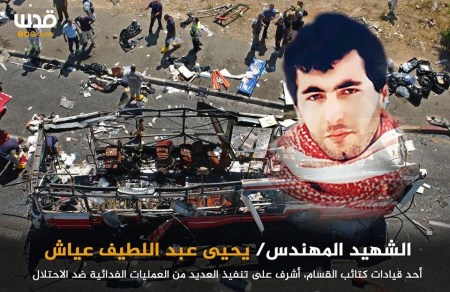 An image recently posted to Twitter glorifying Yahya Ayyash, a Hamas mass murderer who masterminded a wave of suicide bombings that killed and wounded hundreds of Israelis. The image shows Ayyash’s face superimposed over an Israeli bus that was blown up by a Palestinian suicide bomber in the 1990’s.
Sheikh Yusef al-Qaradawi, Chairman of the International Union of Muslim Scholars, joined the chorus of terror glorifiers by offering his own post commemorating the anniversary of the death of Ayyash. “Yahya Ayyash did not die,” wrote the leading Islamic scholar, considered the spiritual father of Muslim Brotherhood. “He is alive in the conscience of all Palestine. The mosque that produced the mujahed (warrior) Ayyash is continuing to produce heroes.”
Sheikh al-Qaradawi is right in two important ways. The first of these is that Ayyash was indeed “produced” by a mosque. Those close to Ayyash describe him as a devout Muslim who used to spend much of his time in mosques, where he was undoubtedly exposed to anti-Semitic hate-speech and indoctrination at the hands of preachers and imams.
It is in these mosques that Ayyash was taught that Islam permits people like him to build bombs and dispatch suicide bombers to blow up buses. It is also in these mosques where he was taught that devout Muslims are best engaged in spilling Jewish blood.
Al-Qaradawi is also right when he says that the mosques are continuing to produce “heroes.” This is true because incitement and anti-Semitism remains a main theme of the Friday prayer sermons. Children and youths who attend prayers at these mosques are being fed the same hate-speech rhetoric that their hero Ayyash was exposed to in his childhood. Hence it is no surprise that the mosques in the West Bank and Gaza Strip continue to this day to churn out new terrorists, many of whom aspire to become like Ayyash – mass murderers.
“Ayyash was only 29 years old, but he became a legend that instilled fear in the hearts of the Zionists,” remarked another social media activist. “He was transformed into an exemplary engineer inspiring new generations.”
Hamas leaders, for their part, chose to celebrate the anniversary of the death of their terrorist by voicing hope that Palestinian youths would look at him as their role model and follow in his footsteps. “The students of Yahya Ayyash are the hope of the Palestinians,” said Hamas spokesman Hussam Badran. He said that Ayyash continues to serve as an inspiration for youths who wish to join the jihad against Israel.
That Ayyash was a Hamas member has not prevented the rival Fatah faction headed by Mahmoud Abbas from joining the campaign of glorification.
True, Hamas and Fatah are rivals and they despise each other. But when it comes to murdering Israelis, they wholeheartedly agree. In truth, Fatah would have preferred if Ayyash had been one of its own. Had that been so Fatah would have been able to boast (instead of Hamas) of the “heroic” attacks engineered by the beloved terrorist.
Still, in the eyes of Fatah, this Hamas arch-terrorist is a hero because he killed and wounded hundreds of Israelis. On one of its Facebook pages, Fatah had these words to say about Ayyash: “The revolutionaries never die; Fatah pledges to remain committed to the martyrs and the path of Yasser Arafat.”
Thus, despite Fatah’s double-talk about a two-state solution and “peace” with Israel, mass murderers still take top billing in its hall of fame. Fatah is also making it known that its former leader, Yasser Arafat, approved of such terrorism against Israel. This Fatah stance should not come as a surprise to those who have been following its leaders’ and activists’ statements and actions. The glorification of terrorists has always been an integral part of Fatah ideology. Most recently, Fatah celebrated its 52nd anniversary in a series of Facebook posts glorifying Palestinian terrorists.
Some would argue that the absence of education for peace with Israel on the Palestinian side is largely responsible for the failure of the peace process. However, this assessment falls short of the full truth. That truth is that the same Palestinian children who are not educated toward peace with Israel are educated toward killing Israeli civilians, as many as possible. The continued glorification of terrorists and the encouragement of youths to join the jihad against Israel and Jews, as well as the celebrations marking the death of Ayyash, demonstrate this truth. Where, the international community might ask, are the voices of the Palestinians who reject this education for wholesale slaughter?
Their voices are being marginalized by many European leaders comfortably doing business with the still-wealthy members of the Arab and Muslim elite who fund those imams and mosques. These European leaders wrongly image that if they get rid of Israel, it will be only Israel. They fail see that Israel is just the first course. They imagine that if they accede to Muslims’ wishes, they will be safe. What they fail to see, as in France, Germany, Sweden, Belgium and Britain, is that they will be next, and that what they have been seeing is just the start. That is how the Muslims in a few hundred years took over Persia, Turkey, southern Spain, all of North Africa, and most of Eastern Europe.
For anyone who treasures freedom – including many Arabs and Muslims who do not want to live under terrorist Islamic dictatorships but are strong-armed from speaking out – the United Nations is now poisonous place. It has been taken over by the Organisation of Islamic Cooperation (OIC) — 56 Islamic countries plus Palestine. It is now the seat of the universal caliphate. In this, it is assisted by dictators, despots and the many dhimmi-European leaders who together command a permanent voting majority and have been lately been busy rewriting historical facts. Nothing good can come from it. Freedom-loving countries should run.




 anneinpt
 artaxes
 danmillerinpanama
 davidking1530
 Peter Hofman
 Joseph Wouk
 Peter
Peter Louisiana Steve
 WarSclerotic
Recent Comments