Archive for July 2016

A Ramadan Piece: The “Other” Islam

July 5, 2016

A Ramadan Piece: The “Other” Islam, Gatestone InstituteSalim Mansur, July 5, 2016

(A fascinating history of the battle between political Islam and non-political Islam. The battle continues. — DM)

♦ Abrahamic monotheism as represented in Judaism, Christianity, and Islam, precedes and stands apart from politics as an ethical vision that transcends history. It was a vision which invited people to embrace their common humanity as created and gifted by one omnipotent deity, and to follow a revealed code of ethics for righteous living, holding the promise of peace with an end to interminable conflicts that divided people into warring tribes.

♦ Thoughtful Muslims, for nearly a century before the demise of the Ottoman Empire and the abolition of the Caliphate, had been writing about the need for an Islamic reform. Europe’s cultural advancement following the Reformation and Enlightenment held up a mirror for the Islamic world to follow in similar direction to similar ends. There was a consensus among Muslims that Islam was not intrinsically opposed to the modern world, and a readiness to follow in the footsteps of the West.

♦ This is the “other” Islam. This is submission to truth, whose most righteous exemplar was Abraham when his faith was tested by his Deity, according to the Hebrew Bible, to sacrifice his son. And this is the faith of Sufis who took Muhammad’s message to people in places far removed from the desert confines of Arabia. It is simply, as the Qur’an reminds (30:30), deen al-fitrah, the natural religion, or inclination, of man to know his Creator. There is no return of this “other” Islam; it never went missing.

The cover of the January 1976 issue of Commentary magazine announced its main story, “The Return of Islam,” by Bernard Lewis. The year of publication coincided with the coming end of the fourteenth century of Islam, and the anticipation of a new Islamic century beginning in 1979. Forty years later this essay by Lewis, widely recognized and respected as the most eminent scholar on the Middle East and Islam alive today, came to be celebrated as the first warning of the coming upheaval inside the world of Islam.

Lewis’s essay was a corrective to viewing the Middle East and its people, Arabs and Muslims, in terms of Western values. “Modern Western man,” wrote Lewis, “being unable for the most part to assign a dominant and central place to religion in his own affairs, found himself unable to conceive that any other peoples in any other place could have done so… [or to] admit that an entire civilization can have religion as its primary loyalty.” This meant, Lewis continued, the “inability, political, journalistic, and scholarly alike, to recognize the importance of the factor of religion in the current affairs of the Muslim world”.

Recent events have proven that Lewis was correct in pointing to this critical flaw in much of Western understanding of Islam and Muslims. But the title of the essay was unfortunate and misleading; there was no “return of Islam” for Muslims, since at no point in Islamic or Muslim history had Islam been missing, or dormant.

Instead of the “return of Islam,” it was the return of political Islam, or Islamism. Lewis’s essay was a timely review of Muslim history in terms of political Islam. But political Islam is but one facet of Islam. It is a recurring mistake to see political Islam as the defining feature of Islam that obscures Islam’s spiritual dimension, which is more vital than the coarse authoritarian features of political Islam.

In antiquity, politics was inseparable from religion. It might be said that politics was the handmaiden of religion. A ruler among people in ancient times was a chief priest, or a demigod. This feature of the ancient world in which religion and politics were bound together could be described as “theopolitics”, and Islam was as much influenced in its history by theopolitics as were Judaism and Christianity.

Lewis wrote:

“The three major Middle Eastern religions are significantly different in their relations with the state and their attitudes to political power. Judaism was associated with the state and was disentangled from it; its new encounter with the state at the present time raises problems which are still unresolved. Christianity, during the first formative centuries of its existence, was separate from and indeed antagonistic to the state with which it only later became involved. Islam from the lifetime of its founder was the state, and the identity of religion and government is indelibly stamped on the memories and awareness of the faithful from their own sacred writings, history, and experience.”

A lot of history is compressed in this passage, and so some misreading of that history is inevitable. Lewis went on to discuss Islam as being entwined with political Islam since its inception. “Islam was associated with power from the very beginning,” wrote Lewis, “from the first formative years of the Prophet and his immediate successors.” Consequently, in Islam “religion is not, as it is in Christendom, one sector or segment of life, regulating some matters while others are excluded; it is concerned with the whole of life—not a limited but a total jurisdiction.”

The problem with Lewis’s view of Islam is that he uncritically accepted the theology of political Islam. This theology was constructed during the three centuries after the Prophet Muhammad when, in the course of events between the seventh and the tenth century of the Common Era, Arabs came to rule a vast empire. It was consistent with the temper of late antiquity, and it put a stamp on Islam ever since that most Muslims have accepted without questioning.

Abrahamic monotheism as represented in Judaism, Christianity, and Islam, however, precedes and stands apart from politics as an ethical vision that transcends history. It was a vision which invited people to embrace their common humanity as created and gifted by one omnipotent deity, and to follow a revealed code of ethics for righteous living, holding the promise of peace with an end to interminable conflicts that divided people into warring tribes.

It was the resistance of pagans and polytheists to Judaism, Christianity, and Islam at their origins that compelled their early followers in the course of their respective histories to seek in politics protection for their religious beliefs. In Judaism and Islam, the founders — Moses and Muhammad — combined in their personalities the roles of prophet, warrior, and statesman. The life of Jesus, in this respect, was different.

In Moses’s case, he never entered the promised land, and it was left to his successors to eventually found a state for the Jews. In the instance of Muhammad, there is the question that has divided Muslims ever since his death: was his prophetic mission primarily to establish an Islamic state that would define, for Muslims for all times, Islam as the ideal arrangement in which religion and politics were one and indivisible?

The answer to this question was surrounded in controversy right from the moment of the Prophet’s last illness before his death. The controversy over his succession, and what such succession meant, tore apart the immediate followers of the Prophet, and incited tribal warfare, fratricide and schisms that since then have provided the backdrop to Muslims in respect to their own understanding and practice of Islam as religion and politics.

Islam as the Abrahamic vision of man’s relation with God was supplanted by the theology of political Islam. The process began in the midst of the Prophet’s last illness and accelerated with his death. The majority Sunni sect in Islam coalesced around the view that the immediate successors of the Prophet, elected or chosen, ought to be the closest companions of Muhammad, and their rulings in the formative stage of Muslim history became the standard by which subsequent generations of Muslims innovated the requirements of ruling an empire.

Those Muslims who dissented from the majority view represented by Sunni Islam were the Shi’a, or the party of Ali. Ali was a cousin of the Prophet, raised from his childhood in the Prophet’s household and, hence, the closest companion of Muhammad. Ali was also the Prophet’s son-in-law by marriage to Fatima, his only surviving child. The Shi’a Muslims believed Ali was the designated successor of the Prophet because of their familial ties, but he was forcefully denied the succession by those who usurped it immediately following the Prophet’s demise. Shi’a Islam evolved as the main minority sect with its own theopolitics within Islam.

The first Muslims were Arabs of the desert, the Bedouins, among whom Muhammad was born. Their tribalism persisted despite the Prophet’s warnings and it shaped Islam from the first hour of the post-Prophetic history. Sectarianism within Islam was the unavoidable outcome of clan and tribal conflicts among the first Muslims, and the Sunni-Shi’a divide became the main cleavage as a result, setting the template of further divisions as sects proliferated over time in the history of Islam.

Less than a century after the Prophet’s death in 632 C.E., his followers, the Bedouin Arabs, became the rulers of an empire that stretched from the Iberian Peninsula in the West to the Indus River in the East. There was nothing in the Qur’an, or in the traditions of the Prophet, to instruct these Arabs on the mechanics of administrating an empire. They took to imitating the rulers of Persia, whom they defeated, and adopted the administrative manuals of both Byzantine and Persian officialdom to rule the lands and peoples they conquered. And in order to provide legitimacy in the name of Islam to Arab rule in Damascus and later in Baghdad, the ulema(religious scholars) worked out the details of law and society, the Sharia, derived from the Qur’an and the Prophetic traditions.

The origin of Islamic culture and civilization lies in the empire that Bedouin Arabs, through the force of arms, established in a very short period. This was also the origin of political Islam, which came to represent the dominant face of Islam as theopolitics.

The fight that erupted, with the news of the Prophet’s demise, among his closest companions over succession related to temporal power that the Prophet had exercised, and not his role as a Messenger of God (Rasul Allah). This fight culminated in 680 C.E. with the defeat of the Prophet’s grandson, Husayn, killed and decapitated in the field of Kerbala, close to the banks of the Euphrates in Iraq, by the army sent out by Yazid I, the Ummayad Caliph of the rapidly expanding Islamic empire.

The event in Kerbala was a watershed in the history of Islam. Ethnic Arabs, recently converted to Islam, delivered Husayn’s cruel end. Ever since, this crime, as sordid as the crucifixion of Jesus, has stained Muslim history with the mark of Cain.

After Kerbala, it could no longer be said that Islam, as Abrahamic monotheism, guided politics ethically along the path of justice and mercy. Instead, the politics that surfaced upon the death of the Prophet hardened after the killing of Husayn, and politics henceforth came to define Islam as faith, culture, and society.
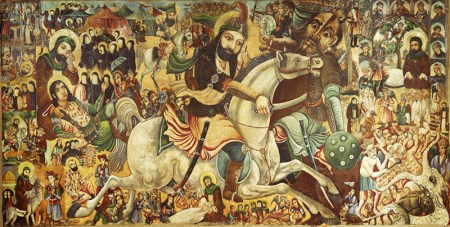
699In the Battle of Kerbala, depicted in Abbas Al-Musavi’s painting, Husayn, the son of Ali and grandson of Muhammad, was killed along with his family and all his followers by the armies of the Umayyad Caliphate. It was the most crucial moment in the split between Shi’a and Sunni Islam. (Image source: Brooklyn Museum)

The Ummayads in Damascus, the imperial capital, were the first dynastic rulers among Arabs in Islamic history. The founder of the dynasty, Muawiyyah, seized power following the murder of Ali, the fourth Caliph and the cousin and son-in-law of the Prophet. With the Ummayads the institution of the Caliphate, which was an innovation to fill the void of leadership among the Arabs in Medina following Muhammad’s death, adopted the pomp and pageantry of the Persian and Byzantine rulers. The Caliphate, from that first century of Islamic history until its abolition in 1924 by Mustafa Kemal Ataturk, the founder of modern Turkey, was the embodiment of Oriental Despotism.

Those Muslims who witnessed the tribal conflicts erupt after the Prophet’s demise and recoiled in revulsion from politics turned inward in seeking union with the divine mystery, as mentioned in the Qur’an. They sought solace in the spiritual dimension of Islam and emulated the Prophetic tradition of withdrawal from the world through prayer and meditation. They became the founders of the Sufi, or mystical, tradition in Islam. This was the “other” face of Islam, distinct from political Islam.

The physical expansion of the Islamic empire was carried forth by the armies of the Caliphs. But the spread of Islam as a faith tradition was a slow process, carried forth by Sufi missionaries belonging to various fraternal orders and independent of political rulers of the world of Islam.

There is a world of difference in conversion brought about at the point of sword of conquering armies, and conversion that results from the communion of hearts and minds among people. The latter is more genuine and transformative than the former in every religion. The Qur’an itself — verse 49:13 — warned the Prophet that the acceptance of Islam by the Arabs of the desert was one of submission in the face of defeat, and that belief had not entered their hearts. This verse might be read as forewarning of crimes Muslims would commit through history in the cause of political Islam, beginning with the killing of Husayn in Kerbala.

Political Islam from its outset was an inquisition. It began with Abu Bakr, the first Caliph, when he subverted the Islamic principle stated in the Qur’an — “there is no compulsion in religion” (2:256) — and declared war on those Arab tribes who withheld their loyalty from him following the death of the Prophet. The “Ridda Wars,” or the “Wars of Apostasy,” launched by Abu Bakr inaugurated political Islam, and since then, the precedent he set for Muslim-on-Muslim violence has plagued Islamic history into our times.

The role of the a’lem (pl. ulema; religious scholars) was instrumental in the making of political Islam. The ulema provided legitimacy to the Ummayad Caliphs in Damascus in the period of intra-tribal conflicts that had led to the killings of the three Caliphs (Umar, Uthman, and Ali) after Abu Bakr and then the massacre in the field of Kerbala.

The consensus of the ulema — accepted by those who eventually came to represent the majority Sunni Muslims (the word “Sunni” derived from Sunna, meaning following the path or tradition of the Prophet) — was that political and social order however provided and maintained was preferable to fitnah (disorder). This consensus provided doctrinal legitimacy to the Caliphs. In return, the Caliphs recognized the special function of the religious scholars and jurists in the drafting, codification, and implementation of Sharia, or Islamic laws.

As a result of this bargain between men wielding swords and men wielding pens, the foundational arrangement of political Islam was firmly established. It was an arrangement consistent with the thinking prevalent in antiquity that religion (deen in Arabic) prescribed the totality of human affairs. This meant, as it was understood by the ulema in the formative period of Islamic history, that the primary function of state and government (dawlat in Arabic) was the establishment of the rule of Sharia. As Ann K.S. Lambton in her study, State and Government in Medieval Islam(1981), observed:

“The law precedes the state and is immutable at all times and under all conditions. The state is there to carry out the law. To disobey a law or to neglect a law is not simply to infringe a rule of the social order: it is an act of religious disobedience, a sin, and as such involves a religious penalty.”

Once the bricks and mortar of political Islam were set in the making of the Islamic civilization, Islam as the official doctrine of the state and empire clearly demarcated the norm as prescribed in the Sharia and made the ulema its official guardians. The Islamic state was a nearly perfect embodiment of a closed totalitarian system designed by men towards the end of the first millennium of the Common Era, and any suggestion of change or adoption of new idea in matters of either religion or politics was condemned as bid’ah (heresy deserving punishment).

But Muslim dissidents who viewed the doctrine of political Islam, or what might also be referred to as “official” Islam, as an aberration, went underground and kept the “other” Islam free from the shackles of politics. Beneath the hardened features of political Islam, the “other” Islam of Sufis provided solace to Muslims by tending to their humanity in the light of God’s most favoured attributes of mercy and compassion.

The “other” Islam, unlike political Islam, is not bound by time and space. It is directed to man’s inner yearnings for that which is eternal. It plunges in search of the inner meaning of the Qur’an as the Word of God, and the assuredness that God’s mercy is not denied to any of His creations. The Qur’an states, “We are nearer to man than his jugular vein” (50:16), reassuring man that he is not alone and God is not some distant uncaring deity.

Whereas the defining characteristic of political Islam was religion inseparable from politics, in “other” Islam politics was the corruption of religion and the dissolution of belief. Hence, from the perspective of “other” Islam, the Sharia as the corpus of Islamic laws codified by the ulema and sanctioned by the Caliphs was a poor, even corrupt, representation of the divine Sharia (in Arabic, a “path”) imprinted in the hearts of all believers as the path to acquiring God’s infinite grace.

ii.

Political Islam and the Islamic civilization it inaugurated was time-bound as a theopolitical system constructed in a certain historical period or context. It was a construct of late antiquity and the early medieval era. Since it was a fixed and closed system, it was invariably given to decay and dissolution.

During the Middle Ages, the Islamic civilization flourished just as other civilizations had. As Abdus Salam (1926-1996) — a physicist of Indo-Pakistani origin and the first Muslim scientist awarded the Nobel Prize for Physics in 1979 — observed in one of his lectures, the world of Islam and the world of Christianity (Europe) were more or less at a similar stage of development around the middle of the seventeenth century.

The evidence of this relative equality of the two civilizations, Salam suggested, could be seen in their technological achievements represented by the two monuments, the Taj Mahal in Agra, India, and St. Paul’s Cathedral in London, England, completed about the same time. Some two decades later, Salam observed,

“there was also created — and this time only in the West — a third monument, a monument still greater in its eventual import for humanity’s future. This was Newton’s Principia, published in 1687.”

Newton’s monument had no counterpart in India, or anywhere else in the Muslim world.

The Renaissance, the Age of Enlightenment and the Scientific Revolution, led by men of astounding intellect from Leonardo da Vinci to Galileo and Newton, propelled Europe out of the medieval age into the making of the modern world. But Islamic civilization, held together by political Islam, descended into a death spiral. A century after Newton published his major work, the Ottoman Empire was turning irreversibly into a pale shadow of a civilization that once had threatened the powers of Europe at the gates of Vienna.

In the aftermath of September 11, 2001 attacks in New York and Washington by the Islamist terrorists of al Qaeda, Bernard Lewis published What Went Wrong? (2002). It was Lewis’s effort to answer why, and how, the world of Islam had failed to accommodate the imperatives of the modern world.

“In most of the arts and sciences of civilization, medieval Europe was a pupil and in a sense a dependent of the Islamic world,” wrote Lewis.

“And then, suddenly, the relationship changed. Even before the Renaissance, Europeans were beginning to make significant progress in the civilized arts. With the advent of the New Learning, they advanced by leaps and bounds, leaving the scientific and technological and eventually the cultural heritage of the Islamic world far behind them.”

The civilizational success of political Islam in late antiquity and the early medieval era ironically carried within it the seeds of its own decline and demise. World War I eventually put an end to the anachronism that the Ottoman Empire had become, and the abolition of the Caliphate was a formal effort to bury political Islam for good.

Thoughtful Muslims, for nearly a century before the demise of the Ottoman Empire and the abolition of the Caliphate, had been thinking and writing about the need for an Islamic reform. Europe’s cultural advancement following the Reformation and Enlightenment held up a mirror for the Islamic world to follow in similar direction to similar ends.

In India under British rule, for instance, there were a significant number of Muslims who painfully recognized the malaise of Islamic societies and offered remedy for their advancement into the modern world. Among them the notable were Sir Sayyid Ahmad Khan (1817-98), the founder of the Aligarh University; Syed Ameer Ali (1849-1928), jurist and historian; and Muhammad Iqbal (1877-1938), poet and philosopher.

One of the most important works was published in 1925 by Ali Abd al-Raziq (1888-1966), an Egyptian scholar and jurist at Al-Azhar University in Cairo. In his seminal work, titled al-Islam wa ‘Usul al-Hukm (Islam and the Fundamentals of Authority), al-Raziq pointed out that there was no basis in the Qur’an and the Sunnah (traditions) of the Prophet for the institution of the Caliphate.

Al-Raziq was not someone from outside the ranks of the ulema, or a lay scholar unfamiliar with the intricacies of Islamic jurisprudence and theology in the construction of Sharia. He was a student of Muhammad Abduh (1849-1905) at al-Azhar, when Abduh had been appointed the Grand Mufti of Egypt.

Al-Raziq’s main contention was based on the distinction between spiritual and temporal authority. He indicated that the confusion among Muslims in the period after the Prophet arose from their inability to distinguish between the Apostolic role of Muhammad and the authority he derived as the Messenger of God (Rasul Allah), and the Caliphate as a temporal institution. Al Raziq wrote:

“Muhammad was but an apostle, sent on behalf of a religious summons, one pertaining entirely to religion and unmarred by any taint of monarchy or of summons to a political state; and he possessed neither kingly rule nor government, and he was not charged with the task of founding a kingdom in the political sense, as this word and its synonyms are generally understood.”

Al-Raziq was denounced by his peers. He was made to appear before the Council of the Greatest Ulema of Al-Azhar to hear the judgment against him, as his license to teach and practice law was revoked. Egypt was then ruled under Britain’s supervision, which likely saved al-Raziq from even more severe punishment.

But al-Raziq had stripped away the argument of traditional Islam on the sanctity of the Caliphate, and with it went the idea of Sharia being sacred. In the half-century following the abolition of the Caliphate by Mustafa Kemal, Muslims under European rule gained their independence as new states emerged in the Middle East and elsewhere in the world of Islam.

This period in the middle decades of the last century was a period of intense expectations on the part of Muslims for progress in their living conditions. A massive effort was invested to make the transition from the world of pre-Newtonian knowledge and learning to the modern world of science, industry and democracy.

There was a consensus among the rich and the poor that Islam was not intrinsically opposed to the modern world. There was a readiness among Muslims to follow in the footsteps of the West.

This consensus was reflected in a well-known and widely circulated aphorism attributed to Muhammad Abduh. On returning to Cairo from a visit to Europe, Abduh told his students, “I travelled in the West and found Islam, but no Muslims; I have returned to the East and find Muslims, but not Islam.”

The transition into the modern world, however, proved immensely complex and difficult. Europe’s transition had required several generations and a couple of centuries to break away from the feudal age into the modern age. The resistance from those invested in the ancien arrangements of society and culture was immense, and wars that followed were fierce.

Something similar to the European experience was unavoidable for Muslims in their effort to break from the hold of their traditional culture. And not unlike the wars in Europe, wars within the world of Islam since the 1970s are symptoms of the Muslim struggle to transit into the modern world.

iii.

The abolition of the Caliphate in 1924 was the formal announcement of political Islam’s death. But it refused to die, even as it was laid to rest. Its twitching was felt in the deep dark interior of the world of Islam, in remote and unwelcome places such as Nejd inside Arabia.

Here in Nejd, the medieval theology of Ibn Taymiyyah had struck roots. It had impressed an eighteenth-century itinerant preacher in the region, Abdul Wahhab (1703-92), who turned Ibn Taymiyyah’s extremist thinking into an even more rigid and austere doctrine, hostile to all things inimical to the Bedouin tribal culture of his time and environment.

Abdul Wahhab’s version of political Islam impressed a local tribal chief, and the marriage of convenience between the preacher and the tribal leader gave birth to the first Saudi state in the interior of Arabia. But when it sent tribal warriors to raid towns inside the frontiers of the Ottoman Empire, it provoked the Caliph of Islam in Istanbul, on whose orders this nascent state of the Wahhabi ruler was destroyed.

But the eventual collapse of the Ottoman Empire provided the conditions for the rebirth of the Saudi state as a kingdom under Abdul Aziz ibn Saud in the 1920s. Fortune, in the guise of great power politics, smiled upon him. He seized the support offered by the British, in return for influence in a region of strategic importance. The discovery of oil made the Saudi kingdom a prize to be protected by the Western powers, first Britain and later the United States, with far reaching consequences for the rest of the world, and even more so for the world of Islam and Muslims.

Any modernizing revolution is hugely disruptive. The movement from one stage of social development to another is not linear; it is, instead, filled with zigzags and reversals at every stage of the process toward an uncertain future.

When a people, however, pushes back against this process of change in their midst, or seeks to abort it, this reactionary effort pins its hopes on longing for an idealized past. The Newtonian revolution and the emergence of modern Europe made political Islam anachronistic. Wahhabism, as the official doctrine of the Saudi kingdom, was much more than a return of the most extreme version of political Islam in the early decades of the last century. It was, and remains, a demented effort of the most backward people within the world of Islam to remain culturally tied to antiquity, or jahiliyya (the age of ignorance), which Islam at its origin derided and rejected.

Political Islam in whatever version — Wahhabism, Khomeinism, Ikhwanism (the Muslim Brotherhood) and their derivatives — has no answer for Muslims on how to make their historic transition into the modern world. It can continue to rage against the modern world until its civilized inhabitants, including Muslims, have had enough of its destructiveness and obliterate it.

Then that vision of Abrahamic monotheism, which Muhammad was mysteriously directed to deliver to his people, will be emancipated from political Islam.

This message Muhammad was given admonished Arabs for their lack of faith, provided them with ethics for living honorably, told them in no uncertain term that the God of Abraham made no distinction among nations and people who believe in Him, and that on the Day of Final Reckoning, they need have no fear if they strive in doing what is right.

This is the “other” Islam. This is submission to truth, whose most righteous exemplar was Abraham when his faith was tested by his Deity, according to the Hebrew Bible, to sacrifice his son. And this is the faith of Sufis who took Muhammad’s message to people in places far removed from the desert confines of Arabia. It is simply, as the Qur’an reminds (30:30), deen al-fitrah, the natural religion, or inclination, of man to know his Creator. There is no return of this “other” Islam; it never went missing.

Bad Ideas Created Benghazi

July 5, 2016

Bad Ideas Created Benghazi, Front Page MagazineBruce Thornton, July 5, 2016

Witch of Benghazi

The House Select Committee on Benghazi report confirms what we pretty much already knew. The Obama administration and Secretary of State Hillary Clinton completely politicized this country’s foreign policy in order to ensure the reelection of Obama and to serve the future presidential ambitions of Hillary Clinton. Along the way Obama, Clinton et al. made dangerous decisions, such as establishing the consular outpost in Benghazi, and ignoring the consul’s pleas for more security. They also ignored the many warning signs of incipient attacks, bungled the response to the attack on September 11, 2012, and then obfuscated, spun, and outright lied in the aftermath. The House report adds new details that flesh out the story, but enough had already been leaked to confirm Clinton’s despicable sacrifice of American lives on the altar of her obsessive ambition.

Toxic ambition, sheer incompetence, and the self-serving politics of the individuals involved mean they bear the primary responsibility for this disaster. But Benghazi illustrates as well the climate of bad ideas that make such decisions possible. Bad politicians eventually go away, but malignant ideas and received wisdom are deeply rooted in our institutions, transcending individuals. The Benghazi fiasco illustrates two particularly tenacious ones.

The military intervention in Libya, the origin of the Benghazi tragedy, was another act of Western wishful thinking about “democratizing” and “reforming” the Muslim world. Despite the failure of George W. Bush’s efforts to bring democracy to Iraq and Afghanistan, the so-called “Arab Spring” revolutions encouraged the Wilsonian “freedom and democracy” promoters in 2011 to make Libya yet another poster-child for this doomed project. Moreover, intervention seemingly could be done on the cheap. No troops need be deployed, since jets and missiles could topple the psychotic Muammar Gaddafi––an autocrat straight out of central casting, whose genocidal bluster gave the West a pretext for intervention.

For Hillary and Obama, this was the perfect opportunity to show those neocon militarists what “smart power” was all about, and strike a contrast with the “cowboy” Bush’s “unilateralist” bumbling in Iraq. A UN resolution was secured, and a NATO-led coalition of 19 states assembled for enforcing a no-fly zone. The mission soon escalated into bringing about regime change and the death of Gaddafi.

For a while, this was a perfect, low-cost, quick little war that would illustrate the various shibboleths of moralizing internationalism: international diplomatic approval for the use of force, multilateral coalition building, a reliance on air power that minimized casualties among participating militaries, and a smaller role for the US, which would be “leading from behind,” as an Obama advisor said. This last idea reflected Obama’s belief that the US needed to diminish its role in world affairs and avoid the arrogant overreach that stained its history abroad, most recently in Iraq. This notion of America’s global sins is another bad idea reflecting ideology, not historical fact.

For Secretary of State Clinton, the Libya intervention would be the showcase of her tenure at State and proof of her superior foreign policy skills and presidential potential. Of course, we all know that the toppling of Gaddafi has been a disastrous mistake. Gaddafi was a brutal creep, but he kept in check the jihadists from Libya eager to kill Americans in Iraq and foment terror throughout the region. His departure created a vacuum that has been filled with legions of jihadist outfits across North Africa, including ISIS franchises. They are armed in part with weapons plundered from Gaddafi’s arsenals such as surface-to-air missiles, assault rifles, machine guns, mines, grenades, antitank missiles, and rocket-propelled grenades. Yet eager to protect her defining foreign policy achievement, Hillary kept open the diplomatic outpost in Benghazi even as other nations pulled out their personnel because of the increasing danger caused by the new Libyan government’s inability to control and secure its territory.

Four dead Americans were the cost of political ambition and adherence to the bankrupt idea that liberal democracy can be created on the cheap in a culture lacking all of the philosophical and institutional infrastructure necessary for its success: inalienable rights, equality under the law, transparent government, accountability to the people, separation of church and state, fair and honest elections, and the freedom of speech and assembly. The folly of expecting democracy in a culture alien to it became clear in the aftermath of Gaddafi’s downfall, when the Libyan National Transitional Council’s Draft Constitutional Charter proclaimed, “Islam is the religion of the state, and the principal source of legislation is Islamic Jurisprudence (Sharia).” The idea of exporting democracy, however, still has a tight hold on many in the West both on the left and the right, which means we have not seen the last of its bloody and costly failures.

Equally bipartisan has been the next bad idea: that al Qaeda, ISIS, et al. are fringe “extremists” who have “hijacked” Islam, and that the vast majority of Muslims are “moderates” grieved by this tarnishing of their noble faith. It was George W. Bush who said in his first address after 9/11 that Islam’s “teachings are good and peaceful, and those who commit evil in the name of Allah blaspheme the name of Allah,” establishing the model for his administration’s policy of “outreach” to Muslims. Obama has taken this delusion to surreal extremes, refusing in the face of mountains of evidence to link the numerous ISIS attacks of the last few years to Islam, and proscribing “jihad” and “radical Islamist” from the government’s communications and training manuals.

It was this imperative to sever Islamic terrorism from its roots in traditional Islamic doctrine that in part accounted for the lies that Hillary, Obama, and their minions like National Security Advisor Susan Rice told in the aftermath of the Benghazi attacks. They peddled the narrative that a spontaneous protest against an obscure Internet video insulting Mohammed had morphed into a violent attack. This lie traded in the delusional belief that despite its 14-century-long record of invasion, murder, slaving, colonization, and occupation­­––all in fulfillment of the divine commands “to slay the idolaters wherever you find them” and “to fight all men until they say there is no god but Allah” –– Islamic doctrine could not possibly justify the actions of modern terrorists. So powerful was the need to protect this belief and, of course, her political future that Clinton lied to the faces of the parents of the four dead Americans, promising to “get” the hapless filmmaker, even as she knew on the very night of the attacks that there was no protest against the video near the consular outpost.

Nor are the various pretexts for this evasion of historical fact convincing. The worst is that making explicit the link between jihadism and Islam will endanger innocent Muslims and stoke “Islamophobia.” There is no evidence that this is the case, and hate crimes against Jews still vastly outnumber those against Muslims. Not much better is the notion that pious Muslims, supposedly offended by “blasphemers” like al Qaeda, the Taliban, and ISIS, will not cooperate with police and the FBI if we state simple facts about their faith and its history.

This idea is psychologically preposterous. It assumes that Muslim pique at infidel statements about their religion trumps their assumed desire to stop the violent “distorters” of their beloved faith. It also assumes that to Muslims, such insults justify keeping quiet about the planned murders of innocents––a damning indictment of the very people whom the “nothing to do with Islam” crowd are so anxious to mollify. Worse, it confirms the unique triumphalism of Islam, whose adherents expect from non-believers deference to their faith, even as Muslims across the globe are slaughtering and torturing people simply because they are non-believers. Such careful monitoring of our discourse about Islam, at the same time Muslim intellectuals routinely attack the West for its alleged historical sins against Islam, is a sign of weakness and fear that encourages our enemies to hit us again.

We’ve been operating by this double standard for decades, and terrorist groups have expanded across the globe, while jihadist violence has murdered Americans in Boston, San Bernardino, Fort Hood, and Orlando, to name just the deadliest attacks. It’s safe to say that the tactic of flattering Muslims and confirming their sense of superiority to infidels has failed to keep us safe.

But if we really want to be honest, we won’t just rely on the weasel-word “Islamist,” which still suggests that the beliefs of the jihadists are somehow a doctrinal aberration. Those of both parties who continually talk about “moderate Muslims” and use the word “Islamist” to distinguish them from jihadists should heed Turkey’s Prime Minister Recep Erdogan: “The term ‘Moderate Islam’ is ugly and offensive; there is no moderate Islam; Islam is Islam.” Using “Islamic” rather than “Islamist” will recognize the continuity of modern jihadism with traditional Islamic doctrines. Whitewashing that fact has done nothing to stop jihadist violence, and it is an enabler of those ordinary Muslims who refuse to acknowledge Islam’s illiberal and violent doctrines.

Barack Obama and Hillary Clinton deserve the opprobrium history will inflict on them for sacrificing our security and interests to their personal ambition and ideological obsessions. But bad ideas had a hand in the killing of four Americans in Benghazi, and those bad ideas will continue to cripple us until we discard them and start facing reality.

Hamas terrorists reveal: Terror tunnels inside moques

July 5, 2016

Terrorists arrested smuggling tens of thousands of Euros from Gaza for Hamas terror activity in Judea and Samaria in their shoes.

By Ido Ben Porat

First Publish: 7/5/2016, 4:18 PM

Source: Large sums of terror money smuggled in shoes – Defense/Security – News – Arutz Sheva

Gaza terror tunnel                                    Reuters

Two terrorists from the Gaza Strip have been arrested for smuggling cash earmarked for Hamas activities in Judea and Samaria – in their shoes.

The two are Faiz Attar (65) of Beit Lahia, and Itallah Sarhan of Jabalia. Both towns are in the Gaza Strip

Attar was arrested last week after it was discovered that he was using his transit permit – issued for work purposes – to act as a courier for cash to fund the terrorism activities of Hamas in Judea and Samaria. The money was hidden in specially designed shoes. He was able to complete the transfer several times, with the total sum of money smuggled amounting to tens of thousands of Euros.

A Shin Bet investigation found that Attar’s family has ties with Hamas, taking part in operations against IDF forces and digging of terror tunnels. Attar’s sons have also hosted Hamas meetings in his house.

The investigation also turned up information regarding tunnel entrances – some of which are located under residential buildings, housing many innocent civilians who have no ties to terror groups, and mosques – and missile launch pads located near residential buildings, endangering the civilian population.

The second terrorist, Sarhan, was arrested last month at the Erez crossing while trying to smuggle 10,000 Euro in his shoes for Hamas in Judea and Samaria.

Sarhan, who received his transit permit only two weeks before his arrest, recounted under questioning that he was approached by a Hamas policeman working the Gazan side of the crossing on his, Sarhan’s, first day of leaving the Gaza strip. The Hamas man tried to interest him in smuggling cash into Judea and Samaria

After Sarhan expressed his willingness to cooperate, the Hamas policeman introduced him to other Hamas terrorism operatives who paid him in advance for his services, supplied him with specially fitted shoes in which the money was hidden, and pledged to provide him with support should he be caught.

Sarhan had already completed a transfer the day before he was arrested. It became clear during the investigation that he knew that the money was intended for funding Hamas activities. The Shin Bet also discovered that Sarhan has been working as a truck driver for a company that clears away dirt from terror tunnel digging sites run by Hamas and Islamic Jihad.

As a result of this work, Sarhan had seen many of the tunnels. He provided Israeli security agencies with much information, including the location of the tunnels, the extent of the progress made in each tunnel, and identity of the terror group behind each tunnel.

The Shin Bet have noted that the information obtained in this investigation shows once again how willing Hamas are to make cynical use of Israel’s decision to allow people to cross out of the Gaza Strip in order to help them financially.

“Hamas uses the bearers of these permits to promote terrorist activity and thus harms the civilian population of Gaza”, Shin Bet representatives commented.

“Israel allows thousands of Gaza residents to cross into Israeli territory monthly, for humanitarian, medical, and other reasons. The terror groups take advantage of this for illegal purposes including the transfer of funds for terror. This is a serious issue which will be dealt with severely.”

‘Price to pay for US’: Beijing ready to confront Washington if it intervenes in S.China Sea dispute

July 5, 2016

Price to pay for US’: Beijing ready to confront Washington if it intervenes in S.China Sea dispute

Published time: 5 Jul, 2016 11:58 Edited time: 5 Jul, 2016 12:06

Source: ‘Price to pay for US’: Beijing ready to confront Washington if it intervenes in S.China Sea dispute — RT News

© China Daily / Reuters

Beijing must prepare to make the US “pay a cost it can’t stand” if it intervenes in the South China Sea dispute by force, a state newspaper editorial has warned, days before a court at The Hague rules on the territorial row between China and the Philippines.

The American military build-up in the South China Sea, including the deployment of two carrier strike groups, comes in defiance of China’s vital interests and represents “a direct threat to national security,” the state-run Global Times said in strongly-worded editorials in its Chinese and English editions on Tuesday.

Beijing should accelerate developing its strategic deterrence capabilities to contain the United States, the newspaper added.

https://twitter.com/globaltimesnews/status/750157270969876480/photo/1?ref_src=twsrc%5Etfw

“Even though China cannot keep up with the US militarily in the short-term, it should be able to let the US pay a cost it cannot stand if it intervenes in the South China Sea dispute by force.”

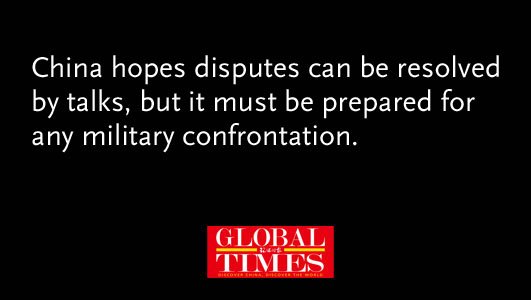
China is a peaceful country that welcomes dialogue on the disputed region, the influential newspaper wrote, “but it must be prepared for any military confrontation.”

The Global Times is believed to have close ties with the government as it operates under the auspices of the Communist Party’s official newspaper, the People’s Daily.

The Tuesday editorial went online a week ahead of a ruling by the International Court of Arbitration in The Hague on the South China Sea dispute between China and the Philippines. In 2013, the Philippines filed a complaint with the court, asking it to rule on who owns the Spratly Islands, which lie at the heart of economically important shipping routes in the area.

China sees the ruling – which is due to be announced on July 12 – as “posing more threat to the integrity of China’s maritime and territorial sovereignty,” the Global Times stated, claiming “the arbitration becomes nothing but a farce.” Beijing has said it will not recognize the ruling.

https://twitter.com/RT_com/status/747539561824268288/photo/1?ref_src=twsrc%5Etfw

The Spratly Islands, or Spratlys, comprise more than 750 islets, atolls and reefs, and lie off the coastlines of Vietnam, the Philippines, Taiwan, Malaysia, Brunei and China, with all the claimants having their own national names for the archipelago.

China runs military drills near Paracel Islands

Prior to The Hague court’s ruling, Beijing announced it will conduct a routine naval exercise covering an area east of China’s Hainan Island all the way up to and including the Paracel Islands (known as Xisha in Chinese), another disputed area. The drill will run from Tuesday to July 11, and will involve two Chinese guided-missile destroyers, the Shenyang and Ningbo, as well as a frigate, the Chaozhou, according to the People’s Daily.

The exercise has sparked fears across the region, but “could be regarded as a countermeasure” to the US efforts “to press China militarily and politically,” the Global Times’ editorial said.

Over the past few years, Beijing has reclaimed several atolls and built up military installations on the group of disputed islands in the South China Sea. Washington has accused China of “aggressive behavior” in the region, sending warships to enforce what it calls freedom of navigation in international waters.

China’s President Xi Jinping says Beijing has no plans to attack anyone, but will continue its policy of active defense.

Media blasts Hillary Clinton on being dishonest and untrustworthy | SUPERcuts! #336

July 4, 2016

Media blasts Hillary Clinton on being dishonest and untrustworthy | SUPERcuts! #336, Washington Free Beacon via YouTube, July 3, 2016

Palestinians hit Sarona after allegiance to ISIS

July 4, 2016

Palestinians hit Sarona after allegiance to ISIS, DEBKAfile, July 4, 2016

SaronaMarket480

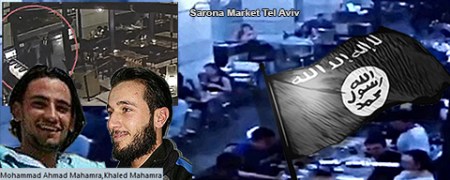
Exclusive to DEBKAfile counter terrorism sources: The IDF and the General Security Service have video footage and photos showing eight Palestinian terrorists from Yatah village in Mt Hebron participating in an ISIS oath of allegiance ceremony. They are in custody as accessories of the two terrorists who perpetrated the Sarona market attack, near the Ministry of Defense and the IDF HQ on June 8.

Four Israelis were killed in the terror attack – Ido Ben-Ari, Ilana Naveh, Michael Feige and Milah Misheiv – and 41 wounded.

The eight cell members are seen standing in a military parade before the ISIS flag and swearing allegiance to the flag and to Abu Bakr al Baghdadi.

DEBKA was the only publication to immediately assign the attack to an ISIS cell.

A third terrorist was supposed to shoot up a crowded train for multiple casualties in coordination with the pair at the Tel Aviv market.

So far this is the largest Palestinian terror cell associated with ISIS to have been captured.

The misleading and opaque statement given out by the IDF official Monday, July 4, describing the cell as ISIS-inspired continued the government and military chiefs’ efforts of the past seven months to obscure the early inroads made by the jihadist group in the Palestinian and Israeli Arab Muslim communities.

This was first noted in a January when an Israeli Arab from Wadi Iron opened fire on people sitting in an open air café on fashionable Dizengoff Street in Tel Aviv.. The shooter, Nashat Malham later turned out to have taken an oath of allegiance to ISIS and its leader.

There is no difference therefore between Syed Rizwan Farook and Tashfeen Malik who murdered 22 Americans in San Bernardino on December 2 in the name of ISIS, Omar Mateen who murdered 49 Americans in Orlando on June 12, and the Islamist killers in Tel Aviv.

Instead of telling the Israeli public the truth at the attack on Sarona Market was the work of ISIS terrorists, Israel’s government, military security service chiefs persist in putting their heads in the sand and using President Barack Obama’s euphemisms to avoid laying some of the most recent and deadliest Palestinian terror attacks at the door of ISIS.

By refusing to recognize that Israel faces the same threat as Jordan, the US and Europe, its policymakers are blinding themselves to reality.

Suicide bomber strikes near Prophet’s Mosque in holy Saudi city of Medina (VIDEO)

July 4, 2016

Suicide bomber strikes near Prophet’s Mosque in holy Saudi city of Medina (VIDEO)

Published time: 4 Jul, 2016 17:11 Edited time: 4 Jul, 2016 17:27

Source: Suicide bomber strikes near Prophet’s Mosque in holy Saudi city of Medina (VIDEO) — RT News

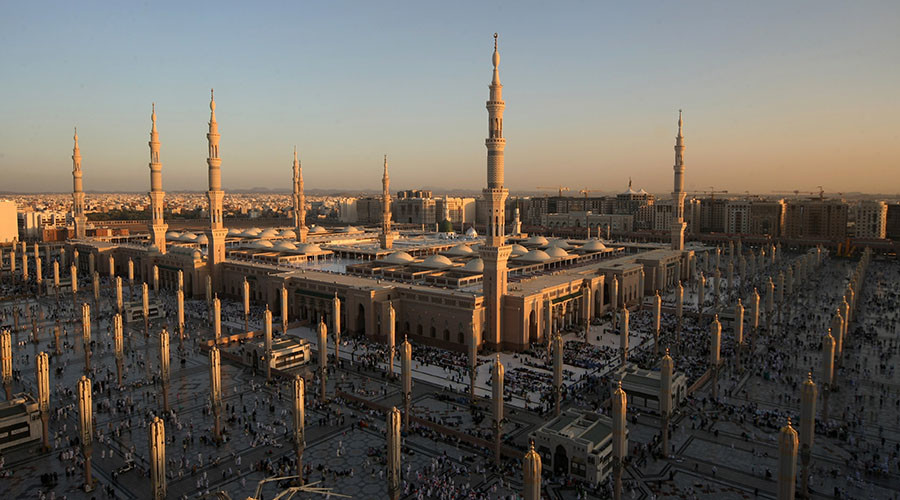
A general view of the Prophet Mohammed Mosque in the Saudi holy city of Medina. © Mahmud Hams / AFP

A bomb exploded outside the Prophet’s Mosque in the Saudi city of Medina on Monday night, local state television reported.

Multiple videos flooding social media showed charred corpses lying next to the burning husk of a car in the mosque’s car park, as police and ambulance sirens blared, and hundreds of onlookers filmed footage on their smartphones.

Monday is the last night of the holy month of Ramadan, and marks the beginning of Eid, the biggest festival in the Muslim calendar.

Other explosions took place Monday in the port city of Jeddah, and Qatif, an eastern city populated by the predominantly-Sunni country’s embattled Shia minority.

Independence and Identity: What Israel Knows, Europe Has Forgotten, and America May Yet Remember

July 4, 2016

Independence and Identity: What Israel Knows, Europe Has Forgotten, and America May Yet Remember, American ThinkerAbe Katsman, July 4, 2016

The Fourth of July is beautiful.  Independence Day marks arguably the most consequential positive political event in history and deserves every bit of the enthusiastic celebration with which it is observed.  Yet the day goes by insufficiently appreciated by so many – a symptom of the erosion of our American identity.

For some perspective, let’s start by looking at Memorial Day.  In Israel.

Israel.  Yom Hazikaron (Israel’s Day of Remembrance) is ushered in by a wailing siren.  Everyone – even drivers on the freeways – stops in his tracks for a minute of mournful silence.  The somber mood of the day is everywhere: no hot dogs or barbecues; no sales at the malls.  No rock music on the radio; no Friends reruns or light entertainment on TV – just reflective songs, unvarnished war documentaries, heart-piercing interviews with families of fallen soldiers, and coverage of countless memorial ceremonies at the nation’s cemeteries.  It is a poignant day, dripping with tragedy, loss, sacrifice, and suffering – but also with heroism, pride, honor, and gratitude.

Does that sound like your Memorial Day?

Israel may be unique in the intensity with which it observes Yom Hazikaron.  But other nations, including America, would be wise to learn from Israel about how and why it honors its fallen as it does.

Yom Hazikaron honors the 23,000 Israeli lives lost – mostly young citizen-soldiers, as well as some 2,500 terror attack victims – in modern Israel’s never-ending struggle to exist.  It is a heavy day, and everyone feels its weight: as a small nation resurrected in the wake of the Holocaust, with a culture that places a premium on each individual life, Israel knows too well not only that its freedom isn’t free, but that it comes at a steep, painful price.

As night falls on Yom Hazikaron, there is a jarring transition to raucous celebration: Yom Ha’atzmaut, Israel’s Independence Day, begins.  There are fireworks, official ceremonies and celebrations, street partying, and happy prayers of thanksgiving.  There are military flyovers, ubiquitous barbecues, and the International Bible Contest finals.  And there is an outpouring of national pride and a sense of accomplishment over how the country has survived and thrived for yet another year, feelings intensified by an appreciation for the fragility of its very existence.

Though quite the 48-hour emotional rollercoaster, the two days add depth and meaning to one another.  As painful as that price has been for Israel to gain and maintain independence, it is dwarfed by the price the Jewish people paid for their prior statelessness.

These two days are a distillation of Israelis’ remarkably strong sense of national identity, healthy cultural confidence, and appreciation for the state they have – imperfect as it may be.  These are sentiments widely shared, even – perhaps especially – by Israel’s sizeable population of immigrants from around the globe.

That is all well and good for Israel.  What is worrisome is that such a strong national identity, though once the norm, has become aberrational in the Western world.  The failure to nurture national identities among new generations and new immigrants threatens the survival of the culture and values Western nations once strongly stood for.

Europe.  The competing cultures of European nations once proudly rivaled each other, spawning revolutions in philosophy, law, science, art, exploration, industry, religion, and academia while raising the prosperity, education, and human rights levels of millions in the process.

But nationalism run amok was also a factor in Europe’s bloody wars.  Since the end of World War II, nationalism-phobia has driven Western European governments.  Though nationalism has only once mutated into Nazism, European elites threw out the baby with the bathwater: to ensure that expansionist racial fascism would not rise again, European leaders strove to minimize individual nationalisms and shrink the autonomy of individual states, cobbling together instead a new, transnational, pan-European identity.

They succeeded, perhaps too well, at diminishing the particular nationalisms of individual states.  Their artificial new Europeanist substitute, however, is a watery, post-Christian, least-common-denominator amalgam which fails any identity’s most basic test: hardly anyone is inspired to identify with it.  As Europeans lament the failure of waves of Middle Eastern and North African immigrants to assimilate, perhaps one question that should be asked is, assimilate into what, precisely?

European nations used to make history happen; “Europe” now passively endures history happening to it.  The U.K. Brexit vote notwithstanding, the exploding rates of violent crime (particularly rape), the metastasizing of terror cells, and the proliferation of no-go zones of debatable sovereignty  seem not to rouse paralyzed mainstream political leaders to act in defense of any cultural value other than so-called multiculturalism.

As cultural identities erode, so erode the senses of purpose, belonging, meaning, inspiration, and cultural confidence of citizens.   Identity-stripped societies are marked by risk aversion, listlessness, passivity, economic stagnation, lack of innovation, and – perhaps most ominous – sub-replacement-level birth rates.  (Israel, notably, has by far the highest fertility rate of any OECD country.)  The European nations, by and large, no longer seem to understand who they used to be or what they are becoming.  They have lost their way.  They are cultures in retreat.

America.  The Unites States has not yet traveled as far down the post-nationalist cul-de-sac as has Europe, but it is heading in the same direction.

We may feel Americanism in our bones, but that does not make it part of our DNA; it is not inherited automatically.  An understanding and appreciation of what America means requires transmission to each new generation.  Yet that transmission is getting ever weaker: it is no longer fashionable within the education establishment to teach students about American exceptionalism or why tens of millions fled their own countries, immigrated to America’s shores, and proudly adopted American identities and values or the degree to which America has been an unparalleled force for liberty and decency in the world.  (It doesn’t help matters that our post-nationalist president, not shy with opinions about everything else, rarely speaks of American greatness, past or present.)

Universities long ago abandoned any thought of instilling in all students some understanding and appreciation for Western and American civilization.  Instead, students are taught the arts of grievance-manufacturing and victimhood, of countering privilege and power structure, of squelching free speech and seeing a complex world exclusively through the race/class/gender prism, and of becoming expertly hypersensitive to nano-aggressions and cultural appropriations.  A wrecking ball of intellectually lazy cultural and moral relativism has displaced the Western/American canon.

Students come out of college arguably are even more ignorant of their Americanism than when they entered.  By signing the Declaration of Independence, men of wealth and stature effectively signed their own death warrants, all in the name of political principle.  Yet if university students are taught anything about those who committed their lives, fortunes, and sacred honor to secure the liberty these students take for granted, it is that the founders were privileged white male slaveholders, thus more deserving of contempt than deep study.

There is far more sense of entitlement and cynicism about America inculcated on campus than sense of appreciation and gratitude for what it means to be American, or for the ultimate sacrifice of 1.35 million American war dead.  And every year, America’s colleges churn out another 3 million graduates thus indoctrinated.

There are only a few remaining cultural institutions where Americanism is honored: the military, talk radio, and country music come to mind.  The prevailing mass cultural influences at best reflect mild embarrassment over American pride and patriotism.

Reclaiming Identity.  National identity does not mean lockstep unity or uniformity, cheerleading, or papering over a nation’s faults.  Israel, for example, soberly faces monumental challenges both internal and external, and Israeli society is fundamentally fragmented – too often along demographic lines – in how to approach them.  While American politicians sometimes call for “national conversations,” Israeli citizens live in one.  Yet Israel’s rollicking, caustic debates, frequently over core questions of just what Israeli identity means, are themselves part of that identity.

Every nation needs to find its own path to instill identity in its people and an understanding of why it is worth preserving.  In Israel’s case, as fractious as society may be, it has utilized several tools to forge its strong sense of common identity.  Through maintaining a strong Jewish historical memory and reconnecting to an ancient homeland; through breathing new life into its historic, though largely dormant, Hebrew language; through ingathering of exiles and rescue of persecuted Jews around the world; and through surviving crises together against often daunting odds, the Jewish people have re-created the nation of Israel.  Infighting aside, there is a widespread sense of shared fate and a still potent recollection of pre-state Jewish powerlessness.  Reinforced through common tradition, education, and ceremony – including Yom Hazikaron and Yom Ha’atzmaut – that powerful identity has kept Israelis together through some dangerous, trying times.

Tragically, reclamation of national identity may well be a lost cause in several European states.  But it is not yet lost in America.  The feelings of gratitude and appreciation for being American, and of understanding what America has meant to ourselves and to the wider world, still run deep in much of the population, in spite of prevailing cultural antipathies toward such attitudes.  But those sensibilities are endangered by insufficient transmission of American identity from one generation to the next and are in dire need of reinforcement.

America has always been a model to Israel of so much worth emulating.  Perhaps in the realm of strengthening of national identity, Israel can return the favor.

There are no simple solutions.  But we might start with something simple: perhaps it’s time to establish an Independence Day custom of sounding sirens for a national minute of silence.  Everyone can share a collective moment to honor the price paid for our liberty.  Linking the sacrifice of others with our own Independence Day celebration of freedom is a good way to enhance the respect and appreciation for both.  It is a small step, but it is at least a step forward, toward strengthening our American identity.


Our Eternal War For Independence

July 4, 2016

Our Eternal War For Independence, Front Page Magazine, Daniel Greenfield, July 4, 2016

usflag-wikimediacommons

We were not meant to be a society of sinecures for public servants. We did not come into being to be ruled by bureaucrats. Our birth of freedom was not meant to give way to the repression of a vast incomprehensible body of regulations administered by an elite political class in Washington D.C.

Americans are rebels. And if we are not rebels, then we are not Americans.

We are not a nation founded by men and women who followed the rules. It is not our capacity for obedience that makes us true Americans, but our capacity for disobedience. 

*****************************

How will you celebrate the Fourth of July?

With fireworks and parades, hamburgers and hot dogs, sweating bands playing Sousa marches and parades down Main Street? Will you remember the men who fell in the first war and all the following wars that were fought to preserve our political and personal independence from foreign and domestic tyrannies? Will you consider what you might have done in the days when revolution was in the air?

Those are all good things. They remind us to celebrate and what it is we are celebrating.

I sat on the warm grass beneath the shade of a spreading fig tree listening to a band run through a repertoire of everything from Yankee Doodle Dandy to Over There. An elderly disabled veteran with a flag listened intently to the orchestra and a small child clambered awkwardly up a tree as his father worriedly urged him to climb down. It could have been a scene from any century. The Fourth is timeless.

It is timeless because it is still going on. The War of Independence went on underneath that fig tree, it continues on in your town, your city and in your community on this day and on every day.

Independence Day is a commemoration, but it is not a mere commemoration. The struggle is not over.

America became America out of a hatred of powerful central government. The War of Independence was not a battle between two countries. America’s Founding Fathers started out as Englishmen who wanted to preserve their rights from a distant and out of touch government.

The War of Independence was a civil war between those who wanted a strong central government and those who wanted to govern themselves. The fundamental breach between these two worldviews led to the creation of an independent nation dedicated to the preservation of independence. This independence was not mere political independence. It was personal independence.

America as a separate nation did not yet exist. Even the Constitution that embodies its purpose was a decade, a war, a failed experiment in government and many bitter debates away.

Nations come and go. Political unions are created and dissolved. There are nations today named Egypt and Greece that have little in common with the historical entities that once bore those names. The Declaration to which those remarkable men pledged their lives, fortunes and sacred honor was not for a flag, which then still bore the Union Jack, or for the invention of yet another administrative body, but for the rights of peoples, nations and individuals to be free to exercise their personal and political rights.

The war for these things was fought, but it has not ended. It began then, but it continues today.

It is not a war against King George III. It is the ongoing struggle between the people and those who would govern them that is at the heart of our independence.

There are two visions of how men are meant to live today, just as there were in 1776. Revolutions and wars may occasionally clarify these visions, but they do not permanently resolve them. New governments are quick to adopt old tyrannies. Freedom is a popular rallying cry for rebels. But few rebels wish to be rebelled against. That is what made America unique. That is what still does.

We were not meant to be a society of sinecures for public servants. We did not come into being to be ruled by bureaucrats. Our birth of freedom was not meant to give way to the repression of a vast incomprehensible body of regulations administered by an elite political class in Washington D.C.

Americans are rebels. And if we are not rebels, then we are not Americans.

We are not a nation founded by men and women who followed the rules. It is not our capacity for obedience that makes us true Americans, but our capacity for disobedience.

The Declaration of Independence was a document of rebellion by a band of rebels. “Damned rebels” as the big government monarchists saw them. The men who signed it pledged their lives because they expected to be executed for treason. The Declaration of Independence and the Constitution were acts of rebellion against the entire order across what was then seen as the civilized world.

American greatness came about because we were willing to break the rules. It was only when we began following the rules, when as a nation we made the maintenance of the international order into our notion of the greatest good and when as individuals we accepted the endless expansion of government as a national ideal that we ceased to be great.

When we think of great Americans, from Thomas Jefferson to the Wright Brothers, from Andrew Jackson to Daniel Boone, from Theodore Roosevelt to today’s true patriots, we think of “damned rebels” who broke the rules, who did what should have been impossible and thumbed their noses at the establishments of the day. American greatness is embodied in individual initiative. That is why the Declaration of Independence places at the center of its striving, Life, Liberty and the Pursuit of Happiness.

It was for these individualistic ends of freedom that government had to be derived from the consent of the governed, that a war was fought that changed the world and it is these ends that we must celebrate.

Rebellion does not always mean muskets and cannon. Long before the War of Independence, we had become a nation of rebels who explored the wild realms of forests and streams, who forged cities out of savage lands, who argued philosophy and sought a higher purpose for their strivings, who refused to bow to their betters out of an accident of birth. And at our best, we are still rebels today.

When we dissent from the system, we rebel. When we refuse to conform, when we think differently, when we choose to live our own lives instead of living according to the dictates of our political rulers and pop culture arbiters, then we are celebrating the spirit of freedom that animates the Fourth.

When we defy the government, when we speak out against Obama and the rest of our privileged ruling class, when we demand the right to govern ourselves, when we fight to hold government accountable, when we question what we are told and the need to be told anything at all, then we are keeping that old spirit of rebellion alive. We are still fighting for our independence from government every day and every year that we choose to live as free people. That is the glorious burden of freedom.

Freedom is not handed to us. It is not secured for us by politicians. Like the Founding Fathers, we are made free by our fight for freedom. Preserving their legacy cannot be meaningfully recreated through any means other than the committed struggle for the same ideals.

This Fourth of July, celebrate by continuing to be a rebel, question and challenge the left’s worship of government. And don’t stop on the Fifth or in July. Or in any year or any decade or any century.

We here at the David Horowitz Freedom Center and at Front Page Magazine don’t.

Our family of writers, activists and commentators, and that includes you, inspired by David’s courageous spirit continue to question authority, challenge government and fight for the independence of the individual against the tyrannies of the radical left and Islamic theocracy, every day, week and month of the year.

And we welcome you to our revolution.

Cartoon of the Day

July 4, 2016

Via Hope n’ Change

Boom Times - 4th of July 1