Corey Lewandowski on The Laura Ingraham Show (4/15/2016) via You Tube
Palestinians: We Will Not Accept a Jewish Israel, Gatestone Institute, Khaled Abu Toameh, April 15, 2016
♦ The obsession with settlements is certain to divert attention from core issues, such as Palestinian recognition of a Jewish Israel. Many Palestinians continue to regard Israel as one big settlement that needs to be removed from the Middle East.
♦ Even those who say they have accepted the two-state solution are not prepared to recognize any Jewish link to or history in the land.
♦ In the view of Al-Husseini, Palestinians refuse to acknowledge a Jewish state because they believe this would grant legitimacy to “Jews’ rights to the land of Palestine” and undermine the Palestinian demand for the “right of return” for millions of refugees into Israel
♦ Israeli Arab leaders are betraying their constituencies by privileging the perceived interests of Palestinian Arabs, while Palestinian Arab leaders are betraying their constituencies by denying any link between Jews and the land. This stance makes peace a non-starter.
Israel as a Jewish state remains anathema to the Palestinian community. This is a top-down attitude, communicated on a constant basis by Palestinian Authority (PA) President Mahmoud Abbas.
The Palestinian refusal to recognize Israel as a Jewish state is based on the argument that such a move would mean giving up the “right of return” for millions of “refugees” into Israel. This refusal is also based on the continued denial of any historic Jewish connection to the land.
In recent weeks, the PA president has once again reiterated his strong opposition to recognizing Israel as a Jewish state.
The Palestinian refusal to recognize Israel as a Jewish state is one of the main obstacles to peace between Israel and the Palestinians.
Settlement construction complaints are nothing more than a Palestinian Authority smokescreen.
There is much talk these days about the Palestinian Authority’s intention to ask the United Nations Security Council to issue a resolution condemning Israel for construction in the settlements. It is not yet clear whether the PA will carry out its threat. What is clear, however, is that this obsession with the settlements is certain to divert attention from core issues, such as Palestinian recognition of a Jewish Israel. Many Palestinians continue to regard Israel as one big settlement that needs to be removed from the Middle East.
Why, in fact, do the Palestinians refuse to accept Israel as a Jewish state?
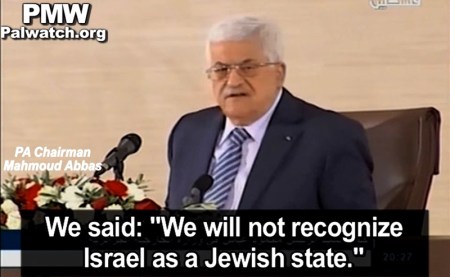
Abbas has consistently failed to state his reasons for his total rejection of Israel as a Jewish state. In January 2014, the PA president declared:
“The Palestinians won’t recognize the Jewishness of the State of Israel and won’t accept it. The Israelis say that if we don’t recognize the Jewishness of Israel there would be no solution. And we say that we won’t recognize or accept the Jewishness of Israel and we have many reasons for this rejection.”
On another occasion that same year, Abbas stated: “No one can force us to recognize Israel as Jewish state. If they [Israel] want, they can go to the UN and ask to change their name to whatever they want — even if they want to be called The Jewish Zionist State.” Again, Abbas failed to explain the vehement Palestinian opposition to this demand.
 (Image source: Palestinian Media Watch)
The Palestinian Authority’s chief negotiator, Saeb Erekat, has shed some light on the matter. “We have already recognized Israel’s existence on the 1948 borders of Occupied Palestine,” Erekat explained. He added that he made it clear to former Israeli Foreign Minister Tipi Livni during a meeting in Munich that the Palestinians “won’t change their history and religion and culture by recognizing Israel as a Jewish state.”
While Palestinian leaders have been rather reluctant to elaborate on the reasons behind their rejectionism, other Palestinians have been more generous about the issue.
One of these is Palestinian political scientist Dr. Saniyeh Al-Husseini, who recently published an article titled, “Why Palestinians Refuse to Accept the Jewishness of the State of Israel.” The article was reprinted by the Palestinian Authority’s official news agency, WAFA — a definite sign that the Palestinian leadership endorses her views.
In her article, Al-Husseini points out that the U.S. supports the Israeli condition, which she described as a “crippling demand.”
The article warns that “accepting the Jewishness of Israel means relinquishing all the Palestinian rights to the Palestinian lands, including the lands that were occupied in 1967.” According to Al-Husseini, there are two main reasons that Palestinians are opposed to this demand. The first has to do with the “right of return” for Palestinian refugees to their former villages and homes inside Israel; the second is related to the status of Israel’s Arab citizens.
Referring to the first of these, Al-Husseini writes:
“Palestinian acceptance of the Israeli narrative would deny any Palestinian right on the land of Palestine and give justification to Israel’s wars against the Palestinians. Palestinian recognition of the Jewishness of Israel means accepting the Israeli narrative regarding the Jews’ right to the land of Palestine and exempts Israel from bearing responsibility for the moral and legal consequences of all its crimes against the Palestinians.”
In the view of Al-Husseini, then, Palestinians refuse to acknowledge a Jewish state because they believe that this would grant legitimacy to “Jews’ rights to the land of Palestine” and undermine the Palestinian demand for the “right of return” for millions of refugees into Israel.
Let us take a moment to clarify this: the Palestinian Authority wants a Palestinian state next to Israel while at the same time flooding Israel with millions of refugees. That, of course, is something to which no Israeli government could ever agree. Even more crucial is the Palestinian refusal to recognize a Jewish right to the land. Such denial is a longstanding pillar of the official Palestinian narrative. Even those who say they have accepted the two-state solution are not prepared to recognize any Jewish link to or history in the land.
The second reason, that which concerns the Arab citizens of Israel, is similarly telling. According to Al-Husseini, Israel’s ultimate goal, as “betrayed” by this demand, is to rid itself of its Arab citizens.
There is indeed a betrayal going on, but it is not being perpetrated by Israel. First, by reprinting Al-Husseini’s article, the PA has “betrayed” the fact that it has appointed itself custodian of the Arab citizens of Israel.
As Israel is a democracy — unlike the dictatorial Palestinian regimes — Israel’s Arab citizens have their own leaders and representatives in Israel’s Knesset. The last thing they need is for the Palestinian Authority or Hamas or any other Palestinian faction to meddle in their internal affairs.
But the betrayal continues. The Arab citizens of Israel are represented by leaders, including some Knesset members, who are so preoccupied with the Palestinians living in the West Bank and Gaza Strip that they have forgotten who their real constituents are.
Just consider MK Zouheir Bahloul, who spends valuable time re-defining the word “terrorist.” Bahloul, a member of the Labor Party, seems to be enjoying the public outcry he created recently when he declared that a Palestinian who tried to stab IDF soldiers in Hebron last month is not a terrorist.
It is as if Bahloul and the other Arab Knesset members have solved all the problems of the Arab community inside Israel and all that is left is to make sure that no one calls a Palestinian stabber a terrorist. Needless to say, this issue does not top the agenda of the Arab citizens of Israel.
The betrayal thus runs wide and deep. Israeli Arab leaders are betraying their constituencies by privileging the perceived interests of Palestinian Arabs, while Palestinian Arab leaders are betraying their constituencies by continuing to deny any link between Jews and the land. This is a stance that makes peace a non-starter in the Middle East. When the international community is presented with settlement complaints and the like, it might wish to ponder these small but critical points.
Germany Flooded with Under-Age Migrants They Can’t Deport, Breitbart, Chris Tomlinson, April 16, 2016
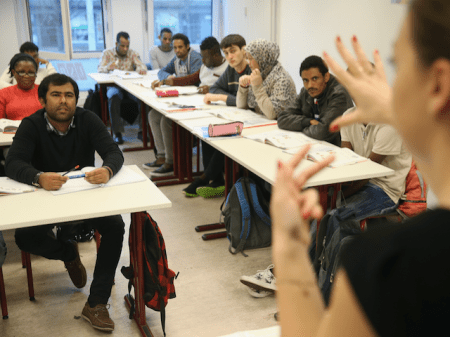
The cost of under-age migrants is also much more expensive than an adult. On average, a young migrant can cost the German taxpayer between 40,000 to 60,000 euro per year. There has also been a rampant problem with young migrants using the hospitality of the German government to go on so-called ‘Grand Tours’ of Europe where they hop from asylum home to asylum home, committing crimes and terrorizing locals.
Breitbart London reported on one gang of North Africans in particular who posted their exploits to social media bragging about the free money they were getting. They were able to live lavish lifestyles and do anything they wanted without consequence and it was all funded by the German taxpayer.
***************************
Germany has been flooded with over 70,000 under-age migrants who cannot be deported even if their asylum application fails.
The number of unaccompanied minors coming to Germany as migrants has exploded over the past year, with over 70,000 under-age migrants arriving since the beginning of 2015. The rise has led to a huge strain on the German government, which is required to process and look after them all as they all require constant supervision, reports Die Welt.
The system of Youth Services has seen delay after delay in finding adequate housing and has often had to resort to hostels and hotels, leaving the young migrants without the supervision of a social worker and at great expense to the German taxpayer. The social services have become so short staffed that they have had to rope in asylum lawyers to act as legal guardians for the children.
Many of these guardians can be looking out for 20 children, and some more than 100.
Tobias Klaus of the Federal Association of unaccompanied refugee minors said, “demands for guardians of our association have increased massively. Many of them are inexperienced,” and said that many of the under-age migrants in care had no idea if they should be applying for asylum or not.
The asylum process for adult migrants can take months but for minors it can take even longer. As a result of the wait there has been a huge clog in the processing of applications.
Of the 70,000 minors who came in the last year only around 14,439 were actually able to apply for asylum in Germany. Around 71 percent of all those who got to apply were above the age of 15.
The government in Germany is trying to fix the wait times by prioritizing children in a new initiative but the wait time could still be up to seven months.
Even if their asylum request fails it’s incredibly unlikely that any migrants who come to Germany as minors will ever be deported. The success rate for under-age migrants was 93 percent compared to adults where 61 percent were approved according to the German Federal Office for Migration and Refugees (BAMF).
Among the seven percent of those who failed the asylum process the German Federal government stated, “in 2015, 21 rejections, ten removals and no expulsions of unaccompanied minor foreign nationals were executed.” The 21 rejections refer to those who were denied at the border or at an airport and doesn’t exclusively cover migrants seeking asylum.
The cost of under-age migrants is also much more expensive than an adult. On average, a young migrant can cost the German taxpayer between 40,000 to 60,000 euro per year. There has also been a rampant problem with young migrants using the hospitality of the German government to go on so-called ‘Grand Tours’ of Europe where they hop from asylum home to asylum home, committing crimes and terrorizing locals.
Breitbart London reported on one gang of North Africans in particular who posted their exploits to social media bragging about the free money they were getting. They were able to live lavish lifestyles and do anything they wanted without consequence and it was all funded by the German taxpayer.
Jobs for Jihadis: ISIS Recruits at Swedish Employment Office, Front Page Magazine, Daniel Greenfield, April 16, 2016

It’s a popular meme from the media to the State Department that Jihadis are just jobless. Well ISIS came down to the employment agency in Sweden to help out.
Among job seekers at the Employment Service in Malmö, ISIS has openly tried to enlist Muslims to join the terrorist group.
According to Sydsvenskan, staff of the Public Employment Service Offices in Malmö discovered that a man sought contact with clients in the office. The man made contact with unemployed Muslims and gave them IS-propaganda, and among other things, pressured a man of African origin.
Both customers and staff reacted to the recruitment, which happened openly and without any attempt to hide the intentions.
Well this Islamophobia and ISISphobia must end at once. ISIS should have as much right to organize and recruit at Swedish employment agencies as it does on American college campuses.
One lesson of the Trump phenomenon is that it has revealed that conservatives have been way too timid or conciliatory in confronting the Left—that the latitude for effectively confronting political correctness is much greater than we thought.
********************************
That’s the open-ended title of the panel I spoke on last weekend at the West Coast Retreat of the David Horowitz Freedom Center (and special thanks to all of the Power Line readers in the audience who introduced themselves). Where do you go with such a wide-ranging title? I spoke from a few short notes that I scratched out the night before (which I have now lost), but I think it went pretty much something like this:
I’m not going to talk about the election, partly because so much of what I have said up to this point, especially about Trump’s prospects, have turned out to be wrong. Instead I think this panel’s title—Where Are We Now?—begs for taking a step back and looking at some longer term factors that overshadow the election, no matter who wins.
Lately I’ve been thinking of two sayings by foreigners—one probably familiar to most everyone, and one likely not. The first is Bismarck’s famous quip that “God looks after drunks, fools, and the United States of America.” I’m hoping this is still true. To the extent that accident and chance play a huge role in determining political life (the teaching of the classics), I think we’d have to say that America has been pretty lucky though most of its history. Thank God it was Harry Truman, and not Henry Wallace, who was vice president in April 1945 when FDR died; Truman was far from perfect, but he was right on a lot of important questions at that important moment.
The second saying comes from my late Hungarian-born friend Peter Schramm. Peter grew up under Communism, and when the Soviet tanks rolled through the country in 1956, his father said—“That’s it: we’re going to America.” “Why are we going to America, dad?” “Because, son, we were born American, just in the wrong place.” That was back at a time when people around the world understood clearly what America meant. I’m not so sure it is as clear to the world any more just what America means, or what it stands for, let alone whether it can be counted upon to defend the West.
Anyway, Peter told me that a favorite Hungarian saying is, “Things are serious—but not yet bad!” Now, I’m starting to think that things are bad. It is likely possible to recover from eight years of Obama with the right leadership, but if Obama is succeeded by Clinton or Sanders—or by a clueless Republican—the damage might be so long-lasting as to be near-irreversible.
A few observations:
First, events of just the last 10 days should remind us once again that our politics have become all out war—a fact that conservatives, and their weak vessel, the Republican Party, do not like to recognize. Conservatives like order and moderation (in the Aristotelian sense), and recoil from the idea of political warfare, because when things reach that stage, it means things are out of hand. But avoiding the unpleasantness of political life—and avoiding confronting it directly—will not make it go away, but instead guarantee that it will grow worse.
One lesson of the Trump phenomenon is that it has revealed that conservatives have been way too timid or conciliatory in confronting the Left—that the latitude for effectively confronting political correctness is much greater than we thought. It ought to be a matter of supreme embarrassment and shame that the most forceful and cogent response to the irresponsible demagoguery of Black Lives Matter has come from Bill Clinton. Never mind that he walked it back yesterday—that’s his problem. Our problem is no public figure on our side has spoken out as forcefully and as plainly as Clinton did.
In this regard, if we can’t win the Bathroom Wars, we might as well load up the lifeboats right now and become the refugees from our own country that the Left longs for us to be. And the most outrageous part of the recent controversy over bathrooms in North Carolina is the role played by big business, which is the most potent force in coercing states like North Carolina to back down from a common sense understanding of human nature. Why have big corporations become adjuncts to leftist identity politics? I suspect a study of corporate HR departments will find they are a hotbed of graduates with degrees in gender and ethnic studies, etc.
About Congress, I will just say that for those who have been critical of Republican leadership over the last few years, the problem is deeper and worse than you think. This is a long subject, having to do with the way in which the Democratic Party deliberately sought over decades to degrade the constitutional role of Congress in ways that many Republican members of Congress do not understand or perceive clearly enough. And it is going to take more than just a Republican president to fix this problem, though I think Ted Cruz understands this issue more profoundly than most of the rest of the GOP presidential field. But this is a very long subject, worthy of a separate complete panel all by itself.
Likewise, our response to the latest outbreak of radicalism on campuses is weak. The new mob of the campus Left says: racism, homophobia, sexism, oppression, and patriarchy. To which we have responded—free speech and academic freedom! This response is wholly inadequate. It concedes the premise of the Left: are we really for free speech on behalf of racism? Of course not, but we need to take the next step and throw back in their faces that their narratives of oppression are completely wrong, contemptible, and not to be taken seriously. That and a few expulsions (and more firings of many more professors like Melissa Click) might do the trick.
In summary, the central point of my remarks is to vindicate what I’m going to call the Horowitz Heuristic, or “David’s Desideratum.” For as long as I have known David, he has been saying that conservatives, and their defective organizational vehicle—the Republican Party—have not been vigorous enough in recognizing that the Left is conducting political warfare, and that it can only be beaten back by engaging in political warfare in return. Maybe a few more people are starting to figure out what David has understood all along. Is it too late? As Lincoln said about a real shooting war, “Wars are not won by blowing rosewater through cornstalks.”
Europe: Suicide by Jihad, Gatestone Institute, Guy Millière, April 16, 2016
♦ In the last two decades, Belgium has become the hub of jihad in Europe. The district of Molenbeek in Brussels is now a foreign Islamist territory in the heart of Belgium. It is not, however, a lawless zone: sharia law has effectively replaced Belgian law.
♦ One of the organizers of the Paris bombings, Salah Abdeslam, was able to live peacefully in Molenbeek for four months until police decided to arrest him. Belgian police knew exactly where he was, but did nothing until French authorities asked them to. After his arrest, he was treated as a petty criminal. Police did not ask him anything about the jihadist networks with which he worked. Officers who interrogated him were ordered to be gentle. The people who hid him were not indicted.
♦ Europe’s leaders disseminated the idea that the West was guilty of oppressing Muslims. They therefore sowed the seeds of anti-Western resentment among Muslims in Europe.
♦ Hoping to please followers of radical Islam and show them Europe could understand their “grievances,” they placed pressure on Israel. When Europeans were attacked, they did not understand why. They had done their best to please the Muslims. They had not even harassed the jihadists.
The March 22 jihadist attacks in Brussels were predictable. What is surprising is that they did not take place sooner. What is also surprising is that more people were not killed. It seems that the authors of the attacks had larger projects in mind; they wanted to attack a nuclear power plant. Others may succeed in doing just that.
In the last two decades, Belgium has become the hub of jihad in Europe. The district of Molenbeek in Brussels is now a foreign Islamist territory in the heart of Belgium. It is not, however, a lawless zone: sharia law has effectively replaced Belgian law. Almost all the women wear veils or burqas; those who do not take risks. Drug trafficking and radical mosques are everyplace. The police stay outside and intervene only in cases of extreme emergency, using military-like commando operations. Other areas of Belgium, such as Shaerbeek and Anderlecht have the same status as Molenbeek.
The Belgian authorities have allowed the situation to deteriorate. The situation in the country now is virtually equivalent to a surrender.
They seemed to hope that willful blindness and accepting the unacceptable would permit the country to be spared. It did not.
The attack on Belgium’s Jewish Museum on May 24, 2014 should have served as a warning. It did not. That “only” Jews were the target led the Belgian government to underestimate the threat. The jihadi who wanted to kill passengers on train from Amsterdam to Paris, on August 21, 2015, prepared his attack in Brussels. That three American heroes neutralized him before he could start shooting again led the Belgian government to think the danger was not large.
The jihadis who struck Paris on November 13, 2015 had also organized their attacks from Molenbeek, but the blood was not spilled in Belgium. Belgian authorities perhaps assumed that Belgium would be spared. They spoke of “imminent danger” for a day or so, but never increased security.
One of the organizers of the Paris bombings, Salah Abdeslam, Europe’s most wanted terrorist criminal, was able to live peacefully in Molenbeek for four months until police decided to arrest him. Belgian police knew exactly where he was, but did nothing until French authorities asked them to. After his arrest, he was treated as a petty criminal, not a jihadi terrorist. Police did not ask him anything concerning the jihadist networks with which he worked. Because he was hurt during police operations, officers who interrogated him were ordered to be gentle. The people who agreed to hide him for so long were not considered suspects and were not indicted.
The Brussels jihadist attacks took place two days later.
Despite the worst attacks on Belgium soil since World War II, Belgian authorities do not seem ready to change their behavior.
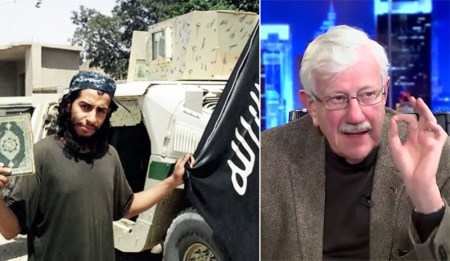 Abdelhamid Abaaoud (left), one of the planners of the November 2015 terrorist attacks in Paris, was — like many terrorists in Europe — from Molenbeek, Belgium. Philippe Moureaux (right) was mayor of Molenbeek for 20 years, thanks to his alliance with radical Islamists.
After the attacks, Belgian Prime Minister Charles Michel denounced “violent and cowardly acts” and stressed his “determination,” without saying what he intended to do. He did not speak of the necessity of changing the Belgian laws to make them more effective. He did not mention any enemy. He never used words such as “jihad” or “radical Islam.”
He behaved and talked as most of his European counterparts did. French Prime Minister Manuel Valls used more courageous words and said many times he is fighting “radical jihad” and “Islamism.” The French parliament passed laws allowing what is still impossible in Belgium: police searches at night. But France stands alone, and effectively the situation in France is no better than in Belgium. Islamist enclaves exists in many suburbs. Whole cities are controlled by thugs and radical imams: cities such as Roubaix, Trappes, Aubervilliers and Sevran in the northeast of Paris.
Islamist enclaves also exist in other European countries: Spain, the Netherlands, Germany, the United Kingdom and Sweden.
European leaders have been making choices. After World War II, they decided Europe would be a region of the world where war would be banished and all problems solved through diplomacy and appeasement. They gradually abandoned financing defense and security activities. Instead, they built welfare states. They thought that taking care of people from cradle to grave would suppress anger and conflicts. They denied the existence of totalitarian dangers and the necessity of showing strength. To this day, their statements indicate that European leaders think both the Berlin Wall and the Soviet empire fell thanks to the benevolence of Mikhail Gorbachev, not thanks to the determination of Ronald Reagan. To this day, they seem to think that Islam is essentially a religion of peace and that the jihadis belong to a tiny, marginal sect.
Decades ago, Europe’s leaders adopted a general policy of “openness” to the Islamic world in general, and the Arab world in particular. They decided to welcome migrants from the Muslim world by hundreds of thousands but without asking them to integrate. They made cultural relativism and multiculturalism their guiding principles. They acted as if Islam could mingle in the Western world harmoniously and without difficulty. Europe’s leaders disseminated the idea that the West was guilty of oppressing Muslims and had to pay for its sins. They therefore sowed the seeds of anti-Western resentment among Muslims in Europe.
When in the Muslim world jihadis started to kill, Europe’s leaders wanted to believe that the attacks would take place in the Muslim world only. They thought that by not interfering with what European jihadis were planning, they would not risk jihadi attacks on European soil.
When Jews were attacked, Europe’s leaders decided that the problem was not jihad, but Israel. They stressed the need not to “export Middle East conflict in Europe.” Hoping to please followers of radical Islam and show them Europe could understand their “grievances,” they placed increasing pressure on Israel. They also increased their financial and political support for the “Palestinian cause.”
When Europeans were attacked, they did not understand why. They had done their best to please the Muslims. They had not even harassed the jihadists. They still do not know how to react.
Many of them now say privately what they will never say in public: it is probably too late.
There are six to eight million Muslims in France, and more than thirty million in Western Europe. Hundreds of jihadis are trained and ready to act — anytime, anyplace. European intelligence services know that they want to make “dirty bombs.” Surveys show that tens of thousands of Muslims living in Europe approve of jihadi attacks in Europe. Millions of Muslims living in Europe keep silent, behave as if they see nothing and hear nothing, and protest only when they think they have to defend Islam.
European political leaders know that every decision they make may provoke reactions among the Muslims living in Europe. Muslim votes matter. Riots occur easily. In France, Belgium, other European countries, Islamists are present in the army and police forces. In the meantime, Islamist organizations recruit and Islamic lobbies gain ground.
European governments are now hostages. The European media are also hostages.
In most European countries, “Islamophobia” is considered a crime — and any criticism of Islam may be considered “Islamophobic.” People trying to warn Europe, such as the Dutch MP Geert Wilders, despite an apparently biased judge and forged documents against him, are now on trial.
Books on radical Islam are still published but surrounded by silence. Books praising the glory of Islam are in every bookstore. When Bat Ye’or’s Eurabia was published in Europe, she was denounced and received hundreds of death threats. Bruce Bawer’s While Europe Slept, published in the U.S., was not even available in Europe. Ten years later, the situation is worse.
Political movements expressing anger and concerns are rising. All are demonized by political power holders and the media. They have almost no chance of gaining more influence.
Populations are gnawed by fear, frustration and impotence. They are looking for answers, but cannot find them. A few hours after the attacks on Brussels, a man on Belgian television said that Europe is on the verge of suicide.
Europe looks like a dying civilization. European governments created a situation that can only lead to more attacks, more massacres, and maybe unspeakable disasters. Europe’s leaders continue to react with speeches and a few police operations.
If some European governments decided to restore their abolished borders, it could take years, and most European leaders would probably disagree with such a policy. Meanwhile, millions more “migrants” will enter Europe, and among them many more jihadis. In spite of the mayhem created in Germany by “migrants” who arrived in 2015, Angela Merkel said she would not change her decisions. No Western European government dared to disagree with her, except Viktor Orbán in Hungary, a lone voice of dissent.
In Brussels, as in Paris earlier, people gathered where the attacks took place. They brought candles and flowers to mourn the victims. They sang sentimental songs. They cried. There were no shouts of revolt against jihad. Members of the Belgian government called on the Belgian people to avoid reactions of violence, and declared that Muslims are the main victims of terrorism.
In Europe’s near future, more people will bring candles, flowers and songs to mourn victims. Another two or three jihadists will be arrested. But nothing will be done.




 anneinpt
 artaxes
 danmillerinpanama
 davidking1530
 Peter Hofman
 Joseph Wouk
 Peter
Peter Louisiana Steve
 WarSclerotic
Recent Comments