Archive for February 2016

Everyone in Syria is Violating Kerry’s Imaginary Ceasefire

February 28, 2016

Everyone in Syria is Violating Kerry’s Imaginary Ceasefire, Front Page Magazine, Daniel Greenfield, February 28, 2016

obama_kerry_bikes

Good news. The ceasefire in Syria is “holding”. You know the great Kerry diplomatic achievement after letting Iran go nuclear and forcing Israel to free a bunch of terrorists. It’s holding about as well as a leaky roof in the rain because everyone and their cousin is violating the mostly imaginary ceasefire.

The Saudis claim that the Russians are violating the ceasefire.

Saudi Arabia on Sunday accused President Bashar al-Assad’s regime and its ally Russia of “ceasefire violations” in Syria.

“There are violations to the ceasefire from Russian and (Syrian) regime aircraft,” Saudi Foreign Minister Adel Jubeir told reporters in Riyadh.

“We are discussing this with (the 17-nation) Syria Support Group,” co-chaired by Russia and the United States, said Jubeir.

The Syrian Observatory for Human Rights has said that several air strikes hit central and northern Syria on Sunday.

Warplanes, believed to be either Syrian or Russian, bombed seven villages in the provinces of Aleppo and Hama, the monitor said.

The Russians are accusing the Syrian rebels of violating the ceasefire.

The Sunni opposition claims 15 violations. The Russians claim 9 violations. And the ceasefire just began. So it’s off to a great start.

Also nobody is really sure what counts as a violation because this agreement was negotiated by John Kerry.

“We do not know which planes carried out the strikes and also we are not sure if this is considered a breach to the truce because it is not clear if these towns are included in the truce,” Abdulrahman said.

So to summarize, the ceasefire is holding, but no one is sure what the ceasefire involves and everyone is violating it.

If you loved this Kerry diplomatic achievement, just wait till Iran detonates its first bomb.


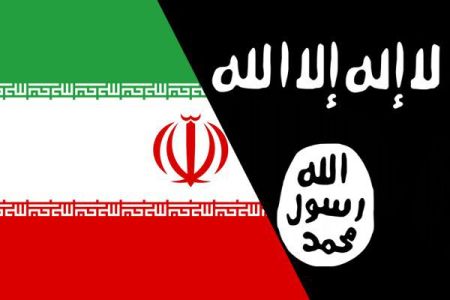
Analysis: Iran, ISIS Likely to Unite for WWIII

February 28, 2016

Analysis: Iran, ISIS Likely to Unite for WWIII, The Jewish PressHana Levi Julian, February 28, 2016

Iran-ISIS-flagPhoto Credit: JP.com graphic

Israeli military analysts are now beginning to prepare top officials, who are in turn beginning to prepare the nation, for what eventually may become the start of World War III.

Most analysts still believe the Syrian crisis is a sectarian conflict between the Sunni, Shi’a and Alawite Muslims. But that time is long gone.

A cataclysmic clash of civilizations is taking place in Syria, one that a number of nations have patiently awaited for decades.

Turkey, so deeply invested in the glorious history of its Ottoman Empire period, would find great satisfaction in stretching its influence with a modern-day “Turkish Islamic Union” that might embrace like-minded nations in the region and perhaps also beyond.

Da’esh, as it is known in the Middle East and which in English calls itself the “Islamic State” (known by others as ISIS or ISIL) is rapidly stretching its influence to build a worldwide Sunni caliphate. It began as a splinter group from the Al Qaeda terrorist organization, and then morphed into the Islamic State in Iraq and Syria (hence “ISIS”) — but at last count had successfully recruited more than 41 other regional Muslim terrorist organizations to its cause from around the world on nearly every continent.

And then there is the Islamic Republic of Iran, a Shi’ite Muslim nation, which is extending its tentacles as rapidly throughout the world as Da’esh, but far more insidiously and certainly more dangerously. If in this world one might define any nation today as Amalek, that ice-cold, black-hearted evil that first picks off the weakest of the Jewish nation, it is Iran, which has quietly extended its influence and control farther and more deeply than any other enemy Israel has ever had. Wealthy, patient, smiling and calculating, Iran acquires new allies each year, even among those Israel once counted as friends. Meanwhile, Iranian officials never forget to keep the home fires burning, to stir the pot and keep it simmering, and always to nurture the various conflicts at home in the Middle East.

This past week, Iran announced the money it donates to families of Arab “martyrs” who murder Israelis will be paid via its own special charity organization, and not through the Palestinian Authority government.

But Tehran has yet to reveal the details of exactly how it intends to pay.

Instead, a high-ranked government official simply made an announcement this weekend saying Iran did not trust the Ramallah government, driving a deeper wedge already dividing the PA’s ruling Fatah faction from Gaza’s ruling Hamas terror organization — Iran’s proxy group.

Hamas has been planting sleeper cells and budding regional headquarters, however, throughout the PA-controlled areas of Judea and Samaria, and it is clear the group’s next goal is an attempt to wrest control of those two regions from the PA, thus completing Iran’s takeover of the PLO — the PA’s umbrella organization and liaison to the United Nations.

Money is always helpful in such an enterprise, and Iran has recently enjoyed a massive infusion of cash that came courtesy of the United States and five other world powers after sanctions were lifted last month as part of last July’s nuclear deal.

Iranian Ambassador to Lebanon Mohammed Fath’ali announced last Wednesday that Iran would pay Arab families for each “martyr” who died attacking Israelis in Jerusalem and each Arab family whose home was demolished by Israel after one of its occupants murdered Israelis in a terror attack.

Iranian Parliament Speaker Ali Larijani last week underlined Tehran’s continued strong support for the wave of terror against Israel.

“The Islamic Republic supports the Palestinian Intifada and all Palestinian groups in their fight against the Zionist regime. We should turn this into the main issue in the Muslim world,” Larijani said in a meeting with a number of “resistance” groups in Tehran,FARS reported Sunday (Feb 28).

But it is clear that Iran is not content solely with a takeover of the PLO.

Tehran has its eye on a much wider goal, now more clearly than ever the resurrection of an updated Persian Empire — in modern parlance military analysts refer to it as an “Axis of Evil” — in much the same manner that Sunni Da’esh (ISIS) is single-mindedly pursuing its goal of rebuilding a worldwide caliphate.

Iranian forces via proxies have already managed to involve themselves in what once were domestic affairs in Yemen, Syria, Lebanon, Egypt, Jordan, Bahrain, Saudi Arabia, Iraq, Israel, Cuba, Mexico, the United States, Afghanistan, Venezuela, Brazil, Argentina, Qatar, Turkey and numerous other nations.

Larijani has at last proclaimed officially that Iran doesn’t differentiate between Shiites and Sunnis since they share many commonalities, adding that Tehran “has supported the Palestinian nation (although they are Sunnis) for the past 37 years.”

The remark is significant in that Iran’s Revolutionary Guard Corps and Lebanese Shi’ite Hezbollah guerrillas – another Iranian proxy – are fighting Sunni opposition forces in Syria on behalf of President Bashar al-Assad. Iranian forces are fighting the Sunni Muslim Da’esh (ISIS) terror organization that seized a significant percentage of territory in Syria.

But south of Israel, Iran’s proxy Hamas, a Sunni Muslim group, has been providing material and technical support to the same Da’esh — but its “Sinai Province” terror group in the Sinai Peninsula.

Here we finally see that Iran is willing to adapt and support terror wherever it can be found, as long as it meets two of three criteria: (1) it furthers its goal to destabilize the region, (2) in the process it works towards the annihilation of Israel, and/or (3) will contribute towards conquest and influence to reach the goal of an ultimate renewed, updated Persian Empire.

How long then until Iran connects the two dots and simply arranges a meeting between its own Supreme Leader Ayatollah Ali Khamenei and the leader of Da’esh, Abu Bakr al-Baghdadi? Hezbollah’s Hassan Nasrallah and Hamas leader Khaled Meshaal will likely be invited for dessert …

The other question is how long until someone strikes the spark that ignites the conflagration — the region is already in chaos.

France: Criticize Islam and Live under Police Protection

February 28, 2016

France: Criticize Islam and Live under Police Protection, Gatestone InstituteGiulio Meotti, February 28, 2016

“After a few moments of fear, I thought that if there are these threats it is because my fight foiled the plans of the Muslim Brothers by bringing them to light. I decided not to give up.” — Laurence Marchand-Taillade, National Secretary of the Parti Radical de Gauche (Radical Party of the Left).

The author Éric Zemmour lives under police protection. Two policemen follow him wherever he goes — including to court, where Muslim organizations tried to defame him and his work by accusing him of “Islamophobia,” to silence him.

In France, hunting season is still open for critics of Islam.

“You are sentenced to death. It’s just a matter of time.” This message, in Arabic, was sent by Islamists to Laurence Marchand-Taillade, National Secretary of the Parti Radical de Gauche (Radical Party of the Left). She now lives under the protection of the French police.

Marchand-Taillade forced the Muslim Brotherhood to withdraw, under pressure from France’s Interior Ministry, its invitation of three Islamic fundamentalists to a conference in Lille. The Islamists in question were the Syrian Mohamed Rateb al Nabulsi, the Moroccan Abouzaid al Mokrie and the Saudi Abdullah Salah Sana’an, who deem that the penalty for homosexuality is death, that the international coalition against the Islamic State is “infidel,” that Jews “destroy the nations” and that only religious music is permitted.

Laurence Marchand-Taillade published an article in Le Figaro in which she called for the ban of these Islamists with their “anti-Semitic and pro-jihadist message.”

In the magazine Marianne, Marchand-Taillade then penned, along with the French-Algerian journalist Mohamed Sifaoui, an article calling for the resignation of the leaders of the Observatory of Secularism.

“I am the president of an association that supports secularism in the Val-d’Oise” said Marchand-Taillade to me in an interview,

“and for years, I observed unreasonable sacrifices and compromises from the National Observatory of Secularism, which has encouraged radical communitarianism by participating to forums such as ‘We Are United,’ with the rapper Médine, who has called for the ‘crucifixion of the secularists,’ the ‘Collective against Islamophobia’ and Nabil Ennasri, a Muslim Brother from Qatar. The president of the Observatory of Secularism, Jean Louis Bianco, gave credit to these Salafist organizations at war with our values.

“Since the first months of 2014, I started also to report to the authorities of the arrival of imams such as Nader Abou Anas, who justifies marital rape, and Hatim Abu Abdillah, who promises a ‘cruel punishment’ for women. Then I went to Lille, on February 6 and 7, where Tariq Ramadan and others were indoctrinating our youths” Since then, her life has not been the same.

How did she react to the death sentence?

“After a few moments of fear, I thought that if there are these threats it is because my fight foiled the plans of the Muslim Brothers by bringing them to light. I decided not to give up. Islamists began a long process of infiltrating all sectors of civil society. The concept is based on the written doctrines of Hassan al-Banna, the grandfather of [Tariq] Ramadan. Their flag has two swords and the Koran; indoctrination and violence are the methods to gain power. France is a country chosen for several reasons: it has a large population from North Africa; it is a secular country in which you can use the freedoms of democracy as weapons against it, and it had weak policies. The only way to stop the threat is to reaffirm secularism and absolute freedom of conscience. We cannot allow entire portions of the French population to fall in the trap of hating the country where they are born and, above all, which considers them part of the nation. It is choice of civilization, while there is an attempt to destroy two centuries of progress for humanity.”

What happened to Marchand-Taillade — the 24-hour a day police protection she needs because she exercised her constitutional right to freedom of expression — tells us a lot about France, where dozens of academics, intellectuals, novelists and journalists now have to live under police protection just because of their criticism of Islam.

It is not only politicians such as Marine Le Pen and Samia Ghali, the mayor of Marseille, and not only judges such as Albert Lévy, who has conducted investigations on Islamic fundamentalists.

The most famous is Michel Houellebecq, author of the novel Submission, who lives under the protection of the gendarmerie since he published his last novel. There is also haute protection(“high protection”) for Éric Zemmour, the author of Le Suicide Français. Two policemen follow him wherever he goes — including to court, where Muslim organizations tried to defame him and his work by accusing him of “Islamophobia,” to silence him.

1486French politician Laurence Marchand-Taillade (left) lives under police protection after receiving a death threat from Islamists. French author Éric Zemmour also lives under police protection. Two policemen follow him wherever he goes — including to court, where Muslim organizations tried to defame him and his work by accusing him of “Islamophobia,” to silence him.

Charlie Hebdo‘s director, “Riss,” and the remaining cartoonists live under police protection, and their new offices are in an undisclosed location. My friend Robert Redeker, a professor of philosophy condemned to death in 2006 by Islamists for an article he wrote in Le Figaro, still lives like a fugitive, as if he is a political prisoner in his own country. His conferences and courses have been canceled, his house sold, his father’s funeral celebrated in secrecy, and his daughter’s wedding organized by the police.

Mohammed Sifaoui, who lived undercover in a French cell of al Qaeda and has written a shocking book, Combattre le terrorisme islamiste (“Combat Islamist Terrorism”) also lives under police protection. His photo and name appear on jihadi websites next to the word murtad(“apostate”).

The French philosopher and essayist, Michel Onfray, just withdrew the planned publication of an essay critical of Islam, He claims that “no debate is possible” in the country after the November 13 attacks in Paris (his book has just been published in my country, Italy).

Frédéric Haziza, a radio journalist and author for the magazine Le Canard Enchaîné, has been the target of threats from Islamists, and is under protection, as is Philippe Val, the former director of Charlie Hebdo and France Inter, who decided to publish the Mohammed cartoons in 2006. The Franco-Algerian journalist Zineb Rhazaoui is always surrounded by six policemen, as is the brave imam Hassen Chalgoumi, who is protected as if he were a head of state.

In Britain, the 1989 fatwa against Salman Rushdie eliminated any doubt among scholars and journalists whether it was appropriate or not to criticize Islam. In the Netherlands, it was enough to shoot dead Theo Van Gogh for having made a film, Submission, about a woman abused in a forced marriage. Dutch MP Geert Wilders had to debate wearing bulletproof vests and Ayaan Hirsi Ali, who wrote Submission’s script, fled the country and found a refuge in the U.S. In Sweden, that artist Lars Vilks now lives like a shadow. In Denmark, the headquarters of theJyllands Posten newspaper, which published the original Mohammed cartoons, has a barbed wire fence two meters high and one kilometer long. It has become like a U.S. embassy in the Middle East.

In France, hunting season is still open for critics of Islam, even after the decimation of Charlie Hebdo‘s brave artists. But for how long?

Report: Israel’s northern border violated daily

February 28, 2016

Report: Israel’s northern border violated daily, Israel National News, David Rosenberg, February 28, 2016

Lebanon borderIDF patrol along border with Lebanon Flash 90

Israel’s border with Lebanon is violated on a daily basis, according to a new report by the Israeli Mission to the United Nations.

The report also shows the degree to which UN resolutions are ignored and even tolerated – despite the presence of United Nations observers. In 2015 alone, there were fully 2,374 documented violations of the most recent UN ruling on the Israel-Lebanon border, UN Security Council Resolution 1701.

Israel’s Ambassador to the UN, Danny Danon, conveyed the statistics to the UN Secretary General and Security Council. Danon condemned the rampant violations of the border area and the UN’s tacit acceptance of Hezbollah control.

“The government of Lebanon is not acting and armed Hezbollah operatives are roaming freely throughout the south Lebanon in violation of the UN,” Danon said. “Hezbollah has free reign in South Lebanon and instead of reacting forcefully to their violations, the UN is ignoring the problem.”

Hezbollah, which has de facto autonomy in southern Lebanon, maintains regular armed patrols along the Blue Line – the UN’s demarcation between Israel and Lebanon – well within the United Nations Interim Force in Lebanon (UNIFIL) security zone. The number of Hezbollah patrols along the border in 2015 was estimated at 653.

More disturbing, the report revealed that Israel’s northern border is violated on a daily basis. During 2015 alone, infiltrators breached the border 589 times.

Another 1,079 incidents of armed individuals – presumably Hezbollah fighters – openly operating in the UNIFIL security zone were recorded.

The report noted two Hezbollah terror attacks on Israel in 2015, and 51 violent protests targeting Israeli forces along the border.

Over 20 blasts in Damascus as ‘terrorists shell residential areas’

February 28, 2016

Over 20 blasts in Damascus as ‘terrorists shell residential areas’ – Russian military

Published time: 27 Feb, 2016 16:41 Edited time: 27 Feb, 2016 18:30

Source: Over 20 blasts in Damascus as ‘terrorists shell residential areas’ – Russian military — RT News

The Syria truce coordinating center has detected shelling of residential areas in Damascus carried out by terror groups, said Sergey Kuralenko, the head of the center launched by Moscow at Khemim airbase earlier in the week.

Over 20 blasts were registered earlier Saturday over a period of five hours, Kuralenko said.

The information on the shelling was immediately passed to the US coordination center in Amman, the military said, RIA Novosti reported.

READ MORE: Russia suspends all Syria airstrikes on areas & armed groups included in ceasefire – General Staff

There were no immediate reports of any casualties, according to SANA news agency.

The Syrian capital came under shelling just a few hours after a nationwide ceasefire was introduced. The deal on “cessation of hostilities” came into effect at midnight Damascus time. Outlined by the US and Russia, it was unanimously adopted by the United Nations Security Council earlier Friday and obliged all parties involved in the conflict to abide by it.

The exceptions are Islamic State group (IS, formerly ISIS/ISIL), Al-Nusra, and other terrorist organizations as designated by the UN Security Council.

The news of the cessation in hostilities was met with mixed reactions in the Syrian capital.

“Do you think people are happy to see blood, devastation and ruins? People should have a rest and get back to normal life,” a woman told RT.

“It’s impossible to introduce a ceasefire. Terrorists and their supporters are going to use this time to obtain more weapons, and then the battles with the Syrian army will go on,” a man said.

During their Saturday phone call, Russian Foreign Minister Sergey Lavrov and US Secretary of State John Kerry welcomed the ceasefire and agreed on more intensive military cooperation between the two countries on regular basis.

Syria’s warring parties are expected to sit down to negotiating table again on March 7. However, the peace talks will be canceled if hostilities go on, UN Special Envoy Staffan de Mistura said.

Women in Combat: A Terrible Idea Whose Time Has Come?

February 28, 2016

Women in Combat: A Terrible Idea Whose Time Has Come? Obama wants to send women to fight women-hating Islamofascist militants.

February 26, 2016 Matthew Vadum

Source: Women in Combat: A Terrible Idea Whose Time Has Come? | Frontpage Mag

Forcing military women into dangerous combat roles traditionally assigned to men is so potentially disastrous that the next president should waste no time reversing this wrong-headed Obama administration edict, a military advocate recently told Congress.

Of course, parachuting women into combat roles is what happens when fevered left-wing utopianism takes over the Pentagon. Radicals on the Left are animated by a morbid obsession with equality, not by results or even by helping people. To them rigid adherence to politically correct fantasies trumps all other concerns. If soldiers die as a result of nutty policies, left-wingers rationalize that –damn the torpedoes!– it’s just the price that has to be paid for their perverse vision of social justice.

Our bilious, perpetually angry Marxist president despises the U.S. military and everything it represents. Like any good radical leftist, Obama believes the only good American soldier is one who plays the role of social worker, not war-fighter. Putting women into combat situations is another way of weakening America.

Obama hates the military’s personnel, its traditions, its historical accomplishments, and its core mission. He has been gutting and gelding the military since taking office, allowing fleets, warplanes, and weapons to rust their way into irrelevance. He has been going on a human resources rampage by purging the military of ideologically hostile officers, and fundamentally transforming it into something other than a war-fighting force. Obama has been moving to reduce soldier pay and benefits and hollow out the military, reducing it to mid-century staff levels. He’s barely concerned with the continuing neglect of veterans and their health care. The more who perish on waiting lists, the more money that Obama can waste on an ever-expanding array of worse-than-useless social programs designed to buy votes.

The testimony by Elaine Donnelly came after Secretary of Defense Ashton Carter unilaterally decided last Dec. 3 to rescind women’s exemptions from direct ground combat. Secretary of the Navy Ray Mabus and other left-wingers are demanding gender diversity quotas of at least 25 percent and that training standards be lowered for females.

“Current military leaders must follow orders, but the next president will have the power to change existing directives in the same way that the current president imposed them,” Donnelly said in written testimony to the Senate Armed Services Committee, which, earlier this month held its first hearing on women in combat in 25 years. “Leaders of the next administration should be prepared to restore sound priorities, putting the needs of the military first.”

“Men and women in uniform, whose voices have been raised but not heard, are facing situations in which men in the combat arms will be less prepared for the violence of combat, and women will be targets of resentment they do not deserve,” she said.

“The administration is planning to assign significant numbers of minimally-qualified young women to small fighting units, on an involuntary basis, and to send them to fight ISIS and other vicious enemies under conditions that involve higher risks for women than for men,” she warned senators.

“This is being done even though officials are well aware that women’s physical capabilities are far less than men’s and their risks of injury are far greater,” said Donnelly, president of the Center for Military Readiness, an independent public policy organization that reports on and analyzes military/social issues.

“This is not a ‘pro-woman’ policy; it is a cruel deception, betraying the interests of uniformed women who deserve better,” she said.

And women don’t want combat duty, according to an official survey of Army women two years ago. It found that 92.5 percent of the respondents had no desire to serve in direct ground combat units.

“Women should not have to accept double-and-higher injury rates and other career disadvantages competing with stronger men, paying a higher price than men do for volunteering to serve their country,” Donnelly said. “It is also unfair to men – tantamount to telling Navy SEALs that they should execute HALO (high altitude, low-opening) jumps with parachutes known to fail 30% of the time.”

Women are physically ill-suited for combat. That’s just the way it is.

Former Sen. Jim Webb’s (D-Va.) classic essay, “Women Can’t Fight,” laid waste to the idea that putting women in combat was a good idea. The international community agrees: hardly any nations put females in combat roles.

By the way, not letting women fight isn’t an example of workplace discrimination. After all, in what place of employment do people shoot at you? Compare the plight of office workers with submarine personnel. What employees stay in the same office building with the same people for six months at a time with no one leaving the building, while they sleep alongside co-workers stacked three persons high in casket-like bunks?

And if women are up to the task of war-fighting, why don’t they participate in America’s leading contact sport (which is mild compared to combat)? “Since there’s no rule preventing ‘people of either gender’ from playing football in the NFL, why has no woman ever appeared in the Super Bowl?” Phyllis Schlafly wrote recently in a column opposing conscription for women.

But political correctness is more important to President Obama than military effectiveness. He is hellbent on forcing the women of the U.S. military into direct combat units at great risk both to themselves and their fellow soldiers. Military leaders have been cowed by radical feminism. They are promoting change for the sake of ideology, not because it is actually needed.

The same virulent strain of PC infects local fire departments across America, some of which routinely induct women as firefighters. Sure, it may be “equality,” but if you need to be carried down the stairs of a burning building, would you prefer to be rescued by a big strong man or a woman who probably doesn’t have the same muscle power or as much endurance? Some women may be drawn to the idea of fighting fires for a living but very few of them can meet the demanding physical requirements to become firefighters.

But when you’re a left-winger, Mother Nature is your enemy. Science must be brought to heel and subordinated to politics.

Seven years into this catastrophic administration, no patriot needs to be reminded that under this president’s kooky social engineering schemes, the military is becoming a social justice-dispensing expeditionary force, a vanguard leading the way towards the lunatic-left vision of what America and the rest of the world should look like.

Whether the collapse of the military is to be allowed to continue is up to American voters to decide in November.

Iran uses Syrian truce to deploy hundreds of Palestinian terrorists on Golan border

February 27, 2016

Iran uses Syrian truce to deploy hundreds of Palestinian terrorists on Golan border, DEBKAfile, February 27, 2016

Al-Sabirin-logo

Under cover of the Syrian ceasefire that went into effect Saturday, Feb. 27, and the Russian air umbrella, Iran’s Revolutionary Guards Corps finally managed to secretly install hundreds of armed Palestinian terrorists on the Syrian-Israeli border face-to-face with the IDF’s Golan positions.

This is reported exclusively by DEBKAfile’s military and intelligence sources.

These Palestinians belong to Al-Sabirin, a new terrorist organization the Iranian Guards and Hizballah are building in the refugee camps of Lebanon and the Gaza Strip. Their agents clandestinely recruited the new terrorists from among young Palestinians who fled the Yarmouk refugee camp outside Damascus and sought refuge in Lebanon. Hizballah organized their return to Syria through south Lebanon – but not before training and arming them for penetration deep inside Israel to carry out mass-casualty assaults on IDF positions, highways and civilians.

So Iran and Hizballah have finally been able to achieve one of the most cherished goals of their integration in the Syria civil war, namely, to bring a loyal terrorist force right up to Israel’s border.

Israel’s military planners went to extreme lengths to prevent this happening. Last December, Samir Quntar, after being assigned by Tehran and Hizballah to establish a Palestinian-Druze terror network on the Golan, was assassinated in Damascus.

Twelve months before that, on Jan. 18, an Israeli air strike hit an Iranian-Syrian military party surveying the Golan in search of jumping-off locations for Hizballah terror squads to strike across the border against Israeli targets. The two senior officers in the party, Iranian General Allah-Dadi and Hizballah’s Jihad Mughniyeh, were killed.

The hubbub in the run-up to the Syrian truce, coupled with Russia’s protective military presence, finally gave the Islamic Republic and its Lebanese proxy the chance to outfox Israeli intelligence and secretly bring forward a terrorist force to striking range against Israel

This discovery was one of the causes of Prime Minister Binyamin Netanyahu’s urgent phone call to President Vladimir Putin Wednesday, Feb. 24, two days before the ceasefire went into effect. He reminded the Russian leader of the understandings they had reached regarding the deployment of pro-Iranian terrorists on the Syrian-Israeli border. He also sent emissaries to Moscow to intercede with Russian officials.

Putin’s answers to Israel’s demarches were vague and evasive, on the lines of a promise to look into their complaints.

He also tried to fob Netanyahu off by inviting President Reuven Rivlin for a state visit to Russia. Putin promised to use that occasion for a solemn Russian pledge of commitment to upholding Israel’s security in a tone that would leave Tehran in no doubt of Moscow support for the Jewish state.
The Rivlin visit has been scheduled for March 16.

But it is clear that the prime minister and defense minister Moshe Ya’alon were too slow to pick up on the new terrorist menace Iran had parked on Israel’s border. Now their hands are tied, say DEBKAfile’s sources. An IDF operation to evict the pro-Iranian Palestinian Al-Sabirin network from the Syrian Golan, before it digs in, would lay Israel open to the charge of jeopardizing, or even sabotaging, the inherently fragile Syrian ceasefire initiated jointly by the US and Russia.

The Next Syrian Refugee Crisis: Child Brides

February 27, 2016

The Next Syrian Refugee Crisis: Child Brides, Investigative Project on Terrorism, Abigail R. Esman, February 26, 2016

1371UNICEF graphic

Off Topic | Inside the Republican Party’s Desperate Mission to Stop Donald Trump

February 27, 2016

The G.O.P.’s Last-Ditch, Frantic Effort to Stop Trump, New York Times, Alexander Burns, Maggie Haberman and Jonathan Martin, February 27, 2016

(Please see also, Off Topic:  Trump and the Rise of the Unprotected – WSJ. — DM)

The scenario Karl Rove outlined was bleak.

Addressing a luncheon of Republican governors and donors in Washington on Feb. 19, he warned that Donald J. Trump’s increasingly likely nomination would be catastrophic, dooming the party in November. But Mr. Rove, the master strategist of George W. Bush’s campaigns, insisted it was not too late for them to stop Mr. Trump, according to three people present.

At a meeting of Republican governors the next morning, Paul R. LePage of Maine called for action. Seated at a long boardroom table at the Willard Hotel, he erupted in frustration over the state of the 2016 race, saying Mr. Trump’s nomination would deeply wound theRepublican Party. Mr. LePage urged the governors to draft an open letter “to the people,” disavowing Mr. Trump and his divisive brand of politics.

The suggestion was not taken up. Since then, Mr. Trump has only gotten stronger, winning two more state contests and collecting the endorsement of Gov. Chris Christie of New Jersey.
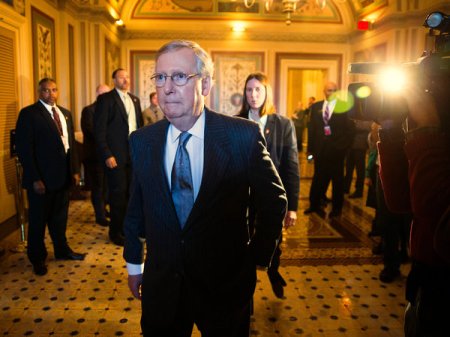
Mitch McThe Senate majority leader, Mitch McConnell, has laid out a plan that would have lawmakers break with Mr. Trump in a general election. Credit Doug Mills/The New York Times

In public, there were calls for the party to unite behind a single candidate. In dozens of interviews, elected officials, political strategists and donors described a frantic, last-ditch campaign to block Mr. Trump — and the agonizing reasons that many of them have become convinced it will fail. Behind the scenes, a desperate mission to save the party sputtered and stalled at every turn.

Efforts to unite warring candidates behind one failed spectacularly: An overture from Senator Marco Rubio to Mr. Christie angered and insulted the governor. An unsubtle appeal from Mitt Romney to John Kasich, about the party’s need to consolidate behind one rival to Mr. Trump, fell on deaf ears. At least two campaigns have drafted plans to overtake Mr. Trump in a brokered convention, and the Senate majority leader, Mitch McConnell of Kentucky, has laid out a plan that would have lawmakers break with Mr. Trump explicitly in a general election.

Despite all the forces arrayed against Mr. Trump, the interviews show, the party has been gripped by a nearly incapacitating leadership vacuum and a paralytic sense of indecision and despair, as he has won smashing victories in South Carolina and Nevada. Donors have dreaded the consequences of clashing with Mr. Trump directly. Elected officials have balked at attacking him out of concern that they might unintentionally fuel his populist revolt. And Republicans have lacked someone from outside the presidential race who could help set the terms of debate from afar.

The endorsement by Mr. Christie, a not unblemished but still highly regarded figure within the party’s elite — he is a former chairman of the Republican Governors Association — landed Friday with crippling force. It was by far the most important defection to Mr. Trump’s insurgency: Mr. Christie may give cover to other Republicans tempted to join Mr. Trump rather than trying to beat him. Not just the Stop Trump forces seemed in peril, but also the traditional party establishment itself.

Should Mr. Trump clinch the presidential nomination, it would represent a rout of historic proportions for the institutional Republican Party, and could set off an internal rift unseen in either party for a half-century, since white Southerners abandoned the Democratic Party en masse during the civil rights movement.

Former Gov. Michael O. Leavitt of Utah, a top adviser to Mr. Romney’s 2012 presidential campaign, said the party was unable to come up with a united front to quash Mr. Trump’s campaign.

“There is no mechanism,” Mr. Leavitt said. “There is no smoke-filled room. If there is, I’ve never seen it, nor do I know anyone who has. This is going to play out in the way that it will.”

Republicans have ruefully acknowledged that they came to this dire pass in no small part because of their own passivity. There were ample opportunities to battle Mr. Trump earlier; more than one plan was drawn up only to be rejected. Rivals who attacked him early, like Rick Perry and Bobby Jindal, the former governors of Texas and Louisiana, received little backup and quickly faded.

Late last fall, the strategists Alex Castellanos and Gail Gitcho, both presidential campaign veterans, reached out to dozens of the party’s leading donors, including the casino magnate Sheldon Adelson and the hedge-fund manager Paul Singer, with a plan to create a “super PAC” that would take down Mr. Trump. In a confidential memo, the strategists laid out the mission of a group they called “ProtectUS.”

“We want voters to imagine Donald Trump in the Big Chair in the Oval Office, with responsibilities for worldwide confrontation at his fingertips,” they wrote in the previously unreported memo. Mr. Castellanos even produced ads portraying Mr. Trump as unfit for the Oval Office, according to people who saw them and who, along with many of those interviewed, insisted on anonymity to discuss private conversations.

The two strategists, who declined to comment, proposed to attack Mr. Trump in New Hampshire over his business failures and past liberal positions, and emphasized the extreme urgency of their project. A Trump nomination would not only cause Republicans to lose the presidency, they wrote, “but we also lose the Senate, competitive gubernatorial elections and moderate House Republicans.”

No major donors committed to the project, and it was abandoned. No other sustained Stop Trump effort sprang up in its place.

Resistance to Mr. Trump still runs deep. The party’s biggest benefactors remain totally opposed to him. At a recent presentation hosted by the billionaires Charles G. and David H. Koch, the country’s most prolific conservative donors, their political advisers characterized Mr. Trump’s record as utterly unacceptable, and highlighted his support for government-funded business subsidies and government-backed health care, according to people who attended.

But the Kochs, like Mr. Adelson, have shown no appetite to intervene directly in the primary with decisive force.

The American Future Fund, a conservative group that does not disclose its donors, announced plans on Friday to run ads blasting Mr. Trump for his role in an educational company that is alleged to have defrauded students. But there is only limited time for the commercials to sink in before some of the country’s biggest states award their delegates in early March.

Instead, Mr. Trump’s challengers are staking their hopes on a set of guerrilla tactics and long-shot possibilities, racing to line up mainstream voters and interest groups against his increasingly formidable campaign. Donors and elected leaders have begun to rouse themselves for the fight, but perhaps too late.

Mit RomneyMitt Romney at an event in Mississippi last year. He has tried various ways to slow the progress of Mr. Trump, without success. Credit Rogelio V. Solis/Associated Press

Two of Mr. Trump’s opponents have openly acknowledged that they may have to wrest the Republican nomination from him in a deadlocked convention.

Speaking to political donors in Manhattan on Wednesday evening, Mr. Rubio’s campaign manager, Terry Sullivan, noted that most delegates are bound to a candidate only on the first ballot. Many of them, moreover, are likely to be party regulars who may not support Mr. Trump over multiple rounds of balloting, he added, according to a person present for Mr. Sullivan’s presentation, which was first reported by CNN.

Advisers to Mr. Kasich, the Ohio governor, have told potential supporters that his strategy boils down to a convention battle. Judd Gregg, a former New Hampshire senator who had endorsed Jeb Bush, said Mr. Kasich’s emissaries had sketched an outcome in which Mr. Kasich “probably ends up with the second-highest delegate count going into the convention” and digs in there to compete with Mr. Trump.

Several senior Republicans, including Mr. Romney, have made direct appeals to Mr. Kasich to gauge his willingness to stand down and allow the party to unify behind another candidate. But Mr. Kasich has told at least one person that his plan is to win the Ohio primary on March 15 and gather the party behind his campaign if Mr. Rubio loses in Florida, his home state, on the same day.

In Washington, Mr. Kasich’s persistence in the race has become a source of frustration. At Senate luncheons on Wednesday and Thursday, Republican lawmakers vented about Mr. Kasich’s intransigence, calling it selfishness.

One senior Republican senator, noting that Mr. Kasich has truly contested only one of the first four states, complained: “He’s just flailing his arms around and having a wonderful time going around the country, and it just drives me up the wall.”

Mr. McConnell was especially vocal, describing Mr. Kasich’s persistence as irrational because he has no plausible path to the nomination, several senators said.

While still hopeful that Mr. Rubio might prevail, Mr. McConnell has begun preparing senators for the prospect of a Trump nomination, assuring them that, if it threatened to harm them in the general election, they could run negative ads about Mr. Trump to create space between him and Republican senators seeking re-election. Mr. McConnell has raised the possibility of treating Mr. Trump’s loss as a given and describing a Republican Senate to voters as a necessary check on a President Hillary Clinton, according to senators at the lunches.

(video of Christie endorsing Trump at the link.- – DM) 

He has reminded colleagues of his own 1996 re-election campaign, when he won comfortably amid President Bill Clinton’s easy re-election. Of Mr. Trump, Mr. McConnell has said, “We’ll drop him like a hot rock,” according to his colleagues.

There is still hope that Mr. Rubio might be able to unite much of the party and slow Mr. Trump’s advance in a series of big-state primaries in March, and a host of top elected officials endorsed him over the last week. But Mr. Rubio has struggled to sideline Mr. Kasich and Senator Ted Cruz of Texas, who is running a dogged campaign on the right. He has also been unable to win over several of his former rivals who might help consolidate the Republican establishment more squarely behind him.

Mr. Rubio showed a lack of finesse in dealing with his fallen rivals’ injured egos.

Mr. Christie had attacked Mr. Rubio contemptuously in New Hampshire, calling him shallow and scripted, and humiliating him in a debate. Nevertheless, Mr. Rubio made a tentative overture to Mr. Christie after his withdrawal from the presidential race. He left the governor a voice mail message, assuring Mr. Christie that he had a bright future in public service, according to people who have heard Mr. Christie’s characterization of the message.

Mr. Christie, 53, took the message as deeply disrespectful and patronizing, questioning why “a 44-year-old” was telling him about his future, said people who described his reaction on the condition of anonymity. Further efforts to connect the two never yielded a direct conversation.

Mr. Trump, by contrast, made frequent calls to Mr. Christie once he dropped out, a person close to the governor said. After the two met at Trump Tower on Thursday with their wives, Mr. Christie flew to Texas and emerged on Friday to back Mr. Trump and mock Mr. Rubio as a desperate candidate near the end of a losing campaign.

Efforts to reconcile Mr. Rubio and Mr. Bush, a former governor of Florida, have been scarcely more successful, dating to before the South Carolina primary, when Mr. Rove reached out to their aides to broker a cease-fire, according to Republicans familiar briefed on the conversations. It did not last.

Mr. Bush has been nearly silent since quitting the race Feb. 20, playing golf with his son Jeb Jr. in Miami and turning to the task of thank-you notes. In a Wednesday conference call with supporters, he did not express a preference among the remaining contenders. When Mr. Rubio called him, their conversation did not last long, two people briefed on it said, and Mr. Rubio did not ask for his endorsement.

“There’s this desire, verging on panic, to consolidate the field,” said Senator Lindsey Graham of South Carolina,  a former supporter of Mr. Bush. “But I don’t see any movement at all.”

Mr. Rubio’s advisers were also thwarted in their efforts to secure an endorsement from Mr. Romney, whom they lobbied strenuously after the Feb. 20 South Carolina primary.

Mr. Romney had been eager to tilt the race, and even called Mr. Christie after he ended his campaign to vent about Mr. Trump and suggest that Mr. Christie help consolidate the field. On the night of the primary, Mr. Romney was close to endorsing Mr. Rubio himself, people familiar with his deliberations said.

Yet Mr. Romney pulled back, instead telling advisers that he would take on Mr. Trump directly.

After a Tuesday night dinner with former campaign aides, during which he expressed a sense of horror at the Republican race, Mr. Romney made a blunt demand Wednesday on Fox News: Mr. Trump must release his tax returns to prove he was not concealing a “bombshell” political vulnerability.

Mr. Trump responded only with casual derision, dismissing Mr. Romney on Twitter as “one of the dumbest and worst candidates in the history of Republican politics.”

Mr. Romney is expected to withhold his support before the voting this week on the so-called Super Tuesday, but some of his allies have urged him to endorse Mr. Rubio before Michigan and Idaho vote March 8. Mr. Romney grew up in Michigan, and many Idahoans are fellow Mormons.

But already, a handful of senior party leaders have struck a conciliatory tone toward Mr. Trump. Representative Kevin McCarthy of California, the House majority leader, said on television that he believed he could work with him as president. Many in the party acknowledged a growing mood of resignation.

Fred Malek, the finance chairman of the Republican Governors Association, said the party’s mainstream had simply run up against the limits of its influence.

“There’s no single leader and no single institution that can bring a diverse group called the Republican Party together, behind a single candidate,” Mr. Malek said. “It just doesn’t exist.”

On Friday, a few hours after Mr. Christie endorsed him, Mr. Trump collected support from a second governor, who in a radio interview said Mr. Trump could be “one of the greatest presidents.”

That governor was Paul LePage.

Geert Wilder’s latest interview on Dutch TV

February 27, 2016

Dutch MP Geert Wilders of the Party for Freedom is currently leading in the polls