Archive for January 19, 2016

Commander of Israel’s Armed Forces: Iran Nuke Agreement Poses Challenges

January 19, 2016

Commander of Israel’s Armed Forces: Iran Nuke Agreement Poses Challenges Says deal also poses ‘opportunities’

BY:
January 19, 2016 2:34 pm

Source: Commander of Israel’s Armed Forces: Iran Nuke Agreement Poses Challenges – Washington Free Beacon

JERUSALEM—The commander of Israel’s armed forces said Monday that the nuclear agreement with Iran posed a number of challenges for Israel “but also opportunities.”

The statement by General Gadi Eizenkot at a symposium Monday in Tel Aviv was a rare instance of an Israeli leader publicly expressing something positive about the deal struck by the international community with Tehran. The Israeli government was the foremost opponent of the agreement for years. Eizenkot did not spell out what the opportunities for Israel might be but analysts have cited one possibility—increased cooperation between Israel and Sunni Gulf states opposed to Iranian hegemony in the region.

“The sanctions relief and the nuclear deal with Iran represent a strategic shift that the Israel Defense Forces will have to deal with over the coming decade,” said Eizenkot. “There is no doubt that the accord is a strategic turning point.”

The diminishing of the Iranian nuclear threat, at least for the next few years, permits Israel to focus on other strategic threats in the area, of which there are many. Closest to home, Eizenkot said, and among the most worrying, is the level of approval for ISIS among Palestinians in the West Bank and Gaza Strip as shown in polls. This level, 16 percent, is higher than in any Arab state, he noted. “When Palestinian teenagers take knives and head out for stabbing attacks, they are nourished by ISIS propaganda and have constructed their own Palestinian version.”

Acts of terror in the West Bank will continue “for many years”, he predicted. The IDF, he noted, must provide security in the area in which 400,000  Israelis live in 161 settlements among two million Palestinians. “The populations are mixed together which creates a huge operational challenge.” Any attempt to punish the Palestinians by cutting back on permits held by 120,000 Palestinians to work in Israel and in the settlements would lead to greater violence, warned Eizenkot.

Although the nuclear threat has temporarily receded, Iran remains a strategic concern through its support of anti-Israel proxies. Hezbollah in Lebanon has been receiving $1 billion a year from Teheran, said Eizenkot, and this will doubtless be increased with the lifting of sanctions on Iran as will allocations to Hamas in Gaza. Terming Hezbollah “our central threat,” he said the militia “is funded, trained, and even led by Iran”.

Under Iran’s guidance, Hezbollah has converted 240 Shiite villages and towns in south Lebanon into rocket assault bases, he said. “Each has its own defense units, rocket launchers, and command and control center.”

Despite periodic flare-ups along the border, he said, he did not believe that Hezbollah was interested in a large-scale conflict with Israel whose intelligence has pinpointed these targets and whose air force and ground forces are equipped with precision weaponry.

“Hezbollah understands the implications of an escalation in Lebanon. Our intelligence and operational abilities have improved dramatically since 2006”, the year that Israel and Hezbollah engaged in a month-long confrontation.

He predicted that the Sunni-Shiite conflict in Syria will go on for years. “I can’t see any element effectively controlling Syria.”

Russian Media Outlets Slam Turkey: Discuss Option Of Nuclear Attack On It, Accuse President Erdogan Of Supporting ISIS

January 19, 2016

Russian Media Outlets Slam Turkey: Discuss Option Of Nuclear Attack On It, Accuse President Erdogan Of Supporting ISIS, MEMRI, January 19, 2016

The Russian-Turkish conflict is reflected not only in the military, political and economic tension between the two countries but also in the Russian media, which expresses extreme hostility towards Turkey and its president.

This is evident, for example, in articles in English published recently on the Russian websites NEO[1] and Pravda.[2] One of these articles cites “a leading military expert” as saying that, in the event of a war between the two countries, “Russia will have to use nuclear weapons immediately, because the existence of the nation will be at stake.” The others focus on Turkish president Recep Tayyip Erdogan, presenting him as an enabler and supporter of the Islamic State (ISIS) and calling him a “madman” and a “murderer.” One even suggests that Turkey was “a prime mover in the [November 13] Paris attack.”

The following are excerpts from the articles.

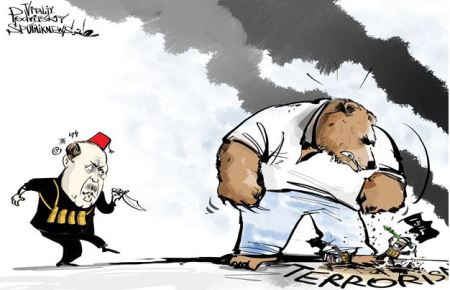
26473The Russian bear stamps out terror, but Erdogan prepares to stab it in the back (Sputniknews.com, November 24, 2015)

‘It Would Be A Mistake For Russia Not To Use Nuclear Weapons’ In A War With Turkey

A Pravda.ru article titled “‘Scenarios For Real War Between Russia And Turkey” states:

“The possibility of a full-fledged war between Russia and Turkey has been a talk of the day for conspiracy theorists, analysts, couch warriors and experts on international politics for several weeks already… Let’s assume that a real war sparks between Russia and Turkey (NATO) – what kind of war would it be? What results would it bring?

“Politonline.ru[3] discussed the topic with leading military experts that follow various approaches to international armed conflicts.

“A leading expert of the Center for Military and Political Studies,[4] Mikhail Alexandrov, is convinced that in case of a real war, Russia will have to use nuclear weapons immediately, because the existence of the nation will be at stake.

“‘It would be a mistake for Russia not to use nuclear weapons in this case,’ [he said]. ‘The West and Turkey will try to drag us into a war such as the Crimean war, where escalation will be slow, combat actions in the Caucasus will erupt, and the Russian group in Syria will be destroyed. The West will be helping Turkey – there will be military units and state-of-the-art aviation deployed there. It will be a war of the wearing-out strategy’, he said.

“‘From my point of view, should the war with Turkey start, it must be a determined, ambitious and quick war. Russia will have to strike a nuclear blow on main infrastructure and military targets in Turkey immediately’…

“‘During the first few hours of this war, Russia must destroy the entire military infrastructure of Turkey’, Mikhail Alexandrov said. ‘One does not even have to use ballistic missiles in this strike – Iskander-M with nuclear warheads would be enough. As soon as the military infrastructure is destroyed, the Russian troops will go and take the area of the straits’, he added.

“‘The West will not even have time to do anything. European countries will be so horrified that they will not even dare to intervene. The Americans will face a choice – either they begin a strategic nuclear war against Russia or not. As a result, Russia will take the area of the straits, and the rest will be left to Turkey’, said the expert.

“In turn, non-nuclear scenario of a hypothetical possibility, but deputy head of the Tauric information-analytical center at Russian Institute for Strategic Studies,[5] Sergey Ermakov, suggested a non-nuclear scenario.

“‘Hopefully, the real conflict will not happen. Using nuclear weapons is an extreme option. As for a  regional war, there are non-military tools in the region. There are many anti-Turkish players in the region. In the case of a military conflict, the Kurds will rip the region to pieces, so for Turkey, a war is a game not even with the zero, but with a negative sum’, he said.

“‘If Turkey provokes the conflict, NATO may not resort to the fifth article. Aggression is one thing, but a country asking for a conflict and pulling NATO into it is another thing. In such cases, NATO tries not to get involved’, Sergei Ermakov said.

“‘No one wants to get involved in a direct military conflict with Russia. This conflict is fraught with a nuclear war and a global tragedy’, he added.”[6]

‘The Leader Of The Turkish Nation Is Not Just An Islamist, He’s A Supporter Of International Terrorism”

An article on NEO titled “What Fate Awaits Turkey?” states:

“It is now clear that Tayyip Erdogan’s political career is heading to a closure, slowly but surely. He had a chance of saving it if he had the courage to immediately offer his apologies to Moscow after the downing of the Russian Su-24 bomber over Syria, that was in fact heading away from Turkey, not toward it.

“Instead, he got tangled in a web of ridiculous lies and explanations, all while being rude to Russia. On top of it all, he framed Washington, by trying to excuse the actions of the Turkish Air Force with alleged orders he personally received from Barack Obama at the G20 summit held in Antalya.

“But even with his back against the wall, Turkey’s President proved to be stubbornly shortsighted, which forced Russia to go even further by uncovering the role Turkey and Erdogan’s family played in the smuggling of stolen Syrian oil, which is a direct violation of the UN Security Council Resolution that was adopted on February 12, 2015. This means that the Turkish state is directly responsible for the sponsorship of international terrorism, which, according to the UN, should be punished in a particularly harsh manner.

“But what’s even more grave – the president has publicly disgraced himself before the country. His had already been steadily losing his position, but once he dropped his mask, his ratings started falling abruptly. It turns out that the leader of the Turkish nation is not just an Islamist, he’s a supporter of international terrorism.

“Now we are presented with a situation in which the AKP leader and the sitting Prime Minister Ahmet Davutoglu who are largely secured by the victory for the ruling party, has obtained as much influence as the president. And after the downing of Russia’s bomber he strengthened his positions even more, even though he decided not to distance himself publicly from the president. It’s safe to assume that he’s just quietly waiting for a perfect opportunity to strike a mortal blow. He’s nothing short of a dangerous contender that is prepared to replace Erdogan at any given moment.

“But the deposing of Erdogan is a relatively positive scenario. Those who remember Turkish history should know that Erdogan is hated by the military command of the Turkish Armed Forces, which has traditionally played a crucial role in the maintaining of country’s stability… The army is not getting any revenues from the illegal oil smuggling, so, should the ties between ISIL and Ankara be maintained, the military command, while enjoying the support of NATO allies, can launch a coup d’etat and return to the power they had three decades ago. But this scenario won’t satisfy local Kurds and other ethnic and religious minorities, who have experienced the cruelty of the army in the suppression of their rights first hand.

“Turkey is going to be plunged into political chaos, when the ruling AKP will find itself opposed by both the army and the legal opposition, along with 22 million Kurds led by the banned Kurdistan Workers Party (PKK). In this case, the civil conflict could result in the collapse of the Turkish state with the Kurdish areas (the entire South-East Anatolia) breaking away, seeking ways to create an independent Kurdistan that will absorb certain areas in Syria in Iraq, changing the whole balance of power in the Middle East.

“Whatever happens, one thing is clear: Tayyip Erdogan will be forced to answer for his stubbornness, inability to respect others, dictatorship, corruption, and connections with ISIL. And above all, he must answer to the people of Turkey. And also to Russia for the cowardly attacks that claimed the lives of two Russian soldiers who fought valiantly against terrorism.”[7]

‘Turkey May Well Have Been A ‘Prime Actor’ In The Paris Attack’

Another NOE article, titled “Mad King Erdogan’s Oil Lies,” stated: “Erdogan is claiming he stole no oil. He has threatened to resign if he receives proof. There is little doubt that Erdogan is insane, those who have been watching his dance of death with ISIS have known this all along.

“However, while Erdogan talks only of oil, there are other issues to note as well. First of all, let’s talk about arms shipments that cross Turkey and move into Syria and Iraq. By Erdogan’s claim of total innocence, we must assume that ISIS, al Qaeda and the other openly terrorist groups that make up 95% of those fighting against Iraq and Syria are operating without any outside supplies.

“Where Erdogan’s wild claims fail is simple as looking at a map. When Russia publishes surveillance photos of not just hundreds but thousands of oil trucks, how can there be denial? The roads that these trucks use only go to Turkey.

“They don’t go anyplace else, there is no place else. There is absolutely no vehicle traffic between the Turkish occupied areas of Iraq and Syria, and we might as well call them that, and the areas under control of the legitimate governments in Baghdad and Damascus.

“What is support of terrorism if it isn’t trading oil for arms or, moreover, trading oil and the other loot of Iraq and Syria, for the cooperation of Turkish politicians and, just perhaps, their European and American friends as well.

“Yet no one considers that Turkey may well have been a ‘prime actor’ in the Paris attack. Would Erdogan have downed a Russian plane if it weren’t for the Paris attack? What about the Russian airliner downed over Syria? When you add MH17 and examine what is now known, that Ukraine and Turkey have been working closely together all along, with ISIS troops joining Kiev forces against NovoRussians, do we see a pattern?”[8]

‘Turkey’s “Leader” Should Be Charged With Murder’

A Pravda.ru article titled “Turkey: Treacherous Turncoat,” stated:

“Turkey’s ‘leader’ should be charged with murder. The sanctimonious West is in denial. NATO, partly complicit if not the instigator, vows to defend the murderer. Washington, which knows every detail, feigns ignorance. Why is there no Western condemnation in absence of Turkey’s compunction?

“Turkey, though paying lip service to Obama’s ‘coalition of the coerced’ to at long last fight ISIS in Syria with military force, is loath to do so. More important Turkey has its political/economic motives to do just the opposite: not lift a finger (against ISIS). That is because, as President Putin already disclosed to Russia’s Western ‘partners’ at the G20 Summit, Turkey is in reality a turncoat. Russian military intelligence provided the evidence: Turkey, including its President, are really aiding and abetting the ISIS terrorists. Detailed satellite images show that Turkey provided the egress for the stolen oil that ISIS has been trucking in and through Turkey.

“From there the contraband, once brokered by the Turks, is sold elsewhere. The ‘buyers’ list includes Israel, the European Union and as some have suggested, even America. The scale and the scope of the covert theft equates to over 50 million barrels. Moreover, Turkey has profited from this nefarious heist for almost four years. Russia has more proof. The laundered money trail flows straight to the Turkish President’s palace. Using a labyrinth of the Erdogan’s financial network including his own son, the ill-gotten gains are then spirited outside the country.

“While the Kurds fight ISIS, Erdogan courts the terrorists by providing them military cover. Russia, now wiser as to Erdogan’s true colors, should endeavor to be ever more vigilant in its Syria campaign as to joining the West’s coalition of ‘partners’.

“That same portent applies to the newest ‘partners’: Hollande and Cameron. The two turkeys are even bigger U.S. vassals. Neither one is trustworthy. Syria’s war is about oil; both Putin and Assad know that well.”[9]


Endnotes:


[1] NEO (New Eastern Outlook) is the journal of the Russian Academy of Science’s Institute of Oriental Studies, a leading research institution dealing with Asian and African countries and cultures. NEO presents itself as follows: “We cover political and religious issues, economic and ideological trends, regional security topics and social problems. We are committed to develop NEO into a notable international networking platform offering unbiased expert opinions and open dialogue among all thinking people worldwide regardless of their nationality, race or religion… We are focused on creating a new culture of partnership where opinions influence decisions.” (Journal-neo.org, “About” section, accessed January 12, 2016).

[2] Pravda.ru is a pro-government news and opinion website. According to its former Director General, Vadim Gorshenin, it is the successor of Pravda, the official mouthpiece of the Soviet Union’s Communist Party. It was founded by prominent members of Pravda’s editorial staff who left it in 1999, and today it is privately owned by Pravda.ru Holding, of which Gorshenin is the head.  Its current Director General, Inna Novikova, is Gorshenin’s wife.

The Pravda website publishes in four languages: Russian, English, Italian, Portuguese, and has more than 200,000 visitors daily. According Gorshenin, the English version is the second most popular English-language Russian website, after Russia Today (Pravda.ru, September 16, 2013).

[3] Politonline.ru is a political website, part of the Pravda media network.

[4] The Center for Military-Political Studies is a division of the Russian foreign ministry’s Moscow State Institute of International Relations. The center studies trends and affairs in the domains of defense policy, weaponry, military industry, military cooperation and state security (Eurasian-defence.ru).

[5] The Russian Institute for Strategic Studies (RISS) is a research center established by the President of the Russian Federation. Its main task is to inform various Russian state institutions on the political, economic and socio-political situation in the Black Sea countries and  Mediterranean region (En.riss.ru).

[6] Pravdareport.com, December 8, 2015. The Russian version of the article was published on Politonline.ru on November 27, 2015.

[7] Journal-neo.org, December 7, 2015. The author, Peter Lvov, is described by NEO as a Ph.D in political science.

[8] Journal-neo.org, December 7, 2015. The author, Gordon Duff, is described by NEO as a U.S. Marine combat veteran of the Vietnam War and a senior editor and board chairman of the Veterans Today website.

[9] Pravdareport.com, December 16, 2016. The author’s name is given as “Montresor.”

New Iranian-Backed Terror Group Makes Inroads in West Bank, Gaza

January 19, 2016

New Iranian-Backed Terror Group Makes Inroads in West Bank, Gaza, Washington Free Beacon, January 19, 2016

Screen-shot-from-al-Sabireen-propaganda-videoScreen shot from al-Sabireen propaganda video

A new Iranian-backed terror group is making inroads in the Gaza Strip and West Bank, where it operates underground with the potential capacity to deliver devastating attacks to Israel, according to regional experts who have been investigating the organization’s rise.

The group, which goes by the name Harakat al-Sabireen, was established around May 2014 but has begun in recent months to boost its public profile on social media and brag about its plots to wage jihad against Israel, according to information gathered by regional analysts and provided to the Washington Free Beacon.

Al-Sabireen is believed to receive $10 million a year from Iran via funds that are smuggled through a large network of tunnels built by terrorists to facilitate illicit travel beneath the Gaza Strip, according to estimates disseminated in the Arab language press.

Like Hezbollah, the Iranian-funded terror group that controls territory along Israel’s northern border, al-Sabireen is being used by the Islamic Republic to indirectly wage war on the Jewish state and foster unrest in the Palestinian territories, according to experts, who view the group’s rise as a sign that Iran is not interested in scaling down its global terror network following the recent implementation of the nuclear agreement.

A State Department official who was not authorized to speak on record said that officials are aware of al-Sabireen and its activities. However, the group has not been officially designated as a foreign terrorist organization, though it is possible this could occur in the future.

Al-Sabireen says it has established an armed wing with militants in Jerusalem and the West Bank, according to a recent interview with the Palestinian news agency Ma’an.

“Given the tense relationship between Tehran and Hamas the past few years, it makes sense that Iran would look to form another proxy in Gaza,” Grant Rumley, a Middle East analyst at the Foundation for Defense of Democracies, said. “However, Sabireen’s entire model of expansion hinges on its ability to present itself as a Palestinian, non-sectarian movement.”

Like Hezbollah, al-Sabireen’s official logo closely resembles that of the Iranian Revolutionary Guard Corps, which is responsible for giving orders to these types of terror groups.

The group’s charter condones violent jihad and promotes attacks on “the racist Zionist body” and “America the great Satan,” according to a copy published by the group on its official Arabic-language website.

Al-Sabireen has taken to its website and Facebook page in recent months to praise operatives who have been killed while conducting reconnaissance missions on the group’s behalf.

In one posting from late October, the group celebrated the death of one operative who was killed “after direct targeting from the Zionist forces while he was leading a monitoring and reconnaissance team.”

Mourners raised flags during a funeral ceremony for this individual from a variety of Palestinian political groups, including Fatah, which is largely viewed by Western governments as a moderate voice, according to photographs posted by al-Sabireen on its Facebook page.

It also has been plucking recruits from rival terrorist groups, according to Rumley.

“It’s unclear exactly what Sabireen’s operational capabilities are right now, but we know that they’ve pulled recruits from a more established terror group, Palestinian Islamic Jihad, and that they’ve lost at least two fighters in two separate Israeli strikes, so they’re on Israel’s radar,” Rumley said.

Al-Sabireen has been present at pro-Hezbollah rallies in Gaza that were also attended by leading Hamas officials.

While not much is known about the group’s composition, it appears to have two main leaders, one an operational leader and another who provides intellectual guidance.

Hisham Salem, the terror group’s top leader, formerly served as a member of Palestinian Islamic Jihad, a State Department-designated terror organization, according to information provided by regional analysts. Salem, who is in his early 50s, was raised in the Gaza Strip and began referring to himself as al-Sabireen’s leader in 2014.

Salem claimed in a recent interview with the Palestinian press that armed members of the group are currently in the West Bank and Jerusalem.

“We have an armed branch whose goal it is to wage war on the Israeli occupation everywhere,” Salem was quoted as saying. “Within this framework we have members in the West Bank and Jerusalem who will soon receive financial and military support from us.”

A recent propaganda video produced by the organization and posted to YouTube shows soldiers marching through Gaza with AK-47s.

Al-Sabireen’s second in command, Mohammad Abu Nadi, frequently writes on al-Sabireen’s official website and praises Palestine as integral to the Arab world.

Al-Sabireen has taken a hardline stance against the United States, claiming in September on its Facebook page that the United States is responsible for “producing terrorists.”

The group’s Facebook page remains active with near-daily postings despite attempts by Facebook to shut it down.

While al-Sabireen has faced difficulty in expanding its base in Gaza, where the Hamas-controlled government cracks down on rival terror groups, it has been able to gain a foothold in the West Bank, where it can directly challenge both Israel and the Palestinian Authority.

UN Plan to Prevent “Violent Extremism” Ignores its Primary Cause

January 19, 2016

UN Plan to Prevent “Violent Extremism” Ignores its Primary Cause, Front Page MagazineJoseph Klein, January 19, 2016

cx

United Nations Secretary General Ban Ki-moon is operating from the same playbook as President Obama when it comes to addressing the threat of global jihad. They both deny that such a religiously-based threat exists. Just like Obama, Ban Ki-moon uses the euphemism “violent extremism,” without linking it to its primary ideological source – Islam.

The global terrorist scourge is driven by Islamic supremacy and the jihadist war against the “infidels” that are embedded in sharia law. That is not to say that the jihadists are the only terrorists in the world. However, to diffuse responsibility by contending that violent extremism is found in all faiths ignores the fact that the only global terrorist network threatening our way of life today is bound together by the teachings of Islam.

In the Secretary General’s remarks to the UN General Assembly on January 15th introducing his “Plan of Action to Prevent Violent Extremism,” he said that “the vast majority of victims worldwide are Muslims.” Obama said essentially the same thing last February at his Summit on Countering Violent Extremism, lamenting that it is “especially Muslims, who are the ones most likely to be killed.”

Both Ban Ki-moon and President Obama omitted to say that the killers are also primarily Muslims. Moreover, they left out entirely any mention of the ongoing genocide being conducted by Muslims in the name of Allah against Christians and Yazidis in the Middle East.

When I asked the spokesperson for the Secretary General why the Secretary General did not acknowledge the fact that the vast majority of global terrorists today are Islamists, the spokesperson responded that “the Secretary‑General’s focus is not on targeting or pointing finger at one ethnic group, one religious group, or people who claim to act in the name of a particular religion.”

This begs the question as to why the Secretary General took pains to assert that Muslims constitute the majority of terrorists’ victims but refused to acknowledge that the vast majority of perpetrators are also Muslims.

The Secretary General’s Plan of Action to Prevent Violent Extremism describes what it calls the “drivers of violent extremism.”  These drivers include, according to the UN document, lack of socioeconomic opportunities, marginalization and discrimination, poor governance and violations of human rights, prolonged and unresolved conflicts, radicalization in prisons, collective grievances, and exploitation of social media.

Obama offered essentially the same explanation for the growth of violent extremism put forth by Ban Ki-moon. A key problem, he said, was lack of economic opportunity that trapped people –especially young people – “in impoverished communities.”

Obama added: “When people are oppressed, and human rights are denied — particularly along sectarian lines or ethnic lines — when dissent is silenced, it feeds violent extremism.”

Ban Ki-moon and President Obama both have argued that Islam itself is blameless. It is, in Ban Ki-moon’s words, the “distortion and misuse of beliefs” that are to blame. At his February 2015 Summit on Countering Violent Extremism, President Obama called out what he described as “the warped ideologies espoused by terrorists like al Qaeda and ISIL, especially their attempt to use Islam to justify their violence.”

However, the truth is that Islam itself contains the seeds for the violence that is such a prominent part of jihad. Jihadists using violence as a tactic to impose Islam as the world’s only “legitimate” belief system are following the path laid down by Prophet Muhammed himself and his early followers, according to their literal words and acts.

The proposed actions to address the problem of “violent extremism,” both Ban Ki-moon and Obama agree, include better education, more opportunities for women, better governance, and respect for human rights including freedom of expression and freedom of religious belief.  The UN Secretary General and President Obama base their common strategy on their shared utopian belief that peoples from every country and culture embrace a common set of “universal” human rights, as expressed in the United Nations Universal Declaration of Human Rights. The Universal Declaration’s preamble states:  “recognition of the inherent dignity and of the equal and inalienable rights of all members of the human family is the foundation of freedom, justice and peace in the world.”

However, the Universal Declaration of Human Rights, despite its enlightened vision of the inherent dignity and fundamental rights of all human beings, is far from being a truly universally accepted creed. Muslims reject it to the extent that it conflicts with sharia law.

While Muslim member states of the United Nations, with the notable exception of Saudi Arabia, signed the Universal Declaration, they disavow its Western, secular-based principles. Islamists refuse to be ruled by any human rights document that deviates from what they regard as the divinely-inspired sharia law.

As the Islamic response to the United Nations Universal Declaration of Human Rights, the Organization of Islamic Cooperation foreign ministers adopted The Cairo Declaration on Human Rights in Islam in 1990. After reciting a litany of human rights that it pledges to protect, the Cairo Declaration subjects all of its protections to the requirements of sharia law. “The Islamic Shari’ah is the only source of reference for the explanation or clarification to any of the articles of this Declaration.” (Article 25)

By making Islamic law the sole authority for defining the scope of human rights, the Muslims’ Cairo Declaration sanctions limits on freedom of expression, discrimination against non-Muslims and women, and a prohibition against a Muslim’s conversion from Islam. Such restrictions on freedoms directly contradict the Universal Declaration of Human Rights.

Saudi Arabia and Iran, the leading Muslim majority countries today representing the Sunni and Shiite branches of Islam respectively, may be at odds with one another regarding certain sectarian and geopolitical issues. However, they both purport to govern according to sharia law, which is used to justify their religious intolerance, brutal suppression of dissent, misogyny and capital punishment for blasphemy, apostasy, adultery and homosexuality. It is Saudi Arabia’s Wahhabism which has helped fuel the jihadists inside and outside of Saudi Arabia seeking to forcibly purify Islam from the influence of “infidels.” And Iran is the world’s leading state sponsor of terrorism, as it seeks to fulfill the vision of Ayatollah Khomeini, the late founder of the Iranian Islamic revolution, to kill the infidels and ensure “that the writ of Islam is obeyed in every country in the world.”

Iran’s current Supreme Leader Ayatollah Khamenei has rejected the Universal Declaration of Human Rights, which he claims is reflective of a “culture of dominance.” Instead, he said “the answer is return to Islam, and recourse to Divine revelation.” He called for the use of “Islamic sources (the Quran and the Sunnah) in legal matters.” Presumably, what the Supreme Leader described as the “Islamic mode of thinking in society” would explain the Islamic Republic of Iran’s arbitrary imprisonment, torture and the killing of political dissidents and members of minority groups. The “Islamic sources in legal matters” evidently serve as the basis for the regime’s discriminatory laws against women, among other repressive laws.

In 2013, Iran was rewarded by the UN for its vows of global conquest with a seat on the General Assembly’s disarmament committee. Last year Iran was rewarded for its horrendous record of abuses against women with membership on the executive board of the UN Entity for Gender Equality and the Empowerment of Women. And as of January 16, 2016, Iran has been welcomed back into the international community with the lifting of sanctions and the unfreezing of assets worth approximately $150 billion.

The Saudi Sheikh Saleh Al-Lehadan, head of the Supreme Judiciary Council, expressed back in 2008 the religious intolerance that lies at the heart of the leading Sunni country’s practice of Islam: “After getting rid of the Jews in our Arab land, we must turn to the Christians. They have three options: either they convert to Islam, or leave, or pay Jizia (protection taxes).” With the help of the Islamic State and al Qaeda that receive funding from Saudi Arabia, this ambition is on its way to being realized, and even expanded to reach throughout the Middle East and beyond.

The same Saudi sheikh and head of the Supreme Judiciary Council also said: “Women who are raped by men are themselves to blame. They provoke men by the way they dress or walk.”

Last year Saudi Arabia was rewarded for its horrendous human rights record with a seat and leadership position on the UN Human Rights Council.

Coddling the leading jihad exporting countries and pretending that sharia law can ever be reconciled with so-called “universal” human rights values will render all plans of action to prevent “violent extremism” an utter failure.

The Islamization of France in 2015

January 19, 2016

The Islamization of France in 2015, Gatestone InstituteSoeren Kern, January 19, 2016

♦ An estimated 40,000 cars are burned in France every year — a destruction often attributed to rival Muslim gangs. Every day, more than 80 cars are burned.

♦ The rector of the Grand Mosque of Paris, Dalil Boubakeur, called for the number of mosques in France to be doubled over the next two years. Boubakeur said that 2,200 mosques are “not enough” for the “seven million Muslims living in France.” He demanded that unused churches be converted into mosques.

♦ Prime Minister Manuel Valls revealed in April that more than 1,550 French citizens or residents are involved in terrorist networks in Syria and Iraq.

♦ “Can we not talk about subjects that split opinion? If you talk about immigration, you are a xenophobe. If you talk about security, you are a fascist. If you talk about Islam, you are an Islamophobe.” – Henri Guaino, MP.

♦ “Those who denounce the illegal behavior of fundamentalists are more likely to be sued than the fundamentalists who behave illegally.” – Marine Le Pen, leader of the National Front party.

The Muslim population of France reached 6.5 million in 2015, or around 10% of the overall population of 66 million. In real terms, France has the largest Muslim population in the European Union, just above Germany.

Although French law prohibits the collection of official statistics about the race or religion of its citizens, this estimate is based on several studies that attempted to calculate the number of people in France whose origins are from Muslim-majority countries.

What follows is a chronological review of some of the main stories about the rise of Islam in France during 2015:

JANUARY

January 1. The Interior Ministry announced the most anticipated statistic of the year: a total of 940 cars and trucks were torched across France on New Year’s Eve, a 12% decrease from the 1,067 vehicles burned during the annual ritual on the same holiday in 2014. Car burnings, commonplace in France, are often attributed to rival Muslim gangs that compete with each other for the media spotlight over which can cause the most destruction. An estimated 40,000 cars are burned in France every year.

January 3. A 23-year-old Muslim man in Metz tried to strangle a police officer while shouting “Allahu Akbar!” (“Allah is the greatest!”). The assault took place at the police station after the man, who was arrested for purse-snatching, asked the officer to bring him a glass of water. When the policeman opened the cell door, the man lunged at him. The officer was rescued by a colleague who saw the scene unfold on a video surveillance camera.

January 7-9. A series of jihadist attacks in Paris left 17 people dead. The first and deadliest of the attacks occurred on January 7, when French-born Islamic radicals Chérif and Saïd Kouachi stormed the offices of the magazine Charlie Hebdo and fatally shot eight employees, two police officers, and two others, and injured eleven other people. On January 8, a third assailant in the attacks, Amedy Coulibaly, shot and killed municipal police officer Clarissa Jean-Philippe in Montrouge, a suburb of Paris. On January 9, Coulibaly entered a HyperCacher kosher supermarket in Paris, killed four people and took several hostages. Coulibaly was killed when police stormed the store. His female accomplice, Hayat Boumeddiene, France’s “most wanted woman,” remains at large and is believed to have fled to Syria.
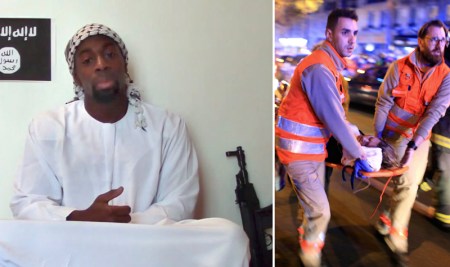
1432Last January, Amedy Coulibaly (left) murdered a policewoman and four Jews in Paris, before being shot dead by police. Right: Medics carry a victim wounded in an attack by Islamist terrorists, who shot hundreds of concert-goers, killing 90, at the Bataclan theater in Paris on November 13, 2015.

January 18. A poll by the firm, Institut français d’opinion publique (IFOP), published by Journal du Dimanche, showed that 42% of French people oppose the publication of cartoons depicting the Prophet Mohammed, such as those published by Charlie Hebdo, and indicated they believed there should be “limitations on free speech online and on social networks.” The vast majority (81%) said they favored stripping French nationality from dual nationals who have committed an act of terrorism on French soil. More than two-thirds (68%) said that French citizens should be banned from returning to the country if “they are suspected of having gone to fight in countries or regions controlled by terrorist groups.”

January 20. Prime Minister Manuel Valls said the terrorist attacks exposed a “territorial, social, ethnic apartheid” that is plaguing France. In a speech described as one of the strongest indictments of French society ever by a government figure, Valls said there was an urgent need to fight discrimination, especially in impoverished suburbs that are home to many Muslim immigrants. He said that despite years of government efforts to improve conditions in run-down neighborhoods, many people have been relegated to living in ghettos. He added:

“The social misery is compounded by daily discrimination, because someone does not have the right family name, the right skin color, or because she is a woman. I am not making excuses, but we have to look at the reality of our country.”

January 21. Valls announced a €736 million ($835 million) program to augment its anti-terrorism defenses amid a rapidly expanding jihadist threat. He said the government would hire and train 2,680 new anti-terrorist judges, security agents, police officers, electronic eavesdroppers and analysts over the next three years. The government will also spend €480 million on new weapons and protective gear for police. The initiative includes an enhanced online presence based on a new government website called “Stop Djihadisme.”

January 27. Police arrested five suspected jihadists, aged 26 to 44, in dawn raids in Lunel, a small town near the Mediterranean coast. At least ten, and possibly as many as 20 people from the town — with a population of just 25,000 — have travelled to Syria and Iraq to fight with the Islamic State.

January 28. An Ipsos/Sopra-Steria poll produced for Le Monde and Europe 1 Radio found that 53% of French citizens believe the country is “at war” and 51% feel that Islam is “incompatible” with the values of French society.

Also in January, artwork depicting women’s shoes on Muslim prayer rugs was removed from an exhibition in the Paris suburb of Clichy-la-Garenne after the Federation of Islamic Associations of Clichy warned it might provoke “uncontrollable, irresponsible incidents.” The artwork, made by the French-Algerian artist Zoulikha Bouabdellah, included high-heel shoes placed on the center of prayer rugs in shades of blue, white and red, symbolizing the French flag. She said she did not consider the work to be blasphemous, but curator Christine Ollier said it would be removed to “avoid polemics.” The act of self-censorship was criticized by other artists, who said that the freedom of expression was being undermined.

FEBRUARY

February 5. A teacher at France’s only state-funded Muslim faith school quit his job, saying that the Averroès Lycée (high school) in Lille was a hotbed of “anti-Semitism, sectarianism and insidious Islamism.” In an article published by Libération, philosophy teacher Sofiane Zitouni wrote:

“The reality is that Averroès Lycée is a Muslim territory that is being funded by the state. It promotes a vision of Islam that is nothing other than Islamism. And it is doing it in an underhand and hidden way in order to maintain its state funding.”

The school’s director, Hassan Oufker, said he would sue Zitouni, of Algerian descent, for defamation.

February 12. The Union of French Muslim Democrats (L’Union des démocrates musulmans Français, UDMF), a start-up Muslim political party, said it had begun fielding candidates in local elections in eight cities in France. UDMF founder Najib Azergui said his group wants to give a voice to the country’s Muslim community by: promoting Islamic finance; promoting the use of Arabic in French schools; working to overturn France’s ban on wearing the veil in schools, and fighting against the “dangerous stigmatization that equates Islam with terrorism.”

February 15. The government announced a series of measures to clamp down on the radical Islam being spread in mosques, including a ban on financial support from countries such as Qatar and Saudi Arabia. French Muslims opposed the move. Karim Bouamrane, a socialist politician said:

“If foreign countries are stepping in to fund mosques, it is because the French government won’t. Muslims cannot run the risk of refusing cash from outside, because the French government won’t allocate them funds to build mosques.”

Bouamrane said France’s 1905 law separating Church and State should be changed to allow the French state to provide financial support for Muslim worship.

February 16. Nacer Bendrer, a 26-year-old French citizen, was extradited to Belgium for his role in the May 20214 jihadist attack against the Jewish Museum in Brussels. He is suspected of helping compatriot Mehdi Nemmouche, 29, carry out the attack in which four people were murdered. When arrested near Marseilles, Bendrer was in possession of a Kalashnikov type of assault rifle, two automatic pistols and a shotgun. Bendrer and Nemmouche reportedly met while in prison in Salon-de-Provence in southern France between 2008 and 2010.

February 23. For the first time ever, French authorities confiscated the passports and identity cards of six French citizens who were allegedly planning to travel to Syria to join the Islamic State. The government said it might seize the passports of at least 40 others.

February 25. Interior Minister Bernard Cazeneuve unveiled a plan to “reform” the Muslim faith to bring it into line with the “values of the French Republic.” This, he said, would be done by means of a new “Islamic Foundation” devoted to conducting “revitalizing research” into a form of Islam that “carries the message of peace, tolerance and respect.” The government would create, among other measures, a new forum to: promote dialogue with the Muslim community; improve the training of Muslim preachers; combat radicalization in French prisons; and regulate Muslim schools.

MARCH

March 3. Prime Minister Manuel Valls announced that the state would double the number of university courses on Islam in an effort to stop foreign governments from financing and influencing the training of French imams. Valls said that he wanted more imams and prison chaplains who have been trained abroad to “undergo more training in France, to speak French fluently and to understand the concept of secularism.” There are currently six universities in France offering courses in Islamic studies and theology. Valls said he wanted to double that number to 12 and that the courses would be free of charge.

March 6. Mohamed Khattabi, the “progressive” imam of the Aicha Mosque in Montpellier, said in a sermon that selfishness is part of “the nature of women.” Khattabi — a Moroccan-Canadian who has lived in France for more than 20 years, and who claims to be a “promoter of an Islam within French society, of coexistence” — said:

“No matter how much good you bestow upon a woman, she will deny it. Her selfishness drives her to deny it. This holds true for all women, whether Western, Arab, Muslim, Jewish, or Christian. This is the nature of women.

“If a woman overcomes her nature and acknowledges [the truth] … Allah grants her a higher place in paradise. But if she succumbs to her nature, and refuses to acknowledge the man’s rights — or rather, the goodness that man bestows upon her — she is destined to go to [hell]…”

March 8. Prime Minister Manuel Valls warned that as many as 10,000 Europeans could be waging jihad in Iraq and Syria by the end of 2015:

“There are 3,000 Europeans in Iraq and Syria today. When you do a projection for the months to come, there could be 5,000 before summer and 10,000 before the end of the year. Do you realize the threat this represents?”

March 16. The Interior Ministry blocked five Islamist websites that, it said, were promoting terrorism. The sites included one belonging to al-Hayat Media Center, the propaganda wing of the Islamic State. Interior Minister Bernard Cazeneuve said: “I make a distinction between freedom of expression and the spread of messages that serve to glorify terrorism. These hate messages are a crime.” But the Human Rights Commissioner of the Council of Europe, Nils Muižnieks, criticized the move because it was carried out without judicial oversight: “Limiting human rights to fight against terrorism is a serious mistake and an inefficient measure that can even help the terrorists’ cause.”

March 17. Interior Minister Bernard Cazeneuve revealed that the government has stopped paying welfare benefits to 290 French jihadists fighting with the Islamic State. He said that the agencies responsible for distributing welfare payments were being notified as soon as it was confirmed that a French citizen had left the country to fight abroad.

March 19. Prime Minister Manuel Valls unveiled a new bill that would allow intelligence services to monitor and collect the email and telephone communications of anyone suspected of being a terrorist. “These are legal tools, but not tools of exception, nor of generalized surveillance of citizens,” he said. “There will not be a French Patriot Act,” he said, referring to American legislation bearing the same name. “There cannot be a lawless zone in the digital space. Often we cannot predict the threat, the services must have the power to react quickly.”

APRIL

April 4. The rector of the Grand Mosque of Paris, Dalil Boubakeur, called for the number of mosques in France to be doubled over the next two years. Speaking at a gathering of French Islamic organizations in the Paris suburb of Le Bourget, Boubakeur said that 2,200 mosques are “not enough” for the “seven million Muslims living in France.” He demanded that unused churches be converted into mosques.

April 7. The Secretary of State for State Reform, Thierry Mandon, claimed that the lack of “decent” places of worship for French Muslims was partly to blame for some of them turning to radical Islam. He said:

“There are not enough mosques in France. There are still too many cities where the Muslim faith is practiced in conditions that are not decent. We are forced to recognize that sometimes the Muslim places of worship are not satisfactory. If they are decent, open rather than underground or hidden, it will be better.”

April 8. Hackers claiming to belong to the Islamic State attacked TV5Monde, a French television network, and knocked it off the air globally. The network broadcasts in more than 200 countries. “We are no longer able to broadcast any of our channels. Our websites and social media sites are no longer under our control and are all displaying claims of responsibility by Islamic State,” the broadcaster’s director general, Yves Bigot, said. The hackers accused President François Hollande of having committed “an unforgivable mistake” by joining a US-led military coalition carrying out air strikes against ISIS positions in Iraq and Syria.

April 13. Prime Minister Manuel Valls revealed that more than 1,550 French citizens or residents are involved in terrorist networks in Syria and Iraq. The figures have almost tripled since January 2014.

April 13. An opinion poll produced for Atlantico found that nearly two-thirds (63%) of French citizens were in favor of restricting civil liberties in order to combat terrorism. Only 33% said they were opposed to having their freedoms reduced, although this number increased significantly among younger respondents.

April 15. A 21-year-old Muslim destroyed more than 200 gravestones at a Catholic cemetery in Saint-Roch de Castres, a town near Toulouse. Police sent the man to the hospital because he was in a “delusional state and unable to communicate.”

April 22. French police arrested Sid Ahmed Ghlam, a 24-year-old Algerian computer science student suspected of planning an attack on Christian churches in Villejuif, a suburb south of Paris. He was arrested after apparently shooting himself by accident. Police found three Kalashnikov assault rifles, handguns, ammunition and bulletproof vests, as well as documents linked to al-Qaeda and Islamic State, in his car and home. Police said Ghlam had expressed a desire to join the Islamic State in Syria.

April 21. A study by the Observatory of Religion in the Workplace (Observatoire du fait religieux en entreprise, OFRE) and the Randstad Institute found that 23% of the managers in France were regularly confronting religious problems at work, up from 12% in 2014. OFRE President Lionel Honoré said religious tension had increased since January because Muslims who feel stigmatized by the jihadist attacks in Paris were becoming more forceful in asserting their beliefs.

MAY

May 5. Sébastien Jallamion, a 43-year-old policeman from Lyon, was suspended from his job and fined €5,000 ($5,400) after he condemned the death of Frenchman Hervé Gourdel — who was beheaded by jihadists in Algeria in September 2014. Jallamion explained:

“I am accused of having created, in September 2014, an anonymous Facebook page, showing several ‘provocative’ images and commentaries, ‘discriminatory and injurious,’ of a ‘xenophobic or anti-Muslim’ nature. As an example, there was that portrait of the Caliph al-Baghdadi, head of the Islamic State, with a visor on his forehead. This publication was exhibited during my appearance before the discipline committee with the following accusation: ‘Are you not ashamed of stigmatizing an imam in this way?’ My lawyer can confirm this… It looks like a political punishment. I cannot see any other explanation.

“Our fundamental values, those for which many of our ancestors gave their life are deteriorating, and that it is time for us to become indignant over what our country is becoming. This is not France, land of Enlightenment that in its day shone over all of Europe and beyond. We must fight to preserve our values, it is a matter of survival.”

May 11. Sarah K., a 15-year-old French Muslim girl of Algerian descent who was banned from class twice for wearing a long black skirt to class, was allowed to return to school wearing a similar dress. Maryse Dubois, the head teacher of the Léo-Lagrange school in the town of Charleville-Mézières, had said she considered the long dress to be a conspicuous religious symbol and a violation of France’s secularism laws. Sarah’s mother said Dubois backed down after news of the incident went viral.

May 27. The leaders of a small mosque in Oullins, a suburb of Lyons, made legal history by using France’s 1905 law separating church and state to prevent a Salafist from radicalizing other members of the mosque. The law includes a clause that guarantees the right to worship and calls for sanctions against anyone found to be disrupting a worship service. A court in Lyons found Faouzi Saïdi, 51, guilty of being disruptive by criticizing the mosque’s imam and holding parallel prayers. Saidi, who was fined €1,500 ($1,640), said his only crime was to “have a big mouth.” He added: “I don’t understand why I’ve been convicted. I practice Islam as it is prescribed.”

JUNE

June 4. Former president Nicolas Sarkozy’s opposition party — rebranded as “The Republicans” — held a meeting on the question of “Islam in France or Islam of France” as part of a roundtable discussion on the “crisis of values” in France. Sarkozy said: “The question is not to know what the Republic can do for Islam, but what Islam can do to become the Islam of France.”

Muslim groups criticized the meeting. “We cannot participate in an initiative like this that stigmatizes Muslims,” said Abdallah Zekri, the president of the National Observatory on Islamophobia. The organizer of the meeting, MP Henri Guaino, countered: “Can we not talk about subjects that split opinion? If you talk about immigration, you are a xenophobe. If you talk about security, you are a fascist. If you talk about Islam, you are an Islamophobe.”

June 6. Prime Minister Manuel Valls said that more than 850 French citizens or residents had travelled to fight in Syria and Iraq. More than 470 are still there and 110 are believed to have been killed in battle.

June 7. Interior Minister Bernard Cazeneuve said that 113 French citizens or residents have died as jihadists on battlefields in the Middle East. There are 130 ongoing judicial proceedings concerning 650 persons related to terrorism, and 60 individuals have been banned from leaving the country.

June 7. More than a dozen members of Forsane Alizza (Knights of Pride), a group formed to defend Muslims against “Islamophobia,” went on trial in Paris for allegedly plotting terrorist attacks. The group — formed in August 2010 by a 37-year-old Franco-Tunisian, Mohamed Achamlane, who refers to himself as “Emir” — put a message on its website demanding that French forces leave all Muslim-majority countries. The message said: “If our demands are ignored, we will consider the government to be at war against Muslims.” In court, Achamlane said: “There is no radical or moderate Islam. There is only authentic Islam.”

Jun 15. Prime Minister Manuel Valls told a half-day conference on relations with the Muslim community that “Islam is here to stay.” He also stressed that there is no link between Islam and extremism. “We must say all of this is not Islam,” Valls said. “The hate speech, anti-Semitism that hides behind anti-Zionism and hate for Israel … the self-proclaimed imams in our neighborhoods and our prisons who are promoting violence and terrorism.” The conference did not discuss radicalization because the issue was deemed too sensitive.

June 23. A court in Paris rejected a case brought by a mother trying to sue the French government for failing to stop her teenage son from leaving to join jihadists in Syria. The boy was 16 when he left with three others from the French city of Nice in December 2013; he took a plane to Turkey, then traveled overland to Syria. His mother, identified only as Nadine A., argued that airport police in Nice should have stopped the boy because he had only a one-way ticket and no baggage. The court ruled that the airport officers were not responsible, and rejected her demand for €110,000 ($120,000) in compensation.

June 28. Prime Minister Manuel Valls told iTele that there are between 10,000 and 15,000 Salafists in France, and that 1,800 people were “linked” in some way to the Islamist cause. He said that the West was engaged in a “war against terrorism,” adding: “We cannot lose this war because it is fundamentally a war of civilization. It is our society, our civilization, that we are defending.”

June 29. Interior Minister Bernard Cazeneuve revealed that France has deported 40 imams for “preaching hatred” in the past three years: “Since the beginning of the year we have examined 22 cases, and around 10 imams and preachers of hatred have been expelled.”

June 29. Yassin Salhi, a 35-year-old father of three, confessed to beheading his boss and trying to blow up a chemical plant near Lyon. The severed head was found hanging on the fence outside the plant, next to two flags bearing the Muslim profession of faith. Salhi, a truck driver, was born in France to parents of Moroccan and Algerian descent. Before his arrest, Salhi took a picture of himself with the severed head and sent the image to a French jihadist fighting for the Islamic State in Syria. Salhi’s wife said: “We are normal Muslims. We do Ramadan.”

Also in June, in Bordeaux, the De L’Orient à L’Occidental grocery store, whose owners recently converted to Islam, scrapped a “gender ban” after facing a barrage of criticism. In an effort to ensure that males and females did not come into contact with one another in the store, the owners attempted to ban women from shopping on Mondays, Tuesdays, Wednesdays and Fridays, and to ban men on Thursdays, Saturdays and Sundays.

JULY

July 8. The weekly newsmagazine, Valeurs Actuelles, launched a nationwide petition titled, “Do not touch my church!” after the head of the Grand Mosque of Paris, Dalil Boubakeur, said that empty churches in France should be converted into mosques. The magazine pointed to an Ifop poll which showed that nearly seven out of ten respondents (67%) said they were opposed to turning French churches into mosques.

July 10. Mohamed Achamlane, 37, the Franco-Tunisian leader of a banned group called Forsane Alizza (Knights of Pride), was sentenced to nine years in prison on terrorism charges after police raids found weapons and a list of Jewish targets in his personal files. The group, created in 2010 with the purported goal of stopping the spread of “Islamophobia,” was banned by the government in March 2012 after jihadist propaganda appeared on its website.

July 14. Some 130 cars were burned in Paris to mark the Bastille Day, the French national day. More than 80 cars are burned every day in France, mostly by young Muslims.

July 15. French authorities foiled a jihadist plot to behead a high-ranking member of the French military at Port-Vendre, a military base near Perpignan, and post a video of the decapitation on the Internet. Counter-terrorism police arrested three men, including Djibril A., a former seaman with the French Navy.

July 22. A 21-year-old woman named Angelique Sloss was attacked by a mob of Muslim women after they saw her sunbathing with two friends in the Parc Léo-Lagrange in Reims. The women accused her of “immorally” exposing too much flesh at a public location.

AUGUST

August 13. A court in Dijon upheld a decision by Gilles Platret, the mayor of Chalon-sur-Saône, to stop offering alternatives to pork in school cafeterias. Platret welcomed the ruling as a “first victory for secularism.” The move was condemned by Muslim groups. Abdallah Zekri of the French Council for the Muslim Faith (Conseil français du culte musulman, CFCM) said:

“I can only condemn the decision of the mayor, which was not made to restore social peace in schools and is creating an outcry in the Muslim community. All Muslims respect secularism. Muslims have never asked for halal meals in canteens.”

August 16. French mayor Yves Jégo filed a petition to introduce a new law that would require all French public schools to offer a vegetarian option in the cafeteria. The initiative aims to help students who cannot eat pork due to religious reasons. Jégo said the topic of school lunch menus was a “source of a useless confrontation aimed in reality in most cases at the Muslim community” that “challenges our ability to make living together a reality.” More than 150,000 people have signed the petition.

August 21. Ayoub El-Khazzani, a 26-year-old Moroccan, was arrested after he boarded a high-speed Amsterdam-to-Paris train with 554 passengers on board and opened fire with a Kalashnikov rifle. He was subdued with the help of three Americans and a Briton. It later emerged that El-Khazzani had fought with ISIS in Syria and was known to at least four intelligence agencies.

SEPTEMBER

September 6. Marine Le Pen, the leader of the National Front party, accused Germany of exploiting the migrant crisis in an effort to drive down wages. Speaking to supporters in Marseilles, she said:

“Germany probably thinks its population is moribund, and it is probably seeking to lower wages and continue to recruit slaves through mass immigration. Germany seeks not only to rule our economy, it wants to force us to accept hundreds of thousands of asylum seekers.”

September 7. President François Hollande said France would take in 24,000 migrants over the next two years: “It is the duty of France. The right of asylum is an integral part of our soul and flesh. Our history demands this responsibility.”

September 8. Prime Minister Manuel Valls condemned two French mayors who said they would only take in Christian refugees. “You do not sort refugees on the basis of religion,” Valls said. “The right to asylum is a universal right.” The mayor of Roanne, Yves Nicolin, said he would only take in Christians, to be “certain they are not terrorists in disguise.” The mayor of Belfort, Damien Meslot, said he would only consider taking in Christian families from Iraq and Syria because “they are the most persecuted.”

September 22. Eric Zemmour, a French writer and political journalist, was acquitted of charges of inciting racial hatred. Zemmour had been prosecuted for comparing gangs of foreigners to the invading barbarians that followed the fall of the Roman Empire. In a May 2014 radio broadcast, he had said:

“The Normans, the Huns, the Arabs, the great invasions after the fall of Rome have now been replaced by gangs of Chechens, Roma, Kosovars, Maghrebins and Africans who rob, assault and pillage. Only homogenous societies such as Japan, which have for a long time said no to mass immigration and protected their natural barriers … have escaped this street violence.”

Prosecutors had called for him to be fined €5,000 ($5,400) and for the radio station RTL to be fined €3,000 euros for posting the broadcast on its Internet site. The court, however, declared: “Excessive and shocking though these words may appear, they only referred to a fraction of the communities and not to them in their entirety.”

September 27. Mohamed Chebourou, a 27-year-old French-Algerian Islamic extremist, went on the run after being granted a brief leave of absence from the Meaux-Chauconin prison in Seine-et-Marne, east of Paris. He was serving a seven-year sentence for robbery and was not to be released until 2019. He was later arrested in Algeria. France’s Justice Minister Christiane Taubira faced pressure to explain how an Islamic extremist could be granted a furlough from prison.

OCTOBER

October 12. A 15-year-old Muslim student was arrested after shouting “Allahu Akbar!” (“Allah is the Greatest!”) and shooting his physics teacher in the hand with a BB gun at a school in Châlons-en-Champagne. The boy said he wanted to die a martyr.

October 20. Marine Le Pen, the leader of the National Front party, went on trial on charges of inciting religious hatred after comparing Muslim street prayers to the Nazi occupation. At a campaign rally in Lyon in 2010, she had said:

“I am sorry, but for those who really like to talk about World War II, if we are talking about an occupation, we could talk about the [street prayers], because that is clearly an occupation of territory.

“It is an occupation of sections of the territory, of neighborhoods in which religious law applies — it is an occupation. There are no tanks, there are no soldiers, but it is an occupation nevertheless, and it weighs on people.”

Le Pen said she was a victim of “judicial persecution.” She added:

“It is a scandal that a political leader can be sued for expressing her beliefs. Those who denounce the illegal behavior of fundamentalists are more likely to be sued than the fundamentalists who behave illegally.”

October 29. Counter-terrorism police foiled a jihadist plot to attack the principle base of the French Navy in Toulon. They arrested Hakim Marnissi, a 25-year-old native of Toulon, who had been under surveillance since summer 2014, when he began posting ISIS propaganda on his Facebook page. Police believe Marnissi was radicalized by Mustapha Mojeddem, a French jihadist, also from Toulon, who is fighting with ISIS in Syria.

NOVEMBER

November 13. A series of coordinated jihadist attacks in Paris and its northern suburb, Saint-Denis, left 130 people dead and more than 360 injured. Three suicide bombers struck near the Stade de France in Saint-Denis, followed by suicide bombings and mass shootings at cafés, restaurants, and a concert hall in Paris.

November 14. In a televised address to the nation, President François Hollande blamed the Paris attacks on the Islamic State. Speaking from the Elysée presidential palace, Hollande said:

“It is an act of war that was committed by a terrorist army, a jihadist army, Daesh [Arabic acronym for the Islamic State], against France. It is an act of war that was prepared, organized and planned from abroad, with complicity from the inside.”

November 14. Ahmad Almohammad, one of the jihadists who blew himself up at the Stade de France, the venue targeted by three suicide bombers during a game between the national team and Germany on November 13, had posed as an asylum seeker to gain entry into the European Union. He had entered the European Union with a fake Syrian passport. It emerged that he had been welcomed ashore on the Greek island of Leros on October 3 by volunteers with the French charity, Médecins Sans Frontières (Doctors Without Borders).

November 16. In a rare speech to a joint session of parliament, President François Hollande warned: “We are in a war against jihadist terrorism that threatens the entire world.”

November 17. Thirty Muslims, all of Bangladeshi origin and living in Paris, turned up to protest the jihadist attacks on November 13. Paris is home to up to 1.7 million Muslims. One of the protesters, Mohammad Hassan, said:

“Muslims are not being loud enough. This needed to be done because some Muslims are afraid of coming out to say the truth. About five percent of Muslims support the terrorists. The rest of them need to speak out. I wish more Muslims would join us here.”

November 18. Police raided an apartment in the Paris suburb of Saint-Denis outside Paris, after they receive a tip that Abdelhamid Abaaoud, the architect of the Paris attacks, might be at the location. Two people were killed, including Hasna Aitboulahcen, a female suspect who detonated a suicide vest. Eight people were arrested.

November 18. A Jewish teacher was stabbed in Marseille by three people claiming to be supporters of the Islamic State. Three men on scooters approached the teacher in the street before showing him a picture of Mohamed Merah, a jihadist who killed seven people in a series of attacks in southern France in 2012. They then stabbed the teacher in the arm and leg.

November 24. Anouar Kbibech, the president of the French Council of the Muslim Faith (Conseil Français du Culte Musulman, CFCM), called for imams in France to obtain preaching licenses as a way to “fight against radicalization.” The certification would verify that imams “promote an Islam that is open and tolerant” and “respect the laws of the Republic.” This “empowerment” could be “withdrawn” if necessary.

November 30. The latest issue of the ISIS French-language magazine Dar al-Islam called on supporters in France to kill teachers who promote secularism in French schools. “It is therefore an obligation to fight and kill these enemies of Allah,” the magazine wrote (p.17).

DECEMBER

December 2. The Secretary General of Air France’s CGT labor union, Philippe Martinez, revealed the organization had expelled nearly 500 members suspected of being Islamic extremists.

December 2. Interior Minister Bernard Cazeneuve announced the closure of a mosque in Lagny-sur-Marne, east of Paris, on the grounds that it was spreading Islamic radicalism and recruiting for ISIS. It was the third mosque to be shut down on the grounds of extremism within a week.

December 13. Nearly 70 employees of the two main airports in Paris had their security clearances revoked after they were identified as being Islamic extremists. So-called red badges are issued to employees, including aircraft service technicians, baggage handlers and gate agents, who work in the secure zones of Roissy-Charles de Gaulle and Orly airports.

December 15. Marine Le Pen, the leader of the National Front party, was acquitted on charges of inciting hatred over comments she made likening Muslim street prayers to Nazi occupation. The presiding judge said that while Le Pen’s comments were “shocking,” they were protected “as a part of freedom of expression.”

December 16. Between 800 to 1,000 migrants tried to break into the Channel Tunnel near the French port city of Calais in a bid to reach Britain. Police, who used tear gas to disperse the crowd, said the number seeking to cross the Channel in a single day was “unprecedented.” Approximately 4,500 migrants from Africa, Asia and the Middle East live in squalid conditions at a makeshift camp in Calais known as the “Jungle.”

December 31. In his traditional New Year’s Eve address, President François Hollande warned that France could be subject to more jihadist attacks in 2016:

“We have just experienced a terrible year. Beginning with the cowardly attacks against Charlie Hebdo and Hypercacher, then the bloody assaults in Montrouge, Villejuif, Saint-Quentin Fallavier, then the Thalys train, and ending with the horrific acts of war in Saint-Denis and Paris… France is not finished with terrorism. The threat is still there. It remains at its highest level.”
Iran Building Two New Nuke Plants

January 19, 2016

Iran to Begin Construction on Two New Nuke Plants

BY:
January 19, 2016 8:12 am

Source: Iran Building Two New Nuke Plants

The head of Iran’s atomic energy organization announced on Tuesday that the Islamic Republic, with assistance from Russia and China, will move forward on the construction of two new nuclear power plants, according to comments published in Iranian state-controlled media.

Ali Akbar Salehi, who heads the Atomic Energy Organization of Iran, told Iranian reporters that construction on these new nuclear plants will begin in the “near future,” according to Fars News Agency.

“Construction of two 1000-MW power plants will start soon,” Salehi was quoted as saying. “We will build two other small power plants too in cooperation with China,” he added.

A handful of European and Asian countries have expressed renewed interest in cooperating with Iran to help develop its nuclear industry now that the landmark nuclear agreement has been implemented, according to Salehi.

“Certain European and Asian states, including China, Japan and South Korea, are ready for cooperation, and conditions have changed compared with the past,” Salehi said.

Iran announced in December that it would begin construction on another new nuclear plant that is being built by Russia, which signed a contract to build two reactors in the country.

Iran is permitted under the nuclear agreement, as well as by the United Nations, to continue building nuclear reactors, despite worries from some experts that the technology could be used to clandestinely continue weapons research.

A State Department official confirmed to the Washington Free Beacon last year that this would not violate past agreements with Iran.

“In general, the construction of light water nuclear reactors is not prohibited by U.N. Security Council resolutions, nor does it violate the JPOA,” the official said at the time.

Meanwhile, Iran is reportedly considering building an oil refinery in Spain that has the capability to produce 200,000 barrels a day.

Robert Gates criticizes Obama|

January 19, 2016

Gates: Obama Thinks He’s Smartest Guy in Room, Ineffective at Developing and Implementing Strategy

BY:
January 19, 2016 10:43 am

Source: Robert Gates criticizes Obama|White House Pentagon relations|Micromanagement of military|Robert Gates new book

Former Defense Secretary Robert Gates said Tuesday that President Obama thinks he is smarter than his advisers and that he surrounds himself with people who will not question his views. As a result, the White House has struggled to develop and implement effective strategy during the Obama administration, according to Gates.

“You know, the president is quoted as having said at one point to his staff, ‘I can do every one of your jobs better than you can,’” Gates said on MSNBC’s Morning Joe.

“Oh my God, ” host Joe Scarborough said.

Gates’ statement was in response to Scarborough, who asked, “President Obama has actually been criticized for always thinking he’s the smartest guy in the room … Did Barack Obama always think he was the smartest guy in the room?”

The question came while Gates and the Morning Joe panel were discussing leadership skills presidents must possess to govern effectively. Gates appeared on the show to promote his new book, A Passion for Leadership: Lessons on Change and Reform from Fifty Years of Public Service, which examines how leaders at all levels in both the public and private sector can better manage organizations and bureaucracies to be more responsive.

Gates also said he thinks “one of the greatest weaknesses of the White House is implementation of strategy, is difficulty in developing strategy and then implementing that strategy.”

The former secretary of defense added that there are no “strong” people around the president who will challenge him on issues. Gates credited Obama for not shutting him down when he pushed back against the president while serving in the cabinet from 2009 to 2011, but he does not see people around Obama now who offer alternative views.

Critics have said the president is stubborn and does not listen to opposing viewpoints, even from his own staff. Politico published a story in October highlighting how this was the case with the administration’s Syria policy when the president’s advisors urged him to take more aggressive action, which Obama refused to do.

Another incident critics cite is when Obama was still a Senator from Illinois and traveled to Iraq in 2007. General David Petraeus, then commanding U.S. forces for the war effort, gave Obama his assessment of the fight against al Qaeda and how to prosecute it. Obama disagreed with the general’s analysis, arguing that Petraeus had it wrong.

Gates also was critical of Obama because “he has centralized power and operational activities of the government in the White House to a degree that I think is unparalleled. An NSC [National Security Council] staff of 450 people at this point.”

Senior military officials have expressed frustration with the White House under Obama for micromanaging the Pentagon and keeping national security decisions isolated within the president’s staff. Another former secretary of defense who served under Obama, Chuck Hagel, recently lambasted the president and his staff for “politically motivated micromanagement” and “debilitating meddling” of the military.

Gates himself has said on previous occasions that he was frustrated with how the White House dealt with the Pentagon.

“It was the operational micromanagement that drove me nuts, of White House and NSC staffers calling senior commanders out in the field … second-guessing commanders,” Gates told Fox News last fall.

“That’s the kind of thing that made me crazy … It was with the background of having served on the NSC under four presidents … When I was deputy national security advisor, if I would have tried to call a field commander, going around Dick Cheney, who was Secretary of Defense, or Colin Powell, who was Chairman of the Joint Chiefs, I’d of had my head handed to me, probably personally, by the president.”

Gates has served under eight presidents in various high-level roles, including as secretary of defense for both George W. Bush and Barack Obama.

Obama changes tack on Russia, calls up Putin

January 19, 2016

Obama changes tack on Russia, calls up Putin

By M.K. Bhadrakumar on January 14, 2016

Source: Obama changes tack on Russia, calls up Putin – Asia Times


The US President Barack Obama sprang a New Year surprise on his Russian counterpart Vladimir Putin by telephoning him Wednesday night. It was a double surprise since the Russian New Year Holiday Week is ending on Thursday, January 14, and Obama rarely makes such gestures; and, secondly, the call signified a virtual U-turn just a day after the US president had made some unfriendly remarks about the Kremlin’s policies and caricatured Russia as undermining the international system.

The Kremlin readout and the White House readout both make it clear that the two presidents held a detailed discussion on the situation in Ukraine and the Middle East tensions (Syrian conflict and Saudi-Iran rift) and North Korea’s dangerous nuclear brinkmanship. It was indeed a substantial phone conversation, signifying a Russian-American constructive engagement.

The Kremlin readout is an unusually detailed one, conveying a high degree of satisfaction, while the White House readout underscored that Obama’s intention was to discuss with Putin the “full implementation” of the Minsk agreement on Ukraine “by all parties”, to coordinate on the upcoming UN-sponsored roadmap on Syrian transition, and to get Russia on board a unified big-power stance to pressure North Korea.

According to the Kremlin’s version, Putin stressed the “need for Kiev’s full and rigorous observance of the Minsk Agreements”, in particular regarding the constitutional amendments that enable local elections to be held in the breakaway regions of Donbass. The White House maintained that on his part, Obama stressed that “the key next step” is about the two sides in Ukraine reaching agreement on the modalities of holding elections in the breakaway regions.

The difference over the implementation of the Minsk agreement appears to have narrowed down to a matter of the relative stress the two big powers put on what are indeed two inter-related aspects of the current situation, namely, the constitutional reform and the holding of local elections under the new legislation.

On Syria, Putin brought up “the need to create a broad coalition to fight the Islamic State and other extremist organizations” and on the criticality of avoiding “double standards” in naming the irreconcilable rebel groups that will be kept out of the purview of the peace talks. Interestingly, there was a discussion on military-to-military contacts between the US and Russia “aimed at consolidating efforts” to fight extremist groups in the Middle East.

The two presidents have called for de-escalation of the Saudi-Iran rift. They obviously share the concern that tensions may result in flashpoint at some point. If the Saudi hope was that Washington will be obliged to take sides in the rift, things are moving altogether in a different way. (The ease with which Washington and Tehran defused a potentially ugly stand-off over the detention of 10 American sailors by the Iranian Revolutionary Guards this week suggests a deepening US-Iranian engagement, which cannot be lost on Riyadh.)

On North Korea, notwithstanding the cordial ties between Russia and that country, Moscow is backing Washington’s tough approach as regards meting out a “harsh international response” (Kremlin’s words) to the reported testing of a hydrogen bomb by Pyongyang. Russia, of course, disfavours any precipitate military actions by the US but has reason to feel gratified that the Obama administration has taken the issue to the UN Security Council and is not acting as a lone ranger.

What does Obama hope to convey through this rare gesture of phoning up Putin amidst the Russian New Year festivities? Indeed, he felt it prudent on second thoughts not to cause annoyance to Moscow at a juncture when the US badly needs Russia’s cooperation to tackle a host of regional issues. In sum, he has hastened to correct the impression he put forth in his 2016 State of the Union Address on Tuesday regarding Russia as a pernicious entity in the international system. Obama signaled the following:

  • The US is no longer playing a behind-the-scenes role of inciting its proxy government in Kiev to drag its feet on the full implementation of the Minsk agreement (which is a precondition for the West to lift sanctions against Russia).
  • The US stance does “see Syria fundamentally very similarly” with Russia – to use Secretary of State John Kerry’s words – and the two countries need to work together in resolving the conflict. Kerry was, perhaps, more explicit after his talks in the Kremlin on December 20: “We (US) are not trying to do a regime change. We are not engaged in a colour revolution”.
  • The US will not take sides in the Saudi-Iran rift; nor is it seeking to take advantage of a flare-up in sectarian strife in the Muslim Middle East.
  • The US recognizes that Russia’s cooperation is necessary and useful to pursue a “strong and united international response” to the North Korean regime.

The Kremlin described the Putin-Obama conversation as “frank and constructive”. Indeed, differences exist between the US and Russia, including some serious differences such as on NATO’s expansion or the US’ missile defense system. The Russian experience so far has been that the US played a spoiler’s role in Ukraine and has not really come to terms with the stunning reality of Russian military presence in Syria. Besides, there is no let-up whatsoever discernible in the US official media propaganda against Russia, which is very often highly personalized attacks on Putin.

However, if Obama has really embarked upon a “constructive” engagement with Putin, the latter can be expected to respond positively. Putin never tires of pointing out that the New Cold War is a choice that Obama needs to make and that Russia by itself is averse to.

The coming weeks will be keenly watched as to how the US-Russia engagement actually works on the ground. Both Ukraine and Syria are immediate testing grounds. The local elections in Donbass cannot wait much longer and the ceasefire and the transition in Syria is also on the cards.

But looking ahead, the real touchstone will be any incipient signs of the easing of western sanctions against Russia. Any such signs would go a long way to confirm that Obama has had misgivings about his administration’s messianic mission to ‘punish’ Russia, which Russia will never accept, and which can only create more turbulence in a world that is already in turmoil.


The threat to ‘national existence’

January 19, 2016

The threat to ‘national existence’ Israel Hayom, Clifford D. May, January 19, 2016

[Islamic immigration and European responses] may not threaten Europe’s existence. But European civilization will never be the same. Should Americans also prepare to accommodate “new realities”? Or is it possible for us to adopt different policies, to choose not to follow Europe’s example? This is a discussion Americans need to have. But Obama will not be the one to lead it.

*********************

President Barack Obama called the Islamic State the “J.V. team,” boasted that he’d set al-Qaida “on its heels,” and implemented successful counterterrorism policies in Yemen. He insists that both the nuclear deal and the hostages-for-felons swap he concluded with Iran’s rulers are triumphs of diplomacy. In his State of the Union address last week, he reassured Americans that our enemies do not “threaten our national existence.” Why am I not filled with optimism?

“Existential threat” is a term that has been most commonly used in recent years about Israel, a nation-state that Islamists aim to exterminate. As Iran’s rulers have noted, the detonation of just one nuclear weapon on Israeli soil could be the quickest means to achieve that goal.

The United States, being bigger and stronger, is obviously more resilient. But a nuclear attack, an EMP (electromagnetic pulse) attack, a biological attack or even a series of attacks of the sort that took place in San Bernardino would profoundly transform America — even if “our national existence” did not come to an end. My grandchildren would inherit a country very different from the one my parents’ generation — the “Greatest Generation,” whose members fought and defeated the tyrants of the 20th century — bequeathed to us.

In Europe, a profound transformation may already be under way. Most recently, on New Year’s Eve in Cologne and several other German cities, hundreds of acts of violence and sexual assault were perpetrated against non-Muslim women by men of Middle Eastern and North African origin. Local politicians at first tried to cover up what happened. Most media adopted a don’t-ask-don’t-tell attitude. Little by little, however, details have been emerging.

According to an internal police report obtained by The Wall Street Journal, there were scenes of “crying women fleeing sexual molestation from crowds of men, passersby trying to rescue young girls from being raped, and groups of intoxicated men throwing bottles and fireworks at a police force no longer in control of the situation.”

What lessons should be learned? According to The New York Times, the police are largely to blame because “officers failed to anticipate the new realities of a Germany that is now host to up to a million asylum seekers, most from war-torn Muslim countries unfamiliar with its culture.”

Let’s unpack that: There are “new realities.” Maybe German authorities can work harder to “familiarize” new arrivals with local culture — a culture that traditionally frowns on robbing, groping and raping women. If not, German culture must adjust. Cologne Mayor Henriette Reke has suggested that women should perhaps begin to dress more modestly in public spaces.

In an opinion piece in the U.K.’s Independent newspaper, commentator Edward Siddons noted that the crimes under discussion were all committed by men. (How perceptive of him!) He then instructs: “We should look to the gender of the Cologne attackers — not their race.”

First: I’m not aware that anyone has been looking at race, a concept based on physical and genetic traits. What the sexual predators have in common is religion. They also all come from parts of the world where beliefs, values and attitudes — not least regarding the rights of women — are unlike those that have evolved in Europe. Second: Siddons’ emphasis on gender is curious. Does he really mean to suggest that Buddhist, Catholic, Baptist and Jewish men are just as likely to participate in orgies of sexual molestation?

Inadvertently, however, he raises this interesting question: If Europe is going to take in millions of new immigrants, shouldn’t at least 50 percent of them be women?

Until now, those streaming into Europe from the south have been disproportionately male. Is anyone asking why these mainly military-age men are abandoning their most vulnerable kith and kin? If they could defend the women and children of their homelands, would they? Might it not be better for European leaders to assist them, rather than teach them to conjugate German verbs and apply for jobs in Volkswagen factories?

Writing in the European edition of Politico, Valerie Hudson, professor at the Bush School of Government and Public Service at Texas A&M University, noted that the large disparity between male and female immigrants means there are likely to be unbalanced sex ratios within immigrant communities and within European societies as a whole for decades to come. “Numerous empirical studies,” she writes, correlate such imbalances “with violence and property crime — the higher the sex ratio, the worse the crime rate.”

She adds that “societies with extremely skewed sex ratios are more unstable even without jihadi ideologues in their midst.”

And, of course, such ideologues are already entrenched throughout Europe. They will be adept at identifying young men who are not succeeding. They will do their best to radicalize and recruit them. Even among those who are adjusting, some may be persuaded that working for a salary, raising a family and paying a mortgage hold less appeal than fighting for a caliphate with all the rewards that can bring in this life and the next.

Such changes may not threaten Europe’s existence. But European civilization will never be the same. Should Americans also prepare to accommodate “new realities”? Or is it possible for us to adopt different policies, to choose not to follow Europe’s example? This is a discussion Americans need to have. But Obama will not be the one to lead it.

Geert Wilders: Male asylum seekers to be locked up in asylum centers

January 19, 2016

Geert Wilders: Male asylum seekers to be locked up in asylum centers via You Tube, January 18, 2016


