Successful integration in Belgium – Diverse youth enriches Brussels with intercultural dialogues
The best way to remember the Holocaust is by bringing Muslims to kill American Jews, Front Page Magazine, Daniel Greenfield, November 20, 2015
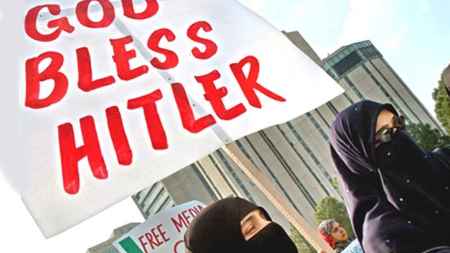
Telling Americans they’re supposed to “atone” for the Holocaust by helping Muslims harass and murder Jews is as backward as trying to apologize for slavery with more slavery.
************************
The dumbest “refugees” meme the left has rolled out to date are the comparisons between the Holocaust refugee policies of FDR that kept out Jews and political leaders today who want to take genuine Christian and Yazidi refugees instead of fake economic Muslim migrants who pose serious terrorism threats.
Living in New York City, I’ve lost count of the number of Muslim terror plots against synagogues since 9/11. The previous Paris attack by Muslims targeted a Jewish supermarket. (Or as Obama put it, “random folks in a deli.”)
Sure it’s #NotAllMuslims. It’s just enough of them that this behavior repeats itself time and time again. Until you end up with European cities like Malmo where there are so many Muslims that the Jews have to flee.
Because Muslims don’t like non-Muslims and really don’t like Jews.
Researchers found that the percentage expressing “favorable views” about Jews was uniformly low: Egypt, 2 percent; Jordan, 2 percent; Pakistan, 2 percent; Lebanon, 3 percent; Palestine, 4 percent; Turkey, 4 percent.
And yes, Muslims in the West also hate Jews.
Belgium: 68 percent of Muslims harbor anti-Semitic attitudes, compared to 21 percent overall;
Spain: 62 percent, compared to 29 percent overall;
Germany: 56 percent, compared to 16 percent overall;
Italy: 56 percent, compared to 29 percent overall;
United Kingdom: 54 percent, compared to 12 percent overall;
France: 49 percent, compared to 17 percent overall.
Theologically, Islam is violently anti-Semitic. Mohammed’s final command was the ethnic cleansing of Jews. The shout Allahu Akbar originated from one of his massacres of Jews.
It’s that simple. Muslims hate Jews. Bringing more Muslims to America makes the country more anti-Semitic. It promotes violence against Jews and harassment of Jews.
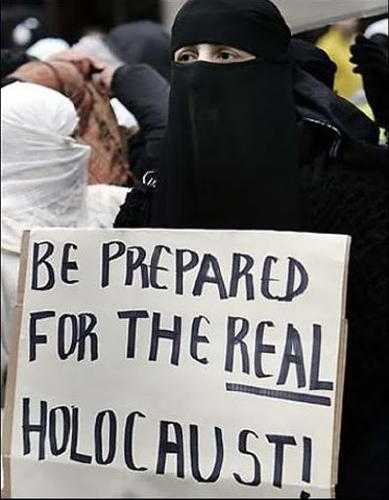
The numbers are in… [NOTE: clicking on the link returns “blank.” — DM)
In France, 73 percent of Jews surveyed said that they had witnessed or experienced anti-Semitism from someone with “Muslim extremist views.”
Why do liberals want to bring this same horrible reality to America?
Telling Americans they’re supposed to “atone” for the Holocaust by helping Muslims harass and murder Jews is as backward as trying to apologize for slavery with more slavery.
The worst possible way to respond to the Holocaust is by promoting the Muslim persecution of Jews in America.
If we want to take the kinds of refugees who are like the Jews in WW2, we should take stateless persecuted minorities, Christians and Yazidis.
Syrian Muslims are not stateless and they are not a minority. They are a supremacist group whose own intolerance of religious differences tore Syria apart. If we bring that intolerance to America, we will all suffer.
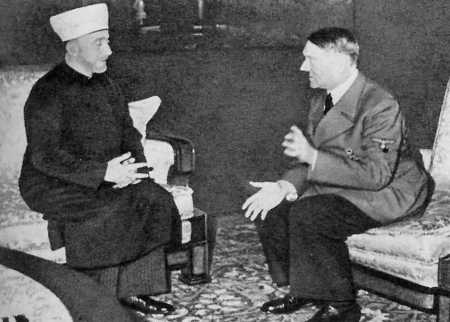
Syrian Muslim migrants are already attacking Syrian Christian refugees in Europe.
Said went across Turkey on foot. He never thought that his problems would only be starting once he made it to Germany.
“In Iran, the Revolutionary Guards have arrested my brother in a house church. I fled the Iranian secret police, because I thought in Germany I can finally freely live by my religion,” says Said. “But in the home for asylum seekers, I can’t even openly admit that I am a Christian.”
Mainly Syrian refugees, mostly devout Sunni Muslims, live in the home. “They wake me before dawn during Ramadan and say that I should eat before the sun comes up. If I refuse, they say, I’m a, kuffar ‘, an unbeliever. They spit at me,” says Said. “They treat me like an animal. And threaten to kill me.”
Why do liberals want to bring this to America? If they don’t care about Syrian Christian refugees, what about gay Syrian refugees?
Rami Ktifan made a snap decision to come out. A fellow Syrian had spotted a rainbow flag lying near the 23-year-old university student’s belongings inside a packed refugee center. The curious man, Ktifan recalled, picked it up before casually asking, “What is this?”
“I decided to tell the truth, that it is the flag for gay people like me,” Ktifan said. “I thought, I am in Europe now. In Germany, I should not have to hide anymore.”
What followed over the next several weeks, though, was abuse — both verbal and physical — from other refugees, including an attempt to burn Ktifan’s feet in the middle of the night.
Bringing these people to America is like bringing Nazis here during the Holocaust to attack minorities here. It’s just evil and wrong.
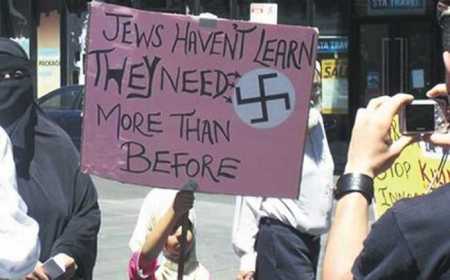
Multiple Paris Attackers Were on U.S. Watch Lists
BY:
November 20, 2015 12:31 pm
Source: Multiple Paris Attackers Were on US Watch Lists
Four of the terrorists behind the deadly attacks in Paris last Friday were listed in a U.S. intelligence community counter-terrorism database, according to multiple U.S. officials.
Moreover, the name of at least one of the terrorists was present on a U.S. “no fly” list.
Reuters reported:
The U.S. officials said four of the attackers who have been publicly named by France were listed before the attacks in TIDE, a central, highly classified database of raw information maintained by the National Counterterrorism Center (NCTC), a division of the Office of the Director of National Intelligence. They did not name those who were listed in TIDE. A paper issued by NCTC last year reported that as of December 2013, TIDE contained “about 1.1 million persons,” many including “multiple minor spelling variations of their names.”
According to the officials, the names of the attackers had been entered into the database after European authorities shared information with the United States. They are not believed to be citizens or residents of the United States, though thousands of names of U.S. citizens are in the database.
Separately, the Terrorist Screening Center (TSC), which is maintained by an official with the FBI, compiles a large list of terrorist suspects called the Terrorist Screening Database in addition to two more selective lists called the “select list” and the “no fly” list.
Three of the anonymous U.S. officials said that one of the Paris attackers, and perhaps more, was on the “no fly” list. A spokesman for TSC would not confirm or deny the report.
Airlines are required to give lists of passengers to TSC so the government entity can screen passengers before flights depart.
The gun attacks and suicide bombings in Paris last Friday killed 129 people and wounded over 350 others. Authorities believe that nine people were behind the attacks, eight of whom are now dead.
Abdelhamid Abaaoud, the terrorist who French authorities suspected was the ringleader behind the attacks, was killed in a police raid in the Paris suburb of Saint-Denis Wednesday.
ANKARA
Friday,November 20 2015
Source: Turkey condemns attack on Syrian Turkmen village, summons Russian envoy – MIDEAST
Turkish Prime Minister Ahmet Davutoğlu has condemned a bombing attack targeting Turkmen villages in Syria, while the Turkish Foreign Ministry has summoned the Russian ambassador over the incident.
“From here, we are once more warning the Syrian regime. We have reacted to all the attacks aimed at civilians close to our border without making any discrimination in regards to whether they have been Turkmen, Arab or Kurdish, not only because they have been Turkmen. At the moment, 40 Turkmen are wounded. We are following the matter village by village,” Davutoğlu told reporters on Nov. 20 an adding Turkish officials contacted their Russian counterparts over the issue.
“In recent days, there have been many intensified attacks against Syrian people in general and against our Turkmen siblings in particular, especially in the Bayırbucak neighborhood. All of last night, we made assessments with our military, intelligence and diplomatic units. Before everything else, this attack has revealed how the Syrian regime is bloody and barbarian,” he said.
“First of all, we are against all kinds of attacks launched against civilian people. The second point, we are against all kinds of attacks leading to a new influx of refugees at our border. The third point: the Bayırbucak Turkmen are our siblings who have lived there for centuries, like other Syrians. We are condemning this barbarian attack against them in the strongest way and once more, calling on everybody to be sensitive to this issue. Nobody can legitimize massacres targeting our Turkmen, Arab and Kurdish siblings there by claiming to have been fighting terror,” Davutoğlu said.
Within minutes of Davutoğlu delivering his remarks, the Turkish Foreign Ministry released a written statement on the same issue.
Upon an order by Foreign Minister Feridun Sinirlioğlu, Russian Ambassador Andrey Karlov was summoned to the ministry, the statement said.
During the meeting with Karlov on Nov. 19, “It was underlined that the Russian side’s actions were bombing civilian Turkmen villages, not fighting terror, which may lead to serious consequences,” Foreign Ministry spokesperson Tanju Bilgiç said in the statement, which came in the form of an official answer to a journalist’s question.
Turkish officials told Karlov they wanted Russia to “end this operation as soon as possible,” Bilgiç said, noting the same kind of warning was also conveyed to Russian Deputy Foreign Minister Mikhail Bogdanov, who is Russian President Vladimir Putin’s special representative for the Middle East and Africa, during a telephone conversation.
Turkey’s state-run Anadolu Agency reported the Syrian regime forces expanded their ground operations on Nov. 19 to the Bayırbucak Turkmen area of the rural town of Latakia.
The agency cited local sources as saying that regime forces, with the support of Russian air strikes, conducted simultaneous attacks on the Fırınlık, Acısı, and Avanlı regions of the Turkmen mountain area near the border city of Kasab.
Ankara has traditionally expressed solidarity with the Syrian Turkmen, who are Syrians of Turkish descent.
President Recep Tayyip Erdoğan has voiced his concern about Russia’s increasing involvement in the Syrian conflict and expressed anger at Russian incursions into Turkish air space in October.
Russia’s air strikes in support of President Bashar al-Assad’s forces have shifted the balance of power in the conflict and dealt a setback to Turkey’s aim of seeing al-Assad removed from power.
The Foreign Ministry said Turkmen villages were subject to “heavy bombardment” by the Russian planes in the Bayırbucak area of northwest Syria, close to Turkey’s Yayladağ border in the Hatay province.
November/20/2015
Defense Ministry
Published time: 20 Nov, 2015 14:57 Edited time: 20 Nov, 2015 15:42
Source: 600 terrorists killed in Russian cruise missile strike in Syria – Defense Ministry — RT News

“On November 20, the warships of the Caspian Fleet launched 18 cruise missiles at seven targets in the provinces of Raqqa, Idlib and Aleppo. All targets were hit successfully,” he said.
The last time the Caspian Fleet took part in the anti-terror operation in Syria was on October 7.
Islamic State (IS, formerly ISIS/ISIL) are suffering huge losses as a result of the Russian offensive, Shoigu said, adding that data on the ground shows that the flow of terrorists arriving in Syria has decreased, while more and more militants are fleeing the warzone to head north and south-west.
Over the past four days, Russian air forces have conducted 522 sorties, deploying more than 100 cruise missiles and 1,400 tons of bombs of various types, the minister stated.
He added that a strike with multiple cruise missiles in the province of Deir ez-Zor had killed more than 600 militants.
Shoigu stressed that the number of aircraft taking part in the operation has been doubled and now consists of 69 jets conducting 143 sorties on a daily basis.
He also added that the Russian military has started cooperating with its French counterparts, as ordered by President Putin.
The Defense Ministry has published a video showing Russian servicemen at the Khmeimim airbase in Syria writing ‘For our people’ and ‘For Paris’ on bombs that were later dropped on the terrorists.
Meanwhile, Russian Foreign Minister Sergey Lavrov and US Secretary of State John Kerry have talked by phone to discuss the need for joint efforts to combat Islamic State in Syria. The pair also discussed the need for talks between Damascus and the Syrian opposition, the Russian Foreign Ministry said in a statement.
Is defeating the Islamic State impossible? Al-Monitor, Ali Hashem, November 19, 2015
(Pretending that the Islamic State is not Islamic won’t defeat it. Neither will pretending that it is “radical” and therefore not representative of “mainstream” Islam. –DM)
While working on a documentary about Islamic State leader Abu Bakr al-Baghdadi, I had the chance to meet Abu Omar, a former IS operative who was once an inmate in the infamous Camp Bucca facility that brought together all those who later became the ruling elite of the most notorious terrorist group in modern history. I asked Abu Omar whether there was any recipe to defeat IS, which seemed unbeatable. In response, he smiled and said, “First, the world will have to really believe it exists — that it’s not an American conspiracy, nor a Turkish secret project, nor an Iranian-Syrian backed organization — that it’s simply the most advanced edition of global jihad resulting from 30 years of experience. It also must not be conceded that no one can win this war.”
Since the abolition of the Ottoman caliphate in 1924, the dream of reviving the caliphate has been alive in the souls of those adopting political Islam as a doctrine. Ordinary Muslims’ feelings of weakness and a sense of disconnection with and lack of support from the regimes that have ruled the Arab and Muslim world grew over time and was inherited by members of the Muslim millennial generation who wanted to belong to an entity that blends power, religion and modernity. IS came with the three together. While many might debate the last point, IS is using cutting-edge technologies in many of their activities, including in the professional use of media tools that fulfill a feeling of superiority through well-crafted videos and clips. As for power, IS was able to prove its strength by creating a de facto state within the borders of Syria and Iraq, challenging the world powers and showing a high level of discipline in the areas under their control. The other element, religion, is the magnet that directly or indirectly attracts people to IS, for the group introduces itself as the guarantor for the application of God’s rule on Earth, and that the caliph is a continuation of the Prophet Muhammad’s legacy.
The fact is that the Islamic State, as a doctrine and practice, has been an unbeatable model in the Sunni Muslim world to those seeking this blend of religion, power and modernity. Sunni and Shiite Islamists shared many similar aspirations until the 1979 Islamic Revolution in Iran succeeded in toppling the Shah; at the time, Sunni Islamists such as Sheikh Abdullah Azzam, the co-founder of al-Qaeda with Osama bin Laden, celebrated Imam Ruhollah Khomeini’s victory in one of Amman’s mosques. Later it became clear that the revolution was more an answer to the aspirations of Shiite Islamists than Sunnis; therefore, the next stop for Azzam and his comrades was Afghanistan, and they later became what were called the Afghan Arabs.
When the creation of the Islamic State was announced, one of the main strategies adopted by its leadership was social engagement. The de facto, self-styled state opened its doors to jihadi foreigners, and thousands came with their families and settled in cities under IS control; according to a UN report, more than 25,000 from over 100 nations have made it to IS territory. Some of them get married to women from tribes in the areas in order to strengthen ties and complicate any attempts to oust IS. The foreign jihadis are persona non grata in their home countries, and if IS falls, their lives and future may be endangered wherever they may be; they have no safe haven but the Islamic State and therefore will fight to the last man standing to keep it alive.
Part of its social and economic strategy was to engage the main tribes in control of the oil business; this helps not only in providing profits but also in strengthening ties with local tribes.
The thinking is that IS tied several knots around its core to make it extremely difficult for enemies to target it effectively. This apparently meant that three years of ground and air operations, international and regional attempts to counter IS and direct media and public campaigns did not effectively harm the group, and now it is able to function in several countries in several continents and is capable of carrying out its tactics with effective command and control, with the multiple attacks in Paris being a strong example.
To defeat IS, the world needs to hit the core of the group, and this means untying the shroud of knots surrounding it and cutting blood off from IS’ heart. A counter model is needed to fight the IS model, a model that is powerful, modern and shows real respect and appreciation for Islam. With such a model it would be easier to deprive the terrorist entity of sympathizers who might become future operatives. As former IS operative Abu Omar told me, “IS is very clever and smart in attracting people with potential; they know how to talk to them and how to address their ambitions. They are also very smart in exploiting mistakes committed by their enemies, and use these mistakes to prove to their supporters why they are the right choice.” He said, “I was behind their walls; therefore, I understand the mentality. If you really want to finish IS, you need to address people’s concerns, let the sheikhs talk to youths and stop making big mistakes. IS is surviving as the result of the dire mistakes committed by governments of the region.”
Defeating IS should not be impossible if the above is addressed and serious military and economic steps are taken to prevent the group from expanding both financially and geographically. This means doing battle on the war fronts and imposing sanctions on countries and individuals financing the group or allowing money to flow to it or buying goods, mainly oil, from territories under its control. Long-term strategic steps must be taken or IS will be here to stay and expand.
Radical Islam: The invisible Enemy, Front Page Magazine, Caroline Glick, November 19, 2015
(Islam has long sought to dominate civilization by establishing a caliphate. Why then, is trying to accomplish that goal considered “radical?” Please see also, Beware of Islamic terrorism. — DM)

Originally published by the Jerusalem Post.
Radical Islam is an ideology that serves both as an organizing principle for civil societies and a military doctrine. By ignoring it, the US and the rest of the free nations of the world have made it impossible to conceptualize or implement a strategy for either discrediting it or defeating its adherents.
On the one hand, there is the Sunni version of radical Islam propounded by the Muslim Brotherhood.
They want the Islamic empire to be an Islamic caliphate. On the other hand, you have the Shi’ite version of radical Islam propounded by the Iranian regime in Tehran. Its adherents want the Islamic empire to be ruled by an ayatollah in Tehran.
Every day the US and its allies maintain their refusal to acknowledge that radical Islam exists and that the regime in Tehran, al-Qaida, IS, Hamas and all the rest are mere expressions of this larger ideology, the danger radical Islam poses to the survival of free societies will continue to mount and grow.
************************
As the cleaning crews were mopping the dried blood from the stage and the seats of the Bataclan concert hall in Paris, a depressing act appeared on stage in distant Iowa.
Saturday night the three contenders for the Democratic Party’s presidential nomination took to the stage in Iowa for a debate. The moderator asked them whether they would be willing to use the term “radical Islam” to describe the ideology motivating Islamic terrorists to massacre innocents. All refused.
Like her former boss, US President Barack Obama, former secretary of state and Democratic frontrunner Hillary Clinton not only refused to accept the relevance of the term. Clinton refused to acknowledge what radical Islam stands for.
She merely noted some of what it rejects.
In her words, “I think this kind of barbarism and nihilism, it’s very hard to understand, other than the lust for power, the rejection of modernity, the total disregard for human rights, freedom, or any other value that we know and respect.”
Her opponents agreed with her.
But of course, it is easy to understand what motivates Islamic terrorists. They tell us all the time.
They want the world to be run by an Islamic empire.
When they are in charge, they will kill, subjugate, convert or enslave all non-Muslims, except Jews.
The Jews will be obliterated.
The attacks they carry out in the Western world are viewed both as battles for the soul of Muslims worldwide and as a means to terrorize non-Muslims into accepting subjugation.
True, there are competing schools inside of the world of radical Islam.
On the one hand, there is the Sunni version of radical Islam propounded by the Muslim Brotherhood.
They want the Islamic empire to be an Islamic caliphate. On the other hand, you have the Shi’ite version of radical Islam propounded by the Iranian regime in Tehran. Its adherents want the Islamic empire to be ruled by an ayatollah in Tehran.
For Americans and the rest of the free world though, this is a distinction without any real meaning.
The radical Islamic goal of destroying America – and the rest of the world – is the same regardless of who ends up winning the intramural jihad contest.
And as we have seen repeatedly in recent years, the sides are happy to come together to achieve their common goal of killing us and destroying our societies.
The Americans’ avoidance of reality is not unique.
The Europeans also refuse to see it.
Following the jihadist massacres at Charlie Hebdo and Hyper Cacher in Paris in January, French President Francois Hollande insisted that the attackers who killed in the name of Islam had nothing to do with Islam.
After jihadists in London beheaded British soldier Lee Rigby outside his barracks in 2013, British Prime Minister David Cameron insisted that the attack, carried out in the name of Islam, had nothing to do with Islam.
The operational consequences of the West’s refusal to acknowledge the nature of the forces waging war against it have been disastrous.
Radical Islam is an ideology that serves both as an organizing principle for civil societies and a military doctrine. By ignoring it, the US and the rest of the free nations of the world have made it impossible to conceptualize or implement a strategy for either discrediting it or defeating its adherents.
Rather than develop comprehensive plans for dealing with this enemy, the Americans, the Europeans and others have opted for a mix of policies running the spectrum from appeasement to whack-a-mole operations.
Abroad, appeasement has taken its most significant form in the US-led nuclear deal with Iran. As the largest state sponsor of terrorism and the most active radical Islamic imperialist force in the Middle East, Iran is the ground zero of radical Islam. It not only oversees and directs the operations of its puppets, like Syrian President Bashar Assad, and its foreign legions, like Hezbollah. The Iranian regime has also played a key role in developing Muslim Brotherhood offshoots like al-Qaida, which received, and likely continues to receive training and direction from Iran’s Revolutionary Guards. As for Islamic State in Iraq and Syria, if Iran had been interested in preventing its rise, IS would never have taken over any territory in either country.
At home, appeasement of radical Islamic forces has involved embracing Muslim Brotherhood front groups and insisting that radical Islamic clerics are moderates because they aren’t pulling any triggers.
The West’s whack-a-mole war against radical Islam at home and abroad has meant that even as one group – like core al-Qaida – is cut down, it is swiftly replaced by other groups, like Islamic State. And if IS is eventually cut down, it too will be replaced by another group, and then reconstitute itself as IS when the West’s attention is taken up by the next major group.
Obama has enabled this state of affairs by defining the enemy as narrowly as possible, reducing the whole sphere of radical Islam to a few discrete groups – like al-Qaeda and IS – that he seeks to defeat or contain.
It is not simply that the whack-a-mole strategy doesn’t work. It is self-defeating. Since the radical Islamic trigger pullers in the West are usually no more than a few people who get together to murder people, insisting that someone has to be a card carrying member of a recognized terrorist group before authorities will go after him makes it almost impossible to find operatives and prevent attacks.
The murderers Friday may well never have received formal orders to commit their attacks from a central jihadist headquarters. They may have met at a mosque in Paris or Brussels and decided to do it.
Certainly they needed no advanced training to mow down people eating dinner or watching a rock concert. They didn’t even really need to know how to shoot straight.
As for their explosives vests, all they needed was a guy with a working knowledge of explosives to set them up with the means to turn themselves into human bombs. Maybe he trained in Syria. Maybe he has a degree in chemistry from the Sorbonne.
Maybe he is just good at following YouTube videos.
The most important component of Friday night’s massacre was the terrorists’ radical Islamic motivation.
Their belief in their ideology motivated them to die killing innocent people. Everything else was secondary. They may have been inspired and loosely directed by the heads of IS. But if Abu Bakr al-Baghdadi had been killed six months ago, they would have found another source of inspiration.
And that’s the main point. While Friday’s killers may have given their allegiance to IS, they were operationally and ideologically all but indistinguishable from their predecessors in the London subways in 2005 and the Madrid commuter rails in 2004 who hailed from al-Qaida. Likewise, while the US may have seriously degraded core al-Qaida in the Middle East over the past seven years, IS in Iraq, Syria, Egypt and Libya is an organic extension of al-Qaida.
To defeat these groups, the US and its allies need to adopt a strategy that is rooted in an acknowledgment of the nature of our true enemy: radical Islam.
Armed with this recognition, the nations of the free world can determine operational guidelines for combating not only specific, discrete groupings of adherents to this ideology, they can develop overall strategies for combating it at home and in the Middle East.
At home, such strategies require Western governments to penetrate, disrupt and destroy radical Islamic networks on the ground in a sustained, concentrated manner. In the Middle East, they require the free world to stop seeking to appease leaders, regimes and militias that support and ascribe to radical Islam.
Sunday night, a group of Parisians stood outside one of the sites of Friday night’s massacre and sang “La Marseilles.” Without fear, a woman garbed in the black robes of radical Islam stepped into the crowd and began bellowing out “Allahu Akbar.” She probably isn’t a card carrying member of IS. Rather, in all likelihood she is just someone who ascribes to radical Islam and so sees France as her enemy.
Assuming the women doesn’t belong to a terrorist group, French officials will not monitor her or her relatives. If she or any of her relatives murder their fellow citizens of France, authorities will probably say they were lone wolves.
Every day the US and its allies maintain their refusal to acknowledge that radical Islam exists and that the regime in Tehran, al-Qaida, IS, Hamas and all the rest are mere expressions of this larger ideology, the danger radical Islam poses to the survival of free societies will continue to mount and grow. Saturday night’s Democratic debate was a depressing reminder how low we have fallen.
–
–
–
–




 anneinpt
 artaxes
 danmillerinpanama
 davidking1530
 Peter Hofman
 Joseph Wouk
 Peter
Peter Louisiana Steve
 WarSclerotic
Recent Comments