Archive for November 9, 2015

Shortly before the Obama-Netanyahu summit, ISIS hit Americans in Jordan

November 9, 2015

Shortly before the Obama-Netanyahu summit, ISIS hit Americans in Jordan, DEBKAfile, November 9, 2015
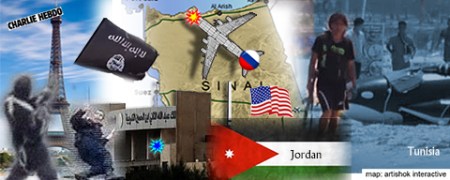
Isis_Jordan480

After the Islamic State succeeded in downing a Russian airliner that took off from Sharm El-Sheikh on October 31, causing the deaths of all 224 passengers and crew, the terrorist organization Monday, Nov. 9, put a US military target in its crosshairs. A captain in the Jordanian police opened fire in the cafeteria of the Special Operations Training Center outside the Jordanian capital, Amman, where American instructors train Iraqi troops to fight ISIS. Two trainers from the US and one from South Africa were initially reported killed and another six wounded, including two more Americans and four Jordanians.

A Jordanian government spokesman said later Monday that the number of fatalities had risen to eight, without specifying how many foreigners.

The gunman did not survive. He was variously reported to have committed suicide after the assault or killed by Jordanian troops.

The modus operandi resembled the “green on blue” insider attacks committed in Afghanistan by al Qaeda and Taliban “insiders” against American and British troops serving at the same base.

Jordan’s Al-Rai newspaper identified the shooter as Anwar Abu Ubayd, but other news outlets said his name was Anwar Abu Zaid.

If the downing of the Russian plane rocked the regime of Egyptian President Fattah El-Sisi, there is no doubt that Monday’s attack will shake King Abdullah’s Hashemite throne.

The attack, furthermore, demonstrated that ISIS is rapidly approaching Israel’s borders with Syria in the north, Egypt in the south and Jordan in the east. The assault gained particular attention as it was carried out just hours before the summit Monday between Israeli Prime Minister Binyamin Netanyahu and US President Barack Obama at the White House in Washington.

They met for the first time after more than a year and after a major row over the Iranian nuclear accord. Both leaders made statements strongly indicating that they had determinedly buried the hatchet and were looking to the future of strong and amicable ties and expanded US support for Israel’s security.

A large part of their two-hour conversation was undoubtedly devoted to the threat posed by ISIS, on which they concur.

Until now, Jordan had been home to the most important and secure US forward base for the war on ISIS in Iraq and Syria.  US air strikes come from bases in Turkey, but more than 10,000 ground troops and special operations forces troops are present in Jordan. The kingdom serves as a training, operations and logistical center for US missions in Iraq and Syria, and for that purpose a command center, the US Central Command Forward-Jordan, was established outside Amman.

Until now, ISIS had not managed to infiltrate Jorda for attacks capable of destabilizing Abdullah’s rule. Numerous infiltration and terrorist attacks were thwarted by Jordanian intelligence and security. The Jordanian authorities focused primarily on keeping the jihads out of the refugee camps housing Syrians and Iraqis in flight from war zones, but this came at the expense of efforts to block the threat from reaching inside the Hashemite kingdom and its security facilities.

Their first success will no doubt embolden ISIS to keep on pressing its advantage. Immediately following Monday’s shooting, Jordan’s military went into high alert nationwide and along its borders. The US, Russia, Egypt, Jordan and Israel are all boosting their vigilance as the threat from ISIS continues to grow. But no one can reliably predict where the Islamist terrorists strike next.

The high price the world could pay for Obama’s Syria, Iraq policy

November 9, 2015

The high price the world could pay for Obama’s Syria, Iraq policy, Center for Security Policy, Fred Fleitz, November 9, 2015

1896925188

As I’ve discussed on Fox News.com before, President Obama’s Syria/Iraq policy is not a policy.  It is a non-policy to do as little as possible about the chaos in these countries so he can hand this mess to the next president.

The Obama administration has announced two major policy shifts in two years to deal with the Iraq/Syria crisis and the threat from ISIS.  Neither exhibited the decisive leadership that the world expects from the United States.  Both were reactive and piecemeal moves to counter multiple humiliations of America.

This has created a growing global perception of American weakness and indecisiveness that will embolden America’s enemies for the remainder of the Obama presidency and possibly beyond.

The first policy shift, announced in a speech by President Obama on September 10, 2014 in response to a series of ISIS beheadings, was supposed to “degrade and ultimately defeat” ISIS.  The president said this effort would include “a systematic campaign of airstrikes” in Iraq and Syria, training and equipping of moderate Syrian rebels, increased support to the Iraqi army and stepped up humanitarian assistance.

The failure of the September 2014 policy shift was obvious soon after it began.  Pinprick airstrikes in Syria did not stop ISIS from making gains on the ground.  In Iraq, ISIS took the city of Ramadi last May despite being outnumbered 10-1 by the Iraqi army.  The Iraqi army and the Iraqi Kurds clamored for more arms while the Obama administration sat on its hands.

Obama’s 2014 policy shift suffered a spectacular collapse this fall when a failed $500 million program to train and equip moderate Syrian rebels was cancelled and Russia intervened in Syria and began conducting airstrikes against anti-Assad rebels, many backed by the United States.  Iran also stepped up its presence in Syria by sending troops who are fighting to prop up the Assad government.

This rapid collapse of President Obama’s Syria/Iraq policy over the last few weeks has caused serious damage to American credibility.  Russian President Putin mocked and ignored President Obama as he sent Russian forces into Syria.  An intelligence sharing agreement was signed between Russia, Syria, Iraq and Iran.  Iraqi lawmakers even called on Russia to conduct airstrikes against ISIS positions in their country.

The Obama administration responded to these setbacks with a new policy shift that looks even worse than the last one.

The president is sending “fewer than 50” special operations troops to help advise an alliance of Syrian Arab rebels.  Given the lack of a clear policy and confusing rules of engagement, such a small deployment will be scoffed at by America’s adversaries and may be at risk of being captured.  On Monday, President Obama made the preposterous claim that this deployment is consistent with his pledge of “no boots on the ground” in Syria and Iraq because these troops will not be on the front lines fighting ISIS.

The New York Times reported on November 2 the Syrian Arab rebel alliance that U.S. special operations troops are supposed to be advising doesn’t yet exist and is dominated by Syrian Kurds who mostly want to carve out their own state and have little interest in fighting to take back Arab territory from ISIS.  Moreover, American military support of the Syrian Kurds worries Turkey because of their close ties with the PKK, a Kurdish terrorist group in Turkey.

The U.S. dropped 50 tons of weapons for the Arab alliance in late September.  Although U.S. officials initially said Syrian Arabs and not Syrian Kurds were the recipients of the airdrop, according to the New York Times, Syrian Kurdish fighters had to retrieve these weapons because the Arab units for which they were intended did not have the logistical capability to move them.

The Obama administration’s latest Iraq/Syria policy shift includes a renewed call for Assad to leave office and a new round of Syrian peace talks.

New U.S. demands that Assad step down make little sense due to increased Russian and Iranian support.

The first round of U.S.-brokered Syrian peace talks were held last week in Vienna.  17 nations participated, including, for the first time, Iran.  The talks produced a vague communique endorsing a future cease-fire, a transitional government, a new constitution and elections in which Syrians would select a new government.  However, it seems unlikely the Assad regime – which was excluded from the talks – or its Russian and Iranian backers will ever support free and fair elections.

Russia and Iran rejected a timeline proposed by U.S. Secretary of State John Kerry at the peace talks under which Assad would step down in four to six months and national elections would be held in 18 months.  This puts a cease-fire out of reach since most Syrian rebels will not agree to a peace process that leaves Assad in power.

The Syria talks were overshadowed by the unwise decision by the Obama administration to include Iran because its presence legitimized its interference in Syria and Iraq.  This also made the talks tumultuous due to open feuding between Iranian and Saudi officials.  More talks are scheduled but Iranian officials have said they may not participate due to their differences with the Saudis.

So far, Mr. Obama has not agreed to Pentagon recommendations to back Iraqi forces with Apache helicopters or to allow U.S. military advisers to serve on the front lines with Iraqi forces.  These proposals are still reportedly under consideration.  Meanwhile, Republican congressmen continue to demand the Obama administration directly arm the Iraqi Kurds who are struggling to battle ISIS with inadequate and obsolete weapons.

America’s friends and allies know President Obama is pursuing a Syria/Iraq non-policy to run out the clock.  They know Mr. Obama’s initiatives are not serious policies but minor gestures that allow the president to be seen as doing something now while also enabling him to claim after he leaves office that he did not put U.S. boots on the ground in Iraq and Syria nor did he get America into another war.

Alliances in the Middle East are already shifting because of President Obama’s Syria/Iraq non-policy.  Russia is filling a power vacuum in the region and is building a new alliance with Iraq, Iran and Syria.  Russia has improved its relations with Egypt and Israel. Although the Saudis are working with the Obama administration to arm moderate Syrian rebel fighters, Riyadh is frustrated that the U.S. is considering compromise solutions which could leave Assad in power.  Saudi Arabia also reportedly is considering providing surface-to-air missiles to the Syrian rebels, a move the U.S. opposes since these missiles could fall into the hands of ISIS.

America’s enemies are certain to try to exploit the run-out-the-clock foreign policy that President Obama apparently plans to pursue for the remainder of his term in office.  This could mean a surge in global provocations, terrorism and violence from North Korea to the South China Sea to Afghanistan and to the Middle East due to the disappearance of American leadership over the next 15 months.

Remember that the weakness and incompetence of President Clinton’s foreign policy emboldened Al Qaeda to step up terrorist attacks against U.S troops and led Osama bin Laden to believe that the September 11, 2001 terrorist attacks would drive the United States from the Middle East.  With Barack Obama dithering away America’s global credibility, a catastrophic terrorist attack like 9/11 could happen again.

Prisons: microcosms of Islamic supremacy and western idiocy, Front Page Magazine

November 9, 2015

Prisons: microcosms of Islamic supremacy and western idiocy, Front Page MagazineRaymond Ibrahim, November 9, 2015

muslim-convicts

Islam’s Rule of Numbers holds that, wherever and whenever Muslims grow in numbers, the same acts of “anti-infidel” violence that are endemic to the Islamic world grow with them.

This has become especially evident in one Western institution that has a disproportionately large number of Muslims: prisons.  Several anecdotes just surfaced last month alone.

Whitemoor prison in Cambridgeshire recently became the first Muslim-majority prison in Britain.  Between the ages of 22 and 39, Muslims now represent 56 per cent of the population there.  “Prisoners and staff found the Muslim presence overwhelming” says a recent report. Non-Muslims “were often bullied into converting to Islam, and those who resisted were too scared to cook pork in communal kitchens in case it caused offence.”

As for those non-Muslim inmates who refuse to convert, they are being pressured to pay a “protection tax”—or in Islamic parlance, jizya—to Muslim gangs.  Along with Whitemoor prison, the collection of jizya is taking place in at least three other of Britain’s largest prisons.  According to a new investigation “religious extremists in prison are using bullying tactics and violent threats to force prisoners to convert or pay money.  Tobacco and other luxury commodities smuggled inside prisons are often used by non-Muslims to pay the tax, while some victims said they had to ask friends and family for money….  Faced with the option of paying up or suffering at the hands of the radicals, some prisoners have been pressured into converting to Islam to ease their time in prison.”

A Whitehall source said that “the tax may have been inspired by the actions of ISIS, who are well known to demand jizya from non-Muslims living in Syria and Iraq.”

In fact, it is the Koran, Islam’s holy book, that calls for the collection of jizya from subdued Christians and Jews:

Fight those among the People of the Book [Christians and Jews] who do not believe in Allah nor the Last Day, who do not forbid what Allah and His Messenger have forbidden, and who do not embrace the religion of truth [Islam], until they pay the jizya with willing submissiveness and feel themselves utterly subdued” (Koran 9:29).

In other words, Muslim prisoners are not copying ISIS; rather, both they and ISIS are obeying the Koran.

Meanwhile, down under, in Australia’s highest security prison, “an extremist ISIS gang … has threatened to behead correctional officers and inmates unless they convert to radical Islam.”  At least 30 Muslim gang members residing in Goulburn jail “have engaged in warfare against ‘infidel’ that oppose their religious ideologies.”

“They were going to take a hostage — one of the six Christians in the yard — and behead them,” reported a prison guard.

Bullying and threatening non-Muslims into converting to Islam or else demanding money (jizya) from them if they refuse is a regular occurrence around the Muslim world, wherever “infidel” minorities live side by side with Muslim majorities.  As Muslims make for disproportionately large numbers in Western prisons—another fact that speaks for itself—it should come as no surprise that coercion, threats, and extortion in the name of Islam are also becoming a regular occurrence.

Ironically, one may have supposed that, if anywhere, it would be in prisons that the Muslim sense of supremacism would be broken.  Far from it; Western prison policies—whether banning pork for all inmates to appease Muslims (in an Ohio prison), allowing prayer mats where knives are concealed and used, spending thousands of tax payer dollars to rebuild toilets to face away from Mecca, apologizing for serving non-halal food to Muslim criminals, or possibly accommodating the Salafi beard against prison policies—all serve to confirm Muslims in their sense of supremacy.

This is to say nothing about the fact that lax and politically correct policies have made prisons prime recruiting grounds for the jihad.  One U.S. prison was referred to as a “terrorist university” for the Islamic State and one U.K prison allowed the distribution of a jihadi book calling on the slaughter of non-Muslim “infidels.”

Thus prisons have become microcosms of Islamic behavior vis-à-vis “infidels”—replete with a sense of violent Islamic supremacism on the one hand and craven political correctness on the other.

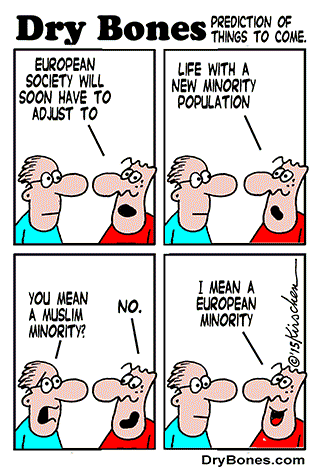
Cartoon of the day

November 9, 2015

H/t Dry Bones

D15B04_1

As U.S. Escalates Air War on ISIS, Allies Slip Away

November 9, 2015

As U.S. Escalates Air War on ISIS, Allies Slip Away

By ERIC SCHMITT and MICHAEL R. GORDON

NOV. 7, 2015

Source: As U.S. Escalates Air War on ISIS, Allies Slip Away – The New York Times


A strike by the Saudi-led coalition hit a Houthi weapons depot in Sana, Yemen, in September. Credit Mohamed Al-Sayaghi/Reuters

AL UDEID AIR BASE, Qatar — As the United States prepares to intensify airstrikes against the Islamic State in Syria, the Arab allies who with great fanfare sent warplanes on the initial missions there a year ago have largely vanished from the campaign.

The Obama administration heralded the Arab air forces flying side by side with American fighter jets in the campaign’s early days as an important show of solidarity against the Islamic State, also known as ISIS or Daesh. Top commanders like Gen. Lloyd J. Austin III, who oversees operations in Syria and Iraq, still laud the Arab countries’ contributions to the fight. But as the United States enters a critical phase of the war in Syria, ordering Special Operations troops to support rebel forces and sending two dozen attack planes to Turkey, the air campaign has evolved into a largely American effort.

Saudi Arabia and the United Arab Emirates have shifted most of their aircraft to their fight against Iranian-backed Houthi rebels in Yemen. Jordan, reacting to the grisly execution of one of its pilots by the Islamic State, and in a show of solidarity with the Saudis, has also diverted combat flights to Yemen. Jets from Bahrain last struck targets in Syria in February, coalition officials said. Qatar is flying patrols over Syria, but its role has been modest.

“They’ve all been busy doing other things, Yemen being the primary draw,” Lt. Gen. Charles Q. Brown Jr., who leads the air war from a $60 million command center at this sprawling base in Qatar, said of the Arab allies. He added that those allies still fly periodic missions in Syria and allow American jets to use their bases.

The United Arab Emirates last carried out strikes in Syria in March; Jordan in August; and Saudi Arabia in September, according to information provided by allied officials last week. But the Arab allies insist they are still playing an essential, if less active, military role in the war.

“Jordan’s commitment to this fight is unwavering,” said Dana Zureikat Daoud, a spokeswoman for the Jordanian Embassy in Washington. “We remain an active partner and contributor to the international coalition, and continue to conduct airstrikes against Daesh targets.”

The engagement of Western allies, like France and Australia, has also been limited. They have conducted a smattering of strikes in Syria, but have reserved most of their firepower for Islamic State targets in Iraq. Canada’s new prime minister, Justin Trudeau, has promised to fulfill his campaign pledge to end Ottawa’s role in the air campaign altogether. And none of the Western allies appear eager to join the United States in basing warplanes at Incirlik air base in Turkey, a move that would make it easier to increase strikes against militants in northern Syria and Iraq.

So far, eight Arab and Western allies have conducted about 5 percent of the 2,700 airstrikes in Syria, compared with 30 percent of the 5,100 strikes in Iraq, where many NATO partners also fly missions against the Islamic State. But the United States was always likely to fly the majority of the missions in Syria, as it does in Iraq, since its air forces are much larger than those of the Arab states or any forces deployed by Western allies.

Defense Secretary Ashton B. Carter has promised Congress that the air war in Syria will escalate “with a higher and heavier rate of strikes,” including more attacks against top Islamic State leaders and oil fields that remain one of the group’s main financial lifelines. But the revamped effort is already facing challenges.

For the first time since 2007, the United States does not have an aircraft carrier in the Persian Gulf and will not again until mid-December; the Navy needed time to conduct badly needed repairs on its fleet. The aircraft carrier Theodore Roosevelt and its air wing, responsible for about 10 percent of the daily strikes in Iraq and Syria, left the gulf in early October. France said on Thursday that it would send its only aircraft carrier to the gulf to help fill the gap.

General Brown said the coalition could also pick up the slack using land-based American and allied warplanes, including a dozen A-10 ground-attack planes newly deployed to Incirlik air base, and a dozen F-15’s on their way there.

Incirlik is far more convenient to the fight — 15 minutes flight time to the Syrian border compared with nearly five hours from Persian Gulf bases — making it easier to increase the number of planes that can spend more time hunting Islamic State targets. But Australia and most of the European allies are reluctant to leave their bases in the Middle East, despite the shorter flight times.

“It’s not just as simple as, ‘go to Turkey,’ “ Gen. John R. Allen, the special American envoy to the coalition fighting the Islamic State, told Congress last month. “They’ve got bilateral relationships in the gulf that are old, and have been cultivated in order for them to deploy.”

So while France will still conduct airstrikes in Syria — it has carried out about 270 strikes in Iraq and Syria over all, though only two so far in eastern Syria, a senior French official said — it will continue to fly out of Jordan and the United Arab Emirates, at least for now. The Australians will continue F/A-18 combat missions over Syria that began on Sept. 11, expanding beyond strikes in Iraq. But they, too, do not want to give up their base in the United Arab Emirates.

Britain has talked tough about going after the Islamic State, but unlike France, its actions have not matched its talk. Britain currently flies bombing missions over Iraq and intelligence, surveillance and reconnaissance flights over Syria.

Report: Iraq sends back Kurdistan-bound coalition planes to Turkey, Kuwait

November 9, 2015

Report: Iraq sends back Kurdistan-bound coalition planes to Turkey, Kuwait

ANKARA

Monday,November 9 2015

Source: Report: Iraq sends back Kurdistan-bound coalition planes to Turkey, Kuwait – MIDEAST

Iraqi Defense Ministry has sent back two aircrafts carrying weapons to Iraq’s Kurdistan region to Turkey and Kuwait after detaining them for a few days, the Doğan News Agency (DHA) reported.

“Upon an order by the Iraqi Armed Forces Command, the two planes which were carrying weapons to Kurdistan have been deported and sent back with their entire cargo to their bases in Kuwait and Turkey after being withheld at Baghdad International Airport for a few days,” DHA quoted a written statement released by the Iraqi Defense Ministry on Nov. 9.

As of Nov. 2, an English-language Iranian news agency, the Fars News Agency (FNA), reported that the Iraqi government seized two planes of the member states of the U.S.-led coalition against the Islamic State of Iraq and the Levant (ISIL) that were carrying weapons to the Kurdistan Region without prior coordination or information-sharing with Baghdad.

“The inspection committee in Baghdad International Airport has found a huge number of rifles equipped with silencers, as well as light and mid-sized weapons,” the agency quoted the head of the Iraqi Parliament’s Security and Defense Commission, Hakem al-Zameli, as saying at the time.

Zameli told the agency that a Swedish and a Canadian airplane were going to fly to the same region but were seized after arms cargo was discovered.

Turkish officials have not yet been available for comment on the news reports.

November/09/2015

Iran ‘Rocket Kitten’ cyber group hit in European raids after targeting Israeli scientists

November 9, 2015

Iran ‘Rocket Kitten’ cyber group hit in European raids after targeting Israeli scientists

Source: Iran ‘Rocket Kitten’ cyber group hit in European raids after targeting Israeli scientists – Middle East – Jerusalem Post

FRANKFURT – European authorities have taken action to shut down a cyber espionage operation linked to Iran’s powerful Revolutionary Guard in the first operation of its kind since Tehran signed a nuclear treaty, according to security researchers who located computers used to launch attacks.

The hacker group – dubbed “Rocket Kitten” by security experts who have been hunting the hacker group since early 2014 – has mounted cyber attacks on high-profile political and defense figures globally since that time.

The action is likely to hamper Tehran’s efforts to gather sensitive intelligence from rivals including Saudi Arabia, Israel, Turkey, the United States and Venezuela, which were among the nations targeted.

Researchers from US-Israeli security firm Check Point Software said the 1,600 high-profile targets include members of the Saudi royal family, Israeli nuclear scientists, NATO officials and Iranian dissidents and even the wives of high-ranking generals from unnamed countries.

The company said it had informed national computer security response teams in Britain, Germany and the Netherlands, who in turn alerted police in those countries to the locations of “command and control” servers used to mount attacks controlled from Iran.

Europol, the FBI and Israel’s internal security service Shin Bet declined immediate comment.

The actions come as US President Barack Obama and Israel’s Prime Minister Benjamin Netanyahu prepare to meet on Monday for the first time since the Israeli leader lost his battle against the Iran nuclear deal and security issues top the agenda.

Check Point plans to issue a report later on Monday. According to an advance copy obtained by Reuters, the report details how its experts burrowed inside the hacker group’s database, giving them a map of malicious software tools and remote-controlled computers used by the group.

Biden: “no excuse” for Israelis talking about Obama and Kerry in “derogatory terms”

November 9, 2015

Biden: “no excuse” for Israelis talking about Obama and Kerry in “derogatory terms,” Front Page Magazine, Daniel Greenfield, November 9, 2015

bald_biden

There’s no excuse for Tehran Joe Biden ever talking about international policy. There’s also no excuse for Israelis or anyone else not referring to Obama in derogatory terms.

But Biden chose to get on his high horse anyway…

“There is no excuse, there should be no tolerance for any member or employee of the Israeli administration referring to the president of United States in derogatory terms. Period, period, period, period!”

“There is no justification for an official Israeli voice degrading the secretary of state, who has worked so hard, for so long for the security of Israel,” Biden continued.

Three periods. That’s a lot of periods.

Biden seems to have forgotten the time his regime’s staffers decided to refer to Netanyahu as “chickenshit” or Obama’s live mic moment while slamming Netanyahu.

John Kerry has worked for the “security of Israel” by pressuring Israel to release large numbers of terrorists. Can Israeli victims of terror degrade Kerry… or just suffer because of him?

Meanwhile here are the comments, made by Baratz before his appointment, that Biden described as “terrible”.

After President Barack Obama reacted to the speech delivered by Netanyahu in Congress in March, Baratz wrote: “This is what modern anti-Semitism looks like in western liberal countries. And of course, it comes with a lot of tolerance and understanding toward Islamic anti-Semitism. So much tolerance and understanding, until they are even willing to give them nukes.”

In October of 2014, he wrote about a speech in which Secretary of State John Kerry “made a connection between Israel and ISIS.” He wrote commented sarcastically:  “After his term as secretary of state he is certain to have a flourishing career in one of the stand-up comedy clubs in Kansas City, Mosul, or the Holot detention facility.” Elsewhere, he reportedly said Kerry had “the mental age of a 12-year-old.”

So Baratz called Obama a bigot who panders to Muslim terrorists and suggested that Kerry was an idiot and a joke.

Is stating obvious facts really such a terrible thing?

But like all social justice warriors, Obama Inc. excels at pretending to be deeply hurt and offended by its victims. Biden’s fake outrage is as real as his hair. Maybe Biden should take himself to a safe room.

“We simply will not,” Biden said, “permit Iran to acquire a nuclear weapon. Period. Period.”

Is it just me or do Biden’s periods seem insincere?

Defense Secretary Suggests Putin Might Nuke America, Says US Will “Defend International Order”

November 9, 2015

Defense Secretary Suggests Putin Might Nuke America, Says US Will “Defend International Order”

by Tyler Durden on 11/08/2015 20:01 -0500

Source: Defense Secretary Suggests Putin Might Nuke America, Says US Will “Defend International Order” | Zero Hedge

Defense Secretary Ash Carter is a funny guy. We’re not out to disparage him personally (although we’ll happily disparage Washington’s foreign policy for which he is partially responsible), but he sure does have an uncanny ability to land himself in situations that end up generating amusing photo ops. Here are just two examples from last week:

“Show me some love”…

“Just listening to Kenny Loggins in my headphones with my water bottle and yeah, since you asked, that’s my aircraft carrier down there”…

Of course to be fair to Carter, Washington hasn’t exactly put him in a good position. After all, what the US is doing in Syria is deplorable and with the passing of MANPADS and anti-tank missiles to Sunni extremists near Aleppo, the whole “strategy” now borders on the bizarre, especially in light of what happened over the Sinai Peninsula last weekend and also taking into account Washington’s relationship with Siite militias battling ISIS in Iraq.

Meanwhile, the situation in the South China Sea is just downright silly, as Washington and Beijing risk starting World War III over 3,000 acres of sand that Beijing piled on top of reefs in the Spratlys.

Still, when you’re the face of The Pentagon, you’ve got to champion the narrative and that narrative now revolves around two things, i) a resurgent Russia, and ii) the rise of China. 

Put simply (and colloquially), more than one US military strategist believes the US and NATO would be “annihilated” in a Balkan battle with the Russians and when it comes to China, well, getting into a maritime dispute in the South Pacific (which is the right way to analyze this by the way, because it’s not like Beijing is going to sail into San Francisco and invade the US mainland) might be a horrible idea:

So, against that backdrop, and with Russia’s dramatic intervention in Syria in mind, Ash gave a keynote speech during the annual Reagan National Defense Forum in southern California, on Saturday.

Below, we present the “highlights” as documented by the DoD and the video clip courtesy of AP. Enjoy your Sunday evening US foreign policy briefing and please do note that Carter suggests Putin wants to nuke America:

“In the face of Russia’s provocations and China’s rise,” Carter said, “we must embrace innovative approaches to protect the United States and strengthen that international order.”

Russia is violating sovereignty in Ukraine and Georgia and is trying to intimidate the Baltic states, and in Syria it is prolonging a civil war, the secretary added.

“At sea, in the air, in space and in cyberspace, Russian actors have engaged in challenging activities,” he told the audience, noting that Moscow’s nuclear saber-rattling raises questions about Russian leaders’ commitment to strategic stability.

“We do not seek to make Russia an enemy,”Carter said. “But make no mistake. The United States will defend our interests, and our allies, the principled international order, and the positive future it affords us all.”

Carter said the United States is modernizing its nuclear arsenal to ensure America’s nuclear deterrent, investing in new unmanned systems, a new long-range bomber, and innovation in technologies like the electromagnetic rail gun, lasers and new systems for electronic warfare, space, cyberspace, and others.

“And we’re accordingly transforming our posture in Europe to be more agile and sustainable,” the secretary said.

Photographer Captures Amazing Time-Lapse Video Of Trident Ballistic Missile Launch

http://www.zerohedge.com/news/2015-11-08/photographer-captures-amazing-time-lapse-video-trident-ballistic-missile-launch

Earlier today, we reported that just after 9pm local time on Saturday evening, a dramatic white light lit up not only all of California, but stretches of Arizona and Nevada, in what was subsequently revealed to be an unannounced launch of a Trident II (D5) missile from the Kentucky, an Ohio-class ballistic missile submarine situated off Point Mugu. But while the entire internet was throttled under the weight of millions of snapshots and short underexposed clips of the missile flight being uploaded to YouTube, Facebook and Twitter, one person captured the whole event in its dramatic entirety on time-lapse photography.

That person was Justin Majeczky, who was conducting time-lapse photography above the Golden Gate bridge, when he noticed an unexpected object in his viewfinder: an ICBM.

The result, first noted by Foxtrot Alpha, is 3 minutes of breathtaking imagery that not only catches the missile emerging from the horzion following its submarine launch, but disappearing far off into the sky on its long voyage to the Marshall Islands.

https://vimeo.com/145029572

Nothing personal about Obama’s consistent hostility toward Israel

November 9, 2015

Nothing personal about Obama’s consistent hostility toward Israel, Human Rights Voices, Anne Bayefsky, November 9, 2015

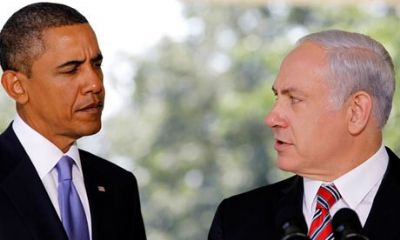
barack-obama-and-binyamin-009President Obama with Prime Minister Netanyahu (file photo)

Much ink has been spilled blaming the state of U.S.–Israel relations on the poor personal rapport between President Obama and Prime Minister Netanyahu. The fact is that huggable Barney the Purple Dinosaur could have been Israel’s elected leader, and the relations would have been equally hostile.

For seven decades from the moment of Israel’s birth – through five wars, one campaign, eight operations, two “uprisings,” and years of terrorism – Palestinian Arabs have done everything possible to avoid living peacefully side by side with a Jewish state.

This isn’t ancient history. It’s today.

Here is Palestinian leader Mahmoud Abbas speaking to the U.N. Human Rights Council in Geneva on October 28, 2015:

    The situation . . . as a result of the continued Israeli occupation and its practices is the worst and most critical since 1948. . . . How long will this protracted Israeli occupation of our land last? After 67 years for how long do you think it is possible for it to continue? . . . Seventy years of suffering, injustice, oppression, and deprivation, and the perpetuation of the longest occupation known to mankind in modern history.

The Palestinian narrative has never varied: Israel has been built on occupied Arab territory – not since 1967, but since 1948. That’s why Palestinians claim a “right of return” whose very purpose is their ideal “one-state solution” – one state where Jews are demographically outnumbered.

Standing in the way of the Palestinians’ one-state goal has been Israel’s and America’s unwavering commitment to a negotiated final resolution of the conflict. A negotiated resolution would legitimize each side and leave both parties still standing.

Hence, the Arab side has sought to eschew negotiations in two ways: first, directly, by the use of force; and, second, indirectly, by insisting on externally imposed “solutions” via multilateral entities where Israel is outnumbered – such as the United Nations.

This isn’t fantasy. It’s fact.

Here is Abbas at the U.N. General Assembly on September 30, 2015: “It is no longer useful to waste time in negotiations.”

In contrast, here is Netanyahu at the U.N. General Assembly on October 1, 2015: “I am prepared to immediately, immediately, resume direct peace negotiations with the Palestinian Authority without any preconditions whatsoever.”

So when President Obama announced on November 6, 2015, via Rob Malley, Middle East coordinator at the National Security Council, that there was an allegedly “new” “reality” in which “the parties are not going to be in a position to negotiate a final status agreement” during his presidency, he was adopting the Palestinian playbook.

This means the president will not spend his final year doing the only thing that would move the ball forward – namely, pressuring Abbas to choose diplomacy and negotiations over violence and third-party coercion. Rather, Obama will attempt to impose his will on Israel, the U.N. being the obvious modus operandi. After all, this president chose the Security Council over Congress on the Iran deal. He can let the Council do the dirty work on Israel, too. Indeed, over the past month, Samantha Power, the U.S. ambassador to the U.N., has been laying the groundwork for just such a treacherous strategy.

Back up to October 3, 2015. A knife-wielding Palestinian attacked Adele Banita, a young Israeli mother, while she walked in Jerusalem’s Old City with her husband Aharon, two-year old son, and infant daughter. Adele lived to tell the tale, supported by video evidence. Her 21-year-old husband lay dying, her son was wounded, and she suffered multiple stab wounds. With a knife still lodged in her body, she cried out for help to nearby Arab shopkeepers, who looked on. Instead of coming to her aid, they spit on her, laughed, told her to die, and stood by. A Jewish man who came to the family’s aid was knifed to death.

But on October 22, 2015, Samantha Power made this shocking statement to the Security Council: “In Jerusalem, shoppers and merchants are on edge. . . . Said an Arab shopkeeper in the old city, ‘When I prepare the juice, I am scared to cut the oranges in case someone sees me with the knife and shoots me.'”

Rather than tell the real-life story of the actual Arab shopkeepers and their pathologically violent Jew-hatred, Ambassador Power peddled the tale of an Arab shopkeeper’s imagining himself to be a victim – in the same place as Banita’s real killers.

Power continued by calling on “both parties” to “exercise restraint.” The Palestinians heard loud and clear the message of moral relativism and impunity for Palestinian incitement.

Days later, on November 3, 2015, Riyad Mansour, the Palestinian ambassador to the U.N., wrote a formal letter to the U.N. claiming that, in October, Palestinian “bodies were returned with missing corneas and other organs, further confirming past reports about organ harvesting by the occupying Power from the Palestinian victims of its brutality.”

Add to this Power’s statement to the Security Council on October 16, 2015, in which she explained that Jews living in settlements (on what is legally disputed territory whose ownership is subject to negotiations) and Jews dying at the hands of “frustrated” terrorists were part of a “cycle of escalation.”

Not surprisingly, the Palestinians’ murderous rampage continues.

Anyone who believes that the president’s toxic foreign policy on Israel is a mere personal vendetta against a foreign leader he doesn’t like is giving Obama far too little credit. His foreign policy has never wavered: He sought “daylight” between himself and Israel. He has achieved a chasm.

The only question left is how much more blood the president can extract from Israel in his last twelve months.