Archive for August 2015

Introducing Yasser Abbas – the son whom the Palestinian leader plans to succeed him

August 25, 2015

Introducing Yasser Abbas – the son whom the Palestinian leader plans to succeed him, DEBKAfile, August 25, 2015

Yasser_AbbasYasser Abbas is tagged to succeed his father as Palestinian leader

The reports swirling around the Arab world over the Palestinian leader Mahmoud Abbas’s decision to quit disguise the octogenarian’s next plans. According to our Middle East sources, Abbas (known to all as Abu Mazen) has confided to his close circle that he has lost faith in President Barack Obama, whom he accuses of deserting the Palestinian cause, and in Secretary of State John Kerry, whom he has nicknamed “the tall liar.” He is now looking for new champions, possibly in Tehran, while at the same time shoring up his rule over the Palestinian Authority and designing his legacy.

Abbas joins the list of regional allies who feel abandoned by the Obama administration, like the Saudi King Salman bin Abdulaziz, Egyptian President Abdel-Fatteh El-Sisi and, up to a point, Israel’s Binyamin Netanyahu. For the immediate future, Abu Mazen is developing a comprehensive plan for replacing his enemies on the PLO’s Executive Committee with young faces, chosen for their ability to preserve the Abbas clan’s majority in this key institution and uphold his guiding principles for the Palestinian movement.

Since the end of July, his henchmen, Saeb Erekat, Akram Haniya and Palestinian General Intelligence chief Mejad Freij have been working on this blueprint.

They are to complete their project by September, when Abbas plans to introduce his choice of new leaders to the Executive Committee. They will consist mainly of the sons of the founders of the PLO and his own Fatah party.

Some of their names are unknown outside the Palestinian Authority’s seat in Ramallah. DEBKAfile reports that prominent among them are Sabry Shayden – son of the PLO’s first chief of staff; Maher Ghanem –  son of Abu Maher Ghanem, the Fatah Party’s first organizer; and also Gen. Majid Freij, Ayman Makbul from Nablus and Fahmi Zar’ir from the Gaza Strip.

The most important new face will be that of Yasser Abbas – Mahmoud Abbas’ own son.

The new appointments will herald another change: the PLO Exective Committee is to be elevated as the supreme Palestinian ruling institution, with jurisdiction over the Palestinian Authority and Palestinian government.

Abu Mazen is shaping this reshuffle to guarantee that his immediate successor as PA Chairman – mostly probably Erekat, whom the West knows as the most public Palestinian negotiator – will give up his seat when the time comes to make way for Yasser Abbas.

In this way, Mahmoud Abbas hopes to keep control of the Palestinian movement in the hands of his dynasty. His son, aged 52, who was named in honor of the late Yasser Arafat, moved from Ramallah to Canada in 1997 and built a business career.

A civil engineering graduate from Washington State University, he owns a string of companies in Canada, the Gulf and the West Bank. Among them is Falco Tobacco, which holds the sole agency for the distribution of American cigarettes in the Palestinian territory.

There are many rumors about how he made his fortune, including corrupt practices in high Palestinian circles. Little is known about his politics. When interviewed on occasion, he prefers to dwell on how he made his money rather than expanding on public affairs that concern his people. His good connections in Washington will no doubt be useful for opening a new chapter with the US when he takes over.

No date has been set for an Abbas visit to Tehran. It will be interesting to see whom he picks for the party to accompany him if and when it takes place.

Traitor senators took money from Iran lobby, back Iran nukes

August 25, 2015

Traitor senators took money from Iran lobby, back Iran nukes, Front Page Magazine, Daniel Greenfield, August 25, 2015

em

Senator Markey has announced his support for the Iran deal that will let the terrorist regime inspect its own Parchin nuclear weapons research site, conduct uranium enrichment, build advanced centrifuges, buy ballistic missiles, fund terrorism and have a near zero breakout time to a nuclear bomb.

There was no surprise there.

Markey had topped the list of candidates supported by the Iran Lobby. And the Iranian American Political Action Committee (IAPAC) had maxed out its contributions to his campaign.

After more fake suspense, Al Franken, another IAPAC backed politician who also benefited from Iran Lobby money, came out for the nuke sellout.

Senator Jeanne Shaheen, the Iran Lobby’s third Dem senator, didn’t bother playing coy like her colleagues. She came out for the deal a while back even though she only got half the IAPAC cash that Franken and Markey received.

As did Senator Gillibrand, who had benefited from IAPAC money back when she first ran for senator and whose position on the deal should have come as no surprise.

The Iran Lobby had even tried, and failed, to turn Arizona Republican Jeff Flake. Iran Lobby cash had made the White House count on him as the Republican who would flip, but Flake came out against the deal. The Iran Lobby invested a good deal of time and money into Schumer, but that effort also failed.

Still these donations were only the tip of the Iran Lobby iceberg.

Gillibrand had also picked up money from the Iran Lobby’s Hassan Nemazee. Namazee was Hillary’s national campaign finance director who had raised a fortune for both her and Kerry before pleading guilty to a fraud scheme encompassing hundreds of millions of dollars. Nemazee had been an IAPAC trustee and had helped set up the organization.

Bill Clinton had nominated Hassan Nemazee as the US ambassador to Argentina when he had only been a citizen for two years.  A spoilsport Senate didn’t allow Clinton to make a member of the Iran Lobby into a US ambassador, but Nemazee remained a steady presence on the Dem fundraising circuit.

Nemazee had donated to Gillibrand and had also kicked in money to help the Franken Recount Fund scour all the cemeteries for freshly dead votes, as well as to Barbara Boxer, who also came out for the Iran nuke deal. Boxer had also received money more directly from IAPAC.

In the House, the Democratic recipients of IAPAC money came out for the deal. Mike Honda, one of the biggest beneficiaries of the Iran Lobby backed the nuke sellout. As did Andre Carson, Gerry Connolly, Donna Edwards and Jackie Speier. The Iran Lobby was certainly getting its money’s worth.

But the Iran Lobby’s biggest wins weren’t Markey or Shaheen. The real victory had come long before when two of their biggest politicians, Joe Biden and John Kerry, had moved into prime positions in the administration. Not only IAPAC, but key Iran Lobby figures had been major donors to both men.

That list includes Housang Amirahmadi, the founder of the American Iranian Council, who had spoken of a campaign to “conquer Obama’s heart and mind” and had described himself as “the Iranian lobby in the United States.” It includes the Iranian Muslim Association of North America (IMAN) board members who had fundraised for Biden. And it includes the aforementioned Hassan Nemazee.

A member of Iran’s opposition had accused Biden’s campaigns of being “financed by Islamic charities of the Iranian regime based in California and by the Silicon Iran network.” Biden’s affinity for the terrorist regime in Tehran was so extreme that after 9/11 he had suggested, “Seems to me this would be a good time to send, no strings attached, a check for $200 million to Iran”.

Appeasement inflation has since raised that $200 million to at least $50 billion. But there are still no strings worth mentioning attached to the big check.

Questions about donations from the Iran Lobby had haunted Kerry’s campaign. Back then Kerry had been accused of supporting an agreement favorable to Iran. The parameters of that controversial proposal however were less generous than the one that Obama and Kerry are trying to sell now.

The hypothetical debates over the influence of the Iran Lobby have come to a very real conclusion.

Both of Obama’s secretaries of state were involved in Iran Lobby cash controversies, as was his vice president and his former secretary of defense. Obama was also the beneficiary of sizable donations from the Iran Lobby. Akbar Ghahary, the former co-founder of IAPAC, had donated and raised some $50,000 for Obama.

It’s an unprecedented track record that has received very little notice. While the so-called “Israel Lobby” is constantly scrutinized, the fact that key foreign policy positions under Obama are controlled by political figures with troubling ties to an enemy of this country has gone mostly unreported by the mainstream media.

This culture of silence allowed the Iran Lobby to get away with taking out a full-page ad in the New York Times before the Netanyahu speech asking, “Will Congress side with our President or a Foreign Leader?”

Iran’s stooges had taken a break from lobbying for ballistic missiles to play American patriots.

Obama and his allies, Iranian and domestic, have accused opponents of his dirty Iran deal of making “common cause” with that same terror regime and of treason. The ugly truth is that he and his political accomplices were the traitors all along.

Democrats in favor of a deal that will let a terrorist regime go nuclear have taken money from lobbies for that regime. They have broken their oath by taking bribes from a regime whose leaders chant, “Death to America”. Their pretense of examining the deal is nothing more than a hollow charade.

This deal has come down from Iran Lobby influenced politicians like Kerry and is being waved through by members of Congress who have taken money from the Iran Lobby. That is treason plain and simple.

Despite what we are told about its “moderate” leaders, Iran considers itself to be in a state of war with us. Iran and its agents have repeatedly carried out attacks against American soldiers, abducted and tortured to death American officials and have even engaged in attacks on American naval vessels.

Aiding an enemy state in developing nuclear weapons is the worst form of treason imaginable. Helping put weapons of mass destruction in the hands of terrorists is the gravest of crimes.

The Democrats who have approved this deal are turning their party into a party of atom bomb spies.

Those politicians who have taken money from the Iran Lobby and are signing off on a deal that will let Iran go nuclear have engaged in the worst form of treason and committed the gravest of crimes. They must know that they will be held accountable. That when Iran detonates its first bomb, their names will be on it.

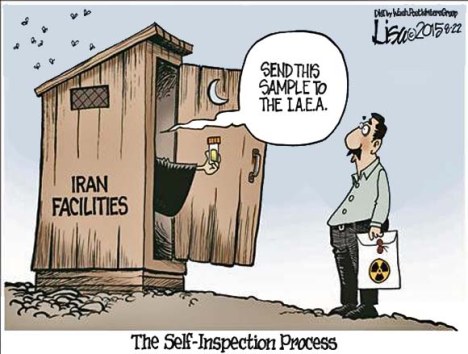
Cartoon of the day

August 24, 2015

H/t Vermont Loon Watch

inspect-this

The Iran deal and the Israeli veto

August 24, 2015

The Iran deal and the Israeli veto, Power LinePaul Mirengoff, August 23, 2015

(How long can Israel wait? Please see also, Thinking About the Unthinkable: An Israel-Iran Nuclear War and WHY IRAN IS NUCLEAR NOW. — DM)

CNN’s report thus raises this obvious question: Will Israel attack Iran now that the U.S. and its European allies are about to enter a deal that effectively grants Iran the right to become a nuclear power?

***********************

This weekend, CNN reported that in recent years, Israeli leaders planned three attacks on military targets in Iran. CNN bases this story on an audio recording with former Defense Minister (and one-time Prime Minister) Ehud Barak. The recording was leaked to an Israeli television station.

Why didn’t Israel carry through with the planned attacks? In the first case (2010), Israeli military leaders reportedly nixed the idea. The head of the Israeli Defense Force (IDF) simply didn’t believe the planned attack was “operational.”

In the second case (2011), the IDF signed off on an attack. However, two key ministers had doubts that could not be overcome.

In the third case (2012), the attack didn’t come off because of scheduling issues. Supposedly, the planned strike conflicted with a joint military exercise with the United States. The Israeli didn’t want to embarrass Washington by attacking Iran just as it was set to engage in the joint military exercise because this would give the appearance that the Americans were involved. (The explanation in CNN’s report for why the attack wasn’t rescheduled is garbled).

In all three instances, Prime Minister Netanyahu wanted to attack. In all three instances, Barak, who is not a member of Netanyahu’s party, concurred.

In none of these instances does it appear that President Obama’s obvious opposition to an Israeli attack on Iran was the dealbreaker, if CNN’s report is to be believed (though Obama’s views may have contributed to the two ministers getting cold feet in 2011).

CNN’s report thus raises this obvious question: Will Israel attack Iran now that the U.S. and its European allies are about to enter a deal that effectively grants Iran the right to become a nuclear power?

One might think not. The deal has the support of European governments eager to allow their businessmen to take advantage of Iranian markets. Here in the U.S., the deal is unpopular, but Obama considers it the main element of his foreign policy legacy.

There will be hell to pay if Israel upsets these expectations by attacking Iran.

But the more we learn about the farcical nature of this deal, the more Israel’s calculus may tilt in favor of an Israeli attack — if not in 2015 or 2016, then in 2017 when Obama is no longer president. After all, the hell Israel would pay if it attacks Iran must be weighed against the threat of a nuclear Iran. CNN’s report, if accurate, adds plausibility to the view that Israel sees the latter as more hellacious.

In a very real sense, then, the key people evaluating Obama’s deal aren’t U.S. Senators and Representatives, but rather Israeli generals, intelligence chiefs, and ministers. They are the ones who, effectively, can nullify the deal.

It seems to be that with every revelation of a major Obama/IAEA concession to the mullahs, the prospect that Israel will exercise its veto increases.

UK’s Hammond in Tehran: Iran has shown more nuanced approach than in past to Israel conflict

August 24, 2015

UK’s Hammond in Tehran: Iran has shown more nuanced approach than in past to Israel conflict

via UK’s Hammond in Tehran: Iran has shown more nuanced approach than in past to Israel conflict – Middle East – Jerusalem Post.

LONDON – Britain must remain cautious in its relations with Iran, foreign minister Philip Hammond said on Monday, after he reopened the British embassy in Tehran nearly four years after it was stormed by protesters.

While the historic step marks an easing of tense relations between the Islamic Republic and Western powers, Hammond said there was still disagreement on major issues.

“We should tread carefully. There’s a deep legacy of distrust on both sides and we have major areas where we have very substantial policy differences,” he told the BBC shortly before a scheduled meeting with Iranian President Hassan Rouhani.

He said that while both countries agreed on the need to tackle jihadist group Islamic State, there were disagreements on human rights issues.

Hammond said the current Iranian government had displayed a more nuanced approach than its predecessor to a long-running conflict with Israel, adding that Tehran would be judged on its actions, not its words.

“What we’re looking for is behavior from Iran, not only towards Israel but towards other players in the region, that slowly rebuilds their sense that Iran is not a threat to them,” he said.

Hammond told Reuters on Monday that he expected sanctions on Iran could start to be lifted as early as Spring next year.

He said preparatory work should be done ahead of lifting sanctions so investment can start to flow as soon as the measures are removed.

“We could be talking as early as next spring to start to see sanctions lifting off,” Hammond said.

Kurdish oil is another Netanyahu-Obama head-to-head front

August 24, 2015

Kurdish oil is another Netanyahu-Obama head-to-head front.

( I’ve watched a number of tankers offload oil here in Eilat this year for the first time since the fall of the Shah.  I presumed they were from Kurdistan.  This article supports that presumption… – JW )

DEBKAfile Special Report August 24, 2015, 1:08 PM (IDT)

SCF Byrranga tank carries Kurdish oil

SCF Byrranga tank carries Kurdish oil

That Israel and other nations were buying oil from the Kurdish republic of Iraq had been published before and was no secret. The Financial Times broke its “discovery” Sunday, Aug. 23, just by chance? on the day that Britain and Iran reopened their respective embassies in Tehran and London after a four-year breach resulting from a mob attack on the Tehran embassy.

Even before sanctions were lifted and Tehran had demonstrated its compliance with the nuclear deal signed with the world powers in Vienna on July 14, European ministers were knocking on the door in a quest for financial relations. The Islamic Republic was deemed rehabilitated by the nuclear accord; and the UK saw no reason to lag behind the others. And so Foreign Secretary Philip Hammond was personally in attendance at the ceremonial reopening Sunday of the Tehran embassy.
The FT’s report’s timing fitting in perfectly with the British government’s plans to quickly develop profitable ties with the Islamic Republic in the following arenas:

1. The oil industries in Iran and Iraq. London seeks as large a slice as possible of the $150 billion worth of oil and gas contracts on offer by Tehran.

2.  The Islamic Republic was also meant to infer from the FT report that British intelligence resources and its powerful media were available as tools for beating Israel out on the world’s energy markets.

3. Britain’s foreign policy is grounded in accentuating its common interests with Washington. The Obama administration may pose as a champion of Masoud Barzani, President of the autonomous Kurdish Republic of northern Iraq. His peshmerga army has after all distinguished itself in its dogged fight against the Islamic State. But in practice, things are different:  the US administration, to meet the wishes of Tehran and Baghdad, consistently withholds from the Kurds the heavy weapons they need to rout ISIS.

The pejorative depiction of Israel’s purchase of Kurdish oil was meant to gain London points – not just with Iran and Iraq, but also with the Obama White House.

In serving this purpose, The Financial Times found no editorial need to fill in the pertinent Middle East background of the trade.

Exactly a year ago, debkafile discovered and reported that Kurdish oil was being delivered to Israel. Several media discovered an American warship that was described at the time as stalking the United Kalvyrta tanker which carried a million barrels of Kurdish oil. The warship planned to prevent the oil being unloaded at any port, since Washington viewed the cargo as the legal property of the Iraqi government – not the KRG which had put it up for sale. Had the oil reached its purchasers, it would have been nearly impossible to cut off Kurdistan’s export trade to clients outside Iraq.
This American step was part and parcel of the US negotiating tactics for a nuclear accord, then at one of their critical moments. The Obama administration was anxious to show Tehran how closely the US would play ball with Iran and Shiite-dominated Iraq on the vital issue of oil, once the nuclear accord was in the bag.
But the episode did not pan out as expected.
This is what happened: “The partially full Kamari tanker carrying Kurdish crude oil disappeared from satellite tracking north of Egypt’s Sinai Peninsula. Two days later, the empty vessel reappeared near Israel.”

No one in the trade doubted for a moment that the vanishing oil had been unloaded at an Israeli port.
In reporting this at the time, a debkafile map traced the freight’s route from the Turkish port of Ceyhan, the terminus of the oil pipeline from the Kurdish-controlled oilfields of Kirkuk, to the Israeli port of Ashkelon.
That was the missing background of the Financial Times story, which led up to its conclusion that Kurdish oil accounts for 77 percent of Israel’s consumption, totalling around a quarter of a million bpd. Between May and August this year, the Haifa refineries are said to have handled 19 million barrels of oil sourced to Kurdistan.

Since all matters relating to energy are made in Prime Minister Binyamin Netanyahu’s office, it stands to reason that the decision to buy oil from the KRG came from the top.
Netanyahu’s readiness to go head to head with the Obama administration on this issue hat two motives:

First, Kurdish oil was cheap. Irbil denies undercutting the market, but debkafile’s sources report that it was willing to do so in the case of Israel.
Second, the Netanyahu government and the Obama administration don’t see to eye to eye not just on nuclear Iran, but on Middle East policy in general – and the autonomous Kurdish republic of Iraq, in particular. The prime minister intended for Barzani to use this oil revenue to buy the arms he needs to fight ISIS to the finish.
At the time of this decision, crude had soared past $100 on the world market, and Islamic State forces were advancing on the Kurdish capital of Irbil. Washington may have countenanced Mosul’s fall to jihadist forces, but Israel was determined to prevent the fall of friendly Irbil.

This week, as Netanyahu marked the first 100 days of his fourth term as prime minister, his critics described him as weak and lacking in accomplishments. The Kurdish enterprise was one of several cases in which he quietly took a strong initiative.

The IKEA Murders: Sweden in Crisis

August 23, 2015

The IKEA Murders: Sweden in Crisis, The Gatestone InstituteIngrid Carlqvist, August 23, 2015

  • The mosque fire received huge attention, while the rape epidemic is basically ignored. When a Swedish woman and her son are brutally knifed to death in the most Swedish of all places – an IKEA store – the Prime Minister has nothing to say.
  • The normal democratic order, where citizens can contact politicians or the media to make their voices heard, has all but evaporated in Sweden. Newspaper websites have removed the reader comment fields, and the politicians hide behind a wall of officials who brand callers expressing concern “racist,” and hang up. Sweden is governed by a power that has shut down the democratic process.
  • Questions flooded the social media: Who are these people that are let into Sweden? How many of them are not innocent victims of war, but in fact war criminals and other criminals, hiding among the refugees?
  • The most relevant question is: Why has one government after another chosen to spend Swedish taxpayers’ money to support and shelter citizens of other countries, while some of them try to kill us?
  • None of the mainstream media has confronted the government about the violent crimes committed by asylum seekers against Swedes. On the contrary – the media have done the utmost to convince Swedes that everything is safe and sound in Sweden. Better than ever, in fact.
  • “Where do I apply for asylum… when the day comes that I can no longer live here?” – “Ewa,” on Facebook.
  • Violent crime is up 300% and rape is up 1,472% since 1975, the year the Swedish Parliament decided to turn homogenous Sweden into a multicultural country.

A surge of rage has washed over otherwise docile Sweden. After a double homicide at an IKEA store in Västerås, where an illegal alien stabbed two random Swedes to death, more and more people are questioning why the government is exposing Swedish citizens to murderers from across the globe.

On August 10, news of the IKEA murders shocked Sweden. Two asylum seekers from Eritrea (the second largest source of asylum applicants in Sweden), were suspected of having grabbed knives from the kitchenware department and attacked two random Swedes. The victims were 55-year-old Carola Herlin and her 28-year-old son, Emil.

1218Carola Herlin, Director of the Moro Backe Health Center, was murdered on August 10, along with her son, in the IKEA store in Västerås, Sweden.

The elder of the two asylum seekers, a 36-year-old man, had twice been denied residency status in Sweden — because he had already been granted residency it in Italy — but he had not yet been deported. (Eritreans without residence permits in other EU-countries automatically get to stay in Sweden.)

The killer also inflicted life-threatening injuries on himself, and underwent several surgeries before the police could finally question him. On August 14, he confessed. His 23-year-old compatriot was released from custody, because the police no longer believe he had anything to do with the murders or had even known what his friend was planning to do.

Fear has now struck the Swedes. Even those who had routinely brand critics of immigration and multiculturalism racist, were shaken to the core. Questions flooded the social media: Who are these people that are let into Sweden? How many of them are not innocent victims of war, but in fact war criminals and other criminals, hiding among the refugees? And should we pay billions in taxes to support and shelter citizens of other countries, while some of them try to kill us?

The fact that the police refuse to deny the persistent rumor that one of the IKEA victims was beheaded, only adds fuel to the fear.

So many questions and no answers. No one from the government has even bothered to make a statement about the horrific double murder. None of the mainstream media has confronted the government about the violent crimes committed by asylum seekers against Swedes. On the contrary – the media have done the utmost to convince Swedes that everything is safe and sound in Sweden. Better than ever, in fact. The day after the double murder, Sweden’s largest morning paper, Dagens Nyheter, published an article titled, “After all, deadly violence on the decline.” The article begins:

“In recent weeks, several brutal murders have been committed, and many people ask themselves where society is headed. The answer is that Sweden has, after all, become a safer place. Deadly violence has been on the decline for some time.”

Nowhere does the article explain that the reason deadly violence has been on the decline is that emergency medicine is now able to save the lives of a lot more victims of knife- and gunshot-injuries. The so-called Laser Man, for example, shot a number of immigrants in Sweden in the 1990s. Forensic pathologist Jovan Rajs commented, “The Laser Man shot eleven people, and one of them died. In the 1930s eight or nine would have died, in the 1970s about five, and today probably none.”

Ergo, deadly violence remains on an even level thanks to better health care in Sweden, but all other kinds of violent crime (including attempted homicide) has gone off the charts. Violent crime is up 300% and rape is up 1,472% since 1975, the year the Swedish Parliament decided to turn homogenous Sweden into a multicultural country.

Ninety percent of asylum seekers to Sweden lack proper identification papers, so in reality no one knows how many murderers, rapists and thugs hide among the 100,000 or so people granted asylum in Sweden every year.

Frustrated Swedes are now howling with powerlessness on social media. The normal democratic order, where citizens can contact politicians or the media to make their voices heard, has all but evaporated. Newspaper websites have removed the reader comment fields, and the politicians hide behind a wall of officials, who brand callers expressing concern “racist,” and hang up. Thousands bear witness to this on Facebook. One person who actually got to talk about her uneasiness is Ewa, who writes on Facebook about calling Immigration Services:

“Well, I’ve unleashed the devil now. I called Immigration Services and demanded to talk to a Unit Manager. … I gave him an earful about every injustice I could think of, like how badly we treat our elderly and how we take away their homes and give them to asylum seekers. I also told him how unsafe Swedish women feel due to all these gang rapes perpetrated by asylum seekers and other foreigners. Also asked him if we all have to be beheaded before they stop taking in these kinds of people. … Now I’m sitting here, feeling completely empty after crying, screaming, discussing, raging and getting all this frustration out of me. Told him there are many of us who feel depressed because of what Immigration is doing. He was really sorry I feel this way. Yes, I told him, a lot of people feel this way but they are afraid to open their mouths because then they are labeled racist. You don’t even have to be a Sweden Democrat to see that our country is falling apart more and more with each passing day. Something you and all the rest at Immigration Services are responsible for. Where do I apply for asylum, I asked, when the day comes and I can no longer live here? Our country is ruined economically, socially and so forth and you are responsible. He answered that it was the politicians who decided about this, but that they would do everything in their power to make things better.”

Another woman, Amanda, wrote on Facebook that she e-mailed Prime Minister Stefan Löfven. She noted that “nothing may change, but at least I’ve made my voice heard.” Her e-mail read:

“Hi, why did the Prime Minister feel it was essential and urgent to go and talk about the fire at the mosque in Eskilstuna, no one even knew what started it when he held his speech? But now, he’s as silent as the grave. Why? It’s his/your unconditional and lax immigration policies that have enabled this culprit to move freely in society, despite having received a deportation order not just once, but twice. Can you tell me if this is something the citizens of this country should get used to, that immigrants, upon receiving deportation orders, kill people in order to get a lifelong contract with the Swedish state? It is your personal responsibility every time this happens, I hope you know that. Because this is nothing if not a political issue regarding immigration, and… its massive consequences to an entire nation.”

The mosque fire in Eskilstuna that Amanda referred to happened December 25, 2014, and is one of many incidents affecting Muslims and other immigrants that have received huge attention, while the rape epidemic in Sweden is basically ignored. After the fire, the Prime Minister was quick to make a statement:

“It is despicable, a despicable act. We will never tolerate this type of crime. People who want to practice their religion should have the right to do so. Today I feel great sympathy and empathy for those affected.”

Three months later, it turned out no crime was behind the mosque fire, and police dropped the investigation. Most likely, it was caused by an accident or children playing with fire.

But when a Swedish woman and her son are brutally knifed to death in the most Swedish of all places – an IKEA store – the Prime Minister has nothing to say.

The Swedes are not prone to rebellion. To find a citizen that took up arms and marched on the citadels of power, one has to go back to the days of Gustav Vasa – the king who during his reign, 1523-1560, founded the nation-state of Sweden.

Although Sweden today is not occupied territory, it is governed by a power that has shut down the democratic process by the “December Agreement” of 2014. In the general election that year, the only party critical of mass immigration, the Sweden Democrats (SD), became the third-largest party in Parliament. The left-wing and center-right blocs then agreed to lock SD out of political power, but SD refused to be silenced. When the left-wing minority government budget was presented one month after the election, SD voted for the opposition’s budget – a shocking and unique occurrence in the Swedish Parliament. Here, it is considered “good manners and decorum” to vote for your own budget proposition first, then lay down your vote and let the government win. But after the Sweden Democrats’ “coup,” Prime Minister Stefan Löfven (of the Social Democratic Party) was forced to govern with a center-right budget during his first year in office.

One would think that this came as a pleasant surprise to the center-right opposition, but that was not what happened. No one wants support from the “racist” Sweden Democrats. Rather than call a snap election, the two blocs entered into an agreement in which the center-right opposition promises to abstain from voting when it comes to important issues such as a proposed budget.

Thus, the December Agreement is in reality a kind of “relay-race” dictatorship: The left-wing government gets to do what it wants for the next four years, and after that, for next the four years (if there is a change of power), it will be the center-right government’s turn. This means both parties are free to ignore the 58% of Swedes who now feel that immigration is too high, and may choose to vote for the Sweden Democrats in the next election.

When the Swedes got the news about the December Agreement, they did what they usually do – clenched their fists in their pockets, formed Facebook groups and wrote angry comments on Twitter and Facebook. But the politicians congratulated each other on once again restoring order; they ignored the people’s concern that democracy had now become even more eroded.

A well-known stand-up comedian, Magnus Betnér, thought it a good idea to mock frightened Swedes in a YouTube clip:

“Yes, it’s really tragic two people were murdered in IKEA. … but… it’s not dangerous; Sweden has never been safer than it is now. … Very few of you guys watching this clip will be murdered. And those of you who are, will be murdered in your own homes.”

When the establishment refuses to take people’s concerns seriously, rumors on social media spread fast. A stubborn rumor claims that Carola Herlin was beheaded by the Eritrean murderer. According to sources interviewed by Gatestone, the woman had her throat slit and was also stabbed in the abdomen. Her son tried to defend himself, but received a deadly stab wound to the stomach.

When Dispatch International called Per Ågren, the police investigator in charge of the case, and asked him about the rumor, he said: “I’m not going to confirm… describe anything at all about what happened, except to say that two people were murdered. You won’t find out how from me.”

One of the first measures taken by the police after the IKEA murders was to start guarding all the buildings housing asylum seekers in the county. There was some apprehension concerning “dark forces,” the police claimed, without specifying who these “dark forces” were. The night of August 15, an asylum house in Arboga had to be evacuated after someone shouted something about a bomb outside. Now the mainstream media were really on their toes: Carola and Emil Herlin, according to their reports, had been “at the wrong place at the wrong time.”

The newspaper Aftonbladet interviewed an anonymous woman who said, “My cousin has lived here for over a year. He told me the Swedes are the nicest people in Europe. Then something like this happens. I could never have imagined.”

Once again, it is supposedly the Swedes who should bow their heads in shame. Supposedly, we are not the ones grieving; we do not have the right to be frightened to death over the immigration policy of our rulers – it is the asylum seekers who are the victims, even when they kill, rape, rob and abuse.

The burning question is: What will the people do, whom no one will listen to? In East Germany of 1989, the people took to the streets, scaled the Berlin wall and made the government to resign. The other communist dictatorships of Eastern Europe fell in similar ways. The Second Amendment to the U.S. Constitution (the right to bear arms), exists to ensure that the citizens are able to seize power from a tyrannical government.

If powerlessness drives people to answer violence with violence, maybe one should not ask why Swedes are “racists” if they do not want the highest immigration level in Europe?

The most relevant question is why one government after another has chosen to spend Swedish taxpayers’ money on citizens of other countries. While Swedish students take a plunge in the PISA tests, 60% of the welfare benefits go to immigrants who make up about 15% of the population. Healthcare and other social services are deteriorating, according to many Swedes, while violence is exponentially increasing. When more and more Swedes feel that they are being badly treated in their own country, the politicians have created a powder keg ready to explode at any minute.

The truth is that even the docile Swedish people have a limit. When those in power expose us to bloodbaths, whether in the Big Square of Stockholm in 1520 or at IKEA in Västerås in 2015, there will always be those who are ready to overthrow the mighty. Just as in Gustav Vasa’s day, a lot of Swedes have firearms. They are not as easy to come by as in the United States, but more and more Swedes are getting hunting licenses, and are thereafter legally able to buy guns. From now on in Sweden, anything can happen.

Thinking About the Unthinkable: An Israel-Iran Nuclear War

August 23, 2015

Thinking About the Unthinkable: An Israel-Iran Nuclear War, Amerian Thinker, John Bosma, August 23, 2015

(We live in “interesting times.” — DM)

The signing of a Munich-class agreement with Iran that hands it more than it ever hoped to pull off represents a shocking, craven American capitulation to an apocalyptic crazy state: a North Korea with oil. Nothing in Western history remotely approaches it, not even Neville Chamberlain’s storied appeasement of another antisemitic negotiating partner.

But it also augurs the possibility of a nuclear war coming far sooner than one could have imagined under conventional wisdom worst-case scenarios. Following the US’s betrayal of Israel and its de facto detente with Iran, we cannot expect Israel to copy longstanding US doctrines of no-first-nuclear-use and preferences for conventional-weapons-only war plans. After all, both were premised (especially after the USSR’s 1991 collapse) on decades of US nuclear and conventional supremacy. If there ever were an unassailable case for a small, frighteningly vulnerable nation to pre-emptively use nuclear weapons to shock, economically paralyze, and decapitate am enemy sworn to its destruction, Israel has arrived at that circumstance.

Why? Because Israel has no choice, given the radical new alignment against it that now includes the US, given reported Obama threats in 2014 to shoot down Israeli attack planes, his disclosure of Israel’s nuclear secrets and its Central Asian strike-force recovery bases, and above all his agreement to help Iran protect its enrichment facilities from terrorists and cyberwarfare – i.e., from the very special-operations and cyber forces that Israel would use in desperate attempts to halt Iran’s bomb. Thus Israel is being forced, more rapidly and irreversibly than we appreciate, into a bet-the-nation decision where it has only one forceful, game-changing choice — early nuclear pre-emption – to wrest back control of its survival and to dictate the aftermath of such a survival strike.

Would this involve many nuclear weapons? No – probably fewer than 10-15, although their yields must be sufficiently large to maximize ground shock. Would it produce Iranian civilian casualties? Yes but not as many as one might suppose, as it would avoid cities. Most casualties would be radiological, like Chernobyl, rather than thermal and blast casualties. Would it spur a larger catalytic nuclear war? No. Would it subsequently impel Russia, China and new proliferators to normalize nuclear weapons in their own war planning? Or would the massive global panic over the first nuclear use in anger in 70 years, one that would draw saturation media coverage, panic their publics into urgent demands for ballistic missile self-defense systems? Probably the latter.

The Iranian elite’s ideology and controlling political psychology is inherently preferential towards nukes and direct population targeting as a way to implement Shi’ite messianism and end-times extremism. Iran is a newly nuclear apocalyptic Shi’ite regime that ranks as the most blatantly genocidal government since the Khmer Rouge’s Sorbonne-educated leaders took over Cambodia in April, 1975. Senior Iranian officials have periodically tied nuclear war to the return of the Twelfth Imam or Mahdi, which Iran’s previous president anticipated within several years. This reflects not just the triumphalist enthusiasm of a new arriviste nuclear power that just won more at the table than it dared to dream. It also reflects a self-amplifying, autarchic end-days theology that is immune to both reality testing and to Western liberal/progressive tenets about prim and proper nuclear behavior.

Admittedly, Iranian leaders have lately resorted to envisioning Israel’s collapse in more restrained terms through Palestinian demographic takeover of the Israeli state and asymmetric warfare. Still there remains a lurid history of Iranian officials urging the elimination of Israel and its people, of allocating their nukes to Israeli territory to maximize Jewish fatalities, of Iranian officials leading crowds in chants of “Death to Israel!” Iran’s government also released a video game allowing players to target various kinds of Iranian ballistic missiles against Israeli cities – this as part of intensive propaganda drumming up hatred of Jews. A more recent video game envisions a massive Iranian ground army marching to liberate Jerusalem. In all, Iran’s official stoking of genocidal Jew hatred is far beyond what Hitler’s government dared to advocate before the 1939 outbreak of World War 2.

The deliberate American silence over Iran’s genocidal intentionality sends an unmistakable signal to Israel that the US no longer recognizes a primordial, civilizational moral obligation to protect it from the most explicit threats imaginable. It is truly on its own, with the US in an all-but-overt alliance with its worst enemy. The shock to Israel’s leaders of this abrupt American lurch into tacitly accepting this Iranian intentionality cannot be understated. Iran is violating the core tenets of the 1949 Geneva Conventions, a US initiative after the Tokyo and Nuremberg war-crimes trials to codify genocide as a crime against humanity. Now the US is silent.

But this shift is also recent. Every US government prior to President Obama would have foresworn nuclear talks with such a psychopathic regime or would have walked out in a rage upon such utterances. Yet Iran’s genocidal threats have had no discernible effect on Obama’s canine eagerness for a deal. It’s as if 75 years ago a US president had cheerfully engaged in peace talks with Hitler and his SS entourage despite learning the details of the Nazis’ secret Wannsee Conference where Hitler signed off on the Final Solution for the Jews. But whereas Hitler had the sense in that era to keep that conclave secret, Iran’s Wannsee intentionality toward Israel and world Jewry has for years been flamboyantly rude-and-crude and in-your-face. That this Iranian advocacy of a second Holocaust drew no objection from the US negotiators of this deal should make moral pariahs out of every one of them – including our president and Secretary of State.

These two factors alone, especially the abrupt evaporation of the US’s ultimate existential bargain with Israel through Obama’s de facto alliance with the mullahs, would drive Israel to the one attack option it can unilaterally use without running short of munitions and experiencing the massive US coercion embedded in that dependence. But there are other reasons why early Israeli nuclear pre-emption is not only justified but almost mandatory.

First, it is too late to stop Iran’s bomb-making momentum with conventional weapons or sanctions. That nation’s science and technology base is robust and improving. It has learned to domestically produce high-performance gas centrifuges whose uranium gas output is such that smaller numbers of them are needed for breakout. The US spent decades and many billions at labs like Oak Ridge National Laboratory on composites, software-controlled magnetic bearings, gas flow separations, thermal controls and ultra-precision manufacturing for these thin-wall, very-high-speed devices. Yet Iran has come up the centrifuge learning curve with surprising speed. Its metallurgists are familiar with a novel aluminum forging method that may yield nanophase aluminum shells so strong that they approach the centrifugal strength usually associated with more demanding composite-shell gas centrifuges. Also, Iran’s bomb engineering and physics can tap the sophisticated bomb designs and re-entry vehicle (RV) skills of North Korea, which is reducing the weight and mass of its H-bombs to fit on ballistic missiles and whose collaboration with Iran reportedly included Iranian technicians at North Korean bomb tests.

Other technology sources in the Nuclear Bombs R Us cartel for wannabe proliferators set up by rogue nuclear scientist A.Q. Khan of Pakistan include China, Russia and Pakistan. Worst of all, under the US-Iran deal, Iran’s ballistic missiles can improve their reliability, accuracy, throw-weight and their post-boost RV-release thrusters.

Second, Iran’s underground nuclear targets are likely harder than American and Israeli hard-target munition (HTM) developers have assumed. Why? Because Iranian engineers have perfected the world’s toughest concrete, developing mixtures using geopolymers, quartz powders (called fume) and metal and ceramic fibers. The result is hardness levels reportedly up to 50,000-60,000 psi in experimental samples. This means that even shallow “cut and cover” hard targets like the Natanz centrifuge enrichment plant, an armored complex in an excavated pit that is then covered, can resist destruction by the US’s most lethal hard-target bomb: the 30,000-lb “Massive Ordnance Penetrator.” Only the B-2 and the B-52 can carry the MOP. Yet while the MOP can penetrate ~200 ft into 5000-psi targets, it only reaches 25 feet into 10,000-psi concrete – and Iranian cement for new or up-armored underground bunkers has likely progressed well beyond that.

US and Israeli HTM alternatives include staged-warhead penetrators and – high on the wish list – novel energetic chemistries with orders-of-magnitude more power than current HTMs. Tactical HTMs with up to four sequential warheads use precursor warheads to blast an initial opening for larger follow-through charges to destroy tanks, fortifications and bridge piers. But these impact at slow speeds compared to what’s needed to kill deep hard targets. The latter need superhard casings (probably single-crystal metals) and packaging to keep their sequenced charges intact during violent impacts of thousands of feet/second (fps). One benchmark is the Department of Energy’s Sandia lab’s success years ago in firing a simulated hard-target RV into rock at 4400 fps. Similarly, reactive-material (RM) munitions and next-generation HEDM (high-energy-density material) explosives and energetic chemistries with orders-of-magnitude more power look promising for the future. But these require years of iterative fly-redesign-fly testing to assure they’ll survive impact with their deep targets.

Bottom line: with even the US’s best non-nuclear HTMs marginal against Iran’s critical deep targets, Israel’s HTMs probably wouldn’t do the job either, being lower in kinetic energy on target. Alternatives like using HTMs to destroy entrances to such targets and ventilation shafts may work – but unless Iranian military power and recovery are set back months or years, this damage would be repaired or worked round. Moreover, nuclear facilities tunneled into mountains would be almost impossible to destroy with conventionals.

Still, the brains behind Iran’s nuclear bomb, missile and WMD is concentrated in soft targets like the Iranian universities run by the IRGC (Iran Revolutionary Guard Corps), custodian of the bomb program). These can be hit by conventionals under a Peenemunde targeting strategy to kill as many weapon scientists and technicians as possible. (This recalls Prime Minister Winston Churchill’s directive for British bombers to target the residential housing on the small Baltic island where Hitler had sited his V-2 rocket program.) Alternatively, conventional or nuclear EMP (electromagnetic pulse) or HPM (high-power microwave) weapons could destroy for months all the computers and communications that support university-hosted bomb work. This would keep these scientists and surrounding urban populations alive.

Third, Obama’s decision to provide Iran “training courses and workshops to strengthen Iran’s ability to prevent, protect and respond to nuclear security threats, including sabotage, to nuclear facilities and systems as well as to enable effective and sustainable nuclear security and physical protection systems” is the clearest indicator that this accord is aimed squarely at Israel. Why? It eliminates the sole option Israel has left now that it lacks the US-supplied conventional HTMs to destroy unexpectedly hard deep targets, forcing it at best into a slow-motion conventionals-only campaign. This would expose it to brutal political and military blowback by Iran and its Chinese, Russian and European suppliers – and by an enraged American president. In essence, it appears that the Obama regime has under the accord deliberately stripped Israel of every option except nuclear pre-emption – which Obama, in typically liberal-progressive fashion, assumes would never happen. Ergo, Israel would be forced to accommodate Iranian military supremacy.

Fourth, what may drive an early Israeli nuclear attack are two considerations: (a) Russian S-300 ATBM/SAMs (anti-tactical ballistic missile/surface-to-air missile) in Iranian hands; and (b) Hezb’allah’s thousands of missiles. Russia’s agreement to supply Iran four batteries of its fearsome S-300 by late August for defending priority targets would make it very difficult for Israel to mount the complex precision bombing strategies needed for tough targets. The S-300, the world’s best, can knock down high-speed aircraft from near ground level to almost 100,000 feet. It can also engage some ballistic missiles.

Meanwhile, Hezb’allah’s arsenal of more than 60,000 rockets (by some estimates) is a much greater threat to Israel, especially its air force, than is appreciated. Hezb’allah has retrofitted an unknown fraction of these missiles, whose range now covers almost all of Israel, with GPS and precision guidance, allowing them to hit critical targets. Unfortunately, Israel’s Iron Dome and David’s Sling interceptors were designed on the assumption that most incoming missiles would be inaccurate and so the interceptors could be saved only for those approaching critical targets. The result? Hezb’allah rocket campaigns targeting Israeli airbases and other military targets could quickly run Israel out of interceptors. Iran could easily order such a campaign to throw Israel off balance as it focuses on the deadly US-abetted nuclear threat from Iran.

An Israeli nuclear pre-emption is thus eminently thinkable. Every other option has been stripped away by Obama’s decision, concealed from Israel, Congress and our allies until it was too late to challenge, to let Iranian bomb-making R&D run free and to harden Iran’s bomb-making infrastructure against Israel – while imposing lethal restrictions on Israeli countermeasures and forswearing any US and allied military attacks, such as B-2’s and B-52’s dropping MOP bombs.

The die is now cast. Nuclear pre-emption becomes attractive to a nation in extremis, where Israel is now:

…Israel needs to impart a powerful, disorganizing shock to the Iranian regime that accomplishes realistic military objectives: digging out its expensive underground enrichment plants, destroying its Arak plutonium reactor and maybe Bushehr in the bargain, killing its bomb and missile professionals, scientists and technicians, IRGC bases, its oil production sites, oil export terminals and the leaders of the regime where they can be found.

…its initial strike must move very fast and be conclusive within 1-2 hours, like the Israeli air attack opening the 1967 Six-Day War. The goal is to so stun the regime that Israel controls the first and subsequent phases of the war and its ending. This means that Israel must hit enough critical targets with maximum shock – and be willing to revisit or expand its targets – so as to control blowback and retaliation from Iran’s allies. In essence, this involves a very fast-paced Israeli redesign of the Middle East in the course of a nuclear war for survival.

…what is poorly appreciated is that nuclear weapons from 10 to 300 kilotons (KT) – depending on accuracy – can destroy deep hard targets to 200+ meters depth by ground coupling if they penetrate merely 3 meters into the ground (Effects of Nuclear Earth Penetrators and Other Weapons: National Research Council / National Academy Press, 2005, pp. 30-51). Israel could lower bomb yields or achieve deeper target kills by its reported tests of two-plane nuclear attacks in which the first plane drops a conventional HTM like a GBU-28 to open up a channel; the second plane drops its tactical nuclear bomb into that ‘soft’ channel for greater depth before bursting. This unavoidably would produce fallout on cities downwind. Fortunately, the same medical countermeasures used for radiological accidents (Chernobyl accidents, etc.)  – potassium iodide pills (available domestically from www.ki4u.com) – can be airdropped for use by exposed urbanites.

…the more important objective, however, is decapitation and economic paralysis by EMP and HPM effects that destroy all electronic, electrical and electromechanical devices on Iranian territory. While a high-altitude nuclear burst would affect most of Iran’s territory, it may not be necessary if smaller, lower-altitude weapons are used.

…A small number of nuclear weapons (10-15?) may suffice: one each for known underground hard targets, with one held in reserve pending bomb-damage assessments; several low-yield bombs for above-ground bomb-related depots; and low-yield neutron weapons to hit IRGC and regime targets while avoiding blast and fallout. Reactors can be hit with conventional HPM pulse weapons to burn out electrical, electronic and electromechanical systems for later reactor destruction by Special Forces. A targeting priority (using antipersonnel conventionals) would be university-hosted bomb/missile scientists.

…Israeli F-15s and F-16s provide the most accurate delivery for the initial phase – assuming that the S-300 batteries can be decoyed, jammed or destroyed (where Israeli air force experience is unmatched). The small stock of Jericho-2 ballistic missiles probably would be held in reserve. They can’t be used against buried targets unless their re-entry vehicles (RVs) are fitted with penetrator casings and decelerators like ribbon parachutes (used to slow down US test RVs for shallow-water recovery at Pacific atolls) to avoid disintegrating on impact. (Both methods require flight-testing, which is detectable.) Israel’s Dolphin subs in the Red Sea and Indian Ocean can launch nuclear or (probably) conventional cruise missiles with cluster munitions for IRGC targets.

The final issue is how Israeli and US leaders would operate in these conditions. An Israeli decision to go nuclear would be the most tightly held decision in history, given the prospect of out-of-control blowback by our current president if that was leaked. Still, Israel sees itself being driven into a Second Holocaust corner, possibly within weeks as the S-300s begin deploying around Iran’s nuclear targets. Once it decides nukes are its only way out, it would simulate and map out all possible event chains and surprises once it launches. Unavoidably, it would also have to decide what to do if it learns the US is feeding its pre-launch mobilization information to Iran, using its electronic listening posts and missile-defense radars in the region. It may have to jam or destroy those US sites.

For the US, however, this no-warning nuclear war would land like a thunderbolt on an unprepared White House that would likely panic and lash out as Obama’s loudly touted “legacy” goes up in smoke. The characteristic signatures of nuclear bursts would be captured and geolocated by US satellite. The commander of NORAD (North American Aerospace Defense Command) under Cheyenne Mountain in Colorado Springs would call the White House on the famous red phone. (As one of the few civilians who sat through a red phone alert at NORAD in July 1982, after a Soviet missile sub launched two test missiles off the Kamchatk Peninsulaa, I can testify it is a frightening experience for which nothing prepares you.) Given the psychology of our current president and his emotional investment in his Iran deal, what might follow could challenge the military chain of command with orders that previously were unthinkable.

Now retired, John Bosma draws on a 40-year background in nuclear war-gaming and strategic arms control (SALT 1 and 2, Soviet arms-racing and SALT violations, US force upgrades) at Boeing Aerospace (1977-1980); congressional staff and White House experience (1981-1983) in organizing the “Star Wars” ballistic missile defense (BMD) program and proposing its “defense-enforced strategic reductions” arms-control model adopted by the Reagan State Department; military space journalism (1984-1987); and technology scouting in conventional strategic warfare, rapid (1-2 hours) posture change in space, novel BMD engagement geometries with miniature air-launched interceptors, counter-WMD/terrorism, naval BMD and undersea warfare. Clients included DARPA (Defense Advanced Research Projects Agency), the Missile Defense Agency, the Office of Secretary of Defense (OSD) Advanced Systems and Concepts Office, the Navy and the  He follows Israeli forces and BMD and has studied Iran’s nuclear R&D programs. All of his work is open-source


Unveiling new missile, Rouhani says Iran will obtain ‘any weapons we need’

August 22, 2015

Unveiling new missile, Rouhani says Iran will obtain ‘any weapons we need’

‘We can negotiate with other countries only when we are powerful,’ says president at ceremony displaying precision solid-fuel rocket

By Times of Israel staff August 22, 2015, 12:00 pm

via Unveiling new missile, Rouhani says Iran will obtain ‘any weapons we need’ | The Times of Israel.

In this photo released by the official website of the office of the Iranian Presidency on Saturday, Aug. 22, 2015, Iran's President Hassan Rouhani, left, briefs the media as Defense Minister Hossein Dehghan listens after unveiling the surface-to-surface Fateh-313, or Conqueror, missile in a ceremony marking Defense Industry Day, Iran. (Iranian Presidency Office via AP)

In this photo released by the official website of the office of the Iranian Presidency on Saturday, Aug. 22, 2015, Iran’s President Hassan Rouhani, left, briefs the media as Defense Minister Hossein Dehghan listens after unveiling the surface-to-surface Fateh-313, or Conqueror, missile in a ceremony marking Defense Industry Day, Iran. (Iranian Presidency Office via AP)

Iran on Saturday unveiled a new surface-to-surface ballistic missile with a 500-kilometer (310 miles) range, saying military might was a precondition for peace and effective diplomacy.

The Fateh 313 missile was unveiled during a ceremony marking the anniversary of Iran’s military industry, attended by Iranian President Hassan Rouhani.

The military industry called the solid-fuel missile one of the most exact ever manufactured, boasting that it has successfully hit multiple targets with great precision, Israel’s Walla website reported.

“We will buy, sell and develop any weapons we need and we will not ask for permission or abide by any resolution for that,” Rouhani said in a speech at the ceremony, which was broadcast live on state television, according to Reuters.

“We can negotiate with other countries only when we are powerful. If a country does not have power and independence, it cannot seek real peace,” the president said.

A senior commander in Iran’s Revolutionary Guards said Friday that the country is planning massive “ballistic missiles war games,” adding that the announcement comes after Tehran said it plans to begin phasing in a new generation of missiles.

“The IRGC Aerospace Force will hold a large-scale ballistic missiles war-games soon,” Brigadier Gen. Amirali Hajizadeh said, according to the state-run Fars news agency.

Tehran said last month that its ballistic missile program was not connected to the UN Security Council resolution endorsing the July 14 accord with world powers that limits its nuclear program.

Under the terms of the agreement, Iran is barred from developing ballistic missiles capable of carrying a nuclear warhead.

Iran says it has ballistic missiles with a range of 2,000 kilometers (1,200 miles), which are capable of striking both Israel and Saudi Arabia. But the Foreign Ministry said that the UN’s resolution endorsing the deal did not have jurisdiction over its missile development.

“Iran’s military capacities, especially ballistic missiles, are strictly defensive and, as they have not been conceived to carry nuclear weapons, they are outside the scope and competence of the Security Council resolution,” the ministry wrote in a statement.

“The Islamic Republic of Iran is committed to implementing its commitments… so long as world powers keep their side of the agreement to lift sanctions in exchange for guarantees that Tehran will not develop a nuclear program,” the statement said.

Khamenei urges Islamic unity against real enemies: US and Israel

August 22, 2015

Khamenei urges Islamic unity against real enemies: US and Israel

Leader suggests Iranians use Mecca pilgrimage to spread truth about ‘bullying powers’ to Muslims worldwide

By Itamar Sharon August 22, 2015, 5:03 pm

via Khamenei urges Islamic unity against real enemies: US and Israel | The Times of Israel.

Iranian Supreme Leader Ayatollah Ali Khamenei (photo credit: AP/Office of the Supreme Leader)

Iranian Supreme Leader Ayatollah Ali Khamenei (photo credit: AP/Office of the Supreme Leader)

Iran’s supreme leader claimed Saturday that Islamic nations were being manipulated into internal strife by the world’s “bullies” and urged Islamic unity in the face of what he identified as the Umma’s two greatest enemies: the US and Israel.

Ayatollah Ali Khamenei said the US had long sought to incite “third-party” states against Iran but “such third parties are only deceived puppets,” the Islamic republic’s Fars news agency reported.

“The root cause of the problems returns to their real enemies, the US and Israel,” he said.

The bullying powers, as he called them, are conspiring “against the Quran and not Shiism and Iran, because they know that the Quran and Islam are the center of awakening nations.”

Iranians, he said, “have realized that their real stubborn enemy is the world arrogance and Zionism and that’s why they chant slogans against the US and Zionism.”

Khamenei was speaking to Iranian officials in charge of the Hajj — the annual pilgrimage to Mecca that Muslims from all over the world undertake.

He explained to them that the pilgrimage to Mecca was a prime opportunity for Iranians to convey their aforementioned insights to other Muslims and thus encourage Islamic unity against its true enemies.

“The world bullies are fully, seriously seeking to stir violence and discord under the name of Islam and are trying to disrepute the religion of Islam, foment internal fights among Islamic nations and even among the people of one nation to weaken the Muslim Ummah, and transferring the Iranian nation’s experience about unity and recognition of the enemy to other nations in the Hajj season can defuse these plots,” he said.

Since the signing of the nuclear deal between Iran and world powers in July, Khamenei has repeatedly spoken out against Tehran’s main negotiating partners in Washington.

Earlier this week he strongly impugned the motives of the US in the talks, saying “their intention was to find a way to penetrate into the country.

Khamenei, who has final say on all state matters in Iran, has not publicly approved or disapproved the deal, though he repeatedly offered words of support for Iran’s nuclear negotiators during the course of the talks.

Last Saturday a prominent Iranian hard-liner, journalist Hossein Shariatmadari, said he believed Khamenei was in fact opposed to the accord. However, an editorial appearing Sunday in the Tasnim news agency, thought closely tied to the Iranian regime, derided Shariatmadari for claiming to speak for Khamenei.