Iran’s foreign minister and lead negotiator in nuclear talks said that under the terms of the recently inked accord, the Islamic Republic is permitted to violate current embargoes on the shipment of arms and construction of missiles, according to recent comments made before Iran’s parliament.
Zarif, who spoke to the country’s parliament about the terms of the nuclear deal, also bragged that the finalization of the accord “puts the Zionist Regime in an irrecoverable danger,” according to an independent translation of his Persian language remarks provided to the Washington Free Beacon.
Zarif insisted that “violating the arms and missiles embargo” placed on Iran by the United Nations “does not violate the nuclear agreement.”
U.S. officials and analysts have become increasingly concerned about portions of the deal that will unilaterally lift current restrictions on Iran’s importation and exportation of weapons, as well as its missile construction programs.
While these restrictions still apply, they would be completely lifted in five to eight years under the agreement.
Zarif also took aim at Israel in his remarks, claiming that the deal has isolated Israel as it never has been before.
“Benjamin Netanyahu is ready to kill himself if it helps to stop this nuclear agreement because this agreement puts the Zionist regime in an irrecoverable danger,” Zarif was reported as saying. “The abominable Zionist Regime has never been so isolated among its allies.”
The recent approval of the deal by the United Nations Security Council has solidified Iran’s right to enrich and operate a nuclear program, Zarif went on to say.
“Our biggest accomplishment is that the U.N. Security Council has endorsed our enrichment, this has never happened in the last 70 years,” Zarif said.
“Permit me not to mention the names, but many countries close to the U.S. have agreed to relinquish their enrichment rights, they all envy us today,” he added.
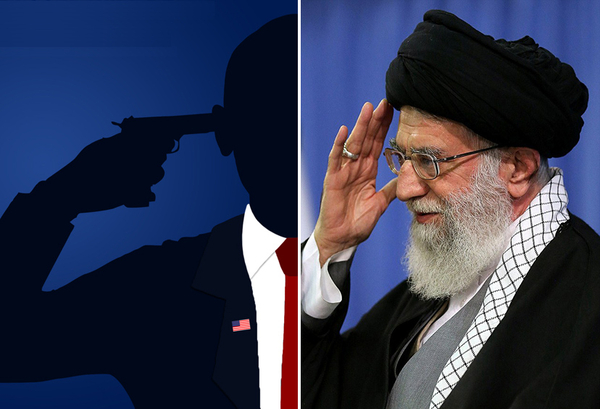
No wonder Iran’s Supreme Leader sent around a tweet of Obama pointing a pistol at his own head. Iran’s forcing itself on the rest of the world is a central part of Khomeini’s Islamic Revolution.
The Ayatollahs’ wish has long been finally to defeat the divided Arabs, and then to move on to defeat Israel, and then the grandest prize of all — the “Great Satan,” the United States.
Worse, apparently a “side deal” — classified for the Americans but not for Iran — enables Iran to provide its own soil samples to the International Atomic Energy Agency (IAEA), to which it has been lying for decades. Even still worse, the parties to the agreement are required to help Iran protect its nuclear facilities should anyone try to attack them or sabotage them — including, presumably, any disenchanted signatories.
Iran will have been rewarded for having violated the Nuclear Non-Proliferation Treaty, and been given a red carpeted fast track to complete its nuclear bomb.
If Obama and the others who signed the catastrophic nuclear agreement with Iran on the eve of Laylat al-Qadr, the Eve of Destiny, a few days before the end of the Ramadan fast, had studied a little history, they would know that the Battle of Qadisiyyah in 636, in which the Persians suffered a disastrous defeat at the hands of the Arabs, has not yet ended. They would know that Islam had, in fact, been imposed on the Sassanid Empire by force, and that, in protest, the Persians adopted Shi’a Islam, a form of the religion that deviated from and changed the Islam of the Arabs, as a way of rebelling and continuing the fight.
If the West had studied that important event in Islamic history, they would understand they were enabling Iran to achieve a nuclear bomb and accelerate the national religious war between us, the Arabs, and the Shi’ite Iranians. For Iran’s mullahs, the showdown is meant to be apocalyptic.
In that respect, the agreement signed by the American-led powers with Iran’s rulers is a milestone along the path they have been praying for. The Ayatollahs’ wish has long been finally to defeat the divided Arabs, currently at their weakest point since the beginning of the so-called Arab Spring, and then to move on to defeat Israel, and then grandest prize of all: the “Great Satan,” the United States.
The Shi’ite regime of the Ayatollahs in Iran and their proxies are united. And, since the fall of the Shah, they are, sadly, also radical. Between their terrorist wings and influence in the Middle East and abroad, the Ayatollahs are refreshingly open about their determination to defeat the Arabs and achieve religious and national hegemony. Iran’s forcing itself on the rest of the world is a central part of Khomeini’s Islamic Revolution.
U.S. President Barack Obama has harmed us Arabs by abandoning his own red lines — against the emphatic advice of his own military advisors — to accept an agreement that in reality gives the Shi’ites open permission to build nuclear weapons at our expense and, more insanely, to allow Iran intercontinental ballistic missiles (ICBMs) that could reach America.
Worse, apparently a “side deal” — classified for Americans but not for Iran — allows Iran to provide its own soil samples to the International Atomic Energy Agency (IAEA), to which it has been lying for decades. In other words, having the cat guard the milk.
Still worse, the parties to the agreement are required to help Iran protect its nuclear facilities should anyone try to attack them or sabotage them — including, presumably, any disenchanted signatories. No wonder Iran’s Supreme Leader sent a tweet of Obama pointing a pistol at his own head.
On July 25, 2015, Iran’s Supreme Leader (right) sent a tweet of Obama pointing a pistol at his own head.
If we try to look at the positive side of the agreement, it is just possible that Obama looked at the Sunni Islamic states, fractured and at each other’s throats, and at the ruthless terrorist groups and all the other battle zones gaining ground, and decided that we were too fractious for the U.S. to protect.
Now, one minute before the Iranians would have collapsed under the weight of the economic sanctions, the U.S. has given them a new lease on life, and, supported by the arrival of billions of dollars, is enabling them to return to their broad international terrorist activities and continue developing their nuclear weapons and the ICBMs on which to mount them.
Not only Iran will profit, but also the Turks, the Chinese and the Russians, who have already jumped at the chance to shore up Iran and themselves, both economically and militarily.
America will be now marginalized, as will its allies. What is in store for America is obvious to anyone listening to the hate speech of Iran’s Supreme Leader Ayatollah Ali Khamenei. He keeps promising that he will continue fighting against America and Israel, and that Iran will neither stop its nuclear development nor surrender.
Instead of lifting the sanctions, the United States should be increasing them.
When Iran joins the global energy market and strengthens its control of the Gulf maritime route, we, the Arabs, will quickly collapse. The recent visits of the Saudi Arabia foreign minister to American and the American Secretary of Defense to Israel did not help. As the arms embargo and sanctions are lifted, money will begin pouring into Iran. Missiles will be developed that will be capable of reaching first Israel and the Sunni Arab states, then Europe and then the United States. Global terrorism will mushroom. Iran will secretly complete its nuclear project ahead of schedule.
Since the agreement forbids agencies affiliated with America, and now apparently “foreigners,” from visiting Iran’s nuclear installations, the arms industry of Islamic Republic will flourish, and Iran will have been rewarded for having violated the Nuclear Non-Proliferation Treaty, and will be given a red carpeted fast track to build a nuclear bomb.
(The views expressed in this article are mine and do not necessarily reflect those of Warsclerotic or its other editors. — DM)
Having been thoroughly schooled by Iran during the P5+1 nuke negotiations on the necessity for flexibility, the Obama Administration is now even better prepared to take on the Democratic People’s Republic of Korea.
Kim learns of U.S. plans
As North Korea and more recently Iran proved, sanctions are feeble devices for getting rogue nations to eliminate their nuclear weapons programs. Possibly effective in bringing such nations to the bargaining table, they tend to collapse as the negotiators come to understand the benefits their nations would realize by their elimination (the sanctions, not necessarily their nations).
After the Obama administration’s groundbreaking nuclear deal with Iran, there have been calls to replicate that pact with North Korea, a rogue state that already has nuclear-weapons capability.
From Washington to Beijing, analysts and policymakers have been talking about the agreement as a possible “blueprint” for negotiations with Pyongyang. [Emphasis added.]
But Kim Jong Un’s regime has made it clear that it expects to be accepted as a nuclear power — saying this month it is “not interested” in an Iran-style deal. The Obama administration is instead focusing on human rights to further isolate North Korea, encouraged by the outbursts this approach has elicited from Kim’s stubbornly recalcitrant regime — apparently because the accusations cast aspersions at the leader and his legitimacy. [Emphasis added.]
“There is a growing assumption that the North Koreans are not going to surrender their nukes,” Andrei Lankov, a North Korea expert based in Seoul, said after recent meetings with officials in Washington. Human rights are Washington’s “next political infatuation,” he said.
The linked article also notes,
Pyongyang this month denounced the United States for “escalating” its anti-North Korea campaign after Sung Kim, the U.S. special representative for North Korea policy said at a public forum that “pressure is a very critical part of our approach to dealing with North Korea.”
The North’s state-run Korean Central News Agency reported afterward that pressure “being persistently increased” would simply “harden” North Korea’s “will to take tough counter-action against” the United States.
North Korean representatives have been notably responsive at the United Nations to criticism of the country’s human rights record and of the leadership in particular, staging a number of protests at forums in New York. [Emphasis added.]
North Korea’s increased responsiveness shows that nuke negotiations with it may well be even more successful than were those with Iran, giving Dear Leader Obama an even greater giant leap forward in His pursuit of foreign policy legacies.
Engagement with North Korea is becoming increasingly necessary. It has recently been reported that
the North has recently upgraded a missile platform and may be readying to launch a long-range missile around the time of a national anniversary in October.
In addition, North Korea is building a new high explosives assembly facility at its main Yongbyon nuclear complex. North Korea will probably use such explosives internally only for peaceful purposes, while (although not suggested by the linked article) preparing them for shipment elsewhere. Perhaps they may be sold to Iran and sent via diplomatic pouch to ensure safety.
Iran persuaded Washington, once “infatuated” with the “possible military dimensions” of Iran’s nuclear program, that Iran itself should probe those dimensions, turn the results of its investigations over to the indefatigable UN watchdog (the International Atomic Energy Agency, a.k.a. “IAEA”) and thereby negate all suspicions. Following that precedent, North Korea should itself investigate whether there are bases for allegations of its human rights violations. It should then, in no less timely fashion, turn any relevant information it finds over to the appropriate UN agency — perhaps the Security Council, where all permanent members, including stellar human rights advocates Russia and China, have vetoes.
Despite the brilliance of its handling of the Iranian nuke program — and the equal if not even greater brilliance of the plan to proceed with North Korea — unsubstantiated rumors will be spread by warmongering hawks such as those who continue to challenge Obama’s great victory over Iran. For example, it may be claimed that any DPRK officials who provide evidence of human rights violations will be executed by hungry dogs starved for the purpose.
That is nonsense. Most of the dogs in North Korea are already starving. The over-inflated egos of any DPRK officials that cause them to blather irresponsibly about such things would simply be deflated by defensive antiaircraft weapons such as recently used on Defense Minister Hyon Yong Chol. It’s the humane way to deal with those guilty of “disloyalty and showing disrespect to dictator Kim Jong Un.” It would, in fact, be sufficient evidence of North Korea’s respect for human rights (comparable Iran’s) to terminate any further inquiry immediately.
If, as Obama claims, “99% of world” likes the Iran “deal,” at least 200% will love a deal with North Korea under which it demonstrates its respect for human rights while promising not to use its nukes on any nation unless it wants to because Dear Leader Kim is upset. The trade potentials are equally mind-boggling and the deal will be no less a win-win situation for everyone than the “deal” with Iran!
The WSJ gained access to some of the documents on the Iran deal that the administration filed with Congress to meet its obligations under the Corker legislation. Two of the documents – both of which are secret and one of which is fully classified (!) – are about the verification process. They reveal that the Obama administration has completely collapsed on the long-standing demand that Iran come clean on the possible military dimensions (PMDs) of its atomic program:
On Iran’s alleged past weapons work, the Obama administration said it concluded: “An Iranian admission of its past nuclear weapons program is unlikely and is not necessary for purposes of verifying commitments going forward…. U.S. confidence on this front is based in large part on what we believe we already know about Iran’s past activities… The United States has shared with the IAEA the relevant information, and crafted specific measures that will enable inspectors to establish confidence that previously reported Iranian [weaponization] activities are not ongoing.”
There’s a history to this collapse. Secretary Kerry made this exact argument to reporters the week before Vienna, but it was a disaster and the State Department immediately retreated: spokesman John Kirby spent the next week telling reporters that they had simply misunderstood Kerry. Ad yet Kerry’s statement is almost word for word what made its way into the documents provided to Congress. Except this time there can’t be a public debate about the stance, because the filing was done in secret and the administration went so far as to classify one of the documents. They’ve made sure that this time there won’t be – there can’t be – any transparency debate over their claims.
Given how the last time went, it’s easy to understand why the administration would want to avoid a robust public discussion over the stance.
On June 11 – a Thursday – the Associated Press revealed that the Obama administration intended to provide Iran with sanctions relief without Tehran resolving the IAEA’s PMD concerns. Instead the Iranians would just have to agree to provide access to inspectors, and the threat of snapback would in theory prevent the them from backsliding [a]. Critics characterized the concession as tantamount to leaving PMD concerns permanentely unresolved, because if current sanctions were inadequate to force Iranian disclosure, how could threatening to restore some of those sanctions later be adequate?
For the next two days – Friday and Monday – the State Department tried arguing that the sequencing would work. They also tried to gaslight reporters by claiming that the administration had always sought access not resolution, leading to exchanges like “our position on this remains the same” vs. “it doesn’t remain the same… you’re lowering the bar even further from address to just agree to give access to” [b].
That wasn’t working so on Tuesday Secretary Kerry teleconferenced into the briefing and introduced a brand new argument: instead of claiming that the Iranians would keep providing PMD-related access after sanctions relief, he declared that the U.S didn’t need to resolve PMDs at all: “We know what they did. We have no doubt. We have absolute knowledge with respect to the certain military activities they were engaged in” [c].
That talking point was even worse. Caving on PMDs guts the verification regime: the IAEA needs to know what the Iranians did and have, so that inspectors can verify they’ve stopped doing those things and given up those assets, and it needs to know how close the Iranians came to a bomb, so that analysts can know how far the Iranians are now [d]. Kerry’s argument – that the West doesn’t need more knowledge because the West already has sufficient knowledge – was indefensible: IAEA chief Amano had said just 3 months before that the agency still lacked adequate insight into Iran’s undeclared activities and former CIA director Michael Hayden published on Wednesday that the same was true of U.S. intelligence community [e][f].
So the rest of the week was retreat. The Obama administration fell back to claiming that reporters had misunderstood Kerry, and that of course the Iranians would still be forced to answer outstanding U.S. and IAEA questions. But since reporters had understood Kerry just fine, the briefings were bloodbaths. On Wednesday seven reporters piled on Kirby, who nonetheless insisted that the plain interpretation of Kerry’s comments was “incorrect” and that “it’s very clear what the expectations are of Iran… we have to resolve our questions about it with specificity. Access is very, very critical” [g]. Ditto for Thursday: “I don’t want to have to rehash this all again today… we were straightforward yesterday about it… nothing has changed about our policy with respect to the possible military dimensions” [h]. Ditto for Friday: “we’ve talked about this before… before there can be a deal, it needs to be determined… that the IAEA will have the access that they need to resolve their concerns” [i].
The converage from Friday to Monday explained why the State Department had retreated. Rep. Devin Nunes, the chair of the House Permanent Select Committee on Intelligence, told Bloomberg View: “My only thought here is that the secretary misspoke or did not understand the question… We clearly don’t have the picture that we need of Iran’s capabilities.” [j]. Veteran diplomat James Jeffrey wrote that “by essentially telling the international community that “the past is past,” Washington and the P5+1 would undercut the arms-control regime that the IAEA is tasked with maintaining globally… there is a term for this that folks all over the region understand, and which Iran greatly values: ‘winning.’ [k]. Politico quoted former IAEA verification chief Olli Heinonen explaining “you need to know how far they got” to calculate breakout [l].
And yet the administration went ahead and put the original Kerry argument, which was crushed when they rolled it out publicly, into the Iran deal.
US president says such outrageous rhetoric has become commonplace among Republican politicians.
US President Barack Obama on Monday condemned rhetoric about the Iran deal from leading members of the Republican party, including GOP presidential hopeful Mike Huckabee, who has drawn criticism for comparing the accord to the Holocaust.
Huckabee called Barack Obama “feckless” and “naive” in an interview with Breitbart News on Saturday, adding that by signing the deal the President “will take the Israelis and march them to the door of the oven.”
Speaking at a press conference in Ethiopia on Monday, Obama said that such “outrageous attacks” have become “all too commonplace” among Republican politicians.
The US president described Huckabee’s comments as “part of just a general pattern we have seen that would be considered ridiculous if it weren’t so sad.”
Huckabee has come under fire from both Jewish groups and the Democratic party after making the comparison between the Holocaust and the Iran deal.
However the Republican presidential candidate refused to back down, continuing to make his case against the Iran deal on Twitter.
— Gov. Mike Huckabee (@GovMikeHuckabee) July 26, 2015
He tweeted a series of messages Sunday with quotes from Iranian Supreme Leader Ayatollah Ali Khamenei and Hezbollah leader Hassan Nasrallah in which they threaten Israel with a holocaust.
Ayatollah Khamenei’s Iranian Martyr Foundation rep: “We have manufactured missiles that allow us…to replace Israel…with a big holocaust”
— Gov. Mike Huckabee (@GovMikeHuckabee) July 27, 2015
“It is the mission of the Islamic Republic of Iran to erase Israel from the map of the region.” – Ayatollah Khamenei http://t.co/tMBfHPHZk2
— Gov. Mike Huckabee (@GovMikeHuckabee) July 27, 2015
“If they [Jews] all gather in Israel, it will save us the trouble of going after them worldwide.” – Hassan Nasrallah, Hezbollah leader
— Gov. Mike Huckabee (@GovMikeHuckabee) July 27, 2015
Obama, speaking in Ethiopia during a tour of African nations, said the majority of the world’s nuclear scientists and non-proliferation experts backed the July 14 accord, indicating it was the best way to stop Iran acquiring nuclear weapons.
“There is a reason why 99 percent of the world thinks it’s a good deal — it’s because it’s a good deal,” Obama said during a joint press conference with Ethiopian prime minister Hailemariam Desalegn in the capital Addis Ababa.
“The good news is that I’ve not yet heard a factual argument on other side that holds up to scrutiny,” he added.
US, Turkey to create ISIS-free buffer zone in Syria
Kurds in Syria advance against Islamic State positions with help of US airstrikes; Turkey rides fine line, striking ISIS and Kurdish forces simultaneously.
The United States and Turkey are finalizing plans for a military campaign to push the Islamic State out of a strip of land along the Turkey-Syria border, deepening efforts to halt the extremists’ advances.
A US official says the “Islamic State-free zone” aims to ensure greater security and stability along the border. However, the official says any joint military efforts with Turkey would not include the imposition of a no-fly zone.
Smoke rises from the Kurdish city of Kobani in Syria near the Turkish border. (Photo: Reuters)
Turkey has been pushing the US to set up a no-fly zone, though Washington has long denied those requests. Turkey did agree last week to let the US launch strikes against the Islamic State from one of its bases.
The official insisted on anonymity because they were not authorized to publicly discuss the talks with Turkey.
Meanwhile, the Kurdish YPG militia on Monday captured a town from Islamic State fighters in northern Syria after a month-long offensive against the ultra hard-line militants in the area to cut their supply lines, the Syrian Observatory for Human Rights said.
The Observatory said the town near the Euphrates River was a launch pad for Islamic State to wage raids on the Kurdish-held town of Kobani further north at the border with Turkey.
US-led air strikes assisted the Kurds in the assault, said Rami Abdulrahman, who runs the Observatory.
Conflicting Strategy
Turkish troops however, shelled positions held the Kurdish fighters who were battling the Islamic State group with the aid of the US, Syria’s main Kurdish militia and an activist group said Monday.
The Kurdish People’s Protection Units, or YPG, said the Sunday night shelling on the border village of Til Findire targeted one of their vehicles. It said Til Findire is east of the border town of Kobani, where the Kurds handed a major defeat to the Islamic State group earlier this year.
A Turkish airstrike against ISIS positions.
In cross-border strikes since Friday, Turkey has targeted both Kurdish fighters as well as ISIS, stepping up its involvement in Syria’s increasingly complex civil war. The Syrian Kurds are among the most effective ground forces battling ISIS group, but Turkey fears they could revive an insurgency against Ankara in pursuit of an independent state.
A Turkish official said Turkish forces are only targeting Islamic State forces in Syria and the Kurdistan Workers’ Party, or PKK, in neighboring Iraq.
The official said the “ongoing military operation seeks to neutralize imminent threats to Turkey’s national security and continues to target ISIS in Syria and the PKK in Iraq.”
“The PYD, along with others, remains outside the scope of the current military effort,” the official said, referring to the political arm of the YPG.
The official added that authorities were “investigating claims that the Turkish military engaged positions held by forces other than ISIS.”
The official spoke on condition of anonymity because of rules that bar officials from speaking to journalists without authorization.
The YPG did not say in its Monday statement whether there were casualties in the shelling.
Hundreds of thousands of soldiers are being called up for service in a surprise emergency exercise that began Monday.
The reservists – from the air, land and sea branches of the IDF, as well as the Home Front Command – began receiving automated messages calling them up to service, starting at 8:00 AM.
Most of the soldiers were only required to acknowledge the call, but thousands will have to don their uniforms and show up at enlistment points, to rehearse emergency scenarios.
A senior officer said that the Air Force will be rehearsing for the neutralization of various attacks and that the Navy will train for protecting national infrastructures, among other things.
The officer added that this will be the first time in which the IDF rehearses cyber-defense on such a large scale.
Southern Command will practice several scenarios, including rocket fire from Gaza.
Northern Command will also rehearse a war scenario, in unspecified locations.
The exercise will continue until Wednesday, and an unusually high volume of security vehicle traffic will be noticeable on Israel’s roads.
Also on Monday, the Home Front Command will be holding rescue drills at sites simulating wartime destruction in Holon and Neurim.
Turkish journalist: “Turkey prefers ISIS to the Kurds”
In an exclusive interview with JerusalemOnline, Turkish journalist Uzay Bulut described how the Turkish state systematically persecutes the Kurds while at the same time assisting ISIS and other jihadist terror groups.
In an exclusive interview with JerusalemOnline, Turkish journalist Uzay Bulut, who writes for the Gatestone Institute, proclaimed that Turkey prefers the ISIS terror organization to the Kurds: “In a television interview on 28 December, 2012, Recep Tayyip Erdogan said that the government was in negotiations with Abdullah Ocalan, the jailed leader of the PKK, in order to resolve the Kurdish issue. But at the same time, there are also several reports and witness accounts that Turkey has aided the rise of ISIS, enabling the flow of funds and fighters to support it.”
According to Bulut, the establishment of Turkey as a state was based upon the denial of the Kurds identity: “After the state was founded in 1923, the name of the Kurdish land, Kurdistan, the Kurdish language and everything else related to the Kurdish existence was denied. According to the founding ideology of the state, there were no Kurds or Kurdish language. So Kurdistan within Turkey’s borders became a sub-colony without even borders or a name. Kurds have been exposed to numerous massacres and extrajudicial murders for more than 90 years. As a result of these repressive and assimilationist policies, many Kurds have been assimilated into Turkishness but many others have resisted and still demand their national rights.”
Bulut noted that it has been more than 90 years since the establishment of the Turkish Republic but the Kurds within the country are still struggling for political recognition and the Turkish government wants to stop the spread of this desire for national rights at all costs. “The establishment of the Kurdistan Regional Government of Iraq was a huge step in the liberation of Kurdistan,” Bulut noted. “Now Syrian Kurdistan is on the rise; Kurdish male and female defenders there are struggling for their freedom. So Turkey wants to stop this new development. And ISIS is the name of their new plan that they apply to stop the liberation of Kurdistan and to exterminate the Kurds – as much as possible.”
In order to highlight this, Bulut stressed that on July 20th, there was a bomb attack in the Kurdish town of Suruc that killed 32 people during a meeting to discuss reconstruction efforts in Kobane and Turkish fighter jets recently bombed Qandil where the PKK was operating. She also noted that scores of Kurds have been arrested within Turkey this week: “These developments do not signal a positive change in Turkish state policy towards the Kurds.”
In an another instance, Kurds were persecuted by the Turkish state for taking a stand against ISIS: “Esra Yakar, a 5th-year Kurdish student at the Medical School of Dicle University in Diyarbakir, went to the Kurdish province of Kobani a few months ago as a volunteer doctor to help treat Kurds wounded in the fighting with ISIS terrorists. In December 2014, she suffered heavy wounds to her head and right eye during an attack by ISIS. Her referral to a hospital for advanced examination and treatment in Turkey was delayed. In the meantime, she lost her right eye. And while still under medical treatment, she was arrested and jailed in the Sincan prison in Ankara for being a terrorist.”
However, Bulut noted that ISIS terrorists face no such obstacles for receiving medical treatment in Turkey: “Emrah Cakan, a Turkish-born ISIS commander wounded in Syria, got medical treatment at the university hospital in Turkey’s Denizli province in March. As it is evident from this instance and many others, aiding ISIS terrorists while attacking or not helping Kurds has paved the way for the crimes committed by ISIS and other jihadist armies there.”
While the Kurds are being systematically oppressed within Turkey, Bulut noted that Turkey has not only economic relations with jihadist groups but also political relations with them as well: “For Islamic armies to advance and invade places today, they do need fighters as well as logistics and military support. People who believe in Islamic jihad become the fighters – or murderers and rapists – of ISIS and other Islamist armies. But the logistics and military support is mostly provided by the regional states – including Turkey.”
This support is used in order to oppress the Kurds: “ISIS mostly operates in all parts of Kurdistan, threatening the security of all Kurds in the region and even slaughtering or kidnapping and selling them as they did to the Yazidi Kurds in the Shengal region in August 2014. And this seems to be the only concrete outcome of the so-called resolution process in Turkey. No Kurdish rights have been recognized officially and Kurdish massacres are still happening.”
“Subjugating Kurds has been one of the primary policies of Turkey since 1920s,” Bulut emphasized. “A democratic state would choose to grant political and cultural rights to indigenous Kurds but Turkish supremacism, Kurdish-hatred and anti-Kurdish bigotry is so intense in Turkey that Turkey does not seem to aim to achieve real and sustainable peace with the Kurds. And because of that, the Turkish state seems to prefer even a genocidal group like ISIS to the Kurds.”
Ambassadors of all 28 member states of the North Atlantic Treaty Organization (NATO) have been called to an emergency meeting on Tuesday in Brussels at the request of Turkey.
The allies were summoned under Article 4 of NATO’s founding Washington Treaty, according to a statement released Sunday by NATO secretary-general Jens Stoltenberg.
The request came in the wake of last week’s attacks on two fronts, one by Da’esh (ISIS) and the other by the outlawed Kurdish separatist PKK terror organization, which has fought for autonomy since 1984.
“Turkey requested the meeting in view of the seriousness of the situation after the heinous terrorist attacks in recent days, and also to inform allies of the measures it is taking,” NATO said. “NATO allies follow developments very closely and stand in solidarity with Turkey.”
Under the treaty, Turkey has the right to request military assistance,, surveillance aircraft to monitor activity along the Syrian border, or even to call for establishment of a “safe zone” in northern Syria. The latter has been under discussion for several days.
Article 4 reads: “The parties will consult together whenever, in the opinion of any of them, the territorial integrity, political independence or security of any of the parties is threatened.”
Turkey has invoked Article 4 twice before, in 2003 and 2012.
A week ago Monday a Da’esh (ISIS) suicide bomber attacked a cultural center in the southeastern Turkish town of Suruc, killing 32 Kurdish youth activists who were engaged in sending aid across the border to the Syrian Kurdish city of Kobane, six miles away. Kurds blamed Turkey for not patrolling the porous 500-mile border with Syria.
And the outlawed Kurdish PKK separatist terror organization retaliated – not against Da’esh, but against Turkey — with a deadly car bombing. Two Turkish soldiers were killed in the predominantly Kurdish southeastern Turkish province of Diyarbakir on Saturday night. Four other soldiers were wounded in the attack. Turkey said PKK terrorists also attacked a police station in the province.
Late Sunday, Turkish F-16 fighter jets struck back, aiming at PKK terror targets in the northern Iraqi town of Hakurk, according to Turkish security sources.
Turkey’s military operations will continue as long as there is a threat, Prime Minister Ahmet Davutoglu told United Nations secretary-general Ban Ki-moon. The U.S. backed Ankara’s air strikes in Iraq, according to a report in the British newspaper The Telegraph.
Talks between the Kurdish terror group and Ankara that led to a cease-fire in 2013 have not resulted in a formal agreement. However, the pro-Kurdish Peoples’ Democratic Party (HDP) garnered 12 percent of the votes in this past parliamentary election, entering the governing body for the very first time.






 anneinpt
 artaxes
 danmillerinpanama
 davidking1530
 Peter Hofman
 Joseph Wouk
 Peter
Peter Louisiana Steve
 WarSclerotic
Recent Comments