H/t Freedom is just another word
Israeli and Syrian Druze join forces – complicating Israel’s military position vis-à-vis southern Syria, DEBKAfile, June 23, 2015
 Druze celebrate ambulance attacks
Even if Druze tempers are temporarily calmed over the fate of their Syrian brethren, the fallout from the Syrian civil war has already spilled over into Israel from an unexpected quarter. For nearly five years, Israel carefully kept its hands off the conflict raging on its northern border, restricting itself to responding ad hoc to dangers and building a quiet aid mechanism for selected Syrian rebels. But in recent months, Israel has re-channeled its military intervention into areas close to its border.
The way this involvement is disavowed by Israeli officials is seriously detrimental to the government’s military credibility.
When IDF spokesman Brig. Motti Almoz reiterated past statemants that the military does not identify or assort by organization the injured Syrian rebels reaching the Israeli Golan border for treatment, he found that the Druze serving in Israel’s armed forces and those living in Golan villages knew better. Israeli Druze and Golan villagers – many loyal to Bashar Assad – were so incensed by this and past evasions that they came together for violent action – hence the attacks Monday, June 22, on two IDF ambulances ferrying injured Syrian rebel fighters to hospital.
After the first ambulance was attacked, the second should have been much better secured. It turned out that the military police escorting it were not up to fighting a raging Druze lynch mob outside Majdal Shams on the Golan. The Syrians were badly beaten up and one died later.
Israeli and Golan Druze have found a common cause, in itself a destabilizing factor, in the conviction that Israel is aiding the Syrian Al Qaeda arm, the Nusra Front, although some of the information from South Syria is disinformation slanted by hostile elements for stirring up trouble for Israel.
The thousand-year old secretive sect is treated as heretic by jihadis, including the Nusra Front. When a rebel alliance neared Jabal Druze in Syria, Nusra leaders promised not to harm the Druze provided that they “retreat from their religious mistakes.” They then forced several hundred Druze to convert to Sunni Islam and desecrated their shrines.
Nusra Front is therefore a red flag for the Druze bull
This is just one more complicating factor in considering the ill-defined, fractious rebel alliance fighting in South Syria across from the Israeli Golan.
Israeli protestations that it doesn’t support Al Qaeda-linked rebels may hold true one day, while the next day, that same group may break up and join a jihadi faction. Some of them are constantly on the move in and out of Al Qaeda.
Saudi Arabia ran up against this phenomenon in recent weeks when it bought and armed 3,000 Nusra Front fighters on condition that they leave their group and join up under an umbrella anti-Assad rebel front called the Southern Front, or the Southern Army of Conquest.
The Saudi step relieved Israel of charges of supporting jihadi movements. But it was no means let off the hook as far as the Druze were concerned, because of the notoriously volatile nature of the rebel movement.
Most of Nusra’s commanders did indeed repudiate their allegiance to Al Qaeda to win Saudi backing, but they soon switched back after Nusra in the north spearheaded major rebel victories. Clearly, victorious groups hold a fatal attraction for the hundreds of hazy rebel factions
The Druze demand for Israel to abandon the Nusra Front is tantamount to its repudiating the Syrian rebel cause at large. For the IDF this is a non-option: Ditching its under-the-radar links with certain Syrian rebel groups is the recipe for ending the relative calm on its Golan border with Syria. And withdrawing from its cooperation with the US-Saudi-Jordanian backed rebel force would endanger their effort to capture southern Syria, in the same way as comparable forces attained control of most of the north.
At the same time, the Israeli government must persuade its up-in-arms Druze citizens that IDF actions in South Syria will not bring harm to their Syrian brethren. This is an uphill task that may not prevent further Druze violence.
Iranian Ex-President Says U.S. Seeks Arrest Of Hidden Imam, Global Security Organization, Golnaz Esfandiari, June 22, 2015
The launch of his website and Instagram account earlier this year was seen by some as sign that the former president may be attempting a political comeback ahead of next year’s parliamentary elections.
**********************
Iran’s former hard-line President Mahmud Ahmadinejad has reportedly said that the United States is working to arrest the Hidden Imam, who according to Shi’ite belief went into hiding in the 10th century and will reappear to bring justice to Earth.
Ahmadinejad made the comments in a speech to a group of clerics marking the start of the holy Muslim month of Ramadan, according to a transcript posted on June 21 on the website Dolatebahar.com, which is run by his supporters.
Ahmadinejad is quoted as saying that the West has been building a case against the Hidden Imam to prevent his reappearance, a claim that the Islamic republic’s main reformist daily newspaper, Shargh, described as ‘strange.’
‘They’ve done so much research about the Hidden Imam in the human science universities of the United States that I am not exaggerating by saying that it is a thousand times more than all the work done in the seminaries of Qom, Najaf, and Mashhad,’ he reportedly said, referring to three Shi’ite holy cities.
Ahmadinejad, who is known for his controversial statements and his devotion to the Hidden Imam, added that U.S. universities have debriefed numerous individuals who have been in touch with the disappeared spiritual leader.
‘To quote a friend, they’ve completed a case against the Hidden Imam, and closed it also for his arrest,’ he was quoted as saying. ‘The only [evidence] they lack is his picture.’
Ahmadinejad suggested that the West — and particularly the United States — sees the return of the Hidden Imam as a threat to its ’empire,’ adding that the U.S. administration is ‘evil.’
‘It is really a government established by Satan to prevent reaching God and the Hidden Imam,’ Ahmadinejad was quoted as saying. ‘ … This evil government knows that its end will come if the Hidden Imam reappears.’
He reportedly acknowledged that ‘some in Iran laugh about these comments.’
Ahmadinejad, who served as Iran’s president from 2005 to 2013, has previously suggested that the United States is attempting to thwart the Hidden Imam’s return.
The launch of his website and Instagram account earlier this year was seen by some as sign that the former president may be attempting a political comeback ahead of next year’s parliamentary elections.
Ahmadinejad kept a low profile after his successor, self-proclaimed moderate cleric Hassan Rohani, came to power in 2013. He has become more visible in recent months thanks to his attendance at several public events — and because of the arrest of two of his former aides.
Hamid Baghaei, who served as Ahmadinejad’s vice president for executive affairs, was arrested on June 8. The charges have not been made public, though Baghaei’s arrest has fueled speculation that they may involve alleged financial improprieties.
In January, another former deputy to Ahmadinejad, Mohammad Reza Rahimi, was jailed for five years after being convicted of corruption and embezzlement.
Ahmadinejad has sought to distance his presidency from widespread allegations of corruption and mismanagement.
Source: http://www.rferl.org/content/iran-ahmadinejad-hidden-imam-us/27086798.html
The ADL’s Unprincipled Attack on Michael Oren.
 06.22.2015 – 5:00 PM
 Michael Oren has been on the receiving end of a lot of abuse from the Obama administration for his memoir in which the former Israeli Ambassador to the United States detailed Washington’s hostility to the Jewish state over the past six years. But the second wave of attacks on Oren’s memoir has gone beyond the efforts of administration figures seeking to deny reality about the way the president sought to downgrade the alliance with Israel and to tilt the diplomatic playing field in the direction of the Palestinians and Iran. Now the battle over Oren’s embarrassing revelations and all-too sharp insights has shifted to false charges alleging that his criticisms of Obama were “insensitive” because of his attempt to understand the president’s thinking as well as efforts to claim that the current member of Knesset made false charges against the New York Times or a prominent Jewish critic of the Israeli government. All these allegations against Oren are false. More to the point, the attack on Michael Oren says a lot more about the liberal imperative to destroy any critic of America’s dear leader than they do about Oren’s judgment or credibility.
The most damaging allegation against Oren comes from someone who is normally a bulwark of support for Israel: Abe Foxman, the outgoing head of the Anti-Defamation League. Foxman claims in an ADL press release that Oren’s essay in Foreign Policy magazine published last Friday contained a passage that he labeled with the most damning phrase that can be uttered against someone in this all-too-politically correct age: “insensitive.”
What did Oren say? He had the chutzpah to speculate as to what had driven the clear animus against Israel that Oren observed in an up close and personal fashion during his four years as his government’s envoy in Washington. As he did in his book, Oren said he devoted a great deal of thought to trying to figure out what was at the roots of the president’s insatiable and generally unrequited (with the exception of Iran’s regime in the nuclear talks) desire for outreach to the Muslim world that was exemplified in his 2009 Cairo address and his clear belief that America should distance itself from Israel. His primary answer was that Obama was the product of the elite academic institutions where he studied, such as Columbia University where radical Palestinian intellectual Edward Said shaped attitudes toward Islam and Israel. He also noted that the president’s personal experiences had made him more predisposed to view Islam as fundamentally unthreatening and to be uncomfortable with confronting the religious roots of Islamist terrorism even to the point of refusing to label the attacks in Paris this past January as being anti-Semitic.
In addition to its academic and international affairs origins, Obama’s attitudes toward Islam clearly stem from his personal interactions with Muslims. These were described in depth in his candid memoir, Dreams from My Father, published 13 years before his election as president. Obama wrote passionately of the Kenyan villages where, after many years of dislocation, he felt most at home and of his childhood experiences in Indonesia. I could imagine how a child raised by a Christian mother might see himself as a natural bridge between her two Muslim husbands. I could also speculate how that child’s abandonment by those men could lead him, many years later, to seek acceptance by their co-religionists.
Merely referencing Obama’s family and his connections to Muslims (or even his middle name Hussein) is considered evidence of prejudice by many of the president’s supporters. But it was particularly egregious of Foxman to claim these words showed Oren was engaging in “conspiracy theories.” But Oren wasn’t claiming the president was a Muslim rather than a Christian or an agent of Islam, as some rabid Obama-haters claim. As a historian, he was merely exploring the president’s own autobiography to see what in his background helped formed a mindset that led him to see an Islamist regime like Iran as a worthy focus of American engagement.
Oren may well be accused of engaging in amateur psychoanalysis in the manner that many political observers employ in trying to get inside the head of leaders. But Oren is neither a birther nor a borderline racist, as Foxman seems to imply. Nor is it somehow prejudicial to Muslims, African-Americans, or even the president as an individual to comb his best-selling memoir for information that might explain an otherwise puzzling set of policy preferences and behaviors. Moreover it was simply false of Foxman to allege that speculation about the president’s background was Oren’s primary thesis when he spent far more space in both the Foreign Policy article and his book discussing other possible reasons. Though he claims to have often been a critic of the president’s policies toward Israel and Iran (though he has rarely been as personal or as publicly vocal in doing so as he has been in attacking Oren) Foxman seems to be following a more common pattern of behavior which consists of kowtowing to whichever party is in power in order to preserve his group’s access to the White House.
Equally egregious were other press attacks. In the Forward, Larry Cohler-Esses claims Oren wasn’t truthful when he relates a damning conversation in his book with New York Times editorial page editor Andrew Rosenthal. Oren said that Rosenthal defended his decision to allow Mahmoud Abbas write a piece that, “suggested that the Arabs had accepted the U.N.’s Partition Plan in 1947 while Israel rejected it.” To Oren’s surprise and incredulity, the editor said this historical fact was a matter of opinion. Cohler-Esses then offers a link to the Abbas piece and says Oren’s charge was untrue and that Abbas had made no such claim. Those who don’t click on the link may accept the writer’s conclusion and agree that other facts in the book might be similarly suspect. But Oren is correct. Abbas speaks of the United Nations passing a partition plan that was followed by an Israeli invasion of Palestinian land and expelling the Arabs. The passage not only omitted that the Arab and Muslim world declared war on the partition resolution and that five Arab armies invaded Israel on the day it was born. He also clearly implied that it was the Israelis who rejected the UN vote and the Arabs who were its supporters. The only person whose credibility — or reading comprehension — that is at fault here is Cohler-Esses. Oren’s charge against the Times and Rosenthal stand up to scrutiny. But for some liberals attacking the Times is just as offensive as calling out Obama for his policies.
Another such example comes from Haaretz’s Barak Ravid, who writes that Oren compared former New Republic editor Leon Wieseltier’s antagonism to Prime Minister Netanyahu to anti-Semitism. But, here again, the critics are distorting the truth. It was Wieseltier who admitted that his attitude was “pathological.” Ravid tries to paint Oren as attacking all liberal Jews as self-hating or fearful when the book says nothing of the kind, but does point out that some on the left had abandoned Israel, a statement so obviously true that it doesn’t need any defense.
The point here of these attacks on Oren by the left as well as groups that clearly fear the wrath of the administration is that they are not content to argue against the former ambassador’s straight-forward and painfully obvious thesis about Obama. Some on the right, like Israel Hayom’s Ruthie Blum, think Oren is far too soft on Obama. Oren absolves him of any feelings of hatred toward Israel and often cites examples of his support in what seems like a self-consciously even-handed approach to the subject. But for the sin of pointing out the president’s clear decision to distance the U.S. from Israel and to unsuccessfully embrace the Muslim world and trying to find a reason for this decision, Oren’s must be not merely be criticized by the left, the historian-turned-diplomat-turned-Knesset member must be destroyed.
The Iran scam worsens — Part III, Human rights and support for terrorism, Dan Miller’s Blog, June 22, 2015
(The views expressed in this post are mine and do not necessarily reflect those of Warsclerotic or its other editors. — DM)
It is likely that the P5+1 nuke “deal” with Iran will be approved soon. Military and other nuke sites which Iran has not “disclosed” will not be inspected. Nor will Iran’s nuke ties with North Korea — which P5+1 member China seems to be helping, Iran’s massive support for terrorism and abysmal human rights record be considered because they are also deemed unnecessary for “deal” approval. Sanctions against Iran are moribund and will not be revived regardless of whether there is a “deal.” However, a bronze bust of Obama may soon be displayed prominently in Supreme Leader Khamenei’s office and one of Khamenei may soon be displayed proudly in Dear Leader Obama’s office.

Iranian support for terrorism
According to the U.S. State Department, The Islamic Republic of Iran continued its sponsorship of terrorism during 2014. The linked article observes,
Iran has increased its efforts to finance and carry out terrorist activities across the world and remains a top nuclear proliferation threat, according to a new State Department assessment. [Emphasis added.]
Iran is funding and arming leading terrorist groups in the Middle East and elsewhere, according to the State Department’s 2014 Country Reports on Terrorism, which thoroughly documents how Tehran continues to act as a leading sponsor terror groups that pose a direct threat to the United States.
The report comes as Western powers work to finalize a nuclear deal with Iran ahead of a self-imposed June 30 deadline, though it is unclear whether the new findings will come up in negotiations.
It seems clear that the new findings will not be considered.
Among many other terrorist organizations, Iran supports the Taliban.
Afghan and Western officials say Tehran has quietly increased its supply of weapons, ammunition and funding to the Taliban, and is now recruiting and training their fighters, posing a new threat to Afghanistan’s fragile security.
Iran’s strategy in backing the Taliban is twofold, these officials say: countering U.S. influence in the region and providing a counterweight to Islamic State’s move into the Taliban’s territory in Afghanistan. [Emphasis added.]
According to James Clapper, the U.S. Director of National Intelligence, the intelligence community considers Iran to be the “foremost state sponsor of terrorism.”
The assessment came after criticism from the Senate that the information was omitted in a global threat assessment submitted to Congress [in February of this year.] Initially, Iran and Hezbollah were not included as terror threats in the intelligence community’s report to the Senate in February. [Emphasis added.]
Might the Obama administration have been trying to ignore Iran’s continuing support for terrorist activities because of its fixation on getting a “deal” with Iran in the ongoing P5+1 “negotiations?” Probably, but that was then. Now, it is apparently not a problem to report on Iran’s terrorist activities because they are deemed unworthy of consideration by the P5+1 negotiators. It’s terrible, but so what?
Iran is the world’s biggest sponsor of terrorism. Its tentacles have a hold on Syria, Lebanon, Iraq, Afghanistan, Yemen and the Gaza Strip. Its terrorist operations know no border and its proxies partake in mass killings and war crimes. But as it has been demonstrated time and time again, the West appears unperturbed by all that. It views Iran as a potentially constructive state actor, which, as long as it gets its way, could serve to stabilize the region. [Emphasis added.]
Iran could, of course, “stabilize” the region with its own military and its terror proxies in much the same way that Hitler tried to “stabilize” Europe — by gaining military control and forcing his ideology on subjugated residents. At first, there was some resistance but that was shown to be useless as Britain under Chamberlain gave Hitler Czechoslovakia. Eventually, Britain and later her ally, the United States, became sufficiently upset to intervene militarily.
As noted in an article at Asia Times on Line, the “free world” is unwilling to confront Iranian hegemony:
For differing reasons, the powers of the world have elected to legitimize Iran’s dominant position, hoping to delay but not deter its eventual acquisition of nuclear weapons. Except for Israel and the Sunni Arab states, the world has no desire to confront Iran. Short of an American military strike, which is unthinkable for this administration, there may be little that Washington can do to influence the course of events. Its influence has fallen catastrophically in consequence of a chain of policy.
. . . .
President Obama is not British prime minister Neville Chamberlain selling out to Hitler at Munich in 1938: rather, he is Lord Halifax, that is, Halifax if he had been prime minister in 1938. Unlike the unfortunate Chamberlain, who hoped to buy time for Britain to build warplanes, Halifax liked Hitler, as Obama and his camarilla admire Iran. [Emphasis added.]
The bountiful windfall soon to be given to Iran if the P5+1 “deal” is approved, via a “signing bonus” and other Sanctions relief, will help Iran’s terror sponsorship.
[S]hould the “treaty” with Iran be consummated, this sponsor of global terrorism will receive at least $100 billion in sanctions relief. Not only will this money be used for Assad, but it will bankroll Hezbollah and Hamas with a new generation of rockets and weapons.
For Tehran, money buys weapons, and weapons buy power and influence. President Obama is counting on an accommodative Iran that receives foreign assistance. But is there any reason to embrace this hypothesis? And even if someone does, at what point can the International Atomic Energy Agency (IAEA), or any other relevant body, determine the turnabout in Iran’s nuclear program? How do we know when a genuine peace has arrived? [Emphasis added.]
Iranian leaders have made it clear that dreams of a Persian kingdom dance like sugar plums in their imagination. For that to happen, the money pump cannot run dry. There is a need to support their Houthi surrogates in Yemen; resupply Hamas rockets that were destroyed in the last war with Israel; continue to add to the Hezbollah war machine that is poised to attack Israel; and keep Assad afloat, the mechanism by which control of Lebanon is retained. [Emphasis added.]
Iran’s abysmal human rights record is getting worse

According to Iranian Human Rights,
[T]he Iranian regime has executed a prisoner every two hours this month.
“So far in 2015, more than 560 have been executed, and we are just in the first half of the year… What we are witnessing today is not so much different from what ISIS is doing. The difference is that the Iranian authorities do it in a more controlled manner, and represent a country which is a full member of the international community with good diplomatic relations with the West.” — Mahmood Amiry-Moghaddam, spokesman for Iran Human Rights. [Emphasis added.]
Now the West, with the possibility of a nuclear deal, stands to increase Iran’s diplomatic standing.
According to officials of the Islamic Republic of Iran,
Iran has “the best human rights record” in the Muslim world;[11] that it is not obliged to follow “the West’s interpretation” of human rights;[12] and that the Islamic Republic is a victim of “biased propaganda of enemies” which is “part of a greater plan against the world of Islam“.[13] According to Iranian officials, those who human rights activists say are peaceful political activists being denied due process rights are actually guilty of offenses against the national security of the country,[14] and those protesters claiming Ahmadinejad stole the 2009 election are actually part of a foreign-backed plot to topple Iran’s leaders.[15] [Emphasis added.]
Conclusions
Iran’s abysmal and already worsening records of human rights violations and support for terrorism will likely get even worse as it gets (or gets to keep) the bomb, along with a reward of massive further sanctions relief. None of that is deemed worthy of consideration by the P5+1 “negotiators,” lest Iran decline to sign a deal or lest its feelings be hurt — as they would be were IAEA inspections of “undisclosed” sites be demanded or if any Iranian demands were not met.
Iran and North Korea share not only nuclear weaponization technology; they also share a common contempt for human rights. Yet the North Korea – Iran nuclear nexus (denied by Iran) appears to be of no concern to the P5+1 “negotiators.”
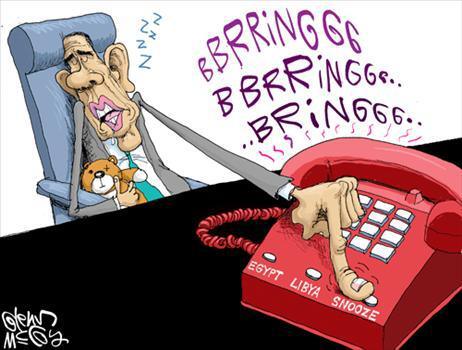
Obama long ago “opened his heart” to the Muslim world.
“To the Muslim world, we seek a new way forward based on mutual interest and mutual respect,” Obama declared in his first inaugural address. The underlying assumption was that America’s previous relations with Muslims were characterized by dissention and contempt. More significant, though, was the president’s use of the term “Muslim world,” a rough translation of the Arabic ummah. A concept developed by classical Islam, ummah refers to a community of believers that transcends borders, cultures, and nationalities. Obama not only believed that such a community existed but that he could address and accommodate it.
The novelty of this approach was surpassed only by Obama’s claim that he, personally, represented the bridge between this Muslim world and the West.

ALL of My policies are the best ever
Obama does deserve some credit: His foreign policies are the most foreign in U.S. history to the security of the United States and of what’s left of the free world. Much the same is true of His domestic policies.
Israel, Hamas In Talks to Achieve Long-Term Cease-Fire Agreement
Discussing 5-10 year truce ( so islamic, named hudna )
BY:
June 22, 2015 10:30 am
via Israel, Hamas In Talks to Achieve Long-Term Cease-Fire Agreement | Washington Free Beacon.
Islamic Law states a “truce” means “a peace treaty with those hostile to Islam, involving a cessation of fighting for a specific period of time…Truces are permissible, not obligatory…There must be some interest served in making a truth other than mere preservation of the status quo…Interests that justify making a truce are such things as Muslim weakness because of lack of number or materiel, or the hope of an enemy becoming Muslim.” (Umdat al Salik, Islamic Sacred Law, (1368), Book O, Justice, 09.16 – published in Maryland, distributed nationwide by Islamic organizations).
Here we go again, till the next dance .
JERUSALEM—A year after fighting a fierce war in the Gaza Strip, Israel and Hamas are engaged in indirect talks aimed at achieving a long-term cease-fire agreement.
While permanent peace is not on the agenda, the two sides are talking of a five- or 10-year truce during which Israel eases restrictions on the Gaza Strip and Hamas refrains from acts of hostility. Unlike similar talks in the past, this time neither side is denying them and both appear to be preparing their publics for the possibility that the ongoing tension and periodic wars of the past decade may give way to a rapprochement, although of limited duration.
Gaza has not yet recovered from last summer’s war, which left more than 2,000 Palestinians and 70 Israelis dead and more than 100,000 Palestinians homeless. Much of the strip is still in ruins and large-scale reconstruction has not begun. Despondency is widespread. Most young men tell reporters that they would leave for other countries if that were possible. Politically, Hamas is in its worst ever situation, with much of the Arab world, particularly neighboring Egypt, turning its back on it, and its economy shattered.
“For the past six months,” writes analyst Alex Fishman in Yediot Achronot, “Hamas has been conveying a real desire for a direct dialogue with Israel on a long-term ‘tahadiya’ (lull).” Although there have been direct contacts in the past on tactical issues, he writes, “this time it is fundamentally different.”
Hamas’ political wing began reaching out to Israel within two months of the end of hostilities last year. Gaza businessmen who had permission to enter Israel were asked to pass on messages to Israeli contacts. This was followed by a 10-point proposal calling for an end to rocket attacks on Israel in return for an end to the Israeli sea blockade of Gaza. Hamas officials confirm that the Islamist organization is involved in “an indirect exchange of ideas.”
United Nations officials and other foreign diplomats have played a role in encouraging the dialogue. Hamas’ rival for Palestinian leadership, the Palestinian Authority on the West Bank headed by President Mahmoud Abbas, has expressed uneasiness about Hamas’ ongoing contacts with Israel, fearing that they may undermine the Authority’s standing. The number two man in Hamas’ political leadership, Moussa Abu Marzouk, said this week that “there are no written plans to discuss with other Palestinian factions.” Another Hamas leader, Salah Bardawil, told Al Jazeera that so far “no vision or timetable for the implementation of the truce has crystallized.”
One of Hamas’ major demands is the right to build a seaport and an airport in Gaza that would permit them direct access to the outside world, rather than via Isael and Egypt, as at present. This has been rejected by Israel on the grounds that militant factions in Gaza would attempt to smuggle in rockets and other weaponry unless cargo is vetted by Israel or another trustworthy international body.
One of the most important intermediaries is Qatar, which has remained loyal to Hamas and is encouraging it to seek a modus vivendi with Israel. A senior Qatari diplomat, Muhammad al-Ahmadi, has met several times with an Israeli major-general, Yoav Mordechai—including twice in Israel—to discuss an Israeli-Hamas truce. “We made it clear to the Israeli general that our intentions are to rebuild, not fund terror,” he told Yediot Achronot reporter Smadar Peri during her recent visit Qatar. “No one wants rockets fired at Israel. Hamas is weak and tired.”
Even without an agreement, Israel has been taking steps to ease life in Gaza. It has permitted about 1,000 Gazans a day to enter Israel and Qatar has been permitted to ship food and equipment to the strip. Israel is linking Gaza to its natural gas supply, according to Israeli officials, and laying additional water and electricity connections to the strip.
Report: Iran Boosts Terror Activities Across Globe
BY: Adam Kredo June 22, 2015 5:00 am Via The Washington Free Beacon

Iranian President Rouhani is happy to serve you. (photo credit: AP)
(It’s ironic and hypocritical that this report was issued by the Department of State. – LS
Iran has increased its efforts to finance and carry out terrorist activities across the world and remains a top nuclear proliferation threat, according to a new State Department assessment.
Iran is funding and arming leading terrorist groups in the Middle East and elsewhere, according to the State Department’s 2014 Country Reports on Terrorism, which thoroughly documents how Tehran continues to act as a leading sponsor terror groups that pose a direct threat to the United States.
The report comes as Western powers work to finalize a nuclear deal with Iran ahead of a self-imposed June 30 deadline, though it is unclear whether the new findings will come up in negotiations.
“In 2014, Iran’s state sponsorship of terrorism worldwide remained undiminished through the Islamic Revolutionary Guard Corps-Qods Force (IRGC-QF), its Ministry of Intelligence and Security, and Tehran’s ally Hizballah, which remained a significant threat to the stability of Lebanon and the broader region,” the report states.
In addition to al Qaeda and the Islamic State (IS, also known as ISIS or ISIL), Iran leads the list of dangerous state actors.
“ISIL and AQ were far from the only serious threat that confronted the United States and its allies,” according to the report. “Iran continued to sponsor terrorist groups around the world, principally through its Islamic Revolutionary Guard Corps-Qods Force (IRGC-QF).”
Iran also is failing to comply with international restrictions on its contested nuclear program and has not lived up to obligations to come clean about past military work on nuclear weapons, according to the report.
“Iran remains a state of proliferation concern,” it states. “Despite multiple [United Nations Security Council resolutions] requiring Iran to suspend its sensitive nuclear proliferation activities, Iran continued to be in noncompliance with its international obligations regarding its nuclear program.”
The Islamic Republic’s support for terrorism spans across the Middle East and even into the Western hemisphere, which remains a particular concern to U.S. officials.
Iran’s terror affiliations include “Lebanese Hizballah, several Iraqi Shia militant groups, Hamas, and Palestine Islamic Jihad,” the report states. “Iran, Hizballah, and other Shia militia continued to provide support to the Assad regime [in Syria], dramatically bolstering its capabilities, prolonging the civil war in Syria, and worsening the human rights and refugee crisis there.”
Iran’s support for the embattled Syrian president includes sending arms shipments through Iraqi airspace, which violates U.N. Security Council resolutions barring such action.
This support is meant “to belittle coalition airstrikes and U.S. contributions to the Government of Iraq’s ongoing fight against ISIL,” according to the report.
However, the report also notes that Iran’s interference in Iraq has been positive in the fight against IS.
“Iraqi security forces, including the Kurdish Peshmerga, in conjunction with Iranian-backed Shia militias, demonstrated some ability to confront this challenge,” it states.
Iranian support for the terror group Hamas, which controls the Gaza Strip, also increased in 2014.
In March, for instance, the Israeli government intercepted “a weapons shipment containing 40 M-302 rockets, 181 mortars, and hundreds of thousands of rounds of ammunition from Iran believed to be destined for militants in Gaza,” according to the report.
On Israel’s northern border, Iran continues to arm Hezbollah with sophisticated weapons meant to be used in attacks on the Jewish state.
“Iran, primarily through the efforts of the Islamic Revolutionary Guard Corps-Qods Force (IRGC-QF), continued to transfer arms to Hizballah,” the State Department found.
“Israeli experts believe that Iran is trying to arm Hizballah with advanced weapons systems such as anti-air and anti-ship cruise missile systems, as well as continuing to transfer long-range rockets into Lebanon,” it states.
Additionally, “Iran has admitted publicly that it armed Hizballah (in violation of UN Security Council Resolutions (UNSCRs) 1701 and 1747) with advanced long-range Iranian manufactured ‘Fateh’ missiles.”
Outside of the Middle East, Iran continues to expand its influence in a bid to establish itself as a world power.
“Iran and its proxies also continued subtle efforts at growing influence elsewhere including in Africa, Asia, and, to a lesser extent, Latin America,” according to the report. “Iran used the Islamic Revolutionary Guard Corps-Qods Force (IRGC-QF) to implement foreign policy goals, provide cover for intelligence operations, and create instability in the Middle East. “
The United States has “remained vigilant in its efforts to monitor Iran’s influence in the Western Hemisphere,” the report claims.
Islamic Hate for the Christian Cross, Front Page Magazine, Raymond Ibrahim, June 22, 2015 (Originally published by PJ Media.)
(Apparently Obama, who appears to favor Islam over all other religions, hopes that when The Islamic Republic of Iran gets or gets to keep the bomb and enjoys lots of sanctions relief its behavior toward non-Muslims will improve. — DM
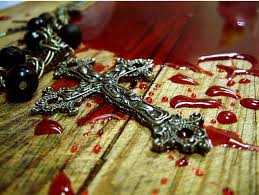
Islamic hostility to the cross is an unwavering fact of life—one that crosses continents and centuries; one that is very much indicative of Islam’s innate hostility to Christianity.
********************
Last May in Italy, a Muslim boy of African origin beat a 12-year-old girl during school because she was wearing a crucifix around her neck. The African schoolboy, who had only started to attend the school approximately three weeks earlier, began to bully the Christian girl—“insulting her and picking on her in other ways all because she was wearing the crucifix”—before he finally “punched the girl violently in the back.”
What is it about the Christian cross that makes some Muslims react this way?
The fact is, Islamic hostility to the cross is an unwavering fact of life—one that crosses continents and centuries; one that is very much indicative of Islam’s innate hostility to Christianity.
Doctrine and History
Because the Christian cross is the quintessential symbol of Christianity—for all denominations, including most forms of otherwise iconoclastic Protestantism—it has been a despised symbol in Islam.
According to the Conditions of Omar—a Medieval text which lays out the many humiliating stipulations conquered Christians must embrace to preserve their lives and which Islamic history attributes to the second “righteous caliph,” Omar al-Khattab—Christians are “Not to display a cross [on churches]… and “Not to produce a cross or [Christian] book in the markets of the Muslims.”
The reason for this animosity is that the cross symbolizes the fundamental disagreement between Christians and Muslims. According to Dr. Sidney Griffith, author of The Church in the Shadow of the Mosque, “The cross and the icons publicly declared those very points of Christian faith which the Koran, in the Muslim view, explicitly denied: that Christ was the Son of God and that he died on the cross.” Thus “the Christian practice of venerating the cross and the icons of Christ and the saints often aroused the disdain of Muslims,” so that there was an ongoing “campaign to erase the public symbols of Christianity, especially the previously ubiquitous sign of the cross.”
Islam’s hostility to the cross, like all of Islam’s hostilities, begins with the Muslim prophet Muhammad. He reportedly “had such a repugnance to the form of the cross that he broke everything brought into his house with its figure upon it.” He once ordered someone wearing a cross to “take off that piece of idolatry” and claimed that at the end times Jesus himself would make it a point to “break the cross”—an assertion the Islamic State regularly makes.
Islamic history following Muhammad is riddled with anecdotes of Muslims cursing and breaking crosses. Prior to the Battle of Yarmuk in 636, which pitted the earliest invading Muslim armies against the Byzantine Empire, Khalid bin al-Walid, the savage “Sword of Allah,” told the Christians that if they wanted peace they must “break the cross” and embrace Islam, or pay jizya and live in subjugation—just as his Islamic State successors are doing today in direct emulation. The Byzantines opted for war.
In Egypt, Saladin (d. 1193)—regularly touted in the West for his “magnanimity”—ordered “the removal of every cross from atop the dome of every church in the provinces of Egypt,” in the words of The History of the Patriarchate of the Egyptian Church.
Europe: Growing Violence against the Cross
Centuries later, not much has changed concerning Islam’s position towards the cross, though much has changed in Western perceptions. In other words, an African boy punching a Christian girl in Italy for her crucifix is part of a long continuum of Islamic hostility for the cross. Perhaps he learned this hatred in mosque—the same European mosques where Islamic State representatives call Muslims to jihad?
After all, earlier this year in Italy, another crucifix was destroyed in close proximity to a populated mosque. The municipality’s Councilor, Giuseppe Berlin, did not mince words concerning the identity of the culprit(s):
Before we put a show of unity with Muslims, let’s have them begin by respecting our civilization and our culture. We shouldn’t minimize the importance of certain signals; we must wake up now or our children will suffer the consequences of this dangerous and uncontrolled Islamic invasion.
Nor is Italy the only European nation experiencing this phenomenon. In neighboring France, a “young Muslim” committed major acts of vandalism at two churches. Along with twisting a massive bronze cross, he overturned and broke two altars, the candelabras and lecterns, destroyed statues, tore down a tabernacle, smashed in a sacristy door and even broke some stained-glass windows. (Click for images.)
And in Germany, a Turkish man who checked himself into a hospital for treatment went into a sudden frenzy because there were “too many crosses on the wall.” He called the nurse a “bitch” and “fascist” and became physically aggressive.
Of course, other times Europeans willingly capitulate to Islamic hostility for the cross. Real Madrid, a professional football (soccer) team in Spain reportedly stripped the traditional Christian cross from its club crest as part of a deal with the National Bank of Abu Dhabi—“so as not to offend Muslim sensibilities in the United Arab Emirates.” And in the United Kingdom, offensive crucifixes are being removed from prisons in order not to offend Muslim inmates (who are further provided with food baths for Islamic rituals).
Muslim World: Christians Killed for the Cross
If this is how some Muslims react to the Christian cross in Europe—where Muslims are aware of their outnumbered, minority status—how do other Muslims react to the cross in the Islamic world, where vastly outnumbered and ostracized Christian “infidels” are easy prey?
The answer is murderous—literally, Christians are being murdered by Muslims provoked at the sight of the cross:
Last year in Egypt, a young Coptic Christian woman named Mary was mauled to death—simply because her cross identified her as a Christian to Muslim Brotherhood rioters. According to an eyewitness who discussed the episode, Mary Sameh George was parking her car by the church to deliver medicine to an elderly woman:
Once they [Brotherhood rioters] saw that she was a Christian [because of the cross hanging on her rearview mirror], they jumped on top of the car, to the point that the vehicle was no longer visible. The roof of the car collapsed in. When they realized that she was starting to die, they pulled her out of the car and started pounding on her and pulling her hair—to the point that portions of her hair and scalp came off. They kept beating her, kicking her, stabbing her with any object or weapon they could find…. Throughout [her ordeal] she tried to protect her face, giving her back to the attackers, till one of them came and stabbed her right in the back, near the heart, finishing her off. Then another came and grabbed her by the hair, shaking her head, and with the other hand slit her throat. Another pulled her pants off, to the point that she was totally naked.
In response, the Coptic Christian Church issued the following statement: “Oh how lucky you are, Mary, you who are beloved of Christ. They tore your body because of the Cross. Yet they offered you the greatest service and gave you a name of honor as one who attained the crown of martyrdom.” The statement also quoted Christ’s warning to believers: “Yes, the time is coming that whoever kills you will think that he offers God service” (John 16:2).
In October 2011, seventeen-year-old Ayman Nabil Labib, a Coptic student, was strangled and beaten to death by his Muslim teacher and some fellow students—simply for refusing to obey the teacher’s orders to remove his cross. Student eyewitnesses present during the assault said that while Ayman was in the classroom he was told to cover up his tattooed wrist cross, which many Copts wear. Not only did he refuse, but he defiantly produced the pectoral cross he wore under his shirt, which prompted the enraged Muslim teacher and students to beat the Christian youth to death.
Before that, an off-duty Muslim police officer on a train from Asyut to Cairo shouted “Allahu Akbar!” and opened fire on six Christians, killing a seventy-one-year-old man and critically wounding the rest. Before opening fire he had checked for passengers with the traditional Coptic cross tattooed on their wrists. (Days ago, another Coptic woman was “shot dead by an Egyptian police officer. Although officially an “accident,” the Muslim officer is notorious for hating Christians.)
In Pakistan, when a Muslim man saw Julie Aftab, a Christian woman, wearing a cross around her neck,
The man became abusive, shouting at her that she was living in the gutter and would go to hell for shunning Islam. He left and returned half an hour later, clutching a bottle of battery acid which he savagely chucked over her head. As she ran screaming for the door a second man grabbed her by the hair and forced more of the liquid down her throat, searing her esophagus. Teeth fell from her mouth as she desperately called for help, stumbling down the street. A woman heard her cries and took her to her home, pouring water over her head and taking her to hospital. At first the doctors refused to treat her, because she was a Christian. ‘They all turned against me . . . even the people who took me to the hospital. They told the doctor they were going to set the hospital on fire if they treated me’. . . . 67 percent of her esophagus was burned and she was missing an eye and both eyelids. What remained of her teeth could be seen through a gaping hole where her cheek had been. The doctors predicted she would die any day. Despite the odds she pulled through.
All this because she was wearing a cross.
Even in Muslim nations deemed “moderate,” violence provoked by the cross is not uncommon. In 2012, a 12-year-old boy in Turkey who converted to Christianity and decided to profess his new faith by wearing a silver cross necklace in class was spit on and beat regularly by Muslim classmates and teachers.
In the Maldives, October 2010, authorities had to rescue Geethamma George, a Christian teacher from India, after Muslim “parents threatened to tie and drag her off of the island” for “preaching Christianity.” Her crime was simply to draw a compass in class as part of a geography lesson. The compass was mistaken for the Christian cross.
Christians ‘Killed’ Again for the Cross
If some Muslims kill the wearers of the cross, so do they disturb the slumber of those already dead for having the cross on their tombstones. A few of the many examples follow:
—–
One can go on and on with more recent examples of Islam’s hostility to the cross. Last April in “moderate” Malaysia, a Muslim mob rioted against a small Protestant church due to the visible cross atop the building of worship. It was quickly removed.
And in Pakistan, a nation where the mere accusation of offending Islam get Christians burned alive—a Muslim shopkeeper is allowed to sell shoes which depict the Christian cross on their sole: “In Pakistani culture, showing the sole of one’s shoe or foot is offensive because placing anything on the ground is considered to be an insult to the object. Therefore, something on the sole of a shoe is going to be constantly insulted as the person walks.”
From an African School Boy in Italy to ‘ISIS’
In light of the above, it should come as no surprise that the Islamic State—“ISIS”—also exhibits violence to the Christian cross. In its communiques to the West, hostile reference to the cross is often made: “We will conquer your Rome, break your crosses, and enslave your women, by the permission of Allah…. [We will cast] fear into the hearts of the cross worshippers….”
After carving the heads of Coptic Christians off in Libya, the lead executioner waved his dagger at the camera and said, “Oh people, recently you have seen us on the hills of as-Sham and Dabiq’s plain [Syrian regions], chopping off the heads that have been carrying the cross for a long time. And today, we are on the south of Rome, on the land of Islam, Libya, sending another message.” He concluded by declaring: “We will fight you [Christians/Westerners] until Christ descends, breaks the cross and kills the pig” (all eschatological actions ascribed to the Muslim “Christ,” Isa).
Moreover, the Islamic State has committed countless atrocities against and because of the cross: it made and disseminated a video showing its members smashing crosses in and atop churches in territories under its sway; it beheaded and stabbed a man with his own crucifix after it exposed him as a Christian; and it published pictures of its members destroying Christian crosses and tombstones in cemeteries under its jurisdiction — and quoted Islamic scriptures justifying its actions.
Careful readers will note the similar parallels here: destroying crosses in churches and cemeteries and even killing Christian “infidels” for wearing them, as documented above, is not limited to “ISIS” but is happening all around the Muslim world, and even in Europe.
In short, Islam’s age-old hatred for the Christian cross—and what it represents—is not a product of the Islamic State, but of Islam.
The Palestinians’ Real Strategy, The Gatestone Institute, Khaled Abu Toameh, June 22, 2015
All signs indicate that the Palestinians are planning to step up their efforts to force Israel to comply with their demands. But as the Palestinians are not united, they are working on two fronts to achieve their goal.
One party, headed by the Palestinian Authority (PA), believes that, with the help of the international community, Israel will be forced to fully withdraw to the pre-1967 lines, including east Jerusalem, and accept the “right of return” for millions of refugees and their descendants to their former homes inside Israel.
The second party, represented by Hamas, Islamic Jihad and several other terror groups, continues to reject any form of compromise, and insists that the only solution lies in the elimination of Israel. Unlike the first party, this one believes that direct or indirect negotiations with the “Zionist enemy” are a waste of time and that terrorism is the only means for the Palestinians to achieve their goal.
The two Palestinian parties, the PA and Hamas, have been at war with each other since 2007, when Hamas seized full control over the Gaza Strip and forced the Palestinian Authority to flee to the West Bank.
But while the two rival parties are fighting each other, they are also working separately to overpower Israel.
On June 19, a Hamas-affiliated group claimed responsibility for the shooting attack that killed Danny Gonen, a 25-year-old man who was visiting the West Bank.
Hamas, Islamic Jihad and other Palestinian groups rushed to “welcome” the killing of the young Israeli man who, by the way, was not a “settler,” but a resident of the Israeli city of Lod, near Ben Gurion Airport.
In separate statements, these terror groups explained that the attack came in the context of Palestinian efforts to “preserve the resistance” against Israel in the West Bank. They said that such attacks were “legitimate means” to achieve Palestinian rights and aspirations.
These groups made it unavoidably clear that their real objective is not to “liberate” the West Bank, but to wipe Israel off the face of the earth. As one of them said, “We will continue to support any resistance action on the land of Palestine until it is liberated, from the (Mediterranean) sea to the (Jordan) river, and cleansed from all Zionist usurpers.”
Hours after the West Bank attack, a senior Hamas leader, Musa Abu Marzouk, repeated that his movement was seeking to replace Israel with an Islamist state: “Hamas wants a state not only in the Gaza Strip, but in all of Palestine; we won’t give up our weapons and will continue to fight in order to liberate our land.”
Marzouk’s remarks refute claims by some Arab and Western media that Hamas has been moving toward pragmatism and moderation, and that it is now willing, for the first time, to recognize Israel’s right to exist. Many in the West often fail to understand Hamas’s true position because they do not follow what Hamas says in Arabic — to its own people. In Arabic, Hamas makes no secret of its call for the destruction of Israel. To Hamas’s credit, this message is often repeated in English and other languages.
While Hamas and its allies work toward destroying Israel through terrorism, the Palestinian Authority seems more determined than ever to step up its worldwide campaign to delegitimize and isolate Israel with the help of various international parties, such as the anti-Israel Boycott, Divestment and Sanctions (BDS) movement.
Some senior Palestinian officials like to describe this campaign as a “diplomatic war” against Israel. They argue that this war has thus far proven to be much more “effective” than rockets and suicide bombings. “When we launch rockets at Israel, we don’t get any sympathy,” explained one official. “But everyone in the international community is now supporting our diplomatic efforts. That’s why we believe that what Hamas is doing right now is harmful to Palestinian interests.”
Shortly before the Israeli man was fatally shot in the West Bank, the chief Palestinian negotiator, Saeb Erekat, revealed his plan to rally the world against Israel so that it would be forced to submit to the Palestinian Authority’s demands, above all a complete withdrawal to the pre-1967 lines.
Erekat’s plan calls for working very closely with EU countries and members of the UN Security Council, to increase pressure on Israel to comply with the Palestinian demands. It also calls for recruiting international support for recognition of a Palestinian state and paving the way for it to join various international organizations and conventions.
In his plan, Erekat warns against endorsing any UN Security Council resolution that would include recognition of Israel as a Jewish state, or offer concessions on the “right of return” for refugees. He also repeats the Palestinian Authority’s rejection of the idea of land swaps between the future Palestinian state and Israel. In addition, Erekat emphasizes his opposition to the idea of creating a demilitarized Palestinian state or giving up any part of Jerusalem.
The Palestinian Authority’s current strategy is to negotiate with the international community, and not with Israel, about achieving peace in the Middle East. The PA knows that it is not going to get from Israel all that it is asking for. That is why the Palestinian leaders have chosen to negotiate with France, Britain, Sweden and the US. The Palestinians are hoping that these countries will give them what Israel cannot and is not prepared to offer at the negotiating table.
Even if Israel wanted to give one hundred percent of what it gained in 1967, the reality on he ground does not allow it. Since 1967, both Jews and Arabs have created irreversible “facts in the ground,” such as the construction of tens of thousands of houses for both Arabs and Jews. A full withdrawal would mean that tens of thousands of Jews and Arabs would lose their homes both in the West Bank and in Jerusalem.
The ultimate goal of the Palestinian Authority is, with the help of the international community, to force Israel to its knees. For the PA, rallying the international community and Europe is about punishing and weakening Israel, not making peace with it. The PA wants to see Israel degraded, isolated and turned into a rogue state. It wants to see Israelis brought before the International Criminal Court and expelled from as many international organizations as possible.
From talking to senior Palestinian Authority officials, one is left with the impression that their true goal is to see Israel in a state of surrender and defeat. Their strategy is no longer about a two-state solution so much as it is about inflicting pain and suffering on Israel. It is more about seeking revenge on Israel than living in a state next to it.
In many ways, the PA’s “diplomatic war” on Israel also helps Hamas. By constantly accusing Israel of “war crimes” and “atrocities,” the PA is helping Hamas justify its terror attacks against Israelis. The PA’s anti-Israel campaign also helps in creating sympathy and understanding for Hamas’s terror attacks.
Meanwhile, Hamas’s terrorism also helps the Palestinian Authority’s anti-Israel campaign in the international community. Each terrorist attack provides the PA with an opportunity to point out the “urgent” need to force Israel to submit to Palestinian demands as a way of “containing the radicals.”
This is how Hamas and the Palestinian Authority, although remaining sworn enemies, complement each other’s role against Israel.
And many in the international community seem to be helping these two Palestinian camps in their effort to undermine and destroy Israel.
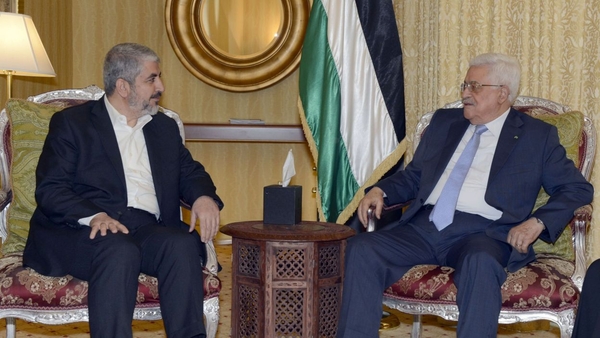 Palestinian Authority President Mahmoud Abbas (r) meets with the Hamas political bureau chief Khaled Mashaal in Qatar, July 20, 2014. (Image source: Handout from the PA President’s Office/Thaer Ghanem)
Iran lawmakers ban nuclear inspectors from military sites
By ALI AKBAR DAREINI Via Associated Press 6-22-2015

Nuclear negotiations put on hold while everyone orders lunch. (photo credit: Unknown)
(Death to the Iran Nuke Deal. – LS)
TEHRAN, Iran (AP) – With some lawmakers chanting “Death to the America,” Iran’s parliament voted to ban access to military sites, documents and scientists as part of a future deal with world powers over its contested nuclear program.
The bill, if ratified, could complicate the ongoing talks in Vienna between Iran and the six-nation group – the U.S., Britain, France, Russia, China and Germany – as they face a self-imposed June 30 deadline. The talks are focused on reaching a final accord that curbs Iran’s nuclear program in return for the lifting of economic sanctions.
Of 213 lawmakers present on Sunday, 199 voted in favor of the bill, which also demands the complete lifting of all sanctions against Iran as part of any final nuclear accord. The bill must be ratified by the Guardian Council, a constitutional watchdog, to become a law.
The terms stipulated in the bill allow for international inspections of Iranian nuclear sites, but forbid any inspections of military facilities.
The bill states in part: “The International Atomic Energy Agency, within the framework of the safeguard agreement, is allowed to carry out conventional inspections of nuclear sites.”
However, it concludes that “access to military, security and sensitive non-nuclear sites, as well as documents and scientists, is forbidden.” It also would require Iran’s foreign minister to report to parliament every six months on the process of implementing the accord.
Iran’s nuclear negotiators say they already have agreed to grant United Nations inspectors “managed access” to military sites under strict control and specific circumstances. That right includes allowing inspectors to take environmental samples around military sites.
But Iranian officials, including Ayatollah Ali Khameni, have strongly rejected the idea of Iranian scientists being interviewed.
In a statement Sunday, the U.S. State Department said inspections remain a key part of any final deal.
All parties “are well aware of what is necessary for a final deal, including the access and transparency that will meet our bottom lines,” the statement said. “We won’t agree to a deal without that.”




 anneinpt
 artaxes
 danmillerinpanama
 davidking1530
 Peter Hofman
 Joseph Wouk
 Peter
Peter Louisiana Steve
 WarSclerotic
Recent Comments