Posted tagged ‘Turkey’

Russian anti-ISIS war from Syria to Caucasus

July 12, 2016

Russian anti-ISIS war from Syria to Caucasus, DEBKAfile, July 12, 2016

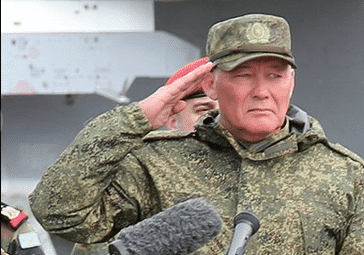
Alexander-Dvornikov-C-in-C-Russian-Syrian-Task-Force

Unimpressed by President Barack Obama’s optimistic assertions about ISIS’ loss of territory and weakening state, the Kremlin judges the counter-terror war to be just beginning. Russian intelligence has found the group to be in full fighting mode and setting up an army of suicide bombers, each team numbering some 20-15 terrorists, ready for strikes in Europe, including Russia, and the Middle East.

************************

In a supreme effort to prevent ISIS suicide units from reaching Russia from Syria, Sergei Shoigu, Russia’s
Defense Minister, has promoted the Russian commander in Syria, Colonel-General Alexander Dvornikov. to an expanded command as head of the South Russia military district. This district covers Russian forces including naval units in the Black and Caspian Seas, the Fourth Air Force Defense Army and Russian bases in Abkhazia, South Ossetia and Armenia.  Gen. Dvornikov will also command tens of ground force divisions, including paratroopers, marines and special coastal defense units.

The fact that the Russian Defense Ministry emphasizes in its announcement that “The decision about the appointment of a new commander of the Syrian operation is pending,” indicates that General Dvornikov will remain in charge of Russian forces in Syria from his new Black Sea HQ. His deputy, Gen.-Lt. Alexander Zhuravlyev, will continue to serve under him in the Syrian arena.

Moscow’s realignment of its military command is taken by DEBKAfile’s military and counter terrorism sources as a step towards becoming the first world power outside the Middle East to recognize and address the trans-frontier, global character of the Islamic peril, a lesson drawn from ISIS suicide attacks in Paris, Brussels, the US, Tunisia Egypt and Turkey

Unimpressed by President Barack Obama’s optimistic assertions about ISIS’ loss of territory and weakening state, the Kremlin judges the counter-terror war to be just beginning. Russian intelligence has found the group to be in full fighting mode and setting up an army of suicide bombers, each team numbering some 20-15 terrorists, ready for strikes in Europe, including Russia, and the Middle East.

This is borne out by the information released in Ankara by Turkish intelligence sources on July 11, showing that since the bombing in Istanbul airport, on June 28, in which 42 people were killed, ISIS has discontinued its passageway through Turkey for suicide terrorists trained in Syria to reach Europe. They are now smuggling terrorists across Azerbaijan, Georgia and Cyprus.

This Turkish announcement has serious implications:

First, that the ISIS’ use of Azerbaijan and Georgia as way stations for its suicide squads points to its presence on the Black Sea coast right up to Russia’s frontier. This region has now passed to the command of  Gen. Dvornikov..

Second, that Turkish intelligence can confirm Russian information about large squads of suicide terrorists gearing up for multiple attacks, some of which are already on-site of their targets, with back-up teams in case the first misses out.

The impending massive invasion of suicide terrorists to Europe and the Middle East was, according to DEBKAfile’s sources, an important item on the agenda of the recent meeting between Yossi Cohen, head of the Israeli Mossad, and Mikhail Yefimovich Fradkov, head of the Russian SVR, that took place on July 1, at the Russian organization’s Yasenevo HQ outside Moscow.

The Case for Kurdish Statehood

July 11, 2016

The Case for Kurdish Statehood, Investigative Project on Terrorism, Noah Beck, July 11, 2016

1691

Why has the West been so supportive of Palestinian nationalism, yet so reluctant to support the Kurds, the largest nation in the world without a state?

The Kurds have been instrumental in fighting the Islamic State (ISIS); have generously accepted millions of refugees fleeing ISIS to the Kurdistan Regional Government (KRG); and embrace Western values such as gender equality, religious freedom, and human rights. They are also an ancient people with an ethnic and linguistic identity stretching back millennia and have faced decades of brutal oppression as a minority. Yet they cannot seem to get sufficient support from the West for their political aspirations.

The Palestinians, by contrast, claimed a distinct national identity relatively recently, are less than one-third fewer in number (in 2013, the global Palestinian population was estimated by the Palestinian Authority to reach 11.6 million), control land that is less than 1/15th the size of the KRG territory, and have not developed their civil society or economy with nearly as much success as the Kurds. Yet the United Nations, the European Union, the Arab League, and other international bodies have all but ignored Kurdish statehood dreams while regularly prioritizing Palestinian ambitions over countless other global crises.

Indeed, in 2014 the UK and Sweden joined much of the rest of the world in recognizing a Palestinian state. There has been no similar global support for a Kurdish homeland. Moreover, Kurdish statehood has been hobbled by U.S. reluctance to see the Iraqi state dismantled and by regional powers like Turkey, which worries that a Kurdish state will stir up separatist feelings among Turkish Kurds.

With an estimated worldwide population of about 35 million (including about 28 million in the KRG or adjacent areas), the Kurds are the fourth-largest ethnic group in the Middle East (after the Arabs, Persians, and Turks), and have faced decades of persecution as a minority in Turkey, Iran, and Iraq.

The 1988 “Anfal” attacks, which included the use of chemical weapons, destroyed about 2,000 villages and killed at least 50,000 Kurds, according to human rights groups (Kurds put the number at nearly 200,000). Several international bodies have recognized those atrocities as a genocide.

The Kurds in Turkey have also suffered oppression dating back to Ottoman times, when the Turkish army killed tens of thousands of Kurds in the Dersim and Zilan massacres. By the mid-1990s, more than 3,000 villages had been destroyed and 378,335 Kurdish villagers had been displaced and left homeless, according to Human Rights Watch.

The drive for Kurdish rights and separatism in Iran extends back to 1918, and – during its most violent chapter – cost the lives of over 30,000 Kurds, starting with the 1979 rebellion and the consequent KDPI insurgency.

A 2007 study notes that 300,000 Kurdish lives were lost just in the 1980s and 1990s. The same study states that 51,000 Jews and Arabs were killed in the Arab-Israeli conflict from 1950 until 2007 (and, because that total includes wars with Israel’s Arab neighbors, Palestinians are a small fraction of the Arab death toll).

Perhaps because of the Kurds’ own painful history, the KRG is exceptionally tolerant towards religious minorities and refugees. The KRG has embraced its tiny community of Jews, and in 2014, the Kurds rescued about 5,000 Yazidis trapped on Mount Sinjar after fleeing attempted genocide by ISIS. Last November, the Kurds recaptured the Sinjar area from ISIS, liberating hundreds more Yazidis from vicious oppression.

The KRG absorbed 1.8 million refugees as of December, representing a population increase of about 30 percent. The KRG reportedly needs $1.4 to 2.4 billion to stabilize the internally displaced people in its territory.

“Most of the refugees [in the KRG] are Arab Sunnis and Shia, Iranians, Christians, and others,” Nahro Zagros, Soran University vice president and adviser to the KRG’s Ministry of Higher Education, told the  IPT. “Yet there is no public backlash from the Kurds. And of course, we have been helping the Yazidi, who are fellow Kurds.”

The Kurdish commitment to gender equality is yet another reason that Kurdish statehood merits Western support. There is no gender discrimination in the Kurdish army: their women fight (and get beheaded) alongside the men. Last December, Kurdistan hosted the International Conference on Women and Human Rights.

The Kurds are also the only credible ground force fighting ISIS, as has been clear since the ISIS threat first emerged in 2014. ISIS “would have totally controlled the Baji oil field and all of Kirkuk had the [Kurdish] Peshmerga not defended it,” said Jay Garner, a retired Army three-star general and former Army assistant vice chief of staff who served during “Operation Provide Comfort” in northern Iraq. “Losing Kirkuk would have changed the entire war [against ISIS], because there are billions of dollars [per] week in oil flowing through there. The Iraqi army abandoned their equipment [while the Kurds defended Kirkuk, which has historically been theirs].”

Masrour Barzani, who heads the KRG’s intelligence services, says that Kurdish independence would empower the Kurds to purchase the type of weapons they need without the delays that currently hobble their military effort against ISIS. Under the present arrangement, Kurdish weapons procurement must go through Iraq’s Shia-led central government, which is also under heavy Iranian influence.

Besides bolstering the fight against ISIS, there are other geopolitical reasons for the West to support Kurdish statehood: promoting a stable partition of Syria, containing Iran, balancing extremist forces in the Middle East, and giving the West another reliable ally in a volatile region.

Now that Syria is no longer a viable state, it could partition into more sustainable governing blocs along traditional ethnic/sectarian lines with Sunni Arabs in the heartland, Alawites in the northwest, Druze in the south, and Kurds in the northeast. KRG leader Masrour Barzani recently argued that political divisions within Iraq have become so deep that the country must transform into “either confederation or full separation.”

Southeast Turkey and northwest Iran also have sizeable Kurdish areas that are contiguous with the KRG, but those states are far from disintegrating, and would aggressively resist any attempts to connect their Kurdish areas to the future Kurdish state. However, the Kurdish areas of former Syria should be joined to Iraqi Kurdistan as a way to strengthen the fledgling Kurdish state and thereby weaken ISIS.

In a recent article, Ernie Audino, the only U.S. Army general to have previously served a year as a combat adviser embedded inside a Kurdish Peshmerga brigade in Iraq, notes that Iran currently controls the Iraqi government and Iran-backed fighters will eventually try to control Kurdistan. He also makes the point that Western support for the Kurdish opposition groups active in Iran would force the Iranian regime to concentrate more on domestic concerns, effectively weakening Iran’s ability to pursue terrorism, expansionism, and other destabilizing activities abroad.

Because the Kurds are religiously diverse moderates who prioritize their ethno-linguistic identity over religion, a Kurdish state would help to balance out the radical Mideast forces in both the Shiite and Sunni camps. The Kurds are already very pro-American, thanks to their Western-leaning values, the U.S.-backed-no-fly zone, and the 2003 toppling of Saddam Husssein that made the KRG possible.

A Kurdish state would also have excellent relations with Israel, another moderate, non-Arab, pro-Western democracy in the region. Israeli Prime Minister Benjamin Netanyahu endorsed Kurdish independence in 2014, and Syrian Kurds – after recently declaring their autonomy – expressed an interest in developing relations with Israel.

By contrast, the Palestinian Authority slanders Israel at every opportunity: Abbas recently claimed in front of the EU parliament that Israel’s rabbis are trying to poison Palestinian drinking water. The Authority raises Palestinian children to hate and kill Jews with endless anti-Israel incitement coming from schools, media, and mosques. Palestinians have also shown little economic progress in the territories that they do control, particularly in Gaza, where Palestinians destroyed the greenhouses that donors bought for them in 2006 and instead, have focused their resources on attacking Israel with tunnels and rockets.

By almost any measure, a Kurdish state deserves far more support from the West. After absorbing millions of Syrian refugees while fighting ISIS on shrinking oil revenue, the KRG is battling a deepening financial crisis. Aggravating the situation, Iraq’s central government has refused – since April 2015 – to send the KRG its share of Iraqi oil revenue. The economic crisis has cost the KRG an estimated $10 billion since 2014.

U.S. Rep. Ed Royce, R-Calif., chairman of the House Foreign Affairs Committee, introduced House Resolution 1654 “to authorize the direct provision of defense articles, defense services, and related training to” the KRG. Fifteen months later, the bill is still stuck in Congress.

Helping the Kurds should be an even bigger priority for the European Union, which absorbs countless new refugees every day that ISIS is not defeated. If the EU were to fund the KRG’s refugee relief efforts and support their military operations against ISIS, far fewer refugees would end up on their shores.


U.S. still gets it wrong on Islamic State

July 1, 2016

U.S. still gets it wrong on Islamic State, Japan Today, Peter Van Buren, July 1, 2016

(An interesting and rather perceptive analysis, quite contrary to Kerry’s position that the suicide attack at the Turkish airport was a sign of desperation. — DM

WASHINGTON — Tuesday’s attacks at Istanbul’s main airport, which appear at this time to be the work of Islamic State, are the latest reminder that the United States should not downplay the group’s rudimentary – yet effective – tactics.

Since the wave of Islamic State suicide bombings in May – killing 522 people inside Baghdad, and 148 people inside Syria – American officials have downplayed the strategy as defensive. Brett McGurk, the Special Presidential Envoy in the fight against Islamic State, said the group “returned to suicide bombing” as the area under its control shrank. The American strategy of focusing primarily on the “big picture” recapture of territory seems to push the suicide bombings to the side. “It’s their last card,” stated an Iraqi spokesperson in response to the attacks.

The reality is just the opposite.

A day after the June 26 liberation of Fallujah, car bombs exploded in eastern and southern Baghdad. Two other suicide bombers were killed outside the city. An improvised explosive device exploded in southwest Baghdad a day earlier.

Washington should know better than to underestimate the power of small weapons to shape large events. After Secretary of Defense Donald Rumsfeld labeled Iraqi insurgents as “dead enders” in 2003, they began taking a deadly toll of American forces via suicide bombs. It was the 2006 bombing of the Shi’ite al-Askari Golden Mosque that kicked the Iraqi civil war into high gear. It was improvised explosive devices and car bombs that kept American forces on the defensive through 2011.

To believe suicide bombings represent a weakening of Islamic State is a near-total misunderstanding of the hybrid nature of the group; Islamic State melds elements of a conventional army and an insurgency. To “win,” one must defeat both versions.

Islamic State differs from a traditional insurgency in that it seeks to hold territory. This separates it from al-Qaida, and most other radical groups, and falsely leads the United States to believe that retaking strategic cities like Fallujah from Islamic State is akin to “defeating” it, as if it is World War Two again and we are watching blue arrows move across the map toward Berlin. Envoy McGurk, following Fallujah, even held a press conference announcing Islamic State has now lost 47 percent of its territory.

However, simultaneously with holding and losing territory, Islamic State uses terror and violence to achieve political ends.

Islamic State has no aircraft and no significant long-range weapons, making it a very weak conventional army when facing down the combined forces of the United States, Iran and Iraq in set piece battles. It can, however, use suicide bombs to strike into the very heart of Shiite Baghdad (and Syria, Jordan, Yemen, and Turkey – as Tuesday’s bombing reminds us), acting as a strong transnational insurgency.

Why does such strength matter in the face of large-scale losses such as Fallujah?

Violence in the heart of Iraqi Shiite neighborhoods empowers hardliners to seek revenge. Core Sunni support for Islamic State grows out of the need for protection from a Shi’ite dominated military, which seeks to marginalize if not destroy the Sunnis. Reports of Shi’ite atrocities leaking out of the ruins of Sunni Fallujah are thus significant. Fallujah was largely destroyed in order to “save” it, generating some 85,000 displaced persons, mirroring what happened in Ramadi. Those actions remind many Sunnis of why they supported Islamic State (and al-Qaida before them) in the first place.

Suicide strikes reduce the confidence of the people in their government’s ability to protect them. In Iraq, that sends Shiite militias into the streets, and raises questions about the value of civil institutions like the Iraqi National Police. Victories such as the retaking of Ramadi and Fallujah, and a promised assault on Mosul, mean little to people living at risk inside the nation’s capital.

American commanders have already had to talk the Iraqi government out of pulling troops from the field to defend Baghdad, even as roughly half of all Iraqi security forces are already deployed there. This almost guarantees more American soldiers will be needed to take up the slack.

Anything that pulls more American troops into Iraq fits well with the anti-American Islamic State narrative. Few Iraqis are left who imagine the United States can be an honest broker in their country. A State Department report found that one-third of all Iraqis believe the Americans are actually supporting Islamic State, while 40 percent are convinced that the United States is trying to destabilize Iraq for its own purposes.

In a country like Turkey, suicide bombings play out in a more complex political environment. Turkey has effectively supported Islamic State with porous borders for transit in and out of Syria, and has facilitated the flow of oil out of Syria and Iraq that ultimately benefits the group. At the same time, however, Turkey opened its territory to American aircraft conducting bombing runs against Islamic State. Attacks in Turkey may be in response to pressure on the nation to shift its strategy more in line with Western demands. Russia (no friend of Islamic State) and Turkey have also recently improved relations; the attack in Istanbul may have been a warning shot reminding Turkey not to get too close.

The suicide bombings – in Turkey and elsewhere – are not desperate or defensive moves. They are not inconsequential, even if their actual numbers decline. They are careful strategy, the well-thought out application of violence by Islamic State. The United States downplays them at great risk.

Anger, Honor and Freedom: What European Muslims’ Attack On Speech Is Really About

June 30, 2016

Anger, Honor and Freedom: What European Muslims’ Attack On Speech Is Really About, Investigative Project on Terrorism, Abigail R. Esman, June 30, 2016

1052

Indeed, much of the Muslim violence in Europe is about exactly this: intimidating non-Muslims into a fearful capitulation, where words like “I hate Muslims” and drawings of Mohammed become extinct because the Muslim communities insist that it be so. It is about forcing Westerners to rearrange their lives, their culture, to accommodate the needs and values and culture of Islam. It is about control, and the power over freedom. And it is about creating a culture in which honor is injured by words and restored through violence and terror.

**********************

“Clash of civilizations,” some say. Others call it the “failure of multiculturalism.” Either way, the cultural conflicts between some Muslims and non-Muslims worldwide continue to play out as Western countries struggle to reconcile their own cultures with the demands of a growing Muslim population.

But herein lies the problem: in many ways, the two cultures are ultimately irreconcilable. There is no middle ground. And hence, the conflicts and the tugs-of-war continue.

Over the past two months, the events surrounding controversial Dutch columnist Ebru Umar have encapsulated that “clash” at its core, a salient metaphor for the tensions, particularly in Europe, between the West’s Muslim populations and its own. More, they illuminate the enormity of the problems we still face.

Umar is no stranger to the spotlight, or to the wrath of Dutch Muslims who read her many columns, most of them published in the free newspaper, Metro. For years, the Dutch-born daughter of secular Turkish immigrants has raged against the failure of other Dutch-born children of immigrants, mostly Moroccan, to assimilate into the culture of their birth. She loudly condemns Dutch-Moroccan families for the shockingly high rates of criminality and violence among Dutch-Moroccan boys – as much as 22 times the rate of Dutch native youth – a phenomenon she ascribes to their Islamic upbringing and their parents’ refusal to allow their children to mingle among the Dutch.

But her critiques have earned her no converts. Instead, Dutch-Moroccan youth, whom she calls “Mocros,” have regularly taunted her, both online and in the street.

This past April, however, Umar added a new team of enemies to her portfolio: when, in response to Turkish president Recep Tayyip Erodogan’s demand that a German satirist be prosecuted for insulting him on TV, Umar tweeted “f***erdogan,” Dutch Turks turned on her in fury. “How dare you insult our president!” cried these Dutch-born subjects of Holland’s King Willem-Alexander. And while Umar took a brief holiday on the Turkish coast, one such Dutch-Turk turned her in to the police. She was arrested at her vacation home in Kusadasi, and though released the following day, was forbidden to leave the country. The charge: Insulting the Turkish president. It took 17 days before discussions between Holland’s prime minister and Turkish authorities enabled her to return to the Netherlands.

But she could not return home. In her absence, Umar’s home had been burgled and vandalized, the word “whore” scrawled on a stairway wall. Death threats followed her both in Turkey and on her return. When it became clear she could not ever return to the apartment she had lived in for nearly 20 years, she announced on Twitter (Ebru Umar posts constantly on Twitter) that she would be moving out.

Meantime, in Metro and elsewhere, she continued her criticism of Moroccans and, as she herself notes, of Islam overall.

And so it was that on the day Ebru Umar moved out of her apartment in Amsterdam, a group of Dutch-Moroccans in their twenties came to see her off, taunting her with chants: Ebru has to mo-o-ve, nyah nyah.” Though furious, she ignored them – until one of them began to film her loading her belongings into her car. For Umar, being taunted by the very people whose threats had forced her from her home in the first place was bad enough: but this violation of what little privacy remained for her was more than she could take. She grabbed her iPhone and began filming them right back. “Go ahead,” she challenged. “Say it for the camera.”

Scuffles ensued, and soon one of the Moroccans had her iPhone in his hand. The others laughed. Then they ran away. Umar filed a police report and, still smarting, took to Twitter once again: “C**t Moroccans, I hate you,” she posted. “I hate you, I hate you, I hate you, I hate you and I hate your Muslim brothers and sisters, too. F**k you all.” (It is important to note that, however offensive, the expression “c**t Moroccans” is a common epithet in the Netherlands.)

But, hey – she was angry. Her phone had been snatched from her hand in a brutal, aggressive gesture that left her feeling violated and, vulnerable. She had just been forced to leave her home. She had endured prison, a criminal inquiry, and death threats, all at the hands of the same group on whom she now spewed her fury.

Her words may have been harsh or inappropriate, but they were words. She had not struck her tormenters as they filmed her. She did not call for their demise, or strap a bomb around her waist and visit the local mosques.

She took to Twitter and said: I hate you.

“But hate,” she tells me later in an e-mail, “is just an emotion.” And in a column penned more than two years ago, she observed, “Hate me till you’re purple, but keep your claws off me.”

Here is where Ebru Umar’s story becomes the story of the Western world. In response to her words (“I hate you. F*** you”), several Muslims – Moroccans and others – filed charges against her for hate speech. (Though ironically, “I hate you” does not legally qualify as “hate speech.”) Such words are an attack upon their honor, a humiliation: and if there is one thing experts on Arab and Muslim culture will agree on, it is the significance of humiliation and honor in governing their lives. For this, Dutch Moroccan youth threaten Umar on the streets, and have done so, she says, for years: after all, she insults them.
1664

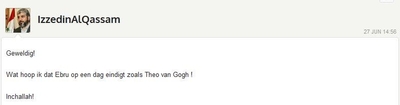
But in truth, it isn’t just the youth. The broader Muslim community stands by, silent: they do not condemn the youth who taunt her, who rip her telephone from her hands, or post things on the Internet like “We hate you, too – can you please kill yourself?” or “Oh, how I hope she ends up like Theo van Gogh.”

Theo van Gogh, also a controversial columnist, was shot and stabbed to death in 2014 by a radical Dutch-Moroccan Muslim.The commenter wishing her the same fate used the name “IzzedinAlQassam,” the founder of modern Palestinian jihad, and an icon of Hamas leader Khaled Meshaal.

For people like this, it doesn’t matter that Umar – or van Gogh – inflicted no violence, any more than it mattered that the editors of Charlie Hebdo were not violent. It was the insult, the humiliation – to them, to Islam, to Mohammed – that mattered: and an insult, a humiliation, deserves a violent response.

Indeed, much of the Muslim violence in Europe is about exactly this: intimidating non-Muslims into a fearful capitulation, where words like “I hate Muslims” and drawings of Mohammed become extinct because the Muslim communities insist that it be so. It is about forcing Westerners to rearrange their lives, their culture, to accommodate the needs and values and culture of Islam. It is about control, and the power over freedom. And it is about creating a culture in which honor is injured by words and restored through violence and terror.

When Umar says “I hate you,” what she hates, really, isn’t the Moroccans who attacked her or their “Muslim brothers and sisters.” What she hates is this – this effort, this battle over honor and speech and freedom, and this clash between violence and expression, guns and conversation.

“I don’t want Muslims to leave,” she tells me, again by e-mail. “I want them to embrace the Enlightenment, Western society, the Netherlands.” And in turn, she calls on the Dutch to “set rules: no violence in any sense. And stop using culture or religion as an excuse for behavior.”

Ebru Umar’s words. More of us should listen.
More airports under ISIS threat after Istanbul

June 29, 2016

More airports under ISIS threat after Istanbul, DEBKAfile, June 29, 2016

istanbul-dead

The US, Europe and the Middle East are again refusing to connect the dots of the terrorist threat, recalling the denial that marked the peak period of Al Qaeda’s atrocities in the early 2000’s.

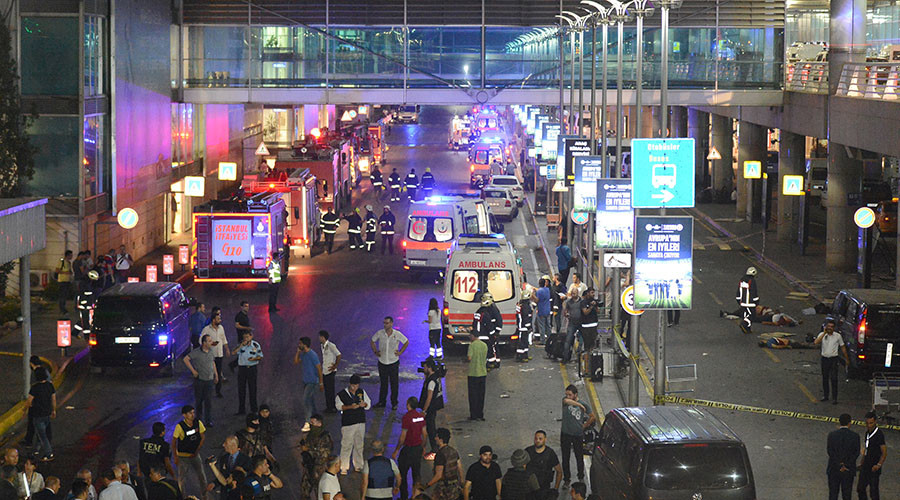
When the US Defense Secretary Ashton Carter trumpeted the Fallujah victory over the Islamic State on June 27, he neglected to disclose that the real victors were Iranians – not Iraqis. The next day, an ISIS suicide attack on Istanbul’s Ataturk airport overshadowed that success, killing at least 41 people including 13 foreign nationald and injuring more than 230.

As the Obama administration labored to conceal from the public in the West its strategy of using Shiite forces to hammer ISIS in Iraq and parts of Syria, the Sunni terrorists retaliated in Istanbul – and not just there.

Seven ISIS suicide bombers, some on motorcycles, exploded on Monday, June 27, in a Christian village in the Lebanon Valley near Baʿalbek. A week earlier, an ISIS suicide bomber blew himself up at the gates of a large Jordanian military base on the Syrian border.

The connection between the ISIS arenas and cause and event is there for anyone who wants to see it.

ISIS has a ready store of suicide bombers who are willing to blow themselves up, not just because they are ‘extreme fanatics’ or “thugs” as President Obama insists on defining them, but because they believe they are fighting a religious war: Sunnis against Shiites, Sunnis against Christians and Sunnis against Jews.

On this point, Obama is in denial.

Turkey’s Sunni President Tayyip Erdogan was swiftly punished for concluding a political-military-intelligence agreement with the Jewish state. That same day, three suicide bombers, probably waiting for months at a safe house near the Istanbul airport, were ordered from ISIS Syrian headquarters in Raqqa, to go into action.

Neither the dense US intelligence net in the region, nor Turkish and Israeli intelligence managed to intercept the order.

DEBKAfile intelligence sources point out that the highly secure Ataturk airport, the third largest in Europe, is not the only one on the continent at which ISIS suicide units are lurking ready to strike.

American-European intelligence input points to their presence near at least two or three other airports in Europe. The problem is that the intel is very general, pointing to intent, with no specifics on countries or airports.

The public in the West and Middle-East are not told either about the ‘small’ victories scored by ISIS on the battle field. For instance, ISIS forces managed to block the Syrian-Hizballah advance towards the highway leading from Palmyra to Raqqa, inflicting heavy losses despite Russian air cover.

In Israel, where security awareness is usually high, no one was told about the successful ISIS engagement at the Syria-Jordan-Israel border junction bordering on the Israeli Golan against US-trained and armed Syrian rebels, who fought under artillery cover from Jordan.

In other words, ISIS has established itself on the Israeli border, a few kilometers away from the Sea of Galilee and Tiberius.

The Islamic State is fully geared to respond to such losses as Fallujah by going for strategic gains on the ground and inflicting horrible retribution on its victims by remotely activating sleeper cells of suicide killers.

Rather than being degraded, as Obama claims, ISIS is fully equipped to target its victims across several continents.

On Tuesday Istanbul airport was its chosen target. Now, we must wait and see who is next.

EXCLUSIVE – Islamic State Supporters Celebrate Deadly Istanbul Airport Attack

June 29, 2016

EXCLUSIVE – Islamic State Supporters Celebrate Deadly Istanbul Airport Attack

by Aaron Klein and Ali Waked

29 Jun 2016

Source: EXCLUSIVE – Islamic State Supporters Celebrate Deadly Istanbul Airport Attack – Breitbart

TEL AVIV – The Islamic State has not claimed official responsibility for Tuesday’s deadly Istanbul airport attack as if this writing, but users in an encrypted messaging forum for Islamic State fighters and supporters are praising the triple assaults and hoping IS was behind the carnage that left 41 people dead and wounded more than 239.

Breitbart Jerusalem has gained insider access to the encrypted Telegraph forum, which consists of known IS leaders, lower and mid-level IS fighters, IS supporters, and propagandists. Some members utilize their own names, while others use screen names. The forum serves as a Twitter of sorts for IS and its supporters.

Inside the forum, users explained with great conviction why they hope and believe the attack was IS “retaliation” against Turkey.

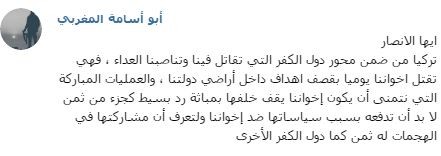
Abu Usama Almagrebi, a Moroccan jihadi, wrote: “Friends, Turkey has become a member of the axis of infidel countries fighting and showing hostility against us. They kill our brothers on a daily basis by launching airstrikes on our country, and the blessed bombings that we hope our brothers are responsible for is a natural reaction and only a small part of the price Turkey has to pay for its policy against our brothers.”

abu usama almagrebi

“She (Turkey) should know that she will pay for participating in the attacks against us just like any other infidel country,” he added.

Another IS activist, writing under the pseudonym “Attacking Barriers,” wrote: “Our friends and dearly beloved, the community of mujahedeen, for us an American Muslim is better than an Arab supporting the infidels. Don’t forget the teachings of Ibn Taimiyah [an Islamic cleric who serves as an inspiration to IS] who said: ‘If I side with the infidels kill me, even if I do it carrying the Quran…’ There are Muslims among the infidels.”

attacking barriors

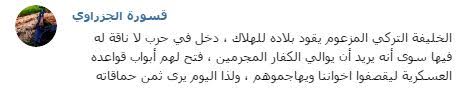
Kassura Aljazrawi wrote: “The Turkish ruler who pretends to be a caliph leads his country to oblivion. He joined a war that’s not his out of support for the infidels, opened the doors to his military bases for them to raid our brothers, and now realizes what price he has to pay for his stupidity.”

kassura aljazrawi (1)

Telegraph user “Tyrant Shaker” mentioned the normalization pact Turkey had signed with Israel just one day before Tuesday’s attack. “I think that the operation is a message from our State that if you think you sign a deal with the Jews to help your economy, it actually depends on our suicide bombers.”

tyrant maarid

“Ironclad Determination” wrote: “Erdogan entered the gates of the world of infidelity and therefore bears the brunt of our Islamic fighters. He started this war by attacking our brothers, and it’s time for him the pay the price. We pray to Allah that this attack was the work of our brothers, and with Allah’s help the mujahedeen will take control of Turkey just like the Prophet promised.”

iron determination

IS is being implicated in the attack in which three suspected suicide bombers opened fire and then detonated themselves in Istanbul’s main airport.

Aaron Klein is Breitbart’s Jerusalem bureau chief and senior investigative reporter. He is a New York Times bestselling author and hosts the popular weekend talk radio program, “Aaron Klein Investigative Radio.” Follow him on Twitter @AaronKleinShow. Follow him on Facebook.

Turkish airport blast caught on camera (GRAPHIC VIDEO)

June 29, 2016

Turkish airport blast caught on camera (GRAPHIC VIDEO)

Published time: 28 Jun, 2016 21:03

Source: Turkish airport blast caught on camera (GRAPHIC VIDEO) — RT News

People walk outside Turkey’s largest airport, Istanbul Ataturk, Turkey, following a blast June 28, 2016. © Ismail Coskun / IHLAS News Agency / Reuters

CCTV footage showing one of the two deadly explosions that took the lives of at least 10 people at Istanbul’s Ataturk Airport has emerged online.

The video shows a bright flash in a crowded terminal, which is followed by a cloud of thick black smoke and panic among the passengers.

https://twitter.com/MahirZeynalov/status/747890126966112256?ref_src=twsrc%5Etfw


The blasts occurred late Tuesday in the airport’s International Arrivals Terminal.

The Turkish media claims that the explosions were terrorist attacks targeting two separate locations in the airport.

READ MORE: At least 2 blasts rock Istanbul’s Ataturk Airport, multiple injuries reported

Al least 10 people were killed and around 60 others injured in the blasts, according to reports.

From FOX


Turkey airport attack in Istanbul blamed on ISIS with up to 50 dead

June 29, 2016

Terrifying moment ISIS suicide bomber blew himself up in Istanbul airport terminal in Brussels-style attack that left at least 41 dead and 239 injured

Source: Turkey airport attack in Istanbul blamed on ISIS with up to 50 dead | Daily Mail Online

‘There was blood and body parts everywhere’:

  • WARNING: GRAPHIC CONTENT 
  • Three explosions rocked Istanbul’s Ataturk airport in a co-ordinated suicide attack at  8pm GMT last night
  • Eyewitness saw a police officer wrestle attacker to the ground just moments before the blast shook the terminal 
  • A total of 41 people are confirmed dead however this total is expected to rise to 50, according to Turkish officials
  • Reports claimed that ISIS is to blame for the attack, according to Turkish news agencies citing police sources
  • Turkish Airlines is the official airline partner of the Euro 2016 football tournament currently being held in France

Witnesses have described the terrifying moment three suicide bombers launched a co-ordinated attack on Istanbul airport that has left at least 41 dead saying there was blood and body parts everywhere.

Shocking footage has shown an explosion at the door to the arrivals hall by a suicide bomber before another two attackers snuck into the building and dentonated their devices.

Twenty-three of the victims were Turkish citizens and 13 foreign nationals were also among the casualties, an official has said. A total of 41 people have already been confirmed dead, but Turkish officials said that number is expected to rise to 50.

This morning the airport has re-opened while investigators piece together what happened, just hours after the attacks, which also left 239 people injured.

One of the passengers who was travelling through Ataturk airport at the time of the blasts was Laurence Cameron, a British cameraman who was travelling from Latvia to Izmir, on the Turkish coast.

Footage appears to show the moment one of the three bombs was detonated in the devastating suicide attack at Turkey’s Ataturk airport

One of the three terrorists that struck at Turkey’s Ataturk Airport wields an AK-47 as he carries out his killing spree (left), while a man carries a wounded boy away from the airport (right)

Paramedics and special forces officers at the scene help the more than 140 wounded at the airport. At least 41 others were killed

An AK-47 can be seen lying abandoned on the floor, after three suicide bombers set off blasts at the airport as police returned fire

Bodies lie on the pavement outside Istanbul’s international airport after explosions and gunfire shook the terminal

Turkish security agencies and emergency services gathered outside Ataturk airport after it was hit by a suicide bomb attack

Desperate passengers embrace as they gather in shock outside the terminal after the airport was evacuated and all flights were grounded

A wounded girl is carried on a stretcher into the Bakirkoy Sadi Konuk Hospital after being injured in the blasts at Ataturk Airport

Relatives of those who were caught up in the bombings at Ataturk airport wait outside the Bakirkoy Sadi Konuk Hospital for news on their loved ones

A mother who lost one of her children in the attack has to be helped from the ground outside a forensic medicine building close to Istanbul Airport

Another mother of one of the victims is comforted after learning the fate of one of her children after suicide bombers opened fire before blowing themselves up

And he believes believes his plane had arrived just as the bombs began to detonate.

As he walked into the terminal, unaware of what had just happened, he was met with chaos, panic and fear.

‘It must have been just as we touched down,’ he told MailOnline. ‘I did not even hear the explosions, but as I walked out and round the corner, the whole building was running screaming towards me.

‘It was just mass panic, guards running around with guns.’

Mr Cameron, originally from Kent, was stuck for half-an-hour, waiting at customs, before he and his fellow passengers were allowed through and out the terminal.

However, the only way to leave the building was to go through the very place where the bombs had been detonated less than an hour before.

‘There was blood on the floor. It was just horrendous. Debris everywhere. A lot of the ceiling panels had fallen down, smashed all over the floor.

‘Coming out to the taxi rank, it was just full of ambulances. Blood was smeared all up to the car park.

‘People were in tears, especially people with families. They were quite clearly traumatised. There was a lot of uncertainty, no one really knew what was going on. Were we safe where we were?’

He added: ‘There is nowhere to go but out through passport control [if you are in an airport terminal]. It’s not nice – it should be safe, but at that moment it was not.’

An aerial view of the airport shows where the suicide bombers are believed to have detonated their explosives, close to the entrance to the international arrivals terminal

A LOT MORE HERE

http://www.dailymail.co.uk/news/article-3664710/Two-explosions-gunfire-Istanbul-s-Ataturk-airport-cause-multiple-injuries.html

Israel and Turkey restore relations – peace in our time?

June 28, 2016

Israel and Turkey restore relations – peace in our time? | Anne’s Opinions, 27th June 2016

(Israel and Turkey renew diplomatic relations – but at what cost to Israel’s national pride, let alone its security? –anneinpt )

On reading the terms under which Israel and Turkey are to restore diplomatic relations today I felt I ought to title this piece by paraphrasing Neville Chamberlain: “I have here a piece of paper…”.

Let’s start with the terms of the agrement:

Israel and Turkey are set to announce on Monday that they have reached a rapprochement agreement that will normalize relations between the two countries more than six years after ties between the erstwhile allies fell apart following the Mavi Marmara incident.

A senior diplomatic source said Prime Minister Benjamin Netanyahu will announce the agreement, and explain its elements, at a news conference at noon in Rome. The Turks will simultaneously hold a similar event in Ankara. Netanyahu arrived in Rome on Sunday for talks with US Secretary of State John Kerry.

Right off the bat this angers me. Netanyahu should be announcing the agreement in Jerusalem! Let’s continue:

According to the senior Israeli source, the Turks have given Israel a letter pledging that Turkish President Recep Tayyip Erdogan will direct the relevant Turkish authorities to work on a humanitarian basis for the return to Israel of two missing Israelis in Gaza – Avraham “Abera” Mengistu and a Beduin from the South – as well as the bodies of St.-Sgt. Oron Shaul and Lt. Hadar Goldin, the two soldiers killed during Operation Protective Edge in 2014.

I am furious that the Turks can only bring themselves to be so “humanitarian” after being bribed to do so. Some humanitarianism!!

And there’s more:

• Turkey will be allowed to transfer humanitarian aid to the Gaza Strip without limitation through the Ashdod port, and will be allowed to build, inside Gaza, power and desalination plants and a hospital. This is in lieu of a lifting of the blockade of Gaza, which Erdogan had demanded for years as a precondition for normalizing ties.

• Turkey will not allow Hamas to plan or carry out attacks against Israel from its territory. Turkey did not, as Israel demanded, agree to kick the terrorist organization out of the country. Erdogan, according to the Turkish press, met Hamas leader Khaled Mashaal in Istanbul on Friday to update him on the deal.

The implication of the term “Turkey will not allow Hamas to plan or carry out attacks against Israel” is that Turkey is one of the prime influences, if not the prime supporter of Hamas. This should make them our most deadly enemy and not any kind of peace partner – particularly as they have NOT agreed to kick out Hamas from their country. How far can we trust Erdogan? Not as far as we can throw him in my own humble opinion.

Instead of Netanyahu instructing the IDF to go in and finish the job,he has abdicated his and our responsibility to a foreign agent. How can we complain about Obama refusing to tackle Assad when we ourselves don’t take on a weak enemy right on our own border, not across the ocean, and outsource the work to a foreign agent?

The next term makes my blood boil:

• As a humanitarian act, Israel will pay $20 million to a special fund set up for the families of the nine victims killed on the Mavi Marmara by IDF commandos who faced violent resistance when they boarded the ship to keep it from breaking the naval blockade of Gaza.

“Peaceful” IHH terrorists aboard the Mavi Marmara attack IF soldiers (via Meir Amit Intelligence & Terrorism Information Center

It doesn’t matter how much Israel claims this is a “humanitarian act”. It will be taken – rightly – as an act of apology, which by extension means that Israel admits it did wrong when it killed the terrorists on board the Mavi Marmara. The only humanitarian act that should have taken place here is for Turkey to compensate Israel for the international condemnation that Israel received, the attempts to sue Israel at the ICC, the copy-cat flotillas and of course for the injuries to the IDF soldiers involved.

All becomes clear at this paragraph below:

Bloomberg reported that energy talks between the two countries are expected to open immediately after the reconciliation is announced, and that this could pave the way for multi-billion dollar natural gas contracts and the export of natural gas to Turkey, which is looking to reduce its energy dependence on Russia.

Israel has sold its soul for the proverbial 30 pieces of silver. Indeed Netanyahu told Secretary of State John Kerry that the agreement will be a tremendous boost to Israel’s economy. Yes, Netanyahu and his government must look after our economy, but not at any price, whether monetary, politically or diplomatically.

This has all brought us to the point that the treasonous Arab List MK Hanin Zoabi speaks the truth when she said that Israel’s compensation agreement is admission of murder:

MK Hanin Zoabi (Joint List), who participated in the 2010 Mavi Marmara flotilla which ultimately resulted in the cutting of ties between Israel and Turkey, on Sunday night said the reconciliation agreement between the two countries was a clear “admission of murder” by Israel.

“Israel’s agreement to transfer 21 million shekels [sic. It is 21 million dollars -Ed.] to the Turks constitutes a clear admission of guilt. Even if Israel does not acknowledge it, it is a confession to the murder of nine people, wounding of dozens, kidnapping and piracy in international waters and false persecution,” she charged.

And of course, as clearly as night leads to day, the next call was inevitable:

Zoabi called for more flotillas like the Marmara one in order to remove the “criminal siege”, as she put it, over Gaza.

I also find myself in rare agreement with the Israeli opposition as they lambasted Netanyahu for the agreement:

“Netanyahu again puts his tail between his legs with Hamas, harms IDF soldiers without blinking, and harms the families of the missing [soldiers and civilians],” Zionist Union MK Erel Margalit said on Facebook. “Once again Mr. Security strengthens the radicals and weakens Israel.”His fellow party member Itzik Shmuli said that while relations with Turkey were important, Netanyahu went “too far” with the terms of the accord. “Where is the old [Defense Minister Avigdor] Liberman who would yell right about now that they’re giving a reward for terrorism?” he asked.

Former Likud minister Gideon Sa’ar, who reportedly plans to run against Netanyahu in the next general elections, said he hoped the news reports about the Turkey deal were incorrect.

“If they are true, this is a national embarrassment and an invitation for more flotillas and libels by Israel haters,” he said.

One of the most egregious parts of the agreement, as I mentioned above, is the “outsourcing” to Turkey of the efforts return the bodies of slain IDF soldiers Hadar Goldin and Oron Shaul Hy’d, who were killed during Operation Protective Edge in 2014. The families of the soldiers are rightly furious that the return of the bodies was not a pre-condition to Israel’s signing of the deal:

“I don’t accept the claim that Turkey has no leverage where returning the bodies of our boys from Gaza is concerned,” the mother of deceased 23-year-old IDF lieutenant Hadar Goldin told The Algemeiner on Sunday.

Dr. Leah Goldin was expressing her outrage and frustration at the discovery that the upcoming agreement between Jerusalem and Ankara, an official announcement about which is scheduled for Sunday evening does not mention the two young men who were abducted and killed by Hamas terrorists during a cease-fire in the midst of Operation Protective Edge – the war that Israel fought in the summer of 2014 against the Palestinian terrorist organization ruling the Gaza Strip.

IDF soldiers Oron Shaul (left) and Hadar Goldin (right)

“Turkey is Hamas’ patron,” she asserted. “Turkey is also a leader of the Muslim Brotherhood. Turkey — with the whole Mavi Marmara story — proved to us that it is the country closest to Hamas and most concerned with taking care of Hamas interests. It cannot be that Turkey has no say.”

Because of Turkey’s support for Hamas, Goldin said, negotiations that have been going on for a few years now between the governments of Erdogan and Israeli Prime Minister Benjamin Netanyahu should have included a stipulation for the return of Hadar and Oron, Goldin said, revealing that her grandson is now a soldier in the Golani Brigade. “He wanted to go into the combat unit to follow in his uncle’s footsteps,” she said.

“This is not only a humanitarian issue – and an Israeli value never to leave behind soldiers in battle – but it is a crucial message to the new crops of soldiers who will have to fight in the next war,” Goldin said, expressing disappointment that the young men were not used as a condition for reaching a deal with Turkey – especially after “being told by Netanyahu on an hour-long conference call recently, that everything was being done to return them to Israel for burial, and that nobody had forgotten us.”

“Until now, Hamas has abducted soldiers and demanded a heavy price from Israel for their release. The time has come to turn that equation on its head. Rather than waiting for Hamas to demand a price from Israel, a price from Hamas must be exacted for not returning the bodies.”

The government responded with one of the lamest responses I have ever heard:

According to Israel’s Channel 2, a senior government official explained that the reason that the return of the bodies was not included in the agreement with Turkey is that doing so would have provided Hamas with veto power over other elements of the deal.

Truly pathetic.

It gets worse. Both Turkey and Hamas are declaring victory, rubbing salt into Israel’s wounds and increasing our national humiliation:

A senior Turkish official said the reconciliation deal reached between Israel and Turkey which is set to be signed on Tuesday was a diplomatic victory for Ankara.

The victors in the reconciliation agreement – best friends Turkey’s President Erdogan and Hamas Leader Khaled Mashal

The official said, according to Israel Radio, that even as Israel stood by its refusal to lift the blockade on Gaza — one of Turkey’s conditions for a rapprochement deal and a past sticking point — Turkey did succeed in convincing Israel to allow Turkish humanitarian aid through its Ashdod port to Gaza, the completion of a much-needed hospital in the Palestinian enclave, as well as the construction of a new power station and a desalination plant for drinking water.

Hamas has said it was not involved in Turkey’s decision to restore ties with Israel but claimed it was “proud” of Turkey’s official position on the Palestinian issue, according to the Turkish Daily Sabah.

The Jerusalem Post also agrees that the winner of this agreement is Hamas:

Hamas and Turkey come out as the winners in the upcoming deal if reports in the Israeli media are correct.

Israel apparently has agreed to the presence of Hamas in Turkey as long as it does not involve itself directly in terrorist attacks against Israel, but limits itself to political and other supposedly nonviolent activity.

However, the sanction of the presence and “political” activity of Hamas in a country with diplomatic ties with Israel undermines years of Israeli public relations against the terrorist group, which sought to identify Hamas with other Sunni groups such as al-Qaida and Islamic State.

Would Israel or any other Western country allow the leader of a friendly state with which it has diplomatic relations meet with Islamic State leader Abu Bakr al-Baghdadi and allow the organization to operate within its territory? Jonathan Schanzer, vice president for research at the Foundation for Defense of Democracies in Washington, told The Jerusalem Post the upcoming deal is “a win for the status quo as nothing really changes.”

Besides Hamas not being able to carry out military activity from Turkish soil, everything else stays the same: Hamas maintains its Turkish headquarters; Turkey continues assisting Hamas-ruled Gaza; and Israel facilitates this.

Israel does gain the removal and blockage of lawsuits against its soldiers in return for a multi-million dollar settlement for families of Turks killed or injured on the Mavi Marmara flotilla, but other than that “it is a victory for Erdogan.”

When the EU decided to ban Hezbollah’s military wing but not its political one in 2013, Israeli supporters criticized it for not going far enough.

Netanyahu said at the time that he hoped the decision would lead to real steps in Europe against the group, and stated that, in Israel’s view, Hezbollah was one indivisible organization.

Hence, allowing Hamas to continue to function anywhere undermines Israel’s security.

The concluding paragraphs of the JPost analysis are depressing and foreboding:

Schanzer pointed out that from Israel’s perspective, the government would like to have normalized ties with Muslim countries in general.

“But there is no way to have true normalized relations with Erdogan’s government. It is virtually impossible to imagine, given that Turkey remains an Islamist-ruled state with close ties to Hamas and other anti-Israel organizations.”

Perhaps the deal can be best described as an agreement “to stop publicly fighting, while quietly continuing to disagree on virtually everything.”

So what was the point? Was this all done purely to be able to sell our natural gas? Where is our sense of national pride? Not to mention the security risks? Netanyahu owes us all a detailed explanation, backed up by proper evidence, not just “pieces of paper”.

Turkey: Blockade on Gaza must be removed

June 23, 2016

Turkish Foreign Minister: Removal of Gaza siege remains a demand for reconciliation agreement The Turkish Foreign Minister stated today that Ankara will not back down from its demand to lift the blockade on Gaza.

Jun 23, 2016, 1:50PM

Source: Turkey: Blockade on Gaza must be removed | JerusalemOnline

Turkish President Recep Tayyip Erdoğan (archives) Photo Credit: Reuters/Channel 2 News

Turkish Foreign Minister Mevlut Cavusoglu declared today (Thursday) that his country will not back down from the condition it set for the signing of an reconciliation agreement- the lifting of the siege on Gaza.

Cavusoglu’s statement comes after it was reported by Turkish news agencies that the two sides have reached a compromise, according to which Israel will allow Turkish aid for building hospitals and restoring infrastructures into the Gaza Strip. It was also reported that all shipments will be channeled through the Israeli port of Ashdod before entering Gaza.

According to the reports, the reconciliation agreement between the countries is expected to become official on Sunday. However, Cavusoglu’s statement today is expected to change the understandings that were agreed upon so far because Israel has never agreed to lift the blockade in the past.