Posted tagged ‘Trump and Saudi Arabia’

Gen. McMaster Squanders Tremendous Capital Trump Earns in Saudi Arabia

May 24, 2017

Gen. McMaster Squanders Tremendous Capital Trump Earns in Saudi Arabia, Front Page magazineKenneth R. Timmerman, May 24, 2017

(Ho, ho ho. McMaster gotta go. — DM)

The newly-created Center for Combating Extremism established by the Saudi government may be a step in the right direction. But as the President said, we also need the Saudis and other Arab Muslim leaders to drive the jihadis and the preachers who inspire them “out of the mosques” and out of the public square.

We cannot succeed in this monumental task when the National Security Advisor turns the President’s steely injunctions against Islamist terrorism into mush.

We are fighting an ideological enemy. We will never defeat him if we refuse to name the ideology that inspires him.

********************************

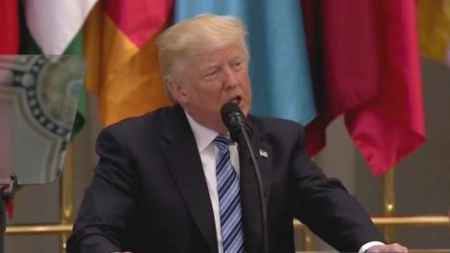
President Trump did not shy away from calling an Islamist terrorist by his real name when he addressed the heads of state of some fifty Muslim countries over the weekend in Riyadh.

His language and his message were clear: the United States needs the leaders of Arab Islamic nations as partners. As non-Muslims, we can not eradicate the scourge of a terrorism that draws its source from authentic Islamic texts, nor can we cast out terrorist leaders who model themselves on Mohammad, the prophet of Islam.

Indeed, that is what the Manchester bomber did, blowing himself up in order to kill the children of the Unbelievers. (Quran 3:151: “Soon shall we cast terror into the hearts of the Unbelievers.”)

ISIS proudly draws on the Quran, and the Sura – the Life of the Prophet Mohammad – to justify its actions and its manner of imposing Sharia law over territory it controls.

In its training manuals and propaganda videos, ISIS regularly calls on young Muslims to join the ranks of the jihad, because it is their duty as good Muslims. How can they say this? Because Mohammad himself told them.

Indeed, there are 164 well-known versus in the Quran where Mohammad calls on Muslims to fight the Unbelievers and carry out jihad.

“I hear so many people say ISIS has nothing to do with Islam – of course it has. They are not preaching Judaism,” says Aaqil Ahmed, a Muslim who is the religion and ethics editor at the BBC.

“It might be wrong, but what they are saying is an ideology based on some form of Islamic doctrine. They are Muslims. That is a fact and we have to get our head around some very uncomfortable things,” Mr. Ahmed went on.

King Salman of Saudi Arabia knows this. Prime Minister Abadi of Iraq knows this. Egyptian president al-Sissi knows this. So does King Abdallah II of Jordan and all the other leaders President Trump met at the Arab Islamic American Summit in Riyadh.

None of them blushed when the President spoke these “very uncomfortable things” in his speech on Sunday. They know that it is up to them to lead the fight against the jihadis and “drive them out,” as the President said – not because the jihadis represent the true face of Islam, but because they are the forces of Evil in today’s Muslim world, whose first victims tend to be Muslims.

Enter Lieutenant General H.R. McMaster.

In a five minute interview with FoxNews host Bret Beier in Riyadh, Gen. McMaster swept away all the gains the President had just made.

He acknowledged that the President had used the term “Islamic terrorism” in his speech, then immediately tried to back away from it.

“These are not Islamic people. These are not religious people. These are people who use a perverted interpretation of religion to advance their criminality. It’s a political agenda,” McMaster said of ISIS. “And you saw great agreement on that in all the speeches yesterday. King Salman used almost the same language.”

But King Salman did not use almost the same language. Instead, he acknowledged that ISIS terrorists “consider themselves as Muslims” and that they drew their inspiration from periods of Islamic history outside the “bright eras… of mercy, tolerance and coexistence.”

Gen. McMaster returned to the Obama-era white-washing of Islam and denial of Islamic doctrine, bending over backwards out of fear of offending Muslim leaders whose support we need to fight ISIS.

While one can hope that the damage he did to the budding anti-jihadi alliance will be transitory, and that wiser officials with a more sophisticated knowledge of Islamic doctrine will be put in the forefront of our cooperation with potential Muslim allies, ISIS leaders must be laughing at the foolishness of McMaster’s words.

Of course their allure draws its source from Islam’s earliest days, when Mohammad and his armies put their enemies to the sword, pillaged their cities, raped their wives, enslaved any survivors, and plundered their crops.

ISIS has already claimed responsibility for the Manchester bombing. We will learn soon enough whether Salman Abedi, the suicide bomber who murdered so many innocents, acted alone or was part of a larger cell.

But what we know for sure is that the ideology motivating him to mayhem wasn’t Judaisim or Christianity or some “perverted interpretation” of them. That ideology was Islam as practiced by Mohammad and his followers.

Sugar-coating Islam’s blood-soaked history will not end terrorism. It will not convince young wannabe jihadis to put down the sword of Islam.

Instead, we need serious, effective programs that attack the causes of radicalization, programs devised by Muslims that speak to Muslims, programs that convincingly reject the jihadi doctrines on which ISIS is based.

The newly-created Center for Combating Extremism established by the Saudi government may be a step in the right direction. But as the President said, we also need the Saudis and other Arab Muslim leaders to drive the jihadis and the preachers who inspire them “out of the mosques” and out of the public square.

We cannot succeed in this monumental task when the National Security Advisor turns the President’s steely injunctions against Islamist terrorism into mush.

We are fighting an ideological enemy. We will never defeat him if we refuse to name the ideology that inspires him.


Trump’s new deal

May 24, 2017

Trump’s new deal, Israel Hayom, Boaz Bismuth, May 24, 2017

(The “nattering nabobs of negativism” are still numerous. No matter what happens it will be bad, they say. — DM)

Trump, it turns out, is not going to make the improvement of U.S.-Israel ties contingent on warmer relations between Israel and the Arabs. In his way, he apparently understands the Middle East better than most of the pundits analyzing him. He knows that in this part of the world, people respect you if you are strong; if you weaken your allies you are looked at with scorn. The players in the region respect his decision to stand by Israel — because they know this means he will keep his promises to them as well.

I have long said that Trump was good for the Jews. I said it as soon as he entered the 2016 race. I have long maintained that Trump’s new deal is actually going to be more pressure — on the Palestinians.

*****************************

Over the past several years, conventional wisdom among pundits was that Israel had lost America. They tried to drive home this argument even forcefully after Barack Obama became president.

They told us that Israel was losing its No. 1 ally because it was not relinquishing land; because it insisted that the Arabs recognize it as a Jewish state, and because it was not in a hurry to see a Palestinian state be established. Prime Minister Benjamin Netanyahu’s personal relations with Obama were thrown into the mix as well, and the bottom line was that Israel and the U.S. are no longer friends. Israel, so their thinking went, could only pine for Christopher Columbus.

And then Donald Trump came along. As Secretary of State Rex Tillerson said the other day, “America is back.”

It is also back in Israel. But the truth of the matter is that it never really went anywhere. It was Obama and its administration that went off course, not Israel. The experts said Israel must do a mea culpa and expected Obama to change the world, and Israel.

Ahead of Trump’s visit, this chorus of experts decided they would sing the same song they sang during the 1990s, using the same lyrics: “Palestinian state”; “ending the occupation is a prerequisite for ending Israel’s state of despair.” We all know how well things turned out during the 1990s.

They were willing to swear that as soon as Trump came to Israel, he would apply pressure on Israel and present demands. They said Netanyahu was nervous from what may come. They warned a diplomatic tsunami was making its way to Israel’s shores.

Some even borrowed medical lingo, saying Trump the candidate put some cotton wool on our skin to prepare from the shot, and now he was going to administer it.

What ultimately unfolded? It turned out that the president who visited Israel this week is the most pro-Israel we have seen in several decades. This man likes us, period. He repeatedly mentions the strong ties between Jerusalem and the Jewish people.

He has promised to protect Israel and to eradicate terrorism, and on the way he said he was determined to make sure Iran would not obtain nuclear weapons and that he would not let anyone hurt Israel. During his visit here he has repeatedly called Netanyahu “my good friend,” as if to make the point that he was not Obama.

How is that possible, the experts wondered. Hasn’t he visited Saudi Arabia on his way? Hasn’t he delivered a speech in front of some 50 Arab and Muslim leaders while he was there? Hasn’t he visited the Palestinian Authority during his trip?

And what about Tillerson, the former head of an energy giant? He cannot possibly be pro-Israel because he is a known wheeler and dealer in the Arab world, they warned.

They also noted that Trump promised to move the U.S. Embassy to Jerusalem but has not done so in the first 120 days of his presidency. Undoubtably, that period is eternity. Not only that, they continued, Trump considered visiting the Western Wall with the prime minister but ultimately decided it would be a private visit. This, they insist, proves that he is actually Obama in Trump clothes.

But lo and behold, Trump’s visit actually ended well, and he had us asking for more. It feels good to have that genuine embrace of a U.S. administration once again. Yes, Israel was deeply loved in America even before Trump came to power, but in recent years this was manifested in Congress, in the public opinion polls in America, among American Christians and among taxi drivers. That’s it.

The Obama White House turned its back on Israel and helped, albeit indirectly, the boycott, divestment and sanctions movement flourish on U.S. campuses.

In the wake of the visit, I dared to think that maybe those experts don’t really know him. After all, the same Trump who was accused of being anti-Muslim got the royal treatment when he arrived in Saudi Arabia, meeting with some 50 Muslim leaders who know full well that he is in love with Zionism.

Trump, it turns out, is not going to make the improvement of U.S.-Israel ties contingent on warmer relations between Israel and the Arabs.. In his way, he apparently understands the Middle East better than most of the pundits analyzing him. He knows that in this part of the world, people respect you if you are strong; if you weaken your allies you are looked at with scorn. The players in the region respect his decision to stand by Israel — because they know this means he will keep his promises to them as well.

I have long said that Trump was good for the Jews. I said it as soon as he entered as the 2016 race. I have long maintained that Trump’s new deal is actually going to be more pressure — on the Palestinians.

Trump’s ‘Islam Speech’ Invited The Muslim World To A Renaissance

May 24, 2017

Trump’s ‘Islam Speech’ Invited The Muslim World To A Renaissance, The Federalist, May 24, 2017

Trump’s Riyadh Summit speech builds on common themes in Abrahamic faiths to advocate for human potential. One of those themes is the archaic but powerful idea of “good versus evil,” as we heard with the repeat phrase “drive them out” as you would drive out the devil that possess the hearts and minds of people, causing mischief in the land. It’s a language not only understood by people in that room, but also by the world watching. Speaking in simple binaries that break down the world into good and evil, President Trump created an opportunity that doesn’t shame Muslims plagued by terrorism. Instead it gives them something greater still to be a part of. That something is humanity.

The alternative is grim. The detriment and the high cost of doing nothing, as Trump points out, is not only the death of life under religious extremism, but also the death of dreams. Let’s give people something to work together for, whether those people are heads of states or those crushed under the weight of war. The speech also powerfully reframed refugees not as destitute victims, but as integral to building stable societies that give them not only autonomy but also dignity.

However flawed they still are, if Muslim nations are willing to come together in partnership with the United States for a common goal, then let’s work with them to secure all our interests

************************

President Trump embarked on an iconic first foreign tour this weekend to the Middle East that started with a stop in Saudi Arabia to deliver a much-anticipated speech on Islam. Americans sat at the edge of their seats in anticipation of what we all sensed was a defining moment in history.

The tour is described as resetting Middle East foreign policy, with President Trump as the first sitting president to embrace complex themes of faith tightly knotted in a rich and often violent regional history. Effectively, he’s channeled the most powerful seat in the world as a vehicle for the most burgeoning diplomatic struggle of the last century.

Yet what makes President Trump’s speech on Islam so iconic is that it wasn’t about Islam. It was about human potential. Presented at the Riyadh Summit, the speech paints a picture of the world that can still be created if nations unite in a common interest of security and advancement through mutual gain. That he spoke at the birthplace of Islam is symbolic because it points at the root of the problem: violent extremism linked to the most fundamentalist interpretations of Islam.

We Have a Common Threat Despite Internal Differences

As hinted in his speech, the last monotheistic faith is still awaiting its renaissance. While there are other issues including non-violent Islamic extremism (Islamism), government corruption, theocracies, autocracies, dictatorships, human rights violations, and failed women’s rights, and on and on, the greatest shadow darkening the future for a world of people is violent jihad that seeks to destroy all standing civilizations equally, including Islamic nation-states it sees as not being Islamic enough.

Back at home, Americans have questioned the authenticity of Muslim nations participating at the summit. American Muslims see the Saudi Arabia as hypocritical in its fight against extremism. Saudis are rightly accused of being both arsonists and firefighters in the fight against extremism.

What also rings true is the strong sense of survival and self-interest fueling the global coalition. Nations should be allies in a common fight, with the understanding that we will not agree on every front or tangential issue. We do not need to all agree; we just need to be aligned on the single greatest threat and work from there. That is how we move forward. Internally, each nation faces its own complications.

A common American reaction was petulant expectation that President Trump “tackle Saudi Arabia” short of going to war with the kingdom. Yet the man is not even allowed to effectively tackle homegrown Islamists in the United States without overwhelming opposition by media and interest groups using propaganda and disinformation.

Meanwhile, Saudi Arabia is dealing with a house divided between Saudis who want progress and those reluctant to move into the twenty-first century, although both sides agree there is an existential threat coming from outside forces even more fundamentalist than they. They can also agree that it is in their collective interest to ally with the United States, something on which all representatives at the Riyadh Summit concur. President Trump understands the most direct path to effecting change is to work in people’s self-interest, to cater to advancement through mutual gain — a strategy that also won him the election.

Let’s Get Beyond Survival

At this exact moment in history, this is about survival. But it is also about what comes after survival. What does the next phase of human evolution look like, and how do we rally the world of people around it?

Trump’s Riyadh Summit speech builds on common themes in Abrahamic faiths to advocate for human potential. One of those themes is the archaic but powerful idea of “good versus evil,” as we heard with the repeat phrase “drive them out” as you would drive out the devil that possess the hearts and minds of people, causing mischief in the land. It’s a language not only understood by people in that room, but also by the world watching. Speaking in simple binaries that break down the world into good and evil, President Trump created an opportunity that doesn’t shame Muslims plagued by terrorism. Instead it gives them something greater still to be a part of. That something is humanity.

The alternative is grim. The detriment and the high cost of doing nothing, as Trump points out, is not only the death of life under religious extremism, but also the death of dreams. Let’s give people something to work together for, whether those people are heads of states or those crushed under the weight of war. The speech also powerfully reframed refugees not as destitute victims, but as integral to building stable societies that give them not only autonomy but also dignity.

In this way, not only was President Trump’s speech iconic, it was visionary for emphasizing humanity and what can still be achieved if we come together. As a Muslim reformer, I focus on getting us to the next phase of human evolution, something that cannot happen without uniting world powers for a common goal. It is a powerful move necessary to destroy the Goliath that’s draining our resources and diverting our attention.

That “Goliath” is the version of Islam that demands we forfeit our humanity. To defeat it, we will need everyone on board, including the people we see as enemies today. If we have to sit at a table with Saudi Arabia to do it, so be it. If Americans expect the Middle East to shed the skin of their tribal identities, then we too have to break out of the tribal mindset that only sees people and populations as one-dimensional. However flawed they still are, if Muslim nations are willing to come together in partnership with the United States for a common goal, then let’s work with them to secure all our interests.

Trump in Israel

May 23, 2017

Trump in Israel, Front Page Magazine, Daniel Greenfield, May 23, 2017

Every act of Islamic terror educates us. It is a difficult and bloody education. We graduate when we realize who our enemies are and how impossible it is to achieve any peace with them.

President Trump’s walk to the Church of the Holy Sepulchre required thousands of police officers, closed stores and houses filled with snipers while their residents were evacuated. 

That is life under the shadow of terrorism.

It’s not only presidents who have to live this way. It’s all of us in Jerusalem and Paris, in Manchester and in Rome where there are soldiers in the street and cries of “Allah Akbar” in the air. And then a car speeds up, a knife slashes, a plane crashes or a bomb goes off. 

And the education continues.

************************************

When President Trump and Prime Minister Netanyahu met on the tarmac, they and their spouses chatted easily. The two conservative leaders have much in common. They are political insurgents who draw their support from a rougher working class overlooked and despised by leftist elites.

The polls said that Netanyahu and Trump would lose their respective elections. Instead they won big. They prevailed despite accusations of bigotry, attacks by celebrities and a torrent of fake media scandals. The media decided that the big story of Trump’s arrival in Israel would be their claim that Melania Trump had swatted her husband’s hand away. A few months ago, Netanyahu was in court testifying against a lefty journalist for spreading fake news that his wife had kicked him out of the car.

Like so much of the fake media news aimed at Trump, it was sourced from an anonymous source through another anonymous source who knew someone’s dog.

And, sure enough, Sara Netanyahu and Melania Trump bonded on the tarmac over the media’s hatred.

Trump and Netanyahu are political pragmatists with a strong economic focus who run to the right. Trump is a developer. Netanyahu has a degree in architecture. Trump has a Queens accent and Netanyahu still has his Philly accent.  And they prevail despite the opposition of leftist elites.

Subtract the geography and this news story from Netanyahu’s victory would sound familiar to Trump. “Leftist, secular Tel Aviv went to sleep last night cautiously optimistic only to wake up this morning in a state of utter and absolute devastation.”

But there is one difference between the two men.

An hour before President Trump landed in Israel, a car struck people in Tel Aviv. Usually when a car hits people, it’s an accident. But in Israeli and in European cities, car ramming has become a terrorist tactic.

And so the incident was one of the first things that Trump heard about when he landed.

Police decided that it was an accident, but as the presidential visit got underway, there was the usual litany of violence; stonings, a fatality and a stabbing. And the question that so many of us now ponder across the civilized world rose unspoken each time blood was shed. Was it Islamic terrorism?

The efforts of conservative Israeli prime ministers to contain the fallout of a disastrous peace process with terrorists set into motion by leftist prime ministers have reduced the violence so that it no longer touches the lives of most Israelis on a regular basis. But it is always there. And it never truly goes away.

That is what must be understood when we talk about “peace”.

No amount of outreach to Muslim terrorists ends the violence. Not in Europe or America. And not in Israel; the country that has become the test case for whether Muslims and non-Muslims can coexist.

President Trump’s itinerary of Saudi Arabia, Israel and Rome is a gamble that “the three Abrahamic Faiths” will join in a coalition to take on Iran and ISIS. It’s a better plan than Bush’s push for regional democracy or Obama’s violently destructive backing for Islamist political takeovers in the Arab Spring. A common enemy is more likely to get different groups behind the same cause. But having a common enemy should not be confused with having peace. At best it means a very temporary truce.

Netanyahu understands this because he has far more experience with Islamic terrorism. When it comes to Islamic terrorism, there are few countries that have faced it as consistently and constantly as Israel.

Muslim terrorists have struck America before. But only in the last decade were the Islamic colonies in the United States large enough and young enough to mount a constant drumbeat of attack plots.

Thousands of terrorism investigations are still new to America. They’re a way of life in Israel.

Terrorism is a bloody education. Trump knows far more about Islamic terrorism than Bush did. And Bush knew far more than his father. Most Americans still can’t conceive of the idea that peace is impossible. It’s too grim and hopeless. We’ve come a long way since the Obama years. But we aren’t there yet.

In the spring of his first year, Obama traveled to the Middle East to seek a “new beginning” with the Muslim world. He stopped off first in Saudi Arabia, but saved his speech calling for political change until his arrival in Egypt. Trump delivered his key speech in Saudi Arabia disavowing calls for political change. Instead America’s relationship with the Muslim world would be defined by its national security needs.

Obama blamed colonialism for the poor relations between the West and the Muslim world. His solution was to dismantle Western power. Trump defined Islamic terrorism as the problem and unity against it as the solution. Obama had bypassed Israel and traveled on to Germany making a heavily publicized visit to the Buchenwald concentration camp. Trump continued on to Israel instead.

The difference was profound.

Obama was more comfortable engaging with Jews as victims and, in a typically egotistical manner, envisioning what the victims of the Holocaust might have made of his visit. “They could not have known that one day an American President would visit this place and speak of them.” His Cairo speech reduced Israel to a byproduct of the Holocaust. If so, Israel’s capital might as well be in Buchenwald.

Trump however is ready to interact with the living Jewish present in Israel. His trip to the Western Wall, the first by a sitting president, and a cancelled visit to Masada, sought to engage with Israel’s national and religious identity. They signify a recognition that Obama never offered to Israel.

In Saudi Arabia, President Trump rolled out a vision of relationships based on national interest. And no such relationship can be built without recognizing national identity. Trump’s recognition of Israel’s national identity adds a note of respect. But Israel is one of the few nations in the region.

Nations can make peace. They can put aside their bloody past and at least learn to ignore each other. And in the West, religion has come to act as a moral operating system within the infrastructure of nations. Religion provides guidelines that transcend the law. The legal system can only tell us what we must do or may not do to each other. Religion tells us what we ought to do or not do to each other. It is a personal conscience and a relationship to a higher authority than mere government.

Saudi Arabia isn’t a nation. Neither is “Palestine”. They’re powerful extended families whose form of worship is terrorism. Islamic terrorism isn’t a perversion of Islam. It’s the implementation of Islam.

Islam provides the morale and motive for the conquest. And once the conquest is complete, it provides the framework for the kingdom. Islam’s message is the inferiority of Muslims to non-Muslims. War affirms the message. Oppression internalizes it. Islam is meaningful only when it is killing and oppressing infidels. It is not a religion of the persecuted, but the persecutors. Its theology is violent supremacism.

President Trump deserves credit for refusing to let the Saudis pretend that some Islamic terror groups are more legitimate than others by classing together ISIS with Hamas. But the only Islamic terrorism that the Saudis will reject is that which does not serve their interests. And even if they wanted to, they could no more end popular support for Islamic terrorism than Iraq could become a multicultural utopia through the magic of democracy.

Nor can Israel make peace with Islamic terrorists no matter how many more concessions Prime Minister Netanyahu offers them. President Trump calls it a tough deal. But you can only make a deal with someone who follows some of the same rules you do. You can’t make a deal with Islamic terrorists whose only rules are that the Koran lets them [say] anything they want to you.

President Trump called Islamic terrorism evil. And it is. But it’s not just evil. Its codes and ethics are utterly incompatible with our own. The only way to negotiate is through threats. And even threats only go so far with fanatics who believe that if they die, they will earn 72 virgins in paradise.

Islamic entities will tell any lie and commit any crime to accelerate their objective of conquering us. Whether they tell a lie or commit a crime depends on whether they’re moderates or extremists.

Yesterday, I heard Geert Wilders speak. And I recognized a leader who understands this grim reality. Few of his fellow Europeans do. Even fewer American politicians share that understanding. Europe is facing a deeper threat than America. And Israel has been confronting a bigger threat than Europe.

Every act of Islamic terror educates us. It is a difficult and bloody education. We graduate when we realize who our enemies are and how impossible it is to achieve any peace with them.

President Trump’s walk to the Church of the Holy Sepulchre required thousands of police officers, closed stores and houses filled with snipers while their residents were evacuated.

That is life under the shadow of terrorism.

It’s not only presidents who have to live this way. It’s all of us in Jerusalem and Paris, in Manchester and in Rome where there are soldiers in the street and cries of “Allah Akbar” in the air. And then a car speeds up, a knife slashes, a plane crashes or a bomb goes off.

And the education continues.

Trump Breaks the Diplomatic Mold

May 23, 2017

Trump Breaks the Diplomatic Mold, Commentary Magazine. May 22, 2017

President Donald Trump walks with Saudi King Salman at the Arab Islamic American Summit, at the King Abdulaziz Conference Center, Sunday, May 21, 2017, in Riyadh. (AP Photo/Evan Vucci)

Upon arrival, Trump received a royal welcome. Saudi King Salman braved the 101-degree heat of the tarmac to greet the presidential plane personally. A brass band serenaded the two world leaders as cannons issued celebratory volleys and seven Saudi jets streamed trails of red, white, and blue overhead. The president and the king joined one another in the presidential limo and rode off together to an extravagant ceremony at the Saudi Court, where attention was even lavished upon the president’s aides.

The intentional contrast this reception struck with Barack Obama’s 2014 trip to the Saudi Kingdom was stark. Upon Obama’s arrival, King Salman dispatched only his distant nephew, the provincial governor of Riyadh, to meet the leader of the free world. The Obama White House did its best to save face, but the snub was a clear indication that tensions surrounding Iran nuclear deal, the ongoing bloodshed in Syria, and Obama’s explicit antipathy toward the Saudi Kingdom as a nation unworthy of an alliance with America.

As COMMENTARY’s Evelyn C. Gordon discussed, in exchange for Israeli technology and intelligence, a relaxation of the Gaza blockade, and the cessation of settlement construction in “some areas,” this Sunni alliance would “establish direct telecommunication links with Israel, let Israeli aircraft overfly their countries, lift certain trade restrictions and perhaps grant visas to Israeli athletes and businessmen.” And all of this would occur with existing Palestinian realities utterly unchanged. Even if no further progress toward peace in the region is secured, that bell cannot be un-rung.

A truly successful presidency in the Middle East may begin first with the abandonment of that burdensome, dog-eared diplomatic playbook.

************************

There is perhaps nothing a global class of calcified diplomatic professionals appreciates more than subtlety and nuance. Donald Trump’s tour of the world’s three major religious capitals is about as unsubtle and unnuanced as you can get. To many seasoned diplomats, this administration’s naïve effort to forge peace in this fashion is downright dangerous—possibly more than the administration even knows. Maybe. Or maybe the president and his team are dispensing with ossified convention in a field that could desperately use some fresh thinking. With the first leg of Trump’s world theological tour complete, it is not impossible that something new is taking shape.

In Saudi Arabia this weekend, Donald Trump danced with swords, touched an ominous glowing orb, and delivered a narrowly tailored and reasonably well-received speech on radical Islamic terrorism in the heart of the Islamic world. Among many other regional power brokers, the president also met with the leaders of Egypt, Kuwait, Qatar, and Bahrain. What Trump did in the Saudi Kingdom is, however, less interesting than how the Saudis responded to him.

Upon arrival, Trump received a royal welcome. Saudi King Salman braved the 101-degree heat of the tarmac to greet the presidential plane personally. A brass band serenaded the two world leaders as cannons issued celebratory volleys and seven Saudi jets streamed trails of red, white, and blue overhead. The president and the king joined one another in the presidential limo and rode off together to an extravagant ceremony at the Saudi Court, where attention was even lavished upon the president’s aides.

The intentional contrast this reception struck with Barack Obama’s 2014 trip to the Saudi Kingdom was stark. Upon Obama’s arrival, King Salman dispatched only his distant nephew, the provincial governor of Riyadh, to meet the leader of the free world. The Obama White House did its best to save face, but the snub was a clear indication that tensions surrounding Iran nuclear deal, the ongoing bloodshed in Syria, and Obama’s explicit antipathy toward the Saudi Kingdom as a nation unworthy of an alliance with America.

From Saudi Arabia, Trump traveled directly to Israel—itself a shift in convention—where he was also greeted warmly. Prime Minister Benjamin Netanyahu and his wife met the president and first lady at Ben Gurion International Airport in Tel Aviv. Using his remarks alongside Trump to issue a veiled rebuke of Obama, Netanyahu noted: “We appreciate the reassertion of American leadership in the Middle East.”

President Obama entered office with the objective of creating a new power balance in the region that would allow the United States to withdraw confidently. The former president’s stated belief that America’s alliance toward Israel “erodes our credibility with the Arab states” in combination with his mistrust toward Sunni Arab states like Saudi Arabia and Egypt left him with few ways of achieving that goal. There’s a cosmic irony in the fact that Obama’s navel-gazing paved the way for a radically new and promising dynamic to emerge in the Middle East. Conceptually, the strategy Trump is pursuing in the Middle East is wildly divergent from his predecessors. He is effectively abandoning the idea that there can be no resolution of the Arab World’s hostility toward Israel without first creating a Palestinian state.

As recently as February, administration sources began providing details to the press about a proposed pan-Sunni military alliance designed to both counter Islamist extremism and a resurgent Iran. That alliance would include states with unfrozen relations with Israel, like Egypt and Jordan, and nations like Saudi Arabia and the United Arab Emirates, which do not recognize the Jewish state. According to a recent bombshell report, however, the prospect of a radical relaxation in tensions between Israel and the Arab World is real.

As COMMENTARY’s Evelyn C. Gordon discussed, in exchange for Israeli technology and intelligence, a relaxation of the Gaza blockade, and the cessation of settlement construction in “some areas,” this Sunni alliance would “establish direct telecommunication links with Israel, let Israeli aircraft overfly their countries, lift certain trade restrictions and perhaps grant visas to Israeli athletes and businessmen.” And all of this would occur with existing Palestinian realities utterly unchanged. Even if no further progress toward peace in the region is secured, that bell cannot be un-rung.

Donald Trump isn’t the first American president to benefit from warm feelings solely because he isn’t the last guy to have occupied the Oval Office. When it comes to the Middle East, crises and chaos have a habit of scuttling even the best-laid plans. Iranian power projection into places like Iraq, Yemen, and Syria has, however, created new avenues of cooperation between adversarial powers with a common enemy in Tehran. If Trump can translate this new reality into tangible accomplishment (a big “if”), he will have the makings of a potent argument for his presidency and a second term.

On foreign affairs, in particular, President Donald Trump has invited the wrath of the critics. He is “the world’s most undiplomatic” diplomat who has embraced illiberal and strategically inept “lame-stream diplomacy.” Indeed, his “rejection of traditional diplomacy for his own distinctive, brusque style has incurred costs without any visible offsetting benefits.” In his article “Is This the End of the Free World,” Abe Greenwald demonstrated that Trump has an appalling and lamentably familiar habit of alienating America’s natural allies. It’s a nasty feature of a distorted worldview, and it may result in the continued loss of allied faith in American vision and authority. For now, however, not only is the Middle East obviously thrilled for the Obama era to be over but that has provided Donald Trump with the opportunity for a real diplomatic triumph. A truly successful presidency in the Middle East may begin first with the abandonment of that burdensome, dog-eared diplomatic playbook.

Al Qaeda criticizes Saudi relations with West during President Trump’s visit

May 22, 2017

Al Qaeda criticizes Saudi relations with West during President Trump’s visit, Long War Journal May 22, 2017

Al Qaeda seized on President Donald J. Trump’s recent visit to Saudi Arabia to once again criticize the royal family and call for an uprising.

According to bin Laden, these early Saudi dealings with the West led to the British capture of Palestine and, later on, the establishment of the Israeli state.

Osama bin Laden liked to argue that there is a “Zionist-Crusader” conspiracy against Muslims. His son, Hamza, has continued with these themes, making it one of his central talking points and accusing the House of Saud of being part of it.

****************************

On May 20, al Qaeda’s propaganda arm, As Sahab, released an audio message from Hamza bin Laden. The junior bin Laden follows in his father’s footsteps by blasting the Saudi royal family. His speech is the second part in a series aimed at the House of Saud. Part 1, in which Hamza called for regime change, was released last August.

It’s not clear when Hamza recorded his latest anti-Saudi message. He does not mention President Trump or the American delegation. Instead, he focuses on the early decades of the Saudi dynasty, portraying it as a corrupt regime that serves the interests of the West. Still, al Qaeda undoubtedly wanted to maximize the audience for Hamza’s audio by releasing it during President Trump’s visit.

Then, on May 21, al Qaeda published the 15th issue of its Al Nafir Bulletin (seen below). The one-page newsletter is devoted to Trump’s visit. “The Al Saud rulers and all apostate rulers appear before us today in wasteful ceremonies to offer loyalty and renew their allegiance to the hateful Crusader master of the White House, Trump,” the newsletter reads.

Just hours before Al Nafir was released online, President Trump attended a ceremony with King Salman and Egyptian President Abdel Fatah al-Sissi to commemorate the opening of the Global Center for Combating Extremist Ideology in Riyadh. Unsurprisingly, Al Nafir’s editors criticize the move, arguing that the “rulers” had really committed to building “an apostate army to fight jihad and the Mujahideen in the name of fighting terror and terrorism.” The center will be used “to fight faith, purity, and commitment, under the call to fight extremism, backwardness, and intolerance,” al Qaeda contends.

In Al-Nafir, al Qaeda also argues that the Saudi government should give its money to the people instead of investing it in defense deals and other arrangements with the US. Al Qaeda uses these two issues — the Saudis’ supposed misuse of funds and the creation of the new center — to renew its call for jihad.

“So here are the Crusaders and the apostates, and they have stolen your money, fought your religion, shed your blood, and transgressed against your honor,” Al Nafir reads. “When will you return to your religion and do jihad in the cause of Allah?”

Hamza bin Laden’s critique of Ibn Saud

Al Qaeda has been raising Hamza’s media profile since the summer of 2015, when he was first introduced as a prominent jihadist figure. On May 13, just one week before Hamza’s new anti-Saudi message, As Sahab released another speech from Osama’s heir. In that talk, Hamza provided advice to “martyrdom seekers” living in the West. [See FDD’s Long War Journal report: Hamza bin Laden offers ‘advice for martyrdom seekers in the West’]

In his latest message, Hamza accuses the Saudi government of promulgating a false version of its own history, arguing that “generations have been raised” ignorant of what truly transpired during the first years of the 20th Century, when the House of Saud rose. Bin Laden is keen to undermine King Abdul Aziz bin Abdul Rahman Al Saud’s (Ibn Saud) legacy, portraying him as a witting agent of the British. Only when the proper history is told, Hamza says, will Muslims “understand the magnitude of the injustice brought upon” their country and then work to “restore” their “stolen rights.”

Bin Laden accuses Ibn Saud of working with the British from the beginning, seeking their “approval” before leaving Kuwait (where the Saud family lived) and conquering the city of Riyadh in 1902. Riyadh and large parts of the Arabian peninsula were controlled by Ibn Rashid’s men, who were allied with the Ottoman Empire at the time. Bin Laden says Ibn Saud could only expand his power at the expense of the Ottoman Empire’s allies and he sought assistance from the British to do it. This, from al Qaeda’s perspective, violates Islamic law, as Ibn Saud attacked fellow Muslims while working with the British.

According to bin Laden, the Saudi telling of Ibn Saud’s early conquests omits these “sharia violations,” including the assault on the Ottoman’s ally “to serve the English” and the “unlawful killing of Muslims.”

In the period leading up to World War I, the Ottoman government sought to reconcile the opposing forces inside the Arabian Peninsula. And so a deal was struck between the Ottomans and Ibn Saud, which granted the Saudi patriarch territorial rights in exchange for military cooperation and an agreement to prevent “foreign powers” from expanding their influence in the region. But Ibn Saud broke this agreement as well, bin Laden says, after he again sided with the British. (Ibn Saud’s territory was declared a British protectorate as part of a treaty in 1915.) Ibn Saud moved on the Turks’ main client, Ibn Rashid, despite their previous understanding. In so doing, bin Laden charges, the founder of the Saudi dynasty paved the way for “the English and their allies to occupy the homelands of the Muslims.”

Bin Laden reminds his audience that Captain William Henry Irvine Shakespear, a British emissary, served as Ibn Saud’s military adviser and had “command” of the Muslim forces while organizing “their ranks.” This was part of Britain’s broader “financial and military” support for Ibn Saud. This is all “clear evidence” of English support, bin Laden says, and led to “Crusader hegemony” over the region.

According to bin Laden, these early Saudi dealings with the West led to the British capture of Palestine and, later on, the establishment of the Israeli state.

Osama bin Laden liked to argue that there is a “Zionist-Crusader” conspiracy against Muslims. His son, Hamza, has continued with these theme, making it one of his central talking points and accusing the House of Saud of being part of it.

A Dose of Reality in Riyadh

May 22, 2017

A Dose of Reality in Riyadh, Front Page MagazineBruce Bawer, May 22, 2017

Early on in his speech, Trump addressed his audience as friends and partners; within a few minutes, without pointing a finger, and without abandoning the collegial tone or the complimentary language, made it clear he was lecturing them. He was the boss, the capo di tutti capi, and he was laying down terms. This wasn’t Obama, who naively thought he could change the world with groveling apologies for the West, praise for Islam built on sheer fantasy, and yet another retelling of his own supposedly inspiring personal story – all the while oozing beta-male deference and docility. No; this was a man of power who – never once talking about himself – made expert use of that power, wielding an iron fist in a velvet glove. His message was unmistakable: either set aside this stupid religion (or at least rein it in, and now), join the modern world, and set your people free to dream, hope, create, grow, and prosper. Or else face the consequences. When, at the end, he summed up the assets of the Islamic world, he didn’t even mention Islam: he cited, among other things, its “spirit of enterprise” and ambitious young people. Where Obama had falsely attributed all kinds of past wonders to Islam, Trump imagined an implicitly Islam-free future in which the region could finally enjoy “glorious wonders of science, art, medicine, and commerce to inspire mankind.” 

*****************

On June 4, 2009, Barack Obama went to Cairo and delivered a speech, addressed to the Muslim world, that was full of praise for Islam and apologies on behalf of the West. In the address, entitled “A New Beginning” (“I’ve come here to Cairo,” he explained, “to seek a new beginning between the United States and Muslims around the world”), he called the university at which he was speaking (which, if it were anywhere in the West, would probably not be able to gain accreditation) “a beacon of Islamic learning”; he blamed tensions between the West and Islam largely on Western “colonialism”; he said “Salaam aleikum” and kept referring to “the Holy Koran”; he asserted, in a ridiculous example of hyperbole, that “Islam has always been part of America’s story”; he served up a big wallop of revised history, giving Islam unmerited praise for centuries-old accomplishments in science, architecture, music, art, and medicine and even holding it up as “a model of tolerance and equality” (at one point, he seemed to imply that in some ways women’s rights are more advanced in the Muslim world than in the U.S.); and, with utter predictability, he quoted the the “Holy Koran” out of context, plucking out that favorite verse of all Western apologists that supposedly teaches “that if one kills an innocent, it is as if it he has killed all of mankind.”

And of course, as always, he talked about himself: a descendant of “generations of Muslims” in Kenya; a man who, in his Indonesian boyhood, daily heard the beautiful Islamic call to prayer; a president who had “known Islam on three continents before coming to the region where it was first revealed.” As someone with such intimate ties to the Religion of Peace, asserted Obama, he saw it as part of his job to “fight against negative stereotypes of Islam.” Yes, he spoke about the need to fight terror, but he was quick to maintain that “Islam is not part of the problem” but rather “an important part of promoting peace.” He defended U.S. ties to Israel and recognized the “reality of the Holocaust,” but quickly pivoted to the “suffering” of Palestinians, the “pain of dislocation” they experienced, and the “daily humiliations” of the “occupation” – preaching, in short, to Israel from a Cairo pulpit. He quoted from the Talmud, but was careful not to call it holy. He implied that the histories of the Jews and Palestinians were equally tragic. And he preached to America too, suggesting that when Americans criticize the “choice” of women – and girls (!) – to wear hijab they were disguising their “hostility” to Islam “behind the pretense of liberalism.” Similarly, instead of thundering against the evil of 9/11, Obama apologized for the supposed excesses of some Americans’ responses to that atrocity, saying with nauseating chagrin that “in some cases it led us to acts contrary to our principles and our ideals.” Oh, and he vowed to close Guantánamo “by early next year.”

This Sunday, almost exactly as far into his presidency as Obama was when he gave his Cairo speech, Donald Trump spoke in Riyadh. For some of us, the very prospect of this appearance had been, to put it mildly, dismaying. Trump won the election, after all, largely because of his tough and bracingly realistic talk about Islam. Now, on his first trip abroad as president, he was going to Saudi Arabia. It was bad enough that this was a trip to a Muslim country. But Saudi Arabia isn’t just any Muslim country. It’s the mother of all Muslim countries. It’s the single most backward of them all. It’s a state sponsor of terrorism. It, and members of its royal family, have bankrolled mosques and madrassas and university departments of Middle Eastern Studies throughout the Western world – places that are nothing more than centers of Islamic propaganda. Most of the 9/11 hijackers, as the whole world knows, were Saudis. And the whole point of Trump’s visit to Riyadh was to celebrate a gigantic sale of U.S. arms to the Saudis on the premise that they represent a major bulwark against an even more dire threat, namely Iran. Nor was Trump just addressing the Saudis: also in attendance were the leaders of most of the other Muslim countries on the planet – in other words, a whole boatload of really nasty customers. It was hard not to conclude that Trump, like Obama, was going to try to brown-nose his way into a “new beginning between the United States and Muslims.”

The opening minutes of Trump’s speech certainly did nothing to dispel this expectation. It was gag-inducing to hear him praise the “magnificent kingdom” of Saudi Arabia, “the splendor of your country,” “the grandeur of this remarkable place,” and so on. It was absurd to hear him talk about working together with the ultra-extremist Saudis to eliminate “extremism.”

But then something happened. Even as he continued to serve up the usual glowing rhetoric about Islam being “one of the world’s great faiths,” and to refer to this and that as being “holy,” he made a couple of exceedingly elegant transitions. First, he began mixing the ethereal praise with realistic businessman-type talk about the value of international partnership. “We are not here to lecture, to tell other people how to live, what to do, who to be, or how to worship,” he said. “Instead, we are here to offer partnership” between the West and the Muslim world – a partnership that would bring prosperity to future Muslim generations. But he underscored the fact that in order for such a partnership to work, something would have to change. And it would have to change a lot. The Islamic world, he insisted, had to turn into a place where young Muslims could grow up “innocent of hatred.” And then he spelled out the results of that hatred, presenting first a roll call of some of the “barbaric attacks” on America – 9/11, Boston, San Bernardino, Orlando – and then a list of other places (“Europe, Africa, South America, India, Russia, China, and Australia”) where that hatred has manifested itself.

However delicately he worked his way around to it, it was nothing less than an accusation.

No, he didn’t explicitly charge Muslim leaders with funding terrorism – but he told them, in no uncertain terms, that they needed to cut off funds to terrorists. Nor did he explicitly blame Islam for terror or explicitly call it evil (as much as some of us would have loved to hear him do so) – but he came tantalizingly close to doing so, speaking bluntly about the “vile creed,” the “wicked ideology,” the “craven ideology”, that underlies terror. He did use the word “evil.” And, yes, he spoke of “Islamic” (not “Islamist” or “radical Islamic”) terror. And he made it clear he wasn’t just talking about terrorism – he was talking about Islam itself. He condemned “the oppression of women, the persecution of Jews, and the slaughter of Christians.” He warned: “barbarism will deliver you no glory. Piety to evil will bring you no dignity.”  Yes, “piety to evil.” Even as he continued to make flattering references to Islam, they felt increasingly pro forma, and it became increasingly manifest that he was identifying that religion as the root not just of terror but of all that is primitive and barbaric about that portion of the world in which it is most commonly practiced. In one remarkable passage, he listed a number of wonders of the Arab region of which his listeners should be proud. What was remarkable was that they were all wonders that dated to pre-Islamic times. In short, he was reminding these people that they had a proud history, a proud identity, that predated their prophet and that could, if they wished, help form the foundation of a new, free, forward-looking culture.

Of course, even to express such thoughts, in some Islamic countries, is considered heretical, illegal; but Trump did it in such a masterly way that you could imagine some of these Muslim big shots sitting there trying to figure out whether they should be offended or not.

In fact, it was all quite masterfully done. Early on in his speech, Trump addressed his audience as friends and partners; within a few minutes, without pointing a finger, and without abandoning the collegial tone or the complimentary language, made it clear he was lecturing them. He was the boss, the capo di tutti capi, and he was laying down terms. This wasn’t Obama, who naively thought he could change the world with groveling apologies for the West, praise for Islam built on sheer fantasy, and yet another retelling of his own supposedly inspiring personal story – all the while oozing beta-male deference and docility. No; this was a man of power who – never once talking about himself – made expert use of that power, wielding an iron fist in a velvet glove. His message was unmistakable: either set aside this stupid religion (or at least rein it in, and now), join the modern world, and set your people free to dream, hope, create, grow, and prosper. Or else face the consequences. When, at the end, he summed up the assets of the Islamic world, he didn’t even mention Islam: he cited, among other things, its “spirit of enterprise” and ambitious young people. Where Obama had falsely attributed all kinds of past wonders to Islam, Trump imagined an implicitly Islam-free future in which the region could finally enjoy “glorious wonders of science, art, medicine, and commerce to inspire mankind.”

Yes, it would have been terrific to hear an American president spell out the truth about Islam in a less nuanced, less diplomatic fashion. And it was frankly bizarre to hear Trump, in his closing moments, singling Iran out as uniquely malevolent after having heaped praise on other equally nefarious regimes whose leaders were right there in the room with him. But we critics of Islam have our jobs and Trump has his. Given the occasion and the purpose, this was, even at its worst, an immense improvement over Obama’s Cairo oration, and, at its best, a convincing assertion of authority, a strongly pitched demand for radical transformation, and a perfectly calibrated use of the carrot-and-stick approach.

No, international Islam is almost certainly beyond meaningful reform. But history has shown that it can at least be contained and controlled in ways that give citizens of Muslim-majority countries a certain degree of freedom and that keep to a minimum the scale of violence in the West originating in those countries. (The rampant Islamization of the West, and the concomitant increase in home-grown Islamic terror, are separate questions.) And no, a single speech can’t accomplish much of anything. But Trump’s tough presentation in Riyadh, if followed up by equally tough interactions with our “friends” in that audience, may well get a few things, here and there, moving in welcome directions.
Tillerson and Saudi Foreign Minister hold briefing

May 20, 2017

Tillerson and Saudi Foreign Minister hold briefing, PBS via YouTube, May 20, 2017


Syria & allies push back at US-held border post

May 20, 2017

Syria & allies push back at US-held border post, DEBKAfile, May 20, 2017

The US bombardment of that force Thursday underlined for Saudi Arabia and the dozens of Arab and Muslim rulers, gathered in Riyadh to meet the US president, his administration’s determination to prevent Iran and its Lebanese surrogate, Hizballah, from gaining control of Syria. American troops were accordingly engaged proactively in securing the border crossings between Syria and Iraq.

This clash of arms is likely to expand into an outright US showdown with the US and Syria, Iran and Hizballah in the next 24-48 hours ahead of President Trump’s visit to Israel, the second stop of his four-national trip.

*********************

The Syrian-pro-Iranian-Hizballah force in southern Syria renewed its advance on the Iraqi border on Saturday, May 20, two days after sustaining heavy casualties from a US air strike on its convoys and in spite of US Defense Secretary James’ Mattis warning, “We will defend our troops.”

Syrian military sources reported the capture Saturday of the Suweida region and another 60 square kilometers. This offensive brought the Syrian army and its allies closer to the strategic Al-Tanf crossing at the Syrian border intersection with Iraq and Jordan, which is held by US and other special operations units.

The US-led coalition force is also made up of elite units from Britain, Holland, Germany and the Czech Republic, as well as Jordan and a large contingent of the rebel Free Syria Army trained and armed by American instructors in Jordan.

The latest arrival to boost this force, DEBKAfile’s military sources report, was a unit of Norwegian special forces, which entered Syria from Iraq through the Al-Waleed border crossing in western Anbar. They arrived along with American reinforcements and linked up with the US and British forces deployed at Al Tanf.

However, the Syrian force and its allies to the US air strike moved fast enough Saturday to threaten the FSA troops fighting there with being trapped by a siege. They have pushed their offensive forward against the US-led force, despite their losses from an American air raid, as a show of defiance that was timed for President Donald Trump’s arrival in Saudi Arabia.

Another US air strike appears to be unavoidable for pushing them back. The danger is also rising of a major clash on the ground between US-led coalition special forces troops and the combined Syrian-Iranian-Hizballah force.

The US bombardment of that force Thursday underlined for Saudi Arabia and the dozens of Arab and Muslim rulers, gathered in Riyadh to meet the US president, his administration’s determination to prevent Iran and its Lebanese surrogate, Hizballah, from gaining control of Syria. American troops were accordingly engaged proactively in securing the border crossings between Syria and Iraq.

However, Tehran, Damascus and Hizballah are evidently not about to shirk a direct confrontation with Washington and the Trump administration, apparently with the support of Moscow.

This clash of arms is likely to expand into an outright US showdown with the US and Syria, Iran and Hizballah in the next 24-48 hours ahead of President Trump’s visit to Israel, the second stop of his four-national trip

Saudi Royals signal the real magnitude of the deal they made with Trump

May 20, 2017

Saudi Royals signal the real magnitude of the deal they made with Trump, American ThinkerThomas Lifson, May 20, 2017

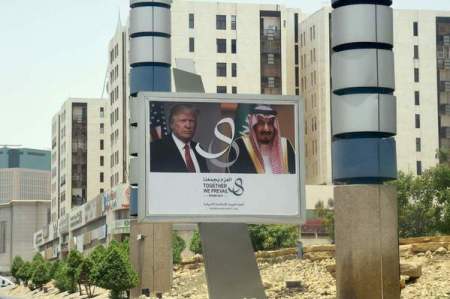
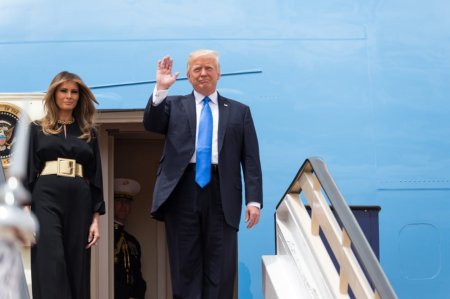
President Trump’s spectacular reception in Riyadh is a signal to the world (and to Saudi subjects, in particular) that big changes are coming. Elderly and frail King Salman ventured out onto the apron in 110 degree heat and actually shook Melania Trump’s hand as she deplaned Air Force One, thereby touching a female infidel.


Perhaps even more important in terms of Saudi daily life, the women in attendance at functions did not wear head coverings and abayas.  The entire nation saw this on television and understands that the fracking-created global oil glut changes everything, that the infidels no longer cower in fear of a cutoff of the oil that Allah granted to the protectors of the holy cities of Mecca and Medina.  The old arguments of the fanatics hold less water.  Change is coming. The King signaled that the restrictions declared by the Wahhabi clergy are no longer the ultimate arbiter of personal behavior, and that Saudis are going to have to start respecting the customs of the infidels.  Something like his handshake gesture can seem trivial, quaint, or even humorous to Americans, but it is very serious business. The role modeling of the women at the highest and most formal level reaches deep into the culture.

It is now clear that the King and his two designated successors (Crown Prince Muhammad bin Nyef and Mohammad bin Salman) have made a deal to liberalize Saudi Arabia. The deal-maker president has told them that there is a price of continued American support.

This would be against the wishes of powerful factions of the Saudi Royal Family (about 5,000 strong), some of whom are closely aligned with (and fund) the radical Wahhabi clergy. For decades, the (principally) Saudi-funded Wahhabis have poisoned the Ummah (the global Muslim community) with their feudal views. Saudi Arabia only became mega-wealthy in the 1950s, and the world’s Muslims were not violently engaged in much jihad. The Wahhabi clergy and the Saudi-funded mosques they brought with them prepared the soil for Al Qaeda at home and abroad.

Make no mistake: there is every possibility that a violent reaction or a coup within the Royal Family if sufficiently provoked. The clergy are important because they preach to the Saudi masses, and could whip them up into an attempt at an overthrow of the corrupt Royals who siphon off so much of Allah’s bounty for their own decadent pleasures, many of them haram. That is why Saudi Arabia has such a large investment in its security forces. The plan is for them to remain loyal in the event of an uprising, but man plans and Allah laughs.

The Royals are in a very delicate position.  The dominant faction, the King and his two designated successors, have to loosen things up gradually, step by step, so as to not put their opponents over the edge into a revolt that would brutally slaughter untold numbers, quite possibly including themselves. Like the mythological frog in a pot of water on the stove, they have to increase the heat very slowly.

They have already agreed to a deal to reward President Trump with a massive arms purchase worth $109.7 billion. That’s jobs and profits. But this aspect of the deal, from the New York Times, is important:

 On the afternoon of May 1, President Trump’s son-in-law, Jared Kushner, welcomed a high-level delegation of Saudis to a gilded reception room next door to the White House and delivered a brisk pep talk: “Let’s get this done today.”

Mr. Kushner was referring to a $100 billion-plus arms deal that the administration hoped to seal with Saudi Arabia in time to announce it during Mr. Trump’s visit to the kingdom this weekend. The two sides discussed a shopping list that included planes, ships and precision-guided bombs. Then an American official raised the idea of the Saudis’ buying a sophisticated radar system designed to shoot down ballistic missiles.

Sensing that the cost might be a problem, several administration officials said, Mr. Kushner picked up the phone and called Marillyn A. Hewson — the chief executive of Lockheed Martin, which makes the radar system — and asked her whether she could cut the price. As his guests watched slack-jawed, Ms. Hewson told him she would look into it, officials said.

Mr. Kushner’s personal intervention in the arms sale is further evidence of the Trump White House’s readiness to dispense with custom in favor of informal, hands-on deal making. It also offers a window into how the administration hopes to change America’s position in the Middle East, emphasizing hard power and haggling over traditional diplomacy.

This is a tangible and personal signal to the factions of the Saudi family represented in the high-level delegation. An Orthodox Jew, married to the favored child of the President (who became a Jew herself) saved them money using his personal connections. Call me suspicious but I think this was carefully planned theatre. You have to see this against the background of the sudden new confluence of interests between Israel and Saudi Arabia, united in opposition to Iran and Arab Radical Islamic terrorists. The two nations already covertly cooperate, a ruse that cannot last forever. Slowly and surely the Saudis have to turn away from the Palestinians and toward an embrace of Israel.  And it turns out that there can be a considerable upside to making peace with Israel and the Jews.

So, where do the Saudis go from here? How do they demonstrate to Trump, the world, and their own subjects that things are changing, and that it is acceptable.

My guess is that a symbolic measure that does not affect anyone in Saudi Arabia would be the next step. An easy one would be to end the prohibition against Israeli civilian airliners flying over Saudi airspace when flying eastward toward India, Thailand, and beyond. Israel’s economic and tourism ties with Asia are large and growing, so this restriction, which adds hours and costs, is an irritant to Israelis, as well as a political statement to the world that Israel is illegitimate.

The fact is that President Trump’s planned nonstop Air Force One flight from Riyadh to Ben Gurion Airport in Israel will be the first publicly-known flight between the two nations. (There is a decent chance that secret flights have taken place because the governments do talk to each other covertly.) So Trump is already liberalizing their aviation restrictions.

Allowing Israeli airliners to fly over Saudi territory would be a good first step toward eventual direct flights, a sign of complete acceptance of Israel as a legitimate nation, which is the only long term solution to peace between Arabs and Jews in the Middle East. It is a long path, but there is no alternative to a step at a time, given the delicate political situation of the Saudi Royals.

It is clear to me that President Trump has made a transformational deal, and that the West has stake in helping it come to fruition.