Posted tagged ‘Trump and Islamists’

Trump in Israel

May 23, 2017

Trump in Israel, Front Page Magazine, Daniel Greenfield, May 23, 2017

Every act of Islamic terror educates us. It is a difficult and bloody education. We graduate when we realize who our enemies are and how impossible it is to achieve any peace with them.

President Trump’s walk to the Church of the Holy Sepulchre required thousands of police officers, closed stores and houses filled with snipers while their residents were evacuated. 

That is life under the shadow of terrorism.

It’s not only presidents who have to live this way. It’s all of us in Jerusalem and Paris, in Manchester and in Rome where there are soldiers in the street and cries of “Allah Akbar” in the air. And then a car speeds up, a knife slashes, a plane crashes or a bomb goes off. 

And the education continues.
************************************

When President Trump and Prime Minister Netanyahu met on the tarmac, they and their spouses chatted easily. The two conservative leaders have much in common. They are political insurgents who draw their support from a rougher working class overlooked and despised by leftist elites.

The polls said that Netanyahu and Trump would lose their respective elections. Instead they won big. They prevailed despite accusations of bigotry, attacks by celebrities and a torrent of fake media scandals. The media decided that the big story of Trump’s arrival in Israel would be their claim that Melania Trump had swatted her husband’s hand away. A few months ago, Netanyahu was in court testifying against a lefty journalist for spreading fake news that his wife had kicked him out of the car.

Like so much of the fake media news aimed at Trump, it was sourced from an anonymous source through another anonymous source who knew someone’s dog.

And, sure enough, Sara Netanyahu and Melania Trump bonded on the tarmac over the media’s hatred.

Trump and Netanyahu are political pragmatists with a strong economic focus who run to the right. Trump is a developer. Netanyahu has a degree in architecture. Trump has a Queens accent and Netanyahu still has his Philly accent.  And they prevail despite the opposition of leftist elites.

Subtract the geography and this news story from Netanyahu’s victory would sound familiar to Trump. “Leftist, secular Tel Aviv went to sleep last night cautiously optimistic only to wake up this morning in a state of utter and absolute devastation.”

But there is one difference between the two men.

An hour before President Trump landed in Israel, a car struck people in Tel Aviv. Usually when a car hits people, it’s an accident. But in Israeli and in European cities, car ramming has become a terrorist tactic.

And so the incident was one of the first things that Trump heard about when he landed.

Police decided that it was an accident, but as the presidential visit got underway, there was the usual litany of violence; stonings, a fatality and a stabbing. And the question that so many of us now ponder across the civilized world rose unspoken each time blood was shed. Was it Islamic terrorism?

The efforts of conservative Israeli prime ministers to contain the fallout of a disastrous peace process with terrorists set into motion by leftist prime ministers have reduced the violence so that it no longer touches the lives of most Israelis on a regular basis. But it is always there. And it never truly goes away.

That is what must be understood when we talk about “peace”.

No amount of outreach to Muslim terrorists ends the violence. Not in Europe or America. And not in Israel; the country that has become the test case for whether Muslims and non-Muslims can coexist.

President Trump’s itinerary of Saudi Arabia, Israel and Rome is a gamble that “the three Abrahamic Faiths” will join in a coalition to take on Iran and ISIS. It’s a better plan than Bush’s push for regional democracy or Obama’s violently destructive backing for Islamist political takeovers in the Arab Spring. A common enemy is more likely to get different groups behind the same cause. But having a common enemy should not be confused with having peace. At best it means a very temporary truce.

Netanyahu understands this because he has far more experience with Islamic terrorism. When it comes to Islamic terrorism, there are few countries that have faced it as consistently and constantly as Israel.

Muslim terrorists have struck America before. But only in the last decade were the Islamic colonies in the United States large enough and young enough to mount a constant drumbeat of attack plots.

Thousands of terrorism investigations are still new to America. They’re a way of life in Israel.

Terrorism is a bloody education. Trump knows far more about Islamic terrorism than Bush did. And Bush knew far more than his father. Most Americans still can’t conceive of the idea that peace is impossible. It’s too grim and hopeless. We’ve come a long way since the Obama years. But we aren’t there yet.

In the spring of his first year, Obama traveled to the Middle East to seek a “new beginning” with the Muslim world. He stopped off first in Saudi Arabia, but saved his speech calling for political change until his arrival in Egypt. Trump delivered his key speech in Saudi Arabia disavowing calls for political change. Instead America’s relationship with the Muslim world would be defined by its national security needs.

Obama blamed colonialism for the poor relations between the West and the Muslim world. His solution was to dismantle Western power. Trump defined Islamic terrorism as the problem and unity against it as the solution. Obama had bypassed Israel and traveled on to Germany making a heavily publicized visit to the Buchenwald concentration camp. Trump continued on to Israel instead.

The difference was profound.

Obama was more comfortable engaging with Jews as victims and, in a typically egotistical manner, envisioning what the victims of the Holocaust might have made of his visit. “They could not have known that one day an American President would visit this place and speak of them.” His Cairo speech reduced Israel to a byproduct of the Holocaust. If so, Israel’s capital might as well be in Buchenwald.

Trump however is ready to interact with the living Jewish present in Israel. His trip to the Western Wall, the first by a sitting president, and a cancelled visit to Masada, sought to engage with Israel’s national and religious identity. They signify a recognition that Obama never offered to Israel.

In Saudi Arabia, President Trump rolled out a vision of relationships based on national interest. And no such relationship can be built without recognizing national identity. Trump’s recognition of Israel’s national identity adds a note of respect. But Israel is one of the few nations in the region.

Nations can make peace. They can put aside their bloody past and at least learn to ignore each other. And in the West, religion has come to act as a moral operating system within the infrastructure of nations. Religion provides guidelines that transcend the law. The legal system can only tell us what we must do or may not do to each other. Religion tells us what we ought to do or not do to each other. It is a personal conscience and a relationship to a higher authority than mere government.

Saudi Arabia isn’t a nation. Neither is “Palestine”. They’re powerful extended families whose form of worship is terrorism. Islamic terrorism isn’t a perversion of Islam. It’s the implementation of Islam.

Islam provides the morale and motive for the conquest. And once the conquest is complete, it provides the framework for the kingdom. Islam’s message is the inferiority of Muslims to non-Muslims. War affirms the message. Oppression internalizes it. Islam is meaningful only when it is killing and oppressing infidels. It is not a religion of the persecuted, but the persecutors. Its theology is violent supremacism.

President Trump deserves credit for refusing to let the Saudis pretend that some Islamic terror groups are more legitimate than others by classing together ISIS with Hamas. But the only Islamic terrorism that the Saudis will reject is that which does not serve their interests. And even if they wanted to, they could no more end popular support for Islamic terrorism than Iraq could become a multicultural utopia through the magic of democracy.

Nor can Israel make peace with Islamic terrorists no matter how many more concessions Prime Minister Netanyahu offers them. President Trump calls it a tough deal. But you can only make a deal with someone who follows some of the same rules you do. You can’t make a deal with Islamic terrorists whose only rules are that the Koran lets them [say] anything they want to you.

President Trump called Islamic terrorism evil. And it is. But it’s not just evil. Its codes and ethics are utterly incompatible with our own. The only way to negotiate is through threats. And even threats only go so far with fanatics who believe that if they die, they will earn 72 virgins in paradise.

Islamic entities will tell any lie and commit any crime to accelerate their objective of conquering us. Whether they tell a lie or commit a crime depends on whether they’re moderates or extremists.

Yesterday, I heard Geert Wilders speak. And I recognized a leader who understands this grim reality. Few of his fellow Europeans do. Even fewer American politicians share that understanding. Europe is facing a deeper threat than America. And Israel has been confronting a bigger threat than Europe.

Every act of Islamic terror educates us. It is a difficult and bloody education. We graduate when we realize who our enemies are and how impossible it is to achieve any peace with them.

President Trump’s walk to the Church of the Holy Sepulchre required thousands of police officers, closed stores and houses filled with snipers while their residents were evacuated.

That is life under the shadow of terrorism.

It’s not only presidents who have to live this way. It’s all of us in Jerusalem and Paris, in Manchester and in Rome where there are soldiers in the street and cries of “Allah Akbar” in the air. And then a car speeds up, a knife slashes, a plane crashes or a bomb goes off.

And the education continues.
A Dose of Reality in Riyadh

May 22, 2017

A Dose of Reality in Riyadh, Front Page MagazineBruce Bawer, May 22, 2017

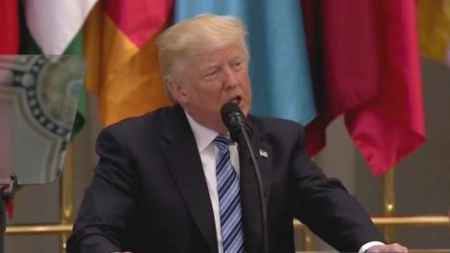
Early on in his speech, Trump addressed his audience as friends and partners; within a few minutes, without pointing a finger, and without abandoning the collegial tone or the complimentary language, made it clear he was lecturing them. He was the boss, the capo di tutti capi, and he was laying down terms. This wasn’t Obama, who naively thought he could change the world with groveling apologies for the West, praise for Islam built on sheer fantasy, and yet another retelling of his own supposedly inspiring personal story – all the while oozing beta-male deference and docility. No; this was a man of power who – never once talking about himself – made expert use of that power, wielding an iron fist in a velvet glove. His message was unmistakable: either set aside this stupid religion (or at least rein it in, and now), join the modern world, and set your people free to dream, hope, create, grow, and prosper. Or else face the consequences. When, at the end, he summed up the assets of the Islamic world, he didn’t even mention Islam: he cited, among other things, its “spirit of enterprise” and ambitious young people. Where Obama had falsely attributed all kinds of past wonders to Islam, Trump imagined an implicitly Islam-free future in which the region could finally enjoy “glorious wonders of science, art, medicine, and commerce to inspire mankind.” 

*****************

On June 4, 2009, Barack Obama went to Cairo and delivered a speech, addressed to the Muslim world, that was full of praise for Islam and apologies on behalf of the West. In the address, entitled “A New Beginning” (“I’ve come here to Cairo,” he explained, “to seek a new beginning between the United States and Muslims around the world”), he called the university at which he was speaking (which, if it were anywhere in the West, would probably not be able to gain accreditation) “a beacon of Islamic learning”; he blamed tensions between the West and Islam largely on Western “colonialism”; he said “Salaam aleikum” and kept referring to “the Holy Koran”; he asserted, in a ridiculous example of hyperbole, that “Islam has always been part of America’s story”; he served up a big wallop of revised history, giving Islam unmerited praise for centuries-old accomplishments in science, architecture, music, art, and medicine and even holding it up as “a model of tolerance and equality” (at one point, he seemed to imply that in some ways women’s rights are more advanced in the Muslim world than in the U.S.); and, with utter predictability, he quoted the the “Holy Koran” out of context, plucking out that favorite verse of all Western apologists that supposedly teaches “that if one kills an innocent, it is as if it he has killed all of mankind.”

And of course, as always, he talked about himself: a descendant of “generations of Muslims” in Kenya; a man who, in his Indonesian boyhood, daily heard the beautiful Islamic call to prayer; a president who had “known Islam on three continents before coming to the region where it was first revealed.” As someone with such intimate ties to the Religion of Peace, asserted Obama, he saw it as part of his job to “fight against negative stereotypes of Islam.” Yes, he spoke about the need to fight terror, but he was quick to maintain that “Islam is not part of the problem” but rather “an important part of promoting peace.” He defended U.S. ties to Israel and recognized the “reality of the Holocaust,” but quickly pivoted to the “suffering” of Palestinians, the “pain of dislocation” they experienced, and the “daily humiliations” of the “occupation” – preaching, in short, to Israel from a Cairo pulpit. He quoted from the Talmud, but was careful not to call it holy. He implied that the histories of the Jews and Palestinians were equally tragic. And he preached to America too, suggesting that when Americans criticize the “choice” of women – and girls (!) – to wear hijab they were disguising their “hostility” to Islam “behind the pretense of liberalism.” Similarly, instead of thundering against the evil of 9/11, Obama apologized for the supposed excesses of some Americans’ responses to that atrocity, saying with nauseating chagrin that “in some cases it led us to acts contrary to our principles and our ideals.” Oh, and he vowed to close Guantánamo “by early next year.”

This Sunday, almost exactly as far into his presidency as Obama was when he gave his Cairo speech, Donald Trump spoke in Riyadh. For some of us, the very prospect of this appearance had been, to put it mildly, dismaying. Trump won the election, after all, largely because of his tough and bracingly realistic talk about Islam. Now, on his first trip abroad as president, he was going to Saudi Arabia. It was bad enough that this was a trip to a Muslim country. But Saudi Arabia isn’t just any Muslim country. It’s the mother of all Muslim countries. It’s the single most backward of them all. It’s a state sponsor of terrorism. It, and members of its royal family, have bankrolled mosques and madrassas and university departments of Middle Eastern Studies throughout the Western world – places that are nothing more than centers of Islamic propaganda. Most of the 9/11 hijackers, as the whole world knows, were Saudis. And the whole point of Trump’s visit to Riyadh was to celebrate a gigantic sale of U.S. arms to the Saudis on the premise that they represent a major bulwark against an even more dire threat, namely Iran. Nor was Trump just addressing the Saudis: also in attendance were the leaders of most of the other Muslim countries on the planet – in other words, a whole boatload of really nasty customers. It was hard not to conclude that Trump, like Obama, was going to try to brown-nose his way into a “new beginning between the United States and Muslims.”

The opening minutes of Trump’s speech certainly did nothing to dispel this expectation. It was gag-inducing to hear him praise the “magnificent kingdom” of Saudi Arabia, “the splendor of your country,” “the grandeur of this remarkable place,” and so on. It was absurd to hear him talk about working together with the ultra-extremist Saudis to eliminate “extremism.”

But then something happened. Even as he continued to serve up the usual glowing rhetoric about Islam being “one of the world’s great faiths,” and to refer to this and that as being “holy,” he made a couple of exceedingly elegant transitions. First, he began mixing the ethereal praise with realistic businessman-type talk about the value of international partnership. “We are not here to lecture, to tell other people how to live, what to do, who to be, or how to worship,” he said. “Instead, we are here to offer partnership” between the West and the Muslim world – a partnership that would bring prosperity to future Muslim generations. But he underscored the fact that in order for such a partnership to work, something would have to change. And it would have to change a lot. The Islamic world, he insisted, had to turn into a place where young Muslims could grow up “innocent of hatred.” And then he spelled out the results of that hatred, presenting first a roll call of some of the “barbaric attacks” on America – 9/11, Boston, San Bernardino, Orlando – and then a list of other places (“Europe, Africa, South America, India, Russia, China, and Australia”) where that hatred has manifested itself.

However delicately he worked his way around to it, it was nothing less than an accusation.

No, he didn’t explicitly charge Muslim leaders with funding terrorism – but he told them, in no uncertain terms, that they needed to cut off funds to terrorists. Nor did he explicitly blame Islam for terror or explicitly call it evil (as much as some of us would have loved to hear him do so) – but he came tantalizingly close to doing so, speaking bluntly about the “vile creed,” the “wicked ideology,” the “craven ideology”, that underlies terror. He did use the word “evil.” And, yes, he spoke of “Islamic” (not “Islamist” or “radical Islamic”) terror. And he made it clear he wasn’t just talking about terrorism – he was talking about Islam itself. He condemned “the oppression of women, the persecution of Jews, and the slaughter of Christians.” He warned: “barbarism will deliver you no glory. Piety to evil will bring you no dignity.”  Yes, “piety to evil.” Even as he continued to make flattering references to Islam, they felt increasingly pro forma, and it became increasingly manifest that he was identifying that religion as the root not just of terror but of all that is primitive and barbaric about that portion of the world in which it is most commonly practiced. In one remarkable passage, he listed a number of wonders of the Arab region of which his listeners should be proud. What was remarkable was that they were all wonders that dated to pre-Islamic times. In short, he was reminding these people that they had a proud history, a proud identity, that predated their prophet and that could, if they wished, help form the foundation of a new, free, forward-looking culture.

Of course, even to express such thoughts, in some Islamic countries, is considered heretical, illegal; but Trump did it in such a masterly way that you could imagine some of these Muslim big shots sitting there trying to figure out whether they should be offended or not.

In fact, it was all quite masterfully done. Early on in his speech, Trump addressed his audience as friends and partners; within a few minutes, without pointing a finger, and without abandoning the collegial tone or the complimentary language, made it clear he was lecturing them. He was the boss, the capo di tutti capi, and he was laying down terms. This wasn’t Obama, who naively thought he could change the world with groveling apologies for the West, praise for Islam built on sheer fantasy, and yet another retelling of his own supposedly inspiring personal story – all the while oozing beta-male deference and docility. No; this was a man of power who – never once talking about himself – made expert use of that power, wielding an iron fist in a velvet glove. His message was unmistakable: either set aside this stupid religion (or at least rein it in, and now), join the modern world, and set your people free to dream, hope, create, grow, and prosper. Or else face the consequences. When, at the end, he summed up the assets of the Islamic world, he didn’t even mention Islam: he cited, among other things, its “spirit of enterprise” and ambitious young people. Where Obama had falsely attributed all kinds of past wonders to Islam, Trump imagined an implicitly Islam-free future in which the region could finally enjoy “glorious wonders of science, art, medicine, and commerce to inspire mankind.”

Yes, it would have been terrific to hear an American president spell out the truth about Islam in a less nuanced, less diplomatic fashion. And it was frankly bizarre to hear Trump, in his closing moments, singling Iran out as uniquely malevolent after having heaped praise on other equally nefarious regimes whose leaders were right there in the room with him. But we critics of Islam have our jobs and Trump has his. Given the occasion and the purpose, this was, even at its worst, an immense improvement over Obama’s Cairo oration, and, at its best, a convincing assertion of authority, a strongly pitched demand for radical transformation, and a perfectly calibrated use of the carrot-and-stick approach.

No, international Islam is almost certainly beyond meaningful reform. But history has shown that it can at least be contained and controlled in ways that give citizens of Muslim-majority countries a certain degree of freedom and that keep to a minimum the scale of violence in the West originating in those countries. (The rampant Islamization of the West, and the concomitant increase in home-grown Islamic terror, are separate questions.) And no, a single speech can’t accomplish much of anything. But Trump’s tough presentation in Riyadh, if followed up by equally tough interactions with our “friends” in that audience, may well get a few things, here and there, moving in welcome directions.

Major US Jewish Organization Lauds Trump’s ‘Refreshing, Honest’ Speech in Saudi Arabia

May 21, 2017

Major US Jewish Organization Lauds Trump’s ‘Refreshing, Honest’ Speech in Saudi Arabia, Algemeiner, May 21, 2017

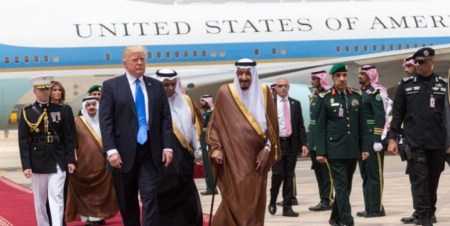
President Donald Trump arrives in Saudi Arabia. Photo: White House

A leading American Jewish advocacy organization praised Donald Trump’s speech to Muslim leaders in Saudi Arabia on Sunday, saying the president had demonstrated “refreshing honesty…in describing the Islamist extremist threat that developed in the Middle East years ago.”

“We agree that the fight against Islamist extremism is a battle between the forces of good and decency, on the one hand, and evil and a death cult, on the other, and that victory depends, above all, on what Arab and Muslim nations do to counter and defeat this violent, deadly scourge,” said David Harris, CEO of the American Jewish Committee (AJC), in a statement.

Trump issued an urgent plea to the leaders of more than 50 Muslim countries to join a “coalition of nations who share the aim of stamping out extremism and providing our children a hopeful future that does honor to God.”

Trump pointed out to his hosts that “in sheer numbers, the deadliest toll has been exacted on the innocent people of Arab, Muslim and Middle Eastern nations. They have borne the brunt of the killings and the worst of the destruction in this wave of fanatical violence.”

Trump pointedly included organizations other than ISIS on his list of terrorist organizations.

“The true toll of ISIS, al Qaeda, Hezbollah, Hamas, and so many others, must be counted not only in the number of dead. It must also be counted in generations of vanished dreams,” Trump declared.

“He could not have been clearer in his description of Hezbollah and Hamas as the terrorist groups they most assuredly are,” the AJC’s Harris added.

Trump, Unlike Obama, Addressed ‘Islamic Terror’ Directly

May 21, 2017

Trump, Unlike Obama, Addressed ‘Islamic Terror’ Directly, BreitbartJoel B. Pollak, May 21, 2017

President Donald Trump and President Barack Obama delivered addresses to the Muslim world at roughly the same point in their respective presidencies.

But unlike Obama, who attempted to appease Islamic resentment of the West by admitting America’s faults, Trump’s speech in Riyadh, Saudi Arabia on Sunday emphasized terrorism and challenged the Arab and Muslim world to foster peace by “honestly confronting the problem of Islamic extremism, and the Islamists, and Islamic terror of all kinds.”

The first difference between the two speeches was the setting. Trump addressed a summit of Arab and Muslim leaders at a conference to deal with terrorism. Obama, by contrast, invited members of the Muslim Brotherhood to his address at Al-Azhar University in Cairo.

Trump rallied the nations of the region to deal with a problem in their midst; Obama gave legitimacy to a banned group associated with terror and extremist ideology.

Obama began his address by focusing on western guilt:

More recently, tension has been fed by colonialism that denied rights and opportunities to many Muslims, and a Cold War in which Muslim-majority countries were too often treated as proxies without regard to their own aspirations. Moreover, the sweeping change brought by modernity and globalization led many Muslims to view the West as hostile to the traditions of Islam.

In contrast, Trump began by declaring that “Muslim countries must take the lead in combating radicalization. He said that he was not there to lecture to others about how to worship, but to call for unity “in pursuing the one goal: … to conquer extremism and vanquish the forces that terrorism brings with it every single time,” singling out “young Muslim men and women.”

Trump went further, taking on “terrorism and the ideology that drives it.” He listed recent terror attacks in the U.S. and around the world, and noted that “the deadliest toll has been extracted from the innocent people of Arab and Muslim nations.” The optimism of the region, he said, was “held at bay by bloodshed and terror.” And he added: “There can be no co-existence with this violence.”

Obama, too, had emphasized that many of the victims of groups like Al Qaeda were Muslim. Like Obama, Trump distanced terror from faith, suggesting terrorists falsely used the name of God, and implying that the problem was not limited to Islam, But Trump did not shy away from the link to Islam, whereas Obama sought to absolve Islam itself of any link with terrorism.

Obama said: “Islam is not part of the problem in combating violent extremism – it is an important part of promoting peace.” Obama never even used the word “terror.” He simply referred to “violence against civilians” by “extremists,” whom he never connected directly to Islam.

In contrast, Trump told the gathering in Saudi Arabia to “[d]rive them [terrorists] out from your places of worship,” and exhorted the nations present to make sure “terrorists find no sanctuary on their soil.”

Obama defended America to the Muslim world by emphasizing America’s connection to Islam — almost describing the U.S. as a Muslim nation itself. “[L]et there be no doubt: Islam is a part of America,” Obama declared. He cited exaggerated population figures for Muslims in the U.S.: “nearly seven million American Muslims in our country today,” he claimed.

Trump, in contrast, praised the achievements of the Arab and Muslim world in the region itself, but did not try to remake America in Islam’s image. Trump also spoke in a forthright manner about the persecution of Jews, whereas Obama irritated Israelis by claiming Israel was created because of the Holocaust.

Both presidents were gracious to their audience. Both downplayed the idea of interfering in the affairs of the Muslim world, unlike earlier administrations. Trump offered the Saudis the “friendship, and hope, and love” of the American people, and praised his hosts as the guardians of “the two holiest sites in the Islamic faith.” Trump also praised the arms deal he had reached with Saudi Arabia the day before, which he said would help both sides.

Obama was somewhat less focused on Egypt itself, but was effusive in his praise of Islam in general, crediting it — with some exaggeration — with making the European enlightenment possible, and with fostering religious tolerance.

Yet Trump was clear about the need to confront Iran as a common challenge to peace in the entire region. He even implied that regime change was an ultimate goal of U.S. policy toward Iran. Obama, in contrast, appeased Iran and accepted blame, publicly, for a “role in the overthrow of a democratically-elected Iranian government” in the 1950s.

Early media reports suggest that Trump’s speech is being described as “moderate,” because he did not use the signature phrase “radical Islamic terror.” That is not accurate: the principal objection to Obama’s evasion was the absence of the word “Islam,” which Trump addressed directly. But if that is indeed how the speech was received, then Trump achieved something great indeed: identifying the eradication of Islamic terror as a “moderate” value.

Excerpts: Trump will say ‘Islamist extremism’ in Saudi Arabia speech

May 21, 2017

Excerpts: Trump will say ‘Islamist extremism’ in Saudi Arabia speech, Washington ExaminerDaniel Chaitin, May 21, 2017

(President Trump’s address is to be carried live here:

— DM)

President Trump speaks during a bilateral meeting with Qatar’s Emir Sheikh Tamim Bin Hamad Al-Thani, Sunday, May 21, 2017, in Riyadh. (AP Photo/Evan Vucci)

Following speculation that he would avoid saying “radical Islamic extremism” on Sunday after using it often during the campaign — both national security adviser H.R. McMaster and Trump counselor Kellyanne Conway refused to say if Trump would use the terminology — Trump will say “Islamist extremism.”

“That means honestly confronting the crisis of Islamist extremism and the Islamist terror groups it inspires. And it means standing together against the murder of innocent Muslims, the oppression of women, the persecution of Jews, and the slaughter of Christians,” Trump will say. “Religious leaders must make this absolutely clear: Barbarism will deliver you no glory — piety to evil will bring you no dignity. If you choose the path of terror, your life will be empty, your life will be brief, and your soul will be condemned.”

************************

President Trump will describe the fight against terrorism as “Islamist extremism” during his major speech to Middle Eastern leaders on Sunday, according to excerpts released from the White House.

“We are adopting a principled realism, rooted in common values and shared interests,” Trump will say in Saudi Arabia. “Our friends will never question our support, and our enemies will never doubt our determination. Our partnerships will advance security through stability, not through radical disruption. We will make decisions based on real-world outcomes — not inflexible ideology. We will be guided by the lessons of experience, not the confines of rigid thinking. And, wherever possible, we will seek gradual reforms — not sudden intervention.”

“Our goal is a coalition of nations who share the aim of stamping out extremism and providing our children a hopeful future that does honor to God,” he will said. “America is a sovereign nation and our first priority is always the safety and security of our citizens. We are not here to lecture — we are not here to tell other people how to live, what to do, who to be, or how to worship. Instead, we are here to offer partnership – based on shared interests and values — to pursue a better future for us all. Every time a terrorist murders an innocent person, and falsely invokes the name of God, it should be an insult to every person of faith.”

The president will urge Middle Eastern countries to take the initiative in the conflict, as the United States is willing to help but not do all the fighting itself. Trump just signed a $110 billion arms deal with Saudi Arabia to do just that, and told the Emir of Qatar, Tamim bin Hamad al Thani, during a brief photo spray on Sunday that they discussed another purchase of “beautiful military equipment.”

“But we can only over acome this evil if the forces of good are united and strong — and if everyone in this room does their fair share and fulfills their part of the burden,” Trump will say. “Terrorism has spread across the world. But the path to peace begins right here, on this ancient soil, in this sacred land. America is prepared to stand with you — in pursuit of shared interests and common security. But the nations of the Middle East cannot wait for American power to crush this enemy for them. The nations of the Middle East will have to decide what kind of future they want for themselves, for their countries, and for their children.”

As previously reported by the Associated Press about a draft it obtained, Trump will cast the fight as a “battle between good and evil.”

“This is not a battle between different faiths, different sects, or different civilizations,” Trump will say. “This is a battle between barbaric criminals who seek to obliterate human life, and decent people of all religions who seek to protect it. This is a battle between good and evil.”

Following speculation that he would avoid saying “radical Islamic extremism” on Sunday after using it often during the campaign — both national security adviser H.R. McMaster and Trump counselor Kellyanne Conway refused to say if Trump would use the terminology — Trump will say “Islamist extremism.”

“That means honestly confronting the crisis of Islamist extremism and the Islamist terror groups it inspires. And it means standing together against the murder of innocent Muslims, the oppression of women, the persecution of Jews, and the slaughter of Christians,” Trump will say. “Religious leaders must make this absolutely clear: Barbarism will deliver you no glory — piety to evil will bring you no dignity. If you choose the path of terror, your life will be empty, your life will be brief, and your soul will be condemned.”

Sebastian Gorka Speech at the Republican National Lawyers Association

May 6, 2017

Sebastian Gorka Speech at the Republican National Lawyers Association, C-SPAN via YouTube, May 5, 2017

(Dr. Gorka addresses the Islamic Caliphate, aka the Islamic State, its history and how to defeat it and its affiliates. Please see also, President Trump slams the book down on calumny campaign against Dr. Gorka. — DM)

https://www.youtube.com/watch?v=EAlYXPTwMCg


Middle East: A Shift from Revolution to Evolution

April 8, 2017

Middle East: A Shift from Revolution to Evolution, Gatestone InstituteNajat AlSaied, April 8, 2017

The lesson the Trump administration might learn from the disastrous mistakes of its predecessor is that the main sources of terrorism in the region are political Islam and all its related religious groups. All these radical groups, including ISIS, Al-Qaeda, Jabhat Al-Nusra and Hamas have been spawned by a political Islam driven by the ideology of the Muslim Brotherhood.

The fight, therefore, should not be against Islam, but against political Islam. Islam needs to be practiced the way other religions are, as a private personal faith that should be kept separate from public life and politics, and whose expression should be confined to worship only.

Mosques, whether in the Arab and Muslim world or in the West, should be places of worship only and must not transformed to centers for polarizing society or for recruitment by political religious groups.

After each Islamist terrorist attack in the West, the public is divided into two camps: one angry and one indifferent. The problem with defeating Islamist terrorism seems to be that either it is attacked by conservatives who call Islam an evil cult or it is forgiven entirely by liberal apologists. What, then, is the answer?

One of the main failures in Western analyses of the origins of terrorism in the Middle East and North Africa is that the West attributes them to a lack of democracy and a lack of respect for human rights. This is, indeed, part of the cause, but the root of the problem is a lack of development and modernity. U.S. President Donald Trump did not exaggerate when he said that the Obama administration’s foreign policy was disastrous. It was catastrophic mainly for two reasons. One was the knee-jerk support for the “Arab Spring” and for extremist Islamic political groups such as the Muslim Brotherhood. The second was the alliances the Obama administration built with unreliable countries such as Qatar, which supports radical political groups such as the Muslim Brotherhood. In addition, Obama made the mistake of continuing to try to appease Iran’s theocratic regime.

The Arab Spring’s uncalculated, hasty attempt to establish so-called democracy only generated more turmoil and chaos in the region. Certain radical political groups simply exploited the elections to serve their own political and sectarian agendas; that swoop for power only resulted in more authoritarian and dictatorial regimes, as have played out, for instance, in Egypt, where we have witnessed the murder of civilians and police officers by the Muslim Brotherhood. In other countries, the situation is even worse; attempts to install democracy have totally destroyed the state and facilitated the spread of terrorist militias, as in Libya.

It is ironic that Western countries and their advocates stress the need to apply democratic practices in Arab countries, but evidently do not recall that development and secularism preceded democracy in Western Europe. The United Kingdom, which has the oldest democratic system, did not become fully democratic until 1930. France became fully democratic only in 1945, 150 years after the French Revolution.

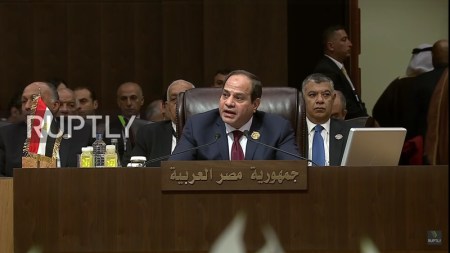
The Emir of Qatar, Sheikh Tamim bin Hamad Al-Thani, at the Arab Summit in Jordan on March 28, 2017 delivered a speech in which he indicated his continuous support for the Muslim Brotherhood:

“If we are serious about focusing our efforts on armed terrorist organizations, is it fair to consider any political party we disagree with as terrorist? Is our goal to increase the number of terrorists?”

Many Arab leaders were infuriated by his speech; at the forefront was President Abdel Fattah el-Sisi of Egypt, who left the Arab Summit Hall during the speech to meet King Salman of Saudi Arabia.

Most Arab leaders and analysts, in fact, are enraged by Qatar’s continuous support for Islamist political groups such as the Muslim Brotherhood, because these groups are a threat to their national security.

President Abdel Fattah el-Sisi of Egypt speaks at the Arab Summit, on March 29. The previous day, Sisi walked out of a speech by the Emir of Qatar, Sheikh Tamim bin Hamad Al-Thani. Sisi was infuriated by Al-Thani’s declaration of support for the Muslim Brotherhood. (Image source: Ruptly video screenshot)

Another consequence of Obama’s foreign policy — in particular attempts to get close to Iran’s hostile regime — has been a fraying of relationships with old Arab allies of the United States. Some of Obama’s advisors thought that replacing Saudi Arabia with Iran was somehow “better” for the United States, if Iran “is beginning to evolve into a very civilized and historically important country” — an analysis that can be described as completely short-sighted.

The Saudi regime, with all its flaws, is a monarchy run by princes; the Iranian regime is a theocracy run by clerics. The Saudi regime is not a theocratic regime but a hybrid structure, which is neither wholly secular nor wholly religious. As such, the religious class functions under the authority of the ruling class. Princes are driven by self-interest; clerics are driven by ideology. In terms of extremism, the Iranian regime is pushing for hegemony, whilst Saudi Arabia has been taking only a defensive, rather than an expansionist, position.

The motivation of Saudi Arabia in exporting mosques world-wide and installing radical Saudi imams is defensive, not expansionist as in Iran. Saudi Arabia’s impetus is to confront Iran’s hegemony and the spread of its hostile ideology. It is this strategy, which Saudi Arabia has practiced since 1979 to balance Iran’s power and to combat its rebellious ideology, that must change.

That Iran’s Khomeini regime sought to embarrass Saudi Arabia — a country that is home to Islam’s two holiest mosques, in Mecca and Medina — by portraying it as not sufficiently Islamic, meant that the foundational Islamic Wahhabism of the Saudi Kingdom was aggressively reinforced. This emphasis resulted in even more constraints being put in place in Iran: especially on entertainment. Since the Khomeini revolution in 1979, all plays, fashion shows, international events, and cinemas have been banned. As for women, the Commission for the Promotion of Virtue and Prevention of Vice has increasingly harassed them. As for minorities, especially Shia challenging the Iranian Shia regime and its support for Shia militias — particularly the dominant Revolutionary Guards — books were published attacking the Shia:

More books appeared, attacking the Shias and especially Khomeini’s views. These books – like the arguments of Khomeini’s followers – rejected modern thinking as an “intellectual invasion.” Saudi Arabia, considered the guardian of Sunni Islam, spent billions of dollars on challenging the Khomeini-backed Shiites.

This religious one-upmanship — a competition over which body can be the “most religious” — must stop. Saudi Arabia would do well to understand that in order to confront the hegemony of the Iranian theocratic regime, the answer is not to radicalize Saudi society but to return to the way it was before 1979.

The best way to defeat the rebel hostile regime in Iran might be through creating an inclusive and tolerant society in Saudi Arabia. Saudi Arabia needs to change its approach towards Iran because the current strategy has not worked. The current strategy has done nothing except to strengthen the Iranian regime’s dominance; distort, globally, the image of Saudi Arabia and accelerate terrorism.

The lesson the Trump administration might learn from the disastrous mistakes of its predecessor is that the main source of terrorism in the region are political Islam and all its related religious groups. All these radical groups including ISIS, Al-Qaeda, Jabhat Al-Nusra and Hamas have been spawned by a political Islam driven by the ideology of the Muslim Brotherhood. Extremist jihadists such as Osama bin Laden, Abdullah Azzam and Ayman al-Zawahiri were all taught by the Muslim Brotherhood.

Political Islam practiced by the Iranian theocratic regime has been comfortably generating Shia radical militias, including the terrorist group, Hezbollah. The fight, therefore, should not be against Islam, but against political Islam. Islam needs to be practiced the way other religions are, as a private personal faith that should be kept separate from public life and politics, and whose expression should be confined to worship only. Mosques, whether in the Arab and Muslim world or in the West, should be places of worship only and must not transformed to centers for polarizing society or for recruitment by political religious groups. Unfortunately, Western countries have turned a blind eye to the political activities inside these mosques.

The danger of these religious political groups is that they do not believe in democracy or human rights; they just use elections to grasp power in order to impose a system of “Islamic Caliphate” as their only form of government. Most of these groups use religion as an ideology to oppose governments other than their own, and when they are criticized or attacked, they play the role of the oppressed.

The Trump administration needs to take advantage of the fact that the majority of people in the Middle East and North Africa have lost faith in religious political groups, especially since the failure of the Muslim Brotherhood in Egypt and Tunisia.

Before the Arab Spring, support for these groups was huge; now it stands at less than 10% of the population. This study was conducted in the Arab world, not including Turkey. The Muslims who support Turkish President Recep Tayyip Erdogan are the Muslim Brotherhood.

Most recent polls indicate that the majority of people in Arab and Muslim countries prefer religion to be kept separate from politics.

The country that is working the most systematically to fight these religious political groups in the region is the United Arab Emirates (UAE). There are several institutes and think tanks researching how to combat these groups. Dr. Jamal Sanad Al-Suwaidi, Director General of the Emirates Center for Strategic Studies and Research (ECSSR), has given a robust analysis of these groups and how to combat them in his book, The Mirage. In it, he cites a study on public opinion on political religious groups: A survey of the UAE population, on how these groups are able to influence the public by taking advantage of certain flaws in the system: 53.9% because of corruption; 47.9% because of poverty and 29.1% because of an absence of civil society groups that confront these opportunists.

The Middle East-North Africa region will undoubtedly have to go through several stages before it can successfully establish democracy. An evolutionary developmental approach will definitely be better than the failed revolutionary democratic one pursued by the Obama administration.

Secularization is also crucial in the fight against terrorism. Trying to build a democracy before going through the stages of secularism and political reformation — which includes rectifying existing flaws, such as corruption; modernization which means the liberation of the region from extremist totalitarian religious dogma and all other forms of backwardness in order to kick-start a renaissance; and scientific development — will not only be inadequate but will actually generate more terrorism by helping radicals to keep gaining power. It would be like a farmer who wants to plant roses in arid desert soil full of thorns.

Dershowitz: Revised travel order should have been upheld

March 18, 2017

Dershowitz: Revised travel order should have been upheld, Fox News via YouTube, March 18, 2017

( In the last minutes of the video, Prof. Dershowitz articulates his hopes for the Democrat Party. Has he allowed his hopes to override reality? — DM)


Are the Hard Leftists Aligned with Radical Islamists?

March 17, 2017

Are the Hard Leftists Aligned with Radical Islamists? Gatestone InstituteNajat AlSaied, March 17, 2017

The leftist media and other American liberals insist on portraying President Trump’s position as a fight against Islam and Muslims. In fact, most moderate Muslims are not offended by the phrase “radical Islam,” because they are very distressed by the fact that their religion has been commandeered by the radicals and transformed from a religion of peace into a more radical version.

I just wonder where those feminists and John Kerry were when millions of Egyptian women needed their support when they marched against the Muslim Brotherhood, asking for America’s help. Where were they when thousands of Syrian and Iraqi women were enslaved and raped by radical ISIS militants?

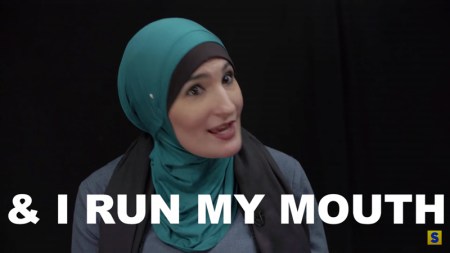
While not a single voice among these liberal feminists spoke out against these inhumane acts perpetrated against Muslim women by radical Islamists, a Hamas and Muslim Brotherhood sympathizer, Linda Sarsour, co-organized the anti-Trump Women’s March on Washington. What’s worse, these liberal feminists want Sarsour to represent all Muslim women, while in fact she speaks for nobody except herself and those who fund her.

Since the presidential campaign began, and then right up until the Conservative Political Action Conference (CPAC) on February 24, 2017, President Donald Trump has kept saying the same thing: that the United States is at war with radical Islam, mainly represented by the Islamic State of Iraq and Syria (ISIS). Yet, the leftist media and other American liberals insist on portraying his position as a fight against Islam and Muslims. In fact, most moderate Muslims are not offended by the phrase “radical Islam,” because they are very distressed by the fact that their religion has been commandeered by the radicals and transformed from a religion of peace into a more radical version. Unfortunately, instead of the leftists giving a voice to and supporting these moderate Muslims, a kind of leftist-Islamist alliance has emerged.

Abdel Rahman al-Rashed, a Saudi columnist for pan-Arab newspaper Al Sharq al Awsat, said in 2004:

“It is a certain fact that not all Muslims are terrorists, but it is equally certain, and exceptionally painful, that almost all terrorists are Muslims… The majority of those who were suicide bombers on buses, other vehicles, in schools and other places, all over the world, were Muslim”.

This statement from a well-known columnist and a former General Manager of the Al Arabiya news channel demonstrates how moderate Muslims are critical of their own culture and how they are saddened by how their religion has been hijacked by radicals. However, these appeals fall on deaf ears with leftists; they call moderate Muslims passive, which instead supports and furthers the radical Islamists’ cause.

In 2009, while millions of Iranians were in the streets opposing a radical, theocratic regime as part of their Green Revolution, then U.S. President Barack Obama ignored this historic moment and continued reaching out to Iran’s rulers, who are designated by the U.S. government as sponsors of terrorism. His appeasing attitude was a clear sign that the US was so eager to reach a nuclear deal by befriending the Iranian regime, that it was willing to tolerate the mullahs’ brutal repression and its hegemonic policies across the region.

In 2011, we witnessed the Obama Administration’s support for the Muslim Brotherhood in Egypt, in the form of billions of dollars that ensured its victory, ignoring the consequences their rule has had on moderate Muslims, Coptic Christians and secular groups. Many moderate Muslim women in Egypt entreated the Obama Administration to support them against the Muslim Brotherhood’s tyranny and misogyny, but to no avail.

Gameela Ismail, an Egyptian politician activist asked John Kerry in 2013 to cease supporting the Muslim Brotherhood:

“We ask you to do nothing for us. Just stop doing anything at all in our country and stop supporting tyranny and fascism, and leave us to complete our revolution and achieve our dreams. Our dreams will not stop because of your humble perceptions of us and our future.”

Kerry responded: “The United States did not take sides but had to deal with the elected legitimate government in place.” Then Kerry announced the United States would give the Muslim Brotherhood government another $250 million.

Ironically, we saw John Kerry protest against President Trump as part of the Women’s March on Washington after Trump’s inauguration. I just wonder where those feminists and John Kerry were when millions of Egyptian women needed their support while marching against the Muslim Brotherhood and asking for America’s help. Where were they when thousands of Syrian and Iraqi women were enslaved and raped by radical ISIS militants? It seems that these liberal women do not recognize the dignity of human life beyond the wall of their uterus. Abortion and contraceptive pills are their ultimate concern.

While not a single voice among these liberal feminists spoke out against these inhumane acts perpetrated against Muslim women by radical Islamists, a Hamas and Muslim Brotherhood sympathizer, Linda Sarsour, co-organized the anti-Trump Women’s March on Washington. What’s worse, these liberal feminists want Sarsour to represent all Muslim women, while in fact she speaks for nobody except herself and those who fund her.

Sarsour’s interview with Rachel Maddow on MSNBC was full of false information, yet she was still cheered by several prominent liberal leftists. She said that Muslim children are being executed in the United States [a lie], that Muslims are prohibited from practising their faith [a lie] and that there is opposition to the building of mosques [a lie: There are more than 2,106 mosques in the US]. She also admitted that she wants Islamic sharia law to be applied in the United Sates and is offended that 22 states are opposed to this. All of these lies and allegations were not challenged by MSNBC anchor Rachel Maddow. In fact, she agreed with Sarsour by saying, “What is happening domestically around issues about bigotry is spooky”. This shows that she is not a tolerant, open-minded anchor, but proves that she is a professional liar, which is a million miles away from a balanced media that presents the truth.

In a recent interview on MSNBC, Linda Sarsour, a Hamas and Muslim Brotherhood sympathizer, said that in the United States, Muslim children are being executed [a lie], and Muslims are prohibited from practising their faith [a lie]. Pictured above: Sarsour is interviewed in a Seriously.TV video.

This is not the only example of the liberals’ hypocrisy. Their use of the “Muslim card” went to the extent that former Secretary of State Madeleine Albright said she is prepared to “register as Muslim” in solidarity with Muslims against President Trump’s plans to take executive action affecting Muslim immigrants into the US. We wonder where warm-hearted Albright’s conscience was when she was asked in 1996 about the deaths of 576,000 Iraqi children under the brutal sanctions on Iraq during the Clinton Administration of the 1990s. She gave a cold-blooded response: that the price paid was worth it. Now she is heartbroken over restrictions on immigrants from seven majority-Muslim states.

Actually, there was nothing new about the three-month temporary block on those with passports from seven majority-Muslim countries. Donald Trump stated on his Facebook page:

“My policy is similar to what President Obama did in 2011 when he banned visas for refugees from Iraq for six months. The seven countries named in the Executive Order are the same countries previously identified by the Obama administration as sources of terror. To be clear, this is not a Muslim ban, as the media is falsely reporting.”

The fact that the liberals are trying to undermine every single action Trump takes with continuous lies, is making them very hard to believe.

It is pathetic that the liberals are not only against President Trump in his fight against radical Islamists, but are also supporting those extremists at the expense of oppressed moderate Muslims. The alignment of the liberal leftists with radical Islamists, and playing the “Muslim card” hypocritically and exploitatively, will not make Muslims support liberals. On the contrary, this will encourage more moderate Muslims to align themselves with conservatives. So, let the liberals have the radicals as their lackeys.

Dr. Jasser shares his thoughts on the revised travel ban on Risk & Reward 03.06.2017

March 10, 2017

Dr. Jasser shares his thoughts on the revised travel ban on Risk & Reward 03.06.2017, Fox News via YouTube