Posted tagged ‘Trump agenda’

Byron York: While other controversies rage, work on border wall moves forward

May 30, 2017

Byron York: While other controversies rage, work on border wall moves forward, Washington Examiner, May 29, 2017

(Please see also, FULL MEASURE: May 28, 2017 – Price of Power on how Congress “works.”  — DM)

New revelations come almost by the minute in the Trump-Russia affair. The White House moves into full-defense mode. The Trump agenda stalls on Capitol Hill.

A reasonable observer might conclude that is all that is happening in the Trump administration. But even as those troubles fill news sites and cable TV, administration officials are quietly moving ahead on one of the president’s top campaign promises: the construction of a wall on the U.S.-Mexico border. Although it hasn’t received much attention relative to the president’s many problems, extensive planning for the wall is under way, officials are evaluating specific proposals, sites are being studied, and yes, there is money available to get going.

The work is being done under President Trump’s executive order of Jan. 25, which declared the administration’s policy to “secure the southern border of the United States through the immediate construction of a physical wall …” The order went on to set a high standard of effectiveness: “the prevention of all unlawful entries into the United States” along the border. Finally, the order cited an existing law, the Secure Fence Act, which in 2006 called for the construction of “at least two layers of reinforced fencing” and “additional physical barriers” on up to 700 miles of the 1,954-mile border.

“The executive order calls on the authority in the Secure Fence Act for us to begin immediately,” said a senior administration official who recently provided an extensive update on the state of the wall project. In March, U.S. Customs and Border Protection sent out a request for proposals for companies to bid on the construction of prototypes — not little models to sit on someone’s desk, but full-scale sections of proposed wall designs that will be put in place on the border. So far, Border Protection has received more than 100 proposals.

“We are evaluating what started out as a solicitation to industry and request for proposals — 18 to 30 feet high, concrete, impenetrable, hard-to-scale, the correct aesthetics,” the official said. “We’ve tried to capture the intent [of the executive order] in the requests for proposals, and those proposals are being evaluated now.”

There are some important points to remember before going any further. First, there is no intention to build a wall to stretch the entire border, from San Diego, Calif., to Brownsville, Texas. In his campaign, the president made clear that the wall need not cover every mile of the border. Certainly, no expert who supports more barriers at the border believes it should, either.

And the wall does not always mean a wall. The Jan. 25 executive order defined “wall” as “a contiguous, physical wall or other similarly secure, contiguous and impassable physical barrier.” Planners say that in practice, that will certainly mean extensive areas with an actual wall. But other areas might have the type of fencing outlined in the Secure Fence Act, or some other barrier yet to be designed.

And that leads to a third point: The border barrier will not look the same at all points along the border. The terrain of the border is different — some parts are so imposing they don’t need a barrier at all — and officials plan to design walls and barriers that fit each area, rather than one long, unchanging structure.

Right now, officials are studying how many “buildable miles” will need a barrier. Whatever the precise number, it will be big. In 2015, the Department of Homeland Security told Congress that, of the 1,954 miles of border, 1,300 miles, or 66.5 percent, have no fencing or barriers at all; 299.8 miles, or 15.3 percent, have vehicle fence; and 316.6 miles, or 16.2 percent, have pedestrian fence. Only 36.3 miles, or 2 percent, have the kind of double-layer fencing required by the Secure Fence Act. (The law was passed by Congress and signed by President George W. Bush, but neither Bush nor Congress really wanted to build the fence. So they didn’t.)

“We’ve asked the nine sectors on the Southwest border, if you have to meet the standards in the executive order and the Secure Fence Act, where is it that barriers are required to complete the task?” said the senior administration official. “We’ve then evaluated those areas where the traffic [of illegal border-crossers] is highest.” Planners are considering those factors in light of the executive order’s “prevent all entries” standard — administration officials are taking that edict very seriously — to come up with areas in which a wall would be the best solution, or where some other type of physical barrier would do the job better.

At the moment, planners believe that about 700 “buildable miles” of the border will require a wall or other barrier. That just happens to be about the same amount called for in the Secure Fence Act.

Does the government have that much land available? The answer is mostly yes. Remember, from the numbers cited above, that there are more than 650 miles along the border with something on them — vehicle fence, simple pedestrian fence, whatever. That means the government has already gone through the land acquisition and approval process required to erect a barrier. “It’s federal property now because we’ve either condemned it or purchased it,” said the official.

There’s no doubt that hundreds of miles of truly impenetrable barriers would have a huge effect on illegal border crossings. Talk to some experts who favor tougher border enforcement, and they will say that even as few as 100 well-chosen miles of barrier would make a difference.

In any event, there is a significant amount of border land that is already in government hands. “West of El Paso, a lot of the land is public,” the official noted, while “as you go further east from El Paso towards Brownsville, a lot of that land is private.” Going through the process of condemning or buying land — with all the legal and financial issues involved — will depend “on how we choose the priorities.”

Once planners decide where to build, there will then be the question of what to build. If the decision is to build a wall, then the question is: a wall of what? Planners have decided that concrete will definitely be involved, even though it hasn’t played much of a role in earlier barriers. Why concrete? “It’s an interpretation of the vision,” the senior administration official explained. By “vision,” he meant it is a way to make Trump’s oft-repeated promise of a “big, beautiful wall” a reality. Trump didn’t mean a fence.

On the other hand, using concrete presents one obvious problem. Whatever barrier is built, Border Protection agents on the U.S. side need to be able to see through it. That’s always been a requirement with earlier barriers. So now, officials are looking for creative ideas for a wall that will still allow them full sight of the Mexican side.

That touches on the most important consideration for planners. A wall isn’t just a wall. It is a system — a “smart wall,” as they call it. It involves building a barrier with the monitoring technology to allow U.S. officials to be aware of people approaching; to be able to track them at all times; to have roads to move people around; the facilities to deal with the people who are apprehended; and more. “It’s not just a barrier,” noted the official. (Last year, with the Obama administration still in office, a number of Border Protection officials traveled to Israel to study that country’s highly effective barriers; they came home big believers in a smart wall.)

At this point, it’s impossible to say what building a smart wall will cost, because officials haven’t yet decided on a plan. But how much money does the administration have to get started now? Begin with money that was already to available to the Department of Homeland Security.

“Congress gave us a re-programming for money we were planning to do other things with — mostly technology — to get us through this request for proposals and to get the prototypes underway immediately,” the senior administration official said. “That has happened already. We found $20 million to get that effort underway.”

“Then, the 2017 budget resolution gives us substantial money to continue doing real estate and environmental planning and design, and then replace some fencing,” he continued. “That’s in the neighborhood of $900 million.”

“You won’t get a lot of new fence for that,” the official conceded. “You’ll get some upgrades. But you’ll get some behind-the-scenes work underway — engineering, design, real estate acquisition, title searches, the kinds of things that have to happen to make it work.”

That is a start. Republicans on the Hill argue that they got as much money in the recent spending bill as they could for the project, given that they had to work with Democrats to avoid a government shutdown and fund the government through Sept. 30. “We weren’t going to get anything passed that said, quote-unquote, ‘wall,'” noted one GOP staffer.

The next funding hurdle will come when Congress considers spending for 2018. Most House and Senate Democrats appear determined to stop a border barrier. They say it will be expensive and ineffective, while some Republicans believe Democrats oppose the wall mainly because they fear it will work.

After the recent spending bill passed, some opponents of the wall declared the project dead. (Sample headline: Vanity Fair’s “How Trump’s Wall Failure Will Forever Doom His Presidency.”) But any victory dance right now is premature. Yes, it’s certainly possible the wall won’t be built. But it’s also possible it will be built, or that significant parts of it will be built. The work is already under way.
Kellyanne Conway Full One-on-One Explosive Interview on Fox & Friends | Video | Fox News (5/30/2017)

May 30, 2017

Kellyanne Conway Full One-on-One Explosive Interview on Fox & Friends | Video | Fox News (5/30/2017) via YouTube, May 30, 2017

(“Explosive?” — DM)

https://www.youtube.com/watch?v=Oo313DBQKcs


Trump to Germany: Lead, Follow, or Get Out of the Way

May 29, 2017

Trump to Germany: Lead, Follow, or Get Out of the Way, PJ Media, Michael Walsh, May 28, 2017

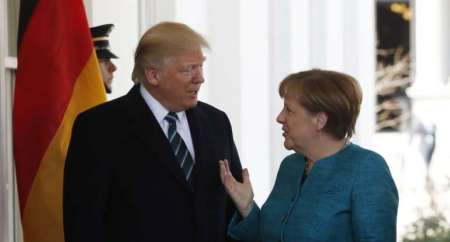
(AP Photo/Pablo Martinez Monsivais)

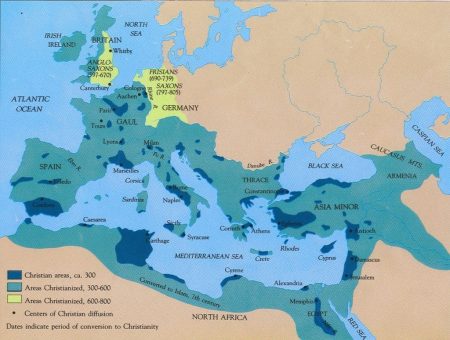
What the president understands, and the Europeans pretend not to, is that Russia is no longer the direct menace it was during the days of the Fulda Gap, and that the real menace to Europe and NATO (which, by the way, includes the Islamicizing state of Turkey) is Islam, and its ongoing invasion of the historic lands of Christendom. If you think that’s a joke, and that it can’t happen in France, Italy or Britain, ask the Anatolians, the north Africans and the Albanians how that worked out for them.

**************************

Quick, name the worst leader in western Europe. Yes, it’s a tough call: it’s either whoever the leader of Italy is this week, plus whichever socialist is temporarily in charge of France, plus the your-name-here chinless wonder domiciled at 10 Downing Street in London. But surely the prize goes to Frau Kartoffel herself, German Kanzlerin Angela Merkel, who’s been in office since 2005 and, alas, shows no signs of leaving any time soon.

On his visit this past week to Europe, President Trump spoke some hard truths to our European allies, but none spat it out more quickly than Merkel, to the absolute delight of the Trump-hating New York Times. It is a cold day in hell when the Times speaks fondly of any German, but here it is:

German Chancellor Angela Merkel, Europe’s most influential leader, has apparently concluded that the United States of President Trump is not the reliable partner her country and continent have automatically depended on in the past.

Clearly disappointed with European leaders’ inability to persuade Mr. Trump to publicly endorse NATO’s doctrine of collective defense — or to agree to common positions on Russia, climate change or global trade — Mrs. Merkel said on Sunday that traditional alliances were no longer as reliable as they once were, and that Europe should pay more attention to its own interests “and really take our fate into our own hands.”

To which let me add: it’s about time. I’ve spent a good deal of my life in Germany, speak the language, and raised my children there; my most recent book, the best-selling The Devil’s Pleasure Palace, concerns not only the Frankfurt School of Marxist philosophers and the cultural havoc they wrought in America, but the musical and literary cornerstones of German culture itself, including Goethe and Wagner.

If it took Trump’s typical bluntness to finally get the message across that the Europeans are now responsible for the mess of their own making, good. Germany in particular has coasted under the American nuclear umbrella for decades, allowing it to a) concentrate entirely on rebuilding its domestic economy, infrastructure and social welfare state and b) thumb its nose at American warmongering imperialism. It’s one of the least attractive aspects of the German character; the gratitude that the immediate postwar generation felt for our having rescued them from Hitler and the love Germans felt for all things American have vanished. In their place has come a churlish, we-can-take-it-from-here mutter that does not become them.

Formerly known as Christendom (Wikipedia)

What the president understands, and the Europeans pretend not to, is that Russia is no longer the direct menace it was during the days of the Fulda Gap, and that the real menace to Europe and NATO (which, by the way, includes the Islamicizing state of Turkey) is Islam, and its ongoing invasion of the historic lands of Christendom. If you think that’s a joke, and that it can’t happen in France, Italy or Britain, ask the Anatolians, the north Africans and the Albanians how that worked out for them.

Speaking on the campaign trail after contentious summit meetings in Belgium and Italy, Ms. Merkel said: “The times in which we could rely fully on others, they are somewhat over. This is what I experienced in the last few days,” she said.

Given this new context for international relations, she said, “that is why I can only say that we Europeans must really take our fate into our own hands — of course in friendship with the United States of America, in friendship with Great Britain and as good neighbors wherever that is possible also with other countries, even with Russia.”

Welcome back to the 19th century! As the gorilla in the middle, Germany has always been forced to deal with the West (in the form of France and French culture) and the East (Russia); the result was two world wars and the deaths of millions. The European Union was essentially a response to the lingering question of how to prevent the great ape from escaping its cage and having dinner in Paris a month or so later. Worse for Merkel, although born in Hamburg, she grew up on the wrong side of the East-West German border and so was raised in a state that was at once a communist dictatorship and a swaddling socialist experiment, one which beat the sense of personal striving out of the people and replaced it with a dull conformity.

That dullness is now embodied by Merkel, a dull, uninspiring leader with no vision for the future and, childless, with no personal stake in it. Somewhere in hell, Walter Ulbricht and Erich Honecker are having a good laugh about their perfect revenge on the capitalist West. Sure, it took their own destruction to pull it off, but what could be more German than that?

Salvadoran Officials Overwhelmed by Returning Deported Gang Members

May 29, 2017

Salvadoran Officials Overwhelmed by Returning Deported Gang Members, Breitbart, Ryan Saavedra, May 28, 2017

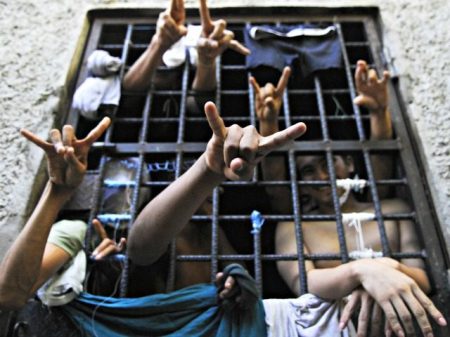
Officials in El Salvador held emergency meetings after seeing a sharp increase in the number of violent gang members being deported back to the country from the United States under the Trump administration.

Salvadoran authorities have held emergency meetings and proposed new legislation to monitor returning criminals and gang members that are returning to El Salvador after deportation, according to the Washington Post.

The move by Salvadoran officials comes as a direct result of the Trump administration’s crackdown on illegal immigration and efforts to deport more criminal illegal aliens from the U.S.

This year the U.S. has already deported 398 gang members back to El Salvador – compared to only 534 for all of 2016.

It is due to this rapid increase in deportations that Salvadoran officials like Héctor Antonio Rodríguez, the director of the country’s immigration agency, are worried about the impact the returning gang members will have in the country.

“This clearly affects El Salvador. We already have a climate of violence in the country that we are combating,” Rodríguez said. “If gang members return, of course this worries us.”

Many of the returning gang members belong to MS-13, a notoriously violent street gang that has plagued communities throughout the U.S. with horrific acts of violence. Although MS-13 started out in Salvadoran communities in Los Angeles sometime during the 1980’s, lax immigration policies and weak border security helped the gang explode in size as MS-13 originated from illegal immigrants, Breitbart Texas reported.

The recent murders of four teens in New York City have put MS-13 in the national spotlight with Attorney General Jeff Sessions declaring that U.S. authorities are going after the gang.

“The MS-13 motto is kill, rape, and control,” Sessions said. “I have a message to the gangs that are targeting our young people: We are targeting you. We are coming after you.”

Speaking at a rally in April, President Trump highlighted the importance of removing illegal alien MS-13 gang members from the U.S.:

At the heart of my administration’s efforts to restore the rule of law has been a nationwide crackdown on criminal gangs, and that means taking the fight to the sanctuary cities that shield these dangerous criminals from removal. The last very weak administration allowed thousands and thousands of gang members to cross our borders and enter into our communities, where they wreaked havoc on our citizens. The bloodthirsty cartel known as MS-13 has infiltrated our schools, threatening innocent children.

We have seen the horrible assaults and many killings all along Long Island where I grew up. We are seeing the vicious spread of transnational gangs into all 50 states and the human suffering they bring with them. I have been with the parents. It is devastation. A very respected General recently told me that MS-13 are the equivalent in their meanness to Al Qaeda. My administration will not rest until we have dismantled these violent gangs, and we are doing it rapidly, and we are sending them the hell out of our country.

On Wednesday, Breitbart Texas reported that Sen. Ron Johnson (R-WI), Chairman of the Senate Homeland Security Committee, said recently obtained documents from a whistleblower show that the Obama administration knowingly admitted 16 MS-13 gang members in 2014.

This Week in Trump

May 28, 2017

This Week in Trump, Power Line, Steven Hayward, May 28, 2017

Normally I don’t traffic in the typical media thumb-sucking about what’s immediately ahead for the President, or other unctuous, subjunctive commands about what the President “must do” if he is going to advance. But I make an exception now because I have a sense that Trump might make some big moves this week following on his highly successful and consequential first foreign trip.

How do I know it was a successful and consequential trip? Because the media was complaining about Melania’s wardrobe and Trump’s supposedly boorish behavior of pushing himself past the prime minister of Montenegro during a group photo setup. I think that was just Trump making clear that the U.S. is done leading from behind. How else do I know it was a successful trip? Because Angela Merkel has her nose bent out of joint. Frau Merkel was quoted this weekend saying, “We can’t rely on the U.S. anymore. I have experienced this in the last days. We Europeans should take destiny in our own hands.”

Merkel and other Europeans reportedly gave Trump the razzle-dazzle about staying in the Paris Climate Accord, which Trump is now rumored to be ready to dump this week. I hope so, though I don’t think it may matter very much. The Paris Accord is so weak that even chief climatista James Hansen calls it a “fraud,” and the fact that ExxonMobil and other major fossil fuel companies support remaining in the Paris Accord is additional indication that Trump might cause more difficulties for the climate racket it he stays in. The great Roger Pielke Jr writes:

“As a symbol, here is how the politics works: Trump pulls out of Paris, Trump wins. Trump stays in, Trump wins. Fun game, huh?”

Roger thinks the smart play for the euroclimatistas would be to kick the U.S. out. I doubt they have that much moxie, and in any case Trump would love it. I can just imagine his tweetstorm now.

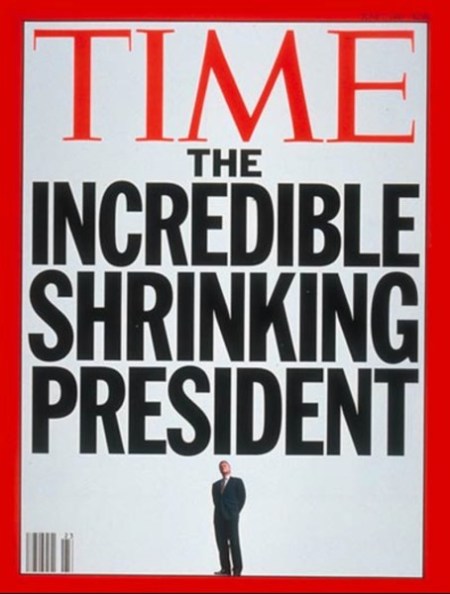
Meanwhile, is Trump going to shake up his staff? One analogy to the early months of Trump’s presidency is the first few months of Bill Clinton’s presidency in 1993, which also did not go well for him in terms of public approval and forward progress on his legislative agenda. It’s not exactly the same: no one in the media today is emulating Time magazine’s “The Incredible Shrinking President” cover of June 1993 that Clinton’s fecklessness provoked. The liberal-media complex fear today is just the opposite—that Trump is a fascist dictator.

It was at about this point in 1993 that Clinton shook up his staff, bringing David Gergen on board as communications director (fortunately there is no risk that Trump will inflict that special misery on us), and musing about demoting Dee Dee Myers, one of his early press spokespeople. It didn’t really help all that much. Hillary’s ridiculous and authoritarian health care plan couldn’t even get a vote in a Congress with comfortable Democratic majorities in both houses, and the crime bill that did pass in the fall of 1994, with its trendy “assault” weapons ban and midnight basketball program, backfired on Democrats.

I suppose the cautionary tale here is that today’s GOP Congress needs to pass some things, or else they will suffer (deservedly) the same fate as the Democrats did in 1994. They really need to get their act together—fast—on the replacement for Obamacare and tax reform. They GOP Congress doesn’t need specific direction from Trump to do these things. In fact, it would be a great move back to political health if Congress stepped up and showed that it can lead the nation just as well as a President, which is what the Founders intended. But that’s a subject for a longer, separate post.

My conclusion is that Trump’s foreign trip and events this week will mark a turning point for his first term.

At G7, Trump Diverts Agenda Away from Climate and Toward Islamist Terrorism

May 26, 2017

At G7, Trump Diverts Agenda Away from Climate and Toward Islamist Terrorism, Breitbart, Thomas D. Williams, Ph.D., May 26, 2017

(Possible WaPo headline: Trump promotes terror to dodge climate change. — DM)

TAORMINA, Italy – At President Trump’s first major meeting with international leaders, his world influence has become evident as conversations shifted from the bogeyman of climate change to the real and present danger of Islamist terrorism.

Prior to the G7 summit of the leaders of the world’s wealthiest and most advanced nations, “climate change” constantly appeared on the list of priorities highlighted by the heads of state especially of European nations.

As one headline read, “Trump talks terrorism while Europe shouts ‘Climate!’” In this shouting match, however, the U.S. President has definitely gotten the upper hand.

Reality has imposed itself, as a major jihadist attack last Monday in Manchester, England, claimed the lives of 22 persons and gunmen massacred some 26 Coptic Christians Friday morning south of Cairo Egypt. The latter attack coincided with the first day of Ramadan, the holiest season in the Islamic calendar.

While the phantasm of global warming hovers over the misty horizon, the reality of repeated slaughters of innocent men, women and children by terrorists inspired by Islamist ideology is an elephant that insists on being recognized.

European leaders have also found themselves asked repeatedly to respond to President Trump’s powerful speech against Islamist terrorism before 55 world leaders from Arab and other Muslim-majority nations in Riyadh earlier this week.

In that speech, Trump called for unity in pursuing “the one goal that transcends every other consideration. That goal is to meet history’s great test—to conquer extremism and vanquish the forces of terrorism.”

In this unique and preeminent task, Trump said, “Muslim-majority countries must take the lead in combatting radicalization.”

“Every time a terrorist murders an innocent person, and falsely invokes the name of God, it should be an insult to every person of faith,” Mr. Trump said. “Terrorists do not worship God, they worship death.”

Asked for a reaction to that speech, the chairman of the European Union’s Council said he agrees with President Trump that the international community should be “tough, even brutal” on terrorism and the Islamic State.

EU Council President Donald Tusk said that he “totally agreed with him when he said the international community, the G7, the United States, Europe — should be tough, even brutal, with terrorism and ISIS.”

Tusk also recognized that “this will be the most challenging G7 summit in years,” because of President Trump’s independent views that do not always mesh with the European globalist establishment.

Throughout the day’s meetings in Taormina, Sicily, President Trump seemed eminently comfortable with his role as world leader and agenda-setter, one which his fellow heads-of-state appeared ill-equipped to counter.

President Trump and Pope Francis Meet Face-to-Face

May 25, 2017

President Trump and Pope Francis Meet Face-to-Face, Front Page MagazineJoseph Klein, May 25, 2017

(Please see also, Catholics Respond to Pope Francis’ ‘One-Sided, Misleading’ Message to Donald Trump. — DM)

[I]t is the fight against climate change that remains his top concern, which is of little comfort to the survivors and families grieving over their loved ones killed or injured in the Manchester slaughter. The same is true about those who suffered from the Islamic terrorist slaughter at a Coptic Christian church in northern Egypt on Palm Sunday. ISIS has claimed responsibility for both attacks.

[I]n the spirit of moral relativism so prevalent today, Pope Francis has declared: “There are fundamentalist and violent individuals in all peoples and religions—and with intolerant generalizations they become stronger because they feed on hate and xenophobia. By confronting terror with love, we work for peace.”

********************************

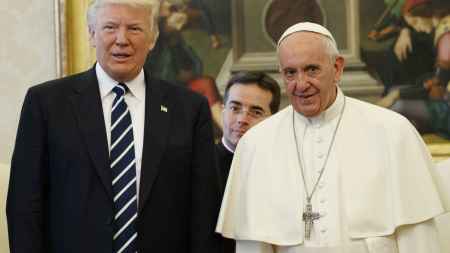
President Trump and Pope Francis held a half-hour private meeting at the Vatican on Wednesday. Despite their sharp differences on climate change, redistribution of wealth, the handling of refugees and other key global issues, the two men were at least outwardly cordial. Both clearly wanted to avoid anything that could be perceived as confrontational, which had characterized remarks each had made about the other on prior occasions.  However, Pope Francis used the occasion of the meeting to deliver a message to President Trump about the importance of remaining committed to the fight against climate change. He even decided to give the president a copy of his 2015 encyclical on saving the environment.

The meeting occurred only two days after the horrific suicide bombing in Manchester, England that claimed at least 22 lives, including an 8 year old girl, and injured many more. Yet fighting against the foremost evil of our day, Islamic terrorism, did not appear to be foremost on Pope Francis’s mind at his meeting with President Trump.   A message had been previously issued in Pope Francis’s name, stating that he was “deeply saddened” by the “barbaric attack” in Manchester and extending his condolences. However, it is the fight against climate change that remains his top concern, which is of little comfort to the survivors and families grieving over their loved ones killed or injured in the Manchester slaughter. The same is true about those who suffered from the Islamic terrorist slaughter at a Coptic Christian church in northern Egypt on Palm Sunday. ISIS has claimed responsibility for both attacks.

“With Allah’s grace and support, a soldier of the Khilafah managed to place explosive devices in the midst of the gatherings of the Crusaders in the British city of Manchester,” ISIS declared in a boastful statement. ISIS threatened more attacks to come against “the worshippers of the Cross and their allies, by Allah’s permission.” Children specifically will be targeted. A May 4th article entitled “The Ruling on the Belligerent Christians” previewed what lay ahead, declaring that the “blood” of women and children “is not protected” since they have not embraced Islam.

The Middle East and “the protection of Christian communities” did come up during the meeting between Pope Francis and President Trump, according to a statement released by the Vatican. However, they may well have been talking past each other.

When the Pope thinks of Christian communities, he tends to focus on what he considers to be the compassionate duty of Christians to reach out to the poor, including to care for the world’s many refugees and other migrants. Indeed, in February 2016, Pope Francis sharply criticized then candidate Trump for his views on immigration. “A person who only thinks about building walls, wherever they may be, and not building bridges, is not Christian,” the Pope said. On another occasion, speaking to Catholics and Lutherans in Germany last October, Pope Francis said, “It’s hypocrisy to call yourself a Christian and chase away a refugee or someone seeking help…”

Pope Francis has acknowledged the “serious harm to the Christian communities in Syria and Iraq, where many brothers and sisters are oppressed because of their faith, driven from their land, kept in prison or even killed.” However, he has failed to single out for condemnation those responsible for such suffering and their animating ideology – radical Islamic terrorists, whose hateful ideology is rooted in their literal reading of the Koran and Prophet Muhammad’s sayings and actions. Instead, in the spirit of moral relativism so prevalent today, Pope Francis has declared: “There are fundamentalist and violent individuals in all peoples and religions—and with intolerant generalizations they become stronger because they feed on hate and xenophobia. By confronting terror with love, we work for peace.”

Terrorism, according to Pope Francis, feeds on “fear, mistrust, and the despair born of poverty and frustration.” End economic inequality, the Pope believes, and voilà – love replaces hatred and terrorism gives way to peace. “This is no time for denouncing anyone or fighting,” he declared. In the Pope’s reckoning, Christian minorities will be safe if we can just all agree to get along and share the wealth.

President Trump, on the other hand, is a realist. He recognizes the clear and present danger to Christian communities, particularly in the Middle East, from genocide committed by Islamic terrorists. These terrorists are not especially motivated by poverty. Indeed, some have been very well-off, including the late Osama bin Laden. As President Trump realizes, they are motivated by their hateful supremacist radical Islamic ideology, which spurs them on to attack the “Crusaders” wherever they can be found. They seek to make their fundamentalist form of Islam the only legitimate religion in the world.  The rest of us either have to convert, pay a tax to live as a dhimmi, or die.

In a major speech on terrorism that Donald Trump delivered last August while running for the presidency, he described the atrocities committed in the name of “the hateful ideology of Radical Islam.” These atrocities included, he said: “Children slaughtered, girls sold into slavery, men and women burned alive. Crucifixions, beheadings and drownings. Ethnic minorities targeted for mass execution. Holy sites desecrated. Christians driven from their homes and hunted for extermination. ISIS rounding-up what it calls the ‘nation of the cross’ in a campaign of genocide.”

This genocide is a product of fundamentalist Islam-inspired ideology, which cannot be fought “with love,” as Pope Francis would like us to believe. Nor would the West’s “warm human welcome” and “authentic hospitality” to all refugees provide “our greatest security against hateful acts of terrorism,” as Pope Francis would also like us to believe.

Again, President Trump is a realist. His policies towards refugees, which Pope Francis evidently thinks are heartless, aim to protect Americans from jihadists seeking to enter the United States from the most terrorist-prone countries in the world. The president sought to reverse Barack Obama’s discrimination against Christian refugees – the truly persecuted victims of radical Islamic genocide in the Middle East – and was called an Islamophobe and worse for his efforts. Pope Francis should be standing up for what President Trump tried to accomplish in this regard. But he hasn’t. In fact, the Vatican expressed concern about President Trump’s first executive order suspending travel and entry of refugees from certain countries, which had included a provision providing preferential treatment for persecuted religious minorities such as Christians.

President Ronald Reagan and Pope John Paul II successfully worked together, projecting military and spiritual power respectively, to defeat the evil of their day – communism and the Soviet Union. The evil of our day is radical Islamic terrorism, not climate change. Will Pope Francis follow in the footsteps of Pope John Paul and work with President Trump to help save Christians and other civilized people from this evil source of mass slaughter? Based on his record so far, it is doubtful, but we shall have to wait and see.

The onus is on us

May 25, 2017

The onus is on us, Israel Hayom, Isi Leibler, May 25, 2017

(Iran is the greatest threat to Israel; it has or will have nukes and the means of delivering them to obliterate the “little Satan.” The Palestinians don’t and, at least in the foreseeable future, are unlikely to. By working with the Saudis, et al, to defang Iran, President Trump rejected Obama’s policy of yielding to Iran and thereby benefitted both the Saudis, et al, and Israel. — DM)

Trump did not try to force unreasonable concessions. A Palestinian state is not ‎even on the horizon. Neither is there any indication of a return to former President Barack ‎Obama’s policy of freezing all settlement construction.‎

In King Salman’s ‎statement outlining the Saudi position, rather than condemning Israel, he merely expressed the ‎hope that peace will be achieved. This was a clear message, as was the fact that Trump flew to ‎Israel on the first openly direct flight from Riyadh to Tel Aviv.‎

According to The Wall Street Journal, the Saudis no longer demand a complete ‎settlement freeze. Instead, they propose that Israel restrict construction outside the ‎settlement blocs and provide additional humanitarian aid in Gaza. ‎

In return, the Saudis would inch toward normalization by allowing ‎Israeli aircraft to fly over their territory, set up direct telephone connection and even provide ‎tourist visas for Israelis. While this was not officially confirmed, there were no denials, which ‎tends to confirm the veracity of the report. ‎

************************

U.S. President Donald Trump has delivered. He will not have satisfied the delusional ‎aspirations of Israel’s radical right but, despite some missteps before he arrived, the Trump visit was favorable for Israel and outlined ‎parameters of what can be achieved with the Palestinians.‎

It was disappointing that he postponed transferring the U.S. Embassy to Jerusalem, but we appreciate that he is the first sitting ‎American president to visit the Western Wall. ‎

He should have been more explicit about the extent of terrorism in Israel in his ‎address to the Muslim world. But he more than compensated in his extraordinarily warm ‎address at the Israel Museum.‎

There is also some concern that the substantial commercial and defense relationship with the ‎Saudis ($380 billion in deals, including $110 billion in arms purchases) might impact Israel and ‎will require steps to ensure that we maintain our qualitative military edge.‎

Trump did not try to force unreasonable concessions. A Palestinian state is not ‎even on the horizon. Neither is there any indication of a return to former President Barack ‎Obama’s policy of freezing all settlement construction.‎

Indeed, the president expressed support for Israel in a far more open and ‎positive manner than his predecessors. In his address to the leaders of 55 Muslim-‎majority countries, he reversed Obama’s moral equivalence approach and described the ‎conflict as being between the forces of decency on the one hand, and an evil death cult on the ‎other. He urged the Arab and Muslim states to actively eradicate terrorism and extremism ‎from within their ranks. He specifically condemned Hamas and ‎Hezbollah together with ISIS and al-Qaida. And he explicitly called on Arab and Muslim ‎leaders to combat anti-Semitism. ‎

For the first time, the Saudis, backed by the Egyptians and Gulf states, appear to be promoting ‎peace or at least easing the tension between the Palestinians and the Israelis. In King Salman’s ‎statement outlining the Saudi position, rather than condemning Israel, he merely expressed the ‎hope that peace will be achieved. This was a clear message, as was the fact that Trump flew to ‎Israel on the first openly direct flight from Riyadh to Tel Aviv.‎

According to The Wall Street Journal, the Saudis no longer demand a complete ‎settlement freeze. Instead, they propose that Israel restrict construction outside the ‎settlement blocs and provide additional humanitarian aid in Gaza. ‎

In return, the Saudis would inch toward normalization by allowing ‎Israeli aircraft to fly over their territory, set up direct telephone connection and even provide ‎tourist visas for Israelis. While this was not officially confirmed, there were no denials, which ‎tends to confirm the veracity of the report. ‎

Whether this was the outcome of discussions with Trump’s representatives, or ‎because the Saudis recognize the value of Israel’s support against Iran’s efforts to achieve ‎regional hegemony, is irrelevant. There have already been widespread rumors attesting to ‎covert Saudi cooperation with Israel against Iran and similarly with Egypt against ISIS.‎

Trump demanded that the Palestinians cease incitement and stop ‎rewarding terrorists murderers and their families, and avoided suggesting that Israel cease settlement activity. But he undoubtedly pressed Prime ‎Minister Benjamin Netanyahu for confidence-building measures such as ‎improving Palestinian economic conditions.‎

At this potentially historic turning point, Netanyahu must stand firm against the radicals in his ‎coalition and impose a limited freeze beyond the settlement blocs. Most Israelis ‎would endorse this, and if it brings down the government, and forces elections, the ‎nation will support Netanyahu.‎

At this crucial time, decision-making must reflect ‎the views of the centrist majority. No minority groups should ‎be able to veto our national interest.‎

Yesh Atid and elements in Labor embrace this centrist view, and should either join the ‎government or support it on this issue. ‎

Of course, this is only the beginning. Before we engage in negotiating details, ‎Palestinian Authority President Mahmoud Abbas must make some concessions. Let him recognize ‎Israel as a Jewish state and abrogate the Palestinian right of return. Then we can ‎discuss borders and a demilitarized state. For now, we must demonstrate to the ‎world and to Trump that we are reasonable and respond positively to genuine Arab ‎gestures.‎

Despite these efforts, Abbas is probably unwilling or unable to ‎change. He is unlikely to make genuine efforts to stem incitement ‎or cease awarding lavish pensions to murderers and their families. Should that be the case, ‎most of the world, especially the Europeans, will still automatically blame Israel for failure to ‎advance the peace negotiations.‎

Trump’s determination will then be put to test. If, to appease the Saudis, he was to continue to ‎make believe that Abbas is a moderate peace partner and extend the fake “peace process ‎negotiations” we have endured under Obama, we would justly feel betrayed. ‎

However, if the Trump administration performs as an honest broker and recognizes Israel’s ‎efforts and genuine desire for peace, it will conclude that in the absence of a Palestinian ‎negotiating partner, all we can achieve is an improvement in Palestinian quality of life under ‎their own autonomy while we maintain our security. At the same time, as has been hinted by ‎Trump, he may then look more seriously at alternative solutions in cooperation with Egypt and ‎Jordan and backed by the moderate Arab States, which do not involve a two state solution. It ‎is no coincidence that Trump failed to explicitly refer to a Palestinian State while visiting the ‎region. It is this veiled threat that Trump is hoping will entice the Palestinian leadership to ‎conduct bona fide negotiations for the first time.‎

We are today in an exceedingly strong position. Israel has never been so powerful militarily, ‎economically and socially.‎

Israel has never had such widespread international recognition. Whether you adore or loathe ‎Netanyahu, nobody can deny that he has been an outstanding statesman in the international ‎arena. He has a unique relationship with the Americans and with Russian President Vladimir ‎Putin, and has built up relations with India, China, Japan, Southeast Asia, Australia, Eastern ‎Europe and now Africa. ‎

The extraordinary opportunities of today may never be replicated. We must demonstrate ‎restraint and ensure that our elected representatives neither undermine us nor project the ‎image of extremists by engaging in foolish or intemperate outbursts primarily designed for ‎personal political promotion. ‎

Today, we have in our grasp this remarkable opportunity to genuinely move toward ‎improving and stabilizing our relationship with our Arab neighbors. ‎

Trump’s Middle East Trip Was a Big, Surprising Success—and the Iranian Regime is Nervous

May 24, 2017

Trump’s Middle East Trip Was a Big, Surprising Success—and the Iranian Regime is Nervous, Tablet MagazineLee Smith, May 23, 2017

The Obama administration moved quietly behind the scenes to reorient American policy toward Iran, while it pulled the rug out from under traditional American allies. Among other things, the Obama White House leaked Israeli strikes against Hezbollah convoys, it coordinated operations with Iranian-backed militias in Iraq, and it stood aside as Bashar al-Assad waged a genocidal campaign in Syria so as not to affect the prospects of the nuclear deal with Iran.

The Iranians know how much they owe the Obama administration—whether it was air support for Qassem Soleimani in Tikrit, legitimization of Iranian interests in Yemen, deterring Israel from striking their nuclear facilities, turning a blind eye as they built a highway from Tehran to Baghdad to Damascus to Beirut.

Now the Americans are dancing with the Arabs and praying with the Jews, and Iran is on its own again.

***************************

“I want to tell you,” Israeli Prime Minister Benjamin Netanyahu said to President Donald Trump during a joint press conference Monday, “how much we appreciate the reassertion of American leadership in the Middle East.”

So how is Trump’s first foreign trip as president playing out? Suddenly, the scandal-mired President seems like a plausible world leader. He is certainly a more welcome guest in the capitols of America’s traditional allies than his predecessor, President Barack Obama. In addition to enjoying the show, viewers at home—the ones who voted for Trump last fall—likely appreciate the $110 billion arms deal Trump struck with Saudi Arabia. With another $350 billion to come over the next decade, those contracts will certainly help put assembly-line Americans back to work.

Trump’s speech before a worldwide audience about terrorism and Islam was a useful initiative that will also put some of the dozens of Muslim leaders who attended the speech on notice. Acknowledging that Jerusalem is in Israel is a break with strict Obama policy. Trump became the first sitting U.S. president to visit the Western Wall.

But having spent nearly a decade living in Cairo and Beirut, and traveling throughout the Middle East, I can easily imagine the spin that the region’s intellectuals are putting on the trip as they sit in their coffee houses and smoke Gitanes:

Habibi, the Saudis just paid the Americans nearly half a trillion dollars to keep them safe from Iran, right? But Iran was nothing before Obama built them up with $150 billion. It’s only because Obama kept paying Iran—first to stay in negotiations over the nuclear program and then as a reward for signing the deal—that Iran was empowered. Obama and his pallets of cash helped Iran extend its reach from the Persian Gulf to the eastern Mediterranean.

Iran thought that it got the better of the Americans, but the Americans played them for suckers! The CIA had something up their sleeves the whole time! They just wanted the Arabs to pay even more to defend them from Iran. So the Americans created this Iranian bogeyman and then they sent the Arabs a bill to make the Iran problem go away. They drove up the price!

It’s a protection racket, don’t you see? And the Americans cleared nearly $300 billion. Oh man, you can be sure Trump and Netanyahu are laughing it up in Jerusalem. Very clever, those Americans!

No, of course it wasn’t really a CIA shakedown orchestrated over two presidencies. And yet Trump’s maiden foreign presidential venture, or at least the first two stops, is indeed all about the new Administration’s determined recalibration of American Middle East policy after eight years of Obama’s adventurism—especially regarding Iran.

Trump made his intentions toward Iran pretty clear in his Riyadh speech. “For decades, Iran has fueled the fires of sectarian conflict and terror,” said Trump. “It is a government that speaks openly of mass murder, vowing the destruction of Israel, death to America, and ruin for many leaders and nations in this room.”

The visuals from Riyadh and Jerusalem were even more important than the speeches. After all, you can reassure your allies on the phone—to scare your shared adversaries, you create a photo album and broadcast it on Facebook and Twitter.

Here’s the president of the United States being celebrated in Saudi Arabia with a sword dance. And clearly, this is not the secretary of state’s first ardha. As a famous oil man who is always welcome to visit the global swing producer of oil, Rex Tillerson knows all the steps already. See him dancing with Wilbur Ross? The Americans and Saudis are like family.

And look—the president of the United States actually has Jews in his family. Here is a picture of his daughter praying at the Western Wall. Here is a picture of the president also at the Western wall wearing a kippah. And oh, look—Trump has made it his status picture on Twitter.

The Iranian regime isn’t very happy. Trump’s photo ops stole the entire foreign policy news cycle from an Iranian regime that wanted a few days of good press after its rigged presidential elections last Friday. The message that Tehran received from the presidential pomp and circumstance in Riyadh is that things are different now.

The Obama administration moved quietly behind the scenes to reorient American policy toward Iran, while it pulled the rug out from under traditional American allies. Among other things, the Obama White House leaked Israeli strikes against Hezbollah convoys, it coordinated operations with Iranian-backed militias in Iraq, and it stood aside as Bashar al-Assad waged a genocidal campaign in Syria so as not to affect the prospects of the nuclear deal with Iran.

The Iranians know how much they owe the Obama administration—whether it was air support for Qassem Soleimani in Tikrit, legitimization of Iranian interests in Yemen, deterring Israel from striking their nuclear facilities, turning a blind eye as they built a highway from Tehran to Baghdad to Damascus to Beirut.

Now the Americans are dancing with the Arabs and praying with the Jews, and Iran is on its own again.


Trump’s new deal

May 24, 2017

Trump’s new deal, Israel Hayom, Boaz Bismuth, May 24, 2017

(The “nattering nabobs of negativism” are still numerous. No matter what happens it will be bad, they say. — DM)

Trump, it turns out, is not going to make the improvement of U.S.-Israel ties contingent on warmer relations between Israel and the Arabs. In his way, he apparently understands the Middle East better than most of the pundits analyzing him. He knows that in this part of the world, people respect you if you are strong; if you weaken your allies you are looked at with scorn. The players in the region respect his decision to stand by Israel — because they know this means he will keep his promises to them as well.

I have long said that Trump was good for the Jews. I said it as soon as he entered the 2016 race. I have long maintained that Trump’s new deal is actually going to be more pressure — on the Palestinians.

*****************************

Over the past several years, conventional wisdom among pundits was that Israel had lost America. They tried to drive home this argument even forcefully after Barack Obama became president.

They told us that Israel was losing its No. 1 ally because it was not relinquishing land; because it insisted that the Arabs recognize it as a Jewish state, and because it was not in a hurry to see a Palestinian state be established. Prime Minister Benjamin Netanyahu’s personal relations with Obama were thrown into the mix as well, and the bottom line was that Israel and the U.S. are no longer friends. Israel, so their thinking went, could only pine for Christopher Columbus.

And then Donald Trump came along. As Secretary of State Rex Tillerson said the other day, “America is back.”

It is also back in Israel. But the truth of the matter is that it never really went anywhere. It was Obama and its administration that went off course, not Israel. The experts said Israel must do a mea culpa and expected Obama to change the world, and Israel.

Ahead of Trump’s visit, this chorus of experts decided they would sing the same song they sang during the 1990s, using the same lyrics: “Palestinian state”; “ending the occupation is a prerequisite for ending Israel’s state of despair.” We all know how well things turned out during the 1990s.

They were willing to swear that as soon as Trump came to Israel, he would apply pressure on Israel and present demands. They said Netanyahu was nervous from what may come. They warned a diplomatic tsunami was making its way to Israel’s shores.

Some even borrowed medical lingo, saying Trump the candidate put some cotton wool on our skin to prepare from the shot, and now he was going to administer it.

What ultimately unfolded? It turned out that the president who visited Israel this week is the most pro-Israel we have seen in several decades. This man likes us, period. He repeatedly mentions the strong ties between Jerusalem and the Jewish people.

He has promised to protect Israel and to eradicate terrorism, and on the way he said he was determined to make sure Iran would not obtain nuclear weapons and that he would not let anyone hurt Israel. During his visit here he has repeatedly called Netanyahu “my good friend,” as if to make the point that he was not Obama.

How is that possible, the experts wondered. Hasn’t he visited Saudi Arabia on his way? Hasn’t he delivered a speech in front of some 50 Arab and Muslim leaders while he was there? Hasn’t he visited the Palestinian Authority during his trip?

And what about Tillerson, the former head of an energy giant? He cannot possibly be pro-Israel because he is a known wheeler and dealer in the Arab world, they warned.

They also noted that Trump promised to move the U.S. Embassy to Jerusalem but has not done so in the first 120 days of his presidency. Undoubtably, that period is eternity. Not only that, they continued, Trump considered visiting the Western Wall with the prime minister but ultimately decided it would be a private visit. This, they insist, proves that he is actually Obama in Trump clothes.

But lo and behold, Trump’s visit actually ended well, and he had us asking for more. It feels good to have that genuine embrace of a U.S. administration once again. Yes, Israel was deeply loved in America even before Trump came to power, but in recent years this was manifested in Congress, in the public opinion polls in America, among American Christians and among taxi drivers. That’s it.

The Obama White House turned its back on Israel and helped, albeit indirectly, the boycott, divestment and sanctions movement flourish on U.S. campuses.

In the wake of the visit, I dared to think that maybe those experts don’t really know him. After all, the same Trump who was accused of being anti-Muslim got the royal treatment when he arrived in Saudi Arabia, meeting with some 50 Muslim leaders who know full well that he is in love with Zionism.

Trump, it turns out, is not going to make the improvement of U.S.-Israel ties contingent on warmer relations between Israel and the Arabs.. In his way, he apparently understands the Middle East better than most of the pundits analyzing him. He knows that in this part of the world, people respect you if you are strong; if you weaken your allies you are looked at with scorn. The players in the region respect his decision to stand by Israel — because they know this means he will keep his promises to them as well.

I have long said that Trump was good for the Jews. I said it as soon as he entered as the 2016 race. I have long maintained that Trump’s new deal is actually going to be more pressure — on the Palestinians.