Posted tagged ‘Terrorists’

Abbas: “Filthy” Jews’ Feet Not Allowed on Temple Mount

September 17, 2015

Abbas: “Filthy” Jews’ Feet Not Allowed on Temple Mount, Investigative Project on Terrorism, September 17, 2015

The International Union of Muslim Scholars is calling on Palestinians to “Rescue al-Aqsa” and rise up against Israel, according to several Twitter posts translated by the Investigative Project on Terrorism (IPT).

One of the tweets features a picture of Israeli police about to enter Jerusalem’s Al-Aqsa mosque. In reality, the Israeli authorities are pursuing Palestinian rioters who took refuge in the mosque and terrorists who were plotting to conduct attacks against Jewish worshippers. The picture – which is clearly intended to provoke Palestinians to continue stirring up trouble for Israeli citizens – includes the following quote:

“The International Union of Muslim Scholars requests the Ulema [Muslim community] and preachers of the Muslims to begin the campaign ‘Rescue al Aqsa’ and proclaim a state of general alarm among the sons of the Muslims in the world to defend al Aqsa mosque, and divulge the plans of the Zionists, and also to summon the Islamic Umma to hold protests, and to devote this Friday’s sermons to discuss Jerusalem, Al-Aqsa and Palestine.”

1232

The hashtag #RescueAlAqsa is also included in a subsequent tweet featuring a picture of flames engulfing the al-Aqsa with a sniper’s target fixated on the dome of the mosque.

“Al-Aqsa is burning Oh Umma of a billion and a half Muslims!!!,” reads the slogan on the provocative tweet.

Meanwhile, Palestinian Authority President Mahmoud Abbas glorified Palestinians fighting Israelis in Jerusalem and called for Palestinians to prevent Jews from entering Al-Aqsa with “everything in our power,” Palestinian Media Watch (PMW) reports.

“The Al-Aqsa [Mosque] is ours… and they have no right to defile it with their filthy feet. We will not allow them to, and we will do everything in our power to protect Jerusalem… We bless every drop of blood that has been spilled for Jerusalem, which is clean and pure blood, blood spilled for Allah, Allah willing. Every martyr (Shahid) will reach Paradise, and everyone wounded will be rewarded by Allah,” Abbas said in a speech, segments of which were aired on official PA TV and posted on his website.

“Today the world is divided between those trying to undermine religious coexistence and those trying to protect it,” Israel’s Foreign Ministry Director General Dore Gold said in a statement Thursday. “By saying that the ‘filthy feet’ of Jewish visitors to the Temple Mount desecrate it, Mahmoud Abbas has now clarified on which side he stands.”

Relative quiet returned to the Temple Mount on Wednesday, after three days of violent confrontations between Muslims and Israeli authorities during the Jewish New Year.

Acting Police Commissioner Bentzi Sau ordered hundreds of Israeli security personnel to Jerusalem to restore calm in light of “an upsurge” in attacks, such as firebombs and stone-throwing targeting Israeli police and civilians.

On Sunday, Palestinians throwing stones killed an Israeli civilian – 64-year-old Alexander Levlovitz – after he lost control of his car and crashed into a lamppost in Jerusalem’s East Talpiot neighborhood.

PM Netanyahu’s Greetings for Rosh Hashana

September 13, 2015

PM Netanyahu’s Greetings for Rosh Hashana, via You Tube, September 13, 2015


Iran: Nuclear Deal Will Enable Support for Terrorism

August 26, 2015

Iran: Nuclear Deal Will Enable Support for Terrorism, Washington Free Beacon, August 25, 2015

Iranian Foreign Minister Mohammad Javad Zarif speaks at the New York University (NYU) Center on International Cooperation in New York April 29, 2015. REUTERS/Lucas Jackson Iranian Foreign Minister Mohammad Javad Zarif speaks at the New York University (NYU) Center on International Cooperation in New York April 29, 2015. REUTERS/Lucas Jackson

Multiple senior officials in recent days have said that the Iranian nuclear deal will help the Islamic Republic fund its global terrorist operations, including the financial backing of Hamas and other regional groups, according to a briefing by an Israeli intelligence group.

Iranian officials, speaking at multiple forums in recent days, stressed that the nuclear deal will embolden Iran’s support for its “regional allies” and that weapons and military support would continue to be delivered on the “resistance front,” according to a recent brief by the Meir Amit Intelligence and Terrorism Information Center.

The officials outlined Iran’s plan to bolster its global terrorism operation and stated that the recent nuclear deal between Tehran and global powers will do nothing to deter Iran’s pursuit of regional dominance.

Ali-Akbar Velayati, Supreme Leader Ali Khamenei’s adviser for international affairs, stated at a recent conference in Tehran that support for the “resistance front” is a top foreign policy objective.

The nuclear agreement, Velayati said, “would make it possible to increase Iran’s support for its regional allies,” according to recent comments noted in the brief. The official went on to say that “the situation of the resistance front had improved.”

Other senior Iranian officials have echoed these remarks.

Foreign Minister Javad Zarif, who led nuclear negotiations with the United States, recently travelled to Syria and Lebanon to announce Iran’s renewed support for Hezbollah and the embattled regime of President Bashar al-Assad in Syria, according to the brief.

Iran will “continue providing weapons to support the Middle Eastern countries fighting terrorism,” Zarif is quoted as saying by Iran’s state-controlled press.

In light of the nuclear deal, Iran will “preserve its defensive capabilities and send weapons to its regional allies,” according to Zarif, who stressed that “without Iran and the weapons it provided to the countries fighting terrorism, the capital cities of the Middle East would have been occupied by” the Islamic State (IS, also known as ISIS or ISIL).

Iran also intends to boost its support for fighters in Yemen and Palestinian terrorist groups.

More than 70 members of the Iranian parliament, for instance, recently petitioned President Hassan Rouhani to increase “Iranian support for the regional resistance front after the nuclear agreement,” according to the report.

“They called on the president to use the ministries of defense and foreign affairs to send aid to the Palestinians in accordance with instructions from the Supreme Leader to arm the Palestinians in the West Bank,” the report notes.

Another senior Iranian national security official, Javad Karimi Qoddousi, demanded this month that “all the senior Iranian officials … support aid for the Palestinian people and the resistance front so that the nuclear agreement [is not] exploited to strengthen Israel’s security,” according to the brief.

These remarks have been accompanied by aggressive military moves by Iran, which has conducted multiple war drills in recent weeks and announced the upcoming launch of missiles, a move that could violate current United Nations Security Council resolutions barring such activity.

Iran appears to be attempting “to impress its allies with its commitment to continue supporting them even after the nuclear agreement with the West,” the Meir Amit center concluded in its brief. “The speeches of senior officials also reflected Iran’s approach to the rise and strengthening of ISIS and radical Sunni Islam.”

Iran also has committed itself to preventing the United States from gaining a foothold in the Middle East.

Iran will “not allow the United States to again extend its political influence in the region,” Velayati said in another recent interview. “Middle Eastern countries and people, led by Iran, had awakened and were standing firm” against America.

Senior Hamas officials have also disclosed in recent days that a delegation would soon be visiting Tehran.

Since the nuclear deal was secured, “relations between Hamas and Iran [have been] good,” according to these officials.

The IKEA Murders: Sweden in Crisis

August 23, 2015

The IKEA Murders: Sweden in Crisis, The Gatestone InstituteIngrid Carlqvist, August 23, 2015

  • The mosque fire received huge attention, while the rape epidemic is basically ignored. When a Swedish woman and her son are brutally knifed to death in the most Swedish of all places – an IKEA store – the Prime Minister has nothing to say.
  • The normal democratic order, where citizens can contact politicians or the media to make their voices heard, has all but evaporated in Sweden. Newspaper websites have removed the reader comment fields, and the politicians hide behind a wall of officials who brand callers expressing concern “racist,” and hang up. Sweden is governed by a power that has shut down the democratic process.
  • Questions flooded the social media: Who are these people that are let into Sweden? How many of them are not innocent victims of war, but in fact war criminals and other criminals, hiding among the refugees?
  • The most relevant question is: Why has one government after another chosen to spend Swedish taxpayers’ money to support and shelter citizens of other countries, while some of them try to kill us?
  • None of the mainstream media has confronted the government about the violent crimes committed by asylum seekers against Swedes. On the contrary – the media have done the utmost to convince Swedes that everything is safe and sound in Sweden. Better than ever, in fact.
  • “Where do I apply for asylum… when the day comes that I can no longer live here?” – “Ewa,” on Facebook.
  • Violent crime is up 300% and rape is up 1,472% since 1975, the year the Swedish Parliament decided to turn homogenous Sweden into a multicultural country.

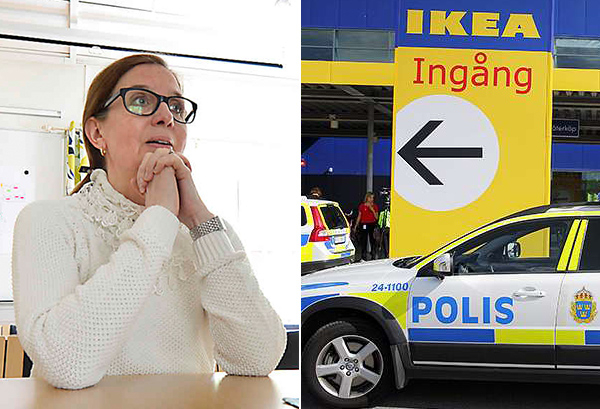
A surge of rage has washed over otherwise docile Sweden. After a double homicide at an IKEA store in Västerås, where an illegal alien stabbed two random Swedes to death, more and more people are questioning why the government is exposing Swedish citizens to murderers from across the globe.

On August 10, news of the IKEA murders shocked Sweden. Two asylum seekers from Eritrea (the second largest source of asylum applicants in Sweden), were suspected of having grabbed knives from the kitchenware department and attacked two random Swedes. The victims were 55-year-old Carola Herlin and her 28-year-old son, Emil.

1218Carola Herlin, Director of the Moro Backe Health Center, was murdered on August 10, along with her son, in the IKEA store in Västerås, Sweden.

The elder of the two asylum seekers, a 36-year-old man, had twice been denied residency status in Sweden — because he had already been granted residency it in Italy — but he had not yet been deported. (Eritreans without residence permits in other EU-countries automatically get to stay in Sweden.)

The killer also inflicted life-threatening injuries on himself, and underwent several surgeries before the police could finally question him. On August 14, he confessed. His 23-year-old compatriot was released from custody, because the police no longer believe he had anything to do with the murders or had even known what his friend was planning to do.

Fear has now struck the Swedes. Even those who had routinely brand critics of immigration and multiculturalism racist, were shaken to the core. Questions flooded the social media: Who are these people that are let into Sweden? How many of them are not innocent victims of war, but in fact war criminals and other criminals, hiding among the refugees? And should we pay billions in taxes to support and shelter citizens of other countries, while some of them try to kill us?

The fact that the police refuse to deny the persistent rumor that one of the IKEA victims was beheaded, only adds fuel to the fear.

So many questions and no answers. No one from the government has even bothered to make a statement about the horrific double murder. None of the mainstream media has confronted the government about the violent crimes committed by asylum seekers against Swedes. On the contrary – the media have done the utmost to convince Swedes that everything is safe and sound in Sweden. Better than ever, in fact. The day after the double murder, Sweden’s largest morning paper, Dagens Nyheter, published an article titled, “After all, deadly violence on the decline.” The article begins:

“In recent weeks, several brutal murders have been committed, and many people ask themselves where society is headed. The answer is that Sweden has, after all, become a safer place. Deadly violence has been on the decline for some time.”

Nowhere does the article explain that the reason deadly violence has been on the decline is that emergency medicine is now able to save the lives of a lot more victims of knife- and gunshot-injuries. The so-called Laser Man, for example, shot a number of immigrants in Sweden in the 1990s. Forensic pathologist Jovan Rajs commented, “The Laser Man shot eleven people, and one of them died. In the 1930s eight or nine would have died, in the 1970s about five, and today probably none.”

Ergo, deadly violence remains on an even level thanks to better health care in Sweden, but all other kinds of violent crime (including attempted homicide) has gone off the charts. Violent crime is up 300% and rape is up 1,472% since 1975, the year the Swedish Parliament decided to turn homogenous Sweden into a multicultural country.

Ninety percent of asylum seekers to Sweden lack proper identification papers, so in reality no one knows how many murderers, rapists and thugs hide among the 100,000 or so people granted asylum in Sweden every year.

Frustrated Swedes are now howling with powerlessness on social media. The normal democratic order, where citizens can contact politicians or the media to make their voices heard, has all but evaporated. Newspaper websites have removed the reader comment fields, and the politicians hide behind a wall of officials, who brand callers expressing concern “racist,” and hang up. Thousands bear witness to this on Facebook. One person who actually got to talk about her uneasiness is Ewa, who writes on Facebook about calling Immigration Services:

“Well, I’ve unleashed the devil now. I called Immigration Services and demanded to talk to a Unit Manager. … I gave him an earful about every injustice I could think of, like how badly we treat our elderly and how we take away their homes and give them to asylum seekers. I also told him how unsafe Swedish women feel due to all these gang rapes perpetrated by asylum seekers and other foreigners. Also asked him if we all have to be beheaded before they stop taking in these kinds of people. … Now I’m sitting here, feeling completely empty after crying, screaming, discussing, raging and getting all this frustration out of me. Told him there are many of us who feel depressed because of what Immigration is doing. He was really sorry I feel this way. Yes, I told him, a lot of people feel this way but they are afraid to open their mouths because then they are labeled racist. You don’t even have to be a Sweden Democrat to see that our country is falling apart more and more with each passing day. Something you and all the rest at Immigration Services are responsible for. Where do I apply for asylum, I asked, when the day comes and I can no longer live here? Our country is ruined economically, socially and so forth and you are responsible. He answered that it was the politicians who decided about this, but that they would do everything in their power to make things better.”

Another woman, Amanda, wrote on Facebook that she e-mailed Prime Minister Stefan Löfven. She noted that “nothing may change, but at least I’ve made my voice heard.” Her e-mail read:

“Hi, why did the Prime Minister feel it was essential and urgent to go and talk about the fire at the mosque in Eskilstuna, no one even knew what started it when he held his speech? But now, he’s as silent as the grave. Why? It’s his/your unconditional and lax immigration policies that have enabled this culprit to move freely in society, despite having received a deportation order not just once, but twice. Can you tell me if this is something the citizens of this country should get used to, that immigrants, upon receiving deportation orders, kill people in order to get a lifelong contract with the Swedish state? It is your personal responsibility every time this happens, I hope you know that. Because this is nothing if not a political issue regarding immigration, and… its massive consequences to an entire nation.”

The mosque fire in Eskilstuna that Amanda referred to happened December 25, 2014, and is one of many incidents affecting Muslims and other immigrants that have received huge attention, while the rape epidemic in Sweden is basically ignored. After the fire, the Prime Minister was quick to make a statement:

“It is despicable, a despicable act. We will never tolerate this type of crime. People who want to practice their religion should have the right to do so. Today I feel great sympathy and empathy for those affected.”

Three months later, it turned out no crime was behind the mosque fire, and police dropped the investigation. Most likely, it was caused by an accident or children playing with fire.

But when a Swedish woman and her son are brutally knifed to death in the most Swedish of all places – an IKEA store – the Prime Minister has nothing to say.

The Swedes are not prone to rebellion. To find a citizen that took up arms and marched on the citadels of power, one has to go back to the days of Gustav Vasa – the king who during his reign, 1523-1560, founded the nation-state of Sweden.

Although Sweden today is not occupied territory, it is governed by a power that has shut down the democratic process by the “December Agreement” of 2014. In the general election that year, the only party critical of mass immigration, the Sweden Democrats (SD), became the third-largest party in Parliament. The left-wing and center-right blocs then agreed to lock SD out of political power, but SD refused to be silenced. When the left-wing minority government budget was presented one month after the election, SD voted for the opposition’s budget – a shocking and unique occurrence in the Swedish Parliament. Here, it is considered “good manners and decorum” to vote for your own budget proposition first, then lay down your vote and let the government win. But after the Sweden Democrats’ “coup,” Prime Minister Stefan Löfven (of the Social Democratic Party) was forced to govern with a center-right budget during his first year in office.

One would think that this came as a pleasant surprise to the center-right opposition, but that was not what happened. No one wants support from the “racist” Sweden Democrats. Rather than call a snap election, the two blocs entered into an agreement in which the center-right opposition promises to abstain from voting when it comes to important issues such as a proposed budget.

Thus, the December Agreement is in reality a kind of “relay-race” dictatorship: The left-wing government gets to do what it wants for the next four years, and after that, for next the four years (if there is a change of power), it will be the center-right government’s turn. This means both parties are free to ignore the 58% of Swedes who now feel that immigration is too high, and may choose to vote for the Sweden Democrats in the next election.

When the Swedes got the news about the December Agreement, they did what they usually do – clenched their fists in their pockets, formed Facebook groups and wrote angry comments on Twitter and Facebook. But the politicians congratulated each other on once again restoring order; they ignored the people’s concern that democracy had now become even more eroded.

A well-known stand-up comedian, Magnus Betnér, thought it a good idea to mock frightened Swedes in a YouTube clip:

“Yes, it’s really tragic two people were murdered in IKEA. … but… it’s not dangerous; Sweden has never been safer than it is now. … Very few of you guys watching this clip will be murdered. And those of you who are, will be murdered in your own homes.”

When the establishment refuses to take people’s concerns seriously, rumors on social media spread fast. A stubborn rumor claims that Carola Herlin was beheaded by the Eritrean murderer. According to sources interviewed by Gatestone, the woman had her throat slit and was also stabbed in the abdomen. Her son tried to defend himself, but received a deadly stab wound to the stomach.

When Dispatch International called Per Ågren, the police investigator in charge of the case, and asked him about the rumor, he said: “I’m not going to confirm… describe anything at all about what happened, except to say that two people were murdered. You won’t find out how from me.”

One of the first measures taken by the police after the IKEA murders was to start guarding all the buildings housing asylum seekers in the county. There was some apprehension concerning “dark forces,” the police claimed, without specifying who these “dark forces” were. The night of August 15, an asylum house in Arboga had to be evacuated after someone shouted something about a bomb outside. Now the mainstream media were really on their toes: Carola and Emil Herlin, according to their reports, had been “at the wrong place at the wrong time.”

The newspaper Aftonbladet interviewed an anonymous woman who said, “My cousin has lived here for over a year. He told me the Swedes are the nicest people in Europe. Then something like this happens. I could never have imagined.”

Once again, it is supposedly the Swedes who should bow their heads in shame. Supposedly, we are not the ones grieving; we do not have the right to be frightened to death over the immigration policy of our rulers – it is the asylum seekers who are the victims, even when they kill, rape, rob and abuse.

The burning question is: What will the people do, whom no one will listen to? In East Germany of 1989, the people took to the streets, scaled the Berlin wall and made the government to resign. The other communist dictatorships of Eastern Europe fell in similar ways. The Second Amendment to the U.S. Constitution (the right to bear arms), exists to ensure that the citizens are able to seize power from a tyrannical government.

If powerlessness drives people to answer violence with violence, maybe one should not ask why Swedes are “racists” if they do not want the highest immigration level in Europe?

The most relevant question is why one government after another has chosen to spend Swedish taxpayers’ money on citizens of other countries. While Swedish students take a plunge in the PISA tests, 60% of the welfare benefits go to immigrants who make up about 15% of the population. Healthcare and other social services are deteriorating, according to many Swedes, while violence is exponentially increasing. When more and more Swedes feel that they are being badly treated in their own country, the politicians have created a powder keg ready to explode at any minute.

The truth is that even the docile Swedish people have a limit. When those in power expose us to bloodbaths, whether in the Big Square of Stockholm in 1520 or at IKEA in Västerås in 2015, there will always be those who are ready to overthrow the mighty. Just as in Gustav Vasa’s day, a lot of Swedes have firearms. They are not as easy to come by as in the United States, but more and more Swedes are getting hunting licenses, and are thereafter legally able to buy guns. From now on in Sweden, anything can happen.

State Department Interferes in Favor of PLO Terrorists

August 11, 2015

State Department Interferes in Favor of PLO Terrorists, Israel National News, Tova Dvorin, August 11, 2015

US President Barack Obama is reportedly seeking to lower that fine – following a series of conflicts between officials from the State Department and the Justice Department over the issue, an official involved in the case told the New York Times Tuesday. 

*********************

Washington asks a judge presiding over terror victims’ compensation case to reduce money paid to Israelis injured during Second Intifada.

The Obama administration has asked a judge Monday to “carefully consider” the size of the bond demanded from the Palestinian Authority (PA) for its role orchestrating years of terror attacks against Israelis and Jews – directly interfering in a US court case.

In February, the Palestine Liberation Organization (PLO) – the terror group behind the PA – was found liable to pay $218.5 million to victims of terror, a figure that was set to be tripled to $655.5 million according to the anti-terrorism laws under which the case was brought.

Legal rights group Shurat Hadin (Israel Law Center) helped represent the 11 families who charge the PA and PLO of inciting, supporting, planning and executing the seven terror attacks which killed American citizens between 2000 and 2004.

In May, the PA admitted it cannot pay such a hefty fine, however – as it is struggling under billions of debt despite an ongoing stream of aid from Israel and other countries – and called the case “political extortion.”

Now, US President Barack Obama is reportedly seeking to lower that fine – following a series of conflicts between officials from the State Department and the Justice Department over the issue, an official involved in the case told the New York Times Tuesday.

In a document entitled “Statement of Interest of the United States of America,” the Obama administration expressed concerns over the payments hurting the PA’s basic government services.

Forcing the PLO to pay “a significant portion of its revenues would likely severely compromise the P.A.’s ability to operate as a governmental authority,” deputy Secretary of State Antony J. Blinken wrote. “A P.A. insolvency and collapse would harm current and future U.S.-led efforts to achieve a two-state solution to the Israeli-Palestinian conflict.”

Blinken stressed in the document, however, that the State Department allegedly values the rights of terror victims to seek “just compensation” and was not taking a position on the case itself, only on the high bond.

“The United States strongly supports the rights of victims of terrorism to vindicate their interests in federal court and to receive just compensation for their injuries,” Blinken claimed.

Justice Department officials have maintained throughout the proceedings that any State Department interference in the case would interfere with the victims’ rights for compensation and justice.


Netanyahu slams Abbas after attack on Palestinian family

August 2, 2015

Netanyahu slams Abbas after attack on Palestinian family, Times of IsraelTamar Pileggi, August 2, 2015

Netanuahu on Jewish terrorismPrime Minister Benjamin Netanyahu chairs the weekly cabinet meeting at his Jerusalem office on August 2, 2015 AFP PHOTO / POOL / GALI TIBBON)

PM says Israel ‘condemns’ such violence, while the PA ‘names public squares after the murderers of children’

Speaking in the wake of a firebombing attack in the West Bank that left a Palestinian toddler dead, Prime Minister Benjamin Netanyahu on Sunday lashed out at Mahmoud Abbas, accusing the Palestinian Authority president of failing to condemn acts of Palestinian terrorism.

Netanyahu, addressing the weekly cabinet meeting, compared Israeli officials’ swift condemnation of Friday’s alleged Jewish terrorist attack to what he said was an inadequate response on the part of PA officials after Palestinian terrorists targeted Israeli civilians.

“We deplore and condemn these murderers. We will pursue them to the end,” he said. “They name public squares after the murderers of children. This distinction cannot be blurred or covered up,” he said.

“It is important to say this even as we utter our condemnations and unite against the criminals among our people,” Netanyahu said.

The prime minister also said that there would be a “zero tolerance” policy toward such crimes in Israel, and vowed to punish the perpetrators to the full extent of the law.

Gay prideParticipants in the gay pride parade in Jerusalem flee stabber Yishai Schlissel, July 30, 2015. (screen capture: Channel 2)

“We recently witnessed two abhorrent crimes. Our policy toward these crimes is zero tolerance,” he said, referring both to the killing of the Palestinian child and a stabbing attack at the Jerusalem Gay Pride Parade on Thursday.

Netanyahu recalled visiting the home of the historian Joseph Klausner as a child. Over the arched entrance to Klausner’s home, said the prime minister, the words “Judaism” and “humanity” were engraved in Hebrew.

The perpetrators of last week’s crimes did not represent Judaism, he said.

The prime minister said he had instructed security and law enforcement officials to use all legal tools at their disposal to apprehend the perpetrators of the arson attack and prosecute the perpetrator of the stabbing attack.

“We are determined to vigorously fight manifestations of hate, fanaticism and terrorism from whatever side. The fight against these phenomena unites us all.

“This is not a struggle by this or that faction. This is a matter of basic humanity and is at the foundation of our enlightened Jewish values,” he said.

The assailant in Thursday’s anti-gay attack was an ultra-Orthodox Jew, Yishai Schlissel, who had just been released after serving 10 years in jail for carrying out a similar attack at the 2005 Pride Parade. On Sunday, doctors said that one of the six victims, who suffered multiple stab wounds to her chest and abdomen, remained in critical condition.

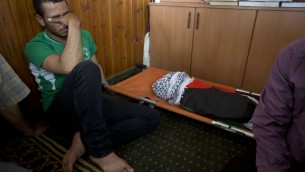
Duma villageA Palestinian man mourns alongside the body of a one-and-a-half year old boy, Ali Dawabsha, during his funeral in Duma village near the West Bank city of Nablus, Friday, July 31, 2015. (Majdi Mohammed/AP)

On Friday, unknown assailants suspected to be Jewish settlers firebombed the home of a Palestinian family in the northern West Bank village of Duma, killing a toddler. The parents and brother of 18-month-old Ali Saad Dawabsha were hospitalized and are still fighting for their lives.

The family’s small brick and cement home was gutted by fire, and a Star of David spray-painted on a wall along with the words “revenge” and “long live the Messiah.”

The phrases were indicative of so-called “price tag” violence — a euphemism for nationalist-motivated hate crimes by Jewish extremists.

Column One: Obama strikes again

July 31, 2015

Column One: Obama strikes again, Jerusalem Post, Caroline Glick, July 30, 2015
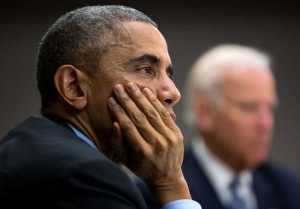
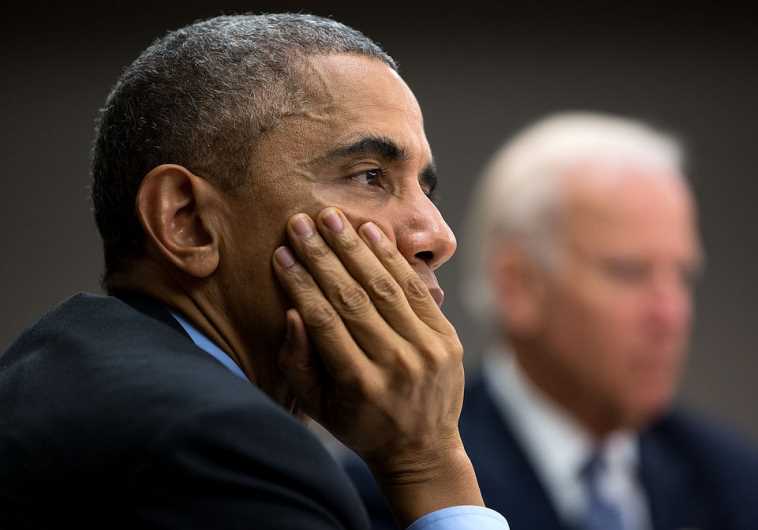
ShowImage (5)US President Barack Obama (L) and Vice President Joe Biden. (photo credit:OFFICIAL WHITE HOUSE PHOTO BY PETE SOUZA)

Most of the antiquities that ISIS plunders in Iraq and Syria make their way to the world market through Turkey. So, too, most of the oil that ISIS produces in Syria and Iraq is smuggled out through Turkey. According to the US Treasury, ISIS has made $1 million-$4m. a day from oil revenue.

Instead of maintaining its current practice of balancing its support for Turkey with its support for the Kurds, under the agreement, the West ditches its support for the Kurds and transfers its support to Turkey exclusively.

************************

While Israel and much of oficial Washington remain focused on the deal President Barack Obama just cut with the ayatollahs that gives them $150 billion and a guaranteed nuclear arsenal within a decade, Obama has already moved on – to Syria.

Obama’s first hope was to reach a deal with his Iranian friends that would leave the Assad regime in place. But the Iranians blew him off.

They know they don’t need a deal with Obama to secure their interests. Obama will continue to help them to maintain their power base in Syria though Hezbollah and the remains of the Assad regime without a deal.

Iran’s cold shoulder didn’t stop Obama. He moved on to his Sunni friend Turkish President Recep Erdogan.

Like the Iranians, since the war broke out, Erdogan has played a central role in transforming what started out as a local uprising into a regional conflict between Sunni and Shiite jihadists.

With Obama’s full support, by late 2012 Erdogan had built an opposition dominated by his totalitarian allies in the Muslim Brotherhood.

By mid-2013, Erdogan’s Muslim Brotherhood- led coalition was eclipsed by al-Qaida spinoffs. They also enjoyed Turkish support.

And when last summer ISIS supplanted al-Qaida as the dominant Sunni jihadist force in Syria, it did so with Erdogan’s full backing. For the past 18 months, Turkey has been ISIS’s logistical, political and economic base.

According to Brett McGurk, the State Department’s point man on ISIS, about 25,000 foreign fighters have joined ISIS in Syria and Iraq. All of them transited through Turkey.

Most of the antiquities that ISIS plunders in Iraq and Syria make their way to the world market through Turkey. So, too, most of the oil that ISIS produces in Syria and Iraq is smuggled out through Turkey. According to the US Treasury, ISIS has made $1 million-$4m. a day from oil revenue.

In May, US commandos in Syria assassinated Abu Sayyaf, ISIS’s chief money manager, and arrested his wife and seized numerous computers and flash drives from his home. According to a report in The Guardian published last week, the drives provided hard evidence of official Turkish economic collusion with ISIS.

Due to Turkish support, ISIS has become a self-financing terrorist group. With its revenue stream it is able to maintain a welfare state regime, attracting recruits from abroad and securing the loyalty of local Sunni militias and former Ba’athist forces.

Some Western officials believed that after finding hard evidence of Turkish regime support for ISIS, NATO would finally change its relationship with Turkey. To a degree they were correct.

Last week, Obama cut a deal with Erdogan that changes the West’s relationship with Erdogan.

Instead of maintaining its current practice of balancing its support for Turkey with its support for the Kurds, under the agreement, the West ditches its support for the Kurds and transfers its support to Turkey exclusively.

The Kurdish peshmerga militias operating today in Iraq and Syria are the only military outfits making sustained progress in the war against ISIS. Since last October, the Kurds in Syria have liberated ISIS-controlled and -threatened areas along the Turkish border.

The YPG, the peshmerga militia in Syria, won its first major victory in January, when after a protracted, bloody battle, with US air support, it freed the Kurdish border town of Kobani from ISIS’s assault.

In June, the YPG scored a strategic victory against ISIS by taking control of Tal Abyad. Tal Abyad controls the road connecting ISIS’s capital of Raqqa with Turkey. By capturing Tal Abyad, the Kurds cut Raqqa’s supply lines.

Last month, Time magazine reported that the Turks reacted with hysteria to Tal Abyad’s capture.

Not only did the operation endanger Raqqa, it gave the Kurds territorial contiguity in Syria.

The YPG’s victories enhanced the Kurds’ standing among Western nations. Indeed, some British and American officials were quoted openly discussing the possibility of removing the PKK, the YPG’s Iraqi counterpart, from their official lists of terrorist organizations.

The YPG’s victories similarly enhanced the Kurds’ standing inside Turkey itself. In the June elections to the Turkish parliament, the Kurdish HDP party won 12 percent of the vote nationally, and so blocked Erdogan’s AKP party from winning a parliamentary majority.

Without that majority Erdogan’s plan of reforming the constitution to transform Turkey into a presidential republic and secure his dictatorship for the long run has been jeopardized.

As far as Erdogan was concerned, by the middle of July the Kurdish threat to his power had reached unacceptable levels.

Then two weeks ago the deck was miraculously reshuffled.

On July 20, young Kurdish activists convened in Suduc, a Kurdish town on the Turkish side of the border, 6 kilometers from Kobani. A suicide bomber walked up to them, and detonated, massacring 32 people.

Turkish officials claim that the bomber was a Turkish Kurd, and a member of ISIS. But the Kurds didn’t buy that line. Last week, HDP lawmakers accused the regime of complicity with the bomber. And two days after the attack, militants from the PKK killed two Turkish policemen in a neighboring village, claiming that they collaborated with ISIS.

At that point, Erdogan sprang into action.

After refusing for months to work with NATO forces in their anti-ISIS operations, Erdogan announced he was entering the fray. He would begin targeting “terrorists” and allow the US air force to use two Turkish air bases for its anti-ISIS operations. In exchange, the US agreed to set up a “safe zone” in Syria along the Turkish border.

Turkish officials were quick to explain that in targeting “terrorists,” the Turks would not distinguish between Kurdish terrorists and ISIS terrorists just because the former are fighting ISIS. Both, they insisted, are legitimate targets.

Erdogan closed his deal in a telephone call with Obama. And he immediately went into action.

Turkish forces began bombing terrorist targets and rounding up terrorist suspects. Although a few of the Turkish bombing runs have been directly against ISIS, the vast majority have targeted Kurdish forces in Iraq and Syria.

Moreover, for every suspected ISIS terrorist arrested by Turkish security forces, at least eight Kurds have been taken into custody.

Then, too, Erdogan has called on AKP lawmakers to begin criminalizing their counterparts from the HDP. Kurdish lawmakers, he urged them, must be stripped of their parliamentary immunity to enable their arrests.

As Erdogan apparently sees things, by going to war against the Kurds, he will be able to reestablish the AKP’s parliamentary majority. Within a few weeks, if the AKP fails to form a governing coalition – and it will – then new elections will be held. The nationalists, who abandoned the AKP in June, will return to the party to reward Erdogan for fighting the Kurds.

As for that “safe area” in northern Syria, as the Kurds see it, Erdogan will use it to destroy Kurdish autonomy. He will flood the zone with Syrian Arab refugees who fled to Turkey, to dilute the Kurdish majority. And he will secure coalition support for the Sunni Arab militias – including those still affiliated with al-Qaida – which will be permitted by NATO to operate openly in the safe area.

Already the Kurds are reporting that the US has stopped providing air support for their forces fighting ISIS in the border town of Jarablus. Those forces were bombed this week by Turkish F-16s.

For their part, despite Erdogan’s pledge to fight ISIS, his forces seem remarkable uninterested in rolling back ISIS achievements. The Turks have no plan for removing ISIS from its strongholds in Raqqa or Haskiyah.

The Obama administration is presenting the deal with Turkey as yet another great achievement.

In an interview with Charlie Rose on Tuesday, McGurk explained that the deal was a long time in the making. It began with a phone conversation between Obama and Erdogan last October and it ended with their phone call last week.

In October, Obama convinced Erdogan not to oppose US air support for the Kurds in Kobani and to enable the US to resupply YPG fighters in Kobani through Turkey. In the second, Obama agreed not to oppose Erdogan’s offensive against the Kurds.

Two years ago, in August 2013, the world held its breath awaiting US action in Syria. That month, after prolonged equivocation amidst mountains of evidence, the Obama administration was forced to acknowledge that Iran’s Syrian puppet Bashar Assad had crossed Obama’s self-declared redline and used chemical weapons against regime opponents, including civilians.

US forces assembled for battle. Everything looked ready to go, until just hours before US jets were scheduled to begin bombing regime targets, Obama canceled the operation. In so doing, he lost all deterrent power against Iran. He also lost all strategic credibility among America’s regional allies.

To save face, Obama agreed to a Russian proposal to have international monitors remove Syria’s chemical weapons from the country.

Last summer, the administration proudly announced that the mission had been completed.

UN chemical weapons monitors had removed Syria’s chemical weapons arsenal from the country, they proclaimed. It didn’t matter to either Obama or Secretary of State John Kerry that by that point Assad had resumed chemical assaults with chlorine-based bombs. Chlorine bombs weren’t chemical weapons, the Americans idiotically proclaimed.

Then last week, the lie fell apart. The Wall Street Journal reported that according to US intelligence agencies, Assad not surrendered his chemical arsenal.

Rather, he hid much of his chemical weaponry from the UN inspectors. He had even managed to retain the capacity to make chemical weapons – like chlorine-based bombs – after agreeing to part with his chemical arsenal.

Assad was able to cheat, because just as the administration’s nuclear deal with the Iranians gives Iran control over which nuclear sites will be open to UN inspectors, and which will be off limits, so the chemical deal gave Assad control over what the inspectors would and would not be allowed to see. So, they saw only what he showed them.

Obama has gone full circle in concluding his deal with Erdogan. Since entering office, Obama has sought to cut deals with both the Sunni jihadists of the Muslim Brotherhood ilk and the Shi’ite jihadists of the Iranian ilk.

His chemical deal with Assad and his nuclear deal with the ayatollahs accomplished the latter goal, and did so at the expense of America’s Sunni Arab allies and Israel.

His deal last week with Erdogan accomplishes the former goal, to the benefit of ISIS, and on the backs of America’s Kurdish allies.

So that takes care of the Middle East. With 17 months left to go till Obama leave office, the time has apparently come for the British to begin to worry.

Israeli deterrence in the eye of the hurricane

July 12, 2015

Israeli deterrence in the eye of the hurricane, Jerusalem PostLouis Rene Beres, July 12, 2015

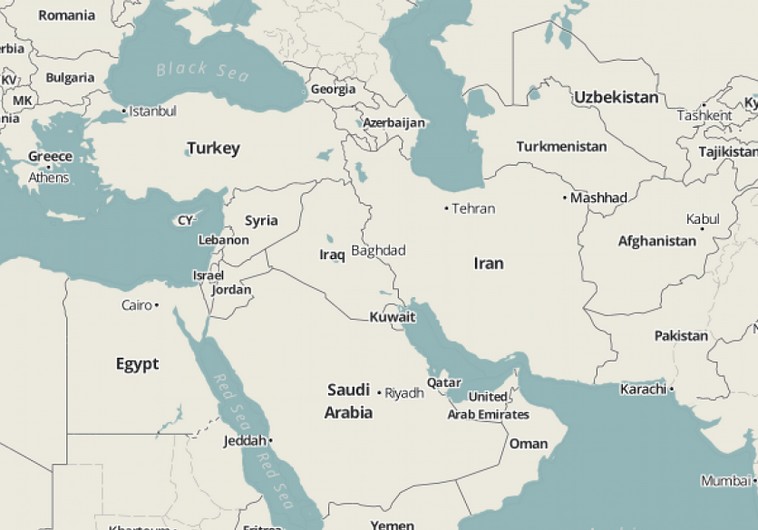
ShowImage (1)Map of Middle East. (photo credit:Courtesy)

Everything is very simple in war, but the simplest thing is difficult.”
– Carl von Clausewitz, On War

To prevent a nuclear war amid steadily growing regional chaos, especially as Iran will soon be fully nuclear (and the grateful beneficiary of US President Barack Obama’s pretend P5+1 diplomacy), Israel will need suitably complementary conventional and nuclear deterrents.

**********************

Left to themselves, especially as more “normal” hostilities dissolve into a full-blown regional chaos, Israel’s adversaries could drive the Jewish state toward an unconventional war. This fateful endangerment could be produced singly or collaboratively, by deliberate enemy intent or by the “collateral damage” of sectarian strife. Militarily, these Islamic adversaries of Israel, both Sunni and Shi’ite, could be either non-nuclear, or, in the future, nuclear.

They might also include certain wellarmed sub-state or terrorist forces. Already, Iranian-backed Hezbollah may have more usable missiles than all NATO countries combined.

To most effectively deal with such interpenetrating threats – including reasonably expected “synergies” and “force multipliers” – Israel’s leaders will first need to consider some largely-opaque factors. These include: 1) probable effects of regional chaos upon enemy rationality; 2) disruptive implications of impending Palestinian statehood; and 3) re-emergence of a corrosively Cold War-style polarity between Russia and the United States. Apropos of a “Cold War II,” there is already evidence of growing contact between Russia and Saudi Arabia, the world’s two largest oil producers.

In essence, Jerusalem must take all necessary steps to successfully manage an expectedly unprecedented level of adversarial complexity and weaponization. Israel’s leaders, in this connection, must take proper measures to ensure that any conceivable failures of its national deterrent would not spark biological or nuclear forms of regional conflict. To accomplish this indispensable goal, the IDF, inter alia, must continue to plan carefully around the core understanding that nuclear deterrence and conventional deterrence are inherently interrelated and meaningfully “seamless.”

Sometimes, in strategic matters, seeing requires distance. A nuclear war in the Middle East is not beyond possibility. This is a sensible assessment even if Israel were to remain the only nuclear weapons state in the region.

How is this possible? A bellum atomicum could come to Israel not only as a “bolt from the blue” enemy nuclear attack (either by a state or by a terrorist group), but also as the result, intended or otherwise, of certain uncontrolled military escalations.

Needed prudence in such narratives calls for additional specificity and precision. If particular Arab/Islamic enemy states were to launch conventional attacks upon Israel, Jerusalem could then respond, sooner or later, with calculated and more-or-less calibrated nuclear reprisals. Alternatively, if some of these enemy states were to launch large-scale conventional attacks, Jerusalem’s own still-conventional reprisals could then be met, perhaps even in the not-too-distant future, with enemy nuclear counterstrikes.

How should Israel prepare for such perilous contingencies? More than likely, Israel has already rejected any doctrinal plans for fielding a tactical/theater nuclear force, and for assuming any corollary nuclear war fighting postures. It would follow further from any such well-reasoned rejection that Israel should do whatever is needed to maintain a credible conventional deterrent.

By definition, such a measured threat option could then function reliably across the entire foreseeable spectrum of non-nuclear threats.

Still, any such strategy would need to include an appropriately complementary nuclear deterrent, a distinctly “last resort” option that could display a “counter-value” (counter-city) mission function. Si vis pacem, para bellum atomicum: “If you want peace, prepare for atomic war.”

A persuasive Israeli conventional deterrent, at least to the extent that it might prevent a wide range of enemy conventional attacks in the first place, could reduce Israel’s growing risk of escalatory exposure to nuclear war. In the always arcane lexicon of nuclear strategy, a complex language that more-or-less intentionally mirrors the tangled coordinates of atomic war, Israel will need to maintain firm control of “escalation dominance.” Otherwise, the Jewish state could find itself engaged in an elaborate but ultimately lethal pantomime of international bluster and bravado.

The reason for Israel’s obligation to control escalatory processes is conspicuous and unassailable. It is that Jerusalem’s main enemies possess something that Israel can plainly never have: Mass.

At some point, as nineteenth century Prussian military thinker Carl von Clausewitz asserts in On War: “Mass counts.”

Today, this is true even though Israel’s many enemies are in chaotic disarray. Now, amid what Clausewitz had famously called “friction” and the “fog of war,” it could become harder for Israel to determine real and pertinent differences between its allies, and its adversaries.

As an example, Jordan could soon become vulnerable to advancing IS forces.

Acknowledging this new vulnerability, an ironic question will come immediately to mind: Should Israel support the Jordanian monarchy in such a fight? And if so, in what specific and safe operational forms? Similarly ironic questions may need to be raised about Egypt, where the return to military dictatorship in the midst of surrounding Islamist chaos could eventually prove both fragile and transient.

Should President Abdel Fattah Sisi fail to hold things together, the ultimate victors could be not only the country’s own Muslim Brotherhood, but also, in nearby Gaza, Palestinian Hamas. Seemingly, however, Hamas is already being targeted by Islamic State, a potentially remorseless opposition suggesting, inter alia, that the principal impediment to Palestinian statehood is not really Israel, but another Sunni Arab terrorist organization. Of course, it is not entirely out of the question that IS’s Egyptian offshoot, the so-called “Sinai Province of Islamic State,” could sometime decide to cooperate with Hamas – the Islamic Resistance Movement – rather than plan to it.

To further underscore the area’s multiple and cross-cutting axes of conflict, it is now altogether possible that if an IS conquest of Sinai should spread to Gaza, President Sisi might then “invite” the IDF to strike on Egypt’s behalf. Among other concerns, Egypt plainly fears that any prolonged inter-terrorist campaign inside Gaza could lead to a literal breaking down of border fences, and an uncontrolled mass flight of Palestinians into neighboring Sinai.

Credo quia absurdum. “I believe because it is absurd.” With such peculiar facts in mind, why should Israel now sustain a conventional deterrent at all? Wouldn’t enemy states, at least those that were consistently rational, steadfastly resist launching any conventional attacks upon Israel, for fear of inciting a nuclear reprisal? Here is a plausible answer: suspecting that Israel would cross the nuclear threshold only in extraordinary circumstances, these national foes could be convinced, rightly or wrongly, that as long as their initial attacks were to remain conventional, Israel’s response would remain reciprocally non-nuclear. By simple extrapolation, this means that the only genuinely effective way for Israel to continually deter large-scale conventional war could be by maintaining visibly capable and secure conventional options.

As for Israel’s principal non-state adversaries, including Shi’ite Hezbollah and Sunni IS, their own belligerent calculations would be detached from any assessments of Israeli nuclear capacity and intent. After all, whatever attacks they might sometime decide to consider launching against the Jewish state, there could never be any decipherable nuclear response.

Nonetheless, these non-state jihadist foes are now arguably more threatening to Israel than most enemy national armies, including the regular armed forces of Israel’s most traditional enemies – Egypt, Jordan and Syria.

Some other noteworthy nuances now warrant mention. Any still-rational Arab/ Islamic enemy states considering firststrike attacks against Israel using chemical and/or biological weapons would likely take Israel’s nuclear deterrent more seriously. But a strong conventional capability would still be needed by Israel to deter or to preempt certain less destructive conventional attacks, strikes that could escalate quickly and unpredictably to assorted forms of unconventional war.

If Arab/Islamic enemy states did not perceive any Israeli sense of expanding conventional force weakness, these belligerent countries, now animated by credible expectations of an Israeli unwillingness to escalate to nonconventional weapons, could be more encouraged to attack. The net result here could be: 1) defeat of Israel in a conventional war; 2) defeat of Israel in an unconventional (chemical/biological/ nuclear) war; 3) defeat of Israel in a combined conventional/unconventional war; or 4) defeat of Arab/Islamic enemy states by Israel in an unconventional war.

For Israel, even the presumptively “successful” fourth possibility could prove too costly.

Perceptions are vitally important in all calculations of nuclear deterrence. By continuing to keep every element of its nuclear armaments and doctrine “opaque,” Israel could unwittingly contribute to the injurious impression among its regional enemies that Jerusalem’s nuclear weapons were unusable. Unconvinced of Israel’s willingness to actually employ its nuclear weapons, these enemies could then decide to accept the cost-effectiveness of striking first.

With any such acceptance, Israeli nuclear deterrence will have failed.

If enemy states should turn out to be correct in their calculations, Israel could find itself overrun, and thereby rendered subject to potentially existential harms.

If they had been incorrect, many states in the region, including even Israel, could eventually suffer the assorted consequences of multiple nuclear weapons detonations. Within the directly affected areas, thermal radiation, nuclear radiation and blast damage would then spawn uniquely high levels of death and devastation.

To prevent a nuclear war amid steadily growing regional chaos, especially as Iran will soon be fully nuclear (and the grateful beneficiary of US President Barack Obama’s pretend P5+1 diplomacy), Israel will need suitably complementary conventional and nuclear deterrents. Even now, at the eleventh hour, it will also require a set of residual but still-available preemption options. Under authoritative international law, actually exercising any such last-resort options would not necessarily represent lawlessness or “aggression.”

On the contrary, such strikes could readily meet the long-established and recognizable jurisprudential standards for “anticipatory self-defense.”

Going forward, Israeli nuclear deterrence – reinforced, of course, by ballistic missile defense – must become an increasingly central part of the Jewish state’s overall survival plan. Fulfilling this requirement should in no way suggest any corresponding violations of international law. After all, every state in world politics has an overriding obligation to survive.

International law is not a suicide pact.

US blocks attempts by Arab allies to fly heavy weapons directly to Kurds to fight Islamic State

July 2, 2015

US blocks attempts by Arab allies to fly heavy weapons directly to Kurds to fight Islamic State, The Telegraph (UK), Defence Editor, July 1, 2015

Barack-Obama-_3361379bPresident Barack Obama pauses speaks at Taylor Stratton Elementary School in Nashville Photo: AP

The United States has blocked attempts by its Middle East allies to fly heavy weapons directly to the Kurds fighting Islamic State jihadists in Iraq, The Telegraph has learnt.

Some of America’s closest allies say President Barack Obama and other Western leaders, including David Cameron, are failing to show strategic leadership over the world’s gravest security crisis for decades.

They now say they are willing to “go it alone” in supplying heavy weapons to the Kurds, even if means defying the Iraqi authorities and their American backers, who demand all weapons be channelled through Baghdad.

High level officials from Gulf and other states have told this newspaper that all attempts to persuade Mr Obama of the need to arm the Kurds directly as part of more vigorous plans to take on Islamic State of Iraq and the Levant (Isil) have failed. The Senate voted down one attempt by supporters of the Kurdish cause last month.

The officials say they are looking at new ways to take the fight to Isil without seeking US approval.

“If the Americans and the West are not prepared to do anything serious about defeating Isil, then we will have to find new ways of dealing with the threat,” said a senior Arab government official. “With Isil making ground all the time we simply cannot afford to wait for Washington to wake up to the enormity of the threat we face.”

Kurdish-weapons_3361377bKurdish Peshmerga fighters train on a weapon during a training session with British military advisers

The Peshmerga have been successfully fighting Isil, driving them back from the gates of Erbil and, with the support of Kurds from neighbouring Syria, re-establishing control over parts of Iraq’s north-west.

But they are doing so with a makeshift armoury. Millions of pounds-worth of weapons have been bought by a number of European countries to arm the Kurds, but American commanders, who are overseeing all military operations against Isil, are blocking the arms transfers.

One of the core complaints of the Kurds is that the Iraqi army has abandoned so many weapons in the face of Isil attack, the Peshmerga are fighting modern American weaponry with out-of-date Soviet equipment.

At least one Arab state is understood to be considering arming the Peshmerga directly, despite US opposition.

The US has also infuriated its allies, particularly Saudi Arabia, Jordan and the Gulf states, by what they perceive to be a lack of clear purpose and vacillation in how they conduct the bombing campaign. Other members of the coalition say they have identified clear Isil targets but then been blocked by US veto from firing at them.

“There is simply no strategic approach,” one senior Gulf official said. “There is a lack of coordination in selecting targets, and there is no overall plan for defeating Isil.”

Western leaders increasingly accept that the “war on Isil” has not gone well, from the moment last year Mr Obama called the group a “JV [junior varsity] team” of jihadists compared with al-Qaeda. At that point, Isil had seized Fallujah, which US forces took in a bloody battle in 2004. It went on to take much of western Iraq and large areas of Syria, and in May took Ramadi, the capital of Anbar province.

Britain is moving closer to expanding its role in the war. The Government on Wednesday gave its strongest indication yet that MPs will be given a new vote on whether to bomb Isil in Syria.

Michael Fallon, the Defence Secretary, said it was “illogical” that British planes were able to hit extremists in Iraq but not across the border.

Any decision to bomb in Syria would have to be approved by MPs. In 2013, the Prime Minister lost a vote for British military action in Syria. However, Mr Fallon said: “It is a new Parliament and I think new Members of Parliament will want to think very carefully about how we best deal with Isil, and the illogicality of Isil not respecting the borderlines.”

Mr Fallon suggested that a bombing campaign could be mounted in revenge for the terror attacks in Tunisia if a link could be proved between the killer and Isil in Libya. Britain would only take military action in Libya “where we think there is an imminent threat, a very direct to British lives or, for example, to British hostages”, he said.

Senior Whitehall sources did not distance themselves from Mr Fallon’s comments but insisted there was no immediate prospect of military action.

The Telegraph understands that Mr Cameron is concerned that Labour might force the Government into another defeat over Syria.

The Palestinians’ Real Strategy

June 22, 2015

The Palestinians’ Real Strategy, The Gatestone InstituteKhaled Abu Toameh, June 22, 2015

  • Marzouk’s remarks refute claims by some in the Arab and Western media that Hamas is moving toward pragmatism and moderation, and that it is now willing, for the first time, to recognize Israel’s right to exist. Many in the West often fail to understand Hamas’s true position because they do not follow what Hamas says in Arabic — to its own people. In Arabic, Hamas makes no secret of its call for the destruction of Israel.
  • The current strategy of the Palestinian Authority (PA) is to negotiate with the international community, and not with Israel, about achieving peace in the Middle East. The ultimate goal of the PA is to force Israel to its knees. For the PA, rallying the international community and Europe is about punishing and weakening Israel, not making peace with it.
  • Their strategy is no longer about a two-state solution so much as it is about inflicting pain and suffering on Israel. It is more about seeking revenge on Israel than living in a state next to it.
  • Hamas’s terrorism also helps the PA’s anti-Israel campaign in the international community. Each terrorist attack provides the PA with an opportunity to point out the “urgent” need to force Israel to submit to Palestinian demands as a way of “containing the radicals.”

All signs indicate that the Palestinians are planning to step up their efforts to force Israel to comply with their demands. But as the Palestinians are not united, they are working on two fronts to achieve their goal.

One party, headed by the Palestinian Authority (PA), believes that, with the help of the international community, Israel will be forced to fully withdraw to the pre-1967 lines, including east Jerusalem, and accept the “right of return” for millions of refugees and their descendants to their former homes inside Israel.

The second party, represented by Hamas, Islamic Jihad and several other terror groups, continues to reject any form of compromise, and insists that the only solution lies in the elimination of Israel. Unlike the first party, this one believes that direct or indirect negotiations with the “Zionist enemy” are a waste of time and that terrorism is the only means for the Palestinians to achieve their goal.

The two Palestinian parties, the PA and Hamas, have been at war with each other since 2007, when Hamas seized full control over the Gaza Strip and forced the Palestinian Authority to flee to the West Bank.

But while the two rival parties are fighting each other, they are also working separately to overpower Israel.

On June 19, a Hamas-affiliated group claimed responsibility for the shooting attack that killed Danny Gonen, a 25-year-old man who was visiting the West Bank.

Hamas, Islamic Jihad and other Palestinian groups rushed to “welcome” the killing of the young Israeli man who, by the way, was not a “settler,” but a resident of the Israeli city of Lod, near Ben Gurion Airport.

In separate statements, these terror groups explained that the attack came in the context of Palestinian efforts to “preserve the resistance” against Israel in the West Bank. They said that such attacks were “legitimate means” to achieve Palestinian rights and aspirations.

These groups made it unavoidably clear that their real objective is not to “liberate” the West Bank, but to wipe Israel off the face of the earth. As one of them said, “We will continue to support any resistance action on the land of Palestine until it is liberated, from the (Mediterranean) sea to the (Jordan) river, and cleansed from all Zionist usurpers.”

Hours after the West Bank attack, a senior Hamas leader, Musa Abu Marzouk, repeated that his movement was seeking to replace Israel with an Islamist state: “Hamas wants a state not only in the Gaza Strip, but in all of Palestine; we won’t give up our weapons and will continue to fight in order to liberate our land.”

Marzouk’s remarks refute claims by some Arab and Western media that Hamas has been moving toward pragmatism and moderation, and that it is now willing, for the first time, to recognize Israel’s right to exist. Many in the West often fail to understand Hamas’s true position because they do not follow what Hamas says in Arabic — to its own people. In Arabic, Hamas makes no secret of its call for the destruction of Israel. To Hamas’s credit, this message is often repeated in English and other languages.

While Hamas and its allies work toward destroying Israel through terrorism, the Palestinian Authority seems more determined than ever to step up its worldwide campaign to delegitimize and isolate Israel with the help of various international parties, such as the anti-Israel Boycott, Divestment and Sanctions (BDS) movement.

Some senior Palestinian officials like to describe this campaign as a “diplomatic war” against Israel. They argue that this war has thus far proven to be much more “effective” than rockets and suicide bombings. “When we launch rockets at Israel, we don’t get any sympathy,” explained one official. “But everyone in the international community is now supporting our diplomatic efforts. That’s why we believe that what Hamas is doing right now is harmful to Palestinian interests.”

Shortly before the Israeli man was fatally shot in the West Bank, the chief Palestinian negotiator, Saeb Erekat, revealed his plan to rally the world against Israel so that it would be forced to submit to the Palestinian Authority’s demands, above all a complete withdrawal to the pre-1967 lines.

Erekat’s plan calls for working very closely with EU countries and members of the UN Security Council, to increase pressure on Israel to comply with the Palestinian demands. It also calls for recruiting international support for recognition of a Palestinian state and paving the way for it to join various international organizations and conventions.

In his plan, Erekat warns against endorsing any UN Security Council resolution that would include recognition of Israel as a Jewish state, or offer concessions on the “right of return” for refugees. He also repeats the Palestinian Authority’s rejection of the idea of land swaps between the future Palestinian state and Israel. In addition, Erekat emphasizes his opposition to the idea of creating a demilitarized Palestinian state or giving up any part of Jerusalem.

The Palestinian Authority’s current strategy is to negotiate with the international community, and not with Israel, about achieving peace in the Middle East. The PA knows that it is not going to get from Israel all that it is asking for. That is why the Palestinian leaders have chosen to negotiate with France, Britain, Sweden and the US. The Palestinians are hoping that these countries will give them what Israel cannot and is not prepared to offer at the negotiating table.

Even if Israel wanted to give one hundred percent of what it gained in 1967, the reality on he ground does not allow it. Since 1967, both Jews and Arabs have created irreversible “facts in the ground,” such as the construction of tens of thousands of houses for both Arabs and Jews. A full withdrawal would mean that tens of thousands of Jews and Arabs would lose their homes both in the West Bank and in Jerusalem.

The ultimate goal of the Palestinian Authority is, with the help of the international community, to force Israel to its knees. For the PA, rallying the international community and Europe is about punishing and weakening Israel, not making peace with it. The PA wants to see Israel degraded, isolated and turned into a rogue state. It wants to see Israelis brought before the International Criminal Court and expelled from as many international organizations as possible.

From talking to senior Palestinian Authority officials, one is left with the impression that their true goal is to see Israel in a state of surrender and defeat. Their strategy is no longer about a two-state solution so much as it is about inflicting pain and suffering on Israel. It is more about seeking revenge on Israel than living in a state next to it.

In many ways, the PA’s “diplomatic war” on Israel also helps Hamas. By constantly accusing Israel of “war crimes” and “atrocities,” the PA is helping Hamas justify its terror attacks against Israelis. The PA’s anti-Israel campaign also helps in creating sympathy and understanding for Hamas’s terror attacks.

Meanwhile, Hamas’s terrorism also helps the Palestinian Authority’s anti-Israel campaign in the international community. Each terrorist attack provides the PA with an opportunity to point out the “urgent” need to force Israel to submit to Palestinian demands as a way of “containing the radicals.”

This is how Hamas and the Palestinian Authority, although remaining sworn enemies, complement each other’s role against Israel.

And many in the international community seem to be helping these two Palestinian camps in their effort to undermine and destroy Israel.

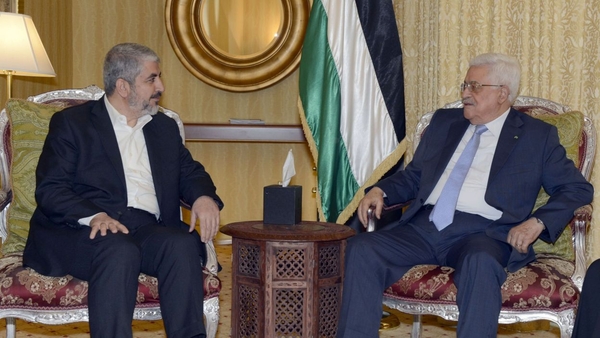
677Palestinian Authority President Mahmoud Abbas (r) meets with the Hamas political bureau chief Khaled Mashaal in Qatar, July 20, 2014. (Image source: Handout from the PA President’s Office/Thaer Ghanem)