Posted tagged ‘Taliban’

HUMOR | ‘We’re Making Real Progress,’ Say Last 17 Commanders In Afghanistan

February 27, 2017

‘We’re Making Real Progress,’ Say Last 17 Commanders In Afghanistan, Duffel Blog, February 27, 2017

afghanprogress

BAGRAM AIRFIELD, Afghanistan — The past 17 commanders of international forces in Afghanistan, as well as other US leaders, say the coalition is making “real progress” towards defeating the Taliban insurgency and stabilizing the country, sources confirmed today.

That positive outlook has offered new hope for peace and stability as the current commander, Gen. John Nicholson, looks to deploy “a few thousand” more troops to theater to build upon all the progress that has already been made

Gen. Tommy Franks served as commander of US Central Command from 2000-2003, and was in charge of operations in the Middle East when the Taliban was conclusively defeated in 2002.

“What a difference 10 months makes in a country like Afghanistan,” Franks said in an interview that year. “Taliban’s gone.”

Many other commanders have talked about the incredible progress that has been achieved in Afghanistan, where NATO has crippled the Taliban and put them against the ropes. As most terror analysts note, the terror group can barely hold on after more than 15 years of fighting.

In 2005, Gen. John Abizaid, who succeeded Franks at CentCom, promisingly judged that international activity in Afghanistan had “shown interesting progress.” He also noted the coalition was making progress in “reconstruction projects that showed some tangible progress” and “the cessation of hostilities after 25 years worth of hostilities in the vast majority of the country.”

And Gen. Dan McNeill, who served as commander of the International Security Assistance Force (ISAF) from 2007-2008, prudently assessed that “there is significant progress in the forward move of the Afghan National Army,” while scrupulously reminding the audience that “NATO’s an interim force in Afghanistan.”

Still, there have been setbacks.

In 2009, Gen. David McKiernan was fired from his post as ISAF commander after brashly stating that the US “must define winning in Afghan terms: meaning improved security, reduced civilian casualties, trustworthy government, economic and social progress.”

He went on to suggest that a satisfactory outcome in Afghanistan would take a decade or more to achieve, despite historical precedent to the contrary and Vice President Dick Cheney’s assertion that the wars in Iraq and Afghanistan were won back in 2004.

After taking the post from McKiernan, Gen. Stanley McChrystal was rightfully relieved in 2010 after failing to recognize the great progress that was being made.

Fortunately, Gen. David Petraeus replaced McChrystal and masterfully implemented a grand strategy to inject more progress into the campaign for progress. In a letter to the troops in July 2010 he declared, “progress has been achieved in some critical areas, and we are poised to realize more.”

Full progress in Afghanistan was achieved definitively in May 2011 with a high-profile raid that killed Osama bin Laden. Vice President Joe Biden then drove a proverbial stake through the heart of the war when he said in 2012, “we are leaving [Afghanistan] in 2014. Period.”

Gen. John Allen paved the path to victory for his successors, stating in 2013, “I think we are on the road to winning,” as he turned over command to Gen. Joseph Dunford.

Before “Fightin’ Joe” closed out the war in 2014, he offered a more somber assessment, saying, “At this point we have made significant progress, but we are not yet at the point where it is completely sustainable.” He also reassured Americans that though there would be a US presence in Afghanistan after 2014, “the actual fighting on a day-to-day basis will all be done by Afghans.”

And as ISAF transitioned to the Resolute Support Mission (RSM) at the end of 2014, Gen. John Campbell maintained a bright outlook.

“Together, we have lifted the Afghan people out of the darkness of despair and given them hope for the future,” he said during the transition ceremony.

Gen. Nicholson, the current RSM commander, is looking to continue the progress made by his predecessors over the past 15 years. He has big shoes to fill, as at least two presidents and perhaps a dozen commanders have successfully won the war thus far.

But his plans are on track, as he stated in a press briefing in July 2016, “I would say overall our mission in Afghanistan is on a positive trajectory.”

Interestingly, Mullah Mohammed Omar, who served as the sole Taliban leader from 1996 until his death in a jet ski accident in 2013, also says the Taliban is making “real progress” in the region.


NYC jihad bomber spent weeks getting “Islamic education” at pro-Taliban Pakistan seminary

September 25, 2016

NYC jihad bomber spent weeks getting “Islamic education” at pro-Taliban Pakistan seminary, Jihad Watch, Robert Spencer, September 25, 2016

This one is really going to leave New York Mayor de Blasio and other New York City authorities scratching their heads: they will be racking their brains trying to figure out how a pious young man instructed in the Religion of Peace could have become such a spectacular misunderstander of Islam. Does he have an ex-girlfriend in Chelsea? Was he “mentally unstable”? What, oh what, could have driven him to kill?

piecemaker

“Chelsea bombing suspect spent weeks at Islamist seminary in Pakistan,” by Kathianne Boniello, New York Post, September 25, 2016:

The alleged New Jersey terrorist charged with trying to blow up Chelsea last weekend with homemade bombs spent weeks getting an “Islamic education” at a Pakistani seminary, according to a report.

Ahman [sic] Khan Rahami spent three weeks in Kuchlak, an area described as a longtime “hub” for the Taliban, in 2011, a security official inside the country told the Guardian.

Rahami, 28, attended lectures at the Kaan Kuwa Naqshbandi madrasa.

US authorities have been tight-lipped with details of Rahami’s trips to Pakistan, acknowledging he was married during a visit to Quetta.

Security agencies inside Pakistan have tried to “hide all details” of his visits to Quetta, one anonymous official told the Guardian….

Fifteen years after the 9/11 attacks, al Qaeda fights on

September 12, 2016

Fifteen years after the 9/11 attacks, al Qaeda fights on, Long War Journal, September 11, 2016

All appeared lost for Osama bin Laden and al Qaeda in December 2001. In the years leading up to the 9/11 hijackings, bin Laden believed that the US was a “paper tiger” and would retreat from the Muslim majority world if al Qaeda struck hard enough. The al Qaeda founder had good reasons to think this. American forces withdrew from Lebanon after a series of attacks in the early 1980s and from Somalia after the “Black Hawk Down” episode in 1993. The US also did not respond forcefully to al Qaeda’s August 1998 embassy bombings in Kenya and Tanzania, or the USS Cole bombing in October 2000.

But bin Laden’s strategy looked like a gross miscalculation in late 2001. An American-led invasion quickly overthrew the Taliban’s regime just weeks after 19 of bin Laden’s men hijacked four airliners and crashed them into the World Trade Center, the Pentagon, and a field in Pennsylvania. Some of al Qaeda’s most senior figures were killed in American airstrikes. With al Qaeda’s foes closing in, bin Laden ordered his men to retreat to the remote Tora Bora Mountains. Here, bin Laden must have thought, al Qaeda would make its last stand. The end was nigh.

Except it wasn’t.

Bin Laden slithered away, eventually making his way to Abbottabad, Pakistan. When Navy SEALs came calling more than nine years later, in early May 2011, the world looked very different.

Documents recovered in bin Laden’s compound reveal that he and his lieutenants were managing a cohesive global network, with subordinates everywhere from West Africa to South Asia. Some US intelligence officials assumed that bin Laden was no longer really active. But Bin Laden’s files demonstrated that this view was wrong.

Writing in The Great War of Our Time: The CIA’s Fight Against Terrorism – From al Qa’ida to ISIS, former CIA official Mike Morell explains how the Abbottabad cache upended the US intelligence community’s assumptions regarding al Qaeda. “The one thing that surprised me was that the analysts made clear that our pre-raid understanding of Bin Laden’s role in the organization had been wrong,” Morell writes. “Before the raid we’d thought that Bin Laden’s deputy, Ayman al Zawahiri, was running the organization on a day-to-day basis, essentially the CEO of al Qaeda, while Bin Laden was the group’s ideological leader, its chairman of the board. But the DOCEX showed something quite different. It showed that Bin Laden himself had not only been managing the organization from Abbottabad, he had been micromanaging it.”*

Consider some examples from the small set of documents released already.

During the last year and a half of his life, Osama bin Laden: oversaw al Qaeda’s “external work,” that is, its operations targeting the West; directed negotiations with the Pakistani state over a proposed ceasefire between the jihadists and parts of the government;ordered his men to evacuate northern Pakistan for safe havens in Afghanistan;instructed Shabaab to keep its role as an al Qaeda branch secret and offered advice concerning how its nascent emirate in East Africa should be run; received status reports on his fighters’ operations in at least eight different Afghan provinces; discussed al Qaeda’s war strategy in Yemen with the head of Al Qaeda in the Arabian Peninsula and other subordinates; received updates from Al Qaeda in the Islamic Maghreb, including details on a proposed truce with the government of Mauritania; authorized the relocation of veteran jihadists to Libya, where they could take advantage of the uprising against Muammar al Qaddafi’s regime; corresponded with the Taliban’s leadership; and generally made decisions that impacted al Qaeda’s operations everywhere around the globe.

Again, these are just a handful of examples culled from the publicly-available files recovered in bin Laden’s compound. The overwhelming majority of these documents remain classified and, therefore, unavailable to the American public.

Al Qaeda has grown under Zawahiri’s tenure

The story of how bin Laden’s role was missed should raise a large red flag. Al Qaeda is still not well-understood and has been consistently misjudged. Not long after bin Laden was killed, a meme spread about his successor: Ayman al Zawahiri. Many ran with the idea that Zawahiri is an ineffectual and unpopular leader who lacked bin Laden’s charisma and was, therefore, incapable of guiding al Qaeda’s global network. This, too, was wrong.

There is no question that the Islamic State, which disobeyed Zawahiri’s orders and was disowned by al Qaeda’s “general command” in 2014, has cut into al Qaeda’s share of the jihadist market and undermined the group’s leadership position. But close observers will notice something interesting about al Qaeda’s response to the Islamic State’s challenge. Under Zawahiri’s stewardship, al Qaeda grew its largest paramilitary force ever.

Brett McGurk, the Special Presidential Envoy for the Global Coalition to Counter ISIL, warned about the rise of Al Nusrah Front during testimony before the Senate Foreign Relations Committee on June 28. “With direct ties to Ayman al Zawahiri, Osama Bin Laden’s successor, Nusra[h] is now al [Qaeda’s] largest formal affiliate in history,” McGurk said. US officials previously contacted by The Long War Journal said Nusrah could easily have 10,000 or more fighters in its ranks.

It is worth repeating that Nusrah grew in size and stature, while being openly loyal to Zawahiri, after the Islamic State became its own jihadist menace. Far from being irrelevant, Zawahiri ensured al Qaeda’s survival in the Levant and oversaw its growth.

image-posted-by-tilmidh-usamah-bin-ladin-1024x348

On July 28, Al Nusrah Front emir Abu Muhammad al Julani announced that his organization would henceforth be known as Jabhat Fath al Sham (JFS, or the “Conquest of the Levant Front”) and would have no “no affiliation to any external [foreign] entity.” This was widely interpreted as Al Nusrah’s “break” from al Qaeda. But Julani never actually said that and al Qaeda itself isn’t an “external entity” with respect to Syria as the group moved much of its leadership to the country long ago. Al Nusrah’s rebranding was explicitly approved by Abu Khayr al Masri, one of Zawahiri’s top deputies, in an audio message released just hours prior to Julani’s announcement. Masri was likely inside Syria at the time.

Julani, who was dressed like Osama bin Laden during his appearance (as pictured above), heaped praise on bin Laden, Zawahiri and Masri. “Their blessed leadership has, and shall continue to be, an exemplar of putting the needs of the community and their higher interests before the interest of any individual group,” Julani said of Zawahiri and Masri.

Most importantly, Al Nusrah’s relaunch as JFS is entirely consistent with al Qaeda’s longstanding strategy in Syria and elsewhere. Al Qaeda never wanted to formally announce its role in the rebellion against Bashar al Assad’s regime, correctly calculating that clandestine influence is preferable to an overt presence for many reasons. This helps explain why Nusrah was never officially renamed as “Al Qaeda in the Levant” in the first place. However, fifteen years after the 9/11 attacks, there is such widespread ignorance of al Qaeda’s goals and strategy that Nusrah’s name change is enough to fool many.

Al Qaeda has grown in South Asia as well. In Sept. 2014, Zawahiri announced the formation of Al Qaeda in the Indian Subcontinent (AQIS), which brought together elements of several existing jihadist organizations. AQIS quickly got to work, attempting to execute an audacious plan that would have used Pakistani arms against American and Indian ships. The plot failed, but revealed that al Qaeda had infiltrated Pakistan’s military.

Pakistani officials recently told the Washington Post that they suspect AQIS has a few thousand members in the city of Karachi alone. And al Qaeda remains closely allied with the Taliban while maintaining a significant presence inside Afghanistan. In October 2015, for instance, Afghan and American forces conducted a massive operation against two large al Qaeda training camps in the southern part of the country. One of the camps was approximately 30 square miles in size. Gen. John F. Campbell, who oversaw the war effort in Afghanistan, explained that the camp was run by AQIS and is “probably the largest training camp-type facility that we have seen in 14 years of war.”

With Zawahiri as its emir, al Qaeda raised its “largest formal affiliate in history” in Syria and operated its “largest training” camp ever in Afghanistan. These two facts alone undermine the widely-held assumption that al Qaeda is on death’s door.

Elsewhere, al Qaeda’s other regional branches remain openly loyal to Zawahiri.

From April 2015 to April 2016, Al Qaeda in the Arabian Peninsula (AQAP) controlled a large swath of territory along Yemen’s southern coast, including the key port city of Mukalla. An Arab-led coalition helped reclaim some of this turf earlier this year, but AQAP’s forces simply melted away, living to fight another day. AQAP continues to wage a prolific insurgency in the country, as does Shabaab across the Gulf of Aden in Somalia. Shabaab’s leaders announced their fealty to Zawahiri in February 2012 and remain faithful to him. They have taken a number of steps to stymie the growth of the Islamic State in Somalia and neighboring countries. Shabaab also exports terrorism throughout East Africa, executing a number of high-profile terrorist attacks in recent years.

Al Qaeda in the Islamic Maghreb (AQIM) continues to operate in West and North Africa, often working in conjunction with front groups. Like al Qaeda’s branches elsewhere, AQIM prefers to mask the extent of its influence, working through organizations such as Ansar al Sharia and Ansar Dine to achieve its goals. Late last year, Al Murabitoon rejoined AQIM’s ranks. Al Murabitoon is led by Mohktar Belmokhtar, who has been reportedly killed on several occasions. Al Qaeda claims that Belmokhtar is still alive and has praised him for rejoining AQIM after his contentious relations with AQIM’s hierarchy in the past. While Belmokhtar’s status cannot be confirmed, several statements have been released in his name in recent months. And Al Murabitoon’s merger with AQIM has led to an increase in high-profile attacks in West Africa.

In sum, AQAP, AQIM, AQIS and Shabaab are formal branches of al Qaeda and have made their allegiance to Zawahiri clear. Jabhat Fath al Sham, formerly known as Al Nusrah, is an obvious al Qaeda project in Syria. Other organizations continue to serve al Qaeda’s agenda as well.

Al Qaeda’s veterans and a “new generation” of jihadist leadership

As the brief summary above shows, Al Qaeda’s geographic footprint has expanded greatly since the Sept. 11, 2001 terrorist attacks. Some US officials argue that al Qaeda has been “decimated” because of the drone campaign and counterterrorism raids. They narrowly focus on the leadership layer of al Qaeda, while ignoring the bigger picture. But even their analysis of al Qaeda’s managers is misleading.

Al Qaeda has lost dozens of key men, but there is no telling how many veterans remain active to this day. Experienced operatives continue to serve in key positions, often returning to the fight after being detained or only revealing their hidden hand when it becomes necessary. Moreover, al Qaeda knew it was going to lose personnel and took steps to groom a new generation of jihadists capable of filling in.

3-aq-leaders-released-from-iran-1023x313From left to right: Saif al Adel, Abu Mohammed al Masri and Abu Khayr al Masri. These photos, first published by the FBI and US intelligence officials, show the al Qaeda leaders when they were younger.

Last year, several veterans were reportedly released from Iran, where they were held under murky circumstances. One of them was Abu Khayr al Masri, who paved the way for Al Nusrah’s rebranding in July. Another is Saif al Adel, who has long been wanted for his role in the 1998 US Embassy bombings in Kenya and Tanzania. At least two others freed by Iran, Abu Mohammed al Masri and Khalid al Aruri, returned to al Qaeda as well.

Masri, Al Adel, and Aruri may all be based inside Syria, or move back and forth to the country from Turkey, where other senior members are based. Mohammed Islambouli is an important leader within al Qaeda. After leaving Iran several years ago, Islambouli returned to Egypt and eventually made his way to Turkey, where he lives today.

Sitting to Julani’s right during his much ballyhooed announcement was one of Islambouli’s longtime compatriots, Ahmed Salama Mabrouk. The diminutive Mabrouk is another Zawahiri subordinate. He was freed from an Egyptian prison in the wake of the 2011 uprisings.

Al Qaeda moved some of its senior leadership to Syria and several others from this cadre are easy to identify. But al Qaeda has also relied on personnel in Yemen to guide its global network. One of Zawahiri’s lieutenants, Hossam Abdul Raouf, confirmed this in an audio message last October. Raouf explained that the “weight” of al Qaeda has been shifted to Syria and Yemen, because that is where its efforts are most needed.

The American drone campaign took out several key AQAP leaders in 2015, but they were quickly replaced. Qasim al Raymi, who was trained by al Qaeda in Afghanistan in the 1990s, succeeded Nasir al Wuhayshi as AQAP’s emir last summer. Raymi quickly renewed his allegiance to Zawahiri, whom Raymi described as the “the eminent sheikh” and “the beloved father.” Another al Qaeda lifer, Ibrahim Abu Salih, emerged from the shadows last year. Salih was not public figure beforehand, but he has been working towards al Qaeda’s goals in Yemen since the early 1990s. Ibrahim al Qosi (an ex-Guantanamo detainee) and Khalid al Batarfi have stepped forward to lead AQAP and are probably also part of al Qaeda’s management team.

This old school talent has helped buttress al Qaeda’s leadership cadre. They’ve been joined by men who signed up for al Qaeda’s cause after the 9/11 attacks as well. In July, the US Treasury Department designated three jihadists who are based in Iran. One of them, known as Abu Hamza al Khalidi, was listed in bin Laden’s files as part of a “new generation” of al Qaeda leaders. Today, he plays a crucial role as the head of al Qaeda’s military commission, meaning he is the equivalent of al Qaeda’s defense minister. Treasury has repeatedly identified other al Qaeda members based in Iran, Afghanistanand elsewhere.

Some members of the “new generation” are more famous than others. Such is the case with Osama’s son, Hamzah bin Laden, who is now regularly featured in propaganda.

This brief survey of al Qaeda is not intended to be exhaustive, yet it is still sufficient to demonstrate that the organization’s bench is far from empty. Moreover, many of the men who lead al Qaeda today are probably unknown to the public.

The threat to the West

Testifying before the Senate Armed Services Committee in February, Director of National Intelligence James Clapper warned that al Qaeda “nodes in Syria, Pakistan, Afghanistan, and Turkey” are “dedicating resources to planning attacks.” His statement underscored how the threats have become more geographically dispersed over time. With great success, the US worked for years to limit al Qaeda’s ability to strike the West from northern Pakistan. But today, al Qaeda’s “external operations” work is carried out across several countries.

During the past fifteen years, Al Qaeda has failed to execute another mass casualty attack in the US on the scale of the 9/11 hijackings. Its most recent attack in Europe came in January 2015, when a pair of brothers backed by AQAP conducted a military-style assault on the Charlie Hebdo office in Paris. AQAP made it clear that the Charlie Hebdo massacre was carried out according to Zawahiri’s orders.

Thanks to vigilance and luck, al Qaeda hasn’t been able to replicate a 9/11-style assault inside the US. Part of the reason is that America’s defenses, as well as those of its partner nations, have improved. Operations such as the 9/11 hijackings are also difficult to carry out in the first place. Even the 9/11 plan experienced interruptions despite a relatively lax security environment. (Most famously, for example, the would-be 20th hijacker was denied entry into the US at an Orlando airport in the summer of 2001.)

But there is another aspect to evaluating the al Qaeda threat that is seldom appreciated. It is widely assumed that al Qaeda is only interested in attacking the West. This is flat false. Most of the organization’s resources are devoted to waging insurgencies in Muslim majority countries.

The story in Syria has been telling. Although al Qaeda may have more resources in Syria than anywhere else, Zawahiri did not order his men to carry out a strike in the West. Al Qaeda’s so-called “Khorasan Group” laid the groundwork for such operations, but Zawahiri did not give this cadre the green light to actually carry them out. Zawahiri’s stand down order is well known. In an interview that aired in May 2015, for instance, Julani explained that the “directives that come to us from Dr. Ayman [al Zawahiri], may Allah protect him, are that Al Nusrah Front’s mission in Syria is to topple [Bashar al Assad’s] regime” and defeat its allies. “We have received guidance to not use Syria as a base for attacks against the West or Europe so that the real battle is not confused,” Julani said. However, he conceded that “maybe” the mother al Qaeda organization is plotting against the West, just “not from Syria.” Julani emphasized that this “directive” came from Zawahiri himself.

To date, al Qaeda has not lashed out at the West from inside Syria, even though it is certainly capable of doing so. Al Qaeda’s calculation has been that such an attack would be too costly for its strategic interests. It might get in the way of al Qaeda’s top priority in Syria, which is toppling the Assad regime. This calculation could easily change overnight and al Qaeda could use Syria as a launching pad against the West soon. But they haven’t thus far. It helps explain why there hasn’t been another 9/11-style plot by al Qaeda against the US in recent years. It also partially explains why al Qaeda hasn’t launched another large-scale operation in Europe for some time. Al Qaeda has more resources at its disposal today than ever, so the group doesn’t lack the capability. If Zawahiri and his advisors decided to make anti-Western attack planning more of a priority, then the probability of another 9/11-style event would go up. Even in that scenario, al Qaeda would have to successfully evade the West’s defenses. But the point is that al Qaeda hasn’t been attempting to hit the West nearly as much as some in the West assume.

In the meantime, it is easy to see how the al Qaeda threat has become more diverse, just as Clapper testified. AQAP has launched several thwarted plots aimed at the US, including the failed Christmas Day 2009 bombing. In 2009, al Qaeda also plotted to strike trains in the New York City area. In 2010, a Mumbai-style assault in Europe was unraveled by security services. It is not hard to imagine al Qaeda trying something along those lines once again. Other organizations tied to al Qaeda, such as the Pakistani Taliban, have plotted against the US as well.

Fifteen years after the 9/11 attacks, al Qaeda lives. Fortunately, Zawahiri’s men have not replicated the hijackings that killed nearly 3,000 Americans. But the al Qaeda threat looms. It would be a mistake to assume that al Qaeda won’t try a large-scale operation again.

*The spellings of al Qaeda and bin Laden are changed in this quote from Morell to make them consistent with the rest of the text.

On 15th Anniversary Of 9/11, Al-Qaeda Leader Al-Zawahiri Urges Mujahideen To Focus On Targeting U.S., Incites Black Christians Against U.S. And Calls Them To Islam

September 9, 2016

On 15th Anniversary Of 9/11, Al-Qaeda Leader Al-Zawahiri Urges Mujahideen To Focus On Targeting U.S., Incites Black Christians Against U.S. And Calls Them To Islam, MEMRI, September 9, 2016

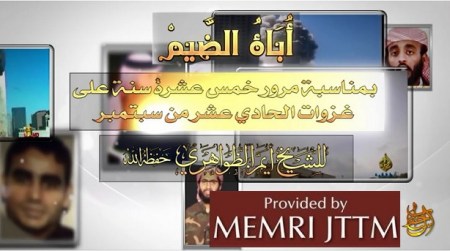
On September 9, 2016, Al-Qaeda’s media wing Al-Sahab released a video message by the group’s leader, Ayman Al-Zawahiri, marking the 15th anniversary of the 9/11 attacks. Al-Zawahiri reiterates the reasons behind the attacks and their impact on the U.S., and urges the mujahideen to focus on targeting the U.S. and its allies, and to bring the battle onto their own soil as well. Appealing to non-Muslim African-Americans, he blames their woes on the U.S. and calls to them to convert to Islam.

29874

Most of the 20-minute video consists of Al-Zawahiri’s message, and the final several minutes feature an archival address by Osama bin Laden. Additionally, archival footage of a Malcolm X address is played as Al-Zawahiri appeals to African-Americans.

Below are the main points of the message:

Al-Zawahiri praises the “blessed raids” of 9/11, noting that they managed to strike deep within the U.S. and to attack its economic symbols, i.e. the Twin Towers. He also notes that the final and fourth hijacked airplane, United Flight 93, was heading towards “the biggest criminals in the White House or the Congress.” Al-Zawahiri boasts that 9/11 was a wakeup call to the U.S., reminding it that its crimes against Muslims won’t go unnoticed. The attacks’ impact, according to Al-Zawahiri, continues to be felt today, and its memory will forever be remembered by the Americans.

29875

Addressing the U.S., Al-Zawahiri reminds it: “The events of 9/11 were a direct result of your crimes against us, your crimes in Palestine, Afghanistan, Iraq, Syria, Mali, Somalia, Yemen, Islamic Maghreb, and Egypt [and] the result of your occupation of Muslim lands, theft of their resources, and support for the murderous corrupt criminals, who rule over them.” He further threatens the U.S.: “As long as your crimes continue, the events of 9/11 will be repeated thousands of times, by the will of Allah. And we will follow you – if you don’t cease your aggression [against us] – until the Day of Judgment…”

Moving on to the subject of the mujahideen, Al-Zawahiri informs the U.S. that their strength is increasing by the day: “There it is, the jihadi awakening [movement] increasing – thanks to Allah – many times over what it used to be before the blessed raids,” he says.

Addressing the mujahideen, Al-Zawahiri urges them to focus on attacking the U.S. and its allies, and on trying as much as possible to shift the battle onto these countries’ own soil. In that regard, he notes that the defeat of the U.S. will lead to the defeat of its lackeys. He also urges the mujahideen to unite, pledge allegiance to the Islamic Emirate in Afghanistan (the Taliban), support the revolutions across the Muslim world, and urge prominent Islamic leaders to form the nucleus of a future council that will be tasked with appointing an imam (leader) for all Muslims.

Speaking to the Muslims in general, Al-Zawahiri implores them to rise up against their rulers: “It has become clear to you that your rulers are tools in the hands of the secular Safavid Crusader alliance, the alliance of the devils, headed by American and the West,” he says. He also urges them to disavow these rulers, and to adopt the path of da’wa and jihad: “Your true soldiers are your mujahideen sons… who wish for you to live free and honored in the shade of the righteous caliphate, in which the ummah chooses, holds accountable, and ousts its imam.”

Al-Zawahiri also lashes out at the various Islamic movements that have emerged in the awake of the Arab Spring, calling them “sheep” and agents of the U.S. who have hijacked the sacrifices of the Muslims. He also calls on the Muslims to be the real lions – like the mujahideen – who refuse to live under these corrupt and apostate regimes.

29876

Finally, Al-Zawahiri appeals to non-Muslims, particularly African Americans, blaming their woes on the U.S. and calling them to Islam. His message is augmented with an address by Malcolm X. Al-Zawahiri says: “We inform every weakened [person] in the world: America is the source of calamity and the head of evil in this world, and it is the thief of nations’ aliment, and it is the one who humiliate the Africans [i.e. African Americans] until this day, and no matter how much they try to reform and obtain their rights according to the law and the [U.S.] constitution, they will not attain it, for the law is in the hands of the white majority, [who] control it as they wish. And they [i.e. African Americans] will not be saved but by Islam.”

Clinton Ignores Questions About Father of Orlando Shooter Attending Her Rally

August 9, 2016

Clinton Ignores Questions About Father of Orlando Shooter Attending Her Rally, Washington Free Beacon,, August 9, 2016

Hillary Clinton ignored questions on Tuesday about whether she knew that the father of the Orlando shooter was going to attend her rally in Kissimmee, Florida on Monday.

Reporters asked Clinton about Seddique Mateen–father of Omar Mateen, the terrorist who killed 49 people at an Orlando nightclub in June–attending her campaign event as a supporter. Clinton dodged the questions from reporters after delivering remarks about the dangers of the Zika Virus to medical staff and other health representatives at the Borinquen Medical Centers of Miami-Dade.

Mateen, a Taliban sympathizer, attended Clinton’s rally on Monday and was seated behind the Democratic nominee. He at first refused to answer questions regarding the rally, but hours later WPTV ran into him and they asked about Clinton.

“Hillary Clinton is good for United States versus Donald Trump, who has no solutions,” Mateen told WPTV.

General Allen’s Service to Al Qaeda’s Paymasters

August 4, 2016

General Allen’s Service to Al Qaeda’s Paymasters, Front Page Magazine, Daniel Greenfield, August 4, 2016

ga (1)

After two American soldiers were murdered by an Islamic terrorist in Afghanistan while a crowd of protesters shouted “Death to Americans” and “Death to Infidels”, General Allen visited his men. 

“There will be moments like this when you’re searching for the meaning of this loss. There will be moments like this when your emotions are governed by anger and a desire to strike back,” Allen pleaded. “Now is not the time for revenge, now is not the time for vengeance.”

General Allen had already apologized to the killers for the “desecration” of the Koran by American soldiers who had been destroying copies of the hateful document being used by Taliban prisoners to send notes to each other. “I offer my sincere apologies for any offence this may have caused, to the president of Afghanistan, the government of the Islamic Republic of Afghanistan, and most importantly, to the noble people of Afghanistan,” he had whined.

The “noble people” of Afghanistan were the ones chanting “Death to America” and “Death to Infidels”.

Meanwhile General Allen was telling the American soldiers grieving the loss of their own that the real tragedy was the destruction of the terrorist books. “Now is how we show the Afghan people that as bad as that act was in Bagram, it was unintentional and Americans and ISAF soldiers do not stand for this.”

Then Allen said that he was “proud” to call General Sher Mohammad Karimi “my brother”. Karimi, was the Afghan military strongman who had defended previous attacks on NATO troops and demanded that the American soldiers be put on trial.

“We admit our mistake,” General Allen cringingly continued. “We ask for our forgiveness.”

Then he praised the “Holy Koran”. Six American military personnel faced administrative punishments for doing their duty in order to appease the murderous Islamic mob in all its nobility in Afghanistan.

This was typical of General Allen’s disgraceful tenure. It is also typical of his post-military career which has included a prominent spot at Brookings and a speaking slot at the Democratic National Convention. After his enthusiastic endorsement of Hillary and attacks on Trump, Hillary has insisted that anyone who criticizes Allen is not fit to be president because Allen is a “hero and a patriot”.

If there’s anyone who is an expert on heroism and patriotism, it’s Hillary.

Allen’s heroic post-military career brought him to Brookings. The road from the think tank runs to Qatar which donated nearly $15 million to promote its agenda. That agenda took General Allen to its US-Islamic World Forum in Doha, Qatar.

Allen praised the “magnificent institutions” of Qatar. He endorsed the mobilization of the Jihadist terror groups known as Popular Mobilization Forces, some of whom have American blood on their hands and are owned and operated by Iran. Allen insisted that “many PMF fighters are not Shia-hardliners but Iraqis who volunteered last summer, answering Grand Ayatolah Ali Sistanti’s fatwa to defend Iraq.”

Then Allen sank to a new unimaginable low by urging compassion toward ISIS Jihadists from abroad.

“We must strive to be a Coalition of compassionate states,” Allen insisted. “There is no denying that many societies find the idea of rehabilitating foreign fighters objectionable. And indeed, those who have broken the laws of our lands must be held accountable. But long-term detention cannot be the sole means of dealing with returning foreign fighters.”

Then he touted “deradicalization” and “reintegration” programs by Muslim countries for Jihadists.

Allen claimed that seeing the “Muslim faith practiced and lived” in Afghanistan had made him a “better Christian”. But his messaging wasn’t surprising considering his employment and his location.

Qatar was a key international state sponsor of terror.

Khalid Sheikh Mohammed, the mastermind of 9/11, had been tipped off by a member of the Qatari royal family. The same Qatari royal family whose shindig Allen had shown up to perform at. Their terrorist media outlet, Al Jazeera, had been Al Qaeda’s media drop outlet of choice.

Qatar is a strong backer of Hamas. It has been accused of funding Al Qaeda. More recently it’s been linked to backing Al Qaeda’s local platform in Syria, the Al Nusra Front. The Taliban opened an office in Qatar. Even an early ISIS leader got his start with patronage from Qatar’s royal family.

A strong backer of the Arab Spring, Qatar exploited the chaos by aggressively smuggling weapons to Jihadists in the region. Two years ago, a bipartisan majority on the House Foreign Affairs Subcommittee on the Middle East and its Subcommittee on Terrorism, Nonproliferation and Trade had called for an investigation of Qatar’s links to terrorist funding.

General Allen’s visit to Qatar was shameful. He was praising and pressing the flesh of the paymasters of Islamic terrorists whose hands were and are covered in American blood. Allen had betrayed the soldiers fighting against Islamic terrorists. He had betrayed his country and his cause. He is a traitor to both.

Allen’s disgusting DNC performance was the climax of a series of betrayals. It is not the worst speech he has ever given. Nor is it the most dishonest or the most despicable.

General Allen has gone from serving his country to serving the enemies of his country. That is the man whose endorsement Hillary Clinton is proudly waving around as if it is a badge of honor instead of a badge of shame.

Allen is neither a hero nor a patriot. He is a man who has sold his soul to the highest bidder. Hillary Clinton has won this latest bid for Allen’s shopworn soul, alongside the tyrants of Qatar who trade in human slaves on a global scale. It is likely worth about as much as Hillary’s own soul. Whatever tattered spiritual scraps are left of it.

The mass deaths of American soldiers in Afghanistan under Obama still remains a largely untold story. It is the story of how Obama and his collaborators among the military elite sold out our soldiers and left them to die on the battlefield without allowing them to defend themselves so as not to offend the “noble people” of Afghanistan and their fine religious traditions.

74.5% of American deaths in Afghanistan occurred under Obama. Countless more came home, crippled and scarred. While General Allen hobnobs at parties with Al Qaeda bosses, the men he betrayed come back in body bags.

They are heroes. Allen is a traitor.

Obama backtracks on Afghanistan withdrawal, cites ‘precarious’ security situation

July 8, 2016

Obama backtracks on Afghanistan withdrawal, cites ‘precarious’ security situation, Long War Journal, , July 7, 2016

President Barack Obama called the security environment in Afghanistan “precarious” and said today he will keep more troops on the ground in Afghanistan than previously planned. Obama repeatedly promised to end the US mission in Afghanistan before the end of his administration in 2017, but a worsening security situation stemming from previous ill-timed reductions in force and a resilient Taliban proved that to be impossible.

“Instead of going down to 5,500 troops by the end of this year, the United States will maintain approximately 8,400 troops in Afghanistan into next year, through the end of my administration,” Obama said in a briefing at the White House.

Despite admitting the deteriorating conditions, Obama announced he will reduce the number of troops in the country by 1,400 by the end of 2016. Obama did not explain how withdrawing an additional 1,400 US forces this year will aid in the fight against the Taliban and its allies. The Taliban has regained ground in the strategic province of Helmand and other areas in spite of direct US military support to Afghan forces.

Obama admitted that the Taliban has continued to wage an effective insurgency and has taken control of territory.

“The Taliban remains a threat,” Obama said. “They’ve gained ground in some places.”

There are currently 9,800 troops in country conducting an “advise and assist” mission to Afghan forces as well as counterterrorism operations. Those two missions will not change, he stated.

The admission that security in Afghanistan is worsening is a dramatic shift by the Obama administration. Previously the administration maintained that Afghan forces were capable of sustaining combat operations with minimal or no US assistance.

However, this view flew in the face of the realities on the ground. The Taliban waited out the US “surge” that targeted their bastions in the south, and began attacking vulnerable Afghan forces when US troops began their withdrawal. By 2014, the Taliban gained control of a handful of far-flung districts while maintaining a guerrilla campaign throughout the country.

By the summer of 2015, the Afghan government admitted that four districts were under Taliban control. A study by The Long War Journal indicated that by the beginning of October 2015, the Taliban controlled 29 districts and contested another 36.

The Afghan government, which has notoriously underestimated the threat posed by the Taliban and areas under the jihadist group’s control, admitted in late June 2015 that nine district were now controlled by the Taliban and another 40 are heavily contested.The Long War Journal estimated that the Taliban controls 39 districts and contest another 43.

Perhaps the most worrisome indicator of deteriorating security in Afghanistan is the discovery of al Qaeda training camps in the country. Al Qaeda operated two large scale training camps, including a large facility, in the Shorabak district in Kandahar for more than a year before they were discovered by US forces. One of the camps occupied an area of 30 square miles and was well provisioned with weapons, ammunition, communications gear, and other equipment. In October 2015, a large US military strike force took four days to clear the two al Qaeda camps in Shorabak. More than 150 al Qaeda fighters are thought to have been killed during the operation.

The US military only discovered the location of the two camps in Shorabak after raiding another in Paktika province in July 2015. Abu Khalil al Sudani, one of al Qaeda’s most senior figures, is thought to have been killed during that raid. Al Qaeda obviously assessed the situation in Paktika as being safe enough to place one of their top leaders there.

The Shorabak raids shocked the US military and intelligence and forced them to revised its long-held estimate of 50 to 100 al Qaeda operatives in Afghanistan upwards to 300 in country. For more than six years, The Long War Journal has warned that official estimate of al Qaeda’s presence in Afghanistan is erroneous, and the jihadist group remains a significant threat to this day. [See LWJ report, US military admits al Qaeda is stronger in Afghanistan than previously estimated.]

Taliban Surpasses Islamic State as World’s Most Prolific Terrorist Group

June 7, 2016

Taliban Surpasses Islamic State as World’s Most Prolific Terrorist Group, BreitbartEdwin Mora, June 6, 2016

taliban-fighters-afghanistan-associated-press-640x480AP Photos/Allauddin Khan

Taliban jihadists replaced their Islamic State (ISIS/ISIL) counterparts as the world’s chief perpetrators of terrorist attacks last year, with 1,093 individual attacks, according to the U.S. Department of State’s Country Reports on Terrorism 2015.

However, ISIS’s 931 terrorist attacks in 2015 wTaliban jihadists replaced their Islamic State (ISIS/ISIL) counterparts as the world’s chief perpetrators of terrorist attacks last year, with 1,093 individual attacks, according to the U.S. Department of State’s Country Reports on Terrorism 2015.ere reportedly much deadlier than those carried out by the Taliban, resulting in 6,050 deaths compared to the 4,512 fatalities linked to the Taliban, notes the State Department’s annual reports, a congressionally mandated analytical and statistical review of global terrorism.

ISIS replaced the Nigeria-based Boko Haram as the terrorist group responsible for the most fatalities in 2015. Boko Haram was responsible for 491 terrorist attacks last year resulting in 5,450 deaths. Boko Haram is treated as a separate terrorist group as its logistics are independent of ISIS, despite the group pledging allegiance to Islamic State caliph Abu Bakr al-Baghdadi last year.

In 2015, ISIS was also responsible for causing more injuries (6,010) and taking more hostages (4,759) than any other terrorist group.

On Sunday, three Taliban jihadists attacked an Afghan court, killing seven people including “a number of prosecutors and judges,” the terrorist group announced, according to CNN.

“The attack triggered a shootout with Afghan security forces that lasted 1 1/2 hours,” adds the news network. “At least 23 people were wounded.”

The Taliban has stepped up an increasingly violent insurgency since President Obama and NATO ended their combat mission in Afghanistan in December 2014. Afghan civilians and security forces have since suffered a record number of casualties at the hands of the terrorist group.

Five terrorist groups were identified by the State Department as being responsible for the most terrorist attacks in 2015: the Taliban (1,093); ISIS (931); Boko Haram (491); the Communist Party of India-Maoist (343); and the Kurdistan Workers’ Party, PKK, (238).

“A total of 270 groups and organizations were identified as perpetrators of terrorist attacks, including 78 organizations that had not previously been identified as perpetrators in the Global Terrorism Database,” reports the State Department. “The number of newly identified perpetrator organizations declined in 2015 from more than 100 in 2014.”

“The biggest surprise was the removal of the Somali group al-Shabaab from the top-five list of perpetrators, that outfit having been responsible for the third-most attacks in 2014,” notes The Atlantic magazine. “The new addition to the 2015 list was the Kurdistan Workers’ Party (PKK), which has re-committed to the use of political violence in a significant way, increasing the number of attacks from 47 to 38 and noncombatants killed from 12 to 287.”

Iraq was the location of the highest numbers of total attacks, deaths, and people injured and kidnapped.

Overall, “the number of attacks in which victims were kidnapped or taken hostage declined in 2015; however, the number of kidnapping victims and hostages increased,” notes the Department of State (DOS) assessment. “This was primarily due to an increase in the number of attacks involving exceptionally large numbers of victims.”

The total number of terrorist attacks across the globe last year dropped by 13 percent, from 13,482 in 2014 to 11,774, and total fatalities by 14 percent, from 32,763 to 28,328.

“This was largely due to fewer attacks and deaths in Iraq, Pakistan, and Nigeria. This represents the first decline in total terrorist attacks and deaths worldwide since 2012,” notes DOS evaluation, adding, “In several countries, including Afghanistan, Bangladesh, Egypt, the Philippines, Syria, and Turkey, terrorist attacks and total deaths increased in 2015.”

There was also a slight decrease in the number of countries where terrorist attacks took place, from 95 in 2014 to 92 last year.

“Although terrorist attacks took place in 92 countries in 2015, they were heavily concentrated geographically,” declares DOS. “More than 55% of all attacks took place in five countries (Iraq, Afghanistan, Pakistan, India, and Nigeria), and 74% of all deaths due to terrorist attacks took place in five countries (Iraq, Afghanistan, Nigeria, Syria, and Pakistan).”

“Of the 28,328 people killed in terrorist attacks in 2015, 6,924 (24%) were perpetrators of terrorist attacks,” it adds. “Perpetrators were killed intentionally in suicide attacks, accidentally while attempting to carry out attacks, or by security forces or victims responding to attacks. This is an 11% increase in the number of perpetrator deaths, compared to 2014.”

Analysis: Iran has supported the Taliban’s insurgency since late 2001

May 29, 2016

Analysis: Iran has supported the Taliban’s insurgency since late 2001, Long War Journal, , May 29, 2016

Joint Task Force – Guantanamo (JTF-GTMO), which oversees the detention facility, deemed Khairkhwa a “high” risk to the U.S. and its allies, in part, because of his dealings with the Iranians. Despite JTF-GTMO’s assessment, and the DC court’s rejection of his habeas petition, Khairkhwa was transferred to Qatar in 2014. He was one of the five Taliban commanders exchanged for Sgt. Bowe Bergdahl.

**********************

On May 21, an American drone strike ended Mullah Akhtar Mohammad Mansour’s reign as the Taliban’s leader. As The Wall Street Journal first reported, US intelligence officials tracked Mansour to Iran, where he was visiting his family, and then targeted his car as he crossed back over the border into Pakistan. Iran’s foreign ministry spokesman, Hossein Jaber Ansari, quickly denied this version of events, claiming that his country “welcomes any measure in line with bringing peace and stability to Afghanistan.”

However, Zabihullah Mujahid (the Taliban’s chief spokesman) has conceded that Mansour was indeed inside Iran. Dawn quotes Mujahid as saying the Taliban chief crossed the border because of “ongoing battle obligations,” adding that Mansour made multiple “unofficial trips” to Iran.

While many of the details concerning Mansour’s travels remain murky, his presence inside Iranian territory shortly before his death isn’t surprising. Iran has a long history of backing the Taliban’s insurgency against US and allied forces in Afghanistan. Indeed, the relationship between the two former foes is one of the most misunderstood and oft-overlooked aspects of the 9/11 wars.

Iran and the Taliban nearly went to war in 1998 after senior Taliban commanders slaughtered Iranian diplomats and other Shiites in Mazar-i-Sharif. But by late 2001, as the Americans prepared to topple the Taliban’s government, the situation changed dramatically. Outwardly, the Iranians acted as if they just wanted to help rebuild Afghanistan. Western diplomats have praised Iran for its role in the Dec. 2001 meetings in Bonn, Germany, where a post-Taliban government was established. But there is much more to this story. Just before the American-led invasion of Afghanistan two months earlier, the Iranians cut a secret deal with Mullah Omar’s representatives.

One of Omar’s most trusted lieutenants, Khairullah Khairkhwa, helped broker an agreement with the Iranians in Oct. 2001. We know this because Khairkhwa was captured in Pakistan in early 2002, transferred to Guantanamo and then told American officials all about it.

A district court in Washington, DC denied Khairkhwa’s petition for a writ of habeas corpus in 2011. The court found that Khairkhwa “repeatedly admitted” that after the 9/11 attacks “he served as a member of a Taliban envoy that met clandestinely with senior Iranian officials to discuss Iran’s offer to provide the Taliban with weapons and other military support in anticipation of imminent hostilities with U.S. coalition forces.” [SeeLWJ report, DC district court denies former Taliban governor’s habeas petition.]

According to the court, the Iranians told Khairkhwa and his Taliban delegation that they could provide shoulder-fired missiles (SAM-7’s) and “track all movements by the United States.” In addition, the Iranians “offered to open their border to Arabs entering Afghanistan.” Iran did just that, allowing some al Qaeda members and others to escape the American onslaught.

Joint Task Force – Guantanamo (JTF-GTMO), which oversees the detention facility, deemed Khairkhwa a “high” risk to the U.S. and its allies, in part, because of his dealings with the Iranians. Despite JTF-GTMO’s assessment, and the DC court’s rejection of his habeas petition, Khairkhwa was transferred to Qatar in 2014. He was one of the five Taliban commanders exchanged for Sgt. Bowe Bergdahl.

During the twelve years Khairkhwa was detained in Cuba, Iran continued to collude with the Taliban. The Defense, State and Treasury Departments have all documented the relationship.

In its “Annual Report on [the] Military Power of Iran,” which was delivered to Congress in 2012, the Department of Defense explained that Iran’s support for the Taliban was part of its “grand strategy” to challenge “US influence.” Although there was “historic enmity” between the two sides, the Pentagon said, support for the Taliban “complements Iran’s strategy of backing many groups to maximize its influence while also undermining US and North Atlantic Treaty Organization (NATO) objectives by fomenting violence.”

“Since 2006,” the State Department noted in its Country Reports on Terrorism for 2012, “Iran has arranged arms shipments to select Taliban members, including small arms and associated ammunition, rocket propelled grenades, mortar rounds, 107mm rockets, and plastic explosives.” In 2012, the Iranians “shipped a large number of weapons to Kandahar, Afghanistan, aiming to increase its influence in this key province.”

Foggy Bottom added that the Islamic Revolutionary Guard Corps’ Quds Force (IRGC-QF) “trained Taliban elements on small unit tactics, small arms, explosives, and indirect fire weapons, such as mortars, artillery, and rockets.”

A series of Treasury Department terror designations illuminate the relationship between the IRGC-QF and the Taliban.

In August 2010, Treasury designated two IRGC-QF commanders as terrorists for providing “financial and material support to the Taliban.” A special unit in the IRGC-QF known as the Ansar Corps is responsible for orchestrating attacks in Afghanistan. Nearly two years later, in Mar. 2012, Treasury identified IRGC-QF General Gholamreza Baghbani as a narcotics trafficker. At the time, Baghbani was based in Zahedan, Iran, which is near the border with Afghanistan and Pakistan. From this strategically situated crossroads, Baghbani allegedly oversaw an operation that “moved weapons to the Taliban,” while smuggling “heroin precursor chemicals through the Iranian border” and facilitating “shipments of opium into Iran.” This guns-for-drugs scheme directly fueled the Taliban’s insurgency, according to Treasury.

Treasury wasn’t finished. In February 2014, three other IRGC-QF officials and one of their associates were designated for plotting terrorist acts in Afghanistan and also using “intelligence operations as tools of influence against” the Afghan government. Iran’s duplicitous scheme meant that the IRGC-QF was “currying favor” with some Afghan politicians while targeting other officials for assassination.

In the weeks immediately following 9/11, the Iranian regime and the Taliban met in the shadows. In the 14-plus years since, their relationship has become overt. The Wall Street Journal reported in 2012 that the Taliban has set up an office in Zahedan, which is also a well-known al Qaeda hub. Taliban officials have repeatedly and openly attended meetings in Tehran. And other sources confirm that Iran has often provided the Taliban with arms and training.

Contrary to what Ansari claims, the Iranians don’t want “peace and stability” in Afghanistan – at least not at the expense of achieving their other objectives. They want to force the US out and expand their influence. Given Iran’s enduring partnership with the Taliban, forged in the aftermath of the 9/11 attacks, Mansour’s trips to Iran may have been “unofficial,” but they are definitely unsurprising.

Iran supplying weapons, cash and training to Taliban

May 27, 2016

Iran supplying weapons, cash and training to Taliban, Jihad Watch

Sunnis and Shi’ites hate each other, but not as much as they hate the Infidel. Hence Iran’s support for the Taliban, as well as Hamas and Islamic Jihad: Sunnis who are waging jihad against Infidels are allies of Iran, as far as the mullahs are concerned. Such support also strengthens Iran’s ongoing maneuvering to be the leader of the Islamic world.

Taliban89
“Death of Mullah Mansoor highlights Taliban’s links with Iran,” by Jon Boone and Saeed Kamali Dehghan, Guardian, May 23, 2016:The killing of the Taliban chief on the main highway leading from the Iranian border shines new light on the movement’s complicated relationship with Tehran.Although it is Pakistan that has traditionally been condemned for secretly supporting Afghan insurgents, analysts say Iran also provides weapons, cash and sanctuary to the Taliban. Despite the deep ideological antipathy between a hardline Sunni group and cleric-run Shia state the two sides have proved themselves quite willing to cooperate where necessary against mutual enemies and in the pursuit of shared interests.

Mullah Mansoor first entered Iran almost two months ago, according to immigration stamps in a Pakistani passport found in a bag near the wreckage of the taxi he was travelling in when he was killed by a US drone strike.

The passport, in the name of Wali Muhammad, also showed he had only just returned to Pakistan from the border crossing of Taftan, some 280 miles (450km) away from the site where he was killed, an area called Ahmed Wal, where he had stopped for lunch.

On Monday, the Iranian foreign ministry denied that “such a person had entered Pakistan from the Iranian border”.

“Iran welcomes any efforts made in bringing stability and peace to Afghanistan,” said spokesman Hossein Jaberi-Ansari.

It is not known where Mansoor went inside Iran, whether his trip was secretly facilitated by the Iranian Revolutionary Guard or whether he stayed among the large populations of Afghans living in eastern Iran, especially in the cities of Mashhad and Zahedan.

The Taliban also have ties to Sunni extremist groups operating in the Iranian province of Sistan and Balochistan.

A Pakistani official from Dalbandin, a district bordering Iran, said he did not think Iran would back foreign insurgents with links to such groups.

“All Afghan militants hold Pakistani nationality, it is not written on their forehead whether he is a militant or not,” said the official, who did not wish to be identified.

Nonetheless police and intelligence officials in western Afghanistan often complain the local insurgency is being managed and supplied with weapons and training from Iran….