Posted tagged ‘Syria’

Iraq Welcomes Russian Airstrikes Against ISIL

October 6, 2015

Top Diplomat: Iraq Welcomes Russian Airstrikes Against Islamic State

BY:
October 5, 2015 4:50 pm

Source: Iraq Welcomes Russian Airstrikes Against ISIL


Unsatisfied by the Obama administration’s campaign against the Islamic State in the region, the Iraqi government welcomes Russian airstrikes against the terrorist group inside Iraq, according to a top diplomat.

The Air Force Times reported:

The Iraqis feel that the U.S.-led campaign against the Islamic State has become too focused on Syria and has not made enough progress on the ground in Iraq, a senior Iraqi diplomat, who asked to speak on condition of anonymity, told Air Force Times on Monday. The official accused the coalition fores of moving too slowly, thereby missing opportunities to roll back the Islamic State in Iraqi cities. Since more than 2,000 Russians are among the Islamic State’s ranks and Russia has experience fighting Islamic militants in Chechnya, it makes sense to include Russia in anti-Islamic State efforts, he said.

While Iraq is open to the possibility of Russian airstrikes, the diplomat said that the Iraqi government would not welcome Russian troops on the ground fighting the Islamic State (IS, also known as ISIL or ISIS). Iraq has not formally asked Russia to conduct airstrikes in the country.

Ignoring warnings from the Obama administration, Russia has been increasing its military activity in Syria in recent weeks in order to allegedly combat IS and bolster the Bashar al-Assad regime. Moscow has sent troops and military aid to Syria and last week conducted its first airstrikes there.

Russian warplanes dropped bombs near the city of Homs in western Syria Wednesday, an area that is not controlled by Islamic State militants. Defense Secretary Ash Carter has expressed skepticism that the Russian strikes were targeting IS.

Iraq agreed last month to share intelligence with Russia and Syria in the effort against IS, but the top diplomat insisted Monday that the agreement will not put U.S. or other coalition forces at risk. He also called on the U.S. to provide Iraq with more M1A1 Abrams tanks so that Iraqi forces can reclaim the Anbar province from IS.

U.S. intelligence agencies concluded in July that the Obama administration bomb campaign against IS in the Middle East has yielded no perceivable degradation in the terrorist group’s forces.

Russian Air Force destroys 20 ISIS tanks near Palmyra

October 6, 2015

Russian Air Force destroys 20 ISIS tanks near Palmyra – Defense Ministry (VIDEOS)

Published time: 5 Oct, 2015 21:23

Edited time: 6 Oct, 2015 11:51

Source: Russian Air Force destroys 20 ISIS tanks near Palmyra – Defense Ministry (VIDEOS) — RT News

Russian pilots prepared to board the SU-30 attack plane to take off from the Hmeimim aerodrome in Syria. © Dmitriy Vinogradov
Russia’s Sukhoi jets flew 15 sorties over Syria on Monday striking 10 Islamic State targets in various regions, according to Russia’s Defense Ministry. 20 tanks and 3 rocket launchers in Homs province near embattled Palmyra were destroyed,

“During the day, Sukhoi-34, Sukhoi-24M and Sukhoi-25 warplanes flew a total of 15 sorties from the Khmeimim airbase. Air strikes were delivered at ten targets of the Islamic State [IS, formerly ISIS/ISIL] group in Syria,” Igor Konashenkov, Russia’s Defense Ministry spokesman said in a statement on Monday.

A pair of Su-25Ms (NATO reporting name: Frogfoot) together with an Su-24 (NATO reporting name: Fencer) carried out strikes on two IS targets in the eastern part of Homs province near the city of Tadmur, he said.

“About 20 units of medium T-55 tanks, which were earlier seized by the militants from the Syrian army, have been destroyed [in the strikes],” as well as three multiple rocket launchers, he noted.

A video released by the ministry also showed a strike against an IS ammunition depot in Homs. The ministry explained: “Bright flashes confirm detonation of munitions caused by direct hits of air bombs. Thick smoke provides evidence of fire in the depot.”

The city Tadmur is located in an oasis in the middle of the Syrian Desert and stands about half a kilometer northeast of the ruins of the ancient city of Palmyra. The UNESCO protected cultural site was captured by IS in May. They have been gradually destroying archeological artifacts and structures since seizing the ancient city. On Sunday they blew up the Arch of Triumph, a centerpiece of the ancient ruins.

READ MORE: ISIS terrorists blow up iconic 2,000yo Arch of Triumph in Palmyra  

US Central Command reported on Monday that the US-led coalition had conducted airstrikes near Palmyra with “inconclusive results.

Russian Su-34 bombers destroyed IS headquarters and a command post in the Aleppo province, Konashenkov said on Monday, adding that there had been “direct hits” on structures housing field commanders in Dayr Hafir and al-Bab.

Some 30 IS military vehicles including tanks were destroyed in the forested area near the city of Idlib in northwest Syria, according to the ministry.

We have irrefutable intelligence, including [intercepted] communications between the militants in the area, [proving] the destruction and damage of the terrorists’ armored vehicles,” Konashenkov said.

Russia launched its anti-IS operation in Syria on September 30 after a request from President Bashar Assad. Russian President Vladimir Putin has also expressed concern about the number of Russian extremists in the country.

On Saturday, three days into the operation, Russia’s Defense Ministry said that, based on Russian intelligence, the militants were fleeing the area which had been under their control. It also stated that the strikes have significantly reduced the terrorists’ combat capabilities.

With Russia’s Dep. Army Chief due in Israel, Moscow posts 64 S-300 ship-to-air missiles off Syria, N. Israel

October 5, 2015

With Russia’s Dep. Army Chief due in Israel, Moscow posts 64 S-300 ship-to-air missiles off Syria, N. Israel

DEBKAfile Exclusive Report October 5, 2015, 2:18 PM (IDT)

Source: With Russia’s Dep. Army Chief due in Israel, Moscow posts 64 S-300 ship-to-air missiles off Syria, N. Israel

The Russian missile cruiser Moskva in action. In addition to 64 S-300 anti-aircraft missiles, the warship has 16 SS-N-12 missiles aboard specially designed to destroy US aircraft carriers.


Russia’s deputy chief of staff, Gen. Nikolay Bogdanovsky, accompanied by a large military delegation, arrives in Israel for a two-day visit on Tuesday, Oct. 6, to discuss increased coordination between the two militaries. However, Moscow seems to be sending Jerusalem an altogether different message: Friday, Oct. 2, the Russian Defense Ministry announced the surprise deployment of Navy cruiser, the Moskva, armed with 64 advanced anti-aircraft missiles S-300 ship-to-air missiles opposite the Syrian coastal town of Latakia.
debkafile’s military sources point out that Russia, without saying so publicly, has thus created an effective no-fly zone over most of Syria, most of northern Israel, including the Golan, as well as southern Turkey, for US aircraft based there for air strikes in Syria; Cyprus, the site of British air force bases; and Jordan.

Since 2012, The Obama administration has been discussing the possibility of establishing no-fly zones in northern and southern Syria on a number of occasions, but has shelved the plan whenever a decision was imminent. Now, with one move, Moscow has imposed a no-fly zone over Syria.

The presence of the wide-ranging S-300s means that the Turkish, British, Israeli and Jordanian air forces will need to coordinate their aerial operations in Syrian or Lebanese airspace with Russia, or face the risk of their planes being shot down.

In the view of debkafile’s military sources, the only aircraft capable of evading those advanced missiles are stealth planes. Neither the Israeli, British, Jordanian or Turkish air forces, nor the US squadron in Turkey consisting of F-16 fighters, have such aircraft at their disposal.

The S-300 has a range of 150 kilometers and can shoot down any type of missile, including cruise missiles, as well as planes.

If US President Obama truly wanted to deal effectively with Moscow’s military moves in Syria, besides saying that Russia is bound to fail, he would have ordered the deployment of US stealth fighters to Turkey and Israel. However,may have been held back from this step by fear of antagonizing Iran, which has so far delayed sealing the nuclear agreement with the world powers by putting it to vote in parliament.

The presence of Moskva off the shores of Syria and close to northern Israel creates a new situation that will very likely be discussed in the talks that start Tuesday in Tel Aviv between Russia’s deputy chief of staff and his Israeli counterpart, IDF Gen. Yair Golan.

Although Russian President Vladimir Putin promised Israeli Prime Minister Binyamin Netanyahu during their summit in Moscow on September 21 not to allow S-300 missiles reach the hands of the Syrian military, he made no promises about positioning them on a Russian warship in the Mediterranean facing Syria and northern Israel.          .

Our military sources point out that Russian air strikes have not been confined to any single area so far, but the injection of S-300s into the war arena widens the Russian air force’s options.

In an interview with CNN on October 4, Prime Minister Netanyahu described how the Russian operation in Syria had affected relations with Moscow. “We don’t want to go back to the days when, you know, Russia and Israel were in an adversarial position,” he said. “I think we’ve changed the relationship. And it’s, on the whole, good.” He added that Israel’s close relations with the US were in a completely different and special category.

When asked whether he thought Russia’s intervention would cause instability in the region, he seemed to avoid giving a detailed response, only saying, “I don’t know. I think time will tell”.

However, on the topic of the transfer of advanced weaponry to Hizballah, the prime minister was very clear. ”If anybody wants to use Syrian territory to transfer nuclear weapons to Hezbollah, we’ll take action,” he said.

It marked the first time for an Israeli prime minister to speak publicly on the possibility that the terrorist organization could acquire atomic weapons.

Turkey says Russia has escalated Syrian conflict with violation of its airspace

October 5, 2015

Turkey says Russia has escalated Syrian conflict with violation of its airspace

Source: Turkey says Russia has escalated Syrian conflict with violation of its airspace – Middle East – Jerusalem Post

Turkey said on Monday it had summoned Russia’s ambassador to protest the violation of its airspace by one of its warplanes and was told it was a “mistake” that would not happen again.

Turkey, which has the second-largest army in NATO, scrambled two F-16 jets on Saturday after a Russian warplane crossed into its airspace near the province of Hatay, which borders Syria, the foreign ministry said.

In a second incident, the Turkish military said a MiG-29 fighter jet — an aircraft used by both Russia and Syria — had harassed two of its F-16s by locking its radar on to them on Sunday as they patrolled the border.

Speaking in a live interview on HaberTurk TV, Prime Minister Ahmet Davutoglu accused Moscow of escalating the Syrian crisis by entering the conflict.

Russian air strikes in Syria, launched last week, have wrong-footed both the United States and its allies including Turkey, which says lasting peace can only be achieved with President Bashar al-Assad’s removal. Moscow says its intervention aims to weaken Islamic State militants, but Ankara and Western powers see it as support for Assad.

“What we have received from Russia this morning is that this was a mistake and that they respect Turkey’s borders and this will not happen again,” Davutoglu said of Saturday’s airspace violation, making clear Turkey would respond if provoked.

“Turkey’s rules of engagement apply to all planes, be they Syrian, Russian or from elsewhere. Turkey’s armed forces are very clearly instructed. Necessary steps would be taken against whoever violates Turkey’s borders, even if it’s a bird,” he said in the interview.

“For Russia, which long opposed foreign intervention in Syria and blocked UN Security Council resolutions, to be actively involved in Syria is both a contradiction and a move that has escalated the crisis.”

U.S. Defense Secretary Ash Carter said Washington was conferring with Turkey about the incursion. Speaking during a trip to Spain, he also compared Moscow’s effort to bolster Assad to tethering itself to a sinking ship.

“By taking military action in Syria against moderate groups targets, Russia has escalated the civil war,” Carter said in a speech in Madrid.

Turkish President Tayyip Erdogan has criticised Russia’s actions as a “grave mistake”.

“Assad has committed state terrorism, and unfortunately you find Russia and Iran defending (him),” Erdogan was quoted by the Hurriyet newspaper as telling a crowd of supporters in Strasbourg, France, late on Sunday.

“Those countries that collaborate with the regime will account for it in history,” he said.

The Turkish foreign ministry said it had summoned Moscow’s ambassador to protest the violation and urged Russia against any repeat, warning that it would be held “responsible for any undesired incident that may occur.”

Foreign Minister Feridun Sinirlioglu spoke with his Russian counterpart Sergei Lavrov, as well as key NATO partners, the statement said.

Kremlin spokesman Dmitry Peskov confirmed that the Russian ambassador had been summoned, telling reporters that “some facts were mentioned there which are to be checked”. There was no emergency meeting planned between Erdogan and his Russian counterpart Vladimir Putin, Peskov said.

“(The) Russian incursion into Turkish airspace raises stakes in what is already a high risk situation,” British Foreign Secretary Philip Hammond said on Twitter, calling on Moscow to desist.


Cartoons of the day

October 3, 2015

H/t Power Line

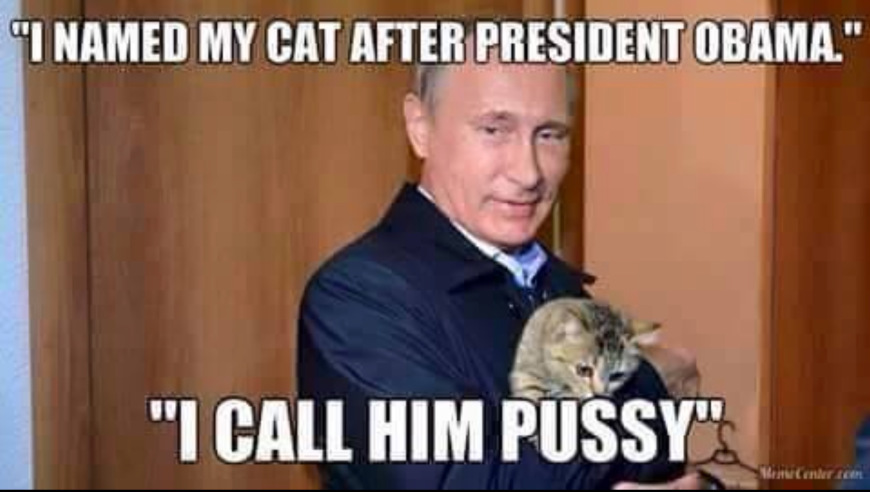
Obama-Pussy-copy

H/t Freedom is just another word

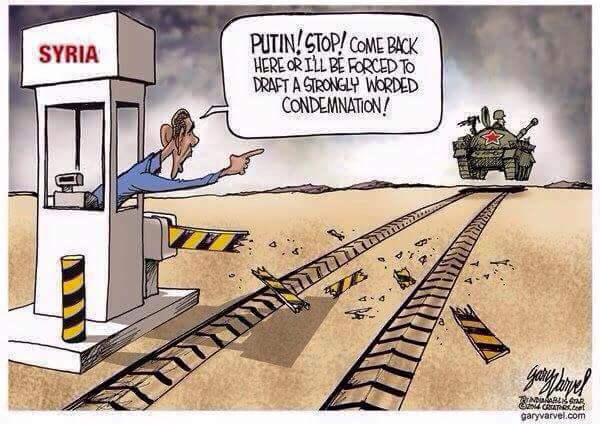
stop

Trump on Putin Controlling Syria: ‘OK, Fine,’ Him Fighting ISIS ‘Wonderful Thing,’ ‘Very Little Downside’

September 30, 2015

Trump on Putin Controlling Syria: ‘OK, Fine,’ Him Fighting ISIS ‘Wonderful Thing,’ ‘Very Little Downside’

By Ian Hanchett29 Sep 2015

Source: Trump on Putin Controlling Syria: ‘OK, Fine,’ Him Fighting ISIS ‘Wonderful Thing,’ ‘Very Little Downside’ – Breitbart

On Tuesday’s “O’Reilly Factor” on the Fox News Channel, Republican presidential candidate Donald Trump stated that it’s “a wonderful thing” Russia’s Vladimir Putin is fighting ISIS and responded “Alright, okay, fine” after host Bill O’Reilly stated Putin would “never get out” of Syria.

Trump said [relevant exchange begins around 3:55] of “in terms of leadership, he’s getting an A, and our president is not doing so well.”

When asked what he thinks Putin is doing in the Middle East, Trump stated, “Well, we spent $2 trillion, thousands of lives, wounded warriors all over, and Putin is now taking over what we started, and he’s going into Syria, and he frankly wants to fight ISIS, and I think that’s a wonderful thing. You know, I said that a year ago and everybody said oh, that’s terrible. If he wants to fight ISIS, let him fight ISIS. Why do we always have to do everything. But he wants to go in. He wants to fight ISIS. Now, he wants to keep, as you know, he wants to keep your leadership, your current leadership, Assad in Syria. Personally I’ve been looking at the different players, and I’ve been watching Assad, and I’ve been pretty good at this stuff over the years, cause deals are people. And I’m looking at Assad and saying, ‘Maybe he’s better than the kind of people that we’re supposed to be backing.’ Because we don’t even know who we’re backing.”

Trump added that there’s “very little downside with Putin fighting ISIS, and Putin wants to keep ISIS out of Russia and, therefore, he’s become very active with respect to ISIS, and I think that’s to our benefit.”

O’Reilly stated, “Once Putin gets in and fights ISIS on behalf of Assad, Putin runs Syria. He owns it. He’ll never get out, never.” Trump said, “Alright, okay, fine. I mean, you know, we can be in Syria. Do you want to run Syria? Do you want to own Syria? I want to rebuild our country.”

Trump concluded, by agreeing with O’Reilly that Putin wants to run the Middle East, adding “you have huge oil reserves. You have huge — you have tremendous wealth in the Middle East that people don’t even know about. And by the way, forget about Putin. You have Iran is going to take over Iraq. I called that many years ago, on your show. I said we should have never gone into Iraq, which I should be given a little credit for vision, because I’m the only one running that said that, but we should have never, because you totally destabilize the Middle East. But the fact is that Putin now — well, that’s what happened. you destabilized, and by the way. Iran is going to be be taking over Iraq, including their vast oil reserves, and the leftovers are taken over by ISIS. So, what have we done with our incompetent leadership?”

After O’Reilly stated, “We have given the Middle East primarily to Putin and Iran, and they will run it for the foreseeable future.” Trump responded, “I believe that’s true.”

Ya’alon: We made it clear to Russia that Israel will continue to protect its interests

September 29, 2015

Ya’alon: We made it clear to Russia that Israel will continue to protect its interests

Source: Ya’alon: We made it clear to Russia that Israel will continue to protect its interests – Breaking News – Jerusalem Post

Israel has made it clear to Russia that it will continue to act in Syria to protect its interests when necessary, and will not coordinate activities such as retaliating to Syrian cross-border fire with Moscow, Defense Minister Moshe Ya’alon said Tuesday.

He spoke a day after Russian President Vladimir Putin expressed “concern” over Israeli strikes in Syria, and two days after IDF artillery units struck two Assad regime artillery positions in response to stray, cross-border Syrian fire that struck the Golan Heights.

During visit to Gaza-border communities, Ya’alon said, “Prime Minister Netanyahu made it clear to president Putin that we are not involved in who will control Syria. Assad or not Assad, we are not entering that discussion at all. But we have interests, and when they are threatened we act, and we will continue to act. This has been clarified to the President of Russia, and here is the result. During the [Sukkot holiday] we acted against every violation or harm of our interest… those who try to violate our sovereignty – we will strike them, and those who try to transfer advanced weapons to terror elements, with an emphasis on Hezbollah, we will strike them, and those who try to transfer chemical weapons to terror elements, we will strike them.”

“We have no intention of giving up our ability to defend our interests. And I suggest that no one tests us,” Ya’alon warned.

Tiny minority of extremists: ISIS got 30,000 recruits

September 29, 2015

Tiny minority of extremists: ISIS got 30,000 recruits, Front Page Magazine, Daniel Greenfield, September 29, 2015

isis-terror

That’s 30,000 foreign fighters. Not Syrians or Iraqis. ISIS heavily depends on foreign fighters and there are plenty of Muslims from around the world who are eager to join.

Nearly 30,000 foreign recruits have now poured into Syria, many to join the Islamic State, a doubling of volunteers in just the past 12 months and stark evidence that an international effort to tighten borders, share intelligence and enforce antiterrorism laws is not diminishing the ranks of new militant fighters.

Among those who have entered or tried to enter the conflict in Iraq or Syria are more than 250 Americans, up from about 100 a year ago, according to intelligence and law enforcement officials.

Those are sizable numbers when you consider how much trouble conventional armies have filling recruitment numbers. And ISIS often pays late, though it pays well.

And those 30,000 recruits have often had to smuggle themselves in, dodge law enforcement and make difficult trips. Not only does this shut down the “ISIS is losing” narrative. But if even a group that most Muslims take issue with (mainly because it demands that they accept it or die) can pick up that many recruits, the whole “Tiny minority of extremists” narrative looks shaky.

The worse ISIS behaves, the more Muslims flock to join it. Not only isn’t its brutality a turn off, it’s a turn on. The more horribly it kills people, the more Muslims want to be part of it.

That’s just the reality and it has to be dealt with.

All these lectures on how ISIS is un-Islamic and has nothing to do with Islam haven’t fooled any actual Muslims. All they’ve done is fooled deluded Western leaders into thinking that black is white and up is down.

Report: Hezbollah to withdraw from Syria fighting

September 24, 2015

Report: Hezbollah to withdraw from Syria fighting, Israel Hayom, Daniel Siryoti and Israel Hayom, September 24, 2015

(Please see also, Russian marines join Hizballah in first Syrian battle – a danger signal for US, Israel. — DM)

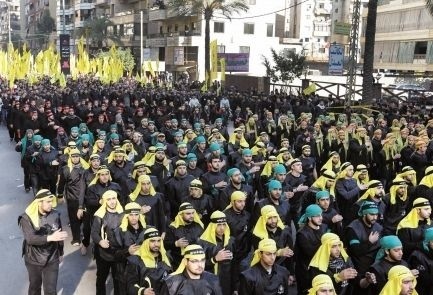
Hezbolla in BeruitHezbollah fighters march in Beirut | Photo credit: AP

Lebanese daily reports that after battle in border town of Zabadani is over, Hezbollah will focus on defensive missions and preventing spillover of fighting from Syria into Lebanon • Sources say Hezbollah wants to prepare for future conflict with Israel.

Hezbollah leaders have decided to cease military activities in Syria in the wake of criticism in Lebanon of the group’s involvement in the Syrian civil war and the high number of casualties its fighters have suffered in battles there, according to a report in Lebanon’s Daily Star newspaper.

According to the report, which was not officially confirmed by any Hezbollah officials, Hezbollah has informed Syrian President Bashar Assad that its fighters will not take further part in attacks against rebel groups and will leave Syria once the battle in the town of Zabadani, north of Damascus, has been decided.

Lebanese sources told the Daily Star that after Hezbollah secures the Lebanon-Syrian border by winning control of Zabadani, it will focus on defensive missions only and on preventing the spillover of fighting from Syria into Lebanon.

The sources also said that one of the reasons behind Hezbollah’s decision is that it has a limited number of fighting forces, and it wants to prepare for a future conflict with Israel.

Like It or Not, America and Russia Need to Cooperate in Syria

September 22, 2015

Like It or Not, America and Russia Need to Cooperate in Syria

September 17, 2015


Source: Like It or Not, America and Russia Need to Cooperate in Syria | The National Interest

Image: Flickr/Official U.S. Air Force

Many outside observers view the Russian military buildup in Syria as a way for President Putin to force his way through to the negotiating table with Barack Obama ahead of the UN General Assembly meeting in New York. There is some truth to that. To be effective, diplomacy should be backed by facts on the ground, and Moscow is busy creating them—in the face of mounting U.S. concerns. However, coercive diplomacy is just another form of diplomacy.

The current spike in Russia’s involvement in Syria, however, does not need to be linked solely to UNGA. Even without it, Moscow would now be sending more weapons and more instructors to Syria. As the Islamic State has expanded its control over more territory in Syria, it has posed more of a threat to the survival of the Russian-backed regime in Damascus. Thus, Moscow’s Plan A now is to help Bashar al-Assad keep his remaining strongholds; its Plan B is to help him secure the Alawite enclave around Latakia.

The Kremlin’s upping the ante in Syria is explained by its vision of IS as a threat to Russia itself, and Putin’s view of Assad as one who stands up to that threat and refuses to give up. Fighting the enemy abroad, by bolstering an ally is preferable, of course, to having to fight in the Caucasus or Central Asia. It is also important not to appear weak under pressure: in Putin’s memorable phrase, “the weak get beaten.”

The expansion of Russia’s military role in Syria has real risks. Both Russian political and military leaders and the Russian people still remember Afghanistan. The Kremlin, however, is probably calculating that the risks in Syria are manageable. Russia is sending advisers and technicians, crews to operate weapons systems, some support personnel and it may send pilots, but not combat troops: the pro-Assad fighters on the battlefield will continue to be Syrians, Iranians or Hezbollah.

Another risk is a potential collision with the United States and its allies, who have long been striking IS targets in Syria and who can also bomb Assad’s forces and potentially hit their Russian advisers. Russian weapons—and warplanes, if it comes to that—can in turn hit Western-backed Syrian opposition. Finally, Israel may not tolerate advanced weapons in the Syrian arsenal that can endanger the Jewish state’s security.

Diplomatically, the collision has already occurred: Washington is angry with Moscow’s policies. The Kremlin, for its part, likely believes that its firm stance would make the White House accept Russia as a player and negotiate with it on the following: de-conflicting of their parallel engagements or even on a division of labor as both countries execute their strategies in Syria; a broad anti-IS coalition, which Putin has proposed; and eventually the future of postwar Syria.

Moscow certainly hopes that cooperation with the United States and the West on Syria would blunt their confrontation over Ukraine, the Kremlin’s overriding concern. It is probably not a mere coincidence that since September 1, shelling in Donbass has died down, the leadership in Donetsk has been purged of recalcitrant figures and progress is expected on the issue of local elections next month. Right after UNGA, Vladimir Putin will be meeting in Paris with Chancellor Merkel, President Hollande and Ukraine’s Petro Poroshenko.

So far, Western reactions to the Russian activism in Syria has been largely negative. Emotionally, this is understandable. Moscow’s actions are clearly at odds with Washington’s policies on an issue very sensitive to the Obama administration. Russia is not asking for permission when it moves troops and borders in Ukraine, or when it ramps up military support for a regime that the United States has said needs to go. Moscow is visibly upgrading its politico-military presence in the key region of the Middle East. While doing so, Russian officials miss few opportunities to sneer at U.S. policies in Iraq, Libya, Yemen—and Syria.

Yet, in a deeper sense, Russian, U.S., European, Iranian, Saudi, Chinese and Indian interests are on the same side against an enemy that threatens all of them. Everyone agrees that IS must be defeated, even though they disagree on how to do it. The Obama administration is unlikely to fall for the Putin plan of a grand coalition with Moscow, Tehran and Damascus to accomplish that, but a degree of coordination is advisable. Alas, Syria as the world has known it for the past seventy years probably cannot be restored. It will have to be put together again in a wholly new way. This can only result from negotiations among the various Syrian players (minus IS), with the assistance of the international community, including the West and Russia.

Dmitri Trenin is Director of the Carnegie Moscow Center.