Posted tagged ‘Syria war’

IRGC members avoiding service in Syria: report

November 5, 2015

IRGC members avoiding service in Syria: report, World Affairs Journal, November 4, 2015

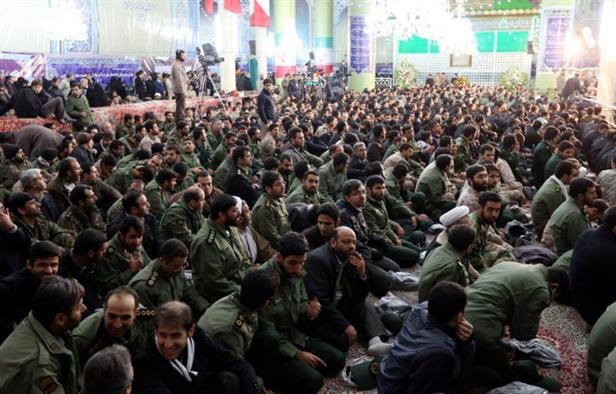
irgcafpattakenaIRGC members in a Tehran ceremony. (AFP/Atta Kenare)

BEIRUT – Officers in Iran’s Revolutionary Guard Corps (IRGC) have started to refuse deployments in Syria amid their country’s mounting casualties in the war-torn country, according to Asharq Alawsat.

 The Saudi-owned daily reported Tuesday that the IRGC has transferred a number of commanders and officers to military courts after they refused to serve in Syria.

“The IRGC’s decision came after its members were given the choice of either carrying out missions in Syria or being dismissed and banned from all government posts,” the paper cited a “well-informed source” as saying.

The source claimed that after a rising number of people asked to leave the IRGC, especially among the younger generation, the military institution was forced to review its former policy.

Members now have to “go to Syria or face court-martial with the possibility of being charged with ‘insubordination and treachery,” the unnamed source added.

“Defiance of orders and refusal to go to the battlefield in Syria is currently a source of great concern for commanders in the IRGC, which is more loyal to the Vilayat-e Faqih system [than any other Iranian institution.]”

According to the source, “some IRGC commanders in the Ahvaz region have resorted to retirement and devoting themselves to [business ventures] as they have passed retirement age.”

“The IRGC’s military court has also opened a large scale investigation in to people registering for retirement in this critical period.”

The source also said that the death of large numbers of Quds Force fighters, special forces commandos and infantrymen has compelled the these forces to resort to recruiting officers from the IRGC’s administrative departments for fear that a large number of elite forces will be killed on the battlefield.

Asharq Alawsat’s report comes amid a dramatic increase in Iranian military casualities in Syria, where Tehran has reportedly deployed hundreds of troops to fight alongside regime forces against rebels in the northwest of the country.

Last Monday, Iranian Revolutionary Guards Corps deputy chief Hossein Salami admitted that that his country was sending additional advisors to Syria, which was leading to increased casualties.

However, the IRGC official did not provide a death toll and insisted that Tehran was only sending advisors, and not combat troops.

A number of high-ranking officers have been killed in Iran in the past month, including Brigadier General Reza Khavari, a senior commander in the IRGC’s Fatemiyoun Division, General Farshad Hasounizad, the former head of the IRGC’s elite Saberin Brigade, and Hamid Mokhtarband, the former chief-of-staff of the 1st Brigade of Iran’s crack 92nd Armored Division, which is considered the country’s top armored unit.

Lower-ranking officers, including Colonel Ezzatollah Soleimani—the commander of the Elite Battalion of the 44th Hazrat Bani Hashem Brigade—have also been among the dozens killed since Iran ramped up its military intervention in Syria.

Their deaths followed the death in early October of IRGC general Hussein Hamdani, who was one of the IRGC’s leading officers and the country’s top military advisor in Syria.

Russian-made cargo plane crash in S. Sudan kills dozens. Second Mid East air disaster

November 4, 2015

Russian-made cargo plane crash in S. Sudan kills dozens. Second Mid East air disaster, DEBKAfile, November 4, 2015

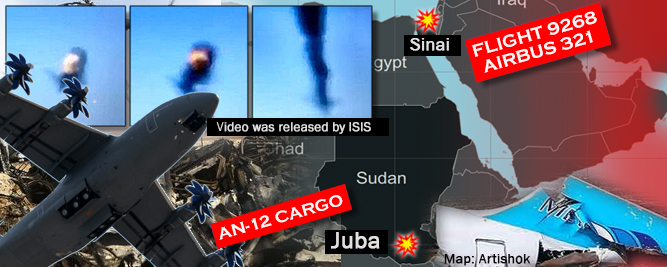
RussianPlaneSinai_Sudan2nd Russian-linked air crash kills dozens in Sudan. The missile or bomb which blew up the Russian airliner over Sinai Saturday is reported by DEBKAfile’s sources to have been likely smuggled in from Libya. Nov 4, 2015, 12:29 PM (IDT)

While neither the Egyptians or the Russians are willing to admit this, it is highly likely that the missile or explosives which brought down the Russian airliner Saturday came from Libya.

*********************

No cause has yet been established for the Russian-made Antonov Ant-12’s crash-landing on the east bank of the Nile River 800 m short of Juba international airport in South Sudan Wednesday, Nov. 4. Its five-man crew were Russians. According to first reports some 40 people were killed both on board and on the ground, although there appear to be two survivors.

But none of the 224 passengers and crew aboard the Metrojet Flight 9268 Airbus 321 survived the airliner’s crash in central Sinai Saturday, Oct. 31, en route from their holiday in Sharm El Sheikh to St. Petersburg.

Russian sources following the forensic examination of the bodies and partial remains of the victims flown to St. Petersburg report that they show evidence of an explosion in the plane before it plummeted to the ground. Further testing is required to establish the cause of the explosion.

A US infrared satellite detected a heat flash at the same time and same vicinity over Sinai where the Russian plane went down. A US defense official added that the same satellite would have been able to track the tell-tale heat trail of a missile from the ground.  “The speculation that this plane was brought down by a missile is off the table,” the official said.

Another official said, “the plane disintegrated at a very high altitude.”

The general consensus ahead of the Egyptian and Russian probes is that a sudden, catastrophic explosion caused the crash – whether from a bomb inside, “external impact” – as the Metrjet company claims – or from faulty fuel. Russian fuel experts found nothing wrong with the fuel.

An Egyptian physician who inspected the scene of the disaster found that one out of every five bodies he saw had been incinerated to death from a fire that may have started in the passenger’s cabin and spread to the rest of the plane.

Egyptian experts reported that “the large number of separate body fragments” could indicate that a strong explosion occurred onboard before the aircraft hit the ground. They were scattered across a radius of 8-10 square kilometers from the wreckage.

Russian and Egyptian sources tracking the examination of the two black boxes found evidence that the calamity occurred too rapidly for the pilots or crew to send an SOS or even say a few words.

As the probe of the air catastrophe began Tuesday and Wednesday, Moscow and Cairo were increasingly at odds on their findings. The Russians asserted that the plane must have broken up into two parts as a result of a strong explosion, whereas Egyptian officials remained intent on playing down the claim of responsibility for the crash published Saturday by the Sinai wing of the Islamic State. They criticize the Russians as rushing to conclusions ahead of the probe.

Egyptian President Abdel-Fatteh El-Sisi arrived in London Wednesday for talks with British Prime Minister David Cameron. In interviews prior to his arrival, the Egyptian president said that he will demand that David Cameron “complete his mission in Libya to prevent the country being dominated by Islamists.”

By “mission,” El-Sisi was referring to the UK’s role in the coalition which toppled Muammar Qaddafi in 2011.

DEBKAfile’s counterterrorism sources report that Egypt faces an acute problem from Libya’s transformation in the last two years into the main supply source of smuggled arms and fighters for the Islamist terrorists operating in Egypt and Sinai.

While neither the Egyptians or the Russians are willing to admit this, it is highly likely that the missile or explosives which brought down the Russian airliner Saturday came from Libya.

Satire | Drones In Syria ‘Serving Strictly In An Advisory Role’

November 2, 2015

Drones In Syria ‘Serving Strictly In An Advisory Role,’ Duffel Blog, November 2, 2015

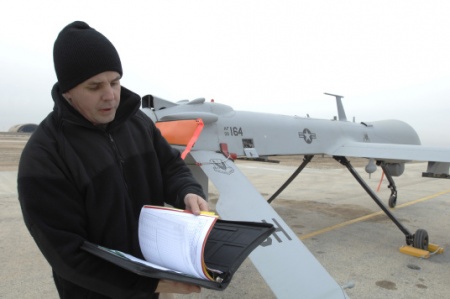
Drone-ADvisoryUS AIR FORCE PHOTO.

RAQQA, Syria — Recent increases in the tempo and nature of US operations against the Islamic State do not indicate a change in US policy, according to senior US officials, in spite of criticism that the Obama administration escalated the mission in Syria from an advisory role to a more active combat mission.

“Let me be clear: our brave drones are serving in a non-combat role,” White House Press Secretary Josh Earnest said. “Sure they might deliver sweet justice to our jihadi friends, but that’s just ‘leading by example.’”

A Predator drone operating in Syria who uses the pseudonym “Vengeance of Lindsay Graham,” spoke to Duffel Blog last week. “We’re not doing combat. Well, sort of. I led a patrol last week and we came across some ISIS jack-wagons in the clear, but the rebels I was leading weren’t ready. The training model is crawl, walk, run; they were still in a crawl phase but I was sprinting like Usain Bolt, baby!”

Despite this story, administration officials maintain that the Syrian conflict remains a strict train-and-advise mission. According to one Air Force general, who asked for anonymity because he was not authorized to talk trash on the record, “We’re advising the ISIL fighters to die, and we’re training them very quickly.”

“Besides,” Earnest said, “If we said our drones were in combat we’d probably have to get a new Authorization of Force.”


An absurd new world order

November 1, 2015

An absurd new world order, Israel Hayom, Omer Dostri, November 1, 2015

(Please see also, Supreme Leader Khamenei’s statements reported here: Leader: Negotiation with US on Regional Issues Meaningless

The Americans seek to impose their interests, not to settle problems. They want to impose 60, 70 percent of their demands via negotiations, and practically implement and impose the rest of their objectives illegally. Then what would negotiations mean?

. . . .

While many consider the Joint Comprehensive Plan of Action (JCPOA) a major breakthrough in the improvement of ties between Iran and the West, the Leader has already made it clear that Tehran’s policy toward the US will remain unchanged regardless of the ultimate fate of the JCPOA.

— DM)

Iran’s participation in the talks in Vienna on Friday on the conflict in Syria was a manifestation of new, post-nuclear deal order in both the world as a whole and the Middle East in particular.

In recent decades, the U.S. was the sole superpower in the international arena. However, that has changed during U.S. President Barack Obama’s seven years in office, and now the world is bipolar in nature, if not multipolar. The past year has seen Russia enter the international scene and take an active role, both militarily and diplomatically, in conflicts around the globe.

This is a direct result of American foreign policy in recent years, as the Obama administration sought to pivot from the Middle East to Asia. With this goal in mind, the U.S. has tried to achieve stability in the Middle East by making sure conflicting powers are balanced out with each other.

Iran’s participation in the Vienna talks was the result of this U.S. outlook which views Iran as a stabilizing agent that could serve as a counterbalance to the Sunni axis led by Saudi Arabia, Egypt and Jordan. The White House considers Iran to be geopolitically important and this has helped Iran gradually turn into a regional power.

The clearest expression of this strategic decision by the Obama administration was the nuclear deal reached between six world powers and Iran. The U.S. enabled this deal to be reached by whitewashing Iran’s violations of U.N. Security Council resolutions and it helped open international doors for Iran.

This is how Iran, previously an isolated nation in economic distress, is now accepted with open arms and is being courted by world powers as if it was an epitome of peace and reconciliation. Iran’s international status has been greatly bolstered, despite the fact is has done nothing yet to warrant the trust of world powers. For example, European Union foreign policy chief Federica Mogherini welcomed Iran’s participation in the Vienna talks and British Foreign Secretary Philip Hammond called Iran a “significant and important power in the region.”

The absurdity becomes even clearer when one considers the ballistic missile test Iran conducted on Oct. 12, which the U.S. characterized as a “clear” violation of the U.N. Security Council resolution prohibiting Iran from undertaking any work on ballistic missiles designed to deliver nuclear warheads. Furthermore, American experts said the test was not just a violation of the U.N. Security Council resolution, but also of the nuclear deal itself.

The Obama administration’s foreign policy has intentionally enabled Iran to become a significant player in global arena, while the U.S. overlooks the many resulting contradictions and dangers posed by this policy.

Iran is still committed to the destruction of Israel, continues to undermine stability in the Middle East via support for the rebels in Yemen and the brutal regime of Syrian President Bashar Assad, maintains funding of terrorist organizations such Hezbollah and Islamic jihad and incites anti-Israel violence by Palestinians in Judea and Samaria. Yet world powers — in a display of senselessness and utter detachment from reality — continue to shower Iran with praise, thus contributing to the creation of an absurd new world order.

Obama arms Islamic terrorists who called for “slaughtering Americans like cattle”

October 12, 2015

Obama arms Islamic terrorists who called for “slaughtering Americans like cattle,” Front Page Magazine, Daniel Greenfield, October 12, 2015

(Surely Obama, with access to top military and intelligence officials, knows precisely what he’s doing. Not only that, it couldn’t be his mess. Somebody else has to be blamed. Right? — DM)

logo_of_ghuraba_al-sham_front

The Syrian Civil War is a mess. Whether or not that disclaimer appears at the top of every article and post, you should assume that it does. There are factions and splinter groups that are constantly merging and reforming.

Which is why backing anyone in the war is hazardous. But here’s the latest phase of Obama’s “I don’t know what the hell I’m doing in Syria” strategy.

The U.S. military airdropped 50 tons of small arms ammo and grenades in northern Syria on Sunday, a senior defense official told Fox News, representing the Pentagon’s shift from training rebel fighters to equipping them.

Coming just two days after the Defense Department announced it was effectively ending its current training program, the airdrop delivery was made Sunday by four C-17 transport aircraft. The 112 pallets contained ammunition for M-16s and AK-47s.

This time, the official said Syrian Kurds were not recipients of the U.S. airdrop — only Syrian Arabs fighting ISIS. There is sensitivity in Washington over arming Syrian Kurds, whom Turkey sees as an enemy but the U.S. counts as a NATO ally.

Who is actually getting the weapons? Here’s whom the weapons are meant to be going to…

The alliance calling itself the Democratic Forces of Syria includes the Kurdish YPG militia and Syrian Arab groups, some of which fought alongside it in a campaign that drove Islamic State from wide areas of northern Syria earlier this year.

The Arab groups in the new alliance are operating under the name “The Syrian Arab Coalition” – a grouping which U.S. officials have said would receive support under a new U.S. strategy aimed at fighting Islamic State in Syria.

So Turkey has forced the US to deny weapons to the Kurdish part of the alliance. The Syriac Military Council is in the alliance too, but it’s unclear if they’re getting resupplied.

So that just leaves the Syrian Arab Coalition. And who is in the Syrian Arab Coalition?

“We met the Americans and this has been approved and we have been told these new arms … are on their way,” said Abu Muazz, a spokesman for the Raqqa Revolutionaries Front, a grouping of mainly Arab tribal insurgents who are mostly drawn from the Raqqa area.

Tribal insurgents. Sounds okay, right? Except that name doesn’t appear to be in use. This may be the Raqqa Revolutionaries’ Brigade whose Arabic name is Liwa Thuwwar al-Raqqa which was formerly allied with the Al Nusra Front… which is Al Qaeda. Since then Liwa claims to have split from Nusra and is fighting ISIS. But Nusra is also fighting ISIS.

Aymenn Jawad Al-Tamimi has a summary of the relationship that runs several paragraphs. (The Syrian Civil War is a mess. See above.)

The new alliance includes the YPG, various Arab groups including Jaysh al-Thuwwar (Army of Rebels) and the Arab tribal Jaysh al-Sanadeed, and an Assyrian Christian group, according to a statement announcing its establishment.

Except we’re apparently not arming the YPG. It’s unclear if we’re arming the Assyrians. But we are arming Jaysh al-Thuwwar, which is a coalition of a bunch of other groups formerly part of the FSA. The Sanadeed appear to actually be closely linked to the YPG.

But it gets messier from here.

Another faction in the new coalition, Jaysh al-Qasas, worked with IS in 2014. FSA commanders say its leader spends most of his time in Turkey and his fighters are most interested in looting.

Of course the FSA, which used to be US backed, has every reason to trash talk the current aid recipients.

“They are fighters who have moved from one militia to another,” says Abdul Rahman, a commander with the Army of Mujahideen , which is aligned with Jaish al Fata, or the Army of Conquest, the Islamist rebel alliance.“Most of them are rejects. They are not reliable — we don’t trust them,” he told VOA.

“I generally agree with the testimony of those rebels you have spoken to,” says Aymenn Jawad al-Tamimi, a fellow at U.S.-based think tank the Middle East Forum. He says that armed groups in one of the largest of the factions, the Dawn of Freedom, have “reputations for corruption.”

“The main groups of the coalition are splinters from larger rebel militias and in the case of Dawn of Freedom it is essentially a regrouping of militias that had reputations for criminality in North Aleppo, such as Ghuraba al-Sham,” he told VOA. Some of the factions were thrown out of an Islamist rebel alliance.

Al-Tamimi added: “The other components of the rebel allies with the YPG are small groups of locals who fled their homes in Deir ez-Zor and Jarabulus” after the Islamic State overran the towns. Some are members of the Shammar tribe in eastern Syria, which has suffered repeated IS reprisals and massacres.

Opportunists is about the nicest thing we could say about them. But it also means they’re likely to resell weapons or engage in fake battles. And when a lot of fighters move from one militia to another, we could very well end up directly arming ISIS or Al Qaeda groups.

But don’t worry, when this falls apart, Obama will blame Hillary Clinton or McCain and claim that he never wanted to do it in the first place. Because Obama never takes responsibility.

Oh by the way, here’s something on Ghuraba al-Sham.

Ghuraba al-Sham comprising mainly Turks and fighters from former Soviet bloc countries…

As Syrian preacher Dr. Mahmud al-Aghasi, known as Abu al-Qaqa, left an Aleppo mosque after Friday prayers on September 28, an assassin stepped out of a car and opened fire with an automatic weapon. The controversial preacher received mortal wounds to the head and body, while three others were wounded. Little information on the case has emerged from the normally secretive and tightly controlled Syrian state. Most of what is known comes from al-Qaqa’s own followers in Ghuraba al-Sham (Strangers of Greater Syria), some of whom chased the killer for two to three kilometers before apprehending him.

It gets worse. Much, much worse.

On the CDs, Abu al-Qaqa is shown speaking to worshipers under the banner of a then-unknown group, Guraba al-Sham (Strangers of Greater Syria). This became the umbrella under which he operated, and whose name was imprinted on all of his CDs. On camera, he tells his followers, who are assembled before him at a mosque: “We will teach our enemies a lesson they will never forget.” He then asks: “Are you ready?” Thundering chants respond affirmatively from his audience, who get worked up into tears as they listen, and he carries on: “Speak louder so [US President George W Bush] can hear you!” Their tears make him weep as well, as he gets impassioned with anti-Americanism and adds: “Guests have come to our land … slaughter them like cattle. Burn them! Yes, they are the Americans!”

So that’s who we’re arming. The pet militia of a guy who played a key role in funneling terrorists to kill Americans in Iraq.

Today the Iraqi government aired the confession of Mohammed Hassan al Shemari, a Saudi al Qaeda member who claims to be the leader of the terror group’s forces in Diyala province. Sherari said Syrian intelligence, or the Mukhabarat, actively supports al Qaeda in Iraq. From Reuters:

Shemari said when he arrived in Syria from Saudi Arabia, he was met by a militant who took him to an al Qaeda training camp in Syria. The head of the camp was a Syrian intelligence agent called Abu al-Qaqaa, he said. “They taught us lessons in Islamic law and trained us to fight. The camp was well known to Syrian intelligence,” he said.

Once inside Iraq he undertook more training in its vast desert province of Anbar, bordering Syria, alongside 30 other foreign fighters. He then met a purported al Qaeda in Iraq leader, Omar al-Baghdadi, who he said appointed him head of al Qaeda in the violent Diyala province.

He launched gun attacks on police checkpoints in Diyala, kidnapping Iraqi officers and extorting money for their release or killed them with knives and set up suicide bombings, he said.

Assad at the time was collaborating with Al Qaeda in conducting attacks on Americans. Which is why all the Russian propaganda claiming that the US created ISIS and that Assad is the only bulwark against them is laughable. Assad was their former pal. Guraba al-Sham is a group of former Jihadists backed by Assad to kill Americans that turned against Assad.

And their dead leader really hated America.

“Our hearts are filled with joy when we hear about any resistance operations in Iraq against the American invaders. We ask people to keep praying to Allah to help achieve victory for Iraq against the US,” Sheikh Qaqa says.

Qaqa’s Islamic values go far beyond vocal – and popular – hostility toward US Mideast policy. For example, he openly calls for an Islamic state based on sharia law in Syria…

“Yes, I would like to see an Islamic state in Syria and that’s what we are working for,” Qaqa says. There are even indications that Qaqa’s support base is becoming organized. His followers hold meetings in a building that serves as an office and library. Several of his followers wear camouflage military trousers.

So we’re arming the Islamic State to fight the Islamic State. It’s a plan that can’t fail.

Sheikh Qaqa was also known as the godfather of Fatah al-Islam. Fatah al-Islam was officially classified as a terror group under Bush, but not under Obama. It was inspired by Al Qaeda and worked with Zarqawi, the leader of what would become ISIS.

It attempted to carry out terrorist attacks in Europe and it’s currently allied with ISIS.

Heck of a job, John Kerry. Heck of a job.

Fast-roping toward war in the Middle East

October 10, 2015

Fast-roping toward war in the Middle East, Washington Times, Ken Allard, October 8, 2015

(Oh well,


Not on our side

— DM)


Home to the Arab world’s largest population and the region’s geopolitical crossroads, Egypt had been a key American strategic ally ever since Anwar Sadat. But Mr. Obama backed the Islamist dictatorship of Mohammed Morsi, even after 30 million Egyptians took to the streets in July, 2013 to force his overthrow. When Mr. Obama cut off military ties with the new Egyptian regime of President Abdel Fattah al-Sisi, the Russians swiftly stepped in to reverse a generation of American statecraft. Unlike the amateurs in the West Wing, Russian strategists and diplomats have no difficulty connecting dots or reading maps.

Neither do our few remaining allies in the Middle East, who can be forgiven for drawing their own conclusions, given the Egyptian reversal, those Syrian red-lines, the recent Iranian arms control deal and the steady expansion of Iranian influence throughout the region.

*****************************

The Russians are rapidly reinforcing their bridgehead in Syria, adding ground troops to their air, marine and naval forces. It is a classic air, land and sea intervention by a military establishment that understands how combined arms build synergies and broaden capabilities. As Jed Babbin pointed out in these pages on Wednesday, the broad-shouldered Russian intervention is the direct counterpoint to the “inaction, indecision and dithering” that have long characterized President Barack Obama’s foreign policy.

Russian President Vladimir Putin has called Mr. Obama’s bluff. He has also deployed a Russian expeditionary force bristling with robust anti-aircraft and ground-attack weapons, even firing cruise missiles from warships in the Caspian Sea. Such a deployment is precisely what Mr. Putin believes necessary to insure that Russian jets and helicopters dominate the skies over Syria. Fox News reports that Russian jets have already shadowed U.S. Predator drones on three occasions, a quiet but unsubtle message that the unmanned aircraft are flying only because of Russian forbearance.

Depending solely on Mr. Putin’s strategic objectives, that prevailing restraint can vanish in an instant. Union and Confederate commanders, for example, routinely practiced counter-reconnaissance throughout the Shenandoah Valley campaign of 1864. When planning a surprise attack or defending a vulnerable position, their first objective was to prevent enemy cavalry from having an unobstructed view of one’s own dispositions. What cavalry did back then, air forces and satellites do today.

Updating an ancient principle for the digital age, Norman Schwarzkopf destroyed Saddam Hussein’s radars, reconnaissance systems and intelligence assets before American airpower launched the opening salvos of Operation Desert Storm. Today’s Russian generals grew up practicing the basic principles of Soviet electronic warfare: Intercept the enemy’s communications, jam him or destroy him. Above all: Use the electromagnetic spectrum and state-of-the-art Russian air defenses to offset hi-tech American airpower. In Syria, that campaign has already begun.

Pandering to an American public that is militarily and strategically illiterate, some presidential candidates have reflexively called for “no-fly zones” to be set up in Syria. Predictably, Donald Trump has even expressed enthusiasm for Mr. Putin’s alleged intent to combat ISIS. But seriously, folks, why would Vladimir Putin go to the considerable trouble of staging the largest foreign deployment of Russian forces since the Cold War only to cater to western conceits about no-fly zones? Even if he did, who would set up and enforce them? Having made a power play to control Syria (and therefore a major chunk of the Middle East) why on earth would Mr. Putin content himself solely with attacking ISIS? (If you are having trouble following this logic, then you probably are a member of the White House staff “perplexed” by Russian objectives.

As a highly trained KGB apparatchik, Syria is not Mr. Putin’s first rodeo. While it has become obligatory in Washington policy salons to deplore Crimea and eastern Ukraine, Egypt’s recent history offers a better clue to Russia’s long-range goals.

Home to the Arab world’s largest population and the region’s geopolitical crossroads, Egypt had been a key American strategic ally ever since Anwar Sadat. But Mr. Obama backed the Islamist dictatorship of Mohammed Morsi, even after 30 million Egyptians took to the streets in July, 2013 to force his overthrow. When Mr. Obama cut off military ties with the new Egyptian regime of President Abdel Fattah al-Sisi, the Russians swiftly stepped in to reverse a generation of American statecraft. Unlike the amateurs in the West Wing, Russian strategists and diplomats have no difficulty connecting dots or reading maps.

Neither do our few remaining allies in the Middle East, who can be forgiven for drawing their own conclusions, given the Egyptian reversal, those Syrian red-lines, the recent Iranian arms control deal and the steady expansion of Iranian influence throughout the region. Because it is a tough and unforgiving neighborhood, where would you place your bets if you lived there? Do you ally yourself with the rising regional power or the one seemingly intent only on defeat and retreat? As a friend points out, “Obama only attacks oilmen, Wall Street, the police, pro-lifers, the NRA, Christians, conservative Republicans, and traditional U.S. allies. Remember when they were the good guys?”

In this confusing world, it is important to remember that things can get worse, particularly given the fog of war with lots of heavily armed aircraft moving at high speeds over surprisingly small operating areas. War is justly famed for confounding the best intentions, for proving that the only assumption which holds true is the one you were certain could never happen.

How ironic that the place where three of the world’s great religions were born might yet spark a global confrontation where no holds are barred.

The Moscow-Washington-Tehran Axis of Evil

October 3, 2015

The Moscow-Washington-Tehran Axis of Evil, Canada Free PressCliff Kincaid, October 3, 2015

(I am not posting this because I currently accept its conclusions or some of their bases. However, it’s frightening, interesting and has at least some food for thought. — DM)

KINCAID100315

The conventional wisdom is that Vladimir Putin has blindsided Barack Obama in the Middle East, catching the U.S. off-guard. It’s another Obama “failure,” we’re told. “Obama administration scrambles as Russia attempts to seize initiative in Syria,” is how a Washington Post headline described it. A popular cartoon shows Putin kicking sand in the faces of Obama and Secretary of State John Kerry on a beach.

The conventional wisdom is driven by the notion that Obama has the best of intentions but that he’s been outmaneuvered. What if his intention all along has been to remake the Middle East to the advantage of Moscow and its client state Iran? What if he knows exactly what he’s doing? Too many commentators refuse to consider that Obama is deliberately working against U.S. interests and in favor of the enemies of the U.S. and Israel.

In his U.N. address, Obama said, “As President of the United States, I am mindful of the dangers that we face; they cross my desk every morning. I lead the strongest military that the world has ever known, and I will never hesitate to protect my country or our allies, unilaterally and by force where necessary.”

This is laughable. We still have a strong military, but the inevitable conclusion from what’s recently transpired is that he doesn’t want to protect the interests of the U.S. or its allies in the Middle East. This is not a “failure,” but a deliberate policy.

The trouble with conventional wisdom is the assumption that Obama sees things the way most Americans do. In order to understand Obama’s Middle East policy, it is necessary to consult alternative sources of news and information and analysis. That includes communist news sources.

A fascinating analysis appears in the newspaper of the Socialist Workers Party, The Militant, one of the oldest and most influential publications among the left. You may remember the old photos which surfaced of Lee Harvey Oswald selling copies of The Militant before he killed the American president.

The headline over The Militant story by Maggie Trowe caught my eye: “‘Reset’ with US allows Moscow to send arms, troops to Syria.” It was not about Hillary Clinton’s reset with Moscow years ago, but a more recent one.

Here’s how her story began: “Moscow’s rapid military buildup in Syria is a result of the ‘reset’ in relations forged with the Russian and Iranian governments by the Barack Obama administration. The deal—reshaping alliances and conditions from Syria, Iran and the rest of the Middle East to Ukraine and surrounding region—is the cornerstone of U.S. imperialism’s efforts to establish a new order in the Mideast, but from a much weaker position than when the now-disintegrating order was imposed after World Wars I and II.”

Of course, the idea that “U.S. imperialism” is served by giving the advantage to Russia and Iran is ludicrous. Nevertheless, it does appear that a “reset” of the kind described in this article has in fact taken place. The author writes about Washington’s “strategic shift to Iran and Russia” and the “downgrading” of relations with Israel and Saudi Arabia. She notes that Moscow “seeks more influence and control of the country [Syria] and its Mediterranean ports and a stronger political hand in Mideast politics.” Iran “has sent Revolutionary Guard Quds forces to help prop up Assad, and collaborates with Moscow on operations in Syria,” she notes.

It is sometimes necessary to reject the conventional wisdom and instead analyze developments from the point of view of the Marxists, who understand Obama’s way of thinking. They pretend that Obama is a pawn of the “imperialists” but their analysis also makes sense from a traditional pro-American perspective. Those who accept the evidence that Obama has a Marxist perspective on the world have to consider that his policy is designed to help Moscow and Tehran achieve hegemony in the region.

At the same time, the paper reported, “Since Secretary of State John Kerry’s congenial visit with Putin in May, it has become clear that Washington would accept Moscow’s influence over its ‘near abroad’ in Ukraine and the Baltics, in exchange for help to nail down the nuclear deal with Tehran.” Hence, Obama has put his stamp of approval on Russian aggression in Europe and the Middle East. This analysis, though coming from a Marxist newspaper, fits the facts on the ground. It means that more Russian aggression can be expected in Europe.

The wildcard is Israel and it looks like the Israeli government is being increasingly isolated, not only by Obama but by Putin. The story notes that Israeli Prime Minister Benjamin Netanyahu met with Putin in Moscow on September 21, saying his concern was to “prevent misunderstandings” between Israeli and Russian troops, since Israel has carried out airstrikes in Syrian territory targeting weapons being transported to the Iranian-backed Hezbollah terrorists in Lebanon.

Some reports indicated that Israel had set up a joint mechanism with the Russian military to coordinate their operations in Syria.

However, the Russian leader reportedly told Obama during their U.N. meeting that he opposes Israeli attacks in Syria. The Israeli newspaper Haaretz ran a story that Russia intends to “Clip Israel’s Wings Over [the] Syrian Skies.” The paper added that Putin’s remarks to Obama showed that despite Netanyahu’s meeting with Putin in Moscow, “Russia intends to create new facts on the ground in Syria that will include restricting Israel’s freedom of movement in Syrian skies.”

It hardly seems to be the case that Obama has been outsmarted in the Middle East, or that Putin and Obama don’t like each other. Instead, it appears that Obama is working hand-in-glove with Putin to isolate Israel and that Obama is perfectly content to let the former KGB colonel take the lead.

Israel has always been seen by most U.N. members as the real problem in the region. Obama is the first U.S. President to see Israel in that same manner and to act accordingly. This is why Putin has not caught Obama off-guard in the least. They clearly see eye-to-eye on Israel and Iran.

Don’t forget that Obama actually telephoned Putin to thank him for his part in the nuclear deal with Iran. The White House issued a statement saying, “The President thanked President Putin for Russia’s important role in achieving this milestone, the culmination of nearly 20 months of intense negotiations.”

Building off the Iran nuclear deal, it looks like the plan is for Russia and the United States to force Israel to embrace a U.N. plan for a nuclear-free Middle East. That would mean Israel giving up control of its defensive nuclear weapons to the world body. Iran will be able to claim it has already made a deal to prohibit its own nuclear weapons development.

Such a scheme was outlined back in 2005 in an article by Mohamed Elbaradei, the director-general at the time of the U.N.‘s International Atomic Energy Agency (IAEA). That’s the same body that is now supposed to guarantee Iranian compliance with the terms of the nuclear deal signed by Russia and the U.S.

Elbaradei argued there would have to be “a dialogue on regional security as part of the peace process,” to be followed by an agreement “to make the Middle East a nuclear-weapons-free zone.”

The “dialogue” appears to be taking place now, mostly under the authority and auspices of the Russian government, with President Obama playing a secondary role.

The obvious danger is that Israel would be forced to comply with the plan for a “nuclear-weapons-free-zone,” while Iran would cheat and develop nuclear weapons anyway.

Netanyahu told the U.N. that “Israel deeply appreciates President Obama’s willingness to bolster our security, help Israel maintain its qualitative military edge and help Israel confront the enormous challenges we face.”

This must be his hope. But he must know that Israel’s security is slipping and that the survival of his country is in grave danger in the face of this Moscow-Washington-Tehran axis.

Before Putin further consolidates his military position in the Middle East and Iran makes more progress in nuclear weapons development, Netanyahu will have to launch a preemptive strike on the Islamic state. “Israel will not allow Iran to break in, to sneak in or to walk in to the nuclear weapons club,” the Israeli Prime Minister said.

In launching such a strike before the end of Obama’s second presidential term, Israel would bring down the wrath of the world, led by Russia and the U.S., on the Jewish state.

Israel’s Risk Aversion Problem

October 2, 2015

Israel’s Risk Aversion Problem, Town Hall, Caroline Glick, October 2, 2015
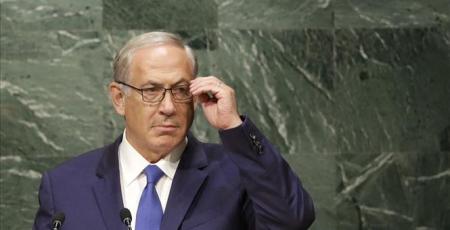
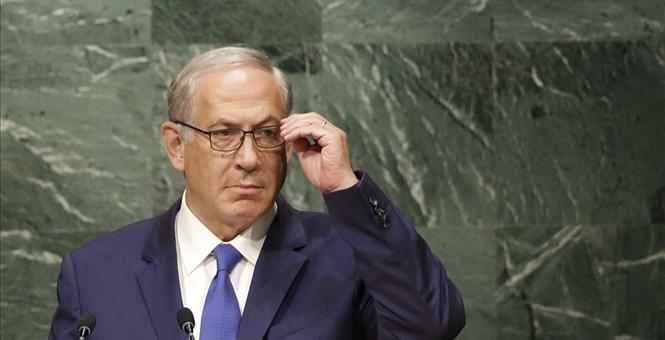
Netanyahu and glasses

Because his strategy is based on ideological beliefs rather than power calculations rooted in reality, Obama’s position cannot be swayed by evidence, even when evidence shows that his administration’s policies endanger US national security.

The more Israel allows other actors to determine the nature of the emerging regional order, the less secure Israel will be. The more willing we are to take calculated risks today the greater our ability will be to influence the future architecture of regional power relations and so minimize threats to our survival in the decades to come.
***********************

On Wednesday the Obama administration was caught off guard by Russia’s rapid rise in Syria. As the Russians began bombing a US-supported militia along the Damascus-Homs highway, Secretary of State John Kerry was meeting with his Russian counterpart, Sergei Lavrov, at the UN. Just hours before their meeting Kerry was insisting that Russia’s presence in Syria would likely be a positive development.

Reacting to the administration’s humiliation, Republican Sen. John McCain said, “This administration has confused our friends, encouraged our enemies, mistaken an excess of caution for prudence and replaced the risks of action with the perils of inaction.”

McCain added that Russian President Vladimir Putin had stepped “into the wreckage of this administration’s Middle East policy.”

While directed at the administration, McCain’s general point is universally applicable. Today is no time for an overabundance of caution.

The system of centralized regimes that held sway in the Arab world since the breakup of the Ottoman Empire nearly a century ago has unraveled. The shape of the new order has yet to be determined.

The war in Syria and the chaos and instability engulfing the region are part and parcel of the birth pangs of a new regional governing architecture now taking form. Actions taken by regional and global actors today will likely will influence power relations for generations.

Putin understands the opportunity of the moment.

He views the decomposition of Syria as an opportunity to rebuild Russia’s power and influence in the Middle East – at America’s expense.

Russia isn’t the only strategic player seeking to exploit the war in Syria and the regional chaos. Turkey and Iran are also working assiduously to take advantage of the current absence of order to advance their long term interests.

Turkish President Recep Tayyip Erdogan is exploiting the rise of Islamic State in Syria and Iraq to fight the Kurds in both countries. Erdogan’s goal is twofold: to prevent the establishment of an independent Kurdistan and to disenfranchise the Kurds in Turkey.

As for Iran, Syria is Iran’s bulwark against Sunni power in the Arab world and the logistical base for Tehran’s Shi’ite foreign legion Hezbollah. Iranian dictator Ali Khamenei is willing to fight to the bitter end to hold as much of Syrian territory as possible.

Broadly speaking, Iran views the breakup of the Arab state system as both a threat and an opportunity.

The chaos threatens Iran, because it has radicalized the Sunni world. If Sunni forces unite, their numeric advantage against Shi’ite Iran will imperil it.

The power of Sunni numbers is the reason Bashar Assad now controls a mere sixth of Syrian territory. To prevent his fate from befalling them, the Iranians seek to destabilize neighboring regimes and where possible install proxy governments in their stead.

Iran’s cultivation of alliances and proxy relationships with Hamas, the Muslim Brotherhood and al-Qaida, and its phony war against Islamic State all point to an overarching goal of keeping Sunni forces separated and dependent on Tehran.

The Iranian regime also fears the prospect of being overthrown by its domestic opponents. To counter this threat the regime engages in large-scale and ever escalating repression of its perceived foes.

Iran’s nuclear program also plays a key role in the regime’s survival strategy. As Khamenei and his underlings see things, nuclear weapons protect the regime in three ways. They deter Iran’s external foes. They increase domestic support for the regime by enriching Iran which, no longer under international sanctions, sees its diplomatic and economic prestige massively enhanced due to its nuclear program.

Finally, there is Iran’s war with Israel and the US. A nuclear-armed Iran is a direct threat to both countries.

And this, too, is a boon for the mullacracy. From the regime’s perspective, fighting Israel and the US serves to neutralize the Sunni threat to the regime. The more Iran is seen as fighting Israel and the US the more legitimate it appears to Sunni jihadists.

This then brings us to the Americans. Like the Russians, the Turks and the Iranians, President Barack Obama and his associates are strategic players. Unlike those powers however, the administration is moved not by raw power calculations but by ideological dictates.

Obama and his advisers are convinced that the instability and radicalization of states and actors throughout the region is the consequence of the actions of past US administrations and those of America’s regional allies – first and foremost, Israel and Egypt. The basis for this conviction is the administration’s post-colonial ideological underpinnings.

Because his strategy is based on ideological beliefs rather than power calculations rooted in reality, Obama’s position cannot be swayed by evidence, even when evidence shows that his administration’s policies endanger US national security.

This brings us to Israel.

Israel has limited power to influence regional events.

It cannot change its neighbors’ values or cultures. Israel can however limit its neighbors’ ability to harm it and expand its ability to deter would be aggressors by among other things, using its power judiciously to influence now forming power balances between various regional and world actors.

Israel has followed this model in Syria with notable success.

At an early stage of the war our leaders recognized that aside from the Kurds, who have no shared border with us, there are no viable actors in Syria that are not dangerous to Israel. As a result, Israel has no interest in the victory of one group against others.

The only actor in Syria that Israel has felt it necessary to actively rein in is Hezbollah. So it has acted repeatedly to prevent Hezbollah from using its operational presence in Syria as a means for augmenting its offensive capabilities in Lebanon.

The problem with this strategy is that it has ignored the fact that from Hezbollah’s perspective, there is no operational difference between Lebanon and Syria.

The war in Syria spread to Lebanon years ago.

Now, with Iranian and Russian assistance, Hezbollah is beginning to develop the industrial capacity to bypass Israel and independently produce advanced weapons inside Lebanon. This rapid industrialization of Hezbollah’s military capabilities requires Israel to end its respect for the all-but-destroyed international border and take direct action against Hezbollah’s capabilities in Lebanon.

This brings us to Hezbollah’s boss, Iran. For the past several years, the same caution that has led Israel to grant de facto immunity to Hezbollah forces in Lebanon has led to Israel’s passivity and deference to the Obama administration in relation to Iran’s nuclear program.

With regard to Iran’s nuclear installations, the strategy of passivity has largely been forced onto an unwilling political leadership by Israel’s military leaders.

For the past several years, the IDF’s General Staff has refused to support the government’s position on Iran’s nuclear program.

Our military leaders have justified their insubordination by arguing that if Israel takes independent action against Iran’s nuclear program it will undermine its bilateral relations with the US, which they consider more important than preventing Iran from acquiring nuclear weapons.

Although under the best of circumstances, the IDF’s position would be unacceptable from the perspective of democratic norms of governance, since the ideologically driven Obama administration took power seven years ago, the military’s position has imperiled the country.

So long as Obama – or the ideology that informs his actions – remains in power in Washington, US security guarantees towards Israel will have no credibility.

The IDF’s assessment that ties to the US are more important than preventing Iran from becoming a nuclear power will remain incorrect, and dangerously so.

Today is Israel’s opportunity to shape the future of the Middle East by not only preventing Iran from becoming a nuclear power, but by preventing a regional nuclear arms race.

The closer Iran comes to emerging as a nuclear power, the more Sunni regimes, including Islamic State, will seek their own nuclear capabilities. It goes without saying that the more regional actors have nuclear weapons, the more dangerous the region becomes for Israel, and indeed for the world as a whole.

For many Israelis, the story of the week wasn’t Russia’s air strikes against US-allied forces in Syria. It was PLO chief and Palestinian Authority President Mahmoud Abbas’s speech at the UN General Assembly.

Leftists expressed horror in the face of Abbas’s threat to end the PLO’s adherence to the agreements it signed with Israel in the 1990s (and has stood in material breach of ever since). The government insisted, for its part that the reason the peace process has not brought peace is because Abbas and his PLO refuse to negotiate with Israel.

Unfortunately, both sides’ responses to Abbas’s speech indicate that Israel has lost all semblance of strategic purpose in regard to the Palestinians.

Fifteen years ago this week, on September 28, 2000, the Palestinians opened their terrorist war against Israel. Ever since it has been clear that no Palestinian faction is interested in living at peace with Israel.

Despite this, for the past 15 years, Israel has refused to reconsider its strategic allegiance to the false notion that it has the ability to influence the hearts and minds of the Palestinians and bend them in the direction of peace.

This delusional thinking is what caused the IDF’s General Staff to convene immediately after Operation Protective Edge ended and try to figure out how to rebuild Gaza.

Ever since the cease-fire came into force, Hamas has diverted all the assistance it has received from Israel and the international community not to rebuild Gaza, but to rebuild its military capacity to harm Israel. And yet, from the IDF’s perspective, ever since the war ended our most urgent task has been to save Hamas and the Palestinians alike from reckoning with the price of their aggression.

Likewise, Israel continues to insist that we have a strategic interest in peace with the PLO. Even if this is true in theory, chances are greater that unicorns will fall from the sky and prance through Jerusalem’s Old City than that the PLO will agree to make peace with Israel.

Our continued defense of the PLO as a legitimate actor harms our ability to secure other strategic interests that are achievable and can improve Israel’s regional position. These interests include securing transportation arteries in Judea and Samaria and strengthening Israel’s military and political control over the areas. These interests have only grown more acute in recent years with the rise of jihadist forces throughout the region and among the Palestinians themselves.

This brings us back to McCain and his strategic wisdom.

Israel must not allow the risks of action to lure us into strategic paralysis that imperils our future.

The more Israel allows other actors to determine the nature of the emerging regional order, the less secure Israel will be. The more willing we are to take calculated risks today the greater our ability will be to influence the future architecture of regional power relations and so minimize threats to our survival in the decades to come.

Putin to Obama: Kiss my…

September 29, 2015

Putin to Obama: Kiss my… , Power LineScott Johnson, September 29, 2015

It’s a sort of PUTIN TO OBAMA moment. Cameron Joseph’s cover story is here. Like everyone else in world politics — everyone outside the White House, that is — Putin has Obama’s number.

NYDN

Finally, A Plan To Defeat the Islamic State

September 28, 2015

Finally, A Plan To Defeat the Islamic State, Town HallJim Hanson, September 28, 2015

(Obama would need the approvals of Putin, Xi, Rouhani, Assad, Erdogan and “our” other “peace partners” as well as his trained seals at the Department of Defense. Then, and only then, could General Bowie Bergdahl lead his march to victory. Or something. —  DM)

Black flag

What if there was an actual strategy to defeat ISIS and stop their reign of terror? The state of affairs and the very existence of IS as a governing entity is intolerable so we developed a strategy called Cut Down the Black Flag – A Plan to Defeat the Islamic State, the second book in the Secure Freedom Strategy series.

President Obama has failed to articulate or implement anything resembling a strategy during his time in office. This fact is even more painful when considering the rise of the Islamic State (IS) occurred on his watch and was largely due to his shortsighted and foolish decision to cut and run from Iraq. He lost the peace after our troops won the war.

Unlike the President, we’re not interested in token gestures doomed to failure as IS kills, rapes, and tortures on ground won for freedom just a few short years ago. We will not stand on the sidelines as an Inter-Continental Caliphate calls for “Death to all Infidels.” We have a plan to win and cut down their blood-soaked, Black Flag of Jihad.

It will not be easy but it is an essential part of the war for the free world. If we do not make a full faith effort to destroy IS, we will have done a disservice to all who gave their lives and limbs to free Iraq from tyranny. We will also be leaving millions to suffer the chaos and killing fields created when the inevitable vacuum of our withdrawal was filled by IS and Iran.

This book details a strategy focused on victory, aimed for stability in the region with the possibility of actual peace. It recognizes this action must be part of a greater “long war” against the whole of the Global Jihad Movement (GJM). They are the collection of groups who, while not officially associated, share a belief in Islamic Supremacy and are working actively to achieve it.

The Violent Jihadists like the Islamic State, Al Qaeda and others are easily identifiable as our enemies. The Civilization Jihadists of the Muslim Brotherhood and the groups it has spawned such as Council on American-Islamic Relations (CAIR) and the Islamic Society of North America (ISNA) are less overt but perhaps even more dangerous. Our overall strategy to defeat the Global Jihad Movement with a whole of government and culture approach is detailed in the Secure Freedom Strategy.

Our plan to defeat the Islamic State is a complete departure from the dismal failures of the current Commander in Chief leading from behind. The military might and will to win of the United States are vital to any chance of success. This does not mean we propose rolling tanks in a thunder run from Baghdad to Damascus. But we must take the handcuffs off the forces we already have deployed by allowing them to participate in combat missions with the forces they have trained to provide command and control and direct fire support. We must remove the cumbersome and overly risk-averse process for airstrikes that leave most of our aircraft returning to base with all munitions unused.

We must also work with the Sunni tribes who helped us defeat the precursor to IS; and, arm the Kurds who are our best friend and truest ally in the region. Both of these groups were left to the mercy of a central Iraqi government when U.S. forces withdrew and Iranian influence became dominant. We must look to a future where they govern by self-determination rather than remain forced into artificial borders established nearly 100 years ago; and, that have been largely erased over the recent war-torn years.

Our strategy is ambitious, but it does not require large deployments of U.S. troops or the expectation we will be the sole guarantor of security going forward. We aim to cut off the head of the jihadist snake by empowering the indigenous people who have suffered the most from its actions and then let them govern themselves. This strategy vigorously executed can do what the current half-hearted efforts never will: Defeat the Islamic State.