Posted tagged ‘Saudi Arabia’

Saudis Sentence Brit to 350 Lashes for Possession of Wine

October 13, 2015

Saudis Sentence Brit to 350 Lashes for Possession of Wine, The Clarion Project, October 13, 2015

(The UN Human Rights Council, of which Saudi Arabia is the head, must be very proud of that splendid nation’s human rights achievements. — DM)

Karl-Andree-640-320Karl Andree, right. (Screenshot from video)

In a case that has recently become public, a British citizen was sentenced to 350 lashes and one year in jail by the Saudi regime after morality police found homemade wine in his car.

All alcohol is strictly prohibited in the Gulf kingdom which enforces sharia law as state law.

Karl Andree, 74, has already served the one year in prison. The sharia court which sentenced him mandated that the flogging would occur at the end of his prison time and in public.

Andree is in poor health, and it is not believed he will survive the flogging. He is being held in Jeddah’s Briman prison. Prior to his arrest he was an oil executive who worked in Saudi Arabia for 25 years.

His three children, Hugh, 46, Kirsten, 45, and Simon, 33, have now gone public with the story, though the incident took place last year in the port city of Jeddah. They are now calling on UK Prime Minister David Cameron to intervene with Saudi Arabia to secure his release.

“Our father has given 25 years of his working life to Saudi Arabia, and this is how he is treated” they said in a statement reported by The Sun. “Until his arrest, he has always been happy working there and felt safe.”

“He is 74 years of age, has had cancer three times and his wife is dying in a home in the UK. He now needs medical care for his cancer and asthma, and there is no doubt in our mind that 350 lashes will kill him. We implore David Cameron to personally intervene and help get our father home. The Saudi government will only listen to him.”

Saudi Arabia has recently drawn fire for its appalling human rights record, with two cases in particular causing an international outcry:

  • Blogger Raif Badawi was sentenced to ten years in prison and 1,000 lashes for running a website critical of the government. The sentence was upheld by an appeals court in June, leaving him no further legal recourse other than a royal pardon. He received the first batch of 50 lashes in January, which incapacitated him. The rest have been temporarily postponed due to his ill health and an international outcry.
  • Human rights activist, Ali Mohammed al-Nimr, now 21, was sentenced to beheading and crucifixion for taking part in pro-democracy protests during the Arab Spring in 2011 when he was just 17.


Putin and Saudi defense minister meet in Russia, agree on common goals in Syria

October 11, 2015

Putin and Saudi defense minister meet in Russia, agree on common goals in Syria

Published time: 11 Oct, 2015 23:08

Source: Putin and Saudi defense minister meet in Russia, agree on common goals in Syria — RT News

Russian President Vladimir Putin, 3rd right, and Deputy Crown Prince, Second Deputy Prime Minister and Defense Minister of Saudi Arabia Mohammad bin Salman Al Saud, 4th left, at their meeting in Sochi, October 11, 2015. © Aleksey Nikolskyi
Russian President Vladimir Putin and Saudi Arabia’s defense minister have agreed that Moscow and Riyadh should pursue common goals in Syria, including national reconciliation and combating terrorists, Russian FM Sergey Lavrov said.

Putin met with Sheikh Mohammed bin Salman for talks on the sidelines of a Formula 1 race in Sochi on Sunday. The meeting was also attended by the foreign ministers of both states.

“The sides confirmed that Saudi Arabia and Russia have similar goals concerning Syria,” said Russian FM Sergey Lavrov following the talks. “First of all, they are to prevent a terrorist caliphate from getting the upper hand in Syria.”

The second goal that we share with Riyadh is “ensuring the triumph of national reconciliation in Syria so that all Syrians, regardless of their nationality or religion, will feel masters of their land,” he said.

Saudi Arabia’s FM, Adel al-Jubeir, expressed Riyadh’s concerns about the targets of Russia’s military operations in Syria. In turn, Putin said Moscow understands the Saudi’s concern and expressed readiness to cooperate and share intelligence, according to Lavrov.

READ MORE:Putin: Russia has no intention of mounting Syria ground operation, wants to see political compromise

“On our part, we expressed readiness, which was met with a positive response from the successor to the Crown Prince, to begin close cooperation between our militaries, and security services in order to eliminate any doubts that the targets of the Russian Air Force are ISIS militants, al-Nusra Front, and other terrorist organizations,” he said.

During the talks, Saudi Arabia expressed readiness to intensify its efforts to cooperate with Russia with regard to anti-terrorist operations, al-Jubeir said.
Though sharing views on reaching a speedy political resolution in Syria, Russia and Saudi Arabia have different stances with regard to President Bashar Assad’s future as president. Russia has reiterated that Assad should remain in power, Lavrov said, adding that this does not prevent launching a process for resolving political differences. Riyadh believes that Assad must step down for there to be a political transition in Syria, al-Jubeir said.

Lavrov said that Russia calls on “all external players who can influence political processes in Syria to promote the soonest launch of a nationwide dialogue in Syria.”

He added that, after the talks between the two sides in Sochi, “we have a much clearer vision of how to move along the path of political settlement.”

Moscow and Riyadh also confirmed that there were a number of opportunities for bilateral cooperation in different areas, including the military-technical sphere, Lavrov said. “The parties stated the existence of very good opportunities in various fields, including economic investment, and military-technical cooperation. Corresponding plans will be implemented.”

Is Russia Plotting To Bring Down OPEC?

October 11, 2015

Is Russia Plotting To Bring Down OPEC?

By
Posted on Sun, 04 October 2015 00:00

Source: Is Russia Plotting To Bring Down OPEC? | OilPrice.com

President Putin’s recent moves in the Middle East—to shore up Bashar al-Assad’s regime in Syria through deployment of combat aircraft, equipment, and manpower and build-out of air-, naval-, and ground-force bases, and the agreement in the last week with Iran, Iraq, and Syria on intelligence and security cooperation—could contribute to Russian efforts to combat the myriad negative pressures on Russia’s vital energy industry.

Live by Energy…

Energy is the foundation of Russia, its economy, its government, and its political system. Putin has highlighted on various occasions the contribution Russia’s mineral wealth, in particular oil and natural gas, must make for Russia to be able to sustain economic growth, promote industrial development, catch up with the developed economies, and modernize Russia’s military and military industry.

Even a casual glance at the IMF’s World Economic Outlook statistics for Russia shows the tight correlation since 1992 between GDP growth on the one hand and oil and gas output, exports, and prices on the other (economic series available here). According to the IMF’s 2015 Article Iv Consultation-Press Release and Staff Report, published August 3, oil and natural gas exports comprised 65 percent of exports, 52 percent of the Federal government budget, and 14.5 percent of GDP in 2014. Including their domestic contribution, hydrocarbons represent ~30 percent of GDP.

While oil and natural gas are crucial to Russia, Russia’s crude and natural gas are crucial to its neighbors on the Eurasian landmass. Russia supplied about 30 percent (146.6 bcm) of Europe’s natural gas in 2014, and about 25 percent of its crude (3.5 mmbbl/day) in 2013. Russia’s oil and natural gas are also important to its Asian and Central Asian neighbors.

It is not only the commodities that make Russia crucial, but its massive land-based infrastructure for their distribution throughout the Eurasian landmass. As Tatiana Mitrova, head of the oil and gas department, Energy Research Institute, Russian Academy of Sciences, pointed out regarding natural gas in The Geopolitics of Russian Natural Gas:

“Russia has a unique transcontinental infrastructure in the heart of Eurasia (150,000 km of trunk pipelines), which also makes it a backbone of the evolving, huge Eurasian gas market (which could include Europe, North Africa, the Commonwealth of Independent States (CIS), Caspian Sea region, and Northeast Asia). Control over the transportation assets in this region together with vast gas reserves make Russia the key element of this new market.”

The land-based oil distribution network is smaller, but also important. The 4,000 km Druzhba pipeline delivers about 1 mmbbl/day of crude to Europe—about 30 percent of total shipments to Europe. In the Far East, Rosneft shipped 22.6 million tons of crude to China in 2014 through the East Siberian Pacific Ocean (ESPO) pipeline.

The Russian government continues to seek to extend and expand the natural gas distribution infrastructure—into Europe, with various proposed pipeline projects (Nord Stream 2, Turkish Stream 2, 3, and 4, South European Pipeline), and into China, with two large pipeline projects, Power of Siberia Pipeline (to supply China from East Siberia), and the proposed Altai pipeline (to supply China from West Siberia).

…Death by Energy

In the last few years, the threats to Russia’s energy industry have multiplied and intensified. They pose an existential threat to the industry and therefore to the Russian economy:

– The revenues Russia can earn from its crude and natural gas exports face intense pressure. The Saudi decision to let the market set prices and to pursue market share, has led to steep declines in crude and petroleum product prices. The decision also has impacted natural gas export prices negatively, since, for Russia’s long-term supply agreements, they wholly or partially are indexed to oil prices. The transition in Europe to hybrid natural gas pricing models (which take European spot hub prices into account) also has pressured natural gas pricing. (Natural gas data from Gazprom).

Adding to the revenue pain, natural gas export volumes have been falling, according to Gazprom (which has a monopoly on pipeline exports), as have domestic volumes within Russia:

It is therefore not surprising that the aforementioned IMF Article Iv Consultation-Press Release and Staff Report projected sharp declines in 2015 and 2016 from 2014 levels for oil export revenues ($109.8 billion and $96 billion respectively) and natural gas export revenues ($12 billion and $14.3 billion respectively).

– The U.S. and European Union’s decisions to impose—and maintain—sanctions on Russia after its invasion and annexation of Crimea and invasion and informal annexation eastern Ukraine will pile more pressure on the Russian energy industry. They include bans on financing for and the supply of critical equipment and technology to important Russian energy projects. Novatek and its partners Total and Chinese National Petroleum Company still lack $15 billion of the $27 billion needed to finance the Yamal LNG plant. Denis Khramov, Russia’s deputy Minister of Natural Resources, said September 28 at a conference in Russia’s Far East that Rosneft and Gazprom are delaying some offshore drilling by two to three years because of sanctions and low oil prices. The sanctions are also impeding Gazprom’s ability to develop the Chayandinskoye and Kovyktinskoye fields in eastern Siberia, from which it plans to supply natural gas to China under the bilateral $400 billion, thirty year deal signed in 2014.

– Following the Russian invasion of Crimea and eastern Ukraine, The European Union is now even more determined to reduce its dependence on Russia for natural gas and to force Gazprom submit to EU competition rules. Europe has sought and continues to seek alternatives Russian natural gas (among them, U.S. LNG and Iranian pipeline and/or LNG). The European Commission, the European Union’s executive body, has refused to bless Gazprom’s proposed 55 bcm/year Nord Stream 2 natural gas pipeline project, citing existing surplus Gazprom pipeline capacity into Europe and insufficient future demand for Russian natural gas. Also, the EU Commission in April charged Gazprom with violating the EU’s anti-trust laws for anti-competitive practices and unfair pricing in Central and Eastern Europe. If found guilty, Gazprom could face substantial fines of around $1 billion. Even if Gazprom avoids fines and manages to reach a settlement with the EU, as it hopes to do, its European market share and pricing will remain under pressure into the future.

– The emergence of the U.S., along with Canada, as powerful crude, NGL, and natural gas producers is also a major concern for the Russian economy. This has transformed the U.S. from a market for Russian crude and natural gas (via LNG) to a global competitor. If, as seems increasingly likely, the ban on crude exports is lifted, U.S. crude will compete with Russian crude in several key markets. It would also force foreign suppliers to seek other markets for all or part of the exports they previously sent to the U.S. This in turn would intensify competition among these crude exporting countries for share in those markets. In regard to natural gas, its explosive output growth in the U.S. undercut Gazprom’s rationale for its Baltic LNG project (10 mtpa), turned the U.S. into a major (potential) LNG competitor in global LNG import markets, and, via the U.S. toll- and Henry Hub- pricing model, weakened Gazprom’s ability to insist on oil-indexed, long-term contracts.

Saving Russian Energy (and Russia) through the Middle East?

Putin’s moves in the Middle East could help Russia address the impact of these threats to the Russian energy industry. They potentially enhance the attractiveness of Russian crude and natural gas supplies compared to those from Saudi Arabia and its Gulf Arab allies.

In the selection of crude and natural gas suppliers, security is a key consideration for importers. Wary of U.S. naval power, the Chinese, for example, prefer pipeline natural gas supplies over seaborne LNG supplies. Importers therefore must take into consideration the potential threats to transport. In this critical area, Russia enjoys a decided advantage over Saudi Arabia and the Gulf Arab producers, which depend on sea transport through the Persian Gulf and the Red Sea to ship their oil and LNG.

Each of the three routes from these two bodies of water passes through a “choke point” (from the Red Sea, through the Suez Canal to Europe and through the Mandeb Strait to Asia, from the Persian Gulf through the Strait of Hormuz). By adding an airbase to their military presence in Syria, the Russians—coordinating with Iran, Syrian President Assad, and eventually possibly Iraq—would have the capability to disrupt shipments from Persian Gulf and Red Sea terminals.

Russia’s export channels are less susceptible to disruption. With the exception of LNG exports to Asia from Sakhalin, Russia sends natural gas to its customers via pipeline. About 70 percent of Russia’s seaborne oil exports are susceptible to choke points (shipments from two ports on the Gulf of Finland through the Baltic Sea to the Atlantic and one port on the Black Sea through the Turkish Strait/Bosporus to the Mediterranean), while 30 percent are not (pipeline shipments to Europe and ESPO pipeline shipments to the port of Primorsk near Vladivostok).

Putin’s moves also are strengthening Russia’s influence with OPEC. Russia already has extensive and close ties with Iran and Venezuela, and is now laying the basis for such ties with Iraq. Putin has aligned Russia with OPEC’s have nots–the members lacking financial resources to withstand low crude prices for an extended period and that have objected to Saudi policies (Iran, Iraq, Angola, Nigeria, Libya, Algeria, Ecuador, and Venezuela)—against the haves (Saudi Arabia, Kuwait, the UAE, and Qatar). He has continually supported Venezuelan President Maduro’s calls for an emergency OPEC meeting on prices and his efforts to persuade Saudi Arabia to reverse its policy. Most recently, in the beginning of September, Putin told Maduro that the two countries “must team up to shore up oil prices”.

In addition, Russia’s deputy prime minister in charge of energy policy, Arkady Dvorkovich, in the beginning of September made comments that, in tone and substance, mocked Saudi policy, saying that “OPEC producers are suffering the ricochet effects of their attempt to flush out rivals by flooding the world with excess output,” expressing doubt that OPEC members “really want to live with low oil prices for a long time,” and implying that Saudi policy is irrational.

Indeed, Russia can be seen as maneuvering to split OPEC into two blocs, with Russia, although not a member, persuading the “Russian bloc” to isolate Saudi Arabia and the Gulf Arab OPEC members within OPEC. This might persuade the Saudis to seek a compromise with the have nots.

A strategic alliance with Iran and Iraq offers Putin two more potential avenues to pressure the Saudis. They can test Saudi determination to defend their market share at any price and its wherewithal financially to do so. Iran claims it can raise crude output by one million barrels within six or so months of the lifting of sanctions. The Saudis may be calculating that Iran must first rehabilitate its oil fields and that Iran, cash poor, cannot do so quickly. If this is the case, Russia could step in, offer Iran financing, and force the Saudis to contemplate prices staying lower longer than they anticipated and therefore continuing pressure on their economy.

Russia also could cooperate with Iran and Iraq to take market share from Saudi Arabia in the vital Chinese market. As a recent Bloomberg article pointed out, Saudi Arabia, Iran, Russia, Iraq and other countries are vying intensely for sales to China, the second largest import market and the major source of demand growth in coming years. Coordinating their pricing and consistently offering the Chinese prices below the Saudi price, they could seek to win market share. Such a price war would pressure the competitors’ currencies.

Since the Russians allow the Ruble to float, Iran maintains an informal and unofficial peg for its Rial to the US$, and Iraq has indicated it is willing to adjust its peg if necessary, while the Saudis are committed to the Riyal’s peg to the US$, Russia, Iran, and Iraq would have any advantage over Saudi Arabia. To the extent that Iran and Iraq allowed their currencies to adjust, Russian, Iranian, and Iraqi revenues in local currency terms would not decline as much as Saudi revenues fixed in US$ (and might even increase) as their currencies depreciated.

Results

Each of these opportunities offers the possibility to address the pressures on the Russian energy industry. However, Putin will have to play his cards carefully. Played heavy-handedly, he could intensify fears in Europe of excessive dependence on Russian energy supplies and awaken such fears in China. This could lead the Europeans and Chinese to search for other suppliers. In addition, mismanaged confrontation with the U.S. and Europe in and over Syria could lead to broadening and strengthening of economic and financial sanctions. Moreover, neither Iran nor Iraq will want to become overly dependent on Russia, which lacks the resources they need develop their energy industries.

Finally, the opportunities assume Putin’s gambits in Syria and with Syria, Iran, and Iraq in intelligence and security cooperation will succeed. And this, given the Soviet experience in Afghanistan and Putin’s experience in eastern Ukraine, is far from certain.

What could a “harsh” Iranian reaction to Riyadh constitute?

October 10, 2015

What could a “harsh” Iranian reaction to Riyadh constitute? Al-MonitorAli Omidi, October 9, 2015

[A]s history has shown, a country’s desire to start a military campaign is not always logical. Iran might decide that no matter what, it must launch a military campaign against Riyadh in order to punish Saudi Arabia.

**********************

TEHRAN, Iran — Hundreds of Iranian pilgrims were killed in the Sept. 24 stampede in Mina, near Mecca. The incident was followed by Saudi negligence in reporting the situation on time, and failure to collaborate with Iranian authorities. This prompted Iran’s Supreme Leader Ayatollah Ali Khamenei to call on Saudi Arabia to apologize to the “Muslim world” and Iran. Ayatollah Khamenei also accused Riyadh of not fulfilling its obligations in returning the bodies of the Iranian pilgrims, and behaving “maliciously.” He further warned, “The slightest disrespect to tens of thousands of Iranian pilgrims in Mecca and Medina as well as the Saudi government’s refusal to fulfill its duties with regard to the transfer of the pure corpses [of those killed during the hajj] will elicit a harsh and tough reaction from Iran.”

Meanwhile, upon the Oct. 3 return of the bodies of 104 Iranian pilgrims, President Hassan Rouhani issued an additional warning. He said, “So far, our language has been one of brotherhood. When necessary, we have used the language of diplomacy; however, if needed, the language of authority will be used as well.”

Indeed, on the very same day, Maj. Gen. Mohammad Ali Jafari, the commander of the Islamic Revolutionary Guard Corps (IRGC), said, “The IRGC has prepared all its possible potentials in order to fulfill the will of the great leader of the Islamic Revolution and make the Saudi dynasty answer for the crimes it committed in Mina and restore the rights of the victims. We are ready and are awaiting orders.” Jafari added, “The Muslim World is tired of the Saudis’ betrayals and ignorance, which reminds us of Abu Lahab, including the massacre of the people of Yemen, displacement of the poor people of Syria, repression of the people of Bahrain, ethnic massacres in Iraq, creation of ethnic tension and support of terrorism. The Saudis shall melt in the anger of the Muslims.”

Lastly, former IRGC Cmdr. Mohsen Rezaei, who is also adviser to Ayatollah Khamenei, warned Riyadh, “Don’t play with fire, because the fire will burn you … don’t follow the example of Saddam [Hussein], who in the middle of the Iraq-Iran War had no way out.”

In response, Saudi Arabia has accused Iran of playing politics with the stampede. “I think the Iranians should think of more productive activities than to play politics with a tragedy that has befallen those people who were performing their most sacred religious duty,” Saudi Foreign Minister Adel al-Jubeir told the UN General Assembly. Mindful of the increasingly hostile rhetoric, the question arises of what the “harsh and tough reaction” that Iran has warned of could potentially constitute.

In general, harsh reaction translates into military action. Iran has just finished its negotiations with the six world powers over its nuclear program, and thus considers itself to be in a stronger position. Separately, Iran also assesses that Saudi Arabia is in a desperate situation in Yemen. Therefore, in the case of a possible military confrontation with Saudi Arabia, there are several scenarios that Tehran could consider:

    • A ground campaign. For this kind of campaign to be possible, Iran would need to cross both Iraq and Kuwait. Neither of these countries will allow Iran to enter their territory in order to attack Saudi Arabia. Therefore, this option is not on the table. In addition, such a military campaign requires a large and well-equipped army as well as logistical, financial and economic abilities enjoyed by a superpower. Iran is only considered a mid-level power in the region. There is also the historical example of the US reaction to Iraq’s 1991 invasion of Kuwait for Iran to consider.


    • A naval campaign. This would mean that Iran has to travel a distance of 200 miles to reach the eastern coast of Saudi Arabia. Such a campaign is impossible considering the Iranian armed forces’ lack of strategic depth vis-a-vis Saudi Arabia, as the latter has the advantage of controlling the sea from land.


    • Supporting allies in proxy wars. This would mean that Iran will, more determinedly than ever, support Syrian President Bashar al-Assad in his fight against opposition forces. Tehran would also support Hezbollah against pro-Saudi elements of the Lebanese government, as well as in Israel, and the Houthis in Yemen. Of course, while supporting Hezbollah and Assad is possible and easy, it is more difficult to give military support to the Houthis since Yemen is under naval blockade. Moreover, UN Resolution 2216 forbids provision of military support to the Houthis. Iran can, however, achieve this goal via smugglers and private contractors.


    • Restricting Saudi access to the Strait of Hormuz. Considering Iran’s familiarity with the Strait of Hormuz and the military advantages that it enjoys in this regard, this option is possible. The problem, however, is that this scenario can lead to a battle of tankers, as it did toward the end of the 1980-88 Iran-Iraq War. Indeed, Saudi ships could be prompted to raise a third party flag. In addition, this scenario will give an excuse to world powers to increase their military presence in the Persian Gulf, which runs counter to Iran’s objectives.


    • Destroying the bridge that connects Saudi Arabia to Bahrain. The King Fahd Causeway, which is 25 kilometer (15.5 miles) long, was used for the first time in December 1986. If the bridge is destroyed by high-explosives missiles from the air, the Saudi military support for Bahrain is likely to decrease, which will in turn weaken the Bahraini regime. If such an attack is carried out, and Iran at the same time manages to provide opposition groups in Bahrain with logistic and military support, the Bahraini regime is likely to collapse. However, considering that the United States maintains a military presence in Bahrain, it is not possible for Iran to conduct a direct military campaign against Bahrain.


    • Supporting the Shiite population of Qatif, in Saudi Arabia’s Eastern Province, with the condition that in case of receiving military and logistic support, the Shiites of Saudi Arabia will rebel with the aim of toppling the Saudi government. Considering that Saudi Arabia has built a very long wall on its border with Iraq, and also considering the distance between the Shiite-inhabited region of Saudi Arabia and Iran, this is hardly a probable option. In addition, there are doubts about whether Saudi Shiites will in fact rebel against their government if provided with such support.


  • Firing missiles at Saudi Arabia. As Iran is equipped with multiple types of missiles, it can hit a variety of targets inside Saudi Arabia. Since Saudi Arabia does not have the necessary infrastructure for an effective air defense, such as an Iron Dome, an Iranian missile attack will be effective. The problem, however, is that in such a scenario, Saudi Arabia and its allies will destroy Iran’s oil infrastructure in retaliation.

Considering the options above, and existing limitations, any “harsh” response on the part of Iran will likely be limited to options three through six above. Of course, in case of any kind of confrontation between Iran and Saudi Arabia, all the Arab states of the Persian Gulf — minus Oman — and more than likely the United States and Israel, will offer their complete support to Saudi Arabia. Nevertheless, as history has shown, a country’s desire to start a military campaign is not always logical. Iran might decide that no matter what, it must launch a military campaign against Riyadh in order to punish Saudi Arabia. It is therefore more beneficial, for both Iran and Saudi Arabia, to solve their problems via diplomatic means. However, the current exchange of harsh words between Saudi and Iranian officials shows that the situation will either get critical, or the current cold war will continue.


Egypt’s secular culture minister ruffles Salafi feathers

October 7, 2015

Egypt’s secular culture minister ruffles Salafi feathers, Al-MonitorRami Galal, October 6, 2015

(Building a secular Muslim state in a region dominated by Islamists is difficult and takes time, as Egypt and Al-Sisi are learning. — DM)

helmiEgypt’s newly appointed Culture Minister Hilmi al-Namnam appears on the Egyptian talk show 25/30, Nov. 11, 2014. (photo by youtube.com/ONtv)

CAIRO — On Sept. 19, a new Egyptian Cabinet, headed by Prime Minister Sherif Ismail, was sworn in before President Abdel Fattah al-Sisi. Among the new ministers is the journalist Hilmi al-Namnam, who holds the culture portfolio. The appointment of Namnam, a secularist, has sparked controversy among Egyptian Salafis and aroused opposition in Saudi Arabia. Such Saudi writers and intellectuals as Jamal Khashoggi, editor-in-chief of Al-Arab News Channel, object to Namnam’s appointment because he opposes Wahhabi Salafism, the religiopoliticial movement that originated in the Nejd region of the Saudi kingdom.

Muhammad ibn Abd al-Wahhab founded what became the Wahhabi movement in the 18th century. In 1744, Wahhab allied with Muhammad ibn Saud, emir of the Nejd and founder of the first Saudi state, to increase followers of the Quran, Sunnism and the words and actions of the Salaf, the first three generations of Muslims. In doing so, they sought to purify Islam of misguided practices negatively affecting the Islamic essence of unity and various forms of heresy.

Immediately after Namnam assumed the culture portfolio, a video of him from July 2013 went viral. In it, Namnam stated, “The political Islam current must leave the political game completely, especially the Salafist Nour Party, which is more dangerous than the Muslim Brotherhood.” He compared the Nour Party to a “whore who extorts her husband if he doesn’t fulfill her demands by escorting someone else.” Namnam also said, “We lie when we say Egypt is a naturally religious country. It is high time we said Egypt is a naturally secular state.”

The Nour Party came in second in the 2012 parliamentary elections. Among its positions at the time were prohibitions on electing women and Copts, saluting the flag and singing the national anthem. The party altered these platforms, however, after lending its stamp of approval in 2013 to the June 30 revolution, although most of its leading figures waivered over what course to take.

On Sept. 19, Shaaban Abdel Aleem, a member of the Nour Party’s board, requested information on the selection criteria used for appointing the new ministers. On the same day, Khashoggi, who is close to Saudi decision-makers, commented on Namnam’s appointment via Twitter. “For whoever is planning mutual cultural exchanges with our brothers in Egypt, the following piece of information could be useful: Namnam is not only a critic of Wahhabism, but abhors it and blames it for all his country’s catastrophes,” Khashoggi tweeted. In a separate tweet, he wrote, “Honestly, for the sake of relations between Saudi Arabia and Egypt, and due to the nature of the regime there, Egypt should not appoint a minister like Namnam, who has taken it too far in offending the kingdom.”

Namnam responded that evening in a phone call to “Al-Ashera Masaa,” a show on Dream TV, saying, “I did not say Wahhabism was the mother of vices. These are not my words, but I am against terrorist groups in general.” He added that he had criticized “attempts to export Wahhabism to Egypt,” but that he “respects the kingdom’s choices, just as the kingdom’s writers should respect Egypt and Egyptians’ choices.”

Khashoggi immediately replied, again on Twitter, writing, “Egypt’s minister of culture claims he respects Wahhabism, but admits that he is against exporting it to Egypt. I would like to tell him that Wahhabism cannot be exported. It is a pillar of the Egyptian revolution and is represented by emblematic figures like the followers of Sheikh Muhammad Abduh.” The Islamic jurist Abduh, an Egyptian, is a founder of Islamic modernism. He spearheaded the movement at the end of the 19th century, beginning of the 20th century to counter intellectual and cultural stagnation and revive the Islamic nation in line with the times.

Khashoggi argued, “Salafism preceded the Muslim Brotherhood in Egypt, as there was the Ansar al-Sunna al-Muhammadiyah group, which remains the oldest reformist Islamic organization in Egypt and the world.” Ansar al-Sunna al-Muhammadiyah seeks absolute unity and the rejection of superstitions and cults. It began in Cairo’s Hadara Mosque in 1926. Many Al-Azhar scholars and Salafist preachers were welcoming of it.

On Oct. 2, tensions escalated when Namnam said during an interview on the Sada al-Balad channel that he was ready to be “martyred to spare Egypt from turning into a caliphate state.” He added that secularism is not the adversary of Islam, as some claim. “Every moderate Muslim is necessarily secular. But, not every secularist is a Muslim,” he said.

The following day, Yasser Borhami, deputy leader of the Salafist Call, implored Sisi to intervene and forbid Namnam from making such statements, which he said contradict the constitution given that Sharia is the primary source of legislation.

Nour Party leader Younes Makhyoun entered the fray Oct. 3, asserting that Namnam should remain impartial or be dismissed. “The person [Sisi] who appointed this minister must oblige him to respect the constitution,” he stated.

Sayyed Mustafa, deputy chair of the Nour Party, told Al-Monitor, “The party did not look into Namnam’s old opinions, because they stem from personal freedom. Each person has the right to believe whatever they wish. But he must realize that he is the minister of culture for 90 million Egyptians. The Ministry of Culture should represent all currents, not just one, be it secular or nonsecular.” He added, “As a minister handling a political portfolio, Namnam must take into consideration Egypt’s foreign relations in general and brotherly relations in particular, like those it shares with Saudi Arabia.”

Zubeida Atta, former dean of Helwan University’s faculty of arts and a member of the Supreme Council of Culture, has a different perspective on the issue. “The concept of secularism that Namnam called for is not a heretical one. It relies on the use of education and its application in countries to improve them and ensure their civil aspects, instead of mixing religion with political life. The latter [mixing of the two] would send Egypt down a sectarian abyss that would threaten its existence,” she told Al-Monitor. “The Nour Party demanded clarifying the selection criteria of ministers. I demand clarifying the criteria that allow such a religious party to participate in political life and in parliamentary elections.”

As for the rumblings from the Gulf, Atta asserted, “Egypt does not dare suggest a Saudi Arabian minister for a certain ministry in the kingdom or criticize a current minister in the Saudi Arabian regime, because this is an internal Saudi Arabian matter. Why is Khashoggi, among others, allowing himself to interfere in the appointment of a minister in the Egyptian Cabinet?”


IRGC Ready for Rapid, Tough Response to Al Saud: Commander

October 3, 2015

IRGC Ready for Rapid, Tough Response to Al Saud: Commander, Tasnim News Agency, October 3, 2015

(Iranian rhetoric sounds increasingly like North Korea’s, but is all mere rhetoric? Does the IRGC commander actually contemplate military action against Saudi Arabia? — DM)

139209140106248561674533

Elsewhere in his comments, the IRGC commander pledged that his forces “will take revenge from the Al Saud for the terrible crime.”

***********************

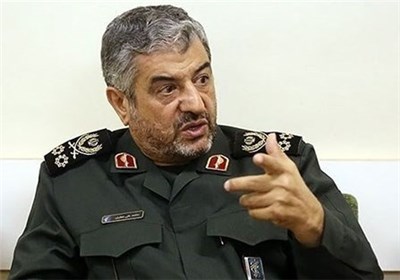
TEHRAN (Tasnim) – Commander of the Islamic Revolution Guards Corps (IRGC) Major General Mohammad Ali Jafari said his forces are ready to show rapid and harsh reaction to make Saudi Arabia accountable after the Kingdom’s mismanagement of Hajj claimed the lives of hundreds of Iranian pilgrims.

Speaking on the sidelines of a military meeting on Saturday, the senior commander underlined that the IRGC enjoys “all possible capacities for Iran’s rapid and tough reaction” to Al Saud and for obliging the monarchy to accept responsibility for the terrible disaster.

On September 24, a crush of pilgrims in Mina, near Mecca, killed around 4,700 people, including 464 Iranians.

Major General Jafari said the IRGC is fully prepared to act under orders from Supreme Leader of the Islamic Revolution Ayatollah Seyed Ali Khamenei.

Back on Wednesday, Ayatollah Khamenei warned Riyadh that any disrespect for the Iranian Hajj pilgrims or its failure to repatriate the bodies of those killed in the Mina crush will draw Iran’s “severe and tough reaction”.

Following the straightforward warning, Saudis began to cooperate with the Iranian officials and have repatriated bodies of some of the victims.

Elsewhere in his comments, the IRGC commander pledged that his forces “will take revenge from the Al Saud for the terrible crime.”

If necessary, the general underscored, the IRGC is firmly and powerfully ready to take any action, in any region and at any time, to protect the dignity of Muslims, particularly to defend the honor of the Iranian people in the face of “oppressive and ignorant rulers of Al Saud.”

Ayatollah Khamenei had announced that Iran has had respect for fraternity in the Islamic world up to now, showing self-restraint and Islamic politeness.

“However,” the Leader had noted, “they (Saudis) should know that the slightest disrespect for tens of thousands of Iranian pilgrims in Mecca and Medina and failing in their duties to transfer the holy bodies (of pilgrims to Iran) will result in Iran’s severe and tough reaction.”

The Moscow-Washington-Tehran Axis of Evil

October 3, 2015

The Moscow-Washington-Tehran Axis of Evil, Canada Free PressCliff Kincaid, October 3, 2015

(I am not posting this because I currently accept its conclusions or some of their bases. However, it’s frightening, interesting and has at least some food for thought. — DM)

KINCAID100315

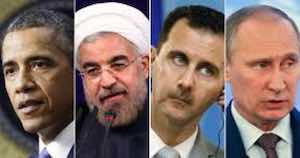
The conventional wisdom is that Vladimir Putin has blindsided Barack Obama in the Middle East, catching the U.S. off-guard. It’s another Obama “failure,” we’re told. “Obama administration scrambles as Russia attempts to seize initiative in Syria,” is how a Washington Post headline described it. A popular cartoon shows Putin kicking sand in the faces of Obama and Secretary of State John Kerry on a beach.

The conventional wisdom is driven by the notion that Obama has the best of intentions but that he’s been outmaneuvered. What if his intention all along has been to remake the Middle East to the advantage of Moscow and its client state Iran? What if he knows exactly what he’s doing? Too many commentators refuse to consider that Obama is deliberately working against U.S. interests and in favor of the enemies of the U.S. and Israel.

In his U.N. address, Obama said, “As President of the United States, I am mindful of the dangers that we face; they cross my desk every morning. I lead the strongest military that the world has ever known, and I will never hesitate to protect my country or our allies, unilaterally and by force where necessary.”

This is laughable. We still have a strong military, but the inevitable conclusion from what’s recently transpired is that he doesn’t want to protect the interests of the U.S. or its allies in the Middle East. This is not a “failure,” but a deliberate policy.

The trouble with conventional wisdom is the assumption that Obama sees things the way most Americans do. In order to understand Obama’s Middle East policy, it is necessary to consult alternative sources of news and information and analysis. That includes communist news sources.

A fascinating analysis appears in the newspaper of the Socialist Workers Party, The Militant, one of the oldest and most influential publications among the left. You may remember the old photos which surfaced of Lee Harvey Oswald selling copies of The Militant before he killed the American president.

The headline over The Militant story by Maggie Trowe caught my eye: “‘Reset’ with US allows Moscow to send arms, troops to Syria.” It was not about Hillary Clinton’s reset with Moscow years ago, but a more recent one.

Here’s how her story began: “Moscow’s rapid military buildup in Syria is a result of the ‘reset’ in relations forged with the Russian and Iranian governments by the Barack Obama administration. The deal—reshaping alliances and conditions from Syria, Iran and the rest of the Middle East to Ukraine and surrounding region—is the cornerstone of U.S. imperialism’s efforts to establish a new order in the Mideast, but from a much weaker position than when the now-disintegrating order was imposed after World Wars I and II.”

Of course, the idea that “U.S. imperialism” is served by giving the advantage to Russia and Iran is ludicrous. Nevertheless, it does appear that a “reset” of the kind described in this article has in fact taken place. The author writes about Washington’s “strategic shift to Iran and Russia” and the “downgrading” of relations with Israel and Saudi Arabia. She notes that Moscow “seeks more influence and control of the country [Syria] and its Mediterranean ports and a stronger political hand in Mideast politics.” Iran “has sent Revolutionary Guard Quds forces to help prop up Assad, and collaborates with Moscow on operations in Syria,” she notes.

It is sometimes necessary to reject the conventional wisdom and instead analyze developments from the point of view of the Marxists, who understand Obama’s way of thinking. They pretend that Obama is a pawn of the “imperialists” but their analysis also makes sense from a traditional pro-American perspective. Those who accept the evidence that Obama has a Marxist perspective on the world have to consider that his policy is designed to help Moscow and Tehran achieve hegemony in the region.

At the same time, the paper reported, “Since Secretary of State John Kerry’s congenial visit with Putin in May, it has become clear that Washington would accept Moscow’s influence over its ‘near abroad’ in Ukraine and the Baltics, in exchange for help to nail down the nuclear deal with Tehran.” Hence, Obama has put his stamp of approval on Russian aggression in Europe and the Middle East. This analysis, though coming from a Marxist newspaper, fits the facts on the ground. It means that more Russian aggression can be expected in Europe.

The wildcard is Israel and it looks like the Israeli government is being increasingly isolated, not only by Obama but by Putin. The story notes that Israeli Prime Minister Benjamin Netanyahu met with Putin in Moscow on September 21, saying his concern was to “prevent misunderstandings” between Israeli and Russian troops, since Israel has carried out airstrikes in Syrian territory targeting weapons being transported to the Iranian-backed Hezbollah terrorists in Lebanon.

Some reports indicated that Israel had set up a joint mechanism with the Russian military to coordinate their operations in Syria.

However, the Russian leader reportedly told Obama during their U.N. meeting that he opposes Israeli attacks in Syria. The Israeli newspaper Haaretz ran a story that Russia intends to “Clip Israel’s Wings Over [the] Syrian Skies.” The paper added that Putin’s remarks to Obama showed that despite Netanyahu’s meeting with Putin in Moscow, “Russia intends to create new facts on the ground in Syria that will include restricting Israel’s freedom of movement in Syrian skies.”

It hardly seems to be the case that Obama has been outsmarted in the Middle East, or that Putin and Obama don’t like each other. Instead, it appears that Obama is working hand-in-glove with Putin to isolate Israel and that Obama is perfectly content to let the former KGB colonel take the lead.

Israel has always been seen by most U.N. members as the real problem in the region. Obama is the first U.S. President to see Israel in that same manner and to act accordingly. This is why Putin has not caught Obama off-guard in the least. They clearly see eye-to-eye on Israel and Iran.

Don’t forget that Obama actually telephoned Putin to thank him for his part in the nuclear deal with Iran. The White House issued a statement saying, “The President thanked President Putin for Russia’s important role in achieving this milestone, the culmination of nearly 20 months of intense negotiations.”

Building off the Iran nuclear deal, it looks like the plan is for Russia and the United States to force Israel to embrace a U.N. plan for a nuclear-free Middle East. That would mean Israel giving up control of its defensive nuclear weapons to the world body. Iran will be able to claim it has already made a deal to prohibit its own nuclear weapons development.

Such a scheme was outlined back in 2005 in an article by Mohamed Elbaradei, the director-general at the time of the U.N.‘s International Atomic Energy Agency (IAEA). That’s the same body that is now supposed to guarantee Iranian compliance with the terms of the nuclear deal signed by Russia and the U.S.

Elbaradei argued there would have to be “a dialogue on regional security as part of the peace process,” to be followed by an agreement “to make the Middle East a nuclear-weapons-free zone.”

The “dialogue” appears to be taking place now, mostly under the authority and auspices of the Russian government, with President Obama playing a secondary role.

The obvious danger is that Israel would be forced to comply with the plan for a “nuclear-weapons-free-zone,” while Iran would cheat and develop nuclear weapons anyway.

Netanyahu told the U.N. that “Israel deeply appreciates President Obama’s willingness to bolster our security, help Israel maintain its qualitative military edge and help Israel confront the enormous challenges we face.”

This must be his hope. But he must know that Israel’s security is slipping and that the survival of his country is in grave danger in the face of this Moscow-Washington-Tehran axis.

Before Putin further consolidates his military position in the Middle East and Iran makes more progress in nuclear weapons development, Netanyahu will have to launch a preemptive strike on the Islamic state. “Israel will not allow Iran to break in, to sneak in or to walk in to the nuclear weapons club,” the Israeli Prime Minister said.

In launching such a strike before the end of Obama’s second presidential term, Israel would bring down the wrath of the world, led by Russia and the U.S., on the Jewish state.

The Iran Nuclear Deal: What the Next President Should Do

October 2, 2015

The Iran Nuclear Deal: What the Next President Should Do, Heritage Foundation, October 2, 2015

(But please see, The Elephant In The Room. — DM)

The failure of Congress to halt the implementation of the Obama Administration’s nuclear agreement with Tehran means that the U.S. is stuck with a bad deal on Iran’s nuclear program at least for now. Iran’s radical Islamist regime will now benefit from the suspension of international sanctions without dismantling its nuclear infrastructure, which will remain basically intact. Iran’s path to a nuclear weapon is unlikely to be blocked by the Administration’s flawed deal, any more than North Korea was blocked by the Clinton Administration’s 1994 Agreed Framework.

The next President should not passively accept Obama’s risky deal with Tehran as a fait accompli. Instead, he or she should immediately cite any violations of the agreement by Iran, its continued support for terrorism, or other hostile policies as reason to abrogate the agreement. The Bush Administration, faced with bad deals negotiated by the Clinton Administration, eventually withdrew from both the Agreed Framework and the Kyoto Protocol.

Rather than endorsing a dangerous agreement that bolsters Iran’s economy, facilitates its military buildup, and paves the way for an eventual Iranian nuclear breakout, the next Administration must accelerate efforts to deter, contain, and roll back the influence of Iran’s theocratic dictatorship, which continues to call for “death to America.”

How the Next President Should Deal with Iran

Upon entering office, the next Administration should immediately review Iran’s compliance with the existing deal, as well as its behavior in sponsoring terrorism, subverting nearby governments, and attacking U.S. allies. Any evidence that Iran is cheating on the agreement (which is likely given Iran’s past behavior) or continuing hostile acts against the U.S. and its allies should be used to justify nullification of the agreement.

Regrettably, Tehran already will have pocketed up to $100 billion in sanctions relief by the time the next Administration comes to office because of the frontloading of sanctions relief in the early months of the misconceived deal. Continuing to fork over billions of dollars that Tehran can use to finance further terrorism, subversion, and military and nuclear expansion will only worsen the situation.

In place of the flawed nuclear agreement, which would boost Iran’s long-term military and nuclear threat potential, strengthen Iran’s regional influence, strain ties with U.S. allies, and diminish U.S. influence in the region, the new Administration should:

1. Expand sanctions on Iran. The new Administration should immediately reinstate all U.S. sanctions on Iran suspended under the Vienna Agreement and work with Congress to expand sanctions, focusing on Iran’s nuclear program; support of terrorism; ballistic missile program; interventions in Syria, Iraq, and Yemen; human rights violations; and holding of four American hostages (Washington Post reporter Jason Rezaian, Christian pastor Saeed Abedini, former U.S. Marine Amir Hekmati, and former FBI agent Robert Levinson, who has been covertly held hostage by Iran since 2007).

The new Administration should designate Iran’s Islamic Revolutionary Guard Corps (IRGC) as a foreign terrorist organization and apply sanctions to any non-Iranian companies that do business with the IRGC’s extensive economic empire. This measure would help reduce the IRGC’s ability to exploit sanctions relief for its own hostile purposes.

Washington should also cite Iranian violations of the accord as reason for reimposing U.N. sanctions on Iran, thus enhancing international pressure on Tehran and discouraging foreign investment and trade that could boost Iran’s military and nuclear programs. It is critical that U.S. allies and Iran’s trading partners understand that investing or trading with Iran will subject them to U.S. sanctions even if some countries refuse to enforce U.N. sanctions.

2. Strengthen U.S. military forces to provide greater deterrence against an Iranian nuclear breakout.Ultimately, no piece of paper will block an Iranian nuclear breakout. The chief deterrent to Iran’s attaining a nuclear capability is the prospect of a U.S. preventive military attack. It is no coincidence that Iran halted many aspects of its nuclear weapons program in 2003 after the U.S. invasion of and overthrow of hostile regimes in Afghanistan and Iraq. Libyan dictator Muammar Qadhafi, motivated by a similar apprehension about the Bush Administration, also chose to give up his chemical and nuclear weapons programs.

To strengthen this deterrence, it is necessary to rebuild U.S. military strength, which has been sapped in recent years by devastating budget cuts. The Obama Administration’s failure to provide for the national defense will shortly result in the absence of U.S. aircraft carriers from the Persian Gulf region for the first time since 2007. Such signs of declining U.S. military capabilities will exacerbate the risks posed by the nuclear deal.

3. Strengthen U.S. alliances, especially with Israel. The nuclear agreement has had a corrosive effect on bilateral relationships with important U.S. allies in the Middle East, particularly those countries that are most threatened by Iran, such as Israel and Saudi Arabia. Rather than sacrificing the interests of allies in a rush to embrace Iran as the Obama Administration has done, the next Administration should give priority to safeguarding the vital security interests of the U.S. and its allies by maintaining a favorable balance of power in the region to deter and contain Iran. Washington should help rebuild security ties by boosting arms sales to Israel, Saudi Arabia, and other members of the Gulf Cooperation Council (GCC) that are threatened by Tehran, taking care that arms sales to Arab states do not threaten Israel’s qualitative military edge in the event of a flare-up in Arab–Israeli fighting.

To enhance deterrence against an Iranian nuclear breakout, Washington also should transfer to Israel capabilities that could be used to destroy hardened targets such as the Fordow uranium enrichment facility, which is built hundreds of feet beneath a mountain. The only non-nuclear weapon capable of destroying such a target is the Massive Ordnance Penetrator (MOP), a precision-guided, 30,000-pound “bunker buster” bomb. Giving Israel these weapons and the aircraft to deliver them would make Tehran think twice about risking a nuclear breakout.

The U.S. and its European allies also should strengthen military, intelligence, and security cooperation with Israel and the members of the GCC, an alliance of Bahrain, Kuwait, Oman, Qatar, Saudi Arabia, and the United Arab Emirates, founded in 1981 to provide collective security for Arab states threatened by Iran. Such a coalition could help both to contain the expansion of Iranian power and to facilitate military action (if necessary) against Iran.

4. Put a high priority on missile defense. Iran’s ballistic missile force, the largest in the Middle East, poses a growing threat to its neighbors. Washington should help Israel to strengthen its missile defenses and help the GCC countries to build an integrated and layered missile defense architecture to blunt the Iranian missile threat. The U.S. Navy should be prepared to deploy warships equipped with Aegis ballistic missile defense systems to appropriate locations to help defend Israel and the GCC allies against potential Iranian missile attacks as circumstances demand. This will require coordinating missile defense activities among the various U.S. and allied missile defense systems through a joint communications system. The U.S. should also field missile defense interceptors in space for intercepting Iranian missiles in the boost phase, which would add a valuable additional layer to missile defenses.

5. Deter nuclear proliferation. For more than five decades, Washington has opposed the spread of sensitive nuclear technologies such as uranium enrichment, even for its allies. By unwisely making an exception for Iran, the Obama Administration in effect conceded the acceptability of an illicit uranium enrichment program in a rogue state. In fact, the Administration granted Iran’s Islamist dictatorship better terms on uranium enrichment than the Ford and Carter Administrations offered to the Shah of Iran, a U.S. ally back in the 1970s.

The Obama Administration’s shortsighted deal with Iran is likely to spur a cascade of nuclear proliferation among threatened states such as Saudi Arabia, Turkey, Egypt, and the United Arab Emirates. Such a multipolar nuclear Middle East, on hair-trigger alert because of the lack of a survivable second-strike capability, would introduce a new level of instability into an already volatile region. To prevent such an outcome, the next Administration must reassure these countries that it will take military action to prevent Iran from gaining a nuclear capability as well as to deter Iranian military threats to their interests.

6. Expand domestic oil and gas production and lift the ban on U.S. oil exports to put downward pressure on world prices. In addition to sanctions, Iran’s economy has been hurt by falling world oil prices. Its oil export earnings, which constitute more than 80 percent of the regime’s revenue, have been significantly reduced. By removing unnecessary restrictions on oil exploration and drilling in potentially rich offshore and Alaskan oil regions, Washington could help to maximize downward pressure on long-term global oil prices. Lifting the ban on U.S. oil exports, an obsolete legacy of the 1973–1974 energy crisis spawned by the Arab oil embargo, would amplify the benefits of increased oil and gas production. Permitting U.S. oil exports not only would benefit the U.S. economy and balance of trade, but also would marginally lower world oil prices and Iranian oil export revenues, thereby reducing the regime’s ability to finance terrorism, subversion, and military expansion.

7. Negotiate a better deal with Iran. The Obama Administration played a strong hand weakly in its negotiations with Iran. It made it clear that it wanted a nuclear agreement more than Tehran appeared to want one. That gave the Iranians bargaining leverage that they used shrewdly. The Administration made a bad situation worse by downplaying the military option and front-loading sanctions relief early in the interim agreement, which reduced Iran’s incentives to make concessions.

The next Administration should seek an agreement that would permanently bar Iran from acquiring nuclear weapons. At a minimum, this would require:

  • Banning Iran from uranium enrichment activities;
  • Dismantling substantial portions of Iran’s nuclear infrastructure, particularly the Fordow and Natanz uranium enrichment facilities and Arak heavy water reactor;
  • Performing robust inspections on an “anytime anywhere” basis and real-time monitoring of Iranian nuclear facilities;
  • Linking sanctions relief to Iranian compliance;
  • Ensuring that Iran comes clean on its past weaponization efforts; and
  • Determining a clear and rapid process for reimposing all sanctions if Iran is caught cheating.

The Bottom Line

The nuclear deal already has weakened relationships between the U.S. and important allies, undermined the perceived reliability of the U.S. as an ally, and helped Iran to reinvigorate its economy and expand its regional influence. After oil sanctions are lifted, Iran will gain enhanced resources to finance escalating threats to the U.S. and its allies. The next Administration must help put Iran’s nuclear genie back in the bottle by taking a much tougher and more realistic approach to deterring and preventing an Iranian nuclear breakout.

Time to delegitimize the UN

September 24, 2015

Time to delegitimize the UN, Israel Hayom, Judith Bergman, September 24, 2015

(The UN has already made numerous heroic efforts to delegitimize itself. Isn’t it finally time for free world nations to leave the UN, stop paying for it and establish a very different organization dedicated to furthering, rather than destroying, western culture? — DM)

The appointment of Saudi Arabia to head this important U.N. Human Rights Council panel displays, once more, how deeply corrupt and truly meaningless the U.N. system and the U.N. Human Rights Council in particular are in practice.

***********************

It was recently publicized that Saudi Arabia has been elected to chair the U.N. Human Rights Council panel in charge of appointing independent experts. According to the U.N. Watch independent monitoring group, Saudi Arabia was chosen to head the Consultative Group, a five-member group of ambassadors that has the power to select applicants from around the world for more than 77 positions dealing with human rights mandates. These include positions such as the U.N. special rapporteur on violence against women and experts for working groups on the issues of discrimination against women and the rights of migrants and religious minorities.

One does not quite know whether to laugh or cry at the appointment of one of the worst human rights offenders in the world to head the selection of such experts. Indeed, Michael Moller, director-general of the United Nations Office at Geneva, does look a little bit uneasy in the photo taken of him, as he shakes the hand of the Saudi ambassador to Geneva, Faisal bin Hassan Trad, at his appointment. It must have been difficult for this Danish-born diplomat, hailing from a Scandinavian country so intensely committed to the pursuit of justice and human rights, to hide a grimace. After all, he was appointing the ambassador of a country where public beheadings are not the actions of criminals or terrorist organization like Islamic State, but a regular working feature of the legal system, which is modeled according to Shariah law. Perhaps the thought of petrodollars made the handshake easier.

Saudi Arabia was first elected to the Human Rights Council in 2013, without any protests from the U.S. and the European Union.

The appointment of Saudi Arabia to head this important U.N. Human Rights Council panel displays, once more, how deeply corrupt and truly meaningless the U.N. system and the U.N. Human Rights Council in particular are in practice. What does it say about the Human Rights Council that it appoints a country that regularly beheads dozens of its own citizens, as well as several of the 9 million foreign workers who constitute over half the workforce and frequently work in slave-like conditions for their Saudi Arabian masters?

While such an appointment clearly undermines any minuscule remnant of credibility that the U.N. Human Rights Council may have left, it should give pause to those who still believe the U.N. can play any credible role in international relations. More than anything, it shows the depraved state of the self-appointed guardian of world human rights.

Unfortunately, it would appear that most human rights advocates do not care much about this appointment, as there has been precious little reaction from them worldwide. Even more disturbing, the same human rights advocates who are so quiet about this are extremely vocal about perceived human rights violations by Israel. It only proves, once more, that they do not truly care about human rights.

What is the innocent blogger Raif Badawi, who has been sentenced to 1,000 lashes in public and 10 years in a prison in Saudi Arabia, supposed to make of this appointment, other than that the international community apparently approves of such punishment for a man who blogged about freedom of speech?

We in Israel hardly have any illusions left when it comes to the U.N., yet we still expend a lot of effort in responding to various U.N. commissions of inquiry, as if anything they conclude carries any kind of meaning or weight. Perhaps it is finally time to create an alliance of nations, with Israel in its midst, to effectively lead a campaign of delegitimization of the U.N., based on that organization’s blatant depravity and utter moral corruption. This is not something that Israel would be able to carry on its own, but although the number of decent nations in the world is shrinking fast, it is still not too late to find allies who might also have an interest in exposing the true face of the U.N. The organization is an expensive and obsolete bureaucratic monster, and there must be other states who would like to see it exposed and reformed.

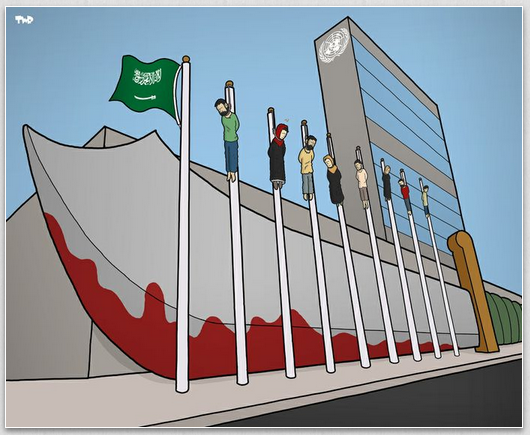
Cartoon of the day

September 24, 2015

(Please see also, Saudi Arabia: World’s Human Rights Sewer. — DM)

H/t Joopklepzeiker

screenshot_1119