(The views expressed in this article are mine and do not necessarily reflect those of Warsclerotic or its other editors. — DM)
An Iranian official recently stated that no International Atomic Energy Agency (IAEA) personnel will be permitted to enter military or missile sites. Another stated that “no country is permitted to know the details of future inspections conducted by the IAEA.” Their statements are probably consistent. There may well be other secret deals we don’t know about and perhaps never will. Meanwhile, Iran is preparing to test long range ballistic missiles “to prove that the missile ban was invalid.”
It’s not MY fault.
I. No IAEA inspections of the sites that matter most
In an interview on Al Jazeera TV last week Ali Akbar Velayati, Security Adviser to Iran’s Supreme Leader, stated that
United Nations nuclear inspectors from the International Atomic Energy Agency would not be given access to Tehran’s sensitive military nuclear sites.
. . . .
“First, allow me to emphasize that the issue of the missiles and of Iran’s defensive capabilities were not part of the negotiations to begin with,” Velayati said. [Emphasis added.]
“No matter what pressure is exerted, Iran never has negotiated and never will negotiate with others – America, Europe, or any other country – about the nature and quality of missiles it should manufacture or possess, or about the defensive military equipment that it needs. This is out of the question.” [Emphasis added.]
A video of Mr. Velayati remarks, with translations by the Middle East Media Research Institute (MEMRI), is available here. Since I have been unable to find it on You Tube I have no way to embed it.
Unfortunately, Mr. Velayati is essentially correct. The November 2013 Joint Plan of Action focused almost exclusively on Uranium enrichment, to the exclusion of the “possible military dimensions” of Iran’s military nuclear activities including missile research, development and testing.
II. Details of IAEA inspections will not be disclosed
Reza Najafi, Iran’s ambassador and permanent envoy to the IAEA, stated over the weekend that “no country is permitted to know the details of future inspections conducted by the IAEA.”
Najafi’s statement could mean (a) that no details about inspection methodology will be disclosed, (b) that no details about inspection results will be disclosed or (c) both. If inspection methodologies — who did the inspections as well as when, where and how, are not disclosed, what useful purpose will they serve, other than for Iran? If details of the results of inspections are not disclosed, that will also be the case. How, in either or both cases, will the members of the P5+1 negotiating teams have sufficient information to decide whether to “snap back” sanctions — if doing so is now even possible — or anything else?
III. Even details about inspections of non-military sites will be hidden
Considering Parts I and II together, and assuming that the statements of Iranian officials are reasonably consistent and not mere gaffes, IAEA personnel will be permitted to inspect non-military sites only and hence only to keep tabs on Uranium enrichment; even the details of those inspections will not be disclosed. Is that what Kerry and the other P5+1 negotiators had (pardon the expression) in mind?
IV. Iran says, Ballistic missile testing and development are OK
Shortly before US Secretary of State John Kerry was due in Qatar Monday, Aug. 3, Iran’s highest authorities led by supreme leader Ayatollah Ali Khamenei Sunday launched a public campaign to support Tehran’s noncompliance with the Vienna nuclear accord and UN Security Council Resolution 2231 of July 20, on its ballistic missile program. The campaign was designed by a team from Khamenei’s office, high-ranking ayatollahs and the top echelons of the Revolutionary Guards, including its chief, Gen. Ali Jafari. [Emphasis added.]
It was kicked off with a batch of petitions fired off by the students of nine Tehran universities and Qom religious seminaries to Iran’s chief of staff Maj Gen. Hassan Firouzabadi, demanding immediate tests of long-range ballistic missiles to prove that the missile ban was invalid. [Emphasis added.]
. . . .
The Security Council Resolution, which unanimously endorsed the Joint Comprehensive Plan of Action (Vienna nuclear accord) signed by Iran’s Foreign Minister Mohammed Javad Zarif, called on Iran “not to undertake any activity related to ballistic missiles designed to be capable of delivering nuclear weapons, including launches using such ballistic technology until the date eight years after the JCPOA Adoption Day.” [Emphasis added.]
Tehran retorted that none of its ballistic missiles were designed to deliver nuclear weapons, and so this provision was void. Shortly after its passage, the foreign ministry in Tehran issued an assurance that “…the country’s ballistic missile program and capability is untouched and unrestricted by Resolution 2231.” [Emphasis added.]
This appears to confirm that all of Iran’s ballistic missile sites are off-limits to inspectors.
V. What does Kerry know?
When questioned by members of Congress on the secret deals, Secretary Kerry testified that he had neither seen nor read them but that he had been fully briefed and knew “exactly” what they say. Put charitably, it seems unlikely that he knew that much.
Less charitably, Kerry knew far more than he said and declined to be forthcoming. Now that two Iranian officials have provided highly important information, thus far probably unknown to Congress, will Kerry have additional comments? Not if he can help it.
VI. Conclusions
I wrote early and often about the miserable “deal” about to be entered into by P5+1 under Obama’s dubious leadership. As Iranian officials provide additional information it should be clear — even to the most enthusiastic “deal” supporters — that the “deal” is far worse than earlier thought possible and that the U.S. Congress is obligated to disapprove it and to override any Obama veto, partisan politics notwithstanding.
(Yet “progressive” supporters of the “deal” seem not to be bothered — unless an African lion is killed. — DM)
Unfortunately, although President Obama is very vocal about defending the nuclear deal, the lifting of economic sanctions on the Ayatollah, the release of over a hundred of billion dollars to the ruling clerics of Iran, he has not issued any serious criticism against the leaders of the Islamic Republic with regards to the execution spree.
***********************
How the Obama administration is facilitating Iran’s unprecedented killing binge.
President Obama is determined to defend the Islamic Republic as a legitimate government that should receive sanctions relief. He has even overstepped his constitutional authority by signing the nuclear deal (a treaty) in the United Nations Security Council without getting the two-third vote of the Senate. He did not give Congress time to review the nuclear deal as he previously promised.
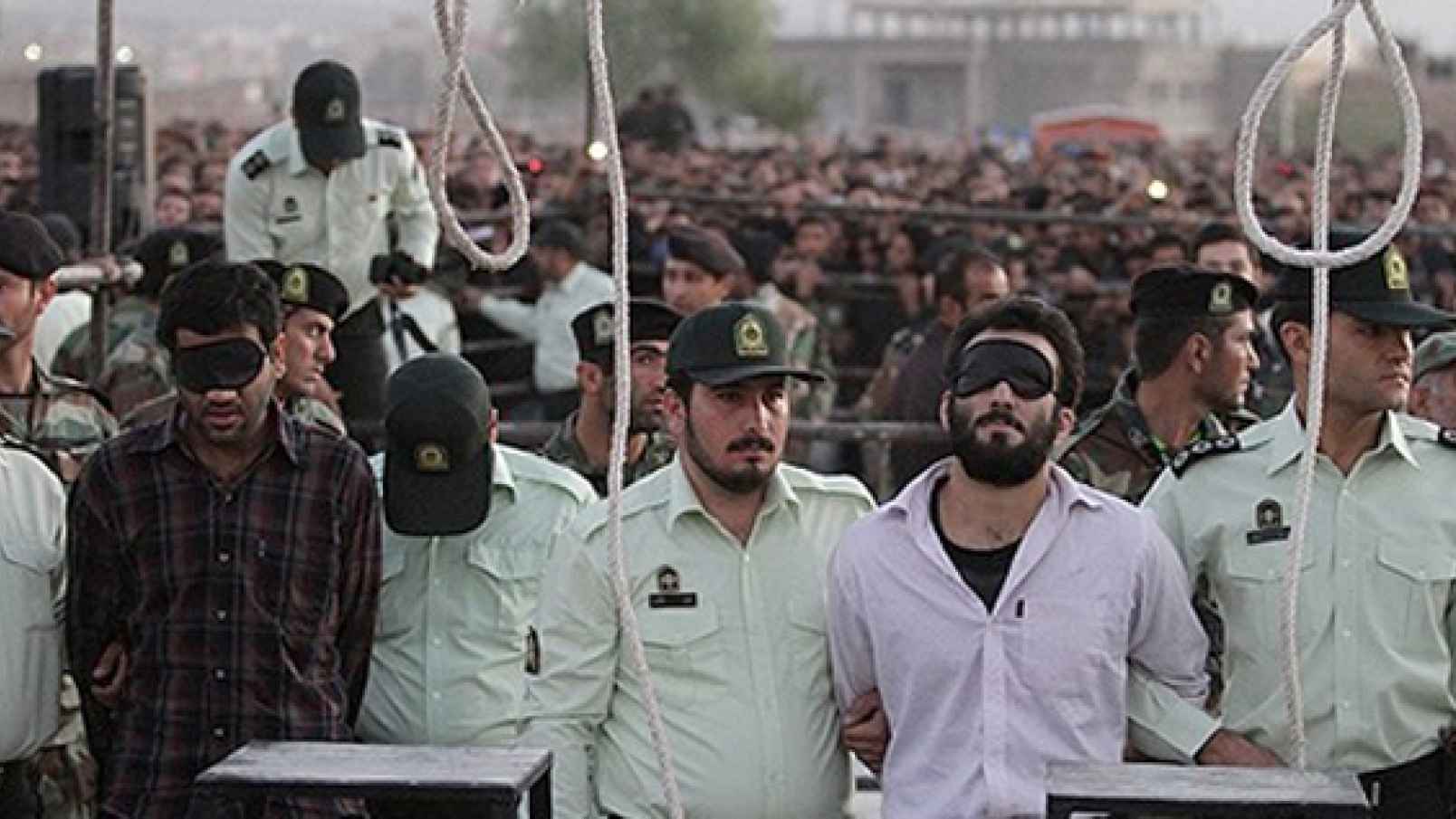
The Obama administration is advocating for a regime that has been on an execution spree on an unprecedented level, according to Amnesty International’s latest report. Since the beginning of this year, the Islamic Republic has executed approximately 700 people.
People being executed are usually not told about their death sentence until the noose is put around their neck and until they reach the gallows. Family members of the victims often do not know about the execution until weeks after.
As Said Boumedouha, deputy director of Amnesty’s Middle East and North Africa program said, “Iran’s staggering execution toll for the first half of this year paints a sinister picture of the machinery of the state carrying out premeditated, judicially-sanctioned killings on a mass scale.” He added, “The use of the death penalty is always abhorrent, but it raises additional concerns in a country like Iran where trials are blatantly unfair.”
I regularly speak with Iranian people living in various cities in Iran including Esfahan, Tehran, Tabriz, and Khorasan in order to obtain a better understanding on the ground. My family lives there too. The words of every one of them (about the current situation in Iran after the nuclear deal was reached) echoes what Zahra, an English teacher in the province of Esfahan, told me. She said, “Any cash given to the these Sheikhs in the government (the clerics) by the powers because of the nuclear deal, will not be distributed to the people. The money will not be used to improve people’s economic standards. The people on top will steal the money, saving it in their bank accounts, or send it to their Arab allies, Bashar Al Assad, Hezbollah, and the Iraqi government. They [Iranian leaders] are also going to increase domestic suppression if they begin seeing the flow of cash.”
If we look at the history of the Islamic Republic closely, we see that when a “reformist” president (Mohammad Khatami) was in power in Iran, the nation witnessed the same increase in executions and suppression. It was one of the worst periods of oppression and crackdowns on civil liberties. In addition, the number of executions normally rises under the so-called “moderates” and “reformists” rules.
When Iranian people feel that they might finally have a better relationships with the West, the ruling establishments ratchets up their imprisonment, torture, suppression and killings in order to show the people who is in charge and in order to impose fear. By using these tactics, they send a clear message that the Islamists are in charge, not the youth.
This staggering number of executions suggests that, as the ruling clerics of the Islamic Republic were gaining global legitimacy due to the nuclear negotiations and “normalizing” relationships with the Obama administration, they have also increased their mass scale killings of their own citizens. At the same time, several American citizens are still spending time in Iran’s prison.
Unfortunately, although President Obama is very vocal about defending the nuclear deal, the lifting of economic sanctions on the Ayatollah, the release of over a hundred of billion dollars to the ruling clerics of Iran, he has not issued any serious criticism against the leaders of the Islamic Republic with regards to the execution spree.
In the Islamic Republic, one can be executed for actions which might not even be a crime or it might be a misdemeanor in other democratic countries. For example, one can be executed for “enmity against Allah” or “corruption on earth.” In addition, a non-Muslim man can be executed for having sex with a Muslim women, but not vice versa. One can be executed or stoned if he/she is married and has sex with an unmarried person. One can also be executed for cursing or using bad words against the prophet.
As the report by Amnesty International described, “They [death sentences] are imposed either for vaguely worded or overly broad offenses, or acts that should not be criminalized at all, let alone attract the death penalty… Trials in Iran are deeply flawed, detainees are often denied access to lawyers, and there are inadequate procedures for appeal, pardon and commutation.”
Boumedouha observed, “For years, Iranian authorities have used the death penalty to spread a climate of fear in a misguided effort to combat drug trafficking, yet there is not a shred of evidence to show that this is an effective method of tackling crime…”
The more the Iranian leaders are empowered and emboldened financially, economically and politically, the more they tighten the noose on all freedoms (including speech, assembly, press, etc.), as well as basic inalienable human rights.
There are currently thousands of innocent people on death row waiting to be unfairly executed in the Islamic Republic. While President Obama finds it urgent to overstep his constitutional authority to quickly sign the nuclear deal with Iran and push for sanctions relief against the ruling clerics, he needs to pay close attention to how the empowerment of the ruling Islamists in Iran is adversely affecting the lives of millions of innocent people.
To listen to President Obama and Secretary of State John Kerry defend their nuclear deal in recent weeks, you’d think the issue at stake is a narrow one that solely concerned whether or not the agreement retards Tehran’s quest for a bomb. The assumption from the administration and its apologists that the deal does this even minimally is a dubious one. But one of the subtexts of the misleading way they have been conducting their end of this debate is their effort to distract both Congress and the public from the broader goals of the pact. While critics of the deal have highlighted Obama’s refusal to make the sanctions relief dependent on an end to support for terrorism, ballistic missile production or the nature of Iranian government, the answers from the administration have been consistent. They want to restrict the discussion to purely technical nuclear issues that can be obfuscated by deceptive claims or to the false choice between the agreement and war. But, to its credit, one of the president’s chief media cheerleaders did highlight the real goals of the administration in an article published on Friday. The New York Times feature titled “Deeper Aspirations Seen in Nuclear Deal With Iran” ought to be required reading for all members of the House and Senate. The choice here isn’t one between a flawed nuclear deal and war, but between Iran détente with a tyrannical, anti-Semitic, aggressive Islamist regime and a reboot of the diplomatic process that has been hijacked by appeasers.
As the Times points out, prior to the announcement of the final, lenient terms of the deal that expires in ten years the administration wasn’t so coy about its real objective:
Before his fight for the deal in Congress, Mr. Obama was far more open about his ultimate goals. In an interview in The Atlantic in March 2014, he said that a nuclear agreement with Iran was a good idea, even if the regime remained unchanged. But an agreement could do far more than that, he said:
“If, on the other hand, they are capable of changing; if, in fact, as a consequence of a deal on their nuclear program those voices and trends inside of Iran are strengthened, and their economy becomes more integrated into the international community, and there’s more travel and greater openness, even if that takes a decade or 15 years or 20 years, then that’s very much an outcome we should desire,” he said. …
And in an interview in December, Mr. Obama even seemed to welcome the rise of a powerful Iran. “They have a path to break through that isolation and they should seize it,” he said. “Because if they do, there’s incredible talent and resources and sophistication inside of — inside of Iran, and it would be a very successful regional power.”
The importance of this context for the discussion of the deal cannot be overemphasized.
The deal ought to be defeated on its own merits because it fails to achieve the administration’s stated objectives about stopping Iran’s nuclear ambitions. All it accomplishes, if it can even be said to do that much, is to delay Iran’s march to a bomb for the period of the agreement while permitting to continue research with a large nuclear infrastructure under a loose inspections regime that makes a mockery of its past promises on all these issues.
But the point on which the administration has been most reluctant to comment is the more than $100 billion in frozen assets that will be released to Tehran. Critics rightly believe this money will, one way or another, help subsidize Iran’s terrorist allies and push for regional hegemony that worries neighboring Arab states as well as Israel, whose existence is threatened by Iran becoming a threshold nuclear state with Western approval.
No rational argument can be mustered against this assertion since the money will be Iran’s to use as it likes and any prohibitions on Iranian adventurism are likely to be even less effective in a post-deal environment than they were prior to it. But if, like President Obama, you believe that Iran is in the process of transforming from a revolutionary threat whose goals are mandated by the extreme religious beliefs and Islamist ideology of its rulers into one eager to be friends with the world, the prospect of a stronger Iran doesn’t trouble you.
That’s why President Obama did not predicate these negotiations on any pledges, even ones that were transparently false, of good behavior from Iran. He claims that insisting on an end to Iranian state sponsorship of terror or forcing it to renounce its goal of eliminating Israel would have prevented him from getting a deal on the nuclear question. But that formulation has it backward. The point of the negotiations was never about the nuclear details, something that was made clear by the astonishing series of concessions that the administration made throughout the talks. In October 2012, during his foreign policy debate with Mitt Romney, Obama pledged that any deal would eliminate Iran’s nuclear program. Now he is advocating for one that leaves it in place under Western sponsorship while rewarding Tehran with the lifting of sanctions.
What Obama always wanted was a deal at any price because he thought it was the pathway to a new entente with Iran that would end the conflict with its Islamist leaders. But while a future in which Iran would no longer be a terror sponsor bent on destroying Israel and dominating the Middle East would be a good thing there is no rational reason to imagine this will happen. Indeed, by strengthening its government the president is ensuring that they will never have to choose between their aggressive goals and economic prosperity.
That’s why rather than being sidetracked into debates about the nuclear details, opponents need to focus on the real goal of the deal: détente with a regime that threatens the U.S. and its allies. The deal fails as a nuclear pact. But it is perhaps an even greater disaster when one realizes that its premise is a naive belief that Islamist tyrants are so enraptured with Obama that they are about to abandon their deeply held beliefs and evil intentions.
The scale of Iran’s multibillion acquisitions from China and Russia – 550 warplanes in all so far – indicates that Tehran’s top spending priority upon receipt of the funds released by the removal of sanctions, is to be a spanking new air force.
**********************
Iran is about to conclude a transaction with China for the purchase of the Chengdu J-10 multirole jet fighter, known in the West as the Vigorous Dragon, according to an exclusive report from DEBKAfile’s military and intelligence sources. Beijing has agreed to sell Tehran 150 of these sophisticated jets.
While the Chinese J-10 is comparable to the US F-16, our sources report that it is virtually a replica of the Lavi, the super-fighter developed by Israel’s aerospace industry in the second half of the 80s. Israel sold China the technology, after Washington insisted on Its discontinuing the Lavi’s production. The US also objected to the sale of the Lavi’s avionics, claiming that it contained some American components.
The Chinese plane comes in two versions – the multirole single-seat J-10A and the two-seat J-10B, which serves for training, ground assaults and electronic warfare.
Iran has additionally weighing the purchase in Moscow of 250 highly-advanced Sukhoi-Su-30MK1 twinjet multirole air superiority fighters, known in the West as Flanker-H.
On Wednesday, July 29, an Indian Air Force Su-30MK1 took part for the first time in a British air maneuver, Rainbow, where it dueled with the European Typhoon fighter.
The sophisticated Flanker has been found to have a major shortcoming. To carry eight tons of ordnance, it must use both of its AL-31FP engines, and the transition from one to two – and the reverse – often causes engine failure.
The Indian Air Force has reported three such malfunctions in a month, as well another shortcoming: The time needed for making the aircraft serviceable is too long. As a result, only half of the Indian fleet can be airborne at one time.
In a confrontation, the Iranian Air Force may find that, because of these drawbacks, the Chinese Su-30MK1 is outmatched by its American and European counterparts in the service of the Israeli, Saudi and UAE air forces.
On July 22, DEBKAfile revealed that Moscow and Tehran had concluded a giant transaction for the acquisition of a fleet of 100 IL78 MK1 (Midas) in-flight refueling planes for extending the range of its warplanes up to 7,300 km and able to refuel 6-8 planes at once.
DEBKAfile: The scale of Iran’s multibillion acquisitions from China and Russia – 550 warplanes in all so far – indicates that Tehran’s top spending priority upon receipt of the funds released by the removal of sanctions, is to be a spanking new air force.
American weakness has brought us to this difficult moment. While we obsessed about its economic discomfort, Iran wore its duress with pride. It was never an even match. We now have to rely on a tiny ally to do the job for us. But unless we are ready to accept a nuclear Iran (and, in relatively short order, several other nuclear Middle Eastern states), get ready. The easy ways out disappeared long ago.
***************************
President Obama has made an art form of attacking his opponents rather than substantively defending his own policies, most recently regarding the Vienna agreement on Iran’s nuclear program. Essentially, Obama argues that we must either accept his wretched deal or go to war to prevent Iran from acquiring nuclear weapons.
As is typical, Obama posits the wrong choice, apparently to distract from the unpleasant reality that the agreement won’t work. It will not prevent Iran from getting nuclear weapons. So the real choice we are faced with is dealing with the consequences of military action or the consequences of a nuclear Iran. Neither is palatable, but the latter is far worse. If the real objective is stopping Iran from getting nuclear weapons, preemptive military action is now inescapable.
This rock-and-hard-place outcome has long been foreseeable. Iran’s dogged determination to become a nuclear-weapons state was fiercer and stronger than the West’s frail response. Assuming Iran scrupulously complies with every provision agreed to in Vienna — an absurdly unlikely scenario given the ayatollahs’ objectives and history — its ambitions for nuclear weapons will simply have been delayed eight to 10 years.
In all likelihood, the ayatollahs are already at work violating the accords. After all, Iran has systematically breached its voluntarily-assumed obligations under the Nuclear Non-Proliferation Treaty for more than 30 years. Now the president’s deal will allow Iran to keep the fruits of its violations. Yes, the deal includes restrictions on uranium enrichment, but Tehran can retain its enrichment program, with guaranteed international assistance in improving it. These concessions are fatal mistakes.
Moreover, Iran’s ballistic missile efforts — its development of the means to deliver nuclear weapons all over the world — will barely be touched. Nor does the deal in any way address Iran’s clandestine weaponization efforts, which it has denied and hidden from the International Atomic Energy Agency with great skill.
Last week, the news that the administration has not even seen the texts of two agreements between the energy agency and Iran, both crucial to implementation of the Vienna accords, only raises further doubts. President Obama must provide the texts of these “side deals” to Congress before any serious consideration of the overall agreement is possible.
Some critics of Obama’s plan advocate scuttling the deal and increasing economic sanctions against Iran instead. They are dreaming. Iran and the United States’ negotiating partners have already signed the accords and are straining at their leashes to implement them. There will be no other “better deal.” Arguments about what Obama squandered or surrendered along the way are therefore fruitless. As for sanctions, they were already too weak to prevent Iran’s progress toward the bomb, and they will not be reset now. To paraphrase Bruce Springsteen, “These sanctions are going boys, and they ain’t coming back.”
Patrick Clawson, the director for research at the Washington Institute for Near East Policy, provided the most recent thumbs-down assessment of sanctions: “Iran has muddled through the shock of the sanctions imposed in 2012, and its structural [economic] problems are not particularly severe compared to those of other countries.” He estimates Iran’s nuclear and terrorism-support programs to cost only about $10 billion annually. No wonder administration officials have testified that sanctions (including those imposed piecemeal before 2012) did not slow Iran’s nuclear efforts.
Nor will the deal’s “snapback” mechanism (intended to coerce Iran back into compliance if it breaches its obligations) change that reality. Tehran’s belligerent response is expressly stated in the agreement’s text: “If sanctions are reinstated in whole or in part, Iran will treat that as grounds to cease performing its commitments … in whole or in part.” Tehran does risk losing some future economic benefits should sanctions snap back, but by then it will have already cashed in the assets the deal unfreezes and signed new lucrative trade and investment contracts.
Once those benefits begin flowing all around, the pressure on world governments will only increase to ignore Iranian violations, or to treat them as minor or inadvertent, certainly not warranting the reimposition of major sanctions. The ayatollahs have dusted off Lenin’s barb that “the capitalists will sell us the rope with which we will hang them,” and applied it to the age of nuclear proliferation.
If diplomacy and sanctions have failed to stop Iran, diplomacy alone will fail worse. Like it or not, we now face this unpleasant reality: Iran probably will violate the deal; it may not be detected doing so and if detected, it will not be deterred by “snapback” sanctions. So we return to the hard question: Are we prepared to do what will be necessary to stop Iran from getting nuclear weapons?
Obama most certainly is not, which means the spotlight today is on Israel.
If Israel strikes, there will be no general Middle East war, despite fears to the contrary. We know this because no general war broke out when Israel attacked Saddam Hussein’s Osirak reactor in 1981, or when it attacked the North Korean-built Syrian reactor in 2007. Neither Saudi Arabia nor other oil-producing monarchies wanted those regimes to have nuclear weapons, and they certainly do not want Iran to have them today.
However, Iran may well retaliate. At that point, Washington must be ready to immediately resupply Israel for losses incurred by its armed forces in the initial attack, so that Israel will still be able to effectively counter Tehran’s proxies, Hamas and Hezbollah, which will be its vehicles for retaliation. The United States must also provide muscular political support, explaining that Israel legitimately exercised its inherent right of self-defense. Whatever Obama’s view, public and congressional support for Israel will be overwhelming.
American weakness has brought us to this difficult moment. While we obsessed about its economic discomfort, Iran wore its duress with pride. It was never an even match. We now have to rely on a tiny ally to do the job for us. But unless we are ready to accept a nuclear Iran (and, in relatively short order, several other nuclear Middle Eastern states), get ready. The easy ways out disappeared long ago.
On Thursday, U.S. Secretary of State John Kerry spent more than four hours trying to defend the nuclear deal before the Senate Foreign Relations Committee. Grilled by Republicans furious at the Obama administration’s total surrender to Iran, Kerry remained true to character: He doubled down on meaningless platitudes with self-righteous indignation.
In fairness to America’s top diplomat, whose stupidity is only matched by President Barack Obama’s evil, how else could he respond to rational concerns but to get on his high horse? Indeed, all he had at his disposal in the face of the emerging details of the agreement, each more shocking than the next, was a feeble attempt to invert reality and ridicule his critics in the process.
Referring to a “Citizens for a Nuclear Free Iran” commercial aimed at persuading Congress to vote against the agreement and currently airing across the U.S., Kerry argued, “The alternative to the deal we’ve reached isn’t what we’re seeing ads for on TV. It isn’t a better deal, some sort of unicorn arrangement involving Iran’s complete capitulation. That’s a fantasy, plain and simple.
This was Kerry’s way of insisting that he had not been “bamboozled” by his Iranian counterparts, as Sen. Jim Risch (R-Idaho) asserted, nor “fleeced,” as committee chairman Sen. Bob Corker (R-Tenn.) accused.
In other words, no wool was pulled over his eyes. Not by the Iranians, at any rate. They were clear all along. And loud, as Kerry can attest, since he was the target of Iranian Foreign Minister Mohammad Javad Zarif’s repeated abusive outbursts during the negotiations.
No, if Kerry was “bamboozled” or “fleeced” by anyone it was Obama, who told him to secure a deal at any and all cost, because doing so would be better in the short run. As for the long-term repercussions, well, that would be a future administration’s headache.
The way Obama and Kerry both justify the travesty is even less comforting. They claim that since Iran was going to pursue nuclear weapons anyway — and support terrorism anyway, and violate terms anyway, and threaten to wipe Israel off the map anyway, and burn American flags anyway — it would be wiser to join them than beat them.
The logic is mind-boggling. But it does shed light on the administration’s attitude towards Israel.
Obama has been bent on earning the Nobel Peace Prize he was awarded — simply for entering the Oval Office — by completing a contract with Iran. Kerry has been obsessed with procuring a document declaring “peace” between Israel and the Palestinian Authority in order to become a Nobel laureate himself.
His dreams were dashed, however, when Prime Minister Benjamin Netanyahu was unwilling to cross certain red lines. Though Netanyahu did agree to negotiations, the release of well over 1,000 Palestinian terrorists, a halt in settlement construction, groveling before Turkish President Recep Tayyip Erdoğan and a slew of slights from the White House, he refused to commit Israel to suicide.
It is thus that Palestinian Authority President Mahmoud Abbas would not come to the negotiating table. Had the P5+1 countries not given Iran reason to believe that their red lines were merely rhetorical, Ayatollah Ali Khamenei — Iran’s “supreme leader” in every respect — would not have allowed his puppets to parlay with American and European representatives in the first place.
No wonder Obama and Kerry can’t stand Netanyahu. If the president of the United States can roll over and abdicate to a sworn enemy, who does the prime minister of Israel think he is to remain steadfast?
Understanding this is crucial. What it means is that Obama’s camp is right — and Netanyahu’s is wrong — about not having been able to hold out for a “better deal.” Iran, like the Palestinians it supports, has one goal in mind: demolishing the enemy.
It remains to be seen whether Obama will garner enough support in Congress to enable him to veto opposition to the agreement, which gives Iran carte blanche for its genocidal-weapons development and billions of dollars to bolster global terrorism.
At the moment, it’s not looking good. What’s worse is an annex in the agreement that provides for cooperation between the P5+1 and Iran “to strengthen Iran’s ability to protect against, and respond to nuclear security threats, including sabotage, as well as to enable effective and sustainable nuclear security and physical protection systems.”
This clause is causing a stir in Israel. It was also the focus of a question raised by presidential hopeful Marco Rubio (R-Fla.) during the Senate hearing. He wanted to know if it means the U.S. would be required to protect Iran’s nuclear facilities from a potential Israeli military strike.
“No,” retorted Energy Secretary Ernest Moniz, on hand with Treasury Secretary Jack Lew to help Kerry through the ordeal. Rubio was not convinced.
He did issue a warning, however: “The Iranian regime and the world should know that this deal is your deal with Iran … and the next president is under no legal or moral obligation to live up to it.”
What the rest of us need to know is which will come first, an Israeli attack or a Republican in the White House?
The Secretary of State can expect some really hard questions during his trip on exactly how the Vienna accord makes the region safer, when Iran’s first act after signing is to arm itself with a fleet of Russian in-flight fuel tankers to expand and strengthen its range and power for aerial aggression.
*********************
In defiance of the international arms embargo, Iran last week placed an order with Moscow for a huge fleet of 100 Russian IL78 MKI tanker aircraft (NATO: Midas) for refueling its air force in mid-flight, thereby extending its range to 7,300 km. This is reported exclusively by DEBKAfile from its military and intelligence sources. The transaction runs contrary to the terms of the nuclear accord the six world powers and Iran signed in Vienna earlier this month.
These tanker planes can simultaneously refuel six to eight warplanes. Their acquisition brings Israel, 1.200km away – as well the rest of the Middle East – within easy range of Iranian aerial bombardment. It also puts Iran’s air force ahead of Israel’s in terms of the quantity and range of its refueling capacity.
Whereas opponents of the Vienna deal have warned that Tehran will spend the billions of dollars released by sanctions relief as a bonanza for fueling its campaigns of terror in the region, it turns out that Iran’s first post-accord purchase is a heavy investment in the rearmament and upgrade of its armed forces’ aggressive capabilities.
The Israeli air force is familiar with the Russian airborne tanker from its use by the Indian air force with which Israel has close ties of cooperation. Its military engineers have also upgraded the Russian fuel tankers in service with the Uzbekistan air force.
Tuesday, July 21, DEBKAfile uncovered some of the tactics and escape clauses Iran has had built into its nuclear accord with the world powers for circumventing its provisions and commitments. The purchase of Russian refueling craft is a concrete example of this kind of evasion. Because the accord confirms the arms embargo in force until 2020, both Moscow and Tehran can maintain that the Russian aircraft industry will not be able to produce 100 new planes before the five years are up, and so the transaction is not a violation.
The huge Iranian-Russian military transaction therefore stands as the first palpable test of the Vienna accord, depending on whether US President Barack Obama or his Secretary of State John Kerry decides to make an issue of it. If they just let it go, it will set a precedent for the arms embargo clause of the nuclear accord to start unraveling.
Also Tuesday, Kerry gave an interview to the Al Arabia TV to prepare the way for his mission to the Gulf region on Aug. 3, which is to ease its rulers’ extreme unease over the ramifications of the nuclear accord. He asserted strongly to the interviewer: “I am not going to go through in great detail all the ways in which this agreement, in fact, makes the Gulf States and the region safer.”
The Secretary of State can expect some really hard questions during his trip on exactly how the Vienna accord makes the region safer, when Iran’s first act after signing is to arm itself with a fleet of Russian in-flight fuel tankers to expand and strengthen its range and power for aerial aggression.
John is going to have to go courting another terror state. North Korea has preemptively turned him down, but maybe Kerry can windsurf his way into North Korea and promise lots and lots of money if its dictator will pose for some photos in Vienna with America’s dumbest traitor.
*********************
Only liberals seem to need an interpretation of “Death to America”. John Kerry meanwhile wanders around the Middle East trying to interpret what Iran means when it vows to fund terrorists and fight America.
US Secretary of State John Kerry has acknowledged that Iranian Supreme Leader Ayatollah Ali Khamenei’s continued vows to defy the US are “very disturbing.”
“I don’t know how to interpret it at this point in time, except to take it at face value, that that’s his policy,” Kerry told Saudi-owned television station Al-Arabiya Tuesday. “But I do know that often comments are made publicly and things can evolve that are different. If it is the policy, it’s very disturbing, it’s very troubling.”
Don’t worry, given a little time, Kerry will find a way to interpret these comments not at “face value”.
Iran’s Supreme Leader Khamenei gave a particularly inflammatory speech just days after the deal, stating that the Islamic Republic’s policies toward the US have not changed.
“We will never stop supporting our friends in the region and the people of Palestine, Yemen, Syria, Iraq, Bahrain and Lebanon,” he continued, referring to the Iranian terror axis in the Middle East. “Even after this deal our policy towards the arrogant US will not change.”
Go and interpret a vow to keep funding Hezbollah, Hamas, the Houthis and Assad while fighting the US in the most positive way possible. If you’re good enough at it, you can get a gig at the State Department.
But you have to feel sorry for John Kerry, who pushed the Iran deal claiming that it would lead to a new era of diplomacy with Iran. Now John has been jilted once again. The Supreme Leader doesn’t seem to want to be his friend after all. Soon the Foreign Minister of Iran will stop returning his phone calls as soon as Iran gets $150 billion in sanctions relief.
And John is going to have to go courting another terror state. North Korea has preemptively turned him down, but maybe Kerry can windsurf his way into North Korea and promise lots and lots of money if its dictator will pose for some photos in Vienna with America’s dumbest traitor.
(The views expressed in this post are mine, and do not necessarily reflect those of Warsclerotic or its other editors. — DM) Oh what a tangled web we weave, when first we practice to deceive.
The current “deal” is based on a long-standing scam
Part I of this series, published on July 14, 2015, pointed out what should be a glaring consistency in the “Joint Comprehensive Plan of Action,” first made available on that date, and the November 24, 2013 Joint Plan of Action: neither provides for any “anytime -anywhere” inspections of Iran’s nuclear weaponization or missile sites. That consistency has been little remarked upon elsewhere.
Secretary Kerry now acknowledges that he never sought such inspections.
Leaving aside the twenty-four day lag between an IAEA request to inspect suspect facilities — which Kerry says is just fine — he claims that we now have a “unique ability” to get the U.N. Security Council to force inspections and reinstate sanctions. However, any effort to do so would almost certainly be vetoed by one or more Security Council members. The permanent members are China, France, Russia, the United Kingdom, and the United States — five of the members of P5+1 which approved the “deal.”
“I think this is one of those circumstances where we have all been rhetorical from time to time,” Sherman said in a conference call with Israeli diplomatic reporters. “That phrase, anytime, anywhere, is something that became popular rhetoric, but I think people understood that if the IAEA felt it had to have access, and had a justification for that access, that it would be guaranteed, and that is what happened.” [Emphasis added.]
Speaking to the BBC after the nuclear agreement between Iran and six world powers was reached, Kerry said that the more than $100 billion that Iran is set to receive “is going to make all the difference in the world is just – it’s not true.”
Acknowledging Iran is an international player in wreaking terror across the globe, Kerry said, “What Iran has done for years with Hezbollah does not depend on money.” He similarly stated Iran’s support of the Houthi rebels against the government in Yemen has not “depended on money.” [Emphasis added.]
. . . .
In its most recent report, the State Department wrote, “Iran has provided hundreds of millions of dollars in support of Lebanese Hezbollah in Lebanon and has trained thousands of its fighters at camps in Iran.”
In 2010 alone, State reported “Iran provides roughly $100-$200 million per year in funding to support Hezbollah.”
Secretary Kerry is almost certainly wrong, on that as on other aspects of the “deal.”.
Here’s Megan Kelly’s wrap up.
Iran may reject the “deal.”
There are at least glimmers of hope that Iran may reject the “deal,” unanimously endorsed by the UN Security council today.
A UN Security Council resolution endorsing Iran’s nuclear deal that passed on Monday is unacceptable, the country’s Islamic Revolutionary Guards Corps commander Mohammed Ali Jafari was quoted as saying by the semi-official Tasnim News Agency.
“Some parts of the draft have clearly crossed the Islamic republic’s red lines, especially in Iran’s military capabilities. We will never accept it,” he was quoted as saying shortly before the resolution was passed in New York. [Emphasis added.]
On Saturday, the Fars News Agency reported that the Majlis threatened to reject the agreement’s provision on ballistic missiles, which call for an international embargo on missile technology to be extended for eight years–a significant, last-minute concession by the U.S.
Iran wants unrestricted ballsitic missile development and access to conventional arms dealers abroad.
“The parliament will reject any limitations on the country’s access to conventional weapons, specially ballistic missiles,” said Tehran MP Seyed Mehdi Hashemi.
. . . .
In addition, the nuclear deal says that the Majlis will ratify the Additional Protocol (AP) to the Non-Proliferation Treaty–but it does not say when.
The AP is the key to long-term monitoring of Iranian nuclear research and development by the International Atomic Energy Agency (IAEA). Without approval of the AP, Iran may hide key information about its nuclear activity, and may accelerate advanced centrifuge research immediately when the nuclear deal expires, among other hazards. (Even then, its commitments under the AP will be somewhat voluntary.) [Emphasis added.]
. . . .
[W]hile the interim agreement of Nov. 2013 provided that Iran would ratify the AP within one year, there is no such deadline in the final Iran deal. The AP is merely to be applied “provisionally,” while the Majlis decides whether to accept it or not.
Meanwhile, if the Obama administration has its way, the U.S. Congress will have no opportunity to amend the deal–and will have to accept the lifting of international sanctions regardless of whether legislators accept or reject the agreement. [Emphasis added.]
Iranian leadership’s opposition to the “deal” appears to have come from Iran’s Supreme leader and the Iranian Parliament has the authority to reject the “deal.”
As expected, Ayatollah Ali Khamenei’s reaction to the nuclear deal was utterly different from that of President Hassan Rouhani. Right after the agreement was announced on July 14, Rouhani appeared on state television and praised the outcome. Yet when he and other officials visited Khamenei’s home a few hours later, the Supreme Leader did not say anything about the deal apart from a few lines thanking the negotiators. This reticence signaled to hardliners that they should increase their attacks on the agreement. [Emphasis added.]
America’s Supreme Leader, on the other hand, has been pushing vigorously to force the U.S. Congress to approve it, with no way to change it.
The “deal,” and Obama’s foreign policy in general, are rooted in His affinity for Islam
Obama may or may not be a Muslim. However, He thinks very highly of Islam and deems it the “religion of peace.” It would be ironic were Obama’s Iran “deal” to be rejected by Iran.
Obama is the first US president who genuinely conceives of Islam as not inherently opposed to American values or interests.
. . . .
It is through this Islamo-philic prism that the Obama administration’s attitude to, and execution of, its foreign policy must be evaluated – including its otherwise incomprehensible capitulation this week on Iran’s nuclear program. [Emphasis added.]
. . . .
The inspection mechanism provided for in the nascent deal make a mockery of Obama’s contention (July 14): “… this deal is not built on trust; it is built on verification,” and, “Because of this deal, inspectors will also be able to access any suspicious location… [They] will have access where necessary, when necessary.”
One can hardly imagine a more grossly misleading representation of the deal – so much so that it is difficult not to find it strongly reminiscent of the Muslim tactic of taqiya (the religiously sanctioned deception of non-Muslims). [Emphasis added.]
Indeed, immediately following the announcement of the agreement, Ben Rhodes, Obama’s deputy national security adviser, made a stunning admission to CNN’s Erin Burnett. Starkly contradicting the president’s contention of “access where necessary, when necessary,” Rhodes conceded, “We never sought in this negotiation the capacity for so-called anytime, anywhere,” which is diametrically opposed to the impression he conveyed in April this year when queried on this issue. [Emphasis added.]
In His capacity as America’s Imam in Chief, Obama has consistently claimed that the “religion of peace” has nothing to do with the Islamic State or with Islamic terrorism (of which he claims there is none) — such as the recent murder of four members of the U.S. Marines and one member of the U.S. Navy — committed in the name of Allah. The Daily Beast has posted some of the terrorist’s writings. They include these statements:
“I would imagine that any sane person would devote their time to mastering the information on the study guide and stay patient with their studies, only giving time for the other things around to keep themselves focused on passing the exam,” Abdulazeez wrote. “They would do this because they know and have been told that they will be rewarded with pleasures that they have never seen.”
This life is that test, he wrote, “designed to separate the inhabitants of Paradise from the inhabitants of Hellfire.”
. . . .
“We ask Allah to make us follow their path,” Abdulazeez wrote. “To give us a complete understanding of the message of Islam, and the strength the live by this knowledge, and to know what role we need to play to establish Islam in the world.” [Emphasis added.]
Obama apparently considers the Islamic Republic of Iran to be Islamic — and therefore peaceful — despite its widespread support for its terrorist proxies. That may explain the credence He gives to Supreme Leader Khamenei’s alleged fatwa preventing Iran from obtaining nukes. Obama and Khamenei have frequently referred to it in support of that proposition, although no text been produced. According to a Washington Post article dated November 27, 2013,
Oddly, the Iranian Web site does not provide the text of the original fatwa — and then mostly cites Western news reports as evidence that Khamenei has reiterated it on several occasions. The fatwa does not appear to be written, but in the Shiite tradition equal weight is given to oral and written opinions.
. . . .
Just about every Alfred Hitchcock thriller had what he called a “MacGuffin” — a plot device that gets the action going but is unimportant to the overall story. The Iranian fatwa thus appears to be a diplomatic MacGuffin — something that gives the Americans a reason to begin to trust the Iranians and the Iranians a reason to make a deal. No one knows how this story will end, but just as in the movies, the fatwa likely will not be critical to the outcome. [Emphasis added.]
Even if one believes the fatwa exists — and will not later be reversed — it clearly appears to have evolved over time. U.S. officials should be careful about saying the fatwa prohibits the development of nuclear weapons, as that is not especially clear anymore. The administration’s statements at this point do not quite rise to the level of earning Pinocchios, but we will keep an eye on this issue. [Emphasis added.]
“Our negotiations have made progress, but gaps remain,” he said. “And there are people, in both our countries and beyond, who oppose a diplomatic resolution. My message to you—the people of Iran—is that, together, we have to speak up for the future we seek. [Emphasis added.]
“As I have said many times before, I believe that our countries should be able to resolve this issue peacefully, with diplomacy,” Obama said. “Iran’s Supreme Leader Ayatollah Khamenei has issued a fatwa against the development of nuclear weapons, and President Rouhani has said that Iran would never develop a nuclear weapon. [Emphasis added.]
Isn’t that special! Why, in light of the alleged fatwa, does Iranian television broadcast simulations of nuclear attacks on Israel?
A short animated film being aired across Iran, shows the nuclear destruction of Israel and opens with the word ‘Holocaust’ appearing on the screen, underneath which a Star of David is shown, Israel’s Channel 2 reported on Tuesday.
Khamenei’s Death to America rants are considered an excellent reason to have a “deal.”
Similarly, the Reverend Jeremiah Wright was fond of saying “God Damn America.”
Obama apparently understood Khamenei’s words, but perhaps He didn’t understand Jeremiah’s words.
Conclusions
Elected on a platform of Hope and Change, Obama has brought us many changes; very few, if any, of those changes provide a basis for hope, at least until He has left office. Some will be difficult, if not impossible, even then to ameliorate. During His remaining time in office, He will continue to do His worst to eliminate any vestigial hope we may have. The “deal” with Iran is only one of the many changes for the worse that He has wrought.
This deal does the opposite of rolling back Iran’s nuclear program. It funds, protects, and perfects the nuclear program.
*****************
Omni Ceren sent out several email messages yesterday updating his readers on the Iran agreement (Joint Comprehensive Plan of Action or “JCPOA”). I would like to bring the following excerpt from one of the messages to your attention. Omri writes:
The agreement commits the international community to actively helping Iran perfect its nuclear program over the life of the deal (!) On a policy level, it means Iran’s breakout time will be constantly shrinking. On a political level, it means that the deal will be seen as accomplishing the exact opposite of what the Obama administration promised Congress: instead of rolling back Iran’s nuclear program, it will commit the U.S. and its allies to funding and boosting it.
The commitments are sprinkled across the JCPOA and obligate a range of global powers:
– Russian sponsorship/cooperation on nuclear research at Fordow — The Fordow Fuel Enrichment Plant (FFEP) will be converted into a nuclear, physics, and technology centre and international collaboration will be encouraged in agreed areas of research. The Joint Commission will be informed in advance of the specific projects that will be undertaken at Fordow…The transition to stable isotope production of these cascades at FFEP will be conducted in joint partnership between the Russian Federation and Iran on the basis of arrangements to be mutually agreed upon.
– European sponsorship of nuclear security, including training against sabotage— E3/EU+3 parties, and possibly other states, as appropriate, are prepared to cooperate with Iran on the implementation of nuclear security guidelines and best practices…Co-operation through training and workshops to strengthen Iran’s ability to protect against, and respond to nuclear security threats, including sabotage.
– International sponsorship/cooperation of Iranian fuel fabrication, which will help Iran complete its mastery of fuel cycle, making Iran’s program harder more opaque and difficult to regulate — The Joint Commission will establish a Technical Working Group with the goal of enabling fuel to be fabricated in Iran while adhering to the agreed stockpile parameters… This Technical Working Group will also, within one year, work to develop objective technical criteria for assessing whether fabricated fuel and its intermediate products can be readily converted to UF6.
This deal does the opposite of rolling back Iran’s nuclear program. It funds, protects, and perfects the nuclear program.








 anneinpt
 artaxes
 danmillerinpanama
 davidking1530
 Peter Hofman
 Joseph Wouk
 Peter
Peter Louisiana Steve
 WarSclerotic
Recent Comments