Posted tagged ‘Regime change’

Nuclearizing Iran, Sabotaging Arabs

August 6, 2015

Nuclearizing Iran, Sabotaging Arabs, The Gatestone InstituteBassam Tawil, August 6, 2015

(Please see also, Obama’s Strategy Of Equilibrium. — DM)

  • Obama’s solution? To let Iran have legitimate nuclear bombs in a few years, along with intercontinental ballistic missiles to deliver them to the U.S. — or perhaps from America’s soft underbelly, South America, where Iran has been acquiring uranium and establishing bases for years. Or perhaps launched from submarines off America’s coast, which would make the identity of the attacker unknowable and a response therefore impossible. Incredibly, America’s politicians do not even seem to seem to be concerned about that.
  • We have just sacrificed Sunni stability for American ideology: empty slogans fed to us by clueless, if well-meaning, American officials.
  • As we watched one stable Arab regime fall after another, we have allowed ourselves to be destroyed from within by these bungling diplomats — from America, Europe, China and Russia. Instead of keeping our eyes on the real threat, we exhausted ourselves in wasteful, unending battles against the Jews — meanwhile letting the Iranian menace slip out of sight.
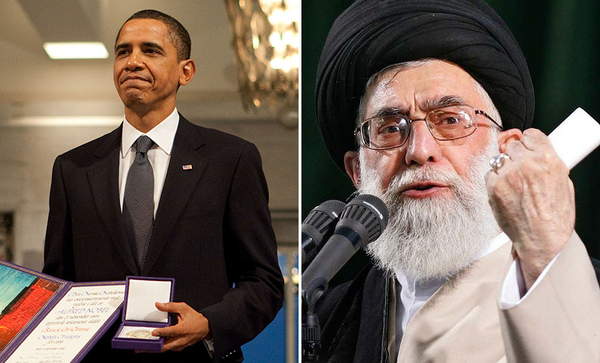
  • Obama really does deserve a Nobel Prize, but it should have been awarded by the Ayatollah Khamenei, the Supreme Leader of Iran, in gratitude for America’s surrender.
“Nation building” seems to have fallen into disrepute in the West, but it should not. It is vitally important — as the successes of Germany, Japan and South Korea attest.

Over the past few years, in our foolishness, we in the Middle East swallowed the deceptive bait of “democracy” dangled before us, even though we knew that it could not, in the misguided way it was presented, be implemented in the Middle East.

The idea was superb, but here in the Middle East, possibly in being impatient to “get credit” before the diplomats’ term of office were over, no one ever took the time to establish the institutions of democracy — equal justice under law, freedom of speech, property rights, the primacy of the individual rather than the collective, separation of religion and state — to show us in the Middle East how democracy actually operates, and to allow those institutions to take rootbefore ever holding an election.

So eager were Western leaders to take credit right away that they refused “let the rice bake.” Had the West introduced democratic elections to Japan and South Korea (where they eventually worked brilliantly) in the same way it muscled democracy into Iraq, it would never have taken root in those countries either. Had the Germans had been asked to vote right after World War II, they would most likely have reelected the Nazis — that was what they knew. It took seven years to re-educate the public to understand and accept a Konrad Adenauer.

What seems clear is that we have sacrificed Sunni stability for empty slogans — and for clueless, if well-meaning, American officials. As we watched one stable Arab regime fall after another, we allowed American ideology to destroy us from within. Instead of keeping our eyes on the real threat, we exhausted ourselves in wasteful, unending battles against the Jews — meanwhile letting the Iranian menace slip out of sight.

If we try to look at the positive side of the Iran nuclear agreement, it is just possible that Obama looked at the Sunni Arab states, fractured and at each other’s throats, and at the ruthless terrorist groups gaining ground in the expanding battle zones, and decided that we were too fractious for the U.S. to protect.

Sunni states such as Saudi Arabia, Qatar and Turkey have been worsening the situation in the Arab world by funding Sunni terrorist organizations, thereby putting it on a course of complete chaos. Despite Arab wealth and power, we have been dealing almost exclusively with the marginal issue of Palestine and the Jews, to excuse our inability to be effective in giving U.S. President Barack Obama what he really needs: regional stability.

Obama sees Iran and its terrorist organizations, which are all unified, organized and obedient, opposing the Sunni Arabs. Obama may be betting on Iran to bring order to the Middle East.

Imagine if we and our fundamentalist Sunni terrorist organizations had actually focused on stopping the Iranians in Syria, Iraq, Lebanon and Yemen. Imagine if we had abandoned, even momentarily, the dream of the Muslim Brotherhood (what the West calls “political Islam”) ruling the world. Imagine if we had stopped our stupid, useless acts of hatred, and could instead have focused on our common enemy, Iran. Our situation now would be immeasurably better. We would not be deviating from the teachings of Muhammad, because first we have to focus on the near enemy and then on the distant one. Iran is nearer and more dangerous than Europe and the United States, so Iran should have been — and still should be — the first Sunni target. We might have led Obama to adopt a different approach than allowing Iran to acquire a nuclear bomb in ten years or sooner — but we did not, because of our weakness and distraction with marginal “causes.” Thus Obama, from a desire to stabilize the Middle East, seems to be betting on the strong horse, Iran.

The truth, however, may be somewhat different. It is entirely possible that Obama, who won the Nobel Peace Prize, is employing a policy of “divide and conquer.” In the U.S., instead of trying to improve how children in the inner cities are being educated, he has been busy stoking racial and economic conflict. The Arabs are becoming increasingly suspicious that he is a historic “divide and conquer” manipulator. He may deliberately be creating fitna (civil strife) in the Arab world by whipping up conflict with Iran, so that America will one again look like the big power-broker — but at the expense of the Arabs.

We Arabs are expert conspiracy theorists, and interpret every political agenda as a hidden plot, but one only has to look at the Obama administration’s fawning support for the Muslim Brotherhood in Turkey and Egypt, and how America supported the fall of Mubarak, and it immediately becomes obvious that the U.S. is trying to manipulate the fate of the Arabs.

Anyone following America’s rejection of, and now only reluctant support for, the reformist regime of Egyptian President Abdel Fattah el-Sisi understands that the Americans prefer what they consider “backward Arabs”: those controlled by regressive Islam.

That is the reason we see Obama’s policies as backing both the Sunni Muslim Brotherhood and the theocrats in Iran. The ideologies of both the Muslim Brotherhood and Iran’s mullahs would lead to most dangerous and regressive fate of both Sunni and Shiite Muslims around the world, as well as Americans at home — and these are the Muslims most loved by the current American administration. Or maybe, as many of us say here on the street, Obama is just trying to “get even” with the West and bring it to its knees, for being white, “imperialist” and non-Muslim. Obama’s solution? To let Iran have legitimate nuclear bombs in a few years, with the intercontinental ballistic missiles to deliver them to the U.S. — or perhaps from America’s soft underbelly, South America, where Iran has been acquiring uranium and establishing bases for years. Or perhaps launched from submarines off America’s coast, which would make the identity of the attacker unknowable and a response therefore impossible. Incredibly, America’s politicians do not even seem to seem to be concerned about that.

Obama really does deserve a Nobel Prize, but it should have been awarded by the Ayatollah Khamenei, the Supreme Leader of Iran, in gratitude for America’s surrender.

1190Perhaps President Obama’s Nobel Prize should have been awarded by the Ayatollah Khamenei, the Supreme Leader of Iran, in gratitude for America’s surrender.

Satire | Watch out Kim, your nukes are next!

July 27, 2015

Watch out Kim, your nukes are next! Dan Miller’s Blog, July 27, 2015


(The views expressed in this article are mine and do not necessarily reflect those of Warsclerotic or its other editors. — DM)

Having been thoroughly schooled by Iran during the P5+1 nuke negotiations on the necessity for flexibility, the Obama Administration is now even better prepared to take on the Democratic People’s Republic of Korea.

Kim Jong-un learns of U.S.  plans to negotiate

Kim learns of U.S. plans

As North Korea and more recently Iran proved, sanctions are feeble devices for getting rogue nations to eliminate their nuclear weapons programs. Possibly effective in bringing such nations to the bargaining table, they tend to collapse as the negotiators come to understand the benefits their nations would realize by their elimination (the sanctions, not necessarily their nations).

According to a July 26th Washington Post article titled U.S. planning to press harder against North Korea on human rights,

After the Obama administration’s groundbreaking nuclear deal with Iran, there have been calls to replicate that pact with North Korea, a rogue state that already has nuclear-weapons capability.

From Washington to Beijing, analysts and policymakers have been talking about the agreement as a possible “blueprint” for negotiations with Pyongyang. [Emphasis added.]

But Kim Jong Un’s regime has made it clear that it expects to be accepted as a nuclear power — saying this month it is “not interested” in an Iran-style deal. The Obama administration is instead focusing on human rights to further isolate North Korea, encouraged by the outbursts this approach has elicited from Kim’s stubbornly recalcitrant regime — apparently because the accusations cast aspersions at the leader and his legitimacy. [Emphasis added.]

“There is a growing assumption that the North Koreans are not going to surrender their nukes,” Andrei Lankov, a North Korea expert based in Seoul, said after recent meetings with officials in Washington. Human rights are Washington’s “next political infatuation,” he said.

The linked article also notes,

Pyongyang this month denounced the United States for “escalating” its anti-North Korea campaign after Sung Kim, the U.S. special representative for North Korea policy said at a public forum that “pressure is a very critical part of our approach to dealing with North Korea.”

The North’s state-run Korean Central News Agency reported afterward that pressure “being persistently increased” would simply “harden” North Korea’s “will to take tough counter-action against” the United States.

North Korean representatives have been notably responsive at the United Nations to criticism of the country’s human rights record and of the leadership in particular, staging a number of protests at forums in New York. [Emphasis added.]

North Korea’s increased responsiveness shows that nuke negotiations with it may well be even more successful than were those with Iran, giving Dear Leader Obama an even greater giant leap forward in His pursuit of foreign policy legacies.

Engagement with North Korea is becoming increasingly necessary. It has recently been reported that

the North has recently upgraded a missile platform and may be readying to launch a long-range missile around the time of a national anniversary in October.

In addition, North Korea is building a new high explosives assembly facility at its main Yongbyon nuclear complex. North Korea will probably use such explosives internally only for peaceful purposes, while (although not suggested by the linked article) preparing them for shipment elsewhere. Perhaps they may be sold to Iran and sent via diplomatic pouch to ensure safety.

Iran persuaded Washington, once “infatuated” with the “possible military dimensions” of Iran’s nuclear program, that Iran itself should probe those dimensions, turn the results of its investigations over to the indefatigable UN watchdog (the International Atomic Energy Agency, a.k.a. “IAEA”) and thereby negate all suspicions. Following that precedent, North Korea should itself investigate whether there are bases for allegations of its human rights violations. It should then, in no less timely fashion, turn any relevant information it finds over to the appropriate UN agency — perhaps the Security Council, where all permanent members, including stellar human rights advocates Russia and China, have vetoes.

Despite the brilliance of its handling of the Iranian nuke program — and the equal if not even greater brilliance of the plan to proceed with North Korea — unsubstantiated rumors will be spread by warmongering hawks such as those who continue to challenge Obama’s great victory over Iran. For example, it may be claimed that any DPRK officials who provide evidence of human rights violations will be executed by hungry dogs starved for the purpose.

That is nonsense. Most of the dogs in North Korea are already starving. The over-inflated egos of any DPRK officials that cause them to blather irresponsibly about such things would simply be deflated by defensive antiaircraft weapons such as recently used on Defense Minister Hyon Yong Chol. It’s the humane way to deal with those guilty of “disloyalty and showing disrespect to dictator Kim Jong Un.” It would, in fact, be sufficient evidence of North Korea’s respect for human rights (comparable Iran’s) to terminate any further inquiry immediately.

If, as Obama claims, “99% of world” likes the Iran “deal,” at least 200% will love a deal with North Korea under which it demonstrates its respect for human rights while promising not to use its nukes on any nation unless it wants to because Dear Leader Kim is upset. The trade potentials are equally mind-boggling and the deal will be no less a win-win situation for everyone than the “deal” with Iran!

And we will do just as well with North Korea!

And we will do the same with North Korea!

The West’s Misconceptions Over the Final Nuclear Deal

June 25, 2015

The West’s Misconceptions Over the Final Nuclear Deal, Front Page Magazine, June 25, 2015

ayatollah_2146641b-450x282

[W]hat is the Obama administration’s strategy? Apparently, the Obama administration does not have one. This is due to the fact that the administration believes that the Islamic Republic will not cheat, interfere in other nations’ affairs, or do any harm in case sanctions are lifted. In other words, the Islamic Republic is going to be another Switzerland.

****************

In a recent interview that President Obama gave to Israeli outlet Channel 2’s Ilana Dayan, he indirectly defended the Islamic Republic and suggested that the ruling clerics are not going to cheat on the terms of the final nuclear deal. But how can President Obama be so sure about Iran’s compliance if a deal is reached and when economic sanctions are lifted? Is he making such an argument based on Iran’s past history of nuclear defiance? Or based on its current military intervention in several nations and support for Shiite militia groups, proxies, and Islamic Jihad?

It is crucial to point out that the nuclear activities of the Islamic Republic came to the international spotlight due to Iran’s clandestine and underground nuclear sites. Iran had since repeatedly violated the IAEA’s terms by building additional underground nuclear sites and inching towards nuclear capabilities in order to obtain nuclear weapons.

President Obama also argued that sanctions will snap back in case Iran cheats. Nevertheless, the truth is that there is no such thing as automatic snapping back of sanctions.  In addition, by the time that the international community realizes that Iran has cheated, Iran would have reduced the nuclear break-out capacity to zero, boosted its Revolutionary Guards’ economy, and gained billions of dollars. Secondly, Russia and China will scuttle any process that would snap back the economic sanctions.

There exists a crucial underlying misconception in the West headed by the Obama administration regarding the final nuclear deal with the Islamic Republic, which is approaching its June 30th deadline.

From President Obama and the Western powers’s perspective,  the nuclear deal with the Islamic Republic is going to be transformational and revolutionary. This follows that the West, and particularly the White House, contends that the final nuclear deal or the nuclear resolution is going to transform the character of Iran’s political system in the long term; hence it will fundamentally alter Iran’s regional, domestic policies, shift its support for Shiite militia groups and proxies across the Middle East, moderate Iran’s foreign policy, and probably change the government in the long term.

On the other hand, from the Iranian leaders’s perspective, the nuclear deal is transitory, fleeting, momentary and transactional. In other words, Iranian authorities will follow the rules of the nuclear agreement for the limited time assigned in the deal. They will boost their economy, regain billions of dollars, and reinitiate their nuclear program soon after.

As long as Iran’s Supreme Leader, Ayatollah Ali Khamenei, is alive, the Islamic Republic is going to prioritize its Islamist revolutionary ideologies. The 75-years-old man, who has ruled over 25 years and continuously spread anti-American and anti-Semitic propaganda, is not going to change his position and become a Western-loving person open to forces of globalization and integration. His has created a powerful social base based on his anti-American and anti-Semitic propagandas.

Since Iranian leaders view the final nuclear deal on a short-term basis, from the perspective of Iranian leaders, particularly Ayatollah Ali Khamenei and influential officials of Iran’s Revolutionary Guard Corps (IRGC), reaching a final nuclear deal is a no-brainer, economically speaking. In addition, the leaders of the Islamic Republic are cognizant of the fact that they will not give up their nuclear program based on the current terms of the nuclear agreement.

Most recently, Royal Dutch Shell PLC, which owes the Islamic Republic an outstanding debt of more than $2 billion, has been talking about repaying Iranian leaders the debt after the nuclear deal is signed. and consequently the related sanctions are lifted. Several other foreign companies were unable to pay Iran due to the financial and banking sanctions imposed by the United Nations Security Council and previous US administrations. Nevertheless, President Obama is opening the way for the flow of billions of dollars into the revolutionary Islamist ideology of the Islamic Republic.

It is crucial to point out that the flow of billions of dollars into the Islamic Republic will not trickle down to the Iranian ordinary people or even be distributed equally among the governmental institutions such as Iran’s foreign ministry. An overwhelming majority of the cash will likely be controlled by the IRGC, Quds forces (an elite revolutionary branch of IRGC fighting in foreign countries) and office of the Supreme Leader. The IRGC and office of the Supreme Leader do enjoy a monopoly over major economic sectors of the Islamic Republic.

The issue of immediate access to billions of dollars is particularly appealing and crucial for the Iranian leaders due to the notion that Tehran looks at the final nuclear deal through the prism of short-term, immediate economic and geopolitical boosts.

As a result, the final nuclear deal is viewed as purely short-term business for the IRGC and the Supreme Leader.

Finally, it is rational for every government to have strategies to rein in Iran’s full economic return. But, what is the Obama administration’s strategy? Apparently, the Obama administration does not have one. This is due to the fact that the administration believes that the Islamic Republic will not cheat, interfere in other nations’ affairs, or do any harm in case sanctions are lifted. In other words, the Islamic Republic is going to be another Switzerland.

The Iran scam worsens — Part III, Human rights and support for terrorism

June 22, 2015

The Iran scam worsens — Part  III, Human rights and support for terrorism, Dan Miller’s Blog, June 22, 2015

(The views expressed in this post are mine and do not necessarily reflect those of Warsclerotic or its other editors. — DM)

It is likely that the P5+1 nuke “deal” with Iran will be approved soon. Military and other nuke sites which Iran has not “disclosed” will not be inspected. Nor will Iran’s nuke ties with North Korea — which P5+1 member China seems to be helping, Iran’s massive support for terrorism and abysmal human rights record be considered because they are also deemed unnecessary for “deal” approval. Sanctions against Iran are moribund and will not be revived regardless of whether there is a “deal.” However, a bronze bust of Obama may soon be displayed prominently in Supreme Leader Khamenei’s office and one of Khamenei may soon be displayed proudly in Dear Leader Obama’s office.

Iran fenced in

Iranian support for terrorism

According to the U.S. State Department, The Islamic Republic of Iran continued its sponsorship of terrorism during 2014. The linked article observes,

Iran has increased its efforts to finance and carry out terrorist activities across the world and remains a top nuclear proliferation threat, according to a new State Department assessment. [Emphasis added.]

Iran is funding and arming leading terrorist groups in the Middle East and elsewhere, according to the State Department’s 2014 Country Reports on Terrorism, which thoroughly documents how Tehran continues to act as a leading sponsor terror groups that pose a direct threat to the United States.

The report comes as Western powers work to finalize a nuclear deal with Iran ahead of a self-imposed June 30 deadline, though it is unclear whether the new findings will come up in negotiations.

It seems clear that the new findings will not be considered.

Among many other terrorist organizations, Iran supports the Taliban.

Afghan and Western officials say Tehran has quietly increased its supply of weapons, ammunition and funding to the Taliban, and is now recruiting and training their fighters, posing a new threat to Afghanistan’s fragile security.

Iran’s strategy in backing the Taliban is twofold, these officials say: countering U.S. influence in the region and providing a counterweight to Islamic State’s move into the Taliban’s territory in Afghanistan. [Emphasis added.]

According to James Clapper, the U.S. Director of National Intelligence, the intelligence community considers Iran to be the “foremost state sponsor of terrorism.”

The assessment came after criticism from the Senate that the information was omitted in a global threat assessment submitted to Congress [in February of this year.] Initially, Iran and Hezbollah were not included as terror threats in the intelligence community’s report to the Senate in February. [Emphasis added.]

Might the Obama administration have been trying to ignore Iran’s continuing support for terrorist activities because of its fixation on getting a “deal” with Iran in the ongoing P5+1 “negotiations?” Probably, but that was then. Now, it is apparently not a problem to report on Iran’s terrorist activities because they are deemed unworthy of consideration by the P5+1 negotiators. It’s terrible, but so what?

Iran is the world’s biggest sponsor of terrorism. Its tentacles have a hold on Syria, Lebanon, Iraq, Afghanistan, Yemen and the Gaza Strip. Its terrorist operations know no border and its proxies partake in mass killings and war crimes. But as it has been demonstrated time and time again, the West appears unperturbed by all that. It views Iran as a potentially constructive state actor, which, as long as it gets its way, could serve to stabilize the region. [Emphasis added.]

Iran could, of course, “stabilize” the region with its own military and its terror proxies in much the same way that Hitler tried to “stabilize” Europe — by gaining military control and forcing his ideology on subjugated residents. At first, there was some resistance but that was shown to be useless as Britain under Chamberlain gave Hitler Czechoslovakia. Eventually, Britain and later her ally, the United States, became sufficiently upset to intervene militarily.

As noted in an article at Asia Times on Line, the “free world” is unwilling to confront Iranian hegemony:

For differing reasons, the powers of the world have elected to legitimize Iran’s dominant position, hoping to delay but not deter its eventual acquisition of nuclear weapons. Except for Israel and the Sunni Arab states, the world has no desire to confront Iran. Short of an American military strike, which is unthinkable for this administration, there may be little that Washington can do to influence the course of events. Its influence has fallen catastrophically in consequence of a chain of policy.

. . . .

President Obama is not British prime minister Neville Chamberlain selling out to Hitler at Munich in 1938: rather, he is Lord Halifax, that is, Halifax if he had been prime minister in 1938. Unlike the unfortunate Chamberlain, who hoped to buy time for Britain to build warplanes, Halifax liked Hitler, as Obama and his camarilla admire Iran. [Emphasis added.]

The bountiful windfall soon to be given to Iran if the P5+1 “deal” is approved, via a “signing bonus” and other Sanctions relief, will help Iran’s terror sponsorship.

[S]hould the “treaty” with Iran be consummated, this sponsor of global terrorism will receive at least $100 billion in sanctions relief. Not only will this money be used for Assad, but it will bankroll Hezbollah and Hamas with a new generation of rockets and weapons.

For Tehran, money buys weapons, and weapons buy power and influence. President Obama is counting on an accommodative Iran that receives foreign assistance. But is there any reason to embrace this hypothesis? And even if someone does, at what point can the International Atomic Energy Agency (IAEA), or any other relevant body, determine the turnabout in Iran’s nuclear program? How do we know when a genuine peace has arrived? [Emphasis added.]

Iranian leaders have made it clear that dreams of a Persian kingdom dance like sugar plums in their imagination. For that to happen, the money pump cannot run dry. There is a need to support their Houthi surrogates in Yemen; resupply Hamas rockets that were destroyed in the last war with Israel; continue to add to the Hezbollah war machine that is poised to attack Israel; and keep Assad afloat, the mechanism by which control of Lebanon is retained. [Emphasis added.]

Iran’s abysmal human rights record is getting worse

Executions in Iran

According to Iranian Human Rights,

[T]he Iranian regime has executed a prisoner every two hours this month.

“So far in 2015, more than 560 have been executed, and we are just in the first half of the year… What we are witnessing today is not so much different from what ISIS is doing. The difference is that the Iranian authorities do it in a more controlled manner, and represent a country which is a full member of the international community with good diplomatic relations with the West.” — Mahmood Amiry-Moghaddam, spokesman for Iran Human Rights. [Emphasis added.]

Now the West, with the possibility of a nuclear deal, stands to increase Iran’s diplomatic standing.

According to officials of the Islamic Republic of Iran,

Iran has “the best human rights record” in the Muslim world;[11] that it is not obliged to follow “the West’s interpretation” of human rights;[12] and that the Islamic Republic is a victim of “biased propaganda of enemies” which is “part of a greater plan against the world of Islam“.[13] According to Iranian officials, those who human rights activists say are peaceful political activists being denied due process rights are actually guilty of offenses against the national security of the country,[14] and those protesters claiming Ahmadinejad stole the 2009 election are actually part of a foreign-backed plot to topple Iran’s leaders.[15] [Emphasis added.]

Conclusions

Iran’s abysmal and already worsening records of human rights violations and support for terrorism will likely get even worse as it gets (or gets to keep) the bomb, along with a reward of massive further sanctions relief. None of that is deemed worthy of consideration by the P5+1 “negotiators,” lest Iran decline to sign a deal or lest its feelings be hurt — as they would be were IAEA inspections of “undisclosed” sites be demanded or if any Iranian demands were not met.

Iran and North Korea share not only nuclear weaponization technology; they also share a common contempt for human rights. Yet the North Korea – Iran nuclear nexus (denied by Iran) appears to be of no concern to the P5+1 “negotiators.”

Obama long ago “opened his heart” to the Muslim world.

“To the Muslim world, we seek a new way forward based on mutual interest and mutual respect,” Obama declared in his first inaugural address. The underlying assumption was that America’s previous relations with Muslims were characterized by dissention and contempt. More significant, though, was the president’s use of the term “Muslim world,” a rough translation of the Arabic ummah. A concept developed by classical Islam, ummah refers to a community of believers that transcends borders, cultures, and nationalities. Obama not only believed that such a community existed but that he could address and accommodate it.

The novelty of this approach was surpassed only by Obama’s claim that he, personally, represented the bridge between this Muslim world and the West.

ALL of My policies are the best ever

ALL of My policies are the best ever

Obama does deserve some credit: His foreign policies are the most foreign in U.S. history to the security of the United States and of what’s left of the free world. Much the same is true of His domestic policies.

Shaking Hands with Iran

June 19, 2015

Shaking Hands with Iran, The Gatestone InstituteDaniel Mael, June 19, 2015

  • According to the organization Iran Human Rights, the Iranian regime has executed a prisoner every two hours this month.
  • “So far in 2015, more than 560 have been executed, and we are just in the first half of the year… What we are witnessing today is not so much different from what ISIS is doing. The difference is that the Iranian authorities do it in a more controlled manner, and represent a country which is a full member of the international community with good diplomatic relations with the West.” — Mahmood Amiry-Moghaddam, spokesman for Iran Human Rights.
  • Now the West, with the possibility of a nuclear deal, stands to increase Iran’s diplomatic standing.

As negotiations between the P5+1 countries and Iran continue, human rights concerns under the Iranian regime remain on the periphery.

The Obama Administration, over the objections of countless human rights organizations, has made clear that the United States is not seeking to alter the nature of the Iranian regime. Rather, the aim of the direct negotiations is solely to reach an agreeable compromise over the Iran’s continued nuclear enrichment. The current nominal deadline for negotiations is June 30.

The Islamic Republic of Iran is notoriously the world’s largest state sponsor of terrorism. Proxy organizations include Hezbollah in Lebanon, Hamas in the Gaza Strip and Houthi rebels in Yemen. The regime’s support of barbarism is reflected within Iran as well, as Iranian leaders support unspeakable human rights abuses on a daily basis.

With the deadline for negotiations only days away, June 2015 has been no exception.

According to a June 17 press release from the organization Iran Human Rights, which “supports the Iranian people’s struggle for human rights and amplifies their voices on the international stage,” the Iranian regime has executed a prisoner every two hours this month:

“According to reports collected by IHR so far in June at least 206 people have been executed in different Iranian cities. 60 of the executions have been announced by the official sources while IHR has managed to confirm 146 other executions which have not been announced by the authorities.”

“So far in 2015 more than 560 people have been executed in the country and we are just in the first half of the year,” Mahmood Amiry-Moghaddam, the spokesman of IHR, said in an interview. “This is unprecedented in the last 25 years! Unfortunately, people in Iran feel that the international community has closed its eyes on what they are going through.”

The executions are just the tip of the crane. As IHR reported Wednesday morning, Mohammed Moghimi, a defense lawyer for civil activist Atena Faraghadani, was scheduled to be released from prison on June 16, after three days in prison. What, exactly, was his crime?

“Mohammad Moghimi was charged with ‘non-adultery illegitimate relations’ for shaking hands with his female client,” writes IHR. “He had gone to Evin Prison to meet Ms. Faraghadani and to prepare an appeal request for her 12-year prison sentence.” According to IHR sources, the forbidden handshake “happened in the presence of two agents in the room. Atena apologized for this right there… but the agents didn’t let it go and took her back to her prison ward and arrested Mr. Moghimi right there.”

Moghimi release was released on condition that he meet a bail of roughly $60,000.

And why is Faraghadani in prison? For Facebook posts. A Revolutionary Court in Tehran sentenced her to 12 years and 9 months in prison for posts against the government, which constituted “assembly and collusion against national security,” “propaganda against the state,” and “insulting the Supreme Leader, the President, Members of the Parliament, and the IRGC [Revolutionary Guards] Ward 2-A agents, ” according to IHR.

“What we are witnessing in Iran today is not much different from what ISIS is doing,” argues Amiry-Moghaddam. “The difference is that the Iranian authorities do it in a more controlled manner, and represent a country which is a full member of the international community with good diplomatic relations with the West.”

Now the West, with the possibility of a nuclear deal, stands to increase Iran’s diplomatic standing — and with not even a minimal regard for human rights.

While U.S. negotiators shake hands with Iranian diplomats during the next round of talks in Geneva, Iranian citizens cannot shake hands among themselves without fear of years of imprisonment. While officials, both from the West and from Iran, share updates on social media, Iranians at home face jail time for staking out the wrong position in Facebook posts.

1118Does Iran’s foreign minister risk going to jail? Iranian FM Javad Zarif (right) is apparently touching the arm of EU Foreign Affairs representative Federica Mogherini (second from right). Back in Tehran, the lawyer Mohammad Moghimi (inset top) was arrested and charged with “non-adultery illegitimate relations,” for shaking hands with his female client, Atena Faraghadani (inset bottom). Faraghadani was sentenced to 12 years and 9 months in prison, for Facebook posts critical of the regime

If the Iranian regime cannot trust its own citizens’ handshakes, how can the West trust the Iranian regime with uranium centrifuges?


