Posted tagged ‘Peace Process’

France, Iran and the “Peace Process”

June 10, 2015

France, Iran and the “Peace Process,” The Gatestone InstituteShoshana Bryen, June 10, 2015

  • The French draft corresponds with President Obama’s own — strongly held — belief that Israel has to ascribe to the President’s view, despite just having elected a Prime Minster who disagrees.
  • The air is poisoned. The CEO of the French cell phone company Orange declared his desire to boycott Israel, while Orange rakes in money from its operation in the Republic of Congo, a major human rights violator.
  • Smash the two stories together and you get an American President supporting France in its efforts to be a major player in the Middle East in exchange for French support for the P5+1 deal with Iran.

Sometimes, if you smash two stories together, you end up with something interesting; sometimes you get something worrisome. This is one of the latter.

The first story is about France, a member of the P5+1 negotiating a deal with Iran on nuclear capabilities. The French government has expressed increasing concern that the emerging deal is flawed — perhaps fatally. Foreign Minister Laurent Fabius reportedly told the French Parliament, “France will not accept [a deal] if it is not clear that inspections can be done at all Iranian installations, including military sites.” He added, “Yes to an agreement, but not to an agreement that will enable Iran to have the atomic bomb. That is the position of France, which is independent and peaceful.”

The French Ambassador to the United States, Gerard Araud, told an American audience “the most worrying aspect of the agreement” is that Iran will become a “one-year breakout state.” He expressed concern that if Iran becomes a nuclear state, other countries in the region will also seek to become nuclear powers.

The French position creates a problem for President Obama because the deal has to be agreed on by the P5+1, not the “P4+1-with-one-vote-in-opposition.”

1101 (1)Is President Obama supporting France in its efforts to be a major player in the Middle East, in exchange for French support for the P5+1 deal with Iran? Above, Secretary of State John Kerry (left) is pictured meeting French Foreign Minister Laurent Fabius, on February 27, 2013. (Image source: U.S. State Dept.)

The second story is also about France. With historic ties to the Middle East, but extremely limited military capabilities there (or anywhere), France is trying to be a diplomatic power broker. Christian Makarian, deputy editor of L’Express, wrote recently that after Assad used chemical weapons against his people, France wanted to intervene in Syria but was dissuaded by President Obama. “Hollande and… Fabius frequently made reference to last year’s backtracking on military intervention in Syria, which they consider one of their greater policy failings.” This, he postulates, accounts for French willingness to support military action in Iraq.

Influence can come from arms sales, and here the French excel. From 2005-2010, France was the third largest supplier of arms to the Middle East/North Africa (MENA) region, after the U.S. and Russia. MENA now accounts for nearly half the orders from the French military. Saudi Arabia, Morocco, UAE, Qatar, Oman, Tunisia and Algeria are clients, and this year, 5.2 billion euros in orders from Egypt. It amounts to a 17.3 percent increase in total arms sales abroad for 2014 over 2013.

Influence also comes from diplomacy — and this is where the stories begin to collide.

France, Britain and Germany had drafted a UN Security Council Resolution late last year to set parameters for establishing a Palestinian State and “ending the conflict.” It was not submitted because of the impending Israeli election. France is prepared to try now with a draft that would “solve” the problem by using the 1949 Armistice Line as a reference point for a Palestinian state with a shared capital in Jerusalem, a “fair” solution for refugees, and possible land swaps. It would also require that the Palestinians recognize Israel as a “Jewish State.”

Fabius, speaking in New York, said, “these parameters have to be defined and recognized by the Security Council and that obviously the two parties have to discuss, but the discussion will be accompanied by an international effort.”

A French official called it a “backdoor” for negotiations, explaining in a press report that “all actors including the Americans now realize that all other ways have been explored, without success.”

The U.S. has historically opposed “internationalizing” the conflict. Giving the UN authority to establish requirements for the parties violates the Oslo Accords, something Israel opposes and the Palestinians support.

In early May, President Obama indicated that he intended to veto the French proposal, saying “a big overarching deal” is probably not “possible in the next year, given the makeup of the Netanyahu government, given the challenges I think that exist for President Abbas.” In the same interview, he suggested “confidence-building measures” that would have an impact on the economic and social lives of Palestinians and Israelis.

However, the President appears to have moved toward the French position. He recently told Israeli television:

If in fact, there’s no prospect of an actual peace process, if nobody believes there’s a peace process, then it becomes more difficult to argue with those who are concerned about settlement construction, those who are concerned about the current situation, it’s more difficult for me to say to them, ‘Be patient. Wait, because we have a process here.'”

His own expressed skepticism about the achievability of an Israeli-Palestinian agreement appears to have given way to the French notion that “all other ways have been explored,” and that it is time to let the UN determine parameters for a “big overarching deal.” And, as it happens, the French draft corresponds with the President Obama’s own — strongly held — belief that Israel has to ascribe to the President’s view, despite having just elected a Prime Minister who disagrees:

The most important thing, I think, that we can do right now in strengthening Israel’s position is to describe very clearly why I have believed that a two-state solution is the best security plan for Israel over the long term… but also, at the end of the day, to say to any Israeli prime minister that it will require some risks in order to achieve peace.

The “risks” sound ominously like Secretary of State Kerry’s 2013 “warning” that Israel might face a “third intifada” if it didn’t toe the then-American, now-French line. “I mean does Israel want a third Intifada?” he asked. “I’ve got news for you. Today’s status quo will not be tomorrow’s.”

In Washington this week, Ambassador Araud used extraordinarily tough language against Israel in a series of Twitter exchanges with American supporters of Israel, culminating in the “blocking” of one of them. Silly kids’ stuff, but the air is poisoned. The CEO of the French cell phone company Orange declared his desire to boycott Israel, while Orange rakes in money from its operation in the Democratic Republic of Congo, a major human rights violator.

Smash the two stories together, you get an American president supporting France in its efforts to be a major player in the Middle East in exchange for French support of the P5+1 deal with Iran.

In both cases, guess who pays the price: Israel.

Op-Ed: Core Synergies in Israel’s Strategic Planning

June 9, 2015

Op-Ed: Core Synergies in Israel’s Strategic Planning, Harvard Law School National Security Journal via Israel National News, Prof. Louis René Beres, June 9, 2016

(Rather “high brow,” but well worth considering seriously. — DM)

Significantly, the most insidious synergy of all could involve a rudimentary failure to understand that belligerent enemy intentions ultimately depend for their efficacy upon confused, partial, or inadequately thoughtful Israeli responses.

*****************

To best serve Israel, the country’s strategic studies community should favor more conceptual or “molecular” assessments of expected security perils. Going forward therefore, it will not suffice for this community to operate in ways that are roughly comparable to the purely reportorial activities of journalists and pundits, that is, of ordinary observers who focus exclusively on current personalities and events. With this timely warning in mind, the following brief essay explains and argues for a specifically enhanced Israeli consideration of enemy “synergies.”

For the most part, the concept of synergy is already familiar to capable scientists and scholars. It signifies, above all, that the usually binding axioms of geometry can sometimes be overridden by various intersecting phenomena. Applied to Israel, this concept suggests that certain identifiable threats to the Jewish State should no longer be considered as wholly separate or discrete, but instead, as more-or-less interpenetrating and mutually-reinforcing.

The most obvious and portentous example of pertinent synergy for Jerusalem is represented by Iranian nuclear weapons and Palestinian statehood.[1]

At first, any such talk of “synergy” may sound needlessly pretentious, or at least more contrived, concocted, or complicated than is really the case. In medicine, after all, it would already seem plain that the dangers of smoking cigarettes and drinking alcohol together must exceed either one behavior without the other. This is because the synergistic effect is presumptively much greater than those consequences ascertained by merely adding these two injurious activities together.

For Israeli planners, the still-widely-unrecognized synergy between Iranian nuclearization and “Palestine” should finally be treated with a more emphatic intellectual regard.[2] Notwithstanding the declared assumptions of virtually all acknowledged national strategists, Iran and Palestine,[3] as “negative force multipliers,”[4] do not represent thoroughly separate or unrelated hazards to Israel. To continue to assess each one independently of the other would be a serious conceptual error. It would be to consciously obscure what is potentially most revealing and most ominous.

Israel’s main security policies must involve carefully nuanced considerations of active defense, as well as of deterrence, preemption, and war-fighting. The country’s multilayered missile defenses are central to national survival. As long as incoming rocket aggressions from Gaza, West Bank, and/or Lebanon (Hezbollah) were to remain “only” conventional, the inevitable leakage could still be tolerable. But once these rockets were fitted with chemical and/or biological materials, such porosity could quickly prove “unacceptable.[5] This means, among other things, that the projected harms of rocket attacks upon Israel would depend not only upon the inherent dangers posed by a particular weapon system, but also upon the ways in which these individual harms would intersect.[6]

Once facing Iranian nuclear missiles, Israel’s “Arrow” ballistic missile defense system would require a fully 100% reliability of interception. To achieve any such level of reliability, however, would be impossible. Now, assuming that the prime minister has already abandoned any residual hopes for a cost-effective eleventh-hour preemption against pertinent Iranian nuclear assets , this means that Israeli defense planners must prepare instead, and longer-term, for stable deterrence.[7]

Theory is a net. Only those who cast, can catch.[8] Because of the expectedly corrosive interactive effects involving Iranian nuclear weapons and Palestinian statehood, for example, Israel will need to update and refine its existing theories of deterrence.

Looking ahead, there are various antecedent issues of theoretical concern. For one, Israel’s leaders will have to accept that certain more-or-less identifiable leaders of prospectively overlapping enemies might not necessarily satisfy the complex criteria of rational behavior in world politics. In such partially improbable but still conceivable circumstances, assorted Jihadist adversaries in Palestine, Iran, Syria, Iraq, Lebanon, or elsewhere might sometime refuse to renounce certain still-contemplated aggressions against Israel.[9]

By definition, these irrational enemies could exhibit such more-or-less plausible refusals even in anticipation of fully devastating Israeli reprisals. But, would they still remain subject to alternative threats or forms of deterrence? And might an entire state sometime exhibit such non-rational orientations, thereby becoming, in essence, a suicide terrorist writ large?

These utterly core questions can no longer be ignored. Sooner rather than later, and facing new and prospectively incalculable synergies from Iranian and Palestinian aggressions, Israel will need to take appropriate steps to assure that: (1) it does not become the object of any non-conventional attacks from these enemies; and (2) it can successfully deter all possible forms of non-conventional conflict. To meet this ambitious but indispensable goal, Jerusalem, inter alia, absolutely must retain its recognizably far-reaching conventional superiority in pertinent weapons and capable manpower, including effective tactical/operational control over the Jordan Valley.

In this connection, a Palestinian state could make Israeli military and civilian targets more opportune for Iranian rockets. It could simultaneously undermine the Jewish State’s critical early-warning systems.

Maintaining a qualitative edge in conventional war-fighting capacity could reduce Israel’s overall likelihood of ever actually having to enter into a chemical, biological, or even nuclear exchange with regional adversaries. CorrespondinglyIsrael should plan to begin to move incrementally beyond its increasingly perilous posture of “deliberate nuclear ambiguity.”[10] By preparing to shift toward prudently selective and partial kinds of “nuclear disclosure” – in other words, by getting ready to take its “bomb” out of the “basement,” but in carefully controlled phases[11] – Israel could best ensure that its relevant enemies will remain sufficiently subject to Israeli nuclear deterrence.

In matters of defense strategy, truth may emerge through paradox. Israeli planners, it follows, may soon have to acknowledge that the efficacy and credibility of their country’s nuclear deterrence posture could sometime vary inversely with enemy perceptions of Israeli nuclear destructiveness. However ironic or counter-intuitive, enemy views of a too-large or too-destructive Israeli nuclear deterrent force, or of an Israeli force that is not sufficiently invulnerable to first-strike attacks,[12] could substantially undermine this deterrence posture.

Here, too, carving “Palestine” out of the still-living body of Israel (whatamounts to the unhidden Palestinian Authority plan for a “one state solution”), could impact the Iranian nuclear threat, and vice-versa. Once again, Israel’s defense planning must account for possible and prospectively prohibitive synergies.

Also critical, of course, is that Israel’s current and future adversaries will always acknowledge the Jewish State’s nuclear retaliatory forces as “penetration capable.” This suggests forces that will seem “assuredly capable” of penetrating any Arab or Iranian aggressor’s active defenses. Naturally, a new state of Palestine would be non-nuclear itself, but it could still present a new “nuclear danger” to Israel by its probable impact upon the prevailing regional “correlation of forces.”[13] Palestine, therefore, could represent an indirect but nonetheless markedly serious nuclear threat to Israel. Here, yet again, is an example of the need for Israeli planners to think synergistically.

More remains to be done. Israel should continue to strengthen its active defenses, but Jerusalem must also do everything possible to improve each critical and interpenetrating component of its nuanced deterrence posture. In this bewilderingly complex and dialectical[14] process of strategic dissuasion, the Israeli task may require more incrementally explicit disclosures of nuclear targeting doctrine, and, accordingly, a steadily expanding role for cyber-defense and cyber-war.

Even before undertaking such delicately important refinements, Israel will need to more systematically differentiate between adversaries that are presumably rational,[15] irrational, or “mad.”[16]

Overall, the success of Israel’s national deterrence strategies will be contingent, inter alia, upon an informed prior awareness of enemy preferences, and of specific enemy hierarchies of preferences. In this connection, altogether new and open-minded attention will need to be focused on the seeming emergence of “Cold War II” between Russia and the United States. Any such emergence, of course, could have meaningful effects upon both Israeli and adversarial military postures.[17]

If, within a pattern of “Cold War II,” a newly-formalized state of Palestine does not find itself in the same ideological orbit as Iran, the net hazard to Decision-makers will then need to explore and acknowledge what amounts, paradoxically, to a geometry of chaos. Israel could still exceed the sum of relevant intersecting threats. While attempting to survive amid growing regional disorder, therefore, Israel’s leaders should learn to understand the profound strategic limits of normal “geometry”—where, quite mundanely, the whole is always expected to equal to the sum of its parts—and to augment an enhanced understanding with certain new geometric orthodoxies. In essence, these decision-makers will then need to explore and acknowledge what amounts, paradoxically, to a geometry of chaos.

Still, even this long-hidden geometry could reveal a discernible sense of symmetry and form, including the precise shape of certain critically interwoven enemy threats. Wherever the belligerent whole might add up to more than the sum of its constituent parts, Israel’s leaders could discover lethal hazards of adversarial synergies. Significantly, the most insidious synergy of all could involve a rudimentary failure to understand that belligerent enemy intentions ultimately depend for their efficacy upon confused, partial, or inadequately thoughtful Israeli responses.

When Pericles delivered his famous Funeral Oration, with its meticulously elaborate praise of Athenian civilization, his geostrategic perspective was applicable to more than the particular struggle at hand. Recorded by Thucydides, Pericles had expressed confidence in a military victory for Athens (a confidence, of course, that turned out to be misplaced), but also grave concern for any self-imposed limitations along the way: “What I fear more than the strategies of our enemies,” he had warned, “is our own mistakes.” However unforeseen, there is a vital lesson here for present-day Israel: In observing enemy preparations for war and terror, never forget that the ultimate success of these preparations will depend upon Israel’s selected responses.

There exists an overarching or determinative synergy between certain individual or intersecting enemy preparations and Israel’s own prepared policies and reactions.

In all world politics, but especially in the Middle East, we are present at the gradual unveiling of a “big picture,” but the nucleus of meaning—the essential truth of what is taking place—involves what is left out. For the foreseeable future, Israel’s enemies will continue with their ardent preparations for every form of war and terrorism. Unaffected by any civilizing expectations of international law of comity, these calculated preparations will proceed largely on their own track, culminating, if left suitably unobstructed, in new and ever more serious aggressions against Israel. The Jewish State must remain vigilant of such an emergent “big picture,” but also of every imaginable intersection or pattern of intersections between its component parts.

Always, Israel’s leaders and planners must reflect, core dangers to national security are profoundly synergistic.

Always, Israeli policy must recall, these fundamental dangers are potentially much greater than the additive sum of their  respective parts.

Always, Jerusalem must insightfully recognize, even a bewildering geometry of chaos has potentially meaningful sense and form.

Always, it must be Israel’s consuming task, to discover this synergistic truth.

Sources: 

[1] There are other still more complex synergies that need to be examined. These concern, especially, the intersecting roles of ISIS and al-Qaeda, including pertinent sub/state-state relationships with Syria, Iran, Libya, Lebanon, Yemen, and Saudi Arabia. Also worth exploring, in this connection, is the plausible escalation of “Cold War II,” a broadly transforming context of world politics that could create a “synergy of synergies.” Although all such bewildering hypotheticals may be intimidating or annoying to scholars and policy-makers, there remains no reasonable explanatory alternative to taking them into account.

[2] Rabbi Eleazar quoted Rabbi Hanina, who said: “Scholars build the structure of peace in the world.” See: The Babylonian Talmud, Order Zera’im, Tractate Berakoth, and IX.

[3] Once a Palestinian state were created, it would more likely become subject to destruction by assorted Arab forces, than by Israel. Plausibly, in this connection, ISIS forces fighting their way westward across Jordan could quickly arrive at the West Bank (Judea/Samaria), and make fast work of any now indigenous Hamas/PA national “army.” In such dire circumstances, the citizens of “Palestine” would assuredly rue the day of their recently-declared “independence.”

[4] This is a term that will likely be favored by the generals, over synergy.

[5] See, on this issue: Louis René Beres and (Major-General/IDF/Res.) Isaac Ben-Israel, “Think Anticipatory Self-Defense,” The Jerusalem Post, October 22, 2007; Professor Beres and MG Ben-Israel, “The Limits of Deterrence,” Washington Times, November 21, 2007; Professor Beres and MG Ben-Israel, “Deterring Iran,”Washington Times, June 10, 2007; Professor Beres and MG Ben-Israel, “Deterring Iranian Nuclear Attack,” Washington Times, January 27, 2009; and Professor Beres and MG Ben-Israel, “Defending Israel from Iranian Nuclear Attack,” The Jewish Press, March 13, 2013. See also: Louis René Beres and (General/USAF/ret.) John T. Chain, “Could Israel Safely Deter a Nuclear Iran?” The Atlantic, August 9, 2012; Professor Beres and General Chain, “Living With Iran,” BESA Center for Strategic Studies, Israel, May 2014; and Louis René Beres and (Lt.General/USAF/ret.) Thomas McInerney, “Obama’s Inconceivable, Undesirable, Nuclear-Free Dream,” U.S. News & World Report, August 29, 2013.

[6] Here, it warrants mention that Palestinian statehood could represent an enlarged set of risks to Israel’s Dimona nuclear reactor. Already, in 1991 and 2014, this small reactor came under missile and rocket attack from Iraqi and Hamas aggressions respectively. For authoritative assessments of these attacks and related risks, see: Bennett Ramberg, “Should Israel Close Dimona? The Radiological Consequences of a Military Strike on Israel’s Plutonium-Production Reactor,” Arms Control Today, May 2008, pp. 6-13.

[7] With particular reference to nuclear deterrence, the primary function of Israel’s nuclear forces must always be dissuasion ex ante, rather than revenge ex post.

[8] This convenient metaphor is generally attributed to Novalis, the late 18th-century German poet and scholar. See, for example, introductory citation by Karl R. Popper, in his The Logic of Scientific Discovery (1959). Ironically, perhaps, Novalis’ fellow German poet, Goethe, had declared, in his early Faust fragment (Urfaust): “All theory, dear friend, is grey. But the golden tree of life is green.” (Grau, theurer Freund, ist alle Theorie, Und grűn des Lebens goldner Baum.)

[9] See, on this point: Louis René Beres, “Religious Extremism and International Legal Norms: Perfidy, Preemption, and Irrationality,” Case Western Reserve Journal of International Law, Vol. 39, No.3., 2007-2008, pp. 709-730.

[10] See: Louis René Beres, “Like Two Scorpions in a Bottle: Could Israel and a Nuclear Iran Coexist in the Middle East,” The Israel Journal of Foreign Affairs, Vol. 8, No. 1., 2014, pp. 23-32; Louis René Beres, “Facing Myriad Enemies: Core Elements of Israeli Nuclear Deterrence,” The Brown Journal of World Affairs, Vol. XX, Issue 1., Fall/Winter 2013, pp. 17-30; Louis René Beres, “Lessons for Israel from Ancient Chinese Military Thought: Facing Iranian Nuclearization with Sun-Tzu,”Harvard National Security Journal, 2013; Louis René Beres, “Striking Hezbollah-Bound Weapons in Syria: Israel’s Actions Under International Law,” Harvard National Security Journal, 2013; Louis René Beres, “Looking Ahead: Revising Israel’s Nuclear Ambiguity in the Middle East,” Herzliya Conference presentation, 2013; March 2013; IDC, Herzliya; Louis René Beres and (General/USAF/ret) John T. Chain, “Could Israel Safely Deter a Nuclear Iran?” The Atlantic, 2012.

[11] On identifying alternative nuclear disclosure options, see: Louis René Beres, “Israel’s Strategic Doctrine: Updating Intelligence Community Responsibilities,”International Journal of Intelligence and Counterintelligence, Vol. 28, No. 1, Spring, 2015, pp. 89-104.

[12] On Israeli submarine basing measures, see: Louis René Beres and (Admiral/USN/ret.) Leon “Bud” Edney, “Israel’s Nuclear Strategy: A Larger Role for Submarine-Basing,” The Jerusalem Post, August 17, 2014; and Professor Beres and Admiral Edney, “A Sea-Based Nuclear Deterrent for Israel,” Washington Times, September 5, 2014.

[13] See: Louis René Beres, “Understanding the Correlation of Forces in the Middle East: Israel’s Urgent Strategic Imperative,” The Israel Journal of Foreign Affairs,Vol. IV, No. 1 (2010).

[14] Dialectic formally originated in the fifth century BCE, as Zeno, author of the Paradoxes, had been acknowledged by Aristotle as its inventor. In the middle dialogues of Plato, dialectic emerges as the supreme form of philosophical/analytic method. Here, Plato describes the dialectician as one who knows best how to ask and answer questions. This particular knowledge – how to ask, and to answer questions, sequentially – should now be insistently transposed to the organized study of Israeli security issues.

[15] Israelis, like Americans, are inclined to project their own dominant sense of rationality upon adversaries. Acknowledging that western philosophy has always oscillated between Plato and Nietzsche, between rationalism and irrationalism, we have all routinely cast our psychological lot with the Greek thinkers and their inheritors. Significantly, however, Israel is now up against a steadily transforming ordering of the geostrategic universe; now, Israel’s strategists might sometimes be better advised to read Dostoyevsky and Kafka, than to dwell too fixedly on Platonic rationalism.

[16] “Do you know what it means to find yourselves face to face with a madman,” inquires Luigi Pirandello, “with one who shakes the foundations of all you have built up in yourselves, your logic, and the logic of all your constructions? Madmen, lucky folk, construct without logic, or rather, with a logic that flies like a feather.”

[17] On this point, see: Louis René Beres, “Staying Strong: Enhancing Israel’s Essential Strategic Options,” Harvard National Security Journal, Harvard Law School, June 13, 2014.


US Diplomats Reveal EU Sanctions Assault After Iran Deal

June 9, 2015

US Diplomats Reveal EU Sanctions Assault After Iran Deal, Israel National News, Ari Yashar, June 9, 2015

EU flagEU flag (illustration)Flash 90

Israel has been fighting the Iran nuclear deal due to the great danger it poses, but senior Western officials have revealed it is also doing so because once a deal is reached, the European Union (EU) and UN are planning a diplomatic offensive targeting the Jewish state.

The political assault is meant to force Israel into returning to yet more peace talks with the Palestinian Authority (PA) and making dangerous concessions in the process – and reportedly the EU already has a list of sanctions ready to force Israel to bend.

A senior Western diplomat told Ma’ariv in a report published Tuesday that “a diplomatic attack against Israel is expected soon that will surprise even the pessimists in Jerusalem.”

“In the (UN) Security Council, in western capitals and at EU headquarters, they are just waiting for the Iran deal to be signed and for it to be approved by the American Congress,” warned the diplomatic source.

It appears that the waiting period will likely expire in September, at which time a UN General Assembly will open in tandem with the first shots of the diplomatic barrage against Israel.

Diplomatic sources familiar with Western European positions vis-a-vis Israel said the EU already has a list ready, itemizing sanctions against Israel in the fields of trade, agriculture, science and culture.

That list is to be translated into an economic assault – unless Israel presents a new set of concessions it is willing to make for a new round of peace talks, after the last set of talks was torpedoed by the PA signing a unity deal with the Hamas terrorist organization.

“S‭enior officials in Jerusalem are aware of the existence of sanctions documents at EU headquarters, some of which have even fallen into their hands,” one diplomatic source revealed to Ma’ariv.

The source added that US President Barack Obama’s threat made in an Israeli interview this month, according to which he may cut US support for Israel at the UN, specifically was referring to “the sanctions file” against Israel which is currently biding its time at the EU headquarters.

The US is reportedly weighing its responses, as the current Israeli government does not appear to be likely to launch a new series of peace talks after the massive failure of the last round, and the PA’s unilateral moves in the international arena in breach of the 1993 Oslo Accords that founded it.

“The make-up of the government is such that no faction or minister will stand up to the lack of an initiative from Prime Minister (Binyamin) Netanyahu,” a diplomat from New York told Ma’ariv. “The coming months will be difficult for Israel. This time Israel will pay a heavy price for continued stagnation. This time, it is also uncertain if Uncle Sam will succeed in saving Israel, and maybe he won’t want to do so.”

Israel’s Revenge Is That “We Are Still Here”

June 7, 2015

Israel’s Revenge Is That “We Are Still Here” The Legal Insurrection, June 7, 2015

My wife and I are back, after an intense two weeks in Israel.

From the Lebanese to Gaza borders, from the Mediterranean Sea to Judea and Samaria, from the cool evenings of Jerusalem to the heat of the Negev Desert, from an apartment in the Jewish Quarter of the Old City of Jerusalem to Bedouin villages in the north and south, from university campuses to military bases, from faculty to students, from Jews to Muslims … I can’t say we saw it all, but we saw a lot.

I’ve documented most of our big events in daily posts, with the exception of our emotional meetings with the families of Edward Joffe and Leon Kanner, students killed in the 1969 Supersol supermarket bombing by Rasmea Odeh; that post is coming, but I still have new photos, documents and information I have to work through.

Here are my 5 Big Takeaways from the trip:

1. Our Revenge Is That “We Are Still Here”

Near the start of our trip, we visited Moshav Avivim straddling the Lebanese border, where we met Shimon Biton, a survivor of the 1970 bazooka attack on a school bus by the Popular Front for the Liberation of Palestine.

Biton, who was six and one-half years old, lost his father in the attack, and himself was shot point blank range by the terrorists when they realized he survived the bazooka attack.  Ten days before we met Biton, he was reunited for the first time in 45 years with the nurse who helped save him.  (Featured Image)

When we asked whether he ever wanted revenge, Biton told us that the revenge was that “we are still here and building for another 70 families.”

Moshav-Aviviv-Shimon-Biton-e1432683043370[Shimon Biton, Moshav Avivim, Israel]

When we related that story to numerous people we met along the rest of the trip, heads vigorously shook up and down.  It struck a chord, since almost every Israeli has a relative or friend impacted by terror.

Despite several decades of terrorism, particularly intense during the Second Intifada, and a world campaign against it, the People of Israel are still there.

The will to resist is underestimated.  Israel has a longer-term view, and a history.  It will not give in to boycotts, or Obama, or outside pressure that puts its security at risk.

2. “I don’t like Bibi, BUT….”

For whatever the reason, most of the people with whom we interacted self-identified as center-left or left.

There was no shortage of criticism of Israeli Prime Minister Benjamin Netanyahu: He’s egotistical, he doesn’t keep his tough promises, he is only interested in his own political survival, he’s a liar, his pre-election comment about Arab voting was shameful, and so on.

Yet with only a couple of exceptions, the negative comments always were followed with a big BUT.

Benjamin-Netanyahu-at-Western-Wall-post-election-2015-e1426681806959[Israeli Prime Minister Benjamin Netanyahu at Western Wall after 2015 election victory.]

But he is the only Israeli politician who has the stature to handle the world pressure; but I don’t envy the position he is in with so many forces against us; but [opposition leader Yitzhak “Bougie” Herzog] Bougie is weak and no one will fear him; and so on.

These opinions pretty much were reflected in polling and the election results — Many people may not like Netanyahu, but he is the only Israeli politician capable of standing up for Israel in a hostile world.

3. I don’t like Obama, no BUTs about it

Polling in Israel shows Obama is hugely unpopular.  Our anecdotal interactions with Israelis confirmed that polling.

I  can’t recall anyone, from left to right, who had anything nice to say about Obama.  The most consistent theme was that Obama is naive and weak, and that naivitee and weakness had resulted in disaster in the Arab world as it encouraged the most aggressive Islamist elements.

They see Syria falling apart with al-Qaeda or ISIS groups likely to control large parts of the country; or if not, then Iran in control. There are no good outcomes for Israel’s Golan Heights border. Along the Lebanese border there is Hezbollah, and in Gaza Hamas and increasingly even more radical Salafist-ISIS groups.

Against this background of being surrounded by a sea of increasing threats resulting from Obama administration policy, not a single person thought the Iran nuclear deal made any sense, or trusted the Obama administration on it.

In other words, Israelis live in the real world, not the world of Obama’s delusional hope.  And they don’t appreciate Obama taking risks with their lives.

4. Are we really that popular in the United States?

The anti-Israel Boycott, Divestment and Sanctions movement was a frequent topic of conversation, almost always brought up by us as part of describing the type of coverage at Legal Insurrection.  This coincided with what I consider an irrational panic the past two weeks in the Israeli press and political discourse about BDS (more on that in a later post.)

I tried to explain that there is a complete disconnect between the BDS movement in the U.S. and the vast majority of Americans.  Gallup and Pew polling shows Israel at or near historical highs in terms of Israel’s favorability both abolutely and relative to favorability of Palestinians.  The gap between those who pick Israel over Palestinians when the question forces a choice, also is historically high.

Virtually every Israeli we met was shocked that Israel is actually so popular in the United States.  Even Israelis who have extensive American contacts and visit the U.S.

That’s not all so surprising.  Both the U.S. and Israeli media focus on the negative, though for different reasons.  The U.S. media long has had in implicit anti-Israel bias, compounded by the rise of left-leaning new media, while the Israeli media competes for readers with a “sky is falling” outlook.

(added) Israel’s enormous popularity among Americans is a strategic asset.  That strategic asset needs to be used more effectively to minimize the damage from the narrow but influential slices of the American population — radical faculty, some students, and mainstream journalists — who have explicit or implicit anti-Israel biases. The American people as a whole are the “Israeli Lobby.”

5. The Next War is Only a Matter of Time

While we were in Jerusalem, Israel underwent a national defense drill, including sirens warningof incoming rockets.

Our tour along the Gaza border, particularly near Sderot, also reflected preparation for the next round of rocket fire through reinforcing key civilian infrastructures, such as schools.

Sderot-Israel-bomb-shelter-street-e1433110130989[Sderot, Israel, street bomb shelter with “Shalom” grafitti]

There was a pervasive feeling that the calm cannot last.  And sure enough, while we were there and just after we left, rockets were fired from Gaza to Israel by Salafists suffering from a Hamas crackdown, and groups competing with Hamas for control.

That’s the logic of the region in which Israel lives: Radical groups retaliate against each other by firing rockets at … Israel.

The next war is coming.  Every Israeli knows it. It’s only a matter of time.

*  *  *  *  *

Those are my big takeaways.  I hope you enjoyed the coverage.

We will be back in Israel, hopefully next year.

War Crimes In GAZA

June 4, 2015

New documentary from Pierre Rehov, this is the trailer , soon the full version.

Who Is Blocking Palestinian Elections?

June 4, 2015

Who Is Blocking Palestinian Elections? The Gatestone InstituteKhaled Abu Toameh, June 4, 2015

  • Fatah is afraid that Hamas’s chances of winning the elections, especially in the West Bank, are very high. Hamas is not willing to relinquish control over the Gaza Strip, certainly not to Abbas and the Palestinian Authority, who were expelled from there in 2007.
  • Each party cares only about its own interests, while at the same time lying to the world that it is all Israel’s fault. Hamas continues to invest enormous resources in digging new tunnels, in preparation for a new war with Israel.
  • All this is being done with the help of anti-Israel governments around the world, and groups such as the Boycott, Divestment and Sanctions (BDS) movement, whose only goal is to delegitimize Israel and demonize Jews rather than to help the Palestinians.

One year after Palestinian Authority (PA) President Mahmoud Abbas announced the establishment of the Palestinian Fatah-Hamas “national consensus” government, the two rival parties remain as far apart as ever.

The “national consensus” government, headed by Prime Minister Rami Hamdallah, was formed after a series of “understandings” between Fatah and Hamas on the basis of previous “reconciliation” agreements between the two sides.

A year later, it has become obvious that the “national consensus” government has failed to achieve its main objectives: the reconstruction of the Gaza Strip; ending the conflict between Hamas and Fatah, and preparing for new presidential and parliamentary elections.

Fatah and Hamas can only blame each other for the failure of the latest attempt to end their dispute and do something good for their people. There is no way this time that they could lay the blame on Israel.

The two parties had a chance to cooperate on the reconstruction of the Gaza Strip in the aftermath of last year’s military confrontation between Israel and Hamas. The international community even offered to assist in the mission, but Fatah and Hamas chose to continue fighting each other at the expense of Palestinians in the Gaza Strip. Until today, the two rival Palestinian parties have not been able to reach agreement on a mechanism for the transfer of funds from international donors to the Gaza Strip.

Fatah claims that Hamas wants to steal the money, while Hamas is already accusing Fatah and the Palestinian Authority government of working to lay their hands on the funds.

Fatah and Hamas agreed back then that the Hamdallah government would remain in office for only six months — the period needed to prepare for long overdue presidential and legislative elections in the West Bank and Gaza Strip. But the “interim” government has just completed its first year in power, while the chances of holding new elections under the current circumstances are non-existent.

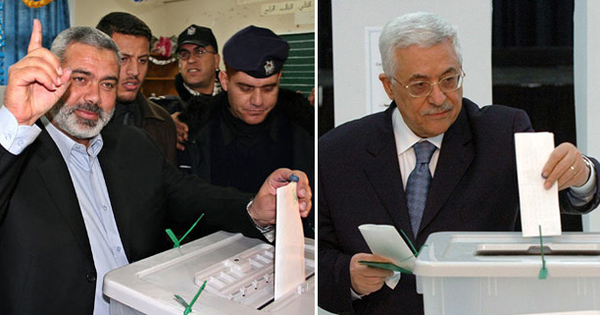
1096One man, one vote, one time? Hamas leader Ismail Haniyeh (left) and Fatah leader Mahmoud Abbas (also president of the Palestinian Authority) are pictured voting in the last election for the Palestinian Legislative Council, which took place in 2006.

Again, the two sides do not seem to be interested at all in sending Palestinians to the ballot boxes. Each side has many good reasons to avoid holding new elections in the West Bank and Gaza Strip.

First, Fatah and Hamas do not trust each other, and each side is convinced that the other would try to steal the vote. How can there be free and democratic elections while Hamas and Fatah continue to arrest and torture each other’s supporters in the Gaza Strip and West Bank?

Second, Fatah is afraid that Hamas’s chances of winning the elections, especially in the West Bank, are very high. That is because many Palestinians still do not trust Abbas and Fatah, whom they accuse of maintaining close security ties with Israel. Moreover, many Palestinians remain disillusioned with Fatah because of its failure to combat financial and administrative corruption and pave the way for the emergence of new leaders.

There is no way that Hamas and Fatah can cast the blame on Israel regarding the issue of elections. If they were really interested in holding new elections, they could do so with the help of the international community, as was the case with previous votes in 2005 and 2006. Israel even helped the Palestinian hold those elections.

When several Hamas candidates from east Jerusalem ran in the January 2006 parliamentary election, Israel did nothing to stop them. Israel even opened its post offices in the city to allow Arab voters from the city (who hold Israeli-issued ID cards) to vote in the election.

Charges made by some Palestinians and anti-Israel groups around the world, to the effect that Israel is responsible for “foiling” efforts to achieve Palestinian unity, are baseless. Although the Israeli government initially opposed the Fatah-Hamas “reconciliation” deal that was reached in 2014, it has not stopped the Palestinian prime minister and some of his cabinet members from visiting the Gaza Strip to pursue the implementation of the accord. In fact, Prime Minister Hamdallah has since visited the Gaza Strip twice, after receiving permission from Israel to go through the Erez border crossing.

Recently, ten Palestinian ministers were forced to leave the Gaza Strip, after Hamas placed them under house arrest in their hotel and banned them from meeting with locals. The ministers entered the Gaza Strip through the Erez border crossing. They came to the Gaza Strip to help solve the problem of thousands of Hamas government employees who have not received salaries for more than a year, and to discuss issues related to the reconstruction of the Gaza Strip.

So while Israel facilitated the visits by Hamdallah and his ministers to the Gaza Strip, it was Hamas that expelled them and prevented them from carrying out their duties. Had Israel expelled the ministers from the Gaza Strip or stopped them from entering the area, the country would have been condemned by the international community for “blocking” efforts to achieve Palestinian unity and rebuild the Gaza Strip.

Today, it has become unavoidably clear that Fatah and Hamas, and not Israel, are responsible for the ongoing plight of the Palestinians in the Gaza Strip. The two parties are unlikely to resolve their differences in the near future, further exacerbating the misery of their people. Each party cares only about its own interests, while at the same time lying to the world that it is all Israel’s fault. Hamas is not willing to relinquish control over the Gaza Strip, certainly not to Abbas and the Palestinian Authority, who were expelled from there in 2007. As for Abbas, he does not seem to be interested in regaining control over a problematic area such as the Gaza Strip, where most of the population lives under the poverty line and in refugee camps.

Yet instead of being honest with their people and admitting their failure to improve their people’s living conditions, Hamas and Fatah continue to wage smear campaigns against each other and, at the same time, also against Israel.

The campaigns that Hamas and Fatah are waging against Israel, particularly in the international community, are designed to divert attention from their failure to provide their people with basic services or any kind of hope.

While ignoring the plight of the Palestinians in the Gaza Strip, the Palestinian Authority leaders were prepared to invest huge efforts and resources in trying to have Israel suspended from the International Federation of Association Football (FIFA). It is as if the Palestinians had solved all their major problems and all that they needed to do now was to stop Israeli soccer players from playing in international matches.

Hamas, for its part, continues to invest enormous resources in digging new tunnels, in preparation for another war with Israel. The money that is being invested in the tunnels and the purchase and smuggling of weapons could benefit many families who lost their homes during the last war. But Hamas, like the Palestinian Authority, does not care about the misery of the Palestinians in the Gaza Strip. They want to fight Israel to the last Palestinian. And this is all being done with the help of anti-Israel governments around the world, and groups such the Boycott, Divestment and Sanctions (BDS) movement, whose only goal is to delegitimize Israel and demonize Jews rather than to help the Palestinians.

US Envoy to Israel: Fight BDS by ‘Negotiating’ with Abbas

June 4, 2015

Obama does not miss an opportunity to force Israel to accept his conditions for an Israeli state.

By: Tzvi Ben-Gedalyahu

Published: June 4th, 2015

via The Jewish Press » » US Envoy to Israel: Fight BDS by ‘Negotiating’ with Abbas.

אֶהְיֶה אֲשֶׁר אֶהְיֶה,

Dan Shapiro and John Kerry.

Dan Shapiro and John Kerry.
Photo Credit: Flash 90

U.S. Ambassador Dan Shapiro told Israel radio stations Thursday that the best way for Israel to fight the Boycott Israel movement is simply to return to negotiations with Mahmoud Abbas, who has conditioned talks on Israel’s agreeing ahead of time to all of his demands.

The issue of BDS has been flying high this week, first with the empty resolution by the British Students Union to join BDS. That was followed up with yesterday’s bombshell statement by an official of the French-based Orange company that it would like to be rid its agreement with Israel’s Partner mobile phone company because of pressure by BDS, which complains that Israel has built more than 100 transmitting antennas on “occupied land” and operates four outlets in Judea and Samaria and eastern Jerusalem

Here comes the United States of America to the rescue.

Shapiro said on Army Radio and Reshet Bet (Voice of Israel) that of course the Obama administration is against boycotts of Israel, which can count on America as its best friends.

The Hebrew-speaking ambassador said:

We staunchly oppose any effort to delegitimize or boycott or sanction Israel. We will never support this. We will fight together with Israel against all these efforts.

And how will it do that?

Shapiro has the simple answer, which could come only from a simpleton’s mindset: The problem is that now there are no negotiations. Shapiro told Israel Radio:

In the past when there were negotiations, that was the most effective tool to tell other countries, perhaps private companies as well, not to impose sanctions because that would upset efforts to reach a solution.

The boycott movement has deep roots in the Arab world, which boycotted Israel long before the Six-Day War in 1967, when Jordan fled territory, most of which it had occupied since 1948 without a United Nations mandate, and left it in Israel’s hands.

The newer “Boycott, Disinvestment and Sanctions” campaign started in 2005, when Israel still was in the midst of marathon “negotiations” in which it conceded point after point and to the Palestinian Authority, with the forceful hand of the Bush administration.

Shapiro may or not believe what he said was true, but he has to be given an “A” for spouting the Obama administration’s magic potion that is based on a bald-faced lie. Obama is against boycotting Israel because he prefers the “diplomatic process,” but he shares the BDS goal of making Israel too weak to exist, although his too naive to know it.

Since taking office, President Barack Obama never has wanted anything more than a Palestinian Authority country to be established, even more than he wants a nuclear-free Iran.

The President regards  himself as an “honorary member of the tribe” thanks to the well-wishers of J Street and Jewish “liberals” who are uncomfortable being Americans while Israel does not do what their president tell it do.

Obama has craftily convinced himself that Judaism teaches that Arabs must have a new country within Israel’s country’s border, and if it does not, then Judaism is doing something wrong.

He has Shapiro, a Jew, and a few other members of the tribe, acting as “good Jews” to kick their brethren in Israel who simply do not understand their duty as Israelis.

Obama and Shapiro know very well that Israel does not sit down with Ababa for negotiations because the leader of the Palestinian Authority does not want to negotiate. He has no reason to compromise because he has the back of the Obama administration, which on the one hand says that it will not force conditions on Israel and on the other hand lets Abbas set the terms.

It is no wonder that Shapiro also told Israel radio today:

We are in a period without negotiations and there is not even a possibility of launching negotiations in the near future. Negotiations have always been the most effective tool to defeat all of these efforts. This is also the best way to advance toward a solution of two states for two peoples.

He frankly states that is no possibility of negotiations now, and President Obama says the same.

The Obama administration has turned “the two states for two peoples” mantra into some kind of voodoo prayer to be recited every time someone threatens Israel, whether with bombs or boycotts.

Shapiro claimed “that when we held negotiations together with the Israelis and the Palestinian Authority it was the most effective tool to tell other states and private companies, ‘Don’t impose these proposals because you will interrupt the efforts to arrive at a solution.’”

And what is the solution?

It is expelling 10 percent of Israel’s population from Jerusalem, Judea and Samaria and withdrawing the IDF from Judea and Samaria as it did from Gaza in 2005.

That has been the Palestinian Authority tactic. Tear apart the Oslo Accords clause by clause, win a concession and then move in for the lethal blow of making Israel the home for several million Arabs living as prisoners of UNRWA in foreign countries.

Obama supports Abbas’ conditions for a new Arab country, but the conditions actually are Obama’s terms for the existence of Israel, which the President does not realize cannot continue to breathe in his fantasy.

Shapiro maintains that the United States will not prematurely “recognize a Palestinian state that does not exist.”

The Obama administration policy is to create facts on the ground that the Palestinian Authority become a member of the United Nations a de facto state, without Jews, in violation the U.N. charter.

And then, according to Shapiro, BDS will fold up and go away, just like Chamberlain could sleep in peace after Hitler would annex Czechoslovakia.

It is not so much of a problem that Shapiro expresses Obama’s holy delusion.

The real problem is that Obama, the honorary member of the tribe, actually believes it.

Satire | Op-Ed: Jews Take Up Too Much Space

June 1, 2015

Satire | Op-Ed: Jews Take Up Too Much Space, Israel National News, Yehezkel Laing, June 1, 2015

(Please see also, 

.– DM)

In July 2022 the UN passed a resolution declaring that for “for the Jews’ own safety” it has been decided to evacuate them to the moon where they would be granted rights to colonize, with the understanding that the world’s lien to the moon would “not be harmed or diminished”. The same resolution removed all Jewish citizenship rights on Earth.

All this I recount in order to properly put into context the latest “development”. As most of you have no doubt heard by now, yesterday the UN assembly unanimously passed a resolution accusing the Jews of having “stolen the moon”. The resolution states that if we do not relinquish full rights the world community will be left with no choice but to attack.

While there are several influential Jewish politicians and scientists who claim we can colonize Jupiter – I do not believe this is feasible at this time. Even if we were successful, where would it end? Would we be forced to colonize another solar system, another galaxy, another universe? If we do not make a stand here, where will we ever make a stand?

**********************

I am not the type of person who seeks publicity for myself and I wouldn’t even be writing this if it could be avoided. But since circumstances leave me no choice, I have decided to break my silence and reveal my true role in the events of the past two decades. While many of these facts are known to the general public, their order and cause are often obscure or confused. So please bear with me as I recount the events in their proper order, as I remember them.

I will start all the way back in 1948 – three years after the destruction of European Jewry, the State of Israel was formed – within two years Sephardic Jewry having been expelled from all the Arab lands fled to the newborn state and joined their Ashkenazi brethren.

Jump ahead 72 years…

In January 2020 the Iranians announced they had decided for “defensive purposes” to build a nuclear arsenal. The US responded it was “shocked” by this development and quickly instituted “robust” new sanctions, but said it would not instigate any hostilities. Following this announcement, the final Israeli government instituted “The Month of Defense” – wherein all citizens were told to prepare for war with Iran. Riots broke out against Jews in Europe and even in North America. Two weeks after the Israeli declaration – the US announced it would not support any Israeli “aggression” against Iran saying it feared this would lead to nuclear war in the region.

It was at this point I went to the Prime Minister. For many years I had been toying with the idea of a lunar colony. My background in environmental physics gave me the perfect training for this experiment. Its true that my Noble Prize in physics was won for discoveries in Isotopic Negativity, what many consider an unrelated field. But any post-doctoral physics student can tell you that the underlying principles of the two disciplines are quite the same. In other words, the original idea was mine and not the Prime Minister’s, but for political reasons it was believed it had a better chance of success if he would propose it and not I.

In February 2021, I was appointed Director of the Jewish Lunar Colony Project. By the way, the space elevator was not my idea but rather that of Yakob Farche, a Czech engineer of Jewish extraction, who approached me shortly after the Prime Minister publicly designated me with the task of designing the plan for the colony.

In July 2022 the UN passed a resolution declaring that for “for the Jews’ own safety” it has been decided to evacuate them to the moon where they would be granted rights to colonize, with the understanding that the world’s lien to the moon would “not be harmed or diminished”. The same resolution removed all Jewish citizenship rights on Earth. Of course, the far Right “Earth Homeland Party” lead by Hezy Ben Arroche fought the plan arguing that Jews had a right to live on Earth just like all other human beings. But the Prime Minister eloquently explained that the Jewish people “had to be practical and not just ideological”. While no referendum was formally held on the matter – rigorous polling showed a consistent majority of Jews in favor of the project.

The UN said it would only back the plan if World Jewry itself would fundthe move. Since Jews could no longer legally live on earth this was accomplished much more easily than was originally imagined. One trilliondollars were raised and the plan was set in motion.

After all the Jews completed evacuation of the Land of Israel in 2015 – the UN passed a resolution formally recognizing the Arab State of Palestine. Unfortunately for the UN, the Palestinians themselves rejected the move. They insisted that the Jews had “ravaged the land of all its natural resources” and that without massive funding, the new state would collapse. A $500 billion world investment plan was quickly instituted to prop up the foundling state – but the subsequent civil was over control of the funds destroyed most of the population and with no prospects for self-support the remaining survivors immigrated.

With the collapse of the State of Palestine, Iran declared it rights to the region claiming that Palestine had always been “a natural extension of Persian autonomy”. The Europeans said this was preposterous and noted that the former State of Israel had once held observer status in the EU and that the land was actually closer to Europe than Iran. What seemed to be a squabble over a small piece of property quickly escalated into hostilities, resulting in the First Nuclear War. While this was limited in scope and only resulted in the loss of only 4 million lives, the lessons of its destructiveness were unfortunately not learned and by the Third Nuclear War most of the planet’s populace had been wiped out and most of the Earth is now uninhabitable.

During this time the Moon Colony flourished. The first dome held up remarkably well and within two years it was decided to expand the dome and institute the lunar landscaping project. Eight years ago I was approached by a young astro-physicist by the name of Aaron Belzberg originally from Bnei Brak. He suggested an incredible idea whereby using a process of reverse ionization of the colony’s oxygen we could create an artificial atmosphere that would remove the need for the dome and make the moon inhabitable. That is how today we have a living moon with 500 million trees, ten lakes and 15 million inhabitants.

All this I recount in order to properly put into context the latest “development”. As most of you have no doubt heard by now, yesterday the UN assembly unanimously passed a resolution accusing the Jews of having “stolen the moon”. The resolution states that if we do not relinquish full rights the world community will be left with no choice but to attack.

While there are several influential Jewish politicians and scientists who claim we can colonize Jupiter – I do not believe this is feasible at this time. Even if we were successful, where would it end? Would we be forced to colonize another solar system, another galaxy, another universe? If we do not make a stand here, where will we ever make a stand?

Don’t the Jews deserve a place to live just like everyone else?

Exiled Fatah Terrorist Amna Muna on PA TV: We Will Continue Until Our Entire Land is Liberated

May 26, 2015

Exiled Fatah Terrorist Amna Muna on PA TV: We Will Continue Until Our Entire Land is Liberated, MEMRI TV via You Tube, May 26, 2015

(The Palestinian Authority is Israel’s “partner for peace” and its titular leader, Abbas, can be an angel of peace according to the Pope. Some angel; some peace.– DM)

In a May 15 interview on the official Palestinian Authority TV channel, Amna Muna, a Palestinian terrorist who was freed in the Shalit prisoner swap and exiled to Turkey, said: “Nothing will break our resolve – not imprisonment, not exile, and not martyrdom… We shall continue on our path until our entire land is liberated.” Muna, who was speaking to PA TV over the Internet, was imprisoned for her involvement in the kidnapping and murder of Israeli teenager Ofir Rahum in 2001.


Op-Ed: Every Day is “Opposite Day” with President Barack Obama

May 26, 2015

Op-Ed: Every Day is “Opposite Day” with President Barack Obama, Israel National News, Mark Langfan, May 26, 2015

In sum, either Obama is, at best, a Middle-east policy ignoramus or, at worst, an Iranian stooge. If Obama rolled dice to make his Middle-East decisions, he’d have a better average than his current total Middle-East failure on every issue.  So, chances are he is not intending his Middle-East policies to bring peace, but instead planning them to bring war and sow the violence, death and destruction that they have predictably brought.

**********************

Obama has done exactly the opposite of what should be done in the Middle East for his entire term. Israel had better ignore his advice.

Following Obama’s speeches is like watchingSesame Street’s “Opposite Day”, the Sesame Street episode where everything is “opposite.”  ‘Up’ is ‘down,’ ‘left’ is ‘right,’ and so on and so forth.  It’s like Berra saying “It’s deja vu all over again.”

With Obama, for the past seven years, every day is “Opposite Day.”  Everything he says sounds upside-down and backwards, and is proven, in the short-term, to be just that.  Instead of being chastened by reality, Obama blithely still talks-the-talk like he’s reading off the Holy Grail.

Take Obama’s latest upside-down and backwards ‘Opposite-Day’ statement: “I continue to believe a two-state solution is absolutely vital for not only peace between Israelis and Palestinians, but for the long-term security of Israel as a democratic and Jewish state.”  Given Obama’s 0%batting average on Middle-East strategy, it safe to conclude that keeping the “West Bank” is vital for Israel’s security.

For starters, what Middle East policy has Obama gotten right in the last seven years?  Obama’s total retreat from Iraq that empowered Iranian-puppet al Maliki to castrate the Western Iraqi Sunnis that mutated into ISIS?  Obama’s bombing of Qaddafi, and setting North Africa into a ball of flames?  Obama’s toppling of Mubarak and coronation of the Muslim Brotherhood Sunni Islamic State of Egypt?  Obama’s green-lighting Iran to set Shiite Arab against Sunni Arab as he anoints Iran as a nuclear-threshold state, and gives $50 billion to further fund its Islamic “resistance” revolution?  Obama’s total protection of the genocidal Assad as he gasses Sunni Muslims to death?

Obama has made the wrong policy decision on every Middle Eastern issue, yet still speaks as if he’s the Middle-east guru.

The truth is Israel’s retention of the “West Bank” is vital not only for the peace and security of Israel, but also, most importantly, for the moderate Arabs who bathe in the warmth of Israel’s security envelope.  If Israel left the “West Bank”, forget about the resulting Hamastan that once concerned us, because the result would be an  ISIStan. Hamas will soon start asking Israel for protection from ISIS as that organization is beginning to attack it in Gaza.  And after Assad falls, and the Sunnis start really paying Hezbollah back for its genocide against the Syrian Sunnis, the Shiites of South Lebanon will have only one protector: Israel.

Was Israel’s retreat from Gaza good for Egypt?  No, it created a cancer that sent its Iranian-funded Islamic-bedlam to the Sinai, and then to Egypt-proper.  Israel’s “peace-process” regarding Gaza has enabled Hamas to turn the Palestinians of Gaza into cannon-fodder for the world press, and the World Court.  With Gaza’s failed-test-case, Obama’s claim that Israel repeat the same withdrawal from Judea and Samaria almost seems to present evidence of a malevolent intent to eradicate peace and security for Israel, and the moderate Arabs who are now protected by Israel.

And let us not forget Jordan.  Wouldn’t Jordan “love” an ISIStan state to its west?  The analogy is simple, a Hamastan Gaza is to Egypt what an ISIStan “West Bank” would be to Jordan—a formula for Jordan’s total disintegration.  As it is, Jordan’s King Abdullah is facing ISIS to the north and to the south. Jordan can be easily overrun, it hardly needs additional pressure along its western border, now protected by Israel.

In sum, either Obama is, at best, a Middle-east policy ignoramus or, at worst, an Iranian stooge. If Obama rolled dice to make his Middle-East decisions, he’d have a better average than his current total Middle-East failure on every issue.  So, chances are he is not intending his Middle-East policies to bring peace, but instead planning them to bring war and sow the violence, death and destruction that they have predictably brought.

If Obama says “up,” think “down;” and if he advises retreat from Judea and Samaria, Israel had better stay exactly where it is.