[Iranian] military leader [Fadavi] went on to claim that “Iranian Armed Forces are now at the highest level of preparedness” and that “only the dead body of the American troops realizes the power of the Islamic Revolution.”
********************
Two Russian warships have docked in northern Iran for a series of naval training exercises with the Islamic Republic, according to Persian-language reports translated by the CIA’s Open Source Center.
The two Russian ships docked in Iran’s Anzali port on Sunday and will hold “joint naval exercises during the three-day stay of the warships in Iran,” according to a Persian-language report in Iran’s state-controlled Fars News Agency.
“The [Russian] warships, Volgodonsk and Makhachkala docked in Anzali Port [near the Caspian Sea], in the fourth naval zone, on the afternoon of 9 August,” the report says.
The war exercises come just weeks after Iran and global powers inked a nuclear accord that will provide Iran with billions of dollars in sanctions relief in return for slight restrictions on the country’s nuclear program.
Russian and Iran have grown close in recent years, with delegations from each country regularly visiting one another to ink arms deals and other agreements aimed at strengthening Iran’s nuclear program.
Russia and Iran agreed earlier this year to begin construction on several new nuclear power plants. Russia has also agreed to sell Iran a controversial advanced missile defense system that can prevent attacks by Western powers.
The Russian fleet docked in Iran’s port “carrying a message of ‘peace and friendship,’” according to Iranian officials quoted by Fars. The fleet was “welcomed by Iranian naval commanders and staff.”
The Russian commander of the fleet is scheduled to hold meetings with “local political and military officials” in Iran’s northern provinces, according to Fars.
Levan Jagarian, Russia’s ambassador to Tehran, reportedly attended the docking ceremony and called for “for boosting mutual ties between the two countries in various fields,” according to the report.
The two nations went on to say that “expanding bilateral economic, political, and military cooperation is among the priorities of the visit.”
A Russian fleet also docked in northern Iran in October.
Last week, a senior Iranian naval commander warned the United States against ever taking military action on Iranian interests, claiming that the response would be “unpredictably strong.”
“The western media are mocking at the U.S. for speaking of ‘on the table options (against Iran)’ because the U.S. always utters some words without the ability to materialize them,” Iranian Revolutionary Guard Corps Naval Commander Ali Fadavi was quoted as saying by the country’s state-run press.
Iran is “ready to give such a powerful response to the slightest move of the U.S. that it won’t be able to make any other moves,” Fadavi was quoted as saying.
The military leader went on to claim that “Iranian Armed Forces are now at the highest level of preparedness” and that “only the dead body of the American troops realizes the power of the Islamic Revolution.
Michael Rubin, a former Pentagon adviser and expert on rogue regimes, said the Obama administration is fundamentally misreading Iran’s intentions in light of the recently inked nuclear accord.
“We’re witnessing a new great game, and Obama is so self-centered he keeps playing solitaire,” Rubin said. “Obama simply doesn’t understand that the world is full of dictators who seek to checkmate America. What he sees as compromise; they see as weakness to exploit.”
Referring to a visit last week to Russia by IRGC leader Qassem Soleimani, who is responsible for the deaths of Americans, Rubin said it is clear that Moscow and Tehran aim to build a tight military alliance.
“Visiting Russia to talk arms purchases and now this naval visit, it’s clear that Putin and Khamenei will waste no time to really develop their military cooperation,” he said.
An axis between Russia, Iran, and North Korea is beginning to emerge Rubin said, citing official releases that a North Korean delegation is currently visiting Russia to tour war games sites.
“The Russian warship visit combined with North Korea scoping out war game sites in Russia suggest a new Axis of Evil is taking shape with Russia the lynchpin between Iran and North Korea,” Rubin said. “As for the United States, rather than the leader of the free world, Obama and Kerry have transformed us in much of the world’s eyes as the pinnacle of surrender.”
Meanwhile, Obama admitted Monday that Iran’s nuclear breakout time will shrink to “a matter of months” once the nuclear accord expires in around 15 years.
(Another interesting question would be, does Obama agree with any of Khamenei’s statements and, if so, which? — DM)
The Khamenei Palestine book is important not in and of itself but because the regime’s obsession with Israel is a key to its foreign policy. . . . But as much as Iran is focused on regional hegemony in which Sunni states would be brought to heel, as Khamenei’s Palestine illustrates, it is the fixation on Israel and Zionism that really animates their expansionism and aid for terror groups.
******************
It turns out President Obama isn’t the only world leader who writes books. His counterpart in Iran – Supreme Leader Grand Ayatollah Ali Khamenei — has also just published a new book. But while it may not be as introspective as Obama’s Dreams From My Father, it does tell us at least as much about the vision of the person in charge in Tehran (as opposed to Hassan Rouhani, the faux moderate who serves as its president) as the president’s best-selling memoir. As Amir Taheri reports in the New York Post,Palestine is a 416-page diatribe against the existence of the state of Israel and a call to arms for it to be destroyed. Supporters of the nuclear deal the president has struck with Khamenei’s regime may dismiss this book as merely one more example of the Supreme Leader’s unfortunate ideology that must be overlooked. But as the New York Times noted last week, the administration’s real goal here isn’t so much in delaying Iran’s march to a nuclear weapon (which is the most that can be claimed for the agreement) as it is fostering détente with it. Seen in that light, the latest evidence of the malevolence of the Islamist regime should be regarded as yet another inarguable reason for Congress to vote the deal down.
In his interview with The Atlantic’s Jeffrey Goldberg on May 21, President Obama was asked directly about the significance of Iran’s anti-Semitism and its commitment to destroying Israel. The president said the anti-Semitism of the Iranian leadership did not mean they weren’t also “interested in survival” or being “rational.” As far as he was concerned, the ideology of the regime was not something that would influence its decisions.
But everything Khamenei says and, even more importantly, everything the regime does, by funding terrorist groups at war with Israel such as Hamas and Hezbollah or by embarking on a ruinously expensive nuclear project that placed it in conflict with the West, speaks to its commitment to policies that Obama may think are irrational but which are completely in synch with what he called its “organizing principle.” Why would a nation so rich in oil need to risk international isolation or war seek nuclear power if not to help Khamenei fulfill his pledge to “liberate” what is now Israel for Muslims?
The president told Goldberg that the American military option would be a sufficient deterrent to ensure that Iran didn’t violate the nuclear pact or behave in an irrational manner. But since the president has ruled out the use of force in a categorical manner, it’s hard to see why the Iranians would fear it once the U.S. and Europe are doing business with them. Even if it was a matter of snapping back sanctions, assuming that such a concept is even possible? Once the restrictions are unraveled, it’s fair to ask why would they work then when the president repeatedly tells us additional sanctions won’t work now and require us to accept the current deal that doesn’t achieve the objectives that the administration set for the negotiations when they began.
The Khamenei Palestine book is important not in and of itself but because the regime’s obsession with Israel is a key to its foreign policy. Iran constitutes a grave threat to Neighboring Arab countries that are at least as angry about the president’s embrace of Tehran as the Israelis since their nuclear status would undermine their security. But as much as Iran is focused on regional hegemony in which Sunni states would be brought to heel, as Khamenei’s Palestine illustrates, it is the fixation on Israel and Zionism that really animates their expansionism and aid for terror groups.
As Taheri notes in his article on the book, Khamenei distinguishes his idée fixe about destroying Israel from European anti-Semitism. Rather, he insists, that his policy derives from “well established Islamic principles.” Chief among them is the idea that any land that was once ruled by Muslims cannot be conceded to non-believers no matter who lives there now. While the Muslim world seems to understand that they’re not getting Spain back, the territory that constitutes the state of Israel is something else. Its central location in the middle of the Muslim and Arab worlds and the fact that Jews, a despised minority people, now rule it makes its existence particularly objectionable to Islamists like Khamenei.
Khamenei’s book shows that not only is he serious about wanting to destroy Israel and uproot its Jewish population, he regards this project as a practical rather than a theoretical idea. The administration ignores this because it wants to believe that Iran is a nation that wants to, as the president put it, “get right with the world.” But what it wants is to do business with the world while pursuing its ideological goals. The nuclear deal is a means to an end for the regime and that end does not involve good relations with the West or cooperation with other states in the region, let alone coexisting peacefully with Israel.
What is curious is that this is the same administration that regarded the announcement of a housing project in Jerusalem by low-level Israeli officials as an “insult” to Vice President Biden. But it chooses to regard the “death to America” chants led by regime functionaries in Iran as well as a book by the country’s leader indicating that Obama’s ideas about its character are fallacious as non-events. The only explanation for this remarkable lack of interest in Iranian behavior is an ideological fixation on détente with Tehran that is every bit as hardcore as any utterances that emanate from the mouth or the pen of the Supreme Leader.
Taken out of the context of a vision of friendship with the Iranian regime, the nuclear deal makes no sense. Yet squaring that vision with Khamenei’s literary effort is impossible. Members of the House and Senate must take note of this conundrum and vote accordingly.
[W]e should conclude that any deal that leads, now or in the near future, to an Iranian bomb is unacceptable to Israel — a nation that will likely soon have no choice but to consider the unthinkable in order to prevent the unimaginable.
*********************
Will Israel do the unthinkable to stop the unimaginable?
The Obama administration seems peeved that almost everyone in Israel, left and right, has no use for the present Iranian–American deal to thwart Iran’s efforts to get the bomb. Indeed, at times John Kerry has hinted darkly that Israel’s opposition to the pact might incur American wrath should the deal be tabled — even though Kerry knows that the polls show a clear majority of Americans being against the proposed agreement while remaining quite supportive of the Jewish state. President Obama, from time to time, suggests that his agreement is being sabotaged by nefarious lobbying groups, big-time check writers, and neoconservative supporters of the Iraq war — all shorthand, apparently, for pushy Jewish groups.
Obama and his negotiators seem surprised that Israelis take quite seriously Iranian leaders’ taunts over the past 35 years that they would like to liquidate the Jewish state and everyone in it. The Israelis, for some reason, remember that well before Hitler came to power, he had bragged about the idea of killing Jews en masse in his sloppily composed autobiographical Mein Kampf. Few in Germany or abroad had taken the raving young Hitler too seriously. Even in the late 1930s, when German Jews were being rounded up and haphazardly killed on German streets by state-sanctioned thugs, most observers considered such activities merely periodic excesses or outbursts from non-governmental Black- and Brownshirts.
The Obama administration, with vast oceans between Tehran and the United States, tsk-tsks over Iranian threats as revolutionary hyperbole served up for domestic consumption. The Israelis, with less than a thousand miles between themselves and Tehran, do not — and cannot. Given the 20th century’s history, Israel has good reason not to trust either the United States or Europe to ensure the security of the Jewish state. Israel has learned from the despicable anti-Semitism now prevalent at the U.N. and from the increasing thuggery directed at Jews in Europe that the world at large would shed crocodile tears over the passing of Israel on the day of its destruction, but, the next day, sigh and get right back to business in a “that was then, this is now” style.
In 1981 the Israelis took out the Iraqi nuclear reactor — sold to Saddam Hussein by France. They were ritually blasted as state terrorists and worse by major U.S. newspapers and at the United Nations — though not by Khomeini’s Iran, which earlier had failed in a preemptive bombing strike to do much damage to the Osirak reactor. Today, in retrospect, most nations are privately glad that the Israelis removed the reactor from a country that had hundreds of years’ worth of natural-gas and oil supplies and no need for nuclear power — and that is now under assault from ISIS.
In 2007, when the Israelis preempted once more, and destroyed the al-Kibar nuclear facility that was under construction in Syria, the world, after initial silence, again in Pavlovian fashion became outraged at such preemptive bombing. The global chorus claimed that there was no intelligence confirming that the North Koreans had helped to launch a Syrian uranium-enrichment plant.
Yet eight years later, most observers abroad once again privately shrug that Bashar Assad most certainly had hired the Koreans to build a nuclear processing plant — and are quietly satisfied that the Israelis took care of it. Note that the al-Kibar site lies in territory now controlled by ISIS. One can imagine a variety of terrifying contemporary scenarios had the Israelis not preempted. Most of those who condemned Israel’s attack would now be worrying about an ISIS improvised explosive device, packed with dirty uranium, that might go off in a major Western city.
In all these cases, the Israelis assumed that Western intelligence about nuclear proliferation in the Middle East was unreliable. They took for granted that Westerners automatically would blame Israelis for any preemptive attack against an Islamic nuclear site. And they likewise concluded that, privately and belatedly, Westerners would eventually be happy that the Israelis had belled the would-be nuclear cat.
But in a larger sense, the Israelis also recall the sad story of the West and the Holocaust less than 75 years ago — a horror central to the birthing of a “never again” Jewish state. By 1943, the outlines of the Nazis’ Final Solution were well known in both Washington and London; Jews were already being gassed at German death camps in Poland in an effort to kill every Jew from the Atlantic Ocean to the Volga River.
It was also a matter of record that the major Western democracies — America, Britain, and prewar France — had refused sanctuary to millions of Jewish refugees who had been stripped of their property by the Third Reich and told to leave Germany and its occupied territories. In some notorious cases, shiploads of Jews were turned away after docking in Western ports and were sent back to Nazi-occupied Europe, where the passengers were disembarked and soon afterward gassed. Moreover, Israelis understand that Hitler’s Final Solution would have been far more difficult to implement without the active participation of sympathetic anti-Semites in occupied European nations, who volunteered to round up their own Jews and send them on German trains eastward to the death camps.
In the case of the United States, anti-Semitic or indifferent officials high up in the State Department and elsewhere within the Roosevelt administration went out of their way to hide data about the plight of Jewish refugees, and circumvented protocol in order to refuse entry into the United States to the vast majority of Jews fleeing the Holocaust. The British were nearly as exclusionary, and also did their best to stop Jewish refugees from fleeing to Palestine to escape the death camps.
As it happens, Fascist and Nazi-allied Japan was sometimes more sympathetic to Jews desperate to leave Europe than were the Allies. Indeed, Hitler and his Nazi top echelon constantly bragged about the fact that neither the Allied powers nor occupied European nations wanted to take Jews off Berlin’s hands — proof, in Nazi eyes, of a supportive wink-and-nod attitude to the Holocaust. Each time the Allies published a threat to the Nazi leadership that there would be an accounting and war-crime trials after the war, Hitler, Goebbels, and Himmler remembered that none of these outraged governments wanted to accept Jews themselves, and thus they must secretly still have remained indifferent to their fate. Thus the threats rang hollow to the Nazis, and the crematoria burned on.
By mid-1943 at the latest, American authorities had comprehensive knowledge — from firsthand reports by camp escapees, from photo reconnaissance, and from brave Germans who passed on detailed inside information through the neutral Swiss — of the vast scope of the Holocaust. They were constantly beseeched by international Jewish advocates to at least bomb the crematoria and gas chambers at Auschwitz, which were within range of the Allies’ four-engine heavy bombers. Indeed, an Allied bombing mission would on occasion hit one of the key German factories that surrounded Auschwitz itself — to the delight of the doomed inmates of the death camps.
Given that eventually over 10,000 Jews per day were being gassed and cremated at Auschwitz, almost every Jewish leader advocated bombing the camps to destroy the rail links, the intricate camp machinery, and the SS guards so essential to the perpetration of the Holocaust. Again, such pleas were met with both indifference and lies, once more offered up by heralded American statesmen like U.S. Assistant Secretary of State Breckinridge Long and well-connected consigliere and future “wise man” John McCloy of the War Department. The latter falsely argued at times that the camps were not really in reach of Allied bombers, or that the numbers of Jews being slaughtered were exaggerated, or that the diversion of even one or two missions from the strategic bombing of Germany would hamper the entire Allied war effort.
After the war, with rising Cold War tensions and a need to ensure that the West German public remained firmly in the new NATO alliance, many Nazi war criminals either were let out of prison early, had their sentences commuted, or were never charged at all. For all the Western empathy about the horrific Final Solution, Jews remembered (1) that it would once have been possible to save many fleeing Jews, if only the democracies had just allowed in political refugees; (2) that many of the death camps could have been leveled by Allied bombers in their last year or two of full-bore operation, saving perhaps 2 to 3 million of the doomed; and (3) that the political expediency of the postwar Western alliance had trumped bringing Nazi war criminals to a full accounting for their horrendous acts.
The Israelis have taken to heart lots of lessons over the last 70 years. They have concluded that often the world quietly wants Israel to deal with existential threats emanating from the Middle East while loudly damning it when it does. They have learned from the experience of the Holocaust that, for good or evil, Jews are on their own and can never again trust in the world’s professed humanity to prevent another Holocaust. And they are convinced that they can also never again err on the side of the probability that national leaders, with deadly weapons in their grasp, do not really mean all the unhinged things they shout and scream about killing Jews.
Given all that, we should conclude that any deal that leads, now or in the near future, to an Iranian bomb is unacceptable to Israel — a nation that will likely soon have no choice but to consider the unthinkable in order to prevent the unimaginable.
Iranian Foreign Minister Mohammad Javad Zarif gestures as he talks with journalist from a balcony of the Palais Coburg hotel where the Iran nuclear talks meetings are being held in Vienna, Austria. (photo credit:REUTERS)
Not only will the US and its allies remove the sanctions imposed on Iran over the past decade and so start the flow of some $150 billion to the ayatollahs’ treasury. They will help Iran develop advanced centrifuges.
They even committed themselves to protecting Iran’s nuclear facilities from attack and sabotage.
Israel still may have the ability to attack Iran’s nuclear sites. If it does, then it should attack them as quickly and effectively as possible.
*********************
On Tuesday, we moved into a new nuclear age.
In the old nuclear age, the US-led West had a system for preventing the proliferation of nuclear weapons. It had three components: sanctions, deterrence and military force. In recent years we have witnessed the successful deployment of all three.
In the aftermath of the 1991 Gulf War, the UN Security Council imposed a harsh sanctions regime on Iraq. One of its purposes was to prevent Iraq from developing nuclear weapons. After the US-led invasion of Iraq in 2003, we learned that the sanctions had been successful. Saddam largely abandoned his nuclear program due to sanctions pressure.
The US-led invasion of Iraq terrified several rogue regimes in the region. In the two to three years immediately following the invasion, America’s deterrent strength soared to unprecedented heights.
As for military force, the nuclear installation that Syrian dictator Bashar Assad built in Deir a-Zour with Iranian money and North Korean technicians wasn’t destroyed through sanctions or deterrence. According to foreign media reports, in September 2007, Israel concluded that these paths to preventing nuclear proliferation to Syria would be unsuccessful.
So then-prime minister Ehud Olmert ordered the IDF to destroy it. The outbreak of the Syrian civil war three years later has prevented Assad and his Iranian bosses from reinstating the program, to date.
The old nuclear nonproliferation regime was highly flawed.
Pakistan and North Korea exploited the post-Cold War weaknesses of its sanctions and deterrence components to develop and proliferate nuclear weapons and technologies.
Due to American weakness, neither paid a serious price for its actions.
Yet, for all its flaws and leaks, the damage caused to the nonproliferation system by American weakness toward Pakistan and North Korea is small potatoes in comparison to the destruction that Tuesday’s deal with Iran has wrought.
That deal doesn’t merely show that the US is unwilling to exact a price from states that illicitly develop nuclear weapons. The US and its allies just concluded a deal that requires them to facilitate Iran’s nuclear efforts.
Not only will the US and its allies remove the sanctions imposed on Iran over the past decade and so start the flow of some $150 billion to the ayatollahs’ treasury. They will help Iran develop advanced centrifuges.
They even committed themselves to protecting Iran’s nuclear facilities from attack and sabotage.
Under the deal, in five years, Iran will have unlimited access to the international conventional arms market. In eight years, Iran will be able to purchase and develop whatever missile systems it desires.
And in 10 years, most of the limitations on its nuclear program will be removed.
Because the deal permits Iran to develop advanced centrifuges, when the agreement ends in 10 years, Iran will be positioned to develop nuclear weapons immediately.
In other words, if Iran abides by the agreement, or isn’t punished for cheating on it, in 10 years, the greatest state sponsor of terrorism in the world will be rich, in possession of a modernized military, a ballistic missile arsenal capable of carrying nuclear warheads to any spot on earth, and the nuclear warheads themselves.
Facing this new nuclear reality, the states of the region, including Jordan, Egypt, Saudi Arabia, Turkey and perhaps the emirates, will likely begin to develop nuclear arsenals. ISIS will likely use the remnants of the Iraqi and Syrian programs to build its own nuclear program.
Right now, chances are small that Congress will torpedo Barack Obama’s deal. Obama and his backers plan to spend huge sums to block Republican efforts to convince 13 Democratic senators and 43 Democratic congressmen to vote against the deal and so achieve the requisite two-thirds majority to cancel American participation in the deal.
Despite the slim chances, opponents of the deal, including Israel, must do everything they can to convince the Democrats to vote against it in September. If Congress votes down the deal, the nuclear chaos Obama unleashed on Tuesday can be more easily reduced by his successor in the White House.
If Congress rejects the deal, then US sanctions against Iran will remain in force. Although most of the money that will flow to Iran as a result of the deal is now frozen due to multilateral sanctions, and so will be transferred to Iran regardless of congressional action, retaining US sanctions will make it easier politically and bureaucratically for Obama’s replacement to take the necessary steps to dismantle the deal.
Just as the money will flow to Iran regardless of Congress’s vote, so Iran’s path to the bomb is paved regardless of what Congress does.
Under one scenario, if Congress rejects the deal, Iran will walk away from it and intensify its nuclear activities in order to become a nuclear threshold state as quickly as possible. Since the deal has destroyed any potential international coalition against Iran’s illegal program, no one will bat a lash.
Obama will be deeply bitter if Congress rejects his “historic achievement.” He can be expected to do as little as possible to enforce the US sanctions regime against his Iranian comrades. Certainly he will take no military action against Iran’s nuclear program.
As a consequence, regardless of congressional action, Iran knows that it has a free hand to develop nuclear weapons at least until the next president is inaugurated on January 20, 2017.
The other possible outcome of a congressional rejection of the deal is that Iran will stay in the deal and the US will be the odd man out.
In a bid to tie the hands of her boss’s successor and render Congress powerless to curb his actions, the day before the deal was concluded, Obama’s UN Ambassador Samantha Power circulated a binding draft resolution to Security Council members that would prohibit member nations from taking action to harm the agreement.
If the resolution passes – and it is impossible to imagine it failing to pass – then Iran can stay in the deal, develop the bomb with international support and the US will be found in breach of a binding UN Security Council resolution.
Given that under all scenarios, Tuesday’s deal ensures that Iran will become a threshold nuclear power, it must be assumed that Iran’s neighbors will now seek their own nuclear options.
Moreover, in light of Obama’s end-run around the Congress, it is clear that regardless of congressional action, the deal has already ruined the 70-year old nonproliferation system that prevented nuclear chaos and war.
After all, now that the US has capitulated to Iran, its avowed foe and the greatest state sponsor of terrorism, who will take future American calls for sanctions against nuclear proliferators seriously? Who will be deterred by American threats that “all options are on the table” when the US has agreed to protect Iran’s nuclear installations and develop advanced centrifuges for the same ayatollahs who daily chant, “Death to America”? For Israel, the destruction of the West’s nonproliferation regime means that from here on out, we will be living in a region buzzing with nuclear activity. Until Tuesday, Israel relied on the West to deter most of its neighbors from developing nuclear weapons. And when the West failed, Israel dealt with the situation by sending in the air force. Now, on the one hand Israel has no West to rely on for sanctions or deterrence, and on the other hand, it has limited or no military options of its own against many of the actors that will now seek to develop nuclear arsenals.
Consider Israel’s situation. How could Israel take action against an Egyptian or Jordanian nuclear reactor, for instance? Both neighboring states are working with Israel to defeat jihadist forces threatening them all. And that cooperation extends to other common threats. Given these close and constructive ties, it’s hard to see how Israel could contemplate attacking them.
But on the other hand, the regimes in Amman and Cairo are under unprecedented threat.
In theory they can be toppled at any moment by jihadist forces, from the Muslim Brotherhood to ISIS. It’s already happened once in Egypt.
The same considerations apply to Saudi Arabia.
As for Turkey, its NATO membership means that if Israel were to attack Turkish nuclear sites, it would run the risk of placing itself at war not only with Turkey, but with NATO.
Given Israel’s limited military options, we will soon find ourselves living under constant nuclear threat. Under these new circumstances, Israel must invest every possible effort in developing and deploying active nuclear defenses.
One key aspect to this is missile defense systems, which Israel is already developing.
But nuclear bombs can be launched in any number of ways.
Old fashioned bombs dropped from airplanes are one option.
Artillery is another. Even suicide trucks are good for the job.
Israel needs to develop the means to defend itself against all of these delivery mechanisms. At the same time, we will need to operate in hostile countries such as Lebanon, Syria and elsewhere to destroy deliveries of nuclear materiel whether transferred by air, sea or land.
Here is the place to mention that Israel still may have the ability to attack Iran’s nuclear sites. If it does, then it should attack them as quickly and effectively as possible.
No, a successful Israeli attack cannot turn back the clock. Israel cannot replace the US as a regional superpower, dictating policy to our neighbors. But a successful attack on Iran’s nuclear program along with the adoption of a vigilantly upheld strategy of active nuclear defense can form the basis of a successful Israeli nuclear defense system.
And no, Israel shouldn’t be overly concerned with how Obama will respond to such actions.
Just as Obama’s nuclear capitulation to Iran has destroyed his influence among our Arab neighbors, so his ability to force Israel to sit on the sidelines as he gives Iran a nuclear arsenal is severely constrained.
How will he punish Israel for defying him? By signing a nuclear deal with Iran that destroys 70 years of US nonproliferation strategy, allows the Iranian regime to grow rich on sanctions relief, become a regional hegemon while expanding its support for terrorism and develop nuclear weapons? Years from now, perhaps historians will point out the irony that Obama, who loudly proclaims his goal of making the world free of nuclear weapons, has ushered in an era of mass nuclear proliferation and chaos.
Israel can ill afford the luxury of pondering irony.
One day the nuclear Furies Obama has unleashed may find their way to New York City.
But their path to America runs through Israel. We need to ready ourselves to destroy them before they cross our border.
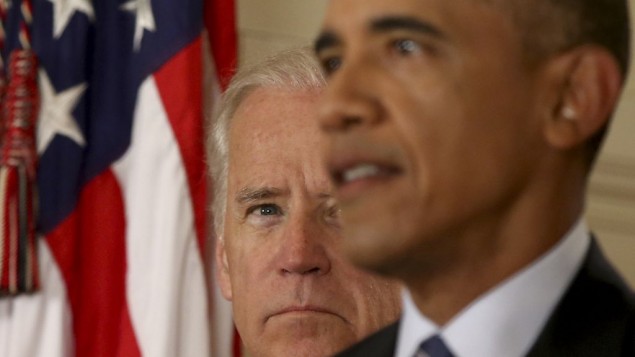
Vice President Joe Biden listens as President Barack Obama delivers remarks in the East Room of the White House in Washington, Tuesday, July 14, 2015, after an Iran nuclear deal is reached. (AP Photo/Andrew Harnik, Pool)
Because of this deal we will for the first time be in a position to verify all of these commitments. That means this deal is not built on trust. It is built on verification. Inspectors will have 24/7 access to Iran’s nuclear facilities. Iran will have access to Iran’s entire nuclear supply chain, its uranium mines and mills, its conversion facility and its centrifuge manufacturing and storage facilities.
Because of this deal, inspectors will also be able to access any suspicious location — put simply, the organization responsible for the inspections, the IAEA, will have access where necessary, when necessary. That arrangement is permanent. And the IAEA has also reached an agreement with Iran to get access that it needs to complete its investigation into the possible military dimensions of Iran’s past nuclear research.
********************
After two years of negotiations, the United States, together with our international partners, has achieved something that decades of animosity has not: a comprehensive long-term deal with Iran that will prevent it from obtaining a nuclear weapon.
This deal demonstrates that American diplomacy can bring about real and meaningful change, change that makes our country and the world safer and more secure.
This deal is also in line with a tradition of American leadership. It’s now more than 50 years since President Kennedy stood before the American people and said, “Let us never negotiate out of fear, but let us never fear to negotiate.” He was speaking then about the need for discussions between the United States and the Soviet Union, which led to efforts to restrict the spread of nuclear weapons.
In those days, the risk was a catastrophic nuclear war between two superpowers. In our time, the risk is that nuclear weapons will spread to more and more countries, particularly in the Middle East, the most volatile region in our world.
Today, because America negotiated from a position of strength and principle, we have stopped the spread of nuclear weapons in this region. Because of this deal, the international community will be able to verify that the Islamic Republic of Iran will not develop a nuclear weapon.
This deal meets every single one of the bottom lines that we established when we achieved a framework this spring. Every pathway to a nuclear weapon is cut off, and the inspection and transparency regime necessary to verify that objective will be put in place. Because of this deal, Iran will not produce the highly enriched uranium and weapons-grade plutonium that form the raw materials necessary for a nuclear bomb.
Because of this deal, Iran will remove two thirds of its installed centrifuges, the machines necessary to produce highly enriched uranium for a bomb and store them under constant international supervision. Iran will not use its advanced centrifuges to produce enriched uranium for the next decade. Iran will also get rid of 98 percent of its stockpile of enriched uranium.
To put that in perspective, Iran currently has a stockpile that could produce up to 10 nuclear weapons. Because of this deal that stockpile will be reduced to a fraction of what would be required for a single weapon. This stockpile limitation will last for 15 years.
Because of this deal, Iran will modify the core of its reactor in Arak so that it will not produce weapons grade plutonium and it has agreed to ship the spent fuel from the reactor out of the country for the lifetime of the reactor. For at least the next 15 years Iran will not build any new heavy water reactors.
Because of this deal we will for the first time be in a position to verify all of these commitments. That means this deal is not built on trust. It is built on verification. Inspectors will have 24/7 access to Iran’s nuclear facilities. Iran will have access to Iran’s entire nuclear supply chain, its uranium mines and mills, its conversion facility and its centrifuge manufacturing and storage facilities.
This ensures that Iran will not be able to divert materials from known facilities to covert ones. Some of these transparency measures will be in place for 25 years.
Because of this deal, inspectors will also be able to access any suspicious location — put simply, the organization responsible for the inspections, the IAEA, will have access where necessary, when necessary. That arrangement is permanent. And the IAEA has also reached an agreement with Iran to get access that it needs to complete its investigation into the possible military dimensions of Iran’s past nuclear research.
Finally Iran is permanently prohibited from pursuing a nuclear weapon under the Nuclear Nonproliferation Treaty, which provided the basis for the international community’s efforts to apply pressure on Iran.
As Iran takes steps to implement this deal, it will receive relief from the sanctions that we put in place because of Iran’s nuclear program, both America’s own sanctions and sanctions imposed by the United Nations Security Council.
This relief will be phased in. Iran must complete key nuclear steps before it begins to receive sanctions relief.
And over the course of the next decade, Iran must abide by the deal before additional sanctions are lifted, including five years for restrictions related to arms and eight years for restrictions related to ballistic missiles.
All of this will be memorialized and endorsed in a new United Nations Security Council resolution. And if Iran violates the deal, all of these sanctions will snap back into place. So there is a very clear incentive for Iran to follow through and there are very real consequences for a violation.
That’s the deal. It has the full backing of the international community. Congress will now have an opportunity to review the details and my administration stands ready to provide extensive briefings on how this will move forward.
As the American people and Congress review the deal it will be important to consider the alternative. Consider what happens in a world without this deal. Without this deal, there is no scenario where the world joins us in sanctioning Iran until it completely dismantles its nuclear program. Nothing we know about the Iranian government suggests that it would simply capitulate under that kind of pressure and the world would not support an effort to permanently sanction Iran into submission.
We put sanctions in place to get a diplomatic resolution and that is what we have done. Without this deal there would be no agreed-upon limitations for the Iranian nuclear program. Iran could produce, operate and test more and more centrifuges. Iran could fuel a reactor capable of producing plutonium for a bomb and we would not have any of the inspections that would allow us to detect a covert nuclear weapons program.
In other words, no deal means no lasting constraints on Iran’s nuclear program. Such a scenario would make it more likely that other countries in the region would feel compelled to pursue their own nuclear programs, threatening a nuclear arms race in the most volatile region of the world.
It would also present the United States with fewer and less effective options to prevent Iran from obtaining a nuclear weapon.
I have been president and commander in chief for over six years now. Time and again I have faced decisions about whether or not to use military force. It’s the greatest decision that any president has to make.
Many times, in multiple countries, I have decided to use force. And I will never hesitate to do so when it is in our national security interest. I strongly believe that our national security interest now depends upon preventing Iran from obtaining a nuclear weapon, which means that, without a diplomatic resolution, neither I nor a future U.S. president would face a decision about whether or not to allow Iran to obtain a nuclear weapon or whether to use our military to stop it.
Put simply, no deal means a greater chance of more war in the Middle East. Moreover, we give nothing up by testing whether or not this problem can be solved peacefully. If, in a worst-case scenario, Iran violates the deal, the same options that are available to me today will be available to any U.S. president in the future.
And I have no doubt that 10 or 15 years from now, the person who holds this office will be in a far stronger position with Iran further away from a weapon and with the inspections and transparency that allow us to monitor the Iranian program.
For this reason, I believe it would be irresponsible to walk away from this deal. But on such a tough issue, it is important that the American people and the representatives in Congress get a full opportunity to review the deal.
After all, the details matter. And we’ve had some of the finest nuclear scientists in the world working through those details. And we’re dealing with a country — Iran — that has been a sworn adversary of the United States for over 35 years.
So I welcome a robust debate in Congress on this issue and I welcome scrutiny of the details of this agreement. But I will remind Congress that you don’t make deals like this with your friends. We negotiated arms control agreements with the Soviet Union when that nation was committed to our destruction and those agreements ultimately made us safer.
I am confident that this deal will meet the national security interests of the United States and our allies. So I will veto any legislation that prevents the successful implementation of this deal. We do not have to accept an inevitable spiral into conflict. And we certainly shouldn’t seek it. And precisely because the stakes are so high this is not the time for politics or posturing. Tough talk from Washington does not solve problems. Hard-nosed diplomacy, leadership that has united the world’s major powers offers a more effective way to verify that Iran is not pursuing a nuclear weapon.
Now that doesn’t mean that this deal will resolve all of our differences with Iran. We share the concerns expressed by many of our friends in the Middle East, including Israel and the Gulf states, about Iran’s support for terrorism and its use of proxies to destabilize the region.
But that is precisely why we are taking this step, because an Iran armed with a nuclear weapon would be far more destabilizing and far more dangerous to our friends and to the world.
Meanwhile we will maintain our own sanctions related to Iran’s support for terrorism, its ballistic missile program and its human rights violations. We will continue our unprecedented efforts to strengthen Israel’s security, efforts that go beyond what any American administration has done before.
And we will continue the work we began at Camp David, to elevate our partnership with the Gulf States to strengthen their capabilities to counter threats from Iran or terrorist groups like ISIL.
However, I believe that we must continue to test whether or not this region, which has known so much suffering, so much bloodshed, can move in a different direction.
Time and again I have made clear to the Iranian people that we will always be open to engagement on the basis of mutual interests and mutual respect. Our differences are real and the difficult history between our nations cannot be ignored. But it is possible to change.
The path of violence and rigid ideology, a foreign policy based on threats to attack your neighbors or eradicate Israel, that’s a dead end. A different path, one of tolerance and peaceful resolution of conflict, leads to more integration into the global economy, more engagement with the international community and the ability of the Iranian people to prosper and thrive. This deal offers an opportunity to move in a new direction. We should seize it.
We have come a long way to reach this point: decades of an Iranian nuclear program, many years of sanctions, and many months of intense negotiation.
Today, I want to thank the members of Congress, from both parties, who helped us put in place the sanctions that have proven so effective as well as the other countries who joined us in that effort. I want to thank our negotiating partners — the United Kingdom, France, Germany, Russia, China, as well as the European Union — for our unity in this effort, which showed that the world can do remarkable things when we share a vision of peacefully addressing conflict. We showed what we can do when we do not split apart.
And finally, I want to thank the American negotiating team. We had a team of experts working for several weeks straight on this, including our secretary of energy, Ernie Moniz. And I want to particularly thank John Kerry, our secretary of state, who began his service to this country more than four decades ago when he put on our uniform and went off to war. He is now making this country safer through his commitment to strong, principled American diplomacy.
History shows that America must lead, not just with our might, but with our principles. It shows we are stronger, not when we are alone, but when we bring the world together. Today’s announcement marks one more chapter in this pursuit of a safer and more helpful, more hopeful world.
Thank you. God bless you and God bless the United States of America.
Mainstreaming extremism is . . . Obama’s policy. It’s the logic behind nearly every Western diplomatic move in the Middle East from the Israel-PLO peace process to the Brotherhood’s Arab Spring. And these disasters only created more Islamic terrorism.
****************
After some of its quarter of a million Muslims headed to join ISIS, Quebec decided the answer was a $2 million anti-radicalization center headed by a specialist in cultural sensitivity. But if you’re about to be beheaded by a masked ISIS Jihadist, a specialist in cultural sensitivity isn’t going to help you much.
Western governments nevertheless keep rolling out their culturally sensitive approaches to fighting ISIS.
The key element in Obama’s strategy for fighting ISIS isn’t the F-15E Strike Eagle, it’s a Twitter account run by a Muslim Brotherhood sympathizer which claims to “Counter Violent Extremism” by presenting moderate Islamists like Al Qaeda as positive role models for the Islamic State’s social media supporters.
So far 75% of planes flown on combat missions against ISIS return without engaging the enemy, but the culturally sensitive State Department Twitter account has racked up over 5,000 tweets and zero kills.
Cultural sensitivity hasn’t exactly set Iraq on fire in fighting ISIS and deradicalization programs here start from the false premise that there is a wide gap between a moderate and extremist Islam. Smiling news anchors daily recite new stories about a teenager from Kentucky, Boston or Manchester getting “radicalized” and joining ISIS to the bafflement of his parents, mosque and community.
And who is to blame for all this mysterious radicalization? It’s not the parents. It certainly can’t be the moderate local mosque with its stock of Jihadist CDs and DVDs being dispensed from under the table.
The attorney for the family of Usaama Rahim, the Muslim terrorist who plotted to behead Pamela Geller, claims that his radicalization came as a “complete shock” to them.
It must have come as a truly great shock to his brother Imam Ibrahim Rahim who claimed that his brother was shot in the back and that the Garland cartoon attack had been staged by the government.
It must have come as an even bigger shock to Imam Abdullah Faaruuq, the Imam linked to Usaama Rahim and his fellow terrorist conspirators, as well as the Tsarnaev brothers, who had urged Muslims to “grab onto the gun and the sword.”
The culturally insensitive truth about Islamic ‘radicalization’ is that it is incremental.
There is no peaceful Islam. Instead of two sharply divided groups, peaceful Islam and extremist Islam, there is a spectrum of acceptable terrorism.
Muslim institutions have different places on that spectrum depending on their allegiances and tactics, but the process of radicalization is rarely a sharp break from the past for any except converts to Islam.
The latest tragic victim of radicalization is Munther Omar Saleh; a Muslim man living in New York City who allegedly plotted to use a Tsarnaev-style pressure cooker bomb in a major landmark such as the Statue of Liberty or the Empire State Building. Saleh claimed to be following orders from ISIS.
Media coverage of the Saleh arrest drags out the old clichés about how unexpected this sudden radicalization was, but what appears to be his father’s social media account shows support for Hamas.
Likewise one of Usaama Rahim’s fellow mosque attendees said that Rahim and another conspirator had initially followed the “teachings of the Muslim Brotherhood” but that he had been forced to cut ties with them when they moved past the Brotherhood and became “extreme”.
Despite the media’s insistence on describing the Muslim Brotherhood as a moderate organization, it has multiple terrorist arms, including Hamas, and its views on non-Muslims run the gamut from the violent to the genocidal.
A year after Obama’s Cairo speech and his outreach to the Muslim Brotherhood, its Supreme Guide announced that the United States will soon be destroyed, urged violent terrorist attacks against the United States and “raising a jihadi generation that pursues death just as the enemies pursue life.”
Despite this, Obama continued backing the Muslim Brotherhood’s rise to power across the region.
There are distinctions between the Muslim Brotherhood and Al Qaeda, but the latter is a splinter group of the former. Al Qaeda’s current leader came out of the Muslim Brotherhood. A move from one to the other is a minor transition between two groups that have far more in common than their differences.
And since the Brotherhood controls much of the Islamic infrastructure in the United States, the idea that Munther Omar Saleh or Usaama Rahim became radicalized because they went from a Jihadist group that takes the long view in the struggle against the infidel, putting political structures into place to make a violent struggle tactically feasible, to a Jihadist group that focuses more on short term violence, is silly.
It’s the Pakistani kid down the block deciding that instead of joining the Muslim Students Association and then CAIR to build Islamist political structures in America, he should just cut to the chase and kill a few cops to begin taking over America now.
Radicalization is the moderate Imam who stops putting on an act for PBS and the local politicians and moves to Yemen where he openly recruits terrorists to attack America instead of doing it covertly at his mosque in Virginia.
Radicalization is the teenage Muslim girl who forgets about marrying her Egyptian third cousin and bringing him and his fifty relatives to America and goes to join ISIS as a Caliphate brood mare instead.
It’s not pacifism giving way to violence. Instead it’s an impatient shift from tactical actions meant to eventually make Islam supreme in America over many generations to immediate bloody gratification. ISIS is promising the apocalypse now. No more waiting. No more lying. You can have it tomorrow.
Radicalization does not go from zero to sixty. It speeds up from sixty to seventy-five.
It builds on elements that are already there in the mosque and the household. The term “extremism” implicitly admits that what we are talking about is not a complete transformation, but the logical extension of existing Islamic beliefs.
Omar Saleh seemed cheerful enough about Hamas dropping Kassam rockets on Israeli towns and cities. Would he have supported his son setting off a bomb in the Statue of Liberty? Who knows, but his son was already starting from a family position that Muslim terrorism against non-Muslims was acceptable.
Everything else is the fine print.
When Usaama Rahim followed the way of the Muslim Brotherhood, he was with a moderate group whose spiritual guide, the genocidal Qaradawi was the godfather of cartoon outrage and had endorsed the murderous Iranian fatwa against Salman Rushdie.
The slope that leads from Qaradawi’s cartoon rage to trying to behead Pamela Geller isn’t a slippery one; it’s a vertical waterfall. And this is what radicalization really looks like. It doesn’t mean moderates turning extreme. It means extremists becoming more extreme. And there’s always room for extremists to become more extreme which turns old extremists into moderates while mainstreaming their beliefs.
In the UK, Baroness Warsi, Cameron’s biggest mistake, blamed Muslim radicalization on the government’s refusal to engage with… radicals. Or as she put it, “It is incredibly odd and incredibly worrying that over time more and more individuals, more and more organisations are considered by the government to be beyond the pale and therefore not to be engaged with.”
The reason why the government is refusing to “engage” with these organizations is that they support terrorism in one form or another. Warsi is proposing that the UK fight radicalization by mainstreaming it.
Mainstreaming extremism is also Obama’s policy. It’s the logic behind nearly every Western diplomatic move in the Middle East from the Israel-PLO peace process to the Brotherhood’s Arab Spring. And these disasters only created more Islamic terrorism.
The Muslim teenagers headed to join ISIS did not come out of a vacuum. They came from mosques and families that normalized some degree of Islamic Supremacism and viewed some Muslim terrorists as heroes and role models. It’s time for Western governments to admit that the ISIS Jihadist is more the product of his parents and his teachers than of social media Jihadis on YouTube and Twitter.
Radicalization doesn’t begin with a sheikh on social media. It begins at home. It begins in the mosque. It just ends with ISIS.
Why is currentintransigence — the refusal to engage in honest disclosure about past activities — not taken as a very major clue about Iran’s likelihood to make good on assurances about the future? This is like waving aside the arrest record of an infamous thief to hire him as a bank security guard, insisting that what he writes on his employment application today matters far more than whatever the cops were so upset about a few years ago.
*****************
As if the Iran nuclear deal farce were not ridiculous enough already, President Obama is ready to reward Tehran for its intransigence once again.
Until now, a sticking point in the deal was Iran’s refusal to come clean about its history of nuclear cheating, to establish an honest baseline from which future compliance can be measured. Secretary of State John Kerry just signaled the Administration is willing to unstick this point and give Iran what it wants, immediate sanctions relief, without resolving those issues.
“In his first State Department news conference since breaking his leg last month in a bicycling accident, Mr. Kerry suggested major sanctions might be lifted long before international inspectors get definitive answers to their longstanding questions about Iranian experiments and nuclear design work that appeared aimed at developing a bomb. The sanctions block oil sales and financial transfers,” the New York Timesreports.
In a video conference from Boston, Kerry said, “We’re not fixated on Iran specifically accounting for what they did at one point in time or another. It’s critical to us to know that going forward, those activities have been stopped, and that we can account for that in a legitimate way. That clearly is one of the requirements in our judgment for what has to be achieved in order to have a legitimate agreement.”
The move reveals this “nuclear deal” as a bit of badly-staged theater in which Obama pretends to be securing Peace In Our Time by working out a tough deal, when in reality Iran is completely driving this process, extracting one concession after another from Obama because they know he cannot afford to walk away from the table. Obama’s concern about his reputation and political legacy, and the damage to his party that would result in the 2016 election cycle if his much-ballyhooed deal falls apart, trump any and all concerns he has about exactly when Iran gets the bomb.
Without knowing what Iran has been up to in the past, it is impossible to accurately judge whether they are complying with whatever sketchy agreement they sign now. The New York Times does a good job of explaining this, and warning that capitulation to Iran will set a dangerous example to other aspiring rogue nuclear states:
Those favoring full disclosure of what diplomats have delicately called the “possible military dimensions” of Iranian nuclear research say that the West will never know exactly how long it would take Iran to manufacture a weapon — if it ever developed or obtained bomb-grade uranium or plutonium — unless there is a full picture of its success in suspected experiments to design the detonation systems for a weapon and learn how to shrink it to fit atop a missile.
For a decade, since obtaining data from an Iranian scientist on a laptop that was spirited out of the country, the C.I.A. and Israel have devoted enormous energy to understanding the scope and success of the program.
Failing to require disclosure, they argue, would also undercut the atomic agency — a quiet signal to other countries that they, too, could be given a pass.
Support for the concessions Kerry teases is based on the idea that Iran will never allow its national pride to be injured by divulging the details of its past mischief. When only one side in a negotiation is permitted to introduce its pride as leverage, that is the winning side. The people trading away vital security considerations to curry favor with the prideful party are the losers.
The Times finds Kerry suggesting “assurances about the future were more important than excavating the past.” What good are those assurances when there is no evidence on where the Iranian program stands on the day a new deal is signed?
Why is currentintransigence — the refusal to engage in honest disclosure about past activities — not taken as a very major clue about Iran’s likelihood to make good on assurances about the future? This is like waving aside the arrest record of an infamous thief to hire him as a bank security guard, insisting that what he writes on his employment application today matters far more than whatever the cops were so upset about a few years ago.
No one on Earth, outside the Obama White House and its friends in U.S. media, will interpret capitulation on this issue as anything less than a major victory for Iran. As Lawrence J. Haas notes at U.S. News and World Report, the White House was loudly insisting it would never make this concession, just a few months ago. “They have to do it. It will be done. If there’s going to be a deal, it will be done,” Haas recalls Kerry saying in a PBS interview in April. But suddenly they don’t have to do it, and it won’t be done.
Another discarded scrap of Obama rhetoric will be the President’s repeated assurances that Iran is X number of years away from having a nuclear weapon. Without the historical evidence Iran refuses to provide, there is really no way to be sure how far Iran is from a deliverable weapon. Once again, it seems as if Obama’s major concern is making sure it happens after he collects a round of applause for striking a “historic” deal, enters a comfortable retirement, and watches the whole mess become someone else’s problem.
It’s not that they’re likely to cheat. Even the Obama administration admits that much, but their answer has been that the deal will have strict requirements for verification. That’s the problem. If the Obama administration won’t call out cheating that actually takes place now, why would anyone trust that they’ll call out violations that take place after a deal is cut — when those violations will make Obama and other world leaders look like saps?
**********************
How tough will the Obama administration be on Iran when it comes to holding them to the terms of a deal on nuclear development? If the track record on reporting sanctions violations gives any indication, we’re all in big trouble. Sanctions violations have become so brazen that even the United Nations wonders why other countries are not reporting Iran. They even have pictures showing the head of the Quds force flouting a travel ban to meet up with Tehran’s proxies, Bloomberg reports:
“The current situation with reporting could reflect a general reduction of procurement activities by the Iranian side or a political decision by some member states to refrain from reporting to avoid a possible negative impact on ongoing negotiations” between Iran and six world powers, said a panel of experts for the UN committee on Iran sanctions in its latest report, dated June 1 and made public Tuesday.
While the panel found that Iran “implemented its commitments” under an interim framework easing economic sanctions in return for curbs on its nuclear activities, the report raised questions about whether countries, including the U.S. and its European allies, have looked the other way on some sanctions violations.
No country reported that General Qassem Suleimani, commander of the elite Quds force of the Islamic Revolutionary Guard Corps, violated a UN-mandated travel ban despite “a number of media reports with photographs and videos” showing him in Iraq, Syria and Lebanon, “reportedly organizing and training militia and regular forces in those countries.” The report included examples of such photos.
The Quds force operates the proxies by which Iran invests in terrorism in the region. Thats why the UN placed a travel ban on Suleimani as part of the overall sanctions on Iran, a sanction that applied directly to their support for international terrorism. Nor is that the only blatant violation cited by the UN; Iran has also established a “nuclear procurement network” linked to UN-blacklisted firms, a violation that the UK did report.
In short, the UN report establishes that Iran intends on continuing its nuclear-weapons program and expanding its proxy terror operations. Why are other nations remaining silent about this? It seems as though Barack Obama isn’t alone in desiring his Neville Chamberlain moment. Small wonder that Israel has declined to quietly play the role of Czechoslovakia in this replay of Munich:
The report provides fresh ammunition for critics, including Israeli Prime Minister Benjamin Netanyahu and members of both parties in the U.S. Congress who say that President Barack Obama and America’s allies are too eager for a deal with Iran. The Islamic Republic, they say, is likely to cheat on any nuclear accord reached in negotiations that face a self-imposed June 30 deadline.
It’s not that they’re likely to cheat. Even the Obama administration admits that much, but their answer has been that the deal will have strict requirements for verification. That’s the problem. If the Obama administration won’t call out cheating that actually takes place now, why would anyone trust that they’ll call out violations that take place after a deal is cut — when those violations will make Obama and other world leaders look like saps?
Even if the Iranians don’t build a nuclear weapon, the lifting of sanctions will keep Suleimani et al busy enough spending the windfall of cash Iran will receive on expanded terror operations. Joint Chiefs chair Gen. Martin Dempsey told Israelis on his recent visit to expect that outcome, but they’ll just have to prepare for it:
U.S. General Martin Dempsey, on a visit to Israel, said he shared a core Israeli fear that sanctions relief for Iran following a nuclear agreement would allow Tehran to give more money to its military and its guerrilla proxies.
“My assessment is that I share their concern. If the deal is reached and results in sanctions relief … it’s my expectation that it’s not all going to flow into their economy,” he said.
“I think that they will invest in their surrogates. I think they will invest in additional military capability,” Dempsey, the chairman of the Joint Chiefs of Staff, told a small group of reporters in Jerusalem.
But Dempsey said the long-term prospects were “far better” with an Iran that was not a nuclear weapons power.
Sure, but that assumes that sanctions relief precludes nuclearization. That would only happen if the West provides dire consequences for violations of the deal. Given the track record, it looks much more likely that Iran will get both the cash and the nuclear weapons, prospects that are far worse than what we had a year ago, both in the near- and long-term.
Secretary of State John Kerry told his Iranian counterpart that he wished the United States had a leader more like Supreme Leader Ayatollah Khamenei, according to comments made by a senior Iranian cleric and repeated in the country’s state-run media.
Ayatollah Alam al-Hoda claimed during Friday prayer services in Iran that in negotiations over Tehran’s contested nuclear program, Kerry told the country’s foreign minister that he “wished the U.S. had a leader like Iran’s supreme leader,” according to a Persian-language report on the remarkspublished by the Asriran news site.
“In the negotiations Kerry told [Iranian Foreign Minister Javad] Zarif that he [Kerry] wished U.S. had a leader like Iran’s supreme leader,” according to Alam al-Hoda, who is a senior member of the Iran’s powerful Assembly of Experts.
A senior administration official told the Washington Free Beacon that such a contention is patently absurd.
The remarks are the latest in a string of comments made by Iranian leaders purporting to reveal private details of the talks.
Iranian newspapers have carried multiplereports in recent months suggesting that Iranian Foreign Minister and chief negotiator Javad Zarif was ordered to stop screaming at Kerry behind closed doors.
In his Friday remarks, al-Hoda went on to say that Obama is set on striking a deal with Iran by June.
“Both Republicans and Democrats want these negotiations with Iran, but they fight each other for partisan interests,” he was quoted as saying. “Obama wants the negotiation to succeed so his party can win the next election and Republicans want to stop him.”
Alam al-Hoda also celebrated Iran’s expansion in the region and controversial activities in war-torn countries such as Syria and Yemen.
“Today, the resistance crescent has gone beyond Syria and Lebanon and reached to Yemen,” he said. “Today the resistance front is in control of Strait of Hormuz and Bab-el-Mandeb.”
The “U.S. and Israel have not been so weak anytime before,” he continues. “All these events are being managed by the hidden Imam,” a revered religious figure in Shia Islam.
Saeed Ghasseminejad, an Iranian dissident and fellow at the Foundation for Defense of Democracies (FDD), said U.S. overtures to Iran at the negotiating table have failed to win it any respect from the Islamic Republic’s leaders.
“President Obama thinks that by making more concessions he can gain the trust and respect of Iranian leaders,” Ghasseminejad said. “However, Iranian leaders neither trust him nor respect him.
“Seeing unprecedented weakness in the U.S. president, Iranian leaders do not fear the United States anymore. Partnership, trust, and alliance between the radical Islamist regime of Tehran and United States cannot and should not exist.”
Meanwhile, Zarif said over the weekend that fighting between the Obama administration and Congress over a potential final deal could not stop America from implementing any agreement the White House signs.
“As we have stated since the beginning, we consider the U.S. administration responsible for implementing the agreement and internal problems and conflicts in the U.S. are not related to us and to the implementation of the agreement, and based on the international laws, the countries’ internal problems don’t exempt them from implementing their undertakings and this is the main framework that we attach importance to,” Zarif said, according to the Fars News Agency.
On Monday, Zarif urged the United States to woo Iran.
“Maintaining an uncertain and unstable situation is not acceptable to Iran and the Americans should take practical and confidence-building measures to reach a comprehensive nuclear agreement,” Zarif was quoted as telling reporters.
 Hassan Rouhani, Vladimir Putin / AP







 anneinpt
 artaxes
 danmillerinpanama
 davidking1530
 Peter Hofman
 Joseph Wouk
 Peter
Peter Louisiana Steve
 WarSclerotic
Recent Comments