These blatant omissions from the report leave create a sense that examples of Palestinian incitement to violence and glorification of terrorists are sporadic occurrences. In reality, the Palestinian Authority institutionalizes a systematic campaign of violent incitement and continues to praise terrorists for killing Jews and Israelis, while encouraging other Palestinians to follow in their footsteps.
****************
The U.S. State Department’s Country Reports on Terrorism 2014 issued Friday minimizes official Palestinian incitement to violence against Israel and completely overlooks Palestinian glorification of terrorists.
The annual report lists major terrorist incidents worldwide and outlines each country’s counterterrorism efforts and legislation. Terrorism attacks and their resulting deaths spiked last year, the report found, an increase largely driven by attacks by the Islamic State and Nigeria’s Boko Haram terrorist groups.
With respect to the Palestinian Authority (PA), the report praises the PA for taking “significant steps to ensure that official institutions in the West Bank that fall under its control do not create content that leads to incitement to violence.” The report acknowledges that “some instances of inciting taking place via official media” still occur, listing only three examples. However, the report diminishes the fact that incitement to violence is a systematic and institutionalized PA phenomenon.
Click here for an Investigative Project on Terrorism comprehensive outline of Palestinian violent incitement focused only on incidents last fall.
The State Department assessment also ignores the direct participation of senior PA officials in praising terrorists and inciting violence against Israelis and Jews.
For example, the report does not mention PA President Mahmoud Abbas’ call last October for Palestinians to prevent Jews from going to the Temple Mount compound “in any way.” The video clip of Abbas’ Oct. 17 speech was shown 19 on PA television times in three days, implicitly calling for Palestinians to use violence against Israelis.
Instead, the report described PA efforts “to ensure” Friday sermons in more than 1,800 mosques controlled by the PA “do not endorse incitement to violence … the guidance is that no sermon can discuss political or lead to incitement to violence.”
In February, however, the PA Minister of Religious Affairs and other prominent religious officials resorted to an age-old blood libel accusing Jews of attacking Muslims sites and that Israel is trying to destroy the al-Aqsa Mosque, Palestinian Media Watch (PMW) reports. Such accusations are baseless and encourage Palestinians to conduct terrorist attacks against Israel.
For example, after the October shooting of Rabbi Yehuda Glick, Abbas sent a condolence letter to the family of terrorist Mutaz Hijazi who was killed by Israeli authorities in a firefight during a raid for his capture. In the letter, Abbas called the terrorist a “Shahid,” a martyr, who “rose to Heaven while defending our people’s rights and holy places,” PMW reported.
Moreover, a senior Fatah official claimed that Hijazi was a Fatah operative and expressed pride in his actions, a PMW translation shows.
These blatant omissions from the report leave create a sense that examples of Palestinian incitement to violence and glorification of terrorists are sporadic occurrences. In reality, the Palestinian Authority institutionalizes a systematic campaign of violent incitement and continues to praise terrorists for killing Jews and Israelis, while encouraging other Palestinians to follow in their footsteps.
(The views expressed in this article are mine and do not necessarily reflect those of Warsclerotic or its other editors. — DM
It is likely that the P5+1 nuke deal with Iran will be approved soon. Military and other nuke sites which Iran has not “disclosed” will not be inspected. Nor will Iran’s nuke ties with North Korea — which P5+1 member China seems to be helping, Iran’s massive support for terrorism and abysmal human rights record be considered because they are also deemed unnecessary for deal approval. Sanctions against Iran are moribund and will not be revived regardless of whether there is a “deal.” However, a bronze bust of Obama may soon be displayed prominently in Supreme Leader Khamenei’s office and one of Khamenei may soon be displayed proudly in Dear Leader Obama’s office.
Part I — Nuke site inspections
According to a June 11, 2015 article by the Middle East Research Institute (MEMRI), Iran’s Supreme Leader has said there will not even be “token” IAEA inspections.
This past week, members of Iran’s nuclear negotiating team revealed details about the Iran-U.S. nuclear negotiations. The negotiations were dealt a blow when Iranian Supreme Leader Ali Khamenei rejected an agreement reached by the two sides concerning a token inspection of military facilities and questioning of several nuclear scientists and “military personnel”; these were to be the response to the IAEA’s open dossier on possible military dimensions (PMD) of Iran’s nuclear program to which Iran has so far refused to respond.
Iranian reports on these developments show that in order to arrive at a comprehensive agreement, the U.S. is willing to forgo actual inspection of Iranian military facilities and to settle for inspection of declared nuclear facilities only, as set forth under the Additional Protocol, while the ongoing monitoring of Iran’s nuclear program will be left to intelligence elements. [Emphasis added.]
CIA Director John Brennan likely came to Israel last week to tell Israeli officials that a final nuclear deal with Iran does not have to include a commitment by Tehran to provide access to military bases, or Iranian consent to interview its scientists, a new report by the Middle East Media Research Institute (MEMRI) said. [Emphasis added.]
the country will never allow its secrets to be exposed under the Additional Protocol of the Nuclear Non-Proliferation Treaty (NPT) or any other treaty.
“Certainly, Iran will not allow its secrets to be obtained by others under the pretext of implementing the (Additional) Protocol or any other treaty,” President Rouhani said at a press conference in Tehran.
He reaffirmed that foreigners will be denied access not only to Iran’s military secrets but also to secret information in other technological fields.
Here’s a video with comments by Former DIA Director Lt. General Michael Flynn and Ambassador Robert Joseph on Iran’s ballistic missile program and other aspects of the “deal:”
Here’s the Obama administration’s most recent waffle on inspections of Iran’s nuclear sites and sanctions relief:
Although the State Department spokesman waffled, his comments were, unfortunately, at least generally consistent with the January 14, 2014 White House Summary of the framework for subsequent P5+1 negotiations. As I noted here in January of 2014, that summary failed even to mention such military sites as Parchin — even though the IAEA “had reason to think that there had been implosion testing in 2011 but was refused access to inspect” it, Iran’s development and testing of rocketry capable of delivering nuclear warheads and its development and testing of nuclear warheads.
Despite Tehran’s protestations that it has no intention of ever creating a nuclear weapon, Iran, in fact, has been developing a warhead for some 15 years. That design is now near perfect. [Emphasis added.]
A top Iranian military leader announced late Tuesday that Iran has developed “indigenous” ballistic missile technology, which could eventually allow it to fire a nuclear payload over great distances. [Emphasis added.]
Why does the White House Summary fail to mention such things? Probably because they are not within the parameters of the November 24, 2013 Joint Plan of Action.
The Joint Plan of Action, — on which the White House Summary seems to have been based — states, in a superficially comforting preamble,
The goal for these negotiations is to reach a mutually-agreed long-term comprehensive solution that would ensure Iran’s nuclear programme will be exclusively peaceful. Iran reaffirms that under no circumstances will Iran ever seek or develop any nuclear weapons. This comprehensive solution would build on these initial measures and result in a final step for a period to be agreed upon and the resolution of concerns. This comprehensive solution would enable Iran to fully enjoy its right to nuclear energy for peaceful purposes under the relevant articles of the NPT in conformity with its obligations therein. This comprehensive solution would involve a mutually defined enrichment programme with practical limits and transparency measures to ensure the peaceful nature of the programme. This comprehensive solution would constitute an integrated whole where nothing is agreed until everything is agreed. This comprehensive solution would involve a reciprocal, step-bystep process, and would produce the comprehensive lifting of all UN Security Council sanctions, as well as multilateral and national sanctions related to Iran’s nuclear programme. [Emphasis added.]
There would be additional steps in between the initial measures and the final step, including, among other things, addressing the UN Security Council resolutions, with a view toward bringing to a satisfactory conclusion the UN Security Council’s consideration of this matter. The E3+3 and Iran will be responsible for conclusion and implementation of mutual near-term measures and the comprehensive solution in good faith. A Joint Commission of E3/EU+3 and Iran will be established to monitor the implementation of the near-term measures and address issues that may arise, with the IAEA responsible for verification of nuclear-related measures. The Joint Commission will work with the IAEA to facilitate resolution of past and present issues of concern.
However, while the Joint Plan of Action calls for “enhanced monitoring” of Iran’s facilities, its focus is on nuclear enrichment, not Iran’s militarization of nukes.
Enhanced monitoring:
Provision of specified information to the IAEA, including information on Iran’s plans for nuclear facilities, a description of each building on each nuclear site, a description of the scale of operations for each location engaged in specified nuclear activities, information on uranium mines and mills, and information on source material. This information would be provided within three months of the adoption of these measures.
Submission of an updated DIQ for the reactor at Arak, designated by the IAEA as the IR-40, to the IAEA. Steps to agree with the IAEA on conclusion of the Safeguards Approach for the reactor at Arak, designated by the IAEA as the IR-40.
Daily IAEA inspector access when inspectors are not present for the purpose of Design Information Verification, Interim Inventory Verification, Physical Inventory Verification, and unannounced inspections, for the purpose of access to offline surveillance records, at Fordow and Natanz.
IAEA inspector managed access to: centrifuge assembly workshops; centrifuge rotor production workshops and storage facilities; and, uranium mines and mills.
Despite Obama’s claims, Iran appears to have increased, not rolled-back, its nuclear enrichment program. According to the New York Times on June 1st,
With only one month left before a deadline to complete a nuclear deal with Iran, international inspectors have reported that Tehran’s stockpile of nuclear fuel increased about 20 percent over the last 18 months of negotiations, partially undercutting the Obama administration’s contention that the Iranian program had been “frozen” during that period.
But Western officials and experts cannot quite figure out why. One possibility is that Iran has run into technical problems that have kept it from converting some of its enriched uranium into fuel rods for reactors, which would make the material essentially unusable for weapons. Another is that it is increasing its stockpile to give it an edge if the negotiations fail.
Here’s an “explanation” by Marie Harf, the “the Senior Advisor for Strategic Communications to U.S. Secretary of State John Kerry at the U.S. State Department. . . .”
Iran will not budge on inspection of its military and other sites it has not disclosed and which are claimed by the IAEA to be places where Iran’s weaponization of nukes is likely. The Obama Administration will not budge on permitting Iran to get away with it.
Although Israel has been the only free and democratic nation consistently to oppose the P5+1 “negotiations” and the framework on which they are based from the beginning, France has sometimes opposed Obama’s pursuit of a bad “deal.” Recently, France even demanded the inspection of Iran’s sites as sought by the IAEA and stated that it would not consent to a P5+1 “deal” without them.
However, “the French position creates a problem for President Obama because the deal has to be agreed on by the P5+1, not the ‘P4+1-with-one-vote-in-opposition’.” Of the P5+1 members (China, France, Russia, the United Kingdom, and the United States, plus Germany), France appeared to stand alone on this point. However, the linked article suggests that Obama may be trying to use France’s support for a Palestinian state within Israel to convince her to agree that such inspections are unnecessary.
The first story is about France, a member of the P5+1 negotiating a deal with Iran on nuclear capabilities. The French government has expressed increasing concern that the emerging deal is flawed — perhaps fatally.
The other story is that Obama’s
expressed skepticism about the achievability of an Israeli-Palestinian agreement appears to have given way to the French notion that “all other ways have been explored,” and that it is time to let the UN determine parameters for a “big overarching deal.” And, as it happens, the French draft corresponds with the President Obama’s own — strongly held — belief that Israel has to ascribe to the President’s view, despite having just elected a Prime Minister who disagrees.
. . . .
Smash the two stories together, you get an American president supporting France in its efforts to be a major player in the Middle East in exchange for French support of the P5+1 deal with Iran.
In both cases, guess who pays the price: Israel.
The rest of the “free world,” such as it has become, will also pay a hefty price for such a “deal” with Iran.
On a similar note, it was reported on June 9th that
A senior Western diplomat told Ma’ariv in a report published Tuesday that “a diplomatic attack against Israel is expected soon that will surprise even the pessimists in Jerusalem.” [Emphasis added.]
“In the (UN) Security Council, in western capitals and at EU headquarters, they are just waiting for the Iran deal to be signed and for it to be approved by the American Congress,” warned the diplomatic source.
It appears that the waiting period will likely expire in September, at which time a UN General Assembly will open in tandem with the first shots of the diplomatic barrage against Israel.
Diplomatic sources familiar with Western European positions vis-a-vis Israel said the EU already has a list ready, itemizing sanctions against Israel in the fields of trade, agriculture, science and culture. [Emphasis added.]
That list is to be translated into an economic assault – unless Israel presents a new set of concessions it is willing to make for a new round of peace talks, after the last set of talks was torpedoed by the PA signing a unity deal with the Hamas terrorist organization.
“Senior officials in Jerusalem are aware of the existence of sanctions documents at EU headquarters, some of which have even fallen into their hands,” one diplomatic source revealed to Ma’ariv.
Were Israeli Prime Minister Netanyahu to have agreed with Obama on the Iran nuke “negotiations,” Israel’s punishment by imposing economic sanctions on her as those on Iran cease would now be unlikely.
Obama seems to be happy with any “deal” that Iran is willing to sign, despite Iran’s ongoing nuke militarization, the Iran-North Korea-China connection, Iran’s continued massive support for terrorism and its abysmal human rights record. With such a “deal,” Iran will be able to pursue such goals essentially unimpeded, at least until a different administration takes over in Washington.
Perhaps one of the greatest, yet least spoken of, misconceptions of the West concerning the Middle East is its failure to understand the radically different concept of time on which it operates. While Israel predominantly ticks on a Western — if Mediterranean — linear clock, which puts a premium on speed and efficiency, this is overwhelmingly not the case in Arab culture. For Muslims in particular, time is the domain of Allah and from this belief follows a fatalism and an immense patience, which could almost be mistaken for resignation, that in time Allah will see to all things.
There could be no greater contrast to the West, which is impatient to the point of hyperventilation, wishing to solve problems that are not always solvable as fast as possible – and preferably yesterday
***********************
In his speech at the 15th annual Herzliya Conference on Tuesday, Prime Minister Benjamin Netanyahu reaffirmed his commitment to a demilitarized Palestinian state that recognizes the Jewish state. Much more important than this reaffirmation, however, was the prime minister’s subsequent realistic estimation of the actual possibility of establishing such a demilitarized state.
Netanyahu described how he had attempted in vain to talk to Palestinian Authority President Mahmoud Abbas over the course of six and a half years. When he finally met him, in Sharm el-Sheikh, they spoke for six hours and the only thing that Abbas had to say during this session was a demand that Israel extend the freeze on settlement construction.
”So I again call on Abbas to return to the negotiating table without preconditions,” said the prime minister, “but I also know he has very little reason to talk. Why should he talk? He can get by without talking. He can get by with an international community that blames Israel for failing to hold talks. In other words, the Palestinians run from the table. … But the Palestinians have a nifty trick up their sleeve: They refuse to negotiate and then get international pressure, sanctions, boycotts on Israel for there not being negotiations. It’s a perfect catch-22. And there are those who attempt to impose terms on Israel in the U.N. Security Council, because there are no talks, and some of them pretend that the dangers we face are not real dangers at all.”
In fact, the ability of the international community — particularly that of its European members — to willfully close its eyes to the dangers and to the complicated geopolitical circumstances that Israel continues to finds itself in, particularly now, is boundless. The catalogue of malicious actions on the part of the international community, most particularly its European members, to force Israel into acquiescing to concessions is expanding. At the same time, its inability to understand the geopolitical realities of the Middle East grows.
Perhaps one of the greatest, yet least spoken of, misconceptions of the West concerning the Middle East is its failure to understand the radically different concept of time on which it operates. While Israel predominantly ticks on a Western — if Mediterranean — linear clock, which puts a premium on speed and efficiency, this is overwhelmingly not the case in Arab culture. For Muslims in particular, time is the domain of Allah and from this belief follows a fatalism and an immense patience, which could almost be mistaken for resignation, that in time Allah will see to all things.
There could be no greater contrast to the West, which is impatient to the point of hyperventilation, wishing to solve problems that are not always solvable as fast as possible – and preferably yesterday.
It is this impatience, bordering on panic, that characterizes the current efforts of the U.S. and the EU to reach a deal with Iran, rushed even more, of course, by U.S. President Barack Obama’s ego-driven desire to have a deal with Iran as part of his legacy.
The Western impulse to solve problems that may turn out to be unsolvable, especially according to a Western time schedule, and the impatience that accompanies repeated failures to solve said problems, is nowhere more prevalent than concerning the question of Israel and the Palestinians. In fact, the very actions of the international community create a false sense of urgency that would not necessarily exist among the parties if the West did not insist on constantly meddling in the process.
Yet, the conflicts of the Middle East — and the Israeli-Arab conflict is no different in this respect – will not be solved with Western quick fixes, express shuttle diplomacy and emergency meetings in the Security Council, only because the West wishes it to be so. While Israel’s clock may tick on a Western time continuum, its security does not, because its security is tightly connected to its Arab and Persian neighbors, who operate on a different time continuum. During a lecture about the Islamic State group, Dr. Eitan Azani, deputy executive director of the Institute for Counter-Terrorism at the IDC Herzliya, mentioned that this organization — which contrary to popular belief is highly organized, with former Iraqi colonels and intelligence officers at the top — operates under a 100-year plan.
One example of a centuries old conflict in the Middle East, which continues unresolved without enjoying a fraction of the sense of urgency that the West bestows on the Israeli-Palestinian conflict, is the persecution of Christians in the Muslim world, including the PA-controlled territories, where their numbers have dwindled dramatically since the Oslo Accords. Most urgent in this respect is the ethnic cleansing of Christians going on in Iraq, which until now has barely caused Western powers to bat an eye.
Similarly, the Yazidis, an ancient people who live in northern Iraq, have suffered persecution throughout their history, but the current ethnic cleansing of the group by Islamic State has not created any sense of urgency in the West, to put it mildly.
Another example is the persecution of the Kurds, an ancient nation comprising roughly 30 million people, and the blatant denial of national self-determination for them. Western powers brutally let them down in their quest for national self-determination after World War I and subsequently conveniently ignored them, as if they had disappeared from history altogether. Instead, Arab, Turkish and Persian rulers have persecuted them, most infamously perhaps Saddam Hussein, who used chemical weapons against them. In the Kurds’ current battle against Islamic State, the West has not exactly been rushing to aid them.
Finally, the internal Muslim conflict between Shiites and Sunnis is also one that has existed for centuries and will probably continue for centuries to come. The West has never felt any urge to resolve this bitter conflict, not when the Sunni Saddam was murdering Shias in the south of Iraq and not now, when Sunni Islamic State murders Shias — and also any Sunnis who do not adhere to its particular teachings of Islam.
Only one conflict out of the many currently burning in the Middle East has been specifically selected for intense scrutiny and resolution by the West — the Israeli-Palestinian conflict. Further, as the prime minister said, it is Israel, not the Palestinians, that is blamed for not resolving this conflict, despite the fact that the Palestinians have run away from every negotiation table that they have ever seen. This should have caused great concern and outrage among decent people a long time ago and a public debate about the rationale for such skewed and slanted Western policies, but the world remains silent and unquestioning on this and instead rages with fury at Israel.
Israel does not have the luxury of dealing with the rose-tinted, imaginary Middle East of the West, where everybody would get along just fine, swaying to the tune of John Lennon’s ”Imagine,” if only Israel would give in to every single demand. Israel must stick to the harsh realities on the ground and deal with the region, as tough, difficult and dangerous as it actually is. This is the important message that the prime minister communicated in his speech, and it would be most helpful if the West would listen — for once.
The French draft corresponds with President Obama’s own — strongly held — belief that Israel has to ascribe to the President’s view, despite just having elected a Prime Minster who disagrees.
The air is poisoned. The CEO of the French cell phone company Orange declared his desire to boycott Israel, while Orange rakes in money from its operation in the Republic of Congo, a major human rights violator.
Smash the two stories together and you get an American President supporting France in its efforts to be a major player in the Middle East in exchange for French support for the P5+1 deal with Iran.
Sometimes, if you smash two stories together, you end up with something interesting; sometimes you get something worrisome. This is one of the latter.
The first story is about France, a member of the P5+1 negotiating a deal with Iran on nuclear capabilities. The French government has expressed increasing concern that the emerging deal is flawed — perhaps fatally. Foreign Minister Laurent Fabius reportedly told the French Parliament, “France will not accept [a deal] if it is not clear that inspections can be done at all Iranian installations, including military sites.” He added, “Yes to an agreement, but not to an agreement that will enable Iran to have the atomic bomb. That is the position of France, which is independent and peaceful.”
The French Ambassador to the United States, Gerard Araud, told an American audience “the most worrying aspect of the agreement” is that Iran will become a “one-year breakout state.” He expressed concern that if Iran becomes a nuclear state, other countries in the region will also seek to become nuclear powers.
The French position creates a problem for President Obama because the deal has to be agreed on by the P5+1, not the “P4+1-with-one-vote-in-opposition.”
Is President Obama supporting France in its efforts to be a major player in the Middle East, in exchange for French support for the P5+1 deal with Iran? Above, Secretary of State John Kerry (left) is pictured meeting French Foreign Minister Laurent Fabius, on February 27, 2013. (Image source: U.S. State Dept.)
The second story is also about France. With historic ties to the Middle East, but extremely limited military capabilities there (or anywhere), France is trying to be a diplomatic power broker. Christian Makarian, deputy editor of L’Express, wrote recently that after Assad used chemical weapons against his people, France wanted to intervene in Syria but was dissuaded by President Obama. “Hollande and… Fabius frequently made reference to last year’s backtracking on military intervention in Syria, which they consider one of their greater policy failings.” This, he postulates, accounts for French willingness to support military action in Iraq.
Influence can come from arms sales, and here the French excel. From 2005-2010, France was the third largest supplier of arms to the Middle East/North Africa (MENA) region, after the U.S. and Russia. MENA now accounts for nearly half the orders from the French military. Saudi Arabia, Morocco, UAE, Qatar, Oman, Tunisia and Algeria are clients, and this year, 5.2 billion euros in orders from Egypt. It amounts to a 17.3 percent increase in total arms sales abroad for 2014 over 2013.
Influence also comes from diplomacy — and this is where the stories begin to collide.
France, Britain and Germany had drafted a UN Security Council Resolution late last year to set parameters for establishing a Palestinian State and “ending the conflict.” It was not submitted because of the impending Israeli election. France is prepared to try now with a draft that would “solve” the problem by using the 1949 Armistice Line as a reference point for a Palestinian state with a shared capital in Jerusalem, a “fair” solution for refugees, and possible land swaps. It would also require that the Palestinians recognize Israel as a “Jewish State.”
Fabius, speaking in New York, said, “these parameters have to be defined and recognized by the Security Council and that obviously the two parties have to discuss, but the discussion will be accompanied by an international effort.”
A French official called it a “backdoor” for negotiations, explaining in a press report that “all actors including the Americans now realize that all other ways have been explored, without success.”
The U.S. has historically opposed “internationalizing” the conflict. Giving the UN authority to establish requirements for the parties violates the Oslo Accords, something Israel opposes and the Palestinians support.
In early May, President Obama indicated that he intended to veto the French proposal, saying “a big overarching deal” is probably not “possible in the next year, given the makeup of the Netanyahu government, given the challenges I think that exist for President Abbas.” In the same interview, he suggested “confidence-building measures” that would have an impact on the economic and social lives of Palestinians and Israelis.
If in fact, there’s no prospect of an actual peace process, if nobody believes there’s a peace process, then it becomes more difficult to argue with those who are concerned about settlement construction, those who are concerned about the current situation, it’s more difficult for me to say to them, ‘Be patient. Wait, because we have a process here.'”
His own expressed skepticism about the achievability of an Israeli-Palestinian agreement appears to have given way to the French notion that “all other ways have been explored,” and that it is time to let the UN determine parameters for a “big overarching deal.” And, as it happens, the French draft corresponds with the President Obama’s own — strongly held — belief that Israel has to ascribe to the President’s view, despite having just elected a Prime Minister who disagrees:
The most important thing, I think, that we can do right now in strengthening Israel’s position is to describe very clearly why I have believed that a two-state solution is the best security plan for Israel over the long term… but also, at the end of the day, to say to any Israeli prime minister that it will require some risks in order to achieve peace.
The “risks” sound ominously like Secretary of State Kerry’s 2013 “warning” that Israel might face a “third intifada” if it didn’t toe the then-American, now-French line. “I mean does Israel want a third Intifada?” he asked. “I’ve got news for you. Today’s status quo will not be tomorrow’s.”
In Washington this week, Ambassador Araud used extraordinarily tough language against Israel in a series of Twitter exchanges with American supporters of Israel, culminating in the “blocking” of one of them. Silly kids’ stuff, but the air is poisoned. The CEO of the French cell phone company Orange declared his desire to boycott Israel, while Orange rakes in money from its operation in the Democratic Republic of Congo, a major human rights violator.
Smash the two stories together, you get an American president supporting France in its efforts to be a major player in the Middle East in exchange for French support of the P5+1 deal with Iran.
Israel has been fighting the Iran nuclear deal due to the great danger it poses, but senior Western officials have revealed it is also doing so because once a deal is reached, the European Union (EU) and UN are planning a diplomatic offensive targeting the Jewish state.
The political assault is meant to force Israel into returning to yet more peace talks with the Palestinian Authority (PA) and making dangerous concessions in the process – and reportedly the EU already has a list of sanctions ready to force Israel to bend.
A senior Western diplomat told Ma’ariv in a report published Tuesday that “a diplomatic attack against Israel is expected soon that will surprise even the pessimists in Jerusalem.”
“In the (UN) Security Council, in western capitals and at EU headquarters, they are just waiting for the Iran deal to be signed and for it to be approved by the American Congress,” warned the diplomatic source.
It appears that the waiting period will likely expire in September, at which time a UN General Assembly will open in tandem with the first shots of the diplomatic barrage against Israel.
Diplomatic sources familiar with Western European positions vis-a-vis Israel said the EU already has a list ready, itemizing sanctions against Israel in the fields of trade, agriculture, science and culture.
That list is to be translated into an economic assault – unless Israel presents a new set of concessions it is willing to make for a new round of peace talks, after the last set of talks was torpedoed by the PA signing a unity deal with the Hamas terrorist organization.
“Senior officials in Jerusalem are aware of the existence of sanctions documents at EU headquarters, some of which have even fallen into their hands,” one diplomatic source revealed to Ma’ariv.
The source added that US President Barack Obama’s threat made in an Israeli interview this month, according to which he may cut US support for Israel at the UN, specifically was referring to “the sanctions file” against Israel which is currently biding its time at the EU headquarters.
The US is reportedly weighing its responses, as the current Israeli government does not appear to be likely to launch a new series of peace talks after the massive failure of the last round, and the PA’s unilateral moves in the international arena in breach of the 1993 Oslo Accords that founded it.
“The make-up of the government is such that no faction or minister will stand up to the lack of an initiative from Prime Minister (Binyamin) Netanyahu,” a diplomat from New York told Ma’ariv. “The coming months will be difficult for Israel. This time Israel will pay a heavy price for continued stagnation. This time, it is also uncertain if Uncle Sam will succeed in saving Israel, and maybe he won’t want to do so.”
Fatah is afraid that Hamas’s chances of winning the elections, especially in the West Bank, are very high. Hamas is not willing to relinquish control over the Gaza Strip, certainly not to Abbas and the Palestinian Authority, who were expelled from there in 2007.
Each party cares only about its own interests, while at the same time lying to the world that it is all Israel’s fault. Hamas continues to invest enormous resources in digging new tunnels, in preparation for a new war with Israel.
All this is being done with the help of anti-Israel governments around the world, and groups such as the Boycott, Divestment and Sanctions (BDS) movement, whose only goal is to delegitimize Israel and demonize Jews rather than to help the Palestinians.
One year after Palestinian Authority (PA) President Mahmoud Abbas announced the establishment of the Palestinian Fatah-Hamas “national consensus” government, the two rival parties remain as far apart as ever.
The “national consensus” government, headed by Prime Minister Rami Hamdallah, was formed after a series of “understandings” between Fatah and Hamas on the basis of previous “reconciliation” agreements between the two sides.
A year later, it has become obvious that the “national consensus” government has failed to achieve its main objectives: the reconstruction of the Gaza Strip; ending the conflict between Hamas and Fatah, and preparing for new presidential and parliamentary elections.
Fatah and Hamas can only blame each other for the failure of the latest attempt to end their dispute and do something good for their people. There is no way this time that they could lay the blame on Israel.
The two parties had a chance to cooperate on the reconstruction of the Gaza Strip in the aftermath of last year’s military confrontation between Israel and Hamas. The international community even offered to assist in the mission, but Fatah and Hamas chose to continue fighting each other at the expense of Palestinians in the Gaza Strip. Until today, the two rival Palestinian parties have not been able to reach agreement on a mechanism for the transfer of funds from international donors to the Gaza Strip.
Fatah claims that Hamas wants to steal the money, while Hamas is already accusing Fatah and the Palestinian Authority government of working to lay their hands on the funds.
Fatah and Hamas agreed back then that the Hamdallah government would remain in office for only six months — the period needed to prepare for long overdue presidential and legislative elections in the West Bank and Gaza Strip. But the “interim” government has just completed its first year in power, while the chances of holding new elections under the current circumstances are non-existent.
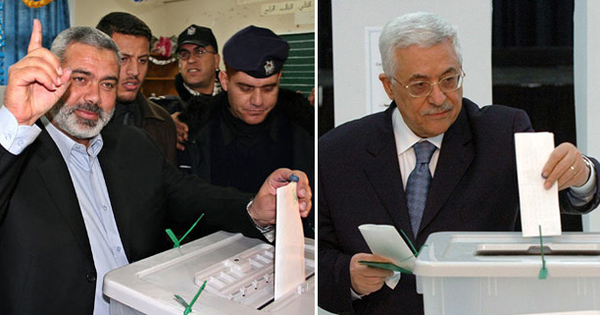
One man, one vote, one time? Hamas leader Ismail Haniyeh (left) and Fatah leader Mahmoud Abbas (also president of the Palestinian Authority) are pictured voting in the last election for the Palestinian Legislative Council, which took place in 2006.
Again, the two sides do not seem to be interested at all in sending Palestinians to the ballot boxes. Each side has many good reasons to avoid holding new elections in the West Bank and Gaza Strip.
First, Fatah and Hamas do not trust each other, and each side is convinced that the other would try to steal the vote. How can there be free and democratic elections while Hamas and Fatah continue to arrest and torture each other’s supporters in the Gaza Strip and West Bank?
Second, Fatah is afraid that Hamas’s chances of winning the elections, especially in the West Bank, are very high. That is because many Palestinians still do not trust Abbas and Fatah, whom they accuse of maintaining close security ties with Israel. Moreover, many Palestinians remain disillusioned with Fatah because of its failure to combat financial and administrative corruption and pave the way for the emergence of new leaders.
There is no way that Hamas and Fatah can cast the blame on Israel regarding the issue of elections. If they were really interested in holding new elections, they could do so with the help of the international community, as was the case with previous votes in 2005 and 2006. Israel even helped the Palestinian hold those elections.
When several Hamas candidates from east Jerusalem ran in the January 2006 parliamentary election, Israel did nothing to stop them. Israel even opened its post offices in the city to allow Arab voters from the city (who hold Israeli-issued ID cards) to vote in the election.
Charges made by some Palestinians and anti-Israel groups around the world, to the effect that Israel is responsible for “foiling” efforts to achieve Palestinian unity, are baseless. Although the Israeli government initially opposed the Fatah-Hamas “reconciliation” deal that was reached in 2014, it has not stopped the Palestinian prime minister and some of his cabinet members from visiting the Gaza Strip to pursue the implementation of the accord. In fact, Prime Minister Hamdallah has since visited the Gaza Strip twice, after receiving permission from Israel to go through the Erez border crossing.
Recently, ten Palestinian ministers were forced to leave the Gaza Strip, after Hamas placed them under house arrest in their hotel and banned them from meeting with locals. The ministers entered the Gaza Strip through the Erez border crossing. They came to the Gaza Strip to help solve the problem of thousands of Hamas government employees who have not received salaries for more than a year, and to discuss issues related to the reconstruction of the Gaza Strip.
So while Israel facilitated the visits by Hamdallah and his ministers to the Gaza Strip, it was Hamas that expelled them and prevented them from carrying out their duties. Had Israel expelled the ministers from the Gaza Strip or stopped them from entering the area, the country would have been condemned by the international community for “blocking” efforts to achieve Palestinian unity and rebuild the Gaza Strip.
Today, it has become unavoidably clear that Fatah and Hamas, and not Israel, are responsible for the ongoing plight of the Palestinians in the Gaza Strip. The two parties are unlikely to resolve their differences in the near future, further exacerbating the misery of their people. Each party cares only about its own interests, while at the same time lying to the world that it is all Israel’s fault. Hamas is not willing to relinquish control over the Gaza Strip, certainly not to Abbas and the Palestinian Authority, who were expelled from there in 2007. As for Abbas, he does not seem to be interested in regaining control over a problematic area such as the Gaza Strip, where most of the population lives under the poverty line and in refugee camps.
Yet instead of being honest with their people and admitting their failure to improve their people’s living conditions, Hamas and Fatah continue to wage smear campaigns against each other and, at the same time, also against Israel.
The campaigns that Hamas and Fatah are waging against Israel, particularly in the international community, are designed to divert attention from their failure to provide their people with basic services or any kind of hope.
While ignoring the plight of the Palestinians in the Gaza Strip, the Palestinian Authority leaders were prepared to invest huge efforts and resources in trying to have Israel suspended from the International Federation of Association Football (FIFA). It is as if the Palestinians had solved all their major problems and all that they needed to do now was to stop Israeli soccer players from playing in international matches.
Hamas, for its part, continues to invest enormous resources in digging new tunnels, in preparation for another war with Israel. The money that is being invested in the tunnels and the purchase and smuggling of weapons could benefit many families who lost their homes during the last war. But Hamas, like the Palestinian Authority, does not care about the misery of the Palestinians in the Gaza Strip. They want to fight Israel to the last Palestinian. And this is all being done with the help of anti-Israel governments around the world, and groups such the Boycott, Divestment and Sanctions (BDS) movement, whose only goal is to delegitimize Israel and demonize Jews rather than to help the Palestinians.
(The article also deal with Islam in general, as to which the Pope’s fantasies reflect those of the Obama Administration and others. — DM)
Perhaps the ultimate expression of this faith in Islam was Pope Francis’ assertion in Evangelii Gaudium that “authentic Islam and the proper reading of the Koran are opposed to every form of violence.”
**************************
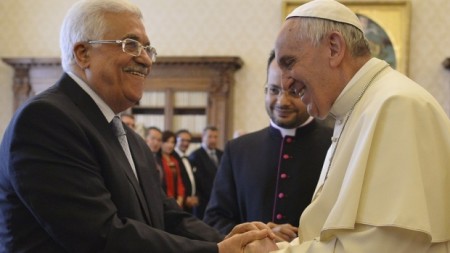
Contrary to reports in the mainstream press, Pope Francis did not call Palestinian Authority leader Mahmoud Abbas “an angel of peace.” The correct translation of the pope’s words is “I have thought of you: that you could be an angel of peace.”
Why, then, was it so easy to believe the initial reports? Perhaps because the initial reports seemed to align with previous papal overtures to Palestinian leaders. Pope Francis had previously called Abbas a “man of peace,” he has shown sympathy for Palestinian grievances, and other popes have given the appearance of lending legitimacy to the Palestinian cause. For example, Pope John Paul II is reported to have received PLO leader Yasser Arafat on twelve different occasions.
Arafat was a terrorist. One would think that the Vatican would have wanted to limit its contacts with him. The same goes for Abbas. He has repeatedly honored and praised Palestinian “martyrs” who have slaughtered innocent Jews. There is evidence that he helped fund the 1972 operation that killed eleven Israeli athletes at the Munich Olympic Games. Why is he accorded such a cordial reception at the Vatican?
Although the Church has often declared its spiritual bond with Jews, it has had a less harmonious relationship with the nation where approximately half the world’s Jews now reside. The Vatican was the last Western government to accord diplomatic recognition to the State of Israel (in 1993). In addition, on several occasions, prominent prelates have likened Israel to King Herod, the murderer of innocents; and others have accused Israel of being an apartheid state. Meanwhile, Catholic NGOs such as Pax Christi and Trocaire have been major players in the boycott, divest, and sanctions campaign against Israel.
Of course, the BDS campaign directly impinges on Israeli security. So do the calls by numerous Christian leaders to tear down the security barrier that divides Israel from the West Bank. On his trip to the Holy Land a year ago, Pope Francis allowed himself to be photographed in prayer at a section of the wall where a large graffiti message compared Bethlehem to the Warsaw Ghetto. In a naïve gesture of solidarity with Palestinians, the pope was unwittingly lending credence to the idea that the Israelis could be compared to the Nazi occupiers of Poland.
The wall was constructed to prevent suicide attacks against Israeli citizens. It’s estimated that its construction has saved thousands of lives. To suggest that the wall is offensive, as many Christians have done, is to suggest that Jewish lives don’t matter. Moreover, such judgments betray an entirely lopsided view of the situation. Take the Gaza conflict. The Catholic hierarchy typically had little to say about the daily rocket barrages launched against Israeli citizens from Gaza, but it was quick to condemn Israel on those occasions when it finally retaliated. In a similar vein, Fouad Twal, the Latin Patriarch of Jerusalem, blamed last year’s Gaza war on the Israeli embargo which, he said, had turned Gaza into “a factory of desperate people, designed to easily turn into extremists.”
In short, many Catholic leaders have shown a tendency to blame Israel for defending itself. The implication, of course, is that there would be no need for defense if Israel would only go to the peace table and make the concessions demanded of it by the Palestinians. The Vatican’s recent recognition of the “State of Palestine” reflects this naïve view of the situation. The supposition is that the Palestinians only want to be left in peace, whereas there is abundant evidence that the deepest desire of Palestinian leaders is for the extermination of Israel. Have Vatican officials never seen the photos of Abbas holding up a map of Palestine that encompasses all of the territory currently known as Israel? Are they unaware that he has personally called for a Palestine that is Judenrein? Didn’t they notice that when Israel gambled on disengaging from the Gaza Strip in 2005, Gaza soon turned into a terrorist state governed by an obsession to destroy Israel?
From the Israeli point of view, the call to cooperate with the Palestinian “peace” agenda is a call to cooperate in its own demise. Whenever I hear a UN representative or a Vatican spokesman call for peace talks between Israel and Palestine, I think of that scene from Goldfinger in which James Bond is about to be sliced in two by a laser beam. “Do you expect me to talk?” he asks. “No, Mr. Bond,” replies Goldfinger, “I expect you to die.” The Vatican hasn’t yet grasped the point that the Palestinian leadership doesn’t want the Israelis to talk, it wants them to die.
By words and by actions, the Vatican continues to suggest that there is a moral equivalence between Israel and the Palestinian Authority. This policy not only does a disservice to Jews, it also does a disservice to Catholics and other Christians. The main effect of the moral equivalence stance is to sow confusion among Catholics at a time when they need to be clear and unconfused—clear about Islam, that is. The Vatican policy toward Palestine reflects it overall stance toward the Islamic world. In other words, let’s overlook the dark side—the terrorism, the anti-Semitism, the oppression of Christians and other minorities—and let’s put the best face on the Mohammedan faith. For the sake of peace. And also for the sake of maintaining the threadbare narrative that Islam is a close cousin of Catholicism and, therefore, a religion of peace. Perhaps the ultimate expression of this faith in Islam was Pope Francis’ assertion in Evangelii Gaudium that “authentic Islam and the proper reading of the Koran are opposed to every form of violence.”
How well has this policy worked? Not very. Catholics and other Christians who lived in Muslim lands and who took seriously the Catholic version of “this has nothing to do with Islam” soon found that the tiny minority of misunderstanders were legion and had murder on their minds. Many found out too late. Years of indoctrination in the myth of Islam’s pacific nature had left them unprepared for the violence. Not that the Church was the only culprit. The secular opinion-makers had been preaching the same gospel. The irony is that the Church wants Israel to adopt the same policy of make-believe about Islam that has contributed to the death and displacement of millions of Christians.
The policy requires an almost total denial of facts. In the case of the Arab-Israeli crisis it means ignoring the terrorist ties of the Palestinian government, its unity coalition with Hamas, the massive state-sponsored indoctrination of Palestinian children, and the oft-stated goal of eliminating Israel. Ironically, it also necessitates that one ignore the ongoing persecution of Christians in the Palestinian territories.
The Palestinian leaders do a good job of hijacking Christian themes and imagery in order to gull Christians into thinking that they are, indeed, brothers in Christ. Thus, Palestinians have milked the massacre-of-the-innocents meme for all its worth. They also like to claim that Jesus was the first Palestinian. Another favorite theme is that the Palestinian people are the “new Jesus” who is being crucified by the Israelis.
Many in the Catholic hierarchy seem to fall for the ruse, but the steady exodus of Christians from the Palestinian territories tells a different story. The overall population of Christians in the Palestinian areas has declined from 15 percent in 1950 to 2 percent today. After the Palestinian Authority took control over Bethlehem in 1995, the Christian population there declined by half. In the Gaza Strip, only a few hundred Christians remain. That’s because Christians in Palestine, like Christians in most Muslim-majority societies, are treated as second-class citizens—subject to rape, intimidation, and legalized theft.
Meanwhile, the Christian population of Israel continues to grow. Palestinian Christians want to live there and so do persecuted Christians in other parts of the Middle East. Despite years of propaganda to the contrary, they have come to realize that Israel is a safe haven in a world of Islamic chaos.
Do Christians who migrate to Israel know something that the Vatican doesn’t know? The facts are there for everyone to see, but not everyone sees them. Why do Catholic leaders persist in assigning moral equivalence when there is no moral equivalence? Normally, a belief in moral equivalence grows out of a relativistic outlook. But presumably we can rule that out in the case of Catholic prelates. A more likely cause of their moral neutrality is a misapplication of the principle of “judge not.” Christians today are highly conscious of the sins of Western civilization and are therefore reluctant to judge those who lie outside it—in this case, Muslims. However, the principle is meant to apply to judgments about the state of an individual’s soul, not his behavior. And it was never meant to apply to withholding judgments about ideologies and belief systems.
The reluctance to see the mote in the other’s eye can eventually slide over into willful blindness. There are numerous warnings in the New Testament about spiritual blindness and they apply to those within the Church as well as to those without. The big danger for Church leaders is not that they will be seen as judgmental in the eyes of the world, but that they will be seen as foolishly naïve in the eyes of history.
“First comes Saturday, then comes Sunday” is a well-known slogan in the Middle East. It means that after the Islamists finish with the Jews, they will come after the Christians. The fate of the Saturday people and the Sunday people is intertwined. And the fate of both is put in jeopardy when Christian leaders insist on holding on to a fantasy-based picture of Islam.
[T]here are still Jews in the West Bank and they have to be gotten rid of. Once enough Jews have been expelled, there will be peace. That’s not a paragraph from Mein Kampf, it’s not some lunatic sermon from Palestinian Authority television– it is the consensus of the international community. This consensus states that the only reason there still isn’t peace is because enough Jews haven’t been expelled from their homes. The ethnic cleansing for peace hasn’t gone far enough.
There will be peace when all the Jews are gone.
Jerusalem Day is a reminder of what the real problem is and what the real solution is. Muslim occupation of Israel is the problem. The Islamization of Jerusalem is the problem. Muslim violence in support of the Muslim occupation of Israel and of everywhere else is the problem. Israel is the solution. Only when we liberate ourselves from the lies, when we stop believing that we are the problem and recognize that we are the solution. Only then will we be free of the Joe Bidens and the Peter Beinarts, the Jimmy Carters and Barack Obamas, the Gilad Atzmons and Jeremy Ben Amis. Only then will the liberation that began in 1967 be complete.
**********************
When Jordan’s Arab Legion seized half of Jerusalem, ethnically cleansed its Jewish population and annexed the city– the only entity to recognize the annexation was the United Kingdom which had provided the officers and the training that made the conquest possible. Officers like Colonel Bill Newman, Major Geoffrey Lockett and Major Bob Slade, under Glubb Pasha, better known as General John Bagot Glubb, whose son later converted to Islam, invaded Jerusalem and used the Muslim forces under their command to make the partition and ethnic cleansing of Jerusalem possible.
Since then, the annexation and ethnic cleansing has become an international mandate. It would be absolutely inconceivable for the international community to denounce an ethnically cleansed group which survived attempted genocide for moving back into a city where they had lived. It is, however, standard policy at the State Department and the Foreign Office to denounce Jews living in those parts of Jerusalem that had been ethnically cleansed by Muslims, as “settlers” living in “settlements,” and describe them as an “obstruction to peace.” Peace being the state of affairs that sets in when an ethnic cleansing goes unchallenged.
Describing Jewish homes in Jerusalem, one of the world’s oldest cities, a city that all three religions in the region associate with Jews and Jewish history, as “settlements” is a triumph of distorted language that Orwell would have to tip his hat to. How does one have “settlements” in a city older than London or Washington D.C.? To understand that, you would have to ask London and Washington D.C., where the diplomats insist that one more round of Israeli compromises will bring peace to the region.
They say that there are three religions in Jerusalem, but there are actually four. The fourth religion is the true Religion of Peace, the one that demands constant blood sacrifices to make peace possible, that insists that there will be peace when the Jews have been expelled from Judea and Samaria, driven out of their homes in Jerusalem, and made into wanderers and beggars once again. Oddly enough, this religion’s name isn’t even Islam– it’s diplomacy.
Diplomacy says that the 1948 borders set by Arab countries invading Israel should be the final borders and that, when Israel reunified a sundered city in 1967, it was an act of aggression, while, when seven Arab armies invaded Israel in 1948, it was a legitimate way to set boundaries. When Jordan ethnically cleansed East Jerusalem, it set a standard that Israelis are obligated to follow to this day by staying out of East Jerusalem.
Vice President Biden was so upset that the Jerusalem municipality had partially approved some buildings in the city during his visit that he threw a legendary hissy fit. Hillary Clinton stopped by MSNBC to tell Andrea Mitchell that, “It was insulting. And it was insulting not just to the Vice President who didn’t deserve that.” David Axelrod browsed through his thesaurus and emerged on the morning shows calling it an “affront” and an “insult.” Two for the price of one.
Editorials in newspapers denounced the Israeli government for this grave insult to the Obama Administration.”Israel’s Provocation”, the Chicago Tribune shrieked in bold type, describing it as a “diplomatic bomb” that went off in Biden’s face. The Atlantic, eager to get in on the action metaphors, described Israel slapping Biden in the face. A horde of other columnists jumped in to depict the Israelis kicking and bashing the poor Vice-President, while holding his head in the toilet.
Whether Joe Biden was the victim of the Jews or the Jews were the victims of Joe Biden is all a matter of perspective. The Hitler Administration was quite upset to find that Jewish athletes would be competing in the 1936 Munich Olympics. When you ethnically cleanse people, they are supposed to stay ethnically cleansed. It’s in poor taste for them to show up and win gold medals at the Olympics or rebuild their demolished synagogues. It’s insulting to the ethnic cleansers and their accomplices.
That sounds like a harsh accusation, but it’s completely and undeniably true.
When Muslims move into a Jewish town, poor Joe doesn’t come crying that he’s been bombed with a diplomatic affront and slapped with a Menorah. When Muslim countries fund Muslim housing in Israel, there are no angry statements from Clinton and no thesaurus bashing from David Axelrod. Muslim housing in Jerusalem or anywhere in Israel is not a problem. Only Jewish housing is. The issue is not Israel. If it were, then Arabs with Israeli citizenship would get Biden to howl as loudly. It’s only the Jews who are the problem.
The entire Peace Process is really a prolonged solution to the latest phase of the Jewish Problem. The problem, as stated by so many diplomats, is that there are Jews living in places that Muslims want. There were Jews living in Gaza before 1948, but they were driven out, they came back, and then they were driven out again by their own government in compliance with international demands. Now only Hamas lives in Gaza and it’s as peaceful and pleasant without the Jews as Nazi Germany.
But there are still Jews in the West Bank and they have to be gotten rid of. Once enough Jews have been expelled, there will be peace. That’s not a paragraph from Mein Kampf, it’s not some lunatic sermon from Palestinian Authority television– it is the consensus of the international community. This consensus states that the only reason there still isn’t peace is because enough Jews haven’t been expelled from their homes. The ethnic cleansing for peace hasn’t gone far enough.
There will be peace when all the Jews are gone. That much is certainly undeniable. Just look at Gaza or Egypt or Iraq or Afghanistan, which has a grand total of two Jews, both of them in their seventies. Or Pakistan, Saudi Arabia and Syria where peace reigns now that the Jews are gone. Some might say that violence seems to increase proportionally with the number of Muslims, but we all know that would be a racist thing to say. On the other hand suggesting that violence increases with the number of Jews living on land that Muslims want, that’s just diplomacy. A common sense fact that everyone who is anyone in foreign policy knows to be true.
How will we know when the Muslims have gotten all the land that they want? When the violence stops. Everyone knows that agreements mean nothing. No matter how many pieces of paper are signed, the bombs and rockets still keep bursting; real ones that kill people, not fake ones that upset Vice Presidents. The only way to reach an agreement is by groping blindly in the dark, handing over parcel after parcel of land, until the explosions stop or the Muslims fulfill their original goal of pushing the Jews into the sea.
That’s the wonderful thing about diplomacy if you’re a diplomat and the terrible thing about it if you are anyone else without a secure way out of the country when diplomacy fails. And diplomacy in the region always fails. Camp David and every single agreement Israel has signed with Muslim countries aren’t worth the paper they’re written on. The only peace treaty that counts is the one made by tanks and rifles. It’s the one made by Israeli planes in Egyptian skies and Israeli soldiers walking the border. It’s the one made by Jewish farmers and ranchers, tending their sheep and their fields, with rifles strung over their backs. The only peace that’s worth anything is the peace of the soldiers and settlers.
In 1966, Jerusalem was a city sundered in two, divided by barbed wire and the bullets of Muslim snipers. Diplomacy did not reunite it. Israel pursued diplomacy nearly to its bitter end until it understood that it had no choice at all but to fight. Israel did not swoop into the fight, its leaders did their best to avoid the conflict, asking the international community to intervene and stop Egypt from going to war. Read back the headlines for the last five years on Israel and Iran, and you will get a sense of the courage and determination of the Israeli leaders of the day.
When Israel went to war, its leaders did not want to liberate Jerusalem, they wanted Jordan to stay out of the war. Even when Jordan entered the war, they did not want to liberate the city. Divine Providence and Muslim hostility forced them to liberate Jerusalem and forced them to keep it. Now some of them would like to give it back, another sacrifice to the bloody deity of diplomacy whose altar flows with blood and burnt sacrifices.
As we remember Yom Yerushalayim, Jerusalem Day, it is important to remember that the city is united and free because diplomacy failed. The greatest triumph of the modern state happened only because diplomacy proved hopeless and useless in deterring Muslim genocidal ambitions. Had Israel succumbed to international pressure and had Nasser been as subtle as Sadat, then the Six-Day War would have looked like the Yom Kippur War fought with 1948 borders– and Israel very likely would not exist today.
Even as Jews remember the great triumph of Jerusalem Day, the ethnic cleansers and their accomplices are busy searching for ways to drive Jews out of Jerusalem, out of towns, villages and cities. This isn’t about the Arab residents of Jerusalem, who have repeatedly asserted that they want to remain part of Israel. It’s not about peace, which did not come from any previous round of concessions, and will not come from this one either. It’s about solving the Jewish problem.
As long as Jews allow themselves to be defined as the problem, there will be plenty of those offering solutions. And the solutions invariably involve doing something about the Jews. It only stands to reason that if Jews are the problem, then moving them or getting rid of them is the solution. The bloody god of diplomacy always assumes that they are the problem. There is less friction in defining Jews as the problem, than in defining Muslims as the problem. The numbers alone mean that is so.
Jerusalem Day is a reminder of what the real problem is and what the real solution is. Muslim occupation of Israel is the problem. The Islamization of Jerusalem is the problem. Muslim violence in support of the Muslim occupation of Israel and of everywhere else is the problem. Israel is the solution. Only when we liberate ourselves from the lies, when we stop believing that we are the problem and recognize that we are the solution. Only then will we be free of the Joe Bidens and the Peter Beinarts, the Jimmy Carters and Barack Obamas, the Gilad Atzmons and Jeremy Ben Amis. Only then will the liberation that began in 1967 be complete.
Only then will we have liberated our Jerusalem. The Jerusalem of the soul. It is incumbent on all of us to liberate that little Jerusalem within. The holy city that lives in all of us. To clean the dross off its golden gates, wash the filth from its stones and expel the invaders gnawing away at our hearts until we look proudly upon a shining city. Then to help others liberate their own Jerusalems. Only then will we truly be free.
There has likely not ever been an administration that has politicized intelligence to the degree that Obama’s has, systematically ignoring any information that would undercut the White House and State Department narrative first on Russia, then on Syria, and now on Iran. As anyone who has ever dealt with intelligence knows, 90 percent if not more is what appears in the open sources every single day. And so, in that spirit, here is an interview with Mohammad Javad Larijani that the Iranian news agency Tasnim just published in Persian. Now, like Rouhani (and, for that matter, Ayatollah Ruhollah Khomeini), Larijani spent time in the West. In Larijani’s case, it was to study mathematics at Berkeley. He has had quite a career, mostly in the judiciary, and today, he is among Supreme Leader Ali Khamenei’s most trusted advisors. So what did Larijani say earlier today with regard to the “historic” agreement that Obama and Kerry have embraced? “…Our facilities will not only remain underground, but will go deeper in the ground,” he said, expressing indignation at Vice President Joseph Biden’s assurances at a recent speech to the Washington Institute that all options remain on the table should Iran cheat on its commitments. He then condemned any slowdown of research and development at the once-covert nuclear enrichment center that Iran built under a mountain at Fordo, and called on Iran to build five new underground facilities.
As talks continue (and sanctions collapse apace), it is important to step back and consider a few broader patterns with regard to Iranian behavior.
First, what the Iranian government is doing is engaging in an elaborate game of good cop, bad cop. Iranian Foreign Minister Mohammad Javad Zarif might whisper sweet nothings into Secretary of State John Kerry’s ear, and like a naïve schoolgirl on the night of the senior prom, President Barack Obama might believe that Iranian President Hassan Rouhani’s statement that if Obama gives up everything, Rouhani will love him for eternity, but there is ample evidence that Iran simply intends to screw the United States. Sincere partners do not play these games.
Second, it is Diplomacy 101 to only strike deals with those who can enact them. Bill Clinton’s Arab-Israeli negotiating team learned this the hard way in 2000, when they called the president to Camp David after Palestinian and Israeli negotiators agreed to a deal. When Palestinian chairman Yasir Arafat arrived, however, he not only flatly refused to agree to what his negotiators had committed him to, but he also refused to make a counteroffer. It was a lesson some of George W. Bush’s diplomats learned the hard way. When the United States negotiated with Zarif back in 2003, Iranian authorities did not abide by the deal that Zarif had struck. There are two possibilities: Either Zarif lied to Ambassador Ryan Crocker and then-National Security Council official Zalmay Khalilzad, or Zarif was sincere but he did not have the influence and ability to guarantee that all of Iran’s myriad power centers would abide by his agreement. And confusing the target with ever shifting power centers—the Iranian equivalent of Three Card Monte—is Iranian strategy 101, whether it comes to revising commercial contracts, undercutting diplomacy, or even negotiating a cultural exchange.
This brings us to the issue of who in Iran has committed themselves to resolving Iran’s nuclear program through negotiations. For a moment, let’s assume that Rouhani and Zarif are sincere (although there is ampleevidencethat they are not). Has the Supreme Leader really endorsed a diplomatic resolution to the nuclear deal as proponents of the talks have suggested? Take the issue of “heroic flexibility.” That doesn’t mean, as proponents of the deal have suggested, that Khamenei has thrown his weight behind the talks. His own advisors have explained that what Khamenei blessed was a change in tactics, not a change in policy. In other words, so long as Iran gets its nuclear capability, the Supreme Leader doesn’t care if it comes through subterfuge or if he holds his nose and has representatives talk to the Americans. How sad it is that Obama and Kerry have such faith in the Supreme Leader, when he refuses to meet American officials, and yet doesn’t hesitate to find time for Gambians, Belarusians, and Eritreans. What the White House and the news media have not realized, however, is that the term “Heroic Flexibility” also has religious connotations. It’s sad to see the State Department and the media—both bastions of multiculturalism—so myopic on issues of culture. Now, none of this even begins to touch the Islamic Revolutionary Guard Corps that has said no to any deal from the very beginning.
So what to make of Larijani’s interview? His proximity to the Supreme Leader should concern anyone who does not have political blinders on. Whether because of personal ambition (in the case of some diplomats or Kerry’s destructive quest for a Nobel Peace Prize), ideological sympathy, or just naiveté, too many do. Simply put, it’s strange to see the White House and the State Department convince themselves that Khamenei is onboard with a substantive nuclear deal that will end Iran’s military nuclear program and illicit nuclear activities when so many statements that come from his office and his proxies suggesttheopposite.










 anneinpt
 artaxes
 danmillerinpanama
 davidking1530
 Peter Hofman
 Joseph Wouk
 Peter
Peter Louisiana Steve
 WarSclerotic

Recent Comments