Posted tagged ‘Obama’s America’

Funding the Mullahs’ exeution spree

August 4, 2015

Funding the Mullahs’ exeution spree, Front Page MagazineDr. Majid Rafizadeh, August 4, 2015

(Yet “progressive” supporters of the “deal” seem not to be bothered — unless an African lion is killed. — DM)
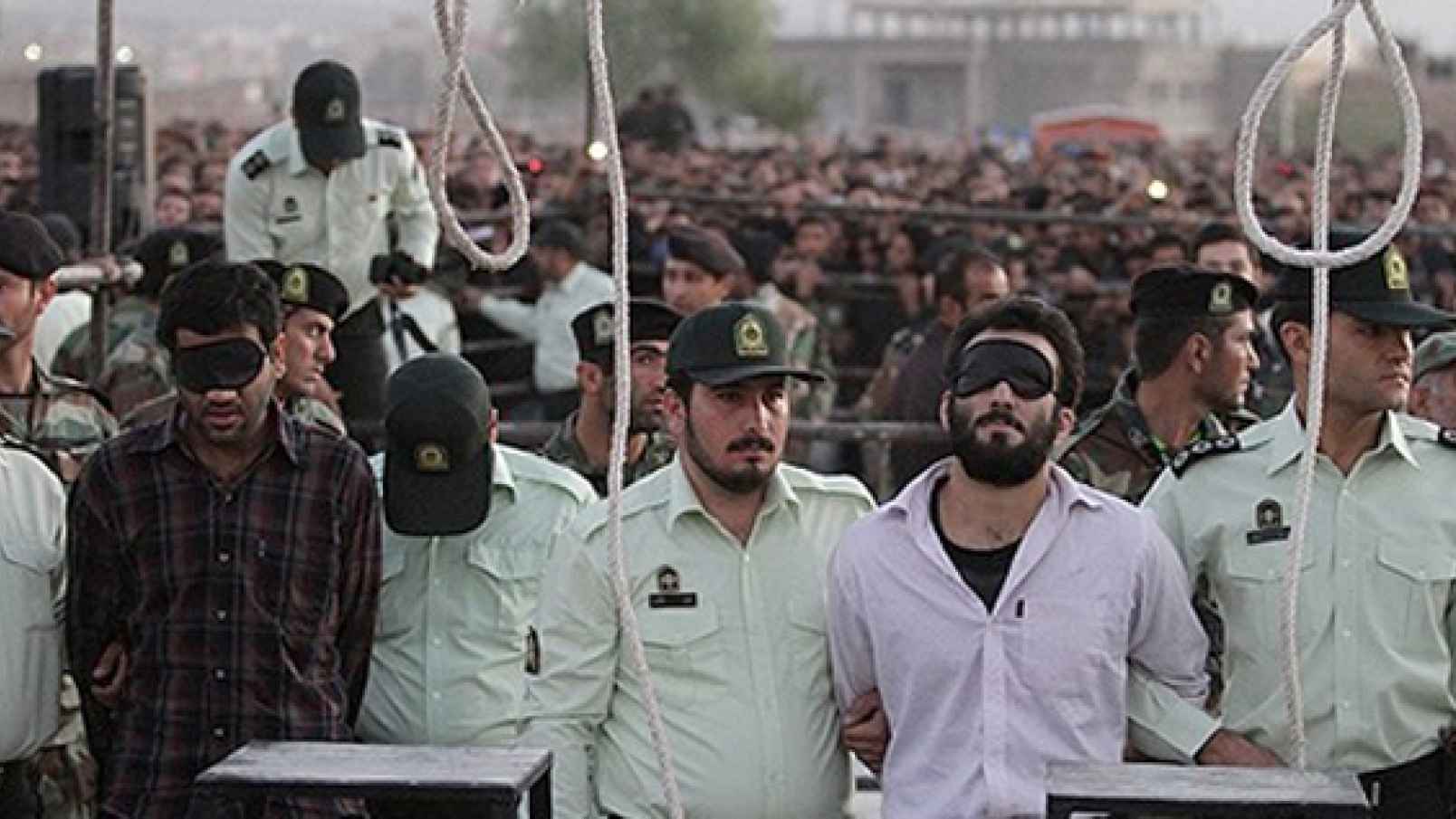
hangings_in_iran_wikimedia_groundreport.com_640_0

Unfortunately, although President Obama is very vocal about defending the nuclear deal, the lifting of economic sanctions on the Ayatollah, the release of over a hundred of billion dollars to the ruling clerics of Iran, he has not issued any serious criticism against the leaders of the Islamic Republic with regards to the execution spree.

***********************

How the Obama administration is facilitating Iran’s unprecedented killing binge.

President Obama is determined to defend the Islamic Republic as a legitimate government that should receive sanctions relief. He has even overstepped his constitutional authority by signing the nuclear deal (a treaty) in the United Nations Security Council without getting the two-third vote of the Senate. He did not give Congress time to review the nuclear deal as he previously promised.

The Obama administration is advocating for a regime that has been on an execution spree on an unprecedented level, according to Amnesty International’s latest report. Since the beginning of this year, the Islamic Republic has executed approximately 700 people.

People being executed are usually not told about their death sentence until the noose is put around their neck and until they reach the gallows. Family members of the victims often do not know about the execution until weeks after.

As Said Boumedouha, deputy director of Amnesty’s Middle East and North Africa program said, “Iran’s staggering execution toll for the first half of this year paints a sinister picture of the machinery of the state carrying out premeditated, judicially-sanctioned killings on a mass scale.” He added, “The use of the death penalty is always abhorrent, but it raises additional concerns in a country like Iran where trials are blatantly unfair.”

I regularly speak with Iranian people living in various cities in Iran including Esfahan, Tehran, Tabriz, and Khorasan in order to obtain a better understanding on the ground. My family lives there too. The words of every one of them (about the current situation in Iran after the nuclear deal was reached) echoes what Zahra, an English teacher in the province of Esfahan, told me. She said, “Any cash given to the these Sheikhs in the government (the clerics) by the powers because of the nuclear deal, will not be distributed to the people. The money will not be used to improve people’s economic standards. The people on top will steal the money, saving it in their bank accounts, or send it to their Arab allies, Bashar Al Assad, Hezbollah, and the Iraqi government. They [Iranian leaders] are also going to increase domestic suppression if they begin seeing the flow of cash.”

If we look at the history of the Islamic Republic closely, we see that when a “reformist” president (Mohammad Khatami) was in power in Iran, the nation witnessed the same increase in executions and suppression. It was one of the worst periods of oppression and crackdowns on civil liberties. In addition, the number of executions normally rises under the so-called “moderates” and “reformists” rules.

When Iranian people feel that they might finally have a better relationships with the West, the ruling establishments ratchets up their imprisonment, torture, suppression and killings in order to show the people who is in charge and in order to impose fear. By using these tactics, they send a clear message that the Islamists are in charge, not the youth.

This staggering number of executions suggests that, as the ruling clerics of the Islamic Republic were gaining global legitimacy due to the nuclear negotiations and “normalizing” relationships with the Obama administration, they have also increased their mass scale killings of their own citizens. At the same time, several American citizens are still spending time in Iran’s prison.

Unfortunately, although President Obama is very vocal about defending the nuclear deal, the lifting of economic sanctions on the Ayatollah, the release of over a hundred of billion dollars to the ruling clerics of Iran, he has not issued any serious criticism against the leaders of the Islamic Republic with regards to the execution spree.

In the Islamic Republic, one can be executed for actions which might not even be a crime or it might be a misdemeanor in other democratic countries. For example, one can be executed for “enmity against Allah” or “corruption on earth.” In addition, a non-Muslim man can be executed for having sex with a Muslim women, but not vice versa. One can be executed or stoned if he/she is married and has sex with an unmarried person. One can also be executed for cursing or using bad words against the prophet.

As the report by Amnesty International described, “They [death sentences] are imposed either for vaguely worded or overly broad offenses, or acts that should not be criminalized at all, let alone attract the death penalty… Trials in Iran are deeply flawed, detainees are often denied access to lawyers, and there are inadequate procedures for appeal, pardon and commutation.”

Boumedouha observed, “For years, Iranian authorities have used the death penalty to spread a climate of fear in a misguided effort to combat drug trafficking, yet there is not a shred of evidence to show that this is an effective method of tackling crime…”

The more the Iranian leaders are empowered and emboldened financially, economically and politically, the more they tighten the noose on all freedoms (including speech, assembly, press, etc.), as well as basic inalienable human rights.

There are currently thousands of innocent people on death row waiting to be unfairly executed in the Islamic Republic. While President Obama finds it urgent to overstep his constitutional authority to quickly sign the nuclear deal with Iran and push for sanctions relief against the ruling clerics, he needs to pay close attention to how the empowerment of the ruling Islamists in Iran is adversely affecting the lives of millions of innocent people.

Contentions| The Real Goal of the Nuclear Deal: Iran Détente

August 3, 2015

Contentions | The Real Goal of the Nuclear Deal: Iran Détente, Commentary Magazine, August 3, 2015

To listen to President Obama and Secretary of State John Kerry defend their nuclear deal in recent weeks, you’d think the issue at stake is a narrow one that solely concerned whether or not the agreement retards Tehran’s quest for a bomb. The assumption from the administration and its apologists that the deal does this even minimally is a dubious one. But one of the subtexts of the misleading way they have been conducting their end of this debate is their effort to distract both Congress and the public from the broader goals of the pact. While critics of the deal have highlighted Obama’s refusal to make the sanctions relief dependent on an end to support for terrorism, ballistic missile production or the nature of Iranian government, the answers from the administration have been consistent. They want to restrict the discussion to purely technical nuclear issues that can be obfuscated by deceptive claims or to the false choice between the agreement and war. But, to its credit, one of the president’s chief media cheerleaders did highlight the real goals of the administration in an article published on Friday. The New York Times feature titled “Deeper Aspirations Seen in Nuclear Deal With Iran” ought to be required reading for all members of the House and Senate. The choice here isn’t one between a flawed nuclear deal and war, but between Iran détente with a tyrannical, anti-Semitic, aggressive Islamist regime and a reboot of the diplomatic process that has been hijacked by appeasers.

As the Times points out, prior to the announcement of the final, lenient terms of the deal that expires in ten years the administration wasn’t so coy about its real objective:

Before his fight for the deal in Congress, Mr. Obama was far more open about his ultimate goals. In an interview in The Atlantic in March 2014, he said that a nuclear agreement with Iran was a good idea, even if the regime remained unchanged. But an agreement could do far more than that, he said:

“If, on the other hand, they are capable of changing; if, in fact, as a consequence of a deal on their nuclear program those voices and trends inside of Iran are strengthened, and their economy becomes more integrated into the international community, and there’s more travel and greater openness, even if that takes a decade or 15 years or 20 years, then that’s very much an outcome we should desire,” he said. …

And in an interview in December, Mr. Obama even seemed to welcome the rise of a powerful Iran. “They have a path to break through that isolation and they should seize it,” he said. “Because if they do, there’s incredible talent and resources and sophistication inside of — inside of Iran, and it would be a very successful regional power.”

The importance of this context for the discussion of the deal cannot be overemphasized.

The deal ought to be defeated on its own merits because it fails to achieve the administration’s stated objectives about stopping Iran’s nuclear ambitions. All it accomplishes, if it can even be said to do that much, is to delay Iran’s march to a bomb for the period of the agreement while permitting to continue research with a large nuclear infrastructure under a loose inspections regime that makes a mockery of its past promises on all these issues.

But the point on which the administration has been most reluctant to comment is the more than $100 billion in frozen assets that will be released to Tehran. Critics rightly believe this money will, one way or another, help subsidize Iran’s terrorist allies and push for regional hegemony that worries neighboring Arab states as well as Israel, whose existence is threatened by Iran becoming a threshold nuclear state with Western approval.

No rational argument can be mustered against this assertion since the money will be Iran’s to use as it likes and any prohibitions on Iranian adventurism are likely to be even less effective in a post-deal environment than they were prior to it. But if, like President Obama, you believe that Iran is in the process of transforming from a revolutionary threat whose goals are mandated by the extreme religious beliefs and Islamist ideology of its rulers into one eager to be friends with the world, the prospect of a stronger Iran doesn’t trouble you.

That’s why President Obama did not predicate these negotiations on any pledges, even ones that were transparently false, of good behavior from Iran. He claims that insisting on an end to Iranian state sponsorship of terror or forcing it to renounce its goal of eliminating Israel would have prevented him from getting a deal on the nuclear question. But that formulation has it backward. The point of the negotiations was never about the nuclear details, something that was made clear by the astonishing series of concessions that the administration made throughout the talks. In October 2012, during his foreign policy debate with Mitt Romney, Obama pledged that any deal would eliminate Iran’s nuclear program. Now he is advocating for one that leaves it in place under Western sponsorship while rewarding Tehran with the lifting of sanctions.

What Obama always wanted was a deal at any price because he thought it was the pathway to a new entente with Iran that would end the conflict with its Islamist leaders. But while a future in which Iran would no longer be a terror sponsor bent on destroying Israel and dominating the Middle East would be a good thing there is no rational reason to imagine this will happen. Indeed, by strengthening its government the president is ensuring that they will never have to choose between their aggressive goals and economic prosperity.

That’s why rather than being sidetracked into debates about the nuclear details, opponents need to focus on the real goal of the deal: détente with a regime that threatens the U.S. and its allies. The deal fails as a nuclear pact. But it is perhaps an even greater disaster when one realizes that its premise is a naive belief that Islamist tyrants are so enraptured with Obama that they are about to abandon their deeply held beliefs and evil intentions.

Iran: U.S. Banned from Knowing Details of Iran Nuclear Inspection Agreement

August 3, 2015

Iran: U.S. Banned from Knowing Details of Iran Nuclear Inspection Agreement, Washington Free Beacon,  , August 3, 2015

(Mr. Najafi states in the highlighted paragraph that “no country is permitted to know the details of inspections. That likely refers to the P5+1 negotiators as well as to nations other than Iran. Does it refer to the results of the inspections or to how and by whom they were conducted when? Either way, how will the P5+1 negotiators know whether Iran continues to seek nuke weaponization and whether to “snap back” sanctions? If they are told little more than “everything is just peachy,” will that be satisfactory evidence that Iran has not violated the “deal?” Please see also, Iran Openly Refuses UN IAEA Inspectors Access to Military Sites.– DM)

Reza Najafi, Iran’s ambassador and permanent envoy to the IAEA, stated over the weekend that no country is permitted to know the details of future inspections conducted by the IAEA. In addition, no U.S. inspectors will be permitted to enter Iran’s nuclear sites.

**********************

Iran’s ambassador to the International Atomic Energy Agency (IAEA) said the nuclear inspection organization is barred from revealing to the United States any details of deals it has inked with Tehran to inspect its contested nuclear program going forward, according to regional reports.

Recent disclosures by Iran indicate that the recently inked nuclear accord includes a series of side deals on critical inspections regimes that are neither public nor subject to review by the United States.

Reza Najafi, Iran’s ambassador and permanent envoy to the IAEA, stated over the weekend that no country is permitted to know the details of future inspections conducted by the IAEA. In addition, no U.S. inspectors will be permitted to enter Iran’s nuclear sites.

“The provisions of a deal to which the IAEA and a second country are parties are confidential and should not be divulged to any third country, and as Mr. Kerry discussed it in the Congress, even the U.S. government had not been informed about the deal between IAEA and Iran,” Najafi was quoted as saying by Iran’s Mehr News Agency.

Due to the secretive nature of these agreements, IAEA officials vising with lawmakers are barred from revealing to them the details of future inspections.

The revelation has rattled lawmakers on Capitol Hill, several of whom are now rallying colleagues to sign a letter to President Barack Obama protesting these so-called side deals.

Rep. Mike Pompeo (R., Kansas) and at least 35 other lawmakers are circulating a letter to Obama to provide Congress the text of these agreements as is required under U.S. law.

“It has come to our attention that during the recent negotiation of the Joint Comprehensive Plan of Action (JCPOA) with Iran, at least two side deals were made between the International Atomic Energy Agency (IAEA) and Iran,” the letter states, according to a copy obtained by the Washington Free Beacon.

“These side deals, concerning the ‘roadmap for the clarification of past and present outstanding issues regarding Iran’s nuclear programs,’ have not been made available to the United States Congress,” it states. “One deal covers the Parchin military complex and the other covers possible military dimensions (PMDs) of Iran’s nuclear program.”

An informational email being circulated to lawmakers explains, “according to the International Atomic Energy Agency (IAEA) and the Obama Administration, these agreements have been negotiated in secret between the IAEA and Iran.”

Secretary of State John Kerry has personally “stated he has not seen these agreements and the Administration failed to submit these agreements as part of the JPCOA,” the email states.

Under the terms of a bill meant to give Congress a final say over the deal, the Obama administration is required to provide text of all agreements, the lawmakers write to Obama.

“Under the clear language of the Iran Nuclear Agreement Review Act, which you signed into law, members of Congress are entitled to the text of these two side deals,” it states. “Specifically, members have a right to all ‘annexes, appendices, codicils, side agreements, implementing materials, documents, and guidance, technical or other understandings and any related agreements, whether entered into or implemented prior to the agreement or to be entered into or implemented in the future.’”

“Congress’s legal right to these documents creates a corresponding legal obligation for your administration to provide them for our review,” the letter says.

The lawmakers are demanding that the White House “immediately secure” these documents from IAEA “and then provide them to Congress” for review.

Pompeo and Rep. Tom Cotton (R., Ark.) sent a separate letter to Obama administration official last week asking for them to disclose the nature of all secret side agreements with Iran.

Iran’s IAEA ambassador claims the agreements with the IAEA are separate from the actual nuclear accord inked with global powers.

“The Agency would know the nature of confidential documents and Iran have clearly briefed the IAEA on this; we have agreed on implementation of a roadmap which is not a part of the JCPOA, with the implementation already on process even before the Congress could examine and approve the deal,” Najafi was quoted as saying.

One senior congressional source familiar with the effort to obtain further information about the deal told the Free Beacon the Obama administration is not being transparent in the review process.

“On top of all the concessions–from ballistic missiles to conventional arms to a 24-day inspection period–we now learn that additional side deals were struck between the IAEA and Iran,” said a senior congressional source familiar with the effort to obtain further information about the deal.

“The Administration promised a transparent review process that would allow Americans and their elected representatives to assess the deal for themselves, but as it turns out, that was just utter bullsh**,” the source added. “The Administration signed off on an agreement that included a series of Iranian Eastern eggs, including secret deals regarding the possible military dimensions of Tehran’s nuclear program, to which Congress and the public are not privy.”

Army is breaking, let down by Washington

August 3, 2015

Army is breaking, let down by Washington, Stars and Stripes, Robert H. Scales, August 2, 2015

(Last year I also wrote a depressing article on the lamentable combat readiness of our military. It’s here at my blog and here at Warsclerotic. The situation has continued to deteriorate. How could Obama’s America help to protect freedom, particularly against an enemy whose name must not be mentioned, without a combat effective military — even if Obama wanted to do it? — DM)

image militaryU.S. paratroopers with the 173rd Airborne Brigade load a M119A2 howitzer at the 7th Army Joint Multinational Training Command’s Grafenwoehr Training Area, Germany, July 28, 2015.
GERTRUD ZACH/U.S. ARMY

Last month, Gen. Ray Odierno, outgoing Army chief of staff, and Gen. Mark Milley, his successor, testified to the difficulties faced by the Army. I’d like to make the same points by telling a story.

When I was a boy, tonsillitis was a dangerous illness. In 1952, it kept me in Tokyo General Hospital for weeks. I shared a cramped ward with dozens of soldiers horribly maimed in Korea. The hospital had only one movie theater. I remember watching a Western sandwiched between bandage- and plaster-wrapped bodies. I remember the antiseptic smells, the cloud of cigarette smoke and the whispers of young men still traumatized by the horrors of the war they had just left.

My dad came from Korea to visit me, and I recall our conversations vividly. At the time he was operations officer for the 2nd Engineer Battalion. He told me how poorly his men were prepared for war. Many had been killed or captured by the North Koreans. During the retreat from the Yalu River, some of his soldiers were in such bad physical shape that they dropped exhausted along the road to wait to be taken captive.

“We have no sergeants, son,” he told me, shaking his head, “and without them we are no longer an Army.”

In the early ’70s, I was the same age as my Korean-era dad. I had just left Vietnam only to face another broken Army. My barracks were at war. I carried a pistol to protect myself from my own soldiers. Many of the soldiers were on hard drugs. The barracks were racial battlegrounds pitting black against white. Again, the Army had broken because the sergeants were gone. By 1971, most were either dead, wounded or had voted with their feet to get away from such a devastated institution.

I visited Baghdad in 2007 as a guest of Gen. David Petraeus. Before the trip I had written a column forecasting another broken Army, but it was clear from what Petraeus showed me that the Army was holding on and fighting well in the dangerous streets of Baghdad. Such a small and overcommitted force should have broken after so many serial deployments to that hateful place. But Petraeus said that his Army was different. It held together because junior leaders were still dedicated to the fight. To this day, I don’t know how they did it.

Sadly, the Army that stayed cohesive in Iraq and Afghanistan even after losing 5,000 dead is now being broken again by an ungrateful, ahistorical and strategically tone-deaf leadership in Washington.

The Obama administration just announced a 40,000 reduction in the Army’s ranks. But the numbers don’t begin to tell the tale. Soldiers stay in the Army because they love to go into the field and train; Defense Secretary Ash Carter recently said that the Army will not have enough money for most soldiers to train above the squad level this year. Soldiers need to fight with new weapons; in the past four years, the Army has canceled 20 major programs, postponed 125 and restructured 124. The Army will not replace its Reagan-era tanks, infantry carriers, artillery and aircraft for at least a generation. Soldiers stay in the ranks because they serve in a unit ready for combat; fewer than a third of the Army’s combat brigades are combat-ready.

And this initial 40,000-soldier reduction is just a start. Most estimates from Congress anticipate that without lifting the budget sequestration that is driving this across-the-board decline, another 40,000 troops will be gone in about two years.

But it’s soldiers who tell the story. After 13 years of war, young leaders are voting with their feet again. As sergeants and young officers depart, the institution is breaking for a third time in my lifetime. The personal tragedies that attended the collapse of a soldier’s spirit in past wars are with us again. Suicide, family abuse, alcohol and drug abuse are becoming increasingly more common.

To be sure, the nation always reduces its military as wars wind down. Other services suffer reductions and shortages. But only the Army breaks. Someone please tell those of us who served why the service that does virtually all the dying and killing in war is the one least rewarded.

My grandson is a great kid. He’s about the same age I was when I was recovering at Tokyo General. Both of his parents served as Army officers, so it’s no wonder that in school he draws pictures of tanks and planes while his second-grade classmates draw pictures of flowers and animals. The other day he drew a tank just for me and labeled it proudly “Abrams Tank!”

Well, sadly, if he follows in our footsteps, one day he may be fighting in an Abrams tank. His tank will be 60 years old by then.

At the moment I’d rather he go to law school.

Robert H. Scales, a retired Army major general, is a former commandant of the U.S. Army War College.

Iran plans missile tests to flaunt defiance of Vienna deal and UNSC resolution

August 3, 2015

Iran plans missile tests to flaunt defiance of Vienna deal and UNSC resolution, DEBKAfile, August 3, 2015

iranian_long-range_ballistic_Shahab-3Iran’s long-range ballistic Shahab-3

Before taking off from Cairo Sunday, Kerry issued this emphatic statement:  “There can be absolutely no question that if the [Iran deal] is fully implemented, it will make Egypt and all the countries of this region safer.”

*********************

Shortly before US Secretary of State John Kerry was due in Qatar Monday, Aug. 3, Iran’s highest authorities led by supreme leader Ayatollah Ali Khamenei Sunday launched a public campaign to support Tehran’s noncompliance with the Vienna nuclear accord and UN Security Council Resolution 2231 of July 20, on its ballistic missile program. The campaign was designed by a team from Khamenei’s office, high-ranking ayatollahs and the top echelons of the Revolutionary Guards, including its chief, Gen. Ali Jafari.

It was kicked off with a batch of petitions fired off by the students of nine Tehran universities and Qom religious seminaries to Iran’s chief of staff Maj Gen. Hassan Firouzabadi, demanding immediate tests of long-range ballistic missiles to prove that the missile ban was invalid.

It was essential, said one student letter, “…to underline the necessity for protecting the country’s defense capabilities and ensuring continued development of Iran’s ballistic missile capability.”

The students, whose influence on public opinion is substantial, went on to argue: “Firing the ballistic missiles in military drills would discourage the US Congress, the Israeli Knesset and their regional Takfiri mercenaries (a reference to the Islamic State) from future strikes against the Islamic Republic.”

The Security Council Resolution, which unanimously endorsed the Joint Comprehensive Plan of Action (Vienna nuclear accord) signed by Iran’s Foreign Minister Mohammed Javad Zarif, called on Iran “not to undertake any activity related to ballistic missiles designed to be capable of delivering nuclear weapons, including launches using such ballistic technology until the date eight years after the JCPOA Adoption Day.”

Tehran retorted that none of its ballistic missiles were designed to deliver nuclear weapons, and so this provision was void. Shortly after its passage, the foreign ministry in Tehran issued an assurance that “…the country’s ballistic missile program and capability is untouched and unrestricted by Resolution 2231.”

On July 30, Ali Akbar Velayati, Khamenei’s senior adviser on international affairs and member of the Expediency Council, told reporters, “The recent UNSC Resolution on Iran’s defensive capabilities, specially (sic) its missiles, is unacceptable to Iran.”

DEBKAfile’s Iranian sources report that Tehran deliberately engineered this campaign’s timing for it to surface the day before the arrival of John Kerry, the live wire behind the Vienna Accord, in Doha, Qatar, Monday. He has defined his mission as an effort to ease the concerns of the Gulf and other Arab nations about the negative affect of the accord on their security.

Before taking off from Cairo Sunday, Kerry issued this emphatic statement:  “There can be absolutely no question that if the [Iran deal] is fully implemented, it will make Egypt and all the countries of this region safer.”

This proposition may be harder than ever to sell to Iran’s neighbors once its ballistic missiles are launched over their heads.

Moral clarity of the past

August 2, 2015

Moral clarity of the past, Power Line, Steven Hayward, August 2, 2015

(Please see also, Iran’s Supreme Leader Khameni publishes book on how to eliminate Israel. — DM)

Scott reminded us this morning of Winston Churchill’s notice of Hitler’s Mein Kampf, suggesting that we ought to take seriously the statements of murderous purpose whether they come from a seemingly implausible Austrian-born corporal, or a soon-to-be nuclear-armed Iranian ayatollah. Of course, Mein Kampf was mostly ignored in the 1930s or dismissed as the unimportant or irrelevant thoughts that Hitler would discard once he assumed the “responsibilities” of high office.

As background research for one of my longer writing projects currently under way I have been reading old issues of the American Political Science Review from the late 1930s to see how the rise of European fascism and specifically German Nazism was treated. The majority of the articles and book reviews are either stupid, trivial, or superficial, i.e., they examine institutional changes and administrative structures in the value-free way typical of social science that can’t bring itself to consider making moral judgments. Hitler’s regime is treated as more or less normal (ditto the Soviet Union, of course). From these treatments a serious student would learn almost noting important about politics. These blinkered assessments remain the case even after the Reichstag fire, Kristallnacht, the Anschluss, the investment of all of Czechoslovakia following the Munich agreement, and even the outbreak of open war in 1939. While there were some clear voices about the deeper significance of what was taking place—one thinks of Hermann Rauschning’s 1939 best-seller The Revolution of Nihilism: Warning to the West—you typically didn’t find such clarity and depth among academic political scientists.

There are a few notable exceptions. One of them was Robert C. Brooks of Swarthmore College, who was president of the American Political Science Association in 1940. His presidential address at the December 1940 annual meeting of the APSA was entitled “Reflections on the ‘World Revolution’ of 1940,” and you could hardly ask for a more direct and sensible statement of what political science ought to be and to say. He opens by chiding his fellow academics for avoiding “contemporary, controversial political affairs.”

Some representative samples:

[S]ince Nazi Germany is the sole really effective totalitarian state, its overthrow should be the one great desideratum of democratic world politics. Nothing should be allowed to obscure that end. It was the tragic, nay criminal, blunder of Neville Chamberlain that he did not perceive this fact, that he believed in the possibility of gaining concessions from the insatiable Hitler by a policy of appeasement. For Britain, the consequences of this blunder have been tragic beyond all reckoning. Fortunately, in Winston Churchill a prime minister has been found who knows how to keep his eye on the ball. Let us hope that the President of the United States will follow his example.

Incredible as it may seem under such conditions, there are still said to be some appeasers on this side of the Atlantic, gentlemen willing to make a neat little loan—five billion dollars is the figure most frequently mentioned—to Germany as soon as her victory over Europe is complete. This, it is assumed, will soften any ill-feeling Hitler might cherish against us because of our earlier mistaken sympathies for the Allies. Also, poor fellow, he would need the money to buy our goods where with to repair the ravages of war and to feed the starving German people. Of course, once the loan were made, we would be too polite to inquire how much of it was spent, not for butter but for guns, the latter to be used against the United States. If political scientists cannot scotch so obviously ruinous a policy, one may well despair of the future of our profession. What is far worse, one would have to despair of the future of free government. . . [Emphasis added.]

Political scientists must be realists. As such, we know that if Britain is crushed, the only kind of peace we can hope for will be an armed peace—and that probably of short duration. . .

Combined attack by dictator powers upon America may result in our defeat or in our victory. In the former event, democracy will be dead upon this planet for a period of unpredictable length. Even so, let us hope that we might inflict wounds upon despotic aggressors from which they would not soon recover. This is not set down in malice; rather it would appear to be the only hope of future resurrection for our political principles. If democracy fighting for its life proves to be spineless and cowardly, why should any future generation wish to revive it? On the other hand, if it goes down fighting gloriously to the last ditch, it will not lose the power to fire the hearts of some future generation. Once more, as at the end of the eighteenth century, a race of rebels may be born of the sons of men.

Finally, the conclusion, which evokes the spirit of both Churchill and the famous words of Lincoln:

In the end, it is certain that Americans will not submit tamely to such a fate. They will not enter the door marked “Appeasement”: they will go out through the opposite door marked “Defiance.” I do not pretend to like the sort of future that confronts us. It may bring with it the heaviest burdens, the most cruel sacrifices. In all probability, things will get worse before they get better. It may fall to the lot of an American President to say, as did Prime Minister Winston Churchill, that he has “nothing to offer but blood, toil, tears, and sweat.” Not liking a future, however, is no reason for not facing up to it. There is a deep satisfaction in resoluteness, through all perils, regardless of the outcome. Let us give thanks also that we are done with roseate illusions; that we are ready to deal with grim realities. Peace and justice may not be for our time, but we have the privilege of risking everything that they “shall not perish from the earth.”

For this Prof. Brooks gets posthumous induction into the Power Line 100 roster of Best Professors in America. Can anyone imagine a president of the APSA speaking in these tones today? Not likely. (And now that James Kurth is retired, is there anyone remotely like Brooks at Swarthmore today?)

(There is no public Internet access to the complete article unfortunately: You can only get it if you have a JSTOR account. It appears in the February 1941 issue of the APSR.)

“This caliphate will take over the entire world and behead every last person that rebels against Allah”

August 1, 2015

“This caliphate will take over the entire world and behead every last person that rebels against Allah,”  Front Page Magazine, Daniel Greenfield, August 1, 2015

(But of course, as all good little Obamabots know, the Islamic State it not Islamic. Please see also, Despite Bombing Campaign, Islamic State No Weaker Than a Year Ago. — DM)

isis_map


The Un-Islamic JayVee team that Obama is trying to fight has a big plan. Behead all non-Muslims. Rule the world.

The undated document, titled “A Brief History of the Islamic State Caliphate (ISC), The Caliphate According to the Prophet,” seeks to unite dozens of factions of the Pakistani and Afghan Taliban into a single army of terror.  It includes a never-before-seen history of the Islamic State, details chilling future battle plans, urges al-Qaeda to join the group and says the Islamic State’s leader should be recognized as the sole ruler of the world’s 1 billion Muslims under a religious empire called a “caliphate.”

“Accept the fact that this caliphate will survive and prosper until it takes over the entire world and beheads every last person that rebels against Allah,” it proclaims. “This is the bitter truth, swallow it.”

Unlike al-Qaeda, which has targeted terror attacks on the United States and other western nations, the document said Islamic State leaders believe that’s the wrong strategic goal. “Instead of wasting energy in a direct confrontation with the U.S., we should focus on an armed uprising in the Arab world for the establishment of the caliphate,” the document said.

First the Muslim world. Then the world. It’s a straightforward strategy, one that Osama bin Laden flirted with but never truly committed to. Though he celebrated the Arab Spring, ISIS would reap its rewards.

Retired Defense Intelligence Agency Director Lt. Gen. Michael Flynn, who also reviewed the document, said it “represents the Islamic State’s campaign plan and is something, as an intelligence officer, I would not only want to capture, but fully exploit. It lays out their intent, their goals and objectives, a red flag to which we must pay attention.”

The failure to target the radical Islamic ideas behind the group has given its fighters the opportunity to spread, Flynn said. “If I were in their shoes, I would say,’We are winning, we are achieving our objectives,’” Flynn said. “They have demonstrated an incredible level of resiliency and they will not be defeated by military means alone.”

We have yet to try defeating them by military means.

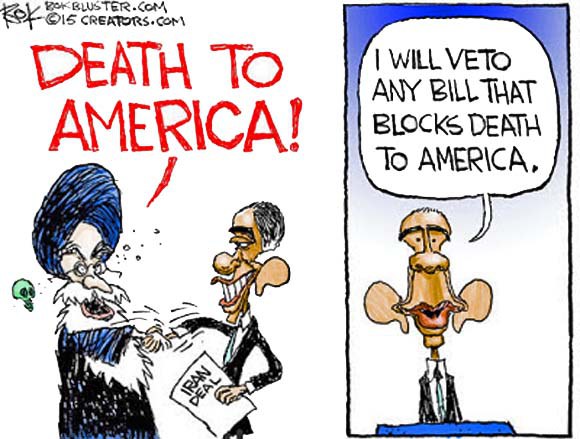
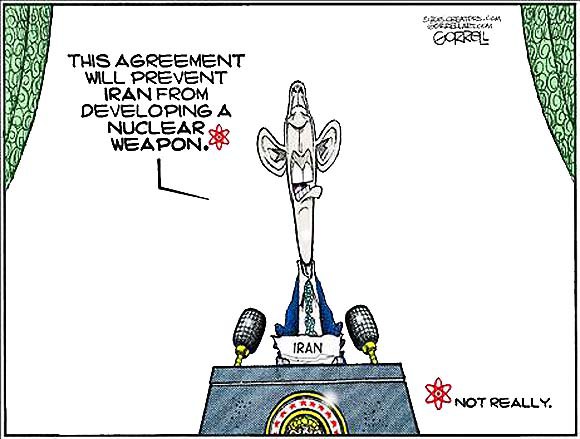
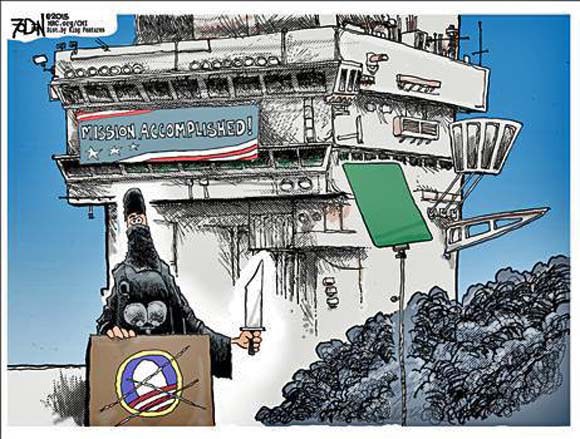
Cartoons of the day

August 1, 2015

H/t Vermont Loon Watch

veto
liar


mission

Cotton v. the White House: it’s no contest

August 1, 2015

Cotton v. the White House: it’s no contest, Power LineScott Johnson, July 31, 2015

White House spokesman Josh Earnest mocked Senator Tom Cotton as “an international man of mystery” this week. Earnest was alluding to Senator Cotton’s complaint regarding “secret side deals” that are integral to our catastrophic deal with Iran. Senator Cotton responds in this video compiling statements by administration officials, some of whom (unlike Earnest) are speaking unironically under oath.

Video via The Right Scoop.

Speaking of the Iran deal (10)

July 31, 2015

Speaking of the Iran deal (10), Power LineScott Johnson, July 31, 2015

(Is North Korea’s Minister of Hyperbolic Statements assisting Iran? — DM) 

I take it that the White House is willing to say and do just about anything in support of this catastrophic deal.

****************

AP Vienna bureau chief George Jahn reports: “Iran: US statements on attacking Tehran violates nuke deal” (subject-verb disagreement in the original, I hate to say). On Twitter, AP diplomatic correspondent Matt Lee concisely comments: “Already?!”

Here is Jahn’s report:

A senior Iranian official is accusing the U.S. of violating the nuclear deal with his country through comments indicating that the accord would make any attack on Tehran’s atomic program more efficient because it would result in greater insight about potential targets.

The July 14 deal foresees increased overview of Iran’s nuclear activities by the U.N.’s International Atomic Energy Agency. Reza Najafi, the IAEA’s chief Iranian delegate, quoted White House spokesman Josh Earnest as saying that would result in enhanced U.S. or Israeli military action against Iran — if needed — “because we’d been spending the intervening number of years gathering significantly more detail about Iran’s nuclear program.”

Israel is a harsh critic of the deal and says it is keeping all options open to prevent Iran from getting nuclear weapons. The Obama administration says the agreement has accomplished its goal of preventing Tehran from getting such arms.

Still, as part of White House pushback against congressional and other critics of the deal, Earnest, in his comments to reporters July 17 said that the U.S. “military option would remain on the table” if Iran breaks out of the deal and races to make a bomb.

Najafi, in a July 24 letter posted to the IAEA website on Wednesday, called Earnest’s statement “outrageous.” He said it “seriously undermines the very basic principles” needed to implement the deal, adding that the comments amount to “a material breach of the commitments” agreed to by the United States and the five other world powers at the negotiating table with Iran.

Citing Earnest, Najafi also suggested that Washington could try to violate provisions of the nuclear deal committing the agency during its Iran monitoring to “protect commercial, technological and industrial secrets as well as other confidential information coming to its knowledge.”

I take it that the White House is willing to say and do just about anything in support of this catastrophic deal. Behind closed doors, to take an example from yesterday, Obama told Democratic congressmen hearing him out on the deal that if they were to help override his veto of congressional disapproval of the deal, he would do everything in his power to  undermine their disapproval. Other than noting the White House’s willingness to say anything, I find the substance of Jahn’s report weird beyond immediate comment.