Posted tagged ‘Obama’s America’

Compromised – John Kerry has much to hide on his ties to Iran.

August 11, 2015

Compromised – John Kerry has much to hide on his ties to Iran, Front Page MagazineKenneth R. Timmerman, August 11, 2015

John Kerry has much to hide on his ties to Iran. As I revealed more than ten years ago, Mr. Kerry has long been sympathetic to the Islamist regime in Tehran.

******************

Secretary of State John Kerry is becoming increasingly frantic as he takes his case for the deeply flawed Iran nuclear deal around the country. 

His latest argument, that congressional disapproval of the deal will be the “ultimate screwing” of Iran’s clerical Supremo – and that we should care – verges on hysteria.

Whether it’s hysterically funny or a psychotic condition would be a tough call, if only the stakes weren’t so high for our security and the security of our friends and allies, starting with the Iranian people.

John Kerry has much to hide on his ties to Iran. As I revealed more than ten years ago, Mr. Kerry has long been sympathetic to the Islamist regime in Tehran.

In June 2002 – just nine months after the 9/11 attacks on America – Mr. Kerry headlined a fund-raising gala for the American-Iranian Council, a pro-regime lobbying group seeking to roll back U.S. sanctions and promote U.S. investment in Iran.

The next day, AIC members returned the favor and hosted a fund-raiser for Senator Kerry’s re-election campaign at the Ritz Carlton in San Francisco that netted more than $26,000. Many of those same fund-raisers became bundlers for Mr. Kerry’s failed 2004 presidential bid.

Among those opening their wallets was a stunning 34-year-old Iranian woman named Susan Akbarpour, aka Zahra A. Mashadi. “I am an actor in U.S. politics,” Ms. Akbarpour boasted to a reporter. “I am a fund-raiser for all candidates who listen to us and our concerns.”

The only problem was, her political contributions were illegal because she did not have a green card. The Kerry campaign never returned those contributions and the Federal Election Commission never investigated.

Mr. Kerry has been accused of behaving as “Iran’s lawyer” in the nuclear negotiations, finding excuses for Iran’s bad behavior and justifications for a seemingly endless stream of U.S. capitulations to Iran.

But that behavior is not new. In fact, during a debate with President George W. Bush during the 2004 campaign, Mr. Kerry pledged that had he been president since 2001, he would have “offered the opportunity to provide the nuclear fuel” to Iran, to “test them, see whether or not they were actually looking for it for peaceful purposes.”

Why would the United States appoint as lead negotiator a politician whose long-held views favoring our adversary in those negotiations were well-known?

Much has been made recently of Secretary Kerry’s family ties to Iran, a fact that was never raised during his confirmation hearings as Secretary of State.

Vanessa Kerry tartly dismissed rumors that have circulated in the Iranian-American community in Los Angeles since her 2009 wedding that the son of Iran’s Foreign Minister, Mehdi Zarif, was best-man for her husband, Behrouz Vala Nahed, an American-born neuro-surgeon. “Happy 2 verify. No wedding party when we married. No Zarif’s son. Sorry 2 disappoint,” she tweeted recently.

An Iranian website close to the father, Mohammad Javad Zarif, initially reported that Brian Nahed and Mahdi Zarif had “only” been college roommates, but later changed the on-line version of the article without noting the correction.

Mahdi Zarif attended the City University of New York and lived in the United States for more than a decade while his father was the Islamic Republic’s ambassador to the United Nations (and repeatedly met with U.S. Senators in Washington, DC, including now vice-president Joe Biden). Dr. Nahed took his pre-med undergraduate degree several years earlier at UCLA.

But the presence or not of Zarif the son at Kerry the daughter’s wedding is a side show and detracts from an examination of Mr. Kerry’s fundamental conflict of interest in serving as chief U.S. negotiator with Iran.

The facts are indisputable:

  • Mr. Kerry took illegal campaign cash from an Iranian national who, while claiming to be a political refugee, assaulted anti-regime protesters in Los Angeles, promoted U.S. computer and software investment in Iran in violation of U.S. sanctions, and boasted of influencing U.S. politicians with a pro-Tehran agenda. Taking that illicit cash tainted Mr. Kerry and identified him a “soft target” to agents of the Iranian regime.
  • Mr. Kerry carried through his side of the bargain, embracing the pro-Tehran agenda during his 2004 presidential campaign, while his Iranian backers kicked in substantial fresh cash to his campaign.
  • Mr. Kerry met Zarif at a private reception hosted by George Soros in New York in 2005, shortly after Soros’s Open Society Institute hosted Zarif at a policy luncheon for New York media elites.
  • Mr. Kerry sought to travel to Tehran to jumpstart diplomatic negotiations in December 2009, but was rebuffed by Tehran.

As I wrote earlier this year, a former aide to Iranian president Rouhani, who defected while covering the nuclear talks, revealed that Mr. Kerry and the U.S. delegation were seen by the Iranian negotiating team as secret allies who helped arm-twist reluctant partners such as France into making major concessions.

I know Iranian-Americans who volunteered for U.S. military service who were forced to leave the military when family members traveled to Iran. Why? Because counter-intelligence professionals who understood the Iranian government track record of exploiting family relationships for intelligence or political purposes indicated they could be compromised.

After all, the Soviets used family relationships all through the Cold War to compromise unwilling individuals to collaborate with their cause.

The game is as old as the intelligence business itself: find some string to manipulate or blackmail your adversary, then pull as hard as you can.

When it comes to Iran, John Kerry is about as compromised as they get.

What Iran’s hostile reaction to the Parchin issue means for the nuclear deal

August 11, 2015

What Iran’s hostile reaction to the Parchin issue means for the nuclear deal, Washington Post, David Albright, August 10, 2015

The United States and Congress should clearly and publicly confirm, and Congress should support with legislation, that if Iran does not address the IAEA’s concerns about the past military dimensions of its nuclear programs, U.S. sanctions will not be lifted. To do otherwise is to make a mockery of the nuclear deal.

********************

Chico Marx said: “Who you gonna believe? Me or your own eyes?” Iran’s Foreign Minister Mohammad Javad Zarif said over the weekend that my organization, the Institute for Science and International Security, was spreading lies when we published satellite imagery that showed renewed, concerning activity at the Parchin military site near Tehran. This site is linked by Western intelligence and the International Atomic Energy Agency (IAEA) to past work on nuclear weapons. But like Chico, instead of acknowledging the concern, the Iranians chose to deny the visible evidence in commercial satellite imagery. Iran’s comments would be mirthful if the topic were not so serious.

Zarif is also calling U.S. intelligence officials and members of Congress liars. They are the original source of the information both about renewed activity at Parchin and concerns about that activity. All we did was publish satellite imagery showing this activity and restate the obvious concern.

Moreover, this information about renewed activity at Parchin does not come from opponents of the Joint Comprehensive Plan of Action negotiated between the United States, five other world powers and Iran, as Zarif suggested. We are neutral on whether the agreement should be implemented and have made that position clear for weeks. The U.S. intelligence community is hardly opposed to the deal. Iran’s attempts to dismiss this concern as the work of the deal’s foes also is just wrong.

Concern about Parchin has become more urgent now that there is a debate raging over whether the IAEA will have adequate access to this site under the terms of its deal with Iran. It would be irresponsible not to worry about reports that suggest that Iran could be again sanitizing the site to thwart environmental sampling that could reveal past nuclear weapons activities there. This concern is further heightened because Iran has demanded to do this sampling itself instead of letting the IAEA do it. Such an arrangement is unprecedented and risky, and will be even more so if Iran continues to sanitize the site. In the cases of the Iranian Kalaye Electric site and the North Korean plutonium separation plant at Yongbyon, the success of sampling that showed undeclared activities depended on samples being taken at non-obvious locations identified during previous IAEA visits inside buildings. The IAEA will not be able to visit Parchin until after the samples are taken, and it remains doubtful that the inspectors will be able to take additional samples.

Some of this can be written off to Zarif’s volatility. At one point during the negotiations, he yelled so loudly at Secretary of State John F. Kerry that those outside the room could hear him. He obviously angers easily. But he is also one of the more reasonable Iranian government officials. I can remember in the late 1990s discussions with Iranian government and nuclear officials in New York where the Iranians vehemently stated, despite the overwhelming evidence to the contrary, that they did not have any gas centrifuge programs. I was presenting the evidence that they did, in fact, have a centrifuge program, one in fact aided by Pakistan, and at one of these meetings, Zarif quietly said to me that he had always told me that Iran had the entire fuel cycle — technical language admitting to an enrichment program. His willingness to admit the obvious gave me hope that the crisis over Iran’s program could be solved diplomatically. But on Parchin, his words appear to reflect Iranian government intransigence on its past nuclear weapons program. Its action is an assault on the integrity and prospects of the nuclear deal.

Iran’s reaction shows that it may be drawing a line at Parchin. Resolving the Parchin issue is central to the IAEA’s effort to resolve concerns about Iran’s past work on nuclear weapons by the end of the year, but Parchin is not the only site and activity involved in this crucial issue. The IAEA needs to visit other sites and interview a range of scientists and officials. Instead of allowing this needed access, Iran appears to be continuing its policy of total denial, stating that the concerns are merely Western falsifications and fantasies. The United States recently reasserted that it believes Iran had a nuclear weapons program and stated that it knows a considerable amount about it. So, if Iran sticks to its strategy, one can expect an impasse that includes Iran refusing to allow the IAEA the access it needs to sites and scientists within the coming months.

U.S. officials have stated that the Joint Comprehensive Plan of Action requires Iran to address concerns about its past work on nuclear weapons prior to the lifting of sanctions. However, Iran may argue otherwise, and one could easily conclude that its recent actions are the start of such a reinterpretation of the agreement. The United States and Congress should clearly and publicly confirm, and Congress should support with legislation, that if Iran does not address the IAEA’s concerns about the past military dimensions of its nuclear programs, U.S. sanctions will not be lifted. To do otherwise is to make a mockery of the nuclear deal.

State Department Interferes in Favor of PLO Terrorists

August 11, 2015

State Department Interferes in Favor of PLO Terrorists, Israel National News, Tova Dvorin, August 11, 2015

US President Barack Obama is reportedly seeking to lower that fine – following a series of conflicts between officials from the State Department and the Justice Department over the issue, an official involved in the case told the New York Times Tuesday. 

*********************

Washington asks a judge presiding over terror victims’ compensation case to reduce money paid to Israelis injured during Second Intifada.

The Obama administration has asked a judge Monday to “carefully consider” the size of the bond demanded from the Palestinian Authority (PA) for its role orchestrating years of terror attacks against Israelis and Jews – directly interfering in a US court case.

In February, the Palestine Liberation Organization (PLO) – the terror group behind the PA – was found liable to pay $218.5 million to victims of terror, a figure that was set to be tripled to $655.5 million according to the anti-terrorism laws under which the case was brought.

Legal rights group Shurat Hadin (Israel Law Center) helped represent the 11 families who charge the PA and PLO of inciting, supporting, planning and executing the seven terror attacks which killed American citizens between 2000 and 2004.

In May, the PA admitted it cannot pay such a hefty fine, however – as it is struggling under billions of debt despite an ongoing stream of aid from Israel and other countries – and called the case “political extortion.”

Now, US President Barack Obama is reportedly seeking to lower that fine – following a series of conflicts between officials from the State Department and the Justice Department over the issue, an official involved in the case told the New York Times Tuesday.

In a document entitled “Statement of Interest of the United States of America,” the Obama administration expressed concerns over the payments hurting the PA’s basic government services.

Forcing the PLO to pay “a significant portion of its revenues would likely severely compromise the P.A.’s ability to operate as a governmental authority,” deputy Secretary of State Antony J. Blinken wrote. “A P.A. insolvency and collapse would harm current and future U.S.-led efforts to achieve a two-state solution to the Israeli-Palestinian conflict.”

Blinken stressed in the document, however, that the State Department allegedly values the rights of terror victims to seek “just compensation” and was not taking a position on the case itself, only on the high bond.

“The United States strongly supports the rights of victims of terrorism to vindicate their interests in federal court and to receive just compensation for their injuries,” Blinken claimed.

Justice Department officials have maintained throughout the proceedings that any State Department interference in the case would interfere with the victims’ rights for compensation and justice.


Russian Warships Dock In Iran for War Training

August 10, 2015

Russian Warships Dock In Iran for War Training, Washington Free Beacon, August 10, 2015

Russian President Vladimir Putin, right, and Iranian President Hassan Rouhani  meet at the Shanghai Cooperation Organization summit in Dushanbe, Tajikistan, Friday, Sept. 12, 2014. Iran has an observer status at the  Shanghai Cooperation Organization summit.  (AP Photo/RIA Novosti, Mikhail Klimentyev, Presidential Press Service)Hassan Rouhani, Vladimir Putin / AP

[Iranian] military leader [Fadavi] went on to claim that “Iranian Armed Forces are now at the highest level of preparedness” and that “only the dead body of the American troops realizes the power of the Islamic Revolution.”

********************

Two Russian warships have docked in northern Iran for a series of naval training exercises with the Islamic Republic, according to Persian-language reports translated by the CIA’s Open Source Center.

The two Russian ships docked in Iran’s Anzali port on Sunday and will hold “joint naval exercises during the three-day stay of the warships in Iran,” according to a Persian-language report in Iran’s state-controlled Fars News Agency.

“The [Russian] warships, Volgodonsk and Makhachkala docked in Anzali Port [near the Caspian Sea], in the fourth naval zone, on the afternoon of 9 August,” the report says.

The war exercises come just weeks after Iran and global powers inked a nuclear accord that will provide Iran with billions of dollars in sanctions relief in return for slight restrictions on the country’s nuclear program.

Russian and Iran have grown close in recent years, with delegations from each country regularly visiting one another to ink arms deals and other agreements aimed at strengthening Iran’s nuclear program.

Russia and Iran agreed earlier this year to begin construction on several new nuclear power plants. Russia has also agreed to sell Iran a controversial advanced missile defense system that can prevent attacks by Western powers.

The Russian fleet docked in Iran’s port “carrying a message of ‘peace and friendship,’” according to Iranian officials quoted by Fars. The fleet was “welcomed by Iranian naval commanders and staff.”

The Russian commander of the fleet is scheduled to hold meetings with “local political and military officials” in Iran’s northern provinces, according to Fars.

Levan Jagarian, Russia’s ambassador to Tehran, reportedly attended the docking ceremony and called for “for boosting mutual ties between the two countries in various fields,” according to the report.

The two nations went on to say that “expanding bilateral economic, political, and military cooperation is among the priorities of the visit.”

A Russian fleet also docked in northern Iran in October.

Last week, a senior Iranian naval commander warned the United States against ever taking military action on Iranian interests, claiming that the response would be “unpredictably strong.”

“The western media are mocking at the U.S. for speaking of ‘on the table options (against Iran)’ because the U.S. always utters some words without the ability to materialize them,” Iranian Revolutionary Guard Corps Naval Commander Ali Fadavi was quoted as saying by the country’s state-run press.

Iran is “ready to give such a powerful response to the slightest move of the U.S. that it won’t be able to make any other moves,” Fadavi was quoted as saying.

The military leader went on to claim that “Iranian Armed Forces are now at the highest level of preparedness” and that “only the dead body of the American troops realizes the power of the Islamic Revolution.

Michael Rubin, a former Pentagon adviser and expert on rogue regimes, said the Obama administration is fundamentally misreading Iran’s intentions in light of the recently inked nuclear accord.

“We’re witnessing a new great game, and Obama is so self-centered he keeps playing solitaire,” Rubin said. “Obama simply doesn’t understand that the world is full of dictators who seek to checkmate America. What he sees as compromise; they see as weakness to exploit.”

Referring to a visit last week to Russia by IRGC leader Qassem Soleimani, who is responsible for the deaths of Americans, Rubin said it is clear that Moscow and Tehran aim to build a tight military alliance.

“Visiting Russia to talk arms purchases and now this naval visit, it’s clear that Putin and Khamenei will waste no time to really develop their military cooperation,” he said.

An axis between Russia, Iran, and North Korea is beginning to emerge Rubin said, citing official releases that a North Korean delegation is currently visiting Russia to tour war games sites.

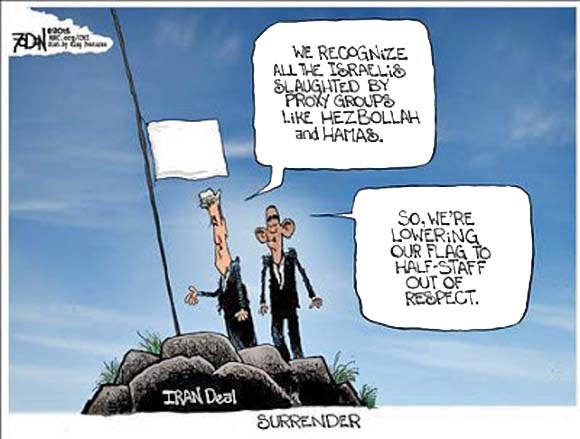
“The Russian warship visit combined with North Korea scoping out war game sites in Russia suggest a new Axis of Evil is taking shape with Russia the lynchpin between Iran and North Korea,” Rubin said. “As for the United States, rather than the leader of the free world, Obama and Kerry have transformed us in much of the world’s eyes as the pinnacle of surrender.”

Meanwhile, Obama admitted Monday that Iran’s nuclear breakout time will shrink to “a matter of months” once the nuclear accord expires in around 15 years.

MSNBC: Obama ‘stunning’ in vilifying of deal opponents

August 10, 2015

MSNBC: Obama ‘stunning’ in vilifying of deal opponents, Washington Free Beacon via You Tube, August 10, 2015


Israel is working at speed to convert Boeing 767 into a long-flight refueling tanker

August 10, 2015

Israel is working at speed to convert Boeing 767 into a long-flight refueling tanker, DEBKAfile, August 10, 2015

kc46aAmerica Boeing KC-46A refueling tanker

In an interview published by the German newspaper Der Spiegel on Aug. 8, Defense Minister Moshe Ya’alon said: “Ultimately it is very clear, one way or another, Iran’s military nuclear program must be stopped. We will act in any way, including taking military action, and are not willing to tolerate a nuclear-armed Iran. We prefer that this be done by means of sanctions, but in the end, Israel should be able to defend itself.”

*****************

US defense and air industry sources report that the Israeli Air Force may give up on the US Boeing’s KC-46A Pegasus as its future refueling tanker for long-range flights because of delays in its delivery. Israel had first planned to take the Pegasus to replace its converted Boeing 707 when delivery was first to the US Air Force was scheduled for August 2017. But this week, the company put the date back by another eight months and the price increased by half a billion dollars.

American sources point out that if Israel wants to retain the option of attacking Iran’s nuclear facilities when Barack Obama exits the White House in January 2017, it can’t wait for the brand-new US Pegasus tanker, which doubles as a military transport plane, to come off the Boeing production line and be delivered to its air force. The Boeing 707 in current service, after a multibillion investment in its conversion to a long-flight refueling tanker, no longer meets the fluctuating conditions in the Middle East. Work is therefore going ahead on the conversion of the Boeing 767 as its replacement.

On July 22, DEBKAfile’s military sources revealed a mammoth transaction for Iran to purchase Russian UL78 MK1 (Midas) tankers with a range of 7,300km. (The distance from Iran to Israel is 1,200km). Each tanker is capable of spontaneously feeding 6-8 fighter craft.

This purchase represented Tehran’s aspiration – not just to draw level with Israel but to outdo its air force in range and fueling capability. This transaction no doubt spurred the decision by Israel’s defense chiefs to go ahead on its own project, instead of waiting for the American KC-46A to become available.
Israel Aerospace Industries [IAI] is therefore working at top speed on the Boeing 767, a long-range, wide-body, twin-engine jet airliner with a range of 7,000 to 11,000 km. The converted aircraft will be designated 767-200ER MRTT.

In an interview published by the German newspaper Der Spiegel on Aug. 8, Defense Minister Moshe Ya’alon said: “Ultimately it is very clear, one way or another, Iran’s military nuclear program must be stopped. We will act in any way, including taking military action, and are not willing to tolerate a nuclear-armed Iran. We prefer that this be done by means of sanctions, but in the end, Israel should be able to defend itself.”

The profs who love Obama’s Iran deal

August 10, 2015

The profs who love Obama’s Iran deal, Front Page MagazineCinnamon Stillwell, August 10, 2015

1.29.13-ayatollah-ali-khamenei

Meet the Mullahs’ academic cheerleaders.

Who supports the Obama administration’s increasingly unpopular Joint Comprehensive Plan of Action (JCPOA) aimed ostensibly at curbing Iran’s nuclear program? Many of its strongest proponents come from the field of Middle East studies, which boasts widespread animus towards the U.S. and Israel along with a cadre of apologists for the Iranian regime determined to promote ineffectual diplomacy at all costs.

University of California, Riverside creative writing professor Reza Aslan concedes that his generation of Iranian-Americans “feel[s] far removed from the political and religious turmoil of the Iranian revolution” before falling in line with the Iranian regime’s propaganda: the deal will “empower moderates in Iran, strengthen Iranian civil society and spur economic development,” and create “an Iran that is a responsible actor on the global stage, that respects the rights of its citizens and that has warm relations with the rest of the world.” “Warm relations” are the least likely outcome of the increase in funding for Iran’s terrorist proxies Hamas and Hezbollah that even President Obama admits will follow the easing of sanctions.

Flynt Leverett, an international relations professor at Pennsylvania State University, whitewashes these terrorist groups as “constituencies” and “communities” which the Iranian regime “help[s] organize in various ways to press their grievances more effectively,” effective terrorism being, for Leverett, a laudable goal.  Characterizing the regime as “a rising regional power” and “legitimate political order for most Iranians,” he urges the U.S., through the JCPOA, to “come to terms with this reality.”

Diablo Valley College Middle East studies instructor Amer Araim’s seemingly wishful thinking is equally supportive of Tehran’s line: “it is sincerely hoped that these funds will be used to help the Iranian people develop their economy and to ensure prosperity in that country.” Meanwhile, Hooshang Amirahmadi, an Iranian-American international relations professor at Rutgers University, attempts to legitimize the regime by delegitimizing the sanctions: “The money that will flow to Iran under this deal is not a gift: this is Iran’s money that has been frozen and otherwise blocked.”

Others deny the Iranian regime intends to build a nuclear bomb. University of Michigan history professor Juan Cole has “long argued that [Iran’s leader Ali] Khamenei is sincere about not wanting a nuclear weapon” because of his “oral fatwas or legal rulings” indicating that “using such weapons is contrary to Islamic law.” His unwarranted confidence in the regime leads him to conclude:

[T]hey have developed all the infrastructure and technical knowledge and equipment that would be necessary to make a nuclear weapon, but stop there, much the way Japan has.

Evidently, Cole has no problem with a tyrannical, terrorist-supporting regime that seeks regional hegemony on the threshold of becoming a nuclear power.

Likewise, William Beeman, an anthropology professor at the University of Minnesota, maintains that, “It was . . .  easy for Iran to give up a nuclear weapons program that never existed, and that it never intended to implement.” Like Cole, he uncritically accepts and recites the regime’s disinformation: “Iran’s leaders have regularly denounced nuclear weapons as un-Islamic.”

Beeman—who, in previous negotiations with the Iranian regime, urged the U.S. to be “unfailingly polite and humble” and not to set “pre-conditions” regarding its nuclear program—coldly disregards criticism of the JCPOA for excluding conditions such as the “release of [American] political prisoners” and “recognition of Israel,” calling them “utterly irrelevant.” No doubt the relatives of those prisoners and the Israeli citizens who live in the crosshairs of the regime’s continued threats of annihilation would disagree.

A number of academics have resorted to classic anti-Semitic conspiracy mongering to attack the deal’s Israeli and American opponents, calling them the “Israel Lobby.” Muqtedar Khan, director of the Islamic Studies Program at the University of Delaware, accuses “the Israeli government and all those in the U.S. who are under the influence of its American lobbies” of obstructing the deal, claiming that, “The GOP congress is now being described as the [Israeli Prime Minister Benyamin] Netanyahu congress.”

Hatem Bazian, director of the Islamophobia Research & Documentation Project at the University of California, Berkeley, takes aim at “pro-Israel neo-conservatives,” “neo-conservative warmongers,” “AIPAC,” and (in a mangled version of “Israel-firster”) “Israel’s first D.C. crowd” for “attempting to scuttle the agreement.” Asserting a moral equivalence between the dictatorial Iranian regime and the democratically-elected Israeli government, Bazian demands to know when Israel’s “pile of un-inspected or regulated nuclear weapons stockpile” will be examined before answering, “It is not going to happen anytime soon!” That Israel has never threatened any country with destruction, even after being attacked repeatedly since its rebirth, is a fact ignored by its critics.

The unhinged Facebook posts of Columbia University Iranian studies professor and Iranian native Hamid Dabashi reveal in lurid language his hatred of Israel:

It is now time the exact and identical widely intrusive scrutiny and control compromising the sovereignty of the nation-state of Iran and its nuclear program be applied to the European settler colony of Jewish apartheid state of Israel and its infinitely more dangerous nuclear program! There must be a global uproar against the thuggish vulgarity of Netanyahu and his Zionist gangsters in Israel and the U.S. Congress to force them to dismantle their nuclear program–systematically used to terrorize and murder Palestinian people and steal the rest of Palestine!

Elsewhere, Dabashi attacks adversaries of the JCPOA, including “Israel, Saudi Arabia, the U.S. Neocons, and their treacherous expat Iranian stooges masquerading as ‘Opposition,’” calling them a “terrorizing alliance,” a “gang of murderous war criminals,” and “shameless warmongers.”

Willful blindness to Iran’s brutal, terrorist-supporting regime, moral equivocation, and an irrational hatred for Israel and the West characterize the fawning support enjoyed by the mullahs from these and other professors of Middle East studies. In place of objective, rigorously researched plans for countering Iran’s aggression and advancing the safety of America and its allies, they regurgitate the crudest propaganda from Teheran. Until their field of study is thoroughly reformed, their advice—such as it is—should and must be utterly ignored.

Cartoons of the day

August 10, 2015

H/t Vermont Loon Watch


hollywood
the-flag

H/t Joopklepzeiker

Poliyicus-prostitue

The day after the deal

August 9, 2015

The day after the deal, Israel Hayom, Prof. Eyal Zisser, August 9, 2015

(Please see also, Russia and US woo Saudis to help save Assad – albeit putting Israel and Jordan in danger from S. Syria.– DM)

[Soleimani] wanted Russia and Iran to agree on the division of the Middle East in a way that would serve their clients in the region (among them, Assad) and check their joint enemies (the Islamic State). After figuring that out, they probably moved on to the next topic: how to marginalize America in the region. As a means to both ends, Russia will continue to serve as Assad’s protector (despite his many crimes), all the while providing Iran with international backing. But above all it will send arms to Iran, to the Syrian regime, and if needed, to Hezbollah.

***********************

Over the weekend it transpired that Maj. Gen. Ghasem Soleimani, the commander of Iran’s Quds Force, had visited Moscow two weeks ago and met with President Vladimir Putin. The Quds Force, in case you forgot, is in charge of the Iranian Revolutionary Guards’ clandestine operations (including terrorism). The Quds Force is responsible for providing aid to Hezbollah and Hamas as well as to Syrian President Bashar Assad and the Houthi rebels in Yemen. In light of his direct involvement in terrorism, the international community imposed sanctions on Soleimani, including travel restrictions.

Only last week, at a hearing on Capitol Hill, U.S. Secretary of State John Kerry vowed that the U.S. will make sure the sanctions on Soleimani would stay in effect and that the Obama administration would counter Iran’s efforts to destabilize the Middle East. But no one takes Kerry seriously anymore. While Kerry continues to engage Iran’s unimportant Foreign Minister Mohammad Javad Zarif, the real wheeling and dealing is actually in Moscow.

Soleimani did not go to Moscow because he had tickets to the Bolshoi. Rather, he arrived because he wanted to discuss “the day after the nuclear deal” with Putin. Namely, he wanted Russia and Iran to agree on the division of the Middle East in a way that would serve their clients in the region (among them, Assad) and check their joint enemies (the Islamic State). After figuring that out, they probably moved on to the next topic: how to marginalize America in the region. As a means to both ends, Russia will continue to serve as Assad’s protector (despite his many crimes), all the while providing Iran with international backing. But above all it will send arms to Iran, to the Syrian regime, and if needed, to Hezbollah.

The Russians, unlike the Iranians, don’t consider Israel to be an enemy state. But as a famous Russian official once said: “When you chop wood, chips fly.” Israel has become the latest chip — the collateral damage. Soleimani’s visit is just the tip of iceberg. It shed light on the not-so-secret deals that are being negotiated in the wake of the “Vienna nuclear agreement.” Europe, as usual, is focused on profit and its corporate executives are already traveling in droves to Tehran to ink deals. There are also political deals Iran wants to secure, which are as important for Tehran. Their price, however, will be measured in blood rather than in euros or dollars.

No one in the Middle East, it seems, is keen on parsing each and every provision in the nuclear deal. Nor is there an attempt to see whether, in the grand scheme of things, it is will have been a worthwhile endeavor some 10 or 15 years from now, when its key elements expire. In this region, what counts is the way this agreement is perceived here and now — and what really matters to people is the way it is portrayed in the media. Under that criteria, Iran is the victor and America is the vanquished, because it caved to Iran. The deal, according to how the media has portrayed it, is a crushing political blow to Israel and the moderate Arab states, led by Saudi Arabia.

This knockout victory will likely produce a new Iranian-American partnership. At the very least, the two nations will mend fences. This will alienate many of Washington’s clients, who will have to look elsewhere for a more reliable ally. Egypt and the Saudis have already realized this and turned to Russia for aid and arms, figuring it would be more trustworthy than the “staff of this broken reed” (Isaiah 36:6).

Saudi Arabia is reportedly sending feelers to see if there is a deal to be had with Russia and Iran. Under the terms of the proposed deal, Saudi Arabia would withhold aid to the Syrian rebels if Iran ends its rogue presence in the state. Such a deal would secure Assad a victory over the insurgents, or a least ensure his regime survives.

The ongoing developments have caused panic, but not over the rising clout of Iran and Russia. The White House, it seems, is fretting over the possibility that Congress may vote against the Iran deal and further tarnish Obama’s image.

No Trust, No Verification, No Sanctions: Obama’s Humiliating Capitulation to the Mullahs

August 8, 2015

No Trust, No Verification, No Sanctions: Obama’s Humiliating Capitulation to the Mullahs, National Review, Andrew C. McCarthy, August 8, 2015

(I have been beating this drum for quite a while. So have others. The Obama administration’s position still makes no sense whatever, unless unfortunate motives are attributed to the Commander in Chief. — DM)

The sanctions regime President Obama and Secretary of State Kerry vowed to step up has already collapsed. The mullahs are already scooping up billions in unfrozen assets and new commerce, and they haven’t even gotten the big payday yet. Obama’s promises of “anytime, anywhere” inspections have melted away as Tehran denies access and the president accepts their comical offer to provide their own nuclear-site samples for examination. Senator John Barasso (R., Wyo.), a medical doctor, drew the apt analogy: It’s like letting a suspect NFL player what he says is his own urine sample and then pronouncing him PED-free.#

And now even the Potemkin verification system has become an embarrassing sham, with Iran first refusing to allow physical investigations, then declining perusal of documentation describing past nuclear work, and now rejecting interviews of relevant witnesses.

Recall that administration officials indignantly assured skeptics that there would be no agreement in the absence of Iran’s Iran’s coming clean on the “past military dimensions” of its nuclear work. As Kerry put it, “They have to do it. It will be done. If there’s going to be a deal; it will be done.”

The reason it had to be done is obvious. According to Obama, his Iran deal is built on verification, not trust — at least when the president is not trusting Ayatollah Khamenei’s phantom anti-nuke fatwa. Plainly, it would be impossible to verify whether Iran was advancing toward the weaponization of nuclear energy — whether it had shortened the “breakout time” the elongation of which, Obama claims, is the principal objective of his deal — unless one knew how far the mullahs had advanced in the first place

But now, in open mockery of an American president they know is so desperate to close this deal he will never call their bluff, the mullahs have told the International Atomic Energy Agency to pound sand — although not sand in Iran, where the IAEA is not permitted to snoop around. Tehran is steadfastly refusing to open its books, and the IAEA sheepishly admits that it cannot answer basic questions about Iran’s programs and progress.

So what does Team Obama do? Do they, as they promised, walk away from an unverifiable and thus utterly indefensible deal that lends aid and comfort to our enemies? Of course not. Now they’re out there telling Americans, “We don’t need this IAEA program to discover whether or not Iran was pursuing a nuclear weapon — they were,” as Senator Chris Murphy, a Connecticut Obamabot, told the Wall Street Journal.

Well good for you, Sherlock; Obama, Kerry, and Hillary Clinton may still be hanging on that fatwa, but you hit the bull’s-eye.

Here’s the thing, though, Senator Murphy: Yes, all of us know the Iranians, as you cheerily put it, “were” pursuing a nuclear weapon — especially all of us who oppose Obama’s Iran deal and who recognize that the jihadist regime has waged war against us since 1979, killing thousands of Americans. But you “let’s make a deal” guys told us your objective was to uncover how far along they “were” and to roll back their progress. (Actually, you used to tell us your objective was to prevent them from getting nuclear weapons, period — as in “if you like your health-care plan, you can keep your health-care plan, period.”)

If you don’t have a baseline from which to begin verification, you can’t verify the time of day, much less the progress of nuclear research, development, procurement, and experimentation. Iran is saying we don’t get the baseline without which the Obama administration guaranteed there would be no agreement.

So in the grand deal our president describes as subjecting the mullahs to historically rigorous inspection, disclosure, and verification requirements, there is no inspection, no disclosure, and no verification.

And did I mention no sanctions?

On July 29, Kerry assured lawmakers that Iranian Quds Force commander “Qassem Soleimani will never be relieved of any sanctions.” Soleimani orchestrates the regime’s terrorist operations and, according to the Pentagon, is responsible for killing at least 500 American soldiers in Iraq.

Yet, only five days before Kerry gave that testimony, Soleimani traveled to Russia for meetings with Putin’s government — notwithstanding the vaunted sanctions that, Kerry would have us believe, confine him to Iran.

Russia, of course, is a member of the U.N. Security Council, from which Obama sought and obtained endorsement of his Iran deal before seeking congressional review. Not only has Russia rendered the current sanctions a joke; it has made Obama’s implausible promise of future “snapback” sanctions against Iran even more laughable. Russia, by the way, has also agreed to build yet another nuclear reactor for the mullahs in Busheir — which Obama’s deal obligates the United States to protect against sabotage. And Putin has also just agreed to supply the terrorist regime in Tehran with $800 million worth of S-300 anti-aircraft missiles that can be used against the U.S. Air Force and have enough range to strike planes in northern Israel.

What a deal, Mr. President!

Actually, we really don’t know quite what a deal it is because key provisions remain secret. After its bold verification promises, the Obama administration was too embarrassed to reveal exactly how pathetic the agreement’s inspections provisions are. So, as I outlined in a recent column, Obama and Kerry tucked them into a secret side deal between Iran and the IAEA. It then twaddled that the details — i.e., the heart of the deal from the American perspective — are, conveniently, between Iran and the IAEA. None of our business, you see.

This message was reiterated on Capitol Hill this week by the IAEA. Understand: The IAEA could not function (to the limited extend it does function) without the United States Congress’s underwriting of 25 percent of its budget — the American taxpayer contribution dwarfs that of every other country, including Iran’s, which is tiny. Yet, the IAEA chief told lawmakers that he could not reveal the agreement between his agency and Tehran because that is “confidential” information, disclosure of which would compromise the IAEA’s “independence.” The only things the IAEA would confirm are that (a) there are verification provisions and (b) Iran is not cooperating with them.

Feel better?

Well, to further improve your mood, let’s talk the Corker bill. Remember, that’s the legislation by which the GOP-controlled Congress reversed the constitutional presumption against international agreements and virtually assured that Obama’s Iran deal — no matter how appalling it may be, no matter how much aid and comfort if provides to the enemy — will become law.

Why on earth would Beltway Republicans agree to anything so catastrophic for the national security that the Constitution’s Treaty Clause is designed to protect? Because, they proclaimed, by making this devil’s bargain, they would ensure that Congress and the American people got full disclosure of the Iran deal that Obama would otherwise shroud in secrecy.

But as I asked at the time, what possessed them to think Obama would not shroud the agreement in secrecy just because there would now be a law forbidding that?

Supporters are telling themselves that the Corker bill’s benefits [include that] the president will have to produce the agreement. . . . But this is a mirage. . . . The president is notoriously lawless, and thus Republicans can have no confidence that the agreement he produces to Congress will, in fact, be the final deal he signs off on with Iran and, significantly, submits to the U.N. Security Council for an endorsing resolution.

And so it has come to pass: Republicans forfeited their constitutional power for an unenforceable promise of transparency from an infamously duplicitous backroom dealer. Now they have no power and no idea what they’ve enabled.

The president had it backwards Wednesday when, in his repulsively demagogic speech on the Iran deal, he said that Republicans are aligned with the Iranian chanting ‘Death to America.’” It is Obama who is aiding and abetting the hardliners. Republicans have merely aided and abetted Obama.