Posted tagged ‘Obama’s affinity for Iran’

Argentine President: Obama Administration tried to convince us to give Iran nuclear fuel

October 2, 2015

Argentine President: Obama Administration tried to convince us to give Iran nuclear fuel, Jihad Watch

“Kirchner went on to say at the U.N. that when Samore was asked to provide the request in writing, all communications immediately ceased and Samore disappeared.” The Obama people knew that what they were doing was wrong, and would be hated by the American people.

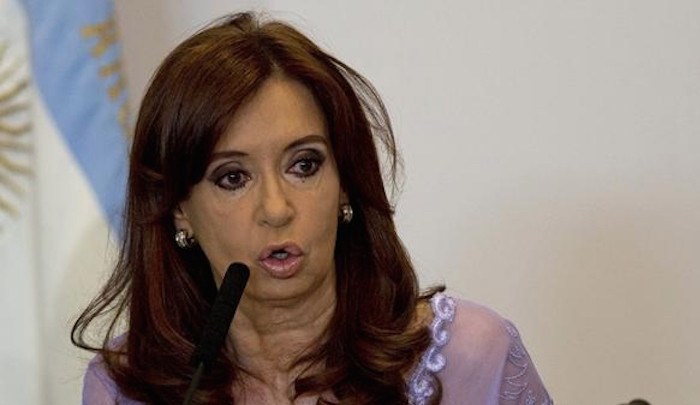
cristina-fernandez-de-kirchner

“Argentine President: Obama Administration Tried To Convince Us To Give Iran Nuclear Fuel,” by Taylor Tyler, HNGN, September 30, 2015 (thanks to Banafsheh):

Argentine President Cristina Fernandez de Kirchner claimed Monday afternoon at the United Nations General Assembly in New York City that in 2010, the Obama administration tried to convince the Argentinians “to provide the Islamic Republic of Iran with nuclear fuel,” reported Mediaite.

Kirchner said that two years into Obama’s first term, his administration sent Gary Samore, former White House Coordinator for Arms Control and Weapons of Mass Destruction, to Argentina to persuade the nation to provide Iran with nuclear fuel, which is a key component of nuclear weapons.

Kirchner’s full remarks are as follows, per the Argentine president’s official website:

“In 2010 we were visited in Argentina by Gary Samore, at that time the White House’s top advisor in nuclear issues. He came to see us in Argentina with a mission, with an objective: under the control of IAEA, the international organization in the field of weapons control and nuclear regulation, Argentina had supplied in the year 1987, during the first democratic government, the nuclear fuel for the reactor known as “Teheran”. Gary Samore had explained to our Minister of Foreign Affairs, Héctor Timerman, that negotiations were underway for the Islamic Republic of Iran to cease with its uranium enrichment activities or to do it to a lesser extent but Iran claimed that it needed to enrich this Teheran nuclear reactor and this was hindering negotiations. They came to ask us, Argentines, to provide the Islamic Republic of Iran with nuclear fuel. Rohani was not in office yet. It was Ahmadinejad’s administration and negotiations had already started.”…

Kirchner went on to say at the U.N. that when Samore was asked to provide the request in writing, all communications immediately ceased and Samore disappeared….

The Most Dangerous Man In the World

October 2, 2015

The Most Dangerous Man In the World, American ThinkerAndrew Logar, October 2, 2015

…is neither Russia’s Vladimir Putin nor China’s Xi Jinping, nor at this time, Ayatollah Khamenei – it’s none other than America’s Barack Hussein Obama.  This is not because of any aggressive, risk-laden actions he has taken, far from it.  It is because of those he has failed to take at critical times to credibly dissuade strategic competitors and potential aggressors, such as Russia and China, from actions that may suddenly compound into  destabilizing confrontations, even war.  When the Middle East cauldron spawned the barbaric ISIS, Obama’s indecisive, pusillanimous response allowed this Islamic malignancy to rapidly metastasize, compounding and accelerating an existing refugee problem that will involve America.  Additionally, throughout his tenure, overt actions Obama has taken served to steadily and materially, degrade American military capabilities, while enemies grow stronger.

In retrospect, divining Obama’s foreign policy should have been relatively easy given his background – a world seen through the eyes of someone whose father was a Muslim, as was his step-father, whose early education was in a Muslim madrassa, followed by mentoring from the known communist Frank Marshall Davis, associations with Columbia University’s Palestinian activist Edward Said and later, Harvard’s leftist Brazilian socialist Roberto Unger, later close association with admitted communist and Weatherman terrorist Bill Ayers, then followed by 20 years of anti-American and anti- Semitic sermons by Reverend Jeremiah Wright who, placing much of the world’s ills at America’s doorstep, culminated a post 9-11 sermon sententiously intoning, “…America’s chickens have come home to roost.”

Ironically, other chickens have indeed come home to roost.   American liberalism’s pernicious obsession to eradicate the odium of slavery long gone and any vestiges of remaining discrimination in one fell swoop, blindly promoted the candidacy of the first black president, propelling a relatively unknown, unvetted and remarkably unqualified candidate to two electoral victories.  That most unfortunate occurrence followed by resultant deleterious fallout at home and abroad, are liberalism’s chickens coming home to roost – in the White House – where they’ll cluck away until January 20, 2017.

After winning the 2008 election, Obama launched his now infamous “Apology Tour,” covering three continents in some 100 days, during which the Heritage Foundation identified 10 major apologies Obama made for America’s past behavior.  Mitt Romney, in his book, “No Apology,” correctly criticized Obama’s gratuitous apologies.  Indeed, unnecessary apologies by our president projected a weakness in resolve, confidence and appreciation of our nation’s accomplishments, our beliefs and values.  While in Europe, when asked if he believed in American “exceptionalism,” he said yes – in the same way that, “ …the Brits believe in British exceptionalism and the Greeks in Greek exceptionalism.”

This was an arresting, if not downright stupefying statement – coming from the head of state of the world’s most powerful nation, with a manifestly unrivaled history.  This is a nation which in 239 years since the Declaration of Independence, grew from 13 colonies and 3 million people to 50 states and 320 million people, a nation victorious in its Revolutionary War, the War of 1812 and which fought its bloodiest of wars, the Civil War, to expunge slavery; this is a nation victorious in the Mexican-American War, the Spanish-American War, WWI and WWII, that introduced the incontestably successful Marshall Plan critical in European post war recovery, that sent men to the moon and back, 6 times – and the nation that won the Cold War – a nation that has consistently led the world in Nobel prizes in medicine, science and technology. This is unequivocally a nation like none other, a nation of unparalleled achievements and sadly, one whose president does not consider particularly exceptional.

The historical record now shows global competitors and enemies have taken their measure of Obama: the Russians have acted with impunity in Crimea, Ukraine and Syria, the Chinese are establishing a stranglehold on the South China Sea while Russians, Chinese and Iranians are engaged in flagrant cyber-espionage against America, ISIS is growing, while Syria, Iraq and Afghanistan are all in play.

Barack Obama’s sophomoric efforts at geopolitics derived from his warped, kaleidoscopic misreading of 20th century history have now spiraled into a veritable tragicomedy of incompetence.  Witness his administration’s $500 million program to train Syrian rebels to fight ISIS: not only didn’t that produce the projected 5,000 trained fighters, or even 500, but only, according to General Lloyd Austin, “…four or five.” This is grist for a Marx Brothers movie and attributable to abysmally poor leadership, planning and organization which can only be placed at the doorstep of the White House.

An objective review of the Obama administration’s policies reveals they have consistently posed a direct or indirect threat to national security:

– The unilateral cancellation of the Easter Europe ABM deployment without securing a tangible quid pro quo from Moscow and no counter to Russia’s recent decision to sell the potent S-300 anti-aircraft system to Iran.

– The ill-advised support for the overthrow of long-term ally of the West, Egypt’s Mubarak and the inexplicable enthusiastic White House support of the Muslim Brotherhood.

– The equally ill-advised and ill-planned toppling of Libya’s Gaddafi, resulting in a country without a functional government now overrun with Islamists, where at Benghazi four Americans died needlessly.

– The withholding of vital intelligence from the Senate that Russia had been flagrantly cheating on the existing INF treaty to advance ratification of New START in 2010. Seventy-one Senators voted for ratification without full background knowledge.

– The 2011 withdrawal of all American troops from Iraq by Obama while blaming the Bush administration for inadequacies of the 2008 Status of Forces Agreement (SOFA).  This allowed Iraq to descend back into sectarian chaos, giving rise to ISIS and advantage to Iran.  A war won at high cost in blood and treasure was thus lost.

– The military drawdown in Afghanistan – mindlessly pre-announced to the enemy – may lose that war as well if continued.

– The release of five dangerous Taliban in exchange for Sgt. Bergdahl is beyond rational justification and/or discussion.

– The manifest dereliction of duty in not taking strong measures to protect America from devastating EMP attack – which can be done at very affordable cost.

– The lack resolute policy has turned Syria into a graveyard of American credibility. Nothing substantive has been achieved to slow, let alone destroy, rapidly metastasizing ISIS, unconscionably leaving a compounding problem to future administrations.

– The opening of our southern border to a tsunami of illegal immigration, arguably to permanently bias future voter demographics toward a one-party (Democratic) state. That many of those gaining easy entry may wish us harm is apparently of no concern to Obama.

– The continuing undermining of America’s military superiority is increasing the likelihood of confrontation with adversaries. According to the Heritage Foundation Index of Military Strength, our Commander-In-Chief has allowed our military power to degrade to “Marginal,” leaving the US Army at its relatively weakest level since the end of WWII, while our antagonists pour money into their armed forces.

– Finally (but Obama is not through yet!) – during recent post-summit remarks, China’s Xi Jinping suggested tough U.S. response to Chinese hacking would bring retaliation; obligingly, Obama affirmed sanctions wouldn’t be directed against governments. Essentially, Xi stepped forward, Obama blinked and stepped back – signaling a major geopolitical sea change. Cyberespionage by Russia and Iran haven’t been addressed.

Before winning the 2008 election and still a senator, during the Bush administration’s then ongoing nuclear negotiations with Iran, Obama, in a brazen and historically unprecedented move, secretly sent a personal emissary to Iran, William G. Miller, a former Ambassador to Ukraine, essentially conveying this message: Obama will very likely to be elected president, after which time Iran will find negotiating with him far easier.  The Bush negotiations reportedly then reached a stalemate.  Fast-forward to 2015, through Obama’s and Kerry’s “hard” bargaining, we’ve reached an agreement with Iran whereby monitoring Iran’s programs will be left to the Iranians as they now have the right to self-inspect” and so as to take the sting away from such an onerous deal, we’ll give them $100 billion of frozen assets  – with which to do as they please – while America agrees to protect Iran’s nuclear facilities from cyber warfare.

Though Red China, Russia and Iran increasingly challenge America, the Middle East bloodshed continues and ISIS grows stronger, President Obama has declared “…no challenge–poses a greater threat to future generations than climate change.” This extraordinarily vacuous statement is from either a hopelessly delusional ideologue, woefully untutored in world history, geopolitics and the unequaled greatness of America, or a brilliant Manchurian Candidate marching to his own drumbeat.  In any case, Obama is a president like none other – and may we never see the likes of him again.
 

Putin Plays Mideast Chess as Obama Looks On

October 1, 2015

Putin Plays Mideast Chess as Obama Looks On, American ThinkerJonathan F. Keiler, October 1, 2015

(Unfortunately, Obama was “in the game” which led to the nuke “deal” with Iran. There, he was not incompetent; he got what he sought. — DM)

Obama has made a lot of foreign policy mistakes in office, but his capitulation on the Iranian nuclear talks followed by Russia’s move into Syria is impossible to explain away as anything but a stupendous strategic fiasco.  Incompetence is too nice a word.  Obama was never even in the game.

*********************

It is sometimes said that in negotiations with foreigners, American leaders play checkers, while their wilier opponents play chess.   There is perhaps some truth to this, as American leaders sometimes chase short-term political results, a consequence of democratic governance and constantly changing leadership.  By contrast, despotic Persians are credited with inventing chess, and in modern times autocratic Russians have been its master, and so it is tempting to say of President Obama’s dealings with those two countries that the analogy holds.

But that is way too charitable.  As Vladimir Putin skillfully reasserts Russian power and influence in the Middle East with Islamic Persian Iran as a willing partner, a more apt analogy might be that while the Russians and Iranians move their chessmen, isolating and threatening opposing pieces, Obama is not even at the table, but rather childishly looking on, as he pushes diplomatic dirt around the Middle East sandbox.

For over 150 years, a primary objective of Western diplomatic and military strategy was to keep the Russians out of the Middle East and Southwest Asia.  In the 1850s, the British and French went to war in Crimea to protect the Ottomans from Russian predation and to preserve the balance of power.  Later, the so-called “Great Game” centered on similar British efforts to frustrate Russian domination of Iran and Afghanistan.  A century later, the United States took up the task, offsetting Russian influence in newly socialist Arab dictatorships by backing Israel and more traditional Arab monarchies in the Middle East, while openly and successfully opposing the Soviet incursion into Afghanistan.

Today, one can’t even say there remains any Western strategy regarding Russia.  Western Europe has mostly forfeited its military and political influence overseas to support decadent welfare states, even as it is being progressively and deliberately overwhelmed by millions of Islamist migrants.  Under Obama, who supports and admires Europe’s demise, the United States has increasingly joined in the decline.  The laughable Libyan campaign, “fought” by Europeans while the U.S. led from behind, set an example of pursuing a feckless, feel-good military campaign without regard for consequences or traditional strategic concerns.  Obama’s encouragement of the so-called Arab Spring and its Islamist provocateurs almost lost Egypt and did lose Syria, with catastrophic humanitarian and geopolitical results.

Putin is taking advantage of American weakness and inaction.  A half-century of successful American effort to keep the Russians out of the Middle East has been forfeit in a few months of breathtaking American diplomatic and military incompetence.  Obama’s capitulation in the Iran deal effectively completed the groundwork for the Russian move, Putin having carefully monitored America’s year-long and ineffectual air campaign against ISIS.  Putin now claims that Russia’s push into Syria is to redeem the campaign against ISIS with Russian troops fighting with Syria and Hezb’allah.  Embarrassed by Putin at the U.N., Obama gave up any pretense of strength, effectively welcoming the Russian “intervention” against ISIS.  Unexplained is why a large percentage of Russian anti-ISIS forces are heavily equipped with anti-aircraft weapons, something that even a flaccid NATO command cannot ignore, inasmuch as ISIS have an air force.  Those weapons are useful only against NATO or Israeli aircraft.

So lost was Obama before his meeting with Putin at the U.N. that his stated strategy for dealing with the Russian strongman was to ask him what he was doing.  From the stiff and awkward body language of the president following the meeting (a painful handshake and awkward smile) it is clear that Putin told Obama at least some of the story, whether Obama liked it or not.  Most particularly, his client Bashar Assad will remain in power with Russian backing, regardless of Obama’s view on the matter.  But likely Obama had known what he was in for, and just going through the motions.  The day before, Secretary of State of State John Kerry responded to a question about how long the U.S. could tolerate the survival of Assad, saying, “… it doesn’t have to be on day one or month one or whatever.”  Right, dude, whatever.  Between Obama and Kerry, it is now fair to assume that our much muddled and irresolute Syrian policy is “whatever,” which means we just don’t care.  We take our toys and go home.

If Obama was hoping, as he and his supporters implied, that the Iranian deal would produce a more moderate, cooperative Iran, Putin and the mullahs are doing all they can to demonstrate how wrong he was.  If he was hoping that “international pressure” and the conflict in Ukraine would moderate Putin’s aggressive strategies, he was wrong again.  And if he thinks that by quitting, he has left Putin an unwinnable game, the Russian leader aims to prove him wrong again.  And since Obama is almost always wrong when it comes to foreign policy, it’s a fool’s errand to bet against Putin.

In chess, before going for the opponent’s king, typical strategy calls for supporting one’s important pieces, while threatening and isolating opposing pieces.  The Russians and Iranians are now going about this with a vengeance, without the United States or the West making any noticeably effective counter-moves.  Russia is backing and protecting Assad and has closely allied itself with a newly empowered (thanks largely to Obama) Iran.  Meanwhile, traditional American allies in the region, Israel, Egypt, and the Arab monarchies are indeed increasingly threatened and isolated.  The stage is being set for a Russo-Iranian endgame that could prove disastrous to America’s traditional allies and the West in general.

Some of Obama’s liberal supporters dismiss such analysis as over the top, and insist that Putin’s moves have more to do with domestic politics than a long-term Middle Eastern power play.  They point out Putin’s problems at home, and the relative weakness of the Russian military.  However, relative Russian weakness means little when moving into a power vacuum created by Obama’s flight from international responsibilities and, to a large extent, reality.  And besides, this has been the basic way liberals have sought to excuse Obama whenever he is pushed around by a foreign leader (which is almost always).  Putin’s got problems, so he invades Ukraine, threatens the Baltic States, and moves into Syria.  The Chinese have problems, so they push naval vessels into American waters and fortify disputed Western Pacific archipelagos.  Korea’s got problems, Iran’s got problems, and none of their aggressive actions has anything to do with the dilettante in the White House.  It’s all about solving problems at home with international temper tantrums.

Obama has made a lot of foreign policy mistakes in office, but his capitulation on the Iranian nuclear talks followed by Russia’s move into Syria is impossible to explain away as anything but a stupendous strategic fiasco.  Incompetence is too nice a word.  Obama was never even in the game.


Russia and Iran, the UN’s darlings

September 29, 2015

Russia and Iran, the UN’s darlings, Israel Hayom, Boaz Bismuth, September 29, 2015

The situation in the Middle East is very complicated these days, particularly when it comes to the ongoing strife in Syria. On Monday, Russian President Vladimir Putin and Iranian President Hassan Rouhani both gave speeches at the U.N. General Assembly in New York that in normal times could have been dismissed as amusing. But in the era of Islamic State, everyone is suddenly trying to appear to be righteous, including Putin and Rouhani.

Putin, for example, believes that Syria’s future must include Bashar Assad, the tyrant who is responsible for the deaths of 250,000 of his own people. As Putin said, “Only Assad is fighting against Islamic State.” Meanwhile, Rouhani declared, “No country should use terrorism to interfere in another country’s affairs.” Let us remember that these were addresses delivered to the world, rather than jokes uttered on a satire program. What a farce.

The sad reality that exists in the Middle East these days is what allowed these two leaders to make such “comical” statements. The growth of Islamic State and the failure of the U.S.-led coalition against it have given Russia and Iran a great opportunity to bolster their international status.

For the Russians, this is a chance to erase memories of their actions in Ukraine and the Crimean Peninsula. For the Iranians, this provides an opening to deflect attention away from 35 years of exporting terrorism around the globe. Russia and Iran are both fortunate that Islamic State exists.

Putin met with U.S. President Barack Obama on Monday to tell him that the purpose of Russia’s increased military presence in Syria was to fight Islamic State. He also told Obama that the rebuilding of Syria would require the rebuilding of the Assad regime.

Obama was right on Monday when, in his own address to the U.N. General Assembly, he said that Assad must have no political future in Syria. Unfortunately, there are two small things that contradict Obama’s view of the situation. First, the pre-civil war Syria no longer exists. And second, all reconstruction proposals for Syria include a transition period during which a role for Assad would be necessary. And who knows how many years this transition would take?

Obama may not want Assad in power, but in reality, an Assad regime backed by Russia and Iran is what there is in Syria. Since Obama reiterated on Monday that the U.S. cannot solve global problems by itself, perhaps he should have added how wonderful it is to have Russia and Iran to help him. This is the woeful state of our world today.

Obama’s General Assembly address was his second-last before he leaves the White House in January 2017. In Monday’s speech, he tried to outline what his legacy will be. One must give Obama credit for adhering to his outlook, even after all of the mishaps he has been personally responsible for.

Russia and Iran were the big winners in New York on Monday. Putin, who was ostracized after Russia’s annexation of Crimea last year, is now the world’s great hope in the fight against Islamic State. And Iran is already talking about a “new world order,” thanks to the nuclear deal it signed with world powers in July.

And what does this all mean for Israel? “The Zionist regime is the root of all terrorism,” Rouhani said in his speech on Monday. How hopeful!

What is the solution for all this? Who knows? Perhaps we will get the answer at the U.N. General Assembly in 2016.

Israel’s biggest fears are materializing

September 27, 2015

Israel’s biggest fears are materializing, Israel Hayom, Boaz Bismuth, September 27, 2015

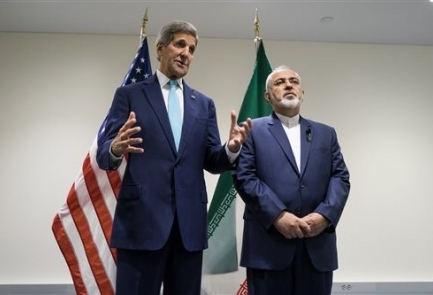
144334028328300476a_bThe Munich moment is upon us. U.S. Secretary of State John Kerry with Iranian Foreign Minister Mohammad Zarif at U.N. headquarters on Saturday | Photo credit: AP

Washington is reaching out to Russia, which is openly helping Syrian President Bashar Assad, who is working in conjunction with Iran, which in turn supports Hezbollah. Now Europe is prepared to talk to Assad, but what about us, for heaven’s sake?

Two years ago to the day, in September 2013, U.S. Secretary of State John Kerry compared Bashar Assad to Adolf Hitler, after the Syrian dictator once again used chemical weapons against his own people. “This is our Munich moment,” Kerry said at the time.

As far as the Americans were concerned, Assad had crossed a line. In those days (more like in those hours, actually), Washington briefly believed that a failure to respond to Assad’s actions would send a dangerous message to Iran regarding its nuclear ambitions.

“Will [Iran] remember that the Assad regime was stopped from those weapons’ current or future use, or will they remember that the world stood aside and created impunity?” Kerry asked at the time. History and retrospect have turned what may have been Kerry’s greatest speech into remarks entirely detached from reality.

The United States did not attack, Assad is still in power, and an ominous nuclear deal has been signed with Iran. It is no wonder that there is a new kind of atmosphere in the region, under American auspices. There are no more good guys and bad guys; everyone is a partner. And thanks to this new reality, Assad now has a renewed license to rule, after having received a license to kill.

Washington is reaching out to Russia, which is openly helping Assad in Syria, who is working in conjunction with Iran, which in turn supports Hezbollah. Europe (Angela Merkel), in the meantime, startled by its refugee crisis, is already prepared to talk with Assad; the same Assad who was compared to Hitler only two years ago. But what about us, for heaven’s sake?

Regretfully, Israel’s biggest fears are now materializing. Instead of being the architects and shaping a new reality in the Middle East, Washington is falling into line with the existing reality. Russia, Syria and Iran are enjoying the consequent vacuum. When the cat is away, the mice will play. Now, all of a sudden, even Hezbollah chief Hassan Nasrallah is letting himself go on television, beaming with joy. Aside from the 75 tanks Damascus is giving him, he now sees his two patrons (Damascus and Tehran) become partners with the West, without having to change one bit.

There is no diplomatic vacuum

The latest developments in Syria are not encouraging: Assad’s first target, with Russia’s help, is expected to be the Nusra Front rebel group, which not only threatens Assad but is also a bitter enemy of the Islamic State group. In other words, somewhat paradoxically, Islamic State could initially benefit from the Russian intervention in Syria.

And one final word about Iran’s rapprochement with the international community: We have been told repeatedly that this was only about the nuclear deal, but in reality we can see cooperation between the U.S. and Iran in Iraq and in the war against Islamic State. We can also see American-Iranian dialogue regarding Syria’s future, and on Saturday night we learned of a gigantic deal worth upwards of $21 billion between Iran and Russia. This time I am forced to agree with Secretary Kerry: This really does look like a Munich moment.

Iran Openly Declares That It Intends To Violate UNSCR 2231 That Endorses The JCPOA

September 23, 2015

Iran Openly Declares That It Intends To Violate UNSCR 2231 That Endorses The JCPOA, Middle East Media Research Institute, September 22, 2015

(Please see also, Iran wants to renegotiate parts of the nuke “deal.” That may be good. Iran’s declaration that it intends to violate UNSCR 2231, dealing with missile development and related sanctions, should further prompt the U.S. Congress to repudiate the “deal.”– DM)

When the Americans moved the sanctions on the missile program to UNSCR 2231, Iran did not object, as, according to their statements above, they can violate Security Council resolutions, as they have done in the past, and this will not be regarded as a violation of the JCPOA.

**************************

In statements, three Iranian leaders – President Hassan Rohani, Foreign Minister Zarif, and Deputy Foreign Minister and senior negotiator Abbas Araghchi – emphasized that Iran has no intention of abiding by UNSRC 2231, which includes the JCPOA and another element; rather, that they will abide only by the original JCPOA.

The Iran nuclear deal consists of the following:

A.   A set of understandings between Iran and the P5+1 powers (as well as the remaining disagreements) all in a single package called the JCPOA. It is not a contract between Iran and the P5+1 countries as a group or any single one of them, and hence no document was signed.

B.   This set of mutual understandings (as well as disagreements) packaged in the JCPOA was transferred, following the conclusion of negotiations in Vienna on July 14, 2015, to the UN Security Council, for endorsement as a UN Security Council resolution. The resolution, UNSCR 2231, was passed on July 25, 2015 and it includes, in addition to the JCPOA, another element (Annex B) with further stipulations regarding Iran. For example, it addresses the sanctions on Iran’s missile development project.

To understand why UNSCR 2231 is structured in this way, we can look at statements by top Iranian negotiators about the process that led up to it:

In a July 20, 2015 interview on Iranian Channel 2, Iranian Deputy Foreign Minister and senior negotiator Abbas Araghchi said that there had been tough bargaining between the Iranian and American delegations over the issue of the arms embargo on Iran and the sanctions related to Iran’s missile development project. “The Americans sought their inclusion in the JCPOA, claiming that otherwise they could not face criticism from Arab countries in the region. When they said that they could not lift the sanctions altogether, we told them explicitly that in that case there is no agreement. We told them that the national security issues are non-negotiable and that we will not accept an agreement which continues the embargo on weapons and the sanctions on missile development. In the end, the Americans said, We will put the issue of the embargo and the missiles in the UN Security Council Resolution separate from the agreement.”

In the same interview, Araghchi was asked whether Iran could refrain from carrying out UNSCR 2231; he replied: “Yes we can; just as we refrained from complying with UN Security Council resolutions, we can do so with regards to 2231.”

Araghchi also referred to the Iranian Foreign Ministry statement issued following the passage of UNSCR 2231: “The Iranian Foreign Ministry statement explicitly noted that Iran does not attach legitimacy to any restriction and any threat. If UNSCR 2231 will be violated by Iran, it will be a violation of the Security Council resolution and not of the JCPOA, similar to what happened 10 years ago when we violated Security Council resolutions and nothing happened. The text of the JCPOA notes the fact that the content of the JCPOA and of the UN Security Council resolution are two separate things.”[1]

Foreign Minister Zarif, in an August 9, 2015 media interview, reiterated the Iranian position regarding the difference between the JCPOA and UNSCR 2231, with a focus on the consequences of possible violation of the two by Iran. He said: “There is a difference between the JCPOA and UNSCR 2231. Violating the JCPOA has consequences, while violating UNSCR 2231 has no consequences.”[2]

Indeed, the restrictions regarding missiles are mentioned only in UNSCR 2231, and not in the JCPOA.

On August 29, 2015, Iranian President Hassan Rohani said: “There is nothing about the topic of missiles, defense, and weapons in the JCPOA.  Whatever we have about it is in Resolution [UNSCR] 2231… Moreover, we have formally announced that we are not committed to all the sections that appear in the resolution [2231], and we specified in the JCPOA that violation of the resolution [2231] does not mean violation of the JCPOA…[3]

The meaning of all this is that in everything related to the issue of missile development, Iran will disregard UNSCR 2231. Already during the negotiations, it insisted on no imposition of sanctions on Iran regarding its missile development (and no sanctions at all). When the Americans moved the sanctions on the missile program to UNSCR 2231, Iran did not object, as, according to their statements above, they can violate Security Council resolutions, as they have done in the past, and this will not be regarded as a violation of the JCPOA.

Endnotes:

[1] ISNA.ir/fa/news/94042915462/%D9%85%D9%85%D9%86%D9%88%D8%B9%DB%8C%D8%AA-%D9%87%D8%A7%DB%8C-%D8%AA%D8%B3%D9%84%DB%8C%D8%AD%D8%A7%D8%AA%DB%8C-%D9%88-%D9%85%D9%88%D8%B4%DA%A9%DB%8C-%D8%A8%D9%87- .

[2] Foreign Minister Javad Zarif said this at an August 9, 2015 conference sponsored by the Iranian daily Ittil’atwith other senior negotiators in attendance. See text in Farsi here.

[3] President.ir/fa/89047, August 30, 2015.

Iran wants to renegotiate parts of the nuke “deal.” That may be good.

September 22, 2015

Iran wants to renegotiate parts of the nuke “deal.” That may be good. Dan Miller’s Blog, September 22, 2015

(The views expressed in this article are mine and do not necessarily reflect those of Warsclerotic or those of its other editors. — DM)


Iran wants sanctions relief to be lifted, immediately, and not merely suspended. Iran should not get that. If it doesn’t, it may well terminate the “deal” unilaterally. If Iran gets what it wants, the Senate should review the “deal” as a treaty and reject it. Either outcome would be a substantial improvement over the current “deal” and the morass in which it is embedded.

This post is based on a September 21st article at Middle East Media Research Institute (MEMRI) titled “Expected September 28 NY Meeting Between P5+1 Foreign Ministers And Iran Could Signify Reopening Of Nuclear Negotiations To Address Khamenei’s September 3 Threat That If Sanctions Are Not Lifted, But Merely Suspended, There Will Be No Agreement.”

The MEMRI article cites statements by Supreme Leader Khamenei and one of his senior advisers, Ali Akbar Velayat. The latter said, on September 19th,  “the nuclear negotiations are not over yet.” Khamenei has said much the same thing.

Khamenei said, in a September 3, 2015 speech to the Assembly of Experts, that he did not accept the terms of the agreement and demanded that the sanctions be immediately lifted rather than merely suspended; otherwise, he said, there would either be no agreement, or Iran too would merely suspend its execution of its obligations under the JCPOA.

. . . .

“Freezing or suspension [of the sanctions] is unacceptable to me… If they suspend [the sanctions], we too will suspend [what is incumbent upon us]. If we are to implement what [is required of us], the sanctions must be [actually] cancelled.

Iran has thus made clear that it will not abide by the nuke “deal” as written; unless it gets the changes it now demands, it will either terminate the deal or violate it. If, as seems likely for the reasons cited in the MEMRI article, the September 28th meeting involves discussion of the deal, it will either be renegotiated or it won’t be.

If the “deal” is not renegotiated, or is renegotiated and Iran does not get what it demands, it may very well terminate the deal. Iran has already received substantial sanctions relief, is already open for business and is already doing lots of it with many more nations than previously. Termination would be a rebuff to the “Great Satan,” would not damage Iran much economically and it could proceed with its “peaceful” nuke program without even farcical nuke self-inspections.

If The Obama administration and others cave and Iran gets what it demands or enough to satisfy it, the “deal” will be very different from what was previously presented to the Congress under the Corker legislation. That legislation purported to eliminate the constitutional requirement of approval of the “deal” by a two-thirds Senate majority before going into effect and permitted it to go into effect unless rejected by half of the membership of both houses; Obama promised to veto such a rejection and put the “deal” into effect. The House has disapproved the “deal” but the Senate has not acted because of Democrat fillibusters, urged by the White House. Under the new “deal,” the ability of the United States to “snap back” sanctions would be vitiated; a possible but very difficult if not impossible to accomplish, “snap back” had been among the reasons cited by many of those who favored the “deal” (often despite its many other flaws) for supporting it.

If a deal eliminating the “snap back” is struck, Obama, et al, may well claim that it’s none of the business of the Congress since, by virtue of the Corker legislation, it has already eliminated its constitutional authority to deal with the JCPOA as a treaty, regardless of any “minor” change.

I hope, but am less than confident, that both houses of the Congress will reject this contention vigorously and repeal the Corker legislation. Whatever benefits or other legitimacy the Corker legislation may once have been thought to have it no longer has. Repeal will probably require use of the “nuclear option” to invoke cloture to end a Democrat filibuster in the Senate. If — as seems likely — Obama vetoes the rejection, the Congress should state that it no longer considers itself bound by the Corker legislation. Next, the Senate should treat the renegotiated “deal” as a treaty, regardless of whether Obama agrees to send it to the Senate, and reject it. It should do so even if, as also seems likely, that requires use of the “nuclear option” to invoke cloture.

Obama has precipitated what may well become a constitutional crisis. If the Congress does its job, Obama will be the loser and America will be the winner — even if it becomes necessary to take out Iran’s nukes militarily.

Cartoons of the day

September 18, 2015

H/t Freedom is just another word


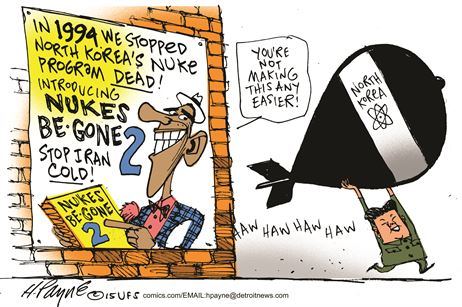
begone
invited

Side Effects – From David Zucker

September 15, 2015

Side Effects – From David Zucker via You Tube, September 10, 2015


Off topic (?) | To bring America back we need to break some stuff

September 15, 2015

To bring America back we need to break some stuff, Dan Miller’s Blog, September 14, 2015

(The article is not immediately pertinent to Israel because the current President will continue to be Obama and his tame Congress will continue to go along to get along. However, the 2016 U.S. presidential elections are very pertinent to Israel’s future, so I am taking the liberty of posting it here. For those not familiar with the acronym “RINO,” it is a term of disparagement referring to Republicans who would probably be happier if they were Democrats. Needless to say, the views expressed in the article are mine and do not necessarily reflect those of Warsclerotic or its other editors. — DM)

In December of 2011, I wrote an article titled The U.S. Constitution and Civil War. A remark by Cokie Roberts — that we need to ignore parts of the Constitution to save the rest — inspired my article. To bring America back, we don’t need to, nor should we, ignore or otherwise break the Constitution; it is America’s foundation. We do need to destroy and rebuild much of the mess that has been wrongly erected atop that foundation.

Obama and Constitution

Who should be our next President?

Daniel Greenfield, in an article titled This is the America We Live in Now, wrote,

We are not this culture. We are not our media. We are not our politicians. We are better than that.

We must win, but we must also remember what it is we hope to win. If we forget that, we lose. If we forget that, we will embrace dead end policies that cannot restore hope or bring victory.

What we have now is not a movement because we have not defined what it is we hope to win. We have built reactive movements to stave off despair. We must do better than that. We must not settle for striving to restore some idealized lost world. Instead we must dream big. We must think of the nation we want and of the civilization we want to live in and what it will take to build it. [Emphasis added.]

Our enemies have set out big goals. We must set out bigger ones. We must become more than conservatives. If we remain conservatives, then all we will have is the America we live in now. And even if our children and grandchildren become conservatives, that is the culture and nation they will fight to conserve. We must become revolutionaries. [Emphasis added.]

If we don’t, perhaps we should surrender and petition to join the European Union. Our unelected and unaccountable bureaucracy could merge with that of the EU and our Congress could merge with the impotent EU Parliament.

Joining the EU would not fit well with the U.S. Constitution, but so what? Obama and “pragmatic” judges have twisted and distorted it. They pay but scant attention to its clear language or that of the statutes they misconstrue. Most in the current crop of Republicans in the Congress have been willing to surrender whenever Obama blows His dog whistle and run to Him with hopes that He may offer them small bones.

Our once great nation is itself broken, but not necessarily beyond repair. It needs to be fixed before it gets to the point where it can’t be, and we are rapidly approaching that point. Our Constitution must be revived, and as revived survive, if America herself is to survive. America can’t be fixed with fresh paint and new floral arrangements featuring a “new” Bush.

When Ronald Reagan was first mentioned as a possible Republican presidential candidate, my first thought was that we don’t need a washed-up grade B movie actor/former Democrat leftist as President. I was wrong. He became the best President America has seen in my thus far seventy-four years on Earth. We need another Reagan, but who should it be? There are only a few good candidates and the Republican establishment opposes, with such insipid vigor as it can muster, all of them. It wants Jeb Bush, or in any event a Bush clone, to march stolidly toward a new Amerika.

Donald Trump

The mainstream media cannot understand why Trump continues to lead in the polls. Neither can the RINOs. Trump can’t possibly continue to lead; why, he is not even a politician! On September 12th, Sharyl Attkisson posted an article titled Donald’s Duck: 7 Reasons Why Nothing Sticks to Teflon Trump. In it, she explored seven of the reasons why it is claimed that Trump “can’t win.”

1. Trump doesn’t know the names of terror leaders.

2. Trump doesn’t have a plan.

3. Trump isn’t conservative enough.

4. Trump has flip-flopped.

5. Trump personally insults people.

6. Trump is against immigrants.

7. Trump won’t apologize.

Please read her analysis pointing out the fallacies behind these talking points as seen by Trump supporters; I think they are correct.

On September 13th Sundance, writing at The Last Refuge, posted an article titled The GOPe Roadmap, Status Update and The Event Horizon… There, he pointed out the RINOs’ multifaceted plan to defeat Trump and to install Jeb Bush as “our” next President. Jeb wants to lead us to more of the same namby-pamby nonsense that gave us Obama, the “great healer.” I don’t want to go there and want to stay as far away from there as possible. Please read Sundance’s article in its entirety. It’s excellent and so is this sequel about the upcoming CNN debate and the night of the long knives.

What will Trump do if elected?

I don’t know what Trump will do if elected President. He probably can’t make things worse, will try very hard to make them better and may well succeed. Please watch “lunatic” Trump respond to questions during this interview.

The only thing I am confident that the RINO candidates would do is to continue America’s collective swirl down the toilet. I very much like Ted Cruz (he would also be an excellent Secretary of State) and Ben Carson (Secretary of Health and Human Services?). Carina Fiorina? I like her thus far but need to learn more.

Trump has captured the public attention and, in many cases, its admiration and trust. Apparently many of his supporters feel as I do and are “mad as hell and don’t want to take it anymore.”

Please compare and contrast these Obama and Hillary campaign videos:

Obama won His last two elections by campaigning for change “we” can believe in. Trump has thus far campaigned for change those who think America was great before Obama got to mucking around with her do believe in and want to have implemented.

Much is yet unknown about where and how Trump will lead the nation as her President. One thing seems clear, at least to me: he will discard that which is broken and replace it with what we need. So long as he does not muck around with the Constitution (as Obama has done with abandon), I think we should give him an opportunity to try.

gop-elite

H/t Vermont Loon Watch

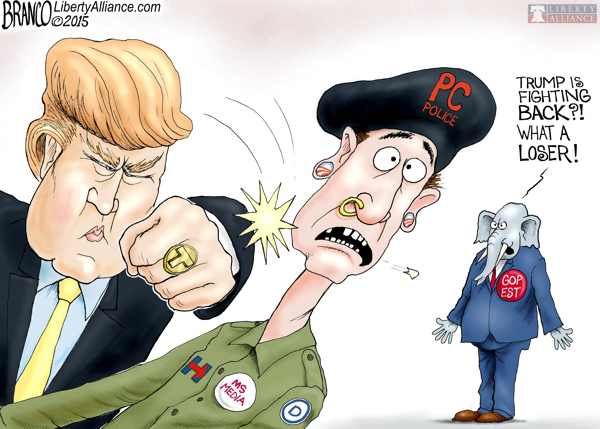
trump-punch-600-la

H/t Kingjester’s Blog