H/t Joopklepzeiker
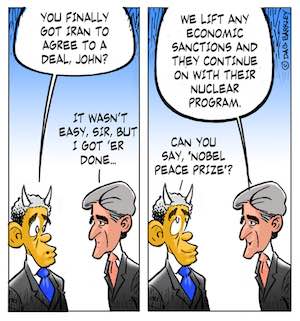
H/t Joopklepzeiker
(The views expressed in this post are mine, and do not necessarily reflect those of Warsclerotic or its other editors. — DM)
Oh what a tangled web we weave, when first we practice to deceive.

The current “deal” is based on a long-standing scam
Part I of this series, published on July 14, 2015, pointed out what should be a glaring consistency in the “Joint Comprehensive Plan of Action,” first made available on that date, and the November 24, 2013 Joint Plan of Action: neither provides for any “anytime -anywhere” inspections of Iran’s nuclear weaponization or missile sites. That consistency has been little remarked upon elsewhere.
Secretary Kerry now acknowledges that he never sought such inspections.
Leaving aside the twenty-four day lag between an IAEA request to inspect suspect facilities — which Kerry says is just fine — he claims that we now have a “unique ability” to get the U.N. Security Council to force inspections and reinstate sanctions. However, any effort to do so would almost certainly be vetoed by one or more Security Council members. The permanent members are China, France, Russia, the United Kingdom, and the United States — five of the members of P5+1 which approved the “deal.”
On July 16th, US Under Secretary of State Wendy Sherman said,
“I think this is one of those circumstances where we have all been rhetorical from time to time,” Sherman said in a conference call with Israeli diplomatic reporters. “That phrase, anytime, anywhere, is something that became popular rhetoric, but I think people understood that if the IAEA felt it had to have access, and had a justification for that access, that it would be guaranteed, and that is what happened.” [Emphasis added.]
Kerry also claimed that the massive financial boost for Iran resulting from the lifting of sanctions will not enhance Iran’s support for terrorism.
Speaking to the BBC after the nuclear agreement between Iran and six world powers was reached, Kerry said that the more than $100 billion that Iran is set to receive “is going to make all the difference in the world is just – it’s not true.”
Acknowledging Iran is an international player in wreaking terror across the globe, Kerry said, “What Iran has done for years with Hezbollah does not depend on money.” He similarly stated Iran’s support of the Houthi rebels against the government in Yemen has not “depended on money.” [Emphasis added.]
. . . .
In its most recent report, the State Department wrote, “Iran has provided hundreds of millions of dollars in support of Lebanese Hezbollah in Lebanon and has trained thousands of its fighters at camps in Iran.”
In 2010 alone, State reported “Iran provides roughly $100-$200 million per year in funding to support Hezbollah.”
Secretary Kerry is almost certainly wrong, on that as on other aspects of the “deal.”.
Here’s Megan Kelly’s wrap up.
Iran may reject the “deal.”
There are at least glimmers of hope that Iran may reject the “deal,” unanimously endorsed by the UN Security council today.
A UN Security Council resolution endorsing Iran’s nuclear deal that passed on Monday is unacceptable, the country’s Islamic Revolutionary Guards Corps commander Mohammed Ali Jafari was quoted as saying by the semi-official Tasnim News Agency.
“Some parts of the draft have clearly crossed the Islamic republic’s red lines, especially in Iran’s military capabilities. We will never accept it,” he was quoted as saying shortly before the resolution was passed in New York. [Emphasis added.]
The Iranian Parliament also has problems with the “deal.”
On Saturday, the Fars News Agency reported that the Majlis threatened to reject the agreement’s provision on ballistic missiles, which call for an international embargo on missile technology to be extended for eight years–a significant, last-minute concession by the U.S.
Iran wants unrestricted ballsitic missile development and access to conventional arms dealers abroad.
“The parliament will reject any limitations on the country’s access to conventional weapons, specially ballistic missiles,” said Tehran MP Seyed Mehdi Hashemi.
. . . .
In addition, the nuclear deal says that the Majlis will ratify the Additional Protocol (AP) to the Non-Proliferation Treaty–but it does not say when.
The AP is the key to long-term monitoring of Iranian nuclear research and development by the International Atomic Energy Agency (IAEA). Without approval of the AP, Iran may hide key information about its nuclear activity, and may accelerate advanced centrifuge research immediately when the nuclear deal expires, among other hazards. (Even then, its commitments under the AP will be somewhat voluntary.) [Emphasis added.]
. . . .
[W]hile the interim agreement of Nov. 2013 provided that Iran would ratify the AP within one year, there is no such deadline in the final Iran deal. The AP is merely to be applied “provisionally,” while the Majlis decides whether to accept it or not.
Meanwhile, if the Obama administration has its way, the U.S. Congress will have no opportunity to amend the deal–and will have to accept the lifting of international sanctions regardless of whether legislators accept or reject the agreement. [Emphasis added.]
Iranian leadership’s opposition to the “deal” appears to have come from Iran’s Supreme leader and the Iranian Parliament has the authority to reject the “deal.”
As expected, Ayatollah Ali Khamenei’s reaction to the nuclear deal was utterly different from that of President Hassan Rouhani. Right after the agreement was announced on July 14, Rouhani appeared on state television and praised the outcome. Yet when he and other officials visited Khamenei’s home a few hours later, the Supreme Leader did not say anything about the deal apart from a few lines thanking the negotiators. This reticence signaled to hardliners that they should increase their attacks on the agreement. [Emphasis added.]
America’s Supreme Leader, on the other hand, has been pushing vigorously to force the U.S. Congress to approve it, with no way to change it.
The “deal,” and Obama’s foreign policy in general, are rooted in His affinity for Islam
Obama may or may not be a Muslim. However, He thinks very highly of Islam and deems it the “religion of peace.” It would be ironic were Obama’s Iran “deal” to be rejected by Iran.
As observed in a Jerusalem Post article, with the thrust of which I agree, His affinity for Islam is at the root of His “deal.”
Obama is the first US president who genuinely conceives of Islam as not inherently opposed to American values or interests.
. . . .
It is through this Islamo-philic prism that the Obama administration’s attitude to, and execution of, its foreign policy must be evaluated – including its otherwise incomprehensible capitulation this week on Iran’s nuclear program. [Emphasis added.]
. . . .
The inspection mechanism provided for in the nascent deal make a mockery of Obama’s contention (July 14): “… this deal is not built on trust; it is built on verification,” and, “Because of this deal, inspectors will also be able to access any suspicious location… [They] will have access where necessary, when necessary.”
One can hardly imagine a more grossly misleading representation of the deal – so much so that it is difficult not to find it strongly reminiscent of the Muslim tactic of taqiya (the religiously sanctioned deception of non-Muslims). [Emphasis added.]
Indeed, immediately following the announcement of the agreement, Ben Rhodes, Obama’s deputy national security adviser, made a stunning admission to CNN’s Erin Burnett. Starkly contradicting the president’s contention of “access where necessary, when necessary,” Rhodes conceded, “We never sought in this negotiation the capacity for so-called anytime, anywhere,” which is diametrically opposed to the impression he conveyed in April this year when queried on this issue. [Emphasis added.]
In His capacity as America’s Imam in Chief, Obama has consistently claimed that the “religion of peace” has nothing to do with the Islamic State or with Islamic terrorism (of which he claims there is none) — such as the recent murder of four members of the U.S. Marines and one member of the U.S. Navy — committed in the name of Allah. The Daily Beast has posted some of the terrorist’s writings. They include these statements:
“I would imagine that any sane person would devote their time to mastering the information on the study guide and stay patient with their studies, only giving time for the other things around to keep themselves focused on passing the exam,” Abdulazeez wrote. “They would do this because they know and have been told that they will be rewarded with pleasures that they have never seen.”
This life is that test, he wrote, “designed to separate the inhabitants of Paradise from the inhabitants of Hellfire.”
. . . .
“We ask Allah to make us follow their path,” Abdulazeez wrote. “To give us a complete understanding of the message of Islam, and the strength the live by this knowledge, and to know what role we need to play to establish Islam in the world.” [Emphasis added.]
Obama apparently considers the Islamic Republic of Iran to be Islamic — and therefore peaceful — despite its widespread support for its terrorist proxies. That may explain the credence He gives to Supreme Leader Khamenei’s alleged fatwa preventing Iran from obtaining nukes. Obama and Khamenei have frequently referred to it in support of that proposition, although no text been produced. According to a Washington Post article dated November 27, 2013,
Oddly, the Iranian Web site does not provide the text of the original fatwa — and then mostly cites Western news reports as evidence that Khamenei has reiterated it on several occasions. The fatwa does not appear to be written, but in the Shiite tradition equal weight is given to oral and written opinions.
. . . .
Just about every Alfred Hitchcock thriller had what he called a “MacGuffin” — a plot device that gets the action going but is unimportant to the overall story. The Iranian fatwa thus appears to be a diplomatic MacGuffin — something that gives the Americans a reason to begin to trust the Iranians and the Iranians a reason to make a deal. No one knows how this story will end, but just as in the movies, the fatwa likely will not be critical to the outcome. [Emphasis added.]
Even if one believes the fatwa exists — and will not later be reversed — it clearly appears to have evolved over time. U.S. officials should be careful about saying the fatwa prohibits the development of nuclear weapons, as that is not especially clear anymore. The administration’s statements at this point do not quite rise to the level of earning Pinocchios, but we will keep an eye on this issue. [Emphasis added.]
An April 6, 2015 article at the Middle East Media Research Institute provides additional information.
In March of this year Obama presented a Nowruz message to the people of Iran citing Khamenei’s alleged fatwa. Here’s a video from the White House.
Here are a few interesting excerpts:
“Our negotiations have made progress, but gaps remain,” he said. “And there are people, in both our countries and beyond, who oppose a diplomatic resolution. My message to you—the people of Iran—is that, together, we have to speak up for the future we seek. [Emphasis added.]
“As I have said many times before, I believe that our countries should be able to resolve this issue peacefully, with diplomacy,” Obama said. “Iran’s Supreme Leader Ayatollah Khamenei has issued a fatwa against the development of nuclear weapons, and President Rouhani has said that Iran would never develop a nuclear weapon. [Emphasis added.]
Isn’t that special! Why, in light of the alleged fatwa, does Iranian television broadcast simulations of nuclear attacks on Israel?
A short animated film being aired across Iran, shows the nuclear destruction of Israel and opens with the word ‘Holocaust’ appearing on the screen, underneath which a Star of David is shown, Israel’s Channel 2 reported on Tuesday.
Khamenei’s Death to America rants are considered an excellent reason to have a “deal.”
Similarly, the Reverend Jeremiah Wright was fond of saying “God Damn America.”
Obama apparently understood Khamenei’s words, but perhaps He didn’t understand Jeremiah’s words.
Conclusions
Elected on a platform of Hope and Change, Obama has brought us many changes; very few, if any, of those changes provide a basis for hope, at least until He has left office. Some will be difficult, if not impossible, even then to ameliorate. During His remaining time in office, He will continue to do His worst to eliminate any vestigial hope we may have. The “deal” with Iran is only one of the many changes for the worse that He has wrought.
McFarland on Kerry’s Iran Inspections Claim: ‘It’s A Lie’
BY: Follow @@BlakeSeitz
July 20, 2015 10:20 am
via McFarland on Kerry’s Iran Inspections Claim: ‘It’s A Lie’ | Washington Free Beacon.
KT McFarland offered a blunt appraisal Monday of Secretary of State John Kerry’s claim that the U.S. had never sought “anytime, anywhere” inspections of Iran’s suspected nuclear sites.
“It’s a lie,” McFarland, a former State Department official for Ronald Reagan, said. “The reason anytime, anyplace inspections are crucial is because Iran in the past has cheated, so you really need ironclad inspections.”
“You think he was lying?” Fox News host Bill Hemmer asked.
“I think he wants this deal so badly he’s willing to stretch the truth around this,” McFarland responded.
Several of Kerry’s close confidants during the Iran negotiations, including Secretary of Energy Ernest Moniz and Deputy National Security Adviser Ben Rhodes, are on record earlier in the year assuring reporters that the U.S. would insist on “anytime, anywhere” inspections as part of any deal.
McFarland said the inspections process that the U.S. ultimately agreed to gives Iran the ability to stall inspectors for almost a month before they can visit a suspicious site.
“When the president said that we have 24-hour access to key nuclear installations, no you don’t—you have a 24-day period to request to look inside, and Iran has 24 days to say yes you can or no you can’t,” McFarland said.
Observers have expressed grave concern about the complicated bureaucratic mechanism that the U.S. will have to fight through at the U.N. to gain approval for an IAEA inspection.
By the time inspectors reach a suspected site, they may find only “elaborate cleanup efforts” like those that have been found at Iran’s Parchin military complex during past inspections.
Iranian Revolutionary Guards: UN resolution endorsing nuclear deal crosses Iran’s red lines
A UN Security Council resolution endorsing Iran’s nuclear deal that passed on Monday is unacceptable, the country’s Islamic Revolutionary Guards Corps commander Mohammed Ali Jafari was quoted as saying by the semi-official Tasnim News Agency.
“Some parts of the draft have clearly crossed the Islamic republic’s red lines, especially in Iran’s military capabilities. We will never accept it,” he was quoted as saying shortly before the resolution was passed in New York.
The United Nations Security Council on Monday endorsed the deal to curb Iran’s nuclear program in return for sanctions relief, but it will be able to re-impose UN penalties during the next decade if Tehran breaches the historic agreement.
The 15-member body unanimously adopted a resolution that was negotiated as part of the agreement reached in Vienna last week between Iran and the world’s major powers.
In return for lifting US, EU and UN sanctions, Iran will be subjected to long-term curbs on a nuclear program that the West suspected was aimed at creating an atomic bomb, but which Tehran says is peaceful.
Passage of the resolution triggers a complex set of coordinated steps agreed by Iran during nearly two years of talks with the United States, Russia, China, Britain, France, Germany and the European Union.
It says that no sanctions relief will be implemented until the International Atomic Energy Agency submits a report to the Security Council verifying that Iran has taken certain nuclear-related measures outlined in the agreement.
Under the deal, the major powers don’t need to take any further action for 90 days. Then they are required to begin preparations so they are able to lift sanctions as soon as the IAEA verification report is submitted.
The European Union approved the Iran nuclear deal with world powers on Monday. US President Barack Obama’s administration has sent the nuclear agreement to Congress, which has the next 60 days to review it.
Once sanctions relief can be implemented, seven previous UN resolutions will be terminated and the measures contained in the resolution adopted on Monday will come into effect.
The resolution allows for supply of ballistic missile technology and heavy weapons, such as tanks and attack helicopters, to Iran with Security Council approval, but the United States has pledged to veto any such requests.
The restrictions on ballistic missile technology are in place for eight years and on heavy weapons for five years. The resolution leaves in place an arms embargo on conventional weapons for five years.
The resolution places restrictions on the transfer to Iran of nuclear technology for peaceful purposes for a decade.
It allows all UN sanctions to be re-imposed if Iran breaches the deal in the next 10 years. If the Security Council receives a complaint of a breach it would then need to vote within 30 days on a resolution to extend sanctions relief.
If the council fails to vote on a resolution, the sanctions would be automatically re-imposed. This procedure prevents any of the veto powers who negotiated the accord, such as Russia and China, from blocking any snap-back of Iran sanctions.
All the provisions and measures of the UN resolution would terminate in a decade if the nuclear deal is adhered to.
However, the six world powers and the EU wrote to UN Secretary-General Ban Ki-moon last week to inform him that after 10 years they plan to seek a five-year extension of the mechanism allowing sanctions to be re-imposed.
Iran Dictator Calls for Muslim World to Unite and Destroy Israel, Says USA Created ISIS
19 Jul 2015
via Iran Dictator Calls For Muslim World to Unite and Destroy Israel, Says USA Created ISIS.
Iranian Supreme Leader Ali Khamenei went into a conspiracy-laden tirade on Saturday, blaming the “arrogant powers” for getting in the way of the Muslim world’s mission to unite and destroy Israel.
“If the Islamic Ummah were united and relied on their own commonalities, they would certainly be a unique power in the international political scene but big powers have imposed such divisions on the Islamic Ummah to pursue their own interests and safeguard the Zionist regime [of Israel],” Khamenei said in remarks to commemorate the end of Ramadan.
Khamenei also defended Iran’s support for its Lebanese proxy, Hezbollah, which is a U.S.-designated terrorist organization, and the Assad regime in Syria.
“The Americans dub the Lebanese resistance as terrorist and regard Iran as a supporter of terrorism because of its support for the Lebanese Hezbollah, while the Americans, themselves, are real terrorists,” Khamenei said. Hezbollah was originally created by Tehran’s first “Supreme Leader” with the mission to “turn Lebanon to a graveyard for Jews,” according to its leader, Hassan Nasrallah.
The Iranian dictator claimed that al-Qaeda and the Islamic State terror group were created by the United States, according to Iran’s state-controlled media. The U.S. “have created al-Qaeda and Daesh [ISIL]” and “support the wicked Zionists [Israel],” he said.
The U.S. cannot criticize Iran’s support for Hezbollah’s “resistance” movement because the U.S. supports the “Zionist, terrorist and infanticidal” Israelis, added Iran’s ruler.
The “Supreme Leader” declared victory over the United States in Tehran’s recent nuclear agreement with world powers, saying, “This is the outcome of the Iranian nation’s resistance and bravery and the creativity of dear Iranian scientists.”
He predicted that in the case of war with the United States, The U.S. “will emerge loser,” PressTV reported.
Khamenei swore to never engage the Americans in dialogue over regional differences, asking, “Our policies and those of the US in the region are 180 degree different, so how could it be possible to enter dialogue and negotiations with them (Americans)?”
In declaring victory over the U.S. in nuclear negotiations, he added, “today, they [world powers] have been forced to accept and stand the spinning of thousands of centrifuges and continuation of research and development in Iran, and it has no meaning but the Iranian nation’s might.”
Noticeably, Khamenei’s more-controversial comments were left out of a CNN story on his remarks.
Netanyahu: No way to compensate Israel if Iran deal goes through
By Roi Kais
via Netanyahu: No way to compensate Israel if Iran deal goes through – Israel News, Ynetnews.
In divergent appearances on US media, PM says ‘There are many things to be done to stop Iran’s aggression and this deal is not one of them,’ while Kerry hits back: ‘If the Congress turns this down, there will be conflict in the region because that’s the only alternative’.
Prime Minister Benjamin Netanyahu continued to do battle against a pro-deal media campaign Sunday, urging US lawmakers to hold out for a better Iran deal, and saying there was no way to compensate Israel if the nuclear agreement goes through.
US Secretary of State John Kerry and Energy Secretary Ernest Moniz also gave competing interviews Sunday, contesting Netanyahu’s point of view.
“I think the right thing to do is merely not to go ahead with this deal. There are many things to be done to stop Iran’s aggression and this deal is not one of them,” Netanyahu said on CBS’ “Face the Nation” as he continued a string of US media interviews denouncing the deal reached on Tuesday between Iran and six major powers.

Netanyahu said he felt obligated to speak out because the deal endangers his country, the region and the world and there was no way Israel could feel safe if it takes effect.
The strain in US-Israeli relations was further evident over the weekend, when it was revealed that Kerry spoke with Netanyahu on Thursday, saying that the idea of reaching a better deal with Iran over its nuclear program is a “fantasy.”
As part of media offensive launched by President Barack Obama after the signing of the deal, Kerry has given several interviews with the intent of explaining the agreement to the public – an agreement that Congress lawmakers have up to 82 days to review.
The secretary of state rejected Netanyahu’s position that the West should maintain pressure until Iran entirely capitulates its nuclear ambitions. “They won’t be crushed by sanctions; that’s been proven. We’ll lose the other people who are helping to provide those sanctions. They’re not going to do that if Iran is willing to make a reasonable agreement.
“If the Congress turns this down, there will be conflict in the region because that’s the only alternative,” said Kerry. “The Ayatollah, if the United States says no, will not come back to the table to negotiate and who could blame him under those circumstances?”
Kerry also addressed Netanyahu’s concerns that Iran will use its newly recovered financial capabilities to fund its proxies throughout the region and increase its military influence, directly endangering Israel’s security interests.
“They’re not allowed to do that, even outside of this agreement. There is a UN resolution that specifically applies to them not being allowed to transfer to Hezbollah.”

But according to Kerry, Iran will struggle to find additional cash for its proxies for the next several years at least. “President Rouhani needs to deliver to the Iranian people. They have high expectations from this deal for a change in their lifestyle. Iran needs to spend $300 billion just to bring their oil industry capacity back to where it was five years ago.
President Barack Obama has promised to exercise his veto if Congress rejects the deal. Overriding the veto will require a two-thirds majority of both the House of Representatives and Senate, so the administration is working to win over enough of Obama’s fellow Democrats to offset strong Republican opposition.
Rueters contributed to this article.
| First Published: | 07.19.15, 12:01 |
Kerry: I never even discussed ‘anytime, anywhere’ inspections of Iran, Washington Free Beacon via You Tube, July 19, 2015
(Our “unique ability” to get the U.N. Security Council to force inspections and reinstate sanctions? Any such effort would almost certainly be vetoed by one or more Security Council members. — DM)
Steinitz slams Kerry claim that better Iran deal was ‘fantasy’
Likud minister calls assessment by top US diplomat ‘baseless,’ says Tehran must be accountable for past actions
By Tamar Pileggi and Times of Israel staff July 19, 2015, 4:53 pm
via Steinitz slams Kerry claim that better Iran deal was ‘fantasy’ | The Times of Israel.

National Infrastructure Minister Yuval Steinitz on Sunday slammed remarks by US Secretary of State John Kerry, who over the weekend dismissed as “fantasy” an Israeli claim that it was possible to have penned a better nuclear deal than the one signed by world powers and Iran last week.
“To the best of our professional assessment, these remarks are baseless,” Steinitz, a close associate of Prime Minister Benjamin Netanyahu, told Army Radio on Sunday.
“One can easily think of a better agreement in which, as is the international practice in such cases, Iran must reveal everything it has done in the past and not simply answer questions of procedure, which really ignores the issue,” he said.
Speaking on US television Friday, Kerry insisted that Israel that “will be safer” under the terms of the nuclear deal, and that the concept of a more stringent nuclear deal was unrealistic.
Kerry said that Netanyahu and other detractors of the deal had not offered an alternative, and promised to increase US support to Israel and America’s other Mideast allies.
“American security cooperation and help will only increase,” he promised. “President [Barack] Obama is prepared to upgrade that,” he told PBS.

John Kerry speaks to Judy Woodruff of PBS’s “Newshour” on the Iranian nuclear deal, July 17, 2015. (screen capture/PBS/YouTube)
Obama, he said, would be willing “to work to do more to be able to address specific concerns” Israel has over the details of the agreement, intended to curb Iran’s nuclear drive in exchange for sanctions relief.
“But we still believe that Israel will be safer with a one-year breakout [to a nuclear weapon] for the ten years [of restrictions stipulated by the deal], than two months,” Kerry said. The assessment that it would currently take two months for Iran to “break out” to a nuclear weapon is based on many Western intelligence estimates.
Netanyahu, Defense Minister Moshe Ya’alon, opposition leader MK Isaac Herzog, Yesh Atid head MK Yair Lapid and other political leaders have slammed the deal, which leaves much of Iran’s enrichment infrastructure and offensive missile programs intact, and, they say, depends on trusting the Iranian regime to adhere to the agreement despite a long record of breaking previous promises.
Those worries are shared by many US lawmakers working to pass congressional resolutions and bills that might stymie the deal, or at least curtail America’s implementation of its part of the agreement.
“Now there’s no alternative being provided by all these other people,” Kerry charged.
“There’s a lot of fantasy out there about this – quote – ‘better deal.’ The fact is we spent four years putting together an agreement that had the consent of Russia, China, France, Germany, Great Britain and Iran. That is not easy, and I believe the agreement we got will withstand scrutiny and deliver an Iran that cannot get a nuclear weapon,” he said.
US Defense Secretary Ash Carter was scheduled to arrive in Israel Sunday to discuss the deal and American help in countering Iranian actions in the region. He will also visit Saudi Arabia and other Gulf states sharing similar concerns over the regional repercussions of the agreement.
Kerry will follow him to the region a week later, meeting with Israeli officials as well as Persian Gulf Arab leaders in Doha.
AP contributed to this report.
Deep meaning of the Iran deal, Power Line,
This deal does the opposite of rolling back Iran’s nuclear program. It funds, protects, and perfects the nuclear program.
*****************
Omni Ceren sent out several email messages yesterday updating his readers on the Iran agreement (Joint Comprehensive Plan of Action or “JCPOA”). I would like to bring the following excerpt from one of the messages to your attention. Omri writes:
The agreement commits the international community to actively helping Iran perfect its nuclear program over the life of the deal (!) On a policy level, it means Iran’s breakout time will be constantly shrinking. On a political level, it means that the deal will be seen as accomplishing the exact opposite of what the Obama administration promised Congress: instead of rolling back Iran’s nuclear program, it will commit the U.S. and its allies to funding and boosting it.
The commitments are sprinkled across the JCPOA and obligate a range of global powers:
– Russian sponsorship/cooperation on nuclear research at Fordow — The Fordow Fuel Enrichment Plant (FFEP) will be converted into a nuclear, physics, and technology centre and international collaboration will be encouraged in agreed areas of research. The Joint Commission will be informed in advance of the specific projects that will be undertaken at Fordow…The transition to stable isotope production of these cascades at FFEP will be conducted in joint partnership between the Russian Federation and Iran on the basis of arrangements to be mutually agreed upon.
– European sponsorship of nuclear security, including training against sabotage— E3/EU+3 parties, and possibly other states, as appropriate, are prepared to cooperate with Iran on the implementation of nuclear security guidelines and best practices…Co-operation through training and workshops to strengthen Iran’s ability to protect against, and respond to nuclear security threats, including sabotage.
– International sponsorship/cooperation of Iranian fuel fabrication, which will help Iran complete its mastery of fuel cycle, making Iran’s program harder more opaque and difficult to regulate — The Joint Commission will establish a Technical Working Group with the goal of enabling fuel to be fabricated in Iran while adhering to the agreed stockpile parameters… This Technical Working Group will also, within one year, work to develop objective technical criteria for assessing whether fabricated fuel and its intermediate products can be readily converted to UF6.
This deal does the opposite of rolling back Iran’s nuclear program. It funds, protects, and perfects the nuclear program.
Into the fray: Iran- Reaping the storm that Barack sowed…, Jerusalem Post, MARTIN SHERMAN,July 16, 2015
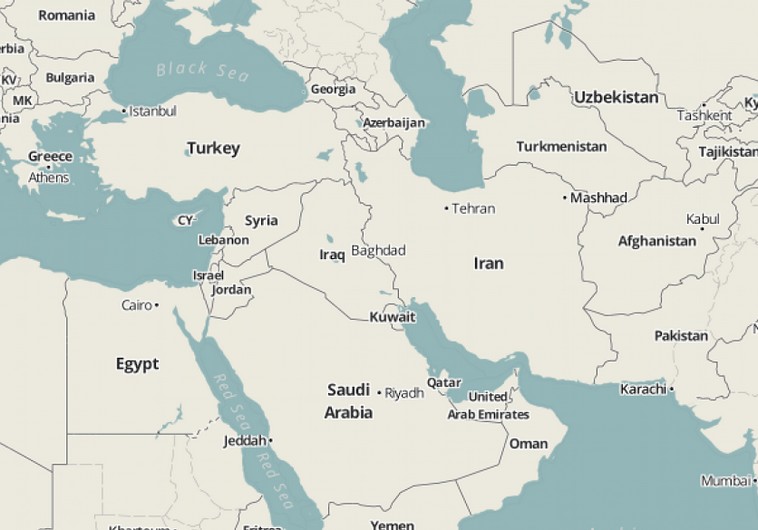 Map of Middle East. (photo credit:Courtesy)
It is through this Islamo-philic prism that the Obama administration’s attitude to, and execution of, its foreign policy must be evaluated – including its otherwise incomprehensible capitulation this week on Iran’s nuclear program.
********************
Obama is the first US president who genuinely conceives of Islam as not inherently opposed to American values or interests.
You’re absolutely right that John McCain has not talked about my Muslim faith – Barack Hussein Obama to ABC’s George Stephanopoulos, September 7, 2008
I also know that Islam has always been a part of America’s story – Barack Hussein Obama, Cairo, June 4, 2009
Islam has always been part of America – Barack Hussein Obama, the White House, August 11, 2010
Islam has been woven into the fabric of our country since its founding – Barack Hussein Obama, the White House, February 18, 2015
A question of cultural affinity?
It is through this Islamo-philic prism that the Obama administration’s attitude to, and execution of, its foreign policy must be evaluated – including its otherwise incomprehensible capitulation this week on Iran’s nuclear program.
Almost two years ago, I wrote a column titled, “Will the West withstand the Obama presidency?” (11/28/2013). In it I warned: “For anyone who understands that the US Constitution is not a Shari’a-compliant document…
it should be alarmingly apparent that the Obama incumbency is a dramatic and disturbing point of inflection in the history of America and its Western allies… whose political practices and societal norms are rooted in Judeo-Christian foundations in a cultural rather than in any religious sense.”
There is little alternative explanation to account for the metamorphosis that has taken place in how the US has approached resolving the impasse with Tehran, as starkly laid out by two former secretaries of state, Henry Kissinger and George Shultz.
In a Wall Street Journal opinion piece, “The Iran Deal and Its Consequences” (April 7), they note that the negotiation has been turned “on its head.” As they point out: “For 20 years, three presidents of both major parties proclaimed that an Iranian nuclear weapon was contrary to American and global interests – and that they were prepared to use force to prevent it. Yet negotiations that began 12 years ago as an international effort to prevent an Iranian capability to develop a nuclear arsenal are ending with an agreement that concedes this very capability.”
Risible inspection mechanism
Even before the specifics of the risible inspection mechanism, which one Israeli minister aptly described as “worse than worthless,” Kissinger and Shultz laid out the difficulties that would render any extended inspection endeavor ineffective: “In a large country with multiple facilities and ample experience in nuclear concealment, violations will be inherently difficult to detect.”
With considerable prescience, they warn: “Devising theoretical models of inspection is one thing. Enforcing compliance, week after week, despite competing international crises and domestic distractions, is another. Any report of a violation is likely to prompt debate over its significance – or even calls for new talks with Tehran to explore the issue.
Envisaging the problems likely to arise in enforcing any agreement, they caution: “Compounding the difficulty is the unlikelihood that breakout will be a clear-cut event.
More likely it will occur… via the gradual accumulation of ambiguous evasions. When inevitable disagreements arise over the scope and intrusiveness of inspections, on what criteria are we prepared to insist and up to what point? If evidence is imperfect, who bears the burden of proof? What process will be followed to resolve the matter swiftly?”
Reminiscent of taqiya?
But even without the daunting generic difficulties described by Kissinger and Shultz, the inspection mechanism provided for in the nascent deal make a mockery of Obama’s contention (July 14): “… this deal is not built on trust; it is built on verification,” and, “Because of this deal, inspectors will also be able to access any suspicious location… [They] will have access where necessary, when necessary.”
One can hardly imagine a more grossly misleading representation of the deal – so much so that it is difficult not to find it strongly reminiscent of the Muslim tactic of taqiya (the religiously sanctioned deception of non-Muslims).
Indeed, immediately following the announcement of the agreement, Ben Rhodes, Obama’s deputy national security adviser, made a stunning admission to CNN’s Erin Burnett. Starkly contradicting the president’s contention of “access where necessary, when necessary,” Rhodes conceded, “We never sought in this negotiation the capacity for so-called anytime, anywhere,” which is diametrically opposed to the impression he conveyed in April this year when queried on this issue.
You couldn’t make this stuff up
For as it turns out, it provides the Iranians with ample warning of impending inspections on any suspected violation, and ample ability to forestall the definition of any given suspicious event as a possible violation.
Thus in the case of a suspected infringement in any undisclosed (to the international community) site, the Iranians will have at least 24 days’ notice. Moreover, inspectors will not be able to conduct surprise visits but will be required to “provide Iran the basis for such concerns and request clarification.” No kidding!!! But wait, there’s more.
If Iran’s explanations do not adequately assuage international concerns, inspectors “may request access to such locations” to make sure no illicit activity has occurred. But first they need to “provide Iran the reasons for access in writing and will make available relevant information.” You can’t make this stuff up.
But here’s the kicker: Should the Iranians and the inspectors prove unable to “reach satisfactory arrangements,” Tehran will resolve any concerns “through necessary means agreed between Iran and the IAEA.” If there is still no agreement two weeks after the initial inquiry is filed, the crisis will be resolved by vote in the so-called Joint Commission – consisting of the six world powers, a representative of EU and – wait for it – Iran.
Like warning drug dealers of a bust
Astonishingly, nearly all the decisions of the Joint Commission, tasked with overseeing/ administering the implementation of the deal, are to be made by consensus – which in effect gives Iran veto power over them. In the case of inspection access, it is sufficient for two of its eight members (say China and Russia) to abstain for Iran to block any decision it dislikes.
It is thus difficult to dispute Benjamin Netanyahu’s characterization of the deal during his address in the Knesset when he likened it to giving drug dealers notice of an impending raid: “It’s like giving a criminal organization that deals drugs a 24-day warning before inspecting its drug lab.”
But worse – the deal requires the international inspectors to expose the sources of intelligence that lead to the detection of the possible infringement – thereby virtually ensuring the termination of their effectiveness.
As Netanyahu remarked: “The agreement also requires the world powers to… show Iran the very intelligence for which they want to conduct the inspections in the first place.”
It is possible that all this could be nothing more than mind-boggling incompetence and blatant lack of foresight? Or are these glaring loopholes the reflection of intent.
Devil not in details
After all, the more you think about the unenforceable, unverifiable agreement just concocted in Vienna, the more implausible it seems. As Alan Dershowitz points out in a Jerusalem Post opinion piece this week, “The devil is not so much in the details as in the broad outlines of this deal.”
Rather than the detailed minutiae of the deal, it is its deeply flawed overall structure that makes it so difficult to comprehend – unless the motives for its conclusion are reexamined.
For unless one is imbued with the child-like naiveté to believe that the tyrannical clergy who head the totalitarian theocracy in Tehran, on seeing their defiant intransigence vindicated and having vast additional resources placed at their disposal, will suddenly change their worldview, the picture of emerging realities is decidedly bleak and bewildering.
The spectacle unfolding before us is almost incomprehensible by any rational criterion.
Virtually the entire developed world, led by the only superpower on the planet, has for all intents and purposes conceded a legitimized path to weaponized nuclear status for a fanatical fundamentalist regime, ideologically bent on the destruction of America and its allies, and a major proliferator of terrorism, committed to attaining regional hegemony at the expense of relatively pro-Western governments.
Despite dwarfing Iran in terms of military might, economic wealth, physical size and population, Tehran’s interlocutors have provided it with vast resources to enormously enhance its nefarious pursuits across the region and beyond.
The New Middle East: Conflicts on steroids
The ominous consequences are not difficult to foresee.
As Ariel Ben Solomon, the Post’s Middle East correspondent, wrote in a recent report, “Iran deal to see Middle East conflicts go on steroids,” “A stronger Iran will translate into a more robust Hezbollah in Lebanon, Houthi movement in Yemen, and Shi’ite forces in Iraq and Syria, and increasing sectarian strife fueled by Shi’ite minorities or Iranian agents throughout the Arab world.” (July 16) There is precious little reason for believing any other outcome is plausible.
In a July 15 interview, New Jersey Democrat Sen. Bob Menendez lamented another aspect of the deal, relating to easing restrictions on conventional weapons to Iran: “When you lift the arms embargo to a country that is the major sponsor of… terrorism in the world and is already destabilizing the region in Yemen, Lebanon, Syria [and] Iraq, to give them – after they are going to get $100 billion-150b. in economic relief – the opportunity to buy conventional weapons and improve their missile technology doesn’t seem to me to be in the national interest of the United States.”
The intriguing question is, of course, does this seem to President Obama to be in the national interest of the United States? And if so, why so? If so, how so?
‘No alternative’: A mindless mendacious mantra
The almost Pavlovian response of the apologists for the Iran deal is that its critics have not offered a feasible alternative. This is a claim – for want of a better word – so feeble that it barely merits a response.
As Sen. Menendez points out: “We never tested the proposition that dismantling elements of Iran’s illicit nuclear infrastructure was possible. It is pretty hard for me to believe that the world powers, sitting on one side of the table, the five permanent members of the Security Council plus Germany and the European Union looking at the Iranians… suffering under staggering sanctions… and falling oil prices couldn’t get a deal that eliminated some of that infrastructure.”
Rebutting John Kerry’s claim that such a goal was achievable only in “a world of fantasy,” Menendez retorted, “I don’t know that that is a ‘world of fantasy.’ Isn’t it possible with all the world on one side of the table, and Iran reeling with economic challenges, that you couldn’t have done better as relates to eliminating that nuclear infrastructure.”
Of course if the underlying assumption is that alternatives are only feasible if Iran deigns to accept them, then the apologists may be right. However, if the rationale were not to accommodate the ayatollahs, but to coerce them, the alternative is clear: Enhanced sanctions backed by the credible threat of military action aimed at destroying Iran’s nuclear facilities and their attendant infrastructure.
Arab arms race or Arab client states
But despite the overwhelming preponderance of power in their favor, the US and its Western allies seem to have forsworn the use of force, or even the credible specter thereof. As Kissinger and Shultz remark: “The threat of war now constrains the West more than Iran.”
This will clearly have a devastating impact on both friend and foe in the region.
It will destroy the confidence of US allies who will therefore be compelled to either acquire their own appropriate arsenals, as they can no longer rely on America for their security, or to become compliant client states of a hegemonic Iran.
For Iran it sends an equivocal message that it can violate the terms of the deal with impunity – for if what it encountered at Vienna is all the West can throw at it, what does it have to fear? There can be little doubt that what happened in Vienna this week has shredded America’s standing in the Middle East.
Some might even suspect that that was the purpose of the exercise.




 anneinpt
 artaxes
 danmillerinpanama
 davidking1530
 Peter Hofman
 Joseph Wouk
 Peter
Peter Louisiana Steve
 WarSclerotic
Recent Comments