Posted tagged ‘Obama’

Iran Bombshell: It Will Inspect Itself

July 24, 2015

Iran Bombshell: It Will Inspect Itself, Center for Security Policy, Fred Fleitz, July 24, 2015

I am glad that Senator Risch ignored the Obama administration’s ridiculous demand to treat the side deal as a classified matter. One has to ask, Classified from whom? Certainly not for Iran, since it is a party to the agreement. I believe Obama officials insisted the deal was classified in order to keep knowledge of it from the American people, and possibly from Middle Eastern states such as Israel and Saudi Arabia that oppose the agreement.

***********************

This week brought the stunning news that Senator Tom Cotton (R., Ark.) and Representative Mike Pompeo(R., Kan.) had discovered, during a meeting with IAEA officials, the existence of secret side deal between the IAEA and Tehran — a side deal that will not, like the main nuclear agreement, be shared with Congress. So critics of the agreement were understandably eager to hear an explanation from Secretary of State John Kerry when he and other senior administration officials testified before the Senate Foreign Relations Committee yesterday.

The hearing produced a new bombshell: In its investigation of Iran’s past nuclear-weapons-related work, the IAEA will rely on Iran to collect samples at its Parchin military base and other locations.

As a former intelligence analyst experienced in the collection of environmental samples for investigations of weapons of mass destruction, I found this allegation impossible to believe when I heard Senator James Risch (R., Idaho) make it yesterday morning.

In his questioning of administration witnesses, Risch said:

Parchin stays in place. Now, does that sound like it’s for peaceful purposes? Let me tell you the worst thing about Parchin. What you guys agreed to was [that] we can’t even take samples there. The IAEA can’t take samples there. [Iranians are] going to be able to test by themselves! Even the NFL wouldn’t go along with this. How in the world can you have a nation like Iran doing their own testing?

. . . Are we going to trust Iran to do this? This is a good deal? This is what we were told we were going to get when we were told, “Don’t worry, we’re going to be watching over their shoulder and we’re going to put in place verification[s] that are absolutely bullet proof”? We’re going to trust Iran to do their own testing? This is absolutely ludicrous.

The issue became even more interesting when Senator Robert Menendez (D., N.J.), who learned about the side deal from Risch’s question, had the following exchange with Kerry:

Menendez: “Is it true that the Iranians are going to be able to take the samples, as Senator Risch said? Because chain of custody means nothing if at the very beginning what you’re given is chosen and derived by the perpetrator.”

Kerry: “As you know, senator, that is a classified component of this that is supposed to be discussed in a classified session. We’re perfectly prepared to fully brief you in a classified session with respect to what will happen. Secretary Moniz has had his team red-team that effort and he has made some additional add-ons to where we are. But it’s part of a confidential agreement between the IAEA and Iran as to how they do it. The IAEA has said they are satisfied that they will be able to do this in a way that does not compromise their needs and that adequately gives them answers that they need. We’ve been briefed on it, and I’d be happy to brief you.”

Menendez: “My time is up. If that is true, it would be the equivalent of the fox guarding the chicken coop.”

The revelation that Iran will collect samples concerning its own nuclear-weapons-related activity makes the whole agreement look like a dangerous farce. This is not just an absurd process; it also goes against years of IAEA practice and established rules about the chain of custody for collected physical samples.

Senator Risch suggested in his remarks that the IAEA would remotely monitor the Iranians’ taking of samples by video. But even if there were a reliable way to ensure that Iranian “inspectors” were carefully monitored, took samples from locations identified by the IAEA, and provided these samples directly to IAEA officials, the process would still be a sham, since it would still place unacceptable limitations on IAEA inspections. To be meaningful, IAEA inspectors must have unfettered access to suspect facilities and be free to take samples anywhere, using whatever collection devices they choose. Only by collecting samples at locations and with methods that Iranian officials may not have anticipated can inspectors reliably find possible evidence of nuclear-weapons-related work that Iran tried to clean up.

That the Obama administration would agree to let Iran collect its own samples at Parchin (where explosive testing related to nuclear-warhead development reportedly took place) and other sites is consistent with reports that surfaced in June (and about which I wrote National Review articles on June 15 and June 17) that Kerry had offered to let Iran off the hook for past nuclear-weapons-related work. Iranian supreme leader Ali Khamenei reportedly rejected this offer as being insufficiently generous.

Remember also that Kerry told reporters on June 16: “We’re not fixated on Iran specifically accounting for what they did at one point in time or another. We know what they did.” Kerry walked back this comment, but I believe it represented part of the Obama administration’s negotiating strategy in the Iran talks.

The Obama administration claims that the Iran–IAEA side deal is a confidential and bilateral arrangement reached between IAEA officials and Tehran, and says that it has been briefed on the deal but not seen its actual language. As I wrote here on July 23, I find this impossible to believe, since the apparent arrangement so clearly reflects Secretary Kerry’s attempt last month to make concerns about Iran’s past nuclear-weapons-related work go away.

I am glad that Senator Risch ignored the Obama administration’s ridiculous demand to treat the side deal as a classified matter. One has to ask, Classified from whom? Certainly not for Iran, since it is a party to the agreement. I believe Obama officials insisted the deal was classified in order to keep knowledge of it from the American people, and possibly from Middle Eastern states such as Israel and Saudi Arabia that oppose the agreement. I also believe that Congress would not know about this matter at all if IAEA officials had not told Senator Cotton and Congressman Pompeo about it.

Possibly making the situation worse, Fox News analyst Monica Crowley said in a tweet yesterday that there are additional side deals. Omri Ceren, managing director of the Israel Project, a nonprofit advocacy organization, e-mailed me yesterday, writing that “the Israelis are saying there will be several more.”

These new developments indicate that not only did the Obama administration negotiate a nuclear deal with Iran that was worse than anyone outside the Obama administration knew only a few days ago, but it also tried to shield a sham inspections process from congressional review, in violation of the law. The entire nuclear agreement is not just a bad deal; it is a deal that now displays the bad faith of the Obama administration toward Congress and the American people. The secret side agreements are yet another compelling reason for a large bipartisan majority in Congress to reject the dangerous nuclear accord with Iran.

Eyes wide shut

July 24, 2015

Eyes wide shut, Israel Hayom, Ruthie Blum, July 24, 2015

On Thursday, U.S. Secretary of State John Kerry spent more than four hours trying to defend the nuclear deal before the Senate Foreign Relations Committee. Grilled by Republicans furious at the Obama administration’s total surrender to Iran, Kerry remained true to character: He doubled down on meaningless platitudes with self-righteous indignation.

In fairness to America’s top diplomat, whose stupidity is only matched by President Barack Obama’s evil, how else could he respond to rational concerns but to get on his high horse? Indeed, all he had at his disposal in the face of the emerging details of the agreement, each more shocking than the next, was a feeble attempt to invert reality and ridicule his critics in the process.

Referring to a “Citizens for a Nuclear Free Iran” commercial aimed at persuading Congress to vote against the agreement and currently airing across the U.S., Kerry argued, “The alternative to the deal we’ve reached isn’t what we’re seeing ads for on TV. It isn’t a better deal, some sort of unicorn arrangement involving Iran’s complete capitulation. That’s a fantasy, plain and simple.

This was Kerry’s way of insisting that he had not been “bamboozled” by his Iranian counterparts, as Sen. Jim Risch (R-Idaho) asserted, nor “fleeced,” as committee chairman Sen. Bob Corker (R-Tenn.) accused.

In other words, no wool was pulled over his eyes. Not by the Iranians, at any rate. They were clear all along. And loud, as Kerry can attest, since he was the target of Iranian Foreign Minister Mohammad Javad Zarif’s repeated abusive outbursts during the negotiations.

No, if Kerry was “bamboozled” or “fleeced” by anyone it was Obama, who told him to secure a deal at any and all cost, because doing so would be better in the short run. As for the long-term repercussions, well, that would be a future administration’s headache.

The way Obama and Kerry both justify the travesty is even less comforting. They claim that since Iran was going to pursue nuclear weapons anyway — and support terrorism anyway, and violate terms anyway, and threaten to wipe Israel off the map anyway, and burn American flags anyway — it would be wiser to join them than beat them.

The logic is mind-boggling. But it does shed light on the administration’s attitude towards Israel.

Obama has been bent on earning the Nobel Peace Prize he was awarded — simply for entering the Oval Office — by completing a contract with Iran. Kerry has been obsessed with procuring a document declaring “peace” between Israel and the Palestinian Authority in order to become a Nobel laureate himself.

His dreams were dashed, however, when Prime Minister Benjamin Netanyahu was unwilling to cross certain red lines. Though Netanyahu did agree to negotiations, the release of well over 1,000 Palestinian terrorists, a halt in settlement construction, groveling before Turkish President Recep Tayyip Erdoğan and a slew of slights from the White House, he refused to commit Israel to suicide.

It is thus that Palestinian Authority President Mahmoud Abbas would not come to the negotiating table. Had the P5+1 countries not given Iran reason to believe that their red lines were merely rhetorical, Ayatollah Ali Khamenei — Iran’s “supreme leader” in every respect — would not have allowed his puppets to parlay with American and European representatives in the first place.

No wonder Obama and Kerry can’t stand Netanyahu. If the president of the United States can roll over and abdicate to a sworn enemy, who does the prime minister of Israel think he is to remain steadfast?

Understanding this is crucial. What it means is that Obama’s camp is right — and Netanyahu’s is wrong — about not having been able to hold out for a “better deal.” Iran, like the Palestinians it supports, has one goal in mind: demolishing the enemy.

It remains to be seen whether Obama will garner enough support in Congress to enable him to veto opposition to the agreement, which gives Iran carte blanche for its genocidal-weapons development and billions of dollars to bolster global terrorism.

At the moment, it’s not looking good. What’s worse is an annex in the agreement that provides for cooperation between the P5+1 and Iran “to strengthen Iran’s ability to protect against, and respond to nuclear security threats, including sabotage, as well as to enable effective and sustainable nuclear security and physical protection systems.”

This clause is causing a stir in Israel. It was also the focus of a question raised by presidential hopeful Marco Rubio (R-Fla.) during the Senate hearing. He wanted to know if it means the U.S. would be required to protect Iran’s nuclear facilities from a potential Israeli military strike.

“No,” retorted Energy Secretary Ernest Moniz, on hand with Treasury Secretary Jack Lew to help Kerry through the ordeal. Rubio was not convinced.

He did issue a warning, however: “The Iranian regime and the world should know that this deal is your deal with Iran … and the next president is under no legal or moral obligation to live up to it.”

What the rest of us need to know is which will come first, an Israeli attack or a Republican in the White House?

Report: International inspectors fail to stop Syria chemical weapons

July 24, 2015

Report: International inspectors fail to stop Syria chemical weapons, Breitbart, Joel B. Pollak, July 24, 2015

(“It’s like Déjà vu all over again.” Please see also, Kerry raps Menendez over ‘classified’ Iran clause, update. — DM)

ap_iranian-foreign-minister-mohammad-javad-zarif_ap-photo4-640x420Carlos Barria/Pool via AP

The Syrian regime, however, imposed harsh restrictions on UN inspectors. ““We had no choice but to cooperate with them,” Scott Cairns, one of the leaders of the UN inspections team, told the Journal.

**********************

International inspectors failed to stop Syria from stockpiling chemical weapons, in spite of an international agreement in 2013, according to a new report by the Wall Street Journal on Friday. International inspectors were skeptical of Syria’s claims to have disposed of its stockpiles, but were afraid that reporting violations would destroy the overall deal: “Members of the inspection team didn’t push for answers, worried that it would compromise their primary objective of getting the regime to surrender the 1,300 tons of chemicals it admitted to having.”

After President Barack Obama failed to enforce his 2012 “red line” against dictator Bashar al-Assad’s use of chemical weapons in the ongoing Syrian civil war, the U.S. agreed to a Russian-brokered agreement in Geneva that provided for the regime to ship its stockpiles abroad while international inspectors gained access to its production and storage facilities.

The Syrian regime, however, imposed harsh restrictions on UN inspectors. ““We had no choice but to cooperate with them,” Scott Cairns, one of the leaders of the UN inspections team, told the Journal.

Initially, the U.S. Central Intelligence Agency had reported that Syria’s declarations about its chemical weapons program matched its own assessments of what the regime possessed. However, the CIA turned out to have underestimated Syria’s capacity, the Journal reports.

The Syrian guards assigned to inspections convoys also drove slowly, failed to destroy chemical weapons when asked to do so, and appeared to be intermingled with Iranian soldiers who were guarding Syrian chemical weapons sites. As a result, Syria remains unaccountable.

The report comes as the Obama administration attempts to persuade Congress that the international inspections regime under a new deal with Iran will be sufficient to monitor that country’s nuclear program, including unknown nuclear facilities and military sites. Critics say that the inspections regime is not tough enough to allow proper verification of Iranian compliance. The Senate Foreign Relations Committee learned Thursday that UN inspectors may rely on the Iranian regime to provide environmental test samples from its own military sites.

In his State of the Union address in January 2014, President Barack Obama said: “American diplomacy, backed by the threat of force, is why Syria’s chemical weapons are being eliminated, and we will continue to work with the international community to usher in the future the Syrian people deserve–a future free of dictatorship, terror and fear.

In a speech in September 2014 about ISIS, he said: “It is America that helped remove and destroy Syria’s declared chemical weapons so they cannot pose a threat to the Syrian people–or the world–again.”

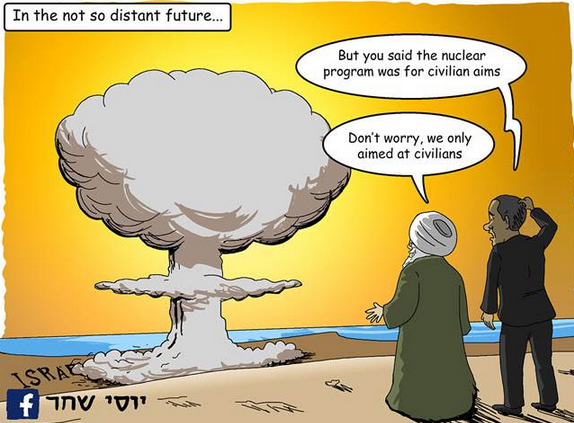
Cartoon of the day

July 24, 2015

H/t Joopklepzeiker

screenshot_374

Kerry: U.S. will Help Iran Protect its Nuclear Program From Sabotage

July 24, 2015

Kerry: U.S. will Help Iran Protect its Nuclear Program From Sabotage, Washington Free Beacon, via You Tube, July 23, 2015

(Kerry: However, we will not protect Iran’s facilities against an Israeli attack. We will just “coordinate” with Israel. Right. — DM)


Obama’s Dangerous Rhetoric

July 24, 2015

Obama’s Dangerous Rhetoric, Hoover Institution, Victor Davis Hanson, July 22, 2015

World runs awayImage credit: Barbara Kelley

President Obama has a habit of asserting strategic nonsense with such certainty that it is at times embarrassing and frightening. Nowhere is that more evident than in his rhetoric about the Middle East.

Not long ago, Obama reassured the world that, despite evidence of the use of chemical weapons in Syria, “Chlorine itself is not listed as a chemical weapon.” What could he have meant by that? Obama apparently was referring to the focus on Sarin gas by the Organization for Prohibition of Chemical Weapons, the UN watchdog agency that was supposed to monitor Obama’s Syria red line warnings against further gas attacks. To reassure the public that the United States would not consider chlorine gas a violation of its own red line about chemical weapons use in Syria—and, therefore, to assure the public that his administration would not intervene militarily in Syria—Obama said:  “Chlorine itself, historically, has not been listed as a chemical weapon.”

Nothing could be further from the truth. Chlorine was the father of poison gas, the first chemical agent used in World War I—and it was used to lethal effect by the Germans at the battle of Ypres in April 1915. Subsequently, it was mixed and upgraded with phosgene gas to make an even deadlier brew and employed frequently throughout the war—most infamously at the Battle of the Somme.

The president was clearly bothered that he had boxed himself into a rhetorical corner and might have had to order air strikes against the defiant Assad regime—lest he appear wavering in carrying out his earlier threats. One way out of that dilemma would be to deny that chorine constituted a serious weapon used to kill soldiers and civilians. Another would simply be to claim that he had never issued such a red line to Bashar al-Assad at all. That refuge is exactly what Obama fell back upon at press conference on September 4, 2013: “I didn’t set a red line. The world set a red line.”

Here is what the president had earlier stated on August 20, 2012, in threatening Assad: “We have been very clear to the Assad regime, but also to other players on the ground, that a red line for us is we start seeing a whole bunch of chemical weapons moving around or being utilized. That would change my calculus. That would change my equation.”

The use of the presidential pronouns “we” and “my” are synonymous with the voice of his administration. Indeed, Obama had doubled down on his 2012 red line with the clarification that, “When I said that the use of chemical weapons would be a game-changer, that wasn’t unique to—that wasn’t a position unique to the United States and it shouldn’t have been a surprise.”

In the summer of 2014, Obama had dismissed the emergence of ISIS with colorful language about its inability to project terrorism much beyond its local Iraqi embryo: “I think the analogy we use around here sometimes, and I think is accurate, is if a JV team puts on Lakers uniforms, that doesn’t make them Kobe Bryant. I think there is a distinction between the capacity and reach of a bin Laden and a network that is actively planning major terrorist plots against the homeland versus jihadists who are engaged in various local power struggles and disputes, often sectarian.”

ISIS, remember, had already conducted terrorist operations across the Mediterranean. Both organized and lone-wolf terrorists, with claims of ISIS ties or inspiration, would go on to attack Westerners from France to Texas.

Obama compounded his obfuscations by later claiming to Meet the Press anchor Chuck Todd that he had never said such a thing at all about ISIS—an assertion that was deemed false by even the liberal fact-checking organization PolitiFact. More recently, in July 2015, Obama claimed that the now growing ISIS threat could not be addressed through force of arms, assuring the world that “Ideologies are not defeated with guns, they are defeated by better ideas.”

Such a generic assertion seems historically preposterous. The defeat of German Nazism, Italian fascism, and Japanese militarism was not accomplished by Anglo-American rhetoric on freedom. What stopped the growth of Soviet-style global communism during the Cold War were both armed interventions such as the Korean War and real threats to use force such as during the Berlin Airlift and Cuban Missile Crisis— along with Ronald Reagan’s resoluteness backed by a military buildup that restored credible Western military deterrence.

In contrast, Obama apparently believes that strategic threats are not checked with tough diplomacy backed by military alliances, balances of power, and military deterrence, much less by speaking softly and carrying a big stick. Rather, crises are resolved by ironing out mostly Western-inspired misunderstandings and going back on heat-of-the moment, ad hoc issued deadlines, red lines, and step-over lines, whether to the Iranian theocracy, Vladimir Putin, or Bashar Assad.

Sometimes the administration’s faith in Western social progressivism is offered to persuade an Iran or Cuba that they have missed the arc of Westernized history—and must get back on the right side of the past by loosening the reins of their respective police states. Obama believes that engagement with Iran in non-proliferation talks—which have so far given up on prior Western insistences on third-party, out of the country enrichment, on-site inspections, and kick-back sanctions—will inevitably ensure that Iran becomes “a successful regional power.” That higher profile of the theocracy apparently is a good thing for the Middle East and our allies like Israel and the Gulf states.

In his well-publicized Cairo speech of June 2009, Obama declared that Islam had a hand in prompting the Western Renaissance and Enlightenment, as well as offering other underappreciated gifts to the West, from medicine to navigation. Obama’s tutorial was offered to remind the Muslim Brotherhood members in his audience that the West really does owe much to the Muslim World—and thus by inference should expect reciprocal consideration in the current war on terror.

In his February 2, 2015 outline of anti-ISIS strategy—itself an update of an earlier September 2014 strategic précis—Obama again insisted that “one of the best antidotes to the hateful ideologies that try to recruit and radicalize people to violent extremism is our own example as diverse and tolerant societies that welcome the contributions of all people, including people of all faiths.” The idea, a naïve one, is that because we welcome mosques on our diverse and tolerant soil, ISIS will take note and welcome Christian churches.

One of Obama’s former State Department advisors, Georgetown law professor Rosa Brooks, recently amplified that reductionist confidence in the curative power of Western progressivism. She urged Americans to tweet ISIS, which, like Iran, habitually executes homosexuals. Brooks hoped that Americans would pass on stories about and photos of the Supreme Court’s recent embrace of gay marriage: “Do you want to fight the Islamic State and the forces of Islamic extremist terrorism? I’ll tell you the best way to send a message to those masked gunmen in Iraq and Syria and to everyone else who gains power by sowing violence and fear. Just keep posting that second set of images [photos of American gays and their supporters celebrating the Supreme Court decision]. Post them on Facebook and Twitter and Reddit and in comments all over the Internet. Send them to your friends and your family. Send them to your pen pal in France and your old roommate in Tunisia. Send them to strangers.”

Such zesty confidence in the redemptive power of Western moral superiority recalls First Lady Michelle Obama’s efforts to persusade the murderous Boko Haram to return kidnapped Nigerian preteen girls. Ms. Obama appealed to Boko Haram on the basis of shared empathy and universal parental instincts. (“In these girls, Barack and I see our own daughters. We see their hopes, their dreams and we can only imagine the anguish their parents are feeling right now.”) Ms. Obama then fortified her message with a photo of her holding up a sign with the hash-tag #BringBackOurGirls.

Vladimir Putin’s Russia has added Crimea and Eastern Ukraine to his earlier acquisitions in Georgia. He is most likely eyeing the Baltic States next. China is creating new strategic realities in the Pacific, in which Japan, South Korea, Taiwan, and the Philippines will eventually either be forced to acquiesce or to seek their own nuclear deterrent. The Middle East has imploded. Much of North Africa is becoming a Mogadishu-like wasteland.

The assorted theocrats, terrorists, dictators, and tribalists express little fear of or respect for the U.S. They believe that the Obama administration does not know much nor cares about foreign affairs. They may be right in their cynicism. A president who does not consider chlorine gas a chemical weapon could conceivably believe that the Americans once liberated Auschwitz, that the Austrians speak an Austrian language, and that the Falklands are known in Latin America as the Maldives.

Both friends and enemies assume that what Obama or his administration says today will be either rendered irrelevant or denied tomorrow. Iraq at one point was trumpeted by Vice President Joe Biden as the administration’s probable “greatest achievement.” Obama declared that Iraq was a “stable and self-reliant” country in no need of American peacekeepers after 2011.

Yanking all Americans out of Iraq in 2011 was solely a short-term political decision designed as a 2012 reelection talking point. The American departure had nothing to do with a disinterested assessment of the long-term security of the still shaky Iraqi consensual government. When Senator Obama damned the invasion of Iraq in 2003; when he claimed in 2004 that he had no policy differences with the Bush administration on Iraq; when he declared in 2007 that the surge would fail; when he said in 2008 as a presidential candidate that he wanted all U.S. troops brought home; when he opined as President in 2011 that the country was stable and self-reliant; when he assured the world in 2014 that it was not threatened by ISIS; and when in 2015 he sent troops back into an imploding Iraq—all of these decisions hinged on perceived public opinion, not empirical assessments of the state of Iraq itself. The near destruction of Iraq and the rise of ISIS were the logical dividends of a decade of politicized ambiguity.

After six years, even non-Americans have caught on that the more Obama flip-flops on Iraq, deprecates an enemy, or ignores Syrian redlines, the less likely American arms will ever be used and assurances honored.

The world is going to become an even scarier place in the next two years. The problem is not just that our enemies do not believe our President, but rather that they no longer even listen to him.

Kerry raps Menendez over ‘classified’ Iran clause

July 23, 2015

Kerry raps Menendez over ‘classified’ Iran clause, Times of Israel, July 23, 2015

(Why, other than the likely embarrassment of the Obama Administration, would such a matter be “classified?” — DM)

John Kerry rebukes fellow Democrat Robert Menendez for revealing what he says is a “classified” clause in the Iran nuclear deal stating that Iran will be the one to provide the UN atomic agency with samples from sites with suspected nuclear activity.

“That is a classified component of this,” Kerry says when the New Jersey senator asks about the section of the deal. Menendez says it is “the equivalent of the fox guarding the chicken coop.”


UPDATE

Here is a video of Sen. Menendez questioning Secretary Kerry and others about the “deal.” The relevant question and answer begin at 10:oo into the video.


American Dream Does not Stop Radicalization of Terrorists

July 23, 2015

American Dream Does not Stop Radicalization of Terrorists, Act for America, July 22, 2015


‘Side deals’ cast shadow over Congress Iran review

July 23, 2015

Side deals’ cast shadow over Congress Iran review

Lawmakers complain about secret agreements between Tehran and UN watchdog over Parchin military site and nuclear program’s ‘military dimensions’

By Rebecca Shimoni Stoil July 23, 2015, 6:20 am

via ‘Side deals’ cast shadow over Congress Iran review | The Times of Israel.


2004 satellite image of the military complex at Parchin, Iran. (AP/DigitalGlobe-Institute for Science and International Security)

2004 satellite image of the military complex at Parchin, Iran. (AP/DigitalGlobe-Institute for Science and International Security)

WASHINGTON — As top administration officials prepared for what will be their first day of unclassified testimony in Congress Thursday in support of the Iran nuclear deal, a very public row erupted Wednesday over whether the administration could — and would — disclose what some lawmakers called the “secret side deals” of the agreement.

Even as the White House deployed Secretary of State John Kerry and Energy Secretary Ernest Moniz to Capitol Hill for a series of classified briefings Wednesday meant to shore up support for the Iran deal in a dubious legislature, lawmakers demanded more details on agreements reached between the International Atomic Energy Agency (IAEA) and Iran with the consent of the P5+1 group of world powers. Those agreements were not previously revealed to Congress as part of the 60-day review process required under law.

One day after Senator Tom Cotton and Representative Mike Pompeo said that an IAEA official in Vienna had told them about the agreements with Iran, administration officials denied these constituted “secret side agreements” that were kept out of the nuclear agreement presented to Congress for review.

“There’s no side deals, there’s no secret deals, between Iran and the IAEA, that the P5+1 has not been briefed on in detail. These kinds of technical arrangements with the IAEA are a matter of standard practice, that they’re not released publicly or to other states, but our experts are familiar and comfortable with the contents, which we would be happy to discuss with Congress in a classified setting,” State Department Spokesman John Kirby said during his daily press briefing.

Tom Cotton (Courtesy United States Congress)

Tom Cotton (Courtesy United States Congress)


Kirby explained that the so-called “side deals” involved “issues between Iran and the IAEA,” referring to them as “technical agreements” and emphasizing that such agreements “are never shared outside the state in question in the IAEA.” At the same time, the US had been briefed on the agreements and administration officials were willing to discuss them with lawmakers.

US National Security Adviser Susan Rice during an interview with Charlie Rose on the Public Broadcasting Service, February 24, 2015. (screen capture/YouTube/Charlie Rose)

US National Security Adviser Susan Rice during an interview with Charlie Rose on the Public Broadcasting Service, February 24, 2015. (screen capture/YouTube/Charlie Rose)


National Security Adviser Susan Rice on Wednesday confirmed the existence of the side agreements, telling reporters that they dealt with Iran’s documentation of previous military dimensions of its nuclear program, a key aspect of intelligence about the program that enabled a better assessment of its scope and purpose.

Although Rice claimed that the arrangements between the IAEA and Iran were “no secret,” the firestorm began when Cotton and Pompeo, following a meeting in Vienna Friday with representatives of the IAEA, said officials from the watchdog group had told them the agreements would remain secret.

“The agency conveyed to the lawmakers that two side deals made between the Islamic Republic of Iran and the IAEA as part of the Joint Comprehensive Plan of Action (JCPOA) will remain secret and will not be shared with other nations, with Congress, or with the public,” the lawmakers said in a statement.

Senate Foreign Relations Committee Chairman Sen. Bob Corker (R-Tennessee), left, shakes hands with ranking member Sen. Ben Cardin (D-Maryland) during a committee markup meeting on the proposed nuclear agreement with Iran on April 14, 2015. (JTA/Win McNamee/Getty Images)

Senate Foreign Relations Committee Chairman Sen. Bob Corker (R-Tennessee), left, shakes hands with ranking member Sen. Ben Cardin (D-Maryland) during a committee markup meeting on the proposed nuclear agreement with Iran on April 14, 2015. (JTA/Win McNamee/Getty Images)


One of the agreements covers inspection of the Parchin military complex, a site that the IAEA suspects was being used for experiments related to weaponization of Iran’s nuclear technology. The second details how the IAEA and Iran will resolve outstanding issues in determining the possible military dimensions of Iran’s nuclear program, Cotton and Pompeo said.

Although Rice and Kirby claimed that US negotiators were familiar with the contents of the IAEA-Iran agreements, Cotton and Pompeo said that they were told that the agreements would not be released even to the P5+1 member states who negotiated the broader deal.

Under the terms of the Iran Nuclear Agreement Review Act passed earlier this year, the administration is required to provide Congress with all documents related to the agreement, including “annexes, appendices, codicils, side agreements, implementing materials, documents, and guidance, technical or other understandings and any related agreements, whether entered into or implemented prior to the agreement or to be entered into or implemented in the future.”

On Wednesday, the author of the law, Senator Bob Corker, a Republican, teamed up with Senator Ben Cardin, a Democrat, to write their second letter to the administration in as many weeks expressing concern over whether it had adhered to the law’s requirements.

This time, the bipartisan duo reportedly requested that Kerry provide them any available documents related to the IAEA-Iran agreements.

Cardin is one of many Democratic senators who have yet to say whether they will support or oppose the deal with Iran when it comes to key Senate and House votes on deal-killing legislation that will likely be placed before Congress within the allotted 60 days. The administration needs to win over at least 34 senators or 146 House members to ensure President Barack Obama’s veto of any such legislation cannot be overturned.

House Democratic leader Nancy Pelosi, an announced supporter of the deal, has expressed optimism that the White House can prevail, and Senator Dick Durbin, a member of the Senate Democratic leadership, declared his support for the agreement this week.

AP contributed to this report.

Cartoon of the day

July 23, 2015

H/t The Jewish Press


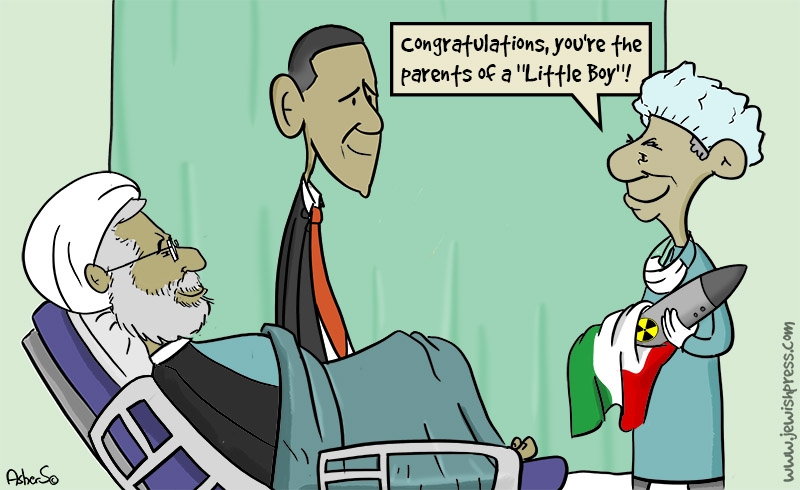
little-boy