Via The Jewish Press
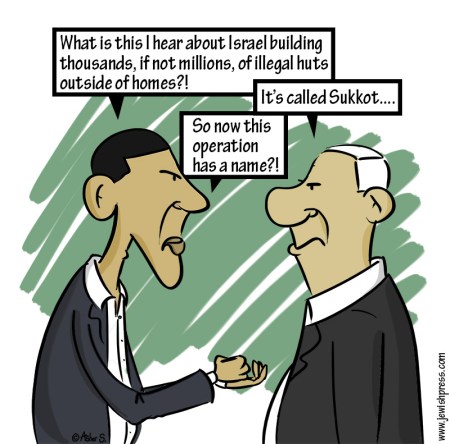

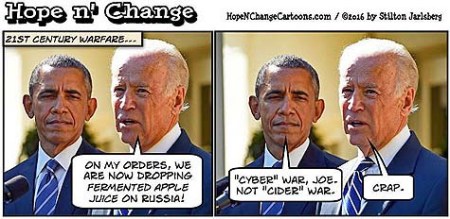
H/t Joop

Palestinian Authority kids’ drawings: Israel drinks the blood of “Palestinians” Jihad Watch,
“Of course, Israel cannot be expected to negotiate with anyone who is dedicated to its destruction. But while I know you have had differences with the Palestinian Authority, I believe that you do have a true partner in President Abbas…” — Barack Obama, March 21, 2013
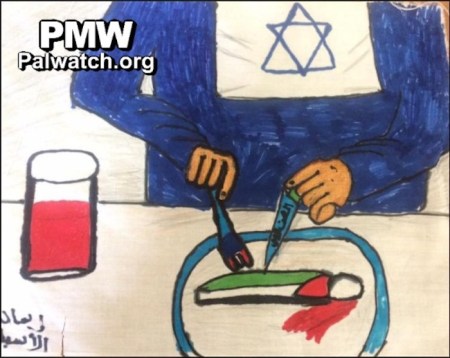
“PA kids’ drawings: Israel drinks blood of Palestinians,” by Itamar Marcus, Palestinian Media Watch, October 16, 2016:
Fatah has posted several children’s drawings on Facebook. The drawings clearly show the success of PA and Fatah brainwashing children to believe that Israel only seeks to harm them, violence is good and that all of Israel really is “Palestine.”
Labeling the drawings “innocent drawings” that “express the feelings of children of #Palestine,” Fatah posted the drawing above showing Israel, as indicated by a Star of David, eating a Palestinian body wrapped in the Palestinian flag. Blood is seen coming from the body, and a glass of blood is next to the plate.
Another drawing by a Palestinian child showed a crucified woman wearing the colors of the Palestinian flag, with her body in the shape of the PA map of “Palestine” that presents all of Israel as “Palestine” together with the PA areas. The crucifixion also repeats the analogy that Palestinians are Martyr victims like Jesus.
Yet other drawings showed support for violence as legitimate means of Palestinian opposition to Israel. One child drew a Palestinian with a slingshot, another drew a hand with a rifle (see below). These drawings echo the PA and Fatah’s encouragement of the use of violence against Israel and their glorification of terrorists as heroes. Palestinian Media Watch documented that summer camps organized by the PA Ministry of Education and the PLO educated children to see terrorist stabbers as role models.
Other drawings repeated the world view that all of Israel is “Palestine,” showing the PA map of “Palestine” which completely erases the existence of Israel and its legitimacy (see below).
This message is repeated endlessly by the PA and Fatah. Children are told that “it will all return to us” on kids’ TV programs. The PA National Security Forces regularly post photos from all over Israel presenting the places as “Palestine,” and even crossword puzzles portray Israeli cities as “occupied Palestine.”
The PA’s exploitation of Palestinian children’s innocence is precisely what PMW has been highlighting and warning about for years….
Column One: From Yemen to Turtle Bay, Jerusalem Post, Caroline Glick, October 13, 2016
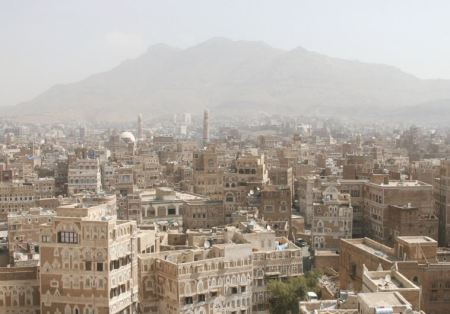
As far as Obama is concerned, Iran is a partner, not an adversary.
****************************
Off the coast of Yemen and at the UN Security Council we are seeing the strategic endgame of Barack Obama’s administration. And it isn’t pretty.
Since Sunday, Iran’s Houthi proxies in Yemen have attacked US naval craft three times in the Bab al-Mandab, the narrow straits at the mouth of the Red Sea. The Bab al-Mandab controls maritime traffic in the Red Sea, and ultimately controls the Suez Canal.
Whether the Iranians directed these assaults or simply green-lighted them is really beside the point. The point is that these are Iranian strikes on the US. The Houthis would never have exposed themselves to US military retaliation if they hadn’t been ordered to do so by their Iranian overlords.
The question is why has Iran chosen to open up an assault on the US? The simple answer is that Iran has challenged US power at the mouth of the Red Sea because it believes that doing so advances its strategic aims in the region.
Iran’s game is clear enough. It wishes to replace the US as the regional hegemon, at the US’s expense.
Since Obama entered office nearly eight years ago, Iran’s record in advancing its aims has been one of uninterrupted success.
Iran used the US withdrawal from Iraq as a means to exert its full control over the Iraqi government. It has used Obama’s strategic vertigo in Syria as a means to exert full control over the Assad regime and undertake the demographic transformation of Syria from a Sunni majority state to a Shi’ite plurality state.
In both cases, rather than oppose Iran’s power grabs, the Obama administration has welcomed them. As far as Obama is concerned, Iran is a partner, not an adversary.
Since like the US, Iran opposes al-Qaida and ISIS, Obama argues that the US has nothing to fear from the fact that Iranian-controlled Shiite militias are running the US-trained Iraqi military.
So, too, he has made clear that the US is content to stand by as the mullahs become the face of Syria.
In Yemen, the US position has been more ambivalent. In late 2014, Houthi rebel forces took over the capital city of Sanaa. In March 2015, the Saudis led a Sunni campaign to overthrow the Houthi government. In a bid to secure Saudi support for the nuclear agreement it was negotiating with the Iranians, the Obama administration agreed to support the Saudi campaign. To this end, the US military has provided intelligence, command and control guidance, and armaments to the Saudis.
Iran’s decision to openly assault US targets then amounts to a gamble on Tehran’s part that in the twilight of the Obama administration, the time is ripe to move in for the kill in Yemen. The Iranians are betting that at this point, with just three months to go in the White House, Obama will abandon the Saudis, and so transfer control over Arab oil to Iran.
For with the Strait of Hormuz on the one hand, and the Bab al-Mandab on the other, Iran will exercise effective control over all maritime oil flows from the Arab world.
It’s not a bad bet for the Iranians, given Obama’s consistent strategy in the Middle East.
Obama has never discussed that strategy.
Indeed, he has deliberately concealed it. But to understand the game he has been playing all along, the only thing you need to do listen to his foreign policy soul mate.
According to a New York Times profile published in May, Obama’s deputy national security adviser Ben Rhodes is the president’s alter ego. The two men’s minds have “melded.”
Rhodes’s first foreign policy position came in the course of his work for former congressman Lee Hamilton.
In 2006, then-president George W. Bush appointed former secretary of state James Baker and Hamilton to lead the Iraq Study Group. Bush tasked the group with offering a new strategy for winning the war in Iraq. The group released its report in late 2006.
The Iraq Study Group’s report contained two basic recommendations. First, it called for the administration to abandon Iraq to the Iranians.
The group argued that due to Iran’s opposition to al-Qaida, the Iranians would fight al-Qaida for the US.
The report’s second recommendation related to Israel. Baker, Hamilton and their colleagues argued that after turning Iraq over to Iran, the US would have to appease its Sunni allies.
The US, the Iraq Study Group report argued, should simultaneously placate the Sunnis and convince the Iranians of its sincerity by sticking it to Israel. To this end, the US should pressure Israel to give the Golan Heights to Syria and give Judea and Samaria to the PLO.
Bush rejected the Iraq Study Group report. Instead he opted to win the war in Iraq by adopting the surge counterinsurgency strategy.
But once Bush was gone, and Rhodes’s intellectual twin replaced him, the Iraq Study Group recommendations became the unstated US strategy in the Middle East.
After taking office, Obama insisted that the US’s only enemy was al-Qaida. In 2014, Obama grudgingly expanded the list to include ISIS.
Obama has consistently justified empowering Iran in Iraq and Syria on the basis of this narrow definition of US enemies. Since Iran is also opposed to ISIS and al-Qaida, the US can leave the job of defeating them both to the Iranians, he has argued.
Obviously, Iran won’t do the US’s dirty work for free. So Obama has paid the mullahs off by giving them an open road to nuclear weapons through his nuclear deal, by abandoning sanctions against them, and by turning his back on their ballistic missile development.
Obama has also said nothing about the atrocities that Iranian-controlled militia have carried out against Sunnis in Iraq and has stopped operations against Hezbollah.
As for Israel, since his first days in office, Obama has been advancing the Iraq Study Group’s recommendations. His consistent, and ever escalating condemnations of Israel, his repeated moves to pick fights with Jerusalem are all of a piece with the group’s recommended course of action. And there is every reason to believe that Obama intends to make good on his threats to cause an open rupture in the US alliance with Israel in his final days in office.
Prime Minister Benjamin Netanyahu’s phone call with Secretary of State John Kerry on Saturday night made this clear enough. In the course of their conversation, Netanyahu reportedly asked Kerry if Obama intended to enable an anti-Israel resolution to pass in the UN Security Council after the presidential election next month. By refusing to rule out the possibility, Kerry all but admitted that this is in fact Obama’s intention.
And this brings us back to Iran’s assaults on US ships along the coast of Yemen.
Early on Sunday morning, the US responded to the Houthi/Iranian missile assaults by attacking three radar stations in Houthi-controlled territory. The nature of the US moves gives credence to the fear that the US will surrender Yemen to Iran.
This is so for three reasons. First, the administration did not allow the USS Mason destroyer to respond to the sources of the missile attack against it immediately. Instead, the response was delayed until Obama himself could determine how best to “send a message.”
That is, he denied US forces the right to defend themselves.
Second, it is far from clear that destroying the radar stations will inhibit the Houthis/Iranians.
It is not apparent that radar stations are necessary for them to continue to assault US naval craft operating in the area.
Finally, the State Department responded to the attack by reaching out to the Houthis. In other words, the administration is continuing to view the Iranian proxy is a legitimate actor rather than an enemy despite its unprovoked missile assaults on the US Navy.
Then there is the New York Times’ position on Yemen.
The Times has repeatedly allowed the administration to use it as an advocate of policies the administration itself wishes to adopt. Last week for instance, the Times called for the US to turn on Israel at the Security Council.
On Tuesday, the Times published an editorial calling for the administration to end its military support for the Saudi campaign against the Houthis/Iran in Yemen.
Whereas the Iranian strategy makes sense, Obama’s strategy is nothing less than disastrous.
Although the Iraq Study Group, like Obama, is right that Iran also opposes ISIS, and to a degree, al-Qaida, they both ignored the hard reality that Iran also views the US as its enemy. Indeed, the regime’s entire identity is tied up in its hatred for the US and its strategic aim of destroying America.
Obama is not the only US president who has sought to convince the Iranians to abandon their hatred for America. Every president since 1979 has tried to convince the mullahs to abandon their hostility. And just like all of his predecessors, Obama has failed to convince them.
What distinguishes Obama from his predecessors is that he has based US policy on a deliberate denial of the basic reality of Iranian hostility. Not surprisingly, the Iranians have returned his favor by escalating their aggression against America.
The worst part about Obama’s strategy is that it is far from clear that his successor will be able to improve the situation.
If Hillary Clinton succeeds him, his successor is unlikely to even try. Not only has Clinton embraced Obama’s policies toward Iran.
Her senior advisers are almost all Obama administration alumni. Wendy Sherman, the leading candidate to serve as her secretary of state, was Obama’s chief negotiator with the Iranians.
If Donald Trump triumphs next month, assuming he wishes to reassert US power in the region, he won’t have an easy time undoing the damage that Obama has caused.
Time has not stood still as the US has engaged in strategic dementia. Not only has Iran been massively empowered, Russia has entered the Middle East as a strategic spoiler.
Moreover, since 2001, the US has spent more than a trillion dollars on its failed wars in the Middle East. That investment came in lieu of spending on weapons development. Today Russia’s S-400 anti-aircraft missiles in Syria reportedly neutralize the US’s air force.
US naval craft in the Bab al-Mandab have little means to defend themselves against missile strikes.
The US’s trillion-dollar investment in the F-35 fighter jet has tethered its air wings to a plane that has yet to prove its capabilities, and may never live up to expectations.
Israel is justifiably worried about the implications of Obama’s intention to harm it at the UN.
But the harm Israel will absorb at the UN is nothing in comparison to the long-term damage that Obama’s embrace of the Iraq Study Group’s disastrous strategic framework has and will continue to cause Israel, the US and the entire Middle East.
Clinton’s ‘foreign intervention’ hypocrisy, Israel Hayom, Ruthie Blum, October 11, 2016
During the second U.S. presidential debate on Sunday night at Washington University in St. Louis, Democratic nominee Hillary Clinton did her best to sidestep the issue of the tens of thousands of emails she deleted from her private server.
This she tried to accomplish by urging listeners to”fact-check” on her web site.
But then, co-moderator Martha Raddatz asked a question — posed by a social media user — surrounding alleged excerpts, released by WikiLeaks, from her exorbitantly paid speeches. In one such address to Wall Street bigwigs, Clinton purportedly said to the hosts she pretends in public to revile, “You need both a public and private position on certain issues.”
Is it okay, Raddatz asked on behalf of the person who had submitted the question, “for politicians to be two-faced?”
Clinton’s response was to compare her double-dealings with America’s 16th president — or at least to Steven Spielberg’s rendition of Abraham Lincoln in the Oscar-winning film.
“I was making the point that it is hard, sometimes, to get the Congress to do what you want to do,” she said. “And you have to keep working at it. And, yes, President Lincoln, [in] trying to convince some people … used some arguments; convincing other people, he used other arguments. That was a great … display of presidential leadership.”
This analogy was so ridiculous that even Hillary knew she had better squirm her way out of it. “But, you know, let’s talk about what’s really going on here, Martha,” she said, self-correcting and diverting attention to her Republican rival. “Because our intelligence community just came out and said in the last few days that the Kremlin, meaning Putin and the Russian government, are directing the attacks — the hacking of American accounts — to influence our election.”
Indeed, she declared, “We have never in the history of our country been in a situation where an adversary, a foreign power, is working so hard to influence the outcome of the election, and … they’re not doing it to get me elected. They are doing it to try to influence the election for Donald Trump.”
One could almost hear Russian President Vladimir Putin and Iranian Supreme Leader Ali Khamenei laughing out loud at this assertion. Why in the world would they want to throw a wrench into the good thing they have going with America in a state of weakness? What could possibly possess them to wish to rock the boat? Iran is getting billions of dollars in cash and renewed business deals; Russia is starting to realize its dream of becoming a superpower again. Furthermore, with a Clinton White House, radical Islamists would have an easy time entering the U.S. — as “refugees” — to wreak havoc on the “Great Satan.”
Now, Hillary may be no dummy, but she is a great hypocrite. This was evident during the debate not only in her assault on Trump’s escapades with women and wealth. Even more striking was her shock and awe about foreign powers attempting to influence the upcoming U.S. election.
As a former member of the Obama administration, she ought to know a thing or two about such a practice. Yes, her pals in the White House and State Department invested hundreds of thousands of dollars in a concerted campaign to prevent the re-election last year of Israeli Prime Minister Benjamin Netanyahu. They did this by funneling “grant” money to a far-Left, pro-Palestinian nongovernmental organization called OneVoice.
A Senate investigation revealed that the activities and political leanings of OneVoice were well known. In addition, as the Washington Free Beacon reported in July, a senior State Department official admitted that he had deleted several email exchanges pertaining to the administration’s coordination with OneVoice, whose grants and oversight were done by then-U.S. Consul General in Jerusalem Michael Ratney.
“It is completely unacceptable that U.S. taxpayer dollars were used to build a political campaign infrastructure that was deployed … against the leader of our closest ally in the Middle East,” said Sen. Rob Portman (R-Ohio), who chaired the subcommittee that investigated the fiasco.
Not to worry, though. Private money from Hillary’s billionaire friends, such as the virulently anti-Israel George Soros, was also spent on the effort to keep Netanyahu from winning the election. Another organization, established specifically for this purpose, was V15 (victory 2015).
Founded by an Israeli named Nimrod Dweck, V15 hired U.S. consulting firm “270 Strategies” — comprised, as the website World Net Daily reported — mostly of former top staffers for Obama’s 2012 re-election campaign. Dweck told World Net Daily that it was OneVoice that persuaded him to hire the firm.
The attempt to topple Netanyahu by bolstering the Israeli Left failed abysmally, much to the dismay of Obama and cohort Democrats. But theirs was a blatant example of foreign intervention in the election process of another country.
I guess Hillary thinks that’s okay, as long as it’s her team running the interference.
Israel in Wonderland, Algemeiner, Martin Sherman, October 7, 2016
 US President Barack Obama speaking at the funeral of former Israeli Prime Minister Shimon Peres on September 30. Photo: YouTube screenshot.
The demise of Shimon Peres unleashed a tidal wave of mendacity and hypocrisy that underscores the dominance the delusional dictates of political correctness have over political discourse in (and on) Israel…On Friday, the world proved that what it really wants is to embrace Israel. Oslo, the disengagement and Peres were enough for the world to carry Israel aloft…But Israel repeatedly bites the outstretched hand, pushes the world to detest it… — Gideon Levy, “Shimon Peres’ funeral proved that anti-Semitism is dead,” Haaretz, October 2, 2016.
…No Israeli government has made any efforts in the past decade to move the peace process forward… — Lior Ackerman, former division head of the Shin Bet, “Wanted: Two courageous leaders,” Jerusalem Post, October 3, 2016.
Alice in “Alice in Wonderland”

It would be so nice if something would make sense for a change.
In the past two and half decades — almost a quarter-century — truth has always been, at best, incidental to much of the manner in which the political discourse in, and on, Israel has been conducted. More often than not, political truth was surrendered as sacrificial offerings on the altar of the omnipotent deity of political correctness — regardless of how far the precepts of the latter diverged from those of factual correctness.
Appeasement as a yardstick for statesmanship
However, in the past 10 days, since the sad demise of former Israeli President Shimon Peres, it seems the floodgates of falsehood and fabrication have been opened even wider than usual, resulting in a veritable deluge of drivel that distorts the nation’s past, disregards present perils it faces and dismisses its future prospects with prophesies of impending doom.
Every endeavor at appeasing Palestinian-Arab demands, no matter how gruesome the results it precipitated, was applauded as far-sighted statesmanship. Any show of resistance to such demands was disparaged as short-sighted political partisanship; any skepticism as to the consequences of complying with them was denigrated as narrow-minded nationalism; any warning that caution should be exercised before accepting them was disparaged as radical right-wing rejectionism; any suggestion that the risks entailed in acceding to them should be thoroughly assessed was dismissed as extremist scare-mongering.
On the one hand, the discourse has been dominated by an approach that insists on making future Israeli concessions — no matter how fruitless (indeed, counter-productive) past concessions have proven. Moreover, it persists in trivializing all past concessions — no matter how far-reaching these have been, and no matter how calamitous the consequences in which they have culminated. On the other hand, the intransigence of the Palestinian Arabs, and their naked Judeocidal bloodlust, whose lethal consequences have hitherto been constrained only by the physical limitation on their practical capacity to murder and maim Jews, have been met with expansive understanding — even empathy — and are seldom, if ever, mentioned as the cause of conflict.
Indeed, in the dominant political discourse in/on Israel, it would appear that abject appeasement has become the sole yardstick for statesmanship — at least, where Israel is concerned.
Eulogizing the imaginary
Much of this mindset — the need for Israeli consideration for its enemies’ positions, coupled with total disregard for their incandescent anti-Israel hated — was reflected in the eulogies at Peres’ funeral last Friday.
Thus, Barack Obama claimed, “I don’t believe he [Peres] was naïve,” when it is clear that “naïve” is the most charitable characterization of the policies Peres forged in the last quarter-century of his life that proved so disastrously detached from reality.
Obama continued to say that Peres “understood from hard-earned experience that true security comes through making peace with your neighbors” — seemingly oblivious to the reality that nearly all previous land-for-peace endeavors have left Israel in a more precarious position than before, and its civilian population commensurately more exposed to attack, despite the fact that the prospect of a conventional military threat has receded significantly.
The president went on to cite a prime example of latter-day “Peresian” pathos, recalling Peres’ remark regarding Israel’s wars: “We won them all…But we did not win the greatest victory that we aspired to: release from the need to win victories.”
Indeed, this is such an illusionary, rather than visionary, pipe dream that even Peres’ protégé and devoted acolyte, former MK Einat Wilf (a dedicated two-state adherent herself) recognized that Israeli victory, or at least Palestinian defeat, is a precondition for peace.
Illusion not vision
In a recent Haaretz op-ed, “When Palestinians acknowledge defeat to Zionism, peace will follow,” published just days prior to Peres’ passing, Wilf wrote, somewhat remarkably:
The Zionist left wants to see the defeat of the Palestinian national movement just as badly as the right wing does. Only when it admits that, will the Left be able to lead the state of Israel to a peace deal, if and when that becomes feasable. That is because a peace agreement based on dividing the land will be possible only when the Palestinian nationalist movement acknowledges its defeat to the Jewish nationalist movement – Zionism.
Sadly, however, it seems the iron grip of political correctness can obfuscate the perspective even of the most sober pundits. Thus, in a piece written on the day of Peres’ demise, Wilf, after crediting Peres for helping ensure “that the Jews fighting a war of annihilation…had the weapons they needed to ultimately prevail,” went on to claim, “When decades later he recognized that the region might be turning somewhat less hostile, he grabbed the opportunity and brokered careful understandings between former sworn enemies.”
Really??
The region was “turning somewhat less hostile”? With the Sunni Islamic State, on the one hand, and the Shia Islamic Republic, on the other? True, the conventional threat from several Sunni state actors had diminished, for the time being, only to be replaced by the arguably even more menacing specter of fanatical non-state actors, with quasi-state capabilities and global reach, as well as the Obama-facilitated threat of a nuclear Iran.
Peres “brokered careful understandings between former sworn enemies”? Hmm, one wonders what “careful understandings” those would be. The Oslo Accords? And which “former sworn enemies”? Hamas? Hezbollah? Arafat?
Eulogies (cont.): prattle on peace
Of course, in the labyrinth of contorted rhetoric and distorted polemics that comprise the political discourse in/on Israel, “peace” is no more than a code-word for Israeli capitulation to Arab demands, and the “peace process” an encrypted synonym for “Israeli withdrawal.”
Accordingly, when Obama lauded Peres in his eulogy, declaring, “He understood the practical necessity of peace. Shimon believed that Israel’s exceptionalism was rooted not only in fidelity to the Jewish people, but to…the precepts of his Jewish faith: ‘The Jewish people weren’t born to rule another people,’” the allusion is clear — to achieve peace, Israel must withdraw from the ancient homeland of the Jewish people. As if Arab or Muslim enmity began only in 1967, and the desire to annihilate the Jewish state was fueled only by the “occupation” of Judea-Samaria and not by an implacable Arab refusal to countenance any expression of Jewish sovereignty in any territorial configuration whatsoever.
Then, of course, there was famed author Amos Oz, the ever-eloquent “oracle” of the obsessive dovish Left, who in a 2000 Haaretz interview promised: “The minute we leave south Lebanon we will have to erase the word Hezbollah from our vocabulary, because the whole idea of the state of Israel versus Hezbollah was sheer folly from the outset. It most certainly will no longer be relevant when Israel returns to her internationally recognized northern border.”
Of course, the realities today, long after “Israel return[ed] to her internationally recognized northern border” and the bloody 2006 Second Lebanon War, demonstrate just how wildly inaccurate Oz’s prognosis was, proving he is far more adept in the world of fanciful fiction than that of cold political realities.
Amos Oz: “Peres, a banal hawk”
Past errors, of course, have never swayed Oz’s absolute belief in the infallibility of his political credo, no matter how often and how incontrovertibly it has been disproven in the past. This should be kept in mind when assessing Oz’s remembrance of Peres. Just prior to the funeral, Oz disparagingly dismissed earlier periods of Peres’ political life, saying, “In the early ’70s, he was, in my eyes, a banal hawk. Supporting settlers, a settler lover, a security man, the more land the better, the more power the better.” Having reduced Peres’ more impressive security successes as a hawk to the “banal,” Oz then enthusiastically gushed over Peres’ later failed fiascoes as a dove, saying, “He changed before my eyes…into an enthusiastic and stubborn believer in Israeli-Palestinian peace.”
In Oz’s graveside eulogy, he proclaimed that, despite naysayers who believe peace is impossible, “Peace is not only possible, it is imperative and inevitable.” But then he elaborated with a simplistic — the less charitable might say puerile — analogy, which revealed that what Oz envisaged was not really a harmonious peace, but (unsurprisingly) Israeli withdrawal and separation from the Palestinian Arabs. Relating to the Jewish homeland as innate real estate, he declared: “Since Israelis and Palestinians cannot suddenly become one happy family, there is no alternative to dividing this house [Israel] into two, and converting it into a duplex building.”
Of course, nowhere in this silly, shallow analogy is there any reference to the fact that the “their” apartment will abut a hostile Islamist neighborhood, whose belligerent inhabitants are very likely to turn it into a base from which to launch deadly attacks against “our” apartment and its vulnerable tenants.
But hey, why let pesky details impede a noble vision?
Where are Peres’ successors?
Convinced with cult-like conviction, despite all the evidence to the contrary, of the absolute truth of his ideological creed, Oz pontificated dogmatically: “In their heart of hearts, all sides know this simple truth. Where are the brave leaders who will stand up and make these things a reality? Where are Shimon Peres’ successors?” Indeed, one can only marvel with stunned amazement at this callous (or is that masochistic?) nostalgia for “successors,” who will lead us back into the horrors of charred buses, mutilated bodies and bombed cafes that were the hallmark of the Oslo-ian “peace process” that Oz perversely yearns for.
This call for “brave leaders” was echoed in a particularly inane and incoherent article by Lior Ackermam, titled “Wanted: Two courageous leaders” in the Jerusalem Post(see introductory excerpt), a publication that, since the departure of editor-in-chief Steve Linde, seems to have adopted a dramatically more leftist (and anti-Netanyahu) line.
In it, Ackerman bewails the continued dire conditions under which the Palestinian Arabs live under the regime of the Abbas-headed Palestinian Authority, suggesting that this has understandably precipitated the latest wave of so-called “lone-wolf” terror. He warns that the only thing preventing “total anarchy or a Hamas takeover” is the hard work of the Israeli security forces. But he raises the outrageous claim that “no Israeli government has made any efforts in the past decade to move the peace process forward.”
From the inane to the insane
I guess he must be unaware of Ehud Olmert’s wildly concessionary offer to Abbas in 2008, which the latter flatly rejected. Or the unreciprocated steps Netanyahu took, cutting sharply across the grain of his political base, to coax the Palestinians back to negotiations: the building freeze in Judea-Samaria; the implicit agreement to have the pre-1967 borders serve as a point of departure for negotiations; the release of convicted terrorists with “blood on their hands.”
I could go on and elaborate on the array of patently useless, self-contradictory, already-tried-and-failed “remedies’” that Ackerman proposes to ameliorate the situation until such adequately “courageous leaders” emerge, but that would take more than the remaining space in this essay…
Instead, allow me to conclude with the buffoonish comments of Haaretz’s Gideon Levy. In a delusional piece entitled “Shimon Peres’ funeral proved that anti-Semitism is dead” (see introductory excerpts), he wrote, “On Friday, the world proved that what it really wants is to embrace Israel. Oslo, the disengagement and Peres were enough for the world to carry Israel aloft…But Israel repeatedly bites the outstretched hand, pushes the world to detest it…” He added, “Every Israeli could be proud of being Israeli and not have to hide it out of fear and shame. How much Israel’s fate is in its own hands depends on its behavior. If it wants, it can be admired.”
The world according to Gideon Levy
So, dear Israelis, there you have it — the world according to Gideon Levy. All you have to do to be admired is to endorse fatally flawed and failed formulae that leave your streets strewn with dead bodies and the world will love you.
Simple, isn’t it?
As Alice in Wonderland sighed: “It would be so nice if something would make sense for a change.”
Accused Hezbollah Operative Slated to Speak In Washington, D.C., Washington Free Beacon,

Azmi Bishara, an Israeli Arab and former lawmaker, speaks with journalists as he arrives to attend the emergency Arab leaders summit on Gaza in Doha, Qatar, Friday, Jan. 16, 2009. (AP Photo/Hassan Ammar)
“The Obama administration’s tilt toward Iran is so extreme that now a visa has been given to a Hezbollah terrorist so that he can visit Washington D.C.,” the source said. “The administration’s love affair with Iran is a disgrace to our country and a danger to our security.”
********************
A former Arab member of Israel’s parliament who was forced to flee the country after he was accused of working as a top Hezbollah operative is slated to speak next week in Washington, D.C., raising questions about how he obtained permission to enter U.S. soil.
Azmi Bishara, who is accused by Israel’s Shin Bet secret service of helping Hezbollah plot terrorist operations, is confirmed to speak next week at Washington’s downtown Marriott hotel as part of a conference organized by The Arab Center of Washington, D.C.
An official from the Arab Center confirmed to the Washington Free Beacon that Bishara will be attending the event, raising questions about how an individual linked to a U.S.-designated sponsor of terror obtained permission to enter America.
Bishara was initially slated to speak alongside former U.S. Ambassador to Russia Michael McFaul, who the Free Beacon has learned cancelled his appearance. The talk was to focus on the promotion of democracy in the Arab world, according to a current conference schedule.
McFaul’s image was removed from the conference’s webpage several hours after the Free Beacon made an inquiry into the event.
Bishara remains listed as a speaker.
Bishara, who has been living in Qatar since he fled Israel in 2007, is accused by Israel of helping Hezbollah select targets during its 2006 assault on the Jewish state. Israel is still seeking to detain Bishara and charge him for these terror offenses. Israeli authorities have said they will arrest Bishara if he returns to the country, where he could face the death penalty, according to the Israeli newspaper Haaretz.
The State Department declined to tell the Free Beacon if it granted a visa to Bishara. It remains unclear how he has gotten official permission to be in the United States, as Qatar, his current place of residence, is not part of the U.S. Visa Waiver Program.
A State Department official told the Free Beacon that visas are granted on a case-by-case basis, but remain confidential.
“We are unable to provide information on individual cases because visa records are confidential under U.S. law,” an official told the Free Beacon. “Visa applications are adjudicated on a case-by-case basis in accordance with U.S. law.”
Additionally, “Section 222 (f) of the Immigration and Nationality Act (INA) prohibits us from disclosing details from individual visa cases,” the official said.
One foreign policy insider familiar with the situation questioned how Bishara obtained entry to the United States.
“The Obama administration’s tilt toward Iran is so extreme that now a visa has been given to a Hezbollah terrorist so that he can visit Washington D.C.,” the source said. “The administration’s love affair with Iran is a disgrace to our country and a danger to our security.”
Bishara, a former chairman of Israel’s Balad political party, is accused by Israel of aiding Hezbollah agents during the 2006 war.
“Bishara allegedly provided ‘information, suggestions and recommendations,’ including censored material, to his contacts in Lebanon during the war,” according to Haaretz.
He currently serves as the general director at the Arab Center for Research and Policy Studies in Qatar.
Obama, criticizing Jewish settlements in Middle East, pushes Muslim settlements in US, American Thinker, Ed Straker, October 6, 2016
President Obama criticized Israel for constructing new settlements in what Israel calls Judea and Samaria and what the Palestinians call the West Bank.
In an uncommonly harsh statement, the State Department “strongly condemned” the move, asserting that it violated Israel’s pledge not to construct new settlements and ran counter to the long-term security interests Israel was seeking to protect. …
The new settlement, one of a string of housing complexes that threaten to bisect the West Bank, is designed to house settlers from a nearby illegal outpost, Amona, which an Israeli court has ordered demolished.
Settlements have poisoned the relationship between Mr. Obama and Mr. Netanyahu from the earliest days of the administration. Mr. Obama demanded that Israel halt construction as a gesture to draw the Palestinians back to the bargaining table. Mr. Netanyahu complained that the president of the Palestinian Authority, Mahmoud Abbas, frittered away most of the 10-month moratorium before sitting down to talk.
Jews have lived in Judea and Samaria for thousands of years. In more recent times, the area became depopulated because of repeated pogroms, or massacres, of Jews by the Palestinians. Now Jews are moving back to Judea. They are not taking any homes from Palestinians; rather, they are setting up shop on empty hilltops, turning barren desert into homes, farms, schools, and businesses.
Obama sees that as a threat. He isn’t bothered by Arabs living in Israel, but he wants territory he has unilaterally decided belongs to the Palestinians to be Judenrein, or free of Jewish people.
Curiously, Obama also has no problem with Muslim settlements in America. In fact, he aggressively pushes them. He has given green cards to over a million Muslims in his eight-year presidency. Many of these Muslims live in insular communities one could call “settlements.”
The differences between these Muslim settlements in America and Jewish settlements in the Middle East are striking. The Israelis are moving into and developing unoccupied land. The Muslims coming here are taking homes that could be occupied by Americans. The Israelis support themselves and do not take money from their Arab neighbors. Many of the Muslims who come here go on welfare and are supported by the American taxpayer. And most importantly, the Israelis in settlements do not go out and kill people. Nor do they impose their religion on others. That is an important difference from some of the Muslim immigrants we take here.
And yet Obama has no qualms about expanding Muslim settlements in America. As their numbers grow, we will start to have “no go” zones like Muslim enclaves in Paris and London. Obama calls the Jewish homes a threat to peace, but it is some of the Muslims in America who are a threat to peace, as we have seen in mall shootings, workplace shootings, and bombings, just to take a few of the most recent examples.
The hypocrisy of Obama pushing this kind of “diversity” in America while declaring Judea Judenrein is inescapable.
An Obama parting gift to Israel? Israel Hayom, Richard Baehr, October 2, 2016
(Please see also, Another area where Congress must be ready to oppose the president. — DM)
U.S. President Barack Obama, former President Bill Clinton and Secretary of State John Kerry all flew off to Israel and attended the funeral of Shimon Peres, the last remaining political figure from modern Israel’s founding generation. Former Secretary of State Hillary Clinton, the current Democratic Party nominee for president, had at one point been listed to attend, but did not make the trip.
The United States is fewer than six weeks away from the conclusion of what is now a tight presidential contest. The race conceivably could soon lean more toward Clinton after the widely watched first debate last Monday night (84 million viewers) between Clinton and Republican nominee Donald Trump, which most pundits suggested she won, a conclusion supported by results from the first polls released after the debate.
However, it has been an unusual and surprising election contest, and there are no guarantees that the broader voting public saw things the same way their media superiors expected it to see them.
The high-level attendance at the funeral by Obama and Bill Clinton will certainly be a plus for Hillary Clinton’s prospects to win a large share of the Jewish vote in closely contested states such as Florida and Pennsylvania. Obama won about seven of every 10 Jewish votes in 2012, down from about eight in 10 in 2008. Bill Clinton scored even higher than this in his two runs for the White House, in 1992 and 1996, so Hillary Clinton can only benefit from association with presidents with far more popular support than she has demonstrated so far. Both Obama and Bill Clinton issued statements full of praise for Peres’ long career and also his commitment both to keep Israel strong but also to seek peace.
Obama’s tribute may be a harbinger of something more to come, presumably in the nine weeks he has left in the White House after the Nov. 8 vote has been cast. The president has just concluded an agreement with Israel for a 10-year military aid bill. The most contentious part of that agreement was Israel’s acceptance that if Congress votes for more assistance in the first two years of the agreement than the agreed $3.8 billion annual amount, it would have to return the excess to the United States. There are constitutional separation-of-powers issues that arise from the agreement, and already Trump has said he does not consider himself bound by the limits, a view also taken by a large number of members in Congress.
In any case, with this settled, Obama may feel free to try his hand at some legacy-building on the Israeli-Palestinian track, an area in which his record of failure follows a long pattern of presidents who thought they had the magic elixir to achieve the two-state solution.
What has been rumored, with no denials offered by either the State Department or the White House, is that Obama may seek to obtain passage of a Security Council resolution in which the president offers his view on the parameters of the deal between the two parties who should end the conflict. As with all such two-state plans, Israeli settlement activity is viewed as the primary culprit in the conflict. Members of the Senate, anticipating some new initiative of this sort, have now sent a letter to the White House, signed by 88 members from both parties, requesting that the president, for the duration of his term, continue traditional American policy, which has been to block any one-sided U.N. resolutions targeting Israel.
”Even well-intentioned initiatives at the United Nations risk locking the parties into positions that will make it more difficult to return to the negotiating table and make the compromises necessary for peace,” the senators wrote, adding that the U.S. “must continue to insist that neither we nor any other outsider substitute for the parties to the conflict.”
Quoting from a 2011 address Obama gave to the U.N. General Assembly in which he said that ”peace will not come through statements and resolutions at the United Nations,” the senators reminded him that his ”administration has consistently upheld the long-standing U.S. policy of opposing — and if necessary vetoing — one-sided U.N. Security Council resolutions.”
Longtime peace processor Dennis Ross, a likely appointee to a Clinton administration if she wins in November, argued that the president’s willingness to try to obtain a resolution with a defined peace plan would be far higher if Trump wins the presidential contest. Then the initiative could be seen as a way to try to bind the incoming president to an Obama-preferred course of action. Further evidence that such a plan is in the works, conceivably regardless of who wins the White House, was a statement by an unusually angry Secretary of State John Kerry. Kerry, busy as always attending to his many other diplomatic failures — the never-ending Syrian carnage, the continued appeasement and excuse offering for the behavior of the U.S.’s new Iranian ”partners,” relations with Russia, seemed ready to pounce once more into the Israeli-Palestinian diplomatic wasteland by condemning Israeli settlement activity, as well as offering a standard (for appearance of balance) criticism of Palestinian incitement.
It is hard not to see this as laying the groundwork for the president cynically offering the ”Obama peace plan” as his final tribute to the late Shimon Peres, who was always committed to the two-state solution and achieving peace. The United Nations is of course a vipers’ nest of Israel hatred with its obsessive and uniquely hostile treatment of the Jewish state on any number of issues.
Other than a Security Council resolution that President Jimmy Carter allowed to get through in 1980 by abstaining on a resolution calling Israel’s unification of Jerusalem illegal, America’s role in Security Council debates on Israel has generally been to try to water down condemnations of Israel. Failing that, the U.S. has vetoed one-sided resolutions aimed at Israel.
Carter’s acquiescence in the U.N. Security Council resolution cost him with Jewish voters. He won only 45% of the Jewish vote, to 39% for Ronald Reagan and 15% for third-party candidate John Anderson, on his way to losing 44 states, the worst defeat ever for an incumbent president. No Democrat since 1920 has performed worse among Jewish voters. This presumably is why Obama’s latest attempt to squeeze Israel and Prime Minister Benjamin Netanyahu will come, if it does, after the presidential election, when it can do no immediate electoral damage to his party or preferred candidate.
In an interview with Vanity Fair, Obama made clear that he plans to be an activist former president, pursuing the causes he cares about. Attacking police and the criminal justice system for their alleged racism is a near certainty. Climate change seems to be a big matter for Obama, as well.
But eight years of bad relations with Netanyahu did not come from nowhere. Obama is one of the more ideological presidents the U.S. has had (Reagan, Carter, and Franklin Roosevelt are others). His vision of Israeli-Palestinian relations comes out of his “Third World” view of colonialism, and the power of the strong versus the weak, their victims. If he can take one more shot at what he regards as balancing the scales and weighing in on the side of the Palestinians, he will. Those last nine weeks of the Obama presidency are a red-alert warning to Israel and many others.
Another area where Congress must be ready to oppose the president, American Spectator, September 30, 2016
President Obama is rumored to be considering a major reversal of decades-long U.S. policy toward Israel by supporting a UN Security Council resolution that unilaterally recognizes a Palestinian state before a peace agreement is negotiated between Israel and the Palestinians. Congress must act to counter this bold and reckless move that endangers Israel’s security and America’s strategic interests.
There is much at stake: Israel is a free and democratic ally in a hostile region that has been repeatedly attacked by its neighbors. Before it occupied the West Bank, Gaza, and Golan Heights in 1967, these territories were used as a base of war and terrorism against the Jewish state. Offers to create a Palestinian state in Gaza and most of the West Bank that would allow for a safe and secure Israel have been repaid by intifada after intifada.
Others have argued persuasively that any Palestinian state established in the absence of a peace agreement with Israel will become a virtually ungovernable hotbed of terrorism sure to threaten not just Israel, but also the region and the world. The events in Gaza in the past decade strongly support this position. Ordinary Palestinians will also suffer, forced to endure rule by the same Islamic fanatics and brutal, corrupt autocrats who have destroyed their economy.
A White House decision to support unilateral Palestinian statehood would unquestionably be contrary to the will of Congress: 88 senators recently signed a letter opposing such an action, while 388 members of the House have signed a similar letter supporting a veto of all “one-sided” UN resolutions concerning the Israel/Palestine issue.
And these numbers understate congressional opposition: several senators refused to sign the letter because they thought it was insufficiently strong. Furthermore, a White House reversal on unilateral Palestinian statehood would also be contrary to the stated policies of both the Democratic and Republican presidential nominees.
To dissuade a determined White House from this course of action, Congress will have to do more than write letters. Here are some of the legislative options that could throw significant roadblocks in its path.
First, Congress should make clear its intention to sanction any unilaterally-declared Palestinian state and its new leaders, blocking their access to U.S. banking and markets, similar tosanctions on the Iranian regime. Loss of access to the U.S. financial system would be extremely costly to any Palestinian regime.
Second, Congress should make clear its intention to immediately and completely cut hundreds of millions of dollars in annual U.S. direct aid to the Palestinian Authority (PA) in the event that President Mahmoud Abbas succeeds in his bid to win Palestinian statehood recognition at the UN. Congress reduced this aid by 22 percent last year in retaliation for the PA’s continuing terrorism incitement. It would be a significant blow to a new state to cut all such aid.
Third, Congress should mandate that any newly-created Palestinian state be designated a state sponsor of terrorism. This designation would include restrictions on U.S. foreign assistance; a ban on defense exports and sales; and various other restrictions. The Palestinian Authority (PA) currently uses a shell-game topay the families of terrorists, something Congress is currently working to stop. Other PA ties to various terrorist activities go back decades.
Finally, Congress should review and update decades-old federal laws prohibiting U.S. funding of any UN organization that “accords the Palestine Liberation Organization the same standing as member states” to ensure that they apply and cannot be skirted if Abbas wins Security Council recognition of Palestinian statehood.
Congress should use its power boldly to exert influence over this vital issue. Large majorities in Congress opposed the Iran nuclear deal and had both the facts and public opinion on their side. But due to the peculiarities of the law and the politics of the situation, they were outmaneuvered. Congress should work to ensure this situation is not repeated.
Though knowledgeable and trusted congressional leaders like Senators Arthur Vandenberg and Henry “Scoop” Jackson once led coalitions in Congress that held great influence in foreign affairs, there is a bipartisan belief that Congress has shirked its duty to shape foreign policy in recent decades. Now would be a good time to start taking it back.
Ending the Palestinian Exception, Front Page Magazine, Caroline Glick, September 27, 2016

Originally published by the Jerusalem Post.
Ahead of Monday night’s first presidential debate, Rudolph Giuliani – former New York mayor and Republican nominee Donald Trump’s current adviser – spoke at the Israeli American Council’s annual conference. Four days of intense debate preparation with Trump preceded the talk. Giuliani insisted the time has come for the US to “reject the whole notion of a two-state solution in Israel.”
It can only be hoped that regardless of who prevails in November, Giuliani’s statement will become the official position of the next US administration.
In his speech before the UN General Assembly last week PLO and Fatah chief and unelected Palestinian Authority President Mahmoud Abbas said many things to drive home the basic point that he is not interested in peace with Israel. He is interested in destroying Israel. But one particular demand stands out.
It stands out not because it is new. It isn’t new.
Abbas says it all the time and his advisers say it all the time. They say it to Palestinian and international audiences alike, and it always is met with support or at least sympathy.
Abbas demanded that Israel stop arresting Palestinian terrorists and release all Palestinian terrorists from its prisons. That is, he demanded that Israel allow thousands of convicted terrorists to walk free and refrain from doing anything to interfere with terrorists engaged planning and carrying out the murder of its citizens.
The overwhelming majority of Palestinians support this demand. And so does the US government.
During US Secretary of State John Kerry’s failed peace process in 2013-14, President Barack Obama and Kerry embraced Abbas’s demand that Israel release 104 terrorist murderers from its prisons as a precondition for agreeing to negotiate with the Jewish state.
Bowing to US pressure, Israel released 78 terrorists from its jails in three tranches. Ahead of the fourth scheduled release, Abbas and his advisers bragged that they would cut off talks with Israel as soon as the last group of terrorist murderers were released.
That is, they admitted that the negotiations, such as they were, were nothing more than a means to achieve the goal of freeing murderers.
Rather than condemn Abbas and his colleagues for their cynical bad faith and repulsive immorality, the Obama administration chastised Israel for refusing to play along. When Israel responded to their statements by refusing to release the last group of 26 convicted terrorists, the administration accused Israel of breaching the terms of the negotiations.
Obama, Kerry and their advisers held Israel responsible for the talks’ failure.
It’s important to consider what Abbas’s demand for free-range terrorists says about him. It is important to ponder what the fact that the overwhelming majority of Palestinians are partners in this demand says about them as a society.
And it is worth pondering as well the strategic rationality and moral stature of a US government that supports this position.
As far as Abbas and the Palestinians are concerned, their refusal to view mass murderers as criminals tells us a great deal about who they are and what they want.
The Palestinian national movement they have come to embody was never about a deep-seated desire for national liberation. It was never about building “Palestine.”
From the time it was created by Amin el-Husseini in 1920, Palestinian identity has been about the negation of the Jewish national liberation movement – Zionism. And since Israel achieved independence in 1948, the Palestinians have defined themselves by their collective dedication to annihilating the Jewish state – hence their support for terrorists who kill Jews.
Husseini’s heir Yasser Arafat shared his view that terrorism was a both strategic goal in and of itself and a means to achieve the ultimate end of the Palestinian movement – that is, the violent eradication of Israel.
As the heir to both men, Abbas, like his sometimes partners and sometimes rivals in Hamas, has never been interested in building anything. And indeed, he hasn’t.
Consider what is loosely referred to as the “Palestinian economy.”
In an article published this week by the Hebrew-language online journal Mida, economist Uri Redler showed that the Palestinian economy isn’t actually an economy. It is an extortion racket.
Using World Bank data, Redler showed that the Palestinian economy is an optical illusion. In its 22 years of existence, the PA has almost entirely destroyed the private sector in Judea, Samaria and Gaza. Seventy-five percent of its tax income comes from indirect taxes that Israel collects for it on imports. Forty percent of its budget comes from donors. Only 18% of it income comes from direct taxation. And most of that comes from deduction at source of PA employees.
Since Operation Protective Edge in 2014, only 15% of foreign aid toward the reconstruction of Gaza has been used for reconstruction projects. The rest of the money has been used as discretionary funds by Hamas. Seventy percent of the funds have come from American and EU taxpayers. This means that the US and the EU have been directly funding Hamas terrorists.
It is not surprising that the aid has been diverted.
And it is not surprising that the US and the EU have continued to provide money they know is being diverted by Hamas.
Hamas, like Fatah, has no interest in developing a Palestinian economy. Economic development doesn’t bring in the money. Terrorism does. Palestinians with economic freedom won’t be dependent on the likes of Abbas and his Hamas counterparts for their livelihoods. So they block all independent paths to prosperity.
Rather than build roads, the PA and Hamas pay people to kill Jews. The more Jews you kill, the more money you receive.
They can maintain this policy because the US and Europe pay them to do so. The more terrorism they commit, the more headlines the Palestinians receive. And the more headlines they receive, the more money they are paid by the UN and Western governments – to advance the cause of the “twostate solution.”
This then brings us to the US and Europe, and their unstinting support for Palestinian demands for the release of terrorists. What are they thinking? Earlier this month Prof. Eugene Kontorovich of Northwestern University Law School and the Kohelet Forum published a paper on the international community’s general interpretation of paragraph 49(6) of the Fourth Geneva Protocol from 1949. The relevant clause states that an “Occupying Power shall not deport or transfer parts of its own civilian population into the territory it occupies.”
As Kontorovich noted, this clause the forms the basis of the international community’s constant refrain that Israeli communities built beyond the 1949 armistice lines in Jerusalem, Judea and Samaria are illegal.
In other words, it forms the basis of the West’s case against Israel and, by extraction, for the Palestinians’.
Just last week during his speech before the UN General Assembly, Obama attacked Israel for its continued settlement activity.
Kontorovich investigated the same international community’s view of communities built by citizens of a dozen other states in lands occupied by their governments in armed conflicts.
He noted that the activities of Moroccans in the Western Sahara, of Turks in Northern Cyprus, of Indonesians in East Timor and of other nationals in multiple other territories are legally indistinguishable from Israel’s activities in the areas it took control over from Jordan in the 1967 Arab-Israel war.
In none of these other cases, however, has the US, EU, UN or any other international or national authority ever invoked the Fourth Geneva Convention or otherwise claimed that those activities are a breach of international law. In other words, the legal basis for the criminalization and political condemnation of Israel in relation to the Palestinians is entirely specious and discriminatory.
In other words, US support for the so-called two state solution, like the international community’s support for it, is really just a means of discriminating against Israel. It does not advance the cause of peace or justice, for Israelis or for Palestinians. It merely empowers terrorist gangsters to kill Israelis and extort both the Palestinians and the international community.
So again, Giuliani is absolutely right.




 anneinpt
 artaxes
 danmillerinpanama
 davidking1530
 Peter Hofman
 Joseph Wouk
 Peter
Peter Louisiana Steve
 WarSclerotic
Recent Comments