Posted tagged ‘North Korea’

Cuba and Obama’s ‘Axis of Evil’

March 21, 2016

Cuba and Obama’s ‘Axis of Evil’ Gatestone InstituteA.J. Caschetta, March 21, 2016

♦ Just as the Soviet Union did not subsidize Castro’s tyranny for the good cigars, so too Iran and North Korea are less interested in old weapons and luxury goods than in the one thing Cuba has always offered to America’s enemies — physical proximity. The USSR used Cuba as a forward operating base in the Cold War. Why would Iran and North Korea not do the same?

♦ Iranian and North Korean scientists have been openly cooperating on so many projects that Iran, if it is not already doing so, will likely evade IAEA inspections by testing its weapons in North Korea.

♦ A medium range missile fired from Cuba could reach most of the US. Cuba would also be a good launch point for an EMP attack on the US.

♦ Obama’s diplomatic engagement with Cuba’s octogenarian dictators will ensure that the island prison stays in business. Like Iran, Cuba has been flaunting its tyranny since Obama’s outreach, with 8,616 political arrests in 2015.

When George W. Bush used the term “axis of evil” to describe Iran, Iraq and North Korea in his 2002 State of the Union speech he was derided from all sides. Post-modernists and others among whom ideas of good and evil are quaint but obsolete, sneered that Bush was a simplistic thinker. Others, who agreed that threats to their existence might be evil, seemed less troubled by the ethics than by the accuracy of the term “axis.”

Bush, by linking these three nations, was accused of misunderstanding that members of an axis work together. As Iraq and Iran were mortal enemies, so went the argument, there was no evidence of cooperation.

In 2002 it may have been impossible to prove Iranian-North Korean cooperation, but that has changed. Since at least 2012 when the two countries signed a technological cooperation pact, Iranian and North Korean scientists have been openly cooperating on so many projects that Iran, if it is not already doing so, will likely evade IAEA inspections by testing its weapons in North Korea.

Whether through prescience or luck, Bush was correct about the Iran-North Korea connection. With Saddam out of the picture the “Axis of Evil” has become the “Duo of Evil” — not nearly the same ring. There also is evidence that the Duo is seeking to recruit a new third member to complete the axis.

Putin’s Russia, for instance, could easily be taken for a new member of the axis. Its fingerprints have been showing up in many places: the murder of Russian dissidents, the downing of passenger jets, the invasion of its neighbors. Putin’s decisions to cancel the transfer of S-300 surface-to-air missiles to Iran and withdrawal of troops from Syria suggest a Russia making a strategic retreat for its own best interests at the moment, whatever they may be.

China might also part of the axis. Constructing military bases on artificial islands indicates a budding expansionism. China’s reportedly growing dismay over North Korea’s antics, however, suggest a nation too concerned with its own interests to join any axis seeking to destroy the chief marketplace for its goods.

The less obvious, but more probable, recruit to the axis is Cuba, which shares with Iran and North Korea an institutional hatred for the USA and a history of autocratic rule. Robin Wright has called Cuba and Iran “melancholy twins.”

Most bitterly of all, all three countries might today be far less threatening had U.S. aid not saved them at crucial moments when their tottering regimes might have been toppled.

1519President Barack Obama shakes hands with Cuban dictator Raúl Castro during the Summit of the Americas in Panama City, on April 11, 2015. (Image source: White House/Pete Souza)

Had Jimmy Carter not pulled the regime out from under the Shah, the Iranian Revolution might never have caught on. Carter’s shameful treatment of an imperfect ally is a blight on his presidency. But when the so-called Green Revolution broke out in 2009, a newly-inaugurated President Obama did nothing to help the revolutionaries. Worse, he reached out his open hand, eventually placing billions of dollars at the mullah’s disposal just when sanctions were crippling Iran’s economy.

In 1994, North Korea was not yet a nuclear power. Its economy was almost non-existent, and an ailing Kim Il-Sung was losing the battle of world opinion after the IAEA declared it in violation of non-proliferation safeguards. Just when international opprobrium might have been leveraged against the regime, a semi-retired Jimmy Carter saved the Kims with the worst diplomatic deal the U.S. had ever made. The subsequent Clinton-Carter Agreed Framework provided Kim Jong Il (whose father died during negotiations) regular shipments of heavy fuel oil and, of all things, two light water nuclear plants. In return, Kim promised not to do what he immediately set about doing.

The now-infamous photograph of Kim Jong-Il and Madeleine Albright toasting the deal is an iconic tableau to diplomatic folly on par with Neville Chamberlain triumphantly waving a piece of paper with Hitler’s promise to behave himself, or more recently, John Kerry and Zarif shaking hands over the JCPOA.

Now Cuba is being saved just when its repressive dictatorship was finally vulnerable and fading on the vine, bereft of the welfare it enjoyed first from its Soviet patrons and then from Venezuela’s Hugo Chavez. Obama’s diplomatic engagement with Cuba’s octogenarian dictators will ensure that the island prison stays in business. Like Iran, Cuba has been flaunting its tyranny since Obama’s outreach, with 8,616 political arrests in 2015.

Historical similarities aside, Cuba has cooperated with both Iran and North Korea. Under the Shah, Iran had no diplomatic ties with Cuba; but after 1979, Castro was one of the first nations to recognize Khomeini’s regime as the legitimate government of Iran. Since then, ties between the two have been increasing steadily. In May of 2001, Fidel Castro visited Iran, where he said “Iran and Cuba, in cooperation with each other, can bring American to its knees.” Visiting Cuba at a meeting of the Non-Aligned Movement (NAM) in 2006, then Iranian President Mahmoud Ahmadinejad thanked the Castros for their support of his country’s nuclear program; he visitedCuba again in 2012; by 2014 the relationship had grown even closer.

Cuban relations with North Korea are not as old nor as easily documented as those with Iran. Aside from Castro’s visit to Pyongyang in 1986 and some weapons transfers in the 1980s, there had been little to report, until recently. The Economist offers 2008 as the year that cooperation between Cuba and North Korea began increasing. In 2013, the North Korean ship Chong Chon Gang was interdicted in Panama after leaving Cuba laden with Soviet weaponry hidden under mountains of sugar. There were MiG jets, spare MiG engines, missile parts, radar components, and other weaponry. There were reports that the ship had visited Cuba several times before being caught with the weapons. What else might have been smuggled out of Cuba is far less worrisome than what might have been smuggled into Cuba.

A Cuban role in the axis would be more than ideological. Just as the USSR did not subsidize Castro’s tyranny for the good cigars, so too Iran and North Korea are less interested in old weapons and luxury goods than in the one thing Cuba has always offered to America’s enemies — physical proximity. The USSR used Cuba as a forward operating base in the Cold War. Why would Iran and North Korea not do the same?

Most analysts are focused on North Korea’s intercontinental ballistic missiles (ICBMs), but a medium-range missile fired from Cuba could reach most of the US. Cuba would also be a good launch point for an electromagnetic pulse (EMP) attack on the US.

Just days before North Korea’s purported hydrogen bomb test, the State Department reached out to Kim Jong Un with another lifeline offer. And on March 17, the US removed Cuba from the list of countries deemed to have insufficient port security.

In spite of repeated Iranian violations of the JCPOA, there is no sign that the so-called “snapback sanctions” are even a topic of discussion at the White House. Last week, Russia used its veto at the UN Security Council to prevent any sanctions on Iran.

The biggest difference between the Bush and Obama approach to the “axis of evil” is that Bush was opposed to it; Obama appears infatuated.

North Korea’s Nuclear Missile Threat: Very Bad News

February 29, 2016

North Korea’s Nuclear Missile Threat: Very Bad News

by Peter Pry and Peter Huessy

February 29, 2016 at 5:30 am

Source: North Korea’s Nuclear Missile Threat: Very Bad News

  • A careful technical reading of the DoD report clearly confirms that North Korea can strike the U.S. mainland with nuclear missiles right now. But the casual or non-expert reader can get the false impression that President Obama was right to assert that there is no nuclear missile threat from North Korea.
  • Given this overwhelming evidence of North Korea’s ability to strike the U.S. mainland, how strange that most major news outlets have never reported that North Korea already has nuclear-armed missiles that can strike the U.S.
  • The DoD report was inexplicably silent about North Korea’s current nuclear and missile capability, which could kill millions of Americans in an EMP attack — as warned by both the 2004 and 2008 Congressional EMP Commission reports.
  • The EMP Commission and the authors of this article believe that North Korea tested what the Russians call a Super-EMP weapon.
  • It is time to stop wishful thinking — that everything is fine, that diplomacy will work — and to face reality.
  • Space-based missile defenses will offer a realistic prospect of rendering nuclear missile threats obsolete, thus neutralizing the growing nuclear missile threats to the U.S. from North Korea, Iran, China, and Russia.

The mainstream media and their stable of “experts” consistently underestimate North Korea’s missile and nuclear weapon capabilities. The gap between how the media report on the North Korean nuclear missile threat and the reality of the threat has become so wide as to be dangerous.

In the aftermath of North Korea’s latest nuclear test on January 6, 2016, for instance, and its launch of a mock satellite on February 7, 2016, the American people were told that North Korea has not miniaturized a nuclear warhead for delivery by missile nor could the missile strike the U.S. with any accuracy.

Mirren Gidda, for example, writing in Newsweek, inexplicably claims “International experts doubt that North Korea has manufactured nuclear weapons small enough to fit on a missile.”

Yet this commonplace assertion that North Korea does not have nuclear-armed missiles is simply untrue.

Eight years ago, in 2008, the CIA’s top East Asia analyst publicly stated that North Korea had successfully miniaturized nuclear warheads for delivery on its Nodong medium-range missile. This capability indicates that the Nodong is able to strike South Korea and Japan, or, if launched off a freighter, even the United States.[1]

In 2009, European intelligence agencies at NATO headquarters also told the media that North Korea’s Nodong missiles were armed with nuclear warheads.[2]

In 2011, the Director of the Defense Intelligence Agency (DIA), Lt. General Ronald Burgess, testified before the Senate Armed Services Committee that North Korea has weaponized its nuclear devices into warheads for arming ballistic missiles.[3]

And as it turned out, North Korea achieved a long-range missile capability to strike the U.S. at least as early as 2012, according to testimony of administration officials before Congress. North Korea’s accomplishment occurred a bare two years outside of the fifteen-year “safe” window promised by the CIA in 1995.

In February and March of 2015, former senior national security officials of the Reagan and Clinton administrations warned that North Korea and Iran should be regarded as capable of delivering by satellite a small nuclear warhead to make an EMP attack against the United States.

In numerous articles that should have made media headlines — by Dr. William Graham (President Reagan’s Science Advisor, Administrator of NASA, and Chairman of the Congressional EMP Commission), Ambassador R. James Woolsey (President Clinton’s Director of Central Intelligence), Ambassador Henry Cooper (former Director of the Strategic Defense Initiative), and Fritz Ermarth (former Chairman of the National Intelligence Council) — have gone largely ignored by much of the media.[4]

On April 7, 2015, at a Pentagon press conference, Admiral William Gortney, Commander of North American Aerospace Defense (NORAD), responsible for protecting the U.S. from long-range missiles, warned that the intelligence community assesses North Korea’s KN-08 mobile ICBM could strike the U.S. with a nuclear warhead.

And on October 8, 2015, Gortney again warned the Atlantic Council: “I agree with the intelligence community that we assess that they [North Koreans] have the ability, they have the weapons, and they have the ability to miniaturize those weapons, and they have the ability to put them on a rocket that can range the [U.S.] homeland.”[5]

Given this overwhelming evidence of North Korea’s ability to strike the U.S., how strange that network and cable television and most major news outlets have never informed the American public that North Korea already has nuclear-armed missiles that can strike the United States.

Just weeks prior to North Korea’s fourth illegal nuclear test of an alleged hydrogen bomb on January 6, 2016, and prior to North Korea’s second successful orbiting of a satellite a month later, the Department of Defense (DoD) finished, in late 2015, a report to Congress. The report, which was not released to the public prior to the recent 2016 North Korean tests, appeared to be low-balling the North Korean nuclear missile threat.

The DoD report — finally released on February 12, 2016 — acknowledges that North Korea does indeed have a mobile ICBM: the KN-08. It is armed with a nuclear warhead that “likely would be capable” of striking the U.S. mainland, but “current reliability as a weapon system would be low” because the KN-08 has not been flight-tested.

Such hedging language about the KN-08 echoes repeated past assurances by the Obama Administration to the American people that North Korea does not yet have a miniaturized nuclear missile warhead, and cannot deliver on its threats to strike the United States.

The earlier DoD report from 2015 had also downplayed the North Korean nuclear missile threat by comforting readers that, “The pace of its progress will also depend, in part, on how much aid it can acquire from other countries.” Yet the DoD report is replete with evidence that North Korea is in fact receiving copious aid from Russia and China — including Golf-class ballistic missile submarines and an SS-N-6 submarine-launched ballistic missile from Russia.

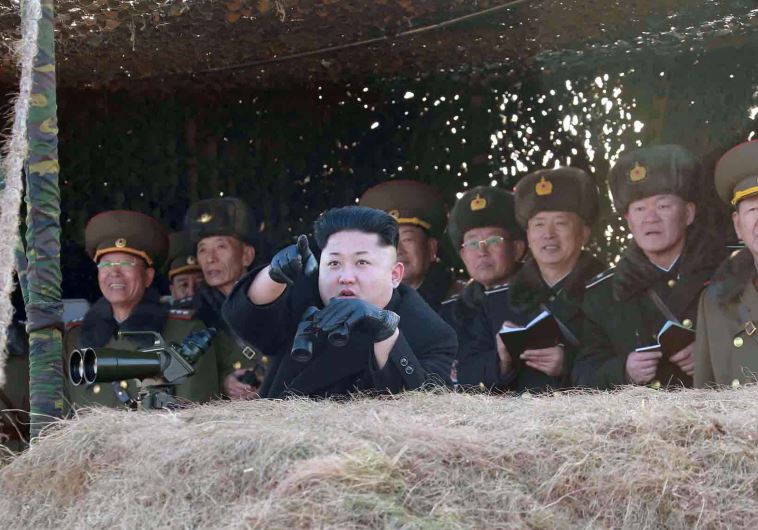
Kim Jong Un, the “Supreme Leader” of North Korea, supervises the April 22 test-launch of a missile from a submerged platform. (Image source: KCNA)

The DoD report from 2015 also acknowledges that North Korea is developing another system for a nuclear strike on the U.S., delivered by satellite; but also notes that the system currently lacks “a reentry vehicle.” However, a nuclear EMP attack delivered by satellite requires no reentry vehicle.

In short, the DoD report was inexplicably silent about North Korea’s current nuclear and missile capability, which, if used, could kill millions of Americans in an EMP attack — as warned by both the 2004 and 2008 Congressional EMP Commission reports.

A careful technical reading of the DoD report clearly confirms the very bad news that North Korea can strike the U.S. mainland with nuclear missiles right now. But the casual or non-expert reader can get the false impression from the report, as no doubt was intended, that President Obama was right to assert that there is no nuclear missile threat from North Korea. As one newspaper article on the DoD report declared in its headline, “Pentagon: North Korea Lacks Technology For Anti-U.S. Nuclear Strike.”

When not downplaying the missile and nuclear developments in North Korea, media reports tended to also discover benign North Korean motives for their missile and nuclear tests or technical arguments designed to lessen their import. One BBC report quoted Andrea Berger, for instance, from the Royal United Services Institute in London, who assured everyone that North Korea “wants a peace treaty with the USA” but “seems to believe that it will not be taken seriously until it can enter talks on this issue with sizeable military strength.”

The New York Times also echoed other analyses, claiming, “Although North Korea can learn much about the technology to build ballistic missiles from satellite launches, putting a satellite into orbit does not guarantee an ability to deliver a nuclear warhead on an intercontinental ballistic missile.”

The New York Times then further diminished the North Korean threat by commenting, “North Korea has never tested a ballistic-missile version of its Unha-series rockets. [And] after four nuclear tests by the North, Western analysts were still unsure whether the country had mastered the technology to build a warhead small enough to mount on a long-range missile” or “survive the intense heat while re-entering the atmosphere, as well as a guidance system capable of delivering a warhead close to a target.”[6]

North Korea’s H-Bomb

The dominant media assessment of North Korea’s nuclear test also followed the same “minimalist” pattern as its coverage of North Korea’s satellite-launch missile test.

The most common assumption by critics downplaying North Korea’s test was that the bomb was no more than 10 kilotons in strength and thus not anywhere near as advanced as a hydrogen bomb, as the North Korean’s claimed, nor appreciably different from previous North Korean tests.

Again, the conventional wisdom missed the real news. Let us explain.

Henry Sokolski, of the National Proliferation Education Center (NPEC), and Dr. Peter Vincent Pry, the Executive Director of the Congressional EMP Task Force, a former top staffer on the House Armed Services Committee, a former CIA analyst, and the co-author of this essay, both said “Not so fast.”

First, U.S. intelligence on North Korea is not perfect. Second, the test could very well have been what is known as a “boosted fission weapon” (which such experts as former Secretary of the Air Force and Reagan’s Deputy National Security Adviser Tom Reed believes it was),[7] rather than a primitive fission atomic bomb.

Remember, the U.S. and other intelligence services have not detected uranium or plutonium (A-Bomb fuels) in any of the North Korean tests, but they have detected tritium (H-Bomb fuel) in at least one. A boosted weapon could explain this anomaly.

One Rand analyst also thinks the test might have been of a boosted fission weapon, and uses a different seismic model that gives a test yield of 50 kilotons (KT) and not the 6-10 KT reported by South Korea and widely used by press reporting on the issue.

What Sokolski implies is that North Korea may be getting help from Russia or China, a possibility that changes the framework of how we in the U.S. have traditionally approached and dealt with proliferation of nuclear weapons, particularly the possible sophistication of nuclear threats from aspirant states.

If North Korea and Iran are getting help from Russia or China, as retired U.S. Northcom Commander General (Retired) Charles Jacoby agrees they are,[8] and do not have to rely only on their indigenous capabilities, their nuclear and missile programs at any time could be more advanced than is commonly thought. There is also the possibility that such advanced technology could be sold to other rogue regimes or by all of them to each other.

North Korea could, in fact, already have the H-Bomb. Everyone assumes that the North Korean test was not an H-Bomb because the seismic signal indicates that the yield was too low for an H-Bomb.

But North Korea could very well have conducted a “decoupled” nuclear test. In a decoupled test, the nuclear explosion is in a large cavern filled with shock-absorbing materials to reduce the seismic signal and conceal the true yield of the test. North Korea would not need help from Russia or China to do a decoupled test. It is both easy and well within North Korea’s capabilities.

A decoupled test could reduce the seismic signal by more than 10-fold. Thus, a test that looks like 10 kiloton yield in the seismic signal could have had a yield of 100 KT. Also, a 50 KT seismic signal could really have been a 500 KT test. Such high yields are in H-Bomb territory.

Alternatively, North Korea could be testing only the primary or first stage of a much more powerful two-stage H-Bomb.

In the last decades of the Cold War this is what the U.S. did to comply with the Threshold Test Ban Treaty (TTBT). The U.S. rarely tested its H-Bombs to full yield — both to comply with the TTBT and because if anything went wrong with a warhead, the problem would most likely be in the first stage.

After the July 1974 Threshold Test Ban Treaty (TTBT)[9] between the USA and the USSR, the U.S. never tested a nuclear weapon of more than 150 kilotons. Most tests were far below the 150 kiloton level and many were below 10 kilotons. And the U.S. has not tested to any yield in the past twenty years because component testing suffices even for America’s most powerful nuclear weapons.

Can the U.S. get away with this because its scientific knowledge is so much better than that of other nations? Russia, China, Britain, and France are not testing their H-Bombs either, as such testing is not necessary to be confident the bombs work. Israel developed the H-Bomb without testing it. South Africa was on the way to doing so, without testing, when it dismantled its arsenal under pressure from the Reagan administration.

Pakistan and India claim to have tested H-Bombs; many of the “instant experts” dismissing the North Korean threat, however, also insist Pakistan and India are not being truthful because the test yields were like North Korea’s recent test, also supposedly “too low.”

Most “experts” cannot believe that North Korea and Pakistan could duplicate what the superpowers have done and reinvent the H-Bomb. None appears to remember that critical design information for thermonuclear weapons was leaked by a magazine, The Progressive, when it published the article. “The H-bomb Secret.”[10]

The Carter administration, losing its case in the U.S. Supreme Court, objected to, but failed to stop, its publication. And “The H-Bomb Secret” is but just one example of copious critical design information for nuclear weapons that has been leaked, stolen, or foolishly declassified.

The EMP Commission and the authors of this article believe that North Korea tested what the Russians call a Super-EMP weapon. It better explains all the data.

Super-EMP Nuclear Warhead

The EMP Commission warned in its 2004 report, that “Certain types of relatively low-yield nuclear weapons can be employed to generate potentially catastrophic EMP effects over wide geographic areas, and designs for variants of such weapons may have been illicitly trafficked for a quarter-century.”

A Super-EMP weapon is designed to produce gamma rays, not a big explosive yield. So a Super-EMP weapon is consistent with all the North Korean tests, including low yield tests, such as the first 3 KT test, and two other suspected North Korean tests. Those were sub-kiloton yet also showed evidence of traces of tritium.

Because a Super-EMP weapon is low-yield, and not designed for blast effects, it can be easily tamped when tested. That possibility could account for America’s inability to detect any plutonium or uranium from North Korea’s tests.

One design of a Super-EMP weapon, of Russian origin, is virtually a pure fusion weapon, so that after an explosive test, there would be little or no plutonium or uranium to detect. As a Super-EMP weapon is, essentially, a very low-yield H-Bomb, it would be consistent with North Korea’s claim.

North Korea’s two successful satellite launches — of the KSM-3 in 2012 and the KSM-4 in 2016 — both look like tests of a Fractional Orbital Bombardment System (FOBS). The FOBS, a Soviet-era secret weapon, would, like a satellite, launch a warhead into low-earth orbit. The FOBS could therefore disguise a nuclear EMP attack as a peaceful space launch. It would conceal the intended target because its flight path masked that information. FOBS would also have allowed the Soviets to attack the United States from over the South Pole, the opposite direction from which U.S. early-warning radars and missile-interceptors, under the North American Aerospace Defense Command (NORAD), are oriented, both during the Cold War and today.[11]

North Korea’s KSM-3 satellite orbits the Earth at precisely at the right trajectory and altitude for making a surprise nuclear EMP attack on the United States — practicable only if the North Koreans have a warhead small enough for delivery by satellite, as a Super-EMP warhead would be.

North Korea has also flown a Nodong medium-range ballistic missile (MRBM) over Japan at an altitude consistent with a potential EMP attack.

Russian experts, one Chinese military commentator, and South Korea’s military intelligence all claim that North Korea has Super-EMP warheads. If we follow the rules for “all sources analysis,” this data should not be ignored.

In November 1999, the North Korea Advisory Group of the U.S. Congress reported that they were convinced that North Korea was developing nuclear weapons, despite the 1994 Agreed Framework deal with the United States, under which North Korea promised to not build such weapons. At the time, the Clinton Administration claimed no such work was being done by the North Koreans.[12] Yet we now know the Advisory Group was right, and the Clinton Administration wrong.

Implications for the Nuclear Missile Threat from Iran

The late Israeli Prime Minister Yitzhak Rabin warned us that it was a terrible mistake to hold talks with North Korea in Beijing in 1994 in an effort to persuade North Korea to stop missile exports to the Middle East.[13]

Rabin said that instead of trying to solve the problem, “North Korea tried to fool Israel. North Korea demanded $1 billion to stop the sales.” At the same time, according to Rabin, North Korea received hundreds of millions of dollars from Iran to produce missiles with longer ranges, threatening not only America’s Middle East allies but allies elsewhere, once the North Koreans received financial help from Iran’s mullahs.

The bottom line is that North Korea and Iran are strategic partners who cooperate on missile technology and probably nuclear technology. As both receive help from Russia and China, it is time to stop wishful thinking — that everything is fine, that diplomacy will work — and to face reality.

North Korea has nuclear-armed missiles that threaten the U.S. mainland — right now. Defending our homeland from that threat is an imperative, including protecting our full electrical grid, other critical infrastructures and of course our cities. And if North Korea has such a capability, how close is Iran to such weaponry?

The mainstream media must face these facts and start reporting that North Korea has nuclear-armed missiles that threaten the United States — right now. Defending the homeland now, including its critical electrical grid, from a nuclear EMP attack is imperative.

What should the United States therefore do?

First, the President should declare that a nuclear EMP attack on the United States is an existential threat to the American people and would warrant an all-out retaliatory response.

The President should prevent North Korea from further developing its long-range nuclear missile capabilities and capabilities to perform EMP attacks. The U.S. could surgically destroy — on the launchpad — any North Korean space-launch vehicle (SLV) or long-range missile prior to launch, or shoot down any SLV or long-range missile launch, including North Korea’s KSM-3 and KSM-4 satellites.

The administration should also provide support to, and work in close consultation with, the newly re-established Congressional EMP Commission. Their primary goal should be to protect DoD assets, military critical infrastructures, and the civilian electric grid that provides 99% of the electric power needed to sustain DoD power-projection capabilities.

The Congress also should immediately pass the Critical Infrastructure Protection Act (CIPA), which passed the House unanimously and now awaits action in the Senate. CIPA empowers the Department of Homeland Security to work with the utilities, State governments and emergency planners at all levels of government, to develop plans to protect and recover the national electric grid and other civilian critical infrastructures from an EMP attack.

Finally, the next President should revive President Ronald Reagan’s vision of the Strategic Defense Initiative (SDI) and develop and deploy space-based missile defenses. Space-based missile defenses will offer a realistic prospect of rendering nuclear missile threats obsolete, thus neutralizing the growing nuclear missile threats to the United States from North Korea, Iran, China, and Russia.

Dr. Peter Vincent Pry is Executive Director of the EMP Task Force on National and Homeland Security, a Congressional Advisory Board, and served in the Congressional EMP Commission, the Congressional Strategic Posture Commission, the House Armed Services Committee, and the CIA. Peter Huessy is President of Geostrategic Analysis, Senior Defense Consultant to the Mitchell Institute of the Air Force Association, and teaches nuclear deterrent policy at the US Naval Academy.


[1] Interview with CIA East Asia Division Chief Arthur Brown by Ruriko Kubota and Yosuke Inuzke, “DPRK Has Produced Small-Type Nuclear warheads,” Sankei Shimbun, Tokyo: October 1, 2008.

[2] “Spy Agencies Believe North Korea Has Nuke Warheads,” Agence France Presse, March 31, 2009.

[3] Lt. General Ronald Burgess, Director, Defense Intelligence Agency, “Worldwide Threat Assessment: Statement before the Committee on Armed Services, U.S. Senate,” Washington, D.C.: March 14, 2011 and “North Korea Nukes Might Fit On Missiles, Aircraft,” Global Security Newswire: NTI, March 14, 2011.

[4] “Experts: Iran Now A Nuclear-Ready State, Missiles Capable Of Hitting US” Newsmax (February 1, 2015); “When Iran Goes Nuclear,” Washington Times (March 2, 2015), and Ambassador Henry Cooper and Dr. Peter Vincent Pry, “The Threat To Melt The Electric Grid,” Wall Street Journal (April 30, 2015); Ambassador Henry Cooper, “North Korea’s H-Bomb–And Iran’s?” Family Security Matters (January 12, 2016).

[5] Admiral William Gortney, Commander, North American Aerospace Command, “Protecting the Homeland,” remarks at the Atlantic Council, October 7, 2015.

[6] The New York Times apparently does not understand that an EMP strike delivered with a nuclear warhead does not re-enter the atmosphere nor is accuracy particularly an issue. Detonated thirty to seventy kilometers high roughly over the center of the eastern seaboard of the United States would be sufficient; and “Why Does the New York Times So Hate Missile Defense?“, Gatestone Institute, June 11, 2013.

[7] Personal Conversation with Secretary Tom Reed by Peter Huessy, February 9, 2016 at the Institute of World Politics.

[8] Author’s Conversation with General (Retired) Charles Jacoby at Real Clear Defense forum on ballistic missile defense issues, February 9, 2016.

[9] Treaty between the United States of America and the Union of Soviet Socialist Republics on the Limitation of Underground Nuclear Weapon Tests (and Protocol Thereto) (TTBT). BUREAU OF ARMS CONTROL, VERIFICATION, AND COMPLIANCE Signed at Moscow July 3, 1974. Entered into force December 11, 1990.

[10] United States of America v. Progressive, Inc., Erwin Knoll, Samuel Day, Jr., and Howard Morland, 467 F. Supp. 990 (W.D. Wis. 1979), was a lawsuit brought against The Progressive magazine by the United States Department of Energy (DOE) in 1979. A temporary injunction was granted against The Progressive to prevent the publication of an article by activist Howard Morland that purported to reveal the “secret” of the hydrogen. Though the information had been compiled from publicly available sources, the DOE claimed that it fell under the “born secret” clause of the Atomic Energy Act of 1954.

[11] In Air Power Australia, “The Soviet Fractional Orbital Bombardment System Program“, Technical Report APA-TR-2010-0101 by Miroslav Gyurosi, January 2010.

[12] North Korea Advisory Group, Report to the Speaker, November 1999.

[13] The talks between Israel and North Korea were held in June 1993; see NTI-Jerusalem Post 18 Dec 1994, page 2, Rabin: “Earlier Talks with North Korea over missiles were a Major Mistake.”

Electronic Doomsday for the US?

January 13, 2016

Electronic Doomsday for the US? The Electromagnetic Pulse (EMP)

by Peter Huessy

January 13, 2016 at 4:45 am

Source: Electronic Doomsday for the US?


  • The recent North Korean nuclear and the Iranian ballistic missile tests are serious deadly threats to the United States. North Korea’s latest bomb test is being widely dismissed by “experts” because the apparent yield is around 10 kilotons or less – which just so happens to be exactly the right amount for an electromagnetic pulse (EMP) explosion.
  • An EMP attack on the U.S. would leave the country with no electricity, no communications, no transportation, no fuel, no food, and no running water.
  • “Our increasing dependence on advanced electronics systems results in the potential for an increased EMP vulnerability… and if unaddressed makes EMP employment by an adversary an attractive asymmetric option.” — EMP Commission
  • The recent military writings and exercises of potential adversaries would combine EMP with cyber-attacks, sabotage, and kinetic attacks against the national electric grid and other critical infrastructures.

Contrary to some “expert” analysis, both the recent North Korean nuclear and the Iranian ballistic missile tests are deadly serious threats to the United States.

The danger to the United States is particularly consequential due to the close military cooperation of North Korea and Iran. Their combined capabilities, as demonstrated recently, could very well signal a future nuclear attack of the electromagnetic pulse type, for which the U.S., at the moment, is totally unprepared.

The threat to the United States from an electromagnetic pulse (EMP) attack — the high-altitude detonation of a nuclear weapon over the United States — is so potentially catastrophic that both the 2004 and 2008 reports of the Congressional EMP Commission said so openly — probably in the hope that the public warning would spur the nation and the Department of Defense to action. [1]

Even an EMP attack from a single 10-kiloton nuclear weapon — of the type now in North Korea’s arsenal — could cause cascading failures which could black out the U.S. Eastern Grid for months or years, and devastate the civilian economy. An EMP, detonated at an altitude above 30-70 kilometers, could be delivered by a short-range missile fired off a freighter, hundreds of kilometers off U.S. shores.

The result would be no communications, no transportation, no fuel, no food, and no water for a decade or more. That would be true for at least the entire eastern half of the United States, where most of the population lives. National Geographic has described it as an “Electronic Armageddon.”

An illustrative rendering of an EMP attack on the United States. (Image source: Video screenshot from “33 Minutes”)

Despite these previous warnings and North Korea’s recent bomb test — its fourth known nuclear test since 2006 — “experts” are dismissing a nuclear threat from North Korea as of little concern because the apparent yield of the bomb was in the neighborhood of 10 kilotons or less.

Hydrogen Bombs, or thermonuclear weapons, which is what North Korea claimed to have detonated, produce yields higher than those.

In fact, however, these experts may be way off base. The yield of an EMP explosion is lower. The North Korean bomb capability that was tested may therefore well be that of a super-EMP.

Neutron bombs, or Enhanced Radiation Weapons such as Super-EMP weapons, are essentially very low yield H-Bombs. They typically have yields of 1-10 kilotons, exactly like North Korea’s device. Indeed, because of their very low yield, all four North Korean nuclear tests look like Super-EMP weapons.

A Super-EMP weapon is designed to produce special effects (gamma rays, in the case of Super-EMP). A Super-EMP warhead, while having a seemingly insignificant explosive yield, could be far more deadly and dangerous to the United States than the most powerful H-Bomb ever built.

Russia’s Tsar H-Bomb, (known as Tsar Bomba), the most powerful H-Bomb ever detonated, produced during its test in October 1961 a yield of 60 megatons. It would have been capable of flattening everything in the state of Rhode Island. [2]

A Super-EMP weapon, however, detonated 300 kilometers above the center of the U.S., could destroy the entire nation’s industrial and military capacity, and kill a large percentage of the American people, by taking down the U.S. electrical grid. Once destroyed, the grid’s elements would take decades to rebuild.[3]

Even if the U.S. were to protect its electrical infrastructure from such a threat — legislation to protect the grid is now in Congress, primarily thanks to Rep. Trent Franks (R-Arizona) — the parallel vulnerability of U.S. military forces to an EMP attack would be just as serious.

We know the Department of Defense has testified to Congress that 99% of the electricity for continental U.S. military bases comes from the civilian grid. Our military bases would thereby be without electrical power for decades as well. Unfortunately, the thousands of electrical transformers destroyed by an EMP attack were not primarily built in America. Even if they were, they require at least a five-year lead-time for production.

Overseas power-projection from U.S. military bases would be effectively impossible without an operational grid. Moreover, after such an EMP attack, the national focus would be on saving millions of Americans from mass starvation and preserving societal existence, not on going “over there” to fight a war or defend U.S. interests.

If the EMP attack were executed anonymously, say, by a missile launched off a freighter at sea close-in to the United States, we would probably not even know against whom to retaliate. Thus, classical deterrence would not work, further “inviting” such an attack.

In 1999, for example, at a high level meeting in Vienna of a Congressional delegation with senior members of the Russian government, Vladimir Lukin, the chairman of the Duma’s Foreign Affairs Committee, angry with American policy in the Balkans, issued the following threat: “If we really wanted to hurt you with no fear of retaliation, we would launch a Submarine-launched Ballistic Missile (SLBM), [and] we would detonate a nuclear weapon high above your country and shut down your power grid.”

Congressman Curt Weldon, (R-PA), the American delegation chair, who understood Russian, turned to his Maryland colleague, (Roscoe Bartlett, D-MD) and asked, “Roscoe, did you hear what he said?”

The chairman of the State Duma Geopolitics Commission, Alexander Shabanov, smiled and said, “And if that one doesn’t work, we have plenty of spares”.[4]

Thus a nuclear weapon designed specifically for EMP attack, what Russian experts call a “Super-EMP” warhead, would constitute a worst-case threat.

A single Super-EMP warhead, detonated in the sky 300 kilometers over the center of the U.S., would generate such a powerful EMP field over all 48 contiguous United States that, not only would a protracted nationwide blackout result, but even the best protected U.S. military forces and C3I on all military bases—if not sufficiently protected– could also be at risk.

The technology to protect the electrical grid is relatively straightforward and inexpensive. But only with action now could the grid be protected sufficiently to give the US industrial and economic capability a fighting chance to survive an “Electronic Armageddon”.

It is also possible to protect military assets through “hardening,” but doing so after production and the fielding of equipment is time-consuming and costly. The sooner the U.S. starts with hardening its equipment, sooner the job will get done. The U.S. is seriously behind schedule in what is required to protect it.

It is not as if the threat is “over the horizon.” Russia and China already have Super-EMP warheads. Moreover, according to the Congressional EMP Commission, the design of Super-EMP warheads is no secret: “Certain types of relatively low-yield nuclear weapons can be employed to generate potentially catastrophic EMP effects over wide geographic areas, and designs for variants of such weapons may have been illicitly trafficked for a quarter-century.”

The EMP Commission warned that non-state actors — terrorists — could also pose an EMP threat: “What is different now is that some potential sources of EMP threats are difficult to deter — they can be terrorist groups that have no state identity, have only one or a few weapons, and are motivated to attack the U.S. without regard for their own safety.”

The EMP Commission also warned that the Department of Defense has failed to maintain adequate EMP protection for U.S. military forces since the end of the Cold War:

“The end of the Cold War relaxed the discipline for achieving EMP survivability within the Department of Defense, and gave rise to the perception that an erosion of EMP survivability of military forces was an acceptable risk. EMP simulation and test facilities have been mothballed or dismantled, and research concerning EMP phenomena, hardening design, testing, and maintenance has been substantially decreased. However, the emerging threat environment, characterized by a wide spectrum of actors that include near-peers, established nuclear powers, rogue nations, sub-national groups, and terrorist organizations that either now have access to nuclear weapons and ballistic missiles or may have such access over the next 15 years have combined to place the risk of EMP attack and adverse consequences on the US to a level that is not acceptable.”

The EMP Commission further warned that even U.S. strategic forces and C3I may be at risk from an EMP attack:

“Current policy is to continue to provide EMP protection to strategic forces and their controls. The Department of Defense must continue to pursue the strategy for strategic systems to ensure that weapons delivery systems of the New Triad [land, sea and air] are EMP survivable, and that there is, at a minimum, a survivable ‘thin-line’ of command and control capability to detect threats and direct the delivery systems.”[5]

U.S. strategic forces today are also relatively more vulnerable than they were during the Cold War: they are far less numerous and located on fewer bases, so an adversary could more easily target peak EMP fields on each base. Compared to Cold War era systems, the more modern and sophisticated C3I systems for command and control of U.S. strategic forces could be vulnerable to EMP, unless they are hardened to withstand such electromagnetic pulse attacks. This is also true for the entire industrial infrastructure, the most critical of which is the electrical grid.

The EMP Commission also warned that as U.S. conventional forces become more dependent upon high-technology, they also become more vulnerable to EMP attack:

“The situation for general-purpose forces (GPF) is more complex. The success of these forces depends on the application of a superior force at times and places of our choosing. We accomplish this by using a relatively small force with enormous technological advantages due to superior information flow, advanced warfighting capabilities, and well-orchestrated joint combat operations. Our increasing dependence on advanced electronics systems results in the potential for an increased EMP vulnerability of our technologically advanced forces, and if unaddressed makes EMP employment by an adversary an attractive asymmetric option.”

The above alarming assessments about the vulnerability of U.S. military forces to EMP attack are what the EMP Commission decided must be stated publicly, in its unclassified Executive Summary. The EMP Commission submitted a separate, classified, report to the Department of Defense analyzing these and many other vulnerabilities in far greater detail.

What progress has the Department of Defense (DoD) made to protect itself and the nation from EMP attacks since the reports were completed?

When the EMP Commission terminated in 2008, it was on the understanding that DoD would move aggressively to protect U.S. military forces from EMP, and report biennially to Congress on progress being made implementing the EMP Commission recommendations. The only unclassified biennial report from DoD indicates that there were still serious deficiencies in protecting U.S. military forces from EMP in 2011.

On April 7, 2015, the North American Aerospace Defense Command (NORAD) chief, Admiral William Gortney, announced that NORAD was moving critical assets back into the nuclear bunker inside Cheyenne Mountain and spending $700 million to harden the mountain further against a potential nuclear EMP attack from North Korea. That the nation’s most critical C3I node is just now being adequately protected does not bode well for the preparedness of U.S. military forces as a whole for an EMP Doomsday scenario.[6]

Fortunately, Congress re-established the EMP Commission in the recently completed and passed Fiscal Year 2016 National Defense Authorization Act, to serve as a watchdog on U.S. preparedness and the fast-evolving EMP threat.

The recent military writings and exercises of potential adversaries, for example, combine EMP with cyber-attacks, sabotage, and kinetic attacks against the national electric grid and other critical infrastructures — a decisive new way of warfare described by Russian experts as a “Revolution in Military Affairs.”[7]

The U.S. response has recently gotten some important traction. The House, on November 16, 2015, unanimously passed the Critical Infrastructure Protection Act (CIPA — House of Representatives bill number HR 1073).

CIPA directs the Department of Homeland Security (DHS) to educate emergency planners and first responders at all levels of government about the EMP threat, and to prepare plans to protect and recover the electric grid and other critical infrastructures from an EMP attack and from natural EMP that can be generated by a rare solar super-storm. The House Energy and Commerce Committee also passed provisions to secure the electric grid from EMP, including by stockpiling spare parts and incorporating the SHIELD Act, which gives new authorities to the U.S. Federal Energy Regulatory Commission to protect the grid.

Protecting the national electric grid from EMP is necessary to preserve the existence of American civilization, to sustain U.S. military power-projection capabilities, and it would also mitigate worst-case threats from cyber warfare, sabotage, kinetic attacks, and even severe weather. CIPA and SHIELD are the crowning achievements of Rep. Trent Franks (R-AZ), who for years has been the conscience of the Congress, warning about the existential threat from EMP. [8]

While both bills now await action in the Senate, there is an increasing threat from Iran, which recently successfully tested two nuclear-capable missiles, and from a North Korean satellite, the KSM-3, which regularly orbits over North America at the optimum trajectory to evade U.S. national missile defenses. If the KSM-3 were to carry a nuclear weapon, it would project an EMP field over all of the 48 contiguous United States.

North Korea is Iran’s strategic partner, and there is a treaty between the two countries that obligates the sharing of scientific and military technology.

North Korea’s military recently carried out what some have described as an attempted test from a submerged barge, an indication that an earlier test failure has not derailed its underwater missile program, according to U.S. defense officials.

Add North Korea’s missile capability and a super EMP weapon to this potential, and the significance of the recent North Korean nuclear test comes into better focus. The possibility of a North Korean or Iranian EMP attack seems to be gathering strength.

We may have already seen what such an attack might look like. During the 2014 Gaza War, Hamas, the Syrian Electronic Army, and Iran attempted mass cyber-attacks, coordinated with massive missile strikes, on Israel’s electrical grid. Hamas launched over 5000 rockets and missiles against Israel. Prepared, Israel’s cyber defenses defeated the cyber-attacks, and the Iron Dome missile defense system shot down all the missiles aimed at the Israeli grid.[9]

There are important lessons here. Missile and cyber defenses work: they are critically important parts of any national security strategy.

Israel had also made a prior decision to harden its grid against threats by EMP attacks. The combined efforts of this crucial ally of ours gives us a roadmap to follow: robust missile defenses to defend the homeland from EMP-armed missiles; cyber defenses to protect critical assets and the infrastructure; and EMP defenses to protect national security and defense assets and the electrical grid from attack.

Both the 2004 and 2008, EMP Commission reports urged America’s leaders to protect against such threats as EMP. The House of Representatives has now passed the necessary legislation to protect the grid. The Senate has a champion — Senator Ron Johnson (R-WI), who has pledged to secure Senate passage.

But there are serious pressures working against its passage. Too many “experts” currently dismiss any such threat to the American homeland.

Just recently, for instance, a former intelligence specialist in the U.S. government, Paul Pilar, argued in The National Interest that Iranian ballistic missiles were “here to stay” and were simply elements of Iran’s defenses – and, despite repeated Iranian calls for “Death to America,” were no threat to the United States homeland or its overseas interests.[10]

Such conventional complacency, such as calling ISIS the jay-vee team, is not uncommon in Washington, D.C. The National Intelligence Estimate on Iran in 2007 argued that Iran had stopped all its nuclear weapons work in 2003[11]; the International Atomic Energy Administration has now determined that Iran’s nuclear work had continued to at least 2009.[12]

Unfortunately, there is real-world experience — in Israel — that such threats from missiles and cyber-attacks are constantly serious and looming: the entire job of an adversary is to look for weak spots to attack.

There always seem to be those who wish to downplay all threats and are reluctant even to invest in an “insurance premium.” The consequences of failing to protect America against such threats, however, will be far more serious than future embarrassment for some head-in-the-sand bureaucrats.

An EMP attack would shut down the country; lead to the loss of millions of lives, and set it back into effective defenselessness.

It is a threat as serious as any estimates of what a mushroom cloud at the height of the Cold War would have entailed. Instead, it kills by sending the country back to what former House Speaker Newt Gingrich has described as early 18th century America: people would not be able to function in even the simplest of ways. Buildings would be left standing but the ability to live in them would not. People would be unable to move about, eat, drink, shop or communicate.

It therefore requires full attention, in this era of increased cyber-sophistication, especially among enemies of the West, to see that an EMP attack is never “invited” to happen in the U.S.

Peter Huessy is President of GeoStrategic Analysis of Potomac, Maryland and Senior Defense Consultant to the Mitchell Institute of the Air Force Association and a guest lecture at the US Naval Academy on nuclear deterrent policy and the founder of the 36 year AFA-NDIA-ROA Congressional Breakfast Seminar Series on Nuclear Deterrence, Missile Defense, Arms Control, Proliferation and Defense Policy.


[1] Previous such threat analysis had been classified; the Report of the Commission to Assess the Threat to the United States from Electromagnetic Pulse (EMP) Attack, July 2004 and April 2008 was issued in both classified and unclassified versions; see also Henry F. Cooper and Peter Vincent Pry, “The Threat to Melt the Electric Grid,” Wall Street Journal, April 30, 2015; and Former Director of Central Intelligence, R. James Woolsey, testimony before the U.S. Congress, May 21, 2013.

[2] “Big Ivan”, The Tsar Bomba”, Viktor Adamsky and Yuri Smirnov, 1994, “Moscow’s Biggest Bomb”.

[3] EMP Commission, April 2008.

[4] Committee on Armed Services, House of Representatives, July 22, 2004, Hearing on the Report of the Commission to Assess the Threat to the US from Electromagnetic Pulse Attack.

[5] “Report of the Commission to Assess the Threat to the United States from Electromagnetic Pulse (EMP) Attack”, Volume I: Executive Report; hereinafter cited as EMP Commission Report 2004.

[6] EMP Commission Report 2004, p. 47.

[7] “Defense Science Board (DSB) Task Force on the Survivability of Systems and Assets to Electromagnetic Pulse (EMP) and other Nuclear Weapon Effects (NWE)”, Summary Report No. 1, Interim Report of the DSB Task Force, 2011. See also Dr. Peter Vincent Pry, Apocalypse Unknown: The Struggle to Protect America from an Electromagnetic Pulse Catastrophe, Task Force on National and Homeland Security, 2013, pp. 158-164.

[8] For a good history of these efforts, see Congressman Trent Franks, remarks at the AFA-NDIA-ROA Congressional Breakfast Seminar, December 17, 2015, transcript available from Peter Huessy at AFA (Phuessy@afa.org).

[9] Information from Uzi Rubin, President of Rubicon, to the authors.

[10] See an excellent rejoinder by Emily Landau and Shimon Stein, INSS, National Defense University, “Iran’s Ballistic Missiles Are Actually a Huge Problem“, January 5, 2016.

[11] Paul Pillar spoke approvingly of the 2007 NIE at “The Iran National Intelligence Estimate and Intelligence Assessment Capabilities”, December 20, 2007, the Brookings Institution.

[12] IAEA Board Report: Joint Comprehensive Plan of Action implementation and verification and monitoring in the Islamic Republic of Iran in light of United Nations Security Council Resolution 2231 (2015), Resolution adopted by the Board of Governors on 15 December 2015.

Satire but not funny|Kim Jong-un has replaced John Boehner as Speaker of the House

September 11, 2015

Kim Jong-un has replaced John Boehner as Speaker of the House, Dan Miller’s Blog, September 11, 2015

(The views expressed in this article are mine and do not necessarily reflect those of Warsclerotic or its other editors. — DM)

We have met the enemy and it is us: we have become too tired to be effective and hence are becoming indifferent. The charade on Capitol Hill continues, and not only about the nuke “deal” with Iran. Will the carnival end before it’s too late, or will Obama continue to win?

The House speaker is elected by all House members, not just those of the majority party. He need not be a member of the House. Boehner having resigned because a serious medical condition often reduces him to tears, one group of Democrats nominated Debbie Wasserman-Schultz to replace him. However, due to her support for Hillary Clinton, she fell out of favor with the White House so another group of Democrats nominated Kim Jong-un at Obama’s request. To avoid the appearance of confrontation, Republicans offered no candidates. Kim won by seventeen votes, becoming the first non-US citizen to hold the office thus far this month.

tearsofboehnerDebby


Reporting for duty!

REPORTING FOR DUTY!

The current upset was precipitated by Republican members’ disagreements with Boehner and other party leaders about how best to deal with the catastrophic Iran nuke “deal” without unnecessarily offending the President. Kim Jong-un is expected to substitute his own brand of leadership for Boehner’s leadership through ambivalence.

A majority also deemed Kim the best qualified to negotiate with Dear Leader Obama on behalf of the House because, as the undisputed leader of a rogue nuclear nation himself, he should be able to pull not only Obama’s strings but also those of the Supreme Leader of the Islamic Rogue Republic of Iran.

White House Press Secretary Josh Earnest declined comment on the situation beyond refusing to comment on whether Obama met privately with Kim to congratulate him. However, Obama is generally thought to have confirmed that He fully supports Kim’s way of governing his own Democratic Peoples’ Republic and — subject to the few pesky restraints still imposed by an antiquated Constitution that He has not yet found ways to sneak around — He does His best to emulate him. In that connection, Obama asked Kim for recommendations on antiaircraft guns to deal humanely with Jews and other traitors who oppose Him (Please see also, New York Times Launches Congress ‘Jew Tracker’ – Washington Free Beacon.)

Desiring to gain Obama’s total good will, Kim promised to have derogatory cartoons of Donald Trump and Hillary Clinton painted on all future North Korean nukes and missiles just before they explode. In return, Obama promised to issue executive orders granting North Korea the permanent right to declassify any and all U.S. documents it sees fit pertaining to the security of the United States and to obtain copies, gratis, from the Government Printing Office.

House Speaker Kim Jong-un will next meet with Supreme Leader Khamenei in Tehran to make two common sense proposals, with which Khamenei is certain to agree:

First, Kim will propose that a group of highly regarded North Korean nuclear experts — under his personal guidance and supervision — conduct all nuke inspections in Iran and draw all conclusions concerning any past or present Iranian nuclear program based on them exclusively. Those conclusions will be drawn on behalf of, and in lieu of any conclusions drawn by, the International Atomic Energy Agency (IAEA). The head of the IAEA, Yukiya Amano, immediately endorsed this plan as “splendid and totally consistent with any and all IAEA – Iran “secret deals.”

Second, Kim will propose that Khamenei promise not to nuke anyone until all sanctions have been permanently eliminated, unless he really wants to.

Obama is thought to have agreed with every aspect of the Kim plan and to have directed Secretary Kerry to tell Khamenei that if he agrees all sanctions will be eliminated permanently, via executive decree, and hence even more expeditiously than previously expected. Due to a successful Senate filibuster yesterday, Obama can issue the executive decree very soon; Today — Friday, September 11th — is being considered seriously due to the obvious symbolism of the date.

H/t Freedom is just another word

arming

The inevitable success of Kim’s mission will result in a win-win situation for nearly everyone, particularly the financially strapped IAEA, and the true Peace of Obama will prevail throughout all parts of the world that He considers worth saving. Remember — it’s all for the Children!

veto (1)Mushroom cloud


Addendum

하원 의장 김정은 의 문 사랑하는 북미 친구 , 그것은 오바마 대통령 아래에서 당신의 인생 이 곧 Amerika 민주주의 인민 공화국 이 될 것입니다 무엇 에 미래의 삶을 위해 잘 준비 것을 진심으로 희망 합니다. 배리 와 나는 제출 된 것을 기쁘게 사람들을 위해 가능한 한 오랫동안 지배 구조 의 우리의 양식 에 서서히 적응 을 하기 때문에 전환이 원활 하게 하기 위해 함께 열심히하고 고통 일했다 .

Translation:

Statement of House Speaker Kim Jong-un

My dear North American friends, it is my sincere hope that your life under President Obama has prepared you well for your future life in what will soon become the Democratic People’s Republic of Amerika. Barry [a.k.a. Barack] and I have worked long and hard together to acclimate you gradually to our transformed and transformational form of governance and hence to make the transition as smooth and painless as possible for those pleased to submit. Now, we will accelerate the progress.

Conclusions

It does not have to be that way. Here, in closing, are a few words from Daniel Greenfield.

We don’t have to give in to despair. If we do, we are lost. Lost the way that the left is lost. Lost the way that the Muslim world is lost.

We are not savages and feral children. We are the inheritors of a great civilization. It is still ours to lose. It is ours to keep if we understand its truths. [Emphasis added.]

We are not alone. A sense of isolation has been imposed on us as part of a culture war. The task of reconstructing our civilization and ending that isolation begins with our communication. We are the successors of revolutions of ideas. We need to do more than keep them alive. We must refresh them and renew them. And, most importantly, we must practice them.

We are not this culture. We are not our media. We are not our politicians. We are better than that.

We must win, but we must also remember what it is we hope to win. If we forget that, we lose. If we forget that, we will embrace dead end policies that cannot restore hope or bring victory.

What we have now is not a movement because we have not defined what it is we hope to win. We have built reactive movements to stave off despair. We must do better than that. We must not settle for striving to restore some idealized lost world. Instead we must dream big. We must think of the nation we want and of the civilization we want to live in and what it will take to build it.

Our enemies have set out big goals. We must set out bigger ones. We must become more than conservatives. If we remain conservatives, then all we will have is the America we live in now. And even if our children and grandchildren become conservatives, that is the culture and nation they will fight to conserve. We must become revolutionaries.

We must think in terms of the world we want. Not the world we have lost.

This is the America we live in now. But it doesn’t have to be.

It can be up to us, not to those who hate America and all for which she once stood.

Our World: The Republican fall guys

September 9, 2015

Our World: The Republican fall guys, Jerusalem Post, Caroline Glick, September 8, 2015

Whenever the Iranians leave, they can be depended on to blame US for their decision to vacate their signature. And the Democrats in turn will blame the Republicans for pushing the Iranians over the edge.

***********************

The ayatollahs will ride their nuclear pact with the Great Satan all the way to a nuclear arsenal and regional hegemony, repeating the cycles of brinksmanship, extortion, respite and brinksmanship that they learned from their North Korean teachers.

ShowImage (11)Kim Jong-un, North Korea leader. (photo credit:KNS / KCNA / AFP)

The Iran nuclear deal is presented as an international agreement between the major powers and Iran. But the fact is that there are really only two parties to the agreement – President Barack Obama and his Democratic Party on the one hand, and the Iranian regime on the other.

Over the past week or so, more and more Democrats have fallen into line behind Obama. At the same time, word is getting out about what Iran is doing now that it has its deal. Together, the actions of both sides have revealed the role the nuclear pact plays in each side’s overall strategies for success.

On the Iranian side, last Wednesday the National Committee of Resistance of Iran revealed that North Korean nuclear experts are in Iran working with the Revolutionary Guards to help the Iranians prevent the UN’s nuclear inspectors from discovering the scope of their nuclear activities.

The NCRI is the same opposition group that in 2003 exposed Iran’s until then secret uranium enrichment installation in Natanz and its heavy water plutonium facility in Arak.

According to the report, the North Koreans “have expertise in ballistic missile and nuclear work areas, particularly in the field of warheads and missile guidance.”

“Over the past two years the North Korean teams have been sharing their experiences and tactics necessary for preventing access to military nuclear sites,” NCRI added.

Although, as The Washington Times reports, NCRI’s finding have yet to be verified, it is unwise to doubt them.

North Korea has been assisting Iran’s nuclear program for nearly 20 years. The US began applying sanctions on North Korea for its ballistic missile proliferation activities in Iran 15 years ago. Iran’s Shahab and Ghadr ballistic missiles are modeled on North Korea’s Nodong missiles.

The Syrian nuclear installation that Israel reportedly destroyed in 2007 was a duplicate of the Yangbyon heavy water reactor in North Korea. The Deir al-Zour reactor was reportedly built by North Korean nuclear personnel and paid for by Tehran.

North Korea’s heavy involvement in Iran’s nuclear weapons program tells us everything we need to know about how Iran views the nuclear deal it signed with the Obama administration and its international partners.

For the past 22 years, the North Koreans have been playing the US and the international community for fools. Ever since February 1993, when inspectors from the International Atomic Energy Agency first discovered that North Korea was conducting illicit nuclear activities, Pyongyang has been using its nuclear program to blackmail the US.

The pattern repeats itself with maddening regularity.

First, the US discovers that North Korea is engaging in illicit nuclear activities. Over the years, these activities have gone from illicit development of plutonium-based nuclear bombs to expelling UN inspectors, to testing long-range ballistic missiles, to threatening nuclear war, to testing nuclear bombs and threatening to supply the bomb to terrorist groups.

Second, the US announces it is applying sanctions to North Korean entities.

Third, North Korea responds with more threats.

The sides then agree to sit down and negotiate the scaling back of North Korea’s nuclear activities. In exchange for Pyongyang’s agreement to talk, the US provides the hermit slave state with whatever it demands. US concessions run the gamut from sanctions relief, to cash payments, provision of fuel, assistance in developing “peaceful” nuclear sites at which the North Koreans expand their nuclear expertise, removal of North Korea from the State Department’s list of state sponsors of terrorism, the provision of formal US commitments not to use force to block North Korea’s nuclear progress, to more cash payments and sanctions relief.

The North then formally agrees to scale back its nuclear program and everyone is happy.

Until the next time it is caught cheating and proliferating.

And then the cycle starts again.

In each go around, the US expresses surprise at the scope of North Korea’s illicit nuclear and missile activities. In every cycle, US intelligence failed to discover what North Korea was doing until after the missiles and bombs were tested and UN inspectors were thrown out of the country.

Despite North Korean brinksmanship and ballistic missile warhead development, the US prohibits its ally South Korea from developing its own nuclear deterrent or even taking steps in that direction.

For their part, while negotiating with the Americans, the North Koreans have proliferated their nuclear technologies and ballistic missiles to Iran, Syria, Pakistan and Libya.

Given North Korea’s clear strategy of using nuclear blackmail to develop its nuclear arsenal and maintain the regime’s grip on power, you don’t need to be a master spy to understand what the presence of North Korean experts in Teheran tells us about Iran’s strategy for nuclear empowerment.

The ayatollahs will ride their nuclear pact with the Great Satan all the way to a nuclear arsenal and regional hegemony, repeating the cycles of brinksmanship, extortion, respite and brinksmanship that they learned from their North Korean teachers.

Given how well the strategy has worked for the psychotic North Koreans who have no economy, no allies and no proxies, it is clear that Iran, with its gas and oil deposits, imperial aspirations, terrorist proxies and educated population believes that this is the strategy that will launch it to world-power status.

This then brings us to the Democrats.

Depending on their pro-Israel protestations, the Democratic position in support of the deal ranges from optimism to pessimistic minimalism. On the side of the optimists, we have the Obama administration.

Obama, Secretary of State John Kerry and their advisors insist that the deal is fantastic. It blocks Iran’s path to the bomb. It opens the possibility of Iran becoming a positive actor on the world stage.

On the other end of the Democratic spectrum are the pessimists like New Jersey Senator Cory Booker and Congresswoman Debbie Wasserman-Schultz.

As they see it, the deal is horrible. It empowers and enriches Iran and legitimizes its nuclear program.

But still, they claim, the deal keeps Iran’s nuclear ambitions at bay for a few years by forcing Iran to submit to the much touted UN inspections regime.

So it is a good deal and they will vote in favor of it and then vote to sustain a presidential veto of a congressional decision to oppose it.

Obviously, the presence of North Korean nuclear experts in Tehran makes a mockery of the notion that Iran has any intention of exercising good faith with UN inspectors. But that isn’t the point.

The point is that the Democrats have no intention of doing anything to prevent Iran from becoming a nuclear power. They just don’t want to be blamed for Iran becoming a nuclear power. They want the Republicans to shoulder the blame. The purpose of the deal from their perspective to set the Republicans up to be blamed.

Obama and his Democratic followers insist that if Iran doesn’t act in good faith, the US will reimpose sanctions. Worse comes to worst, they insist, the US can just walk away from the deal.

This of course is utter nonsense.

Obama won’t walk away from his signature foreign policy. He will devote his energies in his remaining time in office to covering up for Iran. That is why he is breaking the law he signed and refusing to hand over the side deals regarding the farcical nature of UN inspections of Iran’s nuclear sites to Congress.

Moreover, after insisting that the deal is the best way to prevent a holocaust or that it is the only way a Jewish mother can protect the homeland of her people, Democratic lawmakers are not going to rush to acknowledge that they are lying. Now that they’ve signed onto the deal, they own it.

Of course, the Iranians are another story. While the Democrats will not abandon the deal no matter what, the Iranians signed the deal in order to abandon it the minute it outlives its usefulness. And that works just fine for the Democrats.

The Democrats know that the Iranians will use any step the Republicans take to try to enforce the deal’s verification regime or condition sanctions relief on Iranian abidance by the deal’s restrictions on its nuclear activities as an excuse to walk away from the deal. They also know the Iranians will remain in the deal as long as it is useful to them.

Since the Iranians intend to hide their nuclear activities, the Democrats assume Tehran will stay in until it is financially and militarily ready to escalate its nuclear activities.

The Democrats believe that timetable will extend well beyond the lifespan of the Obama administration.

Whenever the Iranians leave, they can be depended on to blame US for their decision to vacate their signature. And the Democrats in turn will blame the Republicans for pushing the Iranians over the edge.

You have to give credit to the administration and its Iranian chums. At least they are consistent. They have constructed an agreement that gives them both what they care about most. Iran, as always, wants to dominate the region and develop the means to destroy Israel and its Arab adversaries at will. The administration, as always, wants to blame the Republicans.

Israel and the Arabs understand the game that is being played. It is time for the Republicans to get wise to it.

Nuclear Fiascoes: From Diplomatic Failure With North Korea To Debacle With Iran

September 1, 2015

Nuclear Fiascoes: From Diplomatic Failure With North Korea To Debacle With Iran, Forbes, Claudia Rosett, August 31, 2015

(An excellent comparison of the machinations that led to the nuke “deal” with North Korea and those now leading to the “deal” with the Islamic Republic of Iran. — DM)

[B]oth Clinton and Bush purchased the transient gains of North Korean nuclear deals at the cost of bolstering a North Korean regime that has become vastly more dangerous. . . . Kim Jong Un bestrides a growing arsenal of weapons of mass murder, including chemical and biological, as well as nuclear, plus a growing cyber warfare capability. This is the legacy not least of North Korea’s skill at exploiting the feckless nuclear deals offered by U.S. presidents whose real achievements on this front were to hand off a monstrous and rising threat to the next administration.

Now comes the Iran nuclear deal, which President Obama has described as a perhaps once-in-a-lifetime “historic chance to pursue a safer and more secure world.” And from Israel’s Prime Minister Netanyahu, leader of America’s closest ally and Iran’s prime target in the Middle East, comes the warning that this deal is a “stunning historic mistake,” configured not to block Iran’s path to the bomb, but to pave the way.

Like the North Korea Agreed Framework, the Iran nuclear deal pivots narrowly on nuclear issues, as if ballistic missiles, terrorism, arms smuggling, gross violations of human rights, blatant declarations of destructive intent and the malign character of the regime itself were irrelevant to the promised “exclusively peaceful” nuclear program.

[I]f this Iran deal goes through, is that we are about to see the mistakes made with North Korea amplified on a scale that augurs not security in the 21st century, but a soaring risk of nuclear war.

************************

With Congress due to vote by Sept. 17 on the Iran nuclear deal, there’s a warning worth revisiting. It goes like this: The president is pushing a historic nuclear agreement, saying it will stop a terror-sponsoring tyranny from getting nuclear weapons. And up pipes the democratically elected leader of one of America’s closest allies, to say this nuclear deal is mortal folly. He warns that it is filled with concessions more likely to sustain and embolden the nuclear-weapons-seeking despotism than to disarm it.

This critic has more incentive than most to weigh the full implications of the deal, because his country is most immediately in harm’s way — though it has not been included in the nuclear talks. He notes that the nuclear negotiators have sidelined such glaring issues as human rights, and warns that Washington is naive, and the U.S. is allowing itself to be manipulated by a ruthless dictatorship.

No, the critic I’m referring to is not Israel’s Prime Minister Benjamin Netanyahu, though he has warned of precisely such dangers in the Iran nuclear deal. I am citing the warnings voiced 21 years ago by the then-President of South Korea, Kim Young Sam, as the Clinton administration bargained its way toward the 1994 nuclear deal with North Korea known as the Agreed Framework.

As it turned out, Kim Young Sam’s misgivings were right on target. The 1994 Agreed Framework did not stop North Korea’s pursuit of the bomb. Instead, it became a pit stop on North Korea’s road to the nuclear arsenal it is amassing today.

For all the differences between North Korea and Iran, there are parallels enough to suggest that the failed 1994 nuclear bargain with North Korea is an excellent guide to the future trajectory with Iran, if the U.S. goes ahead with the nuclear deal — the Joint Comprehensive Plan of Action — announced by the U.S., France, Britain, Germany, Russia, China and Iran on July 14 in Vienna.

Recall that in 1994, faced with the threat of North Korea producing plutonium for nuclear weapons, the U.S. sought a diplomatic solution. Taking a cue from an exploratory trip to Pyongyang by former President Jimmy Carter, the Clinton administration wooed North Korea with an offer of lightwater nuclear reactors to be used exclusively for the peaceful production of electricity. All Pyongyang had to do was give up its nuclear bomb program.

As this agreement was taking shape, South Korea’s Kim Young Sam laid out his concerns in an hourlong interview with the New York Times. In the resulting article, dated Oct. 8, 1994, the Times reported: “After weeks of watching in silent frustration as the United States tries to negotiate a halt to North Korea’s nuclear program, President Kim Young Sam of South Korea lashed out at the Clinton administration today in an interview for what he characterized as a lack of knowledge and an overeagerness to compromise.”

The Times article described Kim’s concerns that “compromises might prolong the life of the North Korean government and would send the wrong signal to its leaders.” Kim was quoted as denouncing the deal then in the making as a “half-baked compromise” which would lead to “more danger and peril.”

President Clinton rolled right past that warning. On Oct. 21, 1994, less than two weeks after Kim’s concerns hit the headlines, the U.S. signed the Agreed Framework with North Korea. Clinton praised the deal as “good for the United States, good for our allies, and good for the safety of the entire world.” Promising that the Agreed Framework would reduce the threat of nuclear proliferation, Clinton further lauded the deal as “a crucial step for drawing North Korea into the global community.”

South Koreans and their leaders, in the main, disagreed. But with South Korea dependent on the U.S. superpower for defense against North Korea, Kim Young Sam had little choice but to follow Clinton’s lead. Seoul damned the deal with faint praise. The Associated Press reported: “South Korean Foreign Minister Han Sung-joo said that even though the deal fell short of expectations, it met South Korea’s minimum policy goals.”

History now shows that the chief policy goals served by the Agreed Framework were those of Pyongyang, which racked up a highly successful exercise in nuclear extortion, and carried on, first secretly, then overtly, with its nuclear weapons program. As South Korea’s president had predicted, the Agreed Framework helped fortify Pyongyang’s totalitarian regime, rather than transforming it.

Some of the negotiators involved in that 1994 deal have since argued that while the North Korean agreement eventually collapsed, it did at least delay Pyongyang’s progress toward nuclear weapons. What they tend to omit from that select slice of history is that the Agreed Framework helped rescue a North Korean regime which in 1994 was on the ropes. Just three years earlier, North Korea’s chief patron of decades past, the Soviet Union, had collapsed. The longtime Soviet subsidies to Pyongyang had vanished. China did not yet have the wealth to easily step in. And just three months before the nuclear deal was struck, North Korea’s founding tyrant, Kim Il Sung, died. His son and heir, Kim Jong Il, faced the challenge of consolidating power during a period of famine at home and American superpower ascendancy abroad.

But in the game of nuclear chicken, it was America that blinked. In exchange for North Korea’s promise to freeze and eventually dismantle its nuclear weapons program, the U.S. agreed to lead a $4.6 billion consortium to build two lightwater reactors for North Korea, and provide shipments of free heavy fuel oil for heating and electricity production while the new reactors were being built. This was augmented by U.S. security guarantees, easing of sanctions and promises to move toward normalizing diplomatic relations, with generous food aid thrown in.

By the late 1990s, just a few years into the deal, North Korea had become the largest recipient of U.S. aid in East Asia. That did not curb Kim Jong Il’s hostile ways. The Pyongyang regime put the interests of its military and its weapons programs before the needs of its starving population. In 1998, North Korea launched a long-range missile over Japan, a test for which it was hard to discern any purpose other than developing a vehicle to carry nuclear weapons. By that time, as a number of former Clinton administration officials have since confirmed, the U.S. was seeing signs that North Korea was cheating on the nuclear deal by pursuing a secret program for uranium enrichment.

Instead of confronting North Korea, Clinton during his last two years in office tried to double down on his crumbling nuclear deal by pursuing a missile deal with Pyongyang. In 2000, that led to an exchange of high-ranking officials, in which the Clinton administration dignified North Korea with the unprecedented move of welcoming one of its top-ranking military officials, Vice Marshal Jo Myong Rok, to a 45-minute sitdown with Clinton at the White House. Clinton then dispatched Secretary of State Madeleine Albright, together with the administration’s special advisor for North Korea policy, Wendy Sherman, to Pyongyang (yes, the same Wendy Sherman recently employed by Obama as chief negotiator of the Iran nuclear deal). Sherman and Albright brought North Korea’s Kim Jong Il a basketball signed by star player Michael Jordan; Kim entertained them with a stadium flip-card depiction of a long-range missile launch. There was no missile deal.

North Korea continued raking in U.S. largesse until late 2002, when the Bush administration finally confronted Pyongyang over its nuclear cheating. North Korea then walked away from the 1994 deal (on which it had by then been cheating for years), withdrew from the Non-Proliferation Treaty (on which it had also been cheating) and began reprocessing plutonium from the spent fuel rods which despite the 1994 deal had never been removed from its Yongbyon nuclear complex. President Bush then made his own stab at nuclear diplomacy, via the Six-Party Talks. North Korea punctuated that process in Oct. 2006 with its first nuclear test. In 2007, the Bush administration led the way to a Six-Party denuclearization deal with North Korea, bull-dozing ahead even after it became clear that North Korea had been helping Syria build a secret copy of North Korea’s plutonium-producing Yongbyon reactor (destroyed in Sept. 2007 by an Israeli air strike). Once again, North Korea took the concessions, cheated on the deal and in late 2008 walked away.

Since Obama took office, North Korea has carried out its second and third nuclear tests, in 2009 and 2013; restarted its plutonium-producing reactor at Yongbyon; and in 2010 unveiled a uranium enrichment plant, which appears to have since at least doubled in size. Having equipped itself with both uranium and plutonium pathways to the bomb, North Korea is now making nuclear weapons, and developing increasingly sophisticated missiles — including long-range — to deliver them.

In sum, both Clinton and Bush purchased the transient gains of North Korean nuclear deals at the cost of bolstering a North Korean regime that has become vastly more dangerous. When Kim Jong Il died in late 2011, North Korea’s regime managed a second transition of power, to third-generation Kim family tyrant Kim Jong Un — who was described last year by the commander of U.S. Forces in Korea, General Curtis Scaparrotti, as “overconfident and unpredictable.” Kim Jong Un bestrides a growing arsenal of weapons of mass murder, including chemical and biological, as well as nuclear, plus a growing cyber warfare capability. This is the legacy not least of North Korea’s skill at exploiting the feckless nuclear deals offered by U.S. presidents whose real achievements on this front were to hand off a monstrous and rising threat to the next administration.

Now comes the Iran nuclear deal, which President Obama has described as a perhaps once-in-a-lifetime “historic chance to pursue a safer and more secure world.” And from Israel’s Prime Minister Netanyahu, leader of America’s closest ally and Iran’s prime target in the Middle East, comes the warning that this deal is a “stunning historic mistake,” configured not to block Iran’s path to the bomb, but to pave the way.

There are surely dissertations to be written on the intricate differences between the North Korea Agreed Framework and the Iran nuclear deal now before Congress. But important and alarming similarities abound.

Like the North Korea deal, the Iran deal dignifies a despotic, murderous regime, and provides its worst elements with relief from economic distress, via a flood of rejuvenating resources. In North Korea’s case, the main help arrived in the form of aid. In oil-rich Iran’s case, it comes in the far more lucrative form of sanctions relief, including access to an estimated $55 billion or more (by some estimates, two or three times that amount) in currently frozen funds held abroad.

Like the North Korea Agreed Framework, the Iran nuclear deal pivots narrowly on nuclear issues, as if ballistic missiles, terrorism, arms smuggling, gross violations of human rights, blatant declarations of destructive intent and the malign character of the regime itself were irrelevant to the promised “exclusively peaceful” nuclear program.

Like the North Korea deal, the Iran deal comes loaded with incentives for the U.S. administration to protect its own diplomatic claims of success by ignoring signs of cheating. Monitoring of nuclear facilities is shunted to the secretive International Atomic Energy Agency, which has no power of enforcement, and will have to haggle with Iran for access to suspect sites.

Like Clinton with North Korea, Obama chose to frame the Iran deal not as a treaty, but as an executive agreement, performing an end-run around vigorous dissent within Congress by submitting the deal pronto for approval by the United Nations Security Council. In the North Korean case, the Security Council gave its unanimous blessing in the form of a presidential statement. In the Iran case, the Obama administration drafted a resolution which the Security Council unanimously approved. Having hustled the deal directly to the U.N., despite legislation meant to ensure Congress a voice, Obama administration officials are now pressuring Congress to defer to the U.N.

To be sure, there are two highly significant differences between the 1994 North Korea deal and the 2015 Iran deal. Iran, with its oil wealth, location in the heart of the Middle East, messianic Islamic theocracy and global terror networks, is even more dangerous to the world than North Korea. And, bad as the North Korea deal was, the Iran deal is much worse. Along with its secret side agreements and its promises to lift the arms embargo on Iran in five years and the missile embargo in eight, this deal lets Iran preserve its large illicitly built nuclear infrastructure and carry on enriching uranium, subject to constraints that will be problematic to enforce, and are themselves limited by sunset clauses that even North Korea never managed to obtain at the bargaining table.

When Israel’s Netanyahu spoke this past March to a joint meeting of Congress, warning that the Iran nuclear deal would lead to “a much more dangerous Iran, a Middle East littered with nuclear bombs and a countdown to a potential nuclear nightmare,” Obama dismissed that speech as “nothing new.” That’s true, in the sense that we have heard similar warnings before. What’s new, if this Iran deal goes through, is that we are about to see the mistakes made with North Korea amplified on a scale that augurs not security in the 21st century, but a soaring risk of nuclear war.

Satire | North Korea announces bold new peace plan

August 16, 2015

North Korea announces bold new peace plan, Dan Miller’s Blog, August 16, 2015

The views expressed in this article are those of my fictitious guest author and do not necessarily reflect mine, those of Warsclerotic or its other editors. — DM)

Editor’s note: This is a guest post by Kim Wu-hu, the highly respected director of North Korea’s Ministry of Everlasting Truth. She is variously believed to be Kim Jong-un’s sister or illegitimate daughter.

old korean woman

Kim Jong-un (also known as Kim Chi-un), the universally beloved Dear Leader of the Democratic Peoples’ Republic of Korea, today announced a bold new plan for peace with the illegitimate regime known as the Republic of Korea. It was met with tremendous joy and relief worldwide. Millions gathered in Pyongyang to celebrate, as even the leader of the rogue regime known as Obama’s America held a televised press briefing to praise Kim’s brilliant plan. 

Kim's hair

Dear Leader Kim’s plan is radical only in its overwhelming simplicity and has just two parts:

1. The illegitimate criminal regime known as the Republic of Korea (“ROK”), which unlawfuly occupies a southern province of the Democratic Peoples Republic of Korea (“DPRK”), will disarm immediately and turn over all of its weapons to the DPRK for safekeeping. Neutral international inspectors from the DPRK and Iran will travel to the ROK in one week to verify the ROK’s compliance. Should the ROK be found not to have complied, the DPRK and its ally Iran will make merciless war on it to force its voluntary compliance.

2. At least seventy-five percent of all males over the age of ten years living in the DPRK’s southern province under the rogue ROK regime will adopt Kim’s hairstyle and, within one month, present themselves to international inspectors who will determine whether they have complied in a satisfactory manner. The DPRK will provide suitable antiaircraft equipment to deal humanely with any who have not.

Many nations, even those which — for unknown and inexplicable reasons — have previously considered the DPRK less than trustworthy, responded enthusiastically. Even Obama, leader of the illegitimate regime known as Obama’s America, promptly held a televised press briefing. He announced that, in a show of solidarity with the DPRK, He will promptly (a) adopt Dear Leader Kim’s hairstyle, (b) issue executive decrees requiring all U.S. and allied military personnel to do the same and (c) seek to disarm His own rogue regime under terms similar to those graciously offered to the ROK. Suitable terms of American surrender to Russia, China and Iran will also be sought.

Obama expressed sincere regret that Republican warmongers will oppose His historic peace efforts for partisan purposes. He also noted that they are racists (as all opposition to Him clearly shows) and are therefore alligned with the apartheid Jewish regime that still occupies Palestine despite His vigorous efforts to impose a two state solution. He stated that their treasonous opposition will not matter, because He will accomplish everything He desires through Executive Decrees.

Here is a photo of Obama showing off His new hairstyle. (A wig was needed because His hair will take time to grow to the necessary length.)

Obama hair

During the press conference Obama also announced the immediate withdrawl of all U.S. military forces from the ROK and termination of planned joint military exercises there to prevent brutal attacks by the DPRK on the ROK and, indeed, on His own illegitimate province. He proudly proclaimed, again, that peace and negotiation are always better than war and stated that His Secretary of State, John Kerry, had already left for Pyongyang, Tehran, Moscow and Beijing to meet with his counterparts.

Kerry begins his journey

Kerry begins his journey

Immediately following Obama’s press briefing, and in lieu of a question and answer period, the reporters broke out spontaneously in song to praise Obama.

Kerry, fresh from his Herculean successes in negotiating the surrender of Obama’s America (as well as the rogue Jewish regime occupying Palestine) to Iran, expects to face difficulties in negotiating the terms of surrender to the DPRK, China and Russia. Iran will not be a problem, Kerry stated proudly but humbly, because his diplomatic skills are well known there and he is highly respected because of them.

Kerry nuanced

The science is settled and can no longer be disputed. A brave new world awaits. We have only our chains to lose and true world peace and prosperity to gain. We must thrust ever onward and upward together until we finally achieve all of the changes we have been waiting for!

*************

Editor’s comment

Due to limits on North Korea’s internet, Kim Wu-hu was unable to provide suitable graphics. I provided them for her.

The Iran-North Korea Axis of Atomic Weapons?

August 13, 2015

The Iran-North Korea Axis of Atomic Weapons? Forbes OpinionClaudia Rosett, August 13, 2015

(I have been beating this drum for years and this is among the best articles on the subject I have read. It is clearly past time for the Obama Administration to “come clean” on what it knows about the Iran – North Korea axis. Congress should reject the current “deal” with Iran if it does not do so, fully and promptly. — DM)

President Obama has been telling Congress and the American public that the Iran nuclear deal — the Joint Comprehensive Plan of Action — “cuts off all Iran’s pathways to the bomb.” That’s not true. One of the most dangerous aspects of this deal is that it does not sever the longtime alliance between Tehran and Pyongyang. If there has indeed been cooperation between these two regimes on nuclear weapons, it’s time not only for Iran to come clean, but for the Obama administration to stop covering up.

******************

As U.S. lawmakers debate the Iran nuclear deal, they are rightly concerned about Iran’s refusal to disclose its past work on nuclear weapons. Not only does this refusal deprive inspectors of a baseline for monitoring Iran’s compliance; it also deprives Congress of information about the networks that Iran’s regime might most readily employ should it choose to secretly continue its quest for  the nuclear bomb.

On that note, it should also concern Congress that Tehran is not alone in hiding information on Iran’s history of developing nuclear weapons. Whatever President Obama and his negotiating team might know about such matters, they have been — to put it mildly — less than diligent about informing the American public.

An honest accounting would quite likely reveal something that many press reports have alleged, but U.S. administration officials have never publicly confirmed: A history of nuclear weapons collaboration between Iran and nuclear-proliferating North Korea.

Don’t take my word for it. Let us turn instead to an in-depth article published on August 4, 2003 by a staff writer of the Los Angeles Times under the headline “Iran Closes In on Ability to Build a Nuclear Bomb.” The reporter was no junior correspondent. The article was the product of a three-month international investigation by a veteran investigative reporter, previously a member of a Pulitzer-Prize winning team at the New York Times, Douglas Frantz.

Drawing on “previously secret reports, international officials, independent experts, Iranian exiles and intelligence sources in Europe and the Middle East,” Frantz wrote that “North Korean military scientists recently were monitored entering Iranian nuclear facilities. They are assisting in the design of a nuclear warhead, according to people inside Iran and foreign intelligence officials.”

Frantz added: “So many North Koreans are working on nuclear and missile projects in Iran that a resort on the Caspian coast is set aside for their exclusive use.”

Perhaps Frantz should recycle that article to Secretary of State John Kerry, who while testifying to a congressional panel last month was asked about its allegations by Rep. Christopher Smith, and ducked the question.

Frantz might have a better chance of getting Kerry’s attention; Frantz now works for Kerry. In 2009, then-Senator Kerry hired Frantz as deputy staff director and chief investigator of the Senate Foreign Relations Committee. Frantz returned briefly to newspaper work in 2012, as national security editor of The Washington Post. Frantz was then hired once again to work under Kerry, this time at the State Department, where Frantz has worked since 2013 as Assistant Secretary in charge of the Bureau of Public Affairs.

At State, Frantz’s portfolio includes engaging “domestic and international media to communicate timely and accurate information with the goal of furthering U.S. foreign policy and national security interests as well as broadening understanding of American values.”

But it appears that as a State Department advocate of a free and well-informed press, Frantz himself is not free to answer questions from the press about his own reporting on North Korea’s help to Iran in designing a nuclear warhead. The State Department has refused my repeated requests to interview Frantz on this subject. Last year, an official at State’s Bureau of Public Affairs responded to my request with an email saying, “Unfortunately Assistant Secretary Frantz is not available to discuss issues related to Iran’s nuclear program.” This June I asked again, and received the emailed reply: “This is indeed an important topic for Doug, but he feels that speaking about his past work would no longer be appropriate, since he is no longer a journalist.”

The real issue, of course, is not the career timeline of Douglas Frantz, but the likelihood, past and future, of nuclear collaboration between Iran and North Korea. Frantz may no longer be a journalist, but it’s hard to see why that should constrain him, or his boss, Secretary Kerry, from speaking publicly about important details of Iran’s illicit nuclear endeavors — information which Frantz in his incarnation as a star journalist judged credible enough to publish in a major newspaper.

If Frantz needs to protect his sources, by all means let him do so. He need not name his contacts inside Iran, or the “foreign intelligence officials” who gave him his scoop. If Frantz’s story was accurate, then presumably the administration has its own sources for such information. Recall that in June, with reference to Iran’s past work on nuclear weapons — the “possible military dimensions” of its nuclear program — Kerry told reporters “We know what they did. We have no doubt. We have absolute knowledge with respect to the certain military activities they were engaged in.”

So, what precisely were those activities, and Congress might want to ask Frantz, or his boss, Secretary of State Kerry, if information available to the U.S. administration supports Frantz’s story of North Korean-Iran collaboration on nuclear warheads. If so, then surely it’s time for the administration to lift the classified veil and share the blockbuster details not only with Congress, but with American voters — who deserve to know a lot more of the history that might yet shape the future of this “historic” Iran nuclear deal.

Of course, the real problem for the Obama administration is that an officially confirmed story of Iran-North Korea collaboration on nuclear warheads could spell further trouble for winning congressional approval of this nuclear deal. North Korea is a rogue state which despite sanctions has long served as a munitions back shop for Iran. If that business has included tutorials on nuclear warhead design, that is very bad news. North Korea has already conducted three nuclear tests, has been threatening a fourth, and appears to be producing bomb fuel — both plutonium and highly enriched uranium — for a nuclear arsenal which by the estimates of various experts could within a few years include dozens of warheads. Under the Iran nuclear deal, Iran would emerge with a lot more money to browse such wares.

According to public statements this year by a number of senior U.S. military officials, North Korea has also acquired the ability –untested, but dangerous — to mount miniaturized nuclear warheads on ballistic missiles. In other words, North Korea is becoming a full service shop for nuclear weapons, including the materials and technology to make them and the means to deliver them.

North Korea has a long record of peddling its weapons and related technology abroad, from conventional arms to missiles to the notorious caper in which North Korea helped Iran’s client state, Syria, build an entire clandestine nuclear reactor for no apparent use except to produce plutonium for nuclear weapons (that reactor was nearing completion when it was destroyed in 2007 by an Israeli air strike). Iran and North Korea are longtime allies, veteran smugglers and since the early days of Iran’s 1979 Islamic revolution have been prolific partners in weapons traffic.

Nor has Frantz been the only journalist to report that Iran and North Korea have worked together on nuclear weapons. For years, there have been reports in the media of Iranian officials attending North Korean nuclear tests, and North Koreans turning up at nuclear weapons research facilities in Iran. In testimony July 28th at a joint subcommittee hearing of the House Committee on Foreign Affairs, a former Congressional Research Service specialist on Asia, Larry Niksch, provided a list of respected news services that have published stories on Iran-North Korea nuclear cooperation. Among them were Reuters, Germany’s Der Spiegel and Suddeutsche Zeitung, Japan’s Kyodo News and Sankei Shimbun. and Australia’s Sydney Morning Herald. Broadly, these stories have cited sources such as foreign intelligence agencies and Iranian defectors.

The staple element missing from this picture is any official U.S. confirmation that Iran and North Korea have worked together on nuclear matters. The Obama administration has confirmed dealings between Iran and North Korea in conventional arms and missiles. But, as Niksch stated, “On nuclear collaboration there has been a virtual blackout of public information.”

When asked about allegations of Iran-North Korea nuclear ties, Obama administration officials either retreat behind the classified veil, or deflect the question. A standard response is that they take such allegations “seriously” and will look into them. From that process, to date, no significant public information has emerged.

The likely reason for this cone of silence is that for more than two decades, American presidents have tried to defang first North Korea’s nuclear program, and now Iran’s, by concocting nuclear deals that don’t hold up. In the process, Presidents Clinton, Bush (in his second term) and now President Obama, have each in turn tried to minimize disclosures that could derail their various nuclear deals. The unfortunate result is that instead of stopping nuclear proliferation, they have collectively run cover for some of the most virulent ties between Iran and North Korea. In doing so, they have deprived the American public of information important to assessing any nuclear deal with either North Korea or Iran.

Some secrecy may be necessary to protect intelligence sources and methods. That should not excuse any American president or his team from failure to alert the public to the extent of the Iran-North Korea connection, or refusal to comment in any meaningful way on allegations of nuclear weapons cooperation between Tehran and Pyongyang.

President Obama has been telling Congress and the American public that the Iran nuclear deal — the Joint Comprehensive Plan of Action — “cuts off all Iran’s pathways to the bomb.” That’s not true. One of the most dangerous aspects of this deal is that it does not sever the longtime alliance between Tehran and Pyongyang. If there has indeed been cooperation between these two regimes on nuclear weapons, it’s time not only for Iran to come clean, but for the Obama administration to stop covering up.

Russian Warships Dock In Iran for War Training

August 10, 2015

Russian Warships Dock In Iran for War Training, Washington Free Beacon, August 10, 2015

Russian President Vladimir Putin, right, and Iranian President Hassan Rouhani  meet at the Shanghai Cooperation Organization summit in Dushanbe, Tajikistan, Friday, Sept. 12, 2014. Iran has an observer status at the  Shanghai Cooperation Organization summit.  (AP Photo/RIA Novosti, Mikhail Klimentyev, Presidential Press Service)Hassan Rouhani, Vladimir Putin / AP

[Iranian] military leader [Fadavi] went on to claim that “Iranian Armed Forces are now at the highest level of preparedness” and that “only the dead body of the American troops realizes the power of the Islamic Revolution.”

********************

Two Russian warships have docked in northern Iran for a series of naval training exercises with the Islamic Republic, according to Persian-language reports translated by the CIA’s Open Source Center.

The two Russian ships docked in Iran’s Anzali port on Sunday and will hold “joint naval exercises during the three-day stay of the warships in Iran,” according to a Persian-language report in Iran’s state-controlled Fars News Agency.

“The [Russian] warships, Volgodonsk and Makhachkala docked in Anzali Port [near the Caspian Sea], in the fourth naval zone, on the afternoon of 9 August,” the report says.

The war exercises come just weeks after Iran and global powers inked a nuclear accord that will provide Iran with billions of dollars in sanctions relief in return for slight restrictions on the country’s nuclear program.

Russian and Iran have grown close in recent years, with delegations from each country regularly visiting one another to ink arms deals and other agreements aimed at strengthening Iran’s nuclear program.

Russia and Iran agreed earlier this year to begin construction on several new nuclear power plants. Russia has also agreed to sell Iran a controversial advanced missile defense system that can prevent attacks by Western powers.

The Russian fleet docked in Iran’s port “carrying a message of ‘peace and friendship,’” according to Iranian officials quoted by Fars. The fleet was “welcomed by Iranian naval commanders and staff.”

The Russian commander of the fleet is scheduled to hold meetings with “local political and military officials” in Iran’s northern provinces, according to Fars.

Levan Jagarian, Russia’s ambassador to Tehran, reportedly attended the docking ceremony and called for “for boosting mutual ties between the two countries in various fields,” according to the report.

The two nations went on to say that “expanding bilateral economic, political, and military cooperation is among the priorities of the visit.”

A Russian fleet also docked in northern Iran in October.

Last week, a senior Iranian naval commander warned the United States against ever taking military action on Iranian interests, claiming that the response would be “unpredictably strong.”

“The western media are mocking at the U.S. for speaking of ‘on the table options (against Iran)’ because the U.S. always utters some words without the ability to materialize them,” Iranian Revolutionary Guard Corps Naval Commander Ali Fadavi was quoted as saying by the country’s state-run press.

Iran is “ready to give such a powerful response to the slightest move of the U.S. that it won’t be able to make any other moves,” Fadavi was quoted as saying.

The military leader went on to claim that “Iranian Armed Forces are now at the highest level of preparedness” and that “only the dead body of the American troops realizes the power of the Islamic Revolution.

Michael Rubin, a former Pentagon adviser and expert on rogue regimes, said the Obama administration is fundamentally misreading Iran’s intentions in light of the recently inked nuclear accord.

“We’re witnessing a new great game, and Obama is so self-centered he keeps playing solitaire,” Rubin said. “Obama simply doesn’t understand that the world is full of dictators who seek to checkmate America. What he sees as compromise; they see as weakness to exploit.”

Referring to a visit last week to Russia by IRGC leader Qassem Soleimani, who is responsible for the deaths of Americans, Rubin said it is clear that Moscow and Tehran aim to build a tight military alliance.

“Visiting Russia to talk arms purchases and now this naval visit, it’s clear that Putin and Khamenei will waste no time to really develop their military cooperation,” he said.

An axis between Russia, Iran, and North Korea is beginning to emerge Rubin said, citing official releases that a North Korean delegation is currently visiting Russia to tour war games sites.

“The Russian warship visit combined with North Korea scoping out war game sites in Russia suggest a new Axis of Evil is taking shape with Russia the lynchpin between Iran and North Korea,” Rubin said. “As for the United States, rather than the leader of the free world, Obama and Kerry have transformed us in much of the world’s eyes as the pinnacle of surrender.”

Meanwhile, Obama admitted Monday that Iran’s nuclear breakout time will shrink to “a matter of months” once the nuclear accord expires in around 15 years.

Army is breaking, let down by Washington

August 3, 2015

Army is breaking, let down by Washington, Stars and Stripes, Robert H. Scales, August 2, 2015

(Last year I also wrote a depressing article on the lamentable combat readiness of our military. It’s here at my blog and here at Warsclerotic. The situation has continued to deteriorate. How could Obama’s America help to protect freedom, particularly against an enemy whose name must not be mentioned, without a combat effective military — even if Obama wanted to do it? — DM)

image militaryU.S. paratroopers with the 173rd Airborne Brigade load a M119A2 howitzer at the 7th Army Joint Multinational Training Command’s Grafenwoehr Training Area, Germany, July 28, 2015.
GERTRUD ZACH/U.S. ARMY

Last month, Gen. Ray Odierno, outgoing Army chief of staff, and Gen. Mark Milley, his successor, testified to the difficulties faced by the Army. I’d like to make the same points by telling a story.

When I was a boy, tonsillitis was a dangerous illness. In 1952, it kept me in Tokyo General Hospital for weeks. I shared a cramped ward with dozens of soldiers horribly maimed in Korea. The hospital had only one movie theater. I remember watching a Western sandwiched between bandage- and plaster-wrapped bodies. I remember the antiseptic smells, the cloud of cigarette smoke and the whispers of young men still traumatized by the horrors of the war they had just left.

My dad came from Korea to visit me, and I recall our conversations vividly. At the time he was operations officer for the 2nd Engineer Battalion. He told me how poorly his men were prepared for war. Many had been killed or captured by the North Koreans. During the retreat from the Yalu River, some of his soldiers were in such bad physical shape that they dropped exhausted along the road to wait to be taken captive.

“We have no sergeants, son,” he told me, shaking his head, “and without them we are no longer an Army.”

In the early ’70s, I was the same age as my Korean-era dad. I had just left Vietnam only to face another broken Army. My barracks were at war. I carried a pistol to protect myself from my own soldiers. Many of the soldiers were on hard drugs. The barracks were racial battlegrounds pitting black against white. Again, the Army had broken because the sergeants were gone. By 1971, most were either dead, wounded or had voted with their feet to get away from such a devastated institution.

I visited Baghdad in 2007 as a guest of Gen. David Petraeus. Before the trip I had written a column forecasting another broken Army, but it was clear from what Petraeus showed me that the Army was holding on and fighting well in the dangerous streets of Baghdad. Such a small and overcommitted force should have broken after so many serial deployments to that hateful place. But Petraeus said that his Army was different. It held together because junior leaders were still dedicated to the fight. To this day, I don’t know how they did it.

Sadly, the Army that stayed cohesive in Iraq and Afghanistan even after losing 5,000 dead is now being broken again by an ungrateful, ahistorical and strategically tone-deaf leadership in Washington.

The Obama administration just announced a 40,000 reduction in the Army’s ranks. But the numbers don’t begin to tell the tale. Soldiers stay in the Army because they love to go into the field and train; Defense Secretary Ash Carter recently said that the Army will not have enough money for most soldiers to train above the squad level this year. Soldiers need to fight with new weapons; in the past four years, the Army has canceled 20 major programs, postponed 125 and restructured 124. The Army will not replace its Reagan-era tanks, infantry carriers, artillery and aircraft for at least a generation. Soldiers stay in the ranks because they serve in a unit ready for combat; fewer than a third of the Army’s combat brigades are combat-ready.

And this initial 40,000-soldier reduction is just a start. Most estimates from Congress anticipate that without lifting the budget sequestration that is driving this across-the-board decline, another 40,000 troops will be gone in about two years.

But it’s soldiers who tell the story. After 13 years of war, young leaders are voting with their feet again. As sergeants and young officers depart, the institution is breaking for a third time in my lifetime. The personal tragedies that attended the collapse of a soldier’s spirit in past wars are with us again. Suicide, family abuse, alcohol and drug abuse are becoming increasingly more common.

To be sure, the nation always reduces its military as wars wind down. Other services suffer reductions and shortages. But only the Army breaks. Someone please tell those of us who served why the service that does virtually all the dying and killing in war is the one least rewarded.

My grandson is a great kid. He’s about the same age I was when I was recovering at Tokyo General. Both of his parents served as Army officers, so it’s no wonder that in school he draws pictures of tanks and planes while his second-grade classmates draw pictures of flowers and animals. The other day he drew a tank just for me and labeled it proudly “Abrams Tank!”

Well, sadly, if he follows in our footsteps, one day he may be fighting in an Abrams tank. His tank will be 60 years old by then.

At the moment I’d rather he go to law school.

Robert H. Scales, a retired Army major general, is a former commandant of the U.S. Army War College.