Posted tagged ‘Netherlands’

The Dutch Death Spiral

December 11, 2016

The Dutch Death Spiral, Gatestone Institute, Giulio Meotti, December 11, 2016

“It would have been better if the Dutch state had sent a clear signal [to terrorists] via a Dutch court that we foster a broad notion of the freedom of expression in the Netherlands.” — Paul Cliteur, Professor of Jurisprudence, Leiden University.

The historic dimension of Wilders’s conviction is related not only to the terrible injustice done to this MP, but that it was the Netherlands that, for the first time in Europe, criminalized dissenting opinions about Islam.

“I will never be silent. You will not be able to stop me… And that is what we stand for. For freedom and for our beautiful Netherlands.” — Geert Wilders, Dutch MP and leader of the Party for Freedom (PVV).

“We have a lot of guests who are trying to take over the house.” — Pym Fortuyn, later shot to death to “defend Dutch Muslims from persecution.”

Before being slaughtered, clinging to a basket, Theo van Gogh begged his assassin: “Can we talk about this?” But can we talk?

A country whose most outspoken filmmaker was slaughtered by an Islamist; whose bravest refugee, hunted by a fatwa, fled to the U.S.; whose cartoonists must live under protection, had better should think twice before condemning a Member of Parliament, whose comments about Islam have forced him to live under 24-hour protection for more than a decade, for “hate speech.” Poor Erasmus! The Netherlands is no longer a safe haven for free thinkers. It is the Nightmare for Free Speech.

The most prominent politician in the Netherlands, MP Geert Wilders, has just been convicted of “hate speech,” for asking at a really if there should be fewer Moroccans in the Netherlands. Many newly-arrived Moroccans in the Netherlands seem to have been responsible for a disproportionate amount of crime there.

Paul Cliteur, Professor of Jurisprudence at Leiden University, who was called as an expert witness, summed up the message coming from the court: “It would have been better if the Dutch state had sent a clear signal [to terrorists] via a Dutch court that we foster a broad notion of the freedom of expression in the Netherlands.”

Here are just a few details to help understand what Wilders experiences every day because of his ideas: No visitors are allowed into his office except after a long wait to be checked. The Dutch airline KLM refused to board him on a flight to Moscow for reasons of “security.” His entourage is largely anonymous. When a warning level rises, he does not know where he will spend the night. For months, he was able to see his wife only twice a week, in a secure apartment, and then only when the police allowed it. The Parliament had to place him in the less visible part of the building, in order better to protect him. He often wears a bulletproof vest to speak in public. When he goes to a restaurant, his security detail must first check the place out.

Wilders’s life is a nightmare. “I am in jail,” he has said; “they are walking around free.”

The historic dimension of Wilders’s conviction is related not only to the terrible injustice done to this MP, but that it was the Netherlands that, for the first time in Europe, criminalized dissenting opinions about Islam.

The Netherlands is a very small country; whatever happens to this enclave is seen in the rest of Europe. The Netherlands refused to surrender to the Spanish invasion. It was from Rotterdam, the second-largest Dutch city, that the Founding Fathers left to create the United States of America. It was to the Netherlands that some of the most brave, original European philosophers and writers — Descartes, Rousseau, Locke, Sade, Molière, Hugo, Swift and Spinoza — had to flee to publish their books. It is also the only corner of Europe where there were no pogroms against Jews, and where Rembrandt painted Jesus with the physical traits of Jews.

Take Leiden: “Praesidium Libertatis” (“Bastion of Freedom”) is the motto of the Netherlands’ most ancient university. Leiden was the university of Johan Huizinga, the great historian who opposed the Nazis and died in a concentration camp. Leiden was also the university of Anton Pannekoek, the mentor of Martinus Van der Lubbe, the Dutch hero who torched the Nazi Parliament in 1933.

In Leiden today, you meet brave intellectuals such as Afshin Ellian, an Iranian jurist who fled Khomeini’s Revolution in Iran and who also now lives under police protection for his observations on Islam. Ellian’s office is close to the former office of Rudolph Cleveringa. When the Nazis invaded the Netherlands and called on Dutch public officials to fill out a form in which they had to declare whether they were “Aryans” or “Jews”, everyone but Cleveringa capitulated. He understood the consequences of such commands.

Twelve years ago, the Netherlands was again plunged into fear for the first time since World War II. In Linnaeusstraat, a district of Amsterdam, Mohammed Bouyeri, a Muslim extremist, ambushed the filmmaker Theo van Gogh and slaughtered him, then pinned on his chest a letter threatening the lives of Geert Wilders and Ayaan Hirsi Ali. Before that murder, Pim Fortuyn, a professor who had formed his own party to save the country from Islamization, was shot to death to “defend Dutch Muslims from persecution.”
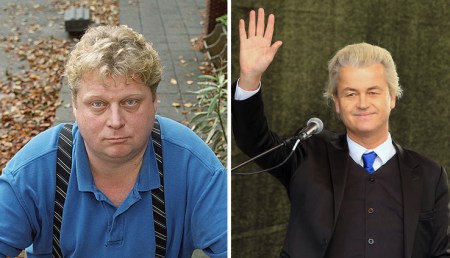
2117Twelve years ago, Dutch filmmaker Theo van Gogh (left) was assassinated by an Islamist who pinned on van Gogh’s chest a letter threatening the life of Geert Wilders (right). Today Wilders, the most prominent politician in the Netherlands, lives in hiding under round-the-clock protection.

Fortuyn had said, “We have a lot of guests who are trying to take over the house.”

Since then, many Dutch artists have capitulated to fear.

Sooreh Hera, from Iran, submitted her photos to the Gemeentemuseum Museum in The Hague. One of these works depicted Mohammed and Ali. After many threats, the museum proposed that it would acquire the photos without publishing them and that one day, perhaps, when the situation was calmer, they might show them then. Hera refused: it would have been self-censorship, a sad day for the West. Rants Tjan, director of Museum Gouda, bravely offered to exhibit her censored images, but that event was later cancelled, too. Hera was forced to go into hiding.

Paul Cliteur, a critic of multiculturalism, announced that he would no longer write for Dutch newspapers about Islam, for fear of reprisals: “With the murder of van Gogh, everyone who writes takes a certain risk. That is a scary development. What I am doing do is self-censorship, absolutely….”

Then a columnist, Hasna el Maroudi, from the newspaper NRC Handelsblad, stopped writing, after receiving threats.

The Dutch artist Rachid Ben Ali, irreverent about Islam, no longer satirizes Muslims.

Amsterdam, a city famous for its exuberant cultural life, had already lived through threats to artists: the occupation by the Nazis during World War II.

Several artists still refuse to mention Theo Van Gogh, so as not to “contribute to… divisions”, according to the New York Times. Translation: They are afraid. Who would not be?

In the Oosterpark, a steel sculpture by the artist Jeroen Henneman, dedicated to Van Gogh, is entitled “De Schreeuw” (“The Scream”). But it is a scream you hardly hear in the Dutch society.

What you do hear is the defiant protest after the conviction of a brave MP, Geert Wilders: “I will never be silent. You will not be able to stop me… And that is what we stand for. For freedom and for our beautiful Netherlands.”

Before being slaughtered, clinging to a basket, Theo van Gogh begged his assassin: “Can we talk about this?

But can we talk?

Ask Geert Wilders, just the latest brave victim of Europe’s Bolshevik thought police.
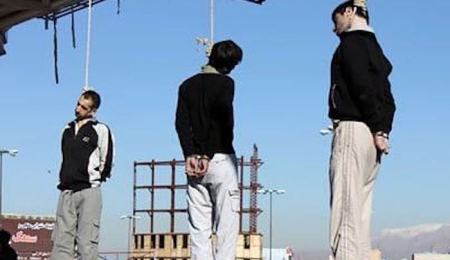
Netherlands: Government-funded watchdog says it’s ok for Muslims to send death threats to gays

December 3, 2016

Netherlands: Government-funded watchdog says it’s ok for Muslims to send death threats to gays, Jihad Watch

(What happened to the “Nothing to do with Islam” notion? — DM)

“The disgraceful stance came to light when a member of the public complained about death threats posted to an online forum which called for homosexuals to be ‘burned, decapitated and slaughtered.’” Yet this “anti-discrimination watchdog” refused to pursue the case, writing: “The remarks must be seen in the context of religious beliefs in Islam, which juridically takes away the insulting character.”

In their globalist ardor to appease and accommodate Islamic supremacists, there seems to be no absurdity that is out of bounds for the political elites.

gay-hanging

“Fury as watchdog says it’s OK to send gay people death threats – but only if you’re Muslim,” by Nick Gutteridge, Express, December 3, 2016:

FURIOUS Dutch MPs have demanded an immediate public inquiry after a government-backed watchdog said it was acceptable for Muslims to send gay people death threats.

In a shocking move, the taxpayer-funded hotline said it would not pursue a criminal complaint over horrific messages from radical Islamists because the Koran says gay people can be killed.

The disgraceful stance came to light when a member of the public complained about death threats posted to an online forum which called for homosexuals to be “burned, decapitated and slaughtered”.

Dutch MPs today reacted with horror to the revelations, demanding an immediate inquiry into the remarks and calling for the hotline to be stripped of public funding.

According to Dutch media advisors from the anti-discrimination bureau MiND said that, while homophobic abuse was usually a crime, it was justifiable if you were Muslim due to laws on freedom of religious expression.

They argued that the Koran says it is acceptable to kill people for being homosexual, and so death threats towards gay people from Muslims could not be discriminatory.

In a jaw-dropping email explaining why they could not take up the complaint, they wrote: “The remarks must be seen in the context of religious beliefs in Islam, which juridically takes away the insulting character.”

They concluded that the remarks were made in “the context of a public debate about how to interpret the Quran” and added that “some Muslims understand from the Quran that gays should be killed”.

And they went on: “In the context of religious expression that exists in the Netherlands there is a large degree of freedom of expression. In addition, the expressions are used in the context of the public debate (how to interpret the Koran), which also removes the offending character.”

The death threats had been made in the comments section for an article about a Dutch-Moroccan gay society, which had been posted to an online platform for Holland’s large Moroccan community….

Reaction of Geert Wilders to Penal Demand of Public Prosecutor

November 17, 2016

Reaction of Geert Wilders to Penal Demand of Public Prosecutor, Gatestone Institute, Geert Wilders, November 17, 2016

I just heard the penal sentence demanded by the Public Prosecutor: a penalty of 5,000 euros.

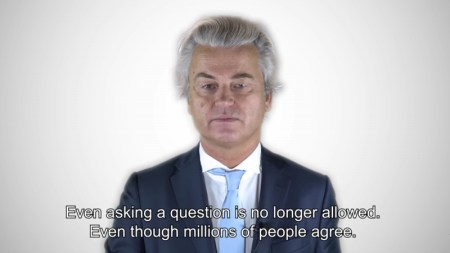
Speaking about one of the biggest problems of our country – the problem with Moroccans – is now punishable, according to the elite. And, hence, we are slowly but surely losing our freedom of speech. Even asking a question is no longer allowed. Even though millions of people agree. And Moroccans have suddenly become a race. So if you say something about Moroccans, you are now a racist. Nobody understands that. It is utter madness. Only meant to shut you and me up.

2051

While in other countries the people send the elite home, here they want to silence an opposition leader. The Netherlands is running the risk of becoming a dictatorship. It looks like Turkey. The differences between the Netherlands and Turkey are getting smaller. The opposition is silenced.

I was elected by nearly a million people. That number will be even higher on March 15th next year. And it is my duty to talk about the problems, even when the politically-correct elite led by Prime Minister Rutte prefers not to mention them. Because looking away and remaining silent is not an option.

I have to say it like it is.

What is the use of political cowards who no longer dare to speak the truth? Who are silent about the problems in our country? Who pander to the government? Who cowardly look the other way?

Nothing at all! Putting one’s head in the sand is cowardliness.

And if you must keep quiet about problems, because simply asking a question has become punishable, the problems will only grow bigger. Then, the Netherlands will become a dictatorship of fearful and cowardly politicians.

I will never accept that. I will continue to fight for a free and safe Netherlands. That is why Islamic terrorists have been trying to kill me for 12 years. Today, these terrorists rejoice. Wilders is going to be punished. The Public Prosecutor has made himself their ally today.

But I will not allow anyone to shut me up!

No terrorist will be able to silence me!

No prosecutor in a black gown or cowardly prime minister will get me on my knees!

I shall therefore not care about their penal demand at all. They can do whatever they want. It will only make me stronger. I will only get more motivated.

And you can support me with this. By continuing to fight with me for the preservation of freedom of expression. For the maintenance of a safe and free Netherlands. Our country.

Geert Wilders is a member of the Dutch Parliament and leader of the Party for Freedom (PVV).

As Geert Wilders again goes on trial for “hate speech,” European media campaigns furiously against him

November 2, 2016

As Geert Wilders again goes on trial for “hate speech,” European media campaigns furiously against him, Jihad Watch

Geert Wilders has yet again gone on trial in the Netherlands for “hate speech,” and this time the case against him is especially flimsy: as Europe is roiled by the criminal activity of Muslim migrants, he is being accused of “hate speech” for saying that the massive influx of immigrants from Morocco (from which most of the Muslim migrants in the Netherlands come) has to be stopped.

This trial could very easily backfire on the Dutch inquisitors, and make Wilders more popular than ever with the people of the Netherlands and Europe in general, as they are increasingly fed up with the political and media elites’ forcing them to accept a massive influx of Muslim migrants that ensures a future only of civil strife, bloodshed, and Sharia oppression.

Consequently, those elites are trying desperately to shore up their position. In this DW piece by freelance “journalist” Teri Schultz, Wilders is (of course) “far-right,” that all-purpose and meaningless semaphore that serves only to signal to right-thinking Deutsche Welle readers that Wilders must be opposed and shunned, his positions unexamined. Schultz contacted me to serve as the villain of her piece, being sure to tell her hapless readers that I am “known for extreme anti-Islam views,” to make sure that if any of them are foolish enough to find themselves agreeing with me, they will immediately reverse themselves and get their minds right. The term “extreme” also, since the Western governing class unanimously refers to jihad terrorists as “extremists,” also implies that I am a terrorist. (After the article came out, I challenged Schultz on this; she replied: “I don’t think even you would consider your views ‘mainstream’, do you?” I responded: “Absolutely yes. My views were the broad mainstream in the Western world from 632 AD until the 1960s. What changed? Not Islamic teaching.” To that she said: “Okay. You’d have to argue it with another expert, which I am not. But thanks again for contributing.” Indeed, she is just a mouthpiece for the views the political and media elites want us to hold.)

In any case, Schultz’s article merely reveals the desperation of the ruling class and the self-appointed opinion-shapers. They can call those of us who wish to defend the people and culture of Europe and North America “far-right” and “extreme” every day (and they do), but the public can see with their eyes what is happening. Wilders’ popularity isn’t growing because he is a charming fellow. It’s growing because he speaks the truths that the political and media elites are in a frenzy to obscure. And it’s only going to get worse for them: the Brexit vote and the Trump candidacy (whether he wins or loses) shows that their hegemony is beginning to be challenged. Those challenges will continue, and grow. They will before too long be decisively voted out and repudiated.

teri-schultz74

“Far-right Wilders skips hate speech trial in Amsterdam,” by Teri Schultz, DW, November 1, 2016:

On Monday, the far-right leader Geert Wilders refused to show up for his trial on charges of hate speech and incitement of violence for comments he made against ethnic Moroccans in the Netherlands.

Instead, Wilders let his legal representatives repeat the views that caused the charges to be brought against him: that the country has a “mega Moroccan problem” and that too many Moroccans get welfare benefits and commit crimes. Wilders believes that he has said “nothing wrong” as he is just vocalizing the views of his constituents….

But while judges ponder the legality of Wilders’ views their popularity grows, as evidenced by Wilders’ showing in the polls and the growth of populist, anti-immigrant parties across Europe, such as the far-right Alternative for Germany. In a world where US Republican Party nominee Donald Trump campaigns on building a wall on the US-Mexican border and a plan to block Muslims from coming to the United States, controversial commentators such Robert Spencer, director of JihadWatch.org, promote Wilders’ perspective. Known for extreme anti-Islam views, Spencer said Wilders’ comments are not out of line.

“Moroccans don’t have some natural right to immigrate to the Netherlands any more than anyone does to anywhere,” Spencer told DW. “And so if someone expresses an opinion saying they would like to slow the rate or stop that immigration, there is nothing ipso facto hateful about that.”

Moroccans make up approximately 2 percent of the Dutch population. Asked how Wilders could consider that as excessive, Spencer said the concern centers more on the growth rate than the actual number of inhabitants at the moment.

Spencer also said since Wilders himself has shown no tendency toward violence – though the court is considering whether he’s encouraging that outcome – the greater “danger to society” would be for Wilders’ remarks to be deemed illegal hate speech.

But European Parliament lawmaker Cecile Kyenge doesn’t think remarks like Wilders’ can be explained away like that. “There has been a constant stream of concerning comments from politicians across Europe,” she said, “that fall short of the responsibilities they have as public figures and opinion leaders. In recent months, politicians have disseminated false information and engaged in hate speech against minorities for political gain. Actions such as these are all the more damaging when they are propagated by politicians.”…

Though Wilders has been acquitted on hate-speech allegations before, Spencer doesn’t necessarily think he’ll be found not guilty again, because Spencer said the ruling elite is afraid of losing power to him. “I wouldn’t be in the least surprised if he were convicted this time and if they don’t convict him this time, they’ll convict him next time. But eventually,” he predicted, “they might have a situation where they’re convicting the sitting prime minister.”

Netherlands FM warns Ankara against meddling in Holland’s internal affairs

August 28, 2016

Netherlands FM warns Ankara against meddling in Holland’s internal affairs

Published time: 27 Aug, 2016 17:39 Edited time: 27 Aug, 2016 20:53

Source: Netherlands FM warns Ankara against meddling in Holland’s internal affairs — RT News


Turkey should refrain from trying to interfere in the Netherland’s internal affairs, Holland’s Foreign Minister said in response to a controversial letter sent by the Turkish consul to Dutch mayors instructing them on how to control anti-Ankara sentiment.

“The Netherlands deals with Dutch society and that is nothing to do with the Turkish government,” FM Bert Koenders said, according to Dutch News.

“We understand the emotions which stem from the terrible attempted coup, but let us solve our differences here… We are free to talk about Turkey and they are free to talk about us, but ultimately, this is a question of national responsibility here in the Netherlands,” Koenders said.

The Foreign Minister is set to pay a one-day visit to Turkey next week to meet with his Turkish counterpart, according to Dutch ANP news agency.

The letter was sent by Turkish Consul General Sadin Ayyildiz to the mayors of several Dutch towns not far from Rotterdam. It contained instructions on how to curb protests organized by those opposed to the Turkish government and also called for action to be taken against the “terrorist group” led by self-exiled cleric Fethullah Gulen, who is accused by Ankara of orchestrating the thwarted coup in July, Dutch News reported.

The entire contents of the letter have not been made public, however.

Koender’s statement echoes a quite similar opinion voiced by Rotterdam Mayor Ahmed Aboutaleb, who also said that Turkey should not meddle in Dutch politics.

Read more

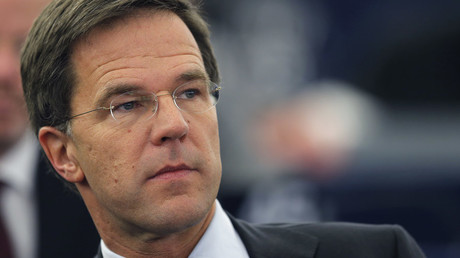
The Netherland's Prime Minister Mark Rutte © Vincent Kessler

Aboutaleb invited the Turkish consul for a discussion, which had been scheduled for Friday, but it was later cancelled without explanation, Dutch Telegraaf reported.

Threats and tensions have been running high in Holland’s Turkish community, which is mostly loyal to Ankara, according a significant number of reports appearing in local media.

“Turkey is trying to install a one-sided political regime. There may by some discussions in the Turkish-Dutch community and Turkey wants to control these discussions, wants to control the opinions,” Laszlo Maracz, an expert for the University of Amsterdam’s department of the European studies, told RT.

This is not the first time Turkey and the Netherlands have gotten into a political spat. In April, the Turkish consulate in the Netherlands allegedly called on local Turks to report on those who insult President Erdogan, sparking outrage among some Dutch lawmakers, who claimed the “long arm of Erdogan” was reaching into the Netherlands. However, the appeal to Dutch Turks was later branded as a mistake by the Ankara.

Anger, Honor and Freedom: What European Muslims’ Attack On Speech Is Really About

June 30, 2016

Anger, Honor and Freedom: What European Muslims’ Attack On Speech Is Really About, Investigative Project on Terrorism, Abigail R. Esman, June 30, 2016

1052

Indeed, much of the Muslim violence in Europe is about exactly this: intimidating non-Muslims into a fearful capitulation, where words like “I hate Muslims” and drawings of Mohammed become extinct because the Muslim communities insist that it be so. It is about forcing Westerners to rearrange their lives, their culture, to accommodate the needs and values and culture of Islam. It is about control, and the power over freedom. And it is about creating a culture in which honor is injured by words and restored through violence and terror.

**********************

“Clash of civilizations,” some say. Others call it the “failure of multiculturalism.” Either way, the cultural conflicts between some Muslims and non-Muslims worldwide continue to play out as Western countries struggle to reconcile their own cultures with the demands of a growing Muslim population.

But herein lies the problem: in many ways, the two cultures are ultimately irreconcilable. There is no middle ground. And hence, the conflicts and the tugs-of-war continue.

Over the past two months, the events surrounding controversial Dutch columnist Ebru Umar have encapsulated that “clash” at its core, a salient metaphor for the tensions, particularly in Europe, between the West’s Muslim populations and its own. More, they illuminate the enormity of the problems we still face.

Umar is no stranger to the spotlight, or to the wrath of Dutch Muslims who read her many columns, most of them published in the free newspaper, Metro. For years, the Dutch-born daughter of secular Turkish immigrants has raged against the failure of other Dutch-born children of immigrants, mostly Moroccan, to assimilate into the culture of their birth. She loudly condemns Dutch-Moroccan families for the shockingly high rates of criminality and violence among Dutch-Moroccan boys – as much as 22 times the rate of Dutch native youth – a phenomenon she ascribes to their Islamic upbringing and their parents’ refusal to allow their children to mingle among the Dutch.

But her critiques have earned her no converts. Instead, Dutch-Moroccan youth, whom she calls “Mocros,” have regularly taunted her, both online and in the street.

This past April, however, Umar added a new team of enemies to her portfolio: when, in response to Turkish president Recep Tayyip Erodogan’s demand that a German satirist be prosecuted for insulting him on TV, Umar tweeted “f***erdogan,” Dutch Turks turned on her in fury. “How dare you insult our president!” cried these Dutch-born subjects of Holland’s King Willem-Alexander. And while Umar took a brief holiday on the Turkish coast, one such Dutch-Turk turned her in to the police. She was arrested at her vacation home in Kusadasi, and though released the following day, was forbidden to leave the country. The charge: Insulting the Turkish president. It took 17 days before discussions between Holland’s prime minister and Turkish authorities enabled her to return to the Netherlands.

But she could not return home. In her absence, Umar’s home had been burgled and vandalized, the word “whore” scrawled on a stairway wall. Death threats followed her both in Turkey and on her return. When it became clear she could not ever return to the apartment she had lived in for nearly 20 years, she announced on Twitter (Ebru Umar posts constantly on Twitter) that she would be moving out.

Meantime, in Metro and elsewhere, she continued her criticism of Moroccans and, as she herself notes, of Islam overall.

And so it was that on the day Ebru Umar moved out of her apartment in Amsterdam, a group of Dutch-Moroccans in their twenties came to see her off, taunting her with chants: Ebru has to mo-o-ve, nyah nyah.” Though furious, she ignored them – until one of them began to film her loading her belongings into her car. For Umar, being taunted by the very people whose threats had forced her from her home in the first place was bad enough: but this violation of what little privacy remained for her was more than she could take. She grabbed her iPhone and began filming them right back. “Go ahead,” she challenged. “Say it for the camera.”

Scuffles ensued, and soon one of the Moroccans had her iPhone in his hand. The others laughed. Then they ran away. Umar filed a police report and, still smarting, took to Twitter once again: “C**t Moroccans, I hate you,” she posted. “I hate you, I hate you, I hate you, I hate you and I hate your Muslim brothers and sisters, too. F**k you all.” (It is important to note that, however offensive, the expression “c**t Moroccans” is a common epithet in the Netherlands.)

But, hey – she was angry. Her phone had been snatched from her hand in a brutal, aggressive gesture that left her feeling violated and, vulnerable. She had just been forced to leave her home. She had endured prison, a criminal inquiry, and death threats, all at the hands of the same group on whom she now spewed her fury.

Her words may have been harsh or inappropriate, but they were words. She had not struck her tormenters as they filmed her. She did not call for their demise, or strap a bomb around her waist and visit the local mosques.

She took to Twitter and said: I hate you.

“But hate,” she tells me later in an e-mail, “is just an emotion.” And in a column penned more than two years ago, she observed, “Hate me till you’re purple, but keep your claws off me.”

Here is where Ebru Umar’s story becomes the story of the Western world. In response to her words (“I hate you. F*** you”), several Muslims – Moroccans and others – filed charges against her for hate speech. (Though ironically, “I hate you” does not legally qualify as “hate speech.”) Such words are an attack upon their honor, a humiliation: and if there is one thing experts on Arab and Muslim culture will agree on, it is the significance of humiliation and honor in governing their lives. For this, Dutch Moroccan youth threaten Umar on the streets, and have done so, she says, for years: after all, she insults them.

1664

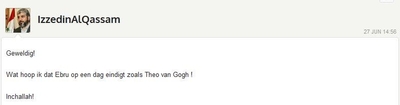
But in truth, it isn’t just the youth. The broader Muslim community stands by, silent: they do not condemn the youth who taunt her, who rip her telephone from her hands, or post things on the Internet like “We hate you, too – can you please kill yourself?” or “Oh, how I hope she ends up like Theo van Gogh.”

Theo van Gogh, also a controversial columnist, was shot and stabbed to death in 2014 by a radical Dutch-Moroccan Muslim.The commenter wishing her the same fate used the name “IzzedinAlQassam,” the founder of modern Palestinian jihad, and an icon of Hamas leader Khaled Meshaal.

For people like this, it doesn’t matter that Umar – or van Gogh – inflicted no violence, any more than it mattered that the editors of Charlie Hebdo were not violent. It was the insult, the humiliation – to them, to Islam, to Mohammed – that mattered: and an insult, a humiliation, deserves a violent response.

Indeed, much of the Muslim violence in Europe is about exactly this: intimidating non-Muslims into a fearful capitulation, where words like “I hate Muslims” and drawings of Mohammed become extinct because the Muslim communities insist that it be so. It is about forcing Westerners to rearrange their lives, their culture, to accommodate the needs and values and culture of Islam. It is about control, and the power over freedom. And it is about creating a culture in which honor is injured by words and restored through violence and terror.

When Umar says “I hate you,” what she hates, really, isn’t the Moroccans who attacked her or their “Muslim brothers and sisters.” What she hates is this – this effort, this battle over honor and speech and freedom, and this clash between violence and expression, guns and conversation.

“I don’t want Muslims to leave,” she tells me, again by e-mail. “I want them to embrace the Enlightenment, Western society, the Netherlands.” And in turn, she calls on the Dutch to “set rules: no violence in any sense. And stop using culture or religion as an excuse for behavior.”

Ebru Umar’s words. More of us should listen.

NETHERLANDS RAMADAN PASSION

June 20, 2016

Roni Stoker

Published on Jun 16, 2016

12 – 13 JUNE 2016. ALMERE, HAARLEM, NETHERLANDS, NOS JOURNAAL,
Violent actions of Muslim youths (especially of North African origin) toward persons and property belong to the Ramadan tradition in the Netherlands, as much as the Mathãus Passion of J.S. Bach to the days before Easter.

https://www.youtube.com/watch?v=pw9dYv1KUsM


Geert Wilders: Let’s Dump Turkey

May 11, 2016

Geert Wilders: Let’s Dump Turkey

by Geert Wilders

11 May 2016

Source: Geert Wilders: Let’s Dump Turkey

The greatest threat to the West is Islam.

Look at every country where Islam is dominant and you will see a total lack of freedom and democracy. Islam and freedom are absolutely incompatible. And yet, we are importing it into our western societies, thereby endangering our own freedoms. It is time to stop this foolishness.

Take Turkey, for example. Turkey’s President, Recep Tayyip Erdogan, has never made a secret of his aim to strengthen the powers of Islam. Contrary to what some want us to believe, Turkey does not prove that Islam and democracy are compatible.

For Erdogan, democracy is merely a tool. He once compared it to a tram: “You ride it until you arrive at your destination, then you step off.”

Today, Mr Erdogan is stepping off.

The repercussions are felt not only in Turkey, but also in European countries, such as Germany and the Netherlands, where large Turkish immigrant communities act as the fifth column of intolerance.

Indeed, the Turkish President not only oppresses free speech at home. He has embarked on a crusade to oppress it in Europe as well. And the large groups of Turkish immigrants in Western European countries are his henchmen.

Last month, the Turkish President demanded criminal prosecution of German comedian Jan Böhmermann. The latter had ridiculed Erdogan with a critical poem on German television.

German Turks began to threaten Böhmermann to such degree that he had to request police protection and go into hiding. At the same time, the German authorities started criminal proceedings against the comedian, based on a 19th century German penal law which forbids insulting the representatives of foreign states.

The criminal proceedings were started with the explicit consent of German Chancellor Angela Merkel, who, according to Böhmermann, has “served me for tea to a despot.”

Meanwhile, Erdogan’s appetite is far from over. This week, he demanded a German court to stop Mathias Döpfner, the CEO of the Springer publishing company, from defending the comedian.

Fear of violent Turkish immigrants also forced a hamburger restaurant in Cologne to shut down. Its owner, Jörg Tiemann, had put a burger with goat cheese on the menu, calling it “the Erdogan burger.” Erdogan supporters immediately responded with threats against owner and staff, forcing the restaurant to close its doors.

Then, there is the case of Ebru Umar, a Dutch journalist of Turkish descent. Four weeks ago, she wrote a column criticizing the Turkish Consulate in Rotterdam. Following the Böhmermann incident, the Consulate had called on Dutch Turks to report incidents of “insults” against Erdogan in The Netherlands.

One week later, while on holiday in the Turkish seaside resort Kusadasi, Umar was arrested and only released on condition that she not leave Turkey. On Facebook and Twitter, hundreds of Dutch Turks openly rejoiced in her arrest.

Her home in Amsterdam was broken into and vandalized.When walking the streets of Kusadasi, Umar was threatened on several occasions by Dutch Turks who had gone looking for her. “We will know where to find you when you return to the Netherlands,” they said. “You will get what you deserve.”

Last Tuesday, after three weeks, the Erdogan regime finally allowed Umar to return to the Netherlands.

Many of those threatening people in the West are third or even fourth generation immigrants to our countries. This proves that – barring a few exceptions – the integration and assimilation of Islamic immigrants into our Western society has failed.

Many of the Islamic newcomers are simply incapable of adopting our values. Indeed, they are a danger to these values.

We must protect these values. And one of the first things to do is to sever our links with regimes promoting Islam. These regimes cannot be our friends; they are dangerous.

It is an outrage that Turkey is still a member of NATO. The sooner we get rid of this Trojan Horse within our Western alliance, the better. We should dump Turkey.

Instead of doing this, however, our current Western leaders are welcoming Turkey.

Next June, the European Union wants to allow visa free travel for Turks. For decades, the EU elites have been promoting Turkish EU membership, eagerly backed by President Barack Obama and by Hillary Clinton, who has even said that she is “strongly in favor of it.”

There is little doubt that if Hillary Rodham Clinton becomes the next President of the United States, she will be a cheerleader for Turkey.

Geert Wilders is a member of the Dutch Parliament and leader of the Party for Freedom (PVV), which is currently by far the biggest party in the Dutch polls. He is the author of “Marked for Death: Islam’s War Against the West and Me” (Regnery)

Dutch Newspaper Publishes Front Page Cartoon Mocking Erdogan After The Arrest Of Dutch Journalist

April 26, 2016

Dutch Newspaper Publishes Front Page Cartoon Mocking Erdogan After The Arrest Of Dutch Journalist, Jonathan Turley’s Blog, Jonathan Turley, April 26, 2016

Netherlands cartoon

Erdogan (like Vladimir Putin) is the face of modern authoritarianism — promising prosperity in exchange for the dismantling of basic civil liberties. The question is whether the West will rally to the side of free speech in time to stop these leaders from returning the world to the age of criminalized speech and censorship.

***************************

As Western leaders like Angela Merkel cave into the authoritarian demands of Turkish President Recep Tayyip Erdogan in crushing free speech, journalists and cartoonists are fighting back. After a Dutch journalist was arrested in Turkey this weekend for allegedly insulting President Recep Tayyip Erdogan, the most-read newspaper in the Netherlands threw down the gauntlet and published a front-page editorial cartoon that shows Erdogan as an ape crushing Europe’s free speech. Since Erdogan demands the prosecution of journalists even outside of Turkey who insult him, the publication could force another confrontation with the aspiring dictator. In the meantime, the West (including the United States) continue to prop up Erdogan as he destroys secular government in Turkey, arrests journalists, and denies the most basic forms of free speech.

The cartoon, entitled “the long arm of Erdogan” was published by the populist daily De Telegraaf, has an ape with Erdogan’s face squashing a woman who appears to be Ebru Umar, the Dutch writer who was arrested in Turkey on Sunday. In the cartoon, the Turkish president is standing on a rock labeled “Apenrots” — a Dutch term meaning “monkey rocks” that is used to refer to the Dutch Foreign Ministry but can also refer to a place where one dominant individual holds power.

It will now to interesting to watch whether the government follows Merkel’s lead in profusely apologizing to Erdogan for the exercise of free speech and/or attempts to bring charges of some kind in the case. The problem for Western leaders who have been leading the rollback on free speech is that citizens are beginning to see the implications of the loss of this defining right for Western Civilization. We have previously discussed the alarming rollback on free speech rights in the West, particularly in France (here and here and here and here and here and here) and England ( here and here and here and here and here and here and here and here and here and here). Much of this trend is tied to the expansion of hate speech and non-discrimination laws. We have seen comedians targeted with such court orders under this expanding and worrisome trend. (here and here).

Erdogan (like Vladimir Putin) is the face of modern authoritarianism — promising prosperity in exchange for the dismantling of basic civil liberties. The question is whether the West will rally to the side of free speech in time to stop these leaders from returning the world to age of criminalized speech and censorship.

Free Speech on Trial in the Netherlands – Again

March 29, 2016

Free Speech on Trial in the Netherlands – Again, Gatestone InstituteRobbie Travers, March 29, 2016

♦ Freedom of speech is the ultimate liberal value — and it is the first value that people who wish to control us would take away.

♦ If a court in a Western society decides to censor or punish Geert Wilders or others for non-violent speech, the court not only attacks the very humanistic values and liberal society we claim to hold dear; it brings us a step closer to totalitarianism. Even the idea of having an “acceptable” range of views is inherently totalitarian.

♦ But what does one do if immigrants prefer not to assimilate? Europeans may be faced with a painful choice: What do they want more, the humanistic values of individual freedom or an Islamized Europe?

♦ Censorship is not a path we should wish to take. While we may rightly fear those on the political right, we would do well to fear even more the autocratic thought-police and censorship on the political left.

You are not truly a proponent of free speech unless you defend speech you dislike as fervently as speech you like.

There are many issues concerning the views of the Dutch MP, Geert Wilders, head of rapidly growing political party, the Freedom Party (Partij voor de Vrijheid, or PVV). Dutch prosecutors have charged Wilders with insulting deliberately a group of people because of their race and inciting hatred. Wilders’s trial focuses on a speech he gave, in which he asked a crowd of supports whether they wanted more or fewer Moroccans in the Netherlands. In another instance, Wilders is reported to have stated that The Hague should be “a city with fewer burdens and if possible fewer Moroccans.” Wilders admits to having made the remarks.

761 (1)Geert Wilders during his March 2014 speech, where he asked “Do you want more or fewer Moroccans?” (Image source: nos.nl video screenshot)

The remarks Wilders made about Moroccans, as they target only one nationality rather than immigration in general, may sound ill-judged or distasteful to some. But do Wilders’s comments, that there should be fewer Moroccans, actually incite hatred or violence? His remarks do not suggest that people attack Moroccans or that people should hate Moroccans; they simply suggest that there should be lower levels of immigration from Morocco.

While Wilder’s comments could certainly be convincingly portrayed as preying on people’s anti-immigration sentiment, does that actually make them an insult to Moroccans, or is he simply supporting policies he thinks would benefit his country? As Wilders himself said in court last week, “What if someone had said, ‘Fewer Syrians?'”

As a society, individuals are responsible for their actions, so if someone acts upon a distortion of Wilders’s words, or is violent because of them, Wilders should not be held responsible for their actions, even if he might choose his words more carefully in the future. A line is dangerous to draw: if we start criminalizing people who have anti-immigration views, poorly expressed or not, then where do we stop?

Is it also possible that because Wilders is labelled as politically “far right,” people on the political “left,” instead of proposing counterarguments, would like to shut him up by branding him a “racist”?

Here are several more statements, none from Wilders; no one who said them has been prosecuted:

  • “We also have s*** Moroccans over here.” Rob Oudkerk, a Dutch Labour Party (PvDA) politician.
  • “We must humiliate Moroccans.” Hans Spekman, PvDA politician.
  • “Moroccans have the ethnic monopoly on trouble-making.” Diederik Samsom, PvDA politician.

One can see that these statements by politicians of the Labour Party, which is one of the current governing parties of the Netherlands, are more inciting, condemnable statements against Moroccans than anything Wilders has said. Yet no prosecution has been initiated against these individuals.

Would it not be better to discuss a nuanced immigration policy openly, like adults, and thereby eliminate prejudice through rational argument?

Prosecuting Wilders has only emboldened the anti-immigrationists, making them less responsive to reason and discussion. Ironically, this trial has moved many left-liberals, who might be criticizing his views, instead to defend his fundamental rights.

On limiting immigration in general, some critics consider that calling for a moratorium on immigration is illiberal — often other groups such as Christians and Yazidis might be fleeing from ISIS or other extremist Islamic organizations. Basing immigration on nationality might also bring back memories of Nazi Germany, when restrictions often were based on crude religious, ethnic and national caricatures. Other critics seem uncomfortable with calls for the dominance of “Christian, Jewish and humanist traditions” within Dutch culture. How, they ask, can one effectively police a “culture” without seemingly authoritarian restrictions on those who might not fit into it?

Still other critics argue that prohibiting the construction of new mosques restricts religious freedom, and could cause further tension with members of the Islamic community, instead of working with them to solve their conflicts with the West.

But what does one do if immigrants prefer not to assimilate?

That, for example, is not an anti-immigration argument; it is a legitimate question that needs to be answered. There are also many questions that pertain to what a society might look like if there is a tectonic demographic shift, along with a tectonic shift in culture that might accompany it.

As one commentator explained, if you have an apple pie with a few cranberries, it is still an apple pie; but if you keep adding more and more cranberries, at some point it is no longer an apple pie, it is a cranberry pie. That is what the Aztecs faced when the Spaniards arrived in South America. That is what Christianity faced in Turkey when the Muslim Turks arrived. Today, in much of the Middle East, Judaism and Christianity have virtually ceased to exist.

Hard as it might be to contemplate, Europeans might at some point be faced with a painful choice: Which do they want more, the humanistic values of individual freedom or an Islamized Europe?

Whether or not one agrees, especially with the tone, this is the dilemma Wilders has chosen to face — before a transformation becomes so fundamental that it cannot be reversed.

Although he has come down on the side of liberal values, this is seen by critics as violating other liberal values, such as not to judge one culture superior to another.

But what should one tolerate, if the other culture advocates stoning women to death for adultery? Or, without four male witnesses attesting to the contrary, regarding rape as adultery? Or executing people for having a different sexual preference, or religion, or for leaving the religion? Or beating one’s wife? Or condoning slavery? Or officially regarding women as worth half a man? Is it a humanistic, liberal value to stay silent — to condemn at least half the population to that?

What if before the Civil War in the United States people had said, “Slavery? But that is their culture!” The British in India outlawed suttee — a ritual in which widows are thrown live onto their husband’s funeral pyre. Is it humanistic say “but that is their culture”?

These are values over which wars have been fought.

So even if many of the policies of Wilders might drastically differ even from those of this author, in a truly liberal, humanistic society, it is one’s duty defend Wilders’s right to express his views without fear of retribution.

If we fail to do that, what we end up with is an authoritarian state in which government agencies decide which views are acceptable and which are not. We have lived through that before with the Soviet Union, and we are now living through it again with countries such as Saudi Arabia, Russia, China, Pakistan and Iran. A happy picture, they are not.

As history shows, as in the French or Russian or Cuban Revolutions, when one person’s views are suppressed, eventually everyone’s views are suppressed. Who decides on the deciders?

If a court in a Western society decides to censor or punish Geert Wilders or others for non-violent speech, the court not only attacks the very humanistic values and liberal society we claim to hold dear; it brings us a step closer to totalitarianism. Even the idea of having an “acceptable” range of views is inherently totalitarian.

“Acceptable” thoughts, by definition, do not need protecting. It is the “unacceptable” thoughts that do. The reason the right to freedom of speech exists is to protect the minority from the majority — so we can openly, freely exchange opinions and have discussions.

If we wish to have any kind of democracy in more than just name, people need to able openly to challenge ideas that are considered unquestionable, even sacred, as well as people who are considered sacred.

Only open discussion can have a beneficial influence by highlighting problems and shaping policy. In discussing even outlandish views, we are reaffirming our right to say them, justifying why liberal values of freedom are paramount. Freedom of speech is the ultimate liberal value — and it is the first freedom that people who wish to control us would take away. As the historian Clare Spark wrote, “Most of European history, with the exception of England, repressed speech that was anti-authoritarian. One might think of Plato, the Spanish Inquisition, and the career of Spinoza for just a few examples.”

Therefore, no proponent of democracy, humanism or liberal values should call for Wilders to be punished or censored for his remarks, even if they might be thought questionably expressed. When you defend the fundamental right of another to express his view, it does not mean that you agree with the view. It does not mean that you would refrain from attacking that view if it seemed based on flawed premises — or even if it did not. Freedom of speech means opposing someone with counterarguments, not trying to silence him.

If Wilders’ views are thought to be anti-humanistic, criminalizing his right to speak freely is even more so. Criminalizing speech only harks back to Giordano Bruno, who was burned at the stake for “blasphemy,” for saying there were a plurality of worlds; or to the trial of Galileo Galilei for claiming that the earth moves around the sun; or the Scopes trial, which attempted to criminalize Darwin’s theory of evolution.

It is restrictions on free speech that are producing many of the worst mockeries of justice today, in countries such as China, North Korea, Pakistan, Bangladesh, Russia, and Iran.

Repressing speech only dangerously hinders the liberal cause. Groups that, in an authoritarian manner, call for censorship and the suppression of debate are being allowed to thrive. We are seeing this now in America on campuses and in the authoritarian attempts to prevent voters from hearing presidential candidates by disrupting speeches. When one fails to answer difficult questions or tries to silence their proponents, instead of solving the problem of prejudice, you are in reality feeding their prejudices and allowing them to grow unchallenged.

We urgently need be concerned about laws that would make “being insulted,” a criminal offense. Where does an “insult” start or stop? In addition, people who claim to be offended might just be using the law to try to silence others with whom they disagree. The culpatory aspect of these laws should probably be reconsidered, and possibly revised by the Dutch government, the United Nations in its UNHRC Resolution 16/18, and others trying to restrict free speech.

Finally, criminalizing views such as those of Wilders does not extinguish them. Yes, people might feel intimidated from raising ideas for fear of reprisals, but the suppressed ideas will continue to fester, often with an even stronger force.

It is completely understandable why many are not quick to come to the aid of Wilders because they deem him an opponent. However, if there is one rallying call to those who are in doubt of whether to support Wilders, it is this: authoritarianism is our enemy, whether it comes from Islamism, or laws restricting speech. We may not like that we have to defend people we may even regard as racists or xenophobes, but if we do not defend the rights of all, then who will be next among us to have his rights eroded?

Censorship is not a path we should wish to take. While we may rightly fear those on the political right, we would do well to fear even more the autocratic thought-police and censorship on the political left.

Wilders should not be standing trial for what he has said. Could there be a question of the case against Wilders being political? It sure looks like that.