Posted tagged ‘Nato’

Why Russia Has Every Right to Be Alarmed by NATO’s Buildup in the Baltics

January 18, 2016

Why Russia Has Every Right to Be Alarmed by NATO’s Buildup in the Baltics

17:16 18.01.2016(updated 17:43

Source: Why Russia Has Every Right to Be Alarmed by NATO’s Buildup in the Baltics

As the North Atlantic Alliance continues to expand its presence in the Baltic countries, Russian experts warn that the US-led alliance is attempting to turn the region into a staging area from which a possible invasion of Russia might take place.

In his swansong State of the Union address before Congress, President Barack Obama indicated that the US would “make sure [that] other countries pull their own weight” in helping Washington contain its geopolitical opponents.Commenting on the president’s remarks, journalist Vasily Vankov suggested that for their part, “Washington’s Baltic satellites can only welcome a situation in which they will be used as a stick with whose help the Americans can have a smack at the Russian bear.”

In his analysis for independent Russian newspaper Svobodnaya Pressa, Vankov recalled that, “impatient ahead of the ‘shift change’ set to take place in the White House, Baltic politicians have raised another tantrum, using the old tune about the ‘Russian threat’. Latvian politician and economist Uldis Osis recently suggested that if Republican frontrunner Donald Trump wins the election, Washington will ‘give away’ the Baltics, Syria and Ukraine to Russia.”

“Apparently,” Vankov writes, “this absurd scenario is taken seriously among the political establishment in the Baltics. At the very least, its officials are doing everything possible to transform the once peaceful, almost pastoral region into a citadel bristling with American bayonets along a potential new eastern front.”

“The militarization of the Baltic states is taking place at an accelerated pace,” the journalist notes, citing the arrival of more and more US heavy equipment, large-scale NATO drills, parades 300 meters from the Russian border, and the creation of new army and air force bases stretching across the region.

​”In response to just indignation on the part of the Russian Foreign Ministry [over the creation of one such base in Lithuania], Lithuanian Defense Minister Juozas Olekas characteristically replied that his country’s moves were ‘forced measures’ taken in connection with Russia’s ‘takeover of Ukrainian territory’ and its ‘aggressive onslaught’ in Syria.”

“And it seems,” Vankov warns, “that the Pentagon has no plans to stop there. Officials have confirmed plans to build warehouses for the forward deployment of military equipment in the Baltic countries, despite the fact that such a move would violate a key provision of the 1997 NATO-Russia Founding Act. Furthermore, this summer’s NATO summit in Warsaw will discuss the placement of increased NATO forces in the region on a permanent (!) basis.”

Commenting on the developments, Ivan Konovalov, the director of the Center for the Study of Strategic Trends, a Moscow-based military think tank, told Svobodnaya Pressa that NATO’s moves to turn the Baltics into a potential staging area for an invasion of Russia is undoubtedly viewed as a threat in Moscow.”I would like to begin by drawing attention to the fact that Moscow has adequately assessed the situation,” Konovalov noted. “A few days ago, the Defense Ministry announced the formation of three new divisions in the western direction. Before the Ukrainian crisis, the area was almost entirely undefended.”

For their part, the analyst suggested, the Baltic countries’ political elites “are using the worsening confrontation between the West and Russia for their own purposes. To begin with, the presence of US and NATO troops on their territory benefits them economically.”

“The military lobby in the Baltic countries has achieved what they were after – the allocation of budgetary funds for armies which could previously be categorized only as ‘dwarf’ in scale. At the same time, the presence of foreign troops will more than reimburse any financial losses. One can only imagine how much the Americans will lay out for the new air bases, of which there are now three in the Baltics. The cost of a full-fledged base, when accounting for aircraft and the ground components, can run upwards of a billion dollars a year.”

“For this reason,” Konovalov explained, “our restless Baltic neighbors are trying to gain permanent bases on their territory – we are talking about big money, which will come in handy for the budgets of countries whose economies have shriveled as a result of the economic crisis and the sanctions war with Russia.”

Commenting on NATO officials’ recent “categorical denial” that NATO’s military buildup poses any threat to Moscow, Konovalov bluntly retorted that “surely you must agree that it is difficult to see how Abrams tanks and artillery can be considered equipment with a purely defensive purpose? Russia was forced to respond because it reminded it of the situation in 1941, when the Germans moved large formations up to our borders, while simultaneously talking about their defensive nature.”As for the current bases’ rotational nature, the analyst noted that it makes little difference. “Yes, NATO is increasing its presence near Russia’s northwest borders on a rotating basis, but by and large, this doesn’t change much. Obviously, they do not want to completely throw out the NATO-Russia Founding Act, because that would untie Moscow’s hands. However, without any fanfare, 300 pieces of NATO heavy equipment have appeared on Russia’s borders. It may not seem like much, but this is already a division-sized force. And to think – only a couple of years ago, Estonia had only one old T-55 tank, which it borrowed from neighboring Latvia to hold military exercises.”

Ultimately, Konovalov warns, “given the pace of the military buildup, it’s not hard to imagine how many pieces of equipment the Baltics might accumulate — say a year from now.”

As for the Russian response to the buildup, the expert notes that Russia “is changing its plans for defense – including the transfer of forces to the western direction. And this is absolutely justified. It is well known that in [Russian] military history, the enemy has most commonly attacked from the west. The main obstacle for invasion has always been the Belarusian marshland. Therefore, they usually bypass the marshes via the northwest and the southwest.”

“By and large, the most convenient bridgehead for an attack on Russia by conventional forces has been via the southern direction. The Germans broke through to Stalingrad via Ukraine. And in the north, they could not pass, stopping at Leningrad…Incidentally, the Wehrmacht’s northern breakthrough failed not least because the Baltic states at the time were part of the Soviet Union. Here, the Germans were forced to break the first line of defense. The defense of Liepaja, Latvia, for example, lasted for almost a week.”As for the worrying prospect of the US deploying tactical nuclear weapons in the Baltics, Konovalov explained that this too is now more likely, given that the latest modification of the B-61 variable yield nuclear bomb can be placed on any airborne platform, and is not limited to strategic bombers.

“The same NATO planes which are now permanently patrolling Baltic airspace, flying near our borders, could be loaded up [with such weapons]. Europe now has 200 such bombs. Accordingly, the 16 aircraft at the bases at Zokniai, Lithuania or Amari, Estonia, can carry them onboard. And the pilots of these countries have been trained on how to use such weapons.”

Speaking to Svobodnaya Pressa, veteran defense commentator Viktor Litovkin agreed with his counterpart that ultimately, “the rotational character of the existing bases, in fact, is of little importance. [All it means is that] one group leaves, and another comes to take their place.”

As to whether the buildup in the Baltics and elsewhere in Eastern Europe violates the spirit of the NATO-Russia Founding Act, Litovkin suggested that in his view, “it obviously does…The Pentagon uses uncertain wording, which forbids the placing of ‘significant numbers of troops’ [in the region]. What precisely is considered ‘significant’? A company-sized force? A battalion? A regiment? A brigade? It is unclear. Moreover, Washington does not want to negotiate with Moscow on the concretization of this fuzzy definition.”

Ultimately, the analyst notes, “NATO will not risk an invasion of Russia. But the deployment of military bases in the Baltics is akin to a situation where you get a stone caught in your shoe. If you cannot shake it out, it will be a constant irritant, and may eventually make it painful to walk.””This NATO ‘stone in our shoe’ will force Moscow to react. And the US is actively trying to provoke another arms race in order to weaken our country economically. The Baltic states’ leaders also benefit – receiving rent for the bases, and taxes for local budgets. Therefore, I would say that the anti-Russian hysteria among the Baltic countries’ political elites have a multi-valued character.”

Emphasizing that Russia full realizes the risks created by NATO’s provocations, Litovkin concludes that in any case, “the three new divisions, referred to by Defense Minister Sergei Shoigu, are only one small part of the measures Russia will take to ensure the security of its western borders.”


A Strategy to Defeat Islamic Theo-fascism

January 7, 2016

A Strategy to Defeat Islamic Theo-fascism, American ThinkerG. Murphy Donovan, January 7, 2016

Surely, whatever passed for American foreign or military policy in the past three decades is not working. Just as clearly, in case anyone keeps score these days, the dark side of Islam is ascendant at home and abroad. What follows here is a catalogue of policy initiatives that might halt the spread of Islamic fascism and encourage religious reform in the Ummah.

Some observers believe that the Muslim problem is a matter of life and death. Be assured that the need for Islamic reform is much more important than either. The choices for Islam are the same as they are for Palestine Arabs; behave or be humbled. Europe may still have a Quisling North and a Vichy South; but Russia, China, and even America, at heart, are still grounded by national survival instincts – and Samuel Colt.

Call a spade a spade

The threat is Islam, both kinetic and passive aggressive factions. If “moderate” Islam is real, then that community needs to step up and assume responsibility for barbaric terror lunatics and immigrants/refugees alike. Neither America nor Europe has solutions to the Islamic dystopia; civic incompetence, strategic illiteracy, migrants, poverty, religious schisms, or galloping irredentism. The UN and NATO have no remedies either. Islamism is an Ummah, Arab League, OIC problem to solve. Absent moral or civic conscience, unreformed Islam deserves no better consideration than any other criminal cult.

Western Intelligence agencies must stop cooking the books too. The West is at war and the enemy is clearly the adherents of a pernicious ideology. A global war against imperial Islam might be declared, just as angry Islam has declared war on civilization.  A modus vivendi might be negotiated only after the Ummah erects a universal barrier between church and state globally. Islam, as we know it, is incompatible with democracy, civility, peace, stability, and adult beverages.

Oxymoronic “Islamic” states need to be relegated to the dustbin of history. If the Muslim world cannot or will not mend itself, Islamism, like the secular fascism of the 20th Century, must be defeated, humbled in detail. Sooner is better.

Answer the Ayatollahs

Recent allied concessions to Tehran may prove to be a bridge too far. If the Persian priests do not abide by their nuclear commitments, two red lines might be drawn around Israel. Firstly, the ayatollahs should be put on notice, publicly, that any attack against Israel would be considered an attack against America — and met with massive Yankee retaliation. Secondly, any future cooperation with NATO or America should be predicated on an immediate cessation of clerical hate speech and so-called fatwas, those arbitrary death sentences.

Clerical threats to “wipe Israel off the face of the earth” and “death to America” injunctions are designed to stimulate jihad and terror globally. The only difference between a Shia ayatollah and a Sunni imam in this regard these days seems to be the torque in their head threads.

Ostracize the Puppeteers

Strategic peril does not emanate from Sunni tacticians like Osama bin Laden, Mullah Omar, or Abu Bakr al-Baghadadi. Nor does the real threat begin with or end with al Qaeda, the Taliban, Hezb’allah, Hamas, or the Islamic State. Lethal threat comes, instead, on four winds: toxic culture, religious politics, fanatic fighters, and furtive finance, all of which originate with Muslim state sponsors. The most prominent of these are Saudi Arabia, the Emirates, Turkey, Iran, and Pakistan.

Put aside for a moment the Saudi team that brought down the Twin Towers in New York. Consider instead, the House of Saud as the most egregious exporter of Salifism (aka Wahabbism) doctrine, clerics, imams, and mosques from which ultra-irredentist ideologies are spread. The Saudis are at once the custodians of Islam’s sacredshrines and at the same time the world’s most decadent, corrupt, and duplicitous hypocrites. Imam Baghdadi is correct about two things: the venality of elites in Washington and Riyadh. The House of Saud, an absolutist tribal monarchy, does not have the moral standing to administer “holy” sites of any description — Mecca, Medina, or Disneyland.

The cozy relationship between Europe, the European Union, and Arabia can be summarized with a few words; oil, money, arms sales, and base rights. This near-sighted blend of Mideast obscenities has reached its sell-by date. The “white man’s burden” should have expired when Edward Said vacated New York for paradise.

Jettison Turkey and Pakistan

What Saudi Arabia is to toxic ideology in North Africa, Turkey and Pakistan are to perfidy in the Levant and South Asia. Turkey and Pakistan are Islam’s most obvious and persistent grifters. Turkey supports the Islamic State and other Sunni terror groups with a black market oil racket. Pakistan supports the Taliban, al Qaeda, and ISIS with sanctuary and tolerance of the world’s largest opium garden. Oil and drug monies from Arabia, Turkey, and South Asia are financing the global jihad. Turkey also facilitates the migration of Muslims west to Europe while sending Islamist fighters and weapons south to Syria and Iraq.

With the advent of Erdogan and his Islamist AKP, Turkey has morphed into NATO’s Achilles Heel, potentially a fatal flaw.  Turkey needs to be drummed out of NATO until secular comity returns to Ankara. Pakistan needs to be restrained, too, with sanctions until it ceases to provide refuge for terrorists. Pakistani troops harassing India could be more prudently redeployed to exterminate jihadists.

Sanctions against Russia and Israel are a study in moral and political fatuity whilst Arabs and Muslims are appeased midst a cultural sewer of geo-political crime and human rights abuses. If NATO’s eastern flank needs to be anchored in trust and dependability, Russia, Kurdistan, or both, would make better allies than Turkey. Ignoring Turkish perfidy to protect ephemeral base rights confuses tactical necessity with strategic sufficiency.

Recognize Kurdistan

Aside from Israel, Kurdistan might be the most enlightened culture in the Mideast. The Kurds are also the largest ethnic group in the world not recognized as a state. While largely Muslim, the Kurds, unlike most of the Ummah, appreciate the virtues of religious diversity and women’s rights. Indeed, Kurdish women fight alongside their men against Turkish chauvinism and Sunni misogyny with equal aplomb. For too long, the Kurds have been patronized by Brussels and Washington.

While Kurdish fighters engage ISIS and attempt to control the Turkish oil black market, Ankara uses American manufactured NATO F-16s to bomb Kurds in Turkey and Syria. Turkish ground forces now occupy parts of Iraq too. In eastern Turkey, Ergdogan’s NATO legions use ISIS as an excuse for bookend genocide, a cleansing of Kurds that might rival the Armenian Christian genocide (1915-1917).

195876_5_Kurdish angel of death

All the while, American strategic amateurs argue for a “no-fly” zone in contested areas south of Turkey. Creating a no-fly zone is the kind of operational vacuity we have come to expect from American politicians and generals. Such a stratagem would foil Kurdish efforts to flank ISIS and allow the Erdogan jihad, arms, and oil rackets to flourish. A no-fly zone is a dangerous ploy designed to provoke Russia, not protect Muslim “moderates.”

Putin, Lavrov, and the Russians have it right this time; Turkish and Erdogan family subterfuges are lethal liabilities, not assets.

Washington and European allies have been redrawing the map in Eastern Europe, North Africa, South Asia, and the Mideast since the end of WWII. The time has come to put Kurdistan on the map too. Kurdistan is a unique and exemplary case of reformed or enlightened Islam; indeed, a nation that could serve as a model for the Muslim world.  If base rights are a consideration, Kurdistan would be an infinitely more dependable ally than Turkey or any corrupt tribal autocracy in Arabia. America has a little in common with desert dictators — and fewer genuine friends there either. Indeed, at the moment America is allied with the worst of Islam.

Create New Alliances

NATO, like the European Union, has become a parody of itself. Absent a threat like the Soviet Union or the Warsaw Pact, Brussels has taken to justifying itself by meddling in East Europe and resuscitating a Cold War with the Kremlin. Indeed, having divided Yugoslavia, NATO now expands to the new Russian border with reckless abandon; in fact, fanning anti-Russian flames now with neo-Nazi cohorts in former Yugoslavia, Georgia, and Ukraine.

NATO support for the Muslims of one-time Yugoslavia is of a piece with support for Islamic troublemakers in Chechnya and China too. Throughout, we are led to believe that jihad Uighurs and caliphate Chechens are freedom fighters. Beslan, Boston, Paris, and now San Bernardino put the lie to any notion that Islamists are “victims” (or heroes). Indeed, the Boston Marathon bombing might have been prevented had Washington a better relationship with Moscow.

Truth is, America has more in common with Russia and China these days than we do with any number of traditional European Quislings. Indeed, it seems that Europe and America can’t take yes for an answer.

The Cold War ideological or philosophical argument has been won. Moscow and Beijing have succumbed to market capitalism. Islamism, in stark contrast, is now a menace to Russian, Chinese, and American secular polities alike. The logic of a cooperative or unified approach to a common enemy seems self-evident. America, China, and Russia, at least on issues like toxic Islam, is a match made in Mecca.

The late great contest with Marxist Russia and China was indeed a revolution without guns. Now the parties to that epic Cold War struggle may have to join forces to suppress a theo-fascist movement that, like its Nazi predecessor, will not be defeated without guns. The West is at war again, albeit in slow motion. Withal, questions of war are not rhetorical. Saying that you are not at war does not make it so. Once declared, by one party or the other, the only relevant question about war is who wins and who loses. Losers do not make the future.

If America and Europe were as committed to Judeo/Christian secular values as Islamists are committed to a sick religious culture, then the war against pernicious Islam would have been won decades ago. Or as Jack Kennedy once put it: “Domestic policy can only defeat us; foreign policy can kill us.

Trump Footnote

Donald Trump made several policy suggestions on the Islamism issue, one on immigration, the other on Mideast oil. On the former, he suggests a hiatus on Muslim immigration until America develops a plan or reliable programs to vet migrants. On Arab oil, he suggests, given the lives and treasure spent liberating Kuwait and Iraqi oil fields, America should have held those resources in trust and use oil revenues to finance the war against jihad, however long that takes. The problem with both Trump ideas is that they come perilously close to common sense, an American instinct in short supply these days.


Baghdad ultimatum to Ankara expires, Moscow to discuss Turkish military invasion at UNSC

December 8, 2015

Baghdad ultimatum to Ankara expires, Moscow to discuss Turkish military invasion at UNSC

Published time: 8 Dec, 2015 10:15 Edited time: 8 Dec, 2015 19:05

Source: Baghdad ultimatum to Ankara expires, Moscow to discuss Turkish military invasion at UNSC — RT News

© Murad Sezer
The Iraqi PM has called on NATO to intervene shortly after the deadline of a Baghdad-issued ultimatum demanding that Turkish troops leave its territory expired. Ankara has refused to withdraw.

Iraq “is incumbent upon NATO to use its powers to urge Turkey to withdraw immediately from Iraqi territory,” a statement posted on Iraqi Prime Minister Haider al-Abadi’s website said on Tuesday.

The statement was made after the Baghdad government’s 48-hour deadline for Turkish withdrawal expired. Al-Abadi has already spoken with NATO Secretary General Jens Stoltenberg by telephone regarding the matter, the statement added, saying that the PM “reiterated during the call that these forces are present without the knowledge and consent of the Iraqi government.”

READ MORE: ‘Hostile act:’ Iraqi PM denounces US ground forces deployment on Iraq’s territory

Meanwhile, Russia intends to bring up Ankara’s invasion of northern Iraq at the UN Security Council on Thursday.

“The issue will be raised at a closed-door meeting,” TASS cited a diplomatic source within the organization as saying. The source also dismissed earlier reports that Moscow was going to call a separate UNSC meeting.

The Russian Foreign Ministry has expressed grave concern over reports of the US-led coalition’s missile airstrike on the Syrian Army base near Ayyash in the Deir ez-Zor province, which killed three Syrian soldiers, as well as an airstrike in Al-Hasakah Governorate that resulted in multiple civilian casualties.

“Generally, these facts serve proof that the situation on the frontline with Islamic State is heating up,” the Foreign Ministry’s Information and Press Department acknowledged.

“An additional and extremely dangerous factor promoting international tensions is the unlawful presence of the Turkish armed forces on Iraqi territory near the city of Mosul, which arrived there without a request and approval of the legitimate government of Iraq,” the Russian Foreign Ministry said in a statement.

We consider this [military] presence unacceptable,” the statement says, adding that violation of international law principles, such as respect towards other states’ sovereignty is “at the core of the emerging problems.”

READ MORE: ‘NATO member Turkey gets immunity from violating international law’

According to Iraqi media,Prime Minister Haider Al-Abadi has put the Iraqi Air Force on high alert and the ruling National Iraqi Alliance has given the prime minister the go-ahead to take “any measures” to ensure territorial integrity and protect its borders, including addressing the UN and the Arab League.

The Turkish Foreign Ministry announced on Tuesday that the country is suspending further deployment of troops to Iraq, but refuses to withdraw servicemen and hardware already on Iraqi soil.

Baghdad was informed of Ankara’s decision in a phone conversation between the Turkish and Iraqi foreign ministers late on Monday.

Turkish Foreign Minister Mevlut Cavusoglu reiterated Ankara’s respect for Iraq’s territorial integrity, Foreign Ministry spokesman Tanju Bilgic told reporters.

In a separate statement, Turkish PM Davutoglu expressed readiness to visit Baghdad as soon as possible to discuss the current troop deployment crisis between Ankara and Baghdad.

Iraqi media reported earlier that on December 4 Iraq’s PM said: “Turkish troops numbering around one regiment armored with tanks and artillery entered Iraqi territory,” labeling the incident as a “serious breach of Iraqi sovereignty.” He added that the move “does not conform with good neighborly relations,” and called on to Ankara to “withdraw immediately from Iraqi territory.”

Ankara’s reaction has been offhand. It claimed up to 150 of its troops had crossed into Iraq to train forces battling Islamic State (IS, formerly ISIS/ISIL).

Although the US-led anti-IS coalition was aware of Turkey’s move, it emerged later that Ankara’s deployment is not part of the efforts of the US-led coalition battling Islamic State.

Turkish troops did not simply cross the Iraqi border into the Nineveh province, but penetrated 100 kilometer into Iraq, according to Reuters. They reached the Bashiqa region, about 10 kilometers northeast of Mosul, Iraq’s second largest city, which has been occupied by IS terrorists since June 2014.

Turkey is lying when it says it received Baghdad’s blessing to invade part of its territory, according to the Iraqi PM.

On Monday, the governor of the Iraqi province of Nineveh told Sputnik that the number of Turkish servicemen there has reached 900.

On December 6, Baghdad warned that “Iraq has the right to use all available options, including resorting to the UN Security Council if these forces are not withdrawn within 48 hours,” reiterating the same ultimatum on Monday giving Ankara 24 hours to leave the area.

READ MORE: ‘Incursion’: Baghdad demands Turkey withdraw ‘training’ troops from northern Iraq

Iraqi Defense Minister Khaled Obeidi turned down his Turkish counterpart’s invitation to visit Ankara. A spokesman for the Iraqi Defense Ministry said the visit will take place only after Turkey sends “positive signals” regarding the withdrawal of its troops from northern Iraq.

Ankara refused to extract its military, claiming that heavily armed troops deployed to a camp near Mosul are needed to protect an Iraqi Kurd training mission, which is taking place near the frontline with Islamic State.

“It is our duty to provide security for our soldiers providing training there,” the Guardian cited the Turkish Foreign Minister Mevlüt Çavuşoğlu as saying in an interview with Kanal 24 television. “Everybody is present in Iraq … The goal of all of them is clear. Train-and-equip advisory support is being provided. Our presence there is not a secret.”

Russia Devouring the Eastern Mediterranean?

December 5, 2015

Russia Devouring the Eastern Mediterranean?

by Burak Bekdil

December 5, 2015 at 5:00 am

Source: Russia Devouring the Eastern Mediterranean?

  • Turkey shot down a Russian jet. No gain, but plenty of damage to its economy. Russia gave up one jet to Turkey and has made its military presence in Syria and the strategic eastern Mediterranean permanent.
  • Turkey can no longer speak to Russia about the possibility of ousting Assad.
  • Putin seems to be making sure that NATO will do nothing.

At this year’s G-20 summit in Antalya, Turkey, Russian President, Vladimir Putin, said that the radical jihadist Islamic State (IS) was being financed by donors from at least 40 countries, including some G-20 member states — clearly pointing his finger, without naming names, at Saudi Arabia and Turkey. A few days later, two Turkish F-16 jets shot down a Russian SU-24 warplane, and claimed that the Russian jet had violated Turkish airspace for 17 seconds on the country’s Syrian border — a violation Russia denies. This was the first time a Soviet or Russian military aircraft was shot down by a NATO air force since the end of WWII.

Turkey and Russia have long been in a proxy war in Syria: Russia, together with its quieter partner, China, supports the Shi’ite Iran-backed Syrian regime of President Bashar al-Assad; and Turkey explicitly supports Assad’s Sunni opponents [“moderate” jihadists] — apparently in the hope of building a Muslim Brotherhood/Hamas-type of regime in Damascus that would be friendly to its own Islamist government. After the downing of the Russian jet, the Turco-Russian proxy war has become less proxy.

No more Mr. Nice Guy.
Russian President Vladimir Putin twice refused to meet with Turkish President Recep Tayyip Erdogan on the sidelines of the Paris Climate Summit this week. Pictured: President Putin with then Prime Minister Erdogan, meeting in Istanbul on December 3, 2012. (Image source:kremlin.ru)

An angry Putin called the incident “a stab in the back.” He declined Turkish President Recep Tayyip Erdogan’s requests to discuss the issue. He twice refused to meet Erdogan on the sidelines of the Paris Climate Summit.

Russia’s foreign minister, Sergei Lavrov, quickly cancelled his official visit to Turkey — a visit that had been scheduled for the day after the downing of the Russian jet. At the outset, NATO member Turkey had taught Russia a good lesson. In reality, judging from the consequences, it all looks like a Russian gambit, with Turkey shooting itself in the foot and risking a new NATO-Russia conflict.

Russia’s ire seemingly is being expressed in economic terms:

  • Moscow said it will introduce visa restrictions for Turkish citizens, beginning Jan. 1, 2016.
  • Russian authorities detained a group of Turkish businessmen on charges of “false statements about their trip to the country.”
  • Press reports noted that Russia was considering limiting or excluding Turkish construction companies from the country, a potentially multi-billion dollar loss for the Turkish economy.
  • Moscow warned its citizens against visiting Turkey — a ban that could deal a big blow to Turkey’s lucrative tourism industry. Last year 4.5 million Russians visited Turkey, mostly its Mediterranean coast. Russian tour operators were warned to suspend business with Turkey.
  • The fate of two huge Turco-Russian energy projects remains unknown, as Russia’s energy minister, Alexei Ulyukayev, did not rule out sanctions hitting the Turkish Stream gas pipeline and a planned Russian nuclear energy plant in Turkey. Turkey buys about 55% of its natural gas from Russia. Its second largest gas supplier is Iran, Russia’s ally — and Turkey’s rival — in Syria.
  • Russia’s Minister of Agriculture, Alexander Tkachev, said that Russia would be replacing Turkish food imports with goods from Iran, Israel and Morocco.
  • Shipments of wheat to Turkey from key Russian ports were put on hold.
  • The Kremlin officially announced a wide range of sanctions on Turkey, including a ban on Turkish workers (with estimates that 90,000 will be fired by Jan. 1, 2016), restrictions on imported goods and services from Turkey and calls for “strengthening of port control and monitoring to ensure transport safety.”
  • Around 1,250 trucks carrying Turkish exports were blocked from entering Russia on Nov. 30 and were stranded at border posts, awaiting clearance.
  • Russian soccer clubs will be banned from signing Turkish players during the upcoming winter break.

All of that is commercially punitive. There is a more serious side of the Turco-Russian conflict that concerns NATO and western interests in the Middle East.

Russian Defense Minister Sergei Shoigu announced on Nov. 25 that Russia would deploy S-400 surface-to-air missile systems in its Hmeymim air base in Syria.

Turkey shot down a Russian jet. No gain, but plenty of damage to its economy. Russia gave up one jet and has made its military presence in Syria and the strategic eastern Mediterranean permanent. It has reinforced its bases in Syria and intends to build a new military base there. Turkey can no longer speak to Russia about the possibility of ousting Assad.

In a further move to escalate tensions, the Russian General Staff deployed one of its largest air defense ships at the edge of Turkish territorial waters in the Mediterranean. Russian military spokesman General Sergei Rudskoi said that Russian bomber aircraft would be “supported by chasers, and any kinds of threats will be responded to instantly.” Accordingly, The Moscow, one of the Russian Navy’s two largest warships and the flagship of Russia’s Black Sea Fleet, will be deployed where Turkey-Syria territorial waters connect.

In addition, Putin issued orders to deploy nearly 7,000 troops, plus anti-aircraft missiles, rocket launchers, and artillery to the Turkish border, and asked them to be in readiness for full combat.

There have been other military repercussions, too. Since the shooting down of the Russian jet, the Russian military has been regularly pounding the Syrian villages near the Turkish border that populated by the Turkmen, a Turkish ethnicity that supports jihadists in Syria — and is supported by Ankara. The Russians also have been hitting Turkish aid convoys bound for Turkmen villages. More than 500 Turks and Turkmen have been killed in Russian airstrikes. Meanwhile, the U.S.-led allied air strikes against IS have come to a halt. Neither Washington nor Ankara is keen for another conflict with Russia. So, IS and Russia keep on flourishing.

The Russian military has scrapped all contacts with the Turkish military, possibly waiting for the first Turkish military aircraft that violates foreign airspace to shoot.

Turkey has every liberty to challenge Russia and, inevitably, become the victim. But with its geostrategic, Islamist ambitions, it is exposing NATO allies to the risk of a fresh conflict with Russia — and at a time when the wounds of previous conflicts remain unhealed.

Putin has accused Turkey’s leaders of encouraging the Islamization of the Turkish society, which he said was a “problem.” He was not wrong. In fact, Islamism and neo-Ottoman ambitions are the source of Turkey’s (not-so) proxy war with Russia in the Syrian theater. Although Turkey, officially, is a NATO member and part of the allied campaign against IS, its Sunni Islamist ambitions over Syria hinder the global fight against jihadists. A Turco-Russian conflict is weakening the fight.

Putin seems to be making sure that NATO will do nothing.

Burak Bekdil, based in Ankara, is a Turkish columnist for the Hürriyet Daily and a Fellow at the Middle East Forum.

Europe cuts refugee deal

November 29, 2015

Europe cuts refugee deal, Washington ExaminerPaige Winfield Cunningham, November 29, 2015

(Please see also, Does ISIS Owe Its Success to Turkey? — DM)

730x420-4dd28666e754459c14faa8917f5c133cThe agreement is expected to significantly stem the tide of hundreds of thousands of refugees from Syria, Iraq and Afghanistan seeking asylum in other countries who are hesitant to let them in their borders. (AP Photo)

Turkey will contain more Middle Eastern refugees within its owns borders so fewer of them flee to other European countries, under a deal it reached Sunday with the European Union.

In return for tightening its border control, Turkey will get several billion dollars from the EU and assistance in its efforts to join the coalition of 28 countries. The agreement is expected to significantly stem the tide of hundreds of thousands of refugees from Syria, Iraq and Afghanistan seeking asylum in other countries who are hesitant to let them in their borders.

The U.S. has admitted fewer than 2,000 Syrian refugees since 2012, yet the flood of migrants in Europe has incited a fierce political debate over whether they are sufficiently screened before entering the country.

President Obama wants to admit 10,000 Syrian refugees next year, saying that a robust vetting process will be in place. Refugees currently have to wait an average of 18-24 months before entering the U.S., as they’re screened by several different government agencies.

But many Republicans running for president have said they should be blocked until stricter screening measures are put in place and some GOP governors have tried to prohibit them from entering their own states. Former Florida Gov. Jeb Bush, who has suggested only refugees who prove they are Christian should be admitted to the U.S., reiterated that position on Sunday, saying on CNN’s “State of the Union” that refugees should be screened for their religion.

And Ben Carson, who is currently polling second in the GOP primary battle, said Middle Eastern countries that are closer geographically to refugees’ home countries should get more financial assistance to help them. Carson spoke with CNN from Jordan, where he has visited Syrian refugee camps.

Carson said instead of focusing on how to let more refugees into the U.S., which is much more difficult for them to travel to, policymakers should figure out how to allow more to settle in countries at closer proximity where they wouldn’t have to experience as big a change in culture. Jordan, for example, should get more money to admit more refugees, Carson said.

“It seems like everybody in the international community is spending more time saying how can we bring refugees here rather than support a facility that is already in place that the refugees are finding perfectly fine — when it’s fully funded,” Carson said.

The Accomplices Have Their Backs Against the Wall

November 29, 2015

The Accomplices Have Their Backs Against the Wall NATO knows its Turkish member’s ties to ISIS will be revealed if Russia succeeds in Syria

German Economic News

Source: The Accomplices Have Their Backs Against the Wall

Originally Appeared at German Economic News; Translated by Susan Neumann

NATO is extremely nervous, because it knows that the truth about the relationship of NATO-member Turkey to the Islamist terror group (IS) will come to light if there is a Russian victory in Syria. If the refugees are able to return, Erdogan won’t have them as a pawn to extort money [from the EU]. It’s clear who’s interested in an escalation of the conflict.

The reaction of the Western alliance on the shooting down of a Russian bomber show that NATO is very nervous. It’s on the verge of losing control of Russia in Syria. The great Turkish ride out, which was most likely planned by the secret services, looks more like a desperate symbolic act than a carefully considered commando operation. The Russian Ambassador to NATO, Alexander Grushko, called it shadow theatre.

The reason why NATO is looking for shady place to hide is the fact that Putin named those who shot down the Russian aircraft accomplices of the terrorists. Turkey is a NATO country. The alliance is confronted with the official accusation of terrorism for the first time. Until now, NATO has been the only one to slap others with the terrorist label. The real reason for their nervousness is tangibly rooted in the military.

The hopes of NATO and their secret services are being dashed on the rocks. US President Barack Obama has been running a different political course than that which NATO and their secret services would want. Obama wants to get out of the Syria war. He’s admitted that the mission has failed — and the idea of “regime change” has taken a heavy beating, to say the least. Obama has arranged it with Russian President Vladimir Putin that the Russians take over the IS-project. This has been devastatingly humiliating for the neocons, NATO, and the secret services.

After that, Russia began fighting terrorists who were allies of the US military. From the very beginning, Putin has stood in the way of the western military’s desire to cover up their manipulations Syria. The Islamic State and the military advisers of both Turkey and the Pentagon are now facing defeat in Syria.

US President Obama knows this as well. His message to Putin is therefore remarkably diplomatic. After a meeting at the White House with French President Francois Hollande, President Barack Obama said that if Moscow had a “change of strategy,” there would be “great potential” for cooperation. “Russia is welcome to be a part of our broad coalition.” It’s Obama’s half-hearted attempt to make it appear to NATO that they can bring Russia under control.

Why indeed, should Russia change its strategy, above all now? The Russians have kept repeating that the reason they’ve involved themselves militarily in Syria is because NATO has failed. One can believe that, because the Russians know that a fight to uncover terrorist cells is anything but easy. In order not to end up like the Americans in no man’s land, the Russians have made skillful alliances with Iran, Iraq, and China; and have even allowed Israel to have access to their information.

The military successes of the past few weeks have put the Western mercenary troops in dire straits. Obama’s added invitation for the Russians to join in is the real reason why NATO is so nervous. Obama says Moscow should work in close military cooperation and target their air strikes on the IS rather than the moderate rebels. They should also support political change in Damascus.

Russia has supported the change in Damascus for weeks. Moscow has repeatedly said that it doesn’t insist on Assad being president in the long run. The Russians do say, however, that it must be the decision of the Syrian people. This position is also shared by Iran. Russia has also submitted a transition plan of Syria, post-war. Within 18 months a new constitution could be drafted and new elections could be held. If anybody needed to make a strategic change, it would be the Western alliance. They have presented no political concept other than the battle cry, “Assad must go!”

The main worry of NATO, and Turkey in particular, lies in the risk that a Russian victory could uncover all the goings-on, of how the West and especially the Turkish government cooperated with the terrorists in the region. [If the Russians are victorious,] it will show the refugee debate in a completely different light, and it will become clear how the Turkish President Recep Tayyip Erdogan cynically abused the refugees as bartering chips for his ambitions. It will also show that Erdogan’s war against the PKK is a completely disproportionate war, one in which the Kurdish civilian population was brutally attacked. One will also recognize that the West only has the Turkish government and Saudi Arabia as its allies, in a region with two Islamist governments.

Erdogan can still blackmail the totally incompetent EU and the German chancellor, who is totally over her head — by demanding billions of euros in protection money for the refugees. If the Russians truly succeed, however, in bringing peace to Syria — and in such a way that a majority of the refugees can return to their homeland — then Erdogan suddenly has a bad poker hand. Turkey is of course totally unsuitable to be included in the EU under Erdogan. Everybody in Brussels knows it. The visa-free travel is also a grotesque idea. Every day there are new incidents of how business can be conducted with fake Turkish passports — especially in Turkey. Then there’s the three billion euros that Erdogan demands from European taxpayers for the refugees. What’s going to happen with the money? Integration of refugees in Turkey? Better accommodation in the camps? No corruption, complete transparency?

This whole outlook makes Erdogan’s government and its intelligence agencies feel justified in shooting down a Russian fighter jet. They need an escalation of the situation, because they have their backs to the wall. That also makes Erdogan unpredictable in this conflict. He has a lot to lose.

For documentation purposes, we’ve published the report by the Germany Press Agency on NATO’s statement about the shoot-down. It proves that military units were not invented to think.

Russian S-400 missiles turn most of Syria into no-fly zone, halt US air strikes

November 28, 2015

Russian S-400 missiles turn most of Syria into no-fly zone, halt US air strikes, DEBKAfile, November 28, 2015

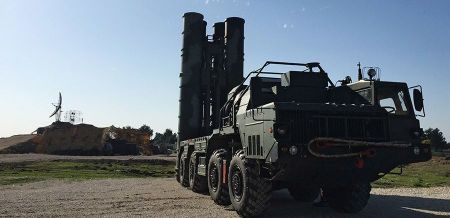
2746772 11/26/2015 An S-400 air defence missile system is deployed for a combat duty at the Hmeymim airbase to provide security of the Russian air group's flights in Syria. Dmitriy Vinogradov/Sputnik

2746772 11/26/2015 An S-400 air defence missile system is deployed for a combat duty at the Hmeymim airbase to provide security of the Russian air group’s flights in Syria. Dmitriy Vinogradov/Sputnik

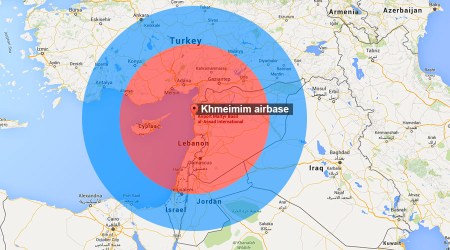
S-400_range_map_25.11.15

The deployment of the highly advanced Russian S-400 anti-air missiles at the Khmeimin base, Russia’s military enclave in Syria near Latakia, combined with Russia electronic jamming and other electronic warfare equipment, has effectively transformed most of Syria into a no-fly zone under Russian control.

Moscow deployed the missiles last Wednesday, Nov. 25, the day after Turkish warplanes downed a Russian Su-24. Since then, the US and Turkey have suspended their air strikes over Syria, including bombardments of Islamic State targets. The attacks on ISIS in Iraq continue without interruption. Turkey is now extra-careful to avoid flights anywhere near the Syrian border.

Both the US and Turkey are obviously wary of risking their planes being shot down by the S-400, so long as Russian-Turkish tensions run high over the Su-24 incident.

Friday, a US-led coalition spokesperson denied that the absence of anti-IS coalition air strikes had anything to do with the S-400 deployment in Syria. He said “The fluctuation or absence of strikes in Syria reflects the ebb and flow of battle.”

However, DEBKAfile’s military sources confirm that neither the US, Turkey or Israel have any real experience in contending with the Russian S-400, which uses multiple missile variants to shoot down stealth aircraft, UAVs, cruise missiles and sub-strategic ballistic missiles. Its operational range for aerodynamic targets is about 250 km and for ballistic targets 60 km. The S-400 can engage up to 36 targets simultaneously.

Thei range covers at least three-quarters of Syrian territory, a huge part of Turkey, all of Lebanon, Cyprus and half of Israel.

Since the downing of their warplane, the Russians have put in place additionally new electronic warfare multifunctional systems both airborne and on the ground to disrupt Turkish flights and forces, Lt. Gen. Evgeny Buzhinksy revealed Friday. Turkey has countered by installing the KORAL electronic jamming system along its southern border with Syria.

An electronic battlefield has spread over northern Syria and southern Turkey, with the Russian and Turks endeavoring to jam each other’s radar and disrupt their missiles. In this, the Russians have the advantage.

With the Americans, Russians and Turks locked in a contest over Syria, and the Israeli Air Force’s freedom of action restricted by objective conditions, some comments made at week’s end by Israeli military and security officials sounded beside the point.

Thursday, Nov. 26, a senior Air Force officer remarked that Israel is being careful to avoid friction with Russia, despite that country’s expanding military presence in Syria. “Russia is now a central player and can’t be ignored. But we each go our own way, according to our own interests,” the officer noted.

“Our policy is not to attack or down any Russian plane. Russia is not our enemy.”

The officer said that Israeli and Russian officers maintain telephone contact. “We don’t notify or ask for anything; we just do our jobs,” he said.

According to DEBKAfile’s military sources, this is not a true picture. Israel does get in touch with the Russians when their planes get too close to Israeli aircraft. There was no need to state that Israeli won’t shoot down Russian planes, as though this was self-evident, because in the current volatile situation, circumstances may change in a trice. Is it in Israel’s interest to fly into air space loaded with electronic warfare waves? But what if Russian warplanes come over the Golan as part of a blitz to destroy Syrian rebels in southern Syria, some of which are backed by Israel?

Hollande, Obama lack the troops and will for total war on ISIS. Mid East rulers are even more reluctant

November 16, 2015

Hollande, Obama lack the troops and will for total war on ISIS. Mid East rulers are even more reluctant, DEBKAfile, November 16, 2015

French_anti-terror_police_15.11.15French anti-terror police

When French President Francois Hollande declared war on ISIS and called the attack in Paris an “act of war,” he gave the terrorist organization’s leader Abu Bakr Al-Baghdadi an unexpected boost. He upgraded the Muslim caliphate to a fully-fledged state against which France is now at war. US President Barack Obama was more cautious, declaring at the G-20 summit in Antalya that his country and France would fight together against terror, without specifying how.

Obama has problems of his own. The attempt to portray the Kurdish conquest of the city of Sinjar in northern Iraq as an important achievement in the war against ISIS dissipated quickly after Peshmerga troops were shown on TV moving into a city that was empty and lying in ruins, after it was abandoned by Islamic State forces. There was no battle there either.

Also, the US and Kurdish claims that they had severed the main road link between the ISIS capitals in Iraq and Syria, Mosul and Raqqa, proved hollow as ISIS had stopped using that route months ago after it became vulnerable to American air strikes.

If that wasn’t enough, Obama ran into an obstacle in Antalya.

The summit’s host, Turkish President Tayyip Erdogan, who is consumed by an overriding aversion to an independent Kurdish state rising on his country’s border, demanded a declaration that all Kurdish forces, including the Peshmerga, the PKK and the YPG, on which the US depends heavily for fighting the war against ISIS, be classified as terrorists and targeted by the West just like ISIS.

Therefore, before broaching any decisions about intensifying the war on the Islamist terrorists, Western and Muslim countries were already at odds on targets.

It therefore makes no sense for President Hollande to try and invoke Article 5 of the NATO charter under which an act of war against one member of the alliance is tantamount to a war on all. Furthermore, making this a NATO operation would rule out a priori any collaboration with Russia in the campaign against ISIS, despite their common objective.  Vladimir Putin was already vexed over the feeble Western response to the bombing of a Russian airliner killing 224 people, compared to the global outcry over the Paris outrage.

In their responses and commentaries on what to do after the Paris assault, Western politicians and security experts seemed to agree that putting their own boots on the ground for finally getting to grips with ISIS was not on the cards – there would just be “more of the same,’ as one American security expert put it.

Others advised assigning the ground battle to the Egyptian, Jordanian, Kurdish, Iraqi, Saudi and other Gulf Arab states.

Who were they kidding? None of those Arab governments or armies is capable or willing to declare full-scale war on the Islamic State. The Kurds alone have stepped into the breach and are confronting the Islamists face to face, but they have sought in vain for the weapons they need, which the US refuses to supply.

Egypt, for instance, even after an ISIS network was able to breach its security system in Sharm El-Sheikh to plant a bomb on the Russian airliner on Oct. 31, has held back from a major military assault on the strongholds of the Ansar Beit Al-Maqdis, otherwise known as ISIS-Sinai. Egypt’s President Fattah Al-Sisi has not uttered a word on the Islamist threat since then.

French security and intelligence services demonstrated that they were unprepared for war on ISIS, and are pretty much in the same boat as other Western powers.

Since the outrage in Paris, French and Belgian security forces have conducted raid after raid to pick up Islamists, claiming to be rounding up the masterminds and confederates of the nine bombers and shooters who attacked Paris and murdered 132 people  In fact, they are acting more to calm a jittery public than in the expectation of achieving meaningful results in the war on terror. Till now, neither France nor any Western government knows exactly how many people were involved in the attack on Paris, or the numbers and locations of the Islamic Caliphate’s worldwide terror networks.

Leading American Scholar John Mearsheimer: The West Blew It Big Time

November 7, 2015

Leading American Scholar John Mearsheimer: The West Blew It Big Time and Irreversibly Endangered European Security

Damir Marinovich

Wed, Mar 18, 2015

Source: Leading American Scholar John Mearsheimer: The West Blew It Big Time and Irreversibly Endangered European Security

  • Round Table on “Defining a new security architecture for Europe that brings Russia in from the cold” was held in Brussels on March 2.
  • The organizer of the event was the American committee for East West Accord.
  • Three key presenters were American scholars Professor John Mearsheimer and Professor Steve Cohen, and publisher-editor of The Nation, Katrina Vanden Heuvel.
  • Q&A session was conducted by VIP guest panel which included five Members of the European Parliament from Left, Center and Right party groupings, two ambassadors and other senior diplomats from several missions, a senior member of the EU External Action Service, and Professor Richard Sakwa, author of the recently published Frontline Ukraine.
  • For more exclusive videos, please visit and subscribe to Russia Insider You Tube Channel

Professor John J. Mearsheimer is an American senior professor of political science at the University of Chicago. He is a leading international relations theorist. We owe a special thanks to Gilbert Doctorow, our invaluable RI contributor and moderator of this round table, for providing us with the video material.

The key points of Mearsheimer’s speech:

  • The best we can hope for is to return to the Status quo ante – the situation that existed in Europe before 2008. However it will be extremely difficulty to achieve this.
  • 1990-2008 was a golden period for Europe with no serious possibility of conflict between Russia ad the West.
  • This is because NATO remained intact and Americans served as a pacifier, ultimate arbiter, higher authority and NATO did not threaten Russia.
  • 2008 was a fateful year – NATO announced that both Georgia and Ukraine would become NATO member states. This was categorically unacceptable for Russians.
  • Furthermore, in May 2008, the EU announced its Eastern Partnership, thus, the EU too will be expanding to the east.
  • Not surprisingly in August 2008 there was a war between Georgia and Russia with Georgians hoping for NATO support that didn’t come.
  • Obama failed to reset the relationship with Russia because the West lead by the US continues to try to make Ukraine part of the West.
  • Democracy promotion, run by the US, actually means toppling leaders who are seen as anti-American and putting in their place leaders who are pro-American.
  • Major crises emerged with the toppling of Yanukovich and the rise of the pro-American regime.
  • The solution is to return to the situation that existed before 2008.
  • Ukraine needs to be turned into a neutral, buffer state.
  • EUis basically telling the West it has two choices: back off or we will use every means available to ensure Ukraine never joins the West.
  • NATO and EU expansion as well as “democracy promotion” must be explicitly taken off the table for Ukraine. However, it’s unlikely this will happen.
  • Western leaders are heavily invested in these post-2008 policies, and now Russia doesn’t trust the West anymore and NATO itself is in trouble since US focus moved from Europe to Asia.
  • Fundamental transformation if China continues to rise: Asia is the most important area of the world for US, Persian Gulf second and Europe only a distant third place.
  • Europe had excellent security before 2008, and we (the West) blew it big time.

NATO Wants to Expand (Again): What Could Possibly Go Wrong?

October 18, 2015

NATO Wants to Expand (Again): What Could Possibly Go Wrong? You know what would really help mend east-west relations? A new NATO member!

Source: NATO Wants to Expand (Again): What Could Possibly Go Wrong?

“Not an inch East”

Is NATO expansion the greatest thing since sliced bread? Of course. But there are still some (like the communist/FSB agent, Stephen Cohen) who have reservations. According to Cohen and other chickenshit scholars who are “afraid” of nuclear war, NATO’s eastward ambitions have led to serious geopolitical disasters, including the current nightmare in Ukraine. Haters gonna hate. Eastward (Balkan?) ho! 

In 1999, NATO was dropping bombs on Montenegro, a small state in southeastern Europe that at that point was part of the Federal Republic of Yugoslavia alongside Serbia. Sixteen years later, things have certainly changed. If a now-independent Montenegro gets what it hopes for, it could be asked to join NATO in just a few months.

“I am certain the conditions are there for the alliance member states in December to take the decision to invite Montenegro to join,” Montenegrin Foreign Minister Igor Luksic told Reuters.

Top NATO officials have been visiting Montenegro this week, a trip they say is designed to assess whether the country has made progress on reforms required to join the alliance. The country is one of four seeking NATO membership (alongside Bosnia-Herzegovina, Macedonia and Georgia), but experts say it is most likely to join next.

Yes, Montenegro: You should definitely join the “defensive” alliance that bombed the living kaka out of you. That makes perfect sense. Just don’t invade your neighbor and then beg NATO for help before you receive membership. Because things will go horribly, horribly wrong.

In conclusion, Russia continues to place its country way too close to NATO’s freedom fortresses.