Posted tagged ‘Muslim Brotherhood’

Islamist Activist Asks Obama to Support Libyan AQ Group

March 18, 2016

Islamist Activist Asks Obama to Support Libyan AQ Group, Investigative Project on Terrorism, John Rossomando, March 18, 2016
1414

The revelation of his praise for Palestinians who chose “the jihad way” to liberation forced northern Virginia surgeon Esam Omeish to resign from a statewide immigration commission in 2007. But it hasn’t stopped him from enjoying red carpet treatment from Obama administration officials.

Omeish briefly drew national attention in 2007 when he was forced to resign from the Virginia immigration panel. The move resulted from Investigative Project on Terrorism (IPT) video showing him praising for Palestinians who chose the “jihad way” during a rally in 2000.

This was no slip of the tongue. At a different event two months earlier, Omeishcongratulated Palestinians who gave “up their lives for the sake of Allah and for the sake of Al-Aqsa. They have spearheaded the effort to bring victory upon the believers in Filastin, insha’allah [God willing]. They are spearing the effort to free the land of Filastin, all of Palestine, for the Muslims and for all the believing people in Allah.”

Nonetheless, high-ranking Obama administration officials engaged with him despite this and his praise for Hamas founder Sheikh Ahmed Yassin. They consulted with him on Libya and included him in other events aimed at engagement with the Muslim community and countering violent extremism.

Now, Omeish is hoping those contacts will help him persuade U.S. officials to change gears in Libya, shifting support from a secular political figure to one with links to al-Qaida. He spelled out those ambitions in a Feb. 29 letter addressed to President Obama posted on Omeish’s Facebook page.

It is co-signed by Emadeddin Z. Muntasser, secretary general of the Libyan American Public Affairs Council (LAPAC). Omeish is identified as the LAPAC president.

Before he was affiliated with the LAPAC, Muntasser was convicted in 2008 of failing to disclose connections between a charity he worked with and jihadist fundraising when he sought tax-exempt status for the charity.

Muntasser ran the Boston branch of the Al-Kifah Refugee Center, which is considered a precursor to al-Qaida, federal prosecutors have said. It was founded by Osama bin Laden’s mentor Abdullah Azzam. Under Muntasser’s leadership, Al-Kifah’s Boston office published a pro-jihad newsletter called Al-Hussam and distributed flyers indicating its support for jihadists fighting on the front lines in places such as Chechnya, Bosnia, Afghanistan and Algeria.

Muntasser’s charity, Care International, was “an outgrowth of and successor” to Al-Kifah, prosecutors say.

Omeish and Muntasser note in their letter that the U.S. has backed the “Libyan National Army,” led by Khalifa Hifter, a former general under dictator Muammar Gaddafi. That’s a bad idea, Omeish and Muntasser wrote, because “many in Libya believe [Hifter] has dictatorial aspirations …”

“He sounds like the Ahmed Chalabi of Libya,” said former Pentagon spokesman J.D. Gordon, a fellow at the Center for a Secure Free Society. “He wants America to fight his battles for him in order to gain the upper hand over his countrymen.”

However, the letter makes no mention of ties between the group Omeish endorses, the Revolutionary Council of Derna, and al-Qaida. Instead, he and Muntasser casts the group as an effective counter to ISIS because the council has “stripped [ISIS] from its social support. [ISIS]’s foreign presence and violent ways made them an evil that local Libyans themselves rejected and defeated” in Derna.

The council’s leaders included two men – Nasir Atiyah al-Akar and Salim Derbi –known to have had ties to al-Qaida.

After ISIS killed al-Akar, the Derna council eulogized him last June for his close ties to Abu Qatada, al-Qaida operative currently in Jordan. Defense Intelligence Agency (DIA) reports from 2012 connect Akar to Abdulbasit Azzouz, who was al-Qaida leader Ayman al-Zawahiri’s man in Libya at the time. Azzouz allegedly was involved with the attack on the U.S. consulate and CIA annex in Benghazi that left U.S. Ambassador Stevens and three other Americans dead.

Derbi, also killed fighting ISIS, previously belonged to the al-Qaida linked Libyan Islamic Fighting Group (LIFG) and commanded the Abu Salim Martyrs Brigade, which also has al-Qaida ties.

Egypt’s Al-Alam Al-Youm refers to the Revolutionary Shura Council as “a branch of al-Qaida.”

Despite his ongoing connections to key White House decision-makers, Omeish appears headed for disappointment this time.

His letter is not likely to be read by the president’s national security team, a White House source told the Investigative Project on Terrorism (IPT). The U.S. is prepared to support a “Government of National Accord” that is being developed, the White House said in a statement.

However, the Obama administration repeatedly has involved Omeish in policy deliberations about Libya.

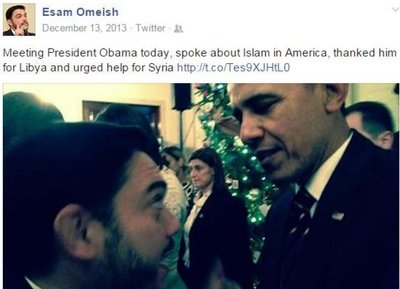
White House logs show that Omeish visited nine times since 2011, including a Dec. 13, 2013 visit in which he was photographed with President Obama.

Omeish’s encounter with the president came during the White House’s annual Christmas party, a White House spokesperson said. President Obama never conducts policy discussions at such public meetings, the source said.

1415 (1)

Two photos appear on Omeish’s Facebook page showing him with U.N. Ambassador Samantha Power, widely considered an architect of the president’s Libya policy, where she advocated for military intervention. She notably helped draft PSD-11, a secret presidential directive that led to the U.S. supporting the Muslim Brotherhood in Libya among other places.

One photo shows Omeish meeting with Power in February 2012, when she worked as special assistant to the president and senior director for Multilateral Affairs and Human Rights at the National Security Council. The other photo posted the day Obama announced Power’s nomination as U.S. ambassador to the U.N. shows her standing next to Omeish.

White House officials thought enough of Omeish that they invited him to attend an April 2011 speech on Libya by President Obama at the White House. Omeish also attended the installation of Christopher Stevens, the late U.S. ambassador to Libya killed in the Sept. 11, 2012 Benghazi attack, and that of his successor, Deborah Jones, in 2013.

Omeish told The Washington Times following the Benghazi attack that he briefed Stevens before the ambassador began his duties in Tripoli.

Omeish and the Muslim Brotherhood

In addition to his comments about Palestinians and jihad, Omeish admits to prior personal involvement in the Muslim Brotherhood in the U.S. and served as president of the Muslim American Society, which has been described as the “overt arm” of the Brotherhood in America. His association with the Brotherhood likely dates back to his involvement in the Muslim Students Association (MSA) in the 1990s when he became the national organization’s president, which was founded by Brotherhood members in 1963.

Omeish endorsed Libya’s Muslim Brotherhood in a 2012 IRIN News article, stating that although it came in a distant second in Libya’s 2012 elections, it “may be able to provide a better platform and a more coherent agenda of national action.”

Libya’s Muslim Brotherhood subsequently failed to implement a coherent agenda and became deadlocked with its liberal rival, the National Forces Alliance, over establishing a working constitution.

Brotherhood members opposed building a strong Libyan military that could have helped rein in the militias that have since created havoc. Numerous militias tied to the Brotherhood have contributed to Libya’s instability. U.S. State Department officials contracted with the Brotherhood-linked February 17 Martyrs Brigade – a group that also had Al-Qaida ties – to provide security for the ill-fated U.S. consulate in Benghazi. A BBC report described the brigade as the best armed militia in eastern Libya. It additionally held al-Qaida sympathies, according to posts on its Facebook page. A State Department report called reliance on the February 17 militia in the case of an attack such as happened on Sept. 11, 2012 “misplaced.”

LAPAC is but one of an alphabet soup of groups that Omeish helped found as a result of the Arab Spring, aimed at affecting U.S. policy toward Libya.

This includes Libyan Emergency Task Force,(LETF), Libyan Americans for Human Rights, Libyan Council of North America (LCNA), Libyan American OrganizationAmerican Libyan Council, American Libyan Chamber of Commerce and Industry (ALCCI), Center for Libyan American Strategic Studies. Former Libyan Ambassador to the U.S. Ali Aujali appointed Omeish the official representative of the Libyan-American community, according to ALCCI’s old website.

LETF lobbied for the U.S. and the international community to establish a no-fly zone to keep Gaddafi from bombing rebellious cities in early 2011. Omeish’s LCNA worked to facilitate meetings between U.S. officials and Libyan rebels, including a meeting with John Kerry while he still was a U.S. senator. ALCCI  works with the Libyan embassy in Washington to “certify and support trade relations between Libya and the United States.”

It remains to be seen whether the advice from Omeish and Muntasser will be ignored. But their gambit, publicly posting their letter urging the president to support Islamists, indicates a confidence generated by years of access and consultation. That raises a host of troubling questions.


Turkey and Saudi Arabia hit back for the Obama-Putin Syrian pact

March 5, 2016

Turkey and Saudi Arabia hit back for the Obama-Putin Syrian pact, DEBKAfile, March 5, 2016

Zaman_4.3.16Headline of last issue of Turkey’s Zaman before government takeover

Turkey and Saudi Arabia have taken separate steps to break free from Washington’s dictates on the Syrian issue and show their resistance to Russia’s highhanded intervention in Syria. They are moving on separate tracks to signal their defiance and frustration with the exclusive pact between Presidents Barack Obama and Vladimir Putin which ostracizes Riyadh and Ankara on the Syrian question.

Turkey in particular, saddled with three million Syrian refugees (Jordan hosts another 1.4 million), resents Washington’s deaf ear to its demand for no-fly zones in northern and southern Syria as shelters against Russian and Syrian air raids.

Last year, President Reccep Erdogan tried in desperation to partially open the door for a mass exit of Syrian refugees to Europe. He was aghast when he found that most of the million asylum-seekers reaching Europe were not Syrians, but Muslims from Africa, Afghanistan and Pakistan, in search of a better life in the West. Most of the Syrians stayed put in the camps housing them in southern Turkey.

Even the Turkish intelligence agency MIT was hard put to explain this setback.  According to one partial explanation, organized crime gangs of Middle East dope and arms smugglers, in which ISIS is heavily represented, seized control of the refugee traffic heading to Europe from Libya, Iraq and Syria.
This human traffic netted the gangs an estimated $1 billion.

Turkey was left high and dry with millions of Syrian refugees on its hands and insufficient international aid to supply their needs. No less painful, Bashar Assad was still sitting pretty in Damascus.

Finding Assad firmly entrenched in Damascus is no less an affront for Saudi Arabia. Added to this, the Syrian rebel groups supported by Riyadh are melting away under continuing Russian-backed government assaults enabled by the Obama-Putin “ceasefire” deal’

The oil kingdom’s rulers find it particularly hard to stomach the sight of Iran and Hizballah going from strength to strength both in Syria and Lebanon.

The Turks threatened to strike back, but confined themselves to artillery shelling of Syrian areas close to the border. While appearing to be targeting the Kurdish YPD-YPG militia moving into these areas, the Turkish guns were in fact pounding open spaces with no Kurdish presence. Their purpose was to draw a line around the territory which they have marked out for a northern no-fly or security zone.

Saturday, March 5, President Erdogan proposed building a “new city” of 4,500 square kilometers on northern Syrian soil, to shelter the millions of war refugees. He again tried putting the idea to President Obama.

The Saudi Defense Minister, Deputy Crown Prince Mohammed bin Salman put together a more high-risk and comprehensive scheme. Its dual purpose is to hit pro-Iranian Hizballah from the rear and forcied [Sic] the two big powers to treat Riyadh seriously as a player for resolving the Syrian imbroglio.

The scheme hinged in the cancellation of a $4 billion Saudi pledge of military aid to the Lebanese army, thereby denying Hizballah, which is a state within the state and also dominates the government, access to Saudi funding. But it also pulled the rug from under Lebanon’s hopes for combating ISIS and Al Qaeda’s Nusra Front, which have grabbed a strip of Lebanese territory in the northern Beqaa Valley.

The Saudi action, by weakening the Lebanese military and its ability to shore up central government in Beirut, risks tipping Lebanon over into another civil war.

The London Economist commented that this Saudi step against Lebanon seems “amateurish.” Under the young prince (30), “Saudi Arabia sometimes acts with bombast and violence that makes it look like the Donald Trump of the Arab World,” in the view of the magazine.

But the Saudi step had a third less obvious motive, a poke in the eye for President Obama for espousing Iran’s claim to Middle East hegemony. Resentment on this score is common to the Saudi royal house and the Erdogan government.

As a crude provocation for Washington, the Turkish president ordered police Friday, March 4, to raid Turkey’s largest newspaper Zaman, after an Istanbul court ruling placed it under government control.

The newspaper released its final edition ahead of the raid declaring the takeover a “shameful day for free press” in the country. A group of protesters outside the building was dispersed with tear gas, rubber bullets and water cannons.

Zaman is owned by the exiled Muslim cleric Felhullah Gulen, who heads the powerful Hizmet movement, which strongly contests Erdogan government policies. A former ally of the president, the two fell out years ago. In 1999, after he was accused of conspiring to overthrow the government in Ankara, Gulen fled to the United States.

Today, the exiled cleric runs the Hizmet campaign against the Turkish president from his home in Pennsylvania, for which he has been declared a terrorist and many of his supporters arrested.

The takeover of Zaman was intended both as a blow by Ankara against Muslim circles opposed to the Erdogan regime and as an act of retaliation against the United States, for harboring its opponents and sidelining Turkey from Obama administration plans for Syria.

Oddly enough, the Turkish president finds himself in a position analogous to Egyptian President Abdel-Fatteh El-Sisi, who is at war with the Muslim Brotherhood, a movement which enjoys Obama’s support.

Israeli Prime Minister Binyamin Netanyahu has his own dilemmas. Struggling to keep his balance while walking a tight rope on the Syrian situation between Israel’s longstanding ties with Washington and handling the Russian tiger lurking next door, he is in no hurry to welcome Erdogan’s determined overtures for the resumption of normal relations.

Turkey is in trouble with both major world powers and, after living for five years under hostile abuse from Ankara, Israel does not owe Erdogan a helping had for pulling  him out of the mess.

Dems Balk at MB Bill Terror Findings

March 4, 2016

Dems Balk at MB Bill Terror Findings, Investigative Project on Terrorism, John Rossomando, March 3, 2016

713

Last Week’s House Judiciary Committee discussion of a bill requesting the State Department evaluate classifying the Muslim Brotherhood as a terrorist organization showcased the confirmation bias of the bill’s Democratic opponents on the panel.

Numerous examples of ties between the international Muslim Brotherhood and terrorist groups like Hamas and al-Qaida peppered the original draft of the bill introduced by Rep. Mario Diaz-Balart, R-Fla.

However, Ranking Member Rep. John Conyers, D-Mich., made the oft-repeated assertion the organization had sworn off violence.

Conyers asserted that the Brotherhood had become a “non-violent religious and social service organization” and that Diaz-Balart’s bill promotes so-called “Islamophobia.”

“Before rushing to conclusions that can lead to unknown and unintended consequences, our committee should consider the facts that pertain to this complex organization,” Conyers said.

He pointed to testimony given in a 2011 hearing but much of what was said there undermines Conyers’ premise the Brotherhood is “non-violent.”

For example, Washington Institute Executive Director Robert Sotloff testified that the Muslim Brotherhood is far from “an Egyptian version of the March of Dimes,” whose orientation was fundamentally humanitarian.

“Should the Brotherhood achieve political power, it will almost certainly use that power to transform Egypt into a very different place … A more realistic situation would see deeper and more systemic Islamization of society, including the potential for a frightening growth of sectarianism between Muslims and Copts and even deepening intra-Muslim conflict between Salafis and Sufis,” Sotloff said, accurately predicting the divisive nature of the Brotherhood’s rule before it was ousted in July 2013.

Similarly, another person who testified before the subcommittee cautioned against falling victim to the Brotherhood’s semantics when it comes to terrorism.

“Just because the MB opposes al-Qaeda does not mean that they agree with us on the definition of terrorism,” Tarek Masoud of Harvard’s John F. Kennedy School of Government told the committee. “For example, they view both Hamas and Hezbollah as freedom fighters whose acts of violence are legitimate forms of resistance against what they see as Israeli occupation. In August 2006, former Muslim Brotherhood leader Mahdi Akef even declared that he was ready to send 10,000 (ten thousand) Brothers to fight alongside Hezbollah in its war against Israel. He didn’t, of course. But the sentiment reveals the gulf between us and the Brotherhood on this issue.”

The House bill also includes the 2011 assessment from then-FBI Director Robert Mueller: “I can say at the outset of that elements of the Muslim Brotherhood both here and overseas have supported terrorism.”

Conyers’ effort to characterize the Brotherhood as a “a predominately non-violent religious political and social service organization” ignores the repeated involvement of Brotherhood-linked charities in terrorism financing, ranging from the Union of Good to the Holy Land Foundation. The Holy Land Trial exposed a Hamas-support network in the United States created by the Muslim Brotherhood which included the Council on American Islamic Relations (CAIR) as a branch.

Conyers ignores statements by the Brotherhood in the past year, including a Jan. 27 call for a “long, uncompromising jihad” against the Egyptian government, as noted in Diaz-Balart’s bill.

Groups calling themselves “Revolutionary Punishment” and “Popular Resistance” have carried out attacks against Egyptian police stations and businesses with support from Brotherhood-connected social media accounts. These accounts have been promoted by U.S. based pro-Brotherhood activists.

The legislation included other numerous specific examples of Brotherhood support for funding or engaging in violent jihad since its founding in 1928 by Egyptian schoolteacher Hasan al-Banna.

“…Jihad in its literal significance means to put forth one’s maximal effort in word and deed,” Al-Banna said in an undated speech. “[I]in the Sacred Law it is the slaying of the unbelievers, and related connotations, such as beating them, plundering their wealth, destroying their shrines, and smashing their idols … it is obligatory on us to begin fighting with them after transmitting the invitation [to embrace Islam], even if they do not fight against us.”

Al-Banna also stated that the “people of the Book” should be fought until they pay jizyah, a tax mandated by the Quran paid by Christians and Jews to an Islamic state in exchange for keeping their lives and not embracing Islam.

It notes that the U.S. government previously listed Hamas, the Brotherhood’s Palestinian branch, and Lajnat al-Daawa, the social wing of Kuwait’s branch of the Brotherhood, as terrorist entities.

Lajnat al-Daawa’s reported involvement in terrorism financing on behalf of Osama bin Laden underscores the hollowness of the Brotherhood’s condemnation of al-Qaida. Ramzi Yousef, planner of the 1993 World Trade Center bombing, and Khalid Sheikh Muhammad, architect of 9/11, each worked for Lajnat al-Daawa.

Numerous individual Brotherhood members with ties to al-Qaida who were previously sanctioned by the U.S. government as terrorists are mentioned in the bill. Among them; Osama bin Laden’s brother-in-law, Mohammad Jamal Khalifa, served a senior member of the Lebanese branch of the Muslim Brotherhood. Khalifa ran charitable offices on al-Qaida’s behalf in the Philippines, including an office for the Saudi-controlled International Islamic Relief Organization. He also established a charity called the International Relations and Information Center in the Philippines, which was the primary funding mechanism for Khaled Sheikh Mohammed and Ramzi Yousef’s 1995 “Bojinka” plot to blow up American airliners over the Pacific.

Diaz-Balart’s bill additionally points out that the Libyan Muslim Brotherhood’s militias joined forces with Ansar al-Sharia, the al-Qaida linked militia responsible for the Sept. 11, 2012 attack on the U.S. Consulate in Benghazi.

In opposing the bill, Conyers said it unfairly paints all Brotherhood members as terrorists. He dismissed the measure as “Islamophobia [which] may be good politics … but it certainly is not good policy.” Classifying the Muslim Brotherhood as a terrorist organization had more to do with fear than keeping Americans safe, he said.

But existing groups on the State Department’s terror list. such as Hizballah and the Revolutionary Armed Forces of Colombia (FARC), also actively engage in social services or serve in parliament.

Hizballah’s social services give it strong support among poor Shiites in Lebanon. It also has 14 seats in Lebanon’s parliament and considerable political clout. Likewise, FARC has a significant social-service component.

Op-Ed: Contemplating a US/Russia Alliance

February 16, 2016

Op-Ed: Contemplating a US/Russia Alliance, Israel National News, Ted Belman and Alexander Maistrovoy, February 16, 2016

Before Donald Trump’s blowout win in New Hampshire he shocked the world by saying he would allow the Russians to do the “dirty work” and would “let them beat the s*** out of ISIS also.”. Trump went further, “I have always felt that Russia and the United States should be able to work well with each other towards defeating terrorism and restoring world peace, not to mention trade and all of the other benefits derived from mutual respect,”

Putin, responded by saying: “He (Trump) says that he wants to move to another level of relations, to a deeper level of relations with Russia. How can we not welcome that? Of course we welcome it.”

The condemnation of Trump for his remarks was immediate but certainly not universal. Many American’s are beginning to see Russia in a new light.

Until the fall of the USSR, the 20th Century was dominated by an ideological struggle between American capitalism and Russian communism. But now that Russia has abandoned communism and the US is embracing socialism, as seen by the Sander’s victory in the New Hampshire primary, the two powers are more alike than ever before.

Now we have a different ideological struggle to contend with, namely a civilizational war between the Christian/Secular West and the Islamic Caliphate. They are inimical to each other. North America, Europe and Russia are natural allies in this struggle as they are different daughters of one civilization.

In the past, both Russia and the US have backed different Arab states or Muslim groups, including radical Islamists. The end result of this US/Russia enmity was to destabilize the ME and Europe and to allow an Islamic fifth column into America and Europe.

The reality is that Russia, Europe and the US desperately need each other. Together they can withstand the hydra of pan-Islamism with its countless heads (ISIS, al-Qaeda, Jabhat al-Nusra, Salafis, Muslim brothers, etc.), can stabilize the Middle East, the cradle of Islamic fanaticism and can stabilize Europe.

For Russia, the triumph of the Caliphate in any form will be a deadly threat to its “soft underbelly”: the Caucasus and Volga region with Tatarstan.

Penetration of Islamic militancy from Afghanistan into Central Asia means the appearance of the Islamists on the longest and vulnerable southeastern border of Russia.

From Europe’s point of view, a destabilized North Africa and Middle East is resulting in a mass migration of Muslims including radical Islamists which threaten to tear it apart and irreparably change it. This in turn will have dire consequences for both Russia and America.

Both US and Russia are not able to cope with the global “jihad” separately” especially when they are supporting different sides. Russia has no resources for a war against radical Islam made more difficult by western sanctions and pressure. The West, in spite of its material power, lacks the will needed to defeat such a savage and ruthless enemy.

Thus an alliance is imperative.

“New Middle East”

A new Middle East is in the making. It will not look like the “New Middle East” as envisioned by Shimon Peres.  Syria, Iraq and Libya are no more. Lebanon looks like it will also fracture due to the influx of 1.5 million Sunnis, either Palestinian or Syrian. Hezbollah Shia have been reduced from 40% to 25% of the population by this influx so expect a power struggle to ensue there.

Alawite Syria, a strong Kurdish state in the north of former Iraq and Syria, tribal unions in Libya, Druze enclaves in Syria, a Christian enclave in Lebanon and perhaps in Iraq, all will appear on the map of the new Middle East. They will all need the support, both militarily and diplomatically, of either the US or Russia. In this way, the west will be empowered to keep the radical Islamists out.

Russia already has supported the Kurdish PYD (Democratic Union Party) in northern Syria diplomatically (Kremlin insists on PYD’s participation in negotiations about the future of Syria) and by providing them with weapons. The US is also supportive of the Kurds but bas been restrained by Turkey’s insistence that the Kurds be denied independence.  If the US forms an alliance with Russia it no longer needs an alliance with Turkey.

The American embrace of the Muslim Brotherhood and Turkey must be seen as the aberration it is. Rather than support the Islamization of the Middle East and North Africa, America should fight it. Rather than embrace the Muslim Brotherhood and other Islamists, as Obama did, the US should embrace Russia.

Pressure could then be brought to bear on Turkey to change its Islamist allegiances and to allow greater autonomy to its 10 million Kurdish citizens who otherwise will want to join the newly formed Kurdistan.

The US, by destroying Qaddafi and Mubarak, greatly destabilized North Africa. By waging war against Assad, the US has destabilized the Middle East and Europe. What is needed now is that the US and Russia come together to strengthen President al Sisi of Egypt to enable him to defeat ISIS in Sinai and Libya. Russia should be invited back into Libya to assist in its stabilization.  Europe and Tunisia will also benefit from this stabilization as will African states to the south.

In addition, US and Russia should cut a deal for a political solution for Syria in which Syria is divided into three states based on ethnic lines; Alawite Syria in which Russia holds sway, Kurdish Syria which will join with Kurdistan in Iraq and a Sunni state amalgamating the Sunni areas of both Syria and Iraq.

Such a deal will involve cooperation between Russia, US, Turkey and Saudi Arabia. ISIS must be defeated and non-Islamist Sunnis must be put in charge. Saudi Arabia would have a major role in the creation and maintenance of such a state. It is not inconceivable that Jordan would in the end, amalgamate with this state given the number of Sunni refugees it is now host to. This state would serve as a bulwark to an expansionist Iran.

It is in the interest of Russia to placate Saudi Arabia so that Saudi Arabia will cut down on her oil production and allow the price of oil to rise. Saudi Arabia would be agreeable to doing so and to such a division of Syria if Russia would restrain Iran.

Iran

Today, Russia is the de facto ally of Iran and the US is a wannabe.  The Iranian star reached its zenith with the total capitulation of the US in the Iran Deal. Since then it’s been downhill all the way. Without the help of Russia they would have lost Syria as an ally and their connection to Hezbollah. But with that help, Russia is now calling the shots.

It wasn’t so long ago that Russia supported the sanctions on Iran and didn’t want to remove them because it meant the addition of Iranian oil to the world market and the weakening the already weak ruble. Kremlin couldn’t betray its ally but in fact (aside from rhetoric) will not object to a renewal of sanctions. This will save Russia from a powerful competitor in the energy market.

Moscow needs Iran primarily as a means to put pressure on the West but it can quite easily sacrifice it for the sake of strategic considerations. Iran is not a natural ally of Russian for it doesn’t have any historical or cultural connection similar to the connection both Serbia and Armenia have for example.

The View from the Kremlin

Since the 16th century, the main threat to Russia came from the West. Moscow was occupied by Poles in the 17th century and by Napoleon in the 19th century.  In 1941, the troops of the Wehrmacht came within a few kilometers of Moscow.  St. Petersburg was built by Peter Great to resist the invasion of the Swedes.

The collapse of the Soviet Union was a painful blow to Russia and the West took advantage of this collapse. The bombing of Serbia and recognition of Kosovo, the “color revolutions” in the former Soviet Union, NATO’s extension to the Baltic countries, and the constant hectoring of Russia on human rights served to undermine Russia and make her feel threatened. This formed the impetus for the revival of nationalism under the leadership of Vladimir Putin.

The US, Britain and France intervened in Libya in order to both destroy the Gadaffi regime and oust Russia.  Accordingly, they refused Russia’s mediation efforts.  Similarly they tried to oust Assad. But this time, Russia, who had lost its Mediterranean port in Libya was determined to keep its Mediterranean port in Syria.  After many years of death and destruction in Syria brought about by the desire of the US and Saudi Arabia to oust Assad, Assad was on his “death bed”. Russia and Iran doubled down on their efforts to support him. Russia supplied their air force and air defense radar systems and Iran provided more troops. As a result Assad has gained much ground and is in a much better negotiating position today.

During this period, Russia acquired Crimea from the Ukraine and supported an insurgency in eastern Ukraine. A majority of the population of both areas are Russian. The Russians didn’t understand why the West came to the defense of Ukraine. It’s impossible to believe that EU wanted to bring Ukraine into the EU given its large population and systemic corruption.  Moscow believes the West didn’t do so in order to protect the sovereignty of Ukraine but to weaken Russia.  Ukraine, after all, is the backyard of Russia, as Mexica is backyard of US and Corsica is backyard of France.

Last week Russia’s Prime Minister, Medvedev, urged a “more constructive and more cooperative relationship with Russia… I strongly believe that the answer lies with both more defense and more dialogue.”

Last week Henry Kissinger delivered a speech in Moscow in which he began:

“I am here to argue for the possibility of a dialogue that seeks to merge our futures rather than elaborate our conflicts. This requires respect by both sides of the vital values and interest of the other,”

And concluded,

“It will only come with a willingness in both Washington and Moscow, in the White House and the Kremlin, to move beyond the grievances and sense of victimization to confront the larger challenges that face both of our countries in the years ahead.”

Should the West want to pursue such an alliance, it must recognize Russia’s “Near Abroad” – its traditional zone of influence since the 18th century: Ukraine and Belarus, Crimea, whose history is inseparable from Russia, the Caucasus and Central Asia. Russia also seeks influence in Europe and in the Eastern Mediterranean. This is imperial policy but Russia is no longer obsessed with ideological madness.  Thus, it is possible to negotiate a rapprochement and to respect each other’s sphere of influence.

Israel is not an ally of Russia nor its enemy.  Israel and Russia agreed to respect each other’s spheres of interest in Syria. In addition, Moscow mediated in delicate situations between Israel and Hezbollah.  This model can be used on a global scale by the US.

It is of historical note that the Byzantium, otherwise known as the Eastern Roman Empire, fought a sustained battle against the Ottoman Turks, who had invaded, only to finally succumb in 1453.  The Turks changed the name of their capital city, Constantinople, to Istanbul.  The Ottoman Empire succeeded over the years in conquering more of Europe and finally laid an unsuccessful siege to Vienna in 1529. There followed 150 years of bitter military tension and attacks, culminating in the Battle of Vienna of 1683. This battle was won by the Holy Roman Empire of the German Nations in league with the Polish-Lithuanian Commonwealth thereby saving Europe from Islamic conquest.

What is needed today is a similar resolute stand by both east and west against the Islamic Jihad’s attempt to conquer Europe.

Will the old prejudices and enmity focused on Russia prevail over rational considerations and the instinct for self-preservation?

According to the Munich Accords just signed, perhaps not.

It now appears that Russia and the US have come to an agreement for the implementation of a ceasefire and a division of spheres of influence. The document was signed by 17 nations, including Saudi Foreign Minister Adel al-Jubayr for the Syrian opposition and Iran’s top diplomat Muhammed Javad Zarif in the name of the Assad regime.

DEBKA reports:

“The nub of the Munich accord was therefore the parties authorized to name the terrorists. This was spelled out as follows: “The determination of eligible targets and geographic areas is to be left up to a task force of nations headed by Russia and the United States.”

“This puts the entire agreement in the joint hands of the US and Russia. Lavrov emphasized, “The key thing is to build direct contacts, not only on procedures to avoid incidents, but also cooperation between our militaries.”

“The Munich accord therefore provided the framework for expanding the existing US-Russian coordination on air force flights over Syria to cover their direct collaboration in broader aspects of military operations in the war-torn country.

“Lavrov mentioned a “qualitative” change in US military policy to cooperate with Russia in continuing the fight against the Islamic State, but it clearly goes beyond that.”

“This pact as sets out a division of military responsibility between the two powers: The Americans took charge of areas east of the Euphrates, leaving the Russians responsible for the territory east of the river. “

Hopefully, this accord is just the beginning of a new alliance.

CAIR Intertwines with US-based, Terror-Linked Fuqra Group

February 9, 2016

CAIR Intertwines with US-based, Terror-Linked Fuqra Group, Clarion ProjectRyan Mauro, February 9, 2016

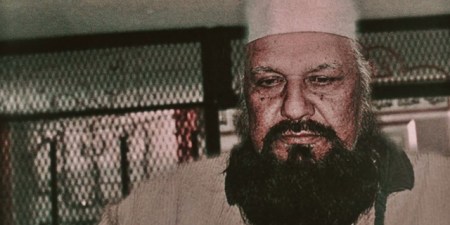
Gilani-HP_1Sheikh Mubarak Ali Gilani, the radical head of Jamaat ul-Fuqra, a terrorist organization fronted in the U.S. by Muslims of the Americas.

The Council on American-Islamic Relations (CAIR) and its “moderate” image is suffering from a self-inflicted wound now it has become intertwined with the Muslims of the Americas, a radical anti-Semitic front for the Jamaat ul-Fuqra terrorist group.

CAIR’s Massachusetts chapter now shares an official with MOA and two CAIR officials spoke at MOA’s International Islamophobia Conference.

The Massachusetts chapter of CAIR recently chose MOA’s general counsel, Tahirah Amatul Wadud, as a board member. CAIR, a U.S.Muslim Brotherhood entity banned for its own terror links in the UAE, wisely omitted mention of MOA. It described her generically as a “general counsel for a New York Muslim congregation.”

Wadud reportedly posted an article by MOA’s Pakistan-based leader, Sheikh Mubarak Ali Gilani, on her Facebook claiming the Islamic State (ISIS/ISIL) is a puppet of the British government and a Jewish conspiracy perpetrated the attacks on Pearl Harbor and September 11, 2001. The Clarion Project was the first to report on the inflammatory article.

“There was no need for America to go to war against Hitler. Hitler was not the enemy of America or the American people. There was a mutual animosity between Hitler and the Jews. So, the American people paid a very heavy price for fighting someone else’s war,” Gilani wrote.

American Taliban _ Mauro-240x145

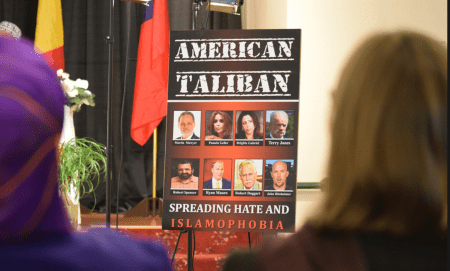
Two CAIR officials spoke at MOA’s International Islamophobia Conference, which included a poster featuring the faces of the “American Taliban” that included Clarion Project national security analyst Ryan Mauro. They were CAIR-Michigan Executive Director Dawud Walid and CAIR-ArizonaExecutive Director Imraan Siddiqi. Walid was one of the CAIR officials who have questioned whether Muslims should honor fallen U.S. servicemen on Memorial Day, sparking a backlash from Muslims who appreciate the U.S. military.

Jamaat ul-Fuqra is led by Gilani. It is best known for a series of terrorist attacks and plots in the 1980s and early 1990s and for setting up “Islamic villages” across the country, including at least two that were shut down by the authorities. These “villages” are known to have been used for guerilla warfare training. Fuqra now goes primarily by the name of Muslims of the Americas (MOA), among other names. The group says it has 22 such “villages” in the U.S.

The Clarion Project obtained video of female members receiving basic paramilitary instruction in military fatigue at its “Islamberg” headquarters in New York. The date of the footage is cut off, only stating “Jan. 28 20,” presumably meaning it was made in 2000 or after. The best explanation MOA members have come up with is that it was a “self-defense class.”

View the video here:

The Clarion Project identified a Fuqra “village” in Texas in 2014 and retrieved an FBI intelligence report from 2007 that stated MOA “possess an infrastructure capable of planning and mounting terrorist campaigns overseas and within the U.S.” and “the documented propensity for violence by this organization supports the belief the leadership of the MOA extols membership to pursue a policy of jihad or holy war against individuals or groups it considers enemies of Islam, which includes the U.S. Government.”

The FBI also said “members of the MOA are encouraged to travel to Pakistan to receive religious and military/terrorist training from Gilani.” In 2001, ATF Special Agent Thomas P. Gallagher testified in court that “individuals from the organization are trained in Hancock, N.Y., and if they pass the training in Hancock, N.Y., are then sent to Pakistan for training in paramilitary and survivalist training by Mr. Gilani.”

After Clarion Project identified the Texas site and published the FBI report, a dozen Muslim groups have signed a statement calling for Fuqra’s designation as a Foreign Terrorist Organization. Of course, CAIR isn’t one of them. CAIR actually came to Fuqra/MOA’s defense. And now CAIR and Fuqra have shared leadership through CAIR-Massachusetts and hold events together.

CAIR Two Officials Siddiqi Walid-240x323

MOA’s International Islamophobia Conference took place at the Muslim Community Center of the Capital District in Schenectady, New York. CAIR-Arizona Executive Director Imraan Siddiqi is listed as a member of the Board of Directors, indicating he played more than a speaking role in setting the MOA event up.

The MOA’s event featured delegates representing the U.S., Canada, Pakistan, Senegal, India, Taiwan, Bangladesh and Egypt. Siddiqi was the delegate representing India. MOA flyers also list headquarters in Caracas, Venezuela and Las Lomas, Trinidad & Tobago. The MOA claims it had nearly 300 attendees and thousands watched online. It announced it would start a new political coalition named the “International United Muslim Forum.”

Ironically, MOA has tried to excuse itself from its terrorist and criminal history by claiming that it was infiltrated by Wahhabist/Muslim Brotherhood operatives who were sent to undermine Sheikh Gilani. It even claims that one operative was a shape-shifter who could go “through physical changes before speaking to people as if he were Sheikh Gilani.”

And now MOA is collaborating with a known Muslim Brotherhood entity. You can read our documented profiles of CAIR and MOA here and here.

The US Mosque Obama Has Chosen For His First Presidential Visit Has Deep Extremist Ties

January 31, 2016

The US Mosque Obama Has Chosen For His First Presidential Visit Has Deep Extremist Ties, Daily Caller, Chuck Ross, January 30, 2016

The Baltimore mosque President Obama has chosen as the first U.S.-based mosque to visit during his presidency has deep ties to extremist elements, including to the Muslim Brotherhood.

The White House announced on Saturday that Obama will visit the Islamic Society of Baltimore (ISB) on Wednesday. He has visited several mosques overseas as president but has resisted visiting one in the homeland. The purpose of the trip, according to the White House, is to “celebrate the contributions Muslim Americans make to our nation and reaffirm the importance of religious freedom to our way of life.”

But ISB is a curious choice for Obama’s first domestic visit.

The mosque is a member of a network of mosques controlled by the Islamic Society of North America (ISNA), a Muslim civil rights group named as an unindicted co-conspirator in the 2008 Holy Land Foundation terror case. Several executives with that organization were convicted of sending money to aid the terrorist group Hamas.

An imam who served at ISB for a total of 15 years has also been a leading member of the Muslim Brotherhood network and has worked for an Islamic relief group that was designated as a terrorist organization by the Treasury Department in 2004.

Mohammad Adam el-Sheikh, who served two stints as ISB’s imam, from 1983 to 1989 and from 1994 to 2003, was a member of the Muslim Brotherhood in Sudan in the 1970s. He also co-founded the Muslim American Society, a Falls Church, Va.-based group that is controlled by the Muslim Brotherhood.

While in Baltimore, el-Sheikh served as a regional director for the Islamic American Relief Agency. That group’s parent organization is the Islamic African Relief Agency, which the Treasury Department says provided funds to Osama bin Laden, al-Qaeda, Hamas and other terrorist organizations.

After leaving Baltimore, el-Sheikh served as imam at the infamous Dar al-Hijrah Islamic Center in Falls Church. That mosque has a lengthy roster of known terrorists and terrorist sympathizers. Its imam during much of the 1990s was Mohammed al-Hanooti. He was named an unindicted co-conspirator in the 1993 World Trade Center bombing, which killed six people.

Dar al-Hijrah came under the control of Anwar al-Awlaki in 2001. He’s the American al-Qaeda recruiter who was killed in a U.S. drone strike in 2011. Nidal Hasan, the U.S. Army major who killed 13 people at Fort Hood in Nov. 2009, is said to have attended the Virginia mosque when al-Awlaki served there. The pair also reportedly exchanged emails. Two of the 9/11 hijackers also attended Dar al-Hijrah during al-Awlaki’s tenure.

El-Sheikh took over at Dar al-Hijrah in Aug. 2003, a little over a year after al-Awlaki left. While there he defended Palestianian suicide bombings against Israel.

“If certain Muslims are to be cornered where they cannot defend themselves, except through these kinds of means, and their local religious leaders issued fatwas to permit that, then it becomes acceptable as an exceptional rule, but should not be taken as a principle,” he said in 2004, according to a Washington Post article at the time.

As The Post reported Saturday, ISB’s website states that it seeks “to be the anchor of a growing Muslim community with diverse backgrounds, democratically governed, relating to one another with inclusiveness and tolerance, and interacting with neighbors in an Islamic exemplary manner.”

But that desire for tolerance — which President Obama frequently touts as well — does not appear to be a virtue shared by ISB’s resident scholar, Yaseen Shaikh.

A 2013 Youtube video shows Shaikh, who previously served as imam at a mosque in Plano, Tex., speaking out forcefully against homosexuality in Islam.

During an hour long diatribe, Shaikh called homosexuality a psychological disorder that has no place in Islam or society. He also lamented that gay rights groups have “hijacked” political discourse.

“This whole subject of homosexuality in the public sphere…is no longer a religious issue, unfortunately, as much as we want to use the religious card and try to defeat this, now it’s become a politicized issue,” Shaikh says in the video.

“Politicians are highly influenced by people who back them, and we find that these politicians who are calling for gay rights and marriage and supporting gay rights are lobbied and campaigned by gay activists, by gay groups. And they are throwing money at it left and right to gain some acceptance in society, to be considered normal people, to be treated normally.”

Obama is one such politician who has supported gay rights.

“We have to counter the efforts that are taking place elsewhere,” Sheikh says in the video, advising that “if our children are taught that [homosexuality is] okay, we have to teach them it’s not okay.”

Obama’s Fake Syrian Peace Talks Falling Apart

January 29, 2016

Obama’s Fake Syrian Peace Talks Falling Apart, Front Page Magazine, Daniel Greenfield, January 29, 2016

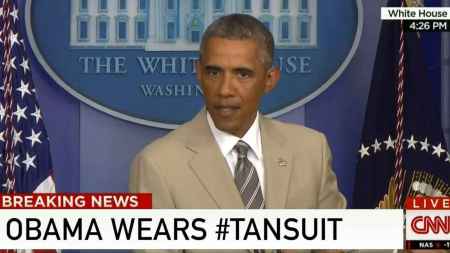
obama-wears-tan-suit-149481242256_6

The peace talks strategy for Syria comes out of Iran and Russia, two countries determined to keep Assad in power. Obama wanted the peace talks in order to rig a fake settlement that would come apart once he was out of office. But the only people fooled by this were stupid enough to get their news from CNN and their talking points from Think Progress. The Sunni side only participated to the extent that they could wreck the talks and extract some demands. They have no intention in signing on to Assad staying in power or to letting Obama get away with a fake solution that does just that.

And, oh yes, no one actually thinks Obama has any credibility.

As the Obama administration pushes for peace in Syria, its credibility is crumbling among Syrian opposition leaders, many of whom increasingly doubt the U.S. is serious about ending the rule of dictator Bashar Assad.

Because he isn’t.

If the talks peter out or collapse, that will further undermine President Barack Obama’s foreign policy legacy, which already has been tarnished by the endless bloodshed in Syria

It’s okay. Obama will blame Tom Cotton or Bush or Israel. Or someone. And the media will go along with it.

“A number of the opposition has expressed the feeling that the U.S. is not acting as an honest broker and that they’ve lost both trust and faith in the ability of the United States to deliver on a political settlement in Syria,” said Andrew Bowen, a senior fellow at the Center for the National Interest who has contacts among Syrian opposition groups.

Obama signed on with Iran. So he’s about as much of an honest broker as any other foreign agent.

“Kerry did not make any promises, nor did he put forward any initiatives,” said Khaled Khoja, president of the opposition Syrian National Coalition, in onestatement questioning U.S. intentions. “He has long been delivering messages similar to those drafted by Iran and Russia, which call for the establishment of a ‘national government’ and allowing Bashar al-Assad to stay in power and stand for re-election.”

Well yes. What else do you expect Kerry to do? This is the only thing he’s been doing since he got to the Senate and even beforehand with the Viet Cong. Traitors gotta traitor.

Among the numerous reports floating around — some of them highly speculative — are those that allege Kerry warned opposition leaders they could lose international support if they didn’t attend Friday’s talks. The reports come as the U.S. has appeared to be backing away from its demand that Assad must leave office by signaling its support for the notion of a transitional period.

And that period will come to an end once Obama is out of office.

But all this is theater anyway as the groups with the most fighters on the ground, including Al Qaeda and ISIS, are not represented. Most of the Islamists aren’t either. So this is just the Muslim Brotherhood, whose actual strength is weak, throwing a tantrum. Even if the Sunni groups signed some sort of deal it would be as worthless as the fake elections Hillary still talks up in Libya

Report: Islamic State, Al-Qaida, Muslim Brotherhood Discuss ‘Mega-Merger’ in Libya

January 25, 2016

Report: Islamic State, Al-Qaida, Muslim Brotherhood Discuss ‘Mega-Merger’ in Libya, Breitbart,  Aaron Klein and Ali Waked, January 25, 2016

(Here’s a video of an interview with Islamic reformist Dr. Zuhdi Jasser about the current situation in Libya. H/t Counter Jihad Report.

— DM)

Peshmerga-sinjar-afp-640x480

TEL AVIV – The Libyan branches of the Islamic State, Al-Qaida, and the Muslim Brotherhood are in discussions to complete a “mega merger,” the London-based A Sharq al Awsat newspaper reported.

Leaked documents have revealed that Libya’s biggest Islamist organizations are considering an alliance and the establishment of a joint council of sages, the Arabic language daily reported.

The prospective move comes in the wake of reports of an imminent international effort to form a unity government that would bring Libya’s numerous parties and militias together.

The paper said the Muslim Brotherhood is considering a united Islamic front even though the movement is officially in favor of forming a unity government. However, sources within the movement told the paper that their support for the international endeavor is merely tactical, and they’re waiting for it to collapse.

Negotiations between the three Islamic groups began because of reports of a rapprochement between the internationally recognized government based in Tobruk and the unrecognized government in the capital Tripoli, the paper said.

The groups wish to send a message to the forces coalescing around a unity government that they are not opposed by IS alone, but “all the Islamist opposition elements speak in one voice and should be treated as such,” a source said.

According to the documents, Muslim Brotherhood leaders said that Egyptian President Abdel Fatah al-Sisi’s regime “isn’t supported by the Americans because of his close relations with Russia. They can’t wait to see him leave the scene.”

The parties agreed to form a joint Shura (advisory) council and territories that are currently under Islamic control will be divided between them, echoing a similar agreement that is already underway in Benghazi.

Al-Qaida’s representative was quoted as saying that the move would inspire Islamists in Algeria and Egypt to follow suit.

This follows Breitbart Jerusalem’s own exclusive reporting on mediation efforts between the Muslim Brotherhood-aligned Hamas in Gaza and Salafists aligned with the Islamic State.

Breitbart Jerusalem previously reported that Shadi al-Menai, one of the leaders of Wilayat Sinai, the Islamic State branch in Sinai, visited Gaza in a bid to mediate between Hamas and local Salafi groups after clashes erupted, resulting in the arrests of dozens of jihadists by Hamas forces.

Earlier this month, a leading Salafi source revealed that Menai mediated a deal whereby Hamas would give the Gaza Salafi opposition groups more leeway in exchange for Wilayat Sinai’s help in bypassing the Egyptian army’s restrictions on smuggling rocket parts into Gaza

This is not the first report of Hamas-IS cooperation in arms smuggling.

A Middle East think tank charged last month that there is information Hamas has been paying off the Islamic State’s Sinai branch to smuggle weapons into Gaza. “Over the past two years, IS Sinai helped Hamas move weapons from Iran and Libya through the peninsula, taking a generous cut from each shipment,” stated a report by the Washington Institute for Near East Policy.

Despite the rapprochement between Hamas and IS-Sinai, tensions between the ruling faction and Salafi opposition groups in Gaza are rampant.

The Army of Islam, a Salafi group that aspires to become IS’s sole representative in Palestine, recently released an acerbic video in which it blames Hamas for straying from Sharia law and cooperating with anti-Islamic players, including Shi’ite Iran.

MB Apologists Arrive In U.S. For Anti-Sisi Rallies

January 22, 2016

MB Apologists Arrive In U.S. For Anti-Sisi Rallies, Investigative Project on Terrorism, John Rossomando, January 21, 2016

(Please see also, UK Review of Muslim Brotherhood: Top 13 Quotes. — DM)

Three Muslim Brotherhood supporters who caused a row in Egypt last year after they met with Obama administration officials and members of Congress returned to the U.S. Wednesday, according to the Facebook page of Egyptian Americans for Freedom and Justice (EAFJ).

During their 2015 trip, Brotherhood leader Gamal Heshmat, former Egyptian Judge Waleed Sharaby and Maha Azzam, head of the Egyptian Revolutionary Council (ERC) lobbied State Department and White House officials for help against the government of Egyptian President Abdel Fatal al-Sisi.

The ERC formed in 2014 with the aim of toppling Sisi and bringing the Brotherhood back to power in Egypt. Sisi took power in 2013 after the Egyptian army ousted President Mohamed Morsi, the leader of the Muslim Brotherhood’s Freedom and Justice Party.

Heshmat has a long history of supporting Palestinian terrorists and was photographed in June 2014 with Hamas political chief Khaled Meshaal.

The State Department agreed with the delegation’s position that Sisi had not brought stability to Egypt, and that his removal would pave the way for a transition to democracy, Sharaby told Egypt’s Mekameleen TV in an interview last February. But that has not translated into concrete action to topple Sisi.

1341 (1)

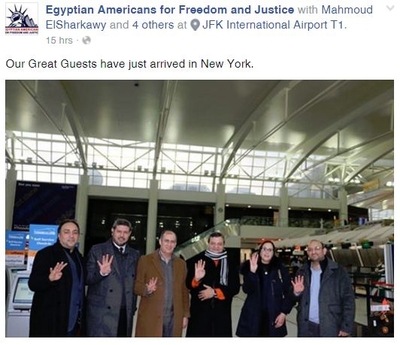
EAFJ leaders Mahmoud El-Sharkawy, Hani Elkadi and Aber Mostafa greeted Heshmat, Sharaby and Azzam at New York’s JFK airport and posed for a picture with them displaying the Brotherhood’s four-fingered Rabaa salute which has become representative among those wanting the Brotherhood’s return to power in Egypt.

The three are scheduled to speak Friday at an event titled “Egyptian Revolution from Sacrifices to Victory” in North Bergen, N.J.

The event is timed to commemorate the Jan. 25 anniversary of dictator Hosni Mubarak’s fall from power in 2011. Heshmat wrote that his group had no plans to meet with Obama administration representatives during this visit, due to their “position biased” toward Sisi’s regime. They hope to speak with some congressmen, academics and others.

El-Sharkawy is a Brotherhood member and serves as liaison with Brotherhood members exiled in Turkey, Egypt’s Al-Bawaba newspaper reported last April.

He frequently reposts Muslim Brotherhood communiqués on his Facebook page. In December, El Sharkawy encouraged “all youth and revolutionaries” to distribute the official page of Brotherhood spokesman Muhammad Muntasir.

1342

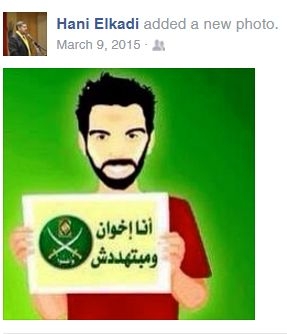
Elkadi seemed to self-identify as a Brotherhood member in a March 9 Facebook post showing an cartoon of a man holding a sign with the Brotherhood logo and the words which translate to, “I am [Muslim] Brotherhood and I’m not threatened.”

Last year, Elkadi, El Sharkawy and Mostafa posted graphics on their Facebook pages seeming to support violence in Egypt.

El Sharkawy and Elkadi posted a Feb. 10 communiqué from the Popular Resistance Movement (PRM) which has launched attacks against Egyptian police and other targets. It features an image of a blood-red map of Egypt with a fist superimposed over it. It claims responsibility for targeting two police cars. “God, martyrs, Revolution,” it said.

Mostafa posted the personal information of a pro-Sisi owner of an Egyptian soccer team with the word “Attaaack!” the same day.

Clare Lopez Exposes Benghazi – Obama Disaster 1 of 3

January 14, 2016

Clare Lopez Exposes Benghazi – Obama Disaster, United West via You Tube, January 12, 2016