Does Iran Have Nuclear Weapons?
Via The Clarion Project (Published over three years ago, but still relevant.)
(A must see for everyone. A grim reminder of what we’re dealing with. – LS)
Does Iran Have Nuclear Weapons?
Via The Clarion Project (Published over three years ago, but still relevant.)
(A must see for everyone. A grim reminder of what we’re dealing with. – LS)
Progressivism, Obama, and Islam, American Thinker, Ken Blackwell, June 24, 2015
As the Obama administration winds down, I expect the situation only to get worse. The increasing desperation of the administration to realize the dream of fraternity with the Muslim world by 2016 will lead to ever more ignominious acts of national self-abasement that may soon verge on outright insanity.
**********************
Looking at President Obama’s foreign policy toward the Muslim world, especially Iran, makes me feel as if America has followed Alice into Wonderland. Nothing makes sense anymore, as the surreal has displaced the logical. Given Mr. Obama’s progressive ideology, it’s exactly what we should have expected.
Foreign policy is the realm of realpolitik. It has to be so, because the stakes are so high: the prosperity and even the survival of the human race. The first duty of every president has to be ensuring that the nation does not become vulnerable to the attacks of its enemies, but Mr. Obama fails to understand who our enemies are.
Progressivism, unfortunately, is not very good at recognizing reality. That’s because progressivism focuses on vision and aspiration. Conservatism begins with the facts on the ground and seeks improvement through gradual reform, while progressivism begins with a utopian vision and tries to conform reality to it.
Progressivism also errs fundamentally about the reality of human nature. Conservatives understand that man is a fallen creature, morally imperfect and inherently capable of evil in motives and actions.
Therefore, in foreign policy, you need to keep your powder dry.
Progressivism believes that man is innately good. In terms of foreign policy, that means we must trust that men’s motives are good, and we can work out our differences by talking with each other. After all, we’re all brothers under the skin.
The problem comes when reality refuses to conform to the utopian vision. One inescapable fact of foreign affairs is that it takes two to make peace, but only one to make war.
The late Robert Kennedy once said, “Some men see things as they are and say why. I dream things that never were and say why not.”
Barack Obama’s dream that never was is to see America reconciled to the Muslim world. He has been obsessed with Islam right from the beginning of his administration. To realize his dream, he insists on treating implacable enemies like Iran as if they were already friends.
Thus, we’ve witnessed inanities like repurposing NASA from space exploration to making nice with the Muslim world (yes, Allah began as the moon god of an Arabian tribe, but it’s not as if we’re going to find him on the Far Side). But emasculating NASA is not a laughing matter. While NASA has been sidetracked for the last six years, the Russians, Chinese, Indians, Japanese and Western Europeans are making strides in their own space programs. Some future president is likely to learn the hard way that falling behind in space will have very painful consequences for America.
We’ve witnessed incomprehensible tactical policy blunders like releasing diehard jihadists from Guantanamo and watching them return to the battlefield, and the infamous exchange of five al-Qaeda generals for an American deserter. How many Americans realize that the leader of ISIS, Abu Bakr al-Baghdadi, was in U.S. custody in Iraq at the beginning of the Obama administration?
We’ve witnessed colossal strategic blunders, like supporting our sworn enemies, the Muslim Brotherhood, in Egypt and elsewhere, and the inexplicable failure to support the pro-Western, pro-democracy revolution against the Iranian mullahs in 2009. Many foreign policy experts have agreed for years that the best chance we have to prevent the mullahs from obtaining nuclear weapons was not a U.S. invasion, but support for a popular Iranian regime change. Obama is missing every opportunity presented him.
We’ve even witnessed the outright denial of reality, such as Obama’s refusal to acknowledge that the Fort Hood massacre was the work of a Muslim terrorist. Officially it is considered “workplace violence,” even though Maj. Nidal Hassan was shouting “Allahu Akbar” as he gunned down his fellow soldiers. Obama won’t even allow his administration to use the words “Muslim” and “terrorist” in the same sentence.
Obama doesn’t seem to understand that the jihadists are not just like us. They have completely different values and ethics, and a worldview radically opposed to both Western secularism and Christianity. They don’t want peace with us; we are the Great Satan — they want to destroy us.
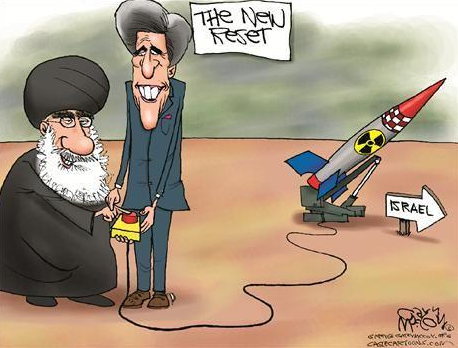
Back to realpolitik. The situation in the Iran nuclear arms talks is dire. Our European partners suspect that Obama is functioning primarily as Iran’s apologist, not adversary, and by watering down economic sanctions, may be cooperating with the mullahs in their quest to obtain the Bomb. Nuclear weapons in the hands of the mullahs would pose an existential threat to Israel immediately, and in time to the entire world as Iran improves its long-range missiles.
As the Obama administration winds down, I expect the situation only to get worse. The increasing desperation of the administration to realize the dream of fraternity with the Muslim world by 2016 will lead to ever more ignominious acts of national self-abasement that may soon verge on outright insanity.
Op-Ed: Core Synergies in Israel’s Strategic Planning, Harvard Law School National Security Journal via Israel National News, Prof. Louis René Beres, June 9, 2016
(Rather “high brow,” but well worth considering seriously. — DM)
*****************
For the most part, the concept of synergy is already familiar to capable scientists and scholars. It signifies, above all, that the usually binding axioms of geometry can sometimes be overridden by various intersecting phenomena. Applied to Israel, this concept suggests that certain identifiable threats to the Jewish State should no longer be considered as wholly separate or discrete, but instead, as more-or-less interpenetrating and mutually-reinforcing.
The most obvious and portentous example of pertinent synergy for Jerusalem is represented by Iranian nuclear weapons and Palestinian statehood.[1]
At first, any such talk of “synergy” may sound needlessly pretentious, or at least more contrived, concocted, or complicated than is really the case. In medicine, after all, it would already seem plain that the dangers of smoking cigarettes and drinking alcohol together must exceed either one behavior without the other. This is because the synergistic effect is presumptively much greater than those consequences ascertained by merely adding these two injurious activities together.
For Israeli planners, the still-widely-unrecognized synergy between Iranian nuclearization and “Palestine” should finally be treated with a more emphatic intellectual regard.[2] Notwithstanding the declared assumptions of virtually all acknowledged national strategists, Iran and Palestine,[3] as “negative force multipliers,”[4] do not represent thoroughly separate or unrelated hazards to Israel. To continue to assess each one independently of the other would be a serious conceptual error. It would be to consciously obscure what is potentially most revealing and most ominous.
Israel’s main security policies must involve carefully nuanced considerations of active defense, as well as of deterrence, preemption, and war-fighting. The country’s multilayered missile defenses are central to national survival. As long as incoming rocket aggressions from Gaza, West Bank, and/or Lebanon (Hezbollah) were to remain “only” conventional, the inevitable leakage could still be tolerable. But once these rockets were fitted with chemical and/or biological materials, such porosity could quickly prove “unacceptable.“[5] This means, among other things, that the projected harms of rocket attacks upon Israel would depend not only upon the inherent dangers posed by a particular weapon system, but also upon the ways in which these individual harms would intersect.[6]
Once facing Iranian nuclear missiles, Israel’s “Arrow” ballistic missile defense system would require a fully 100% reliability of interception. To achieve any such level of reliability, however, would be impossible. Now, assuming that the prime minister has already abandoned any residual hopes for a cost-effective eleventh-hour preemption against pertinent Iranian nuclear assets , this means that Israeli defense planners must prepare instead, and longer-term, for stable deterrence.[7]
Theory is a net. Only those who cast, can catch.[8] Because of the expectedly corrosive interactive effects involving Iranian nuclear weapons and Palestinian statehood, for example, Israel will need to update and refine its existing theories of deterrence.
Looking ahead, there are various antecedent issues of theoretical concern. For one, Israel’s leaders will have to accept that certain more-or-less identifiable leaders of prospectively overlapping enemies might not necessarily satisfy the complex criteria of rational behavior in world politics. In such partially improbable but still conceivable circumstances, assorted Jihadist adversaries in Palestine, Iran, Syria, Iraq, Lebanon, or elsewhere might sometime refuse to renounce certain still-contemplated aggressions against Israel.[9]
By definition, these irrational enemies could exhibit such more-or-less plausible refusals even in anticipation of fully devastating Israeli reprisals. But, would they still remain subject to alternative threats or forms of deterrence? And might an entire state sometime exhibit such non-rational orientations, thereby becoming, in essence, a suicide terrorist writ large?
These utterly core questions can no longer be ignored. Sooner rather than later, and facing new and prospectively incalculable synergies from Iranian and Palestinian aggressions, Israel will need to take appropriate steps to assure that: (1) it does not become the object of any non-conventional attacks from these enemies; and (2) it can successfully deter all possible forms of non-conventional conflict. To meet this ambitious but indispensable goal, Jerusalem, inter alia, absolutely must retain its recognizably far-reaching conventional superiority in pertinent weapons and capable manpower, including effective tactical/operational control over the Jordan Valley.
In this connection, a Palestinian state could make Israeli military and civilian targets more opportune for Iranian rockets. It could simultaneously undermine the Jewish State’s critical early-warning systems.
Maintaining a qualitative edge in conventional war-fighting capacity could reduce Israel’s overall likelihood of ever actually having to enter into a chemical, biological, or even nuclear exchange with regional adversaries. Correspondingly, Israel should plan to begin to move incrementally beyond its increasingly perilous posture of “deliberate nuclear ambiguity.”[10] By preparing to shift toward prudently selective and partial kinds of “nuclear disclosure” – in other words, by getting ready to take its “bomb” out of the “basement,” but in carefully controlled phases[11] – Israel could best ensure that its relevant enemies will remain sufficiently subject to Israeli nuclear deterrence.
In matters of defense strategy, truth may emerge through paradox. Israeli planners, it follows, may soon have to acknowledge that the efficacy and credibility of their country’s nuclear deterrence posture could sometime vary inversely with enemy perceptions of Israeli nuclear destructiveness. However ironic or counter-intuitive, enemy views of a too-large or too-destructive Israeli nuclear deterrent force, or of an Israeli force that is not sufficiently invulnerable to first-strike attacks,[12] could substantially undermine this deterrence posture.
Here, too, carving “Palestine” out of the still-living body of Israel (whatamounts to the unhidden Palestinian Authority plan for a “one state solution”), could impact the Iranian nuclear threat, and vice-versa. Once again, Israel’s defense planning must account for possible and prospectively prohibitive synergies.
Also critical, of course, is that Israel’s current and future adversaries will always acknowledge the Jewish State’s nuclear retaliatory forces as “penetration capable.” This suggests forces that will seem “assuredly capable” of penetrating any Arab or Iranian aggressor’s active defenses. Naturally, a new state of Palestine would be non-nuclear itself, but it could still present a new “nuclear danger” to Israel by its probable impact upon the prevailing regional “correlation of forces.”[13] Palestine, therefore, could represent an indirect but nonetheless markedly serious nuclear threat to Israel. Here, yet again, is an example of the need for Israeli planners to think synergistically.
More remains to be done. Israel should continue to strengthen its active defenses, but Jerusalem must also do everything possible to improve each critical and interpenetrating component of its nuanced deterrence posture. In this bewilderingly complex and dialectical[14] process of strategic dissuasion, the Israeli task may require more incrementally explicit disclosures of nuclear targeting doctrine, and, accordingly, a steadily expanding role for cyber-defense and cyber-war.
Even before undertaking such delicately important refinements, Israel will need to more systematically differentiate between adversaries that are presumably rational,[15] irrational, or “mad.”[16]
Overall, the success of Israel’s national deterrence strategies will be contingent, inter alia, upon an informed prior awareness of enemy preferences, and of specific enemy hierarchies of preferences. In this connection, altogether new and open-minded attention will need to be focused on the seeming emergence of “Cold War II” between Russia and the United States. Any such emergence, of course, could have meaningful effects upon both Israeli and adversarial military postures.[17]
If, within a pattern of “Cold War II,” a newly-formalized state of Palestine does not find itself in the same ideological orbit as Iran, the net hazard to Decision-makers will then need to explore and acknowledge what amounts, paradoxically, to a geometry of chaos. Israel could still exceed the sum of relevant intersecting threats. While attempting to survive amid growing regional disorder, therefore, Israel’s leaders should learn to understand the profound strategic limits of normal “geometry”—where, quite mundanely, the whole is always expected to equal to the sum of its parts—and to augment an enhanced understanding with certain new geometric orthodoxies. In essence, these decision-makers will then need to explore and acknowledge what amounts, paradoxically, to a geometry of chaos.
Still, even this long-hidden geometry could reveal a discernible sense of symmetry and form, including the precise shape of certain critically interwoven enemy threats. Wherever the belligerent whole might add up to more than the sum of its constituent parts, Israel’s leaders could discover lethal hazards of adversarial synergies. Significantly, the most insidious synergy of all could involve a rudimentary failure to understand that belligerent enemy intentions ultimately depend for their efficacy upon confused, partial, or inadequately thoughtful Israeli responses.
When Pericles delivered his famous Funeral Oration, with its meticulously elaborate praise of Athenian civilization, his geostrategic perspective was applicable to more than the particular struggle at hand. Recorded by Thucydides, Pericles had expressed confidence in a military victory for Athens (a confidence, of course, that turned out to be misplaced), but also grave concern for any self-imposed limitations along the way: “What I fear more than the strategies of our enemies,” he had warned, “is our own mistakes.” However unforeseen, there is a vital lesson here for present-day Israel: In observing enemy preparations for war and terror, never forget that the ultimate success of these preparations will depend upon Israel’s selected responses.
There exists an overarching or determinative synergy between certain individual or intersecting enemy preparations and Israel’s own prepared policies and reactions.
In all world politics, but especially in the Middle East, we are present at the gradual unveiling of a “big picture,” but the nucleus of meaning—the essential truth of what is taking place—involves what is left out. For the foreseeable future, Israel’s enemies will continue with their ardent preparations for every form of war and terrorism. Unaffected by any civilizing expectations of international law of comity, these calculated preparations will proceed largely on their own track, culminating, if left suitably unobstructed, in new and ever more serious aggressions against Israel. The Jewish State must remain vigilant of such an emergent “big picture,” but also of every imaginable intersection or pattern of intersections between its component parts.
Always, Israel’s leaders and planners must reflect, core dangers to national security are profoundly synergistic.
Always, Israeli policy must recall, these fundamental dangers are potentially much greater than the additive sum of their respective parts.
Always, Jerusalem must insightfully recognize, even a bewildering geometry of chaos has potentially meaningful sense and form.
Always, it must be Israel’s consuming task, to discover this synergistic truth.
Sources:
[1] There are other still more complex synergies that need to be examined. These concern, especially, the intersecting roles of ISIS and al-Qaeda, including pertinent sub/state-state relationships with Syria, Iran, Libya, Lebanon, Yemen, and Saudi Arabia. Also worth exploring, in this connection, is the plausible escalation of “Cold War II,” a broadly transforming context of world politics that could create a “synergy of synergies.” Although all such bewildering hypotheticals may be intimidating or annoying to scholars and policy-makers, there remains no reasonable explanatory alternative to taking them into account.
[2] Rabbi Eleazar quoted Rabbi Hanina, who said: “Scholars build the structure of peace in the world.” See: The Babylonian Talmud, Order Zera’im, Tractate Berakoth, and IX.
[3] Once a Palestinian state were created, it would more likely become subject to destruction by assorted Arab forces, than by Israel. Plausibly, in this connection, ISIS forces fighting their way westward across Jordan could quickly arrive at the West Bank (Judea/Samaria), and make fast work of any now indigenous Hamas/PA national “army.” In such dire circumstances, the citizens of “Palestine” would assuredly rue the day of their recently-declared “independence.”
[4] This is a term that will likely be favored by the generals, over synergy.
[5] See, on this issue: Louis René Beres and (Major-General/IDF/Res.) Isaac Ben-Israel, “Think Anticipatory Self-Defense,” The Jerusalem Post, October 22, 2007; Professor Beres and MG Ben-Israel, “The Limits of Deterrence,” Washington Times, November 21, 2007; Professor Beres and MG Ben-Israel, “Deterring Iran,”Washington Times, June 10, 2007; Professor Beres and MG Ben-Israel, “Deterring Iranian Nuclear Attack,” Washington Times, January 27, 2009; and Professor Beres and MG Ben-Israel, “Defending Israel from Iranian Nuclear Attack,” The Jewish Press, March 13, 2013. See also: Louis René Beres and (General/USAF/ret.) John T. Chain, “Could Israel Safely Deter a Nuclear Iran?” The Atlantic, August 9, 2012; Professor Beres and General Chain, “Living With Iran,” BESA Center for Strategic Studies, Israel, May 2014; and Louis René Beres and (Lt.General/USAF/ret.) Thomas McInerney, “Obama’s Inconceivable, Undesirable, Nuclear-Free Dream,” U.S. News & World Report, August 29, 2013.
[6] Here, it warrants mention that Palestinian statehood could represent an enlarged set of risks to Israel’s Dimona nuclear reactor. Already, in 1991 and 2014, this small reactor came under missile and rocket attack from Iraqi and Hamas aggressions respectively. For authoritative assessments of these attacks and related risks, see: Bennett Ramberg, “Should Israel Close Dimona? The Radiological Consequences of a Military Strike on Israel’s Plutonium-Production Reactor,” Arms Control Today, May 2008, pp. 6-13.
[7] With particular reference to nuclear deterrence, the primary function of Israel’s nuclear forces must always be dissuasion ex ante, rather than revenge ex post.
[8] This convenient metaphor is generally attributed to Novalis, the late 18th-century German poet and scholar. See, for example, introductory citation by Karl R. Popper, in his The Logic of Scientific Discovery (1959). Ironically, perhaps, Novalis’ fellow German poet, Goethe, had declared, in his early Faust fragment (Urfaust): “All theory, dear friend, is grey. But the golden tree of life is green.” (Grau, theurer Freund, ist alle Theorie, Und grűn des Lebens goldner Baum.)
[9] See, on this point: Louis René Beres, “Religious Extremism and International Legal Norms: Perfidy, Preemption, and Irrationality,” Case Western Reserve Journal of International Law, Vol. 39, No.3., 2007-2008, pp. 709-730.
[10] See: Louis René Beres, “Like Two Scorpions in a Bottle: Could Israel and a Nuclear Iran Coexist in the Middle East,” The Israel Journal of Foreign Affairs, Vol. 8, No. 1., 2014, pp. 23-32; Louis René Beres, “Facing Myriad Enemies: Core Elements of Israeli Nuclear Deterrence,” The Brown Journal of World Affairs, Vol. XX, Issue 1., Fall/Winter 2013, pp. 17-30; Louis René Beres, “Lessons for Israel from Ancient Chinese Military Thought: Facing Iranian Nuclearization with Sun-Tzu,”Harvard National Security Journal, 2013; Louis René Beres, “Striking Hezbollah-Bound Weapons in Syria: Israel’s Actions Under International Law,” Harvard National Security Journal, 2013; Louis René Beres, “Looking Ahead: Revising Israel’s Nuclear Ambiguity in the Middle East,” Herzliya Conference presentation, 2013; March 2013; IDC, Herzliya; Louis René Beres and (General/USAF/ret) John T. Chain, “Could Israel Safely Deter a Nuclear Iran?” The Atlantic, 2012.
[11] On identifying alternative nuclear disclosure options, see: Louis René Beres, “Israel’s Strategic Doctrine: Updating Intelligence Community Responsibilities,”International Journal of Intelligence and Counterintelligence, Vol. 28, No. 1, Spring, 2015, pp. 89-104.
[12] On Israeli submarine basing measures, see: Louis René Beres and (Admiral/USN/ret.) Leon “Bud” Edney, “Israel’s Nuclear Strategy: A Larger Role for Submarine-Basing,” The Jerusalem Post, August 17, 2014; and Professor Beres and Admiral Edney, “A Sea-Based Nuclear Deterrent for Israel,” Washington Times, September 5, 2014.
[13] See: Louis René Beres, “Understanding the Correlation of Forces in the Middle East: Israel’s Urgent Strategic Imperative,” The Israel Journal of Foreign Affairs,Vol. IV, No. 1 (2010).
[14] Dialectic formally originated in the fifth century BCE, as Zeno, author of the Paradoxes, had been acknowledged by Aristotle as its inventor. In the middle dialogues of Plato, dialectic emerges as the supreme form of philosophical/analytic method. Here, Plato describes the dialectician as one who knows best how to ask and answer questions. This particular knowledge – how to ask, and to answer questions, sequentially – should now be insistently transposed to the organized study of Israeli security issues.
[15] Israelis, like Americans, are inclined to project their own dominant sense of rationality upon adversaries. Acknowledging that western philosophy has always oscillated between Plato and Nietzsche, between rationalism and irrationalism, we have all routinely cast our psychological lot with the Greek thinkers and their inheritors. Significantly, however, Israel is now up against a steadily transforming ordering of the geostrategic universe; now, Israel’s strategists might sometimes be better advised to read Dostoyevsky and Kafka, than to dwell too fixedly on Platonic rationalism.
[16] “Do you know what it means to find yourselves face to face with a madman,” inquires Luigi Pirandello, “with one who shakes the foundations of all you have built up in yourselves, your logic, and the logic of all your constructions? Madmen, lucky folk, construct without logic, or rather, with a logic that flies like a feather.”
[17] On this point, see: Louis René Beres, “Staying Strong: Enhancing Israel’s Essential Strategic Options,” Harvard National Security Journal, Harvard Law School, June 13, 2014.
Super Power Poker – Live From Iran, Clarion Project via You Tube, June 9, 2015
The stakes are the highest they’ve ever been. Nuclear Iran. The US, Iran, Saudi Arabia and Israel play for the security of the world. This is the ultimate hold’em game. Who holds the aces, who will go all in, who is bluffing and who has a tell that will leave them with nothing but a mushroom cloud. No nukes for Iran.
Forfeiting America’s Military Leverage, American Thinker, Abraham Katsman, June 6, 2015
International diplomacy, it is said, is the art of letting the other party have your way. While there are numerous diplomatic strategies to accomplish that, one of history’s more effective means of pursuing foreign policy goals was for a superior power to conspicuously display naval forces in the waters of the weaker power, posing a military threat until satisfactory terms with the weaker nation could be reached. Such “gunboat diplomacy” could be remarkably persuasive.
But if there is such a thing as the opposite of gunboat diplomacy, we are witnessing it in the nuclear negotiations with Iran. There will be repercussions.
The United States and other leading nations taking part in the negotiations have military capabilities that dwarf those of Iran, at best a second-rate power. Yet, in spite of the huge military advantages — not to mention the moral gulf between the U.S and Iran, or the huge stakes of allowing Iran to go nuclear — negotiations have proceeded as if between equals.
U.S. military spending is greater than that of the next seven countries combined. Superpower America has a near-monopoly on those gunboats, as well as military aircraft and cruise missiles. But that power is only useful if there is a willingness to use it — or, more precisely, if America’s enemies believe that that there is such a willingness.
If there were ever thoughts that the U.S. under Obama would lay down the law with Iran and order, under overt military threat, the “voluntary” dismantling of the mullah’s nuclear program, they have passed quietly. Sure, President Obama occasionally makes some perfunctory mention that the military option is still on the table, but no one takes his half-hearted warning seriously, least of all the Iranians.
It doesn’t help matters when Obama says, as he did on Israeli TV this week, “A military solution will not fix [the Iranian nuclear problem]. Even if the United States participates, it would temporarily slow down an Iranian nuclear program but it will not eliminate it.”
Obama has effectively forfeited America’s military leverage. He has taken the position that the only alternative to his Iranian appeasement approach is war, and that war is not an outcome acceptable to him under any circumstances.
No Iranian misconduct disrupts Obama’s pacifism. Against American interests and those of America’s allies, Iran has expanded its reach into Syria, Lebanon, Iraq, and Yemen, ethnically cleansing Sunni communities in Iraq. It has seized a cargo ship under U.S. protection, and holds several Americans hostage (complete with an ongoing farcical “trial” against Washington Post reporter Jason Rezaian for espionage). It has increased its nuclear stockpile and violated its existing international agreements, including regarding type and number of centrifuges it may operate, and announced that it will build additional reactors with the help of China and Russia.
In fact, America’s gunboats notwithstanding, it is Iran that has been dictating the terms of a prospective agreement. Iran’s intransigence in the nuclear negotiations has been rewarded: the U.S. has already backed off demands regarding Iranian nuclear enrichment, centrifuges, missile technology, and duration of the prospective agreement — and gotten nothing in return.
Not only is the United States administration going along with all this, but it has released some $11 billion in cash assets to the Islamic Republic. On top of that, it is offering a “signing bonus” of tens of billions of additional dollars to Iran for coming to a nuclear agreement, irrespective of Iranian behavior, support for terror or holding Americans prisoners.
In this context, with no credible American military threat on the table, we should not be surprised that Iran is getting everything it wants from the negotiations at no cost and no risk. As a bonus, it gets to show the world how unserious its American arch-enemy has become.
For the last century, the United States has asserted a global foreign policy, the core of which is being ready, willing, and able to impose its military might to protect its vital interests. Is there a more compelling current American interest than to keep nuclear weapons out of the reach of a rabidly anti-American, anti-Semitic, destabilizing, theocratic, apocalyptic regime, which also threatens the world’s major oil suppliers and is the world’s greatest supporter of terror? If Obama cannot even consider the military protection of that interest, he has rendered American foreign policy impotent, and its military capabilities irrelevant.
That abandonment of longstanding American projection of military power to protect global interests does not go unnoticed, by either friend or foe. The American military’s deterrent effect has been eroded; its security umbrella to its allies looks a lot less secure. The effect on alliances both current and future is corrosive.
From Riyadh to Taipei to Jerusalem, from Moscow to Beijing to Pyongyang, the world is paying close attention. As much as these nuclear negotiations are about Iran, they are even more about America.
Obama Assures Iran It Has Nothing to Fear, Commentary Magazine, Jonathan S. Tobin, June 1, 2015
(Obama seems to have been talking about Iranian efforts to militarize nukes, not peaceful uses such as medical or generation of electricity. If, as claimed, Iran has no intention of getting, keeping or using nukes why try to halt it? Why bother even to negotiate?– DM)
“A military solution will not fix it. Even if the United States participates, it would temporarily slow down an Iranian nuclear program but it will not eliminate it.”
****************
At this point, there is virtually no one in Israel or the United States who thinks it is remotely possible that the Obama administration would ever, under virtually any circumstances, use force against Iran. Though President Obama and his foreign policy team have always claimed that “all options,” including force, are always on the table in the event that Iran refuses to back down and seeks to produce a nuclear weapon, that is a threat that few took seriously. But President Obama has never been quite as explicit about this before as he was in an interview with Israel’s Channel 2 in which he reportedly said there is no military option to stop Iran. If Obama wanted to telegraph Iran that it could be as tough as it likes in the talks over the final text of the nuclear deal being negotiated this month this statement certainly did the job. Though they had little worry about Obama’s toughness or resolve, the ayatollahs will be pleased to note that the president no longer even bothers to pretend he is prepared to do whatever is necessary to stop Iran’s nuclear ambition.
According to the Times of Israel, Obama said:
“A military solution will not fix it. Even if the United States participates, it would temporarily slow down an Iranian nuclear program but it will not eliminate it.”
Though he continued to use rhetoric that left force as an option, the implicit threat of American action if a nuclear weapon were a possibility has lacked credibility since the president began his second term. Once he embarked upon secret back-channel talks in which, one by one, he abandoned his previous pledges about forcing Iran to shut down its program in concessions and virtually every other U.S. position on the issue, force was never a real possibility. The signing of a weak interim deal in November, 2013, and then the framework agreed upon this spring signaled the end of any idea that the U.S. was prepared to act. That is especially so because the current deal leaves Tehran in possession of its nuclear infrastructure and with no guarantees about inspections or the re-imposition of sanctions in the event the agreement collapsed. The current deal, even with so many crucial details left unspecified makes Iran a U.S. partner and, in effect, the centerpiece of a new U.S. Middle East policy that essentially sidelines traditional allies like Saudi Arabia and Israel that are directly threatened by Iran.
Moreover, it must be conceded that the use of force against Iran would be problematic even for the United States and its vast military resources. As for Israel, despite a lot of bold talk by some in the Jewish state, there has always been skepticism that its outstanding air force had the ability to sustain an air campaign for the length of time that would be required to make a difference. Nevertheless, the notion that force would not be effective in forestalling an Iranian bomb is mistaken. Serious damage could put off the threat for a long time and, if sanctions were kept in place or made stricter as they should have been to strengthen the West’s bargaining position, the possibility of an Iranian nuke could have been put off for the foreseeable future.
Yet, while talk about using force has been largely obsolete once the interim deal was signed in 2013, for the president to send such a clear signal that he will not under any circumstances walk away from the current talks, no matter what Iran does, is significant.
After all, some of the most important elements of the deal have yet to be nailed down. Iran’s Supreme Leader, Grand Ayatollah Ali Khamenei has publicly stated that he will never allow the sort of inspections that would make a deal verifiable. He has also demanded that sanctions be lifted permanently on the day the agreement is signed, and that there should be no provision for them to be snapped back. Nor are the Iranians conceding that their stockpile of nuclear fuel be taken out of their hands.
So if Obama is to get the “verifiable tough agreement” he told Channel 2 he seeks, the U.S. must somehow convince the Iranians to back down on all these points. That’s going to be difficult since the past two years of negotiations with Obama have taught them to wait for him to give up since he always does so sooner or later. The president’s statement makes it clear that, no matter how obdurate the Iranians remain, he will never walk away from the talks. And since this deal is the lynchpin of his foreign policy legacy, they know very well that all they have to do is to be patient.
Iran already knows that the deal in its current form allows them two clear paths to a bomb. One is by cheating on its easily evaded terms. The other is by waiting patiently for it to expire, the sunset provision being another astonishing concession by Obama.
If a tough deal were even a possibility, this would have been the moment for the president to sound tough. But throughout this process, the only toughness the president has shown has been toward Israel as he sought to disparage and dismiss its justifiable worries about his course of action. Merely saying now, as he does in the Channel 2 interview, that he understands Israel’s fears is mere lip service, especially since it comes along with a virtual guarantee to Iran that it needn’t worry about a U.S. strike under any circumstance.
With only weeks to go until the June 30 deadline for an Iran deal, there is no question that Obama’s statement makes an unsatisfactory final text even more certain than it was before. That’s good news for Tehran and very bad news for an Israeli people who have no reason to trust the president’s promises or believe in his good intentions.
Iran and suspension of disbelief, Israel Hayom, Yoram Ettinger, May 8, 2015
The term “suspension of disbelief” — coined in 1817 by the philosopher Samuel Taylor Coleridge — refers to a willingness to suspend one’s critical faculties and believe the unbelievable; sacrificing reality, common sense, doubt and complexity on the altar of a pretend reality, convenience and oversimplification; infusing a semblance of truth into an untrue narrative.
U.S. President Jimmy Carter’s policy toward Iran in 1977-1979 was characterized by suspension of disbelief: energizing the Ayatollah Ruhollah Khomeini while ignoring or underestimating his track record and his radical, supremacist and violent worldview. The betrayal of the Shah transformed Tehran from “the U.S. policeman in the Gulf” to the worst enemy of the U.S.
Currently, the suspension of disbelief undermines the U.S. posture of deterrence and vital U.S. national security and commercial interests. It was demonstrated by U.S. President Barack Obama, who — irrespective of Middle East reality — referred to the brutally intolerant, terror-driven, anti-U.S., anti-infidel, repressive, tumultuous Arab tsunami as the “Arab Spring.” He said it was “casting off the burdens of the past,” “a story of self-determination,” “a democratic upheaval,” “a peaceful opposition,” “rejection of political violence” and “a transition toward [multi-sectarian, multi-ethnic] democracy.”
Suspension of disbelief, coupled with the ayatollahs’ mastery of ‘taqiyya’ (Islam-sanctioned double-talk and deception), is what led U.S. Secretary of State John Kerry to assert on November 24, 2013 that “Iran’s Foreign Minister [Mohammad Javad] Zarif emphasized that they don’t intend to acquire nuclear weapons, and Iran’s supreme leader has indicated that there is a ‘fatwa’ [an authoritative religious ruling] which forbids them to do this.”
In an April 7, 2015 NPR interview, Obama made a reality-stretching assumption which underlines the Iran policy: “If in fact Iran is engaged in international business … then in many ways it makes it even harder for them to engage in behaviors that are contrary to international norms. … It is possible that if we sign this nuclear deal, we strengthen the hand of the more moderate forces in Iran.”
Rebutting Obama’s remarks, Amir Taheri, a leading authority on Iran, wrote: “Hope is not a sufficient basis for a strategy. … [The relatively moderate former President Akbar Hashemi] Rafsanjani has little chance of surviving a direct clash with [Supreme Leader Ayatollah Ali] Khamenei.
The Saudi frustration with U.S. policy on Iran — shared by all pro-U.S. Arab regimes — was expressed on April 25, 2015 by the opinion editor of the prestigious Saudi daily Asharq Al-Awsat, which echoes the position of the House of Saud: “While the U.S. considers the ayatollahs a legitimate partner to negotiation, Saudi Arabia and other Persian Gulf states are in a state of war with Iran, which is the main source of chaos in the region.” The editor-in-chief of the Saudi daily added: “Has the axis of evil collapsed to the extent that President Obama is courting one of its key members?! Isn’t this the same Tehran that has posed a clear and present danger to the Gulf states for the past 36 years?!”
• An agreement is not the goal, but a tool to achieve the real goal.
• Transforming an agreement to a goal undermines the real goal.
• Details of an agreement are less critical than the details of the ayatollahs’ 36-year track record of supremacist, apocalyptic and megalomaniacal violence, martyrdom, sponsorship of global Islamic terrorism, subversion of pro-U.S. Arab regimes, repression, anti-U.S. hate education- and policies, a systematic noncompliance with agreements and mastery of concealment.
• Such a track record warrants a “guilty until proven innocent” approach.
• Preconditioning an agreement upon a dramatic change in the conduct of the rogue, anti-U.S. ayatollahs would be “a poison pill” to a bad deal, but a vitamin to a good deal.
• A “bad deal” would nuclearize Iran; “no deal” would allow the U.S. to choose the ways and means to prevent Iran’s nuclearization.
• Nuclear capabilities would extend the life of the repressive, rogue ayatollah regime, precluding any hope for civil liberties or home-induced regime change.
• An agreement — not preconditioned upon the transformation of the ayatollahs — would compound their clear and present threat to vital U.S. interests.
• The transformation of the nature of the ayatollahs — as a precondition to an agreement — would prevent the nuclearization of the ayatollahs.
• Precluding the option of military pre-emption has strengthened and radicalized the rogue ayatollahs, and could lead to a nuclear war.
• Misrepresenting the option of military pre-emption as war defies reality, since it should be limited to surgical — no troops on the ground — air and naval bombings of critical parts of Iran’s nuclear infrastructure from U.S. bases in Bahrain, Qatar, Saudi Arabia, Oman and the Indian Ocean, or aircraft carriers.
• A U.S. military option forced Iran to end the 1980-1988 war against Iraq, convinced Libya to give away its nuclear infrastructure in 2003, and led Iran to suspend its nuclear development in 2003.
• “Ironclad” supervision and intelligence failed to detect the nuclearization of the USSR, China, Pakistan, India and North Korea.
• Unlike the USSR, which was deterred by Mutual Assured Destruction, the apocalyptic ayatollahs would be energized by MAD-driven martyrdom.
• The zeal to strike a deal has led to a U.S. retreat from six U.N. Security Council Resolutions, which aimed to prevent Iran’s nuclearization.
• A nuclear Iran, which celebrates “Death to America Day,” would devastate cardinal U.S. interests: toppling the oil-producing Arab regimes (impacting supply and price of oil) and other pro-U.S. Arab regimes; intensifying Islamic terrorism, globally and on the U.S. mainland; agitating Latin America; collaborating with North Korea; cooperating with Russia and destabilizing Africa and Asia.
• The track record of the ayatollahs on the one hand, and compliance with agreements on the other hand, constitute an oxymoron.
• Suspension of disbelief, in the case of Iran’s nuclearization, entails overlooking facts that highlight the implausibility of a viable agreement with the ayatollahs, thus damaging crucial U.S. interests and fueling a nuclear war.
Rubio Has Just Aligned With Netanyahu In Protecting Israel Against Obama’s Nuke Deal With Iran
Norvell Rose April 30, 2015 at 7:31am Via Western Journalism
(Excellent candidate for POTUS. I strongly recommend everyone watch Mr. Rubio’s eloquent speech…without a teleprompter. Of course, Iran would have nothing to with such a thing. – LS)
A writer for Time magazine says it could be a potential “killer” — a proposed change to the bill now being debated in the Senate that would give Capitol Hill lawmakers a big say in whether President Obama’s emerging nuke deal with Iran goes forward. According to the lead paragraph in the Time article: “Sen. Marco Rubio has proposed a change to the Iran nuclear review bill that could unravel a carefully crafted compromise and kill the Obama Administration’s negotiations.”
There are certainly those who would challenge Time‘s assertion that the arrangement contemplated with Iran’s theocratic regime is a “carefully crafted compromise,” in part because it doesn’t include what Rubio wants to help protect Israel. The Republican senator and 2016 GOP candidate for president has introduced an amendment to the proposed review bill in the Senate insisting that any deal contains Iran’s official recognition of Israel’s right to exist as a Jewish state.
Time notes that a similar proposal was put forth by Israeli Prime Minister Benjamin Netanyahu, who has been harshly critical of the Obama administration’s concessions to Iran in the negotiations intended to prevent the country from obtaining a nuclear weapon. Obama has previously indicated his opposition to the sort of amendment Rubio has introduced with a passionate floor speech.
“Israel is not just a country,” Rubio said. “It has a special and unique purpose that sets it apart from any other nation on Earth. It was created as a homeland for a persecuted people.”
By clicking on the video above, you can see Sen. Marco Rubio’s speech on the floor of the Senate in which he urged his colleagues to approve his one-page amendment protecting Israel’s future.
(Who is fibbing?– DM)
 AP
AP
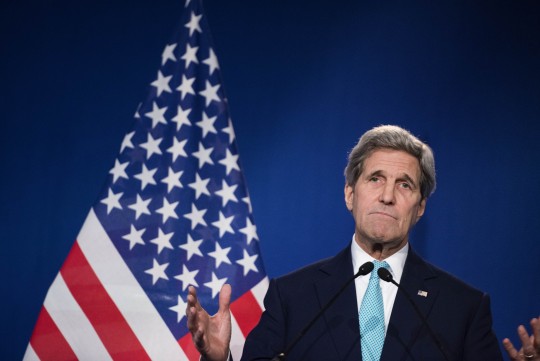
Secretary of State John Kerry told his Iranian counterpart that he wished the United States had a leader more like Supreme Leader Ayatollah Khamenei, according to comments made by a senior Iranian cleric and repeated in the country’s state-run media.
Ayatollah Alam al-Hoda claimed during Friday prayer services in Iran that in negotiations over Tehran’s contested nuclear program, Kerry told the country’s foreign minister that he “wished the U.S. had a leader like Iran’s supreme leader,” according to a Persian-language report on the remarkspublished by the Asriran news site.
“In the negotiations Kerry told [Iranian Foreign Minister Javad] Zarif that he [Kerry] wished U.S. had a leader like Iran’s supreme leader,” according to Alam al-Hoda, who is a senior member of the Iran’s powerful Assembly of Experts.
A senior administration official told the Washington Free Beacon that such a contention is patently absurd.
The remarks are the latest in a string of comments made by Iranian leaders purporting to reveal private details of the talks.
Iranian newspapers have carried multiple reports in recent months suggesting that Iranian Foreign Minister and chief negotiator Javad Zarif was ordered to stop screaming at Kerry behind closed doors.
In his Friday remarks, al-Hoda went on to say that Obama is set on striking a deal with Iran by June.
“Both Republicans and Democrats want these negotiations with Iran, but they fight each other for partisan interests,” he was quoted as saying. “Obama wants the negotiation to succeed so his party can win the next election and Republicans want to stop him.”
Alam al-Hoda also celebrated Iran’s expansion in the region and controversial activities in war-torn countries such as Syria and Yemen.
“Today, the resistance crescent has gone beyond Syria and Lebanon and reached to Yemen,” he said. “Today the resistance front is in control of Strait of Hormuz and Bab-el-Mandeb.”
The “U.S. and Israel have not been so weak anytime before,” he continues. “All these events are being managed by the hidden Imam,” a revered religious figure in Shia Islam.
Saeed Ghasseminejad, an Iranian dissident and fellow at the Foundation for Defense of Democracies (FDD), said U.S. overtures to Iran at the negotiating table have failed to win it any respect from the Islamic Republic’s leaders.
“President Obama thinks that by making more concessions he can gain the trust and respect of Iranian leaders,” Ghasseminejad said. “However, Iranian leaders neither trust him nor respect him.
“Seeing unprecedented weakness in the U.S. president, Iranian leaders do not fear the United States anymore. Partnership, trust, and alliance between the radical Islamist regime of Tehran and United States cannot and should not exist.”
Meanwhile, Zarif said over the weekend that fighting between the Obama administration and Congress over a potential final deal could not stop America from implementing any agreement the White House signs.
“As we have stated since the beginning, we consider the U.S. administration responsible for implementing the agreement and internal problems and conflicts in the U.S. are not related to us and to the implementation of the agreement, and based on the international laws, the countries’ internal problems don’t exempt them from implementing their undertakings and this is the main framework that we attach importance to,” Zarif said, according to the Fars News Agency.
On Monday, Zarif urged the United States to woo Iran.
“Maintaining an uncertain and unstable situation is not acceptable to Iran and the Americans should take practical and confidence-building measures to reach a comprehensive nuclear agreement,” Zarif was quoted as telling reporters.
(Tip of the hat to Joopkiepzeiker — DM)




 anneinpt
 artaxes
 danmillerinpanama
 davidking1530
 Peter Hofman
 Joseph Wouk
 Peter
Peter Louisiana Steve
 WarSclerotic
Recent Comments